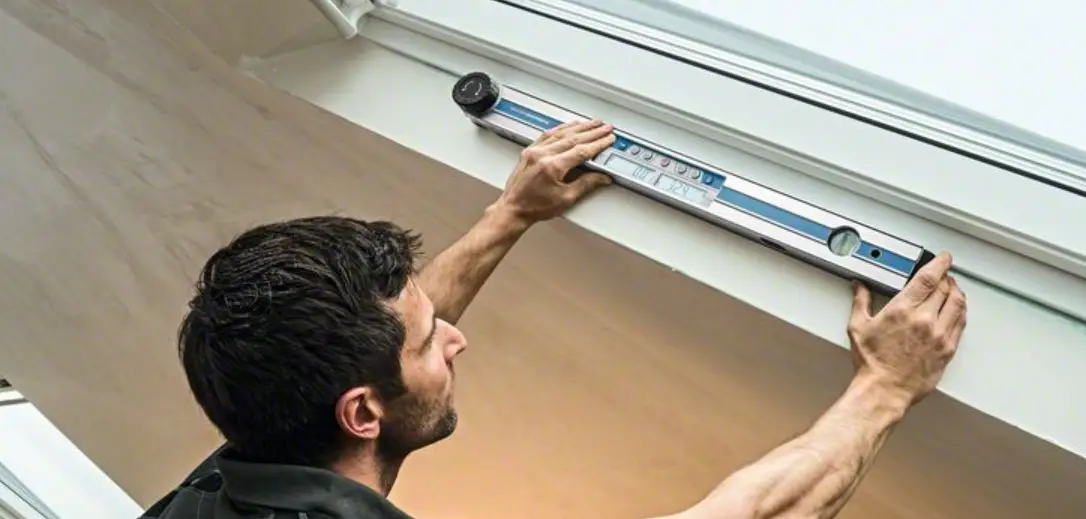
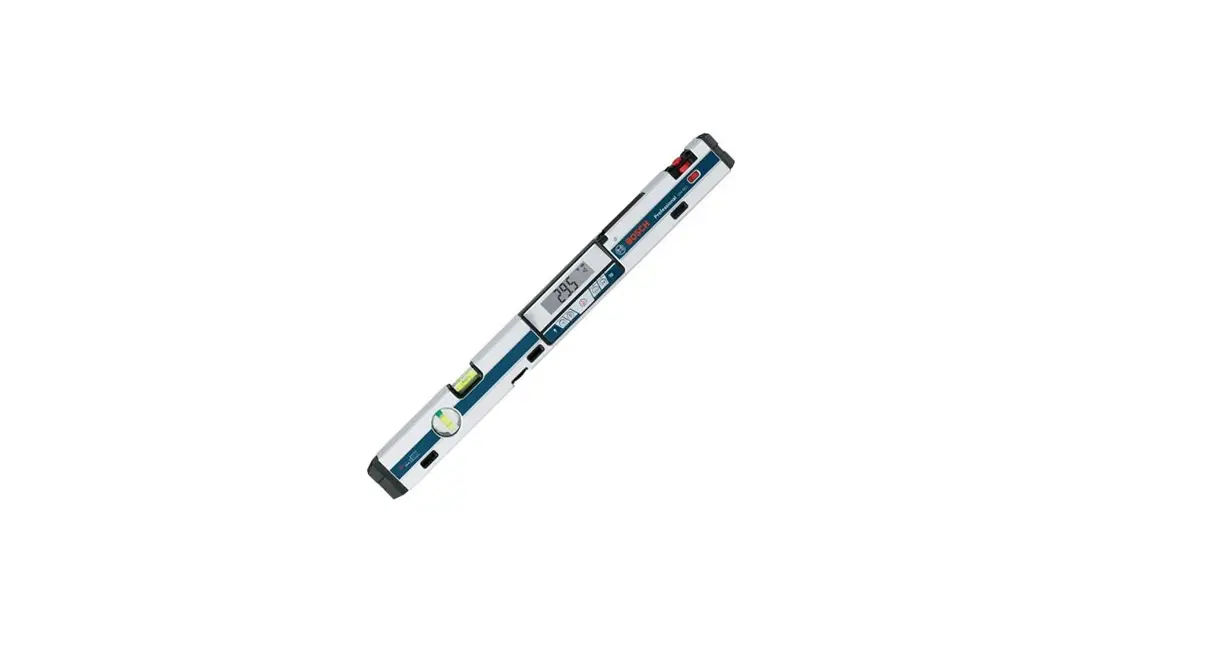
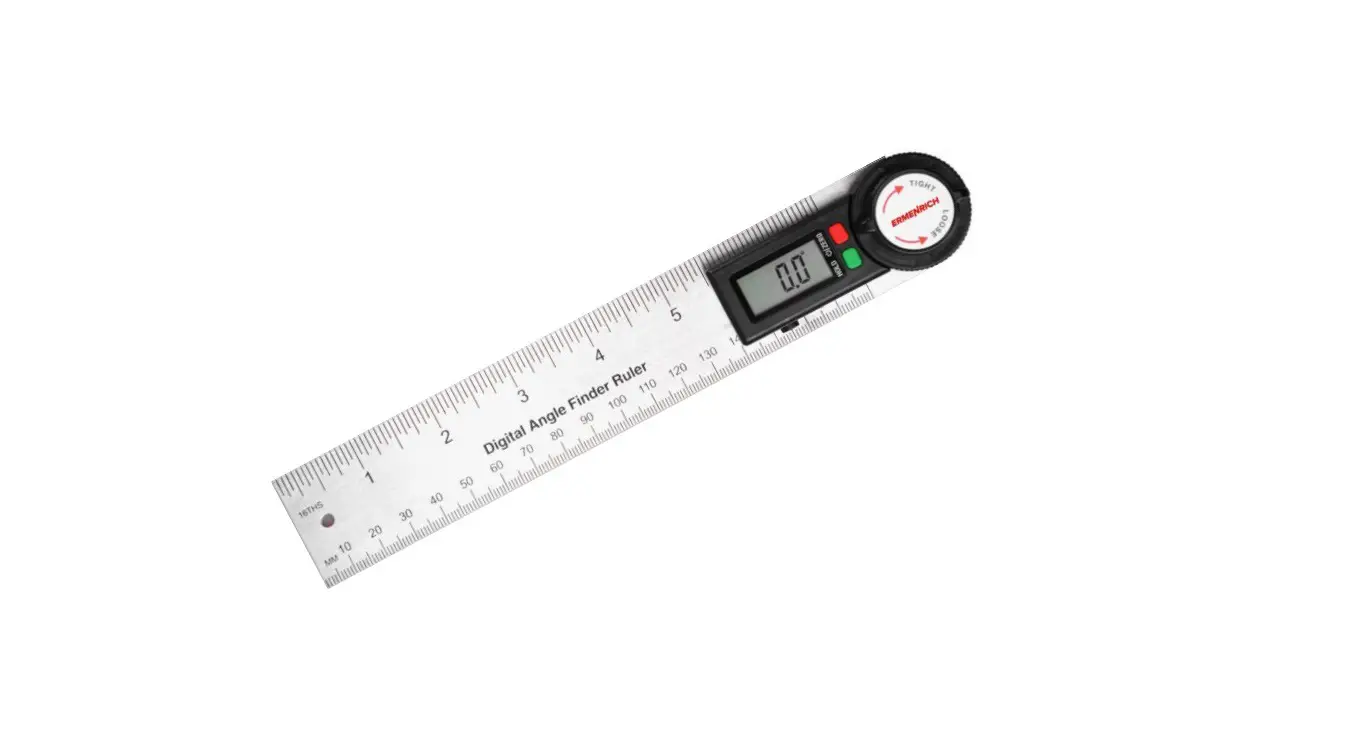
GAM 220 Digital Angle Measuring Device
Product Information
The GAM Professional 220 | 220 MF is a digital angle measuring
tool manufactured by Robert Bosch Power Tools GmbH in Stuttgart,
Germany. The tool can measure angles for simple and double mitre
cuts, with a measurement range of up to 400mm. It has a hold
function, display backlighting, and an accuracy of up to 0.1
degrees. The tool is powered by alkaline-manganese batteries and
has a battery life of approximately 80 hours.
Product Usage Instructions
Safety Instructions
Before using the GAM Professional 220 | 220 MF, please read the
safety instructions provided in the user manual.
Assembly
To insert or replace the batteries, refer to the image A in the
user manual. The battery indicator (b) displays the current status
of the batteries or accumulators:
- 60-90%
- 30-60%
- 10-30%
Operation
Standard Measurement Mode
To start the standard measurement mode:
- Turn on the tool by pressing the On/Off button (1).
- Place the tool on the surface to be measured.
- Read the measured angle on the digital display (4).
Simple Mitre Cut Mode
To start the simple mitre cut mode:
- Turn on the tool by pressing the On/Off button (1).
- Place the tool on the surface to be measured.
- Press the Simple Mitre Cut button (5).
- Adjust the angle until the desired measurement is displayed on
the digital display (4).
Double Mitre Cut Mode
To start the double mitre cut mode:
- Turn on the tool by pressing the On/Off button (1).
- Place the tool on the surface to be measured.
- Press the Double Mitre Cut button (6).
- Press the Spring Angle button (2) and set the spring
angle. - Press the Corner Angle button (3) and set the corner
angle. - Adjust the angle until the desired measurement is displayed on
the digital display (4).
Maintenance and Service
To maintain and clean the GAM Professional 220 | 220 MF, refer
to the instructions provided in the user manual. For customer
service and application advice, please contact Bosch Power
Tools.
Disposal
Please follow local regulations for the disposal of batteries or
accumulators.
GAM Professional
220 | 220 MF
Robert Bosch Power Tools GmbH 70538 Stuttgart GERMANY
www.bosch-pt.com 1 609 92A 58K (2019.11) T / 247
1 609 92A 58K
de Originalbetriebsanleitung en Original instructions fr Notice originale es Manual original pt Manual original it Istruzioni originali nl Oorspronkelijke
gebruiksaanwijzing da Original brugsanvisning sv Bruksanvisning i original no Original driftsinstruks fi Alkuperäiset ohjeet el tr Orijinal iletme talimati pl Instrukcja oryginalna cs Pvodní návod k pouzívání sk Pôvodný návod na pouzitie hu Eredeti használati utasítás ru
uk
kk
ro Instruciuni originale bg mk sr Originalno uputstvo za rad
sl Izvirna navodila
hr Originalne upute za rad
et Algupärane kasutusjuhend
lv Instrukcijas oriinlvalod
lt Originali instrukcija ja zh zh ko
th
id Petunjuk-Petunjuk untuk
Penggunaan Orisinal
vi Bn gc hng dn s dng ar fa
2 |
Deutsch ………………………………………….. Seite 7 English …………………………………………… Page 13 Français ………………………………………….. Page 22 Español ………………………………………… Página 29 Português ………………………………………. Página 37 Italiano …………………………………………. Pagina 43 Nederlands ……………………………………… Pagina 49 Dansk ……………………………………………. Side 55 Svensk ………………………………………….. Sidan 61 Norsk…………………………………………….. Side 66 Suomi ……………………………………………..Sivu 72 ………………………………………… 78 Türkçe…………………………………………… Sayfa 84 Polski ………………………………………….. Strona 91 Cestina ………………………………………… Stránka 97 Slovencina …………………………………….. Stránka 103 Magyar ……………………………………………Oldal 109 ……………………………………… 115 ……………………………………. 122 …………………………………………….. 129 Român ………………………………………… Pagina 135 …………………………………… 142 ………………………………….. 148 Srpski ………………………………………….. Strana 155 Slovenscina ……………………………………….Stran 161 Hrvatski ………………………………………..Stranica 167 Eesti………………………………………….. Lehekülg 173 Latviesu ………………………………………. Lappuse 178 Lietuvi k. ………………………………………Puslapis 184 ……………………………………….. 190 ………………………………………………. 196 ………………………………………….. 202 ……………………………………….. 207 ……………………………………………… 213 Bahasa Indonesia………………………………. Halaman 220 Ting Vit ……………………………………….. Trang 226 ………………………………………….. 233 ………………………………………….. 241
1 609 92A 58K | (18.11.2019)
Bosch Power Tools
3 |
(1) (2)
(3) (10)
(7) (8) (9)
(4) (5) (6)
(a) (b) (c)
(13) (12) (11)
GAM 220
(1) (2)
(3) (10)
(4) (5) (6) (7) (8) (9)
(e) (g)
(f) (d)
(a) (b) (d) (f) (c) (g) (e)
(13) (11) (12) (14) (15)
GAM 220 MF
1 609 92A 58K | (18.11.2019)
Bosch Power Tools
4 |
A (6) (5)
B
(16) (17)
C
D
w
1 609 92A 58K | (18.11.2019)
Bosch Power Tools
5 |
E
(1)
(4) w
(9) (1)
(4) w (3)
1 609 92A 58K | (18.11.2019)
Bosch Power Tools
6 |
F
(1) (4) w
v
(16)
G
(16)
(1) v
w (4)
H
(1)
(16)
v (4)
w
1 609 92A 58K | (18.11.2019)
Bosch Power Tools
Deutsch | 7
Deutsch
Sicherheitshinweise
Sämtliche Anweisungen sind zu lesen und zu beachten. Wenn das Messwerkzeug nicht entsprechend den vorliegenden Anweisungen verwendet wird, können die integrierten Schutzvorkehrungen im Messwerkzeug beeinträchtigt werden. BEWAHREN SIE DIESE ANWEISUNGEN GUT AUF. u Lassen Sie das Messwerkzeug nur von qualifiziertem Fachpersonal und nur mit Original-Ersatzteilen reparieren. Damit wird sichergestellt, dass die Sicherheit des Messwerkzeuges erhalten bleibt. u Arbeiten Sie mit dem Messwerkzeug nicht in explosionsgefährdeter Umgebung, in der sich brennbare Flüssigkeiten, Gase oder Stäube befinden. Im Messwerkzeug können Funken erzeugt werden, die den Staub oder die Dämpfe entzünden. u Beachten Sie beim Sägen von Werkstücken, für die Sie die Winkel mit diesem Messwerkzeug ermittelt haben, immer strikt die Sicherheits- und Arbeitshinweise der verwendeten Säge (einschließlich der Hinweise zum Positionieren und Spannen des Werkstücks). Können die erforderlichen Winkel an einer bestimmten Säge oder einem Sägetyp nicht eingestellt werden, müssen alternative Sägemethoden angewendet werden. Besonders spitze Winkel können unter Verwendung einer konischen Spannvorrichtung mit einer Tisch- oder Handkreissäge geschnitten werden.
Produkt- und Leistungsbeschreibung
Bitte beachten Sie die Abbildungen im vorderen Teil der Betriebsanleitung.
Bestimmungsgemäßer Gebrauch
GAM 220 Das Messwerkzeug ist bestimmt zum Messen und Übertragen von Winkeln (horizontal und vertikal), z.B. für Maßanfertigungen im Innenausbau, im Treppenbau oder bei Außenverkleidungen. Das Messwerkzeug ist zur Verwendung im Innen- und Außenbereich geeignet.
GAM 220 MF Das Messwerkzeug ist bestimmt zum Messen und Übertragen von Winkeln und zum Berechnen einfacher und doppelter Gehrungswinkel. Das Messwerkzeug ist zur Verwendung im Innen- und Außenbereich geeignet.
Abgebildete Komponenten
Die Nummerierung der abgebildeten Komponenten bezieht sich auf die Darstellung des Messwerkzeugs auf der Grafikseite.
(1) Klappschenkel (2) Sichtfenster für Display (3) Feststellrad (4) Basisschenkel (5) Batteriefachdeckel (6) Arretierung des Batteriefachdeckels (7) Display (8) Libelle für waagerechtes Ausrichten (9) Libelle für senkrechtes Ausrichten (10) Seriennummer (11) Taste Hold (12) Ein-/Aus-Taste (13) Taste zum Drehen der Anzeige (14) Taste MTR1 für einfache Gehrung (GAM 220 MF) (15) Taste MTR2 für doppelte Gehrung (GAM 220 MF) (16) Schenkelverlängerung (GAM 220 MF) (17) Schutztasche
Anzeigenelemente (a) Indikator H für Speicherwert Hold (b) Batterie-Anzeige (c) Messwert (d) Indikator für vertikalen Gehrungswinkel BVL (GAM 220 MF) (e) Indikator für horizontalen Gehrungswinkel MTR (GAM 220 MF) (f) Indikator für Eckwinkel CNR (GAM 220 MF) (g) Indikator für Neigungswinkel SPR (GAM 220 MF)
Bosch Power Tools
1 609 92A 58K | (18.11.2019)
8 | Deutsch
Technische Daten
Digitaler Winkelmesser
GAM 220
GAM 220 MF
Sachnummer
3 601 K76 5..
3 601 K76 6..
Hold-Funktion
Displaybeleuchtung
Betriebsart ,,Einfache Gehrung”
Betriebsart ,,Doppelte Gehrung”
Messbereich
0°220°
0°220°
Messgenauigkeit Winkel
±0,1°
±0,1°
kleinste Anzeigeneinheit
0,1°
0,1°
Betriebstemperatur
10 °C … +50 °C 10 °C … +50 °C
Lagertemperatur
20 °C … +70 °C 20 °C … +70 °C
max. Einsatzhöhe über Bezugshöhe
2000 m
2000 m
relative Luftfeuchte max.
90 %
90 %
Verschmutzungsgrad entsprechend IEC 610101
2A)
2A)
Batterien
4 × 1,5 V LR6 (AA) 4 × 1,5 V LR6 (AA)
Akkus
4 × 1,2 V HR6 (AA) 4 × 1,2 V HR6 (AA)
Betriebsdauer (Alkali-Mangan-Batterien) ca.
80 h
80 h
Abschaltautomatik nach ca.
30 min
30 min
Schenkellänge
400 mm
400 mm
Gewicht entsprechend EPTA-Procedure 01:2014
1,3 kg
1,2 kg
Maße (Länge × Breite × Höhe)
447 × 52 × 60 mm 447 × 52 × 60 mm
IP 54 (staub- und spritzwassergeschützt)
A) Es tritt nur eine nicht leitfähige Verschmutzung auf, wobei jedoch gelegentlich eine vorübergehende durch Betauung verursachte Leitfähigkeit erwartet wird.
Zur eindeutigen Identifizierung Ihres Messwerkzeugs dient die Seriennummer (10) auf dem Typenschild.
Montage
Batterien einsetzen/wechseln (siehe Bild A)
Für den Betrieb des Messwerkzeugs wird die Verwendung von Alkali-Mangan-Batterien oder Akkus empfohlen. Zum Öffnen des Batteriefachdeckels (5) drücken Sie die Arretierung (6) und klappen den Batteriefachdeckel auf. Setzen Sie die Batterien bzw. Akkus ein. Achten Sie dabei auf die richtige Polung entsprechend der Darstellung auf dem Batteriefachdeckel.
Batterie-Anzeige Die Batterie-Anzeige (b) zeigt immer den aktuellen Status der Batterien bzw. Akkus an:
Anzeige Kapazität 90-100 %
60-90 %
30-60 %
10-30 %
0-10 % Die leere Batterie-Anzeige blinkt. Nach Beginn des Blinkens bis zur Abschaltung können Sie noch etwa 15-20 min messen. Ersetzen Sie immer alle Batterien bzw. Akkus gleichzeitig. Verwenden Sie nur Batterien oder Akkus eines Herstellers und mit gleicher Kapazität. u Nehmen Sie die Batterien bzw. Akkus aus dem Messwerkzeug, wenn Sie es längere Zeit nicht benutzen. Die Batterien und Akkus können bei längerer Lagerung im Messwerkzeug korrodieren und sich selbst entladen.
Schenkelverlängerung aufsetzen
Schieben Sie die Schenkelverlängerung (16) von vorn auf den Klappschenkel (1) auf. Schieben Sie die Schenkelverlängerung so weit wie möglich über das Gelenk des Messwerkzeugs.
1 609 92A 58K | (18.11.2019)
Bosch Power Tools
Deutsch | 9
Betrieb
Inbetriebnahme
u Schützen Sie das Messwerkzeug vor Nässe und direkter Sonneneinstrahlung.
u Setzen Sie das Messwerkzeug keinen extremen Temperaturen oder Temperaturschwankungen aus. Lassen Sie es z.B. nicht längere Zeit im Auto liegen. Lassen Sie das Messwerkzeug bei größeren Temperaturschwankungen erst austemperieren, bevor Sie es in Betrieb nehmen. Bei extremen Temperaturen oder Temperaturschwankungen kann die Präzision des Messwerkzeugs beeinträchtigt werden.
u Halten Sie die Auflageflächen und Anlegekanten des Messwerkzeugs sauber. Schützen Sie das Messwerkzeug vor Stoß und Schlag. Schmutzpartikel oder Verformungen können zu Fehlmessungen führen.
Ein-/Ausschalten Zum Einschalten des Messwerkzeugs drücken Sie die Ein-/Aus-Taste (12). Leuchtet der Indikator H (a), ist noch ein Wert von der letzten Messung gespeichert. Dieser Wert kann durch kurzes Drücken der Ein-/Aus-Taste (12) gelöscht werden. Zum Ausschalten des Messwerkzeugs drücken Sie die Ein-/Aus-Taste (12). Wird ca. 30 min lang keine Aktion durchgeführt, dann schaltet sich das Messwerkzeug zur Schonung der Batterien bzw. Akkus automatisch ab.
Ausrichten mit den Libellen Mit der Libelle (8) können Sie das Messwerkzeug waagerecht und mit der Libelle (9) senkrecht ausrichten. Sie können das Messwerkzeug auch wie eine Wasserwaage zur Überprüfung von Waagerechten oder Senkrechten einsetzen. Legen Sie dazu das Messwerkzeug auf die zu prüfende Oberfläche auf.
Drehen der Anzeige Um den angezeigten Wert besser lesen zu können, drücken Sie die Taste (13) zum Drehen der Anzeige.
Betriebsart ,,Standardmessung”
Nach jedem Einschalten befindet sich das Messwerkzeug in der Betriebsart ,,Standardmessung”. In der Betriebsart ,,Standardmessung” wird die Winkelmessung ausgeführt.
Winkel messen (siehe Bilder CD) Legen Sie den Klappschenkel (1) und den Basisschenkel (4) flächig an den zu messenden Kanten an bzw. auf. Der angezeigte Messwert (c) entspricht dem Innenwinkel w zwischen dem Basis- und dem Klappschenkel. Dieser Messwert wird so lange auf dem Display (7) angezeigt, bis Sie den Winkel zwischen Klappschenkel (1) und Basisschenkel (4) verändern.
Winkel übertragen (siehe Bild E) Messen Sie den zu übertragenden Winkel durch Anlegen von Klapp- und Basisschenkel an den Vorgabewinkel. Durch Festdrehen des Feststellrades (3) kann die Position der Schenkel mechanisch gesichert werden. Der angezeigte Wert wird nicht gespeichert. Legen Sie das Messwerkzeug in der gewünschten Position an das Werkstück an. Verwenden Sie die Schenkel als Lineal zum Antragen des Winkels.
Messwert speichern Zum Speichern (H) des aktuellen Messwerts (c) drücken Sie die Speichertaste Hold (11). Zur Bestätigung blinkt der Indikator (a) im Display. Der momentan angezeigte Wert ist eingefroren und ändert sich auch bei Bewegung des Schenkels nicht. Drückt man die Speichertaste Hold erneut, wird der Indikator (a) permanent im Display gezeigt. Der angezeigte Wert ändert sich je nach Schenkelbewegung. Der zuvor eingefrorene Wert ist nun im Hintergrund gespeichert. Mit einem erneuten Drücken der Speichertaste Hold (11) wird der zuvor gespeicherte Wert angezeigt, der Indikator (a) blinkt. Zum Löschen des Speicherwerts drücken Sie kurz die Ein-/Aus-Taste (12). Um einen neuen Wert speichern zu können, muss ein zuvor gespeicherter Wert gelöscht werden. Gespeicherte Werte können nicht überschrieben werden. Der Speicherwert bleibt auch beim Ausschalten des Messwerkzeugs (manuell oder automatisch) erhalten. Er wird allerdings beim Batteriewechsel bzw. bei leeren Batterien gelöscht.
Messen mit Schenkelverlängerung (siehe Bilder FH) Die Schenkelverlängerung (16) ermöglicht die Winkelmessung, wenn die Anlegefläche kürzer als der Klappschenkel (1) ist. Legen Sie den Basisschenkel (4) und die Schenkelverlängerung flächig an die zu messenden Kanten an bzw. auf. Im Display wird als Messwert der Winkel w zwischen Basis- und Klappschenkel angezeigt. Den gesuchten Winkel v zwischen Basisschenkel und Schenkelverlängerung können Sie wie folgt berechnen: v = 180° w
Bosch Power Tools
1 609 92A 58K | (18.11.2019)
10 | Deutsch
v
w
v
GAM 220 MF: Betriebsart ,,Einfache Gehrung”
Die Messung ,,Einfache Gehrung” dient zur Berechnung des Schnittwinkels MTR, wenn zwei Werkstücke mit gleicher Gehrung zusammen einen beliebigen Außenwinkel x° kleiner 180° bilden sollen (z.B. für Fußbodenleisten, Treppengeländer-Säulen oder Bilderrahmen). Die Messung ,,Einfache Gehrung” wird durch Drücken der Taste MTR1 (14) aktiviert. Für die Kalkulation des MTR wird immer der angezeigte Wert verwendet. Wird gerade ein gespeicherter Wert angezeigt (Anzeige (a) blinkt), wird die Kalkulation, unabhängig von der Stellung der Schenkel, mit dem gespeicherten Wert durchgeführt.
x°
Sollen die Werkstücke in eine Ecke eingepasst werden (z.B. für Fußbodenleisten), dann messen Sie den Eckwinkel x° durch Anlegen von Klapp- und Basisschenkel. Für vorgegebene Winkel (z.B. Bilderrahmen) öffnen Sie Klapp- und Basisschenkel so weit, bis der gewünschte Winkel im Display angezeigt wird.
x°
x°
MTR
MTR
Berechnet wird der horizontale Gehrungswinkel MTR (,,Miter Angle”: horizontaler Gehrungswinkel), um den die zwei Werkstücke gekürzt werden müssen. Das Sägeblatt steht bei diesen Gehrungsschnitten senkrecht zum Werkstück (der vertikale Gehrungswinkel beträgt 0°).
MTR
Drücken Sie die Taste MTR1 (14). Der berechnete horizontale Gehrungswinkel MTR, der an der Kapp- und Gehrungssäge eingestellt werden muss, sowie der Indikator MTR werden im Display angezeigt. Drücken Sie die Taste MTR1 (14), um aus der Betriebsart ,,Einfache Gehrung” in die Betriebsart ,,Standardmessung” zurückzukehren.
1 609 92A 58K | (18.11.2019)
Bosch Power Tools
Deutsch | 11
Durch kurzes Drücken der Ein-/Aus-Taste (12) kehren Sie auch in die Betriebsart ,,Standardmessung” zurück. Allerdings wird hierbei auch ein eventuell gespeicherter Hold-Wert gelöscht.
Hinweis: Der berechnete horizontale Gehrungswinkel MTR kann nur für Kapp- und Gehrungssägen übernommen werden, bei denen die Einstellung für senkrechte Schnitte 0° beträgt. Ist die Einstellung für senkrechte Schnitte 90°, dann müssen Sie den Winkel für die Säge wie folgt berechnen: 90° angezeigter Winkel MTR = einzustellender Winkel an der Säge.
GAM 220 MF: Betriebsart ,,Doppelte Gehrung”
Die Messung ,,Doppelte Gehrung” (,,Compound MTR”) dient zur Berechnung von horizontalen und vertikalen Gehrungswinkeln, wenn zwei Werkstücke mit Mehrfachwinkeln (z.B. Deckenleisten) exakt aufeinander stoßen sollen.
Die Betriebsart ,,Doppelte Gehrung” wird durch Drücken der Taste MTR2 (15) aktiviert. Für die Kalkulation der Winkel wird immer der angezeigte Wert der Schenkelstellungen verwendet. Ein eventuell gespeicherter HoldWert wird mit Beendigung der Betriebsart ,,Doppelte Gehrung” gelöscht.
Führen Sie die Arbeitsschritte genau in der angegebenen Reihenfolge durch.
1. SPR: Neigungswinkel (Spring Angle) speichern
SPR
SPR
Für die Speicherung des Neigungswinkels gibt es folgende Möglichkeiten: Öffnen Sie Klapp- und Basisschenkel so weit, bis der gewünschte Nei-
gungswinkel im Display angezeigt wird. Bei unbekanntem Neigungswinkel messen Sie diesen. Legen Sie dazu das
zu messende Werkstück zwischen Klapp- und Basisschenkel. Ist die Messung bei besonders schmalen oder kleinen Werkstücken mit dem Messwerkzeug nicht möglich, dann verwenden Sie Hilfsmittel, wie z.B. eine Schmiege, und stellen den Winkel dann am Messwerkzeug ein. Drücken Sie die Taste MTR2 (15), um den gemessenen Neigungswinkel für die doppelte Gehrung zu speichern. Im Display erscheinen SPR und der aktuelle Winkel. Beträgt der Winkel beim Drücken der Taste MTR2 (15) mehr als 90°, aber weniger als 180°, dann wird der Neigungswinkel SPR automatisch wie folgt umgerechnet: SPR = 180° – gemessener bzw. eingestellter Winkel. 2. CNR: Eckwinkel (Corner Angle) speichern
CNR
Legen Sie Klapp- und Basisschenkel zum Messen des Eckwinkels flächig an die Wände an oder stellen Sie einen bekannten Eckwinkel am Messwerkzeug ein. Drücken Sie erneut die Taste MTR2 (15), um den gemessenen Eckwinkel für die doppelte Gehrung zu speichern. Im Display erscheinen CNR und der aktuelle Winkel. 3. MTR: horizontalen Gehrungswinkel (Miter Angle) ermitteln
MTR
Drücken Sie erneut die Taste MTR2 (15). Im Display erscheinen MTR und der berechnete horizontale Gehrungswinkel für die Kapp- und Gehrungssäge. Mithilfe des horizontalen Gehrungswinkels wird die Drehung des Sägetischs festgelegt (MTR).
Bosch Power Tools
1 609 92A 58K | (18.11.2019)
12 | Deutsch 4. BVL: vertikalen Gehrungswinkel (Bevel Angle) ermitteln
BVL
Drücken Sie erneut die Taste MTR2 (15). Im Display erscheinen BVL und der berechnete vertikale Gehrungswinkel für die Kapp- und Gehrungssäge. Mithilfe des vertikalen Gehrungswinkels wird die Neigung des Sägeblatts festgelegt (BVL). Bei Bedarf können der horizontale und der vertikale Gehrungswinkel erneut abgerufen werden, aber nur, solange die Ein-/Aus-Taste (12) zum Wechsel der Betriebsart nicht gedrückt wurde. Drücken Sie zum Abruf der Winkel die Taste MTR2 (15). Im Display erscheinen MTR und der berechnete horizontale Gehrungswinkel, nach einem erneuten Drücken der Taste MTR2 (15) BVL und der vertikale Gehrungswinkel. Drücken Sie die Taste MTR1 (14) kürzer als 1 s, um aus der Betriebsart ,,Doppelte Gehrung” in die Betriebsart ,,Standardmessung” zurückzukehren.
Hinweise zur Betriebsart ,,Doppelte Gehrung” Der berechnete horizontale Gehrungswinkel MTR kann nur für Kapp- und Gehrungssägen übernommen werden, bei denen die Einstellung für senkrechte Schnitte 0° beträgt. Ist die Einstellung für senkrechte Schnitte 90°, dann müssen Sie den Winkel für die Säge wie folgt berechnen: 90° angezeigter Winkel MTR = einzustellender Winkel an der Säge.
Wartung und Service
Wartung und Reinigung
Halten Sie das Messwerkzeug stets sauber. Tauchen Sie das Messwerkzeug nicht ins Wasser oder andere Flüssigkeiten. Wischen Sie Verschmutzungen mit einem feuchten, weichen Tuch ab. Verwenden Sie keine Reinigungs- oder Lösemittel. Sollte das Messwerkzeug über längere Zeit dem Regen ausgesetzt sein, kann es zur Beeinträchtigung seiner Funktion kommen. Nach dem vollständigen Abtrocknen ist das Messwerkzeug jedoch wieder uneingeschränkt einsatzbereit. Eine Kalibrierung ist nicht erforderlich. Lagern und transportieren Sie das Messwerkzeug nur in der Schutztasche (17). Senden Sie im Reparaturfall das Messwerkzeug in der Schutztasche (17) ein.
Kundendienst und Anwendungsberatung
Der Kundendienst beantwortet Ihre Fragen zu Reparatur und Wartung Ihres Produkts sowie zu Ersatzteilen. Explosionszeichnungen und Informationen zu Ersatzteilen finden Sie auch unter: www.bosch-pt.com Das Bosch-Anwendungsberatungs-Team hilft Ihnen gerne bei Fragen zu unseren Produkten und deren Zubehör. www.powertool-portal.de, das Internetportal für Handwerker und Heimwerker. Geben Sie bei allen Rückfragen und Ersatzteilbestellungen bitte unbedingt die 10-stellige Sachnummer laut Typenschild des Produkts an.
Deutschland Robert Bosch Power Tools GmbH Servicezentrum Elektrowerkzeuge Zur Luhne 2 37589 Kalefeld Willershausen Unter www.bosch-pt.de können Sie online Ersatzteile bestellen oder Reparaturen anmelden. Kundendienst: Tel.: (0711) 40040460 Fax: (0711) 40040461 E-Mail: [email protected] Anwendungsberatung: Tel.: (0711) 40040460 Fax: (0711) 40040462 E-Mail: [email protected]
Österreich Unter www.bosch-pt.at können Sie online Ersatzteile bestellen. Tel.: (01) 797222010 Fax: (01) 797222011 E-Mail: [email protected]
Luxemburg Tel.: +32 2 588 0589 Fax: +32 2 588 0595 E-Mail: [email protected]
1 609 92A 58K | (18.11.2019)
Bosch Power Tools
English | 13
Schweiz Unter www.bosch-pt.com/ch/de können Sie online Ersatzteile bestellen. Tel.: (044) 8471511 Fax: (044) 8471551 E-Mail: [email protected]
Entsorgung
Messwerkzeuge, Akkus/Batterien, Zubehör und Verpackungen sollen einer umweltgerechten Wiederverwertung zugeführt werden.
Werfen Sie Messwerkzeuge und Akkus/Batterien nicht in den Hausmüll!
Nur für EU-Länder: Gemäß der europäischen Richtlinie 2012/19/EU müssen nicht mehr gebrauchsfähige Messwerkzeuge und gemäß der europäischen Richtlinie 2006/66/EG müssen defekte oder verbrauchte Akkus/Batterien getrennt gesammelt und einer umweltgerechten Wiederverwendung zugeführt werden.
English
Safety instructions
All instructions must be read and observed. The safeguards integrated into the measuring tool may be compromised if the measuring tool is not used in accordance with these instructions. STORE THESE INSTRUCTIONS IN A SAFE PLACE. u Have the measuring tool serviced only by a qualified specialist using only original replacement parts. This will ensure that the safety of the measuring tool is maintained. u Do not use the measuring tool in explosive atmospheres which contain flammable liquids, gases or dust. Sparks may be produced inside the measuring tool, which can ignite dust or fumes. u When sawing workpieces for which you have determined the angle using this measuring tool, always strictly follow the safety instructions and working advice for the saws in use (including instructions on positioning and clamping the workpiece). When the required angles cannot be set on a certain saw or saw type, alternative sawing methods will need to be applied. Extremely acute (sharp) angles can be cut using a taper jig with a table saw or a circular saw.
Product Description and Specifications
Please observe the illustrations at the beginning of this operating manual.
Intended Use
GAM 220 The measuring tool is intended for measuring and transferring angles (horizontal and vertical), e.g. for customisations in interior finishing work, in staircase construction or on exterior panelling. The measuring tool is suitable for indoor and outdoor use.
GAM 220 MF The measuring tool is intended for measuring and transferring angles and for calculating simple and compound mitre/bevel angles. The measuring tool is suitable for indoor and outdoor use.
Product Features
The numbering of the product features shown refers to the illustration of the measuring tool on the graphic page.
(1) Fold-out leg (2) Viewing window for display (3) Locking wheel (4) Base leg (5) Battery compartment cover (6) Battery compartment cover locking mechanism (7) Display (8) Level for horizontal alignment (9) Level for vertical alignment (10) Serial number (11) Button Hold (12) On/off button (13) Button for rotating the display (14) Button MTR1 for simple mitre (GAM 220 MF)
Bosch Power Tools
1 609 92A 58K | (18.11.2019)
14 | English
(15) Button MTR2 for compound mitre (GAM 220 MF) (16) Leg extension (GAM 220 MF) (17) Protective bag
Display Elements (a) Indicator H for saved value Hold (b) Battery indicator (c) Measured value (d) Bevel angle indicator BVL (GAM 220 MF) (e) Mitre angle indicator MTR (GAM 220 MF) (f) Corner angle indicator CNR (GAM 220 MF) (g) Spring angle indicator SPR (GAM 220 MF)
Technical Data
Digital angle measuring device
GAM 220
GAM 220 MF
Article number
3 601 K76 5..
3 601 K76 6..
Hold function
Display illumination
“Simple mitre” operating mode
“Compound mitre” operating mode
Measuring range
0220°
0220°
Measuring accuracy of angles
±0.1°
±0.1°
Smallest display unit
0.1°
0.1°
Operating temperature
10 °C to +50 °C 10 °C to +50 °C
Storage temperature
20 °C to +70 °C 20 °C to +70 °C
Max. altitude
2000 m
2000 m
Relative air humidity max.
90%
90%
Pollution degree according to
2A)
2A)
IEC 61010-1
Batteries
4 × 1.5 V LR6 (AA) 4 × 1.5 V LR6 (AA)
Rechargeable batteries
4 × 1.2 V HR6 (AA) 4 × 1.2 V HR6 (AA)
Operating lifetime (alkalimanganese batteries) approx.
80 h
80 h
Automatic switch-off after approx.
30 min
30 min
Leg length
400 mm
400 mm
Weight according to EPTAProcedure 01:2014
1.3 kg
1.2 kg
Dimensions (length × width × 447 × 52 × 60 mm 447 × 52 × 60 mm height)
IP 54 (dust and splash-proof)
A) Only non-conductive deposits occur, whereby occasional temporary conductivity caused by condensation is expected.
The serial number (10) on the type plate is used to clearly identify your measuring tool.
Assembly
Inserting/Replacing Batteries (see figure A)
It is recommended that you use alkaline manganese batteries to operate the measuring tool. To open the battery compartment cover (5), press the locking mechanism (6) and fold the battery compartment cover up. Insert the batteries/rechargeable batteries. When doing so, ensure that the polarity is correct and corresponds to the diagram on the battery compartment cover.
Battery Indicator The battery indicator (b) always indicates the current battery status: Indicator Capacity
90100 %
6090 %
3060 %
1030 %
010 % The empty battery indicator flashes. You can measure for approximately another 1520 min from when the flashing begins until the tool shuts down. Always replace all the batteries at the same time. Only use batteries from the same manufacturer and which have the same capacity.
1 609 92A 58K | (18.11.2019)
Bosch Power Tools
English | 15
u Take the batteries out of the measuring tool when you are not using it for a prolonged period of time. The batteries can corrode and self-discharge during prolonged storage in the measuring tool.
Mounting the Leg Extension
Slide the leg extension (16) from the front onto the fold-out leg (1). Slide the leg extension as far as possible over the joint of the measuring tool.
Operation
Starting Operation
u Protect the measuring tool from moisture and direct sunlight.
u Do not expose the measuring tool to any extreme temperatures or variations in temperature. For example, do not leave it in a car for extended periods of time. In case of large variations in temperature, allow the measuring tool to adjust to the ambient temperature before putting it into operation. The precision of the measuring tool may be compromised if exposed to extreme temperatures or variations in temperature.
u Keep the supporting surfaces and contact edges of the measuring tool clean. Protect the measuring tool against shock and impact. Dirt particles or deformations can lead to faulty measurements.
Switching On and Off To switch on the measuring tool, press the on/off button (12). If the indicator H (a) lights up, a value from the last measurement is still saved. This value can be deleted by briefly pressing the on/off button (12). To switch off the measuring tool, press the on/off button (12). When no activity is performed on the measuring tool for approx. 30 min, the measuring tool automatically switches off to save the batteries.
Aligning with the Spirit Levels The measuring tool can be aligned horizontally with spirit level (8) and vertically with spirit level (9). The measuring tool can also be used as a carpenter’s spirit level for checking vertical and horizontal lines. For this, place or hold the measuring tool against the surface subject to checking.
Rotating the Display To make the displayed value easier to read, press the button (13) to rotate the display.
“Normal measuring” Operating Mode
After switching on, the measuring tool is always in “normal measuring” operating mode. In “normal measuring” operating mode, angle measurement is carried out.
Measuring Angles (see figures CD) Place the fold-out leg (1) and the base leg (4) flat on the surfaces adjacent to the angle. The displayed measured value (c) corresponds with the interior angle w between the base leg and the fold-out leg. This measured value is shown on the display (7) until you change the angle between fold-out leg (1) and base leg (4).
Transferring Angles (see figure E) Measure the angle to be transferred by placing the fold-out leg and base leg on the target angle. The position of the legs can be locked mechanically by tightening the locking wheel (3). The displayed value is not saved. Place the measuring tool in the required position against the workpiece. Use the legs as a straight edge to transfer the angle.
Storing the Measured Value Press the Hold (11) button to store (H) the current measured value (c). The indicator (a) flashes in the display for confirmation. The currently displayed value is frozen and will not change even when the leg is moved. If you press the memory button Hold again, the indicator (a) will be shown permanently on the display. The displayed value will change depending on the leg movement. The previously frozen value is now saved in the background. If the memory button Hold (11) is pressed again, the previously saved value is displayed and the indicator (a) flashes. To delete the contents of the memory, briefly press the on/off button (12). To be able to save a new value, a previously saved value has to be deleted. Saved values cannot be overwritten. The held value is saved even when the measuring tool is switched off (manually or automatically). However, it is deleted when changing batteries or when the batteries are empty.
Measuring with Leg Extension (see figures FH) The leg extension (16) makes it possible to measure angles when the contact surface is shorter than the fold-out leg (1). Place the base leg (4) and the leg extension flat on the surfaces to be measured.
Bosch Power Tools
1 609 92A 58K | (18.11.2019)
16 | English The measured value of the angle w between the base leg and fold-out leg is indicated in the display. The required angle v between the base leg and leg extension is calculated as follows: v = 180° w
v
w
v
GAM 220 MF: “Simple Mitre” Operating Mode
The “Simple mitre” measurement is used to calculate the cutting angle MTR when two workpieces with the same mitre have to form any outer angle x° smaller than 180° (e.g. for skirting boards, banister columns or picture frames). The “simple mitre” operating mode is activated by pressing the button MTR1 (14). The displayed value is always used for the calculation of the MTR. If a saved value is being displayed (indicator (a) flashes), the calculation will be performed with the saved value regardless of the position of the legs.
x°
When workpieces are to be fitted into a corner (e.g. for skirting boards), measure the corner angle x° by positioning the fold-out leg and the base leg. For given angles (e.g. picture frames), open the fold-out leg and the base leg until the required angle is indicated in the display.
x°
x°
MTR
MTR
The mitre angle MTR, by which the two workpieces are to be shortened, is calculated. For these mitre/bevel cuts, the saw blade is perpendicular to the workpiece (the bevel angle is 0°).
MTR
Press the button MTR1 (14). The calculated horizontal mitre angle MTR, which has to be set on the chop and mitre saw, and the indicator MTR will be shown on the display.
1 609 92A 58K | (18.11.2019)
Bosch Power Tools
English | 17
Press the button MTR1 (14) to return from the “simple mitre” operating mode to the “standard measurement” operating mode.
Briefly pressing the on/off button (12) will also take you back to the “standard measurement” operating mode. However, any saved Hold value will be deleted when doing so.
Note: The calculated mitre angle MTR can only be transferred for mitre saws, for which the setting for vertical cuts is 0°. When the setting for vertical cuts is 90°, the angle for the saw must be calculated as follows: 90° displayed angle MTR = angle to be set for the saw.
GAM 220 MF: “Compound Mitre” Operating Mode
The “Compound mitre” (“Compound MTR”) measurement is used to calculate mitre and bevel angles when two workpieces with multiple angles (e.g. crown mouldings) have to join precisely.
The “compound mitre” operating mode is activated by pressing the button MTR2 (15). The displayed value of the leg positions is always used for the calculation of the angles. Any saved Hold value will be deleted when the “compound mitre” operating mode is ended.
Carry out the worksteps exactly in the given sequence.
1. SPR: Storing the spring angle
SPR
SPR
The spring angle can be saved as follows: Open the fold-out leg and base leg until the required spring angle is
shown on the display. Measure the spring angle if it is unknown. For this, place the workpiece to
be measured between the fold-out leg and the base leg. When measuring particularly narrow or small workpieces with the measuring tool is not possible, use auxiliary equipment such as a bevel angle or mitre rule, and then adjust the angle on the measuring tool. Press the MTR2 (15) button to store the measured spring angle for the compound mitre. SPR and the current angle will appear on the display. When the angle is greater than 90° yet less than 180° when pressing the button MTR2 (15), the slope angle SPR is automatically converted as follows: SPR = 180° measured or set angle. 2. CNR: Storing the corner angle
CNR
To measure the corner angle, place the fold-out and base legs flat against the walls or set a known corner angle on the measuring tool. Press the MTR2 (15) button again to store the measured corner angle for the compound mitre. CNR and the current angle will appear on the display. 3. MTR: Calculating the mitre angle
MTR
Press the MTR2 (15) button again. MTR and the calculated mitre angle for the mitre saw are indicated on the display. The mitre angle is used to define the rotation of the saw table (MTR).
Bosch Power Tools
1 609 92A 58K | (18.11.2019)
18 | English 4. BVL: Calculating the bevel angle
BVL
Press the MTR2 (15) button again. BVL and the calculated bevel angle for the mitre saw are indicated on the display. The bevel angle is used to define the incline of the saw blade (BVL). If necessary, the mitre and bevel angle can be retrieved again, but only if the on/off button (12) has not been pressed to change the operating mode. Press the button MTR2 (15) to retrieve the angle. In the display, MTR and the calculated mitre angle appear; upon pressing the button MTR2 (15) again, BVL and the bevel angle appear. Press the button MTR1 (14) for less than one second to switch back from the “compound mitre” operating mode to the “standard measurement” operating mode.
Notes on “Compound Mitre” Operating Mode The calculated mitre angle MTR can only be transferred for mitre saws, for which the setting for vertical cuts is 0°. When the setting for vertical cuts is 90°, the angle for the saw must be calculated as follows: 90° displayed angle MTR = angle to be set for the saw.
Maintenance and Service
Maintenance and Cleaning
Keep the measuring tool clean at all times. Never immerse the measuring tool in water or other liquids. Wipe off any dirt using a damp, soft cloth. Do not use any detergents or solvents. When the measuring tool is exposed to rain for an extended period, its function may be impaired. However, after completely drying off, the measuring tool is ready for operation. No calibration is required. Only store and transport the measuring tool in the protective bag (17). If the measuring tool needs to be repaired, send it off in the protective bag (17).
After-Sales Service and Application Service
Our after-sales service responds to your questions concerning maintenance and repair of your product as well as spare parts. You can find explosion drawings and information on spare parts at: www.bosch-pt.com The Bosch product use advice team will be happy to help you with any questions about our products and their accessories. In all correspondence and spare parts orders, please always include the 10digit article number given on the nameplate of the product.
Cambodia Robert Bosch (Cambodia) Co., Ltd Unit 8BC, GT Tower, 08th Floor, Street 169, Czechoslovakia Blvd, Sangkat Veal Vong Khan 7 Makara, Phnom Penh VAT TIN: 100 169 511 Tel.: +855 23 900 685 Tel.: +855 23 900 660 www.bosch.com.kh
People’s Republic of China China Mainland Bosch Power Tool (China) Co. Ltd. Bosch Service Center 567, Bin Kang Road Bin Kang District Hangzhou, Zhejiang Province China 310052 Tel.: (0571) 8887 5566 / 5588 Fax: (0571) 8887 6688 x 5566# / 5588# E-Mail: [email protected] www.bosch-pt.com.cn
HK and Macau Special Administrative Regions Robert Bosch Co. Ltd. Flat B, 2/F, Yeung Yiu Chung No. 6 Industrial Building, 19 Cheung Shun Street Cheung Sha Wan Kowloon, Hong Kong Customer Service Hotline: +852 2101 0235 Fax: +852 2590 9762
1 609 92A 58K | (18.11.2019)
Bosch Power Tools
E-Mail: [email protected] www.bosch-pt.com.hk
India Bosch Service Center 69, Habibullah Road, (Next to PSBB School), T. Nagar Chennai600077 Phone: (044) 64561816
Bosch Service Center 18, Community Center Phase 1, Mayapuri New Delhi110064 Phone: (011) 43166190
Indonesia PT Robert Bosch Palma Tower 10th Floor Jalan RA Kartini II-S Kaveling 6 Pondok Pinang, Kebayoran Lama Jakarta Selatan 12310 Tel.: (21) 3005-5800 www.bosch-pt.co.id
Malaysia Robert Bosch Sdn. Bhd.(220975-V) PT/SMY No. 8A, Jalan 13/6 46200 Petaling Jaya Selangor Tel.: (03) 79663194 Toll-Free: 1800 880188 Fax: (03) 79583838 E-Mail: [email protected] www.bosch-pt.com.my
Pakistan Robert Bosch Middle East FZE Pakistan Liaison Office 2nd Floor Plaza # 10, CCA Block, DHA Phase 5 Lahore, 54810 Phone: +92(303)4444311 Email: [email protected]
Philippines Robert Bosch, Inc. 28th Floor Fort Legend Towers, 3rd Avenue corner 31st Street, Fort Bonifacio, Global City, 1634 Taguig City Tel.: (632) 8703871 Fax: (632) 8703870 www.bosch-pt.com.ph
Singapore Powerwell Service Centre Ptd Ltd Bosch Authorised Service Centre (Power Tools) 4012 Ang Mo Kio Ave 10, #01-02 TECHplace Singapore 569628 Tel.: 6452 1770 Fax: 6452 1760 E-Mail: [email protected] www.powerwellsc.com www.bosch-pt.com.sg
Thailand Robert Bosch Ltd. FYI Center Tower 1, 5th Floor, 2525 Rama IV Road, Klongtoei, Bangkok 10110 Tel.: 02 0128888 Fax: 02 0645802 www.bosch.co.th
Bosch Service Training Centre La Salle Tower Ground Floor Unit No.2 10/11 La Salle Moo 16 Srinakharin Road Bangkaew, Bang Plee Samutprakarn 10540 Tel.: 02 7587555 Fax: 02 7587525
Vietnam Branch of Bosch Vietnam Co., Ltd in HCMC 14th floor, Deutsches Haus, 33 Le Duan Ben Nghe Ward, District 1, Ho Chi Minh City Tel.: (028) 6258 3690 Fax: (028) 6258 3692 – 6258 3694 Hotline: (028) 6250 8555 Email: [email protected] www.bosch-pt.com.vn
English | 19
Bosch Power Tools
1 609 92A 58K | (18.11.2019)
20 | English
Bahrain EA Juffali and Brothers for Technical Equipment Company. Kingdom of Bahrain, Al Aker – Block 0624 – Road 2403 – Building 0055D Phone: +97317704537 Fax: +973177045257 Email: [email protected]
Egypt RBEG-LLC 22 Kamal Eldin Hussein Sheraton Heliopolis 11799 Cairo E-mail: [email protected]
Iran Robert Bosch Iran 3rd Floor, No 3, Maadiran Building Aftab St., Khodami St., Vanak Sq. Tehran 1994834571 Phone: +9821- 86092057
Iraq Sahba Technology Group Al Muthana airport road Baghdad Phone Bagdad: +964 (0) 7 901 930366 Phone Dubai: +971 (0) 4 422 1898 Email: [email protected]
Jordan Roots Arabia Jordan Al-Hurriyah Street, Al-Muqabalein Amman 11623, Jordan P.O. Box: 110068 Tel. : +962 6 4398990 E-mail: [email protected]
Kuwait Shuwaikh Industrial Area, Block 1, Plot 16, Street 3rd P.O. Box 164 Safat 13002 Phone: +965 – 2496 88 88 Fax: +965 – 2481 08 79 E-mail: [email protected]
Lebanon Tehini Hana & Co. S.A.R.L. P.O. Box 90-449 Jdeideh 1202 2040 Dora-Beirut Phone: +9611255211 Email: [email protected]
Libya El Naser for Workshop Tools Swanee Road, Alfalah Area Tripoli Phone: +218 21 4811184
Oman Malatan Trading & Contracting LLC P.O. Box 131, Ruwi, Muscat Postal Code: 112, Sultanate of Oman Phone: +968 2479 4035/4089/4901 Mob: +968-91315465 Fax: +968 2479 4058 E-Mail: [email protected]
Qatar International Construction Solutions W L L P. O. Box 51, Doha Phone: +974 40065458 Fax: +974 4453 8585 Email: [email protected]
Saudi Arabia Juffali Technical Equipment Co. (JTECO) P.O.Box: 1049 Jeddah 21431 KSA Jeddah: 00966 (0) 12 692 0770 Ext 433 Riyadh: 00966 (0) 11 409 3976 Ext-30/34/39 Dammam: 00966 (0) 13 833 9565 E-mail: [email protected]
Syria Dallal Establishment for Power Tools Damascus. Baramkeh street – Ibn Amer street, Phone: +963112241006 or 009631122414009 Mobile: 00963991141005 Email: [email protected]
United Arab Emirates Central Motors & Equipment, P.O. Box 26255, Dubai
1 609 92A 58K | (18.11.2019)
Bosch Power Tools
English | 21
Dubai: 00971 (0) 4 3090920/3090930 Abu Dhabi: 00971 (0) 2 4017745 Sharjah: 00971 (0) 6 5932777 Al Ain: 00971 (0) 3 7157419 E- Mail: [email protected]
Yemen Abu Alrejal Trading Corporation P.O. Box : 17024 , Zubeiry St. Sana’a, Yemen Tel: +967-1-20 20 10 Fax: +967-1-47 19 17 E-mail: [email protected]/[email protected]
Ethiopia Forever plc Kebele 2,754, BP 4806, Addis Ababa Phone: +251 111 560 600 Email: [email protected]
Ghana Robert Bosch Ghana Limited 21 Kofi Annan Road Airport Residential Area Accra Tel. +233 (0)3027 94616
Kenya Robert Bosch East Africa Ltd Mpaka Road P.O. Box 856 00606 Nairobi
Nigeria Robert Bosch Nigeria Ltd. 5254 Isaac John Street P.O. Box GRA Ikeja Lagos
Tanzania Diesel & Autoelectric Service Ltd. 117 Nyerere Rd., P.O. Box 70839 Vingunguti 12109, Dar Es Salaam Phone: +255 222 861 793/794
Australia, New Zealand and Pacific Islands Robert Bosch Australia Pty. Ltd. Power Tools Locked Bag 66 Clayton South VIC 3169 Customer Contact Center Inside Australia: Phone: (01300) 307044 Fax: (01300) 307045
Inside New Zealand: Phone: (0800) 543353 Fax: (0800) 428570
Outside AU and NZ: Phone: +61 3 95415555 www.bosch-pt.com.au www.bosch-pt.co.nz
Great Britain Robert Bosch Ltd. (B.S.C.) P.O. Box 98 Broadwater Park North Orbital Road Denham Uxbridge UB 9 5HJ At www.bosch-pt.co.uk you can order spare parts or arrange the collection of a product in need of servicing or repair. Tel. Service: (0344) 7360109 E-Mail: [email protected]
Ireland Origo Ltd. Unit 23 Magna Drive Magna Business Park City West Dublin 24 Tel. Service: (01) 4666700 Fax: (01) 4666888
Republic of South Africa Customer service Hotline: (011) 6519600
Gauteng BSC Service Centre 35 Roper Street, New Centre Johannesburg Tel.: (011) 4939375 Fax: (011) 4930126 E-Mail: [email protected]
Bosch Power Tools
1 609 92A 58K | (18.11.2019)
22 | Français
KZN BSC Service Centre Unit E, Almar Centre 143 Crompton Street Pinetown Tel.: (031) 7012120 Fax: (031) 7012446 E-Mail: [email protected] Western Cape BSC Service Centre Democracy Way, Prosperity Park Milnerton Tel.: (021) 5512577 Fax: (021) 5513223 E-Mail: [email protected] Bosch Headquarters Midrand, Gauteng Tel.: (011) 6519600 Fax: (011) 6519880 E-Mail: [email protected]
Armenia, Azerbaijan, Georgia Robert Bosch Ltd. David Agmashenebeli ave. 61 0102 Tbilisi, Georgia Tel. +995322510073 www.bosch.com
Kyrgyzstan, Mongolia, Tajikistan, Turkmenistan, Uzbekistan TOO “Robert Bosch” Power Tools, After Sales Service Muratbaev Ave., 180 050012, Almaty, Kazakhstan Service Email: [email protected] Official Website: www.bosch.com, www.bosch-pt.com
Disposal
Measuring tools, battery packs/batteries, accessories and packaging should be sorted for environmentally friendly recycling.
Do not dispose of the measuring tools or rechargeable/non-rechargeable batteries with household waste.
Only for EU countries: According to the Directive 2012/19/EU, measuring tools that are no longer usable, and according to the Directive 2006/66/EC, defective or used battery packs/batteries, must be collected separately and disposed of in an environmentally correct manner.
Français
Consignes de sécurité
Prière de lire et de respecter l’ensemble des instructions. En cas de non-respect des présentes instructions, les fonctions de protection de l’appareil de mesure risquent d’être altérées. BIEN CONSERVER LES PRÉSENTES INSTRUCTIONS. u Ne confiez la réparation de l’appareil de mesure qu’à un réparateur qualifié utilisant uniquement des pièces de rechange d’origine. La sécurité de l’appareil de mesure sera ainsi préservée. u Ne faites pas fonctionner l’appareil de mesure en atmosphère explosive, en présence de liquides, gaz ou poussières inflammables. L’appareil de mesure peut produire des étincelles susceptibles d’enflammer les poussières ou les vapeurs. u Lors du sciage de pièces, dont vous avez déterminé les angles à l’aide de cet appareil de mesure, respectez strictement les avertissements de sécurité et de travail de la scie utilisée (y compris les avertissements pour positionner et serrer la pièce). S’il n’est pas possible de régler les angles nécessaires sur une scie ou un type de scie, utilisez des méthodes de sciage alternatives. Les angles très aigus peuvent être coupés à l’aide d’une scie circulaire de table ou manuelle en utilisant un dispositif de serrage conique.
Description des prestations et du produit
Référez-vous aux illustrations qui se trouvent au début de la notice d’utilisation.
Utilisation conforme
GAM 220 L’appareil de mesure est destiné à la mesure et au report d’angles (horizontaux et verticaux), par ex. pour des travaux sur mesure lors d’aménagements intérieurs, de construction d’escaliers ou de la pose de bardages extérieurs.
1 609 92A 58K | (18.11.2019)
Bosch Power Tools
Français | 23
L’appareil de mesure est conçu pour une utilisation en intérieur et en extérieur.
GAM 220 MF L’appareil de mesure est destiné à la mesure et au report d’angles et au calcul d’angles d’onglet simples et doubles. L’appareil de mesure est conçu pour une utilisation en intérieur et en extérieur.
Éléments constitutifs
La numérotation des éléments de l’appareil se réfère à la représentation de l’appareil de mesure sur la page graphique.
(1) Branche mobile (2) Fenêtre transparente de l’écran (3) Bouton de blocage (4) Branche de base (5) Couvercle du compartiment à piles (6) Verrouillage du couvercle du compartiment à piles (7) Écran (8) Niveau à bulle pour contrôle d’horizontalité (9) Niveau à bulle pour contrôle de verticalité (10) Numéro de série (11) Touche Hold (12) Touche Marche/Arrêt (13) Touche pour la rotation de l’affichage (14) Touche MTR1 pour onglet simple (GAM 220 MF) (15) Touche MTR2 pour onglet double (GAM 220 MF) (16) Rallonge de branche (GAM 220 MF) (17) Housse de protection
Affichages (a) Indicateur « H » de valeur mémorisée « Hold » (b) Indicateur de niveau de charge (c) Valeur de mesure (d) Indicateur pour angle d’onglet vertical « BVL » (GAM 220 MF) (e) Indicateur pour angle d’onglet horizontal « MTR » (GAM 220 MF) (f) Indicateur pour angle de coin « CNR » (GAM 220 MF) (g) Indicateur pour angle d’inclinaison « SPR » (GAM 220 MF)
Caractéristiques techniques
Mesureur d’angle Référence
Fonction Hold Éclairage de l’écran Mode « Onglet simple » Mode « Onglet double » Plage de mesure Précision de mesure d’angles Plus petite unité d’affichage Températures de fonctionnement Températures de stockage Altitude d’utilisation maxi Humidité d’air relative maxi Degré d’encrassement selon CEI 610101 Piles Piles rechargeables Autonomie (durée de fonctionnement avec piles alcalines au manganèse) env. Arrêt automatique après env. Longueur de branche Poids selon EPTA-Procedure 01:2014 Dimensions (longueur x largeur x hauteur)
GAM 220 3 601 K76 5..
0°220° ±0,1° 0,1° 10 °C … +50 °C
20 °C … +70 °C 2000 m 90 % 2A)
4 × 1,5 V LR6 (AA) 4 × 1,2 V HR6 (AA)
80 h
30 min 400 mm
1,3 kg
447 × 52 × 60 mm
GAM 220 MF 3 601 K76 6..
0°220° ±0,1° 0,1° 10 °C … +50 °C
20 °C … +70 °C 2000 m 90 % 2A)
4 × 1,5 V LR6 (AA) 4 × 1,2 V HR6 (AA)
80 h
30 min 400 mm
1,2 kg
447 × 52 × 60 mm
Bosch Power Tools
1 609 92A 58K | (18.11.2019)
24 | Français
Mesureur d’angle
GAM 220
GAM 220 MF
IP 54 (protection contre la poussière et les projections d’eau)
A) N’est conçu que pour les salissures/saletés non conductrices mais supporte occasionnellement la conductivité due aux phénomènes de condensation.
Le numéro de série (10) inscrit sur la plaque signalétique permet une identification précise de votre appareil de mesure.
Montage
Mise en place/remplacement des piles (voir figure A)
Pour le fonctionnement de l’appareil de mesure, nous recommandons d’utiliser des piles alcalines au manganèse ou des accus. Pour ouvrir le couvercle du compartiment à piles (5), appuyez sur le verrouillage (6) et retirez le couvercle du compartiment à piles. Insérez les piles. Respectez ce faisant la polarité indiquée sur le graphique du couvercle de compartiment à piles.
Indicateur de niveau de charge L’indicateur de niveau de charge (b) indique toujours le niveau de charge actuel des piles :
Affichage Capacité
90-100 %
60-90 %
30-60 %
10-30 %
0-10 % L’indicateur de niveau de charge clignote. Lorsque l’indicateur se met à clignoter, il est encore possible d’effectuer des mesures pendant 15 -20 minutes avant que l’appareil de mesure s’arrête. Remplacez toujours toutes les piles en même temps. N’utilisez que des piles de la même marque avec la même capacité. u Sortez les piles de l’appareil de mesure si vous savez que l’appareil ne va pas être utilisé pour une période prolongée. Les piles risquent sinon de se corroder et de se décharger.
Montage de la rallonge de branche
Poussez la rallonge de branche (16) par l’avant sur la branche mobile (1). Faites glisser la rallonge de branche aussi loin que possible au-dessus de l’articulation de l’appareil de mesure.
Fonctionnement
Mise en marche
u Protégez l’appareil de mesure contre l’humidité, ne l’exposez pas directement aux rayons du soleil.
u N’exposez pas l’appareil de mesure à des températures extrêmes ou de brusques variations de température. Ne le laissez p. ex. pas trop longtemps dans une voiture exposée au soleil. Après un brusque changement de température, attendez que l’appareil de mesure prenne la température ambiante avant de l’utiliser. Des températures extrêmes ou de brusques changements de température peuvent réduire la précision de l’appareil de mesure.
u Maintenez les surfaces et bords de l’appareil de mesure propres. Protégez l’appareil de mesure contre les chocs et les coups. Des particules d’encrassement ou des déformations pourraient entraîner des mesures erronées.
Mise en marche/arrêt Pour mettre en marche l’appareil de mesure, appuyez sur la touche Marche/Arrêt (12). Si l’indicateur H (a) est allumé, c’est que la valeur de la dernière mesure est encore en mémoire. Cette valeur peut être effacée en actionnant brièvement la touche Marche/Arrêt (12). Pour arrêter l’appareil de mesure, appuyez sur l’interrupteur Marche/Arrêt (12). Si vous n’actionnez aucune touche pendant env. 30 min, l’appareil de mesure s’arrête automatiquement afin d’économiser les piles.
Alignement au moyen des niveaux à bulle Avec le niveau à bulle (8), vous alignez l’appareil de mesure horizontalement et avec le niveau à bulle (9), vous l’alignez verticalement. Il est possible d’utiliser l’appareil de mesure également en tant que niveau à bulle pour contrôler des horizontales ou des verticales. À cet effet, placez l’appareil de mesure sur la surface à contrôler.
1 609 92A 58K | (18.11.2019)
Bosch Power Tools
Français | 25
Rotation de l’affichage Pour faciliter la lecture de la valeur affichée, appuyez sur la touche (13) afin de faire pivoter l’affichage.
Mode de fonctionnement « Mesure standard »
À chaque mise en marche, l’appareil de mesure se trouve dans le mode « Mesure standard ». Le mode « Mesure standard » permet la mesure d’angles.
Mesure d’angle (voir figures CD) Placez les surfaces de la branche mobile (1) et de la branche de base (4) sur les bords à mesurer. La valeur de mesure indiquée (c) correspond à l’angle intérieur w entre la branche de base et la branche mobile. Cette valeur de mesure est affichée sur l’écran (7) jusqu’à ce que vous modifiez l’angle entre branche mobile (1) et branche de base (4).
Report d’angle (voir figure E) Mesurez l’angle à reporter en positionnant la branche mobile et la branche de base sur l’angle de référence. Le bouton de blocage (3) permet de bloquer mécaniquement la branche dans la position où elle se trouve. La valeur affichée n’est pas mémorisée. Placez l’appareil de mesure de sorte à ce qu’il touche la pièce dans la position souhaitée. Utilisez les branches comme règle pour tracer l’angle.
Mémorisation d’une valeur de mesure Pour mémoriser (H) la valeur de mesure actuelle (c), appuyez sur la touche de mémorisation Hold (11). En guise de confirmation, l’indicateur (a) clignote sur l’écran. La valeur actuelle reste figée sur l’écran, elle ne varie pas même lorsque l’on modifie la position de la branche. En cas de nouvel appui de la touche de mémorisation Hold, l’indicateur (a) cesse de clignoter (affichage permanent). La valeur affichée varie lorsque l’on modifie la position de la branche. La valeur précédemment figée est à présent enregistrée dans la mémoire. Un nouvel appui de la touche de mémorisation Hold (11) fait apparaître sur l’écran la valeur précédemment mémorisée, l’indicateur (a) clignote. Pour effacer la valeur mémorisée, appuyez brièvement sur la touche Marche/Arrêt (12). Pour pouvoir mémoriser une nouvelle valeur, il est nécessaire d’effacer la valeur jusqu’ici enregistrée en mémoire. Il n’est pas possible d’écraser des valeurs déjà mémorisées. La valeur mémorisée est sauvegardée même après arrêt (manuel ou automatique) de l’appareil de mesure. Elle est toutefois effacée lors du remplacement des piles ou lorsque les piles sont vides.
Mesure avec la rallonge de branche (voir figures FH) La rallonge de branche (16) permet d’effectuer une mesure d’angle quand la surface d’appui est plus courte que la branche mobile (1). Posez la branche de base (4) et la rallonge de branche sur et contre le bord à mesurer. Sur l’écran s’affiche la valeur de l’angle w entre la branche de base et la branche mobile. L’angle recherché v entre la branche de base et la rallonge de branche se calcule comme suit : v = 180° w
v
w
v
GAM 220 MF: Mode de fonctionnement « Onglet simple »
La mesure « Onglet simple » permet de calculer l’angle de coupe MTR quand deux pièces avec un angle d’onglet identique doivent former ensemble un angle extérieur x° inférieur à 180° (parex. pour des plinthes de sol, des poteaux de rampe d’escalier ou des cadres photo). Le mode « Onglet simple » s’active en appuyant sur la touche MTR1 (14). Le calcul de l’angle MTR s’effectue toujours sur la base de la valeur affichée. Si la valeur affichée est une valeur mémorisée (reconnaissable au fait que l’indicateur (a) clignote), le calcul s’effectue avec la valeur mémorisée, indépendamment de la position des branches.
Bosch Power Tools
1 609 92A 58K | (18.11.2019)
26 | Français
x°
Si les pièces doivent être montées dans un coin (p.ex. pour plinthes), mesurez l’angle de coin x° en positionnant la branche mobile et la branche de base. Pour les angles donnés (p.ex. cadres), ouvrez la branche mobile et la branche de base jusqu’à ce que l’angle souhaité soit affiché sur l’écran.
x°
x°
MTR
MTR
C’est l’angle d’onglet horizontal MTR (« Miter Angle » : angle d’onglet horizontal), duquel les deux pièces doivent être raccourcies, qui est déterminé. Pour ces angles d’onglet, la lame de scie est positionnée verticalement par rapport à la pièce (l’angle d’onglet vertical est de 0°).
MTR
Appuyez sur la touche MTR1 (14). L’angle d’onglet horizontal calculé MTR, à régler sur la scie à onglets, ainsi que l’indicateur MTR s’affichent sur l’écran. Appuyez sur la touche MTR1 (14) pour repasser du mode « Onglet simple » au mode « Mesure standard ». Un appui bref de la touche Marche/Arrêt (12) permet également de revenir au mode « Mesure standard ». Mais il y a alors toutefois effacement de la valeur Hold éventuellement mémorisée. Remarque : L’angle d’onglet horizontal calculé MTR ne peut être utilisé directement que sur les scies à onglets radiales pour lesquelles les coupes verticales correspondent à un angle de 0°. Si les coupes verticales correspondent à un angle de 90°, l’angle à régler sur la scie se calcule comme suit : Angle à régler sur la scie = 90° angle affiché MTR.
GAM 220 MF: Mode « Onglet double »
La mesure de « coupe d’onglet double » (« Compound MTR ») sert à calculer des angles d’onglets horizontaux et verticaux quand deux pièces avec des angles multiples (parex. des moulures de plafond) doivent se joindre parfaitement. Le mode « Onglet double » s’active en appuyant sur la touche MTR2 (15). Le calcul des angles s’effectue toujours en utilisant l’angle des branches affiché sur l’écran. En quittant le mode « Onglet double », la valeur Hold éventuellement en mémoire est effacée. Effectuez les étapes de travail exactement dans l’ordre donné.
1 609 92A 58K | (18.11.2019)
Bosch Power Tools
Français | 27
1. SPR : Mémorisation de l’angle d’inclinaison (Spring Angle)
SPR
SPR
Pour la mémorisation de l’angle d’inclinaison, il existe deux possibilités : Ouvrez la branche mobile et la branche de base jusqu’à ce que l’angle
d’inclinaison soit affiché sur l’écran. Si l’angle d’inclinaison n’est pas connu, mesurez-le. Placez à cet effet la
pièce à mesurer entre la branche de base et la branche mobile. Si aucune mesure avec l’appareil de mesure n’est possible p.ex. pour des pièces très étroites ou très petites, utilisez des auxiliaires tels qu’une équerre, et réglez ensuite l’angle sur l’appareil de mesure. Appuyez sur la touche MTR2 (15) pour mémoriser l’angle d’inclinaison mesuré. SPR et l’angle actuel apparaissent sur l’écran. Si l’angle obtenu en appuyant sur la touche MTR2 (15) est supérieur à 90° mais inférieur à 180°, l’angle d’inclinaison SPR est automatiquement converti comme suit : SPR = 180° – l’angle mesuré ou réglé. 2. CNR : Mémorisation de l’angle de coin (Corner Angle)
CNR
Pour mesurer l’angle de coin, appliquez la branche mobile et la branche de base à plat contre les murs ou réglez directement l’angle de coin sur l’appareil de mesure, s’il est connu. Appuyez à nouveau sur la touche MTR2 (15) pour mémoriser l’angle de coin mesuré. CNR et l’angle actuel apparaissent sur l’écran. 3. MTR : Détermination de l’angle d’onglet horizontal (Miter Angle)
MTR
Appuyez à nouveau sur la touche MTR2 (15). MTR et l’angle d’onglet horizontal déterminé pour la scie à onglets apparaissent sur l’écran. L’angle d’onglet horizontal définit l’angle de rotation de la table de sciage (MTR). 4. BVL : Détermination de l’angle d’onglet vertical (Bevel Angle)
BVL
Appuyez à nouveau sur la touche MTR2 (15). BVL et l’angle d’onglet vertical déterminé pour la scie à onglets apparaissent sur l’écran.
L’angle d’onglet vertical définit l’angle d’inclinaison de la lame (BVL).
Il est possible, en cas de besoin, de rappeler les angles d’onglet horizontal et vertical, mais seulement tant que la touche Marche/Arrêt (12) n’a pas été actionnée pour changer de mode de fonctionnement. Pour rappeler les angles, appuyez sur la touche MTR2 (15). Il apparaît sur l’écran MTR et l’angle d’onglet horizontal calculé. Après un nouvel appui de la touche MTR2 (15), il apparaît BVL et l’angle d’onglet vertical.
Pour quitter le mode « Onglet double » et revenir au mode « Mesure standard », appuyez sur la touche MTR1 (14) pendant moins d’1 s.
Bosch Power Tools
1 609 92A 58K | (18.11.2019)
28 | Français
Remarques sur le mode de fonctionnement « Onglet double » L’angle d’onglet horizontal calculé MTR ne peut être utilisé directement que sur les scies à onglets radiales pour lesquelles les coupes verticales correspondent à un angle de 0°. Si les coupes verticales correspondent à un angle de 90°, l’angle à régler sur la scie se calcule comme suit : Angle à régler sur la scie = 90° angle affiché MTR.
Entretien et Service aprèsvente
Nettoyage et entretien
Maintenez l’appareil de mesure propre.
N’immergez jamais l’appareil de mesure dans de l’eau ou dans d’autres liquides.
Nettoyez l’appareil à l’aide d’un chiffon doux et humide. N’utilisez pas de détergents ou de solvants.
Au cas où l’appareil de mesure serait exposé à la pluie pour une période assez longue, son fonctionnement peut être entravé. Une fois complètement sec, l’appareil de mesure est de nouveau prêt à être mis en service sans restrictions. Un calibrage n’est pas nécessaire.
Ne transportez et ne rangez l’appareil de mesure que dans sa housse de protection (17).
Si l’appareil de mesure a besoin d’être réparé, renvoyez-le dans sa housse de protection (17).
Service après-vente et conseil utilisateurs
Notre Service après-vente répond à vos questions concernant la réparation et l’entretien de votre produit et les pièces de rechange. Vous trouverez des vues éclatées et des informations sur les pièces de rechange sur le site : www.bosch-pt.com L’équipe de conseil utilisateurs Bosch se tient à votre disposition pour répondre à vos questions concernant nos produits et leurs accessoires.
Pour toute demande de renseignement ou toute commande de pièces de rechange, précisez impérativement la référence à 10 chiffres figurant sur l’étiquette signalétique du produit.
Algérie Siestal Zone Industrielle Ihaddaden 06000 Bejaia Tel. : +213 (0) 982 400 991/2 Fax : +213 (0) 3 420 1569 E-Mail : [email protected]
Maroc Robert Bosch Morocco SARL 53, Rue Lieutenant Mahroud Mohamed 20300 Casablanca Tel.: +212 5 29 31 43 27 E-Mail : [email protected]
Tunisie Robert Bosch Tunisie SARL 7 Rue Ibn Battouta Z.I. Saint Gobain Mégrine Riadh 2014 Ben Arous Tél. : +216 71 427 496/879 Fax : +216 71 428 621 E-Mail : [email protected]
Côte d’Ivoire Rimco ZONE 3, 9 RUE DU CANAL 01 BP V230, Abidjan 01 Tel. : +225 21 25 93 38
Sénégal Bernabé Km 2,5 Bd du Centenaire de la Commune de Dakar B.P. 2098 DAKAR Tel. : +221 33 849 01 01 Fax : +221 33 823 34 20
Belgique, Luxembourg Tel. : +32 2 588 0589 Fax : +32 2 588 0595 E-Mail : [email protected]
France Réparer un outil Bosch n’a jamais été aussi simple, et ce, en moins de 5 jours, grâce à SAV DIRECT, notre formulaire de retour en ligne que vous trouverez sur notre site internet www.bosch-pt.fr à la rubrique Services. Vous y trouverez également notre boutique de pièces détachées en ligne où vous pouvez passer directement vos commandes.
Vous êtes un utilisateur, contactez : Le Service Clientèle Bosch Outillage Electroportatif Tel. : 0811 360122 (coût d’une communication locale) E-Mail : [email protected]
1 609 92A 58K | (18.11.2019)
Bosch Power Tools
Español | 29
Vous êtes un revendeur, contactez : Robert Bosch (France) S.A.S. Service Après-Vente Electroportatif 126, rue de Stalingrad 93705 DRANCY Cédex Tel. : (01) 43119006 E-Mail : [email protected]
Suisse Passez votre commande de pièces détachées directement en ligne sur notre site www.bosch-pt.com/ch/fr. Tel. : (044) 8471512 Fax : (044) 8471552 E-Mail : [email protected]
Élimination des déchets
Prière de rapporter les appareils de mesure, les piles/accus, les accessoires et les emballages dans un Centre de recyclage respectueux de l’environnement.
Ne jetez pas les appareils de mesure et les piles/accus avec des ordures ménagères !
Seulement pour les pays de l’UE : Conformément à la directive européenne 2012/19/UE, les appareils de mesure hors d’usage, et conformément à la directive européenne 2006/66/CE, les accus/piles usagés ou défectueux doivent être éliminés séparément et être recyclés en respectant l’environnement.
Español
Indicaciones de seguridad
Lea y observe todas las instrucciones. Si el aparato de medición no se utiliza según las presentes instrucciones, pueden menoscabarse las medidas de seguridad integradas en el aparato de medición. GUARDE BIEN ESTAS INSTRUCCIONES. u Sólo deje reparar el aparato de medición por personal técnico calificado y sólo con repuestos originales. Solamente así se mantiene la seguridad del aparato de medición. u No trabaje con el aparato de medición en un entorno potencialmente explosivo, en el que se encuentran líquidos, gases o polvos inflamables. El aparato de medición puede producir chispas e inflamar los materiales en polvo o vapores. u Al aserrar piezas de trabajo para las que se han determinado los ángulos con este aparato de medición, se deben observar estrictamente las instrucciones de seguridad y funcionamiento de la sierra utilizada (inclusive las indicaciones para posicionar y sujetar la pieza de trabajo). Si los ángulos requeridos no se pueden ajustar en una sierra o tipo de sierra en particular, se deben utilizar métodos de aserrado alternativos. Los ángulos muy agudos se pueden cortar con un dispositivo de sujeción cónico con una sierra de mesa o una sierra circular manual.
Descripción del producto y servicio
Por favor, observe las ilustraciones en la parte inicial de las instrucciones de servicio.
Utilización reglamentaria
GAM 220 El aparato de medición está diseñado para la medición y la transmisión de ángulos (horizontales y verticales), p. ej. para confecciones a medida en el equipamiento interior, en la construcción de escaleras o en los revestimientos exteriores. El aparato de medición es apropiado para ser utilizado en el interior y a la intemperie.
GAM 220 MF El aparato de medición está determinado para la medición y la transmisión de ángulos y para el cálculo de ángulos de simple y doble inglete. El aparato de medición es apropiado para ser utilizado en el interior y a la intemperie.
Componentes principales
La numeración de los componentes está referida a la imagen del aparato de medición en la página ilustrada.
(1) Brazo abatible
(2) Ventana del display
Bosch Power Tools
1 609 92A 58K | (18.11.2019)
30 | Español
(3) Rueda de fijación (4) Brazo base (5) Tapa del compartimento de la pila (6) Enclavamiento de la tapa del compartimento de las pilas (7) Display (8) Nivel de burbuja para nivelado horizontal (9) Nivel de burbuja para nivelado vertical (10) Número de serie (11) Tecla Hold (12) Tecla de conexión/desconexión (13) Tecla para el giro de la indicación (14) Tecla MTR1 para inglete simple (GAM 220 MF) (15) Tecla MTR2 para inglete doble (GAM 220 MF) (16) Prolongador del brazo (GAM 220 MF) (17) Estuche de protección
Elementos de indicación (a) Indicador H para valor de memoria Hold (b) Indicación de pila (c) Valor de medición (d) Indicador para ángulo de inglete vertical BVL (GAM 220 MF) (e) Indicador para ángulo de inglete horizontal MTR (GAM 220 MF) (f) Indicador para ángulo de esquina CNR (GAM 220 MF) (g) Indicador para ángulo de inclinación SPR (GAM 220 MF)
Datos técnicos
Medidor digital de ángulos Número de referencia
GAM 220 3 601 K76 5..
GAM 220 MF 3 601 K76 6..
Función Hold
Iluminación del display
Modo de operación «Inglete simple»
Modo de operación «Inglete doble»
Alcance
Exactitud de medición de ángulos
0°220° ±0,1°
0°220° ±0,1°
Resolución Temperatura de servicio
0,1° 10 °C…+50 °C
0,1° 10 °C…+50 °C
Temperatura de almacenamiento
Altura de aplicación máx. sobre la altura de referencia
20 °C…+70 °C 2000 m
20 °C…+70 °C 2000 m
Humedad relativa del aire máx.
Grado de contaminación según IEC 610101
90 % 2A)
90 % 2A)
Pilas Acumuladores
4 × 1,5 V LR6 (AA) 4 × 1,5 V LR6 (AA) 4 × 1,2 V HR6 (AA) 4 × 1,2 V HR6 (AA)
Autonomía (con pilas alcalinas de manganeso), aprox.
Sistema automático de desconexión tras aprox.
80 h 30 min
80 h 30 min
Longitud del brazo
Peso según EPTAProcedure 01:2014
400 mm 1,3 kg
400 mm 1,2 kg
Medidas (longitud × ancho × 447 × 52 × 60 mm 447 × 52 × 60 mm altura)
IP 54 (protegido contra polvo
y salpicaduras de agua)
A) Sólo se produce un ensuciamiento no conductor, sin embargo ocasionalmente se espera una conductividad temporal causada por la condensación.
Para la identificación unívoca de su aparato de medición sirve el número de serie (10) en la placa de características.
Montaje
Colocar / cambiar las pilas (ver figura A)
Se recomienda utilizar pilas alcalinas de manganeso, o acumuladores, en el aparato de medición.
1 609 92A 58K | (18.11.2019)
Bosch Power Tools
Español | 31
Para abrir la tapa del compartimento de las pilas (5) pulse el bloqueo (6) y abra la tapa del compartimento de las pilas. Coloque las pilas o los acumuladores. Observe en ello la polaridad correcta conforme a la representación en la tapa del compartimiento de pilas.
Indicación de pila La indicación de pila (b) muestra siempre el estado actual de las pilas o los acumuladores:
Indicador Capacidad 90-100 %
60-90 %
30-60 %
10-30 %
0-10 % La indicación de pila vacía parpadea. Desde el inicio del parpadeo hasta la desconexión le permite medir aún cerca de 15-20 min. Siempre sustituya todas las pilas o acumuladores al mismo tiempo. Solamente utilice pilas o acumuladores del mismo fabricante e igual capacidad. u Retire las pilas o los acumuladores del aparato de medición si no va a utilizarlo durante un periodo largo. Las pilas y los acumuladores pueden sufrir corrosión y descargarse si se almacenan durante mucho tiempo en el aparato de medición.
Montaje del prolongador del brazo
Desplace el prolongador de brazo (16) desde la parte delantera sobre el brazo abatible (1). Desplace el prolongador de brazo sobre la articulación del aparato de medición en la medida posible.
Funcionamiento
Puesta en marcha
u Proteja el aparato de medición de la humedad y de la exposición directa al sol.
u No exponga el aparato de medición a temperaturas extremas o fluctuaciones de temperatura. No la deje, por ejemplo, durante un tiempo prolongado en el automóvil. En caso de fuertes fluctuaciones de temperatura, deje que se estabilice primero la temperatura de la herramienta de medición antes de la puesta en servicio. Las temperaturas extremas o los cambios bruscos de temperatura pueden afectar a la exactitud del aparato de medición.
u Mantenga limpias las superficies de apoyo y los bordes de apoyo del aparato de medición. Proteja el aparato de medición ante choques y golpes. Las partículas de suciedad o una deformación pueden provocar medidas erróneas.
Conexión/desconexión Para conectar el aparato de medición pulse la tecla de conexión/desconexión (12). Si está iluminado el indicador H (a), todavía está almacenado un valor de la última medición. Este valor se puede borrar pulsando brevemente la tecla de conexión / desconexión (12). Para desconectar el aparato de medición presione de nuevo la tecla de conexión/desconexión (12). Si no se realiza ninguna acción durante aprox. 30 min, el aparato de medición se desconecta automáticamente para proteger las pilas o los acumuladores.
Nivelación con los niveles de burbuja Con el nivel de burbuja (8), puede alinear el aparato de medición horizontalmente y, con el nivel de burbuja (9), verticalmente. El aparato de medición lo puede usar también como nivel de burbuja para controlar niveles horizontales y verticales. Para ello, asiente el aparato de medición sobre la superficie a controlar.
Giro de la indicación Para poder leer mejor el valor indicado, pulse la tecla (13) para girar la indicación.
Modo de operación “Medición estándar”
Tras cada conexión, el aparato de medición se encuentra en el modo de operación «Medición estándar». En el modo de operación «Medición estándar» se efectúa la medición de ángulos.
Medición de ángulos (ver figuras CD) Coloque el brazo abatible (1) y el brazo base (4) en o sobre las superficies de los bordes a medir. El valor de medición (c) indicado corresponde al ángulo interior w entre el brazo base y el brazo abatible. Este valor de medición se muestra en el display (7), hasta que cambie el ángulo entre el brazo abatible (1) y el brazo base (4).
Bosch Power Tools
1 609 92A 58K | (18.11.2019)
32 | Español
Transferencia de ángulos (ver figura E) Mida el ángulo a transferir asentando el brazo abatible y el base sobre las respectivas caras. Apretando la rueda de fijación (3) es posible asegurar mecánicamente la posición de los brazos. El valor indicado no se memoriza. Asiente el aparato de medición en la posición deseada sobre la pieza de trabajo. Use los brazos como regla para aplicar el ángulo. Memorizar el valor de medición Para memorizar (H) el valor de medición actual (c), pulse la tecla de memoria Hold (11). Para confirmar, el indicador (a) parpadea en el display. El valor mostrado actualmente se congela y no se modifica aunque se mueva el brazo. Si se pulsa de nuevo la tecla de memoria Hold, el indicador (a) se muestra de manera permanente en el display. El valor indicado se modifica con el movimiento del brazo. El valor previamente congelado está ahora memorizado en segundo plano. Pulsado una vez más la tecla de memoria Hold (11) se muestra el valor previamente memorizado, el indicador (a) parpadea. Para borrar el valor guardado pulse brevemente la tecla de conexión / desconexión (12). Para poder memorizar un nuevo valor, se debe borrar un valor previamente memorizado. Los valores memorizados no se pueden sobrescribir. El valor memorizado se mantiene al desconectarse (manual o automáticamente) el aparato de medición. Sin embargo, éste se borra al cambiar o agotarse las pilas. Medición con prolongador de brazo (ver figuras FH) El prolongador de brazo (16) permite la medición de ángulos cuando la superficie de apoyo es más corta que el brazo abatible (1). Coloque el brazo base (4) y el prolongador de brazo sobre los bordes a medir apoyando en toda su superficie. En el display se mostrará como valor de medición el ángulo w entre el brazo base y el brazo abatible. El ángulo buscado v entre el brazo base y el prolongador de brazo se calcula de la siguiente forma: v = 180° w
v
w
v
GAM 220 MF: Modo de funcionamiento “Inglete sencillo”
La medición “Inglete sencillo” sirve para el cálculo del ángulo de corte MTR, cuando dos piezas con el mismo inglete deben conformar juntas cualquier ángulo exterior x° menor de 180° (p. ej. rodapiés, columnas para barandillas o marcos). La medición “Inglete sencillo” se activa pulsando la tecla MTR1 (14). Para el cálculo del MTR se emplea siempre el valor mostrado. Si en este momento se muestra un valor memorizado (la indicación (a) parpadea), el cálculo se realizará con el valor memorizado independientemente de la posición del brazo.
x°
Si las piezas de trabajo deben montarse en una esquina (p. ej. para rodapiés), entonces mida el ángulo de esquina x° mediante la aplicación del brazo abatible y el brazo base. Para ángulos predeterminados (p. ej. marcos para cuadros) abra el brazo abatible y el brazo base, hasta que se muestre el ángulo deseado en el display.
1 609 92A 58K | (18.11.2019)
Bosch Power Tools
Español | 33
x°
x°
MTR
MTR
Se calcula el ángulo de inglete horizontal MTR (“Miter Angle”: ángulo de inglete horizontal), en el que deben acortarse las dos piezas de trabajo. En estos cortes a inglete, la hoja de sierra se encuentra perpendicularmente a la pieza de trabajo (el ángulo de inglete vertical es de 0°).
MTR
Pulse la tecla MTR1 (14). En el display se muestran tanto el ángulo de inglete horizontal calculado MTR, que debe ajustarse en la sierra de incisión y sierra de ingletar, como el indicador MTR.
Pulse la tecla MTR1 (14) para retornar del modo de funcionamiento “Inglete sencillo” al modo de funcionamiento “Medición estándar”.
Pulsando brevemente la tecla de conexión / desconexión (12) se retorna al modo de funcionamiento “Medición estándar”. No obstante, se borrará el posible valor Hold que se haya memorizado.
Indicación: El ángulo de inglete horizontal calculado MTR solo se puede utilizar para sierras oscilantes y de inglete cuando el ajuste para cortes verticales es de 0°. Si el ajuste para cortes verticales es de 90°, deberá calcular el ángulo de la sierra de la siguiente manera: 90° ángulo indicado MTR = ángulo a ajustar en la sierra.
GAM 220 MF: Modo de funcionamiento “Inglete doble”
La medición de “Inglete doble” (“Compound MTR”) sirve para el cálculo de ángulos de inglete horizontales y verticales, cuando dos piezas de trabajo deben encajar en forma exacta con ángulos múltiples (p. ej. listones de techo). La medición “Inglete doble” se activa pulsando la tecla MTR2 (15). Para el cálculo del ángulo se utiliza siempre el valor indicado de las posiciones de los brazos. Si se ha memorizado un valor Hold, se borrará cuando finalice el modo de funcionamiento “Inglete doble”. Realice los pasos de trabajo respetando exactamente el orden indicado.
1. SPR: Memorizar el ángulo de inclinación (Spring Angle)
SPR
SPR
Para la memorización del ángulo de inclinación existen las siguientes posibilidades: Abra el brazo abatible y el brazo base, hasta que se indique el ángulo de
inclinación deseado en el display.
En caso de un ángulo de inclinación desconocido, debe medirlo. Para ello, coloque las caras de asiento de la pieza a medir entre el lado abatible y el lado base.
Bosch Power Tools
1 609 92A 58K | (18.11.2019)
34 | Español Si no es posible realizar la medición con el aparato de medición en piezas de trabajo especialmente estrechas o pequeñas, entonces utilice medios auxiliares, como p. ej. una falsa escuadra, y ajuste luego el ángulo en el aparato de medición. Oprima la tecla MTR2 (15), a fin de memorizar el ángulo de inclinación medido para el inglete doble. En el display aparece SPR y el ángulo actual. Si al pulsar la tecla MTR2 (15) el ángulo es superior a 90°, pero inferior a 180°, entonces el ángulo de inclinación SPR se convertirá automáticamente de la siguiente forma: SPR = 180° – ángulo medido o ajustado. 2. CNR: Memorizar el ángulo de esquina (Corner Angle)
CNR
Apoye el brazo abatible y el brazo base en toda su superficie sobre las paredes para medir el ángulo de esquina o ajuste un ángulo de esquina conocido en el aparato de medición. Oprima de nuevo la tecla MTR2 (15), a fin de memorizar el ángulo de esquina medido para el inglete doble. En el display aparece CNR y el ángulo actual. 3. MTR: Determinar el ángulo de inglete horizontal (Miter Angle)
MTR
Oprima de nuevo la tecla MTR2 (15). En el display aparece MTR y el ángulo de inglete horizontal calculado para la sierra oscilante y de inglete. Con la ayuda del ángulo de inglete horizontal se determina el giro de la mesa de aserrar (MTR). 4. BVL: Determinar el ángulo de inglete vertical (Bevel Angle)
BVL
Oprima de nuevo la tecla MTR2 (15). En el display aparece BVL y el ángulo de inglete vertical calculado para la sierra oscilante y de inglete. Con ayuda del ángulo de inglete vertical se determina la inclinación de la hoja de sierra (BVL). En caso necesario es posible consultar de nuevo el ángulo de inglete horizontal y vertical, pero solo mientras no se haya pulsado la tecla de conexión/ desconexión (12) para cambiar el modo de funcionamiento. Para consultar los ángulos, pulse la tecla MTR2 (15). En el display aparecen MTR y el ángulo de inglete horizontal calculado; pulsando de nuevo la tecla MTR2 (15) BVL y el ángulo de inglete vertical. Pulse la tecla MTR1 (14) durante menos de 1 seg. para retornar del modo de funcionamiento “Inglete doble” al modo de funcionamiento “Medición estándar”.
Indicaciones para el modo de operación “Inglete doble” El ángulo de inglete horizontal calculado MTR solo se puede utilizar para sierras oscilantes y de inglete cuando el ajuste para cortes verticales es de 0°. Si el ajuste para cortes verticales es de 90°, debe calcular el ángulo de la sierra de la siguiente manera: 90° ángulo indicado MTR = ángulo a ajustar en la sierra.
Mantenimiento y servicio
Mantenimiento y limpieza
Mantenga limpio siempre el aparato de medición. No sumerja el aparato de medición en agua ni en otros líquidos.
1 609 92A 58K | (18.11.2019)
Bosch Power Tools
Español | 35
Limpiar el aparato con un paño húmedo y suave. No utilice ningún detergente o disolvente.
En caso de que el aparato de medición haya quedado expuesto prolongadamente a la lluvia, puede que ello afecte a su funcionamiento. Sin embargo, una vez que se haya secado del todo, es posible utilizar el aparato de medición sin restricción alguna. No es necesario recalibrarlo.
Almacene y transporte el aparato de medición solo en el estuche de protección (17).
En caso de reparación, envíe el aparato de medición en el estuche de protección (17).
Servicio técnico y atención al cliente
El servicio técnico le asesorará en las consultas que pueda Ud. tener sobre la reparación y mantenimiento de su producto, así como sobre piezas de recambio. Las representaciones gráficas tridimensionales e informaciones de repuestos se encuentran también bajo: www.bosch-pt.com El equipo asesor de aplicaciones de Bosch le ayuda gustosamente en caso de preguntas sobre nuestros productos y sus accesorios.
Para cualquier consulta o pedido de piezas de repuesto es imprescindible indicar el nº de artículo de 10 dígitos que figura en la placa de características del producto.
España Robert Bosch España S.L.U. Departamento de ventas Herramientas Eléctricas C/Hermanos García Noblejas, 19 28037 Madrid
Para efectuar su pedido online de recambios o pedir la recogida para la reparación de su máquina, entre en la página www.herramientasbosch.net. Tel. Asesoramiento al cliente: 902 531 553 Fax: 902 531554
Argentina Robert Bosch Argentina Industrial S.A. Calle Blanco Encalada 250 San Isidro B1642AMQ Ciudad Autónoma de Buenos Aires Tel.: (54) 11 5296 5200 E-Mail: [email protected] www.argentina.bosch.com.ar
Chile Robert Bosch Chile S.A. Calle El Cacique, 0258 Providencia 7750000 Santiago de Chile Tel.: (56) 02 782 0200 www.bosch.cl
Colombia Robert Bosch Ltda Av. Cra 45, # 108A-50, piso 7 Bogotá D.C. Tel.: (57) 1 658 5010 www.colombia.bosch.com.co
Ecuador Robert Bosch Sociedad Anónima Av. Rodrigo Chávez Gonzalez, Parque Empresarial Colón, Edif. Coloncorp Piso 1 Local 101-102 Guayaquil Tel.: (593) 371 9100 ext. 214-215 E-mail: [email protected] www.boschherramientas.com.ec
México Robert Bosch S. de R.L. de C.V. Calle Robert Bosch No. 405 C.P. 50071 Zona Industrial, Toluca – Estado de México Tel.: (52) 55 528430-62 Tel.: 800 6271286 www.bosch-herramientas.com.mx
Panamá Robert Bosch Panamá, S.A. Punta Pacifica, Av 8va Sur y Calle 56 Est Ed Paitilla Of. Tower Ciudad de Panamá Tel.: (507) 301-0960 www.boschherramientas.com.pa
Perú Robert Bosch S.A.C. Av. Primavera 781 Piso 2, Urb. Chacarilla San Borja Lima Tel.: (51) 1 706 1100 www.bosch.com.pe
Bosch Power Tools
1 609 92A 58K | (18.11.2019)
36 | Español
Venezuela Robert Bosch S.A. Calle Vargas con Buen Pastor, Edif. Alba, P-1, Boleita Norte, Caracas 1071 Tel.: (58) 212 207-4511 www.boschherramientas.com.ve
Bolivia Hansa Calle Yanacocha esp. Mercado # 1004 Casilla 10800. La Paz. Tel. Hansa: (591) 2 240 7777 Tel. Bosch: 800 10 0014 www.hansaindustria.com.bo
Costa Rica Cofersa Pozos de Santa Ana, de Hules Técnicos 200 metros este San José Tel.: (506) 2205 2525 www.bosch.co.cr
Republica Dominicana MDH SRL Entre Privada y Caonabo lado Norte Santo Domingo, Distrito Nacional Tel.: (1) 534-3020 www.bosch.do
El Salvador Proyesa Calle Gerardo Barrios y 27 Av. Sur, # 1507 San Salvador Tel.: (503) 2559 9999 www.bosch.com.sv
Guatemala Edisa 8a. Calle 6-60, Zona 4 1004 Cuidad de Guatemala Tel.: (502) 2494 0000 www.bosch.com.gt
Honduras Indufesa Av. Juan Pablo II cont. a Casa Presidencial Tegucigalpa, Francisco Morazán Tel.: (504) 0 239 9953 www.bosch.hn
Nicarágua MADINISA Km 3 Carretera Norte, Edificio Armando Guido 3c. abajo Managua Tel.: (505) 2249 8152 Tel.: (505) 2249 8153 www.bosch.nom.ni
Paraguay Robert Bosch Sociedad Anonima Av. General José de San Martín esq. Austria, Piso 8, oficina 5 1585 Asuncion Tel.: (595) 994 972 168 www.bosch.com.py
Uruguay Robert Bosch Uruguay S.A. Av. Italia 7519, local A 004 (esq. Barradas) 11500 Montevideo Tel.: (598) 2604 7010 E-mail: [email protected] www.bosch.uy.com
Eliminación
La herramienta de medición, el acumulador o las pilas, los accesorios y los embalajes deberán someterse a un proceso de reciclaje que respete el medio ambiente.
¡No arroje los aparatos de medición y los acumuladores o las pilas a la basura!
Sólo para los países de la UE: Los aparatos de medición inservibles, así como los acumuladores/pilas defectuosos o agotados deberán acumularse por separado para ser sometidos a un reciclaje ecológico según las Directivas Europeas 2012/19/UE y 2006/66/CE, respectivamente.
1 609 92A 58K | (18.11.2019)
Bosch Power Tools
Português | 37
El símbolo es solamente válido, si también se encuentra sobre la placa de características del producto/fabricado.
Português
Instruções de segurança
Devem ser lidas e respeitadas todas as instruções. Se o instrumento de medição não for utilizado em conformidade com as presentes instruções, as proteções integradas no instrumento de medição podem ser afetadas. CONSERVE BEM ESTAS INSTRUÇÕES. u Só permita que o instrumento de medição seja consertado por pessoal especializado e qualificado e só com peças de reposição originais. Desta forma é assegurada a segurança do instrumento de medição. u Não trabalhe com o instrumento de medição em áreas com risco de explosão, onde se encontram líquidos, gases ou pó inflamáveis. No instrumento de medição podem ser produzidas faíscas, que podem inflamar pós ou vapores. u Ao serrar peças para as quais tenha determinado o ângulo com este instrumento de medição, respeite sempre impreterivelmente as instruções de segurança e de trabalho da serra utilizada (incluindo as indicações para o posicionamento e aperto da peça). Se não for possível ajustar o ângulo necessário numa determinada serra ou tipo de serra, têm de ser aplicados métodos de serrar alternativos. Podem ser cortados ângulos particularmente agudos utilizando um dispositivo de fixação cónico com uma serra de mesa ou serra circular.
Descrição do produto e do serviço
Respeite as figuras na parte da frente do manual de instruções.
Utilização adequada
GAM 220 O instrumento de medição destina-se a medir e transferir ângulos (horizontal e vertical), p. ex. para peças fabricadas à medida em trabalhos de interior, construção de escadas ou revestimentos exteriores. O instrumento de medição é apropriado para a utilização em interiores e exteriores.
GAM 220 MF O instrumento de medição destina-se a medir e transferir ângulos, e a calcular ângulos de meia-esquadria simples e duplos. O instrumento de medição é apropriado para a utilização em interiores e exteriores.
Componentes ilustrados
A numeração dos componentes ilustrados referese à apresentação do instrumento de medição na página de esquemas.
(1) Braço basculante (2) Visor para display (3) Roda de fixação (4) Régua de base (5) Tampa do compartimento da pilha (6) Travamento da tampa do compartimento da pilha (7) Mostrador (8) Nível de bolha para o alinhamento horizontal (9) Nível de bolha para o alinhamento vertical (10) Número de série (11) Tecla Hold (12) Tecla de ligar/desligar (13) Tecla para girar a indicação (14) Tecla MTR1 para meia-esquadria simples (GAM 220 MF) (15) Tecla MTR2 para meia-esquadria dupla (GAM 220 MF) (16) Prolongamento da régua (GAM 220 MF) (17) Bolsa de proteção
Bosch Power Tools
1 609 92A 58K | (18.11.2019)
38 | Português
Elementos de indicação (a) Indicador H para valor memorizado Hold (b) Indicação da bateria (c) Valor de medição (d) Indicador para ângulo de meia-esquadria vertical BVL (GAM 220 MF) (e) Indicador para ângulo de meia-esquadria horizontal MTR (GAM 220 MF) (f) Indicador para ângulo de canto CNR (GAM 220 MF) (g) Indicador para ângulo de inclinação SPR (GAM 220 MF)
Dados técnicos
Medidor de ângulos digital
GAM 220
GAM 220 MF
Número de produto
3 601 K76 5..
3 601 K76 6..
Função Hold
Iluminação do mostrador
Modo de operação “Meiaesquadria simples”
Modo de operação “Meiaesquadria dupla”
Amplitude de medição
0°220°
0°220°
Precisão de medição do ângulo
±0,1°
±0,1°
Mínima unidade de indicação
0,1°
0,1°
Temperatura operacional
10 °C … +50 °C 10 °C … +50 °C
Temperatura de armazenamento
20 °C … +70 °C 20 °C … +70 °C
Altura máx. de utilização acima da altura de referência
2000 m
2000 m
Humidade relativa máx.
90 %
90 %
Grau de sujidade de acordo com a IEC 610101
2A)
2A)
Pilhas
4 × 1,5 V LR6 (AA) 4 × 1,5 V LR6 (AA)
Baterias
4 × 1,2 V HR6 (AA) 4 × 1,2 V HR6 (AA)
Período de funcionamento (pilhas de mangano alcalino) de aprox.
80 h
80 h
Dispositivo de desligamento automático após aprox.
30 min
30 min
Comprimento da régua
400 mm
400 mm
Peso conforme EPTA-Procedure 01:2014
1,3 kg
1,2 kg
Dimensões (comprimento × largura × altura)
447 × 52 × 60 mm 447 × 52 × 60 mm
IP 54 (protegido contra pó e projeção de água)
A) Só surge sujidade não condutora, mas ocasionalmente é esperada uma condutividade temporária causada por condensação.
Para uma identificação inequívoca do seu instrumento de medição, consulte o número de série (10) na placa de características.
Montagem
Colocar / trocar pilhas (ver figura A)
Para o funcionamento do instrumento de medição é recomendável usar pilhas alcalinas de manganés ou baterias. Para abrir a tampa do compartimento das pilhas (5) prima o bloqueio (6) e abra a tampa. Insira as pilhas ou baterias. Tenha atenção à polaridade correta de acordo com a representação na tampa do compartimento das pilhas.
Indicação da bateria A indicação da bateria (b) mostra sempre o estado atual das pilhas ou baterias: Indicação Capacidade
90-100 %
60-90 %
30-60 %
10-30 %
0-10 % A indicação de bateria vazia pisca. Desde que esta começa a piscar até o instrumento se desligar, podem decorrer ainda cerca de 15-20 min.
1 609 92A 58K | (18.11.2019)
Bosch Power Tools
Português | 39
Sempre substituir todas as pilhas ou as baterias ao mesmo tempo. Só utilizar pilhas ou as baterias de um só fabricante e com a mesma capacidade. u Retire as pilhas ou as baterias do instrumento de medição se não o
for usar durante um período de tempo prolongado. Em caso de armazenamento prolongado no instrumento de medição, as pilhas e baterias podem ficar corroídas ou descarregar-se automaticamente.
Colocar a extensão do braço
Coloque o prolongamento da régua (16) pela frente sobre a régua dobrável (1). Desloque o prolongamento da régua tanto quanto possível sobre a articulação do instrumento de medição.
Funcionamento
Colocação em funcionamento
u Proteja o instrumento de medição da humidade e da radiação solar direta.
u Não exponha o instrumento de medição a temperaturas extremas ou oscilações de temperatura. Não os deixe, p. ex., ficar durante muito tempo no automóvel. No caso de oscilações de temperatura maiores, deixe o instrumento de medição atingir a temperatura ambiente antes de o utilizar. No caso de temperaturas ou de oscilações de temperatura extremas é possível que a precisão do instrumento de medição seja prejudicada.
u Mantenha as superfícies de apoio os lados de encosto do instrumento de medição limpos. Proteja o instrumento de medição contra golpes e pancadas. Partículas de sujidade ou deformações podem provocar erros de medição.
Ligar/desligar Para ligar o instrumento de medição prima a tecla de ligar/desligar (12). Se o indicador H (a) se acender, ainda está memorizado um valor da última medição. Este valor pode ser eliminado pressionando brevemente a tecla de ligar/desligar (12). Para desligar o instrumento de medição, prima novamente a tecla de ligar/ desligar (12). Se não for realizada nenhuma ação durante aprox. 30 min, o instrumento de medição desliga-se automaticamente para efeitos de economia das pilhas ou baterias.
Alinhar com os níveis de bolha de ar Com o nível de bolha de ar (8) pode nivelar o instrumento de medição na horizontal e na vertical com o nível de bolha de ar (9). O instrumento de medição também pode ser utilizado como um nível de bolha de ar, para o controlo de linhas horizontais ou verticais. Agora deverá colocar o instrumento de medição sobre a superfície a ser controlada.
Girar a indicação Para poder ler melhor o valor indicado, prima a tecla (13) para girar a indicação.
Modo de operação “Medição padrão”
De cada vez que é ligado, o instrumento de medição encontra-se no modo de operação “Medição padrão”. No modo de operação “Medição padrão” é executada a medição de ângulos.
Medir ângulos (ver figuras CD) Encoste a régua dobrável (1) e a régua de base (4) às arestas a medir. O valor de medição exibido (c) corresponde ao ângulo interno w entre a régua de base e a régua dobrável. Este valor de medição é exibido no display (7) até alternar o ângulo entre a régua dobrável (1) e a régua de base (4).
Transferir ângulo (ver figura E) Meça o ângulo a ser transferido, colocando as réguas dobrável e de base no ângulo predefinido. Apertando a roda de fixação (3), a posição da régua pode fixar-se mecanicamente. O valor indicado não é memorizado. Encostar o instrumento de medição, com a posição desejada, na peça a ser trabalhada. Utilize as réguas como guia para aplicar o ângulo.
Guardar o valor de medição Para guardar (H) do valor de medição atual (c) prima a tecla de memorização Hold (11). Para confirmar, o indicador (a) no display. O valor indicado no momento está bloqueado e não se altera sequer quando a régua se move. Quando se premir novamente a tecla de memorização Hold, o indicador (a) é exibido permanentemente no display. O valor indicado altera-se em função do movimento da régua. O valor anteriormente bloqueado é agora memorizado em background. Premindo novamente a tecla de memorização Hold (11), o valor memorizado anteriormente é indicado, o indicador (a) pisca. Para eliminar o valor memorizado, prima brevemente a tecla de ligar / desligar (12).
Bosch Power Tools
1 609 92A 58K | (18.11.2019)
40 | Português
Para poder memorizar um novo valor, tem de ser eliminado um valor memorizado anteriormente. Os valores memorizados não podem ser sobrescritos. O valor memorizado permanece mesmo quando o instrumento de medição é desligado (manual ou automaticamente). Contudo, é eliminado na troca das pilhas ou quando as pilhas estiverem vazias. Medir com o prolongamento da régua (ver figuras FH) O prolongamento da régua (16) permite a medição de ângulos, se a superfície de encosto for mais curta do que a régua dobrável (1). Encoste a régua de base (4) e o prolongamento da régua às arestas a medir. No display é exibido como valor de medição o ângulo w entre a régua de base e a régua dobrável. O ângulo procurado v entre a régua de base e o prolongamento da régua pode ser calculado da seguinte forma : v = 180° w
v
w
v
GAM 220 MF: Modo de operação “Meia-esquadria simples”
A medição “Meia-esquadria simples” serve para calcular o ângulo de corte MTR, quando duas peças com a mesma meia-esquadria devem formar em conjunto um qualquer ângulo exterior x° inferior a 180° (p. ex. para tramelas de soalho, colunas de corrimões ou molduras de quadros). A medição “Meia-esquadria simples” é ativada premindo a tecla MTR1 (14). Para o cálculo de MTR é sempre utilizado o valor indicado. Se estiver a ser indicado um valor memorizado (a indicação (a) pisca), o cálculo é feito com o valor memorizado, independentemente da posição da régua.
x°
Se as peças tiverem que ser adaptadas a um canto (p. ex. para tramelas de soalho), meça o ângulo do canto x° colocando as réguas dobrável e de base. Para ângulos predefinidos (p. ex. molduras de quadros) abra as réguas dobrável e de base até ser exibido no display o ângulo pretendido.
x°
x°
MTR
MTR
É calculado o ângulo de meia-esquadria horizontal MTR (“Miter Angle”: ângulo de meia-esquadria horizontal), com que as duas peças devem ser encurtadas. Nestes cortes em meia-esquadria, a lâmina de serra fica na vertical em relação à peça (o ângulo de meia-esquadria vertical é de 0°).
1 609 92A 58K | (18.11.2019)
Bosch Power Tools
Português | 41
MTR
Prima a tecla MTR1 (14). O ângulo de meia-esquadria horizontal calculado MTR, que tem de ser ajustado na serra de meia-esquadria, assim como o indicador MTR são indicados no display.
Prima a tecla MTR1 (14), para voltar do modo de operação “Meia-esquadria simples” para o modo de operação “Medição padrão”.
Premindo brevemente a tecla de ligar / desligar (12) também volta para o modo de operação “Medição padrão”. Contudo, aqui também será eliminado um valor Hold eventualmente memorizado.
Nota: O ângulo de meia-esquadria horizontal calculado MTR só pode ser adotado para serras de meia-esquadria, na qual a definição para cortes verticais é de 0°. Se a definição para cortes verticais for de 90°, tem de calcular o ângulo para a serra da seguinte forma: 90° ângulo indicado MTR = ângulo a ser definido na serra.
GAM 220 MF: Modo de operação “Meia-esquadria dupla”
A medição “Meia-esquadria dupla” (“Compound MTR”) serve para calcular ângulos de meia-esquadria horizontais e verticais quando duas peças com múltiplos ângulos (p. ex. tramelas de teto) devem encostar exatamente uma na outra. O modo de operação “Meia-esquadria dupla” é ativado premindo a tecla MTR2 (15). Para o cálculo do ângulo é sempre utilizado o valor indicado da posição da régua. Um valor Hold eventualmente memorizado é eliminado quanto terminar o modo de operação “Meia-esquadria dupla”. Execute os passos de trabalho exatamente pela sequência indicada.
1. SPR: guardar o ângulo de inclinação (Spring Angle)
SPR
SPR
Existem duas opções para guardar o ângulo de inclinação: Abra a régua dobrável e a régua de base o suficiente para que o ângulo de
inclinação desejado apareça no display.
Se o ângulo de inclinação for desconhecido, meça-o. Para tal deverá colocar a peça a ser trabalhada entre o braço basculante e o braço de base. Se não for possível a medição com o instrumento no caso de peças especialmente pequenas, utilize meios auxiliares, como p. ex. um esquadro, e ajuste depois o ângulo no instrumento de medição.
Prima a tecla MTR2 (15), para guardar o ângulo de inclinação medido para a meia-esquadria dupla. No display aparecem SPR e o ângulo atual.
Se ao premir a tecla MTR2 (15) o ângulo for superior a 90° ou inferior a 180°, o ângulo de inclinação SPR é convertido automaticamente da seguinte forma: SPR = 180° – ângulo medido ou ajustado.
2. CNR: guardar o ângulo do canto (Corner Angle)
CNR
Para medir o ângulo do canto, encoste a régua dobrável e a régua de base às paredes ou, se já souber qual é o ângulo do canto, ajuste-o no instrumento de medição.
Prima novamente a tecla MTR2 (15), para guardar o ângulo do canto medido para a meia-esquadria dupla. No display aparecem CNR e o ângulo atual.
Bosch Power Tools
1 609 92A 58K | (18.11.2019)
42 | Português 3. MTR: determinar o ângulo de meia-esquadria horizontal (Miter Angle)
MTR
Prima novamente a tecla MTR2 (15). No display surgem MTR e o ângulo de meia-esquadria horizontal calculado para a serra de meia-esquadria. A rotação da mesa de serrar é determinada com a ajuda de um ângulo de meiaesquadria horizontal (MTR). 4. BVL: determinar o ângulo de meia-esquadria vertical (Bevel Angle)
BVL
Prima novamente a tecla MTR2 (15). No display surgem BVL e o ângulo de meia-esquadria vertical calculado para a serra de meia-esquadria. A inclinação do disco de serra é determinada com a ajuda do ângulo de meia-esquadria vertical (BVL). Os ângulos de meia-esquadria horizontais e verticais podem ser novamente chamados quando necessário, mas desde que a tecla de ligar/desligar (12) para mudar o modo de operação não tenha sido premida. Para chamar o ângulo, prima a tecla MTR2 (15). No display surge MTR e o ângulo de meiaesquadria horizontal calculado, premindo novamente a tecla MTR2 (15) BVL e o ângulo de meia-esquadria vertical. Prima a tecla MTR1 (14) por menos do que 1 s, para voltar do modo de operação “Meia-esquadria dupla” para o modo de operação “Medição padrão”.
Indicações sobre o modo de operação “Meia-esquadria dupla” O ângulo de meia-esquadria horizontal calculado MTR só pode ser adotado para serras de meia-esquadria, na qual a definição para cortes verticais é de 0°. Se a definição para cortes verticais for de 90°, tem de calcular o ângulo para a serra da seguinte forma: 90° ângulo indicado MTR = ângulo a ser definido na serra.
Manutenção e assistência técnica
Manutenção e limpeza
Manter o instrumento de medição sempre limpo. Não mergulhar o instrumento de medição na água ou em outros líquidos. Limpar sujidades com um pano húmido e macio. Não utilize detergentes ou solventes. Se o instrumento de medição for exposto durante muito tempo à chuva, poderão ocorrer problemas de funcionamento. O instrumento de medição está pronto para funcionar, assim que estiver completamente seco. Não é necessário calibrar. Armazene e transporte o instrumento de medição apenas na bolsa de proteção (17). Em caso de reparação, envie o instrumento de medição na bolsa de proteção (17).
Serviço pós-venda e aconselhamento
O serviço pós-venda responde às suas perguntas a respeito de serviços de reparação e de manutenção do seu produto, assim como das peças sobressalentes. Desenhos explodidos e informações acerca das peças sobressalentes também em: www.bosch-pt.com A nossa equipa de consultores Bosch esclarece com prazer todas as suas dúvidas a respeito dos nossos produtos e acessórios. Indique para todas as questões e encomendas de peças sobressalentes a referência de 10 dígitos de acordo com a placa de caraterísticas do produto.
Brasil Robert Bosch Ltda. Divisão de Ferramentas Elétricas Rodovia Anhanguera, Km 98 – Parque Via Norte 13065-900, CP 1195 Campinas, São Paulo Tel.: 0800 7045 446 www.bosch.com.br/contato
1 609 92A 58K | (18.11.2019)
Bosch Power Tools
Italiano | 43
Angola Robert Bosch Ltd Divisão de Ferramentas Elétricas Estrada de Cacuaco 288 Luanda Tel. : +244 927 584 446 http://www.bosch-professional.com/ao/pt/
Portugal Robert Bosch LDA Avenida Infante D. Henrique Lotes 2E 3E 1800 Lisboa Para efetuar o seu pedido online de peças entre na página www.ferramentasbosch.com. Tel.: 21 8500000 Fax: 21 8511096
Eliminação
Os instrumentos de medição, baterias/pilhas, acessórios e embalagens devem ser enviados a uma reciclagem ecológica de matéria-prima.
Não deite o instrumento de medição e as baterias/pilhas no lixo doméstico!
Apenas para países da UE: Conforme a Diretiva Europeia 2012/19/UE relativa aos resíduos de instrumentos de medição europeias 2006/66/CE é necessário recolher separadamente as baterias/as pilhas defeituosas ou gastas e encaminhá-las para uma reciclagem ecológica.
Italiano
Avvertenze di sicurezza
Leggere e osservare tutte le avvertenze e le istruzioni. Se lo strumento di misura non viene utilizzato conformemente alle presenti istruzioni, ciò può pregiudicare i dispositivi di protezione integrati nello strumento stesso. CONSERVARE CON CURA LE PRESENTI ISTRUZIONI. u Far riparare lo strumento di misura solamente da personale tecnico specializzato e soltanto utilizzando pezzi di ricambio originali. In tale maniera potrà essere salvaguardata la sicurezza dello strumento di misura. u Non lavorare con lo strumento di misura in ambienti a rischio di esplosione in cui siano presenti liquidi, gas o polveri infiammabili. Nello strumento di misura possono prodursi scintille che incendiano la polvere o i vapori. u Per il taglio di pezzi per i quali si sia rilevato l’angolo con questo strumento di misura, attenersi sempre strettamente alle avvertenze di sicurezza ed operative della sega utilizzata (incluse le avvertenze di posizionamento e serraggio del pezzo in lavorazione). Se per un determinato tipo o modello di sega non è possibile impostare gli angoli necessari, andranno utilizzati metodi di taglio alternativi. Per tagliare angoli particolarmente acuti, si potrà utilizzare una sega da banco o una sega circolare, abbinando un dispositivo di serraggio conico.
Descrizione del prodotto e dei servizi forniti
Si prega di osservare le immagini nella prima parte delle istruzioni per l’uso.
Utilizzo conforme
GAM 220 Lo strumento di misura è destinato alla misurazione e al trasferimento di angoli (in orizzontale e in verticale), ad es. per realizzazioni su misura per finiture di interni, costruzione di scale o rivestimenti esterni. Lo strumento di misura è adatto per l’impiego in ambienti interni ed all’esterno.
GAM 220 MF Lo strumento di misura è destinato alla misurazione e al trasferimento di angoli e al calcolo di angoli obliqui semplici e doppi. Lo strumento di misura è adatto per l’impiego in ambienti interni ed all’esterno.
Componenti illustrati
La numerazione dei componenti si riferisce all’illustrazione dello strumento di misura che si trova sulla pagina con la rappresentazione grafica.
(1) Braccio mobile (2) Finestrella di controllo per display
Bosch Power Tools
1 609 92A 58K | (18.11.2019)
44 | Italiano
(3) Rotella di arresto (4) Braccio di base (5) Coperchio vano batterie (6) Bloccaggio del coperchio vano batterie (7) Display (8) Livella per allineamento in orizzontale (9) Livella per allineamento in verticale (10) Numero di serie (11) Tasto Hold (12) Tasto di accensione/spegnimento (13) Tasto di rotazione del display (14) Tasto MTR1 per angolo obliquo semplice (GAM 220 MF) (15) Tasto MTR2 per angolo doppio (GAM 220 MF) (16) Prolunga laterale (GAM 220 MF) (17) Custodia protettiva
Elementi di visualizzazione (a) Indicatore H di valore memorizzato Hold (b) Indicatore batteria (c) Valore di misurazione (d) Indicatore per angolo obliquo verticale BVL (GAM 220 MF) (e) Indicatore per angolo di inclinazione orizzontale MTR (GAM 220 MF) (f) Indicatore per elementi angolari CNR (GAM 220 MF) (g) Indicatore per regolazione inclinazione SPR (GAM 220 MF)
Dati tecnici
Goniometro digitale Codice prodotto
GAM 220 3 601 K76 5..
GAM 220 MF 3 601 K76 6..
Funzione Hold
Illuminazione del display
Modalità di azionamento “Taglio smussato semplice”
Modalità di azionamento “Taglio smussato doppio”
Campo di misurazione
0°220°
0°220°
Precisione di misura, angolo
± 0,1°
± 0,1°
Unità di visualizzazione minima
Temperatura di funzionamento
Temperatura di magazzinaggio
0,1° 10 °C…+50 °C 20 °C … +70 °C
0,1° 10 °C…+50 °C 20 °C … +70 °C
Altitudine d’impiego max. oltre l’altitudine di riferimento
Umidità atmosferica relativa max.
Grado di contaminazione secondo IEC 610101
Pile
2000 m
2000 m
90 %
90 %
2A)
2A)
4 × 1,5 V LR6 (AA) 4 × 1,5 V LR6 (AA)
Batterie
4 × 1,2 V HR6 (AA) 4 × 1,2 V HR6 (AA)
Autonomia (batterie alcaline al manganese) ca.
80 h
80 h
Spegnimento automatico dopo circa
30 min
30 min
Lunghezza del braccio
400 mm
400 mm
Peso secondo EPTA-Procedure 01:2014
1,3 kg
1,2 kg
Dimensioni (lunghezza × lar- 447 × 52 × 60 mm 447 × 52 × 60 mm ghezza × altezza)
IP 54 (con protezione contro polvere e spruzzi d’acqua)
A) Presenza esclusivamente di contaminazioni non conduttive, ma che, in alcune occasioni, possono essere rese temporaneamente conduttive dalla condensa.
Per un’identificazione univoca dello strumento di misura, consultare il numero di serie (10) riportato sulla targhetta identificativa.
Montaggio
Introduzione/sostituzione delle pile (vedere Fig. A)
Per il funzionamento dello strumento di misura, si consiglia di utilizzare pile alcaline al manganese, oppure batterie.
1 609 92A 58K | (18.11.2019)
Bosch Power Tools
Italiano | 45
Per aprire il coperchio del vano batterie (5) esercitare pressione sul bloccaggio (6) e quindi sollevare il coperchio stesso. Introdurre le pile o le batterie. In questa fase, prestare attenzione alla corretta polarità, riportata sul coperchio vano batterie.
Indicazione batteria L’indicazione batteria (b) mostra sempre lo stato attuale delle batterie:
Display Capacità
90100 %
6090 %
3060 %
1030 %
010 % L’indicazione batteria esausta lampeggia. Fra l’inizio del lampeggiamento e lo spegnimento saranno ancora disponibili circa 1520 minuti per misurare. Sostituire sempre contemporaneamente tutte le pile, o tutte le batterie. Utilizzare esclusivamente pile o batterie dello stesso produttore e della stessa capacità. u Se lo strumento di misura non viene impiegato per lunghi periodi, prelevare le pile o le batterie dallo strumento stesso. Qualora le batterie rimangano per lungo tempo all’interno dello strumento di misura si possono verificare fenomeni di corrosione e di autoscaricamento.
Applicazione della prolunga del braccio
Spingere la prolunga del braccio (16) dalla parte anteriore sul braccio mobile (1). Spingere la prolunga del braccio il più possibile sullo snodo dello strumento di misura.
Utilizzo
Messa in funzione
u Proteggere lo strumento di misura da liquidi e dall’esposizione diretta ai raggi solari.
u Non esporre lo strumento di misura a temperature o ad oscillazioni termiche estreme. Ad esempio, evitare di lasciarlo per lungo tempo all’interno dell’auto. In caso di forti oscillazioni di temperatura, lasciare che lo strumento di misura raggiunga la normale temperatura prima di metterlo in funzione. Temperature oppure sbalzi di temperatura estremi possono pregiudicare la precisione dello strumento di misura.
u Mantenere puliti le superfici di appoggio e i bordi di appoggio dello strumento di misura. Proteggere lo strumento di misura da impatti ed urti. Particelle di sporco o deformazioni possono provocare errori di misurazione.
Accensione/spegnimento Per accendere lo strumento di misura, premere il tasto di accensione/spegnimento (12). Se l’indicatore H (a) si accende, ciò significa che è ancora memorizzato un valore dell’ultima misurazione. Questo valore può essere cancellato mediante una breve pressione del tasto di accensione/spegnimento (12). Per spegnere lo strumento di misura, premere il tasto di accensione/spegnimento (12). Se per circa 30 min non verrà eseguita alcuna azione, lo strumento di misura si spegnerà automaticamente, per salvaguardare le pile.
Allineamento con le livelle La livella (8) consente di allineare lo strumento di misura in orizzontale; la livella (9) consente di allinearlo in verticale. Lo strumento di misura è anche utilizzabile come livella a bolla, per la verifica di linee orizzontali o verticali. A tale scopo, applicare lo strumento di misura sulla superficie da controllare.
Rotazione del display Per rendere meglio leggibile il valore visualizzato, premere il tasto (13) in modo da ruotare il display.
Modalità «Misurazione standard»
Dopo ogni accensione, lo strumento di misura si troverà in modalità «Misurazione standard». Nella modalità di azionamento “Misurazione standard” viene eseguita la misurazione dell’angolo.
Misurazione dell’angolo (vedere Figg. CD) Accostare, o applicare, a piena superficie il braccio mobile (1) ed il braccio di base (4) sui bordi da misurare. Il valore di misurazione visualizzato (c) corrisponderà all’angolo interno w fra il braccio di base ed il braccio mobile. Tale valore di misurazione verrà visualizzato sul display (7) fino a quando l’angolo fra il braccio mobile (1) ed il braccio di base (4) non verrà modificato.
Bosch Power Tools
1 609 92A 58K | (18.11.2019)
46 | Italiano
Trasferimento dell’angolo (vedere Fig. E) Misurare l’angolo da trasferire, applicando il braccio mobile ed il braccio di base all’angolo preimpostato. Serrando la rotella di arresto (3) è possibile fissare meccanicamente la posizione del braccio. Il valore visualizzato non verrà memorizzato. Accostare lo strumento di misura al pezzo in lavorazione, nella posizione desiderata. Utilizzare il braccio come dima per riportare l’angolo.
Memorizzazione del valore di misurazione Per memorizzare (H) il valore di misurazione attuale (c) premere il tasto di memorizzazione Hold (11). A conferma l’indicatore (a) lampeggerà nel display. Il valore momentaneamente visualizzato è congelato e non cambierà neanche in caso di spostamento del braccio. Premendo nuovamente il tasto di memorizzazione Hold, l’indicatore (a) verrà visualizzato permanentemente sul display. Il valore visualizzato varierà in base allo spostamento del braccio; il valore fissato in precedenza sarà ora memorizzato in background. Con un’ulteriore pressione del tasto di memorizzazione Hold (11) verrà visualizzato il valore memorizzato in precedenza e l’indicatore (a) lampeggerà. Per cancellare il valore memorizzato, premere brevemente il tasto di accensione/spegnimento (12). Per poter memorizzare un nuovo valore, occorrerà cancellarne uno memorizzato in precedenza. I valori memorizzati non possono essere sovrascritti. Il valore memorizzato rimane anche in caso di spegnimento dello strumento di misura (manuale o automatico). Lo stesso viene tuttavia cancellato in caso di cambio delle batterie e con batterie scariche.
Misurazione con prolunga del braccio (vedere Fig. FH) La prolunga del braccio (16) consente la misurazione angolo, qualora la superficie di appoggio sia di minore lunghezza rispetto al braccio mobile (1). Accostare o applicare, a piena superficie, il braccio di base (4) e la prolunga del braccio sui bordi da misurare. Sul display, verrà visualizzato come valore di misurazione l’angolo w fra il braccio di base ed il braccio mobile. L’angolo desiderato v tra il braccio di base e la prolunga del braccio si potrà calcolare come di seguito specificato: v = 180°w
v
w
v
GAM 220 MF: Modalità operativa «Angolo obliquo semplice»
La misurazione «Angolo obliquo semplice» è destinata al calcolo dell’angolo di taglio MTR, dallo stesso angolo obliquo debbano formare un qualsiasi angolo esterno x° minore di 180° (ad es. per listoni da pavimento, montanti da ringhiere per scale o cornici per quadri). La misurazione «Angolo obliquo semplice» viene attivata con la pressione del tasto MTR1 (14). Per il calcolo di MTR verrà sempre utilizzato il valore visualizzato. Se al momento viene visualizzato un valore memorizzato (indicazione (a) lampeggiante), il calcolo verrà eseguito con il valore memorizzato, indipendentemente dalla posizione del braccio.
x°
Se i pezzi in lavorazione dovranno inserirsi in un angolo (ad es. per listoni da pavimento), andrà misurato l’angolo al vertice x°, accostando il braccio mobile ed il braccio di base. Per angoli predefiniti (ad es. cornici per quadri), aprire il braccio mobile ed il braccio di base sino a visualizzare sul display l’angolo desiderato.
1 609 92A 58K | (18.11.2019)
Bosch Power Tools
Italiano | 47
x°
x°
MTR
MTR
Andrà calcolato l’angolo obliquo orizzontale MTR («Miter Angle») del cui valore andranno accorciati i due pezzi in lavorazione. Con questo tipo di tagli obliqui, la lama si troverà in posizione verticale rispetto al pezzo in lavorazione (l’angolo obliquo verticale sarà di 0°).
MTR
Premere il tasto MTR1 (14). L’angolo obliquo orizzontale calcolato MTR, da impostare sulla troncatrice, e l’indicatore MTR verranno visualizzati sul display.
Premere il tasto MTR1 (14), per tornare dalla modalità «Angolo obliquo semplice» alla modalità «Misurazione standard».
Con una breve pressione del tasto di accensione/spegnimento (12) è possibile tornare alla modalità «Misurazione standard». Tuttavia, in quest’ultimo caso, un valore Hold eventualmente memorizzato verrà cancellato.
Avvertenza: L’angolo obliquo orizzontale calcolato MTR si potrà acquisire soltanto su troncatrici la cui impostazione per tagli verticali sia di 0°. Se l’impostazione per tagli verticali è di 90°, l’angolo per la sega dovrà essere calcolato come segue: 90° angolo visualizzato MTR = angolo da impostare sulla sega.
GAM 220 MF: Modalità operativa «Angolo obliquo doppio»
La misurazione «Angolo obliquo doppio» («Compound MTR») è destinata al calcolo di angoli obliqui orizzontali e verticali, qualora due pezzi in lavorazione dagli angoli multipli (ad es. listoni da soffitto) debbano combaciare esattamente. La modalità operativa «Angolo obliquo doppio» viene attivata con la pressione del tasto MTR2 (15). Per il calcolo dell’angolo verrà sempre utilizzato il valore visualizzato delle posizioni del braccio. Un valore Hold eventualmente memorizzato verrà cancellato quando la modalità «Angolo obliquo doppio» verrà terminata. Eseguire le fasi operative esattamente nella sequenza indicata.
1. SPR: memorizzazione dell’angolo d’inclinazione (Spring Angle)
SPR
SPR
L’angolo d’inclinazione si può memorizzare nei seguenti modi: Aprire il braccio mobile ed il braccio di base fino a visualizzare sul display
l’angolo d’inclinazione desiderato.
Qualora l’angolo d’inclinazione non sia noto, misurarlo. A tale scopo, posizionare il pezzo in lavorazione da misurare fra il braccio mobile ed il braccio di base.
Bosch Power Tools
1 609 92A 58K | (18.11.2019)
48 | Italiano Qualora i pezzi in lavorazione siano così minuti da non poter essere misurati con lo strumento di misura, utilizzare ausili, come ad es. una squadra mobile, ed impostare l’angolo sullo strumento di misura. Premere il tasto MTR2 (15) per memorizzare l’angolo d’inclinazione misurato per l’angolo obliquo doppio. Sul display compariranno la scritta SPR e l’angolo attuale. Se con la pressione del tasto MTR2 (15) il valore dell’angolo è superiore a 90°, tuttavia minore di 180°, allora l’angolo di inclinazione SPR verrà calcolato automaticamente come di seguito specificato: SPR = 180° – angolo misurato o impostato. 2. CNR: memorizzazione dell’angolo al vertice (Corner Angle)
CNR
Per misurare l’angolo al vertice, accostare a piena superficie il braccio mobile ed il braccio di base alle pareti, oppure impostare un angolo al vertice noto sullo strumento di misura. Premere nuovamente il tasto MTR2 (15) per memorizzare l’angolo al vertice misurato per l’angolo obliquo doppio. Sul display compariranno la scritta CNR e l’angolo attuale. 3. MTR: rilevamento dell’angolo obliquo orizzontale (Miter Angle)
MTR
Premere nuovamente il tasto MTR2 (15). Sul display compariranno MTR e l’angolo obliquo orizzontale calcolato per la troncatrice. La rotazione del banco sega viene definita mediante l’angolo obliquo orizzontale (MTR). 4. BVL: rilevamento dell’angolo obliquo verticale (Bevel Angle)
BVL
Premere nuovamente il tasto MTR2 (15). Sul display compariranno BVL e l’angolo obliquo verticale calcolato per la troncatrice. L’inclinazione della lama della sega viene definita con l’ausilio dell’angolo obliquo verticale (BVL). All’occorrenza è possibile richiamare nuovamente l’angolo obliquo orizzontale e l’angolo verticale, ma solamente finché il tasto di accensione/spegnimento (12) non viene premuto per cambiare la modalità operativa. Per richiamare l’angolo premere il tasto MTR2 (15). Nel display vengono visualizzati MTR e l’angolo obliquo orizzontale calcolato, dopo un’ulteriore pressione del tasto MTR2 (15) BVL e l’angolo obliquo verticale. Premere il tasto MTR1 (14) per meno di 1 s, per tornare dalla modalità operativa «Angolo obliquo doppio» alla modalità «Misurazione standard».
Avvertenze per la modalità «Angolo obliquo doppio» L’angolo obliquo orizzontale calcolato MTR si potrà acquisire soltanto su troncatrici la cui impostazione per tagli verticali sia di 0°. Se l’impostazione per tagli verticali è di 90°, l’angolo per la sega dovrà essere calcolato come segue: 90° angolo visualizzato MTR = angolo da impostare sulla sega.
Manutenzione ed assistenza
Manutenzione e pulizia
Avere cura di tenere lo strumento di misura sempre pulito. Non immergere in alcun caso lo strumento di misura in acqua, né in alcun altro liquido. Pulire eventuali impurità utilizzando un panno morbido inumidito. Non utilizzare detergenti, né solventi.
1 609 92A 58K | (18.11.2019)
Bosch Power Tools
Nederlands | 49
Se lo strumento di misura verrà esposto alla pioggia per lungo tempo, ciò potrà comprometterne il funzionamento. Una volta asciugato completamente, lo strumento di misura sarà comunque nuovamente pronto all’uso senza limitazioni. Non occorrerà eseguirne la calibrazione. Conservare e trasportare lo strumento di misura esclusivamente nell’apposita custodia protettiva (17). In caso di riparazione, inviare lo strumento di misura all’interno della custodia protettiva (17).
Servizio di assistenza e consulenza tecnica
Il servizio di assistenza risponde alle Vostre domande relative alla riparazione e alla manutenzione del Vostro prodotto nonché concernenti i pezzi di ricambio. Disegni in vista esplosa e informazioni relative ai pezzi di ricambio sono consultabili anche sul sito www.bosch-pt.com Il team di consulenza tecnica Bosch sarà lieto di rispondere alle Vostre domande in merito ai nostri prodotti e accessori. In caso di richieste o di ordinazione di pezzi di ricambio, comunicare sempre il codice prodotto a 10 cifre riportato sulla targhetta di fabbricazione dell’elettroutensile.
Italia Tel.: (02) 3696 2314 E-Mail: [email protected]
Svizzera Sul sito www.bosch-pt.com/ch/it è possible ordinare direttamente on-line i ricambi. Tel.: (044) 8471513 Fax: (044) 8471553 E-Mail: [email protected]
Smaltimento
Strumenti di misura, batterie/pile, accessori e imballi dovranno essere smaltiti/riciclati nel rispetto dell’ambiente.
Non gettare gli strumenti di misura, né le batterie o le pile, nei rifiuti domestici.
Solo per i Paesi UE: Conformemente alla direttiva europea 2012/19/UE, gli strumenti di misura non più utilizzabili e, in base alla direttiva europea 2006/66/CE, le batterie/ le pile difettose o esauste, andranno raccolti separatamente ed avviati ad un riutilizzo rispettoso dell’ambiente.
Nederlands
Veiligheidsaanwijzingen
Alle aanwijzingen moeten gelezen en in acht genomen worden. Wanneer het meetgereedschap niet volgens de beschikbare aanwijzingen gebruikt wordt, kunnen de geïntegreerde veiligheidsvoorzieningen in het meetgereedschap belemmerd worden. BEWAAR DEZE AANWIJZINGEN ZORGVULDIG.
u Laat het meetgereedschap alleen repareren door gekwalificeerd geschoold personeel en alleen met originele vervangingsonderdelen. Daarmee wordt gewaarborgd dat de veiligheid van het meetgereedschap in stand blijft.
u Werk met het meetgereedschap niet in een omgeving waar ontploffingsgevaar heerst en zich brandbare vloeistoffen, brandbare gassen of brandbaar stof bevinden. In het meetgereedschap kunnen vonken ontstaan die het stof of de dampen tot ontsteking brengen.
u Neem bij het zagen van werkstukken waarvoor u de hoeken met dit meetgereedschap heeft bepaald, altijd strikt nota van de veiligheidsaanwijzingen en werkinstructies van de gebruikte zaag (inclusief de aanwijzingen voor het plaatsen en spannen van het werkstuk). Als de noodzakelijke hoeken bij een bepaalde zaag of een zaagtype niet kunnen worden ingesteld, dan moeten alternatieve zaagmethodes worden gebruikt. Zeer spitse hoeken kunnen met behulp van een conische spanvoorziening met een tafel- of handcirkelzaag worden gezaagd.
Beschrijving van product en werking
Neem goed nota van de afbeeldingen in het voorste deel van de gebruiksaanwijzing.
Beoogd gebruik
GAM 220 Het meetgereedschap is bestemd voor het meten en overbrengen van hoeken (horizontaal en verticaal), bijv. voor maatwerk in de binnenafwerking, bij de trappenbouw of bij buitenbekledingen.
Bosch Power Tools
1 609 92A 58K | (18.11.2019)
50 | Nederlands
Het meetgereedschap is geschikt voor gebruik binnenshuis en buitenshuis.
GAM 220 MF Het meetgereedschap is bestemd voor het meten en overbrengen van hoeken en voor het berekenen van enkele en dubbele verstekhoeken. Het meetgereedschap is geschikt voor gebruik binnenshuis en buitenshuis.
Afgebeelde componenten
De componenten zijn genummerd zoals op de afbeelding van het meetgereedschap op de pagina met afbeeldingen.
(1) Uitklapbeen (2) Displayvenster (3) Vastzetknop (4) Basisbeen (5) Batterijvakdeksel (6) Vergrendeling van het batterijvakdeksel (7) Display (8) Libel voor horizontaal uitlijnen (9) Libel voor verticaal uitlijnen (10) Serienummer (11) Toets Hold (12) Aan/uit-toets (13) Toets voor draaien van aanduiding (14) Toets MTR1 voor enkel verstek (GAM 220 MF) (15) Toets MTR2 voor dubbel verstek (GAM 220 MF) (16) Beenverlenging (GAM 220 MF) (17) Opbergetui
Aanduidingselementen (a) Indicator H voor opgeslagen waarde Hold (b) Batterij-aanduiding (c) Meetwaarde (d) Indicator voor verticale verstekhoek BVL (GAM 220 MF) (e) Indicator voor horizontale verstekhoek MTR (GAM 220 MF) (f) Indicator voor hoekhelling CNR (GAM 220 MF) (g) Indicator voor hellingshoek SPR (GAM 220 MF)
Technische gegevens
Digitale hoekmeter
GAM 220
GAM 220 MF
Productnummer
3 601 K76 5..
3 601 K76 6..
Hold-functie
Displayverlichting
Modus ,,Enkel verstek”
Modus ,,Dubbel verstek”
Meetbereik
0°220°
0°220°
Meetnauwkeurigheid hoek
± 0,1°
± 0,1°
Kleinste aanduidingseenheid
0,1°
0,1°
Gebruikstemperatuur
10 °C … +50 °C 10 °C … +50 °C
Opslagtemperatuur
20 °C … +70 °C 20 °C … +70 °C
Max. gebruikshoogte boven referentiehoogte
2000 m
2000 m
Relatieve luchtvochtigheid max.
90 %
90 %
Vervuilingsgraad volgens IEC 610101
2A)
2A)
Batterijen
4 × 1,5 V LR6 (AA) 4 × 1,5 V LR6 (AA)
Oplaadbare batterijen
4 × 1,2 V HR6 (AA) 4 × 1,2 V HR6 (AA)
Gebruiksduur (alkali-mangaanbatterijen) ca.
80 h
80 h
Automatische uitschakeling na ca.
30 min
30 min
Beenlengte
400 mm
400 mm
Gewicht volgens EPTA-Procedure 01:2014
1,3 kg
1,2 kg
Afmetingen (lengte × breed- 447 × 52 × 60 mm 447 × 52 × 60 mm te × hoogte)
IP 54 (stof- en spatwaterbescherming)
A) Er ontstaat slechts een niet geleidende vervuiling, waarbij echter soms een tijdelijke geleidbaarheid wort verwacht door bedauwing.
Het serienummer (10) op het typeplaatje dient voor een duidelijke identificatie van uw meetgereedschap.
1 609 92A 58K | (18.11.2019)
Bosch Power Tools
Nederlands | 51
Montage
Batterijen plaatsen/vervangen (zie afbeelding A)
Voor het gebruik van het meetgereedschap worden alkalimangaanbatterijen of accu’s geadviseerd. Voor het openen van het batterijvakdeksel (5) drukt u op de vergrendeling (6) en klapt u het batterijvakdeksel open. Plaats de (oplaadbare) batterijen. Let er hierbij op dat de polen juist worden geplaatst volgens de afbeelding op het batterijvakdeksel.
Batterij-aanduiding De batterij-aanduiding (b) geeft altijd de actuele status van de (oplaadbare) batterijen aan:
Aandui- Capaciteit ding
90100 %
6090 %
3060 %
1030 %
010 % De lege batterij-aanduiding knippert. Nadat de aanduiding begint te knipperen tot aan het uitschakelen kunt u nog ongeveer 1520 min meten. Verwissel altijd alle batterijen of accu’s tegelijkertijd. Gebruik alleen batterijen of accu’s van één fabrikant en met dezelfde capaciteit. u Haal de (oplaadbare) batterijen uit het meetgereedschap, wanneer u dit langere tijd niet gebruikt. De (oplaadbare) batterijen kunnen bij een langere periode van opslag in het meetgereedschap corroderen en zichzelf ontladen.
Beenverlenging aanbrengen
Schuif de beenverlenging (16) vanaf de voorkant op het uitklapbeen (1). Schuif de pootverlenging zo ver mogelijk over het scharnier van het meetgereedschap.
Gebruik
Ingebruikname
u Bescherm het meetgereedschap tegen vocht en fel zonlicht. u Stel het meetgereedschap niet bloot aan extreme temperaturen of
temperatuurschommelingen. Laat het bijv. niet gedurende langere tijd in de auto liggen. Laat het meetgereedschap bij grotere temperatuurschommelingen eerst op temperatuur komen, voordat u het in gebruik neemt. Bij extreme temperaturen of temperatuurschommelingen kan de nauwkeurigheid van het meetgereedschap nadelig beïnvloed worden. u Houd de oplegvlakken en aanlegkanten van het meetgereedschap schoon. Bescherm het meetgereedschap tegen stoten en schokken. Vuildeeltjes of vervormingen kunnen tot verkeerde metingen leiden.
In- en uitschakelen Voor het inschakelen van het meetgereedschap drukt u op de aan/uittoets (12). Als de indicator H (a) brandt, dan is nog een waarde van de laatste meting opgeslagen. Deze waarde kan door kort indrukken van de aan/uit-toets (12) worden gewist. Voor het uitschakelen van het meetgereedschap drukt u op de aan/uittoets (12). Als ca. 30 min lang geen actie wordt uitgevoerd, dan schakelt het meetgereedschap automatisch uit om de (oplaadbare) batterijen te sparen.
Uitlijnen met de libellen Met de libel (8) kunt u het meetgereedschap horizontaal en met de libel (9) verticaal uitlijnen. Zo kunt u het meetgereedschap ook als een waterpas voor het controleren van horizontale lijnen en loodlijnen gebruiken. Plaats daarvoor het meetgereedschap op het te controleren oppervlak.
Aanduiding draaien Om de aangegeven waarde beter te kunnen aflezen, drukt u op de toets (13) om de aanduiding te draaien.
Modus ,,Standaardmeting”
Telkens na het inschakelen bevindt het meetgereedschap zich in de modus ,,Standaardmeting”. In de modus ,,Standaardmeting” wordt de hoekmeting uitgevoerd.
Bosch Power Tools
1 609 92A 58K | (18.11.2019)
52 | Nederlands
Hoeken meten (zie afbeeldingen CD) Leg het uitklapbeen (1) en het basisbeen (4) vlak tegen of op de te meten kanten. De aangegeven meetwaarde (c) komt overeen met de binnenhoek w tussen het basis- en het uitklapbeen. Deze meetwaarde verschijnt zolang op het display (7) tot u de hoek tussen uitklapbeen (1) en basisbeen (4) verandert.
Hoeken overbrengen (zie afbeelding E) Meet de over te brengen hoek door uitklap- en basisbeen tegen de vooraf opgegeven hoek te leggen. Door de vastzetknop (3) vast te draaien kan de positie van de benen mechanisch worden vastgezet. De aangegeven waarde wordt niet opgeslagen. Leg het meetgereedschap in de gewenste stand tegen het werkstuk. Gebruik de benen als liniaal voor het aantekenen van de hoek.
Meetwaarde opslaan Voor het opslaan (H) van de actuele meetwaarde (c) drukt u op de geheugentoets Hold (11). Ter bevestiging knippert de indicator (a) op het display. De momenteel aangegeven waarde is bevroren en verandert ook bij beweging van het been niet. Als opnieuw op de geheugentoets Hold wordt gedrukt, dan verschijnt de indicator (a) permanent op het display. De aangegeven waarde verandert afhankelijk van beenbeweging. De voorheen bevroren waarde is nu op de achtergrond opgeslagen. Door opnieuw op de geheugentoets Hold (11) te drukken verschijnt de tevoren opgeslagen waarde, de indicator (a) knippert. Voor het wissen van de opgeslagen waarde drukt u kort op de aan/uittoets (12). Om een nieuwe waarde te kunnen opslaan, moet een tevoren opgeslagen waarde worden gewist. Opgeslagen waarden kunnen niet worden overschreven.
References
 Invented for life | Bosch Global
 My Blog
-
Početna strana | Bosch u Srbiji
-
dz.com
 ハナノヒ 365days | 季節の花が毎月届くサブスクリプション – ハナノヒ 365days | 季節の花が毎月届くサブスクリプション|日比谷花壇
-
Welcome to nis.com
-
pt.com
-
NORWAYTODAY.COM
-
Skånevik Ølen Kraftlag AS
-
Inicio | Bosch en Argentina
-
baohanhbosch-pt.com.vn
 Ferramentas elétricas Bosch | Bosch Professional
-
ЕлектроінÑтрументи Bosch | Bosch Professional
-
ÐлектроинÑтрументы Bosch | Bosch Professional
-
Bosch Elektrowerkzeuge | Bosch Elektrowerkzeuge
-
bosch-pt.by
-
Bosch Power Tools | Bosch Power Tools
-
Bosch Power Tools | Bosch Power Tools
-
Bosch Power Tools | Bosch Power Tools
-
Select your country | Bosch Power Tools
-
Bosch Power Tools | Bosch Power Tools
-
首页
-
博世電動工具 | 博世電動工具
-
Bosch Power Tools | Bosch Power Tools
-
Bosch Power Tools | Bosch Power Tools
-
Bosch Power Tools | Bosch Power Tools
-
Bosch Power Tools | Bosch Power Tools
-
Dụng cụ điện cầm tay Bosch | Dụng cụ điện cầm tay Bosch
-
Електроинструменти на Bosch | Електроинструменти на Bosch
-
Bosch Elektrowerkzeuge | Bosch Elektrowerkzeuge
-
Outillage électroportatif Bosch | Outillage électroportatif Bosch
-
Elettroutensili Bosch | Elettroutensili Bosch
-
Elektrické nářadí Bosch | Elektrické nářadí Bosch
-
Bosch Elektrowerkzeuge und Zubehör | Bosch Elektrowerkzeuge
-
Bosch el-værktøj | Bosch el-værktøj
 Invented for life | Bosch Global
 My Blog
 Početna strana | Bosch u Srbiji
 dz.com
 ハナノヒ 365days | 季節の花が毎月届くサブスクリプション – ハナノヒ 365days | 季節の花が毎月届くサブスクリプション|日比谷花壇
 Welcome to nis.com
 pt.com
 NORWAYTODAY.COM
 Skånevik Ølen Kraftlag AS
 Inicio | Bosch en Argentina
 baohanhbosch-pt.com.vn
 Ferramentas elétricas Bosch | Bosch Professional
 ÐлектроинÑтрументы Bosch | Bosch Professional
 Bosch Elektrowerkzeuge | Bosch Elektrowerkzeuge
 bosch-pt.by
 Bosch Power Tools | Bosch Power Tools
 Bosch Power Tools | Bosch Power Tools
 Bosch Power Tools | Bosch Power Tools
 Select your country | Bosch Power Tools
 Bosch Power Tools | Bosch Power Tools
 首页
首页 博世電動工具 | 博世電動工具
 Bosch Power Tools | Bosch Power Tools
 Bosch Power Tools | Bosch Power Tools
 Bosch Power Tools | Bosch Power Tools
 Bosch Power Tools | Bosch Power Tools
 Dụng cụ điện cầm tay Bosch | Dụng cụ điện cầm tay Bosch
 Elektrické nářadí Bosch | Elektrické nářadí Bosch
 Bosch Elektrowerkzeuge und Zubehör | Bosch Elektrowerkzeuge
 Bosch el-værktøj | Bosch el-værktøj