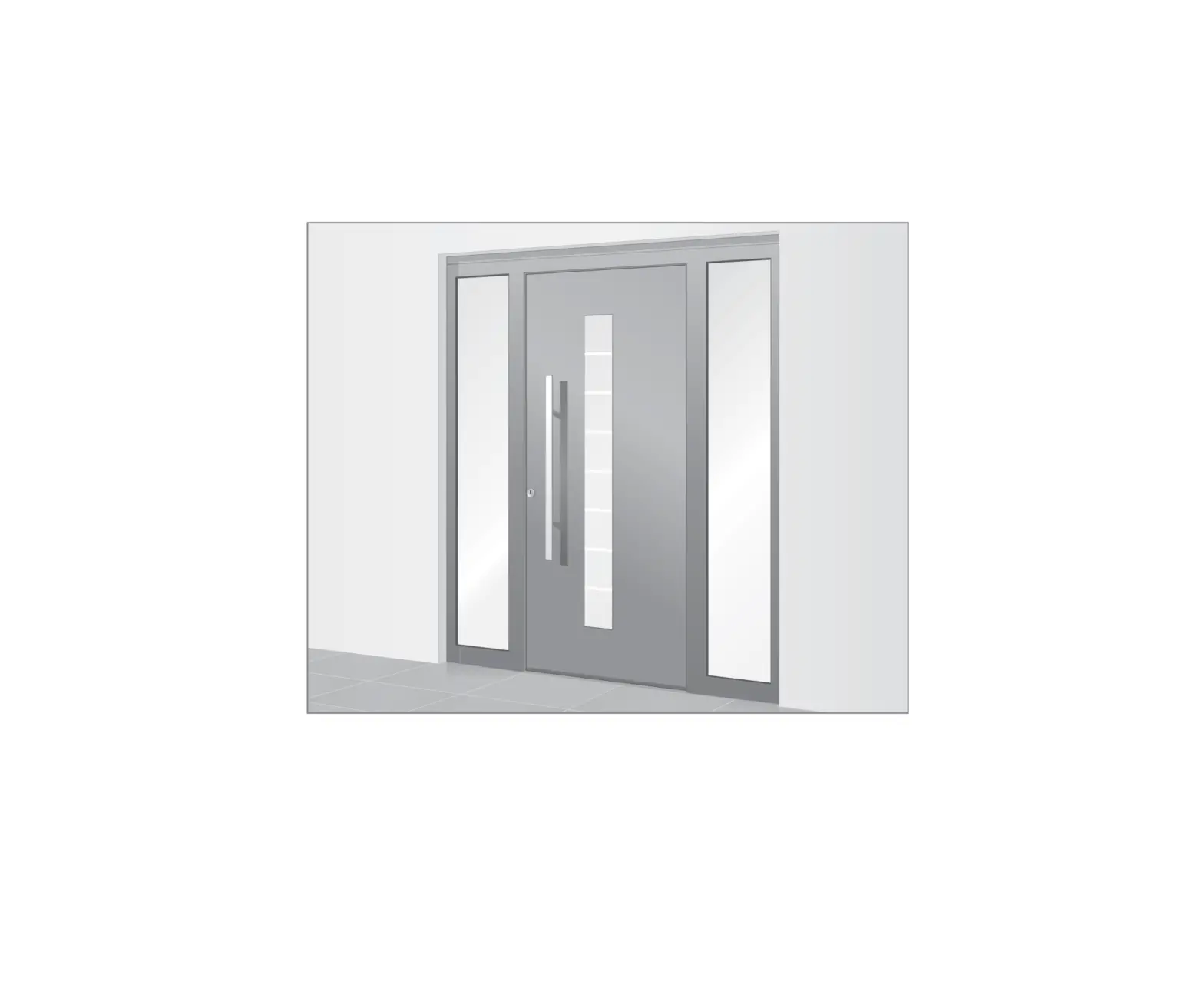
Aluminium Entrance Door
Product Information: Aluminium Entrance Door
This product is an aluminium entrance door that comes with
instructions for fitting, operating, and maintenance. It includes
information on safety precautions, installation methods, and
cleaning and maintenance procedures. The product also features
ECO-Dualverriegelung and LED-Anzeige.
Product Usage Instructions
Before installing or using the Aluminium Entrance Door,
carefully read the instructions in this manual to ensure proper
usage and avoid accidents or damage to the product.
Safety Precautions
- Only qualified personnel should install the door.
- Follow all safety warnings and symbols in the manual.
Installation
- Choose the appropriate installation method for your door.
- Adjust the fittings according to the instructions.
- Install glazing according to the instructions.
ECO-Dualverriegelung
Adjust the mechanical lever as shown in Bild 15d for
ECO-Dualverriegelung.
LED-Anzeige
- Learn how to program a wireless code.
- Activate the wireless codes according to the instructions.
Cleaning and Maintenance
- Clean all movable parts regularly.
- Check and maintain the cylinder.
Disassembly and Disposal
If you need to disassemble or dispose of the door, follow the
instructions in this manual.
For further information or technical support, please see the
manufacturer’s instructions.
5 204 197/5 023 180 / HF 84534 RE / Stand: 12.2022 / Druck: 12.2022
DE Anleitung für Montage, Betrieb und Wartung Aluminium-Eingangstür
EN Instructions for Fitting, Operating and Maintenance Aluminium Entrance Door
FR Instructions de montage, d’utilisation et d’entretien Porte d’entrée en aluminium
ES Instrucciones de montaje, funcionamiento y mantenimiento Puerta de entrada de aluminio ,
RU
NL PL SL
+
IT CS BG
DEUTSCH . . . . . . . . . . . . . . . . . . . . . . . . 3 ENGLISH . . . . . . . . . . . . . . . . . . . . . . . . 10 FRANÇAIS . . . . . . . . . . . . . . . . . . . . . . . 16 ESPAÑOL . . . . . . . . . . . . . . . . . . . . . . . . 22 . . . . . . . . . . . . . . . . . . . . . . . 28 NEDERLANDS . . . . . . . . . . . . . . . . . . . . 35 ITALIANO . . . . . . . . . . . . . . . . . . . . . . . . 41 POLSKI . . . . . . . . . . . . . . . . . . . . . . . . . 47 CESKY . . . . . . . . . . . . . . . . . . . . . . . . . . 53 SLOVENSKO . . . . . . . . . . . . . . . . . . . . . 59 SLOVENSKY . . . . . . . . . . . . . . . . . . . . . 65 . . . . . . . . . . . . . . . . . . . . . 71
. . . . . . . . . . . . . . . . . . . . . . 77
2
5 204 197/5 023 180 / 12.2022
DEUTSCH
Inhaltsverzeichnis
1
Zu dieser Anleitung . . . . . . . . . . . . . . . . . . . . . . . . . . . . . . . . . . . . . . . . . . . . . . . . . . . . . . . . 3
1.1
Verwendete Warnhinweise……………………………………….. 3
1.2
Verwendete Symbole………………………………………………. 3
1.3
Verwendete Abkürzungen………………………………………… 4
1.4
Farbcode für Leitungen, Einzeladern und Bauteile………. 4
2
Sicherheitshinweise . . . . . . . . . . . . . . . . . . . . . . . . . . . . . . . . . . . . . . . . . . . . . . 4
2.1
Qualifikation des Monteurs………………………………………. 4
3
Montage . . . . . . . . . . . . . . . . . . . . . . . . . . . . . . . . . . . . . . . . . . . . . . . . . . . . . . . . . . . . . . . . . . . . . . . . . . 4
3.1
Zubehör ………………………………………………………………… 5
3.2
Türposition ermitteln……………………………………………….. 5
3.3
Montagearten ………………………………………………………… 5
3.4
Baukörperanschluss ……………………………………………….. 5
3.5
Beschlag einstellen…………………………………………………. 5
3.6
ECO-Dualverriegelung, Einstellen
der mechanischen Wippe (siehe Bild 15d) …………………. 5
3.7
Türdrücker …………………………………………………………….. 5
3.8
Obentürschließer (GEZE) …………………………………………. 5
3.9
Verglasen ………………………………………………………………. 5
3.10 Elektrische Anschlüsse……………………………………………. 5
3.11 Montage von einbruchhemmenden Türelementen………. 5
4
Beschreibung von S5 Smart, Comfort, Code, Scan . . . . 7
4.1
LED-Anzeige ………………………………………………………….. 7
4.2
Einlernen eines Funkcodes………………………………………. 7
4.3
Funkcodes einlernen ………………………………………………. 7
4.4
Betrieb ………………………………………………………………….. 7
4.5
Geräte-Reset …………………………………………………………. 7
5
Prüfung und Wartung . . . . . . . . . . . . . . . . . . . . . . . . . . . . . . . . . . . . . . . . . . . . . . . . . . . . 7
5.1
Sitz und Abdichtung prüfen……………………………………… 7
6
Reinigung und Pflege . . . . . . . . . . . . . . . . . . . . . . . . . . . . . . . . . . . . . . . . . . . . . . . . . . . . 8
6.1
Oberfläche …………………………………………………………….. 8
6.2
Bewegliche Beschlagteile………………………………………… 8
6.3
Türbänder ……………………………………………………………… 8
6.4
Zylinder …………………………………………………………………. 8
7
Demontage und Entsorgung . . . . . . . . . . . . . . . . . . . . . . . . . . . . . . . . . . . . . . . . . 8
8
Ersatzteile . . . . . . . . . . . . . . . . . . . . . . . . . . . . . . . . . . . . . . . . . . . . . . . . . . . . . . . . . . . . . . . . . . . . . . . 8
9
Unternehmererklärung . . . . . . . . . . . . . . . . . . . . . . . . . . . . . . . . . . . . . . . . . . . . . . . . . . 8
10
Entsorgung von Elektroaltgeräten in Deutschland . . . . 9
10.1 Entsorgung ……………………………………………………………. 9
10.2 Rückgabe im Einzelhandel oder
beim Entsorgungsträger ………………………………………….. 9
. . . . . . . . . . . . . . . . . . . . . . . . . . . . . . . . . . . . . . . . . . . . . . . . . . . . . . . . . . . . . . . . . . . . . . . . . . . 77
Sehr geehrte Kundin, sehr geehrter Kunde, wir freuen uns dass Sie sich für ein Qualitätsprodukt aus unserem Haus entschieden haben.
1
Zu dieser Anleitung
Diese Anleitung gliedert sich in einen Text- und einen Bildteil. Den Bildteil finden Sie im Anschluss an den Textteil.
Diese Anleitung ist eine Originalbetriebsanleitung im Sinn der EU-BpVO 305/2011. Lesen Sie die Anleitung sorgfältig und vollständig durch. Die Anleitung enthält wichtige Informationen für den Einbau, den Betrieb und die korrekte Pflege bzw. Wartung der Aluminium-Haustür.
Beachten Sie insbesondere alle Sicherheitshinweise und Warnhinweise.
Bewahren Sie diese Anleitung sorgfältig auf!
Sachkundige Montage und sorgfältige Wartung erhöhen Leistung, Verfügbarkeit und Sicherheit.
Texte und Zeichnungen dieser Anleitung entstanden mit größtmöglicher Sorgfalt. Aus Gründen der Übersicht enthält die Anleitung nicht alle Detailinformationen zu allen Varianten und denkbaren Montagen. Die in dieser Anleitung veröffentlichten Texte und Zeichnungen haben lediglich Beispielcharakter.
Jede Gewähr auf Vollständigkeit wird ausgeschlossen und berechtigt nicht zur Reklamation.
Wenn Sie weitere Informationen wünschen oder Probleme auftreten, die diese Anleitung nicht ausführlich behandelt, kontaktieren Sie das Herstellwerk.
Diese Anleitung ist ein wichtiges Dokument für die Bauakte.
1 .1
Verwendete Warnhinweise
GEFAHR
Kennzeichnet eine Gefahr, die unmittelbar zum Tod oder zu schweren Verletzungen führt.
ACHTUNG
Kennzeichnet eine Gefahr, die zur Beschädigung oder Zerstörung des Produkts führen kann.
1 .2
Verwendete Symbole
wichtiger Hinweis zum Vermeiden von Sachschäden
unzulässige Anordnung oder Tätigkeit
zulässige Anordnung oder Tätigkeit
siehe Textteil
siehe Bildteil
siehe Herstelleranleitung
siehe gesonderte Montageanleitung der Steuerung bzw. der zusätzlichen elektrischen Bedienelemente
Rahmen nach Flügel ausrichten
elektrische Spannung
unzulässig nach DIN 4108
Winter
Sommer
Weitergabe sowie Vervielfältigung dieses Dokuments, Verwertung und Mitteilung seines Inhalts sind verboten, soweit nicht ausdrücklich gestattet. Zuwiderhandlungen verpflichten zu Schadenersatz. Alle Rechte für den Fall der Patent-, Gebrauchsmuster- oder Geschmacksmustereintragung vorbehalten. Änderungen vorbehalten.
5 204 197 RE / 12.2022
optionale Bauteile als Zubehör zu bestellen
Tür 1-flüglig
3
DEUTSCH
Tür 2-flüglig
Tür mit Seitenteil
Tauwasserbildung
dampfdiffusionsoffen
Verschraubung fest anziehen
prüfen
Tür nach außen öffnend
Tragklötze
dampfdiffusionsdicht Hausinnenbereich
Hausaußenbereich
Tür nach innen öffnend Türflügel abstellen
Distanzklötze
Bauteil oder Verpackung entfernen und entsorgen
kennzeichnet im Bildteil Arbeitsschritte, die nacheinander ausgeführt werden müssen einbruchhemmendes Bauteil RC2 nach DIN EN 1627:2011
potentialfreier Kontakt
wartungsfrei
Bauteil oder Verpackung entfernen und entsorgen
einbruchhemmendes Bauteil RC3 nach DIN EN 1627:2011
Angriffsseite
Koppelrelais
automatische Tür
bauseits anschließen bzw. montieren
AUTO
werkseitig angeschlossen bzw. montiert
1 .3
Verwendete Abkürzungen
OFF
Oberkante Fertigfußboden
1 .4
Farbcode für Leitungen, Einzeladern und Bauteile
Die Abkürzungen der Farben für Leitungs- und Aderkennzeichnung
sowie Bauteile folgt dem internationalen Farbcode nach IEC 757:
BK
schwarz
BN
braun
GN
grün
GY
grau
YE WH GN / YE
gelb weiß grün, gelb
2
Sicherheitshinweise
GEFAHR
Lebensgefahr beim Einbau der Eingangstür Beim Einbau kann die Tür oder der Türrahmen umfallen und dabei Personen erschlagen. Sichern Sie Tür und Türrahmen vor und während der
Montagearbeit gegen Umfallen.
· Befolgen Sie beim Einbau der Aluminium-Haustür die Grundregeln der DIN 4108 Wärmeschutz und Energieeinsparung in Gebäuden.
· Befolgen Sie gültige Normen, Richtlinien, Vorschriften und Verordnungen. Befolgen Sie die anerkannten Regeln der Technik.
· Schützen Sie Ihre Aluminium-Eingangstür bis zur Baufertigstellung vor Beschädigungen. Decken Sie die Aluminium-Eingangstür mit Folie und Klebeband ab. Beachten Sie, dass Klebestreifen, bei längerer Sonneneinstrahlung Rückstände hinterlassen können.
· Ermitteln Sie die geeigneten Befestigungen entsprechend den örtlichen Gegebenheiten. Halten Sie die Befestigungen bauseits bereit.
· Verankern Sie die Aluminium-Eingangstür an allen vorgesehenen Befestigungspunkten in der Wand.
· Halten Sie die erforderlichen Achsabstände und Randabstände der Dübel ein, abhängig von der Wandart. Beachten Sie die Montagehinweise und Verarbeitungsrichtlinien des Dübelherstellers.
· Reinigen Sie vorher alle Kontaktflächen, die mit Silikon und Dichtstoffen versiegelt werden z. B.
— Profiloberflächen
— Randverbund der Scheibe.
· Verwenden Sie nur Dichtstoffe und Klebstoffe, die für die Anwendung geeignet und für die Werkstoffe verträglich sind. Beachten Sie die Verarbeitungsrichtlinien des jeweiligen Herstellers.
· Beauftragen Sie nur ausgebildete Fachkräfte mit den Elektroarbeiten.
· Bei Aluminium-Eingangstüren mit automatischen Türantrieben müssen Sie die EG-Richtlinie 2006/42/EG einhalten.
2 .1
Qualifikation des Monteurs
Beauftragen Sie für den fachgerechten Einbau der Aluminium-
Eingangstür ausschließlich ausgebildete Monteure.
ACHTUNG
Funktionsbeeinträchtigung Fehlende oder geänderte Bauteile beeinträchtigen die Funktion der Eingangstür. Ändern oder entfernen Sie keine Bauteile. Befestigen Sie alle in der Anleitung aufgeführten Bauteile.
3
Montage
Befolgen Sie für eine einfache und fachgerechte Montage die im Bildteil dargestellten Arbeitsschritte sorgfältig.
Prüfen Sie vor dem Türeinbau ob Anbauteile montiert werden müssen (siehe Bild 3).
Entfernen Sie vor der Montage die Transportsicherungen (siehe Bild 2 .3).
Befestigungsmaterialien und Abdichtungsmaterialien gehören nicht zum Lieferumfang.
HINWEIS:
Verwenden Sie vorrangig die werkseitig vorgerichteten Befestigungspunkte.
Die in der Bauanleitung angegebenen Befestigungspunkte sind allgemeingültig. Sie können von den werkseitig vorgerichteten Befestigungspunkten abweichen.
4
5 204 197 RE / 12.2022
3 .1
Zubehör
· K3 Kopplung Tür / Seitenteil / Oberlicht (siehe Bilder 3 .1) · VP25 / VP50 Verbreiterung (siehe Bild 3 .2a) · VP100 / VP150 Verbreiterung (siehe Bild 3 .2b) · VPE20 / VPE50 Verbreiterung einteilig (siehe Bild 3 .3) · KE135 / KE90 Eckprofile 135º / 90º (siehe Bilder 3 .4) · KS3 Statikprofil (siehe Bild 3 .5)
Befestigungsmaterial für Zubehör gehört zum Lieferumfang.
3 .2
Türposition ermitteln
Legen Sie die Türposition für die Dübel fest. Die Türposition
hängt ab von den örtlichen Befestigungsmöglichkeiten, der Wandart und den erforderlichen Achsabständen sowie
Randabständen.
Positionieren Sie die Tür in der Dämmebene der Wand.
Positionieren Sie bei monolithischem oder einschaligem
Mauerwerk die Tür möglichst weit Richtung
Gebäudeinnenseite. Beachten Sie den Isothermenverlauf
(siehe Bild 1).
3 .3
Montagearten
· Ankermontage (siehe Bilder 9 12) · Dübelmontage (siehe Bilder 9 12) · Rahmenschraubenmontage (siehe Bilder 9 12)
HINWEIS: Hinterklotzen Sie jeden Befestigungspunkt druckfest.
· Türflügel aushängen (siehe Bilder 2 .5 / 15 / 21).
ACHTUNG
Funktionsbeeinträchtigung Das Missachten der Verarbeitungsrichtlinien beeinträchtigt die Funktion der Eingangstür. Beachten Sie beim Befestigungsmaterial und beim
Abdichtungsmaterial die Verarbeitungsrichtlinien des jeweiligen Herstellers.
3 .4
Baukörperanschluss
Die fachgerechte Befestigung und Abdichtung der Anschlussfuge
zum Baukörper ist eine wesentliche Voraussetzung für die
dauerhafte Gebrauchstauglichkeit der Tür. Die Anschlussfuge ist
abhängig vom jeweiligen Außenwandsystem und der
Einbausituation. Befolgen Sie die Anforderungen der aktuellen
EnEV, die Vorgaben der RAL-Gütegemeinschaft Fenster und
Haustüren e.V. und die Verarbeitungsrichtlinien der Hersteller.
Grundsätzlich gilt Raumseite
mittlerer Bereich
Außenseite
dampfdiffusionsdichte und luftdiffusionsdichte Abdichtung
feuchtigkeitsunempfindliche Wärmedämmung
dampfdiffusionsoffene Regensperre und Windsperre
(siehe Bild 10 .1 / 19)
3 .5
Beschlag einstellen
· Türflügelverstellung horizontal und vertikal, Anpressdruckeinstellung (siehe Bilder 15a / 15b / 15c).
ACHTUNG
Türöffnungswinkel begrenzen (siehe Bild 15c .1)
Sie müssen den Türöffnungswinkel bauseits auf 105° begrenzen.
Begrenzen Sie bei verdecktliegenden Bändern den Türöffnungswinkel auf 105°. Beachten Sie, dass sonst Beschädigungen am Band bzw. Türrahmen zu erwarten sind.
3 .6
ECO-Dualverriegelung, Einstellen der
mechanischen Wippe (siehe Bild 15d)
Die mechanische Wippe wird bei zweiflügeligen Türen eingesetzt.
Durch die Wippenfunktion wird beim Öffnen des Gangflügels der
Standflügel gleichzeitig mit entriegelt.
5 204 197 RE / 12.2022
DEUTSCH
3 .7
Türdrücker
· Drückerstift 9 mm
· Vergewissern Sie sich bei Türen in Flucht- und Rettungswegen, dass der Beschlag nach DIN EN 179 bzw. DIN EN 1125 zulässig ist.
3 .8
Obentürschließer (GEZE)
· Montage auf Bandseite, Standardmontage (siehe Bild 16a).
· Montage auf Bandgegenseite, Kopfmontage, schematische Darstellung (siehe Bild 16b).
· Siehe Montageanleitung des gelieferten Schließer-Typs im Zubehörpaket.
· Grundsätzlich können Sie Obertürschließer, für die ein Übereinstimmungszertifikat vorliegt, anbauen. Richtungsweisend sind die EN 1154 und EN 1155.
· Bei der Schließerauswahl sind das Türflügelgewicht sowie die Türflügelbreite maßgebend.
· Eine Öffnungsdämpfung im Obentürschließer ist empfehlenswert. Sie dürfen Obentürschließer nur mit geeigneter Montageplatte befestigen.
· Die Befestigungsbohrungen für die Montageplatten und Gleitschienen sind werkseitig vorgerichtet.
· Die Obentürschließer inklusive Montageplatten und Gleitschienen werden lose mitgeliefert.
· Beachten Sie bei Obentürschließer mit Feststellvorrichtung (integriert oder Haftmagnet) die ,,Bestimmungen über Feststellanlagen”.
· Entnehmen Sie die Schließereinstellung sowie die Wartung der beiliegenden Montageanleitung.
· Stellen Sie den Schließer so ein, dass die Tür sich aus einem Öffnungswinkel von 90° innerhalb von 5 ±2 Sekunden gleichmäßig und sanft schließt.
3 .9
Verglasen
· Einsetzen und Austauschen der Glasscheiben oder Füllungen (siehe Bilder 13 / 14 / 20).
· Klotzungsvorschläge (siehe Bilder 13 / 14 / 20).
· Sichern der Verklotzungen gegen Herunterfallen (z. B. Pattexkleber).
3 .10
Elektrische Anschlüsse
GEFAHR
Netzspannung!
Bei Kontakt mit der Netzspannung besteht die Gefahr eines tödlichen Stromschlags. Beachten Sie folgende Hinweise:
Nur Elektrofachkräfte dürfen Elektroanschlüsse legen.
Die bauseitige Elektroinstallation muss den jeweiligen Schutzbestimmungen entsprechen.
Die Elektrofachkraft muss darauf achten, dass die nationalen Vorschriften für den Betrieb von elektrischen Geräten eingehalten werden!!
Der Querschnitt ist abhängig von der Länge der Spannungsversorgungsleitung:
10 m 40 m 50 m
0,50 mm² 0,75 mm² 1,00 mm²
75 m 125 m
1,50 mm² 2,50 mm²
3 .11
Montage von einbruchhemmenden Türelementen
Die Montageanweisungen dieses Abschnitts enthalten zusätzliche
Hinweise zur Montage einbruchhemmender Türelemente der
Widerstandsklasse RC2, RC3 nach DIN EN 1627: 2011
(siehe Bilder 20 21).
Nur durch den fachgerechten Einbau gemäß dieser Anleitung
verfügen die Türelemente über einbruchhemmende Eigenschaften.
3 .11 .1 Zulässige Wände
Die geforderte Einbruchhemmung wird nur erzielt, wenn die angrenzenden Wände den Anforderungen gemäß Tab. 1 Tab. 3 entsprechen.
5
DEUTSCH
3 .11 .2 Zulässige Wandanschlüsse Die unter Bild 9 .2 definierten Wandanschlüsse sind zulässig. Die fachgerechte Montage muss durch die Montagebescheinigung belegt werden.
3 .11 .3 Sicherheitsrelevante Bauteile Die geforderte Einbruchhemmung wird nur erzielt, wenn die verwendeten Ausfachungen folgenden Anforderungen entsprechen.
Mindestanforderung an die Füllungen der Seitenteile, Oberlichter:
Widerstandsklasse Widerstandsklasse der Verglasung gemäß EN 356 Positionierung der Sicherheitsscheibe
Paneel mit oder ohne Glas
RC2
RC3
P4 A
P5 A
vom Angriff abgewandte
Seite
Angriffsseite
Aluminiumpaneel
Der Austausch sicherheitsrelevanter Bauteilen (z.B. Beschläge, Schlösser und Ausfachungen) bei nicht fachgerechter Montage kann zum Verlust der Widerstandsfähigkeit des Türelements führen.
Tab. 1: Zuordnung der Widerstandsklassen einbruchhemmender Bauteile zu Massivwänden
Widerstandsklasse des Bauteils nach
DIN EN 1627
RC2 RC3
Wanddicke (ohne Putz)
115 mm
Umgebende Wände
aus Mauerwerk nach DIN 1053-1
Druckfestigkeitsklasse der
Steine (DFK)
Rohdichteklasse der Steine (RDK)
Mörtelgruppe
12
min. MG II/DM
aus Stahlbeton nach DIN 1045
Nenndicke
Festigkeitsklasse
min. 100 mm min. 120 mm
min. B 15
Tab. 2: Zuordnung der Widerstandsklassen einbruchhemmender Bauteile zu Porenbetonwänden
Widerstandsklasse
Wand aus Porenbeton
Druckfestigkeitsklasse der Steine
Nenndicke
RC2 RC3
170 mm 4
240 mm
Ausführung verklebt
Tab. 3: Zuordnung der Widerstandsklassen einbruchhemmender Bauteile zu Holztafelwänden
Widerstandsklasse
Geeigneter Wandaufbau
Putz mit Gewebe, Polystyrol 40 mm, GF 15,0 mm, Holzstiel 60 / 140, MF 140 mm, PE-Folie, GF 15 mm
RC2
Putz mit Gewebe, Polystyrol 40 mm, OSB 12,0 mm, Holzstiel 60 / 140, MF 140 mm, PE-Folie, OSB 12,0 mm, GKB12,5 mm
N + F Holzschalung 19 × 120 mm, Lattung 40 × 60 mm, DHF 15 mm, Holzstiel 60 / 140, MF 140 mm, PE-Folie, OSB 15,0 mm, GKB 12,5 mm
Putz mit Gewebe, SB W 40 mm, DWD 15,0 mm, Holzstiel 60 / 140, MF 140 mm, PE-Folie, FP 16,0 mm, V100 E1, GKB 12,5 mm
N + F Holzschalung 19 × 120 mm, Lattung 40 × 60 mm, SB.W 60 mm, Holzstiel 60 / 140, MF 140 mm, PE-Folie, OSB 15,0 mm, GKB 12,5 mm
RC3
Putz mit Gewebe, SB W 40 mm, DWD 15,0 mm, Holzstiel 60 / 140, MF 140 mm, Kraftpapier, BFU 15,0 mm, GKB 12,5 mm
Putz mit Gewebe ca. 4 mm, PS 30 mm, FP 13 mm V100E1, Holzstiel 60 / 140, MF 140 mm, PE-Folie 0,2 mm, FP 13 mm V20E1, Lattung 40 × 60 mm / Dämmung MF 40 mm, BFU 15,0 mm, GKB 9,5 mm
Montagewände und Holzständerwände mit Nachweis des Herstellers bzgl. Eignung der entsprechenden Widerstandsklasse.
6
5 204 197 RE / 12.2022
DEUTSCH
Mindestanforderungen an Beschläge:
Widerstandsklasse
EN 1303 (siehe Bild 20) Schließzylinder (Stelle 7) Schließzylinder (Stelle 8)
EN 1906 Schutzbeschlag (Stelle 7)
EN 12209 Schlösser (Stelle 7)
RC2
RC3
4
4
1
1
in Konstruktion integriert
3 1)
4 1)
1) Der Nachweis über die Eignung der Schlösser muss zusätzlich durch Prüfung nach DIN EN 1627 bzw. im Rahmen einer gutachterlichen Stellungnahme erfolgen.
Beachten Sie folgende Einbauvorschriften: · Damit die Riegel des Schlosses völlig in die Schließöffnungen
eingreifen, wahren Sie die sichtbare Fuge von 5 ± 1 mm zwischen Rahmen und Flügel (siehe Bild 15).
3 .11 .4 Zusätzliche Hinweise zum Einbau
Bauen Sie den Rahmen lotrecht und fluchtgerecht ein (siehe Bild 10).
Hinterfüttern Sie die Freiräume zwischen Rahmen und Wänden druckfest mit verrottungsfreiem Material in den folgenden Bereichen: — Bänder — Füllung — Verriegelung — Befestigungspunkte — an den oberen und unteren Ecken
Sorgen Sie durch geeignete Maßnahmen (z. B. Silikon) dafür, dass die druckfeste Hinterfütterung nicht verrutschen kann (siehe Bild 9 .2).
3 .11 .5 Hinweise für den Benutzer
· Einbruchhemmende Bauteile bieten Widerstand gegen Einbruch nur in geschlossenem, verriegeltem und verschlossenem Zustand und nur mit abgezogenem Schlüssel.
· Antipanikschlösser sind in Verbindung mit einbruchhemmenden Türen nicht zulässig!
· Knaufzylinder und Rundzylinder sind bei einbruchhemmenden Türen (RC2, RC3) unzulässig.
3 .11 .6 Gewährleistung
Zur Gewährleistung der Leistungseigenschaft ,,Einbruchhemmung nach DIN EN 1627″ mit der Klassifizierung RC2, RC3, muss das Montageunternehmen die fachgerechte Montage gemäß dieser Anleitung bestätigen. Dazu müssen Sie das mit der Auftragsbestätigung übergebene Dokument ,,Montagebescheinigung für einbruchhemmende Türen” ausgefüllt an den Hersteller zurücksenden.
4
Beschreibung von S5 Smart, Comfort,
Code, Scan
Potentialfreie Ansteuerung der Schlösser (siehe Bild 6b)
Wenn die Schlösser mit Sprechanlagen oder Tastern angesteuert werden sollen, deren Ausgang unter Spannung steht, muss diese Leitung potentialfrei sein. Dies erfolgt durch den Einbau eines Koppelrelais. Das Koppelrelais für den Standardfall (12 V AC) finden Sie im Zubehör.
ACHTUNG
Bei Inbetriebnahme von Fingerleser oder Codetaster müssen Sie den Werkscode ändern .
Siehe hierzu die mitgelieferten Bedienungsanleitungen der Hersteller.
4 .1
LED-Anzeige
Blau (BU)
Zustand leuchtet kurz
leuchtet 1 × lang
blinkt langsam
blinkt schnell nach langsamem Blinken blinkt 5 Sek. langsam, blinkt 2 Sek. schnell aus
Funktion ein gültiger Funkcode wird erkannt für Kanal 1
ein gültiger Funkcode wird erkannt, der auf beiden Kanälen gespeichert wurde
Empfänger ist im Modus Lernen für Kanal 1
beim Lernen wurde ein gültiger Funkcode erkannt
Geräte-Reset wird durchgeführt bzw. abgeschlossen
Betriebsmodus
Programmiertaste P (P-Taste)
4 .2
Einlernen eines Funkcodes
Um einen Kanal zu aktivieren, zuwechseln: Um Kanal 1 zu aktivieren, drücken Sie die P-Taste 1 ×.
Um den Modus Lernen abzubrechen: Drücken Sie die P-Taste 3 × oder warten Sie auf Timeout.
Timeout:
Wenn innerhalb von 25 Sekunden kein gültiger Funkcode erkannt wird, wechselt der Empfänger automatisch zurück in den Betriebsmodus.
4 .3
Funkcodes einlernen
(siehe Bild 6f)
1 . Aktivieren Sie den gewünschten Kanal durch Drücken der P-Taste.
— Die blaue LED blinkt langsam für Kanal 1
2 . Bringen Sie den Handsender zum Vererben seines Funkcodes in den Modus Vererben, Senden.
3 . Wenn ein gültiger Funkcode erkannt wird, blinkt die LED schnell blau und erlischt. Der Empfänger ist im Betriebsmodus .
4 .4
Betrieb
Der Empfänger signalisiert im Betriebsmodus das Erkennen eines gültigen Funkcodes durch das Aufleuchten der blauen LED.
HINWEIS:
Wenn der Funkcode der eingelernten Handsendertaste eine Kopie eines anderen Handsenders ist, müssen Sie die Handsendertaste zum ersten Betrieb ein zweites Mal drücken.
Ein gültiger Funkcode Kanal 1 wird erkannt
= Die LED leuchtet 1 × kurz
4 .5
Geräte-Reset
So können Sie alle Funkcodes löschen:
1 . Drücken Sie die P-Taste. Halten Sie die P-Taste gedrückt.
— Die LED blinkt 5 Sekunden lang langsam blau.
— Die LED blinkt 2 Sekunden lang schnell blau.
2 . Lassen Sie die P-Taste los. Alle Funkcodes sind gelöscht .
HINWEIS:
Wenn Sie die P-Taste vorzeitig loslassen, bricht der Geräte-Reset ab. Die Funkcodes sind nicht gelöscht.
5
Prüfung und Wartung
5 .1
Sitz und Abdichtung prüfen
Kontrollieren Sie vor dem Abschluss der Montage den korrekten
Einbau der Aluminium-Eingangstür.
Prüfen Sie folgende Punkte: — Sitz der Befestigungsschrauben zum Baukörper
— Abdichtung der Aluminium-Eingangstür zum Baukörper
5 204 197 RE / 12.2022
7
DEUTSCH
6
Reinigung und Pflege
6 .1
Oberfläche
Sie haben ein hochwertiges Produkt aus Aluminium erworben.
Schützen Sie es durch regelmäßige Reinigung und Pflege. Nur so
vermeiden Sie Korrosion durch Umwelteinflüsse und
nutzungsbedingte Verunreinigungen.
Reinigen Sie Klebeflächen vorher mit einem Alkohol-Wasser-
Gemisch.
ACHTUNG
Ungeeignete Pflegemittel
Aggressive, ätzende oder schmirgelnde Stoffe wie z. B. Säuren oder Stahlbürsten können die Oberfläche der Tür oder angrenzender Bauteile beschädigen.
Verwenden Sie zur Pflege der Aluminium-Eingangstür nur handelsübliche Pflegemittel und Microfasertücher.
Spülen Sie bei hochglänzenden Oberflächen den Schmutz mit Wasser ab.
Verwenden Sie bei matten Oberflächen keinesfalls Politur.
Beachten Sie beim Pflegemittel auch stets die Herstellerhinweise.
HINWEIS:
Herstellerempfehlung: Reinigungsmittel proWIN ,,Seidenglanz” in Kombination mit Microfasertuch proWIN ,,Hochglanzzauber” www.prowin.net
6 .2
Bewegliche Beschlagteile
Ölen oder fetten Sie bewegliche Beschlagteile einmal im
Jahr. Verwenden Sie nur säurefreies Öl oder Vaseline.
6 .3
Türbänder
ACHTUNG
Schmieren der Türbänder Schmieren Sie verdeckt liegende Türbänder spätestens nach 50.000 Schließungen Aufliegende Türbänder sind wartungsfrei. Schmieren Sie aufliegende Türbänder niemals.
6 .4
Zylinder
Zur Pflege des Schließzylinders sind ausschließlich spezielle
Zylinderpflegesprays zulässig. Verwenden Sie keinesfalls
graphithaltige Mittel.
7
Demontage und Entsorgung
Die Demontage der Aluminium-Eingangstür erfolgt in umgekehrter Aufbaureihenfolge.
Zerlegen Sie zur ordnungsgemäßen Entsorgung die AluminiumEingangstür nach der Demontage in einzelne Komponenten. Entsorgen Sie alles unter Beachtung der örtlichen, behördlichen Vorschriften.
8
Ersatzteile
Wir weisen ausdrücklich darauf hin, dass nur Originalersatzteile geprüft und freigegeben sind. Sie können in Verbindung mit unseren Schlössern H5 / S5 folgende Zylinder verwenden:
· Knaufzylinder
· Zylinder mit und ohne Freilauffunktion
· Zylinder mit und ohne Gefahrenfunktion und Notfunktion
Vor dem Einsatz anderer Schlösser wie z.B. Getriebeschlösser mit Antipanikfunktion müssen Sie die Funktion in Verbindung mit dem gewünschten Zylinder prüfen und sicherstellen.
9
Unternehmererklärung
…………………………………………………………………………………………. Fachunternehmen bzw. Ersteller
………………………………………………………………………………………….. Straße
………………………………………………………………………………………….. PLZ, Ort
…………………………………………………………………………………………. Bauherrschaft bzw. Auftraggeber
………………………………………………………………………………………….. Straße
………………………………………………………………………………………….. PLZ, Ort
…………………………………………………………………………………………. Standort des Gebäudes
………………………………………………………………………………………….. Straße
………………………………………………………………………………………….. PLZ, Ort
Die Aluminium-Eingangstür mit den Abmessungen: Breite …………………… mm und Höhe …………………… mm hat einen berechneten UD Wert …………………… W / m2 K.
Wir bestätigen den Einbau der Tür nach den anerkannten Regeln der Technik und den Anforderungen der aktuellen GEG.
…………………………………………………………………………………………. Ort, Datum
…………………………………………………………………………………………. Unterschrift Auftragnehmer / Fachunternehmen
Hiermit bestätige ich Erhalt und Kenntnisnahme der Unternehmererklärung.
…………………………………………………………………………………………. Ort, Datum
…………………………………………………………………………………………. Unterschrift Diese Unternehmererklärung ist laut §96 Gebäudeenergiegesetz (GEG) Pflicht und dient als Nachweis. Bewahren Sie die Unternehmererklärung mindestens 10 Jahre auf.
8
5 204 197 RE / 12.2022
10
Entsorgung von Elektroaltgeräten in
Deutschland
Wichtige Informationen nach dem Elektro- und Elektronikgerätegesetz (ElektroG)
Wir weisen Besitzer von Elektro- und Elektronikaltgeräten darauf hin, dass Elektroaltgeräte gemäß den geltenden gesetzlichen Vorschriften einer vom Siedlungsabfall getrennten Entsorgung zuzuführen sind.
10 .1
Entsorgung
In den Elektroaltgeräten enthaltene Batterien und Akkumulatoren,
die nicht fest vom Elektroaltgerät umschlossen sind, sowie
Lampen, die zerstörungsfrei aus dem Elektroaltgerät entnommen
werden können, sind vor deren Abgabe an einer Entsorgungsstelle
zerstörungsfrei von diesem zu trennen und einer vorgesehenen
Entsorgung zuzuführen. Soweit unsere Geräte Batterien oder
Akkumulatoren enthalten, entnehmen Sie weitere Informationen
zum Typ und chemischen System der Batterie sowie zu deren
Entnahme, der Bedienungsanleitung des jeweiligen Geräts.
Das folgend dargestellte und auf Elektro- und Elektronikaltgeräten
aufgebrachte Symbol einer durchgestrichenen Abfalltonne weist
zusätzlich auf die Pflicht zur getrennten Entsorgung hin.
10 .2
Rückgabe im Einzelhandel oder beim
Entsorgungsträger
Elektrofachmärkte und Lebensmittelläden sind nach § 17 ElektroG
unter bestimmten Voraussetzungen zur Rücknahme von Elektro-
und Elektronikaltgeräten verpflichtet. Stationäre Vertreiber müssen
bei Verkauf eines neuen Elektro- und Elektronikgeräts ein
Elektroaltgerät der gleichen Art kostenfrei zurücknehmen
(1:1-Rücknahme). Dies gilt auch bei Lieferungen nach Hause.
Diese Vertreiber müssen außerdem bis zu 3 kleine Elektroaltgeräte
( 25 cm) zurücknehmen, ohne dass dies an einen Neukauf
geknüpft werden darf (0:1-Rücknahme).
Daneben ist die Rückgabe von Elektroaltgeräten auch bei einer
offiziellen Abgabestelle der öffentlich-rechtlichen
Entsorgungsträger möglich.
Löschung personenbezogener Daten
Für die Löschung personenbezogener Daten auf den zu
entsorgenden Elektroaltgeräten sind Sie als Endnutzer vor der
Abgabe selbst verantwortlich.
DEUTSCH
5 204 197 RE / 12.2022
9
ENGLISH
Table of Contents
1
About These Instructions . . . . . . . . . . . . . . . . . . . . . . . . . . . . . . . . . . . . . . . . . . . . 10
1.1
Warnings used ……………………………………………………… 10
1.2
Symbols used ………………………………………………………. 10
1.3
Abbreviations used ……………………………………………….. 11
1.4
Colour code for leads, single wires and components ….. 11
2
Safety Instructions . . . . . . . . . . . . . . . . . . . . . . . . . . . . . . . . . . . . . . . . . . . . . . 11
2.1
Fitter qualification …………………………………………………. 11
3
Fitting . . . . . . . . . . . . . . . . . . . . . . . . . . . . . . . . . . . . . . . . . . . . . . . . . . . . . . . . . . . . . . . . . . . . . . . . . . . . 11
3.1
Accessories …………………………………………………………. 11
3.2
Determining the door position ………………………………… 12
3.3
Fitting types …………………………………………………………. 12
3.4
Connection to building structure …………………………….. 12
3.5
Adjusting the fitting……………………………………………….. 12
3.6
Eco double-locking, adjustment of the
mechanical rocker (see Figure 15d)…………………………. 12
3.7
Lever handle ………………………………………………………… 12
3.8
Overhead door closer (GEZE)…………………………………. 12
3.9
Glazing………………………………………………………………… 12
3.10 Electrical connections……………………………………………. 12
3.11 Fitting break-in-resistant door sets………………………….. 12
4
Description of S5 Smart / Comfort / Code / Scan . . . . . . . 14
4.1
LED display………………………………………………………….. 14
4.2
Teaching in a radio code………………………………………… 14
4.3
Teaching in a radio code………………………………………… 14
4.4
Operation …………………………………………………………….. 14
4.5
Reset…………………………………………………………………… 14
5
Inspection and Maintenance . . . . . . . . . . . . . . . . . . . . . . . . . . . . . . . . . . . . . . 14
5.1
Checking the seating and sealing……………………………. 14
6
Cleaning and Care . . . . . . . . . . . . . . . . . . . . . . . . . . . . . . . . . . . . . . . . . . . . . . . . . . . . . . . 14
6.1
Surface ……………………………………………………………….. 14
6.2
Movable fitting parts……………………………………………… 15
6.3
Door hinges …………………………………………………………. 15
6.4
Cylinder……………………………………………………………….. 15
7
Dismantling and Disposal . . . . . . . . . . . . . . . . . . . . . . . . . . . . . . . . . . . . . . . . . . . 15
8
Spare Parts . . . . . . . . . . . . . . . . . . . . . . . . . . . . . . . . . . . . . . . . . . . . . . . . . . . . . . . . . . . . . . . . . . . 15
. . . . . . . . . . . . . . . . . . . . . . . . . . . . . . . . . . . . . . . . . . . . . . . . . . . . . . . . . . . . . . . . . . . . . . . . . . . 77
Dear customer, We are delighted that you have chosen a high-quality product from our company.
1
About These Instructions
These instructions are divided into a text section and an illustrated section. The illustrated section can be found after the text section.
These instructions are original operating instructions in accordance with EU-BpVO 305/2011. Please read and follow these instructions carefully, as they contain important information on the fitting, operation and correct care/maintenance of the aluminium entrance door so that you can enjoy this product for many years to come.
Please pay particular attention to all safety and warning notices.
Keep these instructions in a safe place for later reference!
Skilled fitting and thorough maintenance increase performance, availability and safety.
The texts and diagrams in this manual have been created with the greatest care possible. In order to provide a concise overview, not all detailed information on all variants and possible assemblies can be described. The texts and diagrams published in this manual are merely intended as examples.
Any guarantee for its completeness is excluded and does not justify a complaint.
Should you desire more information, or if special problems occur which are not described in detail in the manual, you may request information from the manufacturing plant.
These instructions are an important document for the construction file.
1 .1
Warnings used
DANGER
Indicates a danger that leads directly to death or serious injuries.
ATTENTION
Indicates a danger that can lead to damage or destruction of the product.
1 .2
Symbols used
Important note for avoiding damage to property
Non-permissible arrangement or activity
Permissible arrangement or activity
See text section
See illustrated section
See manufacturer’s instructions
See separate Fitting Instructions for the control or for the additional electrical control elements
Position the frame to the leaf
Electrical voltage Winter
Not permissible according to DIN 4108
Summer
Dissemination as well as duplication of this document and the use and communication of its content are prohibited unless explicitly permitted. Noncompliance will result in damage compensation obligations. All rights reserved in the event of patent, utility model or design model registration. Subject to changes.
10
Optional components, to be ordered as accessories
Double – leaf door
Single – leaf door
Door with side element
5 204 197 RE / 12.2022
ENGLISH
Condensation
Open to vapour diffusion
Tighten the screws firmly
Inspect
Door opening outwards
Support blocks
Vapour diffusion proof
House interior
House exterior
Door opening inwards
Placing door leaf on the floor
Spacing blocks
Remove and dispose of component or packaging
In the illustrated section, this indicates work steps that must be performed in succession Break-in-resistant component RC2 acc. to DIN EN 1627:2011
Volt-free contact
Maintenance-free
Break-in-resistant component RC3 acc. to DIN EN 1627:2011
Attack side
Automatic door
Coupling relay
To be connected / fitted onsite
AUTO
To be connected / fitted at the factory
1 .3
Abbreviations used
OFF (FFL)
Finished floor level
1 .4
Colour code for leads, single wires and
components
The colour abbreviations for lead, wire and component identification
follows the international colour code in accordance with IEC 757:
BK
black
BN
brown
GN
green
GY
grey
YE WH GN / YE
yellow white green / yellow
2
Safety Instructions
DANGER
Mortal danger when fitting entrance door During fitting, the door or door frame can fall and kill persons. Prior to and during fitting, secure the door and frame
against falling over.
· Comply with the basic rules of DIN 4108 Thermal protection and energy economy in buildings when fitting the aluminium entrance door.
· Make sure to comply with the applicable standards, directives, regulations, ordinances and the generally accepted rules of technology.
· Protect your aluminium entrance door until construction is completed by covering it with foil to prevent damages. However, please note that, especially with extensive exposure to sunlight, adhesive tape may leave residues.
· Identify suitable fastenings according to the local conditions and have them on hand.
· Anchor the aluminium entrance door to all provided fixing points in the wall.
· Always maintain the required edge and centre line spacing of the plugs depending on wall type, as well as the fitting information and handling guidelines of the plug manufacturer!
· Contact surfaces to be sealed with silicon and sealant material must first be cleaned, such as
— Profile surfaces
— Edge compound of the pane
· Only use adhesive and sealant materials that are suitable for this application and compatible with the product materials. Follow the handling guidelines of the respective manufacturer.
· Electrical work may only be carried out by qualified electricians.
· EC Directive 2006/42/EG must be complied with for aluminium entrance doors with automatic door operators.
2 .1
Fitter qualification
In order to ensure proper installation of the aluminium entrance
door, only fitters with commensurate training may be charged with
the task.
ATTENTION
Impaired function Missing or modified components will impair the function of the entrance door. Do not alter or remove any components. Fasten all components described in the manual.
3
Fitting
To ensure simple and professional fitting, carefully go through all the work steps shown in the illustrated section.
Before fitting the door, check whether any attached parts have to be fitted (see Figure 3).
Remove the transport protection before fitting (see Figure 2 .3).
Fastening and sealing materials are not included in the scope of delivery.
NOTE:
It is important that you use the fixing points prepared at the factory.
The fixing points indicated in the fitting instructions are only general and may deviate from the fixing points prepared at the factory.
3 .1
Accessories
· K3 door / side element / transom light (see Figures 3 .1) · VP25 / VP50 extension (see Figure 3 .2a) · VP100 / VP150 extension (see Figure 3 .2b) · VPE20 / VPE50 one-piece extension (see Figure 3 .3) · KE135 / KE90 corner profiles 135º / 90º (see Figures 3 .4) · KS3 static profile (see Figure 3 .5)
Fixing material for accessories is part of the scope of delivery.
5 204 197 RE / 12.2022
11
ENGLISH
3 .2
Determining the door position
Determine the door position depending on the on-site fastening options, type of wall and the required edge and centre line spacing for the plug.
If possible, position the door so that it is within the insulation layer of the wall. With monolithic or single-shell brickwork, position the door as close as possible towards the building interior side. Observe the isothermal lines (see Figure 1).
3 .3
Fitting types
· Anchor fitting (see Figures 9 12) · Plug-and-screw fitting (see Figures 9 12) · Frame screw fitting (see Figures 9 12)
NOTE: Each fixing point must be back-blocked resistant to pressure.
· Unhinge the door leaf (see Figures 2 .5 / 15 / 21).
ATTENTION
Impaired function Non-compliance with the handling guidelines will impair the function of the entrance door. With fixing and sealant material, follow the handling
guidelines of the respective manufacturer.
3 .4
Connection to building structure
Proper fastening and sealing of the connection joint to the building
structure is a fundamental prerequisite for permanent usability of
the door. It depends on the respective exterior wall system and
fitting situation. Comply with the requirements of the current EnEV,
the specifications of the RAL quality monitoring association for
windows and doors e.V. and the manufacturer`s processing
guidelines.
The following generally applies:
Room side
Average range
Exterior side
Air and vapour diffusion-tight seal Thermal insulation unsusceptible to moisture Vapour diffusion-open wind and rain barrier
(see Figure 10 .1 / 19).
3 .5
Adjusting the fitting
· Horizontal and vertical door leaf adjustment, contact pressure adjustment (see Figures 15a / 15b / 15c).
ATTENTION
Limiting the door opening angle (see Figure 15c .1)
The door opening angle must be limited to 105° on site.
Note that for concealed hinges, the door opening angle must be limited to 105 , as otherwise damage to the hinge or door frame can be expected.
3 .6
Eco double-locking, adjustment of the mechanical
rocker (see Figure 15d)
The mechanical rocker is used as standard for double-leaf doors.
Due to the rocker function, the fixed leaf is always unlocked
simultaneously with the opening of the traffic leaf.
3 .7
Lever handle
· Lever pin 9 mm
· For doors in escape and rescue routes it should be ensured that the fitting is approved acc. to DIN EN 179 or DIN EN 1125.
3 .8
Overhead door closer (GEZE)
· Fitting on the hinge side / standard fitting (see Figure 16a).
· Fitting on the opposite hinge side / head fitting, schematic diagram (see Figure 16b).
· Also see the fitting instructions of the closer type provided with the accessory pack.
· In general, overhead door closers with a certificate of conformity can be fitted. The standards EN 1154 and EN 1155 apply.
· The selection of the closer is determined by the door leaf weight and the door leaf width.
· A restrained opening in the overhead door closer is recommended. Overhead door closers may only be fitted with suitable mounting plates.
· The fitting holes for the mounting plates and slide rails are prepared at the factory.
· The overhead door closer including the mounting plates and slide rails are supplied separately.
· The “regulations for hold-open devices” must be observed for overhead door closers with hold-open device (integrated or magnetic).
· The closer must be set in such a way that the door closes “evenly and gently” within 5 ±2 seconds from a 90° opening angle.
3 .9
Glazing
· Insertion and replacement of the glass panes or infills (see Figures 13 / 14 / 20).
· Blocking suggestions (see Figures 13 / 14 / 20)
· Secure blocking against falling (e.g. with Pattex adhesive).
3 .10
Electrical connections
DANGER
Mains voltage!
Contact with the mains voltage presents the danger of a deadly electric shock. For that reason, observe the following warnings under all circumstances:
Electrical connections may only be performed by a qualified electrician!
The on – site electrical installation must conform to the applicable protective regulations!
Qualified electricians must ensure compliance with the national directives for the operation of electrical devices!
Depending on the length of the power supply cable, it must have at least the following cross-section:
10 m 40 m 50 m
0,50 mm2 0,75 mm2 1,00 mm2
75 m 125 m
1,50 mm2 2,50 mm2
3 .11
Fitting break-in-resistant door sets
The fitting instructions in this section give additional tips on fitting
break-in-resistant door sets with resistance classes RC2, RC3 acc.
to DIN EN 1627: 2011 (see Figures 20 / 21).
Only by a professional fitting in accordance with these instructions
will the door sets be equipped with break-in-resistant features.
3 .11 .1 Permissible walls
The required break-in-resistance can only be obtained if the adjacent walls meet the requirements according to Tab. 1 Tab. 3.
3 .11 .2 Permissible wall connections
The wall connections defined in Image 9 .2 are permissible. Expert fitting must be verified with a fitting certificate.
3 .11 .3 Safety relevant components
The required break – in – resistance can only be obtained if the used infills meet the following requirements.
Minimum requirement for the side element / transom light infills:
Resistance class
Glazing resistance class according to EN 356
Placement of the safety pane
Panel with or without glass
RC2
RC3
P4 A
P5 A
Opposite side Attack side Aluminium panel
12
5 204 197 RE / 12.2022
ENGLISH
The exchange of security-relevant components during improper fitting (e.g. fittings, locks and infills) can lead to a loss of door set resistance.
Minimum requirements for the fittings:
Resistance class
EN 1303 (see Figure 20) Locking cylinder (position 7) Locking cylinder (position 8)
EN 1906 Protective fitting (position 7)
EN 12209 Locks (position 7)
RC2
RC3
4
4
1
1
Integrated into the construction
3 1)
4 1)
1) The suitability of the locks must additionally be verified through tests according to DIN EN 1627 or as part of an expert’s opinion.
Be sure to observe the following fitting instructions: · The visible gap of 5 ± 1 mm between frame and leaf must be
observed (see Figure 15) so that the lock bolts fully extend into the lock plate openings.
Tab. 1: Classification of the resistance classes of break-in-resistant components for solid walls
Resistance class of the component acc. to DIN EN 1627
Surrounding walls
In brickwork according to DIN 1053-1
Wall thickness (unplastered)
Compression strength class of the bricks (DFK)
Apparent density class of the
bricks (RDK)
Mortar group
RC2 RC3
115 mm
12
min. MG II/DM
Reinforced concrete walls acc. to DIN 1045
Nominal thickness
Strength class
min. 100 mm min. 120 mm
min. B 15
Tab. 2: Classification of the resistance classes of break-in-resistant components for gas concrete walls
Resistance class
RC2 RC3
Gas concrete wall
Compression strength class of the bricks
Nominal thickness
170 mm 4
240 mm
Version Bonded
Tab. 3: Classification of the resistance classes of break-in-resistant components for timber panel walls
Resistance class
Suitable wall construction
Putz mit Gewebe, Polystyrol 40 mm, GF 15,0 mm, Holzstiel 60 / 140, MF 140 mm, PE-Folie, GF 15 mm
RC2
Putz mit Gewebe, Polystyrol 40 mm, OSB 12,0 mm, Holzstiel 60 / 140, MF 140 mm, PE-Folie, OSB 12,0 mm, GKB12,5 mm
N + F Holzschalung 19 × 120 mm, Lattung 40 × 60 mm, DHF 15 mm, Holzstiel 60 / 140, MF 140 mm, PE-Folie, OSB 15,0 mm, GKB 12,5 mm
RC3
Putz mit Gewebe, SB W 40 mm, DWD 15,0 mm, Holzstiel 60 / 140, MF 140 mm, PE-Folie, FP 16,0 mm, V100 E1, GKB 12,5 mm
Tongue + groove timber cladding 19 ×120 mm, batten 40 × 60 mm, SB.W 60 mm, timber post 60 / 140, MF 140 mm, PE plastic film, OSB 15.0 mm, GKB 12.5 mm
Plaster with fabric, SB W 40 mm, DWD 15.0 mm, timber post 60 / 140, MF 140 mm, kraft paper, BFU 15.0 mm, GKB 12.5 mm
Plaster with fabric, approx. 4 mm, PS 30 mm, FP 13 mm V100E1, timber post 60 / 140, MF 140 mm, PE plastic film 0.2 mm, FP 13 mm V20E1, batten 40 × 60 mm / insulation MF 40 mm, BFU 15.0 mm, GKB 9.5 mm
Prefabricated and timber partition walls with respective resistance class suitability certification from the manufacturer.
5 204 197 RE / 12.2022
13
ENGLISH
3 .11 .4 Additional instructions for fitting
Install the frames vertically and properly aligned (see Figure 10).
In the areas described below, back-fill the spaces between frame and walls with a rot-free material to withstand pressure: — Hinges — Infill — Locking — Fixing points — On the upper and lower corners
By taking suitable precautions (e.g. silicone), make sure that the pressure-resistant back-packing is not able to shift (see Figure 9 .2).
3 .11 .5 Instructions for the user
· Break-in-resistant components only provide burglar resistance in a closed, locked, and secured state and when the key has been removed!
· Anti-panic locks are not permissible in combination with break-in-resistant doors!
· Knob and round cylinders are not generally permitted in break-in resistant doors (RC2, RC3).
3 .11 .6 Guarantee
To ensure the performance criterion “break-in resistance in accordance with DIN EN 1627” with classification RC2, RC3 the fitting company must confirm expert fitting in accordance with these instructions by means of the document “Fitting certificate for break-in-resistant doors” provided with the order confirmation and return this document filled out to the manufacturer.
4
Description of S5
Smart / Comfort / Code / Scan
Volt-free control of the locks (see Figure 6b)
If the locks are to be controlled via intercom/buttons to which voltage is applied at the output, this cable must be switched to volt-free by fitting a coupling relay. Coupling relay for standard cases (12 V AC) in accessories.
ATTENTION
The factory code must be changed for the initial start-up of the finger-scan or code switch .
See the included manufacturer operating instructions.
4 .1
LED display
Blue (BU)
Condition
Function
Illuminated briefly
A valid radio code was discovered for channel 1
Illuminated long once
A valid radio code is discovered that has been stored on both channels
Flashes slowly
Receiver is in the learn mode for channel 1
Flashes quickly after slow flashing
A valid radio code was discovered during the learning
Flashes slowly for 5 seconds Device reset is being impleFlashes quickly for 2 seconds mented or completed
Off
Operation mode
Programming button P (P button)
4 .2
Teaching in a radio code
To activate / switch a channel: Press the P button once to activate channel 1.
To abort the learn mode: Press the P button 3 times, or wait for the timeout.
Timeout
If no valid radio code is recognised within 25 seconds, the receiver automatically returns to the operation mode.
4 .3
Teaching in a radio code
(see Figure 6f)
1 . Press the P button to activate the desired channel.
— The blue LED will flash slowly for channel 1.
2 . Put the hand transmitter, whose radio code is to be inherited, into the Inheriting / Transmitting mode. If a valid radio code is recognised, the LED flashes quickly in blue then goes out. The receiver is in the operation mode .
4 .4
Operation
In the operation mode, the receiver signals the recognition of a valid radio code by illuminating the blue LED.
NOTE:
If the radio code for the taught-in hand transmitter was copied from another hand transmitter, the hand transmitter button must be pressed a second time during initial start-up.
A valid radio code channel 1 is discovered = The LED is illuminated briefly once
4 .5
Reset
All radio codes are deleted by the following steps:
1 . Press and hold the P button.
— The LED slowly flashes in blue for 5 seconds. — The LED flashes rapidly in blue for 2 seconds.
2 . Release the P button. All radio codes have been deleted .
NOTE:
If the P button is released prematurely, the device reset will be aborted and the radio codes are not deleted.
5
Inspection and Maintenance
5 .1
Checking the seating and sealing
Correct fitting of the aluminium entrance door must be checked before concluding the fitting.
Check the following points:
— Tightness of the fitting screws to the building structure
— Aluminium entrance door seal to the building structure
6
Cleaning and Care
6 .1
Surface
You have purchased a high – grade aluminium product. Protect it
by performing cleaning and upkeep regularly. This is the only way
to prevent undesired corrosion caused by environmental
conditions and contamination related to use.
Wash surfaces with a mixture of alcohol and water before bonding.
ATTENTION
Unsuitable care products
The door surface and adjacent components can be damaged by aggressive, corrosive or abrasive materials such as acids or steel brushes.
Only use conventional care products and microfibre cloths to clean the aluminium entrance door.
Use water to rinse any dirt off high-gloss surfaces.
Never use polish on matt surfaces.
Always take note of the manufacturer information for the care products.
14
5 204 197 RE / 12.2022
NOTE:
Manufacturer`s recommendation: proWIN “Seidenglanz” detergent in conjunction with the proWIN “Hochglanzzauber” microfiber cloth. www.prowin.net
6 .2
Movable fitting parts
Oil or lubricate moveable fitting parts once per year. Only use acid-free oil or vaseline.
6 .3
Door hinges
ATTENTION
Lubricating the door hinges Lubricate concealed door hinges after 50,000 locks at the latest. Surface-mounted door hinges are maintenance-free. Never lubricate the these door hinges.
6 .4
Cylinder
To maintain the closing cylinder, only special cylinder care spray is
approved. Do not use products that contain graphite under any
circumstances.
7
Dismantling and Disposal
Dismantling the aluminium entrance door is done in the reverse order of the assembly.
To dispose of it properly after dismantling, the aluminium entrance door must be disassembled into its individual components and disposed of according to local official regulations.
8
Spare Parts
We advise explicitly that only genuine spare parts are tested and approved.
The following cylinders may be used in conjunction with our locks H5 / S5 :
· Knob cylinders · Cylinders with/without compensator function · Cylinders with/without emergency and hazard function
If using other locks, such as gear locks with anti-panic function, proper function in conjunction with the desired cylinder must be checked and ensured in advance.
ENGLISH
5 204 197 RE / 12.2022
15
FRANÇAIS
Table des matières
1
A propos de ce mode d’emploi . . . . . . . . . . . . . . . . . . . . . . . . . . . . . . . . . . 16
1.1
Consignes de sécurité utilisées ………………………………. 16
1.2
Symboles utilisés………………………………………………….. 16
1.3
Abréviations utilisées …………………………………………….. 17
1.4
Code de couleurs pour câbles, conducteurs et
composants …………………………………………………………. 17
2
Consignes de sécurité . . . . . . . . . . . . . . . . . . . . . . . . . . . . . . . . . . . . . . . . 17
2.1
Qualification du monteur ……………………………………….. 17
3
Montage . . . . . . . . . . . . . . . . . . . . . . . . . . . . . . . . . . . . . . . . . . . . . . . . . . . . . . . . . . . . . . . . . . . . . . . . 17
3.1
Accessoires …………………………………………………………. 18
3.2
Détermination de la position de la porte…………………… 18
3.3
Types de montage ………………………………………………… 18
3.4
Fixation à la construction ………………………………………. 18
3.5
Réglage de la ferrure …………………………………………….. 18
3.6
Verrouillage ECO Dual, réglage de la bascule
mécanique (voir image 15d) …………………………………… 18
3.7
Poignée de porte ………………………………………………….. 18
3.8
Ferme-porte (GEZE)………………………………………………. 18
3.9
Vitrification …………………………………………………………… 18
3.10 Raccordements électriques……………………………………. 18
3.11 Montage d’éléments de porte anti-effraction ……………. 19
4
Description du dispositif S5
Smart / Comfort / Code / Scan . . . . . . . . . . . . . . . . . . . . . . . . . . . . . . . . . . . . . 20
4.1
Affichage à LED ……………………………………………………. 20
4.2
Apprentissage d’un code radio ………………………………. 20
4.3
Apprentissage de codes radio………………………………… 20
4.4
Fonctionnement……………………………………………………. 20
4.5
Réinitialisation de l’appareil ……………………………………. 21
5
Inspection et maintenance . . . . . . . . . . . . . . . . . . . . . . . . . . . . . . . . . . . . . . . . . 21
5.1
Vérification du positionnement et de l’étanchéité………. 21
6
Nettoyage et entretien . . . . . . . . . . . . . . . . . . . . . . . . . . . . . . . . . . . . . . . . . . . . . . . . . 21
6.1
Surface ……………………………………………………………….. 21
6.2
Pièces de ferrure mobiles ………………………………………. 21
6.3
Paumelles de porte……………………………………………….. 21
6.4
Cylindre……………………………………………………………….. 21
7
Démontage et élimination des déchets . . . . . . . . . . . . . . . . . . . . . 21
8
Pièces détachées . . . . . . . . . . . . . . . . . . . . . . . . . . . . . . . . . . . . . . . . . . . . . . . . . . . . . . . . . 21
. . . . . . . . . . . . . . . . . . . . . . . . . . . . . . . . . . . . . . . . . . . . . . . . . . . . . . . . . . . . . . . . . . . . . . . . . . . 77
Cher client, Nous vous remercions d’avoir opté pour un produit de qualité de notre société.
1
A propos de ce mode d’emploi
Les présentes instructions se composent d’une partie texte et d’une partie illustrée. Vous trouverez cette dernière à la fin de la partie texte.
Ces instructions sont les instructions d’utilisation d’origine au sens de l’EU-BpVO 305/2011. Veuillez lire ces instructions et en tenir compte, car elles contiennent des informations très importantes concernant la pose, le fonctionnement et l’entretien / la maintenance corrects de votre porte d’entrée en aluminium, afin que vous puissiez profiter de ce produit pendant de nombreuses années.
Veuillez en particulier respecter toutes les consignes de sécurité et de danger.
Veuillez conserver soigneusement les présentes instructions !
Un montage approprié et une maintenance soignée améliorent les prestations, la disponibilité et la sécurité de l’installation.
Les textes et les illustrations de ces instructions ont fait l’objet du plus grand soin. Pour des raisons de clarté, les détails concernant chaque variante ou montage envisageable ne peuvent tous être décrits. Les textes et schémas imprimés dans les présentes instructions ne sont donnés qu’à titre d’exemple.
Nous déclinons toute responsabilité quant à l’exhaustivité des présentes instructions, qui ne donne droit à aucune réclamation.
Si toutefois vous souhaitez obtenir de plus amples informations ou si vous rencontrez certains problèmes n’étant pas traités de manière détaillée dans ces instructions, veuillez vous adresser au fabricant.
Les présentes instructions constituent un document important pour le dossier de construction.
1 .1
Consignes de sécurité utilisées
DANGER
Désigne un danger provoquant immanquablement la mort ou des blessures graves.
ATTENTION
Désigne un danger susceptible d’endommager ou de détruire le produit.
1 .2
Symboles utilisés
Remarques importantes pour éviter les dommages matériels
Disposition ou procédure autorisée
Disposition ou procédure interdite
Voir partie texte
Voir partie illustrée
Voir instructions du fabricant
Voir instructions de montage séparées de la commande ou des éléments de commande électriques additionnels
Ajuster le cadre par rapport au vantail
Tension électrique
Non conforme à la norme DIN 4108
Toute transmission ou reproduction de ce document, toute exploitation ou communication de son contenu sont interdites, sauf autorisation expresse. Tout manquement à cette règle est illicite et expose son auteur au versement de dommages et intérêts. Tous droits réservés en cas de dépôt d’un brevet, d’un modèle d’utilité ou d’agrément. Changements de construction réservés.
16
Hiver
Eté 5 204 197 RE / 12.2022
FRANÇAIS
Eléments de construction optionnels, à commander en tant qu’accessoires Porte à 2 vantail
Formation de condensation
Perméable à la diffusion de vapeur
Serrage des vis à fond
Vérification
Porte ouvrant vers l’extérieur
Cales de support
Porte à 1 vantail
Porte avec partie latérale
Imperméable à la diffusion de vapeur
Intérieur
Extérieur
Porte ouvrant vers l’intérieur
Réglage du vantail de porte
Cales d’écartement
Retrait de l’élément de construction ou du conditionnement et élimination
Désignation des étapes de travail de la partie illustrée devant être exécutées consécutivement
Equipement pour anti-effraction classe RC2 (CR 2) selon la norme DIN EN 1627:2011
Contact sec
Sans entretien
Equipement pour anti-effraction classe RC3 (CR 3) selon la norme DIN EN 1627:2011 Côté d’attaque
Porte motorisée
Relais de commutation
AUTO
Branchement fait en usine / montage fait en usine
A brancher par l’utilisateur / à monter par l’utilisateur
1 .3 OFF
Abréviations utilisées sol fini
1 .4
Code de couleurs pour câbles, conducteurs et
composants
Les abréviations des couleurs pour l’identification des câbles, des
conducteurs et des composants sont conformes au code couleur
international, selon IEC 757 :
BK
noir
BN
marron
GN
vert
GY
gris
YE WH GN / YE
jaune blanc vert / jaune
2
Consignes de sécurité
DANGER
Danger de mort lors de la pose de la porte d’entrée
Durant le montage, la porte ou l’encadrement de porte sont susceptibles de choir sur une personne.
Avant et pendant les travaux de montage, protégez la porte et l’encadrement de porte de toute chute.
· Lors de la pose de la porte d’entrée en aluminium, respectez les règles de base de la norme DIN 4108 Protection thermique et économies d’énergie dans les bâtiments.
· Veillez au respect des normes, directives, prescriptions et réglementations en vigueur ainsi qu’à celui des règles techniques communément admises.
· Protégez votre porte d’entrée en aluminium jusqu’à la fin du montage en la recouvrant d’un film et de bande adhésive afin d’éviter tout dommage. Veuillez toutefois noter que la bande adhésive peut laisser des résidus, en particulier après une longue exposition au soleil.
· Déterminez les fixations appropriées selon les impératifs locaux et conservez-les à portée de main.
· Ancrez la porte d’entrée en aluminium sur tous les points de fixation muraux prévus.
· Respectez les écarts nécessaires par rapport aux bords et aux axes des chevilles dépendant du type de mur, des consignes de montage, des directives de mise en oeuvre et de pose publiées par le fabricant des chevilles !
· Nettoyez au préalable toutes les surfaces de contact devant être scellées à l’aide de silicone ou de matériaux d’étanchéité, telles que
— Surfaces profilées
— Liaison périphérique de la vitre
· Employez uniquement des colles et des matériaux d’étanchéité adaptés à cette utilisation et compatibles avec le matériel. Respectez les directives de mise en oeuvre publiées par le fabricant.
· Ne confiez les travaux électriques qu’aux seuls professionnels formés.
· Pour les portes d’entrée en aluminium dotées d’une motorisation automatique, respectez la directive européenne 2006/42/CE.
2 .1
Qualification du monteur
Pour garantir une pose dans les règles de l’art de la porte d’entrée
en aluminium, seuls des monteurs disposant d’une qualification
adaptée doivent effectuer ces travaux.
ATTENTION
Dysfonctionnement La suppression ou la modification d’éléments de construction est susceptible d’altérer le fonctionnement de la porte. Ne supprimez ou n’enlevez aucun des éléments de
construction. Fixez tous les éléments de construction mentionnés dans
les présentes instructions.
3
Montage
Pour un montage simple et professionnel, suivez minutieusement les étapes de travail présentées dans la partie illustrée.
Vérifiez qu’aucune pièce ne doive être montée avant l’installation de la porte (voir figure 3).
Avant de procéder au montage, retirez les sécurités de transport (voir figure 2 .3).
Les matériaux de fixation et d’étanchéité ne sont pas compris dans la fourniture.
REMARQUE : Utilisez en priorité les points de fixation préparés en usine.
5 204 197 RE / 12.2022
17
FRANÇAIS
Les points de fixation indiqués dans la notice de montage ont un caractère de validité générale et peuvent différer des points préparés en usine.
3 .1
Accessoires
· Couplage K3 de porte / partie latérale / imposte vitrée (voir figures 3 .1)
· VP25 / VP50 Elargissement (voir figure 3 .2a)
· VP100 / VP150 Elargissement (voir figure 3 .2b)
· VPE20 / VPE50 Elargissement en une pièce (voir figure 3 .3)
· KE135 / KE90 Profils d’angle 135º / 90º (voir figures 3 .4)
· KS3 Profil statique (voir figure 3 .5) Le matériel de fixation pour les accessoires est compris dans la fourniture.
3 .2
Détermination de la position de la porte
La position de la porte doit être déterminée en fonction des possibilités de fixation locales, du type de mur et des écarts nécessaires par rapport aux bords des chevilles et des axes de celles-ci.
Positionnez la porte, dans la mesure du possible, de telle manière qu’elle affleure le mur au niveau de l’isolation. En cas de maçonnerie monolithique ou à simple paroi, positionnez la porte le plus proche possible de la paroi intérieure du bâtiment. Respectez le processus isotherme (voir figure 1).
3 .3
Types de montage
· Montage par pattes de fixation (voir figures 9 12)
· Montage par chevilles (voir figures 9 12) · Montage à vis dans l’encadrement (voir figures 9 12)
REMARQUE :
Chaque point de fixation doit être calé de façon à pouvoir résister à la pression.
· Décrochage du vantail de porte (voir figures 2 .5 / 15 / 21).
ATTENTION
Dysfonctionnement Le non respect des directives de mise en oeuvre est susceptible d’altérer le fonctionnement de la porte d’entrée. Lors de l’utilisation du matériel de fixation et d’étanchéité,
veuillez respecter les directives de mise en oeuvre du fabricant respectif.
3 .4
Fixation à la construction
La pose et l`étanchéité correctes des joints de raccordement au
corps de bâtiment sont une condition essentielle garantissant
l`utilisabilité durable de la porte. Elles dépendent du système de
murs extérieurs et de la situation de montage. Respectez les
exigences de la réglementation EnEv en vigueur, les prescriptions
de la RAL- Gütegemeinschaft Fenster und Haustüren e.V. et les directives du fabricant.
En règle générale Côté pièce Zone médiane Extérieur
Etanchéité à l’air et à la diffusion de vapeur
Isolation thermique insensible à l’humidité
Barrière contre le vent et la pluie perméable à la diffusion de vapeur
(voir figure 10 .1 / 19).
3 .5
Réglage de la ferrure
· Décalage horizontal et vertical du vantail de porte, réglage de la pression d’appui (voir figures 15a / 15b / 15c).
ATTENTION
Limitation de l’angle d’ouverture de la porte (voir figure 15c .1) .
L’angle d’ouverture de la porte doit être limité par l’utilisateur à 105°.
Pour les paumelles masquées, l’angle d’ouverture de la porte doit être limité à 105°. Veuillez noter que dans le cas contraire, des dommages de la paumelle ou de l’encadrement de porte sont à prévoir.
3 .6
Verrouillage ECO Dual, réglage de la bascule
mécanique (voir image 15d)
La bascule mécanique est utilisée de série pour les portes à deux
vantaux. Grâce à la fonction de bascule, le vantail semi-fixe est
déverrouillé lors de l’ouverture du vantail d’entrée.
3 .7
Poignée de porte
· Béquille 9 mm
· Pour les portes d’issues de secours, vérifiez que la ferrure est homologuée selon la norme DIN EN 179 ou DIN EN 1125.
3 .8
Ferme-porte (GEZE)
· Montage côté paumelles / montage standard (voir image 16a).
· Montage côté opposé aux paumelles / montage sur traverse haute, représentation schématique (voir image 16b).
· Voir également les instructions de montage du type de contact de fermeture livré dans le pack d’accessoires.
· Généralement, les ferme-portes dotés d’un certificat de conformité peuvent être montés. Les normes EN 1154 et EN 1155 font foi.
· Le poids et la largeur du vantail de porte sont des critères déterminants dans le choix du ferme-porte.
· Un amortissement à l’ouverture dans le ferme-porte est recommandé. La fixation des ferme-portes n’est permise qu’avec une plaque de montage adaptée.
· Les forages de fixation pour les plaques de montage et les glissières sont préparés en usine.
· Les ferme-portes avec plaques de montage et glissières sont livrés non montés.
· Pour les ferme-portes avec dispositif de verrouillage (intégré ou à ventouse électromagnétique), respectez les « Dispositions sur les dispositifs de blocage ».
· Il faut respecter les informations sur le réglage des fermeportes et leur maintenance figurant dans les instructions de montage jointes.
· Le contact de fermeture doit être réglé de telle sorte que la porte se ferme avec un angle d’ouverture de 90° en 5 ±2 secondes, de manière silencieuse et sans à-coups.
3 .9
Vitrification
· Mise en place et remplacement des vitrages ou des remplissages (voir figures 13 / 14 / 20)
· Suggestions de calage (voir figures 13 / 14 / 20)
· Les calages doivent être protégés de toute chute (par ex. avec de la colle Pattex)
3 .10
Raccordements électriques
DANGER
Tension secteur !
Tout contact avec la tension secteur peut entraîner une décharge électrique mortelle. Par conséquent, veuillez impérativement respecter les consignes suivantes :
Les raccordements électriques doivent uniquement être effectués par un électricien professionnel !
L’installation électrique par l’utilisateur doit satisfaire à toutes les dispositions de protection !
Les électriciens doivent s’assurer que les consignes nationales en matière d’utilisation des appareils électriques sont respectées !
En fonction de la longueur du câble d’alimentation en tension, ce dernier doit présenter la coupe transversale minimale suivante :
10 m 40 m 50 m
0,50 mm2 0,75 mm2 1,00 mm2
75 m 125 m
1,50 mm2 2,50 mm2
18
5 204 197 RE / 12.2022
FRANÇAIS
3 .11
Montage d’éléments de porte anti-effraction
Les instructions de montage de ce paragraphe donnent des
conseils supplémentaires pour le montage d’éléments de porte
anti-effraction appartenant à la classe de résistance RC2, RC3,
conformes à la norme DIN EN 1627: 2011 (voir figures 20 / 21).
Ce n’est qu’avec une pose appropriée, conforme à ces
instructions, que le fonctionnement des propriétés anti-effraction
sur les éléments de porte est garanti.
3 .11 .1 Parois autorisées
La sécurité anti-intrusion exigée n’est atteinte que si les parois attenantes satisfont aux exigences conformément au Tab 1 à Tab 3.
3 .11 .2 Raccords muraux autorisés
Les raccords muraux indiqués sur la figures 9 .2 sont permis. La conformité du montage doit être attestée par un certificat de montage.
3 .11 .3 Composants importants pour la sécurité
La sécurité anti-intrusion exigée n’est atteinte que si les remplissages utilisés satisfont aux exigences suivantes.
Condition minimale pour les panneaux des parties latérales / impostes vitrées :
Classe de résistance
Classe de résistance du vitrage selon la norme EN 356
Positionnement de la vitre de sécurité
Panneau avec ou sans vitre
RC2
RC3
P4 A
P5 A
Face anti-intrusion
Côté d’attaque
Panneau en aluminium
Le remplacement de composants importants pour la sécurité (par ex. ferrures, serrures et remplissages) avec montage non approprié peut entraver la résistance du bloc-porte.
Exigences minimales pour les ferrures :
Classe de résistance
EN 1303 (voir figure 20) Cylindre de fermeture (caractère 7) Cylindre de fermeture (caractère 8)
EN 1906 Ferrure de protection (caractère 7)
EN 12209 Serrures (caractère 7)
RC2
RC3
4
4
1
1
intégrée dans la structure
3 1)
4 1)
1) La conformité de la serrure doit ensuite être vérifiée par une inspection selon la norme DIN EN 1627 et/ou dans le cadre d’un avis consultatif.
Respectez impérativement les prescriptions de montage suivantes : · Le joint visible entre le cadre et le vantail de 5 ± 1 mm doit
être respecté (voir figure 15), de sorte que le verrou de la serrure s’insère totalement dans l’ouverture de la serrure.
Tab. 1: affectation des classes de résistance des composants anti-effraction en contact avec les gros murs
Classe de résistance du compo-
sant conforme à la norme
DIN EN 1627
Epaisseur de paroi (sans crépi)
Parois enveloppantes
En maçonnerie selon la norme DIN 1053-1
Classe de résistance à la compres-
sion des pierres
Classe de densité apparente
des pierres
Groupe de mortier
Parois en béton armé selon la norme DIN 1045
Epaisseur nominale
Classe de résistance
RC2
115 mm
12
RC3
min. 100 mm
min. MG II/DM
min. B 15
min. 120 mm
Tab. 2: affectation des classes de résistance des composants anti-effraction en contact avec les parois en béton cellulaire
Classe de résistance
RC2 RC3
Paroi en béton cellulaire
Classe de résistance à la compression des pierres
Epaisseur nominale
170 mm 4
240 mm
Exécution Collée
Tab. 3: affectation des classes de résistance des composants anti-effraction en contact avec les parois en panneau en bois
Classe de résistance
Structure de parois adaptée
Crépi structuré, polystyrène 40 mm, staff 15,0 mm, baguette bois 60 / 140, MDF 140 mm, film PE, staff 15 mm
RC2
Crépi structuré, polystyrène 40 mm, OSB 12,0 mm, baguette bois 60 / 140, MDF 140 mm, film PE, OSB 12,0 mm, plaque de plâtre fibré 12,5 mm
Lambris à rainure et languette 19 × 120 mm, lattis 40 × 60 mm, DHF 15 mm, baguette bois 60 / 140 /, MDF 140 mm, film PE, OSB 15,0 mm, plaque de plâtre fibré 12,5 mm
Crépi structuré, SB W 40 mm, DWD 15,0 mm, baguette bois 60 / 140, MDF 140 mm, film PE, FP 16,0 mm, V100 E1, plaque de plâtre fibré 12,5 mm
5 204 197 RE / 12.2022
19
FRANÇAIS
Classe de résistance
Structure de parois adaptée
Lambris à rainure et languette 19 × 120 mm, lattis 40 × 60 mm, panneau SB.W 60 mm, baguette bois 60 / 140, MDF 140 mm, film PE, OSB 15,0 mm, panneau en plaque de plâtre cartonné (GKB) 12,5 mm
RC3
Enduit avec toile de fibre, panneau SB W 40 mm, plaque sans barrière de diffusion pour paroi et toit (DWD) 15,0 mm, baguette bois 60 / 140, MDF 140 mm, papier kraft, plaque de contreplaqué affiné (BFU) 15,0 mm, panneau en plaque de plâtre cartonné (GKB) 12,5 mm
Enduit avec toile de fibre env. 4 mm, PS 30 mm, FP 13 mm V100E1, baguette bois 60 / 140, MDF 140 mm, film PE 0,2 mm, FP 13 mm V20E1, lattis 40 × 60 mm/isolation phonique MDF 40 mm, plaque de contreplaqué affiné (BFU) 15 mm, panneau en plaque de plâtre cartonné (GKB) 9,5 mm
Cloisons préfabriquées et colombages avec preuve fournie par le fabricant de la conformité à la classe de résistance correspondante.
3 .11 .4 Remarques supplémentaires concernant la pose
Posez le cadre d’aplomb et dans l’alignement (voir figure 10). Remplissez les espaces libres entre le cadre et les parois aux
emplacements cités ci-après à l’aide d’un produit anti-décomposition de sorte à résister à la pression : — Paumelles — Remplissage — Verrouillage — Points de fixation — Coins supérieurs et inférieurs
A l’aide de mesures appropriées (par exemple avec du silicone), assurez-vous que le remplissage résistant à la pression ne puisse pas glisser (voir figure 9 .2).
3 .11 .5 Remarques à l’attention de l’utilisateur
· Les composants anti-intrusion ne résistent aux effractions qu’à l’état fermé et verrouillé et que si la clé est retirée !
· Les serrures antipaniques ne sont pas autorisées en association avec des portes anti-intrusion !
· Les cylindres ronds et à bouton ne sont généralement pas autorisés pour les portes anti-effraction (CR 2, CR 3).
3 .11 .6 Garantie légale
Pour la garantie des caractéristiques de performance « Sécurité anti-effraction selon la norme DIN EN 1627 » selon les classes RC2, RC3, la société de montage doit attester de la conformité du montage effectué aux présentes instructions par le biais du document « Certificat de montage pour portes anti-effraction » remis conjointement à la confirmation de commande et renvoyer ce document dûment rempli au fabricant.
4
Description du dispositif S5
Smart / Comfort / Code / Scan
Commande en contact sec des serrures (voir image 6b)
Si les serrures doivent être commandées au moyen d’interphones / de contacteurs dont la sortie est sous tension, cette ligne doit être isolée par la pose d’un relais de couplage. Un relais de couplage pour le cas de figure standard (12 V CA) est compris dans les accessoires.
ATTENTION
Lors de la mise en service d`un lecteur d`empreinte digitale ou d`un clavier à code, le code d`usine doit être modifié .
Voir à ce sujet les instructions d`utilisation fournies par les fabricants.
4 .1
Affichage à LED
Bleu (BU)
Etat S’allume brièvement
S’allume 1 × longtemps
Clignote lentement
Clignote rapidement après clignotement lent Clignote 5 s lentement, puis 2 s rapidement Eteint
Fonction
Reconnaissance d’un code radio valide pour le canal 1
Reconnaissance d’un code radio valide enregistré sur les deux canaux
Récepteur en mode Apprentissage pour canal 1
Reconnaissance d’un code radio valide lors de l’apprentissage
Réinitialisation de l’appareil en cours ou achevée
Mode de fonctionnement
Touche de programmation P (touche P)
4 .2
Apprentissage d’un code radio
Pour activer ou changer de canal : Pour activer le canal 1, appuyez 1 × sur la touche P.
Pour quitter le mode Apprentissage :
Appuyez 3 × sur la touche P ou attendez la fin de la temporisation.
Temporisation :
Si aucun code radio valide n’est reconnu dans un intervalle de 25 secondes, le récepteur repasse automatiquement en mode de fonctionnement.
4 .3
Apprentissage de codes radio
(voir figure 6f)
1 . Activez le canal souhaité en appuyant sur la touche P.
— La DEL bleue clignote lentement pour le canal 1
2 . Mettez l’émetteur devant transmettre le code radio en mode Transmission / Envoi. Lorsqu’un code radio valide est reconnu, la DEL clignote rapidement au bleu, puis s’éteint. Le récepteur se trouve en mode de fonctionnement .
4 .4
Fonctionnement
En mode de fonctionnement, le récepteur signale la
reconnaissance d’un code radio valide par un allumage de la DEL
bleue.
REMARQUE :
Si le code radio de la touche d’émetteur apprise a été préalablement copié depuis un autre émetteur, la touche d’émetteur doit être actionnée une seconde fois pour le premier fonctionnement.
Reconnaissance d’un code radio valide pour le canal 1
= la DEL s’allume 1 × brièvement
20
5 204 197 RE / 12.2022
FRANÇAIS
4 .5
Réinitialisation de l’appareil
Tous les codes radio peuvent être supprimés par les étapes
suivantes :
1 . Appuyez sur la touche P et maintenez-la enfoncée. — La DEL clignote lentement au bleu pendant 5 secondes.
— La DEL clignote rapidement au bleu pendant 2 secondes.
2 . Relâchez la touche P. Tous les codes radio sont supprimés .
REMARQUE :
Si vous relâchez la touche P prématurément, la réinitialisation de l’appareil est interrompue et les codes radio ne sont pas supprimés.
5
Inspection et maintenance
5 .1
Vérification du positionnement et de l’étanchéité
Avant de terminer le montage, vérifiez que le montage de la porte
d’entrée en aluminium est correct.
Vérifiez les points suivants :
— Positionnement des vis de fixation par rapport au corps de bâtiment
— Etanchéité de la porte d’entrée en aluminium par rapport au corps de bâtiment
6
Nettoyage et entretien
6 .1
Surface
Vous venez de faire l’acquisition d’un produit de grande qualité en
aluminium. Protégez-le par un nettoyage et un entretien réguliers.
De cette manière, vous préviendrez l’apparition de traces de
corrosion non souhaitées dues aux intempéries et aux impuretés
liées à son utilisation.
Les surfaces de collage doivent auparavant être nettoyées avec un
mélange d’eau et d’alcool.
ATTENTION
Produits d’entretien inappropriés
La surface de la porte ou les éléments de constructions voisins peuvent être endommagés par des brosses métalliques ou des substances agressives, caustiques ou décapantes telles que des acides.
Pour l’entretien de votre porte d’entrée en aluminium, utilisez uniquement des produits d’entretien courants et des chiffons en microfibres.
Nettoyez les surfaces brillantes à l’eau claire.
N’utilisez jamais de poli sur les surfaces mates.
Pour chaque produit d’entretien, veuillez toujours vous conformer aux instructions du fabricant.
REMARQUE :
Recommandation du fabricant : détergent proWin Seidenglanz» en combinaison avec le chiffon en microfibres proWin «Hochglanzzauber». www.prowin.net
6 .2
Pièces de ferrure mobiles
Huilez et graissez les pièces de ferrure mobiles une fois par
an. Utilisez exclusivement des huiles désacidifiées ou de la vaseline.
6 .3
Paumelles de porte
ATTENTION
Graissage des paumelles de porte Graissez les paumelles de porte masquées au plus tard au bout de 50 000 fermetures Les paumelles de porte en applique sont sans entretien. Ne les graissez jamais.
6 .4
Cylindre
Pour l’entretien du cylindre de fermeture, seuls les sprays spéciaux
pour entretien de cylindres sont autorisés. N’utilisez jamais de
produits à base de graphite.
7
Démontage et élimination des déchets
Le démontage de la porte d’entrée en aluminium s’effectue selon la séquence inverse au montage.
Pour une élimination réglementaire des déchets, la porte d’entrée en aluminium doit être désassemblée après le démontage et éliminée conformément aux directives des autorités locales.
8
Pièces détachées
Nous insistons expressément sur le fait que seules les pièces détachées d’origine sont contrôlées et autorisées.
En combinaison avec nos serrures H5 / S5, les cylindres suivants peuvent être utilisés :
· Cylindre à bouton · Cylindre avec ou sans fonction de course libre · Cylindre avec ou sans fonction de secours et de danger
En cas d’utilisation d’autres serrures, par exemple des serrures de transmission avec fonction antipanique, la fonctionnalité en combinaison avec le cylindre souhaité doit être au préalable contrôlée et assurée.
5 204 197 RE / 12.2022
21
ESPAÑOL
Índice
1
Acerca de estas instrucciones . . . . . . . . . . . . . . . . . . . . . . . . . . . . . . . . . . . 22
1.1
Indicaciones de advertencia utilizadas…………………….. 22
1.2
Símbolos utilizados……………………………………………….. 22
1.3
Abreviaturas utilizadas…………………………………………… 23
1.4
Código de colores para cables, conductores
individuales y componentes …………………………………… 23
2
Indicaciones de seguridad . . . . . . . . . . . . . . . . . . . . . . . . . . . . . . . . . 23
2.1
Cualificación del montador…………………………………….. 23
3
Montaje . . . . . . . . . . . . . . . . . . . . . . . . . . . . . . . . . . . . . . . . . . . . . . . . . . . . . . . . . . . . . . . . . . . . . . . . . 23
3.1
Complementos …………………………………………………….. 24
3.2
Determinación de la posición de la puerta ……………….. 24
3.3
Tipos de montaje ………………………………………………….. 24
3.4
Conexión a la obra………………………………………………… 24
3.5
Ajuste del herraje ………………………………………………….. 24
3.6
Bloqueo dual ECO, ajuste del interruptor
basculante mecánico (véase fig. 15d) ……………………… 24
3.7
Tirador de puerta ………………………………………………….. 24
3.8
Cierrapuertas superior (GEZE)………………………………… 24
3.9
Acristalamiento …………………………………………………….. 24
3.10 Conexiones eléctricas …………………………………………… 24
3.11 Montaje de puertas completas antiintrusión …………….. 25
4
Descripción de S5 Smart / Comfort / Code / Scan . . . . . 26
4.1
Indicación LED……………………………………………………… 26
4.2
Aprendizaje de un código de radiofrecuencia …………… 26
4.3
Aprendizaje de los códigos de radiofrecuencia…………. 26
4.4
Funcionamiento ……………………………………………………. 26
4.5
Restablecimiento de los ajustes del aparato…………….. 27
5
Comprobación y mantenimiento . . . . . . . . . . . . . . . . . . . . . . . . . . . . . . . . 27
5.1
Compruebe el correcto ajuste de la fijación y
el sellado……………………………………………………………… 27
6
Limpieza y cuidado . . . . . . . . . . . . . . . . . . . . . . . . . . . . . . . . . . . . . . . . . . . . . . . . . . . . . . 27
6.1
Acabado ……………………………………………………………… 27
6.2
Partes de la guía móviles……………………………………….. 27
6.3
Bisagras………………………………………………………………. 27
6.4
Cilindro………………………………………………………………… 27
7
Desmontaje y reciclaje . . . . . . . . . . . . . . . . . . . . . . . . . . . . . . . . . . . . . . . . . . . . . . . . 27
8
Repuestos . . . . . . . . . . . . . . . . . . . . . . . . . . . . . . . . . . . . . . . . . . . . . . . . . . . . . . . . . . . . . . . . . . . . 27
. . . . . . . . . . . . . . . . . . . . . . . . . . . . . . . . . . . . . . . . . . . . . . . . . . . . . . . . . . . . . . . . . . . . . . . . . . . 77
Estimada cliente, estimado cliente: Nos complace que se haya decidido por un producto de calidad de nuestra casa.
1
Acerca de estas instrucciones
Estas instrucciones están divididas en una parte de texto y una parte de ilustraciones. La parte de ilustraciones se encuentra a continuación de la parte de texto.
Estas instrucciones son una traducción del manual original (alemán) de conformidad con el Reglamento Europeo de Productos de Construcción (UE) Nº 305/2011. Lea y siga estas instrucciones, en ellas encontrará información importante para el montaje, el funcionamiento y el correcto cuidado/mantenimiento de la puerta de entrada de aluminio para que pueda disfrutar del producto durante muchos años.
Tenga en cuenta en particular todas las indicaciones de seguridad y de advertencia.
Guarde estas instrucciones cuidadosamente.
El montaje adecuado y el mantenimiento cuidadoso aumentan el rendimiento, la disponibilidad y la seguridad.
Los textos y dibujos de estas instrucciones han sido preparados cuidadosamente. Por motivos de claridad no se pueden describir todos los detalles de las diferentes variantes y opciones de montaje. Los textos y dibujos publicados en estas instrucciones sólo sirven de ejemplo.
No se garantiza la integridad de las instrucciones, por lo que no son motivo de reclamación.
Si desea más información o surgen problemas particulares que no sean tratados en detalle en las instrucciones, puede solicitar más información en fábrica.
Estas instrucciones son un documento importante para el acta de construcción.
1 .1
Indicaciones de advertencia utilizadas
PELIGRO
Indica un peligro que puede provocar directamente la muerte o lesiones graves.
ATENCIÓN
Indica un peligro que puede dañar o destruir el producto.
1 .2
Símbolos utilizados
Indicación importante para evitar daños materiales
Disposición o actividad no permitida
Disposición o actividad permitida
Ver texto
Ver parte de ilustraciones
Ver instrucciones del fabricante
Ver instrucciones de montaje separadas del cuadro de maniobra o de los elementos de mando eléctricos adicionales
Alinear el marco según la hoja
Tensión eléctrica
No permitido según DIN 4108
Quedan prohibidas la divulgación y la reproducción de este documento, así como su uso indebido y la comunicación del contenido, salvo por autorización explícita. En caso de infracción se hace responsable de indemnización por daños y perjuicios. Se reservan todos los derechos, en particular para el caso de concesión de patente, de modelo de utilidad o industrial. Reservado el derecho a modificaciones.
22
Invierno
Verano 5 204 197 RE / 12.2022
ESPAÑOL
Pida los componentes opcionales como complementos
Puerta de 2 hoja
Puerta de 1 hoja Puerta de 2 hojas
Creación de agua de condensación
Permeable a difusión de vapor
Apretar los tornillos fijamente
Comprobar
Apertura hacia el exterior
Bloque de soporte
Estanco a difusión de vapor
Lado interior de la casa
Lado exterior de la casa
Apertura hacia el interior
Apoyar hoja en el suelo
Bloque distanciador
Retirar y eliminar el componente o el embalaje
Indica en la parte de ilustraciones los pasos que deben realizarse consecutivamente Elemento antiintrusión RC2 según DIN EN 1627:2011
Contacto libre de potencial
Relés de acoplamiento
Conectar en la obra / montar en la obra
Apoyar hoja en el suelo
Elemento antiintrusión RC3 según DIN EN 1627:2011
Lado de cierre
Puerta automática
AUTO
Conectado de fábrica / montado de fábrica
1 .3 OFF
Abreviaturas utilizadas Canto superior del suelo acabado
1 .4
Código de colores para cables, conductores
individuales y componentes
Las abreviaciones de los colores para la marcación de los cables,
conductores y componentes corresponden al código de colores
internacional según IEC 757:
BK
Negro
BN
Marrón
GN
Verde
GY
Gris
YE WH GN / YE
Amarillo Blanco Verde / Amarillo
5 204 197 RE / 12.2022
2
Indicaciones de seguridad
PELIGRO
Peligro de muerte durante el montaje de la puerta de entrada de aluminio Durante el montaje, la puerta o el marco pueden caer sobre una persona y causar heridas mortales. Asegúrese de que la puerta y el el marco de la puerta no
puedan caerse antes ni durante los trabajos de montaje.
· Al montar la puerta de entrada de aluminio, observe las reglas básicas de la DIN 4108 Protección térmica y ahorro de energía en edificios.
· Preste atención a que se respeten las normas, las directivas, las prescripciones y los reglamentos vigentes, así como las reglas técnicas generalmente aceptadas.
· Proteja su puerta de entrada de aluminio hasta el fin de obra cubriéndola con una lámina y cinta adhesiva para evitar daños. Tenga en cuenta que la cinta adhesiva puede dejar residuos sobre todo en caso de una larga exposición al sol.
· Averigüe cuáles son las fijaciones más adecuadas en función de las condiciones locales y prepárelas en la obra.
· Fije la puerta de entrada de aluminio a todos los puntos de fijación previstos en la pared.
· Mantenga la distancia necesaria de los tacos al borde y al eje en función del tipo de pared y respete las indicaciones de montaje y directivas de manejo del fabricante de los tacos.
· Limpie previamente todas las superficies de contacto que vayan a ser selladas con silicona y sustancias de sellado, tal como
— las superficies de los perfiles
— el remate del acristalamiento.
· Utilice únicamente sustancias de adhesión y sellado adecuadas y compatibles con el material. Tenga en cuenta las directivas de tratamiento del respectivo fabricante.
· Encargue los trabajos electrónicos únicamente a personal especializado con la correspondiente formación.
· En el caso de puertas de entrada de aluminio con automatismos de puerta, se respetará la directiva CE 2006/42/CE.
2 .1
Cualificación del montador
Para garantizar un montaje adecuado de la puerta de entrada de
aluminio, se encargará el trabajo exclusivamente a montadores
con la correspondiente formación.
ATENCIÓN
Limitación de la funcionalidad
Si faltan o se modifican componentes, quedará limitada la funcionalidad de la puerta de entrada.
No modifique o retire componentes.
Fije todos los componentes mostrados en las instrucciones.
3
Montaje
Para un montaje sencillo y correcto, realice cuidadosamente los pasos descritos en la parte de las ilustraciones.
Antes de montar la puerta, compruebe si deben montarse componentes (ver ilustr . 3).
Antes del montaje, retire las protecciones para el transporte (ver ilustr . 2 .3).
Los materiales de fijación y sellado no forman parte del volumen de entrega.
INDICACIÓN:
Deben utilizarse preferentemente los puntos de fijación preparados en fábrica.
Los puntos de fijación indicados en las instrucciones de montaje tienen caracter general y pueden diferir de los puntos preparados en fábrica.
23
ESPAÑOL
3 .1
Complementos
· Acoplamiento K3 puerta / fijo lateral / superior fijo (ver ilustr . 3 .1)
· Ensanchamiento VP25 / VP50 (ver ilustr . 3 .2a)
· Ensanchamiento VP100 / VP150 (ver ilustr . 3 .2b)
· Ensanchamiento VPE20 / VPE50, de una parte (ver ilustr . 3 .3)
· Perfiles angulares 135º / 90º KE135 / KE90 (ver ilustr . 3 .4)
· Perfil estático KS3 (ver ilustr . 3 .5) El material de fijación para los complementos forma parte del volumen de suministro.
3 .2
Determinación de la posición de la puerta
Determine la posición de puerta en función de las posibilidades de fijación locales, del tipo de pared y de la distancia necesaria de los tacos al borde y al eje.
Si es posible, posicione la puerta de manera que se encuentre en la parte aislante de la pared. En caso de mampostería monolítica o de una capa, posicione la puerta lo más cerca del lado interior del edificio posible. Tenga en cuenta el recorrido isotérmico (ver ilustr . 1).
3 .3
Tipos de montaje
· Montaje por anclaje (ver ilustr . 9 12) · Montaje por tacos (ver ilustr . 9 12) · Montaje por tornillos de marco (ver ilustr . 9 12)
INDICACIÓN:
Cada punto de fijación debe ser rellenado de forma resistente a la presión.
· Descuelgue la hoja de puerta (ver ilustr . 2 .5 / 15 / 21).
ATENCIÓN
Limitación de la funcionalidad El no cumplimiento de las directivas de manejo limita la funcionalidad de la puerta de entrada. Tenga en cuenta las directivas de manejo del respectivo
fabricante del material de fijación y de sellado.
3 .4
Conexión a la obra
La fijación y el sellado profesional de la junta con el cuerpo es un
requisito esencial si se desea un uso duradero de la puerta.
Depende del correspondiente sistema de pared exterior y de la
situación de montaje. Respete los requisitos del actual EnEV
(reglamento alemán de ahorro de energía), las disposiciones de la
RAL- Gütegemeinschaft Fenster und Haustüren e.V. (asociación
alemana para el control de calidad de ventanas y puertas de
entrada) y las normas de procesamiento del fabricante.
En principio se aplica Lado interior
Zona intermedia
Lado exterior
Sellado estanco contra la difusión de vapor y aire
Aislamiento térmico insensible a la humedad
Bloqueo contra lluvia y viento permeable al vapor
(ver ilustr . 10 .1 / 19)
3 .5
Ajuste del herraje
· Desplazamiento de la hoja en dirección horizontal y vertical, ajuste de la presión de cierre (ver ilustr . 15a / 15b / 15c).
ATENCIÓN
Limitar el ángulo de apertura de la puerta (ver ilustr . 15c .1)
El ángulo de apertura de la puerta debe limitarse en la obra a 105°.
Para bisagras ocultas, el ángulo de apertura de la puerta debe limitarse a 105°. Tenga en cuenta que, de lo contrario, podrían ocasionarse daños en las bisagras o en el marco de la puerta
3 .6
Bloqueo dual ECO, ajuste del interruptor
basculante mecánico (véase fig . 15d)
El interruptor basculante mecánico viene de serie con puertas de
dos hojas. La funcionalidad del interruptor basculante permite que
la apertura de la hoja principal abra la hoja secundaria al mismo
tiempo.
3 .7
Tirador de puerta
· Pasador de 9 mm
· Para puertas de salida de emergencia se debe comprobar que los herrajes estén homologados según DIN EN 179 o DIN EN 1125.
3 .8
Cierrapuertas superior (GEZE)
· Montaje en el lado de bisagras/montaje estándar (véase fig . 16a).
· Montaje en el lado opuesto a bisagras/montaje superior, ilustración esquemática (véase fig . 16b).
· Véanse también las instrucciones de montaje de los tipos de cierrapuertas suministrados con el paquete de complementos.
· En esencia, se pueden montar cierrapuertas superiores que dispongan de certificado de conformidad. Las normas pertinentes son EN 1154 y EN 1155.
· La masa y anchura de la hoja son fundamentales en la selección de cierrapuertas.
· Se recomienda la amortiguación de apertura en los cierrapuertas superiores. Los cierrapuertas superiores deben fijarse exclusivamente con placas de montaje adecuadas.
· Los orificios de fijación para las placas de montaje y las guías de deslizamiento vienen preparados de fábrica.
· Los cierrapuertas superiores, incluyendo las placas de montaje y las guías de deslizamiento, se suministran por separado.
· Para cierrapuertas superiores con mecanismo de retención (integrado o de electroimán), deben tenerse en cuenta las “normativas de dispositivos de retención”.
· Tanto el ajuste como el mantenimiento del cierrapuertas deben realizarse según las instrucciones de montaje adjuntas.
· El cierrapuertas debe instalarse de forma que la puerta se cierre de forma “uniforme y suave” en 5 ±2 segundos desde un ángulo de puerta de 90º.
3 .9
Acristalamiento
· Montaje y sustitución de los acristalamientos o revestimientos (ver ilustr . 13 / 14 / 20)
· Propuesta de relleno (ver ilustr . 13 / 14 / 20)
· Hay que asegurar los calzos contra caídas (p. ej. pegamento Pattex)
3 .10
Conexiones eléctricas
PELIGRO
Tensión de red
En caso de contacto con la tensión de red existe peligro de calambre mortal. Por este motivo, tenga en cuenta las siguientes indicaciones:
Las conexiones eléctricas sólo deben llevarse a cabo por un electricista.
La instalación eléctrica por la obra debe corresponder a las disposiciones de seguridad pertinentes.
El electricista debe prestar atención a que se cumpla la normativa vigente en su país para el funcionamiento de aparatos eléctricos.
En función del largo del cable de alimentación de la tensión el cable debe tener al menos la siguiente sección:
10 m 40 m 50 m
0,50 mm2 0,75 mm2 1,00 mm2
75 m 125 m
1,50 mm2 2,50 mm2
24
5 204 197 RE / 12.2022
3 .11
Montaje de puertas completas antiintrusión
Las instrucciones de montaje de este apartado ofrecen
indicaciones adicionales sobre el montaje de puertas completas
antiintrusión de las clases de resistencia RC2, RC3 según
DIN EN 1627: 2011 (ver ilustr . 20 / 21).
Las puertas completas sólo disponen de las características
antiintrusión si se montan correctamente según estas
instrucciones.
3 .11 .1 Paredes permitidas
Las características antiintrusión exigidas sólo se alcanzan si las paredes adyacentes correspondan a las exigencias según Tabla 1 Tabla 3.
ESPAÑOL
3 .11 .2 Conexiones de pared permitidas Las conexiones de pared definidas en la ilustración 9 .2 están permitidas. El montaje correcto debe probarse mediante el justificante de montaje.
3 .11 .3 Componentes relevantes para la seguridad La función antiintrusión exigida sólo se obtiene si los entrevigados utilizados cumplen los siguientes requisitos.
Tab. 1: Asignación de las clases de resistencia de componentes antiintrusión hacia las paredes macizas
Clase de resistencia de la obra según DIN EN 1627
Grosor de la pared (sin revoque)
Paredes adyacentes
de mampostería según DIN 1053-1
Clase de resistencia a la
presión de las piedras (DFK)
Clase de densidad bruta de
las piedras (RDK)
Grupo de mortero
Paredes de hormigón de acero según DIN 1045
Grosor nominal
Clase de resistencia
RC2 RC3
115 mm
12
min. 100 mm
min. MG II/DM
min. B 15
min. 120 mm
Tab. 2: Asignación de las clases de resistencia de componentes antiintrusión hacia las paredes de hormigón poroso
Clase de resistencia RC2 RC3
Pared de hormigón poroso Clase de resistencia a la presión de las piedras
4
Grosor nominal 170 mm 240 mm
Versión Pegado
Tab. 3: Asignación de las clases de resistencia de componentes antiintrusión hacia las paredes de madera laminada.
Clase de resistencia
Estructura de pared apropiada
Revoque con tejido, poliesterol 40 mm, panel fibra-yeso GF 15,0 mm, mango de madera 60 / 140, placa aislante MF con galce 140 mm, lámina PE, panel fibra-yeso GF 15 mm
RC2
Revoque con tejido, poliesterol 40 mm, OSB 12,0 mm, mango de madera 60 / 140, placa aislante MF con galce 140 mm, lámina de PE, OSB 12,0 mm, placa fibra-yeso GKB 12,5 mm
Encofrado de madera N + F 19 × 120 mm, listones 40 × 60 mm, DHF 15 mm, mango de madera 60 / 140 / placa aislante MF con galce 140 mm, lámina PE, OSB 15,0 mm, placa fibra-yeso GKB 12,5 mm
Revoque con tejido, SB W 40 mm, placa permeable a la difusión DWD 15,0 mm, mango de madera 60 / 140, placa aislante MF con galce 140 mm, lámina PE, FP 16,0 mm, V100 E1, placa fibra-yeso GKB 12,5 mm
Encofrado de madera N + F 19 × 120 mm, listones 40 × 60 mm, SB.W mm, mango de madera 60 / 140, placa aislante MF con galce 140 mm, lámina PE, OSB 15,0 mm, placa fibra-yeso 12,5 mm
RC3
Revoque con tejido, SB W 40 mm, DWD 15,0 mm, mango de madera 60 / 140, placa aislante MF con galce 140 mm, papel reforzado de embalar, BFU 15,0 mm, placa fibra-yeso GKB 12,5 mm
Revoque con tejido aprox. 4 mm, PS 30 mm, FP 13 mm V100E1, mango de madera, 60 / 140, placa aislante MF con galce 140 mm, lámina PE 0,2 mm, FP 13 mm V20E1, listones 40 × 60 mm / aislamiento MF 40 mm, BFU 15,0 mm, placa fibra-yeso GKB 9,5 mm
Paredes de montaje y paredes de madera con justificante del fabricante respecto a la aptitud para la correspondiente clase de resistencia.
5 204 197 RE / 12.2022
25
ESPAÑOL
Exigencias mínimas respecto a los revestimientos de los fijos laterales / acristalamientos superiores:
Clase de resistencia
Clase de resistencia del acristalamiento según EN 356
Posicionamiento del disco de seguridad
Panel con o sin acristalamiento
RC2
RC3
P4 A
P5 A
Lado opuesto Lado de al lado de cierre cierre
Panel de aluminio
La sustitución de componentes relevantes para la seguridad (p. ej. herrajes, cerraduras y entrevigados) puede conllevar una pérdida de resistencia de la puerta en caso de una instalación incorrecta.
Exigencias mínimas que deben cumplir los herrajes:
Clase de resistencia
EN 1303 (ver ilustr . 20) Cilindro de cierre (lugar 7) Cilindro de cierre (lugar 8)
EN 1906 Herraje de protección (lugar 7)
EN 12209 Cerraduras (lugar 7)
RC2
4 1
RC3
4 1
integrado en la estructura
3 1)
4 1)
1) La idoneidad de las cerraduras debe comprobarse adicionalmente mediante la comprobación según DIN EN 1627 o en el marco de un peritraje.
Tenga en cuenta necesariamente las siguientes normas de montaje: · Debe mantenerse una ranura visible entre el marco y la hoja
de 5 ± 1 mm (ver ilustr 15), de modo que los pestillos de la cerradura se enclaven completamente en las aperturas de cierre.
3 .11 .4 Indicaciones adicionales para el montaje
Monte el marco de forma perpendicular y alineada (ver ilustr . 10).
Rellene los espacios libres entre el marco y las paredes en las zonas indicadas a continuación a prueba de presión con material resistente a la putrefacción: — Bisagras — Revestimiento — Bloqueo — Puntos de fijación — En las esquinas superiores e inferiores
Asegúrese mediante medidas apropiadas (p. ej. silicona) que el relleno a prueba de presión no pueda desplazarse (ver ilustr . 9 .2).
3 .11 .5 Indicaciones para el usuario
· Los componentes antiintrusión sólo ofrecen resistencia antiintrusión cuando están cerrados, bloqueados y atrancados, y se ha retirado la llave.
· No está permitido el uso de cerraduras antipánico en combinación con puertas antiintrusión.
· En general, los cilindros de pomo y redondos no están autorizados en puertas antiintrusión (RC2, RC3).
3 .11 .6 Garantía
Para garantizar las características de prestaciones de la ,,Función antiintrusión según DIN EN 1627″ con la clasificación RC2, RC3 la empresa de montaje debe confirmar y enviar cumplimentado al fabricante el montaje profesional conforme a estas instrucciones que hay en el documento ,,Certificado de montaje para puertas antiintrusión” entregado con la confirmación del pedido.
4
Descripción de S5
Smart / Comfort / Code / Scan
Control libre de potencial de cerraduras (ver ilustr . 6b).
Si se desea controlar la cerradura con interfonos/pulsadores en cuyas salidas haya tensión, el cableado debe conmutarse libre de potencial mediante el montaje de un relé acoplado. Relés acoplados para casos estándar (12 V CA) en los complementos.
ATENCIÓN
En la puesta en marcha del escáner dactilar o el lector dactilar debe cambiarse el código de fábrica .
Para ello, consulte las instrucciones de manejo incluidas del fabricante.
4 .1
Indicación LED
Azul (BU)
Estado Brilla brevemente
Se ilumina prolongadamente 1 vez
Parpadea lento
Parpadea rápido después del parpadeo lento Parpadea lento durante 5 s, Parpadea rápido durante 2 s
Función
Se reconoce un código de radiofrecuencia válido para el canal 1
Se reconoce un código de radiofrecuencia válido que ha sido guardado en ambos canales
El receptor se encuentra en el modo de aprendizaje para el canal 1
Durante el aprendizaje se ha reconocido un código de radiofrecuencia válido
Se realiza o concluye un reset a los ajustes de fábrica
Desconectado
Modo operativo
Pulsador de programación P (pulsador P)
4 .2
Aprendizaje de un código de radiofrecuencia
Para activar / conmutar un canal: Presione 1 vez el pulsador P para activar el canal 1.
Para interrumpir el modo de aprendizaje:
Presione 3 veces el pulsador P o espere a que pase el tiempo Timeout.
Timeout:
Si en los próximos 25 segundos no se reconoce ningún código de radiofrecuencia válido, el receptor conmuta automáticamente al modo operativo.
4 .3
Aprendizaje de los códigos de radiofrecuencia
(ver ilustr . 6f)
1 . Active el canal deseado presionando el pulsador P.
— El LED azul parpadea lento para el canal 1
2 . Conmute el emisor manual, que debe transferir su código de radiofrecuencia, al modo de Transferencia / Emisión. Si se reconoce un código de radiofrecuencia válido, el LED parpadea rápido en color azul, y se apaga. El receptor se encuentra en modo operativo .
4 .4
Funcionamiento
Si el receptor reconoce un código de radiofrecuencia válido, lo indica en el modo operativo mediante la iluminación del LED azul.
INDICACIÓN:
Si el código de radiofrecuencia del pulsador del emisor manual memorizado se había copiado previamente de otro emisor manual, deberá presionarse dos veces el pulsador del emisor manual memorizado en la primera activación.
Se reconoce un código de radiofre- = El LED se ilumina breve-
cuencia válido para el canal 1
mente 1 vez
26
5 204 197 RE / 12.2022
ESPAÑOL
4 .5
Restablecimiento de los ajustes del aparato
Todos los códigos de radiofrecuencia se borran siguiendo los
siguientes pasos.
1 . Presione el pulsador P y manténgalo presionado. — El LED parpadea lento durante 5 segundos en color azul.
— El LED parpadea rápido durante 2 segundos en color azul.
2 . Suelte el pulsador P. Todos los códigos de radiofrecuencia han sido borrados .
INDICACIÓN:
Si se suelta antes de tiempo el pulsador P, se interrumpe el reset del aparato y no se borran los códigos de radiofrecuencia.
5
Comprobación y mantenimiento
5 .1
Compruebe el correcto ajuste de la fijación y el
sellado
Antes del remate del montaje, se debe controlar el correcto ajuste
de la puerta de entrada de aluminio.
Compruebe los siguientes puntos:
— Asiento de los tornillos de fijación con respecto al cuerpo
— Sellado de la puerta de entrada de aluminio con respecto al cuerpo
6
Limpieza y cuidado
6 .1
Acabado
Ha adquirido un producto de aluminio de alta calidad. Proteja el
producto limpiándolo y cuidándolo regularmente. Sólo así podrá
prevenir los efectos indeseables de corrosión causados por las
influencias ambientales y por la suciedad debido al uso.
La superficie que se vaya a pegar se limpiará antes con una
mezcla de agua y alcohol.
ATENCIÓN
Detergentes inadecuados
La superficie de la puerta o de componentes colindantes puede ser dañada por sustancias agresivas, cáusticas o esmerilantes, tal como ácidos o cepillos de acero.
Para el cuidado de la puerta de entrada de aluminio, utilice únicamente detergentes convencionales y paños de microfibra.
En el caso de suciedad en acabados brillantes enjúaguelo con agua.
En acabados mates no utilice en ningún caso pulimento.
Tenga en cuenta siempre las indicaciones del fabricante de los detergentes.
INDICACIÓN:
Recomendación del fabricante: producto de limpieza proWIN ,,Seidenglanz” combinado con un paño de microfibra proWIN ,,Hochglanzzauber”. www.prowin.net
6 .2
Partes de la guía móviles
Lubrique o engrase las partes móviles del herraje una vez al año. Emplee únicamente aceite libre de ácidos o vaselina.
6 .3
Bisagras
ATENCIÓN
Lubricación de las bisagras
Lubrique las bisagras ocultas a más tardar después de 50.000 cierres
Las bisagras sobrepuestas están exentas de mantenimiento.
No las lubrique nuca.
6 .4
Cilindro
Para el cuidado del cilindro de cierre deben utilizarse únicamente
sprays especiales para el cuidado de cilindros. No utilice en
ningún caso sustancias que contengan grafito.
7
Desmontaje y reciclaje
El desmontaje de la puerta de entrada de aluminio se realizará en orden inverso al montaje.
Para su eliminación reglamentaria después de desmontarla, la puerta de entrada de aluminio debe desarmarse en los diferentes componentes y desecharse siguiendo las prescripciones legales locales vigentes.
8
Repuestos
Tenga en cuenta que sólo las piezas de repuesto originales están comprobadas y homologadas.
En combinación con nuestras cerraduras H5 / H9 / S5 / S7 se pueden utilizar los siguientes cilindros:
· Cilindro de pomo · Cilindro con / sin función de desplazamiento libre · Cilindro con / sin función de emergencia y peligro
Al utilizar otras cerraduras, por ejemplo cerraduras de engranajes con función antipánico, se comprobará y asegurará previamente la aptitud funcional en combinación con el cilindro deseado.
5 204 197 RE / 12.2022
27
1
. . . . . . . . . . . . . . . . . . . . . . . . . . . . . . . . . . . . . . . . . . . . . . . . . . . . . . . . . . . . . . . . . . . . . . 28
1.1
………………………………………………………. 28
1.2
………………………………………. 28
1.3
…………………………………. 29
1.4
,
……….. 29
2
. . . . . . . . . . . . . . . . . . . . . . . . . . . . . . 29
2.1
……………………………….. 29
3
. . . . . . . . . . . . . . . . . . . . . . . . . . . . . . . . . . . . . . . . . . . . . . . . . . . . . . . . . . . . . . . . . . . . . . . . . 30
3.1
…………………………………………………. 30
3.2
…………………… 30
3.3
……………………………………………….. 30
3.4
…………. 30
3.5
………………………………………. 30
3.6
Eco-Dual,
(. .15d)……………….. 30
3.7
……………………………………….. 30
3.8
(GEZE) ……………………………………. 30
3.9
…………………………………………………………. 31
3.10 ……………………………….. 31
3.11 … 31
4
S5
Smart / Comfort / Code / Scan . . . . . . . . . . . . . . . . . . . . . . . . . . . . . . . . . . . . . 33
4.1
…………………………………….. 33
4.2
…………………………….. 33
4.3
………………………….. 33
4.4
……………………………………………………… 33
4.5
(reset)……… 33
5
. . . . . . . . . . . . . . . . . . . . . . . . . . . . . . . . . . 33
5.1
………………… 33
6
. . . . . . . . . . . . . . . . . . . . . . . . . . . . . . . . . . . . . . . . . . . . . . . . . . . . . . . . . . . . 33
6.1
……………………………………………………….. 33
6.2
…………………………….. 33
6.3
……………………………………………………. 34
6.4
……………………………………………………………. 34
7
. . . . . . . . . . . . . . . . . . . . . . . . . . . . . . . . . . . . . . . . . . . . 34
8
. . . . . . . . . . . . . . . . . . . . . . . . . . . . . . . . . . . . . . . . . . . . . . . . . . . . . . . . . . 34
. . . . . . . . . . . . . . . . . . . . . . . . . . . . . . . . . . . . . . . . . . . . . . . . . . . . . . . . . . . . . . . . . . . . . . . . . . . 77
, – . . ( , ..) . .
! .
1
. .
EU-BpVO 305/2011. , : , , / , .
.
!
, .
. , . .
.
, , .
, .
1 .1
, .
, .
1 .2
.
.
.
.
28
5 204 197 RE / 12.2022
1 .3 OFF
DIN 4108
,
,
RC2 DIN EN 1627:2011
RC3 DIN EN 1627:2011
/
AUTO
/
1 .4
,
,
IEC 757:
BK
BN
GN
GY
YE WH GN / YE
/
2
!
.
.
· DIN 4108 .
· , , , , .
· , . , , .
· .
· .
· , !
· , , , :
—
— .
· , . .
· .
· 2006/42/.
2 .1
.
.
!
.
5 204 197 RE / 12.2022
29
3
.
, (. . 3).
(. . 2 .3).
.
:
.
.
3 .1
· K3 « / / » (. . 3 .1)
· VP25 / VP50 (. . 3 .2a)
· VP75 / VP100 / VP150 (. . 3 .2b)
· VPE20 / VPE50, . (. . 3 .3)
· 135º / 90º KE135 / KE90 (. . 3 .4)
· KS3 (. . 3 .5) .
3 .2
, .
, , . . , (. . 1).
3 .3
· (. . 9 12) · (. . 9 12) · (. . 9 12)
:
.
· (. . 2 .5 / 15 / 21).
.
-.
3 .4
,
.
.
(EnEV),
RAL (,,RALGütegemeinschaft Fenster und Haustüren e.V.”) -.
( )
–
(. . 10 .1 / 19)
3 .5
· ,
(. . 15a / 15b / 15c).
(. . 15c .1)
105°.
105°. , .
3 .6
Eco-Dual,
( . .15d)
.
.
3 .7
· 9
· , DIN EN 179 DIN EN 1125.
3 .8
(GEZE)
· / (. . 16a).
· , / , (. . 16b).
· .
· , . EN 1154 EN 1155.
· .
· . .
· .
· , .
· ( ) « ».
· , , 90°, 5±2 « ».
30
5 204 197 RE / 12.2022
3 .9
· (. . 13 / 14 / 20)
· (. . 13 / 14 / 20)
· , ( Pattex)
3 .10
!
!
. : , ,
! , ,
! , .
:
10 m 40 m 50 m
0,50 mm2 0,75 mm2 1,00 mm2
75 m 125 m
1,50 mm2 2,50 mm2
3 .11
, ,
RC2, RC3 DIN EN 1627: 2011
(. . 20 / 21).
.
3 .11 .1
, . 1 . 3.
3 .11 .2
. 9 .2 . .
. 1:
DIN EN 1627
RC2
RC3
. DIN 1053-1
( )
(DFK)
(RDK)
115
12
. MG II/DM
. DIN 1045
. 100 . 120
. B 15
. 2:
RC2 RC3
170 4
240
. 3: ,
, 40 , 15,0 , 60 / 140, MF 140 , PE, 15
RC2
, 40 , 12,0 , 60 / 140, MF 140 , PE, 12,0 , 12,5
19 × 120 , 40 × 60 , DHF 15 , 60 / 140, MF 140 , PE, 15,0 , 12,5
, SB W 40 , DWD 15,0 , 60 / 140, MF 140 , PE, FP () 16,0 , V100 E1, 12,5
5 204 197 RE / 12.2022
31
19 × 120 , 40 × 60 , SB.W 60 , 60 / 140, MF 140 , PE, 15,0 , 12,5
RC3
, SB W 40 , DWD 15,0 , 60 / 140, MF 140 , -, BFU ( ) 15,0 , 12,5
. 4 , PS 30 , FP () 13 V100E1, 60 / 140, MF 140 , PE 0,2 , FP () 13 V20E1, 40 × 60 / MF 40 , BFU ( ) 15,0 , 9,5
– .
3 .11 .3 ,
, .
, / :
. EN 356
RC2
RC3
P4 A
P5 A
,
, (. , ), .
, :
EN 1303 (. . 20) (. 7) (. 8)
EN 1906 (. 7)
EN 12209 (. 7)
RC2
RC3
4
4
1
1
3 1)
4 1)
1) DIN EN 1627 .
: ·
5 ± 1 (. . 15), .
3 .11 .4
, (. . 10).
, : — — — — —
(, ) , (. . 9 .2).
3 .11 .5
· , , , , !
· «» !
· Knauf (RC2, RC3).
3 .11 .6 « DIN EN 1627» RC2, RC3 . , « », .
32
5 204 197 RE / 12.2022
4
S5
Smart / Comfort / Code / Scan
(. . 6b).
/ , , , . (12 . ) .
.
. -.
4 .1
(BU)
1
5 ., 2 .
1 , 1
P ( P)
4 .2
/ :
P , 1.
:
P .
:
25 , .
4 .3
(. . 6f)
1 . , P.
— 1
2 . , , . . .
4 .4
.
:
, .
1
= 1
4 .5
(reset)
:
1 . P .
— 5 .
— 2 .
2 . P. .
:
P , (reset) .
5
5 .1
.
:
—
—
6
6 .1
.
.
, ,
, .
– .
, , , , .
.
.
.
.
:
-: proWIN « » proWIN « ». www.prowin.net
6 .2
. ,
, .
5 204 197 RE / 12.2022
33
6 .3
50000
.
.
6 .4
.
, .
7
.
.
8
, .
H5 / H9 / S5 / S7 :
· Knauf
· /
· /
, «», .
34
5 204 197 RE / 12.2022
NEDERLANDS
Inhoudsopgave
1
Bij deze handleiding . . . . . . . . . . . . . . . . . . . . . . . . . . . . . . . . . . . . . . . . . . . . . . . . . . . . 35
1.1
Gebruikte waarschuwingsverwijzingen ……………………. 35
1.2
Gebruikte symbolen………………………………………………. 35
1.3
Gebruikte afkortingen ……………………………………………. 36
1.4
Kleurcode voor leidingen, draden en onderdelen………. 36
2
Veiligheidsrichtlijnen . . . . . . . . . . . . . . . . . . . . . . . . . . . . . . . . . . . . . . . . . . 36
2.1
Kwalificatie van de monteur …………………………………… 36
3
Montage . . . . . . . . . . . . . . . . . . . . . . . . . . . . . . . . . . . . . . . . . . . . . . . . . . . . . . . . . . . . . . . . . . . . . . . . 36
3.1
Toebehoren ………………………………………………………….. 37
3.2
Deurpositie bepalen………………………………………………. 37
3.3
Montagetypen………………………………………………………. 37
3.4
Aansluiting op de bouwconstructie …………………………. 37
3.5
Beslag instellen…………………………………………………….. 37
3.6
Tweevoudige ECO-vergrendeling, instellen van het
mechanische schommelstuk (zie afbeelding 15d)……… 37
3.7
Deurdruk ……………………………………………………………… 37
3.8
Deurdranger (GEZE)………………………………………………. 37
3.9
Beglazing …………………………………………………………….. 37
3.10 Elektrische aansluitingen ……………………………………….. 37
3.11 Montage van inbraakwerende deurelementen ………….. 38
4
Beschrijving van S5 Smart / Comfort / Code / Scan . . . 39
4.1
LED-display …………………………………………………………. 39
4.2
Aanleren van een radiocode …………………………………… 39
4.3
Radiocodes aanleren …………………………………………….. 39
4.4
Bediening…………………………………………………………….. 39
4.5
Resetten van het toestel ………………………………………… 40
5
Controle en onderhoud . . . . . . . . . . . . . . . . . . . . . . . . . . . . . . . . . . . . . . . . . . . . . . . 40
5.1
Controleer of het onderdeel goed vastzit en of de
afdichting goed afsluit …………………………………………… 40
6
Reinigung en instandhouding . . . . . . . . . . . . . . . . . . . . . . . . . . . . . . . . . . . . . 40
6.1
Oppervlak ……………………………………………………………. 40
6.2
Beweeglijke beslagdelen ……………………………………….. 40
6.3
Deurscharnieren …………………………………………………… 40
6.4
Cilinders………………………………………………………………. 40
7
Demontage en verwijdering . . . . . . . . . . . . . . . . . . . . . . . . . . . . . . . . . . . . . . . . 40
8
Reserveonderdelen . . . . . . . . . . . . . . . . . . . . . . . . . . . . . . . . . . . . . . . . . . . . . . . . . . . . . 40
. . . . . . . . . . . . . . . . . . . . . . . . . . . . . . . . . . . . . . . . . . . . . . . . . . . . . . . . . . . . . . . . . . . . . . . . . . . 77
Geachte klant, wij verheugen ons dat u gekozen hebt voor een kwaliteitsproduct van onze firma.
1
Bij deze handleiding
Deze handleiding is samengesteld uit een tekstdeel en illustraties. De illustraties vindt u aansluitend aan het tekstdeel.
Deze handleiding is een originele gebruiksaanwijzing zoals bedoeld in de EU-verordening bouwproducten 305/2011. Lees de handleiding door en neem deze in acht. Hierin staat belangrijke informatie voor de inbouw, werking en het correcte onderhoud van de aluminium ingangsdeur, zodat u vele jaren plezier van dit product heeft.
Neem met name alle veiligheids- en waarschuwingsrichtlijnen in acht a.u.b.
Bewaar deze handleiding zorgvuldig!
Een deskundige montage en zorgvuldig onderhoud dragen bij aan goede prestaties, continue beschikbaarheid en veiligheid.
De teksten en illustraties zijn uiterst zorgvuldig opgesteld. Vanwege de overzichtelijkheid kan niet alle gedetailleerde informatie over alle varianten en mogelijke montages worden beschreven. De in deze handleiding gepubliceerde teksten en illustraties dienen slechts als voorbeeld.
Elke aansprakelijkheid op volledigheid is uitgesloten en onvolledigheid geeft niet het recht om een klacht in te dienen.
Wanneer u echter meer informatie wenst of wanneer er zich bepaalde problemen voordoen die in de handleiding niet uitvoering werden behandeld, kunt u de informatie bij de fabriek waar het product vandaan komt opvragen.
Deze handleiding is een belangrijk document voor het bouwdossier.
1 .1
Gebruikte waarschuwingsverwijzingen
GEVAAR
Kentekent een gevaar dat onmiddellijk leidt tot de dood of tot zware letsels.
OPGELET
Kentekent een gevaar dat kan leiden tot beschadiging of vernietiging van het product.
1 .2
Gebruikte symbolen
Belangrijke richtlijn voor het vermijden van materiële schade
Toegelaten opstelling of activiteit
Ontoelaatbare opstelling of handeling
Zie tekstdeel
Zie illustraties
Zie handleiding van de fabrikant
Zie afzonderlijke montagehandleiding van de besturing of van de extra elektrische bedieningselementen
Stel de omraming af op de vleugel
Elektrische spanning
Niet toegestaan volgens DIN 4108
Winter
Zomer
Doorgeven of kopiëren van dit document, gebruik en mededeling van de inhoud ervan zijn verboden indien niet uitdrukkelijk toegestaan. Overtredingen verplichten tot schadevergoeding. Alle rechten voor het inschrijven van een patent, een gebruiksmodel of een monster voorbehouden. Wijzigingen onder voorbehoud.
5 204 197 RE / 12.2022
35
NEDERLANDS
Optionele onderdelen, als toebehoren te bestellen
Deur 2-vleugelig
Deur 1-vleugelig Deur met zijdeel
Vorming dooiwater
Open voor dampdiffusie
Schroefbevestiging vast aandraaien
Controleren
Deur naar buiten openend
Draagblokje
Beschermd tegen dampdiffusie
Huis binnenbereik
Huis buitenbereik
Deur naar binnen openend
Deurvleugel neerzetten
Afstandsblokje
Onderdeel of verpakking verwijderen en bergen
Kenmerkt in de illustraties stappen die na elkaar moeten worden uitgevoerd
Inbraakwerend onderdeel RC2 conform DIN EN 1627:2011
Potentiaalvrij contact
Koppelrelais
Op locatie aan te sluiten / op locatie te monteren
Onderhoudsvrij
Inbraakwerend onderdeel RC3 conform DIN EN 1627:2011
Gevarenzijde
Automatische deur
AUTO
In de fabriek aangesloten / in de fabriek gemonteerd
1 .3
Gebruikte afkortingen
OFF
Bovenkant afgewerkte vloer
1 .4
Kleurcode voor leidingen, draden en onderdelen
De afkortingen van de kleuren voor zowel kabel- en
draadmarkeringen alsook onderdelen volgen de internationale
kleurcode volgens IEC 757:
BK
zwart
BN
bruin
GN
groen
GY
grijs
YE WH GN / YE
geel wit groen / geel
2
Veiligheidsrichtlijnen
GEVAAR
Levensgevaar bij het inbouwen van de ingangsdeur
Tijdens de montage kan de deur of het deurkozijn omvallen en daarmee levensgevaarlijke letsels toebrengen aan personen.
Beveilig de deur en de deuromraming voor en tijdens de montage tegen het omvallen.
· Neem bij het inbouwen van de aluminium ingangsdeur de basisregels van de norm DIN 4108 Thermische isolatie en energiebesparing in gebouwen in acht.
· Zorgt u voor het opvolgen van geldende normen, richtlijnen, voorschriften, verordeningen en de erkende regels van de techniek.
· Bescherm uw aluminium ingangsdeur tot het bouwwerk klaar is met folie en tape om beschadigingen te voorkomen. Vermijd echter dat de tape, vooral bij langere zoninstraling, resten kan achterlaten.
· Bepaal welke bevestiging het beste bij de plaatselijke omstandigheden past en zorg ervoor dat deze door de klant wordt aangeboden.
· Veranker de aluminium ingangsdeur aan alle hiervoor bedoelde bevestigingspunten in de wand.
· Houd u zich beslist aan de vereiste rand- en asafstanden van de pluggen in relatie tot het wandtype. Volg bovendien de montage-instructies en de gebruiksrichtlijnen van de fabrikant van de pluggen op!
· Reinig eerst alle contactoppervlaktes die met silicone- en afdichtingsstoffen worden verzegeld, bijv.
— profieloppervlakken
— randverbinding van de ruit
· Gebruik uitsluitend plak- en afdichtingsstoffen die voor de toepassing geschikt zijn en voor het materiaal niet schadelijk zijn. Neem de verwerkingsrichtlijnen van de betreffende fabrikant in acht.
· Laat werkzaamheden aan elektrische onderdelen alleen uitvoeren door een vakkundige.
· Bij aluminium ingangsdeuren met automatische deuraandrijvingen moet de EG-richtlijn 2006/42/EG in acht worden genomen.
2 .1
Kwalificatie van de monteur
Om een vakkundige inbouw van de aluminium ingangsdeur te
garanderen, mag deze uitsluitend worden uitgevoerd door speciaal
hiervoor opgeleide monteurs.
OPGELET
Functiebeperking Ontbrekende of veranderde onderdelen belemmeren het functioneren van de voordeur. Wijzig of verwijder geen onderdelen! Bevestig alle in de handleiding genoemde onderdelen.
3
Montage
Voer voor een eenvoudige en deskundige montage de in de illustraties weergegeven stappen van de werkwijze zorgvuldig uit!
Controleer voor de montage van de deur of toebehoren moeten worden gemonteerd (zie afbeelding 3).
Verwijder voor de montage de transportbeveiliging (zie afbeelding 2 .3).
Bevestigings- en afdichtingsmaterialen maken geen deel uit van de leveringsomvang.
OPMERKING:
In de eerste plaats moeten de vanaf fabriek aangebrachte bevestigingspunten worden gebruikt.
36
5 204 197 RE / 12.2022
NEDERLANDS
De in de montagehandleiding vermelde bevestigingspunten zijn algemeen en kunnen afwijken van de bevestigingspunten die vanaf de fabriek zijn aangebracht.
3 .1
Toebehoren
· K3 koppeling deur / zijdeel / bovenlicht (zie afbeeldingen 3 .1) · VP25 / VP50 verbreding (zie afbeelding 3 .2a) · VP100 / VP150 verbreding (zie afbeelding 3 .2b) · VPE20 / VPE50 verbreding eendelig (zie afbeelding 3 .3) · KE135 / KE90 hoekprofiel 135º / 90º (zie afbeeldingen 3 .4) · KS3 statica-profiel (zie afbeelding 3 .5)
Bevestigingsmateriaal voor toebehoren is in de leveringsomvang inbegrepen.
3 .2
Deurpositie bepalen
Bepaal de positie van de deur, rekening houdend met de plaatselijke bevestigingsmogelijkheden, het wandtype en de vereiste afstanden tot de rand en de as voor de pluggen.
Plaats de deur indien mogelijk zo dat ze zich in het isolatieveld van de muur bevindt. Plaats ze bij monolithisch of eenschalig metselwerk zoveel mogelijk naar de binnenkant van het gebouw. Neem het isothermenverloop in acht (zie afbeelding 1).
3 .3
Montagetypen
· Ankermontage (zie afbeeldingen 9 12)
· Plugmontage (zie afbeeldingen 9 12) · Omramingschroefmontage (zie afbeeldingen 9 12)
OPMERKING:
Achter elk bevestiginspunt moet drukvast een blokje worden aangebracht.
· Deurvleugel uitnemen (zie afbeeldingen 2 .5 / 15 / 21).
OPGELET
Functiebeperking Wanneer de verwerkingsrichtlijnen niet in acht genomen worden, functioneert de voordeur niet correct. Neem bij het bevestigings- en afdichtingsmateriaal de
verwerkingsrichtlijnen van de betreffende fabrikant in acht.
3 .4
Aansluiting op de bouwconstructie
Een vakkundige bevestiging en afdichting van de aansluitvoeg met
de bouwconstructie vormt een belangrijke voorwaarde voor een
langdurige gebruiksgeschiktheid van de deur. Deze is afhankelijk
van het desbetreffende buitenwandsysteem en de inbouwsituatie.
Neem de eisen van het huidige Duitse energiebesparingsbesluit
(EnEV), de richtlijnen van de RAL- Gütegemeinschaft Fenster und Haustüren e.V. en de verwerkingsrichtlijnen van de fabrikant in
acht.
In principe geldt Kant van de ruimte Middelste zone Buitenkant
Lucht- en dampdiffusiedichte afdichting Vochtongevoelige warmte-isolatie Dampdiffusieopen wind- en regendichting
(zie afbeeldingen 10 .1 / 19)
3 .5
Beslag instellen
· Deurvleugelverstelling horizontaal en verticaal, inste
 proWIN Home