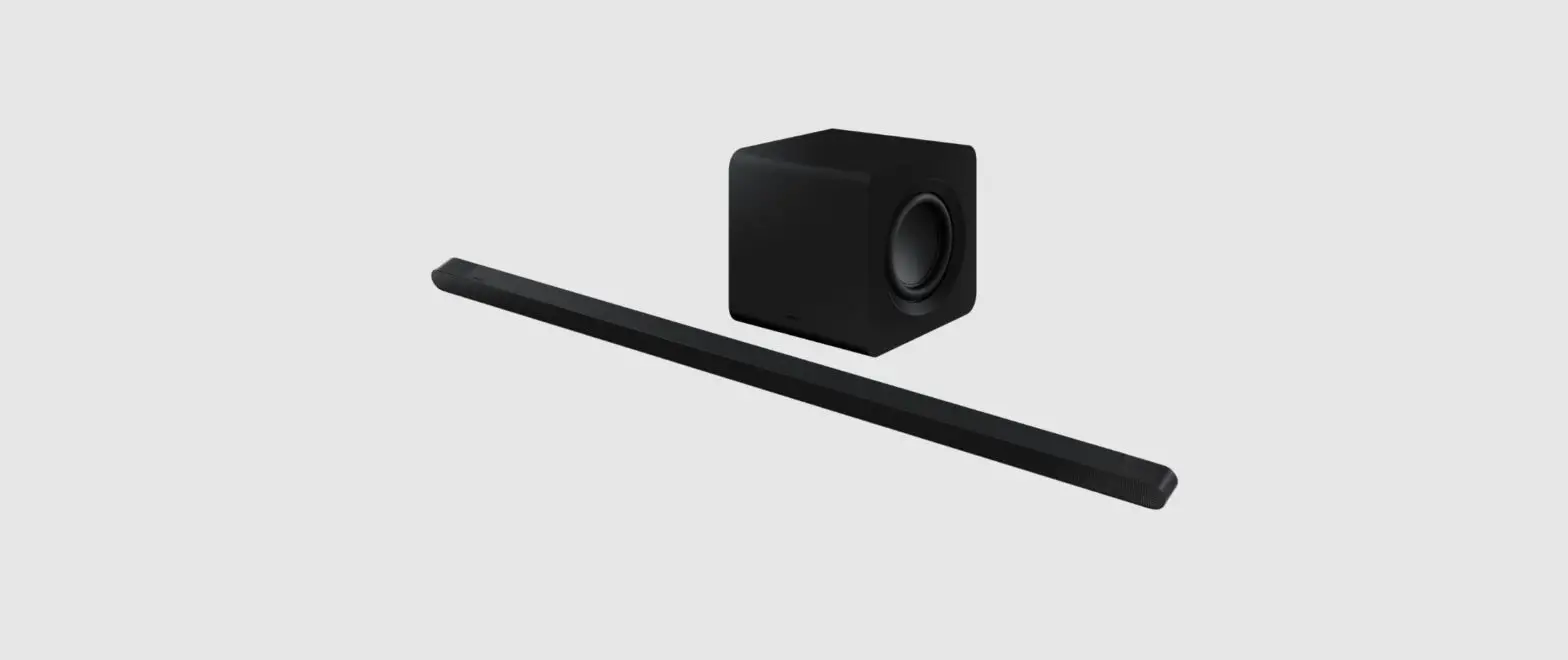
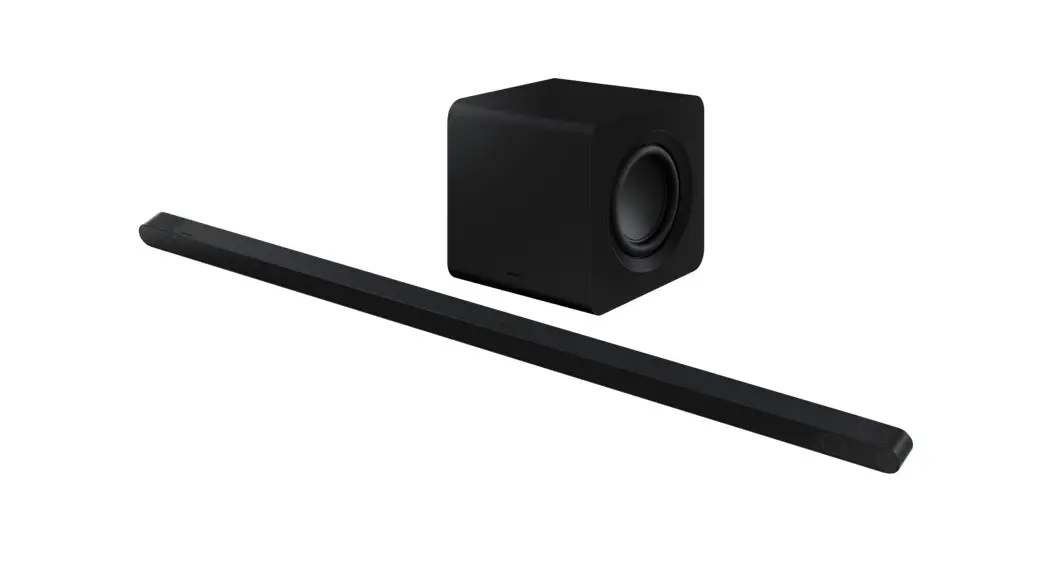
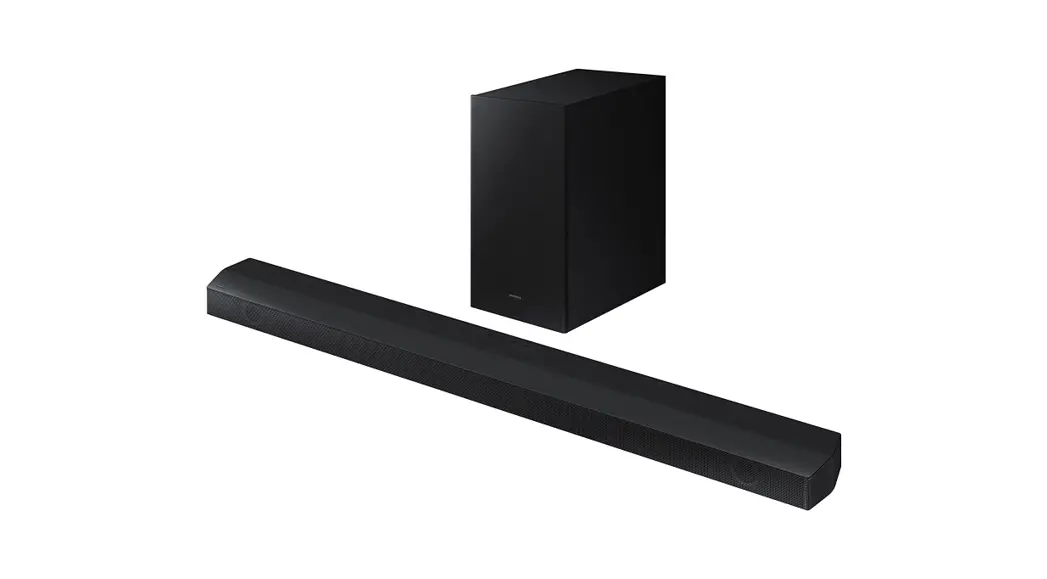
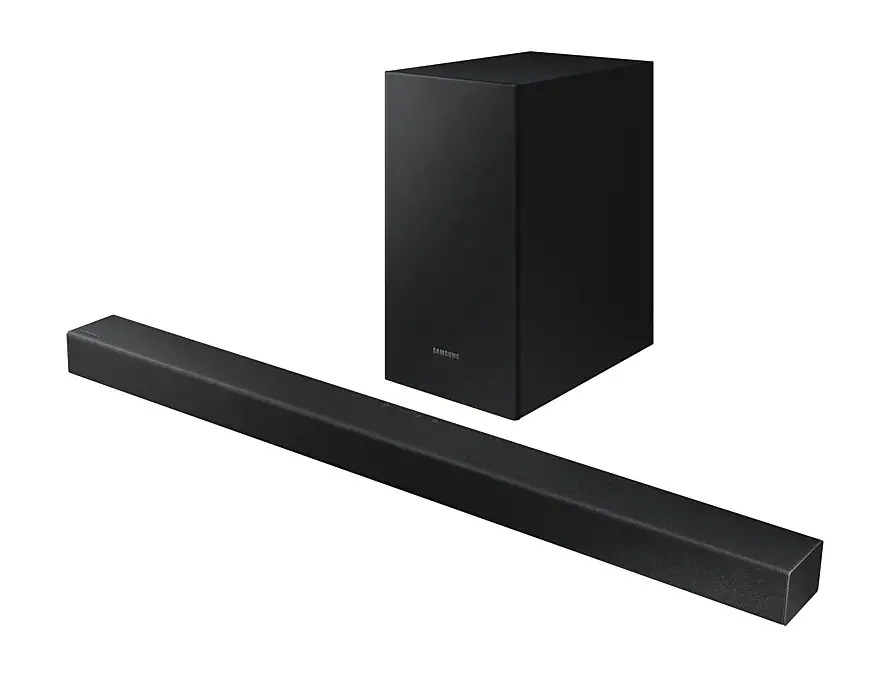
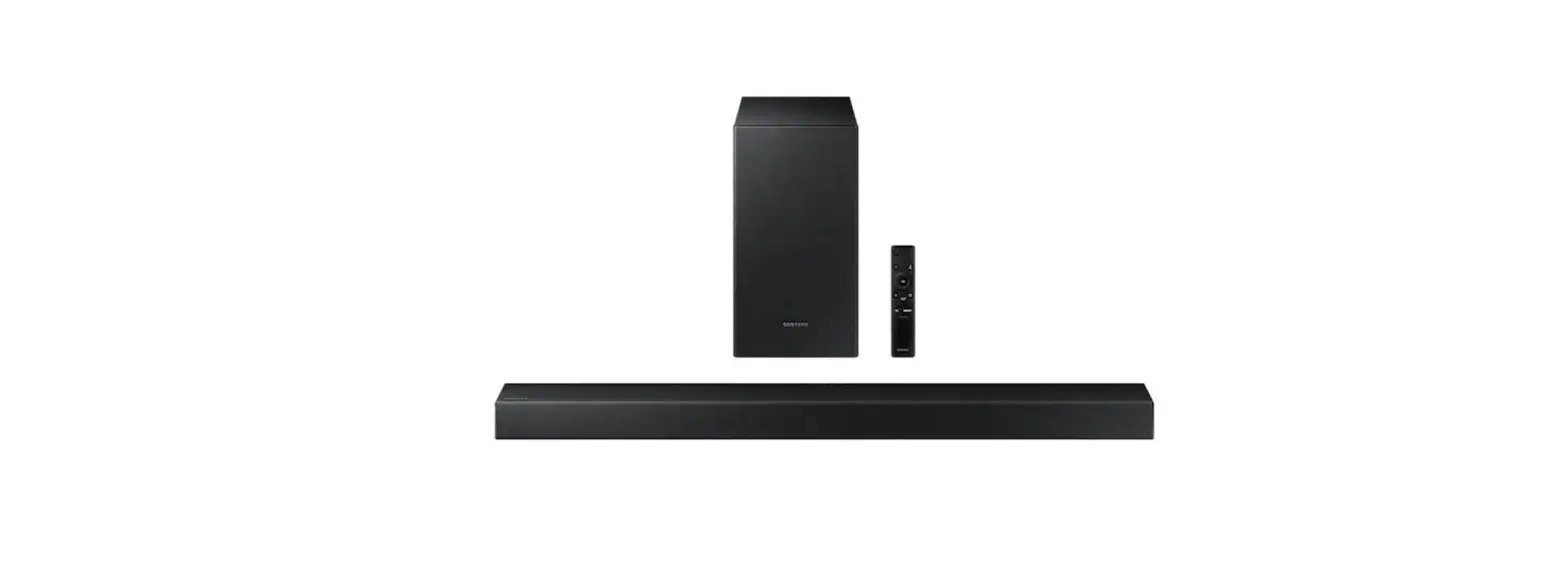
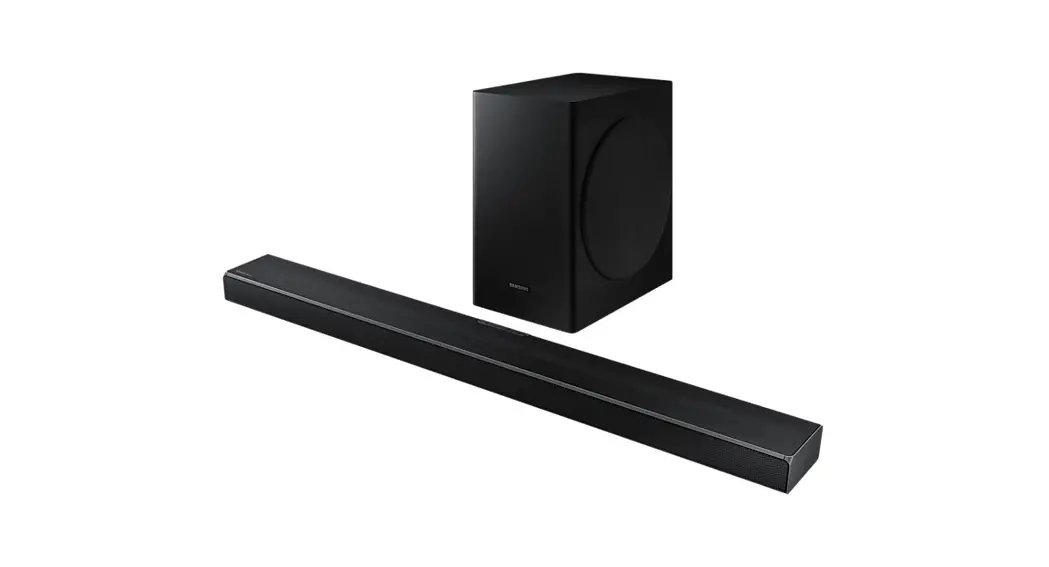
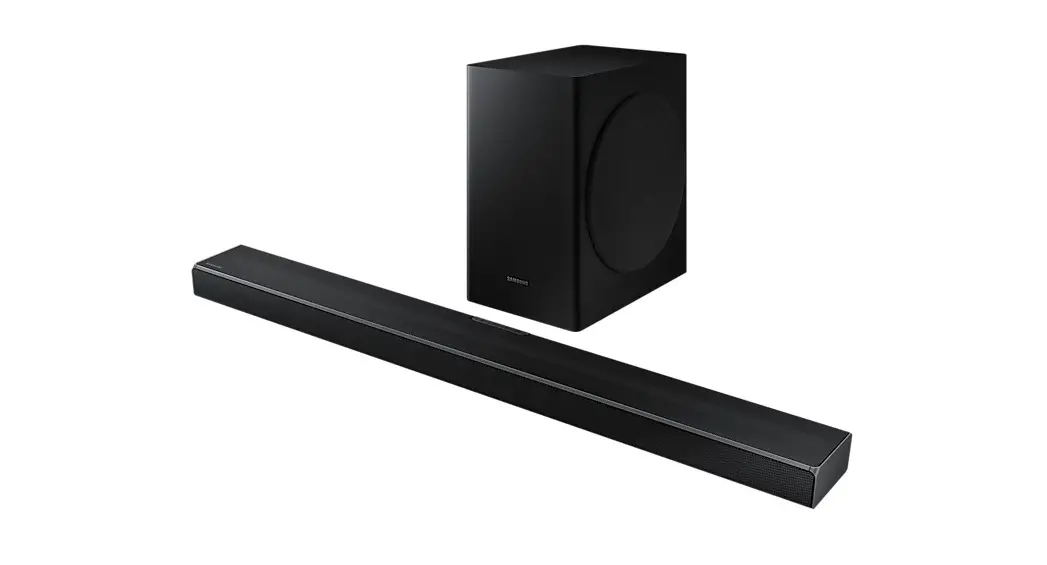
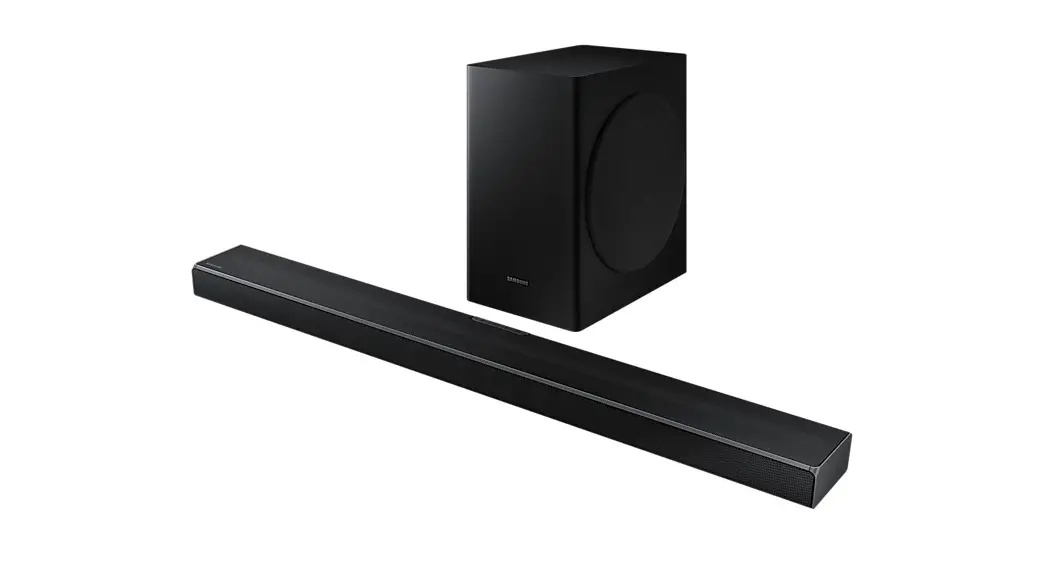
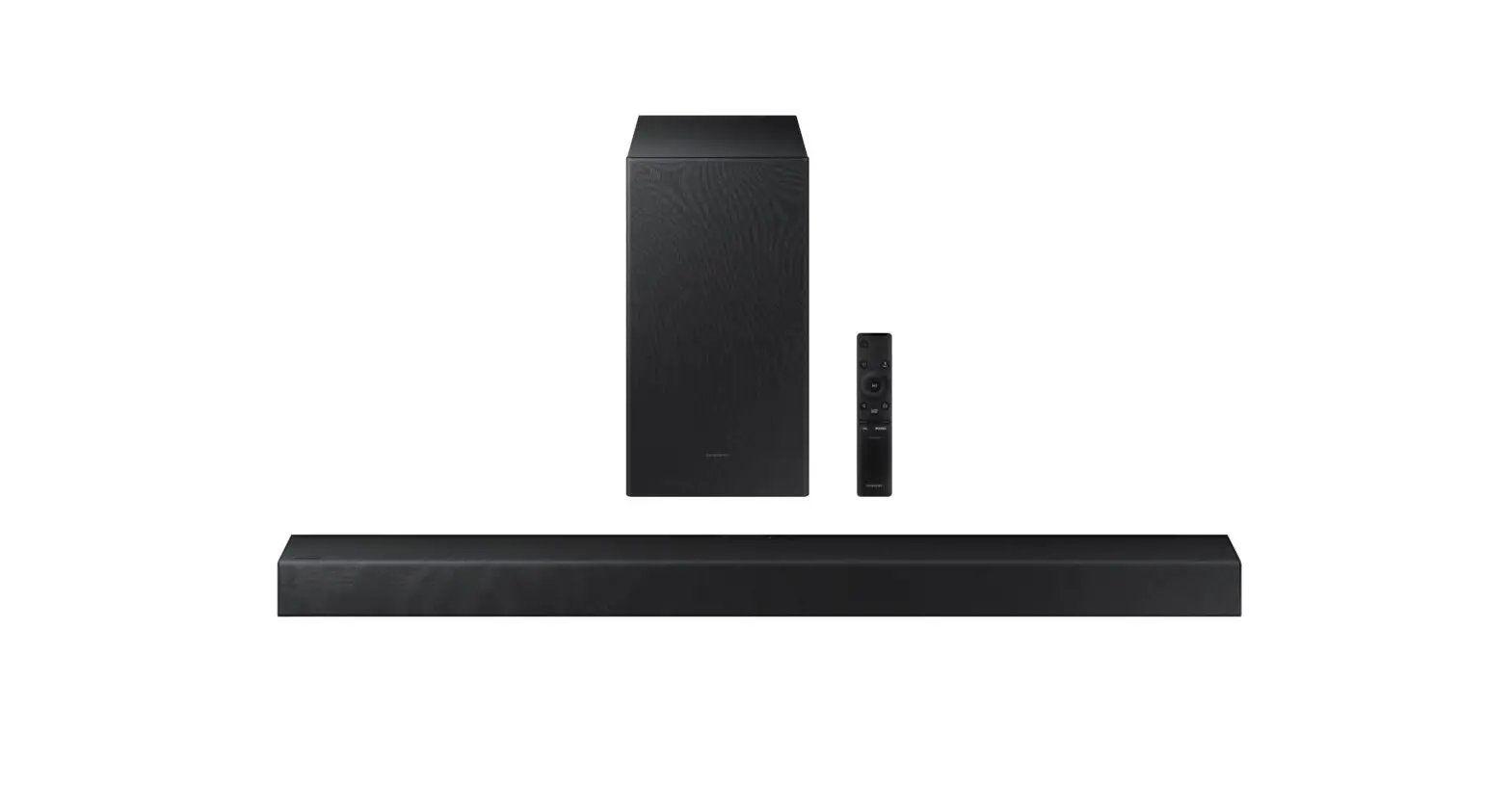
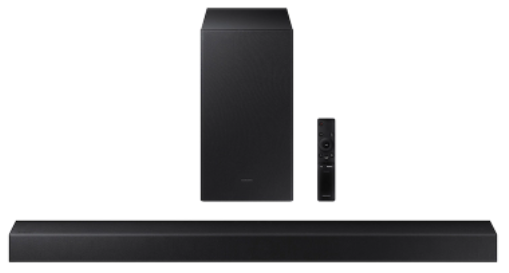
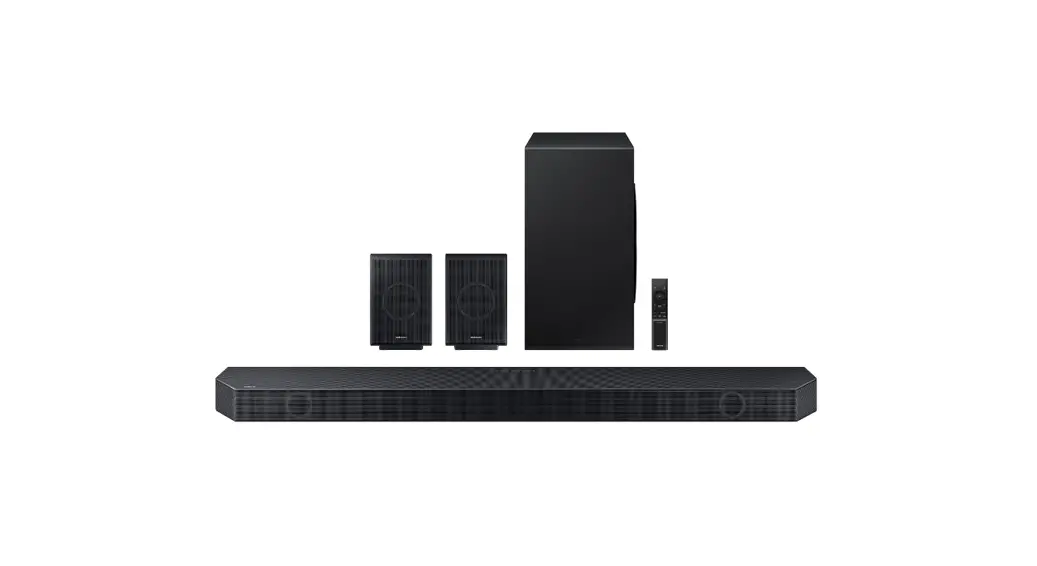
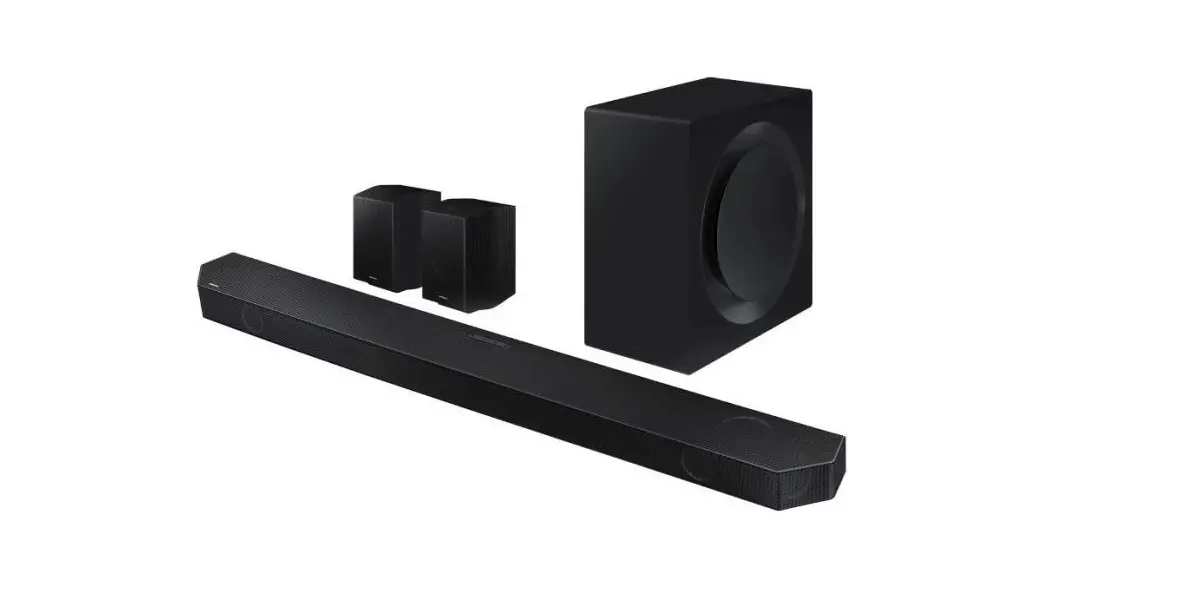
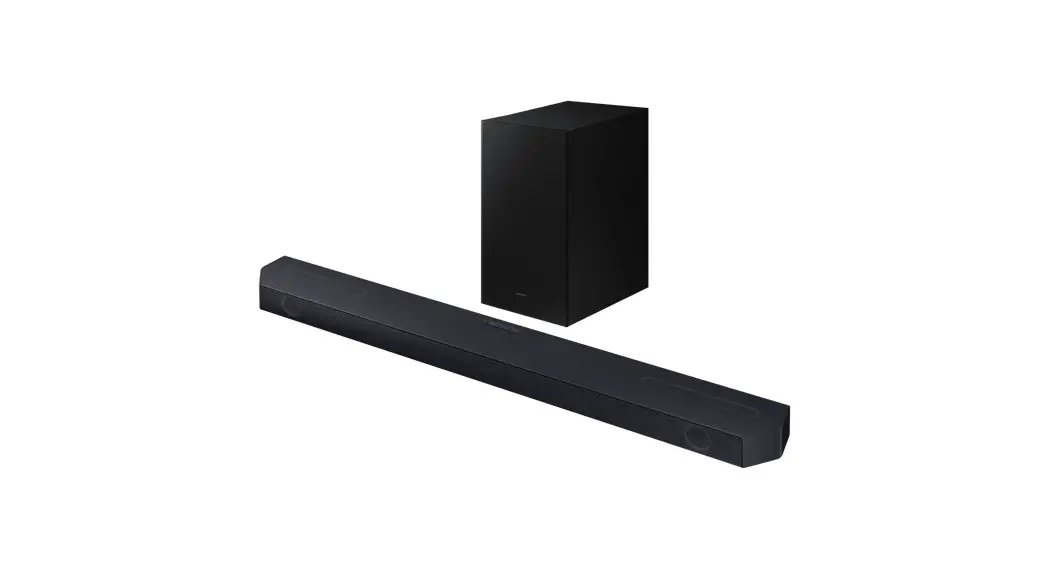
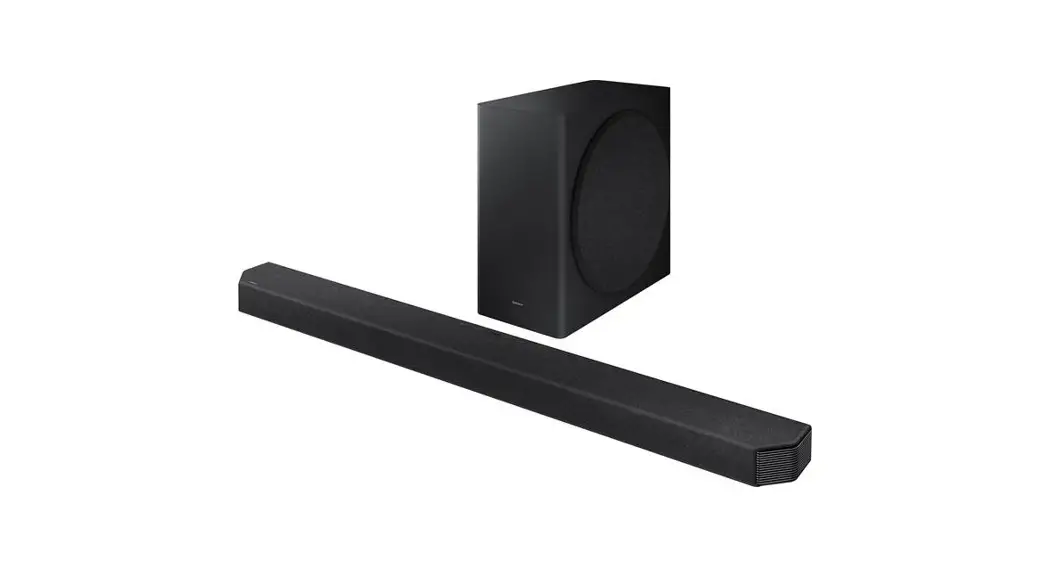
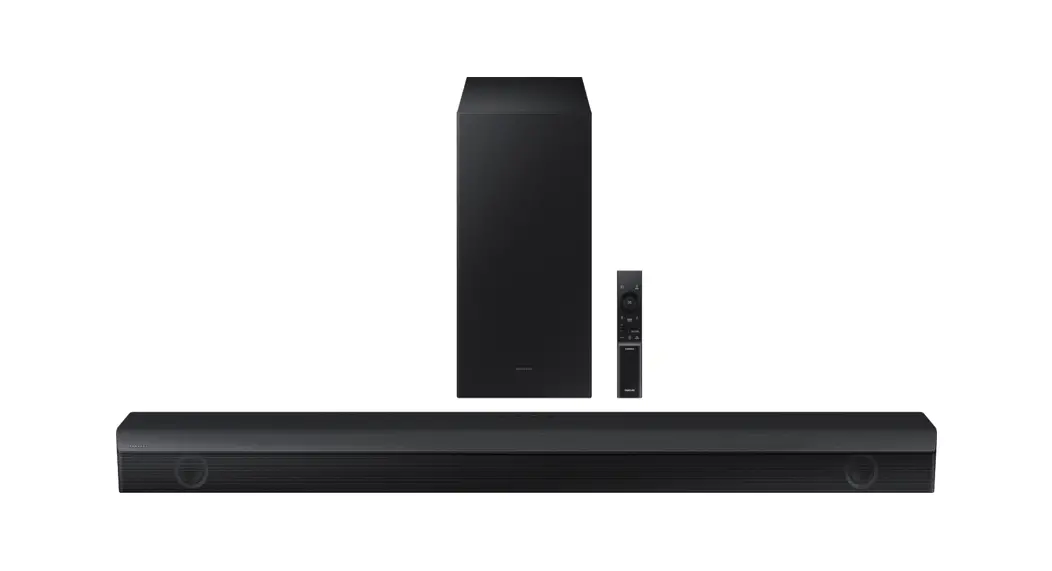
HW-S800B S-Series Soundbar
Product Information
Model Numbers
The product is available in two models: HW-S800B and
HW-S801B.
Safety Information
To reduce the risk of electric shock, do not remove the cover or
back. No user-serviceable parts are inside. Refer servicing to
qualified service personnel.
The product has important literature concerning operation and
maintenance. A safety connection to electrical earth (ground) is
not required for Class II products. If the product does not have a
symbol indicating a safety connection to electrical earth (ground),
it MUST have a reliable connection to protective earth
(ground).
Precautions
- Do not expose the unit to rain or moisture.
- During thunderstorms, disconnect the AC plug from the wall
outlet. Voltage peaks due to lightning could damage the unit. - Do not expose the unit to direct sunlight or other heat
sources. This could lead to overheating and cause the unit to
malfunction.
Contents
- Checking the Components
- Product Overview
- Top Panel of the Soundbar
- Rear Panel of the Soundbar
- Using the Soundbar Remote Control
- About the Remote Control
- How to Use the Remote Control
- Active Voice Amplifier (AVA)
- Using Hidden Buttons (Buttons with more than one function)
- Output specifications for different sound effect modes
Product Usage Instructions
Checking the Components
Check that all components are included in the box. Contact
Samsung customer service if any components are missing.
Product Overview
- Connect the soundbar to the TV using HDMI or Bluetooth.
- The top panel of the soundbar includes buttons for power,
volume, and input selection. - The rear panel of the soundbar includes ports for HDMI In, HDMI
Out, Optical In, and USB.
Using the Soundbar Remote Control
- About the Remote Control: The remote control is used to power
on/off the soundbar, adjust volume, select input source, and access
sound settings. - How to Use the Remote Control: Refer to the user manual for
instructions on how to use the remote control. - Active Voice Amplifier (AVA): AVA detects when there is ambient
noise and enhances the voices in the audio for clearer
dialogue. - Using Hidden Buttons (Buttons with more than one function):
Refer to the user manual for instructions on how to use the hidden
buttons on the remote control. - Output Specifications for Different Sound Effect Modes: Refer
to the user manual for specifications on output sound for different
sound effect modes.
FULL MANUAL
HW-S800B / HW-S801B
Imagine the possibilities Thank you for purchasing this Samsung product. To receive more complete service, please register your product at www.samsung.com/register
SAFETY INFORMATION
SAFETY WARNINGS
TO REDUCE THE RISK OF ELECTRIC SHOCK, DO NOT REMOVE THE COVER (OR BACK). NO USER-SERVICEABLE PARTS ARE INSIDE. REFER SERVICING TO QUALIFIED SERVICE PERSONNEL. Refer to the table below for an explanation of symbols which may be on your Samsung product.
CAUTION
RISK OF ELECTRIC SHOCK. DO NOT OPEN.
This symbol indicates that high voltage is present inside. It is dangerous to make any kind of contact with any internal part of this product.
This symbol indicates that this product has included important literature concerning operation and maintenance.
Class II product : This symbol indicates that a safety connection to electrical earth (ground) is not required. If this symbol is not present on a product with a power cord, the product MUST have a reliable connection to protective earth (ground).
AC voltage : Rated voltage marked with this symbol is AC voltage.
DC voltage : Rated voltage marked with this symbol is DC voltage.
Caution. Consult Instructions for use : This symbol instructs the user to consult the user manual for further safety related information.
WARNING · To reduce the risk of fire or electric shock, do not expose this
appliance to rain or moisture.
CAUTION · TO PREVENT ELECTRIC SHOCK, MATCH WIDE BLADE OF PLUG TO
WIDE SLOT, FULLY INSERT. · This apparatus shall always be connected to a AC outlet with a
protective grounding connection. · To disconnect the apparatus from the mains, the plug must be
pulled out from the mains socket, therefore the mains plug shall be readily operable. · Do not expose this apparatus to dripping or splashing. Do not put objects filled with liquids, such as vases, on the apparatus. · To turn this apparatus off completely, you must pull the power plug out of the wall socket. Consequently, the power plug must be easily and readily accessible at all times.
ENG – 2
PRECAUTIONS
1. Ensure that the AC power supply in your house complies with the power requirements listed on the identification sticker located on the bottom of your product. Install your product horizontally, on a suitable base (furniture), with enough space around it for ventilation (7~10 cm). Make sure the ventilation slots are not covered. Do not place the unit on amplifiers or other equipment which may become hot. This unit is designed for continuous use. To fully turn off the unit, disconnect the AC plug from the wall outlet. Unplug the unit if you intend to leave it unused for a long period of time.
2. During thunderstorms, disconnect the AC plug from the wall outlet. Voltage peaks due to lightning could damage the unit.
3. Do not expose the unit to direct sunlight or other heat sources. This could lead to overheating and cause the unit to malfunction.
4. Protect the product from moisture (i.e. vases), and excess heat (e.g. a fireplace) or equipment creating strong magnetic or electric fields. Unplug the power cable from the AC wall socket if the unit malfunctions. Your product is not intended for industrial use. It is for personal use only. Condensation may occur if your product has been stored in cold temperatures. If transporting the unit during the winter, wait approximately 2 hours until the unit has reached room temperature before using.
5. Fire or explosion may occur, resulting in damage to the remote control or personal injury. · Do not apply shock to the remote control. · Be careful not to let foreign substances such as metal, liquid, or dust come in contact with the charging terminal of the remote control. · When the remote control is damaged or you smell smoke or burning fumes, immediately stop operation and then repair it at the Samsung service centre. · Do not arbitrarily disassemble the remote control. · Be careful not to let infants or pets suck or bite the remote control. Fire or explosion may occur, resulting in damage to the remote control or personal injury.
ENG – 3
CONTENTS
01 Checking the Components
6
02 Product Overview
7
Top Panel of the Soundbar. . . . . . . . . . . . . . . . . . . . . . . . . . . . . . . . . . . . . . . . . . . . . . . . . . . . . . . . . . . . . . . . . . . . . . . . . . . . . . . . . . . . . . . . . . . . . . . . . . . . . .7
Rear Panel of the Soundbar . . . . . . . . . . . . . . . . . . . . . . . . . . . . . . . . . . . . . . . . . . . . . . . . . . . . . . . . . . . . . . . . . . . . . . . . . . . . . . . . . . . . . . . . . . . . . . . . . . . . 8
03 Using the Soundbar Remote Control
9
About the Remote control . . . . . . . . . . . . . . . . . . . . . . . . . . . . . . . . . . . . . . . . . . . . . . . . . . . . . . . . . . . . . . . . . . . . . . . . . . . . . . . . . . . . . . . . . . . . . . . . . . . . . 9
How to Use the Remote Control . . . . . . . . . . . . . . . . . . . . . . . . . . . . . . . . . . . . . . . . . . . . . . . . . . . . . . . . . . . . . . . . . . . . . . . . . . . . . . . . . . . . . . . . . . . . . . . . 9
Active Voice Amplifier (AVA) . . . . . . . . . . . . . . . . . . . . . . . . . . . . . . . . . . . . . . . . . . . . . . . . . . . . . . . . . . . . . . . . . . . . . . . . . . . . . . . . . . . . . . . . . . . . . . . . . . .11
Using the Hidden Buttons (Buttons with more than one function). . . . . . . . . . . . . . . . . . . . . . . . . . . . . . . . . . . . . . . . . . . . . . . . . . . . . . . . . . . . . . . . .11
Output specifications for the different sound effect modes . . . . . . . . . . . . . . . . . . . . . . . . . . . . . . . . . . . . . . . . . . . . . . . . . . . . . . . . . . . . . . . . . . . . . . .12
Adjusting the Soundbar volume with a TV remote control . . . . . . . . . . . . . . . . . . . . . . . . . . . . . . . . . . . . . . . . . . . . . . . . . . . . . . . . . . . . . . . . . . . . . . . 13
04 Connecting the Soundbar
14
Connecting the power and units. . . . . . . . . . . . . . . . . . . . . . . . . . . . . . . . . . . . . . . . . . . . . . . . . . . . . . . . . . . . . . . . . . . . . . . . . . . . . . . . . . . . . . . . . . . . . . . 14 Manually connecting the Subwoofer. . . . . . . . . . . . . . . . . . . . . . . . . . . . . . . . . . . . . . . . . . . . . . . . . . . . . . . . . . . . . . . . . . . . . . . . . . . . . . . . . . . . . . . . 15 LED Indicator Lights on the Rear of Subwoofer. . . . . . . . . . . . . . . . . . . . . . . . . . . . . . . . . . . . . . . . . . . . . . . . . . . . . . . . . . . . . . . . . . . . . . . . . . . . . . . 16
Connecting an SWA-9500S (Sold Separately) to your Soundbar . . . . . . . . . . . . . . . . . . . . . . . . . . . . . . . . . . . . . . . . . . . . . . . . . . . . . . . . . . . . . . . . . . 16
05 Connecting to a TV
17
Connecting the TV that supports HDMI ARC (Audio Return Channel) . . . . . . . . . . . . . . . . . . . . . . . . . . . . . . . . . . . . . . . . . . . . . . . . . . . . . . . . . . . . . .17
Connecting via Bluetooth. . . . . . . . . . . . . . . . . . . . . . . . . . . . . . . . . . . . . . . . . . . . . . . . . . . . . . . . . . . . . . . . . . . . . . . . . . . . . . . . . . . . . . . . . . . . . . . . . . . . . 18
Connecting via Wi-Fi . . . . . . . . . . . . . . . . . . . . . . . . . . . . . . . . . . . . . . . . . . . . . . . . . . . . . . . . . . . . . . . . . . . . . . . . . . . . . . . . . . . . . . . . . . . . . . . . . . . . . . . . . 19
Connecting to a TV that supports Dolby Atmos . . . . . . . . . . . . . . . . . . . . . . . . . . . . . . . . . . . . . . . . . . . . . . . . . . . . . . . . . . . . . . . . . . . . . . . . . . . . . . . . . 20
Using the Q-Symphony Function . . . . . . . . . . . . . . . . . . . . . . . . . . . . . . . . . . . . . . . . . . . . . . . . . . . . . . . . . . . . . . . . . . . . . . . . . . . . . . . . . . . . . . . . . . . . . . .21
Using the Spacefit sound . . . . . . . . . . . . . . . . . . . . . . . . . . . . . . . . . . . . . . . . . . . . . . . . . . . . . . . . . . . . . . . . . . . . . . . . . . . . . . . . . . . . . . . . . . . . . . . . . . . . . 22
06 Connecting a Mobile Device
23
Method 1. Connecting via Bluetooth . . . . . . . . . . . . . . . . . . . . . . . . . . . . . . . . . . . . . . . . . . . . . . . . . . . . . . . . . . . . . . . . . . . . . . . . . . . . . . . . . . . . . . . . . . . 23
Method 2. Connecting via Wi-Fi (Wireless Network). . . . . . . . . . . . . . . . . . . . . . . . . . . . . . . . . . . . . . . . . . . . . . . . . . . . . . . . . . . . . . . . . . . . . . . . . . . . . 25
Using the Tap Sound . . . . . . . . . . . . . . . . . . . . . . . . . . . . . . . . . . . . . . . . . . . . . . . . . . . . . . . . . . . . . . . . . . . . . . . . . . . . . . . . . . . . . . . . . . . . . . . . . . . . . . . . . 26
07 Connecting via Apple Airplay 2
27
08 Installing the Wall Mount
28
Installation Precautions . . . . . . . . . . . . . . . . . . . . . . . . . . . . . . . . . . . . . . . . . . . . . . . . . . . . . . . . . . . . . . . . . . . . . . . . . . . . . . . . . . . . . . . . . . . . . . . . . . . . . . 28
Wallmount Components. . . . . . . . . . . . . . . . . . . . . . . . . . . . . . . . . . . . . . . . . . . . . . . . . . . . . . . . . . . . . . . . . . . . . . . . . . . . . . . . . . . . . . . . . . . . . . . . . . . . . . 28
09 Installing the Soundbar in front of TV
29
ENG – 4
10 Software Update
30
Auto Update. . . . . . . . . . . . . . . . . . . . . . . . . . . . . . . . . . . . . . . . . . . . . . . . . . . . . . . . . . . . . . . . . . . . . . . . . . . . . . . . . . . . . . . . . . . . . . . . . . . . . . . . . . . . . . . . . 30
USB Update . . . . . . . . . . . . . . . . . . . . . . . . . . . . . . . . . . . . . . . . . . . . . . . . . . . . . . . . . . . . . . . . . . . . . . . . . . . . . . . . . . . . . . . . . . . . . . . . . . . . . . . . . . . . . . . . . 30
Reset . . . . . . . . . . . . . . . . . . . . . . . . . . . . . . . . . . . . . . . . . . . . . . . . . . . . . . . . . . . . . . . . . . . . . . . . . . . . . . . . . . . . . . . . . . . . . . . . . . . . . . . . . . . . . . . . . . . . . . . 30
11 Troubleshooting
31
12 Licence
32
13 Open Source Licence Notice
33
14 Important Notes About Service
33
15 Specifications and Guide
34
Specifications . . . . . . . . . . . . . . . . . . . . . . . . . . . . . . . . . . . . . . . . . . . . . . . . . . . . . . . . . . . . . . . . . . . . . . . . . . . . . . . . . . . . . . . . . . . . . . . . . . . . . . . . . . . . . . . 34
ENG – 5
01 CHECKING THE COMPONENTS
Soundbar Main Unit AC/DC Adapter (Soundbar)
Soundbar Remote Control x 2
Power Cord (Subwoofer, Soundbar)
Subwoofer HDMI to Micro HDMI Cable
A TYPE : 740mm B TYPE : 700mm
AH81-15127A-01
x 2
x 2
Wall Mount Guide
Bracket-Wall Mount
Holder-Screw
x 4
x 4
(M5 X L55)
Screw
Screw Anchor
· For more information about the power supply and power consumption, refer to the label attached to the product. (Label: Bottom of the Soundbar Main Unit)
· To purchase additional components or optional cables, contact a Samsung Service Centre or Samsung Customer Care. · For more information about the wallmount or rubber-foot, see pages 28~29. · Design, specifications, and App screen are subject to change without prior notice. · The appearance of the accessories may differ slightly from the illustrations above.
ENG – 6
02 PRODUCT OVERVIEW
Top Panel of the Soundbar
2
4
3
1
1 LED indicator The LED Indicator flashes, glows, or changes colour depending on the Soundbar’s current mode or status. The colour of the LED indicator and the number of lights indicate the active mode as described below.
W White LED
W White LED
M Multicolour LED
W White LED
W White LED
· The Multicolour LED changes to White, Cyan, Green, Red, and Blue depending on the mode or status.
2
(Multi Function) Button
· In standby mode, press the (Multi Function) button to turn on the Soundbar.
· Press the (Multi Function) button to change the mode. Each time you change the mode, the LED lights in white and then turns off.
LED indicator
White On Off
White On Off
White On Off
“TV ARC”
3
(Volume) Button
Adjusts the volume.
4
(Mic On/Off) Button
Press the button to turn the microphone on or off.
When the microphone is off, the LED indicator will light red.
LED indicator
Red On
“Wi-Fi”
“Bluetooth”
“Mic Off”
“Mic On”
· When you plug in the AC cord, the power button will begin working in 4 to 6 seconds. · When you turn on this unit, there will be a 4 to 5 second delay before it produces sound. · If you hear sounds from both the TV and Soundbar, go to the Settings menu for the TV audio and change the TV speaker to External Speaker. · You can turn on and off audio feedback by using SmartThings app. To learn about using the SmartThings app, refer to “Method 2. Connecting
via Wi-Fi (Wireless Network)”.
ENG – 7
Rear Panel of the Soundbar
SERVICE
1
HDMI (ARC)
2
3
DC 19V
SERVICE HDMI (ARC)
DC 19V
1 SERVICE Connect a USB storage device to upgrade the product’s software.
2 HDMI (ARC) Connect to the HDMI (ARC) port on a TV. (See page 17)
3 DC 19V Connect the AC/DC power adapter. (Power Supply In) (See page 14)
· When disconnecting the power cable of the AC/DC power adaptor from a wall outlet, pull the plug. Do not pull the cable.
· Do not connect this unit or other components to an AC outlet until all connections between components are complete.
ENG – 8
03 USING THE SOUNDBAR REMOTE CONTROL
About the Remote control
· Use the Remote less than 6 m from the product. The usable distance may vary with the wireless environmental conditions.
· When the remote control does not work due to low battery, charge it by using the USB-C type port. · The illustration differs with the respective Remote Control model.
USB port (C-type) for charging
How to Use the Remote Control
1
1
2
Power
4 3
5
6
7
2
8
9
Source
10
11
12
13
3
Turns the Soundbar on and off.
LED indicator
Cyan Blinks X1 On
Red Blinks X3 Off
· Auto Power Down Function The unit turns off automatically in the following situations: · In “TV ARC” / “Wi-Fi” / “Bluetooth” mode if there is no audio signal for 18 minutes.
Press to select a source connected to the Soundbar. · Audio Feedback On/Off
You can turn on or off the Audio Feedback. Press and hold the (Source) button on the remote control for 5 seconds while the
Soundbar is off (Standby mode).
LED indicator
Cyan Blinks X1 On
Red Blinks X1 Off
Press the indicated areas to select Up/Down/Left/Right.
Press Up/Down/Left/Right on the button to select or set functions.
Up/Down/Left/ · Music Skip
Right
Press the Right button to select the next music file. Press the Left
14
button to select the previous music file.
· ID SET
Press and hold the Up button for 5 seconds to complete ID SET (when
connecting to a wireless subwoofer or wireless rear speakers).
4
You can also play or pause music by pressing the button.
Play / Pause
5
Press the (Mute) button to mute the sound.
Press it again to unmute the sound.
Mute
LED
Blinks X Repeatly
indicator
ENG – 9
6
Press the button to display information about the current function. (See page 7)
When connected to Dolby Atmos®, the LED indicator blinks cyan 3 times.
Info
7
By pressing the button, you can select the desired audio mode. Each time the mode changes, the Multicolour LED
blinks in white.
SOUND MODE
LED indicator
White Blinks X1
“Surround” “Game” “Standard” “Adaptive Sound” “DTS Virtual:X”
· Surround Provides a wider sound field than standard.
· Game Provides stereoscopic sound to immerse you in the action while gaming.
· Standard Outputs the original sound.
· Adaptive Sound Analyzes the content in real time and automatically provides the optimal sound field based on the characteristics of the content.
· DTS Virtual:X Immersive 3D sound from any content.
8
Push the button up or down to adjust the volume.
VOLUME
LED indicator
White moves to right X1 Volume Up
White moves to left X1 Volume Down
9
Push the button up or down to adjust the level of the woofer (bass) to -12 or between -6 to +6. To set the woofer
(bass) volume level to 0 (Default), press the button. WOOFER (BASS)
LEVEL
10
Switch the Soundbar to Bluetooth pairing mode.
When you press the button, the LED display changes as shown below.
Bluetooth PAIR · Until pairing is complete, the Multicolour LED changes as Red Green Blue in turn.
LED indicator
Red Green Blue Blinks
Pairing
Cyan Blinks X3 Connection is complete
“Ready to connect via Bluetooth.”
11
By pressing the button, you can adjust the volume of the each speaker.
· To control the volume of the each speaker select “Centre Level” or “Front Top Level” in Sound Settings, and
CH LEVEL
then adjust the volume between -6~+6 by using the Up/Down buttons.
· If the Rear Speakers (sold separately) are connected, the setting “Rear Level” and “Rear Top Level” is
supported. To adjust the volume of the “Rear Level” and “Rear Top Level” between -6 to +6 by using the Up/
Down buttons.
LED indicator
White Blinks X1
“Centre Level” “Front Top Level”
ENG – 10
12
By pressing the button, you can adjust the volume of the treble or bass sound. The defired item can be adjusted
using the Up/Down buttons. This function is enabled in Sound mode excluding in Standard mode.
TONE CONTROL · To control the volume of the treble or bass sound, select “Treble” or “Bass” in Sound Settings, and then adjust
the volume between -6~+6 by using the Up/Down buttons.
· Once the bass level is changed, the woofer level will be also adjusted accordingly.
LED indicator
White Blinks X1
“Treble” “Bass”
13
By pressing the button, you can set the audio function. The desired item can be adjusted using the Up/Down
buttons. Each time the mode changes, the Multicolour LED blinks in white.
Sound Control
LED indicator
White Blinks X1
“SpaceFit Sound” “Active Voice Amplifier” “Voice enhancement” “Night Mode” “Sync” “Virtual”
· Voice enhancement makes it easier to hear spoken dialog in movies and TV. · Night Mode is optimized for night time viewing with the settings adjusted to bring the volume down but keep
the dialog clear. · Press and hold the (Sound Control) button for about 5 seconds to adjust the sound for each frequency band.
150Hz, 300Hz, 600Hz, 1.2kHz, 2.5kHz, 5kHz, and 10kHz are selectable using the Left/Right buttons and each can be adjusted to a setting between -6 to +6 using the Up/Down buttons. (Make sure the Sound mode is set to “STANDARD”.) · If the video on the TV and audio from the Soundbar are not synchronized, select “Sync” in Sound Control, and then set the audio delay between 0~300 milliseconds by using the Up/Down buttons. · “Sync” is only supported for some functions. · The Virtual function can be turned On/Off by using the Up/Down buttons.
14 USB port (C-type) The LED lights while charging. When fully charged, the LED turns off.
for charging
· The USB Cable is not provided.
· When the remote control does not work due to low battery, charge it by using the USB-C type port.
Active Voice Amplifier (AVA)
· Analyzes external noise in real time while soundbar is playing, so that voice audio can always be heard clearly. · No data is saved during the analysis.
Using the Hidden Buttons (Buttons with more than one function)
Remote Control Button WOOFER (Up) Up (Sound Control) (Source)
Hidden Button Function
TV remote control On/Off (Standby) ID SET
7 Band EQ Audio Feedback On/Off (Standby)
Reference page
page 13 page 9 page 11 page 9
ENG – 11
Output specifications for the different sound effect modes
Effect Surround
Game Standard Adaptive Sound DTS Virtual:X
Input
2.0 ch 5.1 ch Dolby Atmos® 2.0 ch 5.1 ch Dolby Atmos® 2.0 ch 5.1 ch Dolby Atmos® 2.0 ch 5.1 ch Dolby Atmos® 2.0 ch 5.1 ch Dolby Atmos®
With Subwoofer Only
3.1.2 ch 3.1.2 ch 3.1.2 ch 3.1.2 ch 3.1.2 ch 3.1.2 ch 2.1 ch 3.1 ch 3.1.2 ch 3.1.2 ch 3.1.2 ch 3.1.2 ch 3.1.2 ch 3.1.2 ch 3.1.2 ch
Output With Subwoofer & Wireless Rear Speaker Kit 5.1.4 ch 5.1.4 ch 5.1.4 ch 5.1.4 ch 5.1.4 ch 5.1.4 ch 2.1 ch 5.1 ch 5.1.4 ch 5.1.4 ch 5.1.4 ch 5.1.4 ch 5.1.4 ch 5.1.4 ch 5.1.4 ch
· The Samsung Wireless Rear Speaker Kit can be purchased separately. To purchase a Kit, contact the vendor you purchases the Soundbar from.
· The Surround Speakers will not produce sounds for 2 channel output while STANDARD mode is in use. To enable sound for the Surround Speakers, change the effect mode to SURROUND.
· When the input source is Dolby Atmos® the Subwoofer-only setup provides 3.1.2 channel audio, while the Subwoofer & Wireless Rear Speaker Kit setup provides 5.1.4 channel audio.
ENG – 12
Adjusting the Soundbar volume with a TV remote control
Adjust the Soundbar volume using the TV’s remote control.
· This function can be used with IR remote controls only. Bluetooth remote controls (remote controls that require pairing) are not supported.
· Set the TV speaker to External Speaker to use this function. · Manufacturers supporting this function:
Samsung, VIZIO, LG, Sony, Sharp, PHILIPS, PANASONIC, TOSHIBA, Hisense, RCA
1. Turn Off the Soundbar. 2. Push up and hold the WOOFER button for 5 seconds.
Each time you push the WOOFER button up and hold it for 5 seconds, the mode switches in the following order: “OFF-TV REMOTE” (Default mode), “SAMSUNG-TV REMOTE”, “ALL-TV REMOTE”.
Remote Control Button
LED Indicator (Default mode)
Status
Red Blinks X1
“Off-TV Remote” (Default mode)
Disable the TV remote control.
Cyan Blinks X1 “Samsung-TV Remote”
Enable a Samsung TV’s IR remote control.
Blue Blinks X1 “All-TV Remote”
Enable a third-party TV’s IR remote control.
ENG – 13
04 CONNECTING THE SOUNDBAR
Connecting the power and units
Use the Power cord to connect the Subwoofer and Soundbar to an electrical outlet in the following order: · For more information about the required electrical power and power consumption, refer to the label attached to the product. (Label: Bottom
of the Soundbar Main Unit) 1. Connect the Power cord to the Subwoofer.
Rear of Subwoofer 2. Connect the Power cord to the Soundbar.
Power Cord
DC 19V
DC 19V
Rear of the Soundbar Main Unit
AC/DC Adapter
Power Cord
3. Connect power to the Soundbar and Subwoofer. The Subwoofer is automatically connected when the Soundbar is turned on.
LINK LED – Blue is On
NOTE · Connect the Subwoofer power before connecting to the Soundbar. The Subwoofer will be automatically connected when turning on the
Soundbar. · If you unplug and reconnect the power cord when the product is turned on, the Soundbar turns on automatically.
ENG – 14
Manually connecting the Subwoofer
Before performing the manual connection procedure below: · Check whether the power cables for the Soundbar and subwoofer is connected properly. · Make sure that the Soundbar is turned off. 1. Turn off the Soundbar main. 2. Press and hold ID SET on the rear of the subwoofer for at least 5 seconds.
· The red indicator at the rear of each speaker turns off and the blue indicator blinks.
5 Sec
Blinking blue fast
Rear of Subwoofer 3. Press the Up button on the remote control for 5 seconds.
· The Soundbar will automatically power on when ID SET is complete.
5 Sec
Rear of Subwoofer
LED indicator
Red Green Blue Blinks
4. Check if the LINK LED is solid blue (connection complete).
The LINK LED indicator stops blinking and glows a solid blue when a connection is established between the Soundbar and the Wireless Subwoofer.
LINK LED – Blue is On
ENG – 15
LED Indicator Lights on the Rear of Subwoofer
LED Blue
Red
Status On
Blinking
On
Description Successfully connected
(normal operation)
Resolution
Recovering the connection
Check if the power cable attached to the main Soundbar unit is connected properly or wait about 5 minutes. If blinking persists, try manually connecting the subwoofer. See page 15.
Standby (with the Soundbar main unit turned off)
Check if the power cable attached to the main Soundbar unit is connected properly.
Connection failed
Connect again. See the instructions for manual connection on page 15.
Red and blue
Blinking
Malfunction
See the contact information for the Samsung Service Centre in this manual.
NOTE · If the main unit is powered off, the wireless subwoofer will go into stand-by mode and the STANDBY LED on the rear of the sub-woofer will
turn red after blinking in blue several times. · If you use a device that uses the same frequency as the Soundbar near the Soundbar, interference may cause some sound interruption. · The maximum transmission distance of the main unit’s wireless signal is about 10 m, but may vary depending on your operating environment.
If a steel-concrete or metallic wall is between the main unit and the wireless subwoofer, the system may not operate at all because the wireless signal cannot penetrate metal.
CAUTION · Wireless receiving antennas are built into the wireless subwoofer. Keep the unit away from water and moisture. · For optimal listening performance, make sure that the area around the wireless subwoofer is clear of any obstructions.
Connecting an SWA-9500S (Sold Separately) to your Soundbar
Expand to true wireless surround sound by connecting the Samsung Wireless Rear Speaker Kit (SWA-9500S, sold separately) to your Soundbar. For detailed information on connections, see the Samsung Wireless Rear Speaker Kit manual.
ENG – 16
05 CONNECTING TO A TV
Connecting the TV that supports HDMI ARC (Audio Return Channel)
CAUTION
· When using an HDMI to Micro HDMI cable, take caution not to break the cable terminal. · When the HDMI cable is connected, the HDMI signal is received first. · To connect the HDMI cable between the TV and Soundbar, be sure to connect the terminals marked ARC. Otherwise, the TV sound may not
be output. · The recommended cable is High Speed HDMI Cable with Ethernet.
Connect to the HDMI IN (ARC) or (eARC) port of your TV.
Connect to the HDMI (ARC) port of the Soundbar main
unit.
HDMI IN (ARC)
HDMI to Micro HDMI Cable
HDMI (ARC)
Top of the Soundbar
Rear of the Soundbar
LED indicator
White On Off
“TV ARC”
1. With the Soundbar and TV turned off, connect the HDMI cable as shown in the figure. 2. Turn on the Soundbar and TV. 3. Your TV will output sound via the Soundbar.
· When the TV sound is not output, press the (Multi Function) button at the top of the Soundbar or the control to select the “TV ARC” mode.
· When the sound is not output, check the HDMI cable connection again. · Use the volume buttons on the TV’s remote control to change the volume on the Soundbar.
(Source) button on the remote
NOTE
· We recommend you use a coreless HDMI cable if possible. If you use a cored HDMI cable, use one whose diameter is less than 14 mm. · This function is not available if the HDMI cable does not support ARC. · When the audio in a broadcast is encoded in Dolby Digital and the “Digital Output Audio Format” on your TV is set to PCM, we recommend that
you change the setting to Dolby Digital. When the setting on the TV is changed, you will experience better sound quality. (The TV menu may use different words for Dolby Digital and PCM depending on the TV manufacturer.)
ENG – 17
Connecting via Bluetooth
When a Samsung TV is connected using Bluetooth, you can hear stereo sound without the hassle of cabling. · Only one Samsung TV can be connected at a time. · Samsung TV that supports Bluetooth can be connected. Check the specifications of your TV.
The initial connection
1.
Bluetooth Pairing button
S MOD
+ _
CH LEVEL
WOOFER TCOONNETROL
SOUNDBAR
(OR) When in “Bluetooth” mode
LED Indicator
Red Green Blue Blinks
Cyan Blinks X3
Pairing
Connection is complete
· Until pairing is complete, the Multicolour LED changes as Red Green Blue in turn.
5 Sec
“Ready to connect via Bluetooth.”
1.
2. Select Bluetooth mode on the Samsung TV. (e.g. Home ( ) Menu Settings ( ) All Settings ( ) Sound Sound Output Bluetooth Speaker List [AV] Samsung Soundbar S***B (Bluetooth))
3. Select “[AV] Samsung Soundbar S***B” from the list on TV’s screen. An available Soundbar is indicated with “Need Pairing” or “Paired” on the TV’s Bluetooth device list. To connect the Samsung TV to the Soundbar, select the message, and then establish a connection.
4. You can now hear Samsung TV sound from the Soundbar.
If the device fails to connect · If you have an existing Soundbar (e.g., [AV] Samsung Soundbar S***B) on the list of speakers on the Samsung TV, delete it. · Then repeat steps 1 through 3.
Disconnecting the Soundbar from the Samsung TV
Press the (Multi Function) button at the top of the Soundbar or the (Source) button on the remote control to select the mode other than “Bluetooth”. · Disconnecting takes time because the Samsung TV must receive a response from the Soundbar.
(The time required may differ, depending on the Samsung TV model.)
Notes on Bluetooth connection
· Locate a new device within 1 m to connect via Bluetooth communication. · If asked for a PIN code when connecting a Bluetooth device, enter <0000>. · The Soundbar automatically turns off after 18 minutes in the Ready state. · The Soundbar may not perform Bluetooth search or connection correctly under the following circumstances:
If there is a strong electrical field around the Soundbar. If several Bluetooth devices are simultaneously paired with the Soundbar. If the Bluetooth device is turned off, not in place, or malfunctions. · Electronic devices may cause radio interference. Devices that generate electromagnetic waves must be kept away from the Soundbar main unit – e.g., microwaves, wireless LAN devices, etc.
ENG – 18
Connecting via Wi-Fi
Pre-connection Checklist · Wi-Fi connection is available only on Samsung TV. · Check whether the wireless router (Wi-Fi) is turned on and the TV is connected to the router. · The TV and Soundbar must be connected to the same wireless network (Wi-Fi). · If your wireless router (Wi-Fi) uses a DFS channel, you will not be able to establish a Wi-Fi connection between the TV and Soundbar.
Contact your Internet service provider for details. · Because the menus may differ depending on the year of manufacture, refer to your TV manual. · To connect the TV to the Soundbar via Wi-Fi, connect the Soundbar to the wireless router first. See page 25, for details on how to
establish a Wi-Fi connection. 1. For more information about Wi-Fi connection to the Soundbar, see page 25, “Method 2. Connecting via Wi-Fi (Wireless Network)”. 2. Change the input source of the TV by using the Audio menu to Soundbar.
· Samsung TVs released in 2017 or later Sound Sound Output [AV] Samsung Soundbar S***B (Wi-Fi)
ENG – 19
Connecting to a TV that supports Dolby Atmos
Pre-connection Checklist · Dolby Atmos® is supported in “TV ARC” or “Wi-Fi” mode. · Make sure that the content supports Dolby Atmos®.
Connect to the HDMI IN (ARC) port of your TV.
HDMI IN (ARC)
HDMI to Micro HDMI Cable
Top of the Soundbar
HDMI (ARC)
Rear of the Soundbar
LED indicator
White On Off
“TV ARC”
1. With the Soundbar and TV turned off, connect the HDMI cable as shown in the figure. 2. Turn on the Soundbar and TV. 3. TV sound is output from the Soundbar.
TV menu
Wi-Fi
LED indicator
White On Off “Wi-Fi”
1. Connect the Soundbar and TV to the same wireless network (Wi-Fi). 2. For sound output of the TV, select Soundbar. 3. TV sound is output from the Soundbar.
NOTE · When you use Dolby Atmos®: If the input source is Dolby Atmos®, refer to “Output specifications for the different sound effect modes” on
page 12. · Configuring Dolby Atmos® on your BD player or other device connected to the TV.
Open the audio output options on the settings menu of your BD player or other device and make sure that “No Encoding” is selected for Bitstream. For example, on a Samsung BD Player, go to Home Menu Sound Digital Output and then select Bitstream (unprocessed). · This function is available in some Samsung TVs and some Soundbar models.
ENG – 20
Using the Q-Symphony Function
For Q-Symphony, the Soundbar syncs with a Samsung TV to output sound through two devices for optimum surround effect. When the Soundbar is connected, the menu, “TV+Soundbar” appears under the Sound Output menu of the TV. Select the corresponding menu.
TV menu
HDMI to Micro HDMI Cable
LED indicator
· TV menu example: TV + [AV] Soundbar series name (HDMI)
TV menu
Wi-Fi
White On Off “TV ARC”
LED indicator
White On Off “Wi-Fi”
· TV menu example: TV + [AV] Soundbar series name (Wi-Fi)
NOTE · It can operate according to the Codec supported by TV. · This function is supported only when the HDMI Cable or Wi-Fi is connected. · Ensure that your TV and Soundbar are connected to the same wireless router/frequency. · This function is available in some Samsung TVs and some Soundbar models.
ENG – 21
Using the Spacefit sound
Provides optimized sound quality by analyzing the listening spaces.
Method 1. Connecting via Soundbar
To enable this function, turn on the SpaceFit Sound mode with the remote control of the Soundbar. ( (Sound Control) “SpaceFit Sound Off” ( Up ) “SpaceFit Sound On”) · This is available in all Sound modes.
Method 2. Connecting via TV
To enable this function, turn on the Adaptive Sound+ mode on your Samsung TV menu. (Home ( ) Menu Settings ( ) All Settings ( ) General Intelligent Mode Settings Adaptive Sound+) · The sound mode on your Soundbar will automatically change to Adaptive Sound+ if you enable the Adaptive Sound+ mode on your TV. NOTE This function works when the Soundbar connects to some of the Samsung TVs.
ENG – 22
06 CONNECTING A MOBILE DEVICE
Method 1. Connecting via Bluetooth
When a mobile device is connected using Bluetooth, you can hear stereo sound without the hassle of cabling. · When you connect a paired Bluetooth device with the Soundbar off, the Soundbar automatically
turns on.
Mobile device
The initial connection When connecting to a new Bluetooth device, make sure the device is within 1 m distance.
1.
Bluetooth Pairing button
LED Indicator
S MOD
+ _
CH LEVEL
WOOFER TCOONNETROL
SOUNDBAR
(OR) When in “Bluetooth” mode
Red Green Blue Blinks
Cyan Blinks X3
Pairing
Connection is complete
· Until pairing is complete, the Multicolour LED changes as Red Green Blue in turn.
5 Sec
“Ready to connect via Bluetooth.”
1.
2. On your device, select “[AV] Samsung Soundbar S***B” from the list that appears. 3. Play music files from the device connected via Bluetooth through the Soundbar.
If the device fails to connect · If you have an existing Soundbar (e.g., “[AV] Samsung Soundbar S***B”) in the list of speakers on the Mobile device, delete it. · Repeat steps 1 and 2.
Notes on Bluetooth connection
· Locate a new device within 1 m to connect via Bluetooth communication. · If asked for a PIN code when connecting a Bluetooth device, enter <0000>. · The Soundbar automatically turns off after 18 minutes in the Ready state. · The Soundbar may not perform Bluetooth search or connection correctly under the following circumstances:
If there is a strong electrical field around the Soundbar. If several Bluetooth devices are simultaneously paired with the Soundbar. If the Bluetooth device is turned off, not in place, or malfunctions. · Electronic devices may cause radio interference. Devices that generate electromagnetic waves must be kept away from the Soundbar main unit – e.g., microwaves, wireless LAN devices, etc. · The Soundbar supports SBC data (44.1kHz, 48kHz). · Connect only to a Bluetooth device that supports the A2DP (AV) function. · You cannot connect the Soundbar to a Bluetooth device that supports only the HF (Hands Free) function. · When connecting the Soundbar to a Bluetooth device, place them as close to each other as possible. · The farther the Soundbar and Bluetooth device are from each other, the lower the sound quality will become. The Bluetooth connection may break when the devices are out of the effective range. · The Bluetooth connection may not function as intended in areas with poor reception.
ENG – 23
· A Bluetooth device may experience noise or malfunction under in the following conditions: When the body is in contact with the signal transceiver on the Bluetooth device or Soundbar In corners or when there is an obstacle in proximity, such as a wall or partition, where electrical changes may occur. When exposed to radio interferences by other products operating on the same frequency ranges, such as medical equipment, microwave ovens, and wireless LAN devices. Obstacles such as doors and walls may still impact the sound quality even when the devices are within the effective range.
· Note that your Soundbar cannot be paired with other Bluetooth devices while using the Bluetooth option. · This wireless device may cause electrical interference during operation.
Disconnecting the Bluetooth device from a Soundbar
You can disconnect a Bluetooth device from the Soundbar. For instructions, see the Bluetooth device’s user manual. · The Soundbar will be disconnected. · If the Soundbar is disconnected from the Bluetooth device, the multicolour LED indicator on the Soundbar blinks “Red” three times.
Disconnecting the Soundbar from the Bluetooth device
Press the (Multi Function) button on the top of the Soundbar or the (Source) button on the remote control to switch the mode from “Bluetooth”. · Disconnecting takes time because the Bluetooth device must receive a response from the Soundbar. (Disconnection time may differ,
depending on the Bluetooth device)
ENG – 24
Method 2. Connecting via Wi-Fi (Wireless Network)
To connect a Soundbar to a mobile device via a wireless network (Wi-Fi), the SmartThings app is required.
The initial connection 1. Install and launch the SmartThings app from your mobile device (smartphone or tablet). 2. On the app, follow the screen instructions to add the Soundbar.
· The automatic pop-up (the second screenshot below) may not show on some devices. If the pop-up window does not appear, press ” ” on the Home screen. The Soundbar is added to the app.
· The illustration below may differ with the app version.
SmartThings App
Launch App
Auto pop-up
Add device
ENG – 25
Using the Tap Sound
Tap the Soundbar with your mobile device to play the sound of content on the mobile device through the Soundbar.
· This function may not be supported, depending on the mobile device. · This function is only compatible with Samsung mobile devices with Android 8.1 or later.
SmartThings App
Top of the Soundbar
Mobile device
1. Turn on the Tap Sound function on your mobile device. · For details on how to turn on the function, refer to “Setting the Tap Sound function” below.
2. Tap the Soundbar with the mobile device. Select “Start now” in the displayed message window. A connection is established between the mobile device and Soundbar via Bluetooth.
3. Play the sound of content on the mobile device through the Soundbar. · This function connects a mobile device to the Soundbar via Bluetooth by detecting vibration that occurs when the device touches the Soundbar. · Make sure the mobile device does not tap a sharp corner of the Soundbar. The Soundbar or mobile device may become scratched or damaged. · It is recommended that the mobile device be covered with a case. Lightly tap the wide area in the upper portion of the Soundbar, without using excessive force. · To use this function, update the SmartThings app to the latest version. The function may not be supported, depending on the app version.
Setting the Tap Sound function
Use the SmartThings app to turn on the Tap View, Tap Sound function. 1. On the mobile device, run the SmartThings app. 2. Select ( ) in the SmartThings app screen displayed on the mobile device. 3. Set “Tap View, Tap Sound” to On to allow the function to work when a mobile device moves close to the Soundbar. The function is turned on.
NOTE · When the mobile device is in power-saving mode, the Tap Sound function does not work. · The Tap Sound function may not work if there are devices near the Soundbar that cause radio interference such as electric devices. Make sure
devices that may cause radio interference are placed at a sufficient distance away from the Soundbar.
ENG – 26
07 CONNECTING VIA APPLE AIRPLAY 2
· This feature may not be available in some countries. · This Samsung Soundbar supports AirPlay 2 and requires iOS 11.4 or later. With AirPlay 2, you can stream music, podcasts, and other audio from your Apple devices to the Samsung Soundbar. · Make sure the Soundbar is powered on and connected to the same Wi-Fi network as your Apple device. · Select from an AirPlay-supported app or Control Centre on your iPhone, iPad, or Mac. · Select the Soundbar from the list of available devices to play the current audio to.
ENG – 27
08 INSTALLING THE WALL MOUNT
Installation Precautions
· Install on a vertical wall only. · Do not install in a place with high temperature or humidity. · Verify whether the wall is strong enough to support the product’s
weight. If not, reinforce the wall or choose another installation point. · Connect cables from the unit to external devices before you install the Soundbar on the wall. · Make sure the unit is turned off and unplugged before you install it. Otherwise, it may cause an electric shock.
Wallmount Components
A TYPE : 740mm B TYPE : 700mm
AH81-15127A-01
Wall Mount Guide
2. Align the Wall Mount Guide’s Centre Line with the centre of your TV (if you are mounting the Soundbar below your TV), and then fix the Wall Mount Guide to the wall using tape. · If you are not mounting below a TV, place the Centre Line in the centre of the installation area.
A TYPE : 740mm B TYPE : 700mm
AH81-15127A-01
Centre Line
3. Push a pen tip or sharpened pencil tip through the centre of the A-TYPE and B-TYPE images on each end of the Guide to mark the holes for the supporting screws, and then remove the Wall Mount Guide.
A TYPE : 740mm B TYPE : 700mm
AH81-15127A-01
x 2 Holder-Screw
x 2
x 4 (M5 X L55)
Screw x 4
Bracket-Wall Mount
Screw Anchor
1. Place the Wall Mount Guide against the wall surface. · The Wall Mount Guide must be level. · If your TV is mounted on the wall, install the Soundbar at least 5 cm below the TV.
4. Using an appropriately sized drill bit, drill a hole in the wall at each marking. · If the markings do not correspond to the positions of studs, make sure you insert appropriate anchors or mollies into the holes before you insert the support screws. If you use anchors or mollies, make sure the holes you drill are large enough for the anchors or mollies you use.
5. Push a screw (not supplied) through each Screw, and then screw each screw firmly into a support screw hole.
5 cm or more
ENG – 28
6. Install the 2 Bracket-Wall Mounts in the correct orientation on the rear of the Soundbar using 2 Holder-screws.
09 INSTALLING THE SOUNDBAR IN FRONT OF TV
· When assembling, make sure the hanger part of the BracketWall Mounts are located behind the rear of the Soundbar.
Rear of Soundbar
Right end of Soundbar
7. Install the Soundbar with the attached Bracket-Wall Mounts by hanging the Bracket-Wall Mounts on the Holder-Screws on the wall.
Microphones
As illustrated in the image, align the centre of the Soundbar with the centre of the TV, carefully place the Soundbar onto the TV stand. At this time, place the microphones at the front of the stand not to interfere with voice recognition.
TV
8. Slide the Soundbar down as shown below so that the Bracket-Wall Mounts rest securely on the Holder-Screws. · Insert the Holder-Screws into the wide (rear) part of the Bracket-Wall Mounts, and then slide the Bracket-Wall Mounts down so that the Bracket-Wall Mounts rest securely on the Holder-Screws.
Right end of Soundbar
NOTE · Make sure the Soundbar is placed on a flat and solid surface. · Insufficient gap from the TV may cause voice recognition and
acoustic problems. · The illustration above differs with the respective model.
SERVICE HDMI (ARC)
DC 19V
ENG – 29
10 SOFTWARE UPDATE
Auto Update
When the Soundbar is connected to the Internet, software updates automatically occur even when the Soundbar is turned off. · To use the Auto Update function, the Soundbar must be connected
to the Internet. The Wi-Fi connection to the Soundbar will be terminated if the Soundbar’s power cord is disconnected or the power is cut off. If the power is cut off, when the power comes back on or you reconnect the power cord, turn on the Soundbar, and then reconnect it to the Internet.
USB Update
Rear of the Soundbar
SERVICE
SERVICE HDMI (ARC)
Micro USB to USB adapter Cable (not supplied)
Samsung may offer updates for the Soundbar’s system firmware in the future. When an update is available, you can update the Soundbar by connecting the USB drive that contains the update firmware to the SERVICE port of the Soundbar. 1. Go to (www.samsung.com) search for the model name from the
customer support menu option. · For more information about update, refer to Upgrade Guide. 2. Download the upgrade file (USB type). 3. Unzip the file to create a folder with the file name. 4. Store the created folder in a USB and then connect it to the Soundbar. 5. Turn on the Soundbar. Then the product is updated within 3 minutes.
LED indicator
White moves from left to right and right to left
· If there is no update file available, the indicator blinks red 3 times.
LED indicator
Red Blinks X3
· If the update file is in the same or lower version than the existing, the indicator blinks cyan 3 times.
LED indicator
Cyan Blinks X3
Reset
5 Sec
With the Soundbar on, press the
(Volume) buttons on the body
at the same time for at least 5 seconds. The LED display changes as
shown below and then the Soundbar is reset.
White moves from left to right and right to left
LED indicator
Cyan Blinks X3
Red Blinks Off
CAUTION · All the settings of the Soundbar are reset. Be sure to perform
this only when a reset is required.
· During update, do not turn it off or remove the USB. · If the yellow LED is on after the software update is completed,
this means that an additional update is in progress. When this happens, don’t turn off the power or remove the USB. · If update does not proceed, reconnect the Soundbar power cord. · When the latest version is installed, no update is performed. · Depending on the USB type, update may not be supported.
ENG – 30
11 TROUBLESHOOTING
Before seeking assistance, check the following.
Soundbar does not turn on.
· Check whether the power cord of the Soundbar is correctly inserted into the outlet.
Soundbar works erratically.
· After removing the power cord, insert it again. · Power cycle the external device and try again. · If there is no signal, the Soundbar automatically turns off after a
certain period of time. Turn on the power. (See page 9.)
Remote control does not work
· Point the remote directly at the soundbar. · Recharge the remote control.
The Soundbar indicator turns solid red.
· The microphone is turned off. Turn on the microphone. (See page 7.)
Sound is not output from the soundbar.
· The volume of the Soundbar is too low or muted. Adjust the volume.
· When any external device (STB, Bluetooth device, mobile device, etc.) is connected, adjust the volume of the external device.
· For sound output of the TV, select Soundbar. (Samsung TV: Home ( ) Menu Settings ( ) All Settings ( ) Sound Sound Output Select Soundbar)
· The cable connection to the Soundbar may not be loose. Remove the cable and connect again.
· Remove the power cord completely, reconnect, and turn the power on.
· Reset the product and try again. (See page 30.)
Sound is not output from the subwoofer.
· Check whether the LED indicator on the rear of the Subwoofer is on in blue. Reconnect the Soundbar and Subwoofer if the indicator is blinking in blue or turned red. (See page 15.)
· You may experience an issue if there is an obstacle between the Soundbar and Subwoofer. Move devices to an area away from obstacles.
· Other devices sending radio frequency signals in proximity may interrupt the connection. Keep your speaker away from such devices.
· Remove and reconnect the power plug.
In case there is sound jitter, delays, or noise from the Subwoofer
· If there are any objects between the Soundbar and Subwoofer, this could cause a problem. Please reposition these to a place without such an object.
· There may be sound jitter or delays when the Subwoofer is far from the Soundbar. Please place them near the Soundbar.
· There may be sound jitter or delays when the Soundbar is near an instrument or electrical device that can cause radio interference. Place the Soundbar far from such devices that can cause radio interference. (E.g., wireless router)
· Change the TV network connection status from wireless to wired.
The Subwoofer volume is too low
· The original volume of the content you are playing may be low. Try adjusting the Subwoofer level. (See page 10.)
· Bring the Subwoofer speaker closer to you.
If the TV is not connected via HDMI (ARC).
· Check whether the HDMI cable is correctly connected to the ARC terminal. (See page 17.)
· Connection may not be possible due to the connected external device (set-top box, game console, etc.). Directly connect the Soundbar.
· HDMI-CEC may not be activated on the TV. Turn on the CEC on the TV menu. (Samsung TV: Home ( ) Menu Settings ( ) All Settings ( ) Connection External Device Manager Anynet+ (HDMI-CEC) ON)
There is no sound in when connecting to the TV in HDMI (ARC) mode
· Your device is unable to play the input signal. Change the TV’s audio output to PCM or Dolby Digital. (For a Samsung TV: Home ( ) Menu Settings ( ) All Settings ( ) Sound Expert Settings Digital Output Audio Format)
Soundbar will not connect via Bluetooth.
· When connecting a new device, switch to “Bluetooth Pairing” for connection. (Press the PAIR button on the remote control or press the (Mic On/Off) button on the body for at least 5 seconds.)
· If the Soundbar is connected to another device, disconnect that device first to switch the device.
· Reconnect it after removing the Bluetooth speaker list on the device to connect. (Samsung TV: Home ( ) Menu Settings ( ) All Settings ( ) Sound Sound Output Bluetooth Speaker List)
· Remove and reconnect the power plug, then try again. · Reset the product and try again. (For more information, refer to
“Reset”.)
ENG – 31
Sound drops out when connected via Bluetooth.
· Some devices can cause radio interference if they are located too close to the Soundbar. e. g. microwaves, wireless routers, etc.
· If your device that is connected via Bluetooth moves too far away from the soundbar, it may cause the sound to drop out. Move the device closer to the soundbar.
· If a part of your body is in contact with the Bluetooth transceiver or the product is installed on metal furniture, the sound may drop out. Check the installation environment and conditions for use.
Soundbar will not connect to Wi-Fi.
· Check whether your wireless router is on. · Turn off the router, turn it back on, and then try again. · The soundbar will not connect if the wireless signal is too weak.
Try moving the router closer to the soundbar, or eliminating any obstacles that are between the soundbar and the router, if possible. · If your wireless router is new, you will need to reconfigure the speaker’s network settings.
The soundbar does not turn on automatically with the TV.
· When you turn off the Soundbar while watching TV, power synchronization with the TV is disabled. First turn off the TV.
The AVA function is not available in the following cases.
· The AVA function will not be available using Q-symphony function.
· The AVA function will not be available when the microphone is turned off.
After connecting the TV to the Soundbar, I switched the Soundbar mode. Then no sound is output from the TV.
· If you connect your Soundbar to a mobile device while the Soundbar is connected to the TV, the Soundbar outputs sound from the mobile device while keeping the TV connection. So the TV sound will not be delivered anywhere.
· Disconnect the mobile device, and the TV sound will be output from the Soundbar again.
12 LICENCE
Dolby, Dolby Atmos, and the double-D symbol are registered trademarks of Dolby Laboratories Licensing Corporation. Manufactured under license from Dolby Laboratories. Confidential unpublished works. Copyright © 2012-2021 Dolby Laboratories. All rights reserved.
For DTS patents, see http://patents.dts.com. Manufactured under license from DTS, Inc. (for companies headquartered in the U.S./ Japan/ Taiwan) or under license from DTS Licensing Limited (for all other companies). DTS, Digital Surround, Virtual:X, and the DTS logo are registered trademarks or trademarks of DTS, Inc. in the United States and other countries. © 2021 DTS, Inc. ALL RIGHTS RESERVED.
The terms HDMI and HDMI High-Definition Multimedia Interface, and the HDMI Logo are trademarks or registered trademarks of HDMI Licensing Administrator, Inc. in the United States and other countries.
· Use your phone, tablet or computer as a remote control for Spotify. Go to spotify.com/connect to learn how
· The Spotify Software is subject to third party licenses found here: https://www.spotify.com/connect/third-party-licenses.
* This function may not be supported depending on the model or geographical area.
· Apple, Airplay, iPhone, iPad, and Mac are trademarks of Apple Inc., registered in the U.S. and other countries.
· Use of the Works with Apple badge means that an accessory has been designed to work specifically with the technology identified in the badge and has been certified by the developer to meet Apple performance standards.
ENG – 32
[ENERGY STAR] ENERGY STAR qualified model only · Your Samsung product is ENERGY STAR qualified in itsfactory default setting. Change to certain features, settings and functionality in this product can change the power consumption, possibly beyond the limits required for ENERGY STAR qualification. · Environmental Protection Agency and Department of Energy. ENERGY STAR is a joint program of the Government agencies, designed to promote energy efficient products and practices. Refer to www.energystar.gov for more information of the ENERGY STAR Program.
ENERGY STAR qualified model only (Applicable to Thin Client models only) As an ENERGY STAR® Partner, SAMSUNG has determined that this product meets the ENERGY STAR® guidelines for energy efficiency.
· The ENERGY STAR Program has been to reduced greenhouse gas emissions and save energy through voluntary labeling.
· Power management setting of this product have been enabled by default, and have various timing setting from 1 minutes to 5 hours.
· The product can wake with a button press on the chassis from sleep mode.
ENERGY STAR qualified model only (The other models) · As an ENERGY STAR Partner, Samsung has determined that this
product or product models meets the ENERGY STAR guideline for energy efficiency.
13 OPEN SOURCE LICENCE NOTICE
To send inquiries and requests for questions regarding open sources, contact Samsung Open Source (http://opensource.samsung.com)
14 IMPORTANT NOTES ABOUT SERVICE
Figures and illustrations in this User Manual are provided for reference only and may differ from actual product appearance.
ENG – 33
15 SPECIFICATIONS AND GUIDE
Specifications
Model Name Weight Dimensions (W x H x D) Operating Temperature Range Operating Humidity Range AMPLIFIER Rated Output power
Supported play formats
HW-S800B / HW-S801B 1.4 kg
1160.0 x 38.0 x 39.9 mm +5°C to +35°C 10 % ~ 75 %
(20W x 2) + (10W x 2) + (20W x 2) + (10W x 1) + (10W x 2) Dolby 5.1ch / Dolby Digital Plus / Dolby ATMOS (Dolby Digital Plus) /
DTS 5.1ch / LPCM 2ch
Subwoofer Name
Weight Dimensions (W x H x D) AMPLIFIER Rated Output power
HW-S800B : PS-WB85D HW-S801B : PS-WB86D
6.4 kg 238.0 x 240.8 x 238.0 mm
200 W
NOTE · Samsung Electronics Co., Ltd reserves the right to change the specifications without notice. · Weight and dimensions are approximate.
Precaution : The Soundbar will restart automatically if you turn on/turn off Wi-Fi.
To deactivate Wi-Fi connection: To deactivate Bluetooth connection:
Press and hold the CH LEVEL button on the remote control of the Soundbar for more than 30 seconds to turn on or off the Wi-Fi connection.
Press and hold the TONE CONTROL button on the remote control of the Soundbar for more than 30 seconds to turn on or off the Bluetooth connection.
ENG – 34
INFORMATIONS DE SÉCURITÉ
AVERTISSEMENTS DE SÉCURITÉ
POUR LIMITER LE RISQUE DE CHOC ÉLECTRIQUE, NE RETIREZ PAS LE CACHE (OU LE DOS). L’INTÉRIEUR NE CONTIENT AUCUNE PIÈCE RÉPARABLE PAR L’UTILISATEUR. CONFIEZ TOUTE RÉPARATION AU PERSONNEL D’ENTRETIEN QUALIFIÉ. Reportez-vous au tableau ci-dessous pour une explication des symboles pouvant figurer sur votre produit Samsung.
ATTENTION
RISQUE DE CHOC ÉLECTRIQUE. NE PAS OUVRIR.
Ce symbole indique que ce produit est alimenté par haute tension. Il est dangereux de toucher la moindre pièce située à l’intérieur de ce produit.
Ce symbole indique qu’une documentation importante relative au fonctionnement et à l’entretien est fournie avec le produit.
Produit de classe II : Ce symbole indique qu’aucun raccordement de sécurité à la terre (prise de terre) n’est requis. Si ce symbole n’est pas présent sur un produit avec un cordon d’alimentation, le produit DOIT avoir une connexion de protection fiable à la terre.
Tension CA : La tension nominale indiquée par ce symbole est une tension CA.
Tension CC : La tension nominale indiquée par ce symbole est une tension CC.
Attention. Consulter le mode d’emploi : ce symbole avertit l’utilisateur qu’il doit consulter le manuel utilisateur pour plus d’informations relatives à la sécurité.
AVERTISSEMENT · Pour réduire le risque d’incendie ou de choc électrique, n’exposez pas cet
appareil à la pluie ou à l’humidité.
ATTENTION · AFIN DE PRÉVENIR TOUT RISQUE D’ÉLECTROCUTION, INSÉRER
COMPLÈTEMENT LA FICHE LARGE DE LA PRISE DANS LA FENTE CORRESPONDANTE. · Cet appareil doit toujours être branché sur une prise CA disposant d’une
mise à la terre de protection. · Pour débrancher l’appareil du secteur, la fiche doit être retirée de la
prise secteur, c’est pourquoi celle-ci doit être facilement accessible. · N’exposez pas l’appareil aux égouttements ou aux éclaboussures. Ne
posez pas sur l’appareil des objets contenant des liquides, tels que des vases. · Pour mettre l’appareil complètement hors tension, vous devez le débrancher de la prise murale. En conséquence, la prise murale doit être facilement accessible en permanence.
FRA – 2
PRÉCAUTIONS
1. Vérifiez que l’alimentation électrique CA de votre logement respecte les conditions en matière d’alimentation répertoriées sur l’étiquette d’identification située sur la partie inférieure de votre produit. Installez le produit horizontalement, sur un support adéquat (meuble), en laissant suffisamment d’espace autour pour garantir une bonne ventilation (7 à 10 cm). Vérifiez que les fentes de ventilation ne sont pas couvertes. Ne placez pas l’unité sur des haut-parleurs ou sur tout autre équipement susceptible de devenir chaud. Cette unité a été conçue pour une utilisation continue. Pour l’éteindre complètement, débranchez la prise CA de la prise murale. Débranchez l’appareil si vous envisagez de ne pas l’utiliser durant une longue période.
2. En cas d’orage, débranchez la prise CA de la prise murale. Les pointes de tension occasionnées par les éclairs risquent d’endommager l’appareil.
3. N’exposez pas l’unité à la lumière directe du soleil ou à d’autres sources de chaleur. Cela pourrait entraîner une surchauffe et des dysfonctionnements.
4. Protégez le produit de l’humidité et de la chaleur excessive (comme une cheminée) ou de tout équipement capable de créer des champs magnétiques ou électriques. Débranchez le câble d’alimentation de la prise murale CA si l’unité présente un dysfonctionnement. Le produit n’a pas été conçu pour une utilisation industrielle, mais pour une utilisation personnelle uniquement. De la condensation peut se former si le produit a été stocké à basse température. Si vous transportez l’unité en hiver, attendez environ 2 heures, le temps qu’elle atteigne la température ambiante, avant de l’utiliser.
5. Il existe un risque d’incendie ou d’explosion, pouvant endommager la télécommande ou entraîner des blessures. · La télécommande ne doit être soumise à aucun choc. · Veillez à ne pas laisser des substances étrangères, telles que du métal, un liquide ou de la poussière, entrer en contact avec les bornes de recharge de la télécommande. · Si la télécommande est endommagée ou si vous sentez une odeur de fumée ou de brûlé, ne l’utilisez plus et faites-la réparer par le Centre de service Samsung. · Ne démontez pas la télécommande de manière arbitraire. · Veillez à ce que les enfants ou les animaux ne mettent pas la télécommande dans leur bouche et ne la mordent pas. Il existe un risque d’incendie ou d’explosion, pouvant endommager la télécommande ou entraîner des blessures.
FRA – 3
CONTENU
01 Vérification des composants
6
02 Vue d’ensemble du produit
7
Panneau supérieur de la Soundbar . . . . . . . . . . . . . . . . . . . . . . . . . . . . . . . . . . . . . . . . . . . . . . . . . . . . . . . . . . . . . . . . . . . . . . . . . . . . . . . . . . . . . . . . . . . . . . . . . . . . . . . . . 7
Panneau arrière de la Soundbar. . . . . . . . . . . . . . . . . . . . . . . . . . . . . . . . . . . . . . . . . . . . . . . . . . . . . . . . . . . . . . . . . . . . . . . . . . . . . . . . . . . . . . . . . . . . . . . . . . . . . . . . . . . . 8
03 Utilisation de la télécommande de la Soundbar
9
À propos de la télécommande . . . . . . . . . . . . . . . . . . . . . . . . . . . . . . . . . . . . . . . . . . . . . . . . . . . . . . . . . . . . . . . . . . . . . . . . . . . . . . . . . . . . . . . . . . . . . . . . . . . . . . . . . . . . . 9
Comment utiliser la télécommande . . . . . . . . . . . . . . . . . . . . . . . . . . . . . . . . . . . . . . . . . . . . . . . . . . . . . . . . . . . . . . . . . . . . . . . . . . . . . . . . . . . . . . . . . . . . . . . . . . . . . . . . 9
Amplificateur Vocal Actif (AVA) . . . . . . . . . . . . . . . . . . . . . . . . . . . . . . . . . . . . . . . . . . . . . . . . . . . . . . . . . . . . . . . . . . . . . . . . . . . . . . . . . . . . . . . . . . . . . . . . . . . . . . . . . . . 11
Utilisation des touches dissimulées (Touches avec plus d’une fonction). . . . . . . . . . . . . . . . . . . . . . . . . . . . . . . . . . . . . . . . . . . . . . . . . . . . . . . . . . . . . . . . . . . . . . 11
Spécifications de sortie pour les différents modes d’effets sonore . . . . . . . . . . . . . . . . . . . . . . . . . . . . . . . . . . . . . . . . . . . . . . . . . . . . . . . . . . . . . . . . . . . . . . . . . . . 12
Réglage du volume de la Soundbar avec une télécommande de téléviseur . . . . . . . . . . . . . . . . . . . . . . . . . . . . . . . . . . . . . . . . . . . . . . . . . . . . . . . . . . . . . . . . . . . 13
04 Connexion de la Soundbar
14
Connexion de l’alimentation et des unités . . . . . . . . . . . . . . . . . . . . . . . . . . . . . . . . . . . . . . . . . . . . . . . . . . . . . . . . . . . . . . . . . . . . . . . . . . . . . . . . . . . . . . . . . . . . . . . . . 14 Connexion manuelle du subwoofer . . . . . . . . . . . . . . . . . . . . . . . . . . . . . . . . . . . . . . . . . . . . . . . . . . . . . . . . . . . . . . . . . . . . . . . . . . . . . . . . . . . . . . . . . . . . . . . . . . . . 15 Voyants LED situés à l’arrière du subwoofer . . . . . . . . . . . . . . . . . . . . . . . . . . . . . . . . . . . . . . . . . . . . . . . . . . . . . . . . . . . . . . . . . . . . . . . . . . . . . . . . . . . . . . . . . . . . 16 Connexion d’un kit SWA-9500S (vendu séparément) à votre Soundbar. . . . . . . . . . . . . . . . . . . . . . . . . . . . . . . . . . . . . . . . . . . . . . . . . . . . . . . . . . . . . . . . . . . . . . . 16
05 Connexion à un téléviseur
17
Connexion à un téléviseur qui prend en charge HDMI ARC (canal de retour audio) . . . . . . . . . . . . . . . . . . . . . . . . . . . . . . . . . . . . . . . . . . . . . . . . . . . . . . . . . . . . 17
Connexion via Bluetooth . . . . . . . . . . . . . . . . . . . . . . . . . . . . . . . . . . . . . . . . . . . . . . . . . . . . . . . . . . . . . . . . . . . . . . . . . . . . . . . . . . . . . . . . . . . . . . . . . . . . . . . . . . . . . . . . . 18
Connexion via Wi-Fi . . . . . . . . . . . . . . . . . . . . . . . . . . . . . . . . . . . . . . . . . . . . . . . . . . . . . . . . . . . . . . . . . . . . . . . . . . . . . . . . . . . . . . . . . . . . . . . . . . . . . . . . . . . . . . . . . . . . . . 19
Connexion à un téléviseur qui prend en charge Dolby Atmos . . . . . . . . . . . . . . . . . . . . . . . . . . . . . . . . . . . . . . . . . . . . . . . . . . . . . . . . . . . . . . . . . . . . . . . . . . . . . . . . 20
Utilisation de la fonction Q-Symphony . . . . . . . . . . . . . . . . . . . . . . . . . . . . . . . . . . . . . . . . . . . . . . . . . . . . . . . . . . . . . . . . . . . . . . . . . . . . . . . . . . . . . . . . . . . . . . . . . . . . 21
Utilisation du son Spacefit. . . . . . . . . . . . . . . . . . . . . . . . . . . . . . . . . . . . . . . . . . . . . . . . . . . . . . . . . . . . . . . . . . . . . . . . . . . . . . . . . . . . . . . . . . . . . . . . . . . . . . . . . . . . . . . . 22
06 Connexion d’un appareil mobile
23
Méthode 1. Connexion via Bluetooth . . . . . . . . . . . . . . . . . . . . . . . . . . . . . . . . . . . . . . . . . . . . . . . . . . . . . . . . . . . . . . . . . . . . . . . . . . . . . . . . . . . . . . . . . . . . . . . . . . . . . . 23
Méthode 2. Connexion via Wi-Fi (Réseau sans fil). . . . . . . . . . . . . . . . . . . . . . . . . . . . . . . . . . . . . . . . . . . . . . . . . . . . . . . . . . . . . . . . . . . . . . . . . . . . . . . . . . . . . . . . . . . 25
Utilisation de la fonction Tap Sound. . . . . . . . . . . . . . . . . . . . . . . . . . . . . . . . . . . . . . . . . . . . . . . . . . . . . . . . . . . . . . . . . . . . . . . . . . . . . . . . . . . . . . . . . . . . . . . . . . . . . . . 26
07 Connexion via Apple AirPlay 2
27
08 Installation de la fixation murale
28
Précautions d’installation . . . . . . . . . . . . . . . . . . . . . . . . . . . . . . . . . . . . . . . . . . . . . . . . . . . . . . . . . . . . . . . . . . . . . . . . . . . . . . . . . . . . . . . . . . . . . . . . . . . . . . . . . . . . . . . . 28
Composants de fixation murale . . . . . . . . . . . . . . . . . . . . . . . . . . . . . . . . . . . . . . . . . . . . . . . . . . . . . . . . . . . . . . . . . . . . . . . . . . . . . . . . . . . . . . . . . . . . . . . . . . . . . . . . . . . 28
09 Installation de la Soundbar devant le téléviseur
29
FRA – 4
10 Mise à jour du logiciel
30
Mise à jour automatique. . . . . . . . . . . . . . . . . . . . . . . . . . . . . . . . . . . . . . . . . . . . . . . . . . . . . . . . . . . . . . . . . . . . . . . . . . . . . . . . . . . . . . . . . . . . . . . . . . . . . . . . . . . . . . . . . . 30
Mise à jour par USB . . . . . . . . . . . . . . . . . . . . . . . . . . . . . . . . . . . . . . . . . . . . . . . . . . . . . . . . . . . . . . . . . . . . . . . . . . . . . . . . . . . . . . . . . . . . . . . . . . . . . . . . . . . . . . . . . . . . . . 30
Réinitialisation . . . . . . . . . . . . . . . . . . . . . . . . . . . . . . . . . . . . . . . . . . . . . . . . . . . . . . . . . . . . . . . . . . . . . . . . . . . . . . . . . . . . . . . . . . . . . . . . . . . . . . . . . . . . . . . . . . . . . . . . . . 30
11 Dépannage
31
12 Licence
32
13 Avis concernant les licences libres
33
14 Remarques importantes relatives au service
33
15 Caractéristiques techniques et guide
34
Caractéristiques techniques . . . . . . . . . . . . . . . . . . . . . . . . . . . . . . . . . . . . . . . . . . . . . . . . . . . . . . . . . . . . . . . . . . . . . . . . . . . . . . . . . . . . . . . . . . . . . . . . . . . . . . . . . . . . . . 34
FRA – 5
01 VÉRIFICATION DES COMPOSANTS
Unité principale Soundbar Adaptateur CA/CC (Soundbar)
Télécommande de la Soundbar
x 2
Cordon d’alimentation (caisson de basse, Soundbar)
Subwoofer Câble HDMI vers Micro HDMI
A TYPE : 740mm B TYPE : 700mm
AH81-15127A-01
x 2
x 2
Guide de fixation murale
Support de fixation murale
Vis de fixation
x 4
x 4
(M5 X L55) Vis
Vis d’ancrage
· Pour plus d’informations sur l’alimentation et la consommation électriques, reportez-vous à l’étiquette collée sur le produit. (Étiquette : située au bas de l’unité principale Soundbar)
· Pour acheter des câbles en option ou des composants supplémentaires, contactez un Centre de service Samsung ou le Service client de Samsung. · Pour plus d’informations au sujet de la fixation murale ou du pied en caoutchouc, consultez les pages 28 à 29. · La conception, les spécifications et l’écran de l’application sont sujets à changement sans préavis. · L’apparence des accessoires peut légèrement différer des illustrations ci-dessus.
FRA – 6
02 VUE D’ENSEMBLE DU PRODUIT
Panneau supérieur de la Soundbar
2
4
3
1
1 Voyant LED
Le voyant LED clignote, s’allume ou change de couleur selon le mode sélectionné ou l’état de la Soundbar. La couleur du voyant LED et le nombre de voyants indiquent le mode actif tel que décrit ci-dessous.
W LED blanche
W LED blanche
M LED multicolore
W LED blanche
W LED blanche
· La LED multicolore change en blanc, cyan, vert, rouge et bleu selon le mode ou l’état.
2 Touche (Multi-fonction) · En mode veille, appuyez sur la touche (Multi-fonction) pour allumer la Soundbar. · Appuyez sur la touche (Multi-fonction) pour changer le mode. Lors de chaque changement de mode, la LED s’allume en blanc, puis s’éteint.
Voyant LED
Allumé en blanc Éteint
Allumé en blanc Éteint
Allumé en blanc Éteint
« TV ARC »
3 Touche
(Volume)
Règle le volume.
4
Touche (Micro activé/désactivé)
Appuyez sur la touche pour allumer ou éteindre le microphone.
Lorsque le microphone est éteint, le voyant LED s’allume en rouge.
Voyant LED
Allumé en rouge
« Wi-Fi »
« Bluetooth »
« Mic Off »
« Mic On »
· Lorsque vous branchez le cordon CA, le bouton d’alimentation commence à fonctionner après 4 à 6 secondes. · Lorsque vous allumez cette unité, il y a un délai de 4 à 5 secondes avant qu’elle ne produise du son. · Si vous entendez du son provenant du téléviseur et de la Soundbar, allez dans le menu Paramètres pour l’audio du téléviseur et réglez l’enceinte du
téléviseur sur Enceinte externe. · Vous pouvez activer et désactiver le commentaire audio via l’application SmartThings. Pour savoir comment utiliser l’application SmartThings, reportez-
vous à la section « Méthode 2. Connexion via Wi-Fi (Réseau sans fil) ».
FRA – 7
Panneau arrière de la Soundbar
SERVICE
1
HDMI (ARC)
2
3
DC 19V
SERVICE HDMI (ARC)
DC 19V
1 SERVICE Connectez un appareil de stockage USB pour mettre à jour le logiciel du produit.
2 HDMI (ARC) Effectuez la connexion au port HDMI (ARC) sur un téléviseur. (Voir page 17)
3 DC 19V Connectez l’adaptateur d’alimentation CA/CC. (Entrée d’alimentation) (Voir page 14)
· Lorsque vous débranchez le câble d’alimentation de l’adaptateur d’alimentation CA/CC d’une prise de courant murale, retirez la fiche. Ne tirez pas sur le câble.
· Ne branchez pas cette unité ou d’autres composants à une prise CA tant que toutes les connexions entre les composants n’ont pas été faites.
FRA – 8
03 UTILISATION DE LA TÉLÉCOMMANDE DE LA SOUNDBAR
À propos de la télécommande
· Utilisez la télécommande à moins de 6 m du produit. La distance d’utilisation de la télécommande peut varier selon les conditions de l’environnement sans fil.
· Quand la télécommande ne fonctionne pas, parce que la batterie est déchargée, rechargez celle-ci via le port USB Type-C.
· L’illustration diffère selon le modèle de télécommande utilisé.
Port USB (Type-C) pour la recharge
Comment utiliser la télécommande
1
Active ou désactive la Soundbar.
1
2
Marche/Arrêt
Clignote en cyan 1x
Clignote en rouge 3x
Voyant LED
Activé
Éteint
4 3
· Fonction Auto Power Down L’appareil s’éteint automatiquement dans les situations suivantes :
· En mode « TV ARC »/« Wi-Fi »/« Bluetooth » en l’absence de signal
audio pendant 18 minutes.
5
6
7
2
Appuyez pour sélectionner une source connectée à la Soundbar.
8
9
Source
· Activation/Désactivation du commentaire audio Vous pouvez activer ou désactiver le commentaire audio. Appuyez sur la
10
touche (Source) de la télécommande pendant 5 secondes pendant que
11
12
la Soundbar est éteinte (mode veille).
13
Clignote en cyan 1x
Clignote en rouge 1x
Voyant LED
Activé
Éteint
3 Appuyez sur les zones indiquées pour sélectionner Haut/Bas/ Gauche/Droite.
Appuyez sur Haut/Bas/Gauche/Droite sur la touche pour sélectionner ou
Haut/Bas/Gauche/ paramétrer les fonctions.
Droite
· Changement de titre
14
Appuyez sur la touche Droite pour sélectionner le titre suivant. Appuyez sur
la touche Gauche pour sélectionner le titre précédent.
· ID SET
Appuyez sur la touche Haut pendant 5 secondes pour terminer l’opération ID SET (lors de la connexion d’un caisson de basse sans fil ou d’enceintes
arrière sans fil).
4
Vous pouvez également lire ou mettre en pause la musique en appuyant sur
cette touche.
Lecture / Pause
5
Appuyez sur la touche (Silence) pour couper le son.
Appuyez de nouveau sur cette touche pour réactiver le son.
Silence
Voyant LED
Clignote plusieurs fois
FRA – 9
6
Appuyer sur ce bouton permet d’afficher les informations concernant la fonction actuelle. (Voir page 7)
Si le système Dolby Atmos® est connecté, le voyant LED clignote 3 fois en cyan.
Info
7
En appuyant sur ce bouton, vous pouvez sélectionner le mode audio souhaité. À chaque changement de mode, le voyant
LED multicolore clignote en blanc.
SOUND MODE
Voyant LED
Clignote en blanc 1x
« Surround » « Jeux » « Standard » « Son adaptatif » « DTS Virtual:X »
· Surround
Fournit un champ sonore plus large que la norme. · Game
Fournit un son stéréoscopique vous permettant une immersion dans l’action pendant le jeu. · Standard
Émet le son original. · Adaptive Sound
Analyse le contenu en temps réel et fournit automatiquement le champ sonore optimal sur la base des caractéristiques du contenu. · DTS Virtual:X
Son 3D immersif à partir de n’importe quel contenu.
8
Appuyez sur les touches haut ou bas pour régler le volume.
VOLUME
Voyant LED
Voyant blanc 1x vers la droite
Voyant blanc 1x vers la gauche
Augmentation du volume
Diminution du volume
9
Appuyez sur le bouton vers le haut ou le bas pour régler le niveau du caisson de basse (graves) sur -12 ou de -6 à +6. Pour
NIVEAU WOOFER régler le volume du caisson de basse (graves) sur 0, appuyez sur la touche.
(BASS)
10
Faites passer la Soundbar en mode de jumelage Bluetooth.
Lorsque vous appuyez sur la touche, l’affichage LED change comme indiqué ci-dessous.
Bluetooth PAIR · Jusqu’à ce que le jumelage soit terminé, le voyant LED multicolore change dans l’ordre Rouge Vert Bleu.
Voyant LED
Clignote en rouge vert bleu
Clignote en cyan 3x
Jumelage en cours
Connexion terminée
« Prêt pour connexion Bluetooth. »
11
Appuyer sur ce bouton permet de régler le volume de chaque enceinte.
· Pour régler le volume de chaque enceinte, sélectionnez « Centre Level » ou « Front Top Level » dans les paramètres
CH LEVEL
audio, puis réglez le volume entre -6~ et +6 à l’aide des touches Haut/Bas.
· Si les enceintes arrière (vendues séparément) sont connectées, les réglages « Rear Level » et « Rear Top Level » sont
disponibles. Pour régler le volume de « Rear Level » et de « Rear Top Level » entre -6 et +6, utilisez les touches Haut/
Bas.
Voyant LED
Clignote en blanc 1x
« Niveau centre » « Niveau haut avant »
FRA – 10
12
Appuyer sur ce bouton permet de régler le volume des aigus et des graves. Il est possible de régler l’élément souhaité
à l’aide des boutons Haut/Bas. Cette fonction est activée dans le mode Sound, elle n’est pas disponible avec le mode
TONE CONTROL Standard.
· Pour régler le volume des aigus et des graves, sélectionnez « Treble » ou « Bass » dans les paramètres audio, puis
réglez le volume entre -6~ et +6, à l’aide des touches Haut/Bas.
· Une fois que le niveau des graves est modifié, le niveau du caisson de basse s’ajuste en conséquence.
Voyant LED
Clignote en blanc 1x
« Aigus » « Basses »
13
Appuyer sur ce bouton permet de paramétrer la fonction audio. Il est possible de régler l’élément souhaité à l’aide des
touches Up/Down (Haut/Bas). À chaque changement de mode, le voyant LED multicolore clignote en blanc.
Réglages audio
Voyant LED
Clignote en blanc 1x
« Son SpaceFit » « Amplificateurvocal actif » « Amélioration vocale » « Mode Nuit » « Synchroniser » « Virtuel »
· Voice enhancement permet d’entendre plus facilement les dialogues parlés dans les films et autres programmes sur le téléviseur.
· Night Mode est idéal pour le visionnage de nuit, car les réglages sont modifiés pour baisser le volume sans nuire à la clarté des dialogues.
· Appuyez sur la touche (Réglages audio) pendant environ 5 secondes afin de régler le son pour chaque bande de fréquences. Les fréquences 150 Hz, 300 Hz, 600 Hz, 1,2 kHz, 2,5 kHz, 5 kHz et 10 kHz peuvent être sélectionnées à l’ide des touches Gauche/Droite et chacune peut être réglée entre -6 et +6 à l’aide des touches Haut/Bas. (Assurez-vous que le mode son est réglé sur « STANDARD ».)
· Si l’image du téléviseur et le son de la Soundbar ne sont pas synchronisés, sélectionnez « Sync » dans les réglages audio, puis réglez le décalage audio entre 0~ et 300 millisecondes à l’aide des touches Haut/Bas.
· Le réglage « Sync » n’est pris en charge que pour certaines fonctions. · La fonction Virtual peut être activée/désactivée à l’aide des touches Haut/Bas.
14 Port USB (Type-C) Le voyant LED s’allume pendant la recharge. Quand la recharge est terminée, le voyant LED s’éteint. pour la recharge · Le câble USB n’est pas fourni. · Quand la télécommande ne fonctionne pas, parce que la batterie est déchargée, rechargez celle-ci via le port USB Type-C.
AmplificateurVocal Actif (AVA)
· Analyse le bruit externe en temps réel lorsque la Soundbar émet du son afin que les voix soient toujours clairement audibles. · L’analyse n’enregistre pas de données.
Utilisation des touches dissimulées (Touches avec plus d’une fonction)
Touche dissimulée
Touche de télécommande WOOFER (Haut) Haut
Fonction
Télécommande du téléviseur activée/désactivée (Veille)
ID SET
(Réglages audio) (Source)
Égaliseur 7 bandes
Activation/Désactivation du commentaire audio (Veille)
Page de référence
page 13 page 9 page 11 page 9
FRA – 11
Spécifications de sortie pour les différents modes d’effets sonore
Effet Surround
Game Standard Adaptive Sound DTS Virtual:X
Entrée
2.0 canaux 5.1 canaux Dolby Atmos® 2.0 canaux 5.1 canaux Dolby Atmos® 2.0 canaux 5.1 canaux Dolby Atmos® 2.0 canaux 5.1 canaux Dolby Atmos® 2.0 canaux 5.1 canaux Dolby Atmos®
Sortie
Avec le subwoofer uniquement
Avec le kit d’enceintes arrière sans fil et le subwoofer uniquement
3.1.2 canaux
5.1.4 canaux
3.1.2 canaux
5.1.4 canaux
3.1.2 canaux
5.1.4 canaux
3.1.2 canaux
5.1.4 canaux
3.1.2 canaux
5.1.4 canaux
3.1.2 canaux
5.1.4 canaux
2.1 canaux
2.1 canaux
3.1 canaux
5.1 canaux
3.1.2 canaux
5.1.4 canaux
3.1.2 canaux
5.1.4 canaux
3.1.2 canaux
5.1.4 canaux
3.1.2 canaux
5.1.4 canaux
3.1.2 canaux
5.1.4 canaux
3.1.2 canaux
5.1.4 canaux
3.1.2 canaux
5.1.4 canaux
· Le kit d’enceinte arrière sans fil de Samsung peut être acheté séparément. Pour acheter un kit, contactez le vendeur chez qui vous avez acheté la Soundbar.
· Les enceintes Surround ne produisent pas de son pour 2 canaux de sortie si le mode STANDARD est utilisé. Pour activer le son pour les enceintes Surround, passez en mode d’effet SURROUND.
· Lorsque la source d’entrée est Dolby Atmos®, la configuration du caisson de basse uniquement offre un canal audio 3.1.2, alors que la configuration du caisson de basse et du kit d’enceinte arrière sans fil offre un canal audio 5.1.4.
FRA – 12
Réglage du volume de la Soundbar avec une télécommande de téléviseur
Réglez le volume de la Soundbar en utilisant la télécommande du téléviseur.
· Cette fonction ne peut être utilisée qu’avec une télécommande à infrarouge. Les télécommandes Bluetooth (qui nécessitent un jumelage) ne sont pas prises en charge.
· Réglez les enceintes du téléviseur sur Enceinte externe pour utiliser cette fonction. · Fabricants prenant en charge cette fonction :
Samsung, VIZIO, LG, Sony, Sharp, PHILIPS, PANASONIC, TOSHIBA, Hisense, RCA
1. Éteignez la Soundbar. 2. Poussez vers le haut la touche WOOFER pendant 5 secondes.
Chaque fois que vous poussez la touche WOOFER pendant 5 secondes, le mode change dans l’ordre suivant : « OFF-TV REMOTE » (mode par défaut), « SAMSUNG-TV REMOTE », « ALL-TV REMOTE ».
Touche de télécommande
Voyant LED
État
(Mode par défaut)
Clignote en rouge 1x
« Off-TV Remote » (Mode par défaut)
Désactive la télécommande de téléviseur.
Clignote en cyan 1x « Samsung-TV Remote »
Active la télécommande à infrarouge d’une TV Samsung.
Clignote en bleu 1x « All-TV Remote »
Active toute autre télécommande de téléviseur à infrarouge.
FRA – 13
04 CONNEXION DE LA SOUNDBAR
Connexion de l’alimentation et des unités
Utilisez le cordon d’alimentation pour brancher le caisson de basse et la Soundbar à une prise électrique, dans l’ordre suivant : · Pour plus d’informations sur l’alimentation électrique requise et la consommation d’énergie, reportez-vous à l’étiquette collée sur le produit. (Étiquette :
située au bas de l’unité principale Soundbar) 1. Connectez un cordon d’alimentation au subwoofer.
Arrière du subwoofer 2. Branchez le cordon d’alimentation à la Soundbar.
Cordon d’alimentation
DC 19V
DC 19V
Arrière de l’unité principale de la Soundbar
Adaptateur CA/CC
Cordon d’alimentation
3. Connectez l’alimentation à la Soundbar et au subwoofer. Le subwoofer est automatiquement connecté lorsque la Soundbar est allumée.
VOYANT LED LINK – Bleu si activé
REMARQUE · Connectez l’alimentation du subwoofer avant d’établir la connexion avec la Soundbar. Le subwoofer est connecté automatiquement à la Soundbar au
moment où celle-ci est allumée. · Si vous débranchez, puis rebranchez le cordon d’alimentation alors que le produit est allumé, la Soundbar s’allume automatiquement.
FRA – 14
Connexion manuelle du subwoofer
Avant de réaliser la procédure de connexion manuelle du subwoofer décrite ci-dessous : · Vérifiez que les câbles d’alimentation de la Soundbar et du caisson de basse sont correctement connectés. · Vérifiez que la Soundbar est éteinte. 1. Éteignez l’unité principale de la Soundbar. 2. Maintenez la touche ID SET située à l’arrière du subwoofer enfoncée pendant au moins 5 secondes.
· L’indicateur rouge à l’arrière de chaque enceinte s’éteint et l’indicateur bleu clignote.
Clignotement rapide en bleu
5 Sec
Arrière du subwoofer
3. Appuyez sur la touche Haut de la télécommande pendant 5 secondes. · La Soundbar s’allume automatiquement lorsque l’opération ID SET est terminée.
Arrière du subwoofer
5 Sec
Voyant LED
Clignote en rouge vert bleu
4. Vérifiez que le voyant LED LINK brille en bleu de manière stable (connexion terminée).
Le voyant LED LINK arrête de clignoter et s’éclaire en bleu de manière stable lorsqu’une connexion est établie entre la Soundbar et le subwoofer sans fil.
VOYANT LED LINK – Bleu si activé
FRA – 15
Voyants LED situés à l’arrière du subwoofer
LED
État
Bleu
Allumée
Clignote
Rouge
Allumée
Description
Connexion réussie
(fonctionnement à l’état
–
normal)
Résolution
Récupération de la connexion en cours
Veille (lorsque l’unité principale Soundbar est éteinte)
Vérifiez que le câble d’alimentation fixé à l’unité principale Soundbar est connecté correctement ou attendez environ 5 minutes. Si le clignotement persiste, essayez de connecter manuellement le subwoofer. Voir page 15.
Vérifiez que le câble d’alimentation fixé à l’unité principale de la Soundbar est connecté correctement.
Échec de la connexion
Rétablissez la connexion. Consultez les instructions relatives à la connexion manuelle à la page 15.
Rouge et bleu
Clignote
Dysfonctionnement
Consultez les coordonnées du Centre de service Samsung fournies dans ce manuel.
REMARQUE · Si l’unité principale est hors tension, le caisson de basse sans fil entre en mode veille et le voyant STANDBY à l’arrière du caisson s’allume en rouge après
avoir clignoté en bleu plusieurs fois. · Si vous utilisez un appareil qui exploite la même fréquence que la Soundbar près de celle-ci, des interférences peuvent provoquer des coupures de son. · La distance de transmission maximale du signal sans fil de l’unité principale est d’environ 10 m, mais peut varier en fonction de votre environnement. Si
un mur en béton armé ou métallique se trouve entre l’unité principale et le caisson de basse sans fil, le système risque de ne pas fonctionner du tout car le signal sans fil ne peut pas traverser le métal.
ATTENTION · Les antennes de réception sans fil sont intégrées au subwoofer sans fil. N’exposez pas l’appareil à la pluie ni à l’humidité. · Pour des performances d’écoute optimales, assurez-vous que la zone autour du caisson de basse sans fil ne présente pas d’obstacles.
Connexion d’un kit SWA-9500S (vendu séparément) à votre Soundbar
Passez au vrai son surround sans fil en connectant votre kit d’enceintes arrière sans fil Samsung (SWA-9500S, vendu séparément) à votre Soundbar. Pour plus d’informations concernant les connexions, veuillez consulter le manuel du Kit d’enceinte arrière sans fil Samsung.
FRA – 16
05 CONNEXION À UN TÉLÉVISEUR
Connexion à un téléviseur qui prend en charge HDMI ARC (canal de retour audio)
ATTENTION
· Lors de l’utilisation d’un câble HDMI vers Micro HDMI, veillez à ne pas casser le connecteur du câble. · Lorsque le câble HDMI est connecté, le signal HDMI est reçu en priorité. · Pour raccorder le téléviseur et la Soundbar à l’aide du câble HDMI, veillez à utiliser les bornes marquées ARC. Dans le cas contraire, le son du
téléviseur ne sera pas émis. · Il est recommandé d’utiliser un High Speed HDMI Cable with Ethernet.
Effectuez la connexion au port HDMI IN (ARC) ou (eARC) de votre téléviseur.
Effectuez la connexion au port HDMI (ARC) sur l’unité
principale Soundbar.
HDMI IN (ARC)
Câble HDMI vers Micro HDMI
HDMI (ARC)
Dessus de la Soundbar
Arrière de la Soundbar
Voyant LED
Allumé en blanc Éteint
« TV ARC »
1. Vérifiez que le téléviseur et la Soundbar sont éteints, plus connectez le câble HDMI comme indiqué sur la figure. 2. Allumez la Soundbar et le téléviseur. 3. Votre téléviseur émettra du son via la Soundbar.
· Si le son du téléviseur n’est pas émis, appuyez sur la touche (Multi-fonction) située en haut de la Soundbar ou sur la touche télécommande pour sélectionner le mode « TV ARC ».
· Si le son n’est pas émis, vérifiez à nouveau la connexion du câble HDMI. · Utilisez les touches de volume de la télécommande du téléviseur pour changer le volume de la Soundbar.
(Source) de la
REMARQUE
· Nous recommandons l’utilisation d’un câble HDMI sans noyau, si possible. Si vous utilisez un câble avec un noyau, choisissez-en un de diamètre inférieur à 14 mm.
· Cette fonction n’est pas disponible si le câble HDMI ne prend pas en charge ARC. · Lorsque le son d’un canal de diffusion est encodé en Dolby Digital et que le « Format audio de la sortie numérique » de votre téléviseur est réglé sur
PCM, nous vous recommandons d’ajuster le réglage sur Dolby Digital. Modifier ce réglage sur le téléviseur vous permettra d’obtenir un son de meilleure qualité. (Il est possible que le menu TV utilise différents mots pour Dolby Digital et PCM en fonction du fabricant du téléviseur.)
FRA – 17
Connexion via Bluetooth
Lorsqu’un téléviseur Samsung TV est connecté via Bluetooth, vous pouvez profiter d’un son stéréo sans le cassetête du câblage. · Seul un téléviseur Samsung TV peut être connecté à la fois. · Seul un téléviseur Samsung TV prenant en charge la fonction Bluetooth peut être connecté. Vérifiez les
spécifications de votre téléviseur.
Connexion initiale
1.
Touche de jumelage Bluetooth
S MOD
+ _
CH LEVEL
WOOFER TCOONNETROL
SOUNDBAR
(OU) En mode « Bluetooth »
Voyant LED
Clignote en rouge vert bleu
Clignote en cyan 3x
Jumelage en cours
Connexion terminée
· Jusqu’à ce que le jumelage soit terminé, le voyant LED multicolore change dans l’ordre Rouge Vert Bleu.
5 Sec
« Prêt pour connexion Bluetooth. »
1.
2. Sélectionnez le mode Bluetooth sur la TV Samsung. (p. ex. Accueil ( ) Menu Paramètres ( ) Tous les paramètres ( ) Son Sortie son Liste des haut-parleurs Bluetooth [AV] Samsung Soundbar S***B (Bluetooth))
3. Sélectionnez « [AV] Samsung Soundbar S***B » dans la liste à l’écran du téléviseur. Pour toute Soundbar disponible, le message « Appariement nécessaire » ou « Apparié » apparaît sur la liste des appareils Bluetooth du téléviseur. Pour connecter le téléviseur Samsung TV à la Soundbar, sélectionnez le message, puis établissez une connexion.
4. Vous pouvez à présent profiter du son de la TV Samsung à partir de la Soundbar.
Si la connexion avec l’appareil échoue · S’il y a déjà une Soundbar (p. ex. [AV] Samsung Soundbar S***B) dans la liste des enceintes affichée à l’écran de la TV Samsung, supprimez-la. · Ensuite, répétez les étapes 1 à 3.
Déconnexion de la Soundbar et du téléviseur Samsung TV
Appuyez sur la touche (Multi-fonction) en haut de la Soundbar ou sur la touche (Source) de la télécommande pour sélectionner un mode autre que « Bluetooth ». · La déconnexion prend un certain temps, car la TV Samsung doit recevoir une réponse de la part de la Soundbar.
(Le temps requis peut varier selon le modèle du téléviseur Samsung TV.)
Remarques concernant la connexion Bluetooth
· Placez un nouvel appareil à une distance inférieure à 1 m de la Soundbar pour établir la connexion par le biais de la communication Bluetooth. · Si un code d’identification personnel vous est demandé lors de la connexion d’un nouvel appareil Bluetooth, saisissez <0000>. · La Soundbar s’éteint automatiquement après 18 minutes passées en mode Prêt. · Il est possible que la Soundbar n’effectue aucune recherche Bluetooth ou n’établisse aucune connexion sous certaines circonstances :
En présence d’un fort champ électromagnétique autour de la Soundbar. Si plusieurs appareils Bluetooth ou plus sont jumelés simultanément avec la Soundbar. Si l’appareil Bluetooth est éteint, déplacé ou qu’un dysfonctionnement survient. · Les appareils électroniques peuvent causer des interférences radio. Les appareils qui génèrent des ondes électromagnétiques doivent être conservés à distance de l’unité principale Soundbar (par ex. des micro-ondes, des appareils LAN sans fil, etc.).
FRA – 18
Connexion via Wi-Fi
Liste de vérifications préalables à la connexion · La connexion Wi-Fi n’est disponible que sur les TV Samsung. · Vérifiez si le routeur sans fil (Wi-Fi) est activé et si le téléviseur est connecté au routeur. · Le téléviseur et la Soundbar doivent être connectés au même réseau sans fil (Wi-Fi). · Si votre routeur sans fil (Wi-Fi) utilise un canal DFS, vous ne pourrez pas établir de connexion Wi-Fi entre le téléviseur et la Soundbar. Contactez votre
fournisseur de service Internet pour plus de détails. · Les menus pouvant varier selon l’année de fabrication, reportez-vous au manuel de votre téléviseur. · Pour connecter le téléviseur à la Soundbar par Wi-Fi, connectez d’abord la Soundbar au routeur sans fil. Pour plus de détails sur l’établissement d’une
connexion Wi-Fi, voir page 25. 1. Pour plus d’informations sur la connexion Wi-Fi à la Soundbar, voir page 25, « Méthode 2. Connexion via Wi-Fi (Réseau sans fil) ». 2. Changez la source d’entrée du téléviseur en utilisant le menu Audio de la Soundbar.
· TV Samsung sorties en 2017 ou ultérieurement Son Sortie son [AV] Samsung Soundbar S***B (Wi-Fi)
FRA – 19
Connexion à un téléviseur qui prend en charge Dolby Atmos
Liste de vérifications préalables à la connexion · Dolby Atmos® est pris en charge en mode « TV ARC » ou « Wi-Fi ». · Assurez-vous que le contenu prend en charge Dolby Atmos®.
Connectez au port HDMI IN (ARC) de votre téléviseur.
HDMI IN (ARC)
Câble HDMI vers Micro HDMI
Dessus de la Soundbar
HDMI (ARC)
Arrière de la Soundbar
Voyant LED
Allumé en blanc Éteint
« TV ARC »
1. Vérifiez que le téléviseur et la Soundbar sont éteints, plus connectez le câble HDMI comme indiqué sur la figure. 2. Allumez la Soundbar et le téléviseur. 3. Le son du téléviseur est émis via la Soundbar.
Menu TV
Wi-Fi
Voyant LED
Allumé en blanc Éteint
« Wi-Fi »
1. Connectez la Soundbar et le téléviseur au même réseau sans fil (Wi-Fi). 2. Sélectionnez la Soundbar comme sortie du son du téléviseur. 3. Le son du téléviseur est émis via la Soundbar.
REMARQUE · Lorsque vous utilisez Dolby Atmos® : Si la source d’entrée est Dolby Atmos®, reportez-vous à la section « Spécifications de sortie pour les différents
modes d’effets sonore » page 12. · Configuration de Dolby Atmos® sur votre lecteur BD ou un autre appareil connecté au téléviseur.
Ouvrez les options de sortie audio dans le menu des paramètres de votre lecteur BD ou autre appareil et assurez-vous que « Pas d’encodage » est sélectionné pour le flux binaire. Par exemple, sur un lecteur BD Samsung, allez dans Accueil Son Sortie numérique, puis sélectionnez Bitstream (non traité). · Cette fonction est disponible sur certaines TV Samsung et certains modèles de Soundbar.
FRA – 20
Utilisation de la fonction Q-Symphony
Avec la fonction Q-Symphony, la Soundbar se synchronise avec une TV Samsung pour diffuser le son via deux périphériques pour un effet surround optimal. Quand la Soundbar est connectée, le menu « TV+Soundbar » apparaît dans le menu Sortie son du téléviseur. Sélectionnez le menu correspondant.
Menu TV
Câble HDMI vers Micro HDMI
· Exemple de menu TV : TV + [AV] Nom de série de la Soundbar (HDMI)
Menu TV
Wi-Fi
Voyant LED
Allumé en blanc Éteint « TV ARC »
Voyant LED
Allumé en blanc Éteint
« Wi-Fi »
· Exemple de menu TV : Nom de série TV + [AV] Soundbar (Wi-Fi)
REMARQUE · Le produit peut fonctionner selon le Codec pris en charge par le téléviseur. · Cette fonction n’est prise en charge que lorsque le câble HDMI ou le Wi-Fi est connecté. · Assurez-vous que votre téléviseur et votre Soundbar sont connectés au même routeur sans fil/à la même fréquence. · Cette fonction est disponible sur certaines TV Samsung et certains modèles de Soundbar.
FRA – 21
Utilisation du son Spacefit
Offre une qualité sonore optimisée en analysant les espaces d’écoute.
Méthode 1. Connexion via la Soundbar
Pour activer cette fonction, activez le mode SpaceFit Sound avec la télécommande de la Soundbar. ( (Réglages audio) « Désactiver SpaceFit Sound » ( Haut ) « Activer SpaceFit Sound ») · Cette méthode est disponible dans tous les modes audio.
Méthode 2. Connexion via un téléviseur
Pour activer cette fonction, activez le mode Son adaptatif+ via le menu de votre TV Samsung. (Accueil ( ) Menu Paramètres ( ) Tous les paramètres ( ) General Paramètres du mode Intelligent Son adaptatif+) · Le mode sonore sur votre Soundbar passe automatiquement sur Son adaptatif+ si vous activez le mode Son adaptatif+ sur votre téléviseur. REMARQUE Cette fonction est active si la Soundbar se connecte à certaines TV Samsung.
FRA – 22
06 CONNEXION D’UN APPAREIL MOBILE
Méthode 1. Connexion via Bluetooth
Lorsqu’un appareil mobile est connecté via Bluetooth, vous pouvez profiter d’un son stéréo sans le casse-tête du câblage. · Lorsque vous connectez un appareil Bluetooth déjà jumelé et que la Soundbar est éteinte, celle-ci s’allume
automatiquement.
Appareil mobile
Connexion initiale Lorsque vous établissez la connexion avec un nouvel appareil Bluetooth, veillez à ce que l’appareil soit à une distance inférieure à 1 m de la Soundbar.
1.
Touche de jumelage Bluetooth
Voyant LED
S MOD
+ _
CH LEVEL
WOOFER TCOONNETROL
SOUNDBAR
(OU) En mode « Bluetooth »
Clignote en rouge vert bleu
Clignote en cyan 3x
Jumelage en cours
Connexion terminée
· Jusqu’à ce que le jumelage soit terminé, le voyant LED multicolore change dans l’ordre Rouge Vert Bleu.
5 Sec
« Prêt pour connexion Bluetooth. »
1.
2. Sur votre appareil, sélectionnez « [AV] Samsung Soundbar S***B » dans la liste qui s’affiche. 3. Lisez des fichiers musicaux sur l’appareil connecté via Bluetooth à partir de la Soundbar.
Si la connexion avec l’appareil échoue · S’il y a déjà une Soundbar, (p. ex. « [AV] Samsung Soundbar S***B) ») dans la liste des enceintes affichée à l’écran de l’appareil mobile, supprimez-la. · Répétez les étapes 1 et 2.
Remarques concernant la connexion Bluetooth
· Placez un nouvel appareil à une distance inférieure à 1 m de la Soundbar pour établir la connexion par le biais de la communication Bluetooth. · Si un code d’identification personnel vous est demandé lors de la connexion d’un nouvel appareil Bluetooth, saisissez <0000>. · La Soundbar s’éteint automatiquement après 18 minutes passées en mode Prêt. · Il est possible que la Soundbar n’effectue aucune recherche Bluetooth ou n’établisse aucune connexion sous certaines circonstances :
En présence d’un fort champ électromagnétique autour de la Soundbar. Si plusieurs appareils Bluetooth ou plus sont jumelés simultanément avec la Soundbar. Si l’appareil Bluetooth est éteint, déplacé ou qu’un dysfonctionnement survient. · Les appareils électroniques peuvent causer des interférences radio. Les appareils qui génèrent des ondes électromagnétiques doivent être conservés à distance de l’unité principale Soundbar (par ex. des micro-ondes, des appareils LAN sans fil, etc.). · La Soundbar prend en charge les données SBC (44,1 kHz, 48 kHz). · Ne connectez qu’un appareil Bluetooth prenant en charge la fonction A2DP (AV). · Vous ne pouvez pas connecter la Soundbar à un appareil Bluetooth ne prenant en charge que la fonction HF (mains libres). · Lorsque vous connectez la Soundbar à un appareil Bluetooth, placez-les le plus près possible l’un de l’autre. · Plus la Soundbar et l’appareil Bluetooth sont éloignés, plus la qualité du son sera mauvaise. La connexion Bluetooth peut se rompre lorsque les appareils sont hors de portée. · La connexion Bluetooth peut ne pas fonctionner comme prévu dans les zones où la réception est mauvaise.
FRA – 23
· Un appareil Bluetooth peut produire du bruit ou connaître un dysfonctionnement dans les conditions suivantes : Quand le corps est en contact avec l’émetteur-récepteur de signaux de l’appareil Bluetooth ou de la Soundbar Dans les coins ou lorsqu’il y a un obstacle à proximité, tel qu’un mur ou une cloison, où des changements électriques peuvent se produire. Lorsqu’il est exposé à des interférences radio par d’autres produits fonctionnant sur les mêmes plages de fréquences, tels que des équipements médicaux, des fours à micro-ondes et des dispositifs LAN sans fil. Des obstacles tels que des portes et des murs peuvent aussi avoir un impact sur la qualité du son même lorsque les appareils se trouvent à portée effective.
· Notez que la Soundbar ne peut pas être jumelée avec d’autres appareils Bluetooth pendant l’utilisation de l’option Bluetooth. · Cet appareil sans fil peut causer des interférences électriques lors de son fonctionnement.
Déconnexion de l’appareil Bluetooth de la Soundbar
Vous pouvez déconnecter un appareil Bluetooth de la Soundbar. Pour les instructions, consultez le manuel utilisateur de l’appareil Bluetooth. · La Soundbar se déconnecte. · Si la Soundbar est déconnectée de l’appareil Bluetooth, le voyant LED multicolore de la Soundbar clignote en « rouge » trois fois.
Déconnexion de la Soundbar de l’appareil Bluetooth
Appuyez sur la touche (Multi-fonction) en haut de la Soundbar ou sur la touche (Source) de la télécommande pour quitter le mode « Bluetooth ». · La déconnexion prend un certain temps l’appareil Bluetooth doit recevoir une réponse de la part de la Soundbar. (Le délai de déconnexion peut varier
selon l’appareil Bluetooth)
FRA – 24
Méthode 2. Connexion via Wi-Fi (Réseau sans fil)
Pour connecter une Soundbar à un appareil mobile via un réseau sans fil (Wi-Fi), il est nécessaire de disposer de l’application SmartThings. Connexion initiale 1. Installez et lancez l’application SmartThings sur votre appareil mobile (smartphone ou tablette). 2. Sur l’application, suivez les instructions à l’écran pour ajouter la Soundbar.
· Le message contextuel automatique (deuxième illustration ci-dessous) peut ne pas s’afficher sur certains appareils.
Si la fenêtre contextuelle n’apparaît pas, appuyez sur « » dans l’écran Home. La Soundbar est ajoutée à l’application. · L’illustration ci-dessous peut différer selon la version de l’application.
Application SmartThings
Lancer l’application
Message contextuel automatique
Ajouter l’appareil
FRA – 25
Utilisation de la fonction Tap Sound
Appuyez sur la Soundbar avec votre appareil mobile pour lire le son du contenu de l’appareil mobile via la Soundbar.
· Il se peut que cette fonction ne soit pas prise en charge, selon l’appareil mobile. · Cette fonction est uniquement compatible avec les appareils mobiles Samsung sous Android 8.1 ou supérieur.
Application SmartThings
Dessus de la Soundbar
Appareil mobile
1. Activez la fonction Tap Sound sur votre appareil mobile. · Pour des détails sur l’activation de la fonction, reportez-vous à la section « Configuration de la fonction Tap Sound » ci-après.
2. Appuyez sur la Soundbar avec votre appareil mobile. Sélectionnez « Start now » dans la fenêtre de message affichée. Une connexion est établie entre l’appareil mobile et la Soundbar via Bluetooth.
3. Lisez le son du contenu de l’appareil mobile via la Soundbar. · Cette fonction permet de connecter un appareil mobile à la Soundbar via Bluetooth en détectant les vibrations qui se produisent lorsque l’appareil touche la Soundbar. · Assurez-vous que l’appareil mobile ne touche pas un angle saillant de la Soundbar. La Soundbar ou l’appareil mobile risquerait d’être rayé ou endommagé. · Il est recommandé de recouvrir l’appareil mobile d’une housse protectrice. Appuyez légèrement sur la zone large de la partie supérieure de la Soundbar, sans forcer. · Pour utiliser cette fonction, mettez à jour l’application SmartThings à la dernière version. Il se peut que cette fonction ne soit pas prise en charge, selon la version de l’application.
Configuration de la fonction Tap Sound
Utilisez l’application SmartThings pour activer la fonction Tap View, Tap Sound. 1. Sur l’appareil mobile, exécutez l’application SmartThings. 2. Sélectionnez ( ) sur l’écran de l’application SmartThings qui s’affiche sur l’appareil mobile. 3. Placez « Tap View, Tap Sound » sur Activé pour permettre à la fonction de se mettre en marche lorsqu’un appareil mobile est en mouvement à proximité
de la Soundbar. La fonction est activée.
REMARQUE · Lorsque l’appareil mobile est en mode d’économie d’énergie, la fonction Tap Sound ne se met pas en marche. · La fonction Tap Sound pourrait ne pas fonctionner si des appareils situés à proximité de la Soundbar provoquent des interférences radio, comme par
exemple, des appareils électriques. Assurez-vous que les appareils susceptibles de provoquer des interférences radio sont placés à une distance suffisante de la Soundbar.
FRA – 26
07 CONNEXION VIA APPLE AIRPLAY 2
· Cette fonctionnalité peut ne pas être disponible dans certains pays. · Cette Soundbar Samsung prend en charge AirPlay 2 et nécessite iOS 11.4 ou version ultérieure. Avec AirPlay 2, vous pouvez écouter de la musique, des podcasts et d’autres contenus audio en streaming sur vos appareils Apple via la Soundbar Samsung. · Assurez-vous que la Soundbar est allumée et connectée au même réseau Wi-Fi que votre appareil Apple. · Sélectionnez à partir d’une application prise en charge par AirPlay ou du Control Centre sur votre iPhone, iPad ou Mac. · Sélectionnez la Soundbar dans la liste des appareils disponibles pour lire le son.
FRA – 27
08 INSTALLATION DE LA FIXATION MURALE
Précautions d’installation
· Installez uniquement la Soundbar sur un mur vertical. · N’installez pas la Soundbar dans un endroit chaud ou humide. · Vérifiez que le mur est assez résistant pour soutenir le poids du produit.
Si ce n’est pas le cas, consolidez le mur ou choisissez un autre point d’installation. · Branchez les câbles de l’unité aux appareils externes avant de procéder à l’installation murale de la Soundbar. · Veillez à ce que l’unité soit éteinte et débranchée avant de procéder à l’installation. Dans le cas contraire, il existe un risque d’électrocution.
Composants de fixation murale
2. Alignez la ligne centrale du guide de fixation murale avec le centre de
votre téléviseur (si vous fixez la Soundbar sous votre téléviseur), puis fixez le guide de fixation murale au mur avec du ruban adhésif. · Si vous ne fixez pas la Soundbar sous un téléviseur, placez la ligne
centrale au centre de la zone d’installation.
A TYPE : 740mm B TYPE : 700mm
AH81-15127A-01
Ligne centrale
3. Appuyez avec la pointe d’un stylo ou d’un crayon bien taillé au centre des images A-TYPE et B-TYPE à chaque extrémité du guide pour marquer les trous des vis de fixation, puis retirez le guide de fixation murale.
A TYPE : 740mm B TYPE : 700mm
AH81-15127A-01
A TYPE : 740mm B TYPE : 700mm
AH81-15127A-01
Guide de fixation murale
x 2 Vis de fixation
x 2
x 4
(M5 X L55) Vis x 4
Support de fixation murale
Vis d’ancrage
1. Placez le guide de fixation murale contre le mur. · Le guide de fixation murale doit être de niveau. · Si votre téléviseur est fixé au mur, installez la Soundbar au moins
5 cm sous celui-ci.
4. À l’aide d’une mèche appropriée, faites un trou dans le mur au niveau de chaque marque. · Si les marques ne correspondent pas aux positions des poteaux
muraux, veillez à insérer les ancrages ou les chevilles à expansion approprié(e)s dans les trous avant d’insérer les vis de fixation. Si vous utilisez des ancrages ou des chevilles Molly, pensez à percer des trous suffisamment larges pour les accueillir. 5. Enfoncez une vis (non fournie) dans chaque trou de fixation, puis vissez fermement chaque vis dans le trou correspondant.
5 cm ou plus
FRA – 28
6. Installez les 2 crochets de fixation murale sur la partie arrière de la Soundbar, en veillant à bien les positionner, en utilisant 2 baguessupports.
09 INSTALLATION DE LA SOUNDBAR DEVANT LE TÉLÉVISEUR
· Lors du montage, veillez à ce que la partie verticale des crochets de fixation murale se trouve derrière l’arrière de la Soundbar. Arrière de la Soundbar
Extrémité droite de la Soundbar
7. Installez la Soundbar sur laquelle sont fixés les crochets de fixation murale en accrochant ces crochets sur les bagues-supports au mur.
Microphones
Comme indiqué sur l’illustration, alignez le centre de la Soundbar avec le centre du téléviseur, en plaçant avec précaution la Soundbar sur le socle du téléviseur. Ensuite, placez les microphones sur la partie avant du socle afin qu’il n’y ait pas d’interférence avec la reconnaissance vocale.
TV
8. Faites glisser la Soundbar vers le bas, comme indiqué ci-dessous, afin que les crochets de fixation murale reposent fermement sur les baguessupports. · Insérez les bagues-supports dans la partie large (arrière) des crochets de fixation murale, puis faites glisser les crochets de
fixation murale vers le bas afin qu’ils reposent fermement sur les bagues-supports.
Extrémité droite de la Soundbar
REMARQUE · Veillez à ce que la Soundbar soit placée sur une surface plane et stable. · Un écart insuffisant avec le téléviseur peut entraîner des problèmes
d’acoustique et de reconnaissance vocale. · L’illustration ci-dessus diffère selon le modèle utilisé.
SERVICE HDMI (ARC)
DC 19V
FRA – 29
10 MISE À JOUR DU LOGICIEL
Mise à jour automatique
Lorsque la Soundbar est connectée à internet, le logiciel est automatiquement mis à jour, même lorsque la Soundbar est éteinte. · Pour utiliser la fonction de mise à jour automatique, la Soundbar doit
être connectée à internet. La connexion Wi-Fi à la Soundbar prend fin si le cordon d’alimentation de la Soundbar est débranché ou si l’alimentation est coupée. Si l’alimentation a été coupée, lorsque l’alimentation revient ou quand vous rebranchez le cordon d’alimentation, allumez la Soundbar, puis reconnectez-la à internet.
Mise à jour par USB
Arrière de la Soundbar
SERVICE
SERVICE HDMI (ARC)
Câble adaptateur Micro-USB vers USB
(non fourni)
· Si aucune mise à jour n’est disponible, le voyant rouge clignote 3 fois.
Voyant LED
Clignote en rouge 3x
· Si la version du fichier de mise à jour est identique ou inférieure à celle déjà existante, le voyant cyan clignote 3 fois.
Voyant LED
Clignote en cyan 3x
Réinitialisation
5 Sec
Alors que la Soundbar est allumée, appuyez simultanément sur les
boutons
(Volume) situés sur le boîtier pendant au moins 5 secondes.
L’affichage LED change comme indiqué ci-dessous, puis la Soundbar est
réinitialisée.
Il est possible qu’à l’avenir, Samsung propose des mises à jour du micrologiciel du système de la Soundbar.
Lorsqu’une mise à jour est disponible, vous pouvez mettre à jour la
Soundbar en connectant un lecteur USB contenant la mise à jour du micrologiciel au port SERVICE de la Soundbar. 1. Rendez-vous sur le site www.samsung.com recherchez le nom du
modèle à partir de l’option de menu d’assistance client. · Pour plus d’informations sur les mises à jour, reportez-vous au guide
des mises à jour. 2. Téléchargez le fichier de mise à jour (type USB). 3. Décompressez le fichier pour créer un dossier avec le nom du fichier. 4. Stockez le fichier créé dans une clé USB puis connectez-la à la Soundbar. 5. Allumez la Soundbar. Ensuite, le produit est mis à jour dans les
3 minutes.
Voyant LED
Le voyant blanc se déplace de gauche à droite et de droite à gauche
Le voyant blanc se déplace de gauche à droite et de droite à gauche
Voyant LED
Clignote en cyan 3x
Clignote en rouge Éteint
ATTENTION · Tous les réglages de la Soundbar sont réinitialisés. Veillez à
n’effectuer cette opération que lorsqu’une réinitialisation est nécessaire.
· Pendant la mise à jour, n’éteignez pas l’appareil et ne retirez pas la clé USB.
· Si le voyant LED jaune est allumé après la mise à jour du logiciel,
cela signifie qu’une mise à jour supplémentaire est en cours. Le cas échéant, veuillez ne pas mettre l’équipement hors tension ni retirer le périphérique USB. · Si la mise à jour ne s’effectue pas, rebranchez le cordon d’alimentation de la Soundbar. · Lorsque la dernière version est installée, aucune mise à jour n’est effectuée. · Selon le type de clé USB utilisée, la mise à jour peut ne pas être prise
en charge.
FRA – 30
11 DÉPANNAGE
Avant de contacter l’assistance, vérifiez les éléments suivants.
La Soundbar ne s’allume pas.
· Vérifiez que le cordon d’alimentation de la Soundbar est correctement inséré dans la prise.
La Soundbar fonctionne par intermittence.
· Retirez le cordon d’alimentation, puis insérez-le à nouveau. · Mettez l’appareil externe hors tension, puis sous tension, et réessayez. · En l’absence de signal, la Soundbar s’éteint automatiquement après un
certain temps. Activez l’alimentation. (Voir page 9.)
La télécommande ne fonctionne pas.
· Pointez la télécommande directement vers la Soundbar. · Rechargez la télécommande.
Le voyant de la Soundbar reste allumé en rouge.
· Le microphone est éteint. Allumez le microphone. (Voir page 7.)
Le son n’est pas émis par la Soundbar.
· Le volume de la Soundbar est trop bas ou a été mis en sourdine. Réglez le volume.
· Si un appareil externe (STB, appareil Bluetooth, appareil mobile, etc.) est connecté, réglez le volume de l’appareil externe.
· Sélectionnez la Soundbar comme sortie du son du téléviseur. (TV Samsung : Accueil ( ) Menu Paramètres ( ) Tous les paramètres ( ) Son Sortie son Select Soundbar)
· La connexion du câble à la Soundbar peut ne pas être desserrée. Débranchez le câble et connectez-le de nouveau.
· Débranchez complètement le cordon d’alimentation, reconnectez-le, puis allumez l’alimentation.
· Réinitialisez l’appareil et réessayez. (Voir page 30.)
Le son n’est pas émis par le caisson de basse.
· Vérifiez si le voyant LED situé à l’arrière du caisson de basse est allumé en bleu. Reconnectez la Soundbar et le caisson de basse si le voyant clignote en bleu ou devient rouge. (Voir page 15.)
· Vous pouvez rencontrer un problème s’il y a un obstacle entre la Soundbar et le subwoofer. Déplacez les appareils vers une zone sans obstacle.
· Les signaux de fréquence radio envoyés par d’autres appareils à proximité peuvent interrompre la connexion. Gardez l’enceinte éloignée de ces appareils.
· Débranchez puis reconnectez la fiche d’alimentation.
Le son du caisson de basse est dénaturé par une instabilité, des décalages ou des parasites
· La présence d’objets entre la Soundbar et le caisson de basse peut causer ce type de problème. Veuillez repositionner votre équipement vers un endroit sans objet susceptible d’interférer.
· Si le caisson de basse est éloigné de la Soundbar, le son peut subir une instabilité ou des décalages. Veuillez les placer à proximité de la Soundbar.
· Des instabilités ou des décalages peuvent se produire lorsque la Soundbar se trouve à proximité d’un instrument ou d’un appareil électrique susceptible de causer des interférences radio. Veuillez éloigner la Soundbar de tels appareils (ex : routeur sans fil).
· Passez le statut de la connexion réseau du téléviseur de « sans fil » à « filaire ».
Le volume du subwoofer est trop faible
· Le volume original du contenu que vous écoutez peut être faible. Essayez de régler le niveau du subwoofer. (Voir page 10.)
· Rapprochez l’enceinte subwoofer de vous.
Si le téléviseur n’est pas connecté via HDMI (ARC).
· Vérifiez si le câble HDMI est correctement connecté à la borne ARC. (Voir page 17.)
· La connexion peut être rendue impossible par l’appareil externe connecté (décodeur, console de jeu, etc.). Connectez directement la Soundbar.
· Il est possible que HDMI-CEC ne soit pas activé sur le téléviseur. Activez CEC sur le menu TV. (TV Samsung : Accueil ( ) Menu Paramètres ( ) Tous les paramètres ( ) Connexion External Device Manager Anynet+ (HDMI-CEC) ON)
Il n’y a aucun son lors de la connexion au téléviseur en mode HDMI (ARC)
· Votre appareil est incapable de lire le signal d’entrée. Changez la sortie audio du téléviseur sur PCM ou Dolby Digital. (Pour une TV Samsung : Accueil ( ) Menu Paramètres ( ) Tous les paramètres ( ) Son Réglages expert Format audio de la sortie numérique)
La Soundbar ne se connecte pas en Bluetooth.
· Lors de la connexion d’un nouvel appareil, passez en mode « jumelage Bluetooth » pour établir la connexion. (Appuyez sur la touche PAIR de la télécommande ou maintenez la touche (Micro activé/désactivé) située sur le boîtier de la Soundbar enfoncée pendant au moins 5 secondes.)
· Si la Soundbar est connectée à un autre appareil, déconnectez d’abord cet appareil pour changer d’appareil.
· Supprimez la liste des enceintes Bluetooth sur l’appareil à connecter, puis reconnectez-le. (TV Samsung : Accueil ( ) Menu Paramètres ( ) Tous les paramètres ( ) Son Sortie son Liste des haut-parleurs Bluetooth)
· Débranchez puis reconnectez la fiche d’alimentation, et réessayez. · Réinitialisez l’appareil et réessayez. (Pour plus d’informations,
reportez-vous à la section « Réinitialisation »).
FRA – 31
Le son se coupe lors d’une connexion via Bluetooth.
· Certains appareils peuvent générer des interférences radio s’ils sont placés trop très de la Soundbar (p. ex. les micro-ondes, les routeurs sans fil, etc.).
· Si votre appareil connecté via Bluetooth est trop éloigné de la Soundbar, il est possible que le son soit coupé. Rapprochez l’appareil de la Soundbar.
· Si une partie de votre corps est en contact avec l’émetteur-récepteur Bluetooth ou si le produit est installé sur un meuble en métal, il se peut que le son coupe. Vérifiez l’environnement d’installation et les conditions d’utilisation.
La Soundbar ne se connecte pas en Wi-Fi.
· Vérifiez si votre routeur sans fil est allumé. · Éteignez le routeur, rallumez-le, puis réessayez. · La Soundbar ne peut pas se connecter si le signal sans fil est trop
faible. Placez le routeur plus près de la Soundbar ou éliminez tout obstacle entre celle-ci et le routeur, dans la mesure du possible. · Si votre routeur sans fil est neuf, vous devrez configurer de nouveau les paramètres réseau de l’enceinte.
La Soundbar ne s’allume pas automatiquement avec le téléviseur.
· Éteindre la Soundbar alors que vous regardez le téléviseur entraîne la désactivation de la synchronisation de l’alimentation du téléviseur et de la Soundbar. Commencez par éteindre le téléviseur.
La fonction AVA n’est pas disponible dans les cas suivants.
· La fonction AVA n’est pas disponible lors de l’utilisation de la fonction Q-symphony.
· La fonction AVA n’est pas disponible lorsque le microphone est éteint.
Après avoir connecté le téléviseur à la Soundbar, j’ai activé le mode Soundbar. Aucun son n’est émis par le téléviseur.
· Si vous connectez la Soundbar à un appareil mobile alors que la Soundbar est connectée au téléviseur, la Soundbar émet du son provenant de l’appareil mobile tout en conservant la connexion au téléviseur. Par conséquent, le son du téléviseur ne sera pas émis.
· Déconnectez l’appareil mobile et le son du téléviseur sera émis de nouveau à partir de la Soundbar.
12 LICENCE
Dolby, Dolby Atmos, and the double-D symbol are registered trademarks of Dolby Laboratories Licensing Corporation. Manufactured under license from Dolby Laboratories. Confidential unpublished works. Copyright © 2012-2021 Dolby Laboratories. All rights reserved.
For DTS patents, see http://patents.dts.com. Manufactured under license from DTS, Inc. (for companies headquartered in the U.S./Japan/ Taiwan) or under license from DTS Licensing Limited (for all other companies). DTS, Digital Surround, Virtual:X, and the DTS logo are registered trademarks or trademarks of DTS, Inc. in the United States and other countries. © 2021 DTS, Inc. ALL RIGHTS RESERVED.
The terms HDMI and HDMI High-Definition Multimedia Interface, and the HDMI Logo are trademarks or registered trademarks of HDMI Licensing Administrator, Inc. in the United States and other countries.
· Utilisez votre téléphone, votre tablette ou votre ordinateur comme une télécommande pour contrôler Spotify. Accédez à spotify.com/ connect pour en savoir plus.
· Le logiciel Spotify est soumis à des licences tierces disponibles ici : https://www.spotify.com/connect/third-party-licenses.
* Cette fonction peut ne pas être prise en charge suivant le modèle et la région.
· Apple, Airplay, iPhone, iPad, and Mac are trademarks of Apple Inc., registered in the U.S. and other countries.
· Use of the Works with Apple badge means that an accessory has been designed to work specifically with the technology identified in the badge and has been certified by the developer to meet Apple performance standards.
FRA – 32
[ENERGY STAR] Modèle homologué ENERGY STAR uniquement · Votre produit Samsung est homologué ENERGY STAR dans saconfiguration d’usine par défaut. Changer certains réglages et fonctions de ce produit peut modifier la consommation électrique, qui peut alors dépasser les limites exigées par l’homologation ENERGY STAR. · Agence de protection de l’environnement et Département de l’énergie. ENERGY STAR est un programme conjoint d’agences gouvernementales des États-Unis conçu pour promouvoir les produits et pratiques économes en énergie. Visitez le site www.energystar.gov pour plus d’informations sur le programme ENERGY STAR. Modèle homologué ENERGY STAR uniquement (S’applique aux modèles Thin Client uniquement) En tant que partenaire d’ENERGY STAR®, SAMSUNG a déterminé que ce produit répond aux exigences d’ENERGY STAR® en matière d’efficacité énergétique. · Le programme ENERGY STAR a été créé pour réduire les émissions
de gaz à effet de serre et économiser l’énergie via un label basé sur le volontariat. · Le réglage de gestion de l’énergie de ce produit a été activé par défaut et il dispose de temporisations différentes entre 1 minute et 5 heures. · Le produit peut sortir de veille en appuyant sur un bouton situé sur le boîtier.
Modèle homologué ENERGY STAR uniquement (Autres modèles) · En tant que partenaire d’ENERGY STAR, Samsung a déterminé que
ce produit ou ses modèles de produit répondent aux exigences d’ENERGY STAR® en matière d’efficacité énergétique.
13 AVIS CONCERNANT LES LICENCES LIBRES
Pour toute demande ou question liée aux logiciels libres, contactez Samsung Open Source (http://opensource.samsung.com)
14 REMARQUES IMPORTANTES RELATIVES AU SERVICE
Les figures et les illustrations de ce manuel utilisateur sont fournies à titre de référence uniquement et ne constituent pas nécessairement une représentation fidèle du produit.
FRA – 33
15 CARACTÉRISTIQUES TECHNIQUES ET GUIDE
Caractéristiques techniques
Nom du modèle Poids Dimensions (L x H x P) Plage de température de fonctionnement Plage d’humidité de fonctionnement HAUTS-PARLEURS Puissance nominale de sortie
Formats de lecture pris en charge
HW-S800B / HW-S801B 1,4 kg
1160,0 x 38,0 x 39,9 mm +5 °C à +35 °C 10 % ~ 75 %
(20W x 2) + (10W x 2) + (20W x 2) + (10W x 1) + (10W x 2) Dolby 5.1ch / Dolby Digital Plus / Dolby ATMOS (Dolby Digital Plus) /
DTS 5.1ch / LPCM 2ch
Nom du subwoofer
Poids Dimensions (L x H x P) HAUTS-PARLEURS Puissance nominale de sortie
HW-S800B : PS-WB85D HW-S801B : PS-WB86D
6,4 kg 238,0 x 240,8 x 238,0 mm
200 W
REMARQUE · Samsung Electronics Co., Ltd se réserve le droit de modifier les caractéristiques techniques sans préavis. · Le poids et les dimensions sont donnés à titre approximatif.
Précaution : La Soundbar redémarre automatiquement si vous activez/désactivez le Wi-Fi.
Pour désactiver la connexion Wi-Fi : Pour désactiver la connexion Bluetooth :
Maintenez enfoncé le bouton CH LEVEL sur la télécommande de la Soundbar pendant plus de 30 secondes pour activer ou désactiver la connexion Wi-Fi.
Maintenez enfoncé le bouton TONE CONTROL sur la télécommande de la Soundbar pendant plus de 30 secondes pour activer ou désactiver la connexion Bluetooth.
FRA – 34
INFORMAÇÕES DE SEGURANÇA
AVISOS DE SEGURANÇA
PARA REDUZIR O RISCO DE CHOQUE ELÉTRICO, NÃO RETIRAR A TAMPA (OU A PARTE POSTERIOR). NÃO EXISTEM PEÇAS NO INTERIOR QUE POSSAM SER REPARARAS PELO UTILIZADOR. A MANUTENÇÃO DEVE SER DEIXADA A CARGO DE PESSOAL QUALIFICADO DE SERVIÇOS DE ASSISTÊNCIA. Consulte a tabela abaixo para uma explicação dos símbolos que poderão estar no seu produto Samsung.
CUIDADO
RISCO DE CHOQUE ELÉTRICO. NÃO ABRIR.
Este símbolo indica a presença de alta tensão no interior do produto. É perigoso estabelecer qualquer tipo de contacto com as peças existentes no interior do produto.
Este símbolo indica a existência de documentação importante relativa ao funcionamento e manutenção deste produto (fornecida com o mesmo).
Produto de classe II: este símbolo indica que não é necessária uma ligação elétrica à terra de segurança. Se este símbolo não se encontrar num produto com um cabo de alimentação, o produto DEVERÁ possuir uma ligação de proteção segura à terra.
Tensão CA: a tensão nominal indicada por este símbolo corresponde à tensão CA.
Tensão CC: a tensão nominal indicada por este símbolo corresponde à tensão CC.
Cuidado. Consultar as instruções de utilização: este símbolo aconselha o utilizador a consultar o manual do utilizador quanto a informações de segurança.
AVISO · Para reduzir o risco de incêndio ou choque elétrico, não exponha este
aparelho a chuva ou humidade.
CUIDADO · PARA PREVENIR CHOQUES ELÉTRICOS, INSIRA TOTALMENTE A FICHA
FAZENDO CORRESPONDER O PINO MAIS LARGO COM O ORIFÍCIO MAIS LARGO. · Este aparelho deve estar sempre ligado a uma ficha CA com uma ligação de proteção à terra. · Para desligar o aparelho da rede elétrica, puxe a ficha da tomada, por isso, a tomada deve estar facilmente acessível. · Não exponha o aparelho a gotas ou salpicos. Não coloque objetos com líquidos, como jarros, sobre o aparelho. · Para desligar completamente este aparelho, tem de retirar a ficha da tomada. Por isso, a tomada deve estar sempre fácil e prontamente acessível.
POR – 2
PRECAUÇÕES
1. Certifique-se de que a fonte de alimentação CA da sua residência está em conformidade com os requisitos elétricos indicados no autocolante de caraterísticas na parte inferior do produto. Instale o produto na horizontal, numa base adequada (mobília), com espaço suficiente à volta para ventilação (7 a 10 cm). Certifique-se de que as ranhuras de ventilação não estão cobertas. Não coloque a unidade sobre amplificadores ou outro equipamento que possa ficar quente. A unidade foi concebida para utilização contínua. Para desligar a unidade completamente, desligue a ficha CA da tomada de parede. Se não pretender utilizar a unidade durante um longo período de tempo, desligue-a retirando a respetiva ficha da tomada.
2. Durante tempestades, desligue a ficha CA da tomada. Os picos de tensão provocados pela trovoada podem danificar a unidade.
3. Não exponha a unidade a luz solar direta ou outras fontes de calor. Isto pode originar sobreaquecimento e provocar avaria na unidade.
4. Proteja o produto da humidade (ou seja, jarros) e do calor excessivo (por ex., uma lareira) ou de equipamentos que criem campos magnéticos ou elétricos fortes. Se a unidade se avariar, desligue o cabo de alimentação da tomada de parede CA. O produto não foi concebido para utilização industrial. É apenas para utilização pessoal. Se o produto for armazenado a baixas temperaturas, poderá ocorrer condensação. Se transportar a unidade durante o inverno, espere aproximadamente 2 horas, até a unidade ter alcançado a temperatura ambiente, antes de a utilizar.
5. Podem ocorrer incêndios ou explosões, resultando em danos do telecomando ou ferimentos. · Permita que o telecomando sofra impactos. · Tenha atenção para não permitir que substâncias desconhecidas como metal, líquido ou pó entrem em contacto com o terminal de carga do telecomando. · Quando o telecomando ficar danificado, cheirar a queimado ou deitar fumo, deixe imediatamente de o utilizar e repare-o no Centro de Assistência Samsung. · Não desmonte o telecomando de forma arbitrária. · Tenha atenção para não permitir que crianças ou animais de companhia ponham o telecomando na boca. Podem ocorrer incêndios ou explosões, resultando em danos do telecomando ou ferimentos.
POR – 3
ÍNDICE
01 Verificar os componentes
6
02 Descrição geral do produto
7
Painel superior do Soundbar. . . . . . . . . . . . . . . . . . . . . . . . . . . . . . . . . . . . . . . . . . . . . . . . . . . . . . . . . . . . . . . . . . . . . . . . . . . . . . . . . . . . . . . . . . . . . . . . . . . . . . . . . . . . . . . 7
Painel traseiro do Soundbar . . . . . . . . . . . . . . . . . . . . . . . . . . . . . . . . . . . . . . . . . . . . . . . . . . . . . . . . . . . . . . . . . . . . . . . . . . . . . . . . . . . . . . . . . . . . . . . . . . . . . . . . . . . . . . . 8
03 Utilizar o controlo remoto do Soundbar
9
Acerca do Controlo remoto . . . . . . . . . . . . . . . . . . . . . . . . . . . . . . . . . . . . . . . . . . . . . . . . . . . . . . . . . . . . . . . . . . . . . . . . . . . . . . . . . . . . . . . . . . . . . . . . . . . . . . . . . . . . . . . . 9
Como utilizar o controlo remoto . . . . . . . . . . . . . . . . . . . . . . . . . . . . . . . . . . . . . . . . . . . . . . . . . . . . . . . . . . . . . . . . . . . . . . . . . . . . . . . . . . . . . . . . . . . . . . . . . . . . . . . . . . . 9
Active Voice Amplifier (AVA). . . . . . . . . . . . . . . . . . . . . . . . . . . . . . . . . . . . . . . . . . . . . . . . . . . . . . . . . . . . . . . . . . . . . . . . . . . . . . . . . . . . . . . . . . . . . . . . . . . . . . . . . . . . . . 11
Utilizar os botões escondidos (botões com mais de uma função) . . . . . . . . . . . . . . . . . . . . . . . . . . . . . . . . . . . . . . . . . . . . . . . . . . . . . . . . . . . . . . . . . . . . . . . . . . . . 11
Especificações de saída para os diferentes modos de efeitos sonoros . . . . . . . . . . . . . . . . . . . . . . . . . . . . . . . . . . . . . . . . . . . . . . . . . . . . . . . . . . . . . . . . . . . . . . . . 12
Ajustar o volume do Soundbar com o telecomando de uma TV . . . . . . . . . . . . . . . . . . . . . . . . . . . . . . . . . . . . . . . . . . . . . . . . . . . . . . . . . . . . . . . . . . . . . . . . . . . . . . 13
04 Ligar o Soundbar
14
Ligar a alimentação e as unidades . . . . . . . . . . . . . . . . . . . . . . . . . . . . . . . . . . . . . . . . . . . . . . . . . . . . . . . . . . . . . . . . . . . . . . . . . . . . . . . . . . . . . . . . . . . . . . . . . . . . . . . . 14 Ligar o Subwoofer manualmente . . . . . . . . . . . . . . . . . . . . . . . . . . . . . . . . . . . . . . . . . . . . . . . . . . . . . . . . . . . . . . . . . . . . . . . . . . . . . . . . . . . . . . . . . . . . . . . . . . . . . . 15 Indicadores LED na parte de trás do Subwoofer . . . . . . . . . . . . . . . . . . . . . . . . . . . . . . . . . . . . . . . . . . . . . . . . . . . . . . . . . . . . . . . . . . . . . . . . . . . . . . . . . . . . . . . . . 16 Ligar um SWA-9500S (vendido em separado) ao Soundbar. . . . . . . . . . . . . . . . . . . . . . . . . . . . . . . . . . . . . . . . . . . . . . . . . . . . . . . . . . . . . . . . . . . . . . . . . . . . . . . . . . 16
05 Ligar a uma TV
17
Ligar uma TV compatível com HDMI ARC (canal de retorno de áudio) . . . . . . . . . . . . . . . . . . . . . . . . . . . . . . . . . . . . . . . . . . . . . . . . . . . . . . . . . . . . . . . . . . . . . . . . 17
Ligar via Bluetooth. . . . . . . . . . . . . . . . . . . . . . . . . . . . . . . . . . . . . . . . . . . . . . . . . . . . . . . . . . . . . . . . . . . . . . . . . . . . . . . . . . . . . . . . . . . . . . . . . . . . . . . . . . . . . . . . . . . . . . . 18
Ligar através de Wi-Fi . . . . . . . . . . . . . . . . . . . . . . . . . . . . . . . . . . . . . . . . . . . . . . . . . . . . . . . . . . . . . . . . . . . . . . . . . . . . . . . . . . . . . . . . . . . . . . . . . . . . . . . . . . . . . . . . . . . . 19
Ligar a uma TV que suporte Dolby Atmos . . . . . . . . . . . . . . . . . . . . . . . . . . . . . . . . . . . . . . . . . . . . . . . . . . . . . . . . . . . . . . . . . . . . . . . . . . . . . . . . . . . . . . . . . . . . . . . . . . 20
Utilizar a função Q-Symphony . . . . . . . . . . . . . . . . . . . . . . . . . . . . . . . .