
User Manual
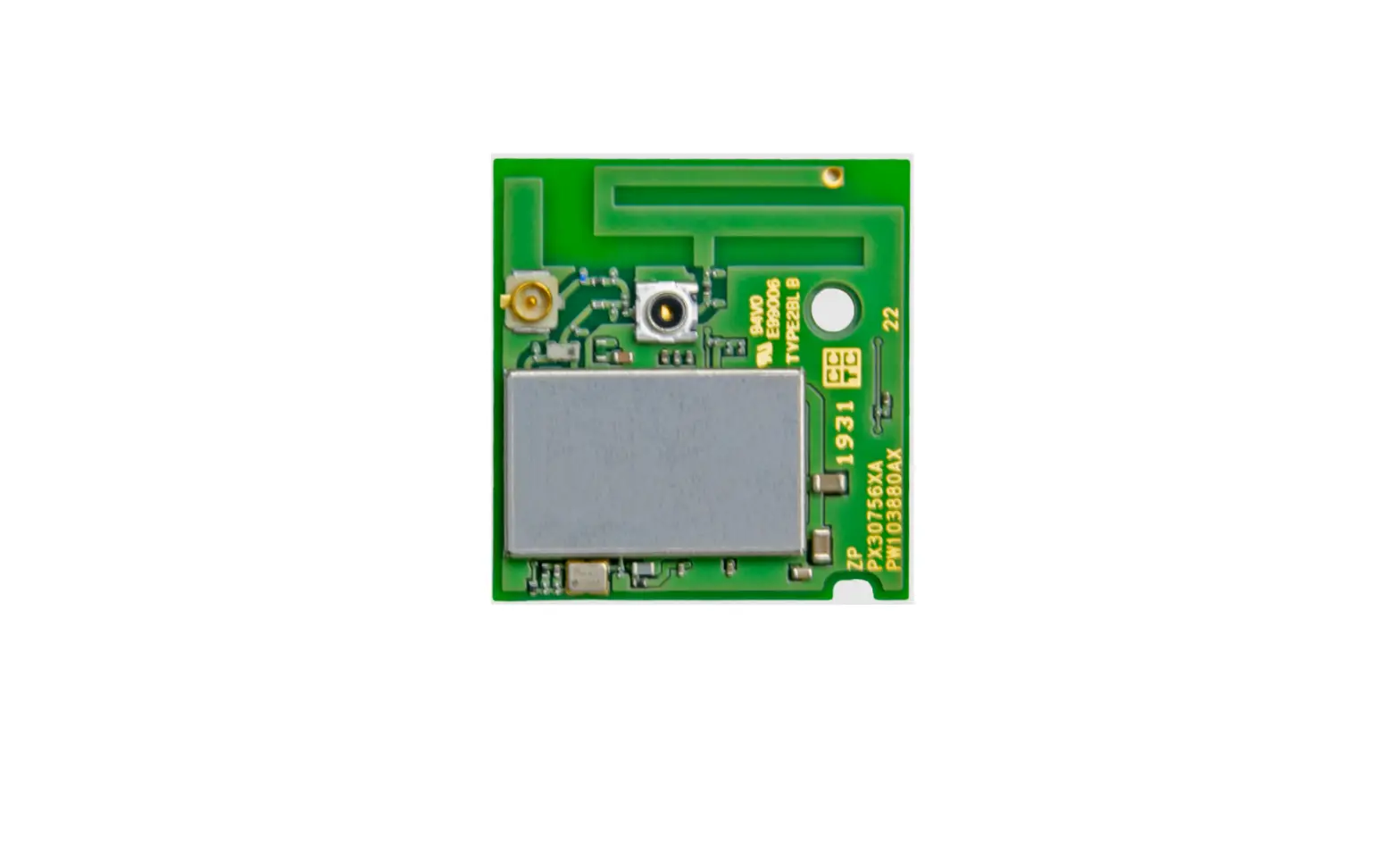
SX-USBAC
silex technology, Inc.
Notifications
- This module is a wireless device using a 2.4GHz / 5GHz band. You have to disable the 5.15-5.35GHz band (W52, W53) before use outdoor in Japan because this band is prohibited to use outdoor by low restrictions.
- This module is designed for embedded purposes into the general electric devices and is not designed for high-reliability demands like aircraft instruments, nuclear control instruments, high reliable medical instruments (Class III, IV), high-reliability security instruments or any other devices that required extremely high reliability and quality. In the case embedded into the medical instrument, please ask for silex despite the medical class.
- As this module communicates by radio waves, it is strongly recommended to use some security systems to prevent unexpected information leakage to others.
- This module is a radio module for embedded purposes. Please understand the functions and features of this module, and evaluate as the final product which has this module embedded. Also, as evaluation of EMC conformity of this module has not been performed, EMC conformity evaluation and application must be performed with the final product in which this module is embedded.
- This module will affect to some other device or be affected by some other device using the same frequency band. Please investigate the environment to use this module beforehand.
- Disassembling or modifying the radio module leads to punishment based on radio law.
- This module is the embedded module that has exposed connectors or some devices. Please be careful for electrostatic, condensing, and other dust.
- In the case of using the other wireless devices using the same frequency band around this product, please take care below. (See IEEE802.11-2012 and IEEE802.11ac-2013)
- +/-25MHz (+/-25MHz) or more frequency separation from the center frequency of this module is recommended in 2.4GHz.
- An appropriate environment to avoid interference from the adjacent channels or the non-adjacent channels is necessary.
- 2.4GHz: Center frequency +/-25MHz (5Ch), Non-Adjacent channel: Further than Center frequency +/-30MHz (6Ch)
- 5GHz HT20: Center frequency +/-20MHz (4Ch), Non-Adjacent channel: Further than Center frequency +/-40MHz (8Ch)
- 5GHz HT40 Adjacent channel: Center frequency +/-40MHz (8Ch), Non-Adjacent channel: Further than Center frequency +/-80MHz (16Ch)
- 5GHz HT80 Adjacent channel: Center frequency +/-80MHz (16Ch), Non-Adjacent channel: Further than Center frequency +/-160MHz (32Ch)
Even if these conditions is satisfied, the module possibly interferes when a strong signal is an input. The other wireless system should be enough far from this module
- The input level from the opponent device must be -20dBm or less at 2.4GHz, -30dBm or less at GHz including antenna gain.
Signal pin specifications
2.1. Pin locations
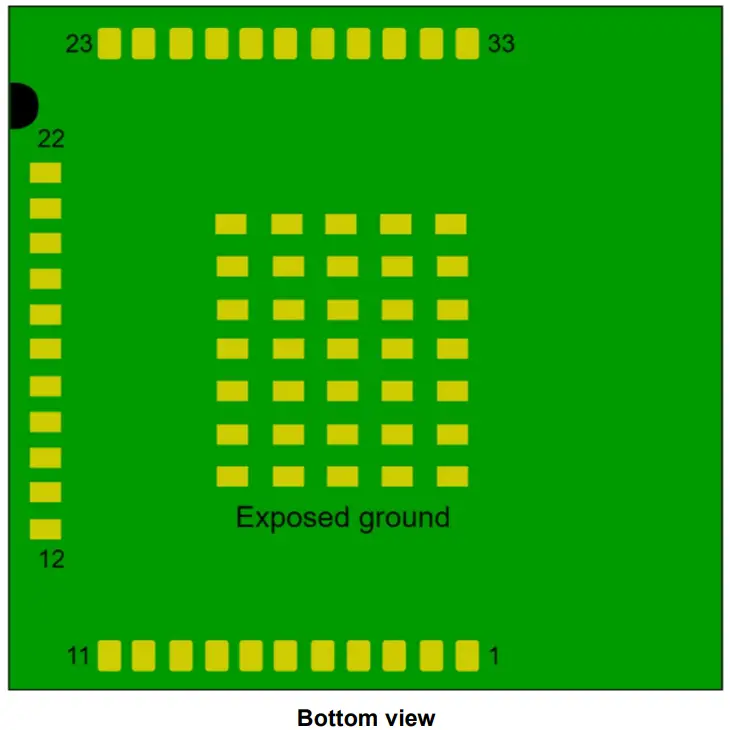
2.2. Signal specifications
| # | Signal name | Type | I/O Domain | Descriptions |
| 1 | GND | GND | GND | Ground |
| 2 | RESERVED | OD | VIDEO _GP101 | Un-used signal. Keep Open. |
| 3 | GND | GND | GND | Ground |
| 4 | WOW | S | OD | Wake on the wireless signal. Low wake-up trigger. Open-drain output. Need external pull-up to 10 power rails of the host system. |
| 5 | GND | GND | GND | Ground |
| 6 | RESERVED | DI | VDDIO _GP101 | Un-used signal. Keep Open. |
| 7 | GND | GND | GND | Ground |
| 8 | GND | GND | GND | Ground |
| 9 | VDD | p | p | Main power supply. +3.14 ∼+3.46V |
| 10 | VDD | p | p | Main power supply. +3.14.∼+3.46V |
| 11 | VDD | p | p | Main power supply. +3.14 ∼+3.46V |
| 12 | WLAN_PWO_L | PO | VDDIO_GPIO_1 | WLAN reset. (0-Enable. 1=Disable) Internal Pull-down. |
| 13 | GND | GND | GND | Ground |
| 14 | GND | GND | GND | Ground |
| 15 | BT_USB_D+ | MAO | VDD | Bluetooth USB 1.1 differential pair |
| 16 | BT_USB_D- | MAO | VDD | |
| 17 | GND | GND | GND | Ground |
| 18 | WL_USB_D- | MAO | VDD | Wireless LAN USB2.0 differential pair |
| 19 | WL_USB_D+ | MAO | VDD | |
| 20 | GND | GND | GND | Ground |
| 21 | VDDIOGP101 | P | P | 10 power supply. +1.71 ∼ +3.46V |
| 22 | GND | GND | GND | Ground |
| 23 | BT_PWD_L | PO | VDDIO_GP101 | Bluetooth reset. (0=Enable. 1=Disable) Internal Pull-down. |
| 24 | GND | GND | GND | Ground |
| 25 | GND | GND | GND | Ground |
| 26 | NC | NA | NA | NC pin |
| 27 | NC | NA | NA | NC pin |
| # | Signal name | Type | I/O Domain | Descriptions |
| 28 | GND | GND | GND | Ground |
| 29 | VIDEO GPIO1 | P | P 10 power supply. | +1.71 ∼+3.46V |
| 30 | GND | GND | GND | Ground |
| 31 | GND | GND | GND | Ground |
| 32 | RESERVED | DI | DI | Un-used signal. Keep Open. |
| 33 | RESERVED | OD | OD | Un-used signal (Debug port). Connected to a test pad. Keep Open if the debug function is not used. |
| EXPAND | Exposed Ground | GND | GND | Exposed Ground pads |
NOTE1
The Type DI signals which are directed “Keep Open” in case unused, these signals can be Open because the software in the chip does not concern about these signals.
2.3. Signal definitions
| Symbols | Descriptions |
| AI | Analog input |
| AO | Analog output |
| B | CMOS bidirectional digital signal |
| DI | CMOS digital input |
| OD | Open drain digital output |
| P | Voltage supply |
| GND | Ground |
| NA | Not applicable |
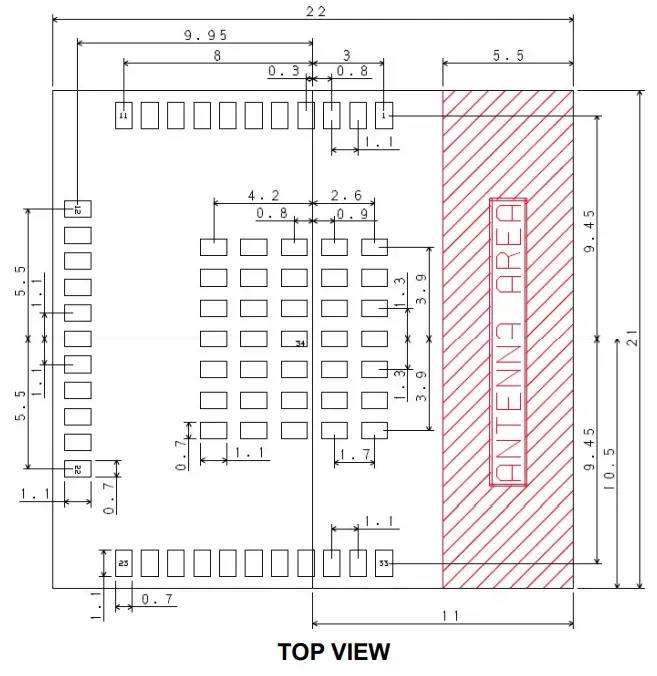
Reference land design
FCC Notice
This device complies with Part 15 of FCC Rules. Operation is subject to the following two conditions:
(1) this device may not cause harmful interference, and
(2) this device must accept any interference received, including interference that may cause undesired operation.
List of applicable FCC rules
This device complies with part 15 of the FCC Rules.
Part 15 Subpart C
Part 15 Subpart E
Test Modes
silex technology, Inc. uses various test mode programs for test set up which operate separately from production firmware. Host integrators should contact silex technology, Inc. for assistance with test modes needed for module/host compliance test requirements.
Additional testing, Part 15 Subpart B disclaimer
The modular transmitter is only FCC authorized for the specific rule parts (i.e., FCC transmitter rules) listed on the grant, and the host product manufacturer is responsible for compliance to any other FCC rules that apply to the host not covered by the modular transmitter grant of certification. The final host product still requires Part 15 Subpart B compliance testing with the modular transmitter installed.
Summarize the specific operational use conditions
This module is designed for mounting inside of the end product by the end-product manufacturer professionally. Therefore, it complies with the antenna and transmission system requirements of §15.203.
Compliance with FCC requirement 15.407(c)
Data transmission is always initiated by software, which is passed down through the MAC, through the digital and analog baseband, and finally to the RF chip. Several special packets are initiated by the MAC. These are the only ways the digital baseband portion will turn on the RF transmitter, which it then turns off at the end of the packet. Therefore, the transmitter will be on only while one of the aforementioned packets is being transmitted. In other words, this device automatically discontinues transmission in case of either absence of information to transmit or operational failure.
RF exposure considerations
This equipment complies with FCC radiation exposure limits set forth for an uncontrolled environment and meets the FCC radio frequency (RF) Exposure Guidelines. This equipment should be installed and operated keeping the radiator at least 20cm or more away from the person’s body.
Co-Location Rule
This transmitter must not be co-located or operated in conjunction with any other antenna or transmitter.
Label and compliance information
The following information must be indicated on the host device of this module.
Contains Transmitter Module FCC ID: N6C-USBAC
Or
Contains FCC ID: N6C-USBAC
FCC CAUTION
The following statements must be described on the user manual of the host device of this module;
FCC CAUTION
Changes or modifications not expressly approved by the party responsible for compliance could void the user’s authority to operate the equipment.
Antennas
Recommended Antenna List
| Antennas | Vendors | Antenna Type | 2.4GHz Gain | 5GHz Gain | ||
| peak | Min. | peak | Min. | |||
| SXANTFDB24A55-02 | Silex | Patern | +2.0dBi | OdBi | +3.0dBi | OdBi |
| H2B1PC1A1C(AA258) | Unictron | PCB | +2.9dBi | OdBi | +4.4dBi | OdBi |
| H2B1PD1A1C(AA222) | Unictron | PCB | +2.8dBi | OdBi | +4.2dBi | OdBi |
| 146153 | Molex | PCB | +3.25dBi | OdBi | +5.0dBi | OdBi |
WLAN Channel 12 & 13
Product hardware has the capability to operate on channels 12 & 13.
However, these 2 channels will be disabled via software and the user will not be able to enable these 2 channels.
Label and compliance information
The following information must be indicated on the host device of this module.
Contains Transmitter Module IC: 4908A-USBAC
Or
Contains IC: 4908A-USBAC
Operation in the band 5150-5350 MHz
Operation in the band 5150-5350 MHz is only for indoor use to reduce the potential for harmful interference to cochannel mobile satellite systems.
Data transmission
Data transmission is always initiated by software, which is passed down through the MAC, through the digital and analog baseband, and finally to the RF chip. Several special packets are initiated by the MAC. These are the only ways the digital baseband portion will turn on the RF transmitter, which it then turns off at the end of the packet. Therefore, the transmitter will be on only while one of the aforementioned packets is being transmitted. In other words, this device automatically discontinues transmission in case of either absence of information to transmit or operational failure.
RF exposure considerations
This equipment complies with ISED radiation exposure limits set forth for an uncontrolled environment and meets RSS102 of the ISED radio frequency (RF) Exposure rules. This equipment should be installed and operated keeping the radiator at least 20cm or more away from the person’s body.
Antenna Type
This radio transmitter (4908A- USBAC) has been approved by Innovation, Science, and Economic Development Canada to operate with the antenna types listed below, with the maximum permissible gain indicated. Antenna types not included in this list that have a gain greater than the maximum gain indicated for any type listed are strictly prohibited from use with this device.
| Antenna Type | Gain | Impedance | |
| 2.4GHz | 5GHz | ||
| PCB Antenna | 3.25dBi | 5dBi | 50ohms |