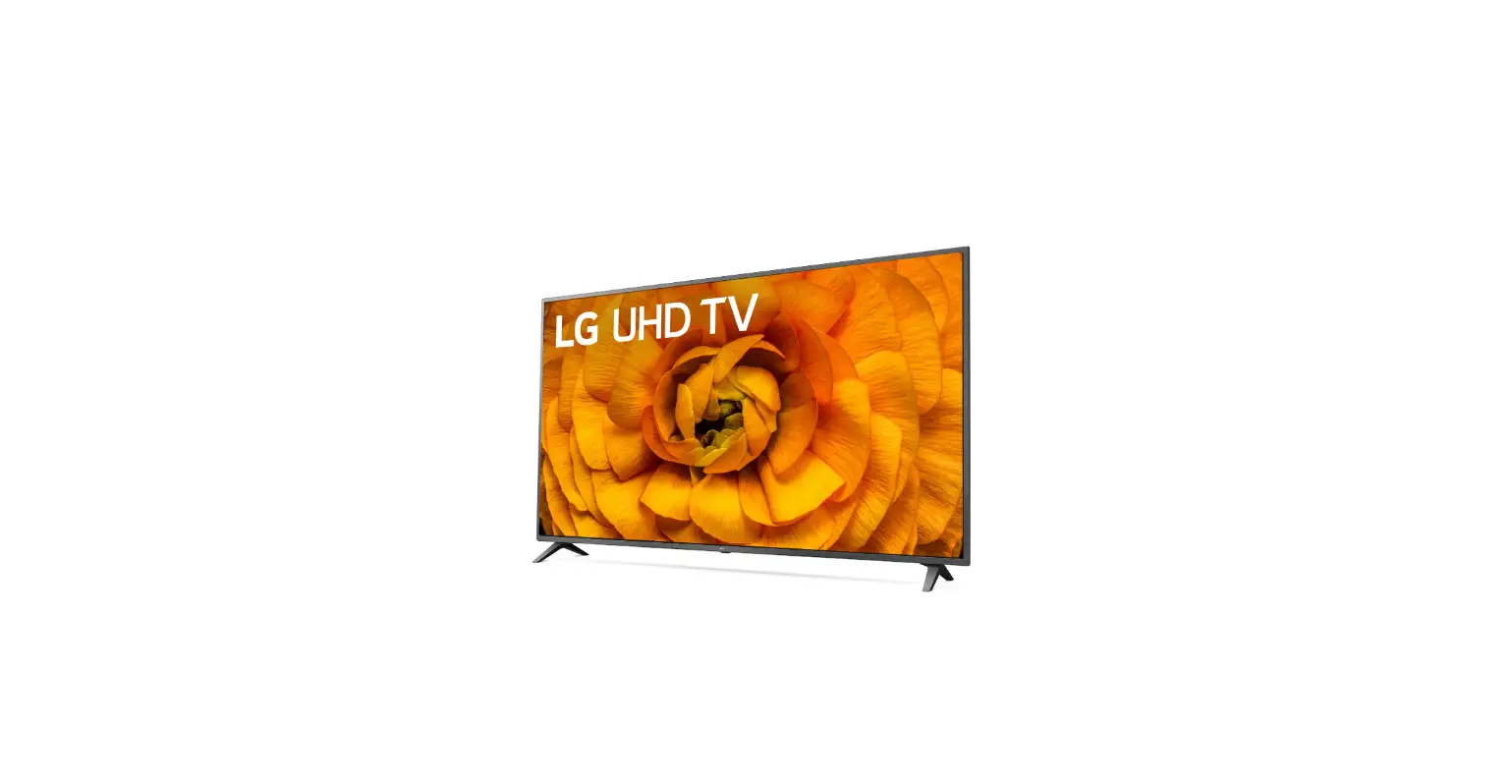
163-8641 Professional Standard 86 Inch UHD 4K Monitor
 86’’ (218cm) Professional large format monitor
USER MANUAL
Important Safety Information

CAUTION: RISK OF ELECTRIC SHOCK DO NOT OPEN
CAUTION: TO REDUCE THE RISK OF ELECTRIC SHOCK DO NOT REMOVE COVER (OR BACK).
NO USER-SERVICEABLE PARTS INSIDE. REFER SERVICING TO QUALIFIED SERVICE PERSONNEL.
OPS USAGE WARNING: Do not plug the OPS unit while the Display is turned on. Turn on the OPS unit using the remote control or the buttons on the Display, do not turn it on using the buttons on the device itself.
Please read these instructions fully and carefully before use and keep for future reference
WARNING: This device is not intended for use by persons (including children) without physical, sensory or mental capabilities, or lack of experience and/or knowledge unless they have been given supervision or instruction concerning use of the device by a person responsible for their safety.
- This product is for indoor use only.
- Use this product at an altitude of less than 5000 meters above the sea level and in dry locations and in regions with moderate or tropical climates.
- Please keep this manual for further use.
- Unplug your product before starting to clean. Do not clean the product when it is on. Do not use liquid or aerosol cleaners. Use a damp cloth for cleaning. If that does not help, please use LCD display cleansers. Do not apply the cleaner directly on the product.
- To prevent breakdown, do not use non-advised accessories.
- Please do not place your product near wash basins, sinks, water pans, pools etc.
- Do not expose the product to dripping or splashing of liquids and do not place objects filled with liquids, such as vases, cups, etc. on or over the product (e.g., on shelves above the unit).
- Please leave at least 5 cm of free space between the product and walls or other furnitures for ventilation purposes.
- That product can only be started by the defined power source on its rating plate. For further information, please contact with your dealer.
- As a safety precaution, a three-wired grounding plug is given with the product. As a safety precaution, please do not make any change on the grounding plug. Always use earthed socket outlet for product.
- Please provide the plug and socket to supply the needed power for appliance.
- Please place the product in a position that electric cables cannot be affected by the operations on the product.
- Follow all warnings and instructions marked on the product.
- Follow the on screen instructions for operating the related features.
- To prevent the risk of fire or electric shock, please do not overuse the plugs and extension cords.
Please do not open the lid of the monitor to service yourself. If the required service needs are not met by an authorized service, dangerous voltage and other risks may occur. - If you will not use the product for a long period of time, unplug the power cord from the mains.
- Put the product on a well-ventilated place and prevent from bright light, overheat and damp.
- The product should be kept in 0 C° – 40 C°.
Otherwise, the appliance may be damaged permanently. - Plug the appliance to a grounded outlet. Always use the grounded power cord supplied with your product.
Manufacturer is not responsible for any damage caused unearthed usage. - The socket-outlet shall be installed near the equipment and shall be easily accessible.
- Do not stay in contact with the parts of the product that become hot for long periods of time. Doing so may result in low-temperature burns.
- The LCD panel used in this product is made of glass. Therefore, it can break when the product is dropped or applied with impact. Be careful not to be injured by broken glass pieces in case the LCD panel breaks.
- Usage of the monitor must not be accompanied by fatal risks or dangers that, could lead directly to death, personal injury, severe physical damage or other loss, including nuclear reaction control in nuclear facility, medical life support system, and missile launch control in a weapon system.
- Do not expose the product to direct sunlight or do not place open flames such as lit candles on the top of or near the product.
- Do not place any heat sources such as electric heaters, radiators, etc. near the product.
- In order to prevent a potential electrical shock, in extreme weather (storms, lightning) disconnect the product from the mains.
- Do not touch the controls other than those described in the operating instructions. Improper adjustment of controls not described in the instructions can cause damage, which often requires extensive adjustment work by a qualified technician.
- Do not shake the product. Ensure that it stays in a balanced stance on its position.
- Do not throw or drop any object on your product.
- Do not interfere on your products screen or any other surface with a sharp object.
- Do not keep your product in a humid environment.
- Do not keep your product in an extremely cold environment.
- Do not keep your product in an extremely hot environment.
- Do not place the product on the floor and inclined surfaces.
- To avoid danger of suffocation, keep plastic bags out of the reach of the babies, children and domestic animals.
Vent holes of the product
The vent holes are designed to provide the product to work constantly and prevent it from overheat. Do not block these openings in anyway. For the same reason, please do not place your product on beds, sofas, carpets and similar surfaces.
Never insert an object into the product through vents or openings. High voltage flows in the product, and inserting any objects in the vents or openings of the product may cause electric shock, short circuit of the internal parts and/or fire. For the same reason, do not spill water or liquid on the product.
Repair
Unless a basic implementation on the product is specified by the producers’ technical department on a document, do not repair your product by yourself.
Otherwise, your guarantee may get suspended and you may risk your health or your product. In case of need, consult your authorized service.
- When the cable is worn off or harmed.
- If the product has been dropped or the cabinet has been damaged.
- If the performance of the product is changed or the appliance needs to be repaired.
- When a liquid was spilled on the product or when objects have fallen into the product.
- When the product has been exposed to rain or water.
- When the product does not operate properly as described in the operating instructions.
Replacement parts
In case the product needs replacement parts, make sure that the service person uses replacement parts specified by the manufacturer, or those with the same characteristics and performance as the original parts.
Use of unauthorized parts can result in fire, electric shock and/or other danger.
Safety checks
Upon completion of service or repair work, request the service technician to perform safety checks to ensure that the product is in proper operating condition.
Wall mounting
When mounting the product on a wall, be sure to install the product according to the method recommended by the manufacturer.
- Read the instructions before mounting the product on the wall.
- The wall mount kit is optional. You can obtain from your local dealer, if not supplied with the product.
- Do not install the product on a ceiling or on an inclined wall.
- Use the specified wall mounting screws and other accessories.
- Tighten the wall mounting screws firmly to prevent the product from fall. Do not over-tighten the screws.
Power Cord
- The power cord is used to disconnect the product from the mains and therefore it must remain readily operable. If the product is not disconnected electrically from the mains, the device will still draw power for all situations even if the product is in standby mode or switched off.
- Use only the power cord supplied with the monitor.
- Do not damage the power cord nor place heavy objects on it, stretch it, over bend it or step on it. Also, do not add extension cords. Damage to the cord may result in fire or electric shock.
- When unplugging the appliance, always pull directly on the plug. Do not pull from the cable when unplugging the appliance.
- Do not use the power cord with a power tap. Adding an extension cord may lead to fire as a result of overheating.
- Do not remove or insert the power plug with wet hands. Doing so could result in electric shock.
- Unplug the power cord if it is not used for a long time.
- Do not attempt to repair the power cord if it is broken or malfunctioning. When damaged it must be replaced, this should only be done by qualified personnel.
Especially for child safety
- Don’t allow children to climb on or play with the monitor.
- Don’t place the monitor above furniture that can easily be used as steps.
- Remember that children can become excited while watching a program, especially on a “larger than life” monitor. Care should be taken to place or install the monitor where it cannot be pushed, pulled over, or knocked down.
- Care should be taken to route all cords and cables connected to the monitor so that they cannot bepulled or grabbed by curious children.
Connections Be sure to turn off the main power switch and disconnect the plug from the power outlet before connecting/disconnecting cables. Also, read themanual of the equipment to be connected. Be careful not to confuse the input terminal with the output terminal when connecting cables. Accidentally reversing cables connected to the input and output terminals may cause malfunctions and otherproblems.
In the case of USB fault condition, maximum current is below 5A.
Positioning
If a monitor is positioned in an unstable or inclined location, it can be potentially hazardous due to falling.
Many injuries, particularly to children, can be avoided by taking simple pre-cautions such as:
- Using fixing devices like wall mount brackets recommended or supplied by the manufacturer.
- Educating children about the dangers of climbing on furniture to reach the monitor or its controls. If your existing product is being retained and relocated, the same considerations as above should be applied
Transport and Shipping
- Your device must be kept in its original package to protect from damage to its accessories during transport and shipping.
- Keep the product in normal position during transport.
- Do not drop the device during transport and protect it against impacts.
- Damages and faults that occur during transport after the delivery of the appliance to the customer are notincluded in the warranty cover.
- Product transportation, installation, repair andservicing must be done by qualified technical servicepersonnel.
Intended Use
- This product is intended to be used in public places such as schools, offices, theatres, places of worship.
- Product is only suitable for connecting commercial mains socket outlets. Do not connect productindustrial socket outlets.
Foreseeable misuse and incorrect use
- For apparatus intended to be used in vehicles, ships or aircraft or at altitudes exceeding 5000m above sea level, for outdoor use or in general for the application other than mentioned in user manual additional requirements may be necessary.
 CAUTION
Do not leave a static image displayed for prolonged period of time. If a static image is displayed continuously for a long period of time, that image may cause image sticking on the display. This condition is not permanent, but may require a considerable amount of operational display time to dissipate, depending upon the degree of image stick. 120 minutes of continuous motion display will eliminate most image sticking effects at normal room temperature (not lower than 10 C).
As the nature of the TFT technology, you may see some amount of bright, dark, red, green and blue dots and sparklings on the screen, those do not affect the performance of the computer and are not accepted as a defect. Warning
This is a class A. In a domestic environment this may cause radio interference in which case the user may be required to take adequate measures.
BATTERY SAFETY GUIDELINES
Used correctly, domestic batteries are a safe and dependable source of portable power. Problems can occur if they are misused or abused resulting in leakage or, in extreme cases, fire or explosion.
Here are some simple guidelines to safe battery use designed to eliminate any such problems.
- Take care to fit your batteries correctly, observing the plus and minus marks on the battery and appliance. Incorrect fitting can cause leakage or, in extreme cases, fire or even an explosion.
- Replace the whole set of batteries at one time, taking care not to mix old and new batteries or batteries of different types, since this can result in leakage or, in extreme cases, fire or even an explosion.
- Store unused batteries in their packaging and away from metal objects which may cause a short-circuit resulting in leakage or, in extreme cases, fire or even an explosion.
- Remove dead batteries from equipment and all batteries from equipment you know you are not going to use for a long time. Otherwise the batteries may leak and cause damage.
- Batteries must not be exposed to excessive heat such as sunshine, fire or the like.
- Never dispose of batteries in fire or with hazardous or flammable materials as this can cause them to explode. Please recycle dead batteries; do not put with the normal household waste.
- Never attempt to recharge ordinary batteries, either in a charger or by applying heat to them. They may leak, cause fire or even explode. There are special rechargeable batteries which are clearly marked as such.
- Supervise children if they are replacing batteries themselves in order to ensure these guidelines are followed.
- Do not ingest the battery, Chemical Burn Hazard.
- This product or the accessories supplied with the product may contain a coin/button cell battery. If the coin/button cell battery is swallowed, it can cause severe internal burns in just 2 hours and can lead to death.
- Remember that small button cell batteries such as used in some hearing aids, toys, games and other appliances, are easily swallowed by young children and this can be dangerous.
- Keep new and used batteries away from children.
- Make sure battery compartments are secure. If the battery compartment does not close securely, stop using the product and keep it away from children.
- Seek immediate medical attention if you believe batteries might have been swallowed or placed inside any part of the body.
- If leaked battery fluid gets on your skin or clothing, rinse immediately and thoroughly. If it gets into your eye, bathe your eye well rather than rubbing and seek medical treatment immediately. Leaked battery fluid that gets into your eye or your clothing may cause a skin irritation or damage your eye.
CAUTION
RISK OF EXPLOSION IF BATTERY IS REPLACED BY AN INCORRECT TYPE.
DISPOSE OF USED BATTERIES ACCORDING TO THE INSTRUCTIONS.
Markings on the Product
The following symbols are used on the product as a marker for restrictions and precautions and safety instructions. Each explanation shall be considered where the product bears related marking only. Note such information for security reasons. Class II Equipment: This appliance is designed in such a way that it does not require a safety connection to electrical earth.
 Class II Equipment With Functional Earthing: This appliance is designed in such a way that it does not require a safety connection to electrical earth, the earth connection is used for functional purposes.
 Protective Earth Connection: The marked terminal is intended for connection of the protective earthing conductor associated with the supply wiring.
 Hazardous Live Terminal: The marked terminal(s) is/are hazardous live under normal operating conditions.
 Caution, See Operating Instructions: The marked area(s) contain(s) user replaceable coin or button cell batteries.
Any issues which are caused by customer mis-adjustment of any software including the operating system are not covered by the warranty.
Depending on the model you buy, the actual appearance of the product may differ from the images used in this manual.
General View
Front Side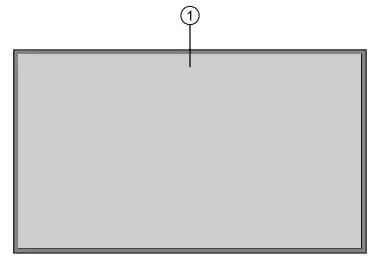
- LCD Panel
Rear Side (1)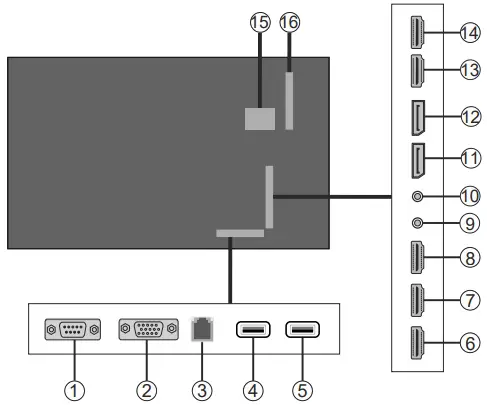
- RS232
- VGA
- Ethernet
- USB (2.0)
- USB (2.0)
- HDMI2 In
- HDMI3 In
- HDMI4 In
- IR Input
- Headphone/Line Out
- DP In
- DP Out
- HDMI1 In
- HDMI Out
- Internal USB Compartment
- Connector for PC (OPS) Module
Rear Side (2)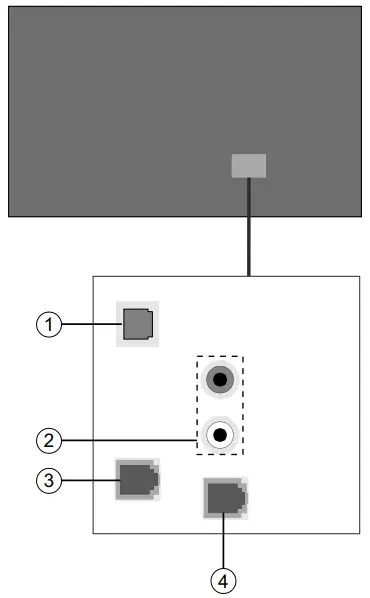
- SPDIF Optical Out
- Audio In
- RJ12 (for sensor)
- RJ12 (service use only)
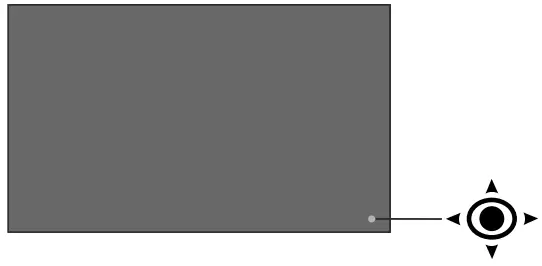 To turn on the Display: Press the centre of the joystick in and hold it down for a few seconds, the Display will turn on.
To turn the Display off: Press the centre of the joystick in and hold it down for a few seconds, the Display will turn into standby mode.
To change source: Press the centre of the joystick in, the sources list will appear on the screen. Scroll through the available sources by pushing the joystick up or down.
To change volume: Increase the volume by pushing the joystick right. Decrease the volume by pushing the joystick left.
Note: Main menu OSD cannot be displayed via joystick.
Connecting the IR Receiver
Before plugging the Display into the mains supply, connect the supplied IR receiver to the IR input on the Display. Place the IR receiver in sight of your own remote control. Simply operate your remote control whilst pointed at the IR receiver and it will relay the control signal to your Display.
In case your Display has touch screen feature and if the IR receiver is going to be placed on the Display it shouldn’t be placed facing the inside of the screen, otherwise the signals of the touch screen and the remote may interfere with each other. To improve the performance of your remote control place the IR receiver as shown in the drawing below.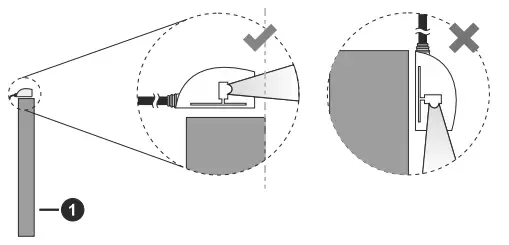
- Front side of the Display
Turning the Display On/Off
After connecting the Display to the mains set the main On/Off switch to the “1” position. The Display will switch into standby mode. Press the Standby button on the remote or press the centre of the joystick in located on the rear left side of the Display and hold it down for a few seconds to switch it on from standby.
Press the centre of the joystick in and hold it down for a few seconds or press the Standby button on the remote to switch the Display into standby mode. To switch the Display off, set the On/Off switch to the “2” position.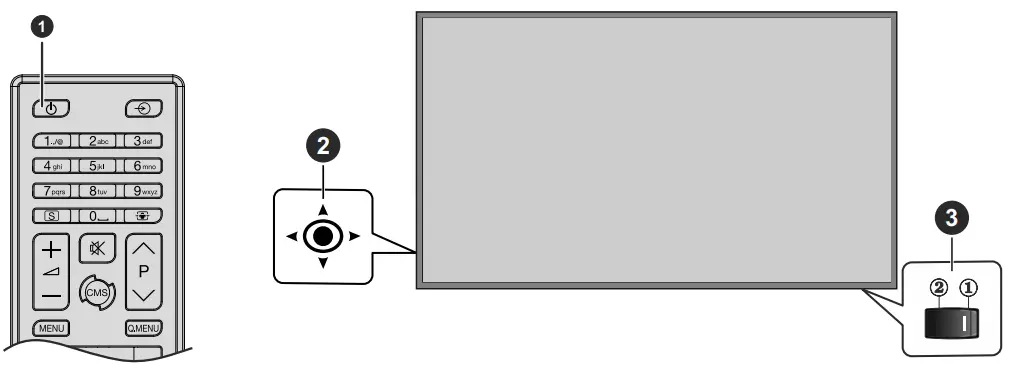
- Standby button
- Joystick
- On/Off Switch (*)
(*) The location of the On/Off switch may differ depending on the model.
| LED Status | Status of the monitor |
| Power LED not lit | Power on |
| Power LED lit | Power off (Standby mode) |
| Power LED flashing (slow) | Scheduler active (optional) |
| Power LED flashing (fast) | Software update |
Remote Control
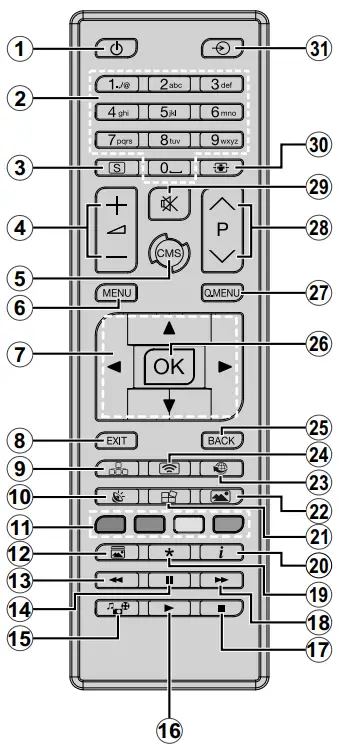
- Standby: Switches On / Off the Display
- Numeric buttons: Enters a number or a letter in the text box on the screen.
- Signage: Displays Settings>Signage menu
- Volume +/-: Increases or decreases the volume
- CMS: Opens the predefined Start url (in Settings>Signage>Link Options menu). Press and hold 3 seconds to open the predefined Settings url (in Settings>Signage>Link Options menu)
- Menu: Displays the main menu
- Directional buttons: Helps navigate menus, content etc.
- Exit: Closes and exits from displayed menus or returns to previous screen
- Network: Displays Network/Internet Settings menu
- Sound: Displays Sound menu
- Coloured Buttons: Follow the on-screen instructions for coloured button functions Blue Button: Freezes the currently displayed picture on the screen. Press again to cancel the freeze function.
- Picture Mode: Cycles between picture modes
- Rapid reverse: Moves frames backwards in media such as movies
- Pause: Pauses the media being played
- Media browser: Opens the media browsing screen
- Play: Starts to play selected media
- Stop: Stops the media being played
- Rapid advance: Moves frames forward in media such as movies
- No function
- Info: Displays information about on-screen content
- No function
- Picture: Displays Picture menu
- Internet: Opens the predefined Start url (in Settings>Signage>Link Options menu).
- Wireless Display: Opens the wireless display connection screen
- Back/Return: Returns to previous screen
- OK: Confirms user selections
- Quick Menu: Displays picture and sound setting menus
- No function
- Mute: Completely turns off the volume of the Display
- Screen: Changes the aspect ratio of the screen
- Source: Shows all available content sources
Inserting the Batteries into the Remote
Remove the screw that secure the battery compartment cover on the back side of the remote control first. Lift the cover gently. Insert two AAA batteries. Make sure the (+) and (-) signs match (observe correct polarity). Place the cover back on. Then screw the cover back on again.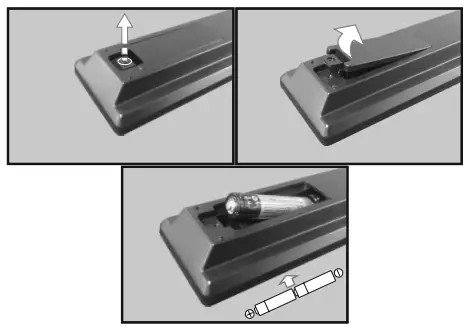
First Time Installation
When turned on for the first time, the language selection screen will be displayed. Select the desired language and press OK.
On the next screen, set your country preference and press OK to continue.
You will be asked to set and confirm a PIN at this point.
For some country options, the PIN cannot be set to 0000, in this case you need to enter another 4-digit number combination. You have to enter this PIN if you are asked to enter a PIN for any menu operation later.
The Signage Settings menu will be displayed next.
Set ID, OSD Orientation, Auto Software Update options can be configured using this menu. Model name, Serial number and Software version options are for information only. They will be grayed out and not selectable. You can save the model information data of the Display to a connected USB device using the Save model information option. You can also copy database files from a connected USB device to the Display using the Clone from USB option. Also, the NTP server option can be set here to get the current time and date information over the network.
Refer to the Signage Menu Content section for more information on the options of this menu. After the settings are completed, highlight Next and press OK to continue.
If the ERP Regulations 2021 are applied (depends on the model of the unit): The following step will be available
The Display Operation Mode selection screen will be displayed next. For normal operation set the Power Mode option to Reactive. Set to Eco for an energyefficient operation.
In this mode your Display’s settings will be configured to reduce the energy consumption.
The Auto Launch Selection screen will be displayed next. Vsign Lite, CMS, Open Browser and Disabled options will be available. Highlight the desired option and press OK to proceed.
On the next screen, the Network/Internet Settings menu will be displayed. Please refer to Connectivity section to configure a wired or a wireless connection.
If you want your Display to consume less power in standby mode, you can disable the Networked Standby Mode option by setting it as Off. After the settings are completed highlight Next and press OK button to continue.
The First Time Installation is completed.
To repeat this process and reset the Display’s settings to the factory defaults enter the Settings>Signage menu, highlight First time installation and press OK. You will be asked to enter the PIN that you have defined in the First Time Installation. If the correct PIN
is entered a confirmation message will be displayed asking whether you want to delete all settings and reset the Display. Select Yes and press OK to confirm.
Note: Do not turn off the Display while initializing first time installation. Note that, some options may not be available depending on the country selection.
When the Menu button is pressed, the main Display menu will appear at the bottom of the screen. You can navigate through the menu items using the directional buttons on the remote. To select an item or see the sub-menu options of the highlighted menu press OK button. When you highlight a menu option some of the sub-menu items of this menu may appear on the upper side of the menu bar for quick access. To use a quick access item highlight it, press OK and set as desired using the Left/Right directional buttons. When finished press OK or Back/Return button to exit.
Press Exit button to close the main menu.
- Home
When main menu is opened Home menu bar will be highlighted. The content of the Home menu can be customised by adding options from other menus.
Just highlight an option and press the Down direction button on the remote. If you see Add to Home option you can add it to the Home menu. Same way you can delete or change the position of any item in the Home menu. Press the Down direction button and select Delete or Move option and press OK. In order to move a menu item use the Right and Left direction buttons to select the position that you want the item to move to and press OK. - Settings
You can manage the settings of your Display using the options of this menu. Refer to Settings Menu Contents section for more information. - Apps
When your Display is connected to the Internet related contents will also be available, including Apps related contents. Using the Apps menu you can access your applications. Refer to Apps section for more information. - Sources
You can manage your input source references using the options of this menu. To change the current source highlight one of the options and press OK.
4.1. Source Settings
Edit the names, enable or disable selected source options. There are also Regular, Enhanced and Disabled options available for HDMI source. Regular and Enhanced options are affecting the colour settings of the HDMI source. To be able to watch 4K or HDR/HLG images from the HDMI source its source setting should be set as Enhanced if the connected device is compatible with HDMI 2.0 and subsequent versions. Set as Regular if the connected device is HDMI 1.4 compatible. Set accordingly or disable the HDMI source by setting as Disabled.
You can reset your customizations on the Home and Apps menus to defaults using the Reset Menu option in the Settings menu. Highlight this option and press OK. A confirmation message will be displayed.
Highlight Yes and press OK to proceed.
Vsign Lite
Vsign Lite is a signage application runs without CMS and managed through Display. Display software is integrated with it.
- Setup
1.1. Application SpecificationRequirements Display Platform MB135VS Firmware Version v7.33 & higher versions Language Options English, Turkish Hardware Requirements USB 1.2. How is it opened?
During the Display’s setup, Auto Launch option should be selected as Vsign Lite. Later, every time the Display restarts, the application will open. Additionally this can be changed on Menu > Settings > Signage > Power Up Settings > Auto Launch. - Vsign Application Display
The Vsign Lite application consists of three main parts.
These are Player, Schedule and Template sections.
Moreover, there are the Import/Export settings section for backup/export of application settings and to switch to VSign there is a Switch to VSign part.
2.1. PLAYER
Using this screen, the inserted USB memory can be viewed, erased, played, and transferred to another USB memory. Various filtering and sorting operations can be done from the menu section above. In addition, the channels created in the section over time are played here.
2.1.1. File Management
Pressing the OK button on any file opens the menu for file-related operations. The options described below can be selected and processed.
Select: Selecting the file activates the multi-selection mode described in the next section. Play: If the selected file is playable, it plays, otherwise the text is dimmed.
Send: It sends the chosen file to another memory.
Delete: It deletes the chosen file.
2.1.2. Multi-Selection Mode
Multiple selection mode is activated by pressing OK button on Select option on file management menu.
Then select the files you want to select with the OK button and cancel them. During this process, you can go to different folders and select the files there. Options appear up when multi-selection mode is on. These operations can be done to the selected filesas explained below.
Select All: Selects all files.
Delete All: Clears all selected options.
Play All: Plays selected files in order of selection.
Send All: Sends selected files to USB.
Cancel: Closes multi-selection mode.
2.2. SCHEDULE
By using Schedule screen, a channel can be created, programs can be created within the channel, they can be viewed and edited. The channels number are limited to four.
In the menu, the channels are displayed on the screen in accordance with the time information on the top left and down. With navigation, it can be switched through programs. Detailed information about the focused program can be found on the right-hand panel.
2.2.1. Channel/Program Addition
Navigate to an empty or occupied area and press the OK button. In the empty area, channel and program addition screen, in the occupied area editing screen are opened. Images, videos and templates can be added to the channel as content.
-If the rightmost space (Add Channel) is selected, a new channel will be created and the screen will pop up to create our first program.
-If an empty space is selected in a previously created channel, the new program is added to the channel.
-If the occupied area is selected in a previously created channel, the selected program will be edited.
2.2.1.1. Channel/Program Editing Screen
Input Fields Add Content: If the OK button is pressed on this field; the appropriate contents are listed.
The users can do multi-selection. You can then delete the contents by pressing the OK button. Start
Time: Start time of the program.
Finish
Time: Finish time of the program.
Channel: Name of the channel in which the program is included. Memory:
Memory in which the channel is saved.
2.2.2. Supported Files The application supports the formats listed below: video: mp4, mpeg, avi, mov, webm, ts, mpg, m4a, mkv image: jpg, jpeg, png, bmp
2.3. TEMPLATE
This screen displays the predefined templates and the user fills them and prepares them for use. User-created templates are kept in the My Templates folder.
They can be played, edited and deleted from here.
2.3.1. Creation of the Templates
Scroll to one of the previously defined templates and press OK. When the OK button is pressed on the zones, the compatible contents in the memory are listed. Single or multiple selections can be made here. The template can be previewed with the Preview button on the right and the Save button can be selected and saved.
2.3.1.1. Add Content to
Templates Input Fields Template Time: The length of time that the template will be displayed in a program cycle. Content Time: Specifies the amount of time a content will be displayed in the selected area via the template. Aspect Ratio: If the area on the template accepts the image, it determines whether the inserted image performs one of the behaviors that maintain the aspect ratio or fill the area.
Audio: If there is a field that accepts video in the template, it determines whether the video will sound or not.
2.4. Export/Import
Using this menu, the Display settings can be transferred to another Display.
2.5. Switch to Vsign
With this menu, the users can be transferred to VSign Application. In addition, the VSign application will start to open when the Display is turned on.
2.6. Switch to Vsign Lite Portrait Orientation
The user can rotate the screen 90 degrees clockwise or counterclockwise by selecting Portrait 1 or Portrait 2 from Menu > Settings > Signage > Controls > OSD Orientaton. The application will be rotated vertically.
Media Playback via USB Input
You can connect 2.5” and 3.5” inch (HDD with external power supply) external hard disk drives or USB memory stick to your Display by using the USB input/s of the Display.
IMPORTANT! Back up the files on your storage devices before connecting them to the Display.
Manufacturer will not be responsible for any file damage or data loss. Certain types of USB devices (e.g. MP3 Players) or USB hard disk drives/memory sticks may not be compatible with this Display. The Display supports FAT32 and NTFS disk formatting.
Wait a little while before each plugging and unplugging as the player may still be reading files. Failure to do so may cause physical damage to the USB player and the USB device itself. Do not pull out your drive while playing a file.
You can use USB hubs with your Display’s USB input/s. External power supplied USB hubs are recommended in such a case.
It is recommended to use the Display’s USB input/s directly, if you are going to connect a USB hard disk. Note: When viewing image files the Media Browser menu can only display 1000 image files stored on the connected USB device.
Media Browser Menu
You can play back music and movie files and display photo files stored on a USB storage device by connecting it to your Display. Connect a USB storage device to one of the USB inputs located on the rear side of the Display.
After connecting a USB storage device to your Display Media Browser menu will be displayed on the screen.
You can access the content of the connected USB device any time later from the Sources menu. Select the related USB input option from this menu and press OK. Then select the file of your choice and press OK to display or play it back.
You can set your Media Browser preferences by using the Settings menu. Settings menu can be accessed via the information bar which is displayed on the bottom of the screen when pressed the Info button while playing back a video file or displaying a picture
file. Press the Info button, highlight the gear wheel symbol positioned on the right side of the information bar and press OK. Picture Settings, Sound Settings, Media Browser Settings and Options menus will be available. The contents of these menus may change according to the type of the currently open media file.
Only Sound Settings menu will be available while playing back audio files.
| Loop/Shuffle Mode Operation | |
Start playback and activate  | All files in the list will be continuously played in original order |
Start playback and activate  | The same file will be played continuously (repeat) |
Start playback and activate  | All files in the list will be played once in random order |
Start playback and activate  , , | All files in the list will be continuously played in the same random order. |
To use the functions on the information bar highlight the symbol of the function and press OK. To change the status of a function highlight the symbol of the function and press OK as much as needed. If the symbol is marked with a red cross, that means it is deactivated.
USB Auto Play Feature
USB AutoPlay feature is to start playing the media content installed on a removable device, automatically.
It uses the Media Browser. The media content types have different priorities in order to be played. The reducing priority order is as Photo, Video and Audio.
That means, if there is Photo content in the root directory of the removable device, Media Browser will play the Photos in a sequence (in file name order) instead of Video or Audio files. If not, it will be checked for Video content and as last Audio.
This feature will only work if all of the following circumstances occur:
- The USB device is plugged in.
- USB Auto Play option is enabled. It is placed in the
Settings>System>More menu.
USB Auto Play Feature with Playlist Scenario
If there is a file named as “playlist.txt” installed on the connected USB storage device, the new scenario is started. The media content in this file will be played or displayed according to the entered sequence.
To activate this function, a file named “playlist.txt” should be installed on the USB storage device. Also, the first line of the file must start with “//**do usb auto play**//”.
Files which to be displayed/played must be written line by line in playlist.txt. The “/* */” expression provides to comment out the line. During playing content, only the volume and standby buttons are used. Other buttons perform the exit operation.
Sample file content: //**do usb auto play**// picture.jpg video.mp4 picture2.jpg /*picture3.jpg*/ video2.mp4 Scheduler playlist scenario In this scenario, if the Source option is set as USB while creating a scheduler, playlist options will be displayed. The user can create 3 different playlists.
When the scheduler is activated, the playlist scenario is started.
During the autoplay, the selected playlist will be checked first. If the selected playlist is not available in connected the USB storage device, the default playlist file will be checked. If the default playlist file is not found, it works just like the USB Auto play scenario.
Failover Feature
If No Signal option in the Settings>Signage>Controls menu is set as Failover the Display checks the connected USB device for available files to play. If no playable files are available or there is no USB device connected to the Display, the No Signal image will be displayed and the Display will turn itself off after a period of 5 minutes (*). If there isn’t any No Signal Image available, No Signal OSD will be displayed on the screen and the Display will turn itself off after a period of 5 minutes (*).
(*) If the ERP Regulations 2021 are applied (depends on the model of the unit): The Display will turn itself off after a specified period of time (defined in No Signal Timer option located in Settings>Signage>Controls menu) Note: The setting of the USB Auto Play option in the Settings>System>More menu is not important, in Failover mode it will function anyway.
CEC and CEC RC Passthrough
This function allows to control the CEC-enabled devices, that are connected through HDMI ports by using the remote control of the Display.
The CEC option in the Settings>System>More menu should be set as Enabled at first. Press the Source button and select the HDMI input of the connected CEC device from the Sources List menu. When new CEC source device is connected, it will be listed in source menu with its own name instead of the connected HDMI ports name(such as DVD Player, Recorder 1 etc.).
The Display remote is automatically able to perform the main functions after the connected HDMI source has been selected. To terminate this operation and control the Display via the remote again, press and hold the “0-Zero” button on the remote control for 3 seconds.
You can disable the CEC functionality by setting the related option under the Settings>System>More menu accordingly.
The Display supports ARC (Audio Return Channel). This feature is an audio link meant to replace other cables between the Display and an audio system (A/V receiver or speaker system).
When ARC is active, the Display does not mute its other audio outputs automatically. You will need to decrease Display volume to zero manually if you wish to hear the ARC audio only (same as optical or co-axial digital audio outputs). If you want to change connected device’s volume level, you should select that device from the source list. In that case volume control keys are directed to connected audio device.
System Audio Control
Allows an Audio Amplifier/Receiver to be used with the Display. The volume can be controlled using the remote control of the Display. To activate this feature set the Speakers option in the Settings>System>More menu as Amplifier. The Display speakers will be muted and the sound of the watched source will be provided from the connected sound system.
Note: The audio device should support System Audio Control feature and CEC option should be set as Enabled.
Usage of the Start URL
- Create a file named “starturl.txt” in the root directory of any USB storage device. Make sure that the extension is “txt”.
- Open this file with a text editor software such as Notepad.
- Write the desired URL (for example, www.starturl. com) in the file and save changes.
- Connect the USB storage device to the Display. Highlight USB Operations option in the Settings>Signage>USB menu and press OK.
- Switch the Display off and then switch it on again.
Note: You can check if the Start URL have the desired link from the Settings>Signage>Link Options menu.
| Picture Menu Content | |
| Mode | You can change the picture mode to suit your preference or requirements. Picture mode can be set to one of these options: Text Game, Sports, Signage and Natural. |
| Contrast | Adjusts the light and dark values on the screen. |
| Brightness | Adjusts the brightness values on the screen. |
| Sharpness | Sets the sharpness value for the objects displayed on the screen. |
| Colour | Sets the colour value, adjusting the colours. |
| Energy Saving | This Display is designed to be environmentally friendly. If you set this option to Minimum, Medium. Maximum or Auto the Display will reduce energy consumption by regulating the backlight level accordingly. If you like to set the backlight level to a fixed value set as Custom and adjust the Backlight (located under this setting) manually using Left or Right buttons on the remote. Set as Off to turn this setting off. If pressed Right button while Auto option is selected or Left button while Custom option is selected, “Screen will be off in 15 seconds: message will be displayed on the screen. Select Proceed and press OK to turn the screen off immediately. If you don’t press any button, the screen will be off in 15 seconds. Press any button on the remote or on the Display to turn the screen on again. When the Display is not in use, please switch off or disconnect the Display from the mains plug. This will also reduce energy consumption. Note: Available options may differ depending on the selected Mode. |
| Backlight | This setting controls the backlight level. The backlight function will be inactive if the Energy Saving is set to an option other than Custom. |
| Advanced Settings | |
| Dynamic Contrast | You can change the dynamic contrast ratio to desired value. |
| Noise Reduction | If the signal is weak and the picture is noisy, use the Noise Reduction setting to reduce the amount of noise. |
| Colour Temp | Sets the desired colour temperature value. Cool (1300K). Normal (9300K) and Warm (8500K) options are available. |
| Picture Zoom | Sets the desired image size format. |
| Picture Shift | This option may be available depending on the Picture Zoom setting. Highlight and press OK, then use directional buttons to shift the picture upwards or downwards. |
| Film Mode | Films are recorded at a different number of frames per second. Turn this feature on when you are watching fims to see the fast motion scenes dearly. |
| Skin Tone | Skin tone can be changed between -5 and 5. |
| RGB Gain | Adjust the strength of the red, green and blue colours. You can use this feature for fine adjustment of white balance in the picture. |
| HDMI Full Range | While watching from a HDMI source, this feature will be visible. You can use this feature to enhance blackness in the picture. |
| Edge Smoother | Configures the High-Frequency Enhancer function preference. Off, Low. Med. and High options are available (Off – dear image, High – blur image). |
| Reset | Resets the picture settings to factory default settings (except Game mode). |
| Sound Menu Content | |
| Volume | Adjusts the volume level. |
| Equalizer | Selects the equalizer mode. Custom settings can be made only when in User mode. |
| Balance | Adjusts whether the sound comes from the left or right speaker. |
| Headphone | Sets headphone volume. Please ensure before using headphones that the headphone volume is set to a low level, to prevent damage to your hearing. Only available if Headphone/Lineout option is set to Headphone. |
| Audio Link (Optional) | Press OK to open the Audio Link menu screen. Using this screen you can discover and connect the sound devices to your Display wirelessly. |
| AVL (Automatic Volume Limiting) | Sets the sound to obtain fixed output level between sources. If the Dolby Audio menu item is set to an option other than Off the AVL setting options will change. Auto, Night, Normal and Off options will be available. In Auto mode the Display will switch to Normal or Night mode automatically according to the current time information. If no time information is available this option will always function as Normal. When the Display switches to Night mode for the first time after setting this option as Auto, an information bar will pop up on the screen. Please note that compared to Normal mode Night mode provides more aggressive dynamic compression control which is suitable for silent environments. |
| Headphone/Lineout | When you connect an external amplifier to your Display using the headphone jack, you can select this option as Lineout. If you have connected headphones to the Display, set this option as Headphone. Please ensure before using headphones that this menu item is set to Headphone. If it is set to Lineout, the output from the headphone socket will be set to maximum which could damage your hearing. A warning message will be displayed on the screen when switched to Lineout option. Remove your headphone and press OK to continue. |
| Dynamic Bass | Enables or disables the Dynamic Bass. |
| Dolby Audio | Smart, Movie, Music, News and Off options will be available. Set as Off to disable. Note: Some items in Sound menu will be grayed out and unavailable if set to an option other than Off. |
| Surround Sound | Surround sound mode can be changed as On or Off. |
| Digital Out | Sets digital out audio type. PCM and Compressed options are available. |
| Network Menu Content | |
| Network Type | Disable the network connection or change the connection type. |
| Scan Wireless Networks | Start a search for wireless networks. This option will be available if the Network Type is set as Wireless Device. |
| Press WPS on your wifi router | If your modem/router device has WPS, you can directly connect to it using this option. Highlight this option and press OK. Go to your modem/router device and press the WPS button on it to make the connection. This option will be available if the Network Type is set as Wireless Device. |
| Internet Speed Test | Start a speed test to check your connection bandwidth. The result will be displayed on the screen when finished. |
| Advanced Settings | Change the IP and DNS configurations of your Display. |
| Networked Standby Mode | Enable or disable this feature by setting it as On or Off. |
| Note: For detailed information on the options of this menu refer to the Connectivity section. | |
| Signage Menu Content | |
| Device Info | |
| Set ID | Sets the device ID. You can select a value between 0-99 using the numeric buttons on the remote in order to identify your Display. |
| Software upgrade | Displays current software version. Press OK to see the upgrade options. You can use these options to start a manual search for software updates and set your automatic scan preference. |
| Serial number | Displays serial number of the unit. (Cannot changed by user) |
| Model name | Displays model name of the unit. (Cannot changed by user) |
| Save model information | Copies the model information data of the unit to a connected USB device. |
| Display Life Time | Displays the lifetime of the unit in hours. |
| Controls | |
| OSD Orientation | Sets the OSD (On Screen Display) rotation of your Display. Landscape, Portrait 1 and Portrait 2 options are available. |
| Pixel shift | Enables or disables pixel shifting. This option can be used to avoid image retention (after image effects) that can occur when displaying fixed patterns or still images for long periods of time. If enabled, the picture and OSD (On-Screen Display) will be shifted at specified time intervals. |
| No Signal | Sets the behavior preference of the Display, when no signal is detected from the currently set input source. Failover and Input Search options are available. If Failover is selected the Display checks the connected USB device for available files to play. If no playable files are available or there is no USB device connected to the Display, the No Signal image will be displayed. If there isn’t any No Signal Image available, No Signal OSD will be displayed on the screen. The setting of the USB Auto Play option in the Settings>System>More menu is not important, in Failover mode it will function anyway. If Input Search is selected the Display will search all available input sources consecutively to find signal. If no signal is detected from other available sources, No Signal OSD will be displayed and the Display will turn itself off after a period of 30 seconds (*). (*) If the ERP Regulations 2021 are applied (depends on the model of the unit): The Display will turn itself off after a specified period of time (defined in No Signal Timer option) How to install No Signal Image Install the file you want to use onto the root directory of any USB storage device and name it as “NoSignalImage.png”. Connect the USB storage device to the Display. Highlight USB Operations option in the Settings>Signage>USB menu and press OK. |
| No Signal Delay | Sets a delay value to the ‘No Signal’ preferences when the Display is in No Signal state. After the set delay time is expired ‘No Signal’ preferences will be applied. If the No Signal option is set as Input Search, this option will not be available. |
| No Signal Power Off | When enabled the Display will turn itself off after a period of 5 minutes (*), if no signal is received from the selected source. (*) If the ERP Regulations 2021 are applied (depends on the model of the unit): The Display will turn itself off after a specified period of time (defined in No Signal Timer option) This feature will only work if all of the following circumstances occur: – No Signal option is set as Failover. – USB device is not connected to the Display / USB device is connected but there are no playable files installed on the USB device. If the No Signal option is set as Input Search, this option will not be available. |
| No Signal Timer (*) | You can define a shut-off timer for the Display using this option. When the Display is in No Signal state and No Signal OSD is displayed on the screen, it will go into standby mode after the time set here has expired. (*) If the ERP Regulations 2021 are applied (depends on the model of the unit): This option will be available |
| Panel Lock | Set as Off to prohibit the use of the buttons on the Display. |
| RCU Inhibit | Set as On to inhibit the use of the remote. Remote control will function in Stand-By mode independently from the setting of this option. To turn this option off and be able to use the remote again, press MENU/M-1-9-7-3 buttons on the remote consecutively. Signage menu will appear. Enter the Controls menu and set this option as Off. |
| UART 0 | Select ASCII/HEX protocol for UART 0. Default value is ASCII. There is no need to restart the Display after selection in order to work with the protocols correctly. If the selection is changed, the latest selected protocol will be preserved and started when the Display is booted up. Note that ASCII/HEX selection is not working while debug logs are enabled. If it is wrongly changed to HEX while debug logs are enabled, revert the selection to ASCII and reboot the Display in order to correct the debug logs and the ASCII protocol behaviour. Also note that HEX protocol will work with the baud rate value 19200 for UART 0. |
| UART 1 | Select ASCII/HEX protocol for UART 1. Default value is HEX. There is no need to restart the Display after selection in order to work with the protocols correctly. If the selection is changed, the latest selected protocol will be preserved and started when the Display is booted up. Note that ASCII/HEX selection is always working as expected. It does not matter if the debug logs are enabled or not. Also note that HEX protocol will work with the baud rate value 9600 for UART1 |
| Wifi & BT (Optional) | Sets the source option for these funtions. Auto, Display and Android options will be available. |
| Menu lock | You can block the usage of the menu button on the remote by setting this item as All menus. When you press the menu button, you will be asked to enter the PIN that you have defined in the First Time Installation. Set as Off to disable this function. |
| Auto Source Switch | If this option is enabled the Display will switch to the currently active HDMI source automatically when a device is connected to the Display through the HDMI1 or HDMI2 input socket. Set as Enabled to enable this feature. When the HDMI source is removed the Display will switch to other active HDMI source. If there isn’t any other device connected to the Display and the HDMI Wake UP option for the related HDMI source is enabled the Display will switch into the standby mode. There is also a 3-second restriction for the successive connected HDMI sources. This means, second HDMI device must be plugged in 3 seconds after the first HDMI device is plugged in. Note: This feature applies for HDMI1 and HDMI2 input sockets only. Refer to the General View section to see the HDMI inputs. |
| Power Up Settings | |
| Power Up Mode | Configures the power up mode preference. Last State, Always On and Standby options are available. |
| Quick Standy | If this feature is enabled the Display can be turned on again with the RS232 and LAN commands if it is turned off through it. Press Left or Right button to enable or disable the feature. If this feature is enabled the Display can be turned on again with the Power RS232 and LAN commands if it is turned off through it. Set to Reactive Mode to enable or to Eco to disable the feature. (*) (*) If the ERP Regulations 2021 are applied (depends on the model of the unit): Power Mode option will be available instead of Quick Standby option |
| Power on Delay | Sets a delay value at power on. This value can be set from 0 to 2000 ms in steps of 100 ms. The Display will turn on after the set delay time is expired. |
| Auto Launch | Configures the auto launch preference. CMS(Start url), Open Browser(Open Browser initial page), Vsign Lite and Disabled options are available. |
| Boot Up Picture Mode | Configures the picture mode preference at power on. If set as Off the last set picture mode will be used at power on. |
| HDMI1 Wake Up | If this option is set as Enabled, the Display will turn on with the HDMI1 input source, when it is switched on. This feature works based on HDMI 5V signal. When this signal is active the Display wakes up and when the signal is inactive the Display shuts down. You can disable this option by setting as Disabled. In order to use this feature in conjunction with the Auto Source Switch feature it is recommended to enable the Auto Source Switch option in the Signage>Controls menu. If any Scheduler is set this option will be inactive and can not be set as Enabled. Note: This feature may not be available depending on the model of your unit. |
| HDMI2, HDMI3,HDMI4 Wake Up (optional) | If this option is set as Enabled, the Display will turn on with the active input source (HDMI2, HDM3 or HDMI4 depending on which input source is active), when it is switched on. This feature works based on HDMI 5V signal. When this signal is active the Display wakes up and when the signal is inactive the Display shuts down. You can disable this option by setting as Disabled. In order to use this feature in conjunction with the Auto Source Switch feature it is recommended to enable the Auto Source Switch option in the Signage>Controls menu. If any Scheduler is set this option will be inactive and can not be set as Enabled. Note: This feature or HDMI3 and HDMI4 options may not be available depending on the model of your unit. If multiple devices are connected to the Display through HDMI input sockets, this feature will not work. |
| USB | |
| Clone to USB | Copies the database files from the unit to a connected USB device. |
| Clone from USB | Copies the database files from a connected USB device to the unit. |
| Copy app cache from USB | Copies app cache data from a connected USB device to the unit. Note: This feature may not be available depending on the model of your unit. |
| USB Information | Press OK to open the USB information menu screen. Current Total space and Free space information of the connected USB device will be displayed. You can also format the connected USB device using the Format Disk option in this menu (FAT32 format only). |
| USB Operations | Highlight and press OK to perform USB operations. |
| USB Option | Set as Off to disable the USB ports on the Display. You can also set this option as 5V to provide 5 volts power over USB. In this case it will still not be available to browse the USB content via Media Browser feature of the Display. |
| Safely Remove | You can use this option to remove the devices connected to the USB inputs of the Display safely. Highlight this option and press OK. Wait for the message to bedisplayed on the screen indicating that you can remove your device and then remove your device. Failure to do so, may cause problems when you connect your USB device to other devices and you might have to format your USB device. |
| Video Wall Settings | Press OK to open the Video Wall Settings menu screen. Video Wall Settings, Row Count, Column Count, Cell and Offset options are available. Video Wall Settings: Enable or disable the Video Wall function by pressing Left/ Right directional buttons. Row count: Adjust the number of Video Wall “rows” by pressing Left/Right directional buttons. The maximum number that can be set is 10. Column count: Adjust the number of VideoWall “columns” by pressing Left/Right directional buttons. The maximum number that can be set is 10. Cell: Each Video Wall unit is called “Cell”. Adjust the number of a cell by pressing Left/Right directional buttons. The maximum number that can be set is 100. In order to disable video wall function of the unit and display the image in full-screen mode, the Cell option should be set as 0. Offset: Offset setting is used to adjust the refractions at the sides of the picture depending on the bezel thickness between Video Wall units (Cells). The maximum number that can be set is 50. For example; For a 2×3 video wall matrix, Row count option should be set as 2 and Column count option should be set as 3. Numbers of the cells in a video wall matrix will be determined as shown in the template below. If you are setting the Display, which is positioned same as the Display with the number 1 in this template, then the Cell option should be set as 1 for this Display. 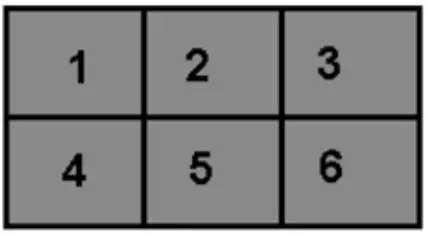 |
| OPS Settings (Optional) | Press OK to open the OPS Settings menu screen. Three sub-menu options are available. OPS Information: Displays read-only information about the OPS unit, if supported. OPS Status: Displays whether the OPS module is on or off. Allows the change of status via soft PSON signal (0.5s) Boot Signal: Enables or disables sending of a PSON signal. The Display checks the status signal of the OPS at bootup in order to turn it on by sending a PSON signal if it is off. Some OPS’s send incorrect information on their status during the bootup of the Display, so they seem to be on even though they are off. For such non-standard OPS’s, this option must be enabled. In this case, a PSON signal will be send for the OPS regardless of the received status information at bootup. Powerdown: Turns the OPS off via hard PSON signal (5s) OPS Always on (optional): When this option is enabled, Quick Standby will be forced to enabled and greyed out in the menu and OPS will not be set to standby (*). (*) If the ERP Regulations 2021 are applied (depends on the model of the unit): When this option is enabled, Power Mode will be forced to enabled (set to Reactive) and greyed out in the menu and OPS will not be set to standby Recovery Mode: When this option is enabled and OPS is on, if there is no video for 10 seconds it resets hotplug. If there is no video available after 30 seconds it reboots OPS. Note: This menu will not be available if OPS is not supported or not connected to the unit. |
| Scheduler Settings | Using the scheduler options you can set the unit to turn on automatically at defined time intervals with the defined input source setting on the desired days of the week. Press OK to open the Scheduler Settings menu screen. You can set up to 4 different schedulers. Highlight the first checkbox of the desired scheduler option and check it by pressing the OK button. Now you will be able to define a time for the Display to be turned on automatically. Highlight the time box next to the first checkbox and press the OK button, then use the directional and numeric buttons on the remote to set a time. Press the OK button again when you are done. Perform the same steps to set a time for the Display to turn off. You can also define a source for your scheduler. Highlight the box located under the Source tab for your scheduler option and press the OK button, then set as desired using the Left/Right directional buttons. If the Source option is set as Last Source, the input source will not be changed at the power-up. If the Source option is set as USB, the media files in the connected USB device will be played back automatically as explained in the section entitled ‘USB Auto Play Feature’. Lastly, you can select the week day/s for your scheduler setting to be activated. Highlight the checkbox under the desired day tab and press OK to check. Highlight and press OK a second time to uncheck a box. The scheduler will be active on the checked days of the week. You can also set a backlight scheduler. After setting the On, Off, Source and day options highlight the checkbox under the Backlight column and press OK. The checkbox will be checked and backlight level setting screen will be displayed. Set On value and Off value using the sliders and then press OK to save. Mind that, in case you set a backlight scheduler, the display will not be turned on or off, only the backlight values will be changed at defined time interval. If Source option is set as Last Source the backlight settings will be applied to all sources, otherwise the settings will be applied to the selected source only. Press the Green button on the main scheduler screen to save settings when complete. |
| ink options | Press OK to open the link options menu screen. Current Start url and Settings url links will be displayed. These items are for information only and not selectable. Refer to Usage of the Start URL section for information on setting the Start url. Open browser initial page and NTP server link preferences can be configured using the related options. |
| Volume Settings | Press OK to see available menu options. |
| Reset to Default Values | Highlight this option and press the OK button on the remote to return the Display to default settings. |
| First time installation | Highlight and press OK to perform First Time Installation and reset all settings to factory settings. You will need to enter the correct PIN to carry out this operation. Note: Enter the PIN you have defined during the First Time Installation process. |
| System Menu Content | ||
| Language | Sets the OSD menu language preference. | |
| Date/Time | Sets date and time. | |
| Sources | Enables or disables selected source options. There will be Regular, Enhanced and Disabled options available for HDMI sources, if your Display supports Ultra HD. Regular and Enhanced options are affecting the colour settings of the selected HDMI source. To be able to watch 4K images from an HDMI source related source setting should be set as Enhanced if the connected device is HDMI 2.0 compatible. Set as Regular if the connected device is HDMI 1.4 compatible. Set accordingly or disable the related HDMI source by setting as Disabled. Note: HDMI cables which are longer than 5 metres and which are not HDMI certified can cause display problems. We recommend using a certified Premium High-Speed HDMI Cable. Source device, connection cable quality and other HDMI equipments used may affect performance. Please refer to → https://www.hdmi.org/consumer/finding_right_cable.aspx (for finding the right cable) https://www.hdmi.org/installers/longcablelengths.aspx (for cable lengths) | |
| More | Displays other setting options of the Display. | |
| Menu Timeout | Changes timeout duration for menu screens. | |
| Standby Led | Enables or disables the functionality of the standby led. If disabled the led will not function. | |
| Software upgrade | Displays current software version. Press OK to see the upgrade options. You can use these options to start a manual search for software updates and set your automatic scan preference. | |
| Auto Display OFF | Sets the desired time for the Display to automatically go into standby mode when not being operated. | |
| Audio Video Sharing (optional) | Audio Video Sharing feature allows you to share files stored on your smartphone or tablet pc. If you have a compatible smartphone or tablet pc and the appropriate software is installed, you can share/play photos on your Display. See instructions of your sharing software for more information. | |
| CEC | With this setting you can enable and disable CEC functionality completely. Press Left or Right button to enable or disable the feature. | |
| CEC Auto Power On (optional) | This function allows the connected HDMI-CEC compatible device to turn on the Display and switch to its input source automatically. Press Left or Right button to enable or disable the feature. | |
| DP Stream Setting (*) | Sets the DisplayPort stream type. MST and SST options are available. (*) This menu item appears only when the input source is set to DP. | |
| USB Auto Play | Using this option you can set your Display to start playing the media content installed on a removable device automatically. Refer to USB Auto Play Feature section for detailed information. | |
Connectivity
To configure wired or wireless settings you should access the Network menu in the Settings menu.
Wired Connectivity
To Connect to a Wired Network
- You must have a modem/router connected to an active broadband connection.
- There is a LAN port at the bottom of the rear side of your Display. Connect your Display to your modem/ router via this LAN port using an Ethernet cable.
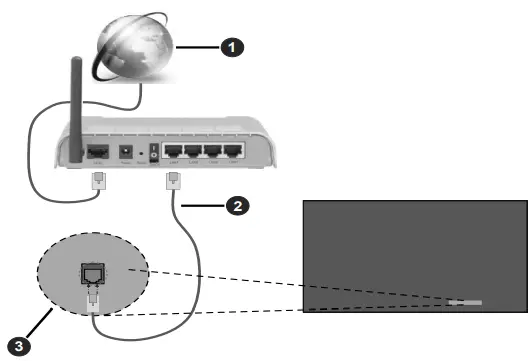
- Broadband ISP connection
- LAN (Ethernet) cable
- LAN input on the bottom of the rear side of the
Display
Configuring Wired Device Settings
Network Type
Set the Network Type as Wired Device if you areconnecting via an Ethernet cable.
Internet Speed Test
Highlight Internet Speed Test and press the OKbutton. Display will check the internet connectionbandwidth and display the result when complete.
Advanced Settings
Highlight Advanced Settings and press the OK button. On the next screen you can change the IP and DNS settings of the Display. Highlight the desired oneand press Left or Right button to change the setting from Automatic to Manual. Now you can enter the Manual IP and / or Manual DNS values. Select the related item in the drop down menu and enter the new values using the numeric buttons on the remote. Highlight Save and press the OK button to save settings when complete.
Other Information
You can also enable or disable Networked StandbyMode feature using the related option. The status ofthe connection will be displayed as Connected or Not Connected and the current IP and MAC addresses, if a connection is established.
Wireless Access Point (optional) If the network type is set as Wired Device access point feature will be available. Highlight Access Point option and press OK. Access Point, SSID, Security Type and Password options will be available.
Access Point: Start or stop access point functionality.
The function of this option will change according to the current status.
SSID: Set the name of the accesspoint.
Security Type: Secure your network using WPA2 PSK.
You can also set this option as None. In that case no password will be required to connect to the access point.
This option can be set only if the access point feature is not activated.
Password: Define a password for the access point. This option will be available if the Security Type option is set as WPA2 PSK and can be set only if the access point feature is not activated.
Wireless Connectivity
To Connect to a Wireless Network
- You must have a wireless modem/router connected to an active broadband connection.
 1 Broadband ISP connection
 - A Wireless-N router (IEEE 802.11a/b/g/n) withsimultaneous 2.4 and 5 GHz bands is designedto increase bandwidth. These are optimized forsmoother and faster HD video streaming, filetransfers and wireless gaming.
- The frequency and channel differ depending onthe area.
- The transmission speed differs depending on the distance and number of obstructions between the transmission products, the configuration of these products, the radio wave conditions, the line traffic and the products that you use. The transmission mayalso be cut off or may get disconnected depending on the radio wave conditions, DECT phones or any other WLAN 11b appliances. The standard values of the transmission speed are the theoretical maximum values for the wireless standards. They are not the actual speeds of data transmission.
- The location where the transmission is most effective differs depending on the usage environment.
- The Wireless feature of the Display supports 802.11 a,b,g & n type modems. It is highly recommended that you should use the IEEE 802.11n communication protocol in order to avoid any possible problems while watching videos.
- You must change your modem’s SSID when there are any other modems around with the same SSID. You can encounter connection problems otherwise. Use a wired connection if you experience problems with a wireless connection.
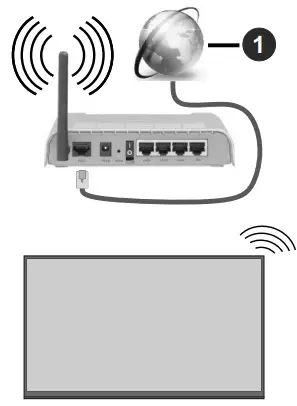 1 Broadband ISP connection
Configuring Wireless Device Settings
Open the Network menu and select Network Type as Wireless Device to start connection process.
Highlight Scan Wireless Networks option and press OK to start a search for available wireless networks.
All found networks will be listed. Highlight your desired network from the list and press OK to connect.
Note: If the modem supports N mode, you should set N mode settings.
If the selected network is password-protected, enter the correct key by using the virtual keyboard. You can use this keyboard via the directional buttons and the OK button on the remote control.
Wait until the IP address is shown on the screen.
This means that the connection is now established.
To disconnect from a wireless network, highlight Network Type and press Left or Right buttons to set as Disabled.
If your router has WPS, you can directly connect to the modem/router without entering a password or adding the network first. Highlight Press WPS on your wifi router option and press OK. Go to your modem/router device and press the WPS button on it to make the connection. You will see a connection confirmation on your Display once the devices have paired. Select OK to proceed. No further configuration is required.
Highlight Internet Speed Test and press the OK button to check your internet connection speed. Highlight Advanced Settings and press the OK button to open the advanced setting menu. Use directional and numeric buttons to set. Highlight Save and press the OK button to save settings when complete.
Other Information
You can also enable or disable Networked Standby Mode feature using the related option. The status of the connection will be displayed as Connected or Not Connected and the current IP and MAC addresses, if a connection is established.
Connecting to your mobile device via WLAN
- If available, you can download a virtual remote controller application from the server of your mobile device application provider.
Note: This feature may not be supported on all mobile devices.
Networked Standby Mode
Networked Standby Mode is a standart that allows a device to be turned on or woken up by a network message(magic packet). This message is sent to the device by a program executed on a remote device connected to the same local area network, such as a smartphone.
To enable this feature set the Networked Standby Mode option in the Settings/Network menu as On and set the Quick Standby option in the Signage>Power Up Settings menu as Disabled (*). It is necessary that both the device, from which the network message will be sent to the Display, and the Display are connected to the same network. All devices must support magic packet on the system from Access Points to the device which sends the magic packet and the device which receives the magic packet to wake-up. You can use any Networked Standby Mode software available for the operating system of your device in order to send magic packets.
(*) If the ERP Regulations 2021 are applied (depends on the model of the unit): To enable this feature set the Networked Standby Mode option in the Settings/ Network menu as On and set the Power Mode option in the Signage>Power Up Settings menu as Eco In order to use this feature the Display and the remote device should be connected at least once while the Display is on. If the Display is powered off, the connection should be re-established, the next time it is switched on. Otherwise this feature will be unavailable. This does not apply, when the Display is switched into the standby mode.
How to control functionality
- Enable Networked Standby Mode option from Settings>Network menu by settings as On
- Connect your Display and the remote device, which will send the magic packets to the Display, to the same network
- Get the MAC address of your Display which will be needed in order to send magic packets
- Switch the Display into standby mode
- Send magic packets to the MAC address of your Display by using mobile phones, Linux or Windows computers
Your Display should wake up after receiving magic packets.
Connecting Other Wireless Devices
Your Display supports another short range wireless connection technology too. A pairing is required beforeusing these kind of wireless devices with the Display set. You should do the followings to pair your device with the Display:
- Set the device to pairing mode
- Start device discovery on the Display
Note: Refer to the user manual of the wireless device to learnhow to set the device to pairing mode.
You can connect audio devices wirelessly to yourDisplay. Unplug or switch off any other connectedaudio device in order for wireless connection feature to work correctly. Select the Audio Link option inthe Settings>Sound menu and press the OK button to open the related menu. Using this menu you can discover and connect the devices that use the same wireless technology and start to use them. Follow the on-screen instructions. Start the device discovery. Alist of available wireless devices will be displayed.Select the device you want to connect from thelist and press the OK button to connect. If “Device connected” message is displayed, the connectionis successfully established. If the connection failstry it again.
Note: Wireless devices may operate within the same radio frequency range and may interfere with one another. Toimprove the performance of your wireless device place it at least 1 meter away from any other wireless devices.
Wireless Display
Wireless Display is a standard for streaming video andsound content. This feature provides the ability to useyour Display as wireless display device.
Using with mobile devices
There are different standards which enable sharing ofscreens including graphical, video and audio content between your mobile device and Display.
Plug in the WLAN USB dongle to Display first, then press the Source button on the remote and switch to Wireless Display source.
A screen appears stating that the Display is ready for connection.
Open the sharing application on your mobile device.
These applications are named differently for eachbrand, refer to the instruction manual of your mobile device for detailed information.
Scan for devices. After you select your Display and connect, the screen of your device will be displayed on your Display.
Note: This feature can be used only if the mobile devicesupports this feature. If you experience problems with the connection check if the operating system version you use supports this feature. There may be incompatibility problems with the operating system versions which are released after the production of this Display. Scanning and connecting processes differ according to the programme you use. The maximum supported resolution is 1920×1080. Image quality may be affected by neighbouring wireless networks and your internet connection speed.
Connectivity Troubleshooting
Wireless Network Not Available
- Ensure that any firewalls of your network allow the Display wireless connection.
- Try searching for wireless networks again, using the Network menu screen.
If the wireless network does not function properly, try using the wired network. Refer to the Wired Connectivity section for more information on the process.
If the Display does not function using the wired connection, check the modem (router). If the router does not have a problem, check the internet connection of your modem.
Connection is Slow
See the instruction book of your wireless modem to get information on the internal service area, connection speed, signal quality and other settings. You need to have a high speed connection for your modem.
Distruption during playback or slow reactions
You could try the following in such a case: Keep at least three meters distance from microwave ovens, mobile telephones, bluetooth devices or any other WLAN compatible devices. Try changing the active channel on the WLAN router.
Internet Connection Not Available
If the MAC address (a unique identifier number) of your PC or modem has been permanently registered, it is possible that your Display might not connect to the internet. In such a case, the MAC address is authenticated each time when you connect to the internet. This is a precaution against unauthorized access. Since your Display has its own MAC address, your internet service provider cannot validate the MAC address of your Display. For this reason, your Display cannot connect to the internet. Contact your internet service provider and request information on how to connect a different device, such as your Display, to the internet.
It is also possible that the connection may not be available due to a firewall problem. If you think this causes your problem, contact your internet service provider. A firewall might be the reason of a connectivity problem.Warning
Please make sure that below 3 parameters are not configured this way at the same time; otherwise your display may enter a reset loop on logo screen. In orderto get out of this loop, you should unplug the OPS unitand change at least one of the 3 parameters.
- Display: Menu > Settings > Signage > Power Up Settings > Power Up Mode = STANDBY
- Display: Menu > Settings > Signage > Power Up Settings > Quick Standby = DISABLED (*) If the ERP Regulations 2021 are applied (depends on the model of the unit): Menu > Settings > Signage > Power Up Settings > Power Mode = ECO
- OPS: BIOS Menu > Chipset > State After G3 > S0 STATE
Apps
You can access the applications installed on yourDisplay from Apps menu. Highlight an app and press OK to launch.
In order to open the Start url that is defined the in Settings>Signage>Link Options menu highlight theCustom App option and press OK.
Notes: Possible application dependent problems may be caused by the content service provider.
Third party internet services may change, be discontinued or restricted at any time.
Using Audio Video Sharing Network Service (optional)
Audio Video Sharing feature uses a standard that easesthe viewing process of digital electronics and makesthem more convenient to use on a home network.
This standard allows you to view and play photos, musicand videos stored on your media server connected toyour home network.
- Server Software Installation
The Audio Video Sharing feature cannot be used if theserver programme is not installed onto your PC or if the required media server software is not installed onto the companion device. Please prepare your PC with a proper server programme. - Connect to a Wired or Wireless Network
See the Wired/Wireless Connectivity chapters for detailed configuration information. - Enable Audio Video Sharing
Enter the Settings>System>More menu and enable the Audio Video Sharing option. - Play Shared Files via Media Browser
Highlight the Audio Video Sharing option in theSources menu by using the directional buttons and press OK. Available media server devices in the network will be listed. Select one and press OK to continue. The media browser will then be displayed.
Refer to the Media Browser Menu section for further information on file playback.
If a problem occurs with the network, please switch your display off at the wall socket and back on again.
Trick mode and jump are not supported with the Audio Video Sharing feature.
PC/HDD/Media Player or any other devices that are compatible should be used for higher playback quality.
Note: There may be some PC’s which may not be able to utilise the Audio Video Sharing feature due to administrator and security settings (such as business PC’s).
Internet Browser
To use the internet browser enter the Apps menu first.
Then launch the internet browser application which has an orange coloured logo with earth symbol on it.
(*) The appearance of the internet browser logo may change In the initial screen of the browser, the thumbnails of the predefined (if any) links to web sites available will be displayed as Speed Dial options along with the Edit Speed Dial and the Add to Speed Dial options.
You can press the Internet button on the remote to open the initial internet browser page. If the Open browser initial page URL in the Settings>Signage>Link Options menu is defined, the browser will open on this page. Otherwise this button will not be functional.
To navigate the web browser, use the directional buttons on the remote or a connected mouse. To see the browser options bar, move the cursor to the top of the page. History, Tabs and Bookmarks options and the browser bar which contains previous/next buttons,
the refresh button, the adress/search bar, the Speed Dial and the Vewd buttons are available.
To add a desired website to the Speed Dial list for quick access, move the cursor to the top of the page.
The browser bar will appear. Highlight the Speed Dial –  button and press the OK button. Then select Add to Speed Dial option and press the OK button. Fill in the blanks for Name and Address, highlight OK and press the OK button to add. Whilst you are on the site you wish to add to the Speed Dial list, highlight the Vewd button and press the OK button. Then highlight Add to Speed Dial option in the submenu and press the OK button again. Name and Address will be filled automatically according to the site you are visiting.
Highlight OK and press the OK button to add.
You can also use the Vewd menu options to manage the browser. Highlight the Vewd button and press the OK button to see available page specific and general options.
There are various ways to search or visit websites using the web browser.
Enter the address of a website(URL) into the search/ address bar and highlight the Submit button on the virtual keyboard and press the OK button to visit thesite.
Enter keyword/s into the search/address bar and highlight the Submit button on the virtual keyboard and press the OK button to start a search for the related websites.
Highlight a Speed Dial thumbnail and press the OKbutton to visit the related website. Your Display is compatible with USB keyboard/mice.
Plug your device into the USB input of your Display for easier and quicker navigation.
Some web pages include flash content. These are notsupported by the browser.
Your Display does not support any downloadprocesses from the internet via the browser.
All sites on the internet might not be supportted.According to the site; content problems may occur.
In some circumstances video contents might not be able to be played.
OSD Rotation Support
You can change the OSD (On Screen Display) rotation of your Display if desired. While performing First time installation set the OSD Orientation option as desired when the Signage menu is displayed. You can also change this setting later from the Signage>Controls menu.
Available options are: Landscape, Portrait 1 and Portrait 2.
DisplayPort
DisplayPort version 1.2 is supported via the DisplayPort input and output connectors on your Display.
DP Stream Setting option in the Settings>System>More menu is set as MST(Multi-Stream Transport) by default. If a MST compliant source device is connected to the Display, the streaming data should be configured on the source device (Daisy-chaining).
If DisplayPort version 1.1 compliant or SST (SingleStream Transport) compliant source device withDisplayPort version 1.2 support is connected to the Display, DisplayPort output on the Display will work asa splitter. In this case, same image will be displayed in all connected Displays.
To be able to stream the same image to all connected Displays using a MST compliant device, DP Stream Setting option in the Settings>System>More menu should be set as SST.
The maximum amount of the Displays that can be connected by using daisy-chaining function may differdepending on the source device’s capacity. The image that will be displayed in all Displays will be defined by the source device. For example, to be able to stream 4 different FHD images, the source device should be capable of supporting this operation.
Note: It is recommended to use a DisplayPort certified cable for connection.
In SST operation mode the total amount of the Displays is limited (a maximum of 7 units) due to HDCP encryption. If the signal is stable and there is no cable loss, there will be no limitation in case the source content is not HDCP-encrypted.
When using cascade-connected Displays, it is recommended to set the DP Stream Setting as SST on all Displays in SST operation mode.
For proper operation in MST operation mode make sure your source device is MST compliant. If your source device is a computer check the specifications of its graphic card to ensure MST compatibility. When using daisy-chained Displays, it is recommended to set the DP Stream Setting as MST on all Displays in MST operation mode.
HDMI Out
The HDMI port located on the rear left side of the Display functions as an output port (upper HDMI port, HDMI Out). This port will not function as an input, thus no source devices should be connected to this port. Only the content received from the HDMI inputport located also on the rear left side of the Display
(lower HDMI port, HDMI1 In) can be outputted from
this port. The contents received from other inputs,
such as VGA or Display Port, can not be outputted.
This is a default function and you can not disable/
enable through any menu option. HDMI output port
will always function if a source device is connected
to the specified HDMI input.
Real Time Clock (RTC)
Your Display has an RTC. It is used to maintain the
real date and time information for a period of time if
the energy supply is interrupted by separating the
Display from the mains or by a power blackout. In this
case the Display will use the date and time information
stored in RTC.
• All time sources are able to override RTC date/time.
• Display tries to connect to the NTP server periodically
(6 hours
after last update)
to get the current
date
and
time
information.
If
the
Display
successfully
gets
these informations from the NTP server, it
updates itself and RTC with the received date and
time information. If the NTP server update fails, the
Display uses RTC time and date to update itself.
• The RTC battery provides power to the integrated
real-time clock and the calendar. Without any
external power source, RTC is able to function for
a minimum of 14 days.
• If RTC is used as time source, manual date-time set
is enabled from Date/Time option in the Settings>
System menu.
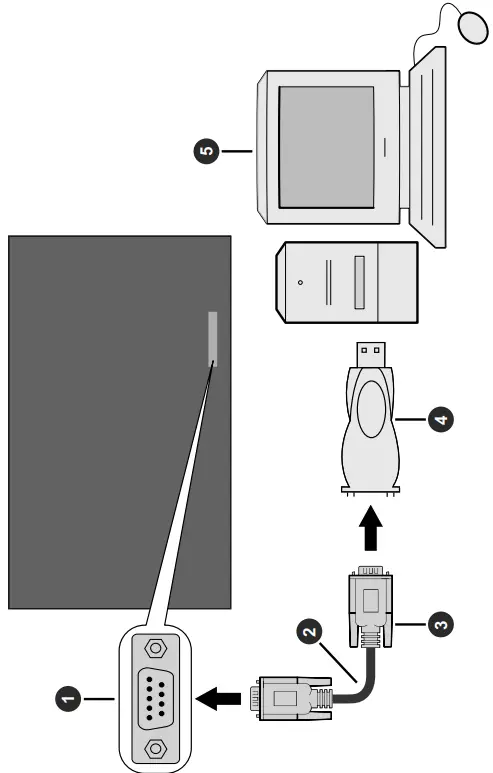
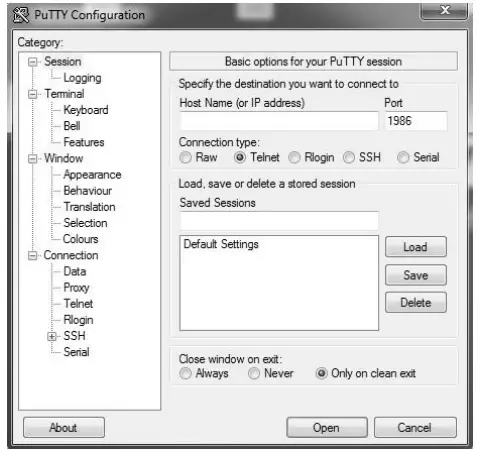




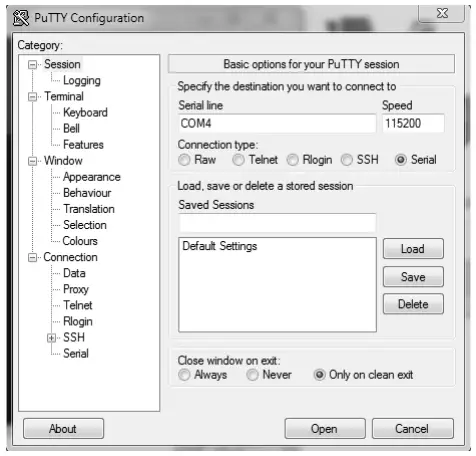
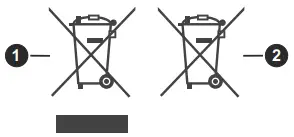


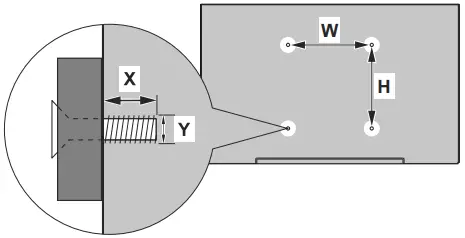
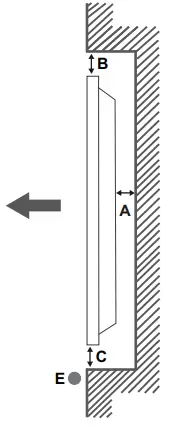

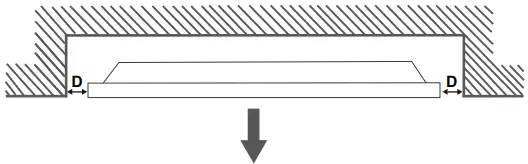
 Declaration of Conformity
 Download PuTTY - a free SSH and telnet client for Windows