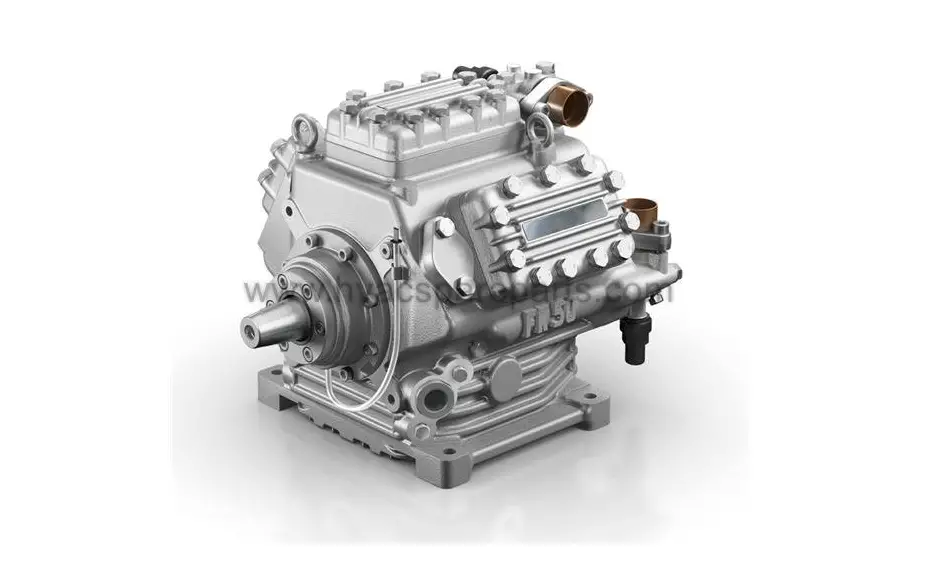
BOCK FK20 GEA Vehicle Compressors
Product Information
The product is a compressor, available in various models:
- FK20/120 N
- FK20/120 K
- FK20/120 TK
- FKX20/120 N
- FKX20/120 K
- FKX20/120 TK
- FK20/145 N
- FK20/145 K
- FK20/145 TK
- FKX20/145 N
- FKX20/145 K
- FKX20/145 TK
- FK20/170 N
- FK20/170 K
- FK20/170 TK
- FKX20/170 N
- FKX20/170 K
- FKX20/170 TK
About these instructions
These instructions should be read before assembling and using
the compressor. They contain important safety information to
prevent misunderstandings and damage. Improper assembly and use can
result in serious or fatal injuries. The safety instructions must
be followed. These instructions should be provided to the end
customer along with the installed unit.
Contents
The user manual includes the following sections:
- Safety
- Product description
- Areas of application
- Compressor assembly
- Commissioning
- Maintenance
- Accessories
- Technical Data
- Dimensions and Connections
- Declaration of incorporation
Safety
Identification of safety instructions:
- DANGER! Indicates a dangerous situation which,
if not avoided, will cause immediate fatal or serious injury. - WARNING! Indicates a dangerous situation
which, if not avoided, may cause fatal or serious injury. - CAUTION! Indicates a dangerous situation
which, if not avoided, may cause fairly severe or minor
injury. - ATTENTION! Indicates a situation which, if not
avoided, may cause property damage. - INFO! Important information or tips on
simplifying work.
Qualifications required of personnel:
Inadequately qualified personnel poses the risk of accidents,
which can result in serious or fatal injury. Work on compressors
should only be performed by personnel with the following
qualifications:
- Engineer
- Professions with comparable training that enables personnel to
assemble, install, maintain, and repair refrigeration and
air-conditioning systems - Personnel capable of assessing the work and recognizing
potential dangers
Product Usage Instructions
To use the compressor, follow these steps:
- Read and understand the safety instructions provided in the
user manual. - Assemble the compressor according to the instructions provided
in the user manual. - Ensure that the compressor is set up correctly and placed on a
stable surface. - Check the maximum permissible inclination of the compressor and
ensure it is within the specified limits. - If using a V-belt drive, follow the instructions provided in
the user manual for proper installation. - Take note of the main bearing load and ensure it is within the
recommended range. - If applicable, assemble the electromagnetic clutch assembly
according to the instructions provided in the user manual. - Connect the necessary pipes to the compressor following the
pipe connections guidelines provided in the user manual. - Operate the shut-off valves as instructed in the user
manual. - Understand and follow the operating mode of the lockable
service connections. - If applicable, install and maintain the suction pipe filter
according to the instructions provided in the user manual. - Before starting up the compressor, make sure all necessary
preparations have been made, including pressure strength test, leak
test, evacuation, and refrigerant charge. - If needed, refer to the user manual for instructions on
replacing the shaft seal. - Avoid liquid shocks during operation as indicated in the user
manual. - Maintain the compressor regularly by following the recommended
maintenance procedures provided in the user manual. - Use recommended spare parts and accessories when carrying out
maintenance or repairs. - Refer to the user manual for information on lubricants and oils
to be used with the compressor. - When decommissioning the compressor, follow the decommissioning
guidelines provided in the user manual. - If using the TK version, refer to the user manual for specific
instructions regarding the valve plate.
BOCK® FK20
Operating guide
FK20/120 N FK20/120 K FK20/120 TK
FKX20/120 N FKX20/120 K FKX20/120 TK
FK20/145 N FK20/145 K FK20/145 TK
FKX20/145 N FKX20/145 K FKX20/145 TK
FK20/170 N FK20/170 K FK20/170 TK
FKX20/170 N FKX20/170 K FKX20/170 TK
Translation of the original instructions
AQ451838788471en-000201
About these instructions
Read these instructions before assembly and before using the compressor. This will avoid misunderstandings and prevent damage. Improper assembly and use of the compressor can lead to serious or fatal injury. Observe the safety instructions contained in these instructions. These instructions must be passed onto the end customer along with the unit in which the compressor is installed.
The safety advice, which is contained in these instructions for assembly, and which is relevant for regular operation and maintenance, must be forwarded by the manufacturer in his own documents to the operator of the entire system. It must also be ensured, that personnel working in daily operation with the compressor have access to important information such as safety and warning advice about the compressor. Such persons must read the safety advice and have understood it. Bock assumes no liability for any damage arising from non-compliance.
D GB F I TR
2 | AQ451838788471en-000201
© Danfoss | Climate Solutions | 2023.07
Contents
1 Safety 1.1 Identification of safety instructions 1.2 Qualifications required of personnel 1.3 Danger to life and limb in the event of faults during operation 1.4 General safety instructions 1.5 Intended use
2 Product description 2.1 Brief description 2.2 Name plate 2.3 Type key
3 Areas of application 3.1 Refrigerants 3.2 Oil charge 3.3 Limits of application
4 Compressor assembly 4.1 Setting up 4.2 Maximum permissible inclination 4.3 V-belt drive 4.4 Main bearing load 4.5 Electromagnetic clutch assembly 4.6 Pipe connections 4.7 Pipes 4.8 Operating the shut-off valves 4.9 Operating mode of the lockable service connections 4.10 Suction pipe filter
5 Commissioning 5.1 Preparations for start-up 5.2 Pressure strength test 5.3 Leak test 5.4 Evacuation 5.5 Refrigerant charge 5.6 Shaft seal 5.6.1 Notes on replacing the shaft seal 5.7 Avoiding liquid shocks
6 Maintenance 6.1 Preparation 6.2 Work to be carried out 6.3 Recommended spare parts/accessories 6.4 Lubricants / Oils 6.5 Decommissioning 6.6 Valve plate, TK version
7 Accessories 7.1 Thermal protection thermostat
8 Technical Data
9 Dimensions and Connections
10 Declaration of incorporation
Page 4
6 8 9
D
GB
13
F
I
TR
16
18
19 20 22
© Danfoss | Climate Solutions | 2023.07
AQ451838788471en-000201 | 3
1| Safety
1.1 Identification of safety instructions:
DANGER!
Indicates a dangerous situation which, if not avoided, will cause immediate fatal or serious injury.
Indicates a dangerous situation which, if not avoided, WARNING! may cause fatal or serious injury.
Indicates a dangerous situation which, if not CAUTION! avoided, may cause fairly severe or minor injury.
ATTENTION! Indicates a situation which, if not avoided, may cause property damage.
INFO!
Important information or tips on simplifying work.
D
GB
1.2 Qualifications required of personnel
F
I
WARNING! Inadequately qualified personnel poses the risk of accidents, the consequence being serious or fatal injury. Work on
TR
compressors is therefore reserved for personnel with the
qualifications listed below:
· For example, a refrigeration technician, refrigeration mechatronic
engineer.
As well as professions with comparable training, which enables
personnel to assemble, install, maintain and repair refrigeration and
air-conditioning systems. Personnel must be capable of assessing
the work to be carried out and recognising any potential dangers.
4 | AQ451838788471en-000201
© Danfoss | Climate Solutions | 2023.07
1| Safety
1.3 Danger to life and limb in the event of faults during operation
WARNING!
If a compressor continues to be operated during extreme running noise and/or a sharp reduction in refrigerating capacity, there is the danger of further events occurring, such as the fracture of the housing wall. If people are standing in the immediate surroundings, there is the risk of severe injury or even death from flying parts. · In the event of extreme running noise, switch the compressor off
immediately. · If there is a sharp reduction in refrigerating capacity, switch the
compressor off immediately. · Secure the compressor against being switched on again. · In such cases do not continue to operate the compressor under
any circumstances.
1.4 General safety instructions
D
DANGER! · Refrigerating compressors are pressurised machines and as
GB
such call for heightened caution and care in handling.
The maximum permissible overpressure must not be exceeded,
F
even for testing purposes.
I
TR WARNING! · Risk of burns! Depending on the operating conditions,
surface temperatures of over 60 °C on the discharge side or below 0 °C on the suction side can be reached.
1.5 Intended use
These assembly instructions describe the standard version of the FK20 manufactured by Bock. The compressor is intended for use in refrigeration systems in compliance with the limits of application. Only the refrigerant specified in these instructions may be used. Any other use of the compressor is prohibited!
The Bock refrigerating compressor named in the title is intended for installation in a machine (within the EU according to the EU Directives 2006/42/EC Machinery Directive, 2014/68/EU Pressure Equipment Directive). Commissioning is permissible only if the compressor has been installed in accordance with these assembly instructions and the entire system into which it is integrated has been inspected and approved in accordance with legal regulations.
© Danfoss | Climate Solutions | 2023.07
AQ451838788471en-000201 | 5
2| Product description
2.1 Brief description
Three different designs are available for various ranges of application:
> for air-conditioning
the K Design
> for air-conditioning or normal cooling the N Design
> for deep freezing
the TK Design
The differences lie mainly in the valve plate tooling which is adapted to each applica-
tion range where operational safety and efficiency are concerned.
Compact two-cylinder compressor in single row. Three capacity ranges. Lightweight aluminum design. Lubricating oil pump with oil pressure relief valve independent of rotational direction. Variable connection and fixing options.
D
Name plate
GB
F Shaft seal
I Shaft end
TR
Cylinder cover Discharge
shut-off valve
Fig. 1
Valve plate Oil pump
Suction shut-off valve
Sight glass
Fig. 2 Dimension and connection values can be found in Chapter 9
6 | AQ451838788471en-000201
© Danfoss | Climate Solutions | 2023.07
2| Product description
2.2 Name plate (example)
BOCK Bock GmbH, Benzstr. 7 72636 Frickenhausen, Germany
BB12345A020
4
1
FKX20/170N
2
14,8
3
19/28bar Öl: BOCK lub E55 5
Fig. 3
1 Type designation 2 Displacement at 1450 rpm
4 Machine number 5 Factory-filled oil type
} 3 LP: Max. permissible operating pressure (g) Low pressure side HP: Max. permissible operating pressure
Observe the limits of application diagrams!
(g) High pressure side
2.3 Type key (example)
FK X 2 0 / 170 N
D
GB
Designs ¹)
F
Swept volume
I
Size
TR
Ester oil charging ²)
Series
¹) K – specially for air-conditioning
N – specially for air-conditioning or normal cooling
TK – specially for deep freezing ²) X – Ester oil charging (HFC refrigerant, e.g. R134a, R407C)
© Danfoss | Climate Solutions | 2023.07
AQ451838788471en-000201 | 7
3| Areas of application
3.1 Refrigerants
· HFKW / HFC: · HFCKW / HCFC:
R134a, R404A/R507, R407C R22
3.2 Oil charge
The compressors are factory-filled with the following oil type:
– for R134a, R404A/R507, R407C
BOCK lub E55
– for R22
BOCK lub A46
Compressors with ester oil charge (BOCK lub E55) are marked with an X in the type designation (e.g. FKX20/170 N).
INFO!
For recharging, we recommend the above oil types. See chapter 6.4.
3.3 Limits of application
ATTENTION! Compressor operation is possible within the operating limits.
These can be found in Bock compressor selection tool (VAP)
under vap.bock.de. Observe the information given there.
D
– Max. permissible discharge end temperature: 140°C
GB
– Permissible ambient temperature: (-20°C) – (+100°C)
– Max. permissible switching frequency: 12 x /h
F
– A minimum running time of 2 min. at equilibrium (continuous
I
operation) must be achieved.
TR
Avoid continuous operation near the threshold. Should the
compressor happen to be used near the thresholds, we
recommend the use of a thermal protection thermostat
(Accessories, Chap. 7).
When operating in the vacuum range, there is a danger of air entering on the suction side. This can cause chemical reactions, a pressure rise in the condenser and an elevated compressedgas temperature. Prevent the ingress of air at all costs!
Max. permissible operating pressure (g) high-pressure side (HP): 28 bar
8 | AQ451838788471en-000201
© Danfoss | Climate Solutions | 2023.07
4| Compressor assembly
INFO!
New compressors are factory-filled with inert gas. Leave this service charge in the compressor for as long as possible and prevent the ingress of air. Check the compressor for transport damage before starting any work.
4.1 Setting up
Storage at (-40°C) – (+100°C), maximum permissible relative Humidity 10% – 95%, no condensation Fittings (e.g. pipe holders, additional units etc.) on the compressor are permissible only following consultation with Bock. Setup on an even surface or frame with sufficient load-bearing capacity. The compressor can be fastened as follows: – using the 4 drill holes on the baseplate – using the 3 side M10 tapped blind holes on the left or right of the compressor housing – using the 4 M10 tapped blind holes on the front of the compressor housing. Correct setup of the compressor and mounting of the belt drive are decisive for running comfort, operating safety and the service life of the compressor.
4.2 Maximum permissible inclination
D
ATTENTION! Poor lubrication can damage the compressor.
GB
Respect the stated values.
F
A
A
A
A
I
aa
aa
TR
Fig. 4
A max. 30°, max. 2 minutes
a max. 15°, continuous operation
© Danfoss | Climate Solutions | 2023.07
AQ451838788471en-000201 | 9
4| Compressor assembly
4.3 V-belt drive
ATTENTION! Inappropriately designed belt drives, especially belt knocking (offsets, inclinations) or excessive tensioning forces can cause compressor damage! Make sure that the drive belt is designed correctly, e.g. by using tensioners and selecting the belt profile and the belt length.
4.4 Main bearing load
To prevent the belt drive overloading the compressor main bearing,
ensure that: The engagement force applied by the belt tension (see Fig. 5)
must not exceed Fmax per. = 600 N. If the force engagement point shifts to the right (see Fig. 5,
small
point),
the
force
F max
per.
reduces
as
per
the
following
formula:
Fmax= 600 N Mbmax= 30kNmm
F= max per.
30 kNmm (50 mm + L1 [mm])
D
GB
Fig. 5 L1 (mm)
F
4.5 Electromagnetic clutch assembly
I
The following description applies for an electromagnetic clutch secured to a shaft.
To absorb the magnetic field of the electromagnetic clutch, the sliding ring lid has
TR
a snug fit Ø 38 h8 (see Fig. 6).
To connect the magnetic field, remove the marked Allen head screws of the sliding ring lid
(see Fig. 7).
Slide the magnetic field to a snug-fit and fasten using the three M5 x 20 cheese head
screws provided (Fig. 7). Screw torque = 9 Nm.
Further assembly of the electromagnetic clutch according to the clutch manufacturer.
Sliding ring lid Magnetic field
Fig. 6
Snug fit
10 | AQ451838788471en-000201
Fig. 7
© Danfoss | Climate Solutions | 2023.07
4| Compressor assembly
4.6 Pipe connections
The pipe connections, if installed, have graduated inside diameters so that pipes in the common millimeter and inch dimensions can be used.
Fig. 8: Stepped internal diameters
The connection diameters of the shut-off valves are designed for maximum compressor output. The required pipe cross-section must
be matched to the capacity. The same applies for non-return
valves.
ATTENTION! Overheating can damage the valve. Solder only using inert gas to inhibit oxidation products.
4.7 Pipes
Pipes and system components must be clean and dry inside and free of scale, swarf and layers
of rust and phosphate. Only use air-tight parts.
Lay pipes correctly. Suitable vibration compensators must be provided to prevent pipes being
cracked and broken by severe vibrations.
Ensure a proper oil return.
D
Keep pressure losses to an absolute minimum. GB
4.8 Operating the shut-off valves
F
Before opening or closing the shut-off valve, release the valve spindle seal by approx. ¼ of a turn
counter-clockwise.
I
After activating the shut-off valve, re-tighten the adjustable valve spindle seal clockwise.
TR
Release
Valve spindle seal Fig. 9
Tighten Fig. 10
© Danfoss | Climate Solutions | 2023.07
AQ451838788471en-000201 | 11
4| Compressor assembly
4.9 Operating mode of the lockable service connections
3 3 2
1
Opening the shut-off valve: a) Spindle 1: turn to the left (counter-clockwise) as far as it will go.
–> Shut-off valve fully opened / service connection 2 closed
Pipe connection
Fig. 11
3
3
2
D
GB
F
I
1
TR
Opening the service connection (2):
b) Spindle 1: Turn ½ – 1 rotation to the right.
–> Service connection 2 opened / shut-off valve opened. Connection 3 is provided for safety devices and is not lockable.
Pipe connection
Fig. 12
After activating the spindle, generally fit the spindle protection cap again and tighten with 14-16 Nm. This serves as a second sealing feature during operation.
4.10 Suction pipe filter
For systems with long pipes and higher degree of contamination, a filter on the suction-side is recommended. The filter has to be be renewed depending on the degree of contamination (reduced pressure loss).
12 | AQ451838788471en-000201
© Danfoss | Climate Solutions | 2023.07
5| Commissioning
5.1 Preparations for start-up
INFO!
To protect the compressor against inadmissible operating conditions, high-pressure and low-pressure pressostats are mandatory on the installation side.
The compressor has undergone trials in the factory and all functions have been tested. There are therefore no special running-in instructions.
Check the compressor for transport damage!
5.2 Pressure strength test
The compressor has been tested in the factory for pressure integrity. If however the entire system is to be subjected to a pressure integrity test, this should be carried out in accordance with EN 378-2 or a corresponding safety standard without the inclusion of the compressor.
5.3 Leak test
DANGER! Risk of bursting!
The compressor must only be pressurised using dried nitrogen (N2). Never pressurise with oxygen or other gases!
The maximum permissible overpressure of the compressor must not
D
be exceeded at any time during the testing process (see name plate
GB
data)! Do not mix any refrigerant with the nitrogen as this could
cause the ignition limit to shift into the critical range.
F
I Carry out the leak test on the refrigerating plant in accordance with EN 378-2 or a corresponding safety standard, while always observing the maximum permissible overpressure for the compressor. TR
5.4 Evacuation
First evacuate the system and then includethe compressor in the evacuation process. Relieve the compressor pressure. Open the suction and discharge line valves. Evacuate the suction and discharge pressure sides using the vacuum pump. At the end of the evacuation process, the vacuum should be < 1.5 mbar when the pump is switched off. Repeat the process as often as is required.
© Danfoss | Climate Solutions | 2023.07
AQ451838788471en-000201 | 13
5| Commissioning
5.5 Refrigerant charge
CAUTION! Wear personal protective clothing such as goggles and protective gloves!
ATTENTION!
Avoid overfilling the system with refrigerant!
To avoid shifts in concentration, zeotropic refrigerant blends (e.g. R407C) must always be added to the refrigerating plant in liquid form. Do not pour liquid refrigerant through the suction line valve on the compressor. It is not permissible to mix additives with the oil and refrigerant.
Make sure that the suction and discharge line valves are open.
With the compressor switched off, add the liquid refrigerant directly to the condenser or receiver,
breaking the vacuum.
If the refrigerant needs topping up after starting the compressor, it can be topped up in vapour form on the suction side, or, taking suitable precautions, also in liquid form at the inlet to the
D
evaporator.
GB
5.6 Shaft seal
F
ATTENTION! Failure to observe the following instructions can cause loss
I
of refrigerant and damage to the shaft seal!
TR INFO! The shaft seal seals and lubricates with oil. An oil leakage
of 0.05 ml per operating hour is therefore normal. This applies
particularly during the run-in phase (200 300 h).
The compressor shaft is sealed to outside using a shaft seal. The sealing element rotates with the shaft. The following is especially important to ensuring fault-free operation:
The complete refrigerant circuit must be correctly executed and clean inside. Heavy shocks and vibrations to the shaft as well as continuous cyclic operation are to be avoided. The sealing surfaces can stick together during prolonged downtimes (e.g. winter). Therefore, run the system every 4 weeks for 10 minutes.
14 | AQ451838788471en-000201
© Danfoss | Climate Solutions | 2023.07
5| Commissioning
5.6.1 Notes on replacing the shaft seal
Since changing the shaft seal involves encroaching into the refrigerant circuit, this is only recommended, if the seal is losing refrigerant, or if oil is escaping in excess of the permissible amount (see information on page 14, chapter 5.6, “Shaft seal”). Changing the shaft seal is described in the relevant spare part kit.
The shaft seal is a wearing part, and its service life depends on the prevailing conditions. Damaging effects on the shaft seal:
· Too little suction gas superheat, particularly during wet operation
· Too high or too low belt tension · Thermal overload (operation outside the limits of application) · Frequent cycling
· Long periods of stoppage
· Material deposits / dirt from the system
Due to these effects, the shaft seal can develop leaks, and it must then be replaced.
5.7 Avoiding liquid shocks
D
ATTENTION! Slugging can damage the compressor and cause refrigerant to
GB
leak. F
To prevent liquid shocks:
I
The complete refrigeration plant must be correctly designed and executed.
The capacities of all components must be compatible (particularly evaporator
TR
and expansion valve).
Suction gas superheating at the evaporator output should be at least 7 10 K (check setting
of the expansion valve). The system must reach a state of equilibrium. Particularly in critical systems (e.g. several evaporator points), suitable measures, e.g. use of liquid traps, solenoid valve in the liquid line, etc. are recommended.
© Danfoss | Climate Solutions | 2023.07
AQ451838788471en-000201 | 15
6| Maintenance
6.1 Preparation
WARNING! Before starting any work on the compressor: Switch off the compressor and secure it to prevent a restart. Relieve compressor of system pressure. Prevent air from infiltrating the system!
After maintenance has been performed: Connect safety switch. Evacuate compressor. Release switch lock.
6.2 Work to be carried out
Oil change: In principle, an oil change is not a mandatory requirement, if the equipment is correctly manufactured and properly operated. Based on decades of experience, we recommend however that
the following oil change/service work is carried out: · Initial oil change during the first maintenance of the vehicle (at the latest after one year) · Then after every 5,000 operating hours, at the latest however after 3 years. Also clean the oil filter.
· An oil change is also necessary, if the oil is very cloudy and dark, or after repairs have been carried
out on the compressor.
D
Emptying the shaft seal oil reservoir: As required depending on use, but at the latest after 1 year
GB
or approx. 1,400 operating hours
F
I
Where requirements are higher during use (frequent operation at the limits of application, or in hotlands with over +40 °C ambient temperature, or in the case of deep freezing), the following
TR requirements must be observed:
· Initial oil change during the first maintenance of the vehicle (at the latest after one year)
· Then an oil change after every 2,000 operating hours, at the latest however after two years. Also clean the oil filter.
Preventive maintenance The above requirements for higher use applications also apply in the case of preventive maintenance. The shaft seal must also be changed after 3 years.
Regular inspections (at least annually): Checks to be carried out on oil level in the oil sight glass, oil fill level of the shaft seal in the oil drain hose, absence of leaks in the compressor, running noise, vibrations, pressures, temperatures, and functioning of auxiliary devices such as the capacity control.
16 | AQ451838788471en-000201
© Danfoss | Climate Solutions | 2023.07
6| Maintenance
6.3 Recommended spare parts/accessories
Maintenance set for oil change · BOCK lub E55 1 l · Oil drain screw with seal Maintenance set for shaft seal · shaft seal kit · BOCK lub E55 1 l · Oil drain screw with seal
Available spare parts and accessories can be found on our compressor selection tool under vap.bock.de as well as in our online spare parts catalogue at bockshop.bock.de.
Only use original Bock spare parts!
6.4 Lubricants / Oils
The oil type filled as standard in the factory is marked on the name plate, and this should always be used, even in the case of maintenance units. Alternative oil types can vary significantly in quality due
to additives or inferior raw materials by the manufacturer. Validation within the compressors entire
operating limits can not be guaranteed, if such alternative oil types are used. It is for this reason, that
D
we only recommend the use of oil from Bock! Bock assumes no liability for any damage arising from GB
alternative oil types. F
Refrigerants
Bock standard oil types
I
HFC
BOCK lub E55
TR
(e.g. R134a, R407, R 404A)
HCFC (e.g. R22)
BOCK lub A46
6.5 Decommissioning
Close the shut-off valve on the compressor. Drain the refrigerant (it must not be discharged directly into the environment) and dispose of it according to the regulations. When the compressor is depressurised, undo the fastening screws of the shut-off valves. Remove the compressor using an appropriate hoist. Dispose of the oil inside in accordance with the valid national regulations.
© Danfoss | Climate Solutions | 2023.07
AQ451838788471en-000201 | 17
6| Maintenance
6.6 Valve plate, TK version Based on the tried-and-tested N valve plate system, a valve plate with reduced dead space has been adapted to the FK20 TK specifically for applications in the deep-freeze area. The system is equipped with a non-interchange safeguard to avoid confusing it with N valve plate.
Non-interchange safeguard for the FK20 valve plate, TK version:
D GB
F Fig. 13
I TR
7| Accessories
7.1 Thermal protection thermostat (Item No. 097B07595*)
A special intermediate flange, located below the discharge line valve, is used to attach the sensor element (Part no. 097B04175*). Wire the thermal protection thermostat in series with the control line.
Technical Data:
Switching voltage max. : Switching current max. : Switch-off temperature : Switch-on temperature :
24 V DC 2.5 A at 24 V DC 145 °C ± 5 K approx. 115 °C
* Please note that the legacy BOCK code numbers are without 097B
18 | AQ451838788471en-000201
© Danfoss | Climate Solutions | 2023.07
8| Technical data
No. of cylinders
© Danfoss | Climate Solutions | 2023.07
Type
FK20/120 FK20/145 2 FK20/170
Displacement
Swept volume (1450 rpm)
cm3
m3/h
118
10,3
143
12,4
170
14,8
Weight
Connections
Discharge Suction
line
line
DV
SV
kg mm / inch mm / inch
15,0
14,0
16 / 5/8 16 / 5/8
14,0
Oil charge
Ltr.
0,7
Inertia moment of the driving
unti [kgm2]
0,0013
Lubrication
Forced lubrication
Oil pump
Independent of rotational
direction
The technical data for the different designs K, N and TK are identical. The compressor type data therefore do not mention these additions.
AQ451838788471en-000201 | 19
D GB F I TR
9| Dimensions and connections
+2
215
78
78
+2
265
73
155
B1
A2 4x M10x26
B
DV
B
SV X
H
150
K
+ 2
271 (281) 114,5
130 30°
30 6 0
135
4x 11
F,G
155
X
58,1
50
3x M10x26
beidseitig
99 ±1
125
both sides
= Centre of gravity Dimensions in mm
Dimensions in () = K Design
Fig. 14
D
GB
Shaft end
F
38 -0,05
I
6xM5
1:4 TR
View X
M8x25 21,69 25
110 h8 60 49
1,5
A4x6,5 DIN6888 24,7 34,3 36,3 55,1
Dimensions in mm
A A1
Fig. 15
20 | AQ451838788471en-000201
© Danfoss | Climate Solutions | 2023.07
9| Dimensions and connections
SV Suction line DV Discharge line
see technical data, Chapter 8
A
Connection suction side, not lockable
A1 Connection suction side, lockable
A2 Connection suction side, not lockable
B
Connection discharge side, not lockable
B1 Connection discharge side, lockable
F
Oil drain plug
G
Opt. connection for oil sump heating
H
Oil charge plug
K
Sight glass
1) = Only possible ex factory
7/16″ UNF 7/16″ UNF 1/8″ NPTF 7/16″ UNF 7/16″ UNF
G 1/8″ G 3/8″ 1) 1/4″ NPTF 1 1/8″ – 18 UNEF
D GB F I TR
© Danfoss | Climate Solutions | 2023.07
AQ451838788471en-000201 | 21
10| Declaration of incorporation
Declaration of incorporation for incomplete machinery in accordance with EC Machinery Directive 2006/42/EC, Annex II 1. B
Manufacturer:
Bock GmbH Benzstraße 7 72636 Frickenhausen, Germany
We, as manufacturer, declare in sole responsibility that the incomplete machinery
Name: Types:
Name:
D
Types:
GB
F
Serial number:
Semi-hermetic compressor HG(X)12P/60-4 S (HC) …………………… HG(X)88e/3235-4(S) (HC) UL-HGX12P/60 S 0,7……………………… UL-HGX66e/2070 S 60 HGX12P/60 S 0,7 LG …………………….. HGX88e/3235 (ML/S) 95 LG HG(X)22(P)(e)/125-4 A …………………… HG(X)34(P)(e)/380-4 (S) A HGX34(P)(e)/255-2 (A) ………………….. HGX34(P)(e)/380-2 (A)(K) HA(X)12P/60-4 ……………………………… HA(X)6/1410-4 HAX22e/125 LT 2 LG ……………………. HAX44e/665 LT 14 LG HGX12e/20-4 (ML/S) CO2 (LT) ……….. HGX44e/565-4 S CO2 UL-HGX12e/20 (S/ML) 0,7 CO2 (LT)… UL-HGX44e/565 S 31 CO2 HGX12/20-4 (ML/S/SH) CO2T………….. HGX46/440-4 (ML/S/SH) CO2 T UL-HGX12/20 ML(P) 2 CO2T…………. UL-HGX46/440 ML(P) 53 CO2T HGZ(X)7/1620-4 ……………………………. HGZ(X)7/2110-4 HGZ(X)66e/1340 LT 22…………………… HGZ(X)66e/2070 LT 35 HRX40-2 CO2 T H………………………….. HRX60-2 CO2 T H
Open type compressor F(X)2 …………………………………… F(X)88/3235 (NH3) FK(X)1………………………………….. FK(X)3 FK(X)20/120 (K/N/TK)…………….. FK(X)50/980 (K/N/TK)
BC00000A001 BN99999Z999
I
complies with the following provisions of the above-mentioned Directive:
According to Annex I, points 1.1.2, 1.1.3, 1.1.5, 1.3.2, 1.3.3, 1.3.7, 1.5.1, 1.5.2, 1.5.13 and
TR
1.7.1 to 1.7.4 (excepted 1.7.4 f) are fulfilled.
Applied harmonised standards, in particular: EN ISO 12100 :2010
EN 12693
:2008
Safety of machinery — General principles for design — Risk assessment and risk reduction Refrigerating systems and heat pumps — Safety and environmental requirements — Positive displacement refrigerant compressors
Remarks:
We also declare that the special technical documentation for this incomplete machine has been created in accordance with Annex VII, Part B and we obligate to provide these upon reasoned request from the individual national authorities by data transfer.
Commissioning is prohibited until it has been confirmed that the machinery into which the incomplete machine above is to be incorporated complies with the EC Machinery Directive and an EC Declaration of Conformity, Annex II. 1. A exists.
Authorized person for compiling and handing over technical documentation:
Bock GmbH Alexander Layh Benzstraße 7 72636 Frickenhausen, Germany
Frickenhausen, 04th of January 2021
i. A. Alexander Layh, Global Head of R&D
22 | AQ451838788471en-000201
© Danfoss | Climate Solutions | 2023.07
10| Declaration of incorporation
Declaration of incorporation of partly completed machinery in accordance with UK Statutory Instrument Supply of Machinery (Safety) Regulations 2008, Annex II 1. B
Manufacturer:
Bock GmbH Benzstraße 7 72636 Frickenhausen, Germany
We, as manufacturer, declare in sole responsibility that the partly completed machinery
Name: Types:
Semi-hermetic compressor HG(X)12P/60-4 S (HC) …………………… HG(X)88e/3235-4(S) (HC) UL-HGX12P/60 S 0,7……………………… UL-HGX66e/2070 S 60 HGX12P/60 S 0,7 LG …………………….. HGX88e/3235 (ML/S) 95 LG HG(X)22(P)(e)/125-4 A …………………… HG(X)34(P)(e)/380-4 (S) A HGX34(P)(e)/255-2 (A) ………………….. HGX34(P)(e)/380-2 (A)(K) HA(X)22e/125-4 ……………………………..HA(X)6/1410-4 HAX22e/125 LT 2 LG ……………………. HAX44e/665 LT 14 LG HGX12e/20-4 (ML/S) CO2 (LT) ……….. HGX44e/565-4 S CO2 UL-HGX12e/20 (S/ML) 0,7 CO2 (LT)… UL-HGX44e/565 S 31 CO2 HGX12/20-4 (ML/S/SH) CO2T………….. HGX46/440-4 (ML/S/SH) CO2 T UL-HGX12/20 ML(P) 2 CO2T…………… UL-HGX46/440 ML(P) 53 CO2T HGZ(X)7/1620-4 ……………………………. HGZ(X)7/2110-4 HGZ(X)66e/1340 LT 22…………………… HGZ(X)66e/2070 LT 35
HRX40-2 CO2 T H………………………….. HR(Z)X60-2 CO2 T (H)(V)
Name:
Open type compressor
Types:
F(X)2 …………………………………………… F(X)88/3235 (NH3)
FK(X)1………………………………………….. FK(X)3
D
FK(X)20/120 (K/N/TK)…………………….. FK(X)50/980 (K/N/TK)
GB
Serial number:
BC00000A001 BN99999Z999
F
complies with the following provisions of the above-mentioned Statutory instrument:
I
According to Schedule 2, part1, points 1.1.2, 1.1.3, 1.1.5, 1.3.2, 1.3.3, 1.3.7, 1.5.1, 1.5.2,
1.5.13 and 1.7.1 to 1.7.4 (excepted 1.7.4 f) are fulfilled.
TR
Designated standards: EN ISO 12100 :2010
EN 12693
:2008
Safety of machinery — General principles for design — Risk assessment and risk reduction Refrigerating systems and heat pumps — Safety and environmental requirements — Positive displacement refrigerant compressors
Remarks:
We also declare that the special technical documentation for this partly completed machine has been created in accordance with Annex II, 1. B and we obligate to provide these upon reasoned request from the individual national authorities by data transfer.
Commissioning is prohibited until it has been confirmed that the machinery into which the partly completed machine above is to be incorporated complies with the UK Statutory Instrument Supply machinery (Safety) regulations 2008 and an EC Declaration of Conformity, Annex II, 1. A exists.
Authorized person for compiling and handing over technical documentation:
Bock GmbH Alexander Layh Benzstraße 7 72636 Frickenhausen, Germany
Frickenhausen, 14th of October 2022
i. A. Alexander Layh, Global Head of R&D
© Danfoss | Climate Solutions | 2023.07
AQ451838788471en-000201 | 23
24 | AQ451838788471en-000201
© Danfoss | Climate Solutions | 2023.07
 bockshop.bock.de
 vap.bock.de
 Home | BOCK