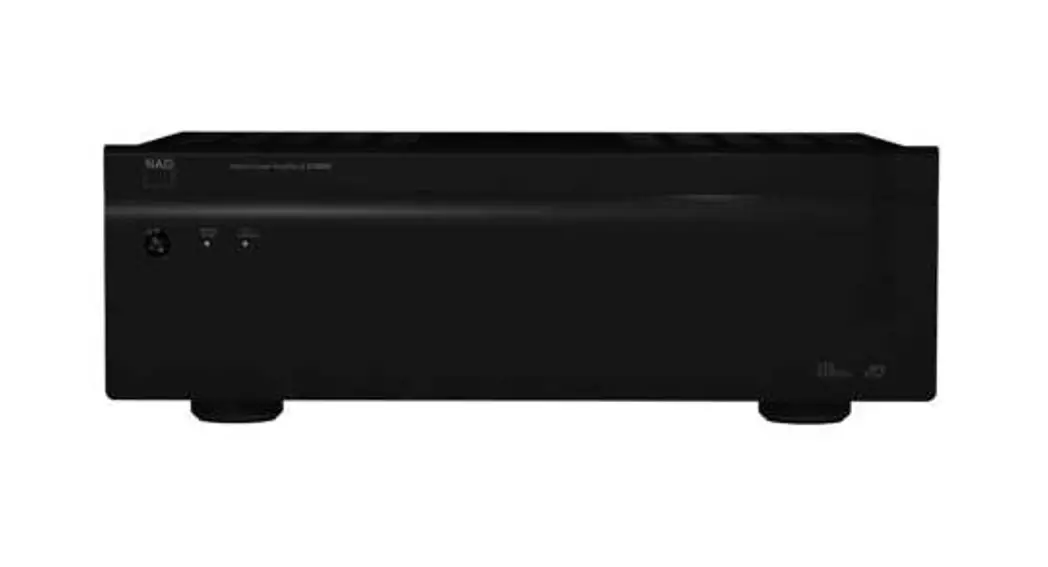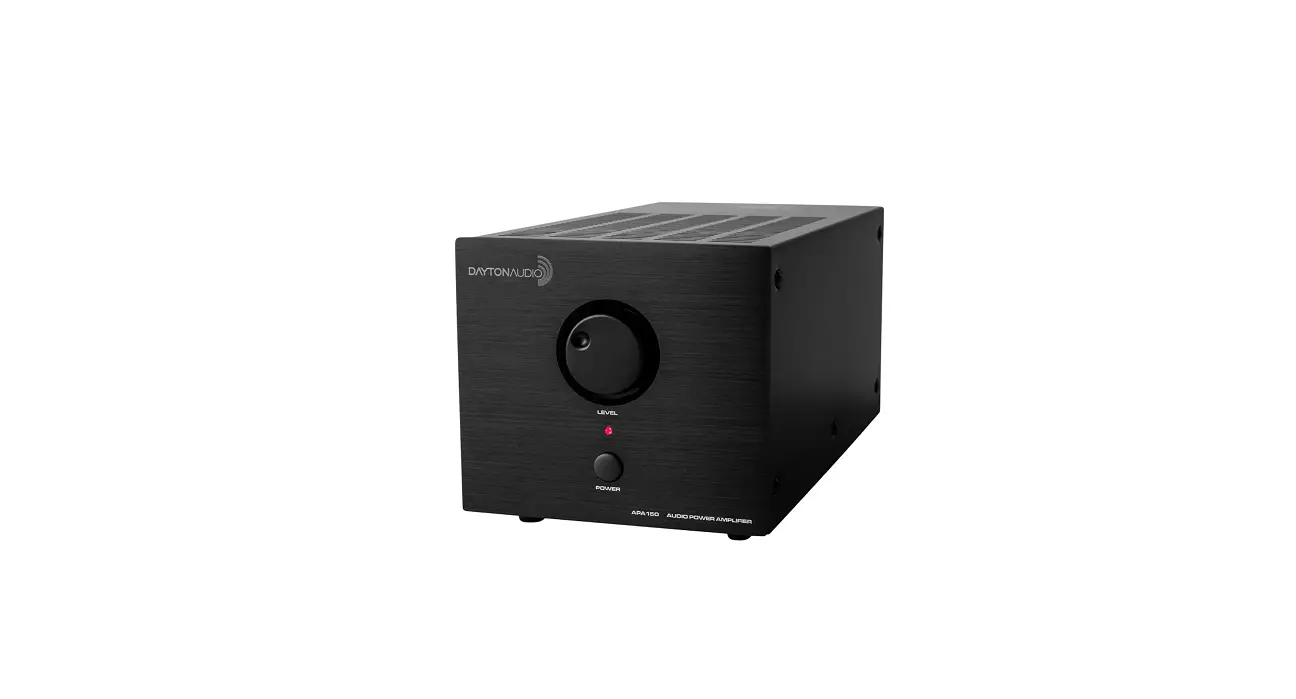

Dayton Audio APA150 150W Power Amplifier
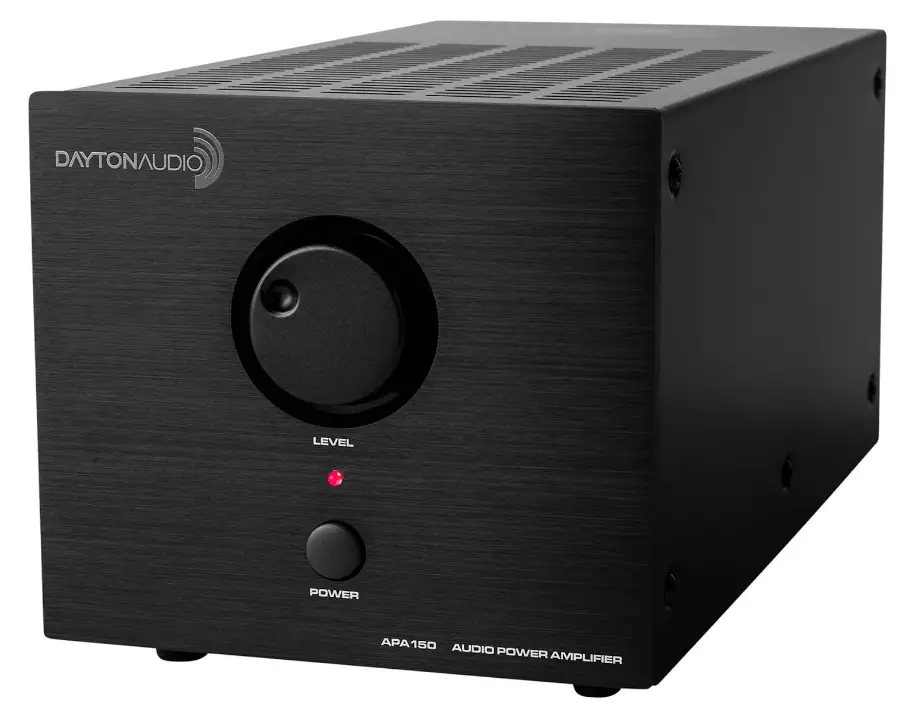
INTRODUCTION
Thank you for purchasing the Dayton Audio® APA150 Audio Power Amplifier. This amplifier offers a new level of high-fidelity performance and versatility previously unattainable at this price. Power output is 75 watts x 2 into a stereo 4-ohm load, and 150 watts x 1 into a bridged-mono 8 ohm load.
Versatility was the primary design goal when engineering the APA150. Configured in stereo mode, amplification is provided to a pair of speakers for stereo or front/rear surround playback. Switching to the bridge-mono mode config-ures the APA150 for powering a center channel speaker, or a subwoofer/tactile transducer when used with the onboard low pass filter. Additionally, the full-range line-level outputs allow for daisy chaining amplifiers for a multi-zone whole house audio system. A small form-factor chassis consumes less space than conventional amplifiers making placement options virtually endless.
IMPORTANT SAFETY INSTRUCTIONS
To reduce the risk of electric shock, do not remove cover. No user serviceable parts inside. Refer servicing to qualified personnel. To reduce the risk of fire and shock do not expose unit to rain or moisture. The unit should be connected to an earth grounded AC electrical socket. The unit should be operated in a well ventilated area. Minimum clearance is 2 inches from the ventilation openings.
Note: Unit is set at the factory for 120V operation. Be sure to change the fuse (1.6A rating) before switching to 230V operation.
FEATURES
Key features of the APA150 include high current discrete power transistors (used in premium amp designs), a hefty toroidal power supply transformer, low-noise forced air cooling, a fully adjustable and defeatable electronic 50-150 Hz low-pass filter, extensive heat sinks to extend the amplifier life, and complete protection against shorting and thermal overload.
Additional features found on the APA150 include full-range line-level outputs, gold-plated 5-way binding posts that accept up to 8 AWG wire, gold-plated stereo line-level inputs and outputs, user-selectable input voltage of 120/230V.
CONNECTING THE APA150
Connecting a line-level device
- Locate the RCA line-level output from your source device.
- Using RCA patch cables, connect the appropriate channel from the source output to the amplifier input.
- For a mono line-level signal, use the left channel line-level input.
Daisy-chaining APA150s
- Connect the line-level input from source device as above.
- Connect the line-level output from first amplifier to line level input on the second amplifier.
Using the APA150s low-pass filter
- Ensure Low Pass-Flat switch is set to Low Pass.
- Connect line-level input from source device.
- Connect loud speakers as described below.
- Adjust crossover frequency until desired output is reached.
Connecting your loudspeakers for stereo operation
- Ensure that the amplifier is powered down.
- Remove approximately 1/2” of the insulation from your speaker cables’ positive and negative conductors.
- Loosen the speaker binding posts by turning the knobs counter-clockwise, exposing the wire insert hole.
- Observing polarity, insert the conductors into their appropriate binding posts and tighten the knobs down, securing the conductors in place.
Connecting your loudspeaker for bridged-mono operation
- Set the Mono-Stereo switch to Mono position.
- Remove approximately 1/2” of insulation from your speaker cables’ positive and negative conductors.
- Loosen speaker binding posts by turning the knobs counter-clockwise, exposing the wire insert hole.
- Connect positive conductor to top left binding post.
- Connect negative conductor to the bottom right binding post.
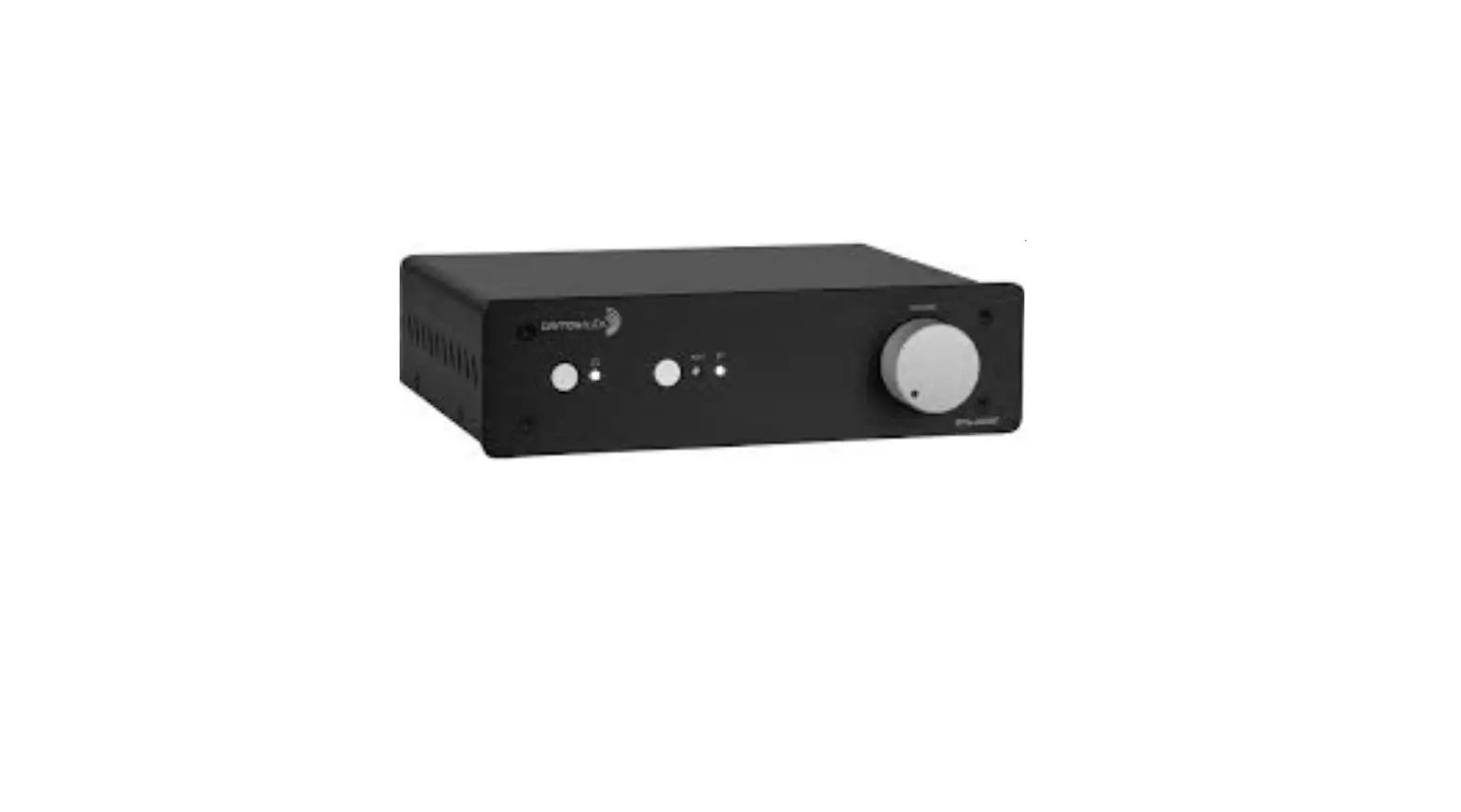
PRODUCT ILLUSTRATION
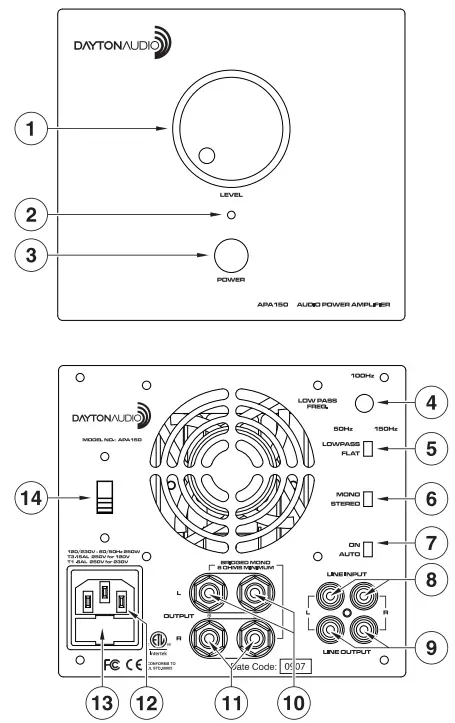
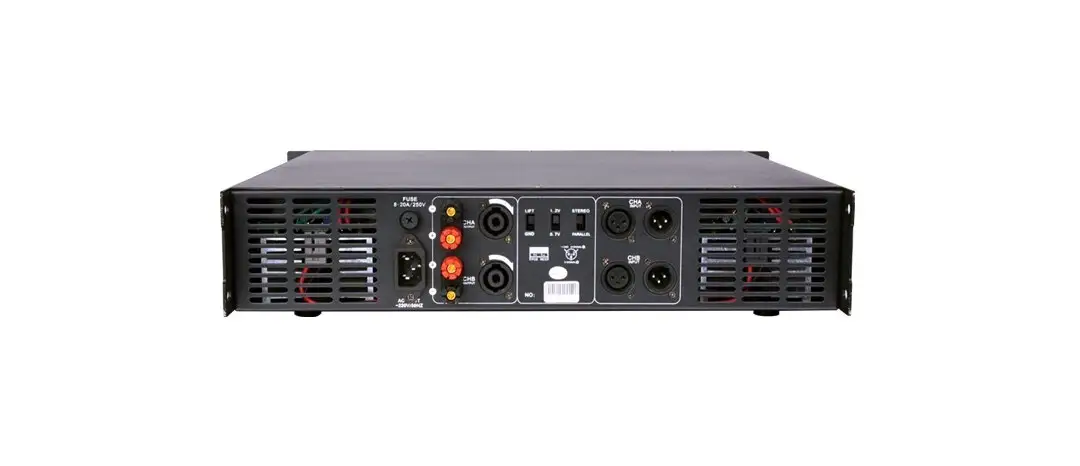
- Level Adjustment
- Status LED:
- Red – Standby/Protection
- Blue – Amplifier On
- Power Button
- Low Pass Frequency Adjustment: 50-150 Hz
- Low Pass/Flat Selector Switch
- Mono/Stereo Speaker Output Switch
- Auto Turn-On/On Selector Switch
- Line-Level Input
- Line-Level Output
- Left Speaker Output
- Right Speaker Output
- IEC Power Cord Input
- 15AL/T1.6AL 250V Fuses
- 120/230 Voltage Selector Switch
SPECIFICATIONS
- POWER OUTPUT 75 watts RMS x 2 into 4 Ω, 150 watts RMS x 1 into 8Ω
- TOTAL HARMONIC DISTORTION Less than 0.01% (20-20,000 Hz)
- SIGNAL-TO-NOISE RATIO > 100 dB, unweighted
- CROSSOVER Variable 50-150 Hz, 18 dB/octave
- AUTO-ON SENSITIVITY 3 mV
- AUTO-OFF DELAY TIME 15 minutes
- INPUT IMPEDANCE 47 k Ω ±5%
- LINE-OUT FREQUENCY RESPONSE 20-20,000 Hz (-3 dB)
- MAXIMUM NOISE AND HUM Less than 1 mV with gain at maximum and input shorted
- MINIMUM CLEARANCE FOR VENTILATION 2″
- ELECTRICAL REQUIREMENT 120V 60 Hz, 230V 50 Hz (switchable)
- STAND-BY POWER RATING 120V 6W; 230V 7W
- DIMENSIONS 6″ H x 5.7″ W x 12.8″ D
- WEIGHT 05 lbs
WARRANTY
5-Year Limited Warranty See daytonaudio.com for details
SUPPORT

705 Pleasant Valley Dr. Springboro, OH 45066 USA daytonaudio.com
tel + 937.743.8248 [email protected]
FAQs
Can you leave an Dayton Audio APA150 amplifier on all the time?
Amplifiers shouldn’t be left on since prolonged and continuous heat exposure might cause internal components, including the filament, to wear out. Quality and dependable amplifiers can run continuously for hours, days, or even weeks without experiencing any damage. It’s advisable to switch your amps off when not in use, though.
Why is there no sound coming from my Dayton Audio APA150 amplifier?
The speaker is totally destroyed. The output transformer is broken in some other way or is open. The speaker jack is improperly wired. The speaker jacks or speaker wiring have become so rusty or damaged that they are unable to form a reliable connection.
Does a Dayton Audio APA150 power amp improve sound quality?
No, amplifiers do not improve sound quality. An amplifier is made to boost the levels of audio signals. However, neither the recorded audio nor the reproduction of such audio is meant to be improved, either objectively or subjectively.
Can you have too much Dayton Audio APA150 amplifier power for speakers?
When an amplifier produces far more wattage than your speakers can handle, it may be too powerful for your speakers. Speakers should not be pushed over their breaking point as this could cause damage. It’s not a good idea to crank up a much less powerful amp since clipping will occur and cause audio distortion.
How long can you use an Dayton Audio APA150 amplifier?
But the life of an amplifier tube is finite. And the only thing you should be concerned about is this final item. The tubes, which have a lifespan of 500 to 800 hours, are the first components of a modern amplifier to fail. The useable life will differ depending on the amp model, the tubes used, and their usage.
How long does an Dayton Audio APA150 amplifier last?
The likelihood that your amp will sound as good as new is high if you change them every 10 or 20 years. This is what? Of course, you shouldn’t make any changes if there are no problems with your amp or the sound. The best part about amps is probably how easy you can see when something is amiss.
What happens if your Dayton Audio APA150 amp is not getting enough power?
The amp will clip before it reaches its actual maximum output if the electrical system of the automobile is unable to supply it with enough power. It might be because the wiring needs to be improved, the car is unable to keep up, there are weak connections, etc. In this situation, increasing the amp size will not solve the issue.
What causes an Dayton Audio APA150 amplifier to overheat?
An amplifier may overheat and shut down for a variety of causes. The four most frequent ones are: blown or grounded speakers, subpar power and/or ground connections, an impedance (load) that is too low, and excessive Gain/Punch Bass control settings.
What happens if your Dayton Audio APA150 amp is underpowered?
When the average power increases due to clipping distortion, tweeters and woofers can get overpowered and suffer damage. Under powering is a persistent issue. My ideal amplifier would have a power rating that was near to or more than the loudspeakers’ stated maximum power.
Why does my Dayton Audio APA150 amp turn on then off right away?
If an amplifier shuts off by itself while speakers are connected, check the impedance of the speakers and the wiring of the speaker that stopped functioning. Without speakers or wires connected to the amplifier, if the amplifier continues to turn off, it needs to be opened and the insides examined for damaged parts.
How do I match my Dayton Audio APA150 amp to my speakers?
This guide’s second rule of thumb is to match the ohms of your speakers to the ohms that your amplifier can support. Now, most amplifiers are built to support 4, 8, and 16 ohm speakers. But it’s crucial to understand exactly what your amplifier is capable of.
Do Dayton Audio APA150 power amps make a difference?
Yes, it is true that speakers play louder and clearer at higher power levels (watts). However, slight variations in power don’t produce much of an audible difference. The power would need to double in order to perceptibly hear a change (a 3dB increase).
Can I connect a Dayton Audio APA150 power amp to a receiver?
You will need an RCA cable to connect a power amp to an AV receiver as well as a speaker connected to the amp and speaker wire to transport audio from the amp to the speaker.
How many types of Dayton Audio APA150 power amplifiers are there?
Power amplifiers can be categorized into one of the following three categories based on the kind of output device they are linked to: Power amplifiers for audio. Amplifiers for RF signals. Amplifiers for DC power.
Does a Dayton Audio APA150 power amp need a preamp?
A preamp is required to provide the line-level signal that a power amp requires. It is possible to connect active speakers directly from a preamp without using an additional external power amplifier.