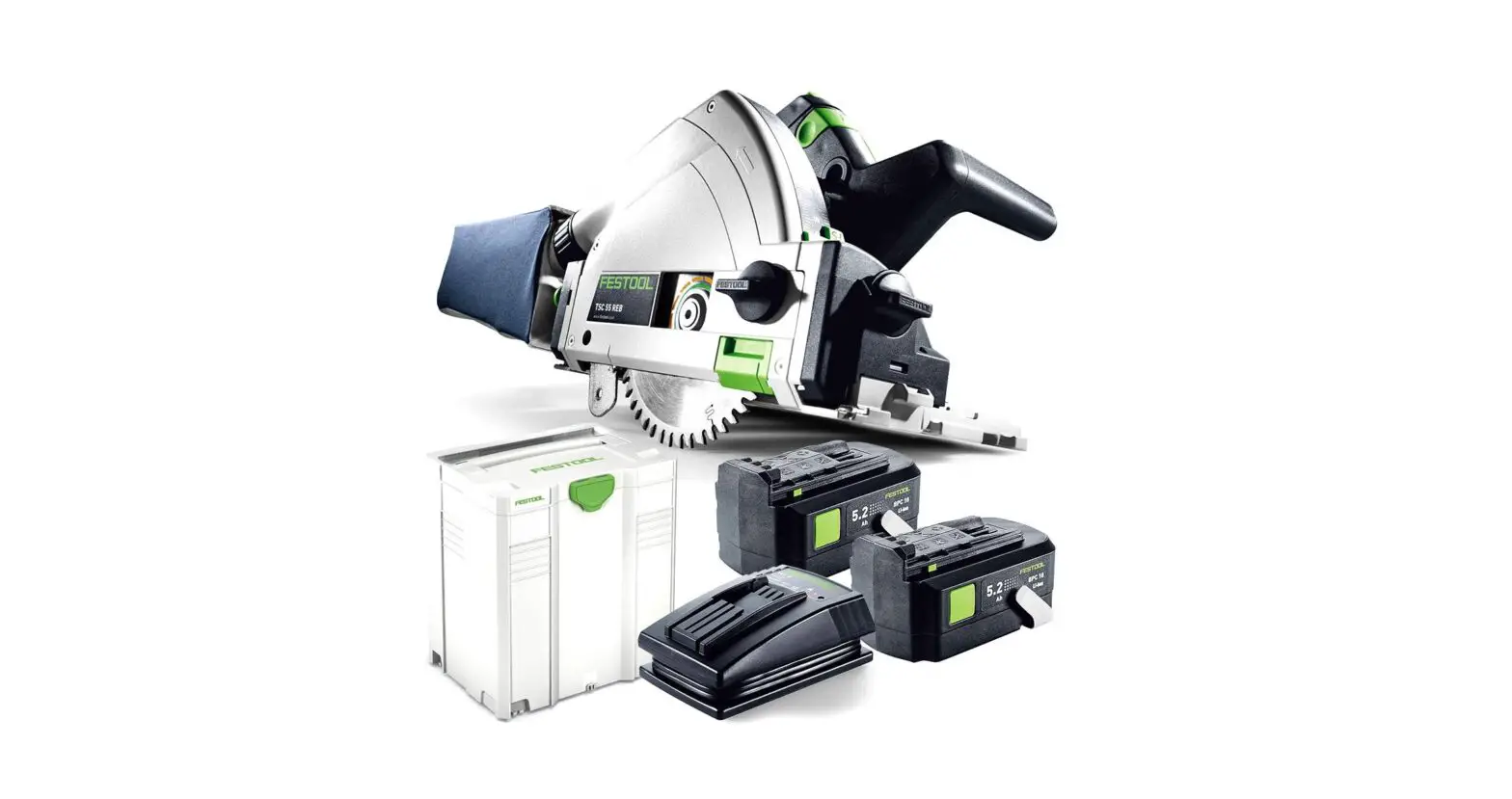
CSC SYS 50 EBI Cordless Sliding Table Saw
Product Information
- Product Name: Cordless sliding table saw CSC SYS 50 EBI
- Serial Number: 205712
- Manufacturer: Festool GmbH
- Model Number: CSC SYS 50 EBI
Product Usage Instructions
- Read the user manual and safety instructions before using the
product. - Make sure to wear appropriate personal protective equipment,
such as safety glasses and gloves, while operating the tool. - To insert the battery pack, follow these steps:
- Ensure the tool is turned off.
- Locate the battery compartment on the tool.
- Align the battery pack with the compartment and slide it in
until it clicks into place.
- To remove the battery pack, follow these steps:
- Ensure the tool is turned off.
- Press the release button located near the battery
compartment. - Slide the battery pack out of the compartment.
- Follow the specific operating instructions provided in the user
manual for different cutting tasks and adjustments. - Always use the tool in a well-ventilated area and avoid
inhaling dust or debris generated during operation. - Keep the tool clean and free from any obstructions that may
affect its performance. - Inspect the tool and its components regularly for any damage or
wear. Replace any damaged parts before using the tool. - Store the tool in a dry and secure place, away from children
and unauthorized users.
de
Originalbetriebsanleitung – Akku-Formatkreissäge
9
en
Original Instructions cordless sliding table saw
26
fr
Notice d’utilisation originale – scie circulaire sans fil
42
es
Manual de instrucciones original – Escuadradora a batería
60
it
Istruzioni per l’uso originali – Sega circolare a batteria
78
nl
Originele bedieningshandleiding – accu-formaatcirkelzaag
95
sv
Originalbruksanvisning – Batteridriven formatcirkelsåg
112
fi
Alkuperäiset käyttöohjeet – Akkupöytäsaha
127
da
Original brugsanvisning akku formatrundsav
143
nb
Bruksanvisning – batteridrevet formatsirkelsag
159
pt
Manual de instruções original – Serra circular de bateria
174
ru
—
192
cs
Originální návod k obsluze akumulátorová formátovací okruzní pila
210
pl
Oryginalna instrukcja obslugi – akumulatorowa pila formatowa
226
CSC SYS 50 EBI
Festool GmbH Wertstraße 20 73240 Wendlingen Germany +49 (0)70 24/804-0 www.festool.com
721829_H / 2022-10-07
1 1-22
1-10
1-9 1-8 1-7 1-6 1-5 1-4 1-3 1-2 1-1
1-21
1-23
1-24
1-22
1-11 1-12
1-13 1-14 1-15
1-16 1-17
1-18 1-1
1-20
1-19
2
2-3
2-4
2-2
2-5
2-1
2-6
2-15 2-14 2-13
2-12
30.0 0.0
30 0 48.0
mm
0.0
33.0 45.0
18 0 34.0 10.0
2-16
2-7
13
Place Wauofrlkepgieence
2-8 2-9
2-11
2-10
3A
2
3B
click
click
1 2
3B-1
4A
1
4B
3 2 4
2
1
4C
click
5
5-2 2
5-3 1
5-1
5-2 2 1
6
4
2 3
1
3
7
1 3
2
8
1 3
2
2
10658208_A
Akku-Formatkreissäge Cordless sliding table saw Scie circulaire sans fil
CSC SYS 50 EBI
Seriennummer * Serial number *
N° de série * (T-Nr.) 205712
de EU-Konformitätserklärung. Wir erklären in alleiniger Verantwortung, dass dieses Produkt mit allen relevanten Anforderungen folgender EU-Richtlinien übereinstimmt, und folgende Normen oder normative Dokumente zugrunde gelegt wurden:
en EU Declaration of Conformity. We declare under sole responsibility that this product complies with all the relevant requirments in the following EU Directives, and following standards or normative documents were applied:
fr Déclaration de conformité de l`UE. Nous déclarons, sous notre seule responsabilité, que ce produit satisfait à toutes les exigences pertinentes des directives UE suivantes et repose sur les normes ou documents normatifs suivants :
es Declaración UE de conformidad. Declaramos bajo nuestra responsabilidad que este producto cumple todos los requisitos relevantes de las siguientes directivas de la UE y que se han tomado como base las siguientes normas o documentos normativos:
it Dichiarazione di conformità UE. Dichiariamo sotto nostra unica responsabilità che il presente prodotto sia conforme a tutti i requisiti di rilevanza definiti dalle seguenti Direttive UE e che siano stati applicati le seguenti norme o i seguenti documenti normativi:
nl EU-conformiteitsverklaring. Wij verklaren en stellen ons ervoor verantwoordelijk dat dit product volledig voldoet aan alle volgende EU-richtlijnen en volgende normen of normatieve documenten daaraan ten grondslag gelegd werden:
sv EU-försäkran om överensstämmelse. Vi förklarar på eget ansvar att denna produkt uppfyller alla relevanta krav enligt följande EU-direktiv och baseras på följande normer eller normgivande dokument:
fi EU-vaatimustenmukaisuusvakuutus. Vakuutamme yksinomaisella vastuulla, että tämä tuote täyttää seuraavien EU-direktiivien kaikki olennaiset vaatimukset ja se on seuraavien standardien tai standardiasiakirjojen mukainen:
da EU-overensstemmelseserklæring. Vi erklærer med eneansvar, at dette produkt er i overensstemmelse med alle relevante krav i følgende EU-direktiver, og at følgende standarder eller normative dokumenter danner grundlag for det:
nb EU-samsvarserklæring. Vi erklærer under eneansvar at dette produktet oppfyller alle relevante krav i følgende EU-direktiver og at følgende standarder eller normative dokumenter er blitt lagt til grunn:
pt Declaração de conformidade UE. Sob nossa inteira responsabilidade, declaramos que este produto está de acordo com todas as exigências relevantes das seguintes diretivas UE, tendo sido tomadas por base as seguintes normas ou documentos normativos: ru . , , : cs Prohlásení o shod EU. Prohlasujeme s veskerou odpovdností, ze tento výrobek spluje vsechny píslusné pozadavky následujících smrnic EU a ze byly pouzity následující normy nebo normativní dokumenty: pl Deklaracja zgodnoci UE. Niniejszym owiadczamy na wlasn odpowiedzialno, e produkt ten spelnia wszystkie obowizujce wymogi nastpujcych dyrektyw UE, norm lub dokumentów normatywnych.
2006/42/EC, 2014/30/EU, 2014/53/EU, 2011/65/EU EN 62841-1:2015 EN 62841-3-1:2014 + A11:2017 EN 55014-1:2017 + A11:2020, EN 55014-2:2015 EN 55032:2015 + A11:2020 EN 300 328 V2.2.2 EN 303 446-1 V1.2.1 EN 301 489-1 V2.2.3, EN 301 489-17 V3.2.4 EN IEC 63000:2018
Unterzeichnet für und im Namen von/ Signed on behalf of and in name of/ Signé pour et au nom de
Festool GmbH Wertstr. 20, 73240 Wendlingen, GERMANY Wendlingen, 2022-09-06
Markus Stark Head of Product Development
Denis Drobner Head of Product Conformity
* im definierten Seriennummer-Bereich (S-Nr.) von 40000000 49999999 in the specified serial number range (S-Nr.) from 40000000 49999999 dans la plage de numéro de série (S-Nr.) de 40000000 49999999
Cordless sliding table saw CSC SYS 50 EBI
Serial number 1) (T-Nr.)
205712
We as the manufacturer declare under our sole responsibility that the product(s) fulfill(s) all the relevant provisions of the following UK Regulations and are manufactured in accordance with the following designated standards:
S.I. 2008/1597 S.I. 2016/1091 S.I. 2017/1206 S.I. 2021/422
Supply of Machinery [Safety] Regulations 2008 Electromagnetic Compatibility Regulations 2016 Radio Equipment Regulations 2017 Restriction of the Use of Certain Hazardous Substances in Electrical and Electronic Equipment Regulations 2012
BS EN 62841-1:2015 BS EN 62841-3-1:2014 + A11:2017 BS EN 55014-1:2017 + A11:2020, BS EN 55014-2:2015 BS EN 55032:2015 + A11:2020 EN 300 328 V2.2.2 EN 303 446-1 V1.2.1 EN 301 489-1 V2.2.3, EN 301 489-17 V3.2.4 BS EN IEC 63000:2018
Signed on behalf of and in name of Festool GmbH Wertstr. 20, 73240 Wendlingen, GERMANY
Place and date of declaration: Wendlingen, 2022-09-06
Markus Stark Head of Product Development
Denis Drobner Head of Product Conformity
1) in the specified serial number range (S-Nr.) from 40000000 – 49999999
10658209 _A
Inhaltsverzeichnis 1 Symbole……………………………………………….9 2 Sicherheitshinweise……………………………… 9 3 Bestimmungsgemäße Verwendung……… 14 4 Technische Daten………………………………..14 5 Geräteelemente…………………………………. 15 6 Bedienmodul……………………………………… 15 7 Inbetriebnahme…………………………………..15 8 Akkupack…………………………………………… 16 9 Einstellungen…………………………………….. 16 10 Arbeiten mit dem Elektrowerkzeug……….20 11 Transport……………………………………………21 12 Wartung und Pflege……………………………. 22 13 Zubehör…………………………………………….. 23 14 Umwelt……………………………………………… 23 15 Allgemeine Hinweise………………………….. 24 16 Fehlerbehebung…………………………………. 24
1 Symbole
Warnung vor allgemeiner Gefahr
Warnung vor Stromschlag
Quetschgefahr für Finger und Hände!
Betriebsanleitung, Sicherheitshinweise lesen!
Gehörschutz tragen!
Atemschutz tragen!
Schutzhandschuhe beim Werkzeug wechsel tragen!
Schutzbrille tragen!
Nicht in den Hausmüll geben.
Gerät enthält einen Chip zur Daten speicherung. Siehe Kapitel 15.2 CE-Kennzeichnung: Bestätigt die Kon formität des Elektrowerkzeugs mit den Richtlinien der Europäischen Gemein schaft.
Tipp, Hinweis
Handlungsanweisung
Akkupack einsetzen.
Deutsch
Akkupack abnehmen.
Drehrichtung der Säge und des Säge blatts
Einstellmarkierung Parkposition
Sägeblatt zum Spaltkeilwechsel über das Be dienmodul in Parkposition fahren.
2 Sicherheitshinweise
2.1 Allgemeine Sicherheitshinweise für Elektrowerkzeuge
WARNUNG! Lesen Sie alle Sicherheits hinweise und Anweisungen. Versäumnis se bei der Einhaltung der Sicherheitshinweise und Anweisungen können elektrischen Schlag, Brand und/oder schwere Verletzungen verursa chen.
Bewahren Sie alle Sicherheitshinweise und Anweisungen für die Zukunft auf. Der in den Sicherheitshinweisen verwendete Begriff ,,Elektrowerkzeug” bezieht sich auf netzbetriebene Elektrowerkzeuge (mit Netzlei tung) oder auf akkubetriebene Elektrowerkzeu ge (ohne Netzleitung).
Beachten Sie die Betriebsanleitung des Lade geräts und des Akkupacks.
2.2 Sicherheitshinweise für Tischkreissägen
1) Schutzabdeckungsbezogene Sicherheitshin weise
Lassen Sie Schutzabdeckungen montiert. Schutzabdeckungen müssen in funktions fähigem Zustand und richtig montiert sein. Lockere, beschädigte oder nicht richtig funktionierende Schutzabdeckungen müs sen repariert oder ersetzt werden.
Verwenden Sie für Trennschnitte stets die Sägeblatt-Schutzabdeckung und den Spaltkeil. Für Trennschnitte, bei denen das Sägeblatt vollständig durch die Werkstück dicke sägt, verringern die Schutzabdeckung
9
Deutsch
und andere Sicherheitseinrichtungen das Risiko von Verletzungen.
Befestigen Sie nach Fertigstellung von Ar beitsvorgängen (z. B. Falzen, Ausnuten oder Auftrennen im Umschlagverfahren), bei denen das Entfernen von Schutzabde ckung und Spaltkeil erforderlich ist, un verzüglich wieder das Schutzsystem. Die Schutzabdeckung und der Spaltkeil verrin gern das Risiko von Verletzungen.
Stellen Sie vor dem Einschalten des Elek trowerkzeugs sicher, dass das Sägeblatt nicht die Schutzabdeckung, den Spaltkeil oder das Werkstück berührt. Versehentli cher Kontakt dieser Komponenten mit dem Sägeblatt kann zu einer gefährlichen Situa tion führen.
Justieren Sie den Spaltkeil gemäß der Be schreibung in dieser Betriebsanleitung. Falsche Abstände, Position und Ausrich tung können der Grund dafür sein, dass der Spaltkeil einen Rückschlag nicht wirksam verhindert.
Damit der Spaltkeil funktionieren kann, muss er auf das Werkstück einwirken. Bei Schnitten in Werkstücke, die zu kurz sind, um den Spaltkeil in Eingriff kommen zu lassen, ist der Spaltkeil unwirksam. Unter diesen Bedingungen kann ein Rückschlag nicht durch den Spaltkeil verhindert wer den.
Verwenden Sie das für den Spaltkeil pas sende Sägeblatt. Damit der Spaltkeil rich tig wirkt, muss der Sägeblattdurchmesser zu dem entsprechenden Spaltkeil passen, das Stammblatt des Sägeblatts dünner als der Spaltkeil sein und die Zahnbreite mehr als die Spaltkeildicke betragen.
2) Sicherheitshinweise für Sägeverfahren
GEFAHR: Kommen Sie mit Ihren Fin
gern und Händen nicht in die Nähe des Sä geblatts oder in den Sägebereich. Ein Mo
ment der Unachtsamkeit oder ein Ausrut schen könnte Ihre Hand zum Sägeblatt hin lenken und zu ernsthaften Verletzungen
führen.
Führen Sie das Werkstück nur entgegen der Drehrichtung dem Sägeblatt zu. Zu führen des Werkstücks in der gleichen
Richtung wie die Drehrichtung des Säge blatts oberhalb des Tisches kann dazu füh ren, dass das Werkstück und Ihre Hand in
das Sägeblatt gezogen werden.
10
Verwenden Sie bei Längsschnitten nie mals den Gehrungsanschlag zur Zufüh rung des Werkstücks, und verwenden Sie bei Querschnitten mit dem Gehrungsan schlag niemals zusätzlich den Parallelan schlag zur Längeneinstellung. Gleichzeiti ges Führen des Werkstücks mit dem Paral lelanschlag und dem Gehrungsanschlag erhöht die Wahrscheinlichkeit, dass das Sägeblatt klemmt und es zum Rückschlag kommt.
Üben Sie bei Längsschnitten die Zuführ kraft auf das Werkstück immer zwischen Anschlagschiene und Sägeblatt aus. Ver wenden Sie einen Schiebestock, wenn der Abstand zwischen Anschlagschiene und Sägeblatt weniger als 150 mm, und einen Schiebeblock, wenn der Abstand weniger als 50 mm beträgt. Derartige Arbeitshilfs mittel sorgen dafür, dass Ihre Hand in si cherer Entfernung zum Sägeblatt bleibt.
Verwenden Sie nur den mitgelieferten Schiebestock des Herstellers oder einen, der anweisungsgemäß hergestellt ist. Der Schiebestock sorgt für ausreichenden Ab stand zwischen Hand und Sägeblatt.
Verwenden Sie niemals einen beschädig ten oder angesägten Schiebestock. Ein be schädigter Schiebestock kann brechen und dazu führen, dass Ihre Hand in das Säge blatt gerät.
Arbeiten Sie nicht ,,freihändig”. Verwen den Sie immer den Parallelanschlag oder den Gehrungsanschlag, um das Werkstück anzulegen und zu führen. ,,Freihändig” be deutet, das Werkstück statt mit Parallelan schlag oder Gehrungsanschlag mit den Händen zu stützen oder zu führen. Freihän diges Sägen führt zu Fehlausrichtung, Ver klemmen und Rückschlag.
Greifen Sie nie um oder über ein sich drehendes Sägeblatt. Das Greifen nach ei nem Werkstück kann zu unbeabsichtigter Berührung mit dem sich drehenden Säge blatt führen.
Stützen Sie lange und/oder breite Werk stücke hinter und/oder seitlich des Säge tischs ab, so dass diese waagrecht blei ben. Lange und/oder breite Werkstücke neigen dazu, am Rand des Sägetischs ab zukippen; dies führt zum Verlust der Kon trolle, Verklemmen des Sägeblatts und Rückschlag.
Führen Sie das Werkstück gleichmäßig zu. Verbiegen oder verdrehen Sie das Werk stück nicht. Falls das Sägeblatt ver klemmt, schalten Sie das Elektrowerk zeug sofort aus, trennen Sie es vom Akku pack und beheben Sie die Ursache für das Verklemmen. Das Verklemmen des Säge blatts durch das Werkstück kann zu Rück schlag oder zum Blockieren des Motors führen.
Entfernen Sie abgesägtes Material nicht, während die Säge läuft. Abgesägtes Mate rial kann sich zwischen Sägeblatt und An schlagschiene oder in der Schutzabde ckung festsetzen und beim Entfernen Ihre Finger in das Sägeblatt ziehen. Schalten Sie die Säge aus und warten Sie, bis das Sägeblatt zum Stillstand gekommen ist, bevor Sie das Material entfernen.
Verwenden Sie für Längsschnitte an Werkstücken, die dünner als 2 mm sind, einen Zusatz- Parallelanschlag, der Kon takt mit der Tischoberfläche hat. Dünne Werkstücke können sich unter dem Paral lelanschlag verkeilen und zu Rückschlag führen.
3) Rückschlag – Ursachen und entsprechende Sicherheitshinweise
Ein Rückschlag ist die plötzliche Reaktion des Werkstücks infolge eines hakenden, klemmen den Sägeblatts oder eines bezogen auf das Sä geblatt schräg geführten Schnitts in das Werk stück oder wenn ein Teil des Werkstücks zwi schen Sägeblatt und Parallelanschlag oder ei nem anderen feststehenden Objekt einge klemmt wird.
In den meisten Fällen wird bei einem Rück schlag das Werkstück durch den hinteren Teil des Sägeblatts erfasst, vom Sägetisch angeho ben und in Richtung des Bedieners geschleu dert.
Ein Rückschlag ist die Folge eines falschen oder fehlerhaften Gebrauchs der Tischkreissä ge. Er kann durch geeignete Vorsichtsmaßnah men, wie nachfolgend beschrieben, verhindert werden.
Stellen Sie sich nie in direkte Linie mit dem Sägeblatt. Halten Sie sich immer auf der Seite zum Sägeblatt, auf der sich auch die Anschlagschiene befindet. Bei einem Rückschlag kann das Werkstück mit hoher Geschwindigkeit auf Personen geschleu dert werden, die vor und in einer Linie mit dem Sägeblatt stehen.
Deutsch
Greifen Sie niemals über oder hinter das Sägeblatt, um das Werkstück zu ziehen oder zu stützen. Es kann zu unbeabsichtig ter Berührung mit dem Sägeblatt kommen, oder ein Rückschlag kann dazu führen, dass Ihre Finger in das Sägeblatt gezogen werden.
Halten und drücken Sie das Werkstück, welches abgesägt wird, niemals gegen das sich drehende Sägeblatt. Drücken des Werkstücks, welches abgesägt wird, gegen das Sägeblatt führt zu Verklemmen und Rückschlag.
Richten Sie die Anschlagschiene parallel zum Sägeblatt aus. Eine nicht ausgerichte te Anschlagschiene drückt das Werkstück gegen das Sägeblatt und erzeugt einen Rückschlag.
Verwenden Sie bei verdeckten Säge schnitten (z. B. Falzen, Ausnuten oder Auftrennen im Umschlagverfahren) einen Druckkamm, um das Werkstück gegen Tisch und Anschlagschiene zu führen. Mit einem Druckkamm können Sie das Werk stück bei Rückschlag besser kontrollieren.
Seien Sie besonders vorsichtig beim Sä gen in nicht einsehbare Bereiche zusam mengebauter Werkstücke. Das eintau chende Sägeblatt kann in Objekte sägen, die einen Rückschlag verursachen können.
Stützen Sie große Platten ab, um das Risi ko eines Rückschlags durch ein klemmen des Sägeblatt zu vermindern. Große Plat ten können sich unter ihrem Eigengewicht durchbiegen. Platten müssen überall dort abgestützt werden, wo sie die Tischoberflä che überragen.
Seien Sie besonders vorsichtig beim Sä gen von Werkstücken, die verdreht, ver knotet, verzogen sind oder nicht über eine gerade Kante verfügen, an der sie mit ei nem Gehrungsanschlag oder entlang ei ner Anschlagschiene geführt werden kön nen. Ein verzogenes, verknotetes oder ver drehtes Werkstück ist instabil und führt zur Fehlausrichtung der Schnittfuge mit dem Sägeblatt, Verklemmen und Rückschlag.
Sägen Sie niemals mehrere aufeinander oder hintereinander gestapelte Werkstü cke. Das Sägeblatt könnte ein oder mehre re Teile erfassen und einen Rückschlag verursachen.
Wenn Sie eine Säge, deren Sägeblatt im Werkstück steckt, wieder starten wollen,
11
Deutsch
zentrieren Sie das Sägeblatt im Sägespalt so, dass die Sägezähne nicht im Werk stück verhakt sind. Klemmt das Sägeblatt, kann es das Werkstück anheben und einen Rückschlag verursachen, wenn die Säge erneut gestartet wird.
Halten Sie Sägeblätter sauber, scharf und ausreichend geschränkt. Verwenden Sie niemals verzogene Sägeblätter oder Sä geblätter mit rissigen oder gebrochenen Zähnen. Scharfe und richtig geschränkte Sägeblätter minimieren Klemmen, Blockie ren und Rückschlag.
4) Sicherheitshinweise für die Bedienung von Tischkreissägen
Schalten Sie die Tischkreissäge aus und trennen Sie sie vom Akkupack, bevor Sie den Tischeinsatz entfernen, das Sägeblatt wechseln, Einstellungen am Spaltkeil oder der Sägeblattschutzabdeckung vor nehmen und wenn die Maschine unbeauf sichtigt gelassen wird. Vorsichtsmaßnah men dienen der Vermeidung von Unfällen.
Lassen Sie die Tischkreissäge nie unbe aufsichtigt laufen. Schalten Sie das Elek trowerkzeug aus und verlassen es nicht, bevor es vollständig zum Stillstand ge kommen ist. Eine unbeaufsichtigt laufende Säge stellt eine unkontrollierte Gefahr dar.
Stellen Sie die Tischkreissäge an einem Ort auf, der eben und gut beleuchtetet ist und wo Sie sicher stehen und das Gleich gewicht halten können. Der Aufstellort muss genug Platz bieten, um die Größe Ih rer Werkstücke gut zu handhaben. Unord nung, unbeleuchtete Arbeitsbereiche und unebene, rutschige Böden können zu Un fällen führen.
Entfernen Sie regelmäßig Sägespäne und Sägemehl unter dem Sägetisch und/oder von der Staubabsaugung. Angesammeltes Sägemehl ist brennbar und kann sich selbst entzünden.
Sichern Sie die Tischkreissäge. Eine nicht ordnungsgemäß gesicherte Tischkreissäge kann sich bewegen oder umkippen.
Entfernen Sie Einstellwerkzeuge, Holz reste usw. von der Tischkreissäge, bevor Sie diese einschalten. Ablenkung oder mögliche Verklemmungen können gefähr lich sein.
Verwenden Sie immer Sägeblätter in der richtigen Größe und mit passender Auf nahmebohrung (z. B. rautenförmig oder
12
rund). Sägeblätter, die nicht zu den Monta geteilen der Säge passen, laufen unrund und führen zum Verlust der Kontrolle.
Verwenden Sie niemals beschädigtes oder falsches Sägeblatt-Montagematerial, wie z. B. Flansche, Unterlegscheiben, Schrau ben oder Muttern. Dieses Sägeblatt-Mon tagematerial wurde speziell für Ihre Säge konstruiert, für sicheren Betrieb und opti male Leistung.
Stellen Sie sich nie auf die Tischkreissäge und benutzen Sie die Tischkreissäge nicht als Tritthocker. Es können ernsthafte Ver letzungen auftreten, wenn das Elektro werkzeug umkippt oder wenn Sie verse hentlich mit dem Sägeblatt in Kontakt kommen.
Stellen Sie sicher, dass das Sägeblatt in der richtigen Drehrichtung montiert ist. Verwenden Sie keine Schleifscheiben oder Drahtbürsten mit der Tischkreissäge. Un sachgemäße Montage des Sägeblattes oder die Benutzung von nicht empfohlenem Zu behör kann zu ernsthaften Verletzungen führen.
2.3 Sicherheitshinweise für das vormontierte Sägeblatt
Verwendung
Die auf dem Sägeblatt angegebene Höchst drehzahl darf nicht überschritten werden, bzw. der Drehzahlbereich muss eingehal ten werden.
Das vormontierte Sägeblatt ist ausschließ lich zur Verwendung in Kreissägen be stimmt.
Beim Aus- und Einpacken des Werkzeugs sowie beim Hantieren (z.B. Einbau in die Maschine) mit äußerster Sorgfalt vorgehen. Verletzungsgefahr durch die sehr scharfen Schneiden!
Beim Hantieren mit dem Werkzeug wird durch das Tragen von Schutzhandschuhen die Griffsicherheit am Werkzeug verbessert und das Verletzungsrisiko weiter gemin dert.
Kreissägeblätter, deren Körper gerissen sind, müssen ausgewechselt werden. Eine Instandsetzung ist nicht zulässig.
Kreissägeblätter in Verbundausführung (eingelötete Sägezähne), deren Sägezahn dicke kleiner als 1 mm sind, dürfen nicht mehr benutzt werden.
WARNUNG! Werkzeuge mit sichtbaren Ris sen, mit stumpfen oder beschädigten Schneiden dürfen nicht verwendet werden.
Montage und Befestigung
Werkzeuge müssen so aufgespannt sein, dass sie sich beim Betreiben nicht lösen.
Bei der Montage der Werkzeuge muss si chergestellt werden, dass das Aufspannen auf der Werkzeugnabe oder der Spannflä che des Werkzeuges erfolgt, und dass die Schneiden nicht mit anderen Bauteilen in Berührung kommen.
Ein Verlängern des Schlüssels oder das Festziehen mithilfe von Hammerschlägen ist nicht zulässig.
Die Spannflächen müssen von Verschmut zungen, Fett, Öl und Wasser gereinigt wer den.
Spannschrauben müssen nach den Anlei tungen des Herstellers angezogen werden.
Zum Einstellen des Bohrungsdurchmes sers von Kreissägeblättern an den Spindel durchmesser der Maschine dürfen nur fest eingebrachte Ringe, z.B.: eingepresste oder durch Haftverbindung gehaltene Rin ge, verwendet werden. Die Verwendung lo ser Ringe ist nicht zulässig.
Wartung und Pflege
Reparaturen und Schleifarbeiten dürfen nur von Festool-Kundendienstwerkstätten oder von Sachkundigen ausgeführt werden.
Die Konstruktion des Werkzeuges darf nicht verändert werden.
Werkzeug regelmäßig entharzen und reini gen (Reinigungsmittel mit pH-Wert zwi schen 4,5 bis 8).
Stumpfe Schneiden können an der Spanflä che bis zu einer minimalen Schneidendicke von 1 mm nachgeschliffen werden.
Transport des Werkzeugs nur in einer ge eigneten Verpackung – Verletzungsgefahr!
2.4 Weitere Sicherheitshinweise
Tragen Sie geeignete persönliche Schutz ausrüstungen: Gehörschutz, Schutzbrille, Staubmaske bei stauberzeugenden Arbei ten.
Beim Arbeiten können schädliche/giftige Stäube entstehen (z.B. bleihaltiger An strich, einige Holzarten oder Metalle). Das Berühren oder Einatmen dieser Stäube
Deutsch
kann für die Bedienperson oder in der Nä he befindliche Personen eine Gefährdung darstellen. Beachten Sie die in Ihrem Land gültigen Sicherheitsvorschriften.
Zum Schutz Ihrer Gesundheit einen geeig neten Atemschutz tragen. In geschlosse nen Räumen für ausreichende Belüftung sorgen und ein Absaugmobil anschließen.
Kontrollieren Sie, ob Gehäuse-Bauteile Beschädigungen wie Risse oder Weissbrü che aufweisen. Lassen Sie beschädigte Teile vor dem Einsatz des Elektrowerkzeu ges reparieren.
Keine Netzteile oder Fremd-Akkupacks zum Betreiben des Akku-Elektrowerk zeugs verwenden. Keine Fremd-Ladege räte zum Laden der Akkupacks verwen den. Die Verwendung von nicht vom Her steller vorgesehenem Zubehör kann zu ei nem elektrischen Schlag und/oder schwe ren Unfällen führen.
2.5 Aluminiumbearbeitung
Bei der Bearbeitung von Aluminium sind aus Sicherheitsgründen folgende Maßnahmen ein zuhalten:
Schutzbrille tragen!
Elektrowerkzeug an ein geeignetes Ab sauggerät mit Antistatik-Saugschlauch an schließen.
Elektrowerkzeug regelmäßig von Staubab lagerungen im Motorgehäuse reinigen.
Verwenden Sie ein Aluminium-Sägeblatt.
Beim Sägen von Platten muss mit Petrole um geschmiert werden, dünnwandige Pro file (bis 3 mm) können ohne Schmierung bearbeitet werden.
2.6 Restrisiken
Trotz Einhaltung aller relevanter Bauvorschrif ten können beim Betreiben des Elektrowerk zeugs noch Gefahren entstehen, z.B. durch:
Berühren von sich drehenden Teilen: Säge blatt, Spannflansch, Flansch-Schraube,
Berühren spannungsführender Teile bei geöffnetem Gehäuse,
Wegfliegen von Werkstückteilen, Wegfliegen von Werkzeugteilen bei beschä
digten Werkzeugen, Geräuschemission, Staubemission.
13
Deutsch
2.7 Emissionswerte
Die nach EN 62841 ermittelten Werte betragen typischerweise:
Schalldruckpegel Schallleistungspegel Unsicherheit
LPA = 85 dB(A) LWA = 98 dB(A)
K = 3 dB
VORSICHT
Beim Arbeiten eintretender Schall Schädigung des Gehörs Gehörschutz benutzen.
VORSICHT
Emissionswerte können von den angegebe nen Werten abweichen. Dies hängt ab von der Verwendung des Werkzeugs und der Art des bearbeiteten Werkstücks.
Die tatsächliche Belastung während des gesamten Betriebszyklus muss beurteilt werden.
Abhängig von der tatsächlichen Belastung müssen geeignete Sicherheitsmaßnahmen zum Schutz des Bedieners festgelegt wer den.
3 Bestimmungsgemäße
Verwendung
Die CSC SYS 50 ist als transportable Format kreissäge (Tischkreissäge mit integriertem Schiebetisch) vorgesehen zum Sägen von Holz, laminierten Holzplatten und Kunststoff.
Mit den von Festool angebotenen Spezialsäge blättern können die Maschinen auch zum Sägen von ungehärteten Eisenmetallen und Buntme tallen verwendet werden.
Sie wird nicht empfohlen zum Sägen von mine ralischen Plattenwerkstoffen wie z. B. Gipskar ton. Der abrasive Staub führt zu hohem Ver schleiß an den elektrischen Antrieben.
Asbesthaltige Materialien dürfen NICHT bear beitet werden.
Keine Trenn- und Schleifscheiben einsetzen.
Bei nicht bestimmungsgemäßem Ge brauch haftet der Benutzer.
3.1 Sägeblätter
Es dürfen nur Sägeblätter mit folgenden Daten verwendet werden:
Sägeblätter gemäß EN 847-1 Sägeblattdurchmesser 168 mm
Schnittbreite 1,8 mm Aufnahmebohrung 20 mm Stammblattdicke 1,2 mm geeignet für Drehzahlen bis 9500 min-1 Festool Sägeblätter entsprechen der EN 847-1. Nur Werkstoffe sägen, für welche das jeweilige Sägeblatt bestimmungsgemäß vorgesehen ist. Sägeblätter aus hochlegiertem Schnellarbeits stahl (HSS-Stahl) dürfen nicht verwendet wer den.
4 Technische Daten
Akku-Format kreissäge Motorspannung
Drehzahl (Leerlauf)
Geeignete Akku packs
Aufnahmebohrung
Neigungswinkel
Schnitthöhe bei 0°
Schnitthöhe bei 45°
Schnitthöhe bei 47°
Schnitthöhe bei 2°
Schnitthöhe bei 10°
Kappschnittbreite bei 90°
Kappschnittbreite bei 45°
Kappschnittbreite bei 70°
Parallelschnittbreite
Gehrungswinkel
Transportmaß
Tischhöhe
Frequenz
Äquivalente isotrope Strahlungsleistung (EIRP)
Gesamtgewicht oh ne Akkupacks
CSC SYS 50
36 V 6800 min-1 Festool Baureihe BP 18 4 Ah
Ø 20 mm -10° – 47° 0 – 48 mm* 0 – 34 mm* 0 – 33 mm* 0 – 48 mm* 21 – 32 mm*
450 mm
340 mm
140 mm
280 mm 0 – 70°
512 x 396 x 296 mm 228 mm
2402 Mhz 2480 Mhz <10 dBm
20,2 kg
* Aufgrund von Fertigungstoleranzen bei Sägeblatt und Elektrowerkzeug können auch höhere Schnitte möglich sein.
14
5 Geräteelemente
Die angegebenen Abbildungen befinden sich am Anfang und am Ende der Betriebsanleitung.
Grifffläche Kühlluftöffnung Hauptschalter Status LED Klemmhebel Winkelrastanschlag fi xieren Schiebetisch Nut für Winkelrastanschlag Nut für Festool FS-Zwinge Tischeinsatz Innensechskantschlüssel Spaltkeil Verdecktschnitt Spaltkeil mit Schutzabdeckung Schiebestock in Schiebestockgarage Parallelanschlag Skala Schnittbreite Längsschnitte Tischverbreiterung Arretierung Tischverbreiterung Bedienmodul Staubfangbeutel Winkelrastanschlag Arretierhebel Schiebetisch Verschlussklammer Systainerhaube Tragegriff
6 Bedienmodul
6.1 Elemente des Bedienmoduls
6.2 Displayelemente Abhängig vom Kontext, werden im Display [2-3] unterschiedliche Elemente angezeigt.
Deutsch
[2-7] [2-8] [2-9] [2-10] [2-11] [2-12] [2-13] [2-14] [2-15] [2-16]Position Seite X von Y (bei Assisten ten) Hinweisgrafik Dialog Infotext Dialog Fokuslinie Auswahlmöglichkeit Favorit Parkposition Schnittwinkel (Hauptbildschirm) Schnitthöhe (Hauptbildschirm) Kapazitätsanzeige Akkupacks
Status Bluetooth®-Verbindung (bei aktiver Bluetooth®-Funktion) Favoritenbelegung (Hauptbild schirm)
7 Inbetriebnahme
7.1 Elektrowerkzeug aufstellen
WARNUNG
Unfallgefahr
Elektrowerkzeug kippt auf unebenem Unter grund. Auf sicheren Stand des Elektrowerkzeuges
achten. Die Auflagefläche muss eben, in gutem Zustand und frei von lose herumlie genden Gegenständen (z. B. Spänen und Schnittresten) sein.
Elektrowerkzeug in einer waagerechten ebenen Position mit den Gummifüßen auf eine feste ebene Unterlage stellen.
Verschlussklammer [1-22] auf beiden Sei ten des Elektrowerkzeugs lösen.
Systainerhaube [1-23] nach oben abheben.
7.2 Erst-Inbetriebnahme
Nach dem ersten Einschalten des Elektrowerk zeugs startet am Display folgender Ablauf
1. Einstellung von Sprache und Einheit. 2. Der Assistent “Erste Schritte” erklärt die
Grundbedienung des Elektrowerkzeugs. 3. Initiale Referenzfahrt wird durchlaufen. 4. Schnitthöhe auf Null kalibrieren (siehe Ka
pitel 9.5). 5. Hauptbildschirm (Schnittwinkel / Schnitt
höhe) wird angezeigt.
Wird die Referenzfahrt unterbrochen, wird die se beim nächsten Einschalten des Elektrowerk zeugs erneut angefordert.
15
Deutsch
7.3 Ein-/Ausschalten
Elektrowerkzeug einschalten Akkupacks einsetzen (siehe Kapitel 8). Hauptschalter [1-3] drücken. LED [1-4] leuchtet auf. Wenn eine Referenz fahrt erforderlich ist, wird dies im Display an gezeigt. Referenzfahrt durchführen: Drehrad [2-4]
drücken und gedrückt halten.
Um dauerhaft präzise Arbeitsergebnisse zu erzielen, empfehlen wir, nach einem Transport des Elektrowerkzeugs eine Re ferenzfahrt durchzuführen.
Sägeblatt einschalten Gewünschte Einstellungen am Bedienmo
dul vornehmen (siehe Kapitel 9.1). Werkstück auflegen und ggf. mittels
Festool FS-Zwinge in der Nut [1-8] am Schiebetisch befestigen. Hände aus dem Sägebereich fernhalten. Start-Schalter [2-5] drücken Sägeblatt startet.
Sägeblatt ausschalten Zum Ausschalten des Sägebetriebes den
Stopp-Schalter [2-6] drücken.
Dreht das Sägeblatt dennoch weiter: Elek trowerkzeug am Hauptschalter [1-3] aus schalten oder Akkupack abziehen. Festool Service kontaktieren.
Elektrowerkzeug ausschalten Warten bis das Sägeblatt zum Stillstand ge
kommen ist. Elektrowerkzeug am Hauptschalter [1-3]
ausschalten.
Nach 4 Stunden ohne Bedienung schaltet sich das Elektrowerkzeug vollständig aus. (Zeit kann über die Festool Work App ge ändert werden.)
8 Akkupack
Vor dem Einsetzen des Akkupacks die Akku schnittstelle auf Sauberkeit prüfen. Eine Ver schmutzung der Akkuschnittstelle kann den korrekten Kontakt behindern und zu Schäden an den Kontakten führen. Ein gestörter Kontakt kann zu Überhitzung und Beschädigung des Geräts führen.
Akkupack abnehmen.
Akkupack einsetzen – bis zum klick Einrasten.
Der Betrieb des Elektrowerkzeugs ist nur möglich, wenn beide Akkupacks eingesetzt sind und über ausreichende Ladekapazität verfügen. Geeignete Akkupacks siehe Ka pitel 4.
8.1 Kapazitätsanzeige Der Ladezustand der Akkupacks wird am Dis play und in der Festool Work App angezeigt. Die Nummerierung der Akkupacks [3B-1] befindet sich neben den Akkuschnittstellen.
Weitere Infos zu Ladegerät und Akkupack mit Kapazitätsanzeige finden Sie in den Betriebsanleitungen von Ladegerät und Akkupack.
9 Einstellungen
Ergänzende Informationen siehe www.festool.com/QuickGuide-CSCSYS
9.1 Einstellungen am Bedienmodul
Achten Sie darauf, dass der Bereich um das Sä geblatt frei ist, wenn Sie Einstellungen am Sä geblatt vornehmen.
Folgende Einstellungen können über das Be dienmodul vorgenommen werden:
Sprache Einheit Drehzahl Schnitthöhe (Sägeblatthöhe) Schnitthöhe kalibrieren Schnittwinkel (Sägeblattwinkel) Schnittwinkel kalibrieren Favoriten auswählen und belegen Referenzfahrt Zurücksetzen auf Werkseinstellungen
Für folgende Einstellungen steht ein Assistent im Menü zur Verfügung:
Referenzfahrt Erste Schritte Schnitthöhe kalibrieren Schnittwinkel kalibrieren Sägeblatt wechseln
Navigieren
Navigieren durch ein Menü, einen Assistent oder durch verschiedene Auswahlmöglichkei ten
16
Drehrad [2-4] nach rechts oder links dre hen.
Hauptmenü aufrufen Drehrad zweimal drücken.
Auswählen Einen Assistent starten oder eine Auswahl be stätigen Drehrad drücken.
9.2 Festool Work App* Mithilfe der Festool Work App kann das Elek trowerkzeug konfiguriert werden. Hierfür muss mindestens einer der beiden eingesetzten Ak kupacks ein Bluetooth® Akkupack sein.
Verbindung des Akkupacks via Bluetooth®, siehe Betriebsanleitung Akkupack.
In der Festool Work App finden Sie weitere Informationen zur Bedienung des Elektro werkzeugs.
* Nicht für jedes Land verfügbar.
9.3 Drehzahl einstellen Die Drehzahl kann am Bedienmodul in 6 Stufen an die Anforderungen des Werkstücks ange passt werden.
9.4 Schnitthöhe einstellen Die Schnitthöhe am Bedienmodul einstellen. Höhentaste [2-2] betätigen. Innerhalb 10 Sekunden am Drehrad [2-4]
die gewünschte Schnitthöhe einstellen.
Um den Einstellmodus schon vor Ablauf der 10 Sekunden zu beenden: Höhentaste betätigen.
Einstellung der Schnitthöhe in Zehntelstu fen: Drehrad während des Drehens ge drückt halten.
9.5 Schnitthöhe kalibrieren Bei der ersten Inbetriebnahme sowie nach ei ner Veränderung des Sägeblattdurchmessers muss die Schnitthöhe kalibriert werden. Ein veränderter Sägeblattdurchmesser kann durch Nachschärfen oder Austauschen des Sägeblatts entstehen. Die Kalibrierung starten Sie über den Menü punkt “Schnitthöhe kalibrieren” am Display. Folgen Sie den Anweisungen auf dem Display. Drehrad drücken, um das Sägeblatt bis un
ter den Tisch abzusenken. Eine kurze Abfallleiste auf den Schiebetisch
am Winkelrastanschlag legen (wie bei ei nem Kappschnitt).
Deutsch
Drehrad drücken, um den Schritt zu bestäti gen.
Sägeblatt am Start-Schalter [2-5] einschal ten.
Einen Kappschnitt durchführen. Dabei das Drehrad langsam drehen um das Sägeblatt langsam und schrittweise nach oben zu be wegen.
Kratzt das Sägeblatt an der Abfallleiste, ist der Nullpunkt erreicht und das Sägeblatt kann aus geschaltet werden. Drehrad drücken, um diese Einstellung als
neue Nullposition zu speichern.
9.6 Schnittwinkel einstellen
VORSICHT
Quetschgefahr Beim Einstellen des Schnittwinkels bewegt sich der Absaugkanal mit. Hände oder Gegenstände nicht zwischen
Absaugkanal und Schiebetisch bringen.
Den Schnittwinkel am Bedienmodul einstellen. Winkeltaste [2-1] betätigen. Innerhalb von 10 Sekunden am Dreh
rad [2-4] den gewünschten Winkel einstel len.
Um den Einstellmodus schon vor Ablauf der 10 Sekunden zu beenden: Winkeltaste betätigen.
Einstellung des Schnittwinkels in Zehntel stufen: Drehrad während des Drehens ge drückt halten.
9.7 Schnittwinkel kalibrieren Wenn die Säge den eingegebenen Schnittwinkel nicht mehr korrekt sägt: Den Schnittwinkel über den Assistent am
Bedienmodul kalibrieren.
9.8 Favoriten Vier häufig verwendete Kombinationen aus Schnitthöhe und Schnittwinkel können als Fa vorit gespeichert werden. Als fünfter nicht än derbarer Favorit “P” ist die Parkposition ge speichert. Dieser wird nur angezeigt, wenn in der aktuellen Position die Systainerhaube nicht aufgesetzt werden könnte.
Favorit auswählen Im Hauptbildschirm mit dem Drehrad ein
Favoritenpaar [2-11] auswählen. Drehrad drücken und Halten bis die Säge
blattposition vollständig angefahren wurde.
17
Deutsch
Favorit speichern Gewünschte Kombination aus Schnitthöhe
und Schnittwinkel einstellen. Winkeltaste und Höhentaste gleichzeitig
drücken. Mit dem Drehrad die gewünschte Favoriten
position [2-11] wählen. Auswahl durch Drücken des Drehrads be
stätigen.
9.9 Spaltkeil
WARNUNG
Verletzungsgefahr Vor allen Arbeiten am Elektrowerkzeug das
Elektrowerkzeug am Hauptschalter aus schalten und den Akkupack vom Elektro werkzeug abnehmen.
WARNUNG
Verletzungsgefahr Niemals ohne Spaltkeil arbeiten.
Spaltkeil mit Schutzabdeckung [1-12] Nach Möglichkeit immer den Spaltkeil mit Schutzabdeckung verwenden.
Spaltkeil Verdecktschnitt [1-11] Für verdeckte Schnitte oder Nuten.
Spaltkeil demontieren Möglichkeit 1 [4A]
Sägeblatt über das Bedienmodul in Park position fahren (Favorit “P” auswählen).
Innensechskantschlüssel [1-10] in die Öffnung am Leistungsschild drücken, ge drückt halten und Spaltkeil nach oben abziehen.
Innensechskantschlüssel wieder in die vorgesehene Halterung [1-10] setzen.
Spaltkeil demontieren Möglichkeit 2 [4B] Abdeckplatte demontieren (siehe Kapi
tel 9.16). Spaltkeilverriegelung drücken, gedrückt
halten und Spaltkeil nach oben abziehen. Abdeckplatte wieder montieren.
Spaltkeil montieren [4C] Spaltkeil von oben eindrücken bis er einras
tet. WARNUNG! Verletzungsgefahr! Wirksa me Verrastung des Spaltkeils prüfen.
9.10 Absaugung
WARNUNG
Gesundheitsgefährdung durch Stäube
Nie ohne Absaugung arbeiten. Nationale Bestimmungen beachten. Beim Sägen von krebserregenden Stoffen
immer ein geeignetes Absaugmobil, gemäß den nationalen Bestimmungen, anschlie ßen. Nicht den Staubfangbeutel verwen den.
Eigenabsaugung
Das Anschlussstück [5-1] des Staubfang beutels [5-3] mit einer Rechtsdrehung am Absaugstutzen [5-2] befestigen.
Zum Entleeren das Anschlussstück des Staubfangbeutels mit einer Linksdrehung vom Absaugstutzen abnehmen.
Durch Verstopfungen in der Schutzhaube kön nen Sicherheitsfunktionen beeinträchtigt wer den. Um Verstopfungen zu vermeiden ist es da her besser, mit einem Absaugmobil mit voller Saugleistung zu arbeiten.
Beim Sägen (z. B. von MDF) kann es zu stati scher Aufladung kommen. Arbeiten Sie dann mit einem Absaugmobil und einem AntistatikSaugschlauch.
Festool Absaugmobil
An den Absaugstutzen [5-2] kann ein Festool Absaugmobil mit einem Saugschlauchdurch messer von 27 mm angeschlossen werden.
Das Anschlussstück eines Saugschlauchs wird in das Anschlussstück [5-2] gesteckt.
VORSICHT! Wird kein Antistatik-Saugschlauch verwendet, kann es zu statischer Aufladung kommen. Der Anwender kann einen elektri schen Schlag bekommen und die Elektronik des Elektrowerkzeugs kann beschädigt werden.
9.11 Tischverbreiterung [6] Zur Vergrößerung der Arbeitsfläche bei Längs schnitten ab ca. 95 mm.
Tischverbreiterung aufklappen.
Tischverbreiterung zuklappen.
9.12 Parallelanschlag
Parallelanschlag montieren
Bild [7]
Schnittbreite Längsschnitte einstellen
Bild [8]
Anschlagschiene [9-1] einstellen
Bild [9A]
18
Für Winkelschnitte oder sehr niedrige Werkstücke die Anschlagschiene [9-1] drehen [9B]. Die niedrige Seite zeigt dann zum Sägeblatt.
9.13 Schiebetisch einstellen Der Schiebetisch kann in zwei Positionen fixiert werden.
Arbeitsposition Hinterste Position A, Bild [10]
Sägeblattwechselposition Vorderste Position B, Bild [10] VORSICHT! Verletzungsgefahr. Den Schiebe tisch immer fixieren, wenn dieser nicht zum Schieben verwendet wird.
9.14 Winkelrastanschlag Der Winkelrastanschlag kann als Quer- bzw. Winkelanschlag (Gehrungsanschlag) eingesetzt werden.
WARNUNG
Unfallgefahr durch Einsatzwerkzeug Anschlagschiene [13-1] darf nicht in die
Schnittbereiche hineinreichen. Sämtliche Schrauben und Drehknöpfe des
Winkelrastanschlags müssen während des Sägens fest angezogen sein.
Winkelrastanschlag montieren / positionieren Bild [11]
Winkel einstellen Bild [12] Winkelrastanschlag rastet an 13 gebräuchli chen Winkeleinstellungen.
Anschlagschiene seitliche Position einstellen Bild [13]
9.15 Sägeblatt auswählen Festool-Sägeblätter sind mit einem farbigen Ring gekennzeichnet. Die Farbe des Rings steht für den Werkstoff, für den das Sägeblatt geeig net ist. Beachten Sie die erforderlichen Sägeblattdaten (siehe Kapitel 3.1).
Farbe Werkstoff Gelb Holz
Deutsch
Symbol
Rot Laminat, Mineralwerk stoff
Blau Aluminium, Kunststoff
HPL/TRESPA® “$3:-
9.16 Sägeblatt wechseln
WARNUNG
Verletzungsgefahr Vor allen Arbeiten am Elektrowerkzeug das
Elektrowerkzeug am Hauptschalter aus schalten und den Akkupack vom Elektro werkzeug abnehmen.
VORSICHT
Verletzungsgefahr durch heißes und schar fes Einsatzwerkzeug Keine stumpfen und defekten Einsatzwerk
zeuge verwenden. Schutzhandschuhe tragen beim Hantieren
mit Einsatzwerkzeug.
Sägeblattwechselposition
Sägeblatt über das Bedienmodul [14-9] in Sägeblattwechselposition fahren.
Abdeckplatte demontieren
Schiebetisch [14-12] in die vorderste Positi on bringen. Dort mit dem Arretierhe bel [14-7] verriegeln.
Mit beiliegendem Innensechskantschlüs sel [14-2] die Schraube [14-11] an der Ab deckplatte lösen.
Abdeckplatte [14-8] abnehmen.
Sägeblatt demontieren
Spaltkeil [14-10] demontieren (siehe Kapi tel 9.9)
Spindelstopptaste [14-1] nach unten drü cken und die Schraube [14-3] mit dem In nensechskantschlüssel öffnen (Linksgewin de).
Schraube und Flansch [14-4] abnehmen und Sägeblatt nach oben herausnehmen.
Sägeblatt montieren
WARNUNG! Schrauben und Flansch auf Verschmutzung prüfen und nur saubere und unbeschädigte Teile verwenden!
19
Deutsch
Neues Sägeblatt und äußeren Flansch ein setzen. WARNUNG! Die Drehrichtung von Säge blatt [14-5] und Säge [14-6] müssen über einstimmen! Bei Nichtbeachtung können schwerwiegende Verletzungen die Folge sein. In eingesetztem Zustand ist die Beschrif tung des Sägeblattes nicht zu sehen.
Die Schraube fest anziehen (Linksgewinde). Abdeckplatte [14-8] einsetzen und fest
schrauben. Spaltkeil einsetzen. Innensechskantschlüssel in die vorgesehe
ne Halterung [1-10] setzen.
10 Arbeiten mit dem Elektrowerkzeug
10.1 Sicheres Arbeiten
Beachten Sie beim Arbeiten alle ein gangs eingeführten Sicherheitshinweise sowie folgende Regeln:
Vor Beginn Sicherstellen, dass die Sägeblatt-Schutz
abdeckung unbeschädigt ist und bei allen Schnittwinkeln und Schnitthöhen das Säge blatt nicht berührt. Die Klappen an der Sä geblatt-Schutzabdeckung müssen frei be weglich sein. Tischplatte, Abdeckplatte und Tischeinsatz dürfen keine Beschädigungen (z. B. Ein schnitte am Sägespalt) aufweisen. Tau schen Sie beschädigte Teile unverzüglich aus. Arbeiten Sie nie ohne eingesetzte Abdeck platte, Serviceklappe oder Tischeinsatz. Festen Sitz des Sägeblatts überprüfen. VORSICHT! Überhitzungsgefahr! Vor dem Anwenden vergewissern, dass der Akku pack sicher eingerastet ist. Das Werkstück spannungsfrei und eben auflegen.
Beim Arbeiten Kippgefahr! Elektrowerkzeug kann kippen
wenn übergroße Werkstücke oder zu schwere Werkstücke bearbeitet werden. Tragen Sie keine Schutzhandschuhe beim Sägen. Schutzhandschuhe können vom Sä geblatt erfasst werden und die Hand in das Sägeblatt ziehen. Korrekte Arbeitsposition: Auf der Schiebe tischsseite neben der Sägeblattflucht.
20
Verletzungsgefahr durch wegfliegende Tei le. Umstehende Personen können verletzt werden. Abstand halten.
Vermeiden Sie durch eine angepasste Vor schubgeschwindigkeit eine Überhitzung der Schneiden des Sägeblattes, und beim Schneiden von Kunststoffen ein Schmelzen des Kunststoffes. Je härter der zu sägende Werkstoff, desto kleiner sollte die Vor schubgeschwindigkeit sein.
Die Position des Elektrowerkzeugs nie bei laufendem Sägeblatt ändern.
Den Schiebestock [1-12] bei Nichtbenut zung in der Schiebstockgarage (Bild 1) auf bewahren.
10.2 Einsatzarten
Die Säge kann eingesetzt werden als
Formatkreissäge
mit Schiebetische und Queranschlag. Tischkreissäge
mit arretiertem Schiebetisch und Längsan schlag.
10.3 Kappschnitte
Kapp- und Winkelschnitte an der linken Seite des Elektrowerkzeugs durchführen. Stets den Winkelrastanschlag verwenden (siehe Kapi tel 9.14).
10.4 Winkelschnitte
Für Winkelschnitte den Spaltkeil mit Schutzabdeckung verwenden (siehe Kapi tel 9.9).
Den Parallelanschlag demontieren. Winkelrastanschlag im Schiebetisch positi
onieren (siehe Kapitel 9.14). Schiebetischfixierung lösen (siehe Kapi
tel 9.13). Werkstück mit Winkelrastanschlag führen.
10.5 Längsschnitte
Den Spaltkeil mit Schutzabdeckung montie ren (siehe Kapitel 9.9).
Den Winkelrastanschlag demontieren (sie he Kapitel 9.14).
Den Parallelanschlag montieren (siehe Ka pitel 9.12).
Längsschnitt durchführen.
10.6 Gehrungslängsschnitte
Spaltkeil mit Schutzabdeckung verwenden (siehe Kapitel 9.9).
Den Winkelrastanschlag demontieren (sie he Kapitel 9.14).
Den Parallelanschlag montieren (siehe Ka pitel 9.12).
Wenn das Sägeblatt in Richtung Parallelan schlag geneigt wird [9B]: Die Anschlagschiene [9-1] so drehen, dass die niedrige Seite zum Sägeblatt zeigt, damit mehr Platz für den Schiebe stock entsteht und das Sägeblatt nicht in Kontakt mit der Anschlagschiene kommt . Wenn dennoch nicht ausreichend Platz für den Schiebestock zwischen Schutz abdeckung und Anschlagschiene vor handen ist, dann einen Schiebeblock* verwenden. Um ein Verklemmen und einen Rück schlag des Werkstücks zu verhindern, die Anschlagschiene so einstellen, dass deren hinteres Ende auf Höhe einer 45°Linie zur Sägeblattmitte liegt.
Neigungswinkel des Sägeblatts am Bedien modul einstellen (siehe Kapitel 9.6).
Werkstück am Parallelanschlag führen.
* Nicht im Lieferumfang enthalten.
10.7 Verdecktschnitte
WARNUNG
Unfallgefahr durch Rückschlag Direkt im Anschluss an Arbeiten, die das
Entfernen des Spaltkeils mit Schutzabde ckung erfordern, unbedingt wieder den Spaltkeil mit Schutzabdeckung installie ren.
Komplizierte Verdecktschnitt-Verfahren wie Eintauchsägen und Auskehlen sind nicht zuläs sig.
Verwenden Sie für Verdecktschnitte einen Druckkamm*, damit das Werkstück wäh rend des Schnittes fest auf den Tisch ge drückt wird.
* Nicht im Lieferumfang enthalten.
Für Verdecktschnitte den Spaltkeil Verdeckt schnitt verwenden (siehe Kapitel 9.9).
Nuten
Nuttiefe (=Schnitthöhe) am Bedienmodul einstellen (siehe Kapitel 9.4).
Parallelanschlag einstellen (siehe Kapi tel 9.12).
Spaltkeil Verdecktschnitt montieren (siehe Kapitel 9.9).
Werkstück am Parallelanschlag führen. Vorgang wiederholen bis zur gewünschten
Nutbreite.
Deutsch
Falzen
Den ersten Schnitt in die schmale Seite des Werkstückes sägen.
Schnitthöhe des ersten Schnittes am Be dienmodul einstellen (siehe Kapitel 9.4).
Parallelanschlag einstellen (siehe Kapi tel 9.12).
Der erste Schnitt in die schmale Seite des Werkstückes kann durchgeführt werden. Werkstück wenden. Schnitthöhe des zweiten Schnittes einstel
len. Parallelanschlag einstellen.
Abstand zum Parallelanschlag so wäh len, dass die bereits gesägte Nut nicht an der Seite des Anschlags liegt.
Der zweite Schnitt an der schmalen Seite des Werkstückes kann durchgeführt werden.
10.8 Blockierungen entfernen [15]
WARNUNG
Verletzungsgefahr Vor allen Arbeiten am Elektrowerkzeug das
Elektrowerkzeug am Hauptschalter aus schalten und den Akkupack vom Elektro werkzeug abnehmen.
Abdeckplatte demontieren (siehe Kapi tel 9.16).
Sägeblattklappe [15-1] entriegeln und nach unten schwenken.
VORSICHT! Schutzhandschuhe tragen. Werkstückreste entfernen, Bereich um das Sägeblatt absaugen.
Sägeblattklappe schließen, Abdeckplatte montieren.
Innensechskantschlüssel in die vorgesehe ne Halterung [1-10] setzen.
11 Transport
VORSICHT
Verletzungsgefahr! Elektrowerkzeug kann beim Tragen aus der Hand gleiten. Elektrowerkzeug stets mit beiden Händen
an den vorgesehenen Griffflächen [1-1] beidseits des Elektrowerkzeugs halten. Beim Tragen am Tragegriff [1-24] sicher stellen, dass der Deckel mit beiden Ver schlussklammern gesichert ist.
21
Deutsch
VORSICHT
Verletzungsgefahr
Schiebetisch kann ausfahren. Tischverbrei terung kann ausklappen. Der Transport des Elektrowerkzeugs muss
stets in der dafür vorgesehenen Transport stellung erfolgen.
11.1 Elektrowerkzeug sichern (Transportstellung)
Sägeblatt über das Bedienmodul in Parkpo sition fahren (Favorit “P” auswählen).
Elektrowerkzeug am Hauptschalter aus schalten (siehe Kapitel 7.3).
Schiebetisch fixieren (siehe Kapitel 9.13). Tischverbreiterung zuklappen (siehe Kapi
tel 9.11). Anschlagschienen zusammenschieben bis
die beiden Einstellmarkierungen Parkposi tion (siehe Kapitel 1) zueinander zeigen. Parallelanschlag am Elektrowerkzeug in Parkposition bringen [16B]. Spaltkeil mit Schutzabdeckung und restli ches Zubehör im Deckel verstauen [16A]. Der Winkelrastanschlag kann auch am Elektrowerkzeug in Parkposition ange bracht werden [16B]. Deckel schließen und mit den beiden Ver schlussklammern sichern. Elektrowerkzeug ist in Transportstellung.
12 Wartung und Pflege
WARNUNG
Verletzungsgefahr, Stromschlag
Vor allen Wartungs- und Pflegearbeiten stets den Akkupack von dem Elektrowerk zeug abnehmen.
Alle Wartungs- und Reparaturarbeiten, die ein Öffnen des Motorgehäuses erfordern, dürfen nur von einer autorisierten Kunden dienstwerkstatt durchgeführt werden.
Kundendienst und Reparatur nur durch Hersteller oder durch Ser vicewerkstätten. Nächstgelegene Adresse unter: www.festool.de/ service
EKAT 4
35 2 1
Nur original Festool Ersatzteile ver wenden! Bestell-Nr. unter: www.festool.de/service
22
Beschädigte Schutzeinrichtungen und Teile müssen sachgemäß durch eine anerkannte Fachwerkstatt repariert oder ausgewech selt werden, soweit nichts anderes in der Betriebsanleitung angegeben ist.
Zur Sicherung der Luftzirkulation die Kühl luftöffnungen im Gehäuse stets frei und sauber halten.
Staubablagerungen, Splitter und Späne durch Absaugen entfernen (siehe Kapi tel 10.8).
12.1 Höhe Tischverbreiterung nachstellen
Bild [17]
12.2 Schiebetischhöhe nachstellen [18]
Stimmt die Höhe des Schiebetisches nicht mehr mit der Höhe der Tischplatte überein:
Schiebetisch in die vorderste Position brin gen.
Abdeckkappe [18-1] entfernen und Schrau be darunter lösen.
Schiebetisch in die hinterste Position brin gen.
Abdeckkappe [18-2] entfernen und Schrau be lösen.
Die Höhe des Schiebetisches mit den Ein stellschrauben [18-3] und [18-4] nachstel len.
Rechtsdrehen = Absenken
Linksdrehen = Anheben
Schrauben [18-1] und [18-2] festzie hen (3,5 Nm) und Abdeckkappen aufsetzen.
12.3 Schiebetisch Maximalhub nachstellen [19]
Lässt sich der Schiebetisch nicht mehr über den maximalen Verschiebebereich bewegen:
Schiebetisch manuell (mit Kraft) jeweils in die Endlagen vorne und hinten bewegen bis die Kante des Schiebetisches auf den HubMarkierungen [19-1] liegt.
12.4 Laufbahnen des Schiebetisches reinigen [20]
Lässt sich der Schiebetisch nur schwergängig bewegen, kann dies an Verschmutzungen in den Laufbahnen des Schiebetisches oder in den Kugellagern liegen.
Vier Laufbahnen in der Führung des Schie betisches [20-1] und vier Laufbahnen am Schiebetisch [20-2] mit einem Lappen rei nigen.
Läuft der Schiebetisch weiterhin schwergängig, wenden Sie sich an den Hersteller oder an eine autorisierte Servicewerkstätte.
12.5 Winkelrastanschlag nachstellen
Nachstellen der Rechtwinkligkeit:
Bild [21]
12.6 Endanschläge reinigen [22]
Wenn die Referenzfahrt fehlschlägt: Endan
schläge von Höhen- und Winkeleineinstellung
reinigen.
Sägeblatt auf die höchste Position fahren.
Schnittwinkel auf 0° einstellen.
Elektrowerkzeug am Hauptschalter aus
schalten und Akkupacks abnehmen.
Tischverbreiterung aufklappen.
Serviceklappe [22-1] abnehmen.
Endanschläge Höhe unten [22-3] und
Winkel [22-4] mit einer Bürste reinigen.
Serviceklappe einsetzen und mit der
Schraube [22-2] festziehen.
Akkupacks einsetzen und Elektrowerkzeug
am Hauptschalter einschalten.
Sägeblatt vollständig nach unten fahren.
Elektrowerkzeug am Hauptschalter aus
schalten und Akkupacks abnehmen.
Serviceklappe [22-1] abnehmen.
Endanschläge Höhe oben [22-5] mit ei ner Bürste reinigen.
Serviceklappe einsetzen und mit der Schraube [22-2] festziehen.
Abdeckplatte demontieren (siehe Kapi tel 9.16).
Endanschläge Winkel [22-6]+[22-7] mit einer Bürste reinigen.
Abdeckplatte montieren.
Bei Problemen mit diesem Vorgehen kontaktie ren Sie eine autorisierte Servicewerkstätte oder den Hersteller.
12.7 Parallelanschlag zum Sägeblatt ausrichten [23]
Bei Ausrissen auf der Werkstückoberseite links vom Sägeblatt (auf der Seite des Winkel rastanschlages) Schraube [23-1] eindrehen.
Parallelanschlag bewegt sich in Richtung A.
Bei Ausrissen rechts vom Sägeblatt (auf der Seite des Parallelanschlages) Schraube [23-1] ausdrehen. Parallelanschlag bewegt sich in Richtung B.
Eine Umdrehung der Schraube [23-1] ent spricht einer Bewegung in Richtung A oder B von ca. 3,1 mm
Deutsch
Ggf. muss die Klemmkraft des Parallelan schlags neu eingestellt werden (siehe Kapi tel 12.8). Schraube [23-1] eindrehen: Klemmkraft
muss reduziert werden. Schraube [23-1] ausdrehen: Klemmkraft
muss erhöht werden.
12.8 Klemmkraft Parallelanschlag nachstellen [24]
Eindrehen der Schraube [24-1] erhöht die Klemmkraft.
Lösen der Schraube verringert die Klemm kraft.
12.9 Schiebetisch zum Sägeblatt ausrichten [25]
Schiebetisch in die vorderste Position brin gen und verriegeln.
Abdeckkappe [25-1] entfernen.
Zum Lösen auf die beiden Punkte drücken.
Abdeckkappe abziehen. Abdeckkappe [25-2] entfernen und
Schraube darunter leicht lösen. Schiebetisch in die hinterste Position brin
gen. Abdeckkappe [25-3] entfernen und
Schraube darunter leicht lösen. Den Freischnitt mit der Schraube [25-4]
nachstellen. ACHTUNG : Schraube [25-5] NICHT verstellen. Schiebetisch läuft sonst schwergängig. + Schrauben festziehen. Alle Abdeckkappen wieder aufsetzen.
13 Zubehör
Die Bestellnummern für Zubehör und Werkzeu ge finden Sie in Ihrem Festool Katalog oder im Internet unter www.festool.de.
14 Umwelt
Gerät nicht in den Hausmüll werfen! Geräte, Zubehör und Verpackungen ei ner umweltgerechten Wiederverwertung zuführen. Geltende nationale Vorschriften be achten. Vor dem Entsorgen, sofern vorhanden, sind entladene Altbatterien und Altakkumulatoren, die nicht vom Altgerät umschlossen sind, sowie Lampen, die zerstörungsfrei aus dem Altgerät entnommen werden können, vom Altgerät zu trennen. Somit können Altbatterien und Akkus einem geordneten Recycling zugeführt werden.
23
Deutsch
Gemäß Europäischer Richtlinie über Elektround Elektronik-Altgeräte und Umsetzung in na tionales Recht, müssen verbrauchte Elektro werkzeuge getrennt gesammelt und einer um weltgerechten Wiederverwertung zugeführt werden. Informationen zur den Rücknahmestellen für eine ordnungsgemäße Entsorgung sind unter www.festool.de/recycling einsehbar. Informationen zur REACH: www.festool.de/ reach
15 Allgemeine Hinweise
15.1 Bluetooth® Die Wortmarke Bluetooth® und die Logos sind eingetragene Marken von Bluetooth SIG, Inc. und werden von der TTS Tooltechnic Sys
tems AG & Co. KG und somit von Festool unter Lizenz verwendet.
15.2 Informationen zum Datenschutz
Das Elektrowerkzeug enthält einen Chip zur automatischen Speicherung von Maschinenund Betriebsdaten. Die gespeicherten Daten enthalten keinen direkten Personenbezug.
Die Daten können mit speziellen Geräten kon taktlos ausgelesen werden, und werden von Festool ausschließlich zur Fehlerdiagnose, Re paratur- und Garantieabwicklung sowie zur Qualitätsverbesserung bzw. Weiterentwicklung des Elektrowerkzeugs verwendet. Eine darüber hinausgehende Nutzung der Daten ohne aus drückliche Einwilligung des Kunden erfolgt nicht.
16 Fehlerbehebung
Problem Display geht nicht an.
Mögliche Ursachen
Ein oder beide Akkupacks sind entladen.
Falscher Akkupack verwen det.
Abhilfen Akkupacks laden.
Geeignete Akkupacks verwenden (siehe Kapi tel 4).
Display zeigt nichts an. Display defekt.
Autorisierte Servicewerkstätte oder Hersteller kontaktieren.
Display zeigt Warnmel Warnung z. B. vor Überhit
dung an.
zung.
Infotext im Dialog beachten und Meldung über die Fokuslinie quittieren.
Display zeigt Fehler an. Elektrowerkzeug versucht ein Den Anweisungen im Display folgen. Problem zu lösen, z. B. Über hitzung.
Elektrowerkzeug defekt.
Autorisierte Servicewerkstätte oder Hersteller kontaktieren.
Status-LED blinkt rot.
Falsche Akkukombination eingesetzt.
Unterspannung bei System start (Akkustand zu niedrig).
Siehe Kapitel 4. Akkupack tauschen.
Systainerhaube lässt sich nicht schließen.
Zubehörteile befinden sich nicht in Parkposition.
Elektrowerkzeug in Transportstellung bringen (siehe Kapitel 11.1).
Innensechskantschlüs sel lässt sich nicht in die Öffnung am Leis tungsschild einführen.
Sägeblatt befindet sich nicht in Parkposition.
Sägeblatt über das Bedienmodul in Parkposition fahren (siehe Kapitel 9.8).
Schnittwinkel stimmt nicht überein mit der Angabe im Display.
Schnittwinkel verstellt.
Schnittwinkel kalibrieren (siehe Kapitel 9.7).
24
Deutsch
Schnitthöhe stimmt nicht überein mit der Angabe im Display.
Schnitthöhe verstellt.
Schnitthöhe kalibrieren (siehe Kapitel 9.5).
Referenzfahrt fehlge schlagen
Bereich kann nicht erreicht werden. Endanschläge ver schmutzt.
Endanschläge reinigen (siehe Kapitel 12.6).
Schiebetisch und Tischplatte befinden sich nicht auf gleicher Höhe.
Schiebetischhöhe verstellt.
Schiebetischhöhe nachstellen (siehe Kapi tel 12.2).
Tischverbreiterung und Tischplatte befinden sich nicht auf gleicher Höhe.
Höhe Tischverbreiterung ver stellt.
Höhe Tischverbreiterung nachstellen (siehe Ka pitel 12.1).
Schiebetisch kann nicht mehr vollständig bis in beide Positionen bewegt werden.
Maximalhub verstellt.
Schiebetisch Maximalhub nachstellen (siehe Ka pitel 12.3).
Schiebetisch lässt sich nur schwergängig be wegen.
Laufbahnen verschmutzt. Kugellager verschmutzt.
Laufbahnen mit einem Lappen säubern (siehe Kapitel 12.4).
Autorisierte Servicewerkstätte oder Hersteller kontaktieren.
Ausrisse beim Sägen
Freischnitt Parallelanschlag Parallelanschlag zum Sägeblatt ausrichten (sie
verstellt.
he Kapitel 12.7).
Motor läuft mit verrin gert Leistung
Motortemperatur zu hoch. Drehzahl wurde verringert, um eine rasche Abkühlung durch die Motorlüftung zu er möglichen.
Nach Abkühlung läuft das Elektrowerkzeug wie der selbstständig hoch.
Erst weiterarbeiten nach abgeschlossener Ab kühlung.
25
English
Contents
1 Symbols…………………………………………….. 26 2 Safety warnings…………………………………..26 3 Intended use……………………………………….30 4 Technical data……………………………………. 31 5 Parts of the device……………………………….31 6 Control module………………………………….. 31 7 Commissioning……………………………………32 8 Battery pack………………………………………. 32 9 Settings………………………………………………33 10 Working with the electric power tool……..36 11 Transportation…………………………………….38 12 Service and maintenance……………………..38 13 Accessories……………………………………….. 40 14 Environment………………………………………. 40 15 General information……………………………. 40 16 Troubleshooting…………………………………. 40
1 Symbols
Warning of general danger
UKCA marking: The United Kingdom Conformity Assessed symbol is a marking for products being placed on the market in the United Kingdom. It is a manufacturers indication that the product is in conformance with the rel evant regulations in the UK.
Tip or advice
Handling instruction
Inserting the battery pack.
Remove the battery pack.
Direction of rotation of saw and the saw blade
Parked position adjustment marking
Warning of electric shock
Risk of pinching fingers and hands!
Read the operating instructions and safety instructions.
Wear ear protection.
Wear a dust mask.
Wear protective gloves when changing tools!
Wear protective goggles.
Do not dispose of it with domestic waste. Tool contains a chip which stores data. See section 15.2 CE marking: Confirms the conformity of the power tool with the European Community directives.
Move the saw blade to the parked position with the control module to change the spacer wedge.
2 Safety warnings
2.1 General power tool safety warnings
WARNING! Read all safety warnings, in structions, illustrations and specifica tions provided with this power tool. Failure to follow all instructions listed below may result in electric shock, fire and/or serious injury. Save all warnings and instructions for future reference. The term “power tool” in the warnings refers to your mains-operated (corded) power tool or battery-operated (cordless) power tool. Follow the operating manual for the charger and the battery pack.
2.2 Safety warnings for bench-mounted circular saws
1) Guarding related warnings
Keep guards in place. Guards must be in working order and be properly mounted. A guard that is loose, damaged, or is not functioning correctly must be repaired or replaced.
26
Always use saw blade guard and riving knife for every throughcutting operation. For through-cutting operations where the saw blade cuts completely through the thickness of the workpiece, the guard and other safety devices help reduce the risk of injury.
Immediately reattach the guarding system after completing an operation (such as rabbeting, dadoing or resawing cuts) which requires removal of the guard and riving knife . The guard and riving knife help to reduce the risk of injury.
Make sure the saw blade is not contacting the guard, riving knife or the workpiece before the switch is turned on. Inadvertent contact of these items with the saw blade could cause a hazardous condition.
Adjust the riving knife as described in this instruction manual. Incorrect spacing, po sitioning and alignment can make the riving knife ineffective in reducing the likelihood of kickback.
For the riving knife and anti-kickback de vice to work, they must be engaged in the workpiece. The riving knife and anti-kick back device are ineffective when cutting workpieces that are too short to be engag ed with the riving knife and anti-kickback device. Under these conditions a kickback cannot be prevented by the riving knife and anti-kickback device.
Use the appropriate saw blade for the riv ing knife. For the riving knife to function properly, the saw blade diameter must match the appropriate riving knife and the body of the saw blade must be thinner than the thickness of the riving knife and the cutting width of the saw blade must be wid er than the thickness of the riving knife.
2) Cutting procedures warnings
DANGER: Never place your fingers or
hands in the vicinity or in line with the saw blade. A moment of inattention or a slip
could direct your hand towards the saw blade and result in serious personal injury.
Feed the workpiece into the saw blade on ly against the direction of rotation. Feed
ing the workpiece in the same direction that the saw blade is rotating above the ta ble may result in the workpiece, and your
hand, being pulled into the saw blade.
English
Never use the mitre gauge to feed the workpiece when ripping and do not use the rip fence as a length stop when cross cutting with the mitre gauge. Guiding the workpiece with the rip fence and the mitre gauge at the same time increases the like lihood of saw blade binding and kickback.
When ripping, always apply the workpiece feeding force between the fence and the saw blade. Use a push stick when the dis tance between the fence and the saw blade is less than 150 mm, and use a push block when this distance is less than 50 mm. “Work helping” devices will keep your hand at a safe distance from the saw blade.
Use only the push stick provided by the manufacturer or constructed in accord ance with the instructions. This push stick provides sufficient distance of the hand from the saw blade.
Never use a damaged or cut push stick. A damaged push stick may break causing your hand to slip into the saw blade.
Do not perform any operation “freehand”. Always use either the rip fence or the mi tre gauge to position and guide the work piece. “Freehand” means using your hands to support or guide the workpiece, in lieu of a rip fence or mitre gauge. Freehand saw ing leads to misalignment, binding and kickback.
Never reach around or over a rotating saw blade. Reaching for a workpiece may lead to accidental contact with the moving saw blade.
Provide auxiliary workpiece support to the rear and/or sides of the saw table for long and/or wide workpieces to keep them lev el. A long and/or wide workpiece has a ten dency to pivot on the table’s edge, causing loss of control, saw blade binding and kick back.
Feed workpiece at an even pace. Do not bend or twist the workpiece. If jamming occurs, turn the tool off immediately, dis connect the battery pack then clear the jam. Jamming the saw blade by the work piece can cause kickback or stall the mo tor.
Do not remove pieces of cut-off material while the saw is running. The material may become trapped between the fence or in side the saw blade guard and the saw blade pulling your fingers into the saw blade.
27
English
Turn the saw off and wait until the saw blade stops before removing material.
Use an auxiliary fence in contact with the table top when ripping workpieces less than 2 mm thick. A thin workpiece may wedge under the rip fence and create a kickback.
3) Kickback causes and related warnings
Kickback is a sudden reaction of the workpiece due to a pinched, jammed saw blade or mis aligned line of cut in the workpiece with respect to the saw blade or when a part of the work piece binds between the saw blade and the rip fence or other fixed object.
Most frequently during kickback, the workpiece is lifted from the table by the rear portion of the saw blade and is propelled towards the opera tor.
Kickback is the result of saw misuse and/or in correct operating procedures or conditions and can be avoided by taking proper precautions as given below.
Never stand directly in line with the saw blade. Always position your body on the same side of the saw blade as the fence. Kickback may propel the workpiece at high velocity towards anyone standing in front and in line with the saw blade.
Never reach over or in back of the saw blade to pull or to support the workpiece. Accidental contact with the saw blade may occur or kickback may drag your fingers in to the saw blade.
Never hold and press the workpiece that is being cut off against the rotating saw blade. Pressing the workpiece being cut off against the saw blade will create a binding condition and kickback.
Align the fence to be parallel with the saw blade. A misaligned fence will pinch the workpiece against the saw blade and create kickback.
Use a featherboard to guide the workpiece against the table and fence when making non-through cuts such as rabbeting, dado ing or resawing cuts. A featherboard helps to control the workpiece in the event of a kickback.
Use extra caution when making a cut into blind areas of assembled workpieces. The protruding saw blade may cut objects that can cause kickback.
Support large panels to minimise the risk of saw blade pinching and kickback. Large panels tend to sag under their own weight. Support(s) must be placed under all por tions of the panel overhanging the table top.
Use extra caution when cutting a work piece that is twisted, knotted, warped or does not have a straight edge to guide it with a mitre gauge or along the fence. A warped, knotted, or twisted workpiece is unstable and causes misalignment of the kerf with the saw blade, binding and kick back.
Never cut more than one workpiece, stacked vertically or horizontally. The saw blade could pick up one or more pieces and cause kickback.
When restarting the saw with the saw blade in the workpiece, centre the saw blade in the kerf so that the saw teeth are not engaged in the material. If the saw blade binds, it may lift up the workpiece and cause kickback when the saw is restar ted.
Keep saw blades clean, sharp, and with sufficient set. Never use warped saw blades or saw blades with cracked or bro ken teeth. Sharp and properly set saw blades minimise binding, stalling and kick back.
4) Table saw operating procedure warnings
Turn off the table saw and disconnect the battery pack when removing the table in sert, changing the saw blade or making adjustments to the riving knife or saw blade guard, and when the machine is left unattended. Precautionary measures will avoid accidents.
Never leave the table saw running unat tended. Turn it off and don’t leave the tool until it comes to a complete stop. An unat tended running saw is an uncontrolled haz ard.
Locate the table saw in a well-lit and level area where you can maintain good footing and balance. It should be installed in an area that provides enough room to easily handle the size of your workpiece. Cram ped, dark areas, and uneven slippery floors invite accidents.
Frequently clean and remove sawdust from under the saw table and/or the dust
28
collection device. Accumulated sawdust is combustible and may self-ignite.
The table saw must be secured. A table saw that is not properly secured may move or tip over.
Remove tools, wood scraps, etc. from the table before the table saw is turned on. Distraction or a potential jam can be dan gerous.
Always use saw blades with correct size and shape (diamond versus round) of ar bour holes. Saw blades that do not match the mounting hardware of the saw will run off-centre, causing loss of control.
Never use damaged or incorrect saw blade mounting means such as flanges, saw blade washers, bolts or nuts. These mounting means were specially designed for your saw, for safe operation and opti mum performance.
Never stand on the table saw, do not use it as a stepping stool. Serious injury could occur if the tool is tipped or if the cutting tool is accidentally contacted.
Make sure that the saw blade is installed to rotate in the proper direction. Do not use grinding wheels, wire brushes, or abrasive wheels on a table saw. Improper saw blade installation or use of accessories not recommended may cause serious in jury.
2.3 Safety instructions for the preassembled saw blade
Usage
The maximum speed specified on the saw blade must not be exceeded and the speed range must be adhered to.
The pre-installed saw blade is only de signed for use in circular saws.
Proceed with extreme care when unpack ing, packing and handling the tool (e.g. in stalling it in the machine). There is a risk of injury from extremely sharp cutting edges!
When handling the tool, wearing safety gloves provides a more secure hold of the tool and further reduces the risk of injury.
Circular saw blades with cracked bodies must be replaced. Repair is not permitted.
Circular saw blades with a combination de sign (soldered saw teeth) with saw tooth thickness smaller than 1 mm must no lon ger be used.
English
WARNING! Do not use tools with visible cracks or blunt or damaged cutting edges.
Installation and mounting
Tools must be clamped in such a way that they cannot come loose during operation.
When assembling the tools, it must be en sured that the clamping takes place on the tool hub or the clamping surface of the tool, and that the cutting edges do not come into contact with other components.
Do not lengthen the key or tighten by hitting with a hammer.
The clamping surfaces must be cleaned to remove contamination, grease, oil and wa ter.
Clamping screws must be tightened ac cording to the manufacturer’s instructions.
Only securely installed rings, e.g. rings that have been pressed in or those that are held in position by an adhesive bond, may be used to adjust the hole diameter of circular saw blades to the spindle diameter of the machine. The use of loose rings is not per mitted.
Service and maintenance
Repairs and sanding work may only be car ried out by Festool customer service work shops or experts.
The tool design must not be changed. Deresinify and clean the tool regularly
(cleaning agent with pH between 4.5 and 8). Blunt edges can be resharpened on the
clamping surface to a minimum cutting edge thickness of 1 mm. Only transport the tool in suitable packag ing risk of injury!
2.4 Further safety instructions
Wear suitable personal protective equip ment: Ear protection, safety goggles, a dust mask for work that generates dust.
Harmful/toxic dust may be produced dur ing your work (e.g. paint containing lead, certain types of wood or metals). Contact with or inhalation of this dust may pose a risk for the operating personnel or persons in the vicinity. Comply with the safety regu lations that apply in your country.
Wear suitable breathing protection to pro tect your health. In enclosed spaces, en
29
English
sure that there is sufficient ventilation and connect a mobile dust extractor.
Check whether there are any signs of damage to the housing components, such as cracks or stress whitening. Have any damaged components repaired before us ing the power tool.
Do not use power supply units or thirdparty battery packs to operate cordless power tools. Do not use third-party charg ers to charge the battery packs. The use of accessories not expressly authorised by the manufacturer can result in electric shocks and/or serious accidents.
2.5 Sawing aluminium
When sawing aluminium, the following meas ures must be taken for safety reasons:
Wear protective goggles.
Connect the power tool to a suitable dust extractor with an antistatic suction hose.
Regularly clean dust deposits from the mo tor housing on the power tool.
Use an aluminium saw blade.
When sawing panels, they must be lubrica ted with petroleum, but thin-walled profiles (up to 3 mm) can be sawed without lubrica tion.
2.6 Other risks
In spite of compliance with all relevant design regulations, dangers may still present them selves when the power tool is operated, e.g.:
Touching rotating parts: Saw blade, clamp ing flange, flange screw,
Touching live parts while the housing is open,
Workpiece parts being thrown off, Parts of damaged tools being thrown off, Noise emissions, Dust emissions.
2.7 Emission levels
The levels determined in accordance with EN 62841 are typically:
Sound pressure level Sound power level Uncertainty
LPA = 85 dB(A) LWA = 98 dB(A)
K = 3 dB
CAUTION
Noise generated when working Risk of damage to hearing Use ear protection.
CAUTION
The emission values may deviate from the specified values. This is dependent on how the tool is used and the type of workpiece being machined. The actual load during the entire operating
cycle must be evaluated. Depending on the actual load, suitable pro
tective measures must be defined in order to protect the operator.
3 Intended use
The CSC SYS 50 is designed as a transportable cordless sliding table saw (table saw with inte grated sliding table) for sawing wood, lamina ted wooden panels and plastic. When fitted with the special saw blades offered by Festool, the machines can also be used for sawing unhardened ferrous metal and non-fer rous metal. It is not recommended for sawing mineral plate materials such as plasterboard. The abrasive dust leads to a high level of wear on the electric drives. Materials containing asbestos must NOT be processed. Do not use cutting or abrasive wheels.
The user is liable for improper or non-in tended use.
3.1 Saw blades Only use saw blades with the following dimen sions: Saw blades according to EN 847-1 Saw blade diameter 168 mm Cutting width 1.8 mm Locating bore 20 mm Standard blade thickness 1.2 mm Suitable for speeds of up to 9500 rpm Festool saw blades comply with EN 847-1. Only saw materials for which the saw blade in question has been designed. Saw blades made of high-alloy high-speed steel (HSS steel) must not be used.
30
4 Technical data
Cordless sliding table saw Motor voltage Speed (no-load)
Suitable battery packs Locating bore Bevel angle Cutting height at 0° Cutting height at 45° Cutting height at 47° Cutting height at 2° Cutting height at 10° Cross cut width at 90° Cross cut width at 45° Cross cut width at 70° Parallel cut width Mitre angle Transport dimensions
Table height Frequency Equivalent Isotropically Radiated Power (EIRP) Total weight without bat tery packs
CSC SYS 50
36 V 6800 rpm Festool series BP 18 4 Ah Dia. 20 mm
-1047° 048 mm* 034 mm* 033 mm* 048 mm* 2132 mm*
450 mm 340 mm 140 mm 280 mm
070° 512 x 396 x
296 mm 228 mm 24022480 MHz < 10 dBm
20.2 kg
* Due to manufacturing tolerances of saw blade and power tool, higher cuts may also be possible.
5 Parts of the device
The illustrations specified are located at the be ginning and end of the operating instructions.
Gripping surface Cooling air opening Main switch Status LED Clamp lever to fix the preset profile setting rail Sliding table
English
[1-7] [1-8] [1-9] [1-10] [1-11] [1-12] [1-13] [1-14] [1-15] [1-16] [1-17] [1-18] [1-19] [1-20] [1-21] [1-22] [1-23] [1-24]Groove for preset profile setting rail Groove for Festool guide rail clamp Table insert Hexagon socket wrench Non-through cutting spacer wedge Spacer wedge with protective cover Push stick in push stick holder Parallel side fence Cutting width scale for rip cutting Extension table Extension table locking mechanism Control module Dust collection bag Preset profile setting rail Sliding table locking lever Locking clip Systainer hood Carrying handle
6 Control module
6.1 Elements of the control module
Angle button Height button Display Dial Start switch Stop switch
6.2 Display elements
Depending on the context, different elements are shown on the display [2-3].
Position on page X of Y (for assis tants) Info graphic dialogue box Info text dialogue box Focus line option Favourite parked position Cutting angle (main screen) Cutting height (main screen) Battery pack capacity indicator
31
English
[2-15] [2-16]Bluetooth® connection status (if Bluetooth® function is active)
Favourite assignment (main screen)
7 Commissioning
7.1 Setting up the power tool
WARNING
Risk of accidents
Power tool tips over on uneven surface. Ensure that the power tool is securely
positioned. The surface underneath the machine must be level, in good condition and free of loose objects (e.g. chips and offcuts).
Position the power tool on a level and firm surface and use the rubber feet to ensure that it is horizontal and level.
Loosen the locking clips [1-22] on both sides of the power tool.
Lift the Systainer hood [1-23] upwards to remove it.
7.2 Initial commissioning
The following sequence will start on the display after switching on the power tool for the first time:
1. Language and unit settings. 2. The “Initial steps” assistant explains the
basic operation of the power tool. 3. The initial reference movement is carried
out. 4. Calibrate the cutting height to zero (see
section 9.5). 5. The main screen (cutting angle/cutting
height) is displayed.
If the reference movement is interrupted, it is requested again the next time the power tool is switched on.
7.3 Switching on/off
Switching on the power tool
Insert the battery packs (see Section 8). Press the main switch [1-3]. The LED [1-4] lights up. If a reference move ment is required, this will be indicated on the display. Carry out the reference movement: Press
and hold the dial [2-4].
In order to achieve permanently precise working results, we recommend carrying out a Reference movement after trans porting the power tool.
Switching on the saw blade
Make the required settings on the control module (see section 9.1).
Position the workpiece and, if necessary, secure it in the groove [1-8] on the sliding table using a Festool guide rail clamp.
Keep hands away from the saw area. Press the start switch [2-5]. The saw blade starts.
Switching off the saw blade
To switch off sawing mode, press the stop switch [2-6].
If the saw blade continues to rotate: Use the main switch [1-3] to switch off the power tool or remove the battery pack. Contact Festool Service.
Switching off the power tool
Wait until the saw blade has come to a stop. Use the main switch [1-3] to switch off the
power tool.
After not being operated for four hours, the power tool switches off completely. (The time can be changed via the Festool Work app.)
8 Battery pack
Before using the battery pack, check that the battery interface is clean. Any contamination of the battery interface may impair correct contact and lead to the contacts being damaged.
A faulty contact may result in the machine over heating or being damaged.
Remove the battery pack.
Insert the battery pack until it klick clicks into place.
The power tool can only be operated when both battery packs are inserted and have a sufficiently high charging capacity. See section 4 for suitable battery packs.
8.1 Capacity indicator
The charge level of the battery packs is shown on the display and in the Festool Work app. The numbering of the battery packs [3B-1] can be found next to the battery interfaces.
32
Further information about the charger and battery pack with capacity indicator can be found in the corresponding operating manual.
9 Settings
For additional information, see www.festool.com/QuickGuide-CSCSYS
9.1 Settings on the control module Ensure that the area around the saw blade is free when you are applying settings to the saw blade. The following settings can be set and adjusted using the control module: Lang Unit Speed Cutting height (saw blade height) Calibrating the cutting height Cutting angle (saw blade angle) Calibrating the cutting angle Selecting and assigning favourites Ref. movement Resetting to factory settings An assistant is available in the menu to help with the following settings: Reference movement Initial steps Calibrating the cutting height Calibrating the cutting angle Changing the saw blade
Navigating Navigate through a menu, an assistant or a range of selection options Turn the dial [2-4] to the left or right. Open the main menu. Press the dial twice.
Selecting Start an assistant or confirm a selection Press the dial.
9.2 Festool Work App* The power tool can be configured with the Festool Work app. At least one of the two bat tery packs used must be a Bluetooth® battery pack
The battery pack is connected via Bluetooth®, see the operating manual for the battery pack.
English
You can find further information about op erating the power tool in the Festool Work app.
* Not available in all countries.
9.3 Setting the speed The speed can be adjusted in six settings using the control module, depending on the work piece requirements.
9.4 Setting the cutting height Adjust the cutting height using the control mod ule. Press the height button [2-2]. Set the desired cutting height on the di
al [2-4] within ten seconds.
To end setting mode early, before ten sec onds have passed: Press the height but ton.
Adjusting the cutting height in tenths: Press the dial while turning it.
9.5 Calibrating the cutting height Upon initial commissioning and after changing the saw blade diameter, the cutting height must be calibrated. A saw blade diameter can be changed by sharpening or replacing the saw blade. Start calibration via the “Calibrating cutting height” menu item on the display. Follow the in structions on the display. Press the dial to lower the saw blade until
it’s below the table. Place a short waste strip on the sliding ta
ble on the preset profile setting rail (as for a cross cut). Press the dial to confirm the step. Switch on the saw blade at the start switch [2-5]. Perform a cross cut. When doing so, slowly turn the dial to move the saw blade slowly and gradually upwards. If the saw blade scratches the waste strip, the zero point has been reached and the saw blade can be switched off. Press the dial to save this setting as a new zero position.
33
English
9.6 Adjusting the cutting angle
CAUTION
Risk of crushing When adjusting the cutting angle, the extrac tion channel also moves. Do not place hands or objects between the
extraction channel and sliding table.
Adjust the cutting angle using the control mod ule. Press the angle button [2-1]. Set the desired angle on the dial [2-4] with
in ten seconds.
To end setting mode early, before ten sec onds have passed: Press the angle button.
Adjusting the cutting angle in tenths: Press the dial while turning it.
9.7 Calibrating the cutting angle If the saw no longer cuts correctly at the cutting angle that has been entered: Calibrate the cutting angle using the assis
tant on the control module.
9.8 Favourites Four commonly used combinations of cutting height and cutting angle can be saved as fa vourites. A fifth favourite “P”, which cannot be changed, is the parked position. This is only shown if the Systainer hood cannot be put on in the current position.
Selecting a favourite Select a pair of favourites [2-11] on the
main screen with the dial. Press and hold the dial until the saw blade
position has been fully reached.
Saving favourites Set the desired combination of cutting
height and cutting angle. Press the angle button and height button at
the same time. Select the required favourite position [2-11]
with the dial. Confirm your selection by pressing the dial.
9.9 Spacer wedge
WARNING
Risk of injury Switch the power tool off at the main
switch and remove the battery pack from the power tool before performing any work on the power tool.
WARNING
Risk of injury Never work without a spacer wedge.
Spacer wedge with guard [1-12] Where possible, always use the spacer wedge with guard.
Non-through cutting spacer wedge [1-11] For hidden cuts or grooves.
Removing the spacer wedge, option 1 [4A]
Move the saw blade to the parked posi tion with the control module (select favour ite “P”).
Press a hex key [1-10] into the opening on the type plate, hold it there and pull the spacer wedge upwards to remove it.
Place the hex key into the holder [1-10] provided again.
Removing the spacer wedge, option 2 [4B] Remove the cover plate (see section 9.16). Press and hold the spacer wedge locking
mechanism and pull the spacer wedge up wards to remove it. Fit the cover plate again.
Fitting the spacer wedge [4C] Push the spacer wedge in from above until
it engages. WARNING! Risk of injury! Check that the spacer wedge has engaged proper ly.
9.10 Dust extraction
WARNING
Health hazard posed by dust Always work with an extractor. Comply with national regulations. When sawing carcinogenic materials, al
ways connect a suitable extraction mobile in accordance with national regulations. Do not use the chip collection bag.
34
Independent extraction
Secure the connection piece [5-1] of the dust collection bag [5-3] at the extractor connector [5-2] with a clockwise rotation.
To empty, remove the connection piece of the dust collection bag from the extractor connector with an anti-clockwise rotation.
Blockages in the guard may impair safety fea tures. To avoid blockages, it is therefore better to work with a mobile dust extractor at full suc tion power.
Static charge may occur when sawing (e.g. MDF). If this is the case, work with a mobile dust extractor and an antistatic suction hose.
Festool mobile dust extractor
A Festool mobile dust extractor with a suction hose diameter of 27 mm can be connected at the extractor connector [5-2].
The adapter on a suction hose is inserted into the adapter [5-2].
CAUTION! If an anti-static suction hose is not used, static charge may occur. The user may receive an electric shock and the electronics of the power tool may be damaged.
9.11 Extension table [6] To extend the working surface for rip cutting from approx. 95 mm.
Unfold the extension table.
Fold the extension table.
9.12 Parallel side fence
Fitting the parallel side fence
Image [7]
Setting the cutting width for rip cutting
Image [8]
Adjusting the stop rail [9-1]
Image [9A]
Rotate [9B] the stop rail [9-1] for angled cuts or very small workpieces. The lower side then points towards the saw blade.
9.13 Adjusting the sliding table The sliding table can be secured in two posi tions.
Working position Rearmost position A, image [10]
Saw blade change position Foremost position B, image [10] CAUTION! Risk of injury. Always secure the sliding table while it is not used for sliding.
English
9.14 Preset profile setting rail The preset profile setting rail can be set as a cross stop or angle stop (mitre fence).
WARNING
Risk of accidents due to tools The stop rail [13-1] must not protrude into
the cutting areas. All screws and rotary knobs of the preset
profile setting rail must be firmly tightened when sawing.
Fitting/removing the preset profile setting rail Image [11]
Setting the angle Image [12] The preset profile setting rail engages at 13 commonly used angle settings.
Adjusting the stop rail side position Image [13]
9.15 Selecting the saw blade Festool saw blades are identified by a coloured ring. The colour of the ring represents the ma terial for which the saw blade is suited. Refer to the necessary saw blade data (see sec tion 3.1).
Colour Material Yellow Wood
Symbol
Red Laminate, mineral ma terial
HPL/TRESPA®
Blue Aluminium, plastic
“$3:-
9.16 Changing the saw blade
WARNING
Risk of injury Switch the power tool off at the main
switch and remove the battery pack from the power tool before performing any work on the power tool.
35
English
CAUTION
Risk of injury from hot and sharp insertion tool Do not use any blunt or faulty insertion
tools. Wear protective gloves when handling an
insertion tool.
Saw blade change position Move the saw blade to the saw blade
change position with the control mod ule [14-9].
Removing the cover plate Move the sliding table [14-12] into the front
position. Use the locking lever [14-7] to lock it in this position. Loosen the screw [14-11] on the cover plate using the hex key [14-2] provided. Remove the cover plate [14-8].
Removing the saw blade Remove the spacer wedge [14-10] (see
Section 9.9) Push the spindle stop button [14-1] down
wards and loosen the screw [14-3] using the hex key (left-hand thread). Remove the screw and flange [14-4] and lift the saw blade upwards to remove it.
Fitting the saw blade WARNING! Check the screws and flange for
contamination and only use clean and un damaged parts. Insert a new saw blade and outer flange. WARNING! The direction of rotation of the saw blade [14-5] and saw [14-6] must match. Serious injuries may occur in the event of non-compliance. The labelling on the saw blade cannot be seen while it is inserted. Tighten the screw (left-hand thread). Insert the cover plate [14-8] and screw it into place. Insert the spacer wedge. Insert the hex key into the holder [1-10] provided.
10 Working with the electric power tool
10.1 Safe working
When working on the machine, observe all of the safety warnings that are listed at the start as well as the following rules:
36
Before starting
Ensure that the saw blade protective cover is undamaged and the saw blade is un touched at any cutting angles or cutting heights. The flaps on the saw blade protec tive cover must be able to move freely.
There must not be any damage to the plate, cover plate and table insert (e.g. cuts in the sawing gap). Replace any damaged parts immediately.
Never work without using a cover plate, service flap or table insert.
Check that the saw blade is securely in place.
CAUTION! Risk of overheating. Before use, make sure that the battery pack is securely clicked into place.
Position the workpiece so that it is stressfree and level.
During work
Risk of tilting. The power tool may tilt if at tempting to machine a workpiece that is too large or too heavy.
Do not wear protective gloves when sawing. Protective gloves may become caught in the saw blade and pull the hand into the saw blade.
Correct working position: On the side of the sliding table next to the saw blade’s line of cut.
Risk of injury from ejected parts. Any per sons standing in the vicinity of the saw may be injured. Maintain distance from the saw.
Adapt the infeed speed to prevent the cut ters on the saw blade from overheating and prevent plastic materials from melting dur ing cutting. The harder the material to be sawn, the lower the feed speed needs to be.
Never change the position of the power tool while the saw blade is running.
Store the push stick [1-12] in the push stick holder (Fig. 1) when not in use.
10.2 Types of use
The saw can be used as
Sliding table saw
with sliding tables and cross stop. Bench saw
with locked sliding table and stopper.
10.3 Cross cuts
Make cross cuts and angled cuts on the left side of the power tool. Always use the preset profile setting rail (see Section 9.14).
10.4 Angled cuts
For angled cuts, use the spacer wedge with protective cover (see Section 9.9).
Remove the parallel side fence. Position the preset profile setting rail in the
sliding table (see Section 9.14). Release the sliding table (see Section 9.13). Use the preset profile setting rail to guide
the workpiece along.
10.5 Rip cuts
Fit the spacer wedge with protective cover (see Section 9.9).
Remove the preset profile setting rail (see Section 9.14).
Fit the parallel side fence (see Section 9.12). Make a rip cut.
10.6 Mitre rip cuts
Use the spacer wedge with protective cover (see Section 9.9).
Remove the preset profile setting rail (see Section 9.14).
Fit the parallel side fence (see Section 9.12). If the saw blade is inclined towards the par
allel side fence [9B]:
Rotate the stop rail [9-1] so that the lower side faces the saw blade so that there is more space for the push stick and the saw blade does not come into contact with the stop rail.
If there is still insufficient space for the push stick between the protective cover and stop rail, use a push block*.
In order to prevent jams and workpiece kickbacks, set the stop rail so that its rear end is at the height of a 45° line leading from the centre of the saw blade.
Set the inclination angle of the saw blade on the control module (see Section 9.6).
Guide the workpiece along the parallel side fence.
* Not included in the scope of delivery.
10.7 Non-through cutting
WARNING
Risk of accidents due to kickback
The spacer wedge with guard must be reinstalled immediately after work that re quires the spacer wedge with guard to be removed.
English
Complicated non-through cutting operations such as plunge cutting and plowing are not per mitted.
For non-through cutting, use a feather board* to ensure that the workpiece is pressed tightly against the table during the cutting process.
* Not included in the scope of delivery.
For non-through cutting, use the non-through cutting spacer wedge (see section 9.9).
Grooving Set the grooving depth (= cutting height) on
the control module (see Section 9.4). Adjust the parallel side fence (see Sec
tion 9.12). Fit the spacer wedge for non-through cut
ting (see Section 9.9). Guide the workpiece along the parallel side
fence. Repeat the process until the required
grooving width is achieved.
Rabbeting
Saw the first cut into the thin side of the workpiece.
Set the cutting height for the first cut on the control module (see section 9.4).
Adjust the parallel side fence (see sec tion 9.12).
The first cut can be made into the thin side of the workpiece. Turn the workpiece. Set the cutting height for the second cut. Adjust the parallel side fence.
Select the clearance to the parallel side fence in such a way that the groove that has already been sawed is not on the side of the stop.
The second cut on the thin side of the work piece can be produced.
10.8 Removing blockages [15]
WARNING
Risk of injury Switch the power tool off at the main
switch and remove the battery pack from the power tool before performing any work on the power tool.
Remove the cover plate (see Section 9.16).
37
English
Unlock and swivel the saw blade flap [15-1] downwards.
CAUTION! Wear protective gloves. Remove any remaining parts of the work piece and use an extractor in the area around the saw blade.
Close the saw blade flap and fit the cover plate.
Insert the hex key into the holder [1-10] provided.
11 Transportation
CAUTION
Risk of injury! The power tool may slip out of your hands when you are carrying it. Always carry the power tool with both
hands, using the gripping surfaces [1-1] provided on both sides of the power tool. When carrying with the carrying han dle [1-24], ensure that the lid is secured with both locking clips.
CAUTION
Risk of injury The sliding table may extend. The extension table may unfold. The power tool must always be transported
in the transport position that has been pro vided for this purpose.
11.1 Securing the power tool (transport position)
Move the saw blade to the parked position with the control module (select favourite “P”).
Use the main switch to switch off the power tool (see section 7.3).
Lock the sliding table in position (see sec tion 9.13).
Fold the extension table (see section 9.11). Push the stop rails together until the two
adjustment markings for the parked posi tion (see section 1) are facing each other. Put the parallel side fence on the power tool in parked position [16B]. Stow the spacer wedge with protective cov er and the remaining accessories in the lid [16A]. The preset profile setting rail can also be attached to the power tool in parked position [16B]. Close the lid and secure it with the two locking clips.
38
The power tool is in the transport position.
12 Service and maintenance
WARNING
Risk of injury, electric shock
Always remove the battery pack from the power tool before performing any mainte nance or service work.
All maintenance and repair work which re quires the motor housing to be opened should always be carried out by an author ised service workshop.
Customer service and repairs must only be carried out by the manufac turer or service workshops. Find the nearest address at: www.festool.co.uk/service
EKAT 4
35 2 1
Always use original Festool spare parts. Order no. at: www.festool.co.uk/service
Damaged safety devices and components must be repaired or replaced in a recog nised specialist workshop, unless otherwise indicated in the operating instructions.
To ensure constant air circulation, always keep the cooling air openings in the housing clean and free of blockages.
Use an extractor to remove dust deposits, splinters and chips (see section 10.8).
12.1 Adjusting the extension table height
Image [17]
12.2 Adjusting the sliding table height [18]
If the height of the sliding table no longer matches the height of the plate:
Move the sliding table into the front posi tion.
Remove the cover cap [18-1] and undo the screw underneath it.
Move the sliding table into the back posi tion.
Remove the cover cap [18-2] and undo the screw.
Adjust the height of the sliding table with the adjusting screws [18-3] and [18-4].
Turn to the right = lower
Turn to the left = lift
Tighten the screws [18-1] and [18-2] (3.5 Nm) and fit the cover caps.
12.3 Adjusting the maximum sliding table lift [19]
If the sliding table can no longer be moved across its maximum adjustment range:
Manually (using force) move the sliding ta ble to its front and rear end positions until the edge of the sliding table is positioned at the lift markings [19-1].
12.4 Cleaning the sliding table tracks [20]
If the sliding table is difficult to move, this may be due to dirt in the sliding table tracks or in the ball bearings.
Clean the four tracks in the sliding table guide [20-1] and the four tracks on the slid ing table [20-2] with a cloth.
If the sliding table is still difficult to move, con tact the manufacturer or an authorised service workshop.
12.5 Adjusting the preset profile setting rail
Adjusting the perpendicularity:
Image [21]
12.6 Cleaning the end stops [22]
If the reference movement fails: Clean the end stops of the height and angle adjustment.
Move the saw blade to the top position. Set the cutting angle to 0°. Use the main switch to switch off the power
tool and remove battery packs. Unfold the extension table.
Remove the service flap [22-1].
Clean the bottom height [22-3] and
angle [22-4] end stops with a brush.
Insert the service flap and tighten it with the
screw [22-2].
Insert battery packs and switch on the pow
er tool at the main switch.
Move the saw blade all the way down. Use the main switch to switch off the power
tool and remove battery packs. Remove the service flap [22-1].
Clean the top height [22-5] end stops with a brush.
Insert the service flap and tighten it with the screw [22-2].
Remove the cover plate (see Section 9.16).
Clean the angle end stops [22-6]+[22-7] with a brush.
Fit the cover plate.
If you experience problems with this procedure, contact an authorised service workshop or the manufacturer.
English
12.7 Aligning the parallel side fence with the saw blade [23]
In case of splintering on the top side of the workpiece left of the saw blade (on the side of the preset profile setting rail) Turn in the screw [23-1]. The parallel side fence moves in direction A.
In case of splintering on the right-hand side of the saw blade (on the side of the parallel side fence) Turn out the screw [23-1]. The parallel side fence moves in direction B.
One turn of the screw [23-1] corresponds to a movement of approx. 3.1 mm in direc tion A or B.
It may be necessary to readjust the clamping force of the parallel side fence (see Sec tion 12.8). Turn in the screw [23-1]: The clamping
force needs to be reduced. Turn out the screw [23-1]: The clamping
force needs to be increased.
12.8 Adjusting the clamping force of the parallel side fence [24]
Turning in the screw [24-1] increases the clamping force.
Undoing the screw reduces the clamping force.
12.9 Aligning the sliding table with the saw blade [25]
Move the sliding table into the front position and lock it there.
Remove the cover cap [25-1].
Press on both points to release. Pull off the cover cap. Remove the cover cap [25-2] and slightly undo the screw underneath it. Move the sliding table into the back posi tion. Remove the cover cap [25-3] and slightly undo the screw underneath it. Adjust the free cut with the screw [25-4]. NOTICE : Do NOT adjust the screw [25-5]. Otherwise, the sliding table will not move easily. + tighten screws. Fit all cover caps again.
39
English
13 Accessories
Refer to the Festool catalogue for the order numbers of accessories and tools or find them online at www.festool.co.uk.
14 Environment
Do not dispose of the device in the household waste! Recycle devices, ac cessories and packaging. Observe appli cable national regulations. Before disposal, users must remove discharged batteries, accumulators that are not enclosed by the device and lights that can be removed from the old device without causing damage, if these are present. The old batteries and re chargeable batteries can then be recycled sys tematically. In accordance with the European Directive on waste electrical and electronic equipment and implementation in national law, used power tools must be collected separately and handed in for environmentally friendly recycling. Information about collection points for correct disposal is available at www.festool.co.uk/ recycling . Information on REACH: www.festool.co.uk/ reach
15 General information
Imported into the UK by
Festool UK Ltd 1 Anglo Saxon Way Bury St Edmunds IP30 9XH Great Britain
15.1 Bluetooth®
The Bluetooth® word mark and the logos are registered trademarks of Bluetooth SIG, Inc.; they are used by TTS Tooltechnic Systems AG & Co. KG, and therefore by Festool, under licence.
15.2 Information on data privacy
The power tool contains a chip which automati cally stores machine and operating data. The data saved cannot be traced back directly to an individual.
The data can be read in a contactless manner using special devices and shall only be used by Festool for fault diagnosis, repair and warranty processing and for quality improvement or en hancement of the power tool. The data shall not be used in any other way without the express consent of the customer.
16 Troubleshooting
Problem
The display does not come on.
Possible causes
Remedy
One or both battery packs are Charge the battery packs. discharged.
Incorrect battery pack used. Use suitable battery packs (see section 4).
The display does not show anything.
Display fault.
Contact an authorised service workshop or the manufacturer.
The display shows a warning.
The display shows a failure.
Warning, e.g. due to over heating.
The power tool is attempting to solve a problem, e.g. over heating.
The power tool is faulty.
Observe the info text in the dialogue box and ac knowledge the message via the focus line. Follow the instructions on the display.
Contact an authorised service workshop or the manufacturer.
Status LED flashes red. Incorrect battery pack combi See Section 4. nation inserted.
Undervoltage upon system start (battery level too low).
Replace the battery pack.
The Systainer hood does not close.
Accessory parts are not in the Move the power tool to the transport position
parked position.
(see Section 11.1).
40
English
The hex key cannot be The saw blade is not in the inserted into the open parked position. ing on the type plate.
Move the saw blade to the parked position with the control module (see section 9.8).
The cutting angle does Cutting angle shifted. not match the indica tion on the display.
Calibrate the cutting angle (see section 9.7).
The cutting height does Cutting height shifted. not match the indica tion on the display.
Calibrate the cutting height (see section 9.5).
Reference movement An area cannot be reached.
failed
End stops dirty.
Clean the end stops (see section 12.6).
The sliding table and plate are not at the same height.
Sliding table height shifted.
Adjust the height of the sliding table (see sec tion 12.2).
The extension table
Extension table height shif
and plate are not at the ted.
same height.
Adjust the extension table height (see sec tion 12.1).
The sliding table can no longer be moved fully into both posi tions.
Maximum lift shifted.
Adjust the maximum sliding table lift (see sec tion 12.3).
The sliding table is dif Dirty tracks.
ficult to move.
Ball bearings dirty.
Clean the tracks with a cloth (see section 12.4).
Contact an authorised service workshop or the manufacturer.
Splintering during saw The parallel side fence for
ing
free cuts has shifted.
Alignin the parallel side fence to the saw blade (see section 12.7).
Motor runs with re duced power
Motor temperature too high. Speed has been reduced to allow the ventilator to cool the motor quickly.
The power tool starts up again automatically once the motor has cooled sufficiently.
Only continue working once cooling down has concluded.
41
Français
Sommaire 1 Symboles…………………………………………… 42 2 Consignes de sécurité………………………….42 3 Utilisation conforme…………………………….47 4 Caractéristiques techniques…………………47 5 Éléments de l’appareil………………………… 48 6 Module de commande………………………….48 7 Mise en service……………………………………48 8 Batterie………………………………………………49 9 Réglages…………………………………………….49 10 Utilisation de l’outil électroportatif………..53 11 Transport……………………………………………55 12 Entretien et maintenance……………………. 55 13 Accessoires……………………………………….. 57 14 Environnement…………………………………… 57 15 Remarques générales………………………….57 16 Dépannage………………………………………….58
1 Symboles
Avertit d’un danger général
Avertit d’un risque de décharge électri que
Risque d’écrasement des doigts et des mains !
Lire le mode d’emploi et les consignes de sécurité !
Porter une protection auditive !
Porter une protection respiratoire !
Porter des gants de protection pour procéder au changement d’outil !
Porter des lunettes de protection !
Ne pas jeter avec les ordures ménagè res.
L’outil contient une puce permettant l’enregistrement des données. Voir chapitre 15.2 Marquage CE : confirme la conformité de l’outil électroportatif aux directives de la Communauté européenne.
Conseil, information
Instruction
Insérer la batterie.
Retirer la batterie.
Sens de rotation de la scie et de la la me de scie
Repère de réglage de la position de rangement
Pour remplacer le guide-lame, à l’aide du module de commande, amener la lame de scie en position de rangement.
2 Consignes de sécurité
2.1 Consignes générales de sécurité pour outils électroportatifs
AVERTISSEMENT ! Veuillez lire toutes les consignes de sécurité et instructions. Le non-respect des consignes de sécurité et des instructions peut provoquer une décharge électrique, un incendie et/ou des blessures graves. Conserver l’ensemble des consignes de sécu rité et des instructions afin de pouvoir les con sulter ultérieurement. Le terme « outil électroportatif » utilisé dans les consignes de sécurité se rapporte aux outils électroportatifs fonctionnant sur secteur (avec câble) et aux outils électroportatifs fonction nant sur batterie (sans câble). Respecter la notice d’utilisation du chargeur et de la batterie. 2.2 Consignes de sécurité pour les scies stationnaires 1) Consignes de sécurité spécifiques au capot de protection Laisser les capots de protection montés. Les capots de protection doivent être en bon état de marche et être montés correc tement. Des capots de protection mal fixés, endommagés ou ne fonctionnant pas cor rectement doivent être réparés ou rempla cés. Pour les coupes de tronçonnage, utiliser uniquement le capot de protection de la lame de scie et le guide-lame. Pour les
42
coupes de tronçonnage dans lesquelles la lame de scie traverse entièrement l’épais seur de la pièce, le capot de protection et d’autres dispositifs de sécurité diminuent le risque de blessures.
À la fin des opérations (par ex. feuillura ge, rainurage ou découpe avec retourne ment) qui exigent de retirer le capot de protection et le guide-lame, replacer im médiatement le système de protection. Le capot de protection et le guide-lame dimi nuent le risque de blessures.
Avant de brancher l’outil électroportatif, s’assurer que la lame de scie ne touche ni le capot de protection, ni le guide-lame, ni la pièce. Tout contact involontaire de ces composants avec la lame de scie peut en traîner une situation dangereuse.
Ajuster le guide-lame selon la description dans cette notice d’utilisation. Des écarts, une position et une orientation erronés peuvent être la raison pour laquelle le gui de-lame ne peut véritablement empêcher un recul.
Le guide-lame doit agir sur la pièce pour pouvoir fonctionner. Lors de découpes dans les pièces trop courtes pour que le guide-lame puisse s’engager, le guide-la me est inefficace. Dans ces conditions, un recul ne peut être empêché par le guidelame.
Utiliser la lame de scie adaptée au guidelame. Pour que le guide-lame puisse fonc tionner, le diamètre de lame de scie doit être adapté au guide-lame, la lame de base de la lame de scie doit être plus mince que le guide-lame et la largeur de dent doit être supérieure à l’épaisseur du guide-la me.
2) Consignes de sécurité pour le sciage
DANGER : Ne pas approcher les
doigts et mains de la lame de scie ou de la zone de sciage. Un moment d’inattention ou un glissement pourrait entraîner votre
main vers la lame de scie et entraîner des blessures sérieuses.
Guider la pièce vers la lame de scie uni quement à l’inverse du sens de rotation. Amener la pièce dans la même direction
que le sens de rotation de la lame de scie au-dessus de la table peut entraîner le happement de la pièce et de la main par la
lame de scie.
Français
Pour les coupes longitudinales, ne jamais utiliser la butée d’onglet pour amener la pièce et pour les coupes transversales, ne jamais utiliser en plus le guide parallèle au réglage longitudinal. Le guidage simul tané de la pièce avec le guide parallèle et la butée d’onglet augmente la probabilité que la lame de scie ne se coince et qu’il y ait un recul.
Pour les coupes longitudinales, toujours exercer la force d’amenée sur la pièce en tre le rail de butée et la lame de scie. Uti liser un bois de poussée quand la distance entre le rail de butée et la lame de scie est inférieure à 150 mm et un bloc de poussée quand la distance est inférieure à 50 mm. De tels outils de travail garantissent que la main de l’utilisateur reste à une distance sûre de la lame de scie.
Utiliser uniquement le bois de poussée du fabricant ou un fabriqué selon les instruc tions. Le bois de poussée garantit une dis tance sûre entre la main et la lame de scie.
Ne jamais utiliser un bois de poussée en dommagé ou un peu scié. Un bois de pous sée endommagé peut se casser et entraî ner la main vers la lame de scie.
Ne jamais travailler “en mains libres”. Toujours utiliser le guide parallèle ou la butée d’onglet pour poser la pièce ou la guider. “Mains libres” signifie guider ou porter la pièce avec les mains au lieu du guide parallèle ou de la butée d’onglet. Le sciage en mains libres entraîne une orien tation erronée, un blocage et un recul.
Ne jamais mettre la main autour ou sur une lame de scie en rotation. Le fait de toucher une pièce peut faire toucher de fa çon involontaire la lame de scie en mouve ment.
Maintenir les pièces longues et/ou larges derrière et/ou sur le côté de la table de sciage de sorte qu’elles restent à l’hori zontale. Les pièces longues et/ou larges ont tendance de basculer sur le borde de la table de sciage ; cela entraîne une perte de contrôle, un blocage de la lame de scie et un recul.
Guider la pièce de manière régulière. Ne pas tordre ou tourner la pièce. Si la lame de scie se bloque, arrêter immédiatement l’outil électroportatif, enlever le bloc bat teries et éliminer la cause du blocage. Le
43
Français
blocage de la lame de scie par la pièce peut entraîner un recul ou bloquer le moteur.
Ne pas retirer le matériau scié tant que la scie fonctionne. Le matériau scié peut se bloquer entre la lame de scie et le rail de butée ou dans le capot de protection et, au moment où il est retiré, il peut coincer les doigts dans la lame de scie. Arrêter la scie et attendre que la lame de scie soit à l’arrêt avant de retirer le matériau.
Pour des coupes longitudinales sur des pièces plus fines que 2 mm, utiliser un guide parallèle supplémentaire en contact avec la surface de la table. Des pièces fi nes peuvent se coincer sous le guide para llèle et entraîner un recul.
3) Causes du recul et consignes de sécurité correspondantes
Un recul est la réaction subite de la pièce suite à une lame de scie accrochée ou bloquée ou à une coupe en biais de la lame de scie dans la pièce ou si une partie de la pièce est coincée entre la lame de scie et le guide parallèle ou un autre objet fixe. Dans la plupart des cas, la pièce est saisie lors d’un recul par la partie arrière de la lame de scie, puis soulevée de la table de sciage et pro jetée en direction de l’utilisateur. Un recul est la conséquence d’un mauvais usa ge ou d’une utilisation incorrecte de la scie sta tionnaire. Il peut être évité en prenant des me sures de précaution adéquates, comme décrit ci-après.
Ne jamais se placer en ligne droite par rapport à la lame de scie. Toujours se te nir sur le côté de la lame de scie, sur le quel se trouve également le rail de butée. Lors d’un recul, la pièce peut être projetée à une grande vitesse sur des personnes qui se trouvent devant la lame de scie et en li gne droite avec celle-ci.
Ne jamais mettre jamais la main au-des sus ou derrière la lame de scie pour tirer la pièce ou la maintenir. Un contact invo lontaire avec la lame de scie ou un recul pourrait attirer les doigts vers la lame de scie.
Ne jamais maintenir ni appuyer la pièce qui est sciée contre la lame de scie en ro tation. Le fait d’appuyer la pièce qui est sciée contre la lame de scie entraîne un blocage et un recul.
44
Orienter le rail de butée parallèlement à la lame de scie. Un rail de butée non orien té appuie la pièce contre la lame de scie et génère un recul.
Pour des coupes cachées (par ex. feuillu rage, rainurage ou découpe avec retour nement), utiliser un presseur à peigne pour guider la pièce contre la table et le rail de butée. Un presseur à peigne permet de mieux contrôler la pièce en cas de recul.
Être particulièrement prudent lors de coupes dans des zones de pièces assem blées non visibles. La lame de scie plon geante peut scier dans des objets pouvant eux-mêmes entraîner un recul.
Constituer un support à l’aide de grandes planches afin de minimiser le risque de recul lié à une lame de scie coincée. Les grandes planches peuvent fléchir sous leur propre poids. Les planches doivent être soutenues partout là où elles dépassent de la surface de la table.
Être particulièrement prudent en sciant des pièces qui sont déformées, nouées, tordues ou qui ne disposent pas d’une arê te droite sur laquelle elles peuvent être guidées avec une butée d’onglet ou le long d’un rail de butée. Une pièce déformée, nouée ou tordue est instable et entraîne une orientation erronée de la rainure avec la lame de scie, un blocage et un recul.
Ne jamais scier plusieurs pièces empilées les unes sur les autres ou l’une derrière l’autre. La lame de scie pourrait saisir une ou plusieurs pièces et causer un recul.
Pour remettre en marche une scie dont la lame de scie a pénétré dans la pièce à tra vailler, centrer la lame de scie dans la fente de la scie de sorte que les dents de la scie ne soient pas accrochées dans la pièce à travailler. Si la lame de scie coince, cela peut soulever la pièce et causer un re cul quand la scie est redémarrée.
Maintenir les lames de scie propres, affû tées et suffisamment avoyées. Ne jamais utiliser de lames de scie tordues ou des lames de scie avec des dents fissurées ou cassées. Des lames de scie aiguisées et bien avoyées diminuent un coincement, un blocage et un recul.
4) Consignes de sécurité pour l’utilisation des scies stationnaires
Éteindre la scie stationnaire et la débran cher du bloc batteries avant de retirer
l’insert de table, de remplacer la lame de scie, de faire les réglages sur le guide-la me ou sur le capot de protection de la la me de scie et si la machine est laissée sans surveillance. Les mesures de précau tion servent à éviter des accidents.
Ne jamais laisser la scie stationnaire sans surveillance. Déconnecter l’outil électro portatif et ne pas le quitter pas avant qu’il ne soit entièrement à l’arrêt. Une scie fonctionnant sans surveillance constitue un danger incontrôlé.
Installer la scie stationnaire à un endroit plat et bien éclairé, où l’utilisateur peut tenir en toute sécurité et garder l’équili bre. Le lieu d’installation doit offrir assez de place pour bien manipuler la taille de vos pièces. Un poste de travail en désordre et mal éclairé ainsi que des sols irréguliers et glissants peuvent entraîner des acci dents.
Retirer régulièrement les sciures et la poussière de sciage sous la table de scia ge et/ou de l’aspiration des poussières. La poussière de sciage accumulée est inflam mable et peut s’enflammer spontanément.
Sécuriser la scie stationnaire. Une scie stationnaire non sécurisée de façon confor me peut bouger ou basculer.
Retirer les outils de réglage, restes de bois etc. de la scie stationnaire avant de la mettre en marche. Le fait d’être distrait ou des coincements possibles peuvent être dangereux.
Toujours utiliser des lames de scie d’une taille adaptée et qui s’ajustent au perçage (en forme de losange ou ronde). Les lames de scie non adaptées aux pièces de monta ge de la scie fonctionnent de manière ex centrique et peuvent entraîner une perte de contrôle.
Ne jamais utiliser de matériel de montage endommagé ou erroné, par ex. brides, rondelles, vis ou écrous. Ce matériel de montage de lame de scie a été conçu spé cialement pour votre scie, pour un fonc tionnement sûr afin de garantir une perfor mance optimale.
Ne jamais monter sur la scie stationnaire et ne pas utiliser la scie stationnaire com me tabouret. Des blessures sérieuses peu vent intervenir si l’outil électroportatif bas cule ou si l’utilisateur entre en contact par inadvertance avec la lame de scie.
Français
S’assurer que la lame de scie est montée dans le sens de rotation correct. Ne pas utiliser d’abrasifs ou de brosses métalli ques avec la scie stationnaire. Le montage non conforme de la lame de scie ou l’utili sation d’accessoires non adaptés risque de provoquer des blessures sérieuses.
2.3 Consignes de sécurité relatives à la lame de scie prémontée
Utilisation
La vitesse maximale indiquée sur la lame de scie ne doit pas être dépassée ou la pla ge de vitesse doit être respectée.
La lame de scie prémontée est réservée pour l’utilisation dans des scies circulaires.
Déballer, emballer et manipuler l’outil avec le plus grand soin (lors de l’installation dans la machine par ex.). Risque de blessu re dû aux dents très tranchantes !
Lors de la manipulation de l’outil, le port de gants de protection améliore la prise sur l’outil et réduit encore le risque de blessu re.
Remplacez les lames de scie circulaire fis surées. Une remise en état n’est pas auto risée.
Les lames de scies circulaires de type composite (avec dents de scie soudées) dont l’épaisseur des dents est inférieure à 1 mm ne doivent plus être utilisées.
AVERTISSEMENT ! N’utilisez pas les outils avec des fissures visibles, des dents émoussées ou endommagées.
Montage et fixation
Les outils doivent être serrés de telle sorte qu’ils ne se détachent pas pendant le tra vail.
Lors du montage des outils, s’assurer que le serrage sur le moyeu de l’outil ou sur la surface de serrage de l’outil a bien lieu et que les lames n’entrent pas en contact avec les autres éléments.
Le fait de rallonger la clé ou de la serrer avec des coups de marteau n’est pas auto risé.
Nettoyer les salissures, la graisse, l’huile ou l’eau des surfaces de serrage.
Serrer les vis de serrage selon les instruc tions du fabricant.
Pour adapter le diamètre d’alésage des la mes de scie circulaire au diamètre de la broche de la machine, seules des bagues
45
Français
fixes sont utilisées, par ex. : des bagues pressées ou maintenues en place par col lage. L’utilisation de bagues desserrées n’est pas autorisée.
Entretien et maintenance
Les réparations et travaux de ponçage ne doivent être effectués que par des ateliers du service après-vente Festool ou par des experts.
Ne modifiez pas la conception de l’outil. Enlevez la résine et nettoyez régulièrement
l’outil (produit nettoyant dont le pH est compris entre 4,5 et 8). Les arêtes de coupe émoussées peuvent être rectifiées sur la surface de coupe jus qu’à une épaisseur de coupe minimale de 1 mm. Transportez l’outil dans un emballage ap proprié pour éviter tout risque de blessu re !
2.4 Autres consignes de sécurité
Portez un équipement de protection indi viduelle approprié : protection auditive, lu nettes de protection, masque contre la poussière pour des opérations s’accompa gnant d’un dégagement de poussière.
Pendant l’utilisation du travail, des pous sières nocives/toxiques peuvent être gé nérées (comme les poussières de peintu res au plomb et certaines poussières de bois ou de métaux). Le contact avec ces poussières ou leur inhalation peut présen ter un danger pour la santé de l’utilisateur ou des personnes se trouvant à proximité. Veuillez respecter les prescriptions de sé curité en vigueur dans votre pays.
Pour protéger votre santé, portez une pro tection respiratoire appropriée. Dans les espaces clos, assurer une ventilation suffi sante et raccorder un aspirateur.
Vérifiez si des éléments du carter présen tent des dommages (fissures, fendille ments, etc.). Faites réparer les parties en dommagées avant d’utiliser l’outil électro portatif.
Ne pas faire fonctionner l’outil électropor tatif sans fil avec des blocs d’alimentation secteur ou avec des batteries d’autres fa bricants. Ne pas utiliser de chargeurs d’autres fabricants pour recharger la bat terie. L’utilisation d’accessoires autres que
46
ceux prévus par le fabricant peut provoquer une décharge électrique et/ou des acci dents graves.
2.5 Sciage de l’aluminium
Pour des raisons de sécurité, prenez les mesu res suivantes en cas de sciage d’aluminium :
Portez des lunettes de protection !
Raccordez l’outil électroportatif à un aspi
rateur approprié en utilisant un tuyau d’as
piration antistatique.
Retirez régulièrement les dépôts de pous sière accumulés dans le carter moteur de l’outil électroportatif.
Utilisez une lame de scie pour aluminium.
Pour scier des panneaux, la lame doit être graissée avec de la graisse de pétrole, des profilés aux parois minces (3 mm max.) peuvent être traités sans graissage.
2.6 Autres risques
Malgré le respect de toutes les règles de con ception pertinentes, certains risques restent possibles durant l’utilisation de l’outil électro portatif, à titre d’exemple dans les cas :
de contact avec des pièces en rotation : la me de scie, bride de serrage, vis de bride,
de contact avec des pièces sous tension lorsque le boîtier est ouvert,
de projection de morceaux de pièce, de projection de morceaux d’outils si les
outils sont endommagés, d’émissions sonores, d’émissions de poussières.
2.7 Valeurs d’émission
Les valeurs typiques déterminées selon EN 62841 sont les suivantes :
Niveau de pression acousti quel
Niveau de puissance acousti que
Incertitude
LPA = 85 dB(A) LWA = 98 dB(A)
K = 3 dB
ATTENTION
Émission de bruit lors de l’utilisation Lésions auditives Utiliser une protection auditive.
ATTENTION
Les valeurs d’émissions peuvent diverger des valeurs indiquées. Ceci dépend de l’utili sation de l’outil et du type de pièce à travail ler. Il est nécessaire d’évaluer les nuisances
sonores réelles sur toute la durée du cycle d’utilisation. Déterminer ensuite des mesures de sécu rité adaptées aux nuisances sonores réel les afin de protéger l’utilisateur.
3 Utilisation conforme
La CSC SYS 50 est une scie circulaire transpor table (scie stationnaire avec table coulissante intégrée) prévue pour le sciage du bois, des panneaux de bois stratifiés et du plastique.
Les lames de scies spéciales proposées par Festool permettent également d’utiliser les machines pour scier les métaux ferreux et mé taux non ferreux non trempés.
Elle n’est pas recommandée pour le sciage de panneaux minéraux tels que le placoplâtre. La poussière abrasive provoque une usure impor tante des entraînements électriques.
L’utilisation de l’outil électroportatif avec des matériaux contenant de l’amiante n’est pas au torisée.
N’utilisez pas de disques à tronçonner ni de disques abrasifs.
L’utilisateur est responsable des dom mages provoqués par une utilisation non conforme.
3.1 Lames de scie
Seules des lames de scie conformes aux carac téristiques suivantes sont autorisées :
Lames de scie selon EN 847-1 Diamètre de lame 168 mm Largeur de coupe 1,8 mm Alésage 20 mm Épaisseur de lame 1,2 mm Utilisable pour vitesses jusqu’à 9500
tr/min
Les lames de scie Festool répondent à la nor me EN 847-1.
Scier uniquement des matériaux pour lesquels la lame de scie utilisée a été conçue.
L’utilisation de lames de scie en acier rapide fortement allié (acier HSS) n’est pas autorisée.
Français
4 Caractéristiques techniques
Scie circulaire sans fil
Tension du moteur
Régime (marche à vide)
Blocs batteries ap propriés
Alésage
Angle d’inclinaison
Hauteur de coupe à 0°
Hauteur de coupe à 45°
Hauteur de coupe à 47°
Hauteur de coupe à 2°
Hauteur de coupe à 10°
Largeur de coupe en large à 90°
Largeur de coupe en large à 45°
Largeur de coupe en large à 70°
Largeur de coupe parallèle
Angle d’onglet
Dimension de trans port
Hauteur de la table
Fréquence
Puissance isotrope rayonnée équivalen te (PIRE)
Poids total sans blocs batteries
CSC SYS 50 36 V
6 800 tr/min Série Festool BP 18 4 Ah
Ø 20 mm -10° – 47° 0 – 48 mm* 0 – 34 mm* 0 – 33 mm* 0 – 48 mm* 21 – 32 mm*
450 mm
340 mm
140 mm
280 mm
0 – 70° 512 x 396 x 296 mm
228 mm 2 402 Mhz 2 480 Mhz
< 10 dBm
20,2 kg
* En raison des tolérances de fabrication de la lame de scie et de l’outil électroportatif, il est également possible de réaliser des découpes plus élevées.
47
Français
5 Éléments de l’appareil
Les illustrations indiquées se trouvent au début et à la fin du mode d’emploi.
Surface de préhension Ouïes de ventilation Interrupteur principal DEL d’état Fixer le levier de blocage de la bu tée angulaire encliquetable Table coulissante Rainure pour butée angulaire encli quetable Rainure pour pince Festool FS Insert de table Clé Allen Guide-lame coupes invisibles Guide-lame avec capot de protec tion Bois de poussée dans le logement pour accessoires Butée parallèle Échelle graduée largeur des coupes longitudinales Extension de table Système de verrouillage de l’exten sion de table Module de commande Sac récupérateur de poussière Butée angulaire encliquetable Levier de blocage de la table coulis sante Clip de fermeture Couvercle du Systainer Poignée de transport
6 Module de commande
6.1 Éléments du module de commande
Touche angle Touche hauteur Écran Sélecteur rotatif
[2-5] [2-6]Interrupteur démarrage Bouton d’arrêt STOP
6.2 Éléments d’affichage
En fonction du contexte, différents éléments s’affichent à l’écran [2-3].
Position page X de Y (pour les assis tants)
Graphique de la boîte de dialogue
Texte d’information de la boîte de dialogue
Option de sélection de la barre d’état
Position de rangement favorite
Angle de coupe (écran principal)
Hauteur de coupe (écran principal)
Affichage de charge des blocs batte ries
État de la connexion Bluetooth® (lorsque la fonction Bluetooth® est activée)
Affectation des favoris (écran princi pal)
7 Mise en service
7.1 Mettre l’outil électroportatif
AVERTISSEMENT
Risque d’accident L’outil électroportatif bascule sur une surfa ce inégale. Veiller à la stabilité de l’outil électroporta
tif. La surface d’appui doit être plane, en bon état et libre de tout objet (par ex. co peaux et résidus de coupe).
Placer l’outil électroportatif dans une posi tion horizontale plane, avec les pieds en caout
References
 Festool United Kingdom
-
Festool United Kingdom
-
Festool customer service | Service for you and for your tool
-
Festool Worldwide - Tools for the toughest demands
-
Festool Worldwide - Tools for the toughest demands
-
Festool Worldwide - Tools for the toughest demands
-
Festool ÄŒeská republika
-
Festool ÄŒeská republika
-
OdpovÄ›dnost za životní prostÅ™edí ve firmÄ› Festool
-
Zákaznický servis Festool | Servis pro vás a vaÅ¡e náÅ™adí
-
Elektrowerkzeuge für professionelle Handwerker | Festool Deutschland
-
Elektrowerkzeuge für professionelle Handwerker | Festool Deutschland
-
Verantwortung für die Umwelt bei Festool
-
Festool Kundenservice | Service für Sie und Ihr Werkzeug
-
Festool Denmark
-
Festool Denmark
-
Festool kundeservice | Service til dig og dit værktøj
-
Festool España | Fabricando Herramientas Profesionales desde 1925
-
Festool España | Fabricando Herramientas Profesionales desde 1925
-
Nuestra responsabilidad con el medioambiente en nuestras herramientas
-
Nuestros Servicios Personalizados | Rendimiento sin concesiones ? Festool
-
Festool Suomi
-
Festool Suomi
-
Festool-asiakaspalvelu | Sinun ja työkalusi palveluksessa
-
Vastuu ympäristöstä Festoolilla
-
Vastuu ympäristöstä Festoolilla
-
Festool France
-
Respect de l'environnement chez Festool
-
Respect de l'environnement chez Festool
-
Festool Services | Le service après-vente pour vous et votre machine
-
Festool Italia
-
Responsabilità per l'ambiente in Festool
-
Responsabilità per l'ambiente in Festool
-
Servizio clienti Festool | Assistenza per te e per i tuoi utensili
-
Festool Netherlands
 Festool United Kingdom
 Festool Worldwide - Tools for the toughest demands
 Festool ÄŒeská republika
 Elektrowerkzeuge für professionelle Handwerker | Festool Deutschland
 Festool Denmark
 Festool España | Fabricando Herramientas Profesionales desde 1925
 Festool Suomi
 Festool France
 Festool Italia
 Festool Netherlands