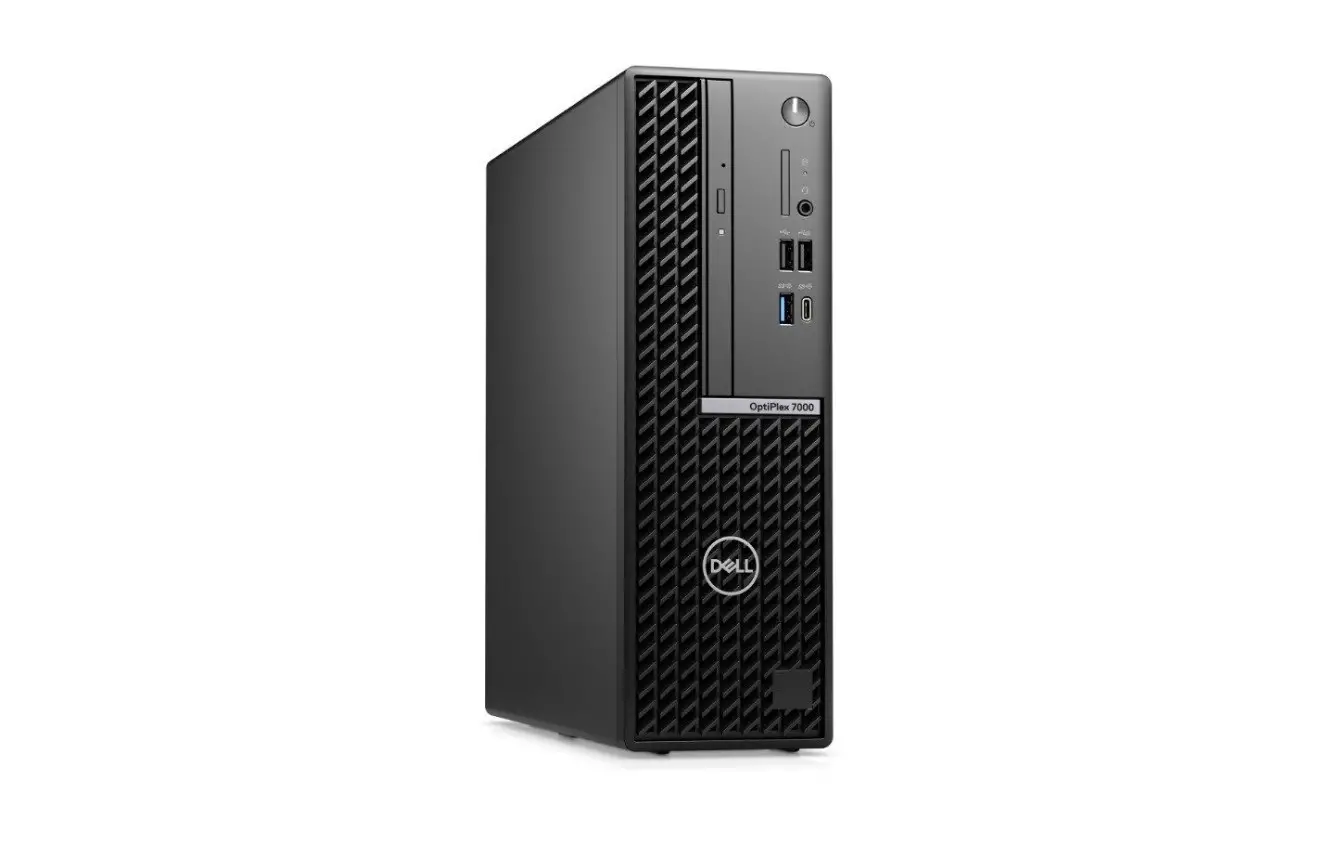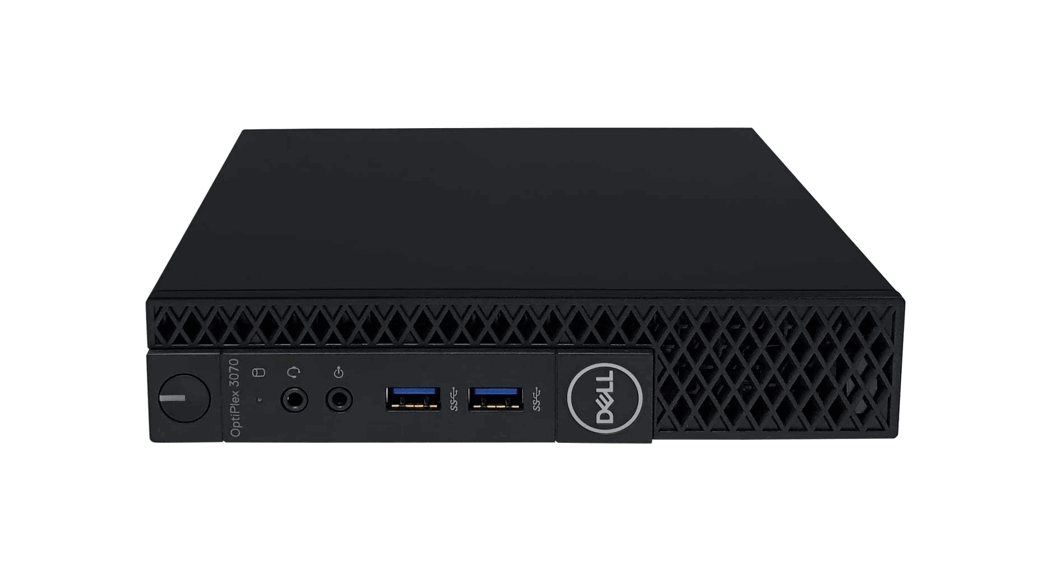
 OptiPlex 3070 Micro Factor PC with 9th Gen Intel
User Manual
OptiPlex 3070 Micro Factor PC with 9th Gen Intel
 NOTE: NOTE indicates important information that helps you make better use of your product.
 CAUTION: CAUTION indicates either potential damage to hardware or loss of data and tells you how to avoid the problem.
 WARNING: WARNING indicates a potential for property damage, personal injury, or death.
Set up your computer
- Connect the keyboard and mouse.
- Connect to your network using a cable, or connect to a wireless network.
- Connect the display.
 NOTE: If you ordered your computer with a discrete graphics card, the HDMI and the display ports on the back panel of your computer are covered. Connect the display to the discrete graphics card.
 - Connect the power cable.
- Press the power button.
- Follow the instructions on the screen to finish Windows setup:
a. Connect to a network. b. Sign-in to your Microsoft account or create a new account.
- Locate Dell apps.
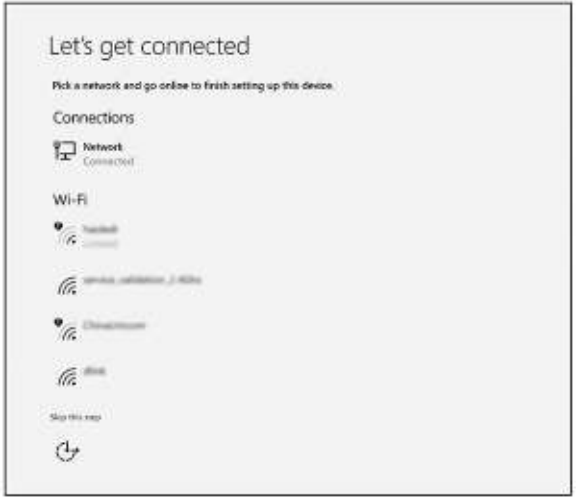 b. Sign-in to your Microsoft account or create a new account.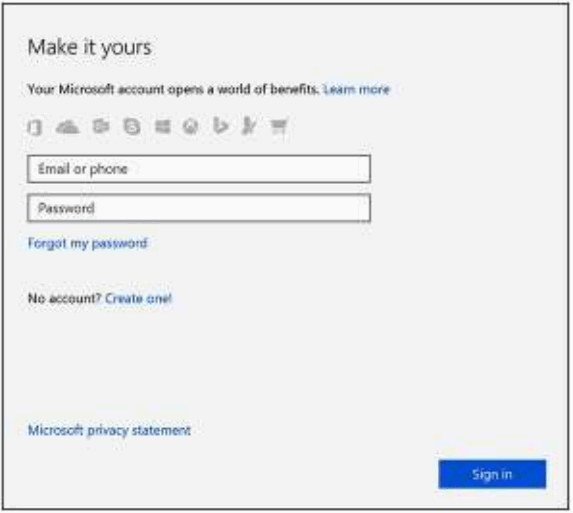
Table 1. Locate Dell apps
 | Register your computer |
 | Dell Help & Support |
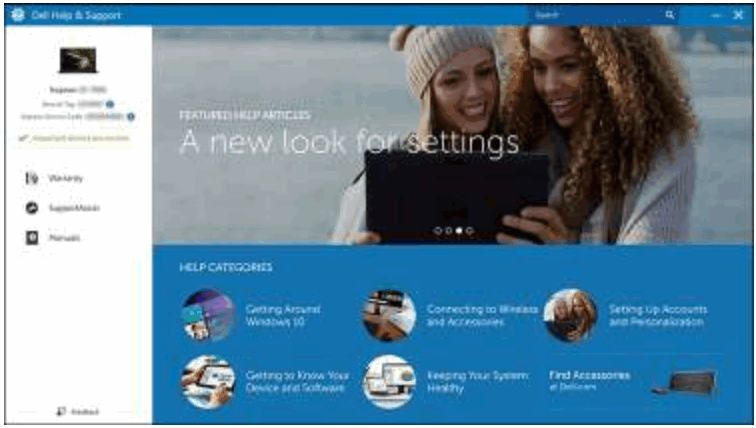 | |
 | SupportAssist — Check and update your computer |
This chapter illustrates the multiple chassis views along with the ports and connectors and also explains the FN hot key combinations.
Topics:
- Front view
- Micro computer view
Front view
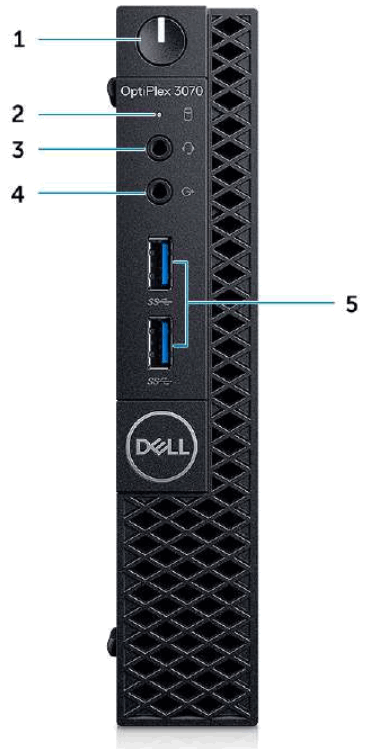
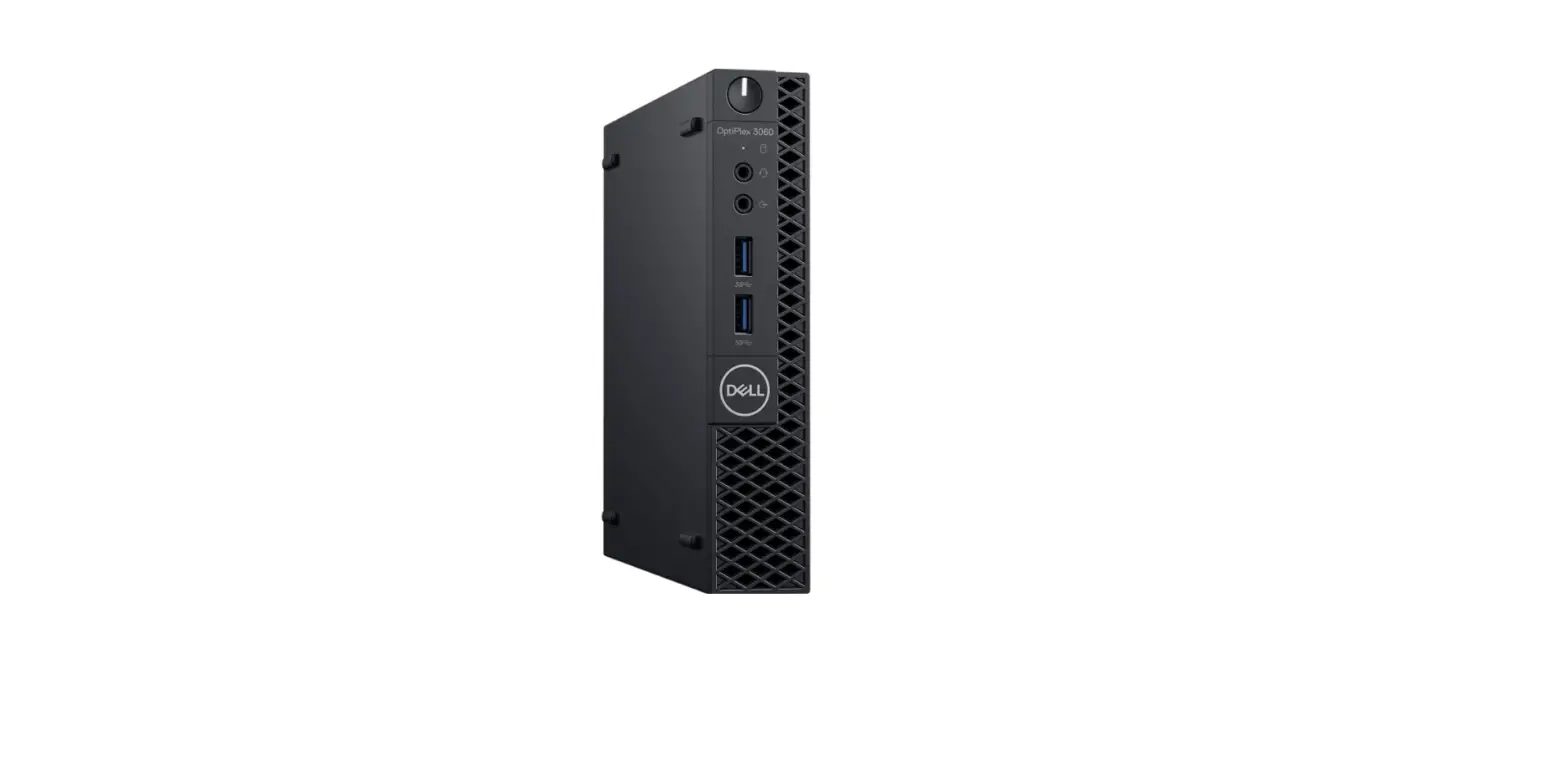
- Power button and power light/diagnostic LED
- Hard drive activity light
- Headset/Universal audio jack port (3.5 mm headphone/microphone combo port)
- Line-out port
- USB 3.1 Gen 1 ports (2)
Micro computer view
Back view
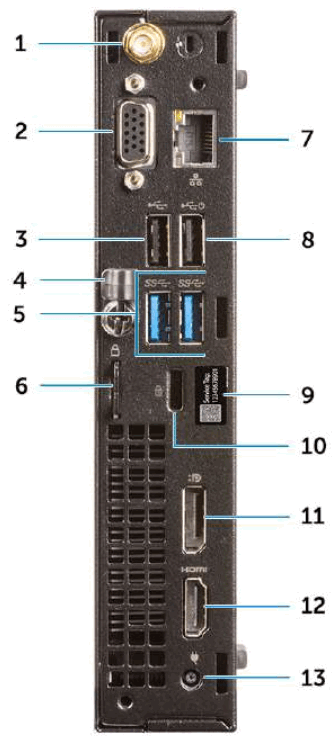
- External antenna connectors
- DP1.2/HDMI2.0/VGA/Serial/Serial-PS/2 (Optional)
- USB 2.0 port
- Cable holder
- USB 3.1 Gen 1 ports (2)
- Padlock ring
- Network port
- USB 2.0 port (supports SmartPower On)
- Service tag label
- Kensington security cable slot
- DisplayPort
- HDMI port
- Power connector port
System specifications
NOTE: Offerings may vary by region. The following specifications are only those required by law to ship with your computer. For more information about the configuration of your computer, go to Help and Support in your Windows operating system and select the option to view information about your computer.
Topics:
- Chipset
- Memory
- Intel Optane Memory
- Storage
- Audio and speakers
- Graphics and Video Controller
- Communications – Wireless
- Communications – Integrated
- External ports and connectors
- System board connector maximum add-in card allowable dimensions
- Operating system
- Power
- System dimensions – physical
- Regulatory and Environmental Compliance
Chipset
Table 2. Chipset
| Tower/Small form factor/Micro | |
| Chipset | H370 |
| Non-volatile memory on chipset | |
| BIOS Configuration SPI (Serial Peripheral Interface) | 256Mbit (32MB) located at SPI_FLASH on chipset |
| Trusted Platform Module (TPM) 2.0 Security Device (Discrete TPM Enabled) | 24KB located at TPM 2.0 on chipset |
| Firmware-TPM (Discrete TPM disabled) | By default the Platform Trust Technology feature is visible to the OS. |
| NIC EEPROM | LOM configuration contained within LOM e-fuse – no dedicated LOM EEPROM |
Processor
NOTE: Global Standard Products (GSP) are a subset of Dell’s relationship products that are managed for availability and synchronized transitions on a worldwide basis. They ensure the same platform is available for purchase globally. This allows customers to reduce the number of configurations managed on a worldwide basis, thereby reducing their costs. They also enable companies to implement global IT standards by locking in specific product configurations worldwide.
Device Guard (DG) and Credential Guard (CG) are the new security features that are only available on Windows 10 Enterprise today.
Device Guard is a combination of enterprise-related hardware and software security features that, when configured together, will lock a device down so that it can only run trusted applications. If it is not a trusted application, it cannot run.
Credential Guard uses virtualization-based security to isolate secrets (credentials) so that only privileged system software can access them. Unauthorized access to these secrets can lead to credential theft attacks. Credential Guard prevents these attacks by protecting NTLM password hashes and Kerberos Ticket Granting Tickets NOTE: Processor numbers are not a measure of performance. Processor availability subject to change and may vary by region/country.
Table 3. Processor
| Intel Core Processors 9th Gen Core CPUs (Offered offline only) | Tower/ Small Form Factor | Micro | GSP | DG/CG Ready |
| Intel® Celeron G4930 (2 Cores/2MB/2T/ 3.2GHz/65W); supports Windows 10/Linux | x | x | ||
| Intel® Celeron G4930T (2 Cores/2MB/2T/ 3.0GHz/35W); supports Windows 10/Linux | x | x | ||
| Intel® Pentium G5420 (2 Cores/4MB/4T/ 3.8GHz/65W); supports Windows 10/Linux | x | x | ||
| Intel® Pentium G5420T (2 Cores/4MB/4T/ 3.2GHz/35W); supports Windows 10/Linux | x | |||
| Intel® Pentium G5600 (2 Cores/4MB/4T/ 3.9GHz/65W); supports Windows 10/Linux | x | x | ||
| Intel® Pentium G5600T (2 Cores/4MB/4T/ 3.3GHz/35W); supports Windows 10/Linux | x | x | ||
| Intel® Core™ i3-9100 (4 Cores/6MB/4T/ 3.6GHz to 4.2GHz/65W); supports Windows 10/Linux | x | x | ||
| Intel® Core™ i3-9100T (4 Cores/6MB/4T/ 3.1GHz to 3.7GHz/35W); supports Windows 10/Linux | x | x | ||
| Intel® Core™ i3-9300 (4 Cores/8MB/4T/ 3.7GHz to 4.3GHz/65W); supports Windows 10/Linux | x | x | ||
| Intel® Core™ i3-9300T (4 Cores/8MB/4T/ 3.2GHz to 3.8GHz/35W); supports Windows 10/Linux | x | x | ||
| Intel® Core™ i5-9400 (6 Cores/9MB/6T/ 2.9GHz to 4.1GHz/65W); supports Windows 10/Linux | x | x | x | |
| Intel® Core™ i5-9400T (6 Cores/9MB/6T/ 1.8GHz to 3.4GHz/35W); supports Windows 10/Linux | x | x | x | |
| Intel® Core™ i5-9500 (6 Cores/9MB/6T/ 3.0GHz to 4.4GHz/65W); supports Windows 10/Linux | x | x | x |
| Intel Core Processors 9th Gen Core CPUs (Offered offline only) | Tower/ Small Form Factor | Micro | GSP | DG/CG Ready |
| Intel® Core™ i5-9500T (6 Cores/9MB/6T/ 2.2GHz to 3.7GHz/35W); supports Windows 10/Linux | x | x | x | |
| Intel® Core™ i7-9700 (8 Cores/12MB/8T/ 3.0GHz to 4.7GHz/65W); supports Windows 10/Linux | x | x | ||
| Intel® Core™ i7-9700T (8 Cores/12MB/8T/ 2.0GHz to 4.3GHz/35W); supports Windows 10/Linux | x | x |
Table 4. Processor
| Intel Core Processors 8th Gen Core CPUs (Offered offline only) | Tower | Small Form Factor | Micro | GSP | DG/CG Ready |
| Intel Core i7-8700 (6 Cores/12 MB/12T/up to 4.6 GHz/65 W); supports Windows 10/Linux | Yes | Yes | No | GSP | Yes |
| Intel Core i5-8500 (6 Cores/9 MB/6T/up to 4.1 GHz/65 W); supports Windows 10/Linux | Yes | Yes | No | GSP | Yes |
| Intel Core i5-8400 (6 Cores/9 MB/6T/up to 4.0 GHz/65 W); supports Windows 10/Linux | Yes | Yes | No | GSP | Yes |
| Intel Core i3-8300 (4 Cores/8 MB/4T/3.7 GHz/65 W); supports Windows 10/Linux | Yes | Yes | No | Yes | |
| Intel Core i3-8100 (4 Cores/6 MB/4T/3.6 GHz/65 W); supports Windows 10/Linux | Yes | Yes | No | Yes | |
| Intel Pentium Gold G5500 (2 Cores/4 MB/4T/3.8 GHz/65 W); supports Windows 10/Linux | Yes | Yes | No | Yes | |
| Intel Pentium Gold G5400 (2 Cores/4 MB/4T/3.7 GHz/65 W); supports Windows 10/Linux | Yes | Yes | No | Yes | |
| Intel Celeron G4900 (2 Cores/2 MB/2T/up to 3.1 GHz/65 W); supports Windows 10/Linux | Yes | Yes | No | Yes | |
| Intel Core i7-8700T (6 Cores/12 MB/12T/up to 4.0 GHz/35 W); supports Windows 10/Linux | No | No | Yes | GSP | Yes |
| Intel Core i5-8500T (6 Cores/9 MB/6T/up to 3.5 GHz/35 W); supports Windows 10/Linux | No | No | Yes | GSP | Yes |
| Intel Core i5-8400T (6 Cores/9 MB/6T/up to 3.3 GHz/35 W); supports Windows 10/Linux | No | No | Yes | GSP | Yes |
| Intel Core i3-8300T (4 Cores/8 MB/4T/3.2 GHz/35 W); supports Windows 10/Linux | No | No | Yes | Yes | |
| Intel Core i3-8100T (4 Cores/6 MB/4T/3.1 GHz/35 W); supports Windows 10/Linux | No | No | Yes | Yes | |
| Intel Pentium Gold G5500T (2 Cores/4 MB/4T/3.2 GHz/35 W); supports Windows 10/Linux | No | No | Yes | ||
| Intel Pentium Gold G5400T (2 Cores/4 MB/4T/3.1 GHz/35 W); supports Windows 10/Linux | No | No | Yes |
| Intel Core Processors 8th Gen Core CPUs (Offered offline only) | Tower | Small Form Factor | Micro | GSP | DG/CG Ready |
| Intel Celeron G4900T (2 Cores/2 MB/2T/2.9 GHz/35 W); supports Windows 10/Linux | No | No | Yes |
Memory
NOTE: Memory modules should be installed in pairs of matched memory size, speed, and technology. If the memory modules are not installed in matched pairs, the computer will continue to operate, but with a slight reduction in performance. The entire memory range is available to 64-bit operating systems.
Table 5. Memory
| Tower | Small Form Factor | Micro | |
| Type: DDR4 DRAM Non-ECC Memory | 2666 MHz on i5 and i7 processors (performs at 2400 MHz on Celeron, Pentium and i3 processors) | ||
| DIMM Slots | 2 | 2 | 2 (SODIMM) |
| DIMM Capacities | Up to 16 GB | Up to 16 GB | Up to 16 GB |
| Minimum Memory | 4 GB | 4 GB | 4 GB |
| Maximum System Memory | 32 GB | 32 GB | 32 GB |
| DIMMs/Channel | 2 | 2 | 1 |
| UDIMM support | Yes | Yes | No |
| Memory configurations: | |||
| 32 GB DDR4, 2666 MHz, (2 x 16 GB) | Yes | Yes | Yes |
| 16 GB DDR4, 2666 MHz, (1 x 16 GB) | Yes | Yes | Yes |
| 16 GB DDR4, 2666 MHz, (2 x 8 GB) | Yes | Yes | Yes |
| 8 GB DDR4, 2666 MHz, (1 x 8 GB) | Yes | Yes | Yes |
| 8 GB DDR4, 2666 MHz, (2 x 4 GB) | Yes | Yes | Yes |
| 4 GB DDR4, 2666 MHz, (1 x 4 GB) | Yes | Yes | Yes |
Intel Optane Memory
NOTE: Intel Otani memory cannot replace DRAM entirely. However, these two memory technologies complement each other within the PC.
Table 6. M.2 16 GB Intel Optane
| Tower/Small form factor/Micro | |
| Capacity (TB) | 16 GB |
| Dimensions (inches) (W x D x H) | 22 x 80 x 2.38 |
| Interface type and Maximum speed | PCIe Gen2 |
| MTBF | 1.6 M hours |
| Tower/Small form factor/Micro | |
| Logical Blocks | 28,181,328 |
| Power Source: | |
| Power Consumption (reference only) | Idle 900 mW to 1.2 W, Active 3.5 W |
| Environmental Operating Conditions (Non-Condensing): | |
| Temperature Range | 0°C to 70°C |
| Relative Humidity Range | 10 to 90% |
| Op Shock (@2 ms) | 1,000G |
| Environmental Non-Operating Conditions (Non-Condensing): | |
| Temperature Range | -10°C to 70°C |
| Relative Humidity Range | 5 to 95% |
Storage
Table 7. Storage
| Tower | Small form factor | Micro | |
| Bays: | |||
| Optical Drives Supported | 1 Slim | 1 Slim | 0 |
| Hard Drive Bay Supported (Internal) | 1×3.5”/2×2.5” | 1×3.5″ or 1×2.5″ | 1×2.5″ |
| Hard Drives Supported 3.5”/2.5” (maximum) | 1/2 | 1/1 | 0/1 |
| Interface: | |||
| SATA 2.0 | 1 | 1 | 0 |
| SATA 3.0 | 2 | 1 | 1 |
| M.2 Socket 3 (for SATA / NVMe SSD) | 1 | 1 | 1 |
| M.2 Socket 1 (for WiFi/BT card) | 1 | 1 | 1 |
| 3.5” Drives: | |||
| 3.5 inch 500 GB 7200 RPM HDD | Y | Y | N |
| 3.5 inch 1 TB 7200 RPM HDD | Y | Y | N |
| 3.5 inch 2 TB 7200 RPM HDD | Y | Y | N |
| 2.5” Drives: | |||
| 2.5 inch 500 GB 5400 RPM HDD | Y | Y | Y |
| 2.5 inch 512 GB 7200 RPM HDD | Y | Y | Y |
| 2.5 inch 512 GB 7200 RPM SED HDD | Y | Y | Y |
| 2.5 inch 1 TB 7200 RPM HDD | Y | Y | Y |
| 2.5 inch 2 TB 5400 RPM HDD | Y | Y | Y |
| M.2 Drives: | |||
| M.2 1 TB PCIe C40 SSD | Y | Y | Y |
| M.2 256 GB PCIe C40 SSD | Y | Y | Y |
| Tower | Small form factor | Micro | |
| M.2 512 GB PCIe C40 SSD | Y | Y | Y |
| M.2 128 GB PCIe NVMe Class 35 Solid State Drive | Y | Y | Y |
| M.2 256 GB PCIe NVMe Class 35 Solid State Drive | Y | Y | Y |
| M.2 512 GB PCIe NVMe Class 35 Solid State Drive | Y | Y | Y |
NOTE: 2.5 Inch Solid State Drives are only available as a secondary storage option and can only be paired with a M.2 Solid State Drive as the Primary Storage Device
Audio and speakers
Table 8. Audio and speakers
| Tower/Small Form Factor/Micro | |
| Realtek ALC3234 High Definition Audio Codec (supports multiple streaming) | Integrated |
| Audio enhancement software | Wave Maxx Audio Pro (Standard) |
| Internal speaker (mono) | Integrated |
| Speaker Performance, Speech Grade & Electrical Grade | Grade D |
| Dell 2.0 Speaker System – AE215 | Optional |
| Dell 2.1 Speaker System – AE415 | Optional |
| Dell AX210 USB Stereo speakers | Optional |
| Dell Wireless 360 Speaker System – AE715 | Optional |
| AC511 Sound Bar | Optional |
| Dell Professional Sound Bar – AE515 | Optional |
| Dell Stereo Soundbar – AX510 | Optional |
| Dell Performance USB Headset – AE2 | Optional |
| Dell Pro Stereo Headsets – UC150/UC350 | Optional |
Graphics and Video Controller
NOTE: Tower supports Full Height (FH) cards and Small Form Factor supports low profile (LP) cards.
Table 9. Graphics / Video Controller
| Tower | Small Form Factor | Micro | |
| Intel UHD 630 Graphics [with 8th Generation Core i3/i5/i7 CPU-GPU combo] | Integrated on CPU | Integrated on CPU | Integrated on CPU |
| Intel UHD 610 Graphics [with 8th Generation Pentium CPU-GPU combo] | Integrated on CPU | Integrated on CPU | Integrated on CPU |
| Enhanced Graphic/ Video Options | |||
| 2 GB AMD Radeon R5 430 | Optional | Optional | Not available |
| 4 GB AMD Radeon RX 550 | Optional | Optional | Not available |
| Tower | Small Form Factor | Micro | |
| 2 GB NVIDIA GT 730 | Optional | Optional | Not available |
Communications – Wireless
Table 10. Communications – Wireless
| Tower/Small form factor/Micro | |
| Qualcomm QCA9377 Dual- band 1×1 802.11ac Wireless + Bluetooth 4.1 | Yes |
| Qualcomm QCA61x4A Dual- band 2×2 802.11ac Wireless + Bluetooth 4.2 | Yes |
| Intel Wireless-AC 9560, Dual- band 2×2 802.11ac Wi-Fi with MU-MIMO + Bluetooth 5 | Yes |
| Internal Wireless Antennas | Yes |
| External Wireless Connectors and Antenna | Yes |
| Support for 802.11n and 802.11ac wireless NIC | Yes via M.2 |
| Energy-Efficient Ethernet capability as specified in IEEE 802.3az-2010. (required for California Energy Commission MEPs) | Yes |
Communications – Integrated
Table 11. Communications – Integrated Realtek RTL8111HSD-CG
| Tower/Small Form Factor/Micro | |
| Realtek RTL8111HSD-CG Gigabit Ethernet LAN 10/100/1000 | Integrated on system board |
External ports and connectors
NOTE: Tower supports Full Height (FH) cards and Small Form Factor supports Low Profile (LP) cards. See chassis diagrams section for port/connector locations.
Table 12. External ports / connectors
| Tower | Small Form Factor | Micro | |
| USB 2.0 (Front/Rear/Internal) | 2/2/0 | 2/2/0 | 0/2/0 |
| USB 3.1 Gen 1 (Front/Rear/Internal) | 2/2/0 | 2/2/0 | 2/2/0 |
| Serial | Parallel/Serial PCIe card or PS/2/Serial | Low Profile Serial PCIe card or PS/2 & Serial port add in bracket (Optional) | ● Available in 2 options ○ Serial port (Optional) |
| Tower | Small Form Factor | Micro | |
| add-in bracket (Optional) | ○ Serial and PS/2 via fan out cable (Optional) | ||
| Network Connector (RJ-45) | 1 Rear | 1 Rear | 1 Rear |
| Video: | |||
| DisplayPort 1.2 | 1 Rear | 1 Rear | 1 |
| HDMI 1.4 port | 1 Rear | 1 Rear | 1 Rear |
| Support for Dual 50W Graphics | No | No | No |
| Support for Dual 25W Graphics | No | No | No |
| Integrated Graphics output 3rd optional video out: VGA, DP, or HDMI 2.0b | Optional | Optional | Optional |
| Audio: | |||
| Line out for headphones or speakers | 1 Rear | 1 Rear | 1 Front |
| Universal Audio Jack (3.5 mm headphone/microphone combo port) | 1 Front | 1 Front | 1 Front |
System board connector maximum add-in card allowable dimensions
Table 13. System board connector maximum add-in card allowable dimensions
| Tower | Small Form Factor | Micro | |
| PCIe x16 Connector (BLUE) (Voltage supported 3.3V/12V) | 1 | 1 | NA |
| Height (inches / centimeters) | 4.38 / 11.12 | 2.73 / 6.89 | NA |
| Length (inches / centimeters) | 6.6 / 16.77 | 6.6 / 16.77 | NA |
| Maximum Wattage | 75 W | 50 W | NA |
| PCIe x1 Connector (Voltage supported 3.3/12V) | 3 | 1 | NA |
| Height (inch / cm) | 4.38 / 11.12 | 2.73 / 6.89 | NA |
| Length (inch / cm) | 4.5 / 11.44 | 6.6 / 16.77 | NA |
| Maximum Wattage | 10 W | 25 W | NA |
Operating system
This topic lists the operating system supported by
Table 14. Operating system
| Operating system | Tower/Small form factor/Micro |
| Windows operating system | Microsoft Windows 10 Home (64-bit) Microsoft Windows 10 Pro (64-bit) |
| Operating system | Tower/Small form factor/Micro |
| Microsoft Windows 10 Pro National Academic Microsoft Windows 10 Home National Academic Microsoft Windows 10 China | |
| Other | Ubuntu 18.04 LTS (64-bit) Neokylin v6.0 (China only) Commercial Platform Windows 10 N-2 and 5 year OS Supportability All newly introduced 2019 and later commercial platforms (Latitude, OptiPlex, and Precision) will qualify and ship with the most current factory installed Semi-Annual Channel Windows 10 version (N) and qualify (but not ship) the previous two versions (N-1, N-2). This device platform OptiPlex 3070 will RTS with Windows 10 version v19H1 at time of launch, and this version will determine the N-2 versions that are initially qualified for this platform. For future versions of Windows 10, Dell will continue to test the commercial platform with coming Windows 10 releases during device production and for five years post-production, including both fall and spring releases from Microsoft. Please reference the Dell Windows as a Service (WaaS) website for additional information on N-2 and 5 year Windows OS supportability. Website can be found at this link: Platforms Qualified on specific versions of Windows 10 This website also includes a matrix of other platforms qualified on specific versions of Windows 10. |
Power
NOTE: These form factors utilize a more efficient Active Power Factor Correction (APFC) power supply. Dell recommends only Universal Power Supplies (UPS) based on Sine Wave output for APFC PSUs, not an approximation of a Sine Wave, Square Wave, or quasi-Square Wave. If you have questions, please contact the manufacturer to confirm the output type.
Table 15. Power
| Tower | Small Form Factor | Micro | |||||
| Power Supply1 | APFC | EPA Bronze | EPA Platinum | APFC | EPA Bronze | EPA Platinum | EPS Level V |
| Wattage | 260 W | 200 W | 65 W | ||||
| AC input voltage range | 90-264 Vac | 90-264 Vac | 90-264 Vac | ||||
| AC input current (low ac range / high ac range) | 4.2 A/2.1 A | 3.2 A/1.6 A | 1.7 A/1.0 A | ||||
| AC input frequency | 47 Hz/63 Hz | 47 Hz/63 Hz | 47 Hz/63 Hz | ||||
| AC holdup time (80% load) | 16mS | 16mS | NA | ||||
| Average efficiency (ESTAR 7.0/7.1 compliant) | NA | 82-85-82% @ 20-50-100% | 90-92-89% @ 20-50-100% load | NA | 82-85-82% @ 20-50-100% | 90-92-89% @ 20-50-100% load | 87% |
| Typical Efficiency (APFC) | 70% | NA | NA | 70% | NA | NA | NA |
| Tower | Small Form Factor | Micro | |||||
| DC Parameters: | |||||||
| +12.0v output | 12 VA/16.5 A; 12 VB/16 A | 12 VA/16.5 A; 12 VB/14 A | |||||
| +19.5v output | NA | NA | 19.5 V/3.34 A | ||||
| +12.0v auxiliary output | 2.5 A | 2.5 A | NA | ||||
| Max total power | 260 W | 200 W | NA | ||||
| Max combined 12.0v power (note: only if more than one 12v rail) | 260 W | 200 W | NA | ||||
| BTUs/h (based on PSU max WT) | 888 BTU | 683 BTU | 222 BTU | ||||
| Power Supply Fan | 60 mm*25 mm | 60 mm*25 mm | NA | ||||
| Compliance: | |||||||
| ErP Lot6 Tier 2 0.5watt requirement | Yes | Yes | Yes | Yes | Yes | Yes | NA |
| 80Plus Certified | No | Yes | Yes | No | Yes | Yes | No |
| FEMP Standby Power Compliant | Yes | Yes | Yes | Yes | Yes | Yes | No |
Table 16. CMOS battery
| 3.0v CMOS battery (Type and estimated battery life): | ||||
| Brand | Type | Voltage | Composition | Life |
| JHIH HONG | CR2032 | 3 V | Lithium | Continuous Discharge Under 15 kΩ Load to 2.5 V End-Voltage. 20 °C±2 °C: 940Hrs or longer; 910Hrs or longer after 12 mo. |
| PANASONIC | CR2032 | 3 V | Lithium | Continuous Discharge Under 15 kΩ Load to 2.5 V End-Voltage. 20 ℃±2 ℃.1183Hrs or longer 1133Hrs or longer after 12 mo. |
| MITSUBISHI | CR2032 | 3 V | Lithium | Continuous Discharge Under 15 kΩ Load to 2.0 V End-Voltage. 20 ℃±2 ℃ 940Hrs or longer 910Hrs or longer after 12 mo. |
| SHUNWO & KTS | CR2032 | 3 V | Lithium | Continuous Discharge Under 15 kΩ Load to 2.5V End-Voltage. 20 ℃±2 ℃.1183Hrs or longer 1133Hrs or longer after 12 mo. |
1 Power Supplies not available in all countries.
System dimensions – physical
NOTE: System Weight and Shipping Weight is based on a typical configuration and may vary based on PC configuration. A typical configuration includes: integrated graphics, one hard drive, one optical drive.
Table 17. System dimensions (Physical)
| Tower | Small Form Factor | Micro | |
| Chassis Volume (liters) | 14.77 | 7.8 | 1.16 |
| Chassis Weight (lb / kg) | 17.49 / 7.93 | 11.57 / 5.26 | 2.60/1.18 |
| Tower | Small Form Factor | Micro | |
| Chassis Dimensions (H x W x D) | |||
| Height (inch / cm) | 13.8 / 35 | 11.42 / 29 | 7.2/18.2 |
| Width (inch / cm) | 6.1 / 15.4 | 3.65 / 9.26 | 1.4/3.6 |
| Depth (inch / cm) | 10.8 / 27.4 | 11.50 / 29.2 | 7/17.8 |
| Shipping Weight (lb / kg – includes packaging materials) | 20.96 / 9.43 | 14.19/6.45 | 5.91/2.68 |
| Packaging Dimensions (H x W x D) | |||
| Height (inch / cm) | 13.19 / 33.5 | 10.38 / 26.4 | 5.2 / 13.3 |
| Width (inch / cm) | 19.4 / 49.4 | 19.2 / 48.7 | 9.4 / 23.8 |
| Depth (inch / cm) | 15.5 / 39.4 | 15.5 / 39.4 | 19.6 / 49.8 |
Regulatory and Environmental Compliance
Product related conformity assessment and regulatory authorizations including Product Safety, Electromagnetic Compatibility (EMC), Ergonomics, and Communication Devices relevant to this product may be viewed at www.dell.com/regulatory_compliance. The Regulatory Datasheet for this product is located at http://www.dell.com/regulatory_compliance.
Details of Dell’s environmental stewardship program to conserve product energy consumption, reduce or eliminate materials for disposal, prolong product life span and provide effective and convenient equipment recovery solutions may be viewed at www.dell.com/environment. Product related conformity assessment, regulatory authorizations, and information encompassing Environmental, Energy Consumption, Noise Emissions, Product Materials Information, Packaging, Batteries, and Recycling relevant to this product may be viewed by clicking the Design for Environment link on the webpage. This OptiPlex 3070 system is TCO 5.0 Certified.
Table 18. Regulatory/Environmental Certifications
| Tower/ Small form factor/ Micro | |
| Energy Star 7.0/7.1 Compliant (Windows & Ubuntu) | Yes |
| Br/CL Reduction: Plastic parts above 25 grams shall not contain greater than 1000 ppm chlorine or greater than 1000 ppm bromine at the homogenous level. Following can be excluded: – Printed circuit boards, cable and wiring, fans, and electronic components Anticipated Required Criteria for EPEAT Revision Effective 1H 2018 | Yes |
| Minimum 2% Post-Consumer Recycled (PCR) plastics as standard in product. Anticipated Required Criteria for EPEAT Revision Effective 1H 2018 | Yes |
| Higher level % Post-Consumer Recycled (PCR) plastics in product: * DT, Workstations, Thin Clients – 10% * Integrated Desktop Computers (AIO) 15% | Yes |
| Tower/ Small form factor/ Micro | |
| (Anticipated 1 Optional point in the EPEAT Revision for higher level PCR) | |
| BFR / PVC Free: (aka Halogen Free) : The system shall comply with the limits defined in Dell specification ENV0199 – BFR/CFR/PVC-Free Specification. | Yes |
BIOS setup
CAUTION: Unless you are an expert computer user, do not change the settings in the BIOS Setup program.
Certain changes can make your computer work incorrectly. NOTE: Depending on the computer and its installed devices, the items listed in this section may or may not be displayed. NOTE: Before you change BIOS Setup program, it is recommended that you write down the BIOS Setup program screen information for future reference.
Use the BIOS Setup program for the following purposes:
- Get information about the hardware installed in your computer, such as the amount of RAM and the size of the hard drive.
- Change the system configuration information.
- Set or change a user-selectable option, such as the user password, type of hard drive installed, and enabling or disabling base devices.
Topics:
- BIOS overview
- Entering BIOS setup program
- Navigation keys
- One time boot menu
- System setup options
- Updating the BIOS
- System and setup password
- Clearing BIOS (System Setup) and System passwords
BIOS overview
The BIOS manages data flow between the computer’s operating system and attached devices such as hard disk, video adapter, keyboard, mouse, and printer.
Entering BIOS setup program
- Turn on your computer.
- Press F2 immediately to enter the BIOS setup program.
NOTE: If you wait too long and the operating system logo appears, continue to wait until you see the desktop. Then, turn off your computer and try again.
Navigation keys
NOTE: For most of the System Setup options, changes that you make are recorded but do not take effect until you restart the system.
Table 19. Navigation keys
| Keys | Navigation |
| Up arrow | Moves to the previous field. |
| Keys | Navigation |
| Down arrow | Moves to the next field. |
| Enter | Selects a value in the selected field (if applicable) or follow the link in the field. |
| Spacebar | Expands or collapses a drop-down list, if applicable. |
| Tab | Moves to the next focus area. NOTE: For the standard graphics browser only. |
| Esc | Moves to the previous page until you view the main screen. Pressing Esc in the main screen displays a message that prompts you to save any unsaved changes and restarts the system. |
One time boot menu
To enter one time boot menu, turn on your computer, and then press F12 immediately.
NOTE: It is recommended to shutdown the computer if it is on.
The one-time boot menu displays the devices that you can boot from including the diagnostic option. The boot menu options are:
- Removable Drive (if available)
- STXXXX Drive (if available)
NOTE: XXX denotes the SATA drive number. - Optical Drive (if available)
- SATA Hard Drive (if available)
- Diagnostics
The boot sequence screen also displays the option to access the System Setup screen.
System setup options
NOTE: Depending on the and its installed devices, the items listed in this section may or may not appear.
General options
Table 20. General
| Option | Description |
| System Information | Displays the following information: ● System Information: Displays BIOS Version, Service Tag, Asset Tag, Ownership Tag, Ownership Date, Manufacture Date, and the Express Service Code. ● Memory Information: Displays Memory Installed, Memory Available, Memory Speed, Memory Channel Mode, Memory Technology, DIMM 1 Size, DIMM 2 Size. ● PCI Information: Displays SLOT1, SLOT 2, SLOT1_M.2, SLOT2_M.2 ● Processor Information: Displays Processor Type, Core Count, Processor ID, Current Clock Speed, Minimum Clock Speed, Maximum Clock Speed, Processor L2 Cache, Processor L3 Cache, HT Capable, and 64-Bit Technology. ● Device Information: Displays SATA-0, SATA 4, M.2 PCIe SSD-0, LOM MAC Address, Video Controller, Audio Controller, Wi-Fi Device, and Bluetooth Device. |
| Option | Description |
| Boot Sequence | Allows you to specify the order in which the computer attempts to find an operating system from the devices specified in this list. ● Windows Boot Manager ● Onboard NIC (IPV4) ● Onboard NIC (IPV6) |
| Advanced Boot Options | Allows you to select the Enable Legacy Option ROMs option, when in UEFI boot mode. By default, this option is selected. ● Enable Legacy Option ROMs—Default ● Enable Attempt Legacy Boot |
| UEFI Boot Path Security | This option controls whether or not the system will prompt the user to enter the Admin password when booting a UEFI boot path from the F12 Boot Menu. ● Always, Except Internal HDD—Default ● Always, Except Internal HDD and PXE ● Always ● Never |
| Date/Time | Allows you to set the date and time settings. Changes to the system date and time take effect immediately. |
System information
Table 21. System Configuration
| Option | Description |
| Integrated NIC | Allows you to control the on-board LAN controller. The option ‘Enable UEFI Network Stack’ is not selected by default. The options are: ● Disabled ● Enabled ● Enabled w/PXE (default) NOTE: Depending on the computer and its installed devices, the items listed in this section may or may not appear. |
| SATA Operation | Allows you to configure the operating mode of the integrated hard drive controller. ● Disabled = The SATA controllers are hidden ● AHCI = SATA is configured for AHCI mode ● RAID ON = SATA is configured to support RAID mode (selected by default) |
| Drives | Allows you to enable or disable the various drives on-board: ● SATA-0 ● SATA-4 ● M.2 Pie SSD-0 |
| Smart Reporting | This field controls whether hard drive errors for integrated drives are reported during system startup. The Enable Smart Reporting option is disabled by default. |
| USB Configuration | Allows you to enable or disable the integrated USB controller for: ● Enable USB Boot Support ● Enable Front USB Ports ● Enable Rear USB Ports All the options are enabled by default. |
| Front USB Configuration | Allows you to enable or disable the front USB ports. All the ports are enabled by default. |
| Rear USB Configuration | Allows you to enable or disable the rear USB ports. All the ports are enabled by default. |
| Option | Description |
| USB PowerShare | This option allows you to charge the external devices, such as mobile phones, music player. This option is enabled by default. |
| Audio | Allows you to enable or disable the integrated audio controller. The option Enable Audio is selected by default. ● Enable Microphone ● Enable Internal Speaker Both the options are selected by default. |
| Dust Filter Maintenance | Allows you to enable or disable BIOS messages for maintaining the optional dust filter installed in your computer. BIOS will generate a pre-boot reminder to clean or replace the dust filter based on the interval set. ● Disabled (default) ● 15 days ● 30 days ● 60 days ● 90 days ● 120 days ● 150 days ● 180 days |
Video screen options
Table 22. Video
| Option | Description |
| Primary Display | Allows you to select the primary display when multiple controllers are available in the system. ● Auto (default) ● Intel HD Graphics NOTE: If you do not select Auto, the on-board graphics device will be present and enabled. |
Security
Table 23. Security
| Option | Description |
| Strong Password | This option lets you enable or disable strong passwords for the system. The option is disabled by default. |
| Password Configuration | Allows you to control the minimum and maximum number of characters allowed for a administrative password and the system password. The range of characters is between 4 and 32. |
| Password Bypass | This option lets you bypass the System (Boot) Password and the internal HDD password prompts during a system restart. ● Disabled — Always prompt for the system and internal HDD password when they are set. This option is enabled by default. ● Reboot Bypass — Bypass the password prompts on Restarts (warm boots). NOTE: The system will always prompt for the system and internal HDD passwords when powered on from the off state (a cold boot). Also, the system will always prompt for passwords on any module bay HDDs that may be present. |
| Option | Description |
| Password Change | This option lets you determine whether changes to the System and Hard Disk passwords are permitted when an administrator password is set. Allow Non-Admin Password Changes – This option is enabled by default. |
| UEFI Capsule Firmware Updates | This option controls whether this system allows BIOS updates via UEFI capsule update packages. This option is selected by default. Disabling this option will block BIOS updates from services such as Microsoft Windows Update and Linux Vendor Firmware Service (LVFS) |
| TPM 2.0 Security | Allows you to control whether the Trusted Platform Module (TPM) is visible to the operating system. ● TPM On (default) ● Clear ● PPI Bypass for Enable Commands ● PPI Bypass for Disable Commands ● PPI Bypass for Clear Commands ● Attestation Enable (default) ● Key Storage Enable (default) ● SHA-256 (default) Choose any one option: ● Disabled ● Enabled (default) |
| Absolute | This field lets you Enable, Disable or Permanently Disable the BIOS module interface of the optional Absolute Persistence Module service from Absolute Software. ● Enabled (default) ● Disabled ● Permanently Disabled |
| Chassis Intrusion | This field controls the chassis intrusion feature. Choose any one of the option: ● Disabled (default) ● Enabled ● On-Silent |
| OROM Keyboard Access | ● Disabled ● Enabled (default) ● One Time Enable |
| Admin Setup Lockout | Allows you to prevent users from entering Setup when Admin password is set. This option is not set by default. |
| SMM Security Mitigation | Allows you to enable or disable additional UEFI SMM Security Mitigation protections. This option is not set by default. |
Secure boot options
Table 24. Secure Boot
| Option | Description |
| Secure Boot Enable | Allows you to enable or disable Secure Boot feature ● Secure Boot Enable This option is not selected by default. |
| Secure Boot Mode | Allows you to modify the behavior of Secure Boot to allow evaluation or enforcement of UEFI driver signatures. |
| Option | Description |
| ● Deployed Mode (default) ● Audit Mode | |
| Expert key Management | Allows you to manipulate the security key databases only if the system is in Custom Mode. The Enable Custom Mode option is disabled by default. The options are: ● PK (default) ● KEK ● db. ● dbx If you enable the Custom Mode, the relevant options for PK, KEK, db, and dbx appear. The options are: ● Save to File– Saves the key to a user-selected file ● Replace from File– Replaces the current key with a key from a user-selected file ● Append from File– Adds a key to the current database from a user-selected file ● Delete– Deletes the selected key ● Reset All Keys– Resets to default setting ● Delete All Keys- Deletes all the keys NOTE: If you disable the Custom Mode, all the changes made will be erased and the keys will restore to default settings. |
Intel Software Guard Extensions options
Table 25. Intel Software Guard Extensions
| Option | Description |
| Intel SGX Enable | This field specifies you to provide a secured environment for running code/storing sensitive information in the context of the main OS. Click one of the following options: ● Disabled ● Enabled ● Software controlled—Default |
| Enclave Memory Size | This option sets SGX Enclave Reserve Memory Size Click one of the following options: ● 32 MB ● 64 MB ● 128 MB—Default |
Performance
Table 26. Performance
| Option | Description |
| Multi Core Support | This field specifies whether the process has one or all cores enabled. The performance of some applications improves with the additional cores. ● All—Default ● 1 ● 2 ● 3 |
| Option | Description |
| Intel SpeedStep | Allows you to enable or disable the Intel SpeedStep mode of processor. ● Enable Intel SpeedStep This option is set by default. |
| C-States Control | Allows you to enable or disable the additional processor sleep states. ● C states This option is set by default. |
| Intel TurboBoost | Allows you to enable or disable the Intel TurboBoost mode of the processor. ● Enable Intel TurboBoost This option is set by default. |
| Hyper-Thread Control | Allows you to enable or disable the HyperThreading in the processor. ● Disabled ● Enabled—Default |
Power management
Table 27. Power Management
| Option | Description |
| AC Recovery | Determines how the system responds when AC power is re-applied after a power loss. You can set the AC Recovery to: ● Power Off ● Power On ● Last Power State This option is set to Power Off by default. |
| Enable Intel Speed Shift Technology | Allows you to enable or disable Intel Speed Shift Technology support. The option Enable Intel Speed Shift Technology is set by default. |
| Auto On Time | Sets time to automatically turn on the computer. Time is kept in standard 12-hour format (hour:minutes:seconds). Change the startup time by typing the values in the time and AM/PM fields. NOTE: This feature does not work if you turn off your computer using the switch on a power strip or surge protector or if Auto Power is set to disabled. |
| Deep Sleep Control | Allows you to define the controls when Deep Sleep is enabled. ● Disabled (default) ● Enabled in S5 only ● Enabled in S4 and S5 |
| Fan Control Override | The option is not set by default |
| USB Wake Support | Allows you to enable the USB devices to wake the computer from standby mode. The option “Enable USB Wake Support” is selected by default |
| Wake on LAN/WWAN | This option allows the computer to power up from the off state when triggered by a special LAN signal. This feature only works when the computer is connected to AC power supply. ● Disabled – Does not allows the system to power on by special LAN signals when it receives a wake-up signal from the LAN or wireless LAN. |
| Option | Description |
| ● LAN or WLAN – Allows the system to be powered on by special LAN or wireless LAN signals. ● LAN Only – Allows the system to be powered on by special LAN signals. ● LAN with PXE Boot – A wakeup packet sent to the system in either the S4 or S5 state, that will cause the system to wake-up and immediately boot to PXE. ● WLAN Only – Allows the system to be powered on by special WLAN signals. This option is set to Disabled by default. | |
| Block Sleep | Allows you to block entering to sleep (S3 state) in OS environment. This option is disabled by default. |
Post behavior
Table 28. POST Behavior
| Option | Description |
| Numlock LED | Allows you to enable or disable the Numlock feature when your computer starts. This option is enabled by default. |
| Keyboard Errors | Allows you to enable or disable the keyboard error reporting when the computer starts. The option Enable Keyboard Error Detection is enabled by default. |
| Fast Boot | This option can speed up the boot process by bypassing some compatibility steps: ● Minimal — The system boots quickly, unless the BIOS has been updated, memory changed, or the previous POST did not complete. ● Thorough — The system does not skip any steps in the boot process. ● Auto — This allows the operating system to control this setting (this works only when the operating system supports Simple Boot Flag). This option is set to Thorough by default. |
| Extend BIOS POST Time | This option creates an additional pre-boot delay. ● 0 seconds (default) ● 5 seconds ● 10 seconds |
| Full Screen Logo | This option will display full screen logo if your image match screen resolution. The option Enable Full Screen Logo is not set by default. |
| Warnings and Errors | This option causes the boot process to only pause when warning or errors are detected. Choose any one of the option: ● Prompt on Warnings and Errors (default) ● Continue on Warnings ● Continue on Warnings and Errors |
Manageability
Table 29. Manageability
| Option | Description |
| USB provision | This option is not selected by default. |
| Mix Hotkey | This option is selected by default. |
Virtualization support
Table 30. Virtualization Support
| Option | Description |
| Virtualization | This option specifies whether a Virtual Machine Monitor (VMM) can utilize the additional hardware capabilities provided by the Intel Virtualization technology. ● Enable Intel Virtualization Technology This option is set by default. |
| VT for Direct I/O | Enables or disables the Virtual Machine Monitor (VMM) from utilizing the additional hardware capabilities provided by the Intel Virtualization technology for direct I/O. ● Enable VT for Direct I/O This option is set by default. |
Wireless options
Table 31. Wireless
| Option | Description |
| Wireless Device Enable | Allows you to enable or disable the internal wireless devices. The options are: ● WLAN/WiGig ● Bluetooth All the options are enabled by default. |
Maintenance
Table 32. Maintenance
| Option | Description |
| Service Tag | Displays the service tag of your computer. |
| Asset Tag | Allows you to create a system asset tag if an asset tag is not already set. This option is not set by default. |
| SERR Messages | Controls the SERR message mechanism. This option is set by default. Some graphics cards require that the SERR message mechanism be disabled. |
| BIOS Downgrade | Allows you to flash previous revisions of the system firmware. ● Allow BIOS Downgrade This option is set by default. |
| Bios Recovery | BIOS Recovery from Hard Drive—This option is set by default. Allows you to recover the corrupted BIOS from a recovery file on the HDD or an external USB key. BIOS Auto-Recovery— Allows you to recover the BIOS automatically. |
| First Power On Date | Allows you the set Ownership date. The option Set Ownership Date is not set by default. |
System logs
Table 33. System Logs
| Option | Description |
| BIOS events | Allows you to view and clear the System Setup (BIOS) POST events. |
Advanced configuration
Table 34. Advanced configuration
| Option | Description |
| ASPM | Allows you to set the ASPM level. ● Auto (default) – There is handshaking between the device and PCI Express hub to determine the best ASPM mode supported by the device ● Disabled – ASPM power management is turned off at all time ● L1 Only – ASPM power management is set to use L1 |
Updating the BIOS
Updating the BIOS in Windows
CAUTION: If BitLocker is not suspended before updating the BIOS, the next time you reboot the system it will not recognize the BitLocker key. You will then be prompted to enter the recovery key to progress and the system will ask for this on each reboot. If the recovery key is not known this can result in data loss or an unnecessary operating system re-install. For more information on this subject, see Knowledge Article: https://www.dell.com/support/article/sln153694
- Go to www.dell.com/support.
- Click Product support. In the Search support box, enter the Service Tag of your computer, and then click Search. NOTE: If you do not have the Service Tag, use the Support Assist feature to automatically identify your computer. You can also use the product ID or manually browse for your computer model.
- Click Drivers & Downloads. Expand Find drivers.
- Select the operating system installed on your computer.
- In the Category drop-down list, select BIOS.
- Select the latest version of BIOS, and click Download to download the BIOS file for your computer.
- After the download is complete, browse the folder where you saved the BIOS update file.
- Double-click the BIOS update file icon and follow the on-screen instructions.
For more information, see knowledge base article 000124211 at www.dell.com/support.
Updating the BIOS in Linux and Ubuntu
To update the system BIOS on a computer that is installed with Linux or Ubuntu, see the knowledge base article 000131486 at www.dell.com/support.
Updating the BIOS using the USB drive in Windows
CAUTION: If BitLocker is not suspended before updating the BIOS, the next time you reboot the system it will not recognize the BitLocker key. You will then be prompted to enter the recovery key to progress and the system will ask for this on each reboot. If the recovery key is not known this can result in data loss or an
unnecessary operating system re-install. For more information on this subject, see Knowledge Article: https://www.dell.com/support/article/sln153694
- Follow the procedure from step 1 to step 6 in Updating the BIOS in Windows to download the latest BIOS setup program file.
- Create a bootable USB drive. For more information, see the knowledge base article 000145519 at www.dell.com/support.
- Copy the BIOS setup program file to the bootable USB drive.
- Connect the bootable USB drive to the computer that needs the BIOS update.
- Restart the computer and press F12 .
- Select the USB drive from the One Time Boot Menu.
- Type the BIOS setup program filename and press Enter.
The BIOS Update Utility appears. - Follow the on-screen instructions to complete the BIOS update.
Updating the BIOS from the F12 One-Time boot menu
Update your computer BIOS using the BIOS update.exe file that is copied to a FAT32 USB drive and booting from the F12 One-Time boot menu.
CAUTION: If BitLocker is not suspended before updating the BIOS, the next time you reboot the system it will not recognize the BitLocker key. You will then be prompted to enter the recovery key to progress and the system will ask for this on each reboot. If the recovery key is not known this can result in data loss or an unnecessary operating system re-install. For more information on this subject, see Knowledge Article: https://www.dell.com/support/article/sln153694
BIOS Update
You can run the BIOS update file from Windows using a bootable USB drive or you can also update the BIOS from the F12 One-Time boot menu on the computer.
Most of the Dell computers built after 2012 have this capability, and you can confirm by booting your computer to the F12 One-Time Boot Menu to see if BIOS FLASH UPDATE is listed as a boot option for your computer. If the option is listed, then the BIOS supports this BIOS update option.
NOTE: Only computers with BIOS Flash Update option in the F12 One-Time boot menu can use this function.
Updating from the One-Time boot menu
To update your BIOS from the F12 One-Time boot menu, you need the following:
- USB drive formatted to the FAT32 file system (key does not have to be bootable)
- BIOS executable file that you downloaded from the Dell Support website and copied to the root of the USB drive
- AC power adapter that is connected to the computer
- Functional computer battery to flash the BIOS
Perform the following steps to perform the BIOS update flash process from the F12 menu:
CAUTION: Do not turn off the computer during the BIOS update process. The computer may not boot if you turn off your computer.
- From a turn off state, insert the USB drive where you copied the flash into a USB port of the computer.
- Turn on the computer and press F12 to access the One-Time Boot Menu, select BIOS Update using the mouse or arrow keys then press Enter.
The flash BIOS menu is displayed. - Click Flash from file.
- Select external USB device.
- Select the file and double-click the flash target file, and then click Submit.
- Click Update BIOS. The computer restarts to flash the BIOS.
- The computer will restart after the BIOS update is completed.
System and setup password
Table 35. System and setup password
| Password type | Description |
| System password | Password that you must enter to log in to your system. |
| Setup password | Password that you must enter to access and make changes to the BIOS settings of your computer. |
You can create a system password and a setup password to secure your computer. CAUTION: The password features provide a basic level of security for the data on your computer. CAUTION: Anyone can access the data that is stored on your computer if it is not locked and left unattended. NOTE: System and setup password feature is disabled.
Assigning a system setup password
You can assign a new System or Admin Password only when the status is in Not Set.
To enter the system setup, press F12 immediately after a power-on or reboot.
- In the System BIOS or System Setup screen, select Security and press Enter.
The Security screen is displayed. - Select System/Admin Password and create a password in the Enter the new password field.
Use the following guidelines to assign the system password:
● A password can have up to 32 characters.
● At least one special character: ! ” # $ % & ‘ ( ) * + , – . / : ; < = > ? @ [ \ ] ^ _ ` { | }
● Numbers 0 through 9.
● Upper case letters from A to Z.
● Lower case letters from a to z. - Type the system password that you entered earlier in the Confirm new password field and click OK.
- Press Esc and save the changes as prompted by the pop-up message.
- Press Y to save the changes.
The computer restarts.
Deleting or changing an existing system setup password
Ensure that the Password Status is Unlocked (in the System Setup) before attempting to delete or change the existing System and/or Setup password. You cannot delete or change an existing System or Setup password, if the Password Status is Locked.
To enter the System Setup, press F12 immediately after a power-on or reboot.
- In the System BIOS or System Setup screen, select System Security and press Enter.
The System Security screen is displayed. - In the System Security screen, verify that Password Status is Unlocked.
- Select System Password, update, or delete the existing system password, and press Enter or Tab.
- Select Setup Password, update, or delete the existing setup password, and press Enter or Tab.
NOTE: If you change the System and/or Setup password, reenter the new password when prompted. If you delete the System and/or Setup password, confirm the deletion when prompted. - Press Esc and a message prompts you to save the changes.
- Press Y to save the changes and exit from System Setup.
The computer restarts.
Clearing BIOS (System Setup) and System passwords
To clear the system or BIOS passwords, contact Dell technical support as described at www.dell.com/contactdell.
NOTE: For information on how to reset Windows or application passwords, refer to the documentation accompanying Windows or your application.
Software
This chapter details the supported operating systems along with instructions on how to install the drivers.
Topics:
• Downloading drivers
Downloading drivers
- Turn on the .
- Go to Dell.com/support.
- Click Product Support, enter the Service Tag of your , and then click Submit.
NOTE: If you do not have the Service Tag, use the auto detect feature or manually browse for your model. - Click Drivers and Downloads.
- Select the operating system installed on your .
- Scroll down the page and select the driver to install.
- Click Download File to download the driver for your .
- After the download is complete, navigate to the folder where you saved the driver file.
- Double-click the driver file icon and follow the instructions on the screen.
System device drivers
Verify if the system device drivers are already installed in the system.
Serial IO driver
Verify if the drivers for Touchpad, IR camera, and keyboard and are installed.
 | Human Interface Devices |
| USB Input Device |
| USB Input Device |
 | Keyboards |
| HID Keyboard Device |
 | Mice and other pointing devices |
| HID-compliant mouse |
Figure 1. Serial IO driver
Security drivers
Verify if the security drivers are already installed in the system.
 | Security devices |
| Trusted Platform Module 2.0 |
USB drivers
Verify if the USB drivers are already installed in the computer.
 | Universal Serial Bus controllers |
| Intel(R) USB 3.1 extensible Host Controller – 1.10 (Microsoft) |
| USB Root Hub (USB 3.0) |
Network adapter drivers
Verify if the Network adapter drivers are already installed in the system.
Realtek Audio
Verify if audio drivers are already installed in the computer.
 | Sound, video and game controllers |
| Intel(R) Display Audio |
| Realtek Audio |
Storage controller
Verify if the storage control drivers are already installed in the system.
Topics:
• Contacting Dell
NOTE: If you do not have an active Internet connection, you can find contact information on your purchase invoice, packing slip, bill, or Dell product catalog.
Dell provides several online and telephone-based support and service options. Availability varies by country and product, and some services may not be available in your area. To contact Dell for sales, technical support, or customer service issues:
- Go to Dell.com/support.
- Select your support category.
- Verify your country or region in the Choose a Country/Region drop-down list at the bottom of the page.
- Select the appropriate service or support link based on your need.
© 2018 – 2019 Dell Inc. or its subsidiaries. All rights reserved. Dell, EMC, and other trademarks are trademarks of Dell Inc. or its subsidiaries. Other trademarks may be trademarks of their respective owners.
Regulatory Model: D10U
Regulatory Type: D10U003
July 2020 Rev. A01
References
 Support | Dell US
-
Computers, Monitors & Technology Solutions | Dell USA
-
Contact Support | Dell US
-
Advancing Sustainability | Dell USA
-
Regulatory Compliance | Dell
-
Support | Dell US
-
Updating the BIOS on Dell Systems With BitLocker Enabled | Dell US
-
Contact Support | Dell US
-
Support | Dell US
-
Updating the BIOS on Dell Systems With BitLocker Enabled | Dell US
-
Windows as a Service (WaaS) support for Windows on the following Dell Commercial Products | Dell US
-
Dell BIOS Updates | Dell US
-
Update the Dell BIOS in a Linux or Ubuntu environment | Dell US
-
How to Create a Bootable USB Flash Drive using Dell Diagnostic Deployment Package (DDDP) | Dell US
 Support | Dell US
 Computers, Monitors & Technology Solutions | Dell USA