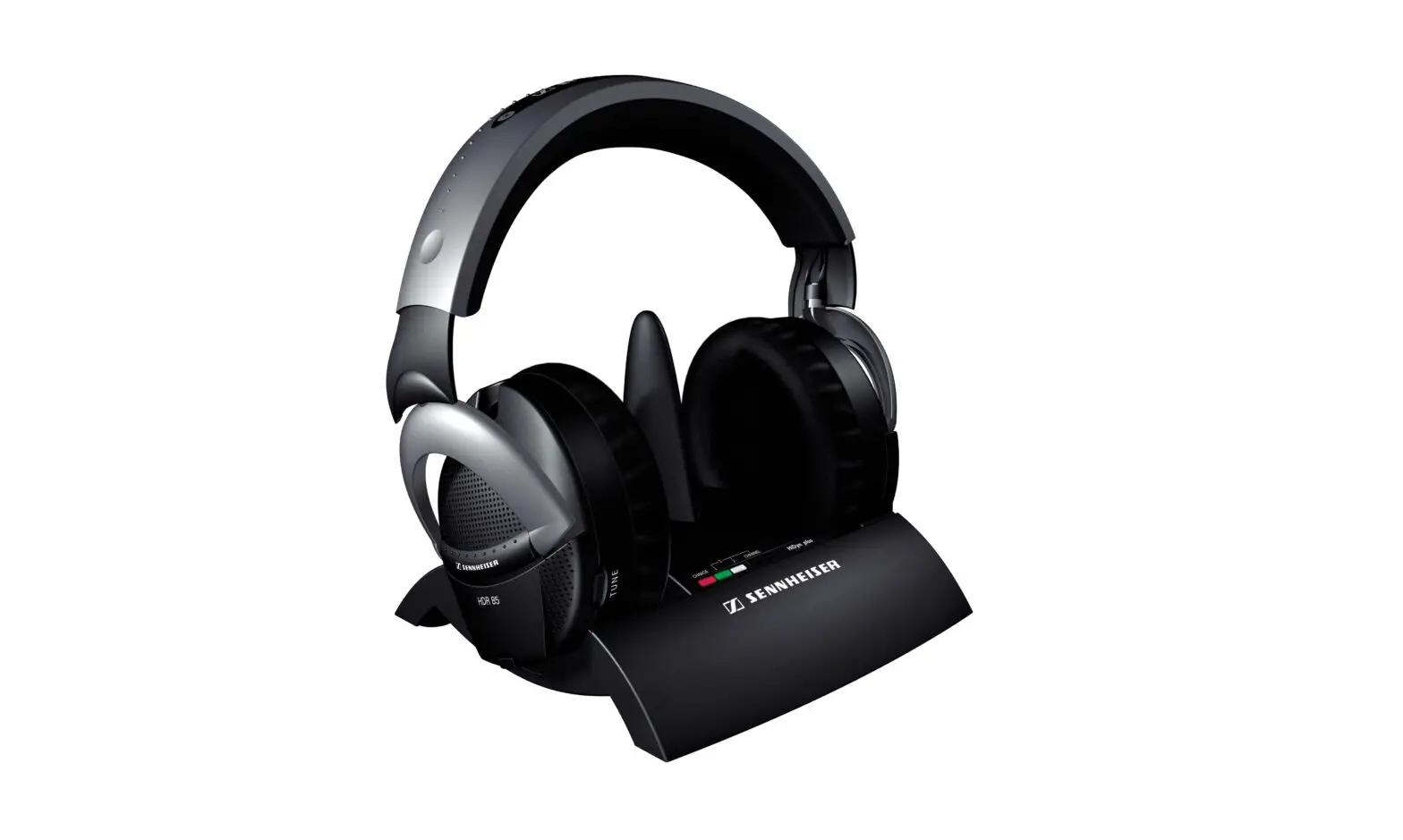
Wireless RS 85
INSTRUCTION
MANUAL Wireless RS 85
SYSTEM COMPONENTS AND CONNECTIONS
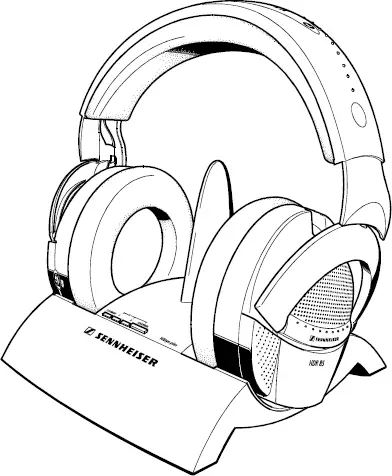
Wireless RS 85
Thank you for choosing Sennheiser! Over half a century of accumulated expertise
in the design and manufacture of high-quality electro-acoustic equipment have
made Sennheiser a world-leading company in this field. We have designed this
product to give you reliable operation over many years.
Please take a few moments to read these instructions carefully, as we want you to
enjoy your new Sennheiser product quickly and to the full.
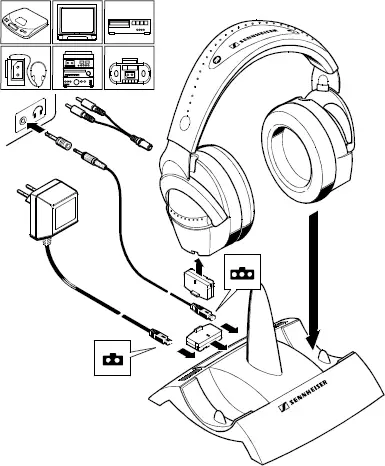
 System components and connections
 System components and connections
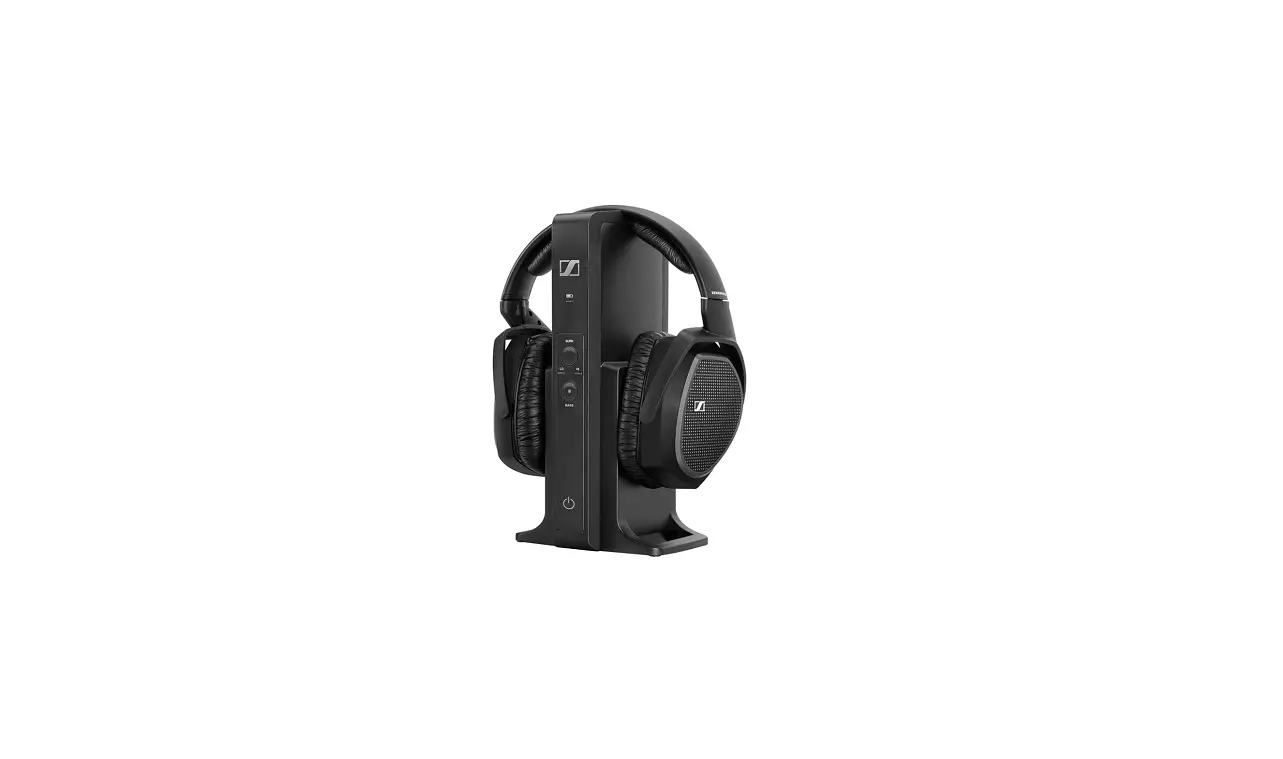
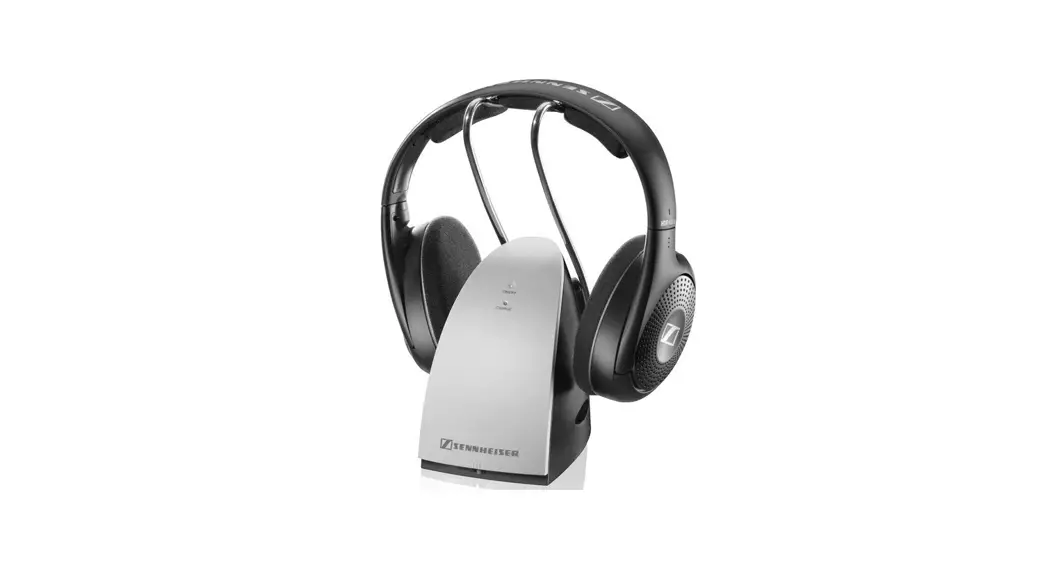
Before proceeding, please check and make sure the system components shown are all present and correct (see illustration inside cover page).
Establish the necessary connections.
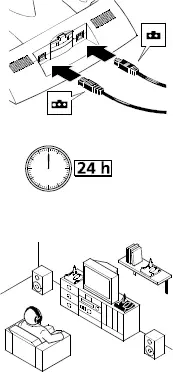
Charge the accupack for 24 hours before you use it for the first time! (Please refer to the section Charging the accupack.)
Where to place the transmitter
Choose a suitable place near your hi-fi system or TV set.
Do not place the transmitter close to metal objects such as shelf bars, reinforced concrete
walls, etc.
The transmitter features a convenient automatic on/off function. The transmitter is switched on by the audio signal. If there is no audio signal for about 3 minutes, the transmitter automatically switches off. The transmitter is now in stand-by mode, its power consumption is very low so that it can remain connected to the mains. Accupacks can always be recharged when the transmitter is connected to the mains.
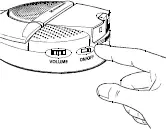 Switching the headphone receiver on
The ON/OFF switch is on the right earpiece.
Switching the headphone receiver off
Make sure to switch off the headphones after each use and store the headphones in the transmitter’s charging compartment to avoid discharging the accupack.
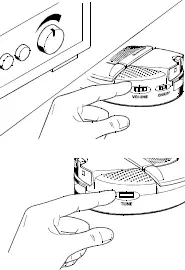 Adjusting the volume
Set the volume of your sound source to a
medium value. With some devices, the volume
for the headphone output can be regulated
separately.
Use the VOLUME control on the right earpiece to
adjust the headphones´ volume.
Adjusting the receiver channel
First switch on the transmitter (see section Where to place the transmitter). Then switch on
the headphone receiver – as soon as the receiver is switched on it automatically tunes
itself to the first strong signal found (normally the transmitter frequency). If, for some reason, the selected channel is not the correct one (eg: because of interference or another nearby system), press the TUNE button on the earpiece and the auto-tune function will re-tune to the next strong signal. Repeat this until you can hear the audio signal loud and clear. If you decide to change the transmitter channel, the receiver search tuning must be re-started by pressing the TUNE button on the headphones again.
Changing the transmission channel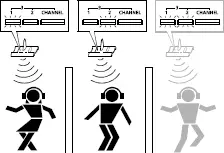 To avoid interference caused by the
simultaneous operation of several transmitters,
select a different channel on each transmitter.
Depending on the system variant, two or three
switchable transmission channels are available.
To select a channel, press the CHANNEL button
until the desired LED or LED combination
lights up:
LED 1 channel 1 active
LED 2 channel 2 active
LED 1 and 2 channel 3 active (except 863 MHz version).
Complete freedom of movement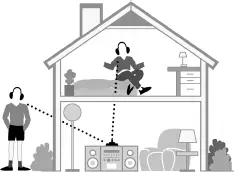 It is not necessary that transmitter and headphone receiver are in a direct line of sight, so you can move around freely in the home or outside in the garden. One transmitter can be used to transmit to several receivers on the same frequency.
Additional headphones with the designation
HDR 85 are available from your specialist dealer. Please make sure to choose headphones with the same frequency range as the transmitter you are using (see type plate on the bottom of the transmitter).
Charging the accupack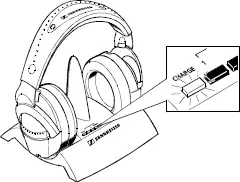 For charging the accupack, place the headphones into the transmitter’s charging compartment (nb: make sure the headphones are inserted the correct way round. The
Sennheiser logo on the headband must be readable looking from the front – see diagram.
The charging contacts are on the RH earpiece of the headphones – these are placed on the corresponding contacts in the LH indentation of
the transmitter, the one next to the “charge” light). The red LED on the transmitter
must light up to show charging is taking place.
Always store the headphones on the transmitter to ensure that they are fully
charged when they are needed. The headphones are automatically switched off
by the charging process.
BA 151 spare accupack
When the headphones’ accupack is going flat (noise, interference and distortion
are sure signs of a flat accupack), recharge the accupack. After an initial charging
of 24 hours, the normal charging time is 14 hours. A fully charged accupack has
an operating time of approx. 3.5 hours. Place the discharged accupack in the
charging compartment at the back of the transmitter and use the spare accupack
in the meantime.
Additional BA 151 spare accupacks can be charged via the L 151-2 charger
(available from your specialist dealer).
Before disposing of an old and exhausted accupack, make sure that it is totally
discharged by using it until the device switches off. To protect the environment,
only dispose of totally exhausted accupacks.
HiDyn plusTM
This device is equipped with HiDyn plusTM, Sennheiser´s noise reduction system
that reduces noise and interference in wireless transmission systems.
Additional information
The audio transmission technology used with this device is basically that of a
radio. According to today’s scientific knowledge, the radio waves emitted by this
device are not harmful to humans or animals.
ATTENTION: LISTENING AT HIGH VOLUME LEVELS FOR LONG
PERIODS CAN PERMANENTLY DAMAGE YOUR HEARING.
This device has been designed for use with stereo devices. For connection to mono devices, please use a stereo to mono jack plug available from most audio accessory shops.
Use a soft cloth or, if necessary, a damp wash-leather for cleaning the devices. Do not use aggressive cleansing agents.
Varnish or furniture polish may attack the rubber feet of the transmitter’s charging
unit. As these could stain your furniture, place the transmitter on a non-slip pad.
If problems occur…
Are all connections properly made?
Are the headphones and sound source switched on and is the volume
correctly adjusted?
Have you charged the accupack for at least 20 minutes?
Are you too far from the transmitter? (if so, move closer)
Choose a different channel.
Adjust the setting with the TUNE button.
If the problem persists, please contact your specialist dealer for assistance.
Never open the device!
Only use original Sennheiser spare parts and accessories. Components from
other manufacturers (e.g. for mains unit or accupack) may cause damage to the
device and will invalidate the guarantee.
Accessories
The following accessories are available from your specialist dealer:
Spare accupack BA 151
Charger L 151-2
Additional headphones HDR 85
Technical data
Modulation FM, stereo
Transmitter
Power supply 12 V DC via plug-in mains unit
Power consumption approx. 1 VA
RF output power typ. up to 10 mW (0.75 mW with 925 MHz version)
Signal-to-noise ratio typ. > 85 dBA
Frequency range see type plate located on the bottom of ransmitter
Channels 3 (2 with 863 MHz version)
Audio connector 3.5 mm /1/4″ (6.3 mm) stereo jack plug, (925 MHz
version supplied with jack to 2 x phono plug)
Charging compartments 1, for BA 151 accupack
Weight approx. 186 g incl. accupack
Dimensions approx. 155 x 153 x 105 mm
Receiver
Max. sound pressure level 101 dB
THD < 0.5 % (at 1 kHz and nom. deviation)
Power supply 2.4 V via BA 151 accupack
Current consumption 24.5 mA
Operating time approx. 3.5 hrs per accupack
Weight approx. 160 g incl. accupack
Dimensions approx. 150 x 80 x 200 mm
Subject to alterations
Sennheiser electronic GmbH & Co. KG D-30900 Wedemark
Printed in Germany Publ.01/01
Telefon +49 (0) 5130/600-0
Telefax +49 (0) 5130/600-300
www.sennheiser.com
81856 / A02
 INTERPROCESS d.o.o. – INTERPROCESS d.o.o.