 Series Infrared Viewers
Instruction Manual
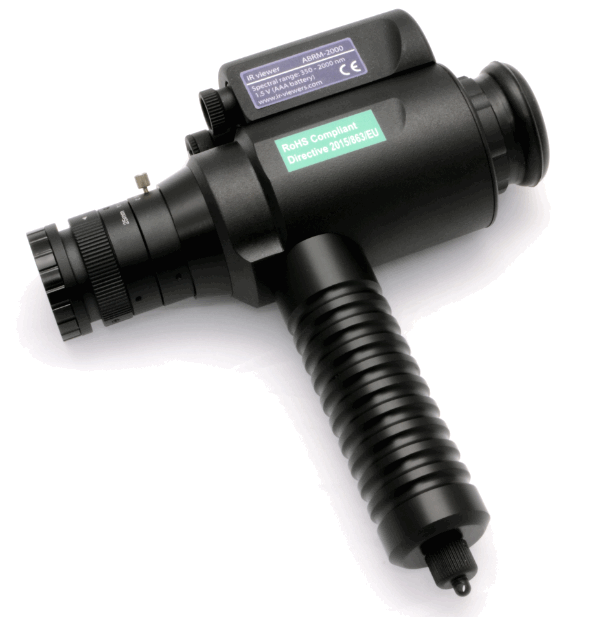
Series Infrared Viewers
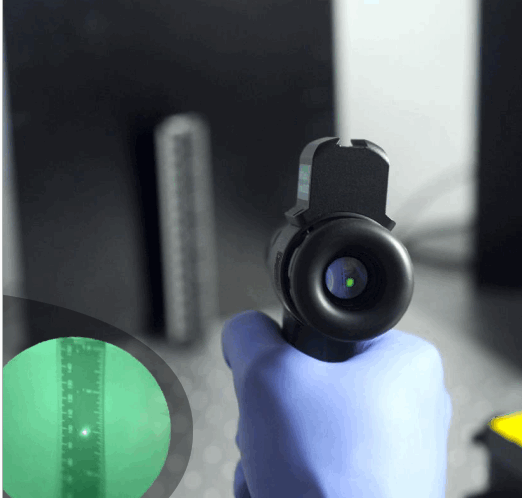
Safety requirements
- The customer is responsible for light source safety while using a viewer as a standalone device or integrated into system.
- The customer must consider protective measures if necessary.
- While assembling or operating viewer, do not stare at the direct laser (or other source) light even with safety goggles.
- This device will not protect you from direct or high light radiation. Use viewer with caution and appropriate attenuation
- Electrical safety requirements must be complied while operating this device.
About
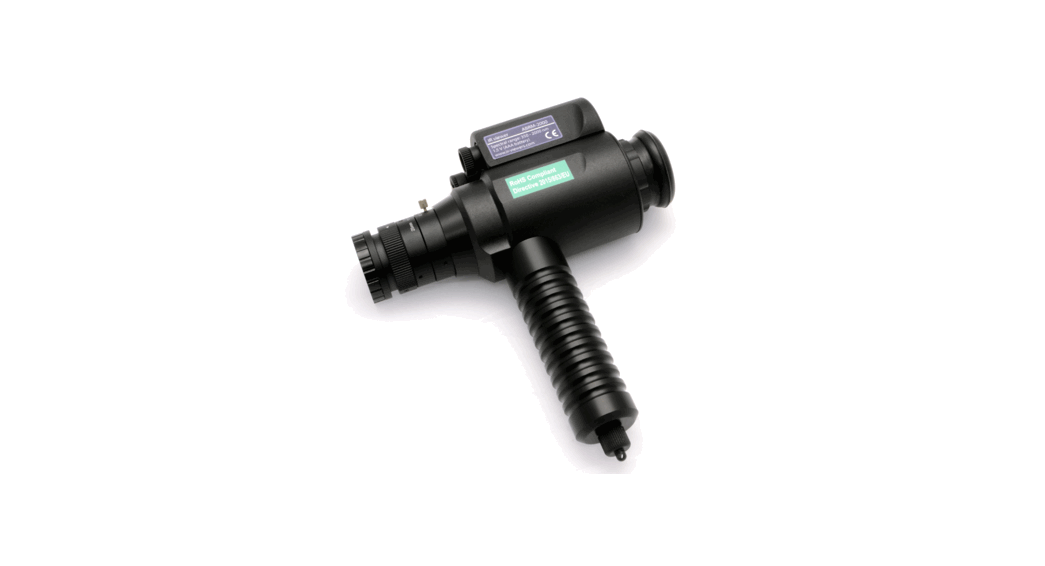
High performance image conversion viewers ABRIS-M, based on high- grade image converter, are designed to observe indirect radiation of infrared laser, light emitting iodes (LED), dye and other IR-sources in 350 – 2000 nm spectral region. The lightweight, compact device can be used hand-held, post mounted with the 1/4-20 internal read or face-mask mounted for hands free operation.
ABRIS-M viewer has better resolution, infrared sensitivity and factor of intensification. Also, it can be used with a CCD camera adapter for PC andvideo registration of the image. This device allows viewing continuous lasers radiation as well as pulsed lasers radiation with pulse duration from ps to µs without synchronization.
Applications
- Laser alignment and safety. IR viewers are ideal for alignment of infrared laser beam and opticacomponents in near infrared systems.
- Semiconductors wafer inspection. With a microscope adapter IR viewer can be used to view through the surface of silicon and gallium arsenide wafers.
- Forensics and art restoration
- Photo processing
- Thermal imaging
- Food sorting
- Vein and blood vessel observation under the skin
- Fluid inspection
How does it work?
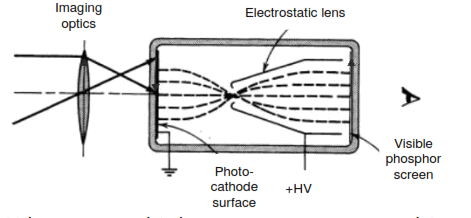
IR viewer is based on a first-generation high-grade image converter thathas an electro-static focusing system, photocathode S-1+ with increased concentration of oxygen and screen of type P-20 with maximum of luminescence at 550nm. Infrared viewer focus emitted or reflected light from a chosen subject into the image tube where electron mage is generated. When powered (with battery or power supply) the 16-18 kV voltage is generated required to accelerate the electron image into the output phosphor creen. The fluorescent green light output (550 nm) is observed via an adjustable eyepiece lens.
Operation
CAUTION! Do not use the device for direct beam viewing. Long-term over- exposure may cause satiation of screen and decrease of resolution or irreversible reduction of photocathode response.
- Unscrew the lid (1) of the battery compartment and install one AAA size battery into battery compartment, observing the polarity.
- Screw the handle (7) into the tripod thread ¼ inches (10) in body.
- Take of the lens cover. To switch the unit on, press button (2).
NOTE: after switching off, the device continues to work some minutes due to the accumulated power. - Rotate the ring (3) to focus the lens 1Х (F1.4/25mm). Rotate ring (13) to focus the lens 2Х (F1.8/50mm). For adjustment of diaphragm (11), release the screw, adjust the diaphragm (11) and tighten the screw. Turn the ring (5) for eyepiece focus adjustment.
- When viewing in near-infrared range, use cut-off filter (4). While viewing a reflected radiation, use metallic surface as a reflector. Any paper surface absorbs the radiation greatly.
- For “goggle” operation, place the IR viewer onto “dovetail” (9) of face- mask and clamp it with screw. Adjust the position with fixing screws for the most convenient operation.
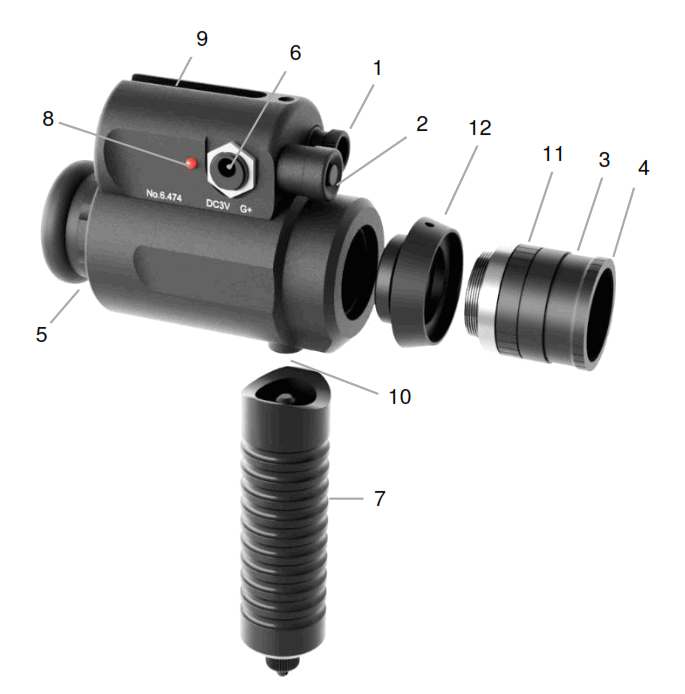 Figure 1. ABRIS M 1X viewer
| 1. Lid of battery 2. Button ON/OFF 3. Focusing ring of F1.4/25mm lens 4. IR Filter 5. Eyepiece 6. Socket 3V | 7. Handle 8. LED 9. Dovetail (for face- mask clamping) 10. Tripod thread 11. Diaphragm 12. C-mount ring 13. Focusing ring of F1.8/50mm lens |
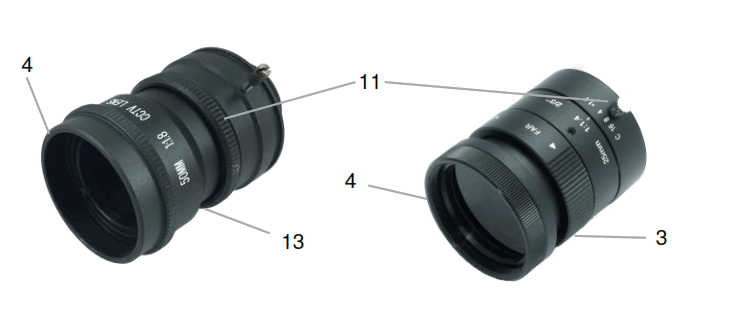 Figure 2. Lenses F1.8/50mm (left) and F1.4/25mm (right)
IR viewer in comparison with a CCD camera
Certain models of CCD cameras can be used to observe near-infrared radiation at wavelengths up to 1100 nm. However, because these cameras are designed for optimum erformance in the visible wavelength range, as a result, they exhibit mediocre performance in the near-infrared range; image bleeding, blooming, low sensitivity and low ontrast are some of the observed characteristics. Image conversion viewers are design to observe much wider spectrum.
Visualization of infrared laser beam in “mid-air”
It is a misconception that an IR viewer can be used to view infrared laser beams in “mid-air” (1100 – 2000 nm). However, if dust particles are in the beam path, the beam will become partly visible. Basically, IR viewers can be used to see the projection of the infrared beam spot on a flat diffusing surface such as a white card or metallic surface.
The Maintenance instruction
- During IR viewer operation there is no danger of electric shock.
- When brought into a warm room from the cold outside the optical elements may become wet.
- Keep away viewer from mechanical damage and moisture.
- Protect the lenses from dirt. If necessary, clean them with clean soft cloth; remove oiled spots or deposit with cotton wool slightly wetted in rectified alcohol or with alcohol-ether mixture.
- If necessary, unscrew the lens and clean the photocathode window, because dust can be seen through eyepiece.
Black spots on screen
Black spots on the screen are cosmetic blemishes in the image converter which do not affect the performance or reliability of an infrared viewers. Some spots are inherent in he manufacturing processes.
| Zone | Form and sizeof zones on photocathode, mm | The greatest diameter of points, mm | Total area of allowable defects on creen, mm2 . | ||
| Non accounted | Accounted | ||||
| Size | Qty | ||||
| 1 | Circle dia 12mm | 0.0735 | 0.294 | 2 | 0.452 |
| 2 | Ring dia 12-19mm | 0.1 0.588 | 1 | 0.904 | |
| 3 | Ring dia 19-24mm | Non specified | |||
Spectral sensitivity
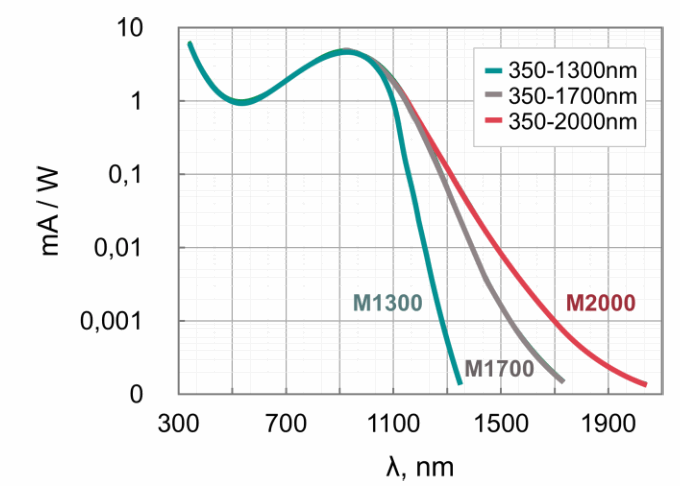
Figure 3. Spectral sensitivity (Abris M series IR viewers)
Power density
Approximate minimum of power densities required to view an infrared laser beam from a one meter distance:
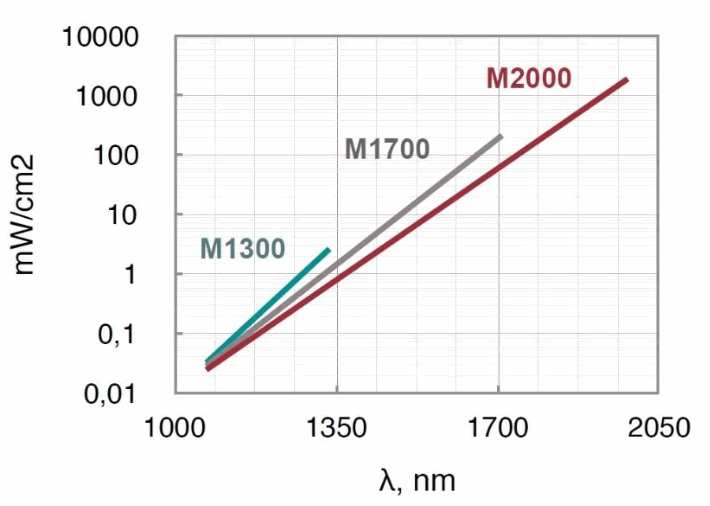
Figure 4. Power density (Abris M series IR viewers)
Photosensitivity
The minimum detectable signal for a near-infrared viewer depends on:
- Power density;
- Wavelength of incident radiation;
- Effective aperture of the objective lens;
- Distance between observed target and the viewer;
- Time duration of the signal (pulsed or continuous);
- Reflectivity of the diffusing surface;
- Sensitivity of human eye or device used in viewing the output of the IR viewer.
Approximate minimum of power densities required for observing an infrared laser source from a distance of one meter: 20 µW/cm2 for a 1060 nm; 500 µW/cm2 for a 1300 nm.
The IR viewer with sensitivity 350-2000 nm has the photocathode S-1+ type which contain the increased concentration of oxygen. It increases sensitivity of the hotocathode. R viewer can be used to view 2.0 µm laser beam at minimum power density 2 W/cm2. When operated in the 1500-2000 nm range, IR viewer has a low spectral response, therefore observations can be performed when the following requirements are met:
- Use an IR cut-off filter or interference filter and darken the room to reduce external background;
- Use a metallic surface for observation reflected radiation, as any other material might absorb infrared radiation.
Technical information
| Version | 1 (1X) | 2 (2X) |
| Spectral sensitivity | ABRM-1300-x (350-1300nm) | |
| ABRM-1700-x (350-1700nm) | ||
| ABRM-2000-x (350-2000nm) | ||
| Resolution (center) | 60 Lp/mm | 60 Lp/mm |
| Field of view | 40° | 20° |
| Magnification | 1Х | 2Х |
| Objective lens | F1.4/25mm | F1.8/50mm |
| Adjustable iris | Included | Included |
| Focus | 0.1m to inf | 0.5m (0.15m)* to inf |
| Battery | 1.5V, 1x “AAA” size | |
| Non-uniformity of screen | <20% | |
| Non-uniformity of response | <15% | |
| Distortion of image | <18% | |
| Battery life (continuous) | 35 hours | |
| External power supply | DC 3V, 30 mA | |
| Weight | 0.38kg | 0.42kg |
| Dimensions | 140x78x52 mm | 145x78x52 mm |
| Temperature range | -10ºC…40ºС | |
| Tripod or handle | R”1/4″ | |
| * with macro ring | ||
Lenses 1X (F1.4/25mm) and 2X (F1.8/50mm) are exchangeable.
| Standard kit for version 1X includes: • IR viewer; • lens 1X; • C-mount ring; • IR filter; • handle; • battery and case. | Standard kit for version 2X includes: • IR viewer; • lens 2X; • macro ring; • IR filter; • handle; • battery and case. |
Accessories available upon request:
- Neutral density filter for lens 1X(3-5% @ 1064nm)
- Neutral density filter for lens 2X(3-5% @ 1064nm)
- Microscope adapter
- Face-mask for hands free operation
- IR illuminator (940nm, 850nm)
- 1:1 Optical relay lens adapter for c-mount camera
- Video adapter VA-1 to Abris
- Lens 2X (F1.8/50mm)
- Lens 1X(F1.4/25mm)
- Macro ring
- C-mount ring for any C-mount type lenses
- Tripod
Warranty
Infrared viewing device ABRIS M meets specifications of the manufacturer and declared operation. The warranty period of the device is 24 months from the date it was sold to the consumer. Claims not accepted, and warranty repair are not made, because of the improper use or incorrect service and maintenance of product instructions. The ompany shall not accept warranty claim:
– non-authorized alteration,
– disassembling of device,
– mechanical or any external damages,
– if 2 years warranty term has expired.
Serial No………………….
Version No………………
Spectral range…………..
Date of Invoice………..
ADOS-TECH, UAB
Mokslininku st. 2A,
LT-08412, Vilnius, Lithuania
Phone: +370 5 270 6407
Fax: +370 5 210 0067
[email protected]
www.ir-viewers.com
 OPTO SCIENCE
www.ir-viewers.com
[email protected]