AURORA AMU900 900 MHz ISM Band Spread Spectrum Transceiver User Guide

1 Legal Disclaimer and Conditions of Use
This document contains information for the MLink Ultra Transceiver and accompanying accessories (“Product”) and is provided “as is”. The purpose of providing such information is to enable a Product Developer to understand the Product and how to integrate it into a wireless data solution. Reasonable effort has been made to make the information in this document reliable and consistent with specifications, test measurements and other information. However, Aurora Wireless Networks Inc. and its affiliated companies, directors, officers, employees, agents, trustees or consultants (“Aurora Wireless Networks Inc”) assume no responsibility for any typographical, technical, content or other inaccuracies in this document. Aurora Wireless Networks Inc reserves the right in its sole discretion and without notice to you to change Product specifications and materials and/or revise this document or withdraw it at any time. The Product Developer assumes the full risk of using the Product specifications and any other information provided.
Your use of the information contained in this Guide is restricted to the development activity authorized under the agreement(s) between you and Aurora Wireless Networks Inc, and is otherwise subject to all applicable terms and conditions of such agreement(s), including without limitation software license, warranty, conditions of use and confidentiality provisions.
2 Revision History
| Revision | Date | Description |
| Draft | Apr 1, 2021 | Initial release |
3 Abbreviations
| Abbreviation | Description |
| A/D | Analog to Digital |
| ATTN | Attenuator |
| Aux | Auxiliary |
| BSL | Boot Strap Loader |
| CLK | Clock |
| CS (nCS) | Chip Select (not Chip Select) |
| CTS | Clear to Send |
| EN | Enable |
| FCC | Federal Communications Commissions |
| GPIOD | General Purpose Input/Output Digital |
| HCR | Hardware Configuration Resistor |
| I2C | Inter-Integrated Circuit |
| IC | Industry Canada |
| IRQ | Interrupt Request |
| LNA | Low Noise Amplifier |
| MOSI | Master Out Slave In |
| MISO | Master In Slave Out |
| PA | Power Amplifier |
| PCB | Printed Circuit Board |
| PWM | Pulse Width Modulated |
| RBW | Resolution Bandwidth |
| RF | Radio Frequency |
| RST (nRST) | Reset (not Reset) |
| RTC | Real Time Clock |
| RTS | Request to Send |
| Rx | Receive |
| RxD | Receive Data |
| SCK | Serial Clock |
| SDA | Serial Data |
| SPI | Serial Peripheral Interface |
| SW | Software |
| TBC | To Be Confirmed |
| TBD | To Be Determined |
| TRP | Total Radiated Power |
| Tx | Transmit |
| TxD | Transmit Data |
| TDD | Time Division Duplex |
| UART | Universal Asynchronous Receiver/Transmitter |
4 Reference Documents
- MLink Ultra Block Diagrams – Draft, Mar 29, 2021
- Schematics (MLink Ultra – Rev 2.pdf MLink Ultra – Rev 2.pdf )
5 Product Overview
MLink Ultra (AMU900) is the next generation of MLink 900. It is an ultra energy and cost efficient, long range wireless network. Available as a module, development platform or a fully
customized product. Perfect for a wide range of applications, this highly versatile platform enables rapid design, development, and deployment of your next generation products.
6 Features
Ultra Low Energy: Up to 10 years or more from AA batteries or even directly from the sun. Impressive Range: Up to 10 km or more using high efficiency integral antennas.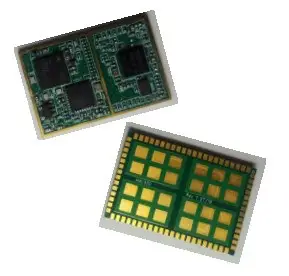
Design Flexibility: Build your application right on the
MLink platform or communicate through the embedded serial port.
Direct support for a variety of peripherals:
o GPS
o Displays, accelerometers
o Industrial sensors, audio alerts
Intrinsically safe options available.
7 Specifications
7.1 Physical
- Size 18.03 x 27.43 x 3.05 mm
7.2 Electrical
- Frequency Range 902 – 928 MHz (US/Can)
- Output Power up to +29 dBm (US/Can)
- Effective Radiated better than -120 dBm Sensitivity (1.2 kbps at 10-3 BER)
- Access Method TDD – FHSS
- DC Supply Voltage 2.2 to 3.6 Vdc (Main) 2.2 to 4.2 Vdc (PA)
- Energy Consumption (typical @ 38.4 kpbs)
o TX < 20 mJ
o RX < 0.5 mJ
o Standby (/s) < 100 μW
7.3 Data Rates
- Dynamically adaptable from 1.2 – 76.8 kbps
7.4 Interfaces
- RF
o 50 Ω - Digital/Base Band
o ADC, PWM, GPIO, I2C, SPI, UART
7.5 Firmware
- Real Time Operating System
- Embedded, autonomous protocol
- Up to 64 kB Flash and 4 kB RAM available for customer applications
7.6 Environmental
- Operating Temperature -40 to +85 C
- Storage Temperature -40 to +85 C
- Operating Relative Humidity 0 to 90% non-condensing
8 Regulatory Certification
8.1 United States (FCC)
MLink Ultra modules meets Part 15 of the FCC rules and regulations. Compliance with the labeling requirements, FCC notices is required. In order to comply with FCC Certification requirements, the Original Equipment Manufacturer (OEM) must fulfill the following requirements.
- The system integrator must place an exterior label on the outside of the final product housing the MLink Ultra module. Figure 8.1.1.1 below shows the contents that must be included in this label.
- MLink Ultra modules may only be used with the antenna that has been tested and approved for use with the module.
- NOTE: THE AURORA WIRELESS NETWORKS INC IS NOT RESPONSIBLE FOR ANY CHANGES OR MODIFICATIONS NOT EXPRESSLY APPROVED BY THE PARTY RESPONSIBLE FOR COMPLIANCE. SUCH MODIFICATIONS COULD VOID THE USER’S AUTHORITY TO OPERATE THE EQUIPMENT.
8.1.1 Labeling Requirements
The OEM must make sure that FCC labeling requirements are met. This includes a clearly visible exterior label on the outside of the final product housing that displays the contents shown in Figure 8.1.1.1 below.
8.1.2 FCC Notices
WARNING: The MLink Ultra modules have been tested by the FCC for use with other products without further certification (as per FCC Section 2.1091). Changes or modifications to this device not expressly approved by Aurora Wireless Networks Inc could void the user’s authority to operate the equipment.
NOTICE: OEM’s must verify the final end product complies with unintentional radiators (FCC Section 15.107 and 15.109) before providing a declaration of conformity for their final product to Part 15 of the FCC Rules.
NOTICE: The MLink Ultra modules have been certified for mobile and fixed radio applications. If the module will be used for portable applications, the device must undergo SAR testing.
RF Exposure WARNING:
This equipment complies with FCC radiation exposure limits set forth for an uncontrolled environment. This equipment should be installed and operated with minimum distance 20 cm between the radiator and your body. This transmitter must not be co-located or operating in conjunction with any other antenna or transmitter.
NOTICE: The preceding statement must be included as a CAUTION statement in OEM product manuals in order to alert users of FCC RF Exposure compliance.
8.2 Canada (IC)
This device complies with Industry Canada license-exempt RSS standard(s). Operation is subject to the following two conditions: (1) this device may not cause interference, and (2) this device must accept any interference, including interference that may cause undesired operation of the device.
list, having a gain greater than the maximum gain indicated for that type, are strictly prohibited for use with this device.
8.3 Approved Antennas
MLink Ultra modules are approved for mobile and fixed applications. FCC & IC requires that for mobile applications the antenna be mounted a minimum of 20 cm from users, as captured in section 8.1.2 above.
MLink Ultra modules has been approved for use with both an integral PCB antenna and recommended external antenna.
8.3.1 Integral PCB Antenna
MLink Ultra modules has been approved for use with both an integral PCB antenna structure as capture below.
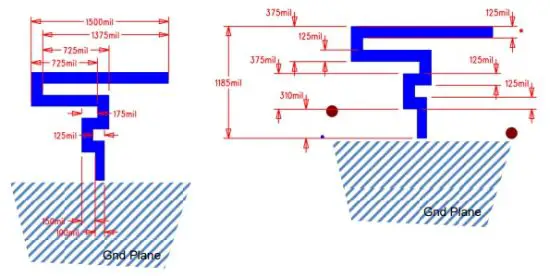
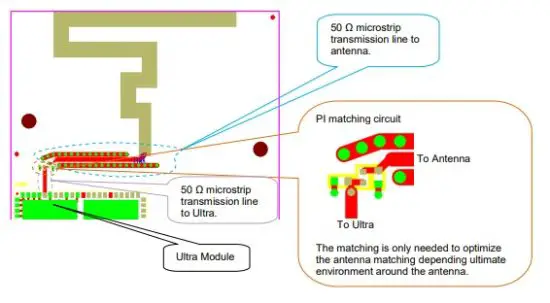
The PCB antenna is connected to a 50 Ω microstrip transmission line and lumped element matching circuit as shown below.
8.3.2 External Antenna
Mlink Ultra modules have been approved for use with an external Yagi antenna captured below including a 1.2 dB min cable loss. External antenna types with the same or lower maximum gain are permitted for use with MLink Ultra. Professional installation is required for the external antenna.
| Manufacturer | Part Number | Type | Gain | Application | Min Separation |
| MaxStream Inc | A09-Y8NF | 4 | 4.8 dBd1 | Mobile and | 20 cm |
| or | or | Element | Fixed | ||
| Laird Technologies | PC904 | Yagi |
Note 1: Including 1.2 dB min cable loss as captured below:
- 5 ft min of RG-174 (27.9 dB/100 ft @ 900 MHz)
- 7 ft min of RG-58/RG-8X (20.1 dB/100 ft @ 900 MHz)
- 16 ft min of RG-213/LMR240 (7.7 dB/100 ft @ 900 MHz)
- 32 ft min of LMR-400 (3.9 dB/100 ft @ 900 MHz)
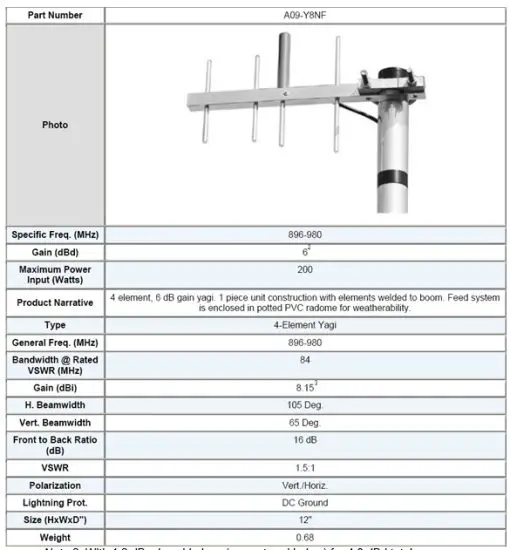
Note 2: With 1.2 dB min cable loss (as captured below) for 4.8 dBd total.
Note 3: With 1.2 dB min cable loss (as captured below) for 7 dBi total.
- 5 ft min of RG-174 (27.9 dB/100 ft @ 900 MHz)
- 7 ft min of RG-58/RG-8X (20.1 dB/100 ft @ 900 MHz)
- 16 ft min of RG-213/LMR240 (7.7 dB/100 ft @ 900 MHz)
- 32 ft min of LMR-400 (3.9 dB/100 ft @ 900 MHz)
9 Integration Instructions
MLink Ultra is designed for use in countless wireless applications requiring long rangecommunications with low energy consumption. To ensure that the final product complies with the all of the regulatory requirements for the Modular Grant the following integration instructions should be followed. MLink is limited to OEM installation ONLY. The OEM integrator is.
responsible for ensuring that the end-user has no manual instructions to remove or install the module.
9.1 Mounting
MLink Ultra is a surface mount device which is installed on the OEM PCB along with other components. The mechanical drawing below captures the external dimensions of the MLink Ultra module.
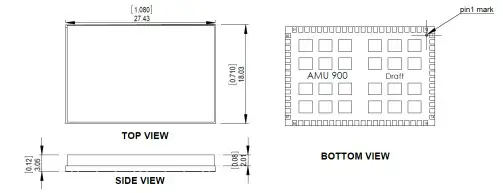
Figure 9.1.1 – MLink Ultra Mechanical Drawing
The recommended footprint is shown in the figure below.
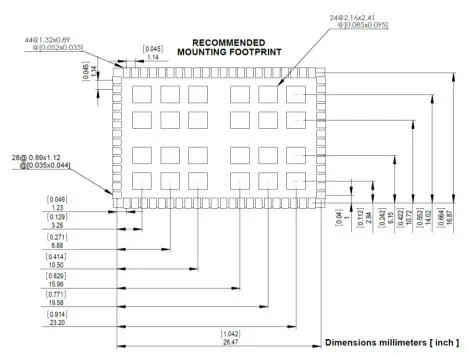
Figure 9.1.2 – Recommended MLink Ultra Footprint
Minimal circuitry is required to support MLink Ultra and therefore the PCB can be a simple 2 layer FR4 board with ground plane (> 1350 mm2) on the bottom opposite layer to the MLink Ultra module for heat dissipation.
9.2 Interfaces
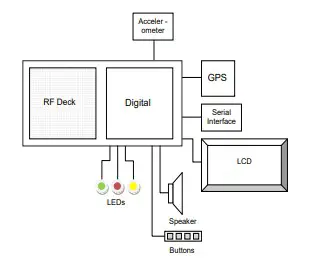
The figure below captures the interface lines to MLink Ultra
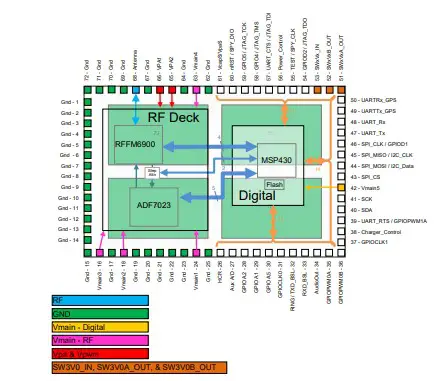
Key interface pins shown below. The MLink Ultra datasheet (Ref 4) provides detailed information for all interface pins.
| Pin # | Name | Description |
| 16, 18, 24, 63 | Vmain3, Vmain2, Vmain1, Vmain4, Vmain5 (input) | Power Supplies · Various analog and digital supplies · 2.2 – 3.6 V · 3 V typ |
| 65, 66 | VPA2, VPA1 (input) | Power Supplies · RF PA supplies · 2.2 – 4.2 V · 3 V typ |
| 1-15, 17, 19-23, 25, 62, 64, 67, 69-72, 32 | Gnd (bi-directional) | Ground · Low impedance ground connection for MLink power supply, digital and analog signals. |
| 68 | Antenna | RF · 900 MHz RF TX and RX signal · 50 ohms impedance |
| 49, 50 | UARTTX_GPS, UARTRX_GPS | Digital · Serial interface to GPS peripheral module. |
| Pin # | Name | Description |
| (bi-directional) | ||
| 39, 47, 48, 57 | UART_RTS, UART_Tx, UART_Rx, UART_CTS (bi-directional) | Digital · MLink serial interface. Use to communicate via the MLink Modem Interface |
| 43-46 | SPI_CS, SPI_MOSI, SPI_MISO, SPI_CLK (bi-directional) | Digital · SPI to peripheral modules |
| 27-30, 34- 37, 54, 58, 59 | Aux A/D, GPIOA.2, GPIOA.1, GPIOA.5, GPIOCLK0, AudioOut, GPIOPWM0A, GPIOPWM0B, GPIOCLK1, GPIOD2, GPIO4, GPIO5 (bi-directional) | Digital/Analog · General purpose digital and analog I/O which is firmware configurable – for example for use with LED, Buttons, voltage measurement, etc |
For additional information please contact Aurora Wireless Networks at 403-777-9988 or [email protected].