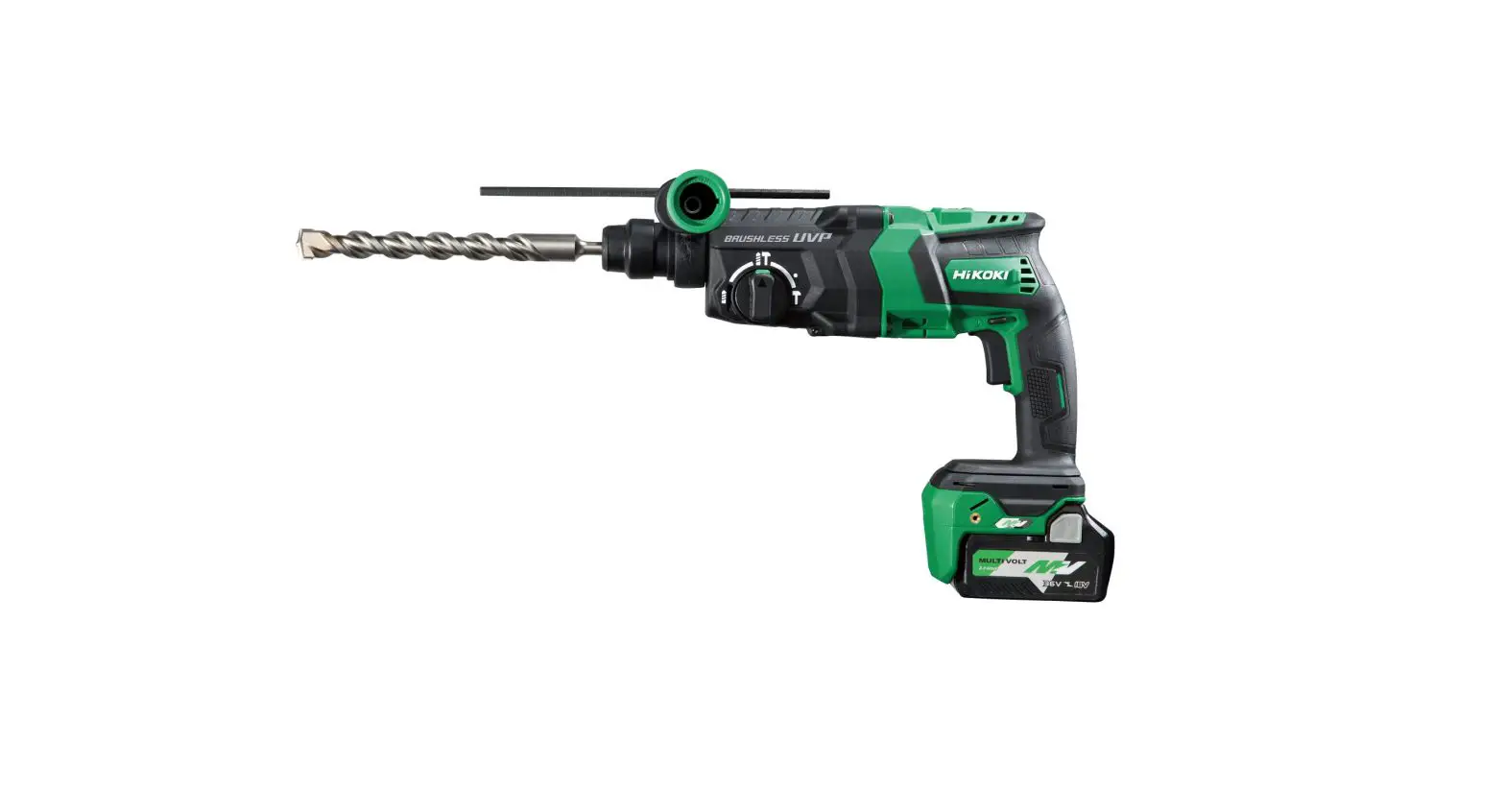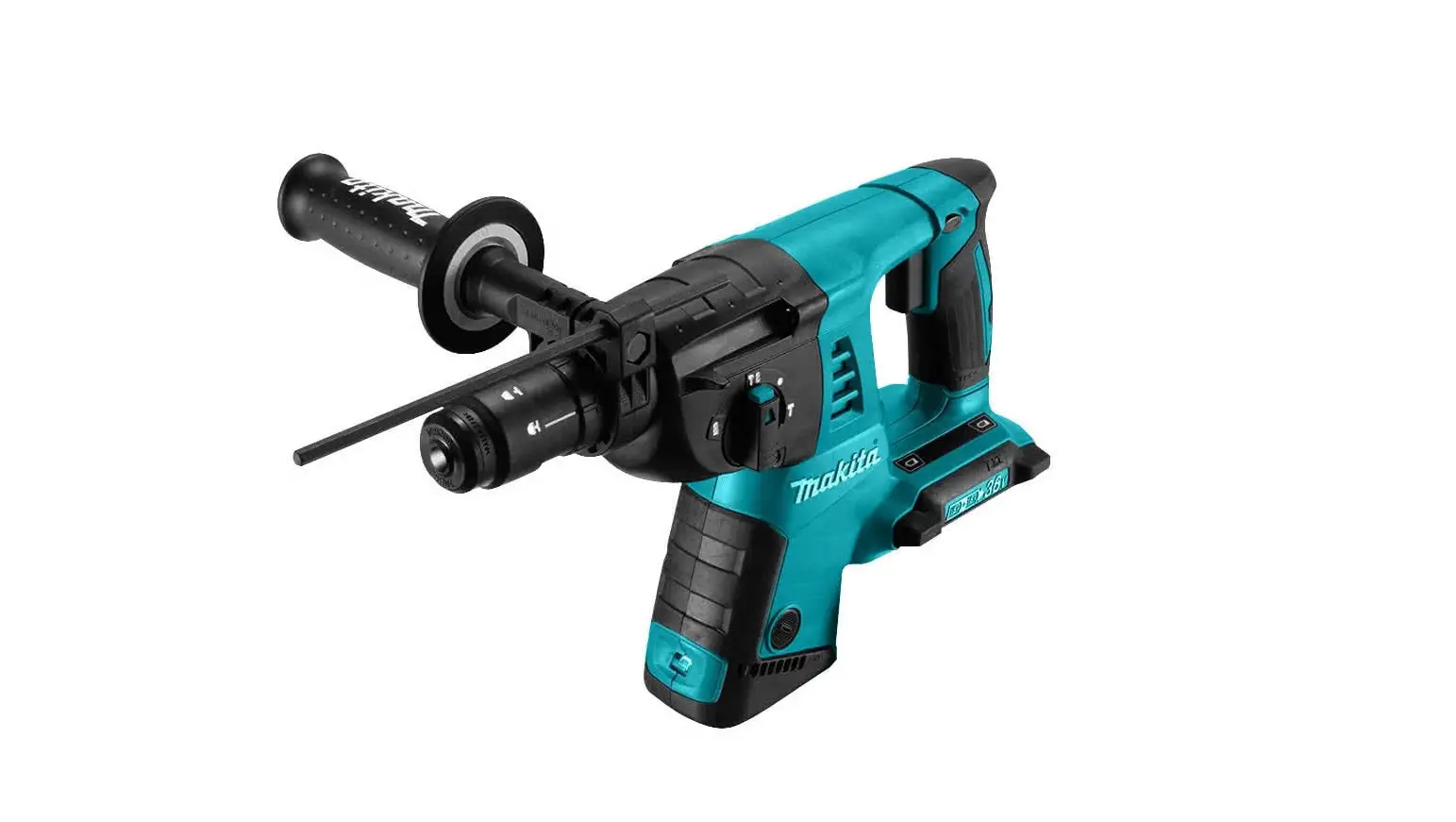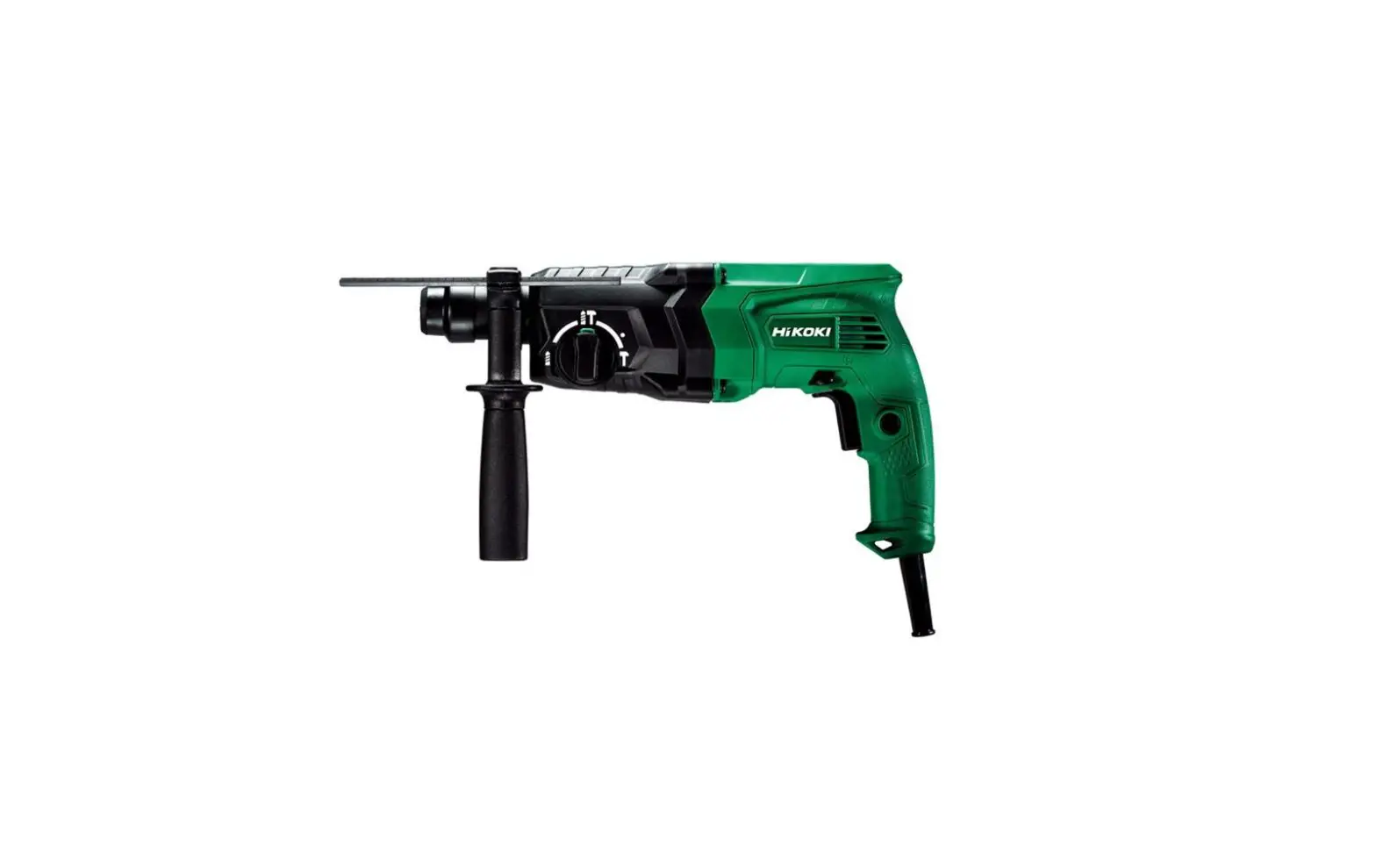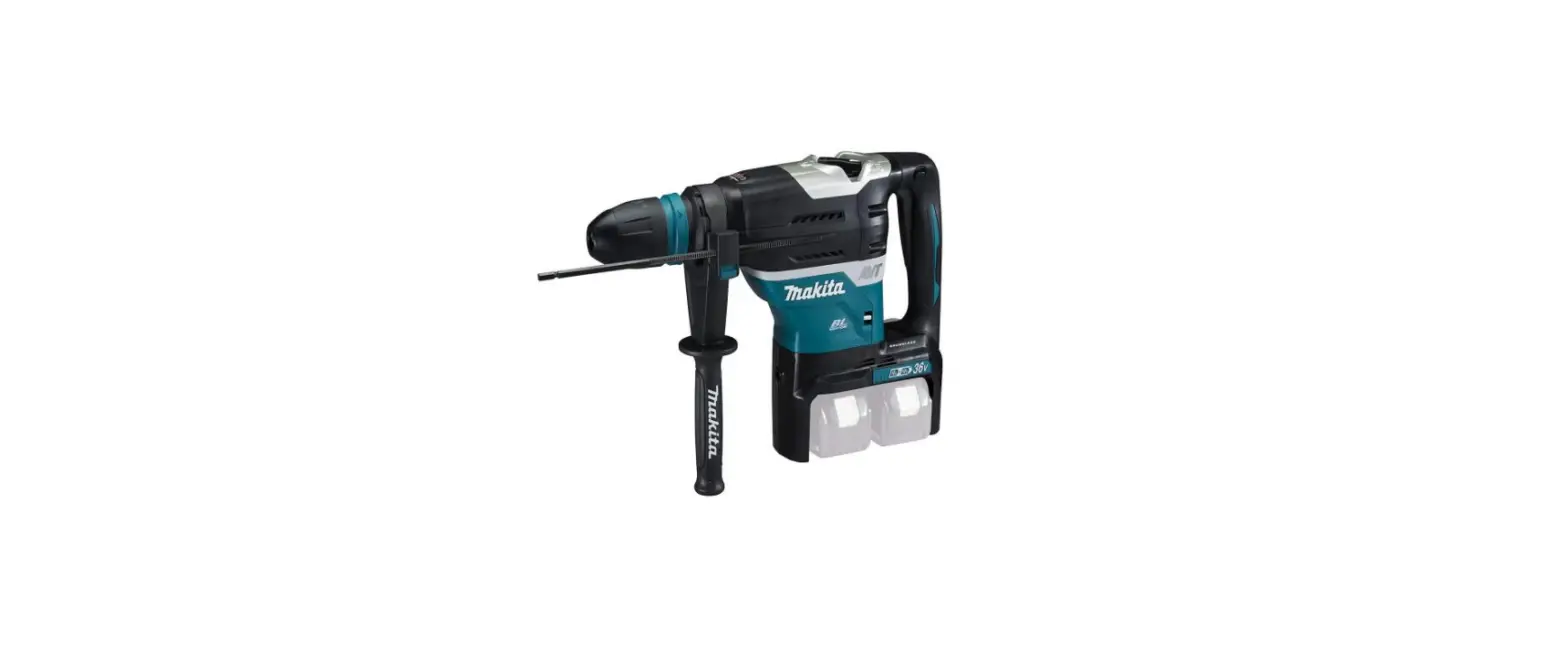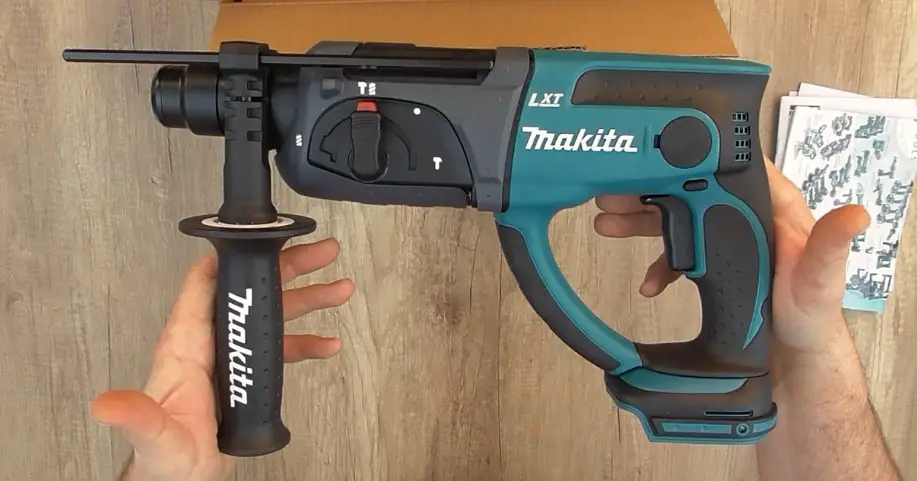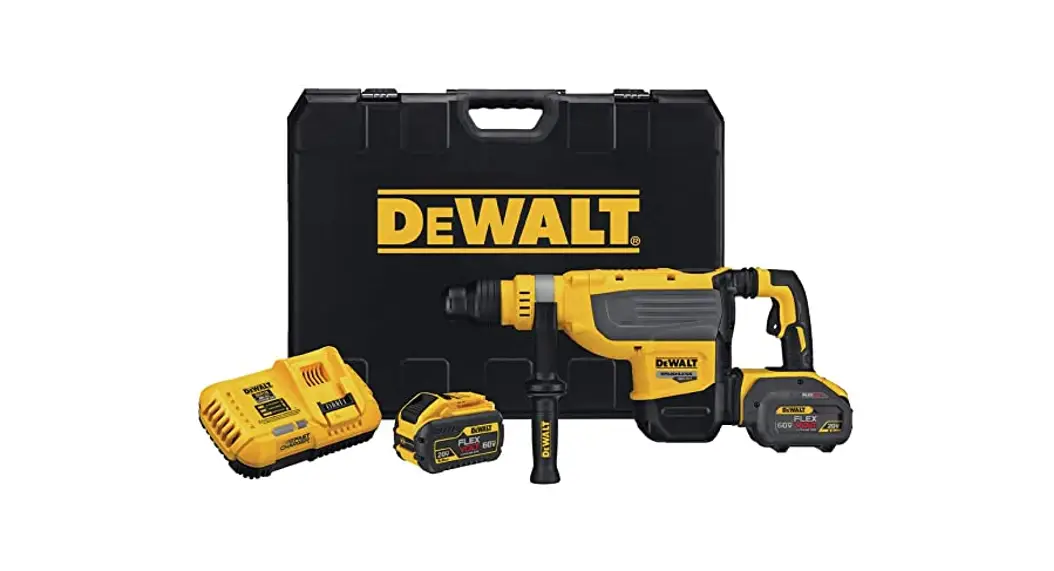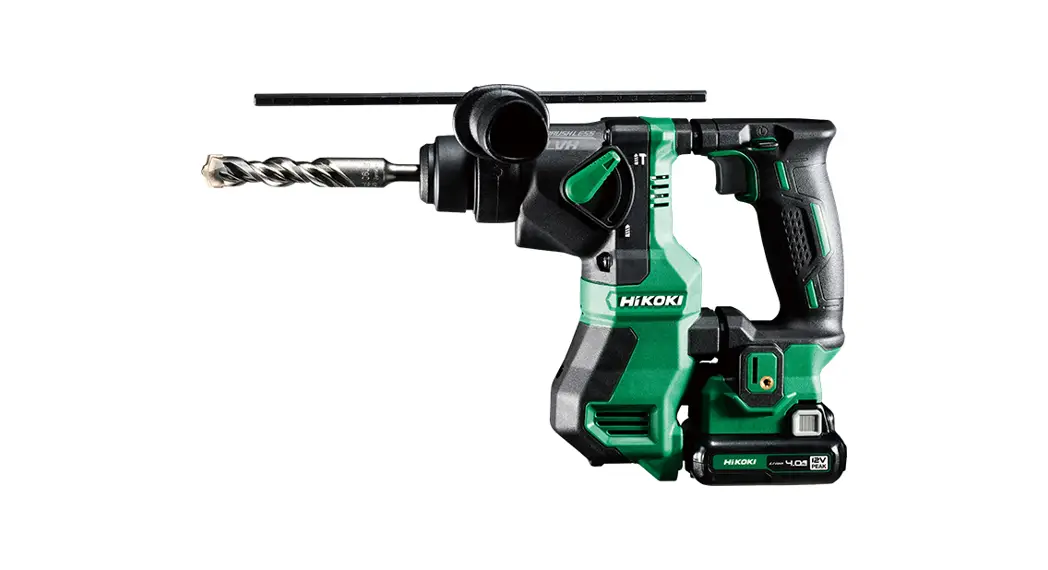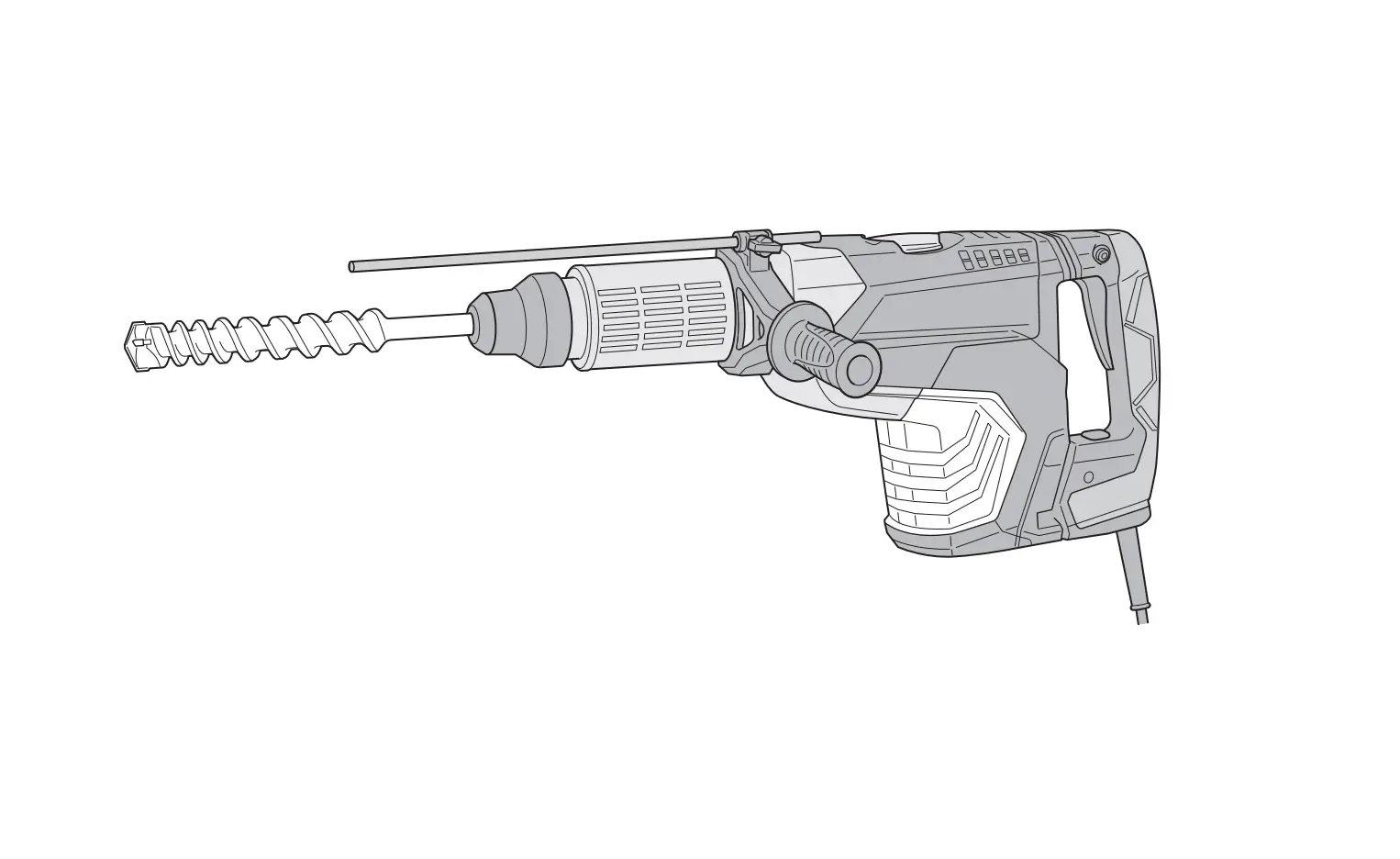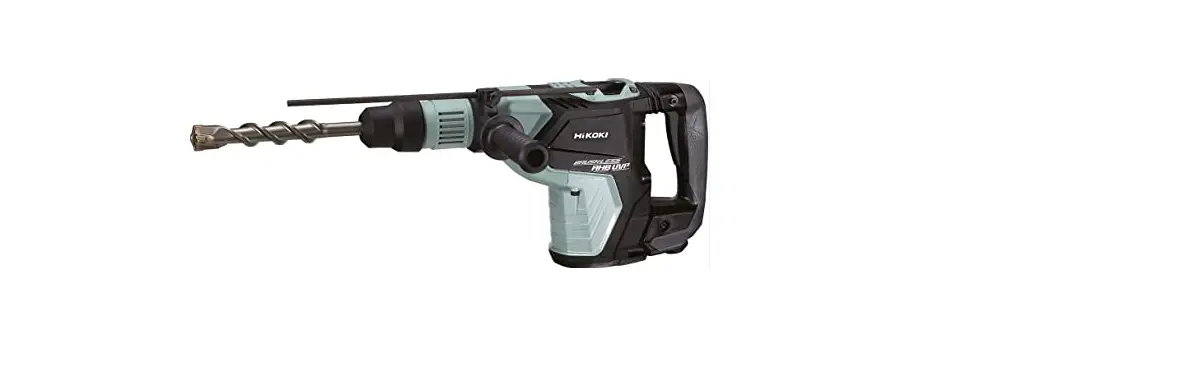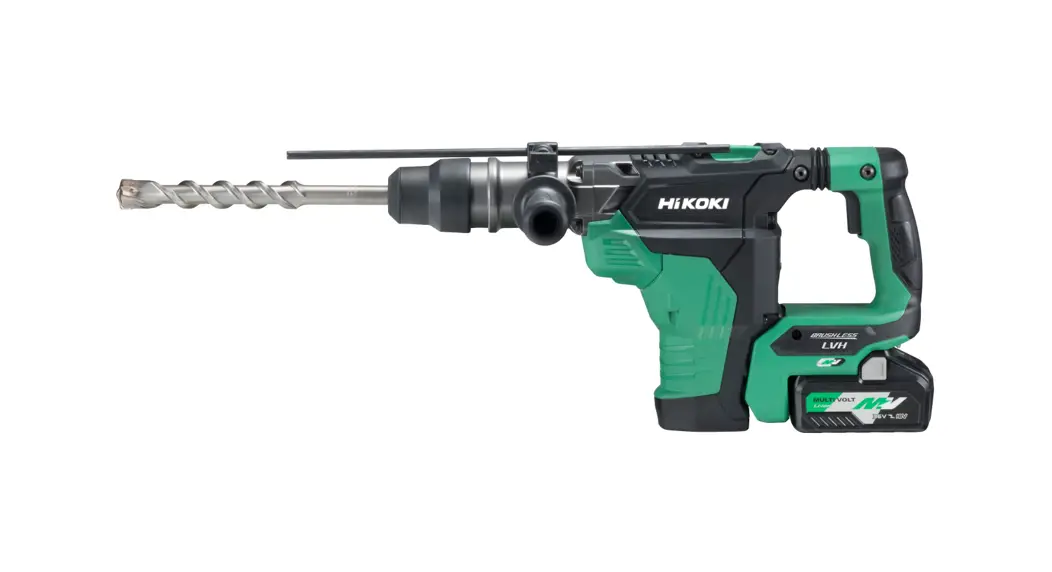
 DH36DMAWAZ Cordless Combined Hammer 36V
Instruction Manual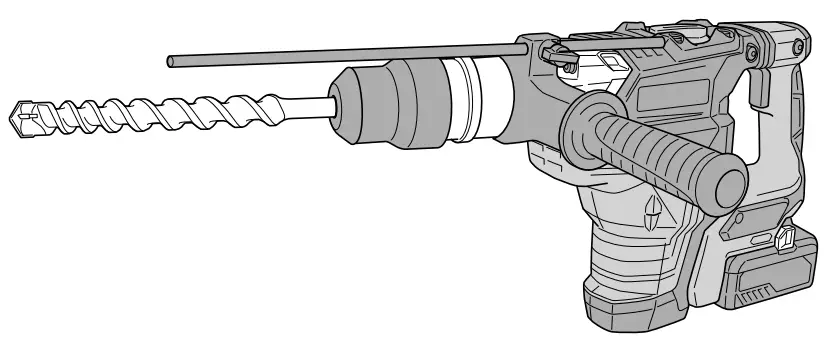
 Handling instructions
DH36DMAWAZ Cordless Combined Hammer 36V
 (Original instructions)
GENERAL POWER TOOL SAFETY WARNINGS
 WARNING
Read all safety warnings and all instructions.
Failure to follow the warnings and instructions may result in
electric shock, fi re and/or serious injury.
Save all warnings and instructions for future reference.
The term “power tool” in the warnings refers to your mainsoperated (corded) power tool or battery-operated (cordless) power tool.
- Work area safety
a) Keep work area clean and well lit.
Cluttered or dark areas invite accidents.
b) Do not operate power tools in explosive atmospheres, such as in the presence of fl ammable liquids, gases or dust.
Power tools create sparks which may ignite the dust or fumes.
c) Keep children and bystanders away while operating a power tool.
Distractions can cause you to lose control. - Electrical safety
a) Power tool plugs must match the outlet.
Never modify the plug in any way.
Do not use any adapter plugs with earthed (grounded) power tools.
Unmodifi ed plugs and matching outlets will reduce risk of electric shock.
b) Avoid body contact with earthed or grounded surfaces, such as pipes, radiators, ranges and refrigerators.
There is an increased risk of electric shock if your body is earthed or grounded.
c) Do not expose power tools to rain or wet conditions.
Water entering a power tool will increase the risk of electric shock.
d) Do not abuse the cord. Never use the cord for carrying, pulling or unplugging the power tool.
Keep cord away from heat, oil, sharp edges or moving parts.
Damaged or entangled cords increase the risk of electric shock.
e) When operating a power tool outdoors, use an extension cord suitable for outdoor use.
Use of a cord suitable for outdoor use reduces the risk of electric shock.
f) If operating a power tool in a damp location is unavoidable, use a residual current device (RCD) protected supply.
Use of an RCD reduces the risk of electric shock. - Personal safety
a) Stay alert, watch what you are doing and use common sense when operating a power tool.
Do not use a power tool while you are tired or under the infl uence of drugs, alcohol or medication.
A moment of inattention while operating power tools may result in serious personal injury.
b) Use personal protective equipment. Always wear eye protection.
Protective equipment such as dust mask, non-skid safety shoes, hard hat, or hearing protection used for appropriate conditions will reduce personal injuries.
c) Prevent unintentional starting. Ensure the switch is in the off position before connecting to power source and/or battery pack, picking up or carrying the tool.
Carrying power tools with your finger on the switch or energising power tools that have the switch on invites accidents.
d) Remove any adjusting key or wrench before turning the power tool on.
A wrench or a key left attached to a rotating part of the power tool may result in personal injury.
e) Do not overreach. Keep proper footing and balance at all times.
This enables better control of the power tool in unexpected situations.
f) Dress properly. Do not wear loose clothing or jewellery. Keep your hair, clothing and gloves away from moving parts.
Loose clothes, jewellery or long hair can be caught in moving parts.
g) If devices are provided for the connection of dust extraction and collection facilities, ensure these are connected and properly used.
Use of dust collection can reduce dust-related hazards. - Power tool use and care
a) Do not force the power tool. Use the correct power tool for your application.
The correct power tool will do the job better and safer at the rate for which it was designed.
b) Do not use the power tool if the switch does not turn it on and off .
Any power tool that cannot be controlled with the switch is dangerous and must be repaired.
c) Disconnect the plug from the power source and/ or the battery pack from the power tool before making any adjustments, changing accessories, or storing power tools.
Such preventive safety measures reduce the risk of starting the power tool accidentally.
d) Store idle power tools out of the reach of children and do not allow persons unfamiliar with the power tool or these instructions to operate the power tool.
Power tools are dangerous in the hands of untrained users.
e) Maintain power tools. Check for misalignment or binding of moving parts, breakage of parts and any other condition that may affect the power toolʼs operation.
If damaged, have the power tool repaired before use.
Many accidents are caused by poorly maintained power tools.
f) Keep cutting tools sharp and clean.
Properly maintained cutting tools with sharp cutting edges are less likely to bind and are easier to control.
g) Use the power tool, accessories and tool bits etc. in accordance with these instructions, taking into account the working conditions and the work to be performed.
Use of the power tool for operations diff erent from those intended could result in a hazardous situation. - Battery tool use and care
a) Recharge only with the charger specifi ed by the manufacturer.
A charger that is suitable for one type of battery pack may create a risk of fi re when used with another battery pack.
b) Use power tools only with specifi cally designated battery packs.
Use of any other battery packs may create a risk of injury and fi re.
c) When battery pack is not in use, keep it away from other metal objects, like paper clips, coins, keys, nails, screws or other small metal objects, that can make a connection from one terminal to another.
Shorting the battery terminals together may cause burns or a fi re.
d) Under abusive conditions, liquid may be ejected from the battery; avoid contact. If contact accidentally occurs, flush with water. If liquid contacts eyes, additionally seek medical help.
Liquid ejected from the battery may cause irritation or burns. - Service
a) Have your power tool serviced by a qualifi ed repair person using only identical replacement parts.
This will ensure that the safety of the power tool is maintained.
PRECAUTION
Keep children and infirm persons away.
When not in use, tools should be stored out of reach of children and infirm persons.
CORDLESS ROTARY HAMMER SAFETY WARNINGS
- Wear ear protectors
Exposure to noise can cause hearing loss. - Use auxiliary handle(s), if supplied with the tool.
Loss of control can cause personal injury. - Hold power tool by insulated gripping surfaces, when performing an operation where the cutting accessory may contact hidden wiring.
Cutting accessory contacting a “live” wire may make exposed metal parts of the power tool “live” and could give the operator an electric shock.
ADDITIONAL SAFETY WARNINGS
- Do not allow foreign matter to enter the hole for connecting the rechargeable battery.
- Never disassemble the rechargeable battery and charger.
- Never short-circuit the rechargeable battery.
Shortcircuiting the battery will cause a great electric current and overheat. It results in burn or damage to the battery. - Do not dispose of the battery in fi re. If the battery is burnt, it may explode.
- When using this unit continuously, the unit may overheat, leading to damage in the motor and switch. Please leave it without using it for approximately 15 minutes.
- Do not insert object into the air ventilation slots of the charger. Inserting metal objects or inflammables into the charger air ventilation slots will result in electrical shock hazard or damaged charger.
- Bring the battery to the shop from which it was purchased as soon as the post-charging battery life becomes too short for practical use. Do not dispose of the exhausted battery.
- Before starting to break, chip or drill into a wall, floor or ceiling, thoroughly confirm that such items as electric cables or conduits are not buried inside.
- Ensure that the power switch is in the OFF position. If the battery is installed while the power switch is in the ON position, the power tool will start operating immediately,
which could cause a serious accident. - Do not touch the bit during or immediately after operation. The bit becomes very hot during operation and could cause serious burns.
- Always hold the body handle and side handle of the power tool firmly. Otherwise the counterforce produced may result in inaccurate and even dangerous operation.
- Wear a dust mask
Do not inhale the harmful dusts generated in drilling or chiseling operation. The dust can endanger the health of yourself and bystanders. - Make sure that the battery is installed firmly. If it is at all loose it could come off and cause an accident.
- To prevent accidents, make sure to turn the switch off and pull out the battery before changing accessories, storing, carrying or when not using the tools.
- Mounting the tool
○ To prevent accidents, make sure to turn the switch off and pull out the battery.
○ When using tools such as bull points, drill bits, etc., make sure to use the genuine parts designated by our company.
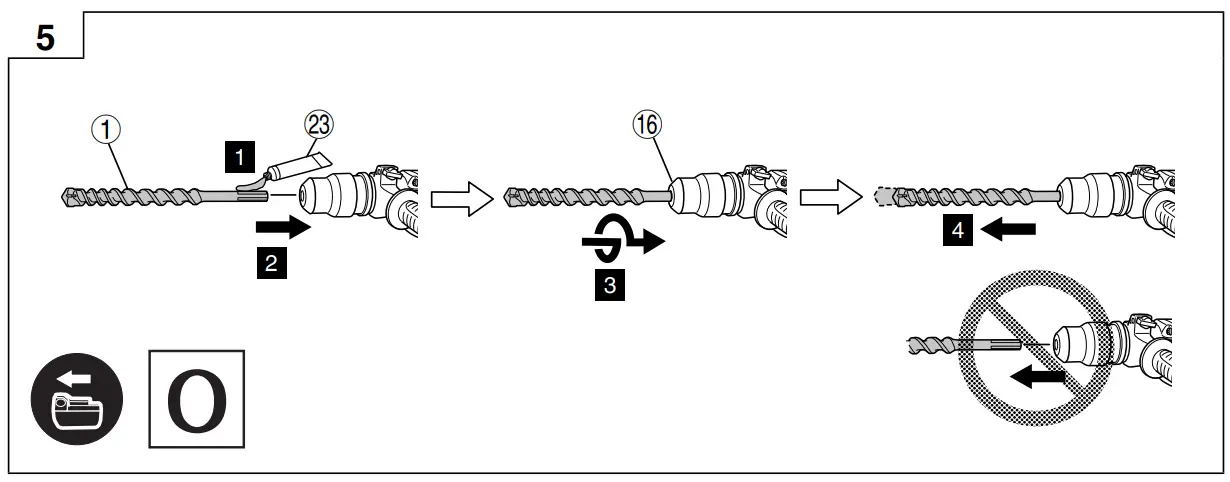
○ Clean the shank portion of the drill bit. Then smear the shank portion with the grease or machine oil.
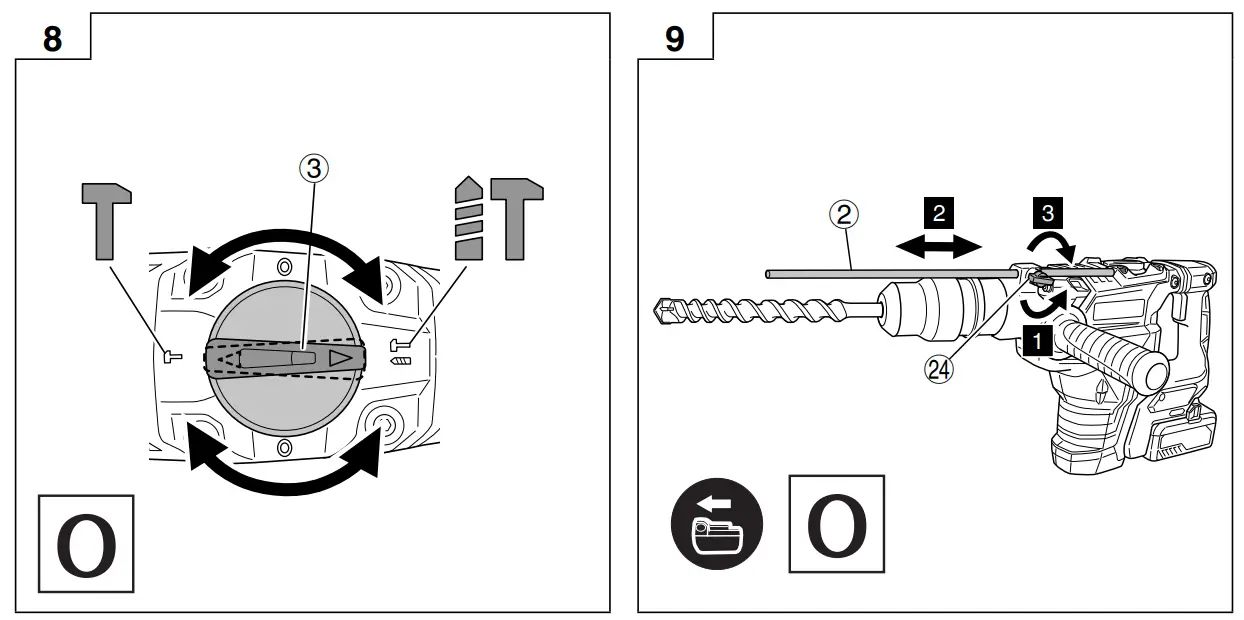
○ Check the latching by pulling on the drill bit. - Operate the change lever only when the motor is at a full stop. Operating the change lever while the motor is running may cause the tip tool to unexpectedly rotate and result in an accident. (Fig. 8)
- Rotation + hammering
When the drill bit touches construction iron bar, the bit will stop immediately and the rotary hammer will react to revolve. Therefore firmly tighten the side handle, hold the body handle and side handles. - Do not use the product if the tool or the battery terminals (battery mount) are deformed.
Installing the battery could cause a short circuit that could result in smoke emission or ignition. - Keep the tool’s terminals (battery mount) free of swarf and dust.
○ Prior to use, make sure that swarf and dust have not collected in the area of the terminals.
○ During use, try to avoid swarf or dust on the tool from falling on the battery.
○ When suspending operation or after use, do not leave the tool in an area where it may be exposed to falling swarf or dust.
Doing so could cause a short circuit that could result in smoke emission or ignition.
CAUTION ON LITHIUM-ION BATTERY
To extend the lifetime, the lithium-ion battery equips with the protection function to stop the output.
In the cases of 1 to 3 described below, when using this product, even if you are pulling the switch, the motor may stop. This is not the trouble but the result of protection function.
- When the battery power remaining runs out, the motor stops.
In such a case, charge it up immediately. - If the tool is overloaded, the motor may stop. In this case, release the switch of tool and eliminate causes of overloading. After that, you can use it again.
- If the battery is overheated under overload work, the battery power may stop.
In this case, stop using the battery and let the battery cool. After that, you can use it again.
Furthermore, please heed the following warning and caution.
WARNING
In order to prevent any battery leakage, heat generation, smoke emission, explosion and ignition beforehand, please be sure to heed the following precautions.
- Make sure that swarf and dust do not collect on the battery.
○ During work make sure that swarf and dust do not fall on the battery.
○ Make sure that any swarf and dust falling on the power tool during work do not collect on the battery.
○ Do not store an unused battery in a location exposed to swarf and dust.
○ Before storing a battery, remove any swarf and dust that may adhere to it and do not store it together with metal parts (screws, nails, etc.). - Do not pierce battery with a sharp object such as a nail, strike with a hammer, step on, throw or subject the battery to severe physical shock.
- Do not use an apparently damaged or deformed battery.
- Do not use the battery in reverse polarity.
- Do not connect directly to an electrical outlets or car cigarette lighter sockets.
- Do not use the battery for a purpose other than those specifi ed.
- If the battery charging fails to complete even when a specifi ed recharging time has elapsed, immediately stop further recharging.
- Do not put or subject the battery to high temperatures or high pressure such as into a microwave oven, dryer, or high pressure container.
- Keep away from fi re immediately when leakage or foul odor are detected.
- Do not use in a location where strong static electricity generates.
- If there is battery leakage, foul odor, heat generated, discolored or deformed, or in any way appears abnormal during use, recharging or storage, immediately remove it from the equipment or battery charger, and stop use.
- Do not immerse the battery or allow any fl uids to flow inside. Conductive liquid ingress, such as water, can cause damage resulting in fi re or explosion. Store your battery in a cool, dry place, away from combustible and fl ammable items. Corrosive gas atmospheres must be avoided.
CAUTION
- If liquid leaking from the battery gets into your eyes, do not rub your eyes and wash them well with fresh clean water such as tap water and contact a doctor immediately.
If left untreated, the liquid may cause eye-problems. - If liquid leaks onto your skin or clothes, wash well with clean water such as tap water immediately.
There is a possibility that this can cause skin irritation. - If you fi nd rust, foul odor, overheating, discolor, deformation, and/or other irregularities when using the battery for the fi rst time, do not use and return it to your supplier or vendor.
WARNING
If a conductive foreign matter enters in the terminal of lithium ion battery, the battery may be shorted, causing fi re. When storing the lithium ion battery, obey surely the rules of following contents.
○ Do not place conductive debris, nail and wires such as iron wire and copper wire in the storage case.
○ To prevent shorting from occurring, load the battery in the tool or insert securely the battery cover for storing until the ventilator is not seen.
REGARDING LITHIUM-ION BATTERY TRANSPORTATION
When transporting a lithium-ion battery, please observe the following precautions.
WARNING
Notify the transporting company that a package contains a lithium-ion battery, inform the company of its power output and follow the instructions of the transportation company when arranging transport.
○ Lithium-ion batteries that exceed a power output of 100Wh are considered to be in the freight classifi cation of Dangerous Goods and will require special application procedures.
○ For transportation abroad, you must comply with international law and the rules and regulations of the destination country.
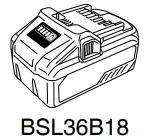
○ If the BSL36B18 is installed in the power tool, the power output will exceed 100 Wh and the unit will be classifi ed as Dangerous Goods for freight classifi cation.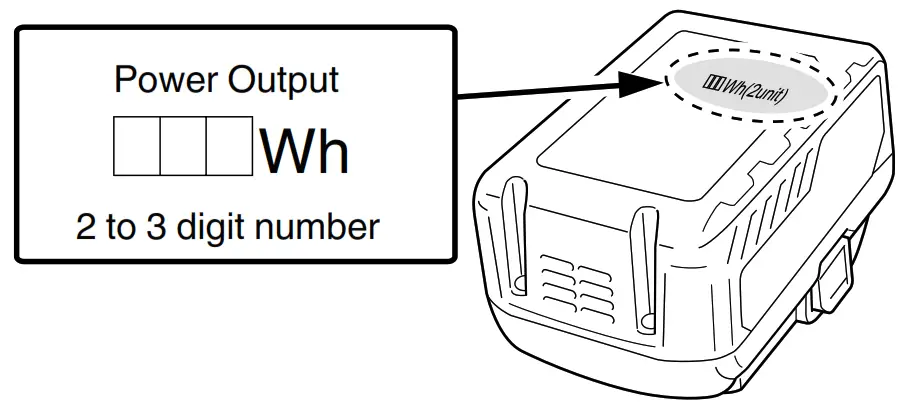
USB DEVICE CONNECTION PRECAUTIONS (UC18YSL3)
When an unexpected problem occurs, the data in a USB device connected to this product may be corrupted or lost. Always make sure to back up any data contained in the USB device prior to use with this product.
Please be aware that our company accepts absolutely no responsibility for any data stored in a USB device that is corrupted or lost, nor for any damage that may occur to a connected device.
WARNING
○ Prior to use, check the connecting USB cable for any defect or damage.
Using a defective or damaged USB cable can cause smoke emission or ignition.
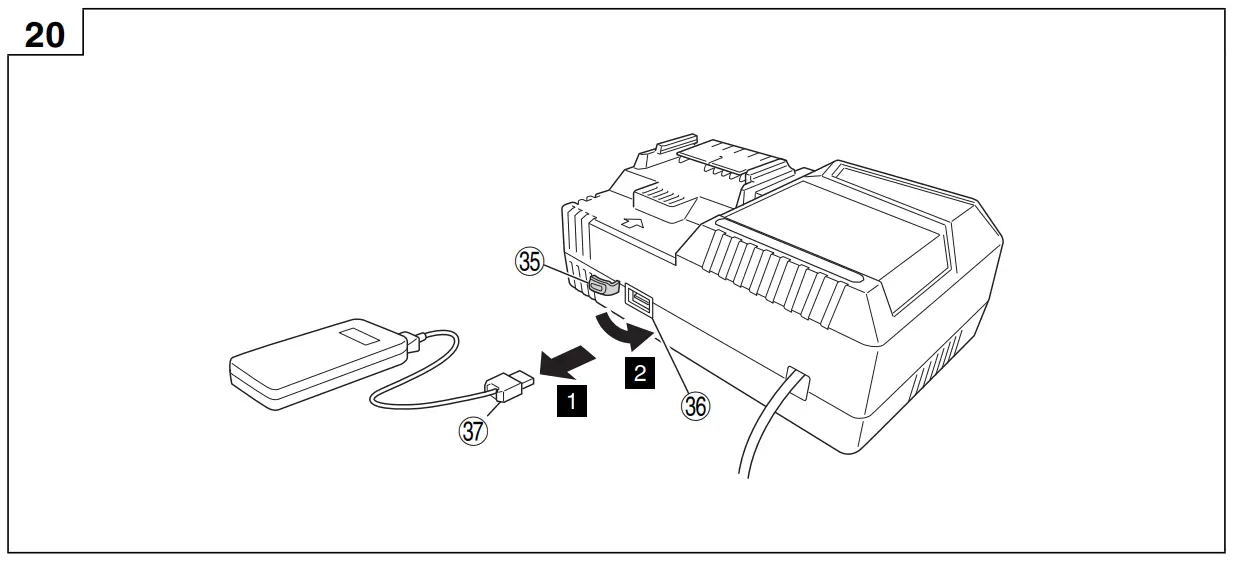
○ When the product is not being used, cover the USB port with the rubber cover.
Buildup of dust etc. in the USB port can cause smoke emission or ignition.
NOTE
○ There may be an occasional pause during USB recharging.
○ When a USB device is not being charged, remove the USB device from the charger.
Failure to do so may not only reduce the battery life of a USB device, but may also result in unexpected accidents.
○ It may not be possible to charge some USB devices, depending on the type of device.
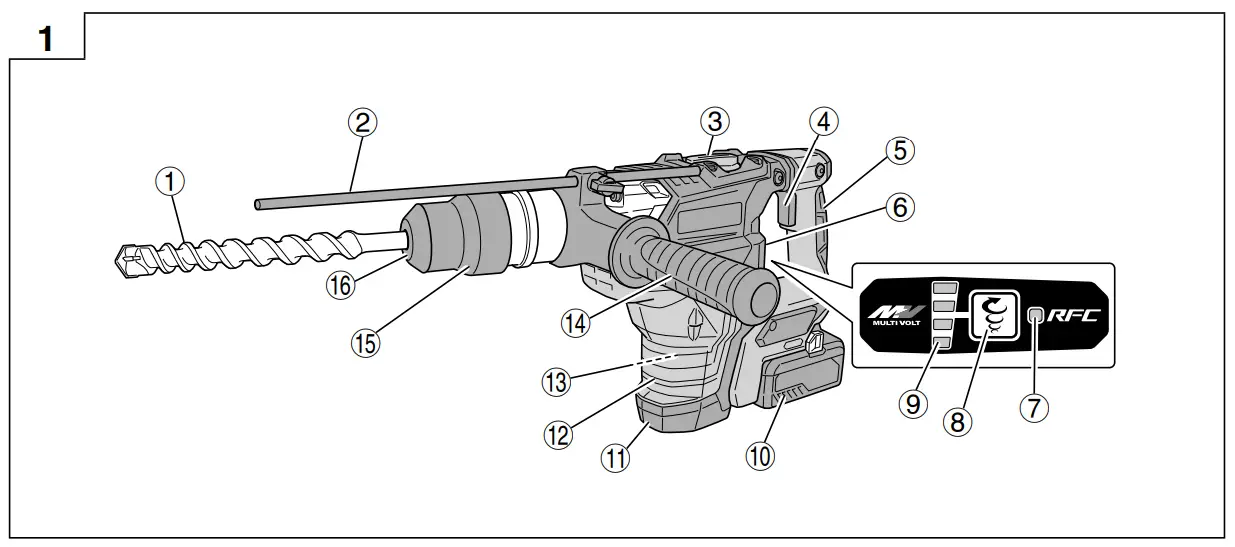
NAMES OF PARTS (Fig. 1 – Fig. 20)
| 1 | Drill bit | 20 | Remaining battery indicator switch |
| 2 | Stopper | 21 | Remaining battery indicator lamp |
| 3 | Selector lever | 22 | Display panel |
| 4 | Switch trigger | 23 | Grease |
| 5 | Handle | 24 | Wing bolt |
| 6 | Nameplate | 25 | Taper shank adapter |
| 7 | RFC indicator lamp | 26 | Drill bit (Taper shank) |
| 8 | Rotation speed selector switch | 27 | Cotter |
| 9 | Display lamp | 28 | Core bit shank |
| 10 | Battery | 29 | Core bit |
| 11 | Tail cover | 30 | Guide plate |
| 12 | Housing | 31 | Center pin |
| 13 | Motor | 32 | Core bit tip |
| 14 | Side handle | 33 | Battery sliding grooves |
| 15 | Grip | 34 | Terminal |
| 16 | Front cap | 35 | Rubber cover |
| 17 | Stopper lever | 36 | USB port |
| 18 | Latch | 37 | USB cable |
| 19 | Charge indicator lamp |
SYMBOLS
WARNING
The following show symbols used for the machine.
Be sure that you understand their meaning before use.
 | DH36DMA: Cordless Rotary Hammer |
| To reduce the risk of injury, user must read instruction manual. |
 | Only for EU countries Do not dispose of electric tools together with household waste material! In observance of European Directive 2002/96/EC on waste electrical and electronic equipment and its implementation in accordance with national law, electric tools that have reached the end of their life must be collected separately and returned to an environmentally compatible recycling facility. |
 | Direct current |
| V | Rated voltage |
| n0 | No-load speed |
| min-1 | Oscillation per minute |
| Bpm | Full-load impact rate |
| φ max | Drilling diameter, max. |
 | Weight (According to EPTA-Procedure 01/2003) |
 | Drill bit |
 | Core bit |
 | Adjustment of the tool position function |
 | Hammering only function |
 | Rotation and hammering function |
 | Switching ON |
 | Switching OFF |
 | Rotation speed selector switch |
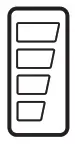 | Display lamp |
| Ls | Low speed / impact rate |
| Hs | High speed / impact rate |
 | Disconnect the battery |
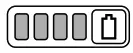 | Lights ; The battery remaining power is over 75% |
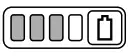 | Lights ; The battery remaining power is 50% – 75%. |
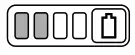 | Lights ; The battery remaining power is 25% – 50%. |
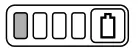 | Lights ; The battery remaining power is less than 25% |
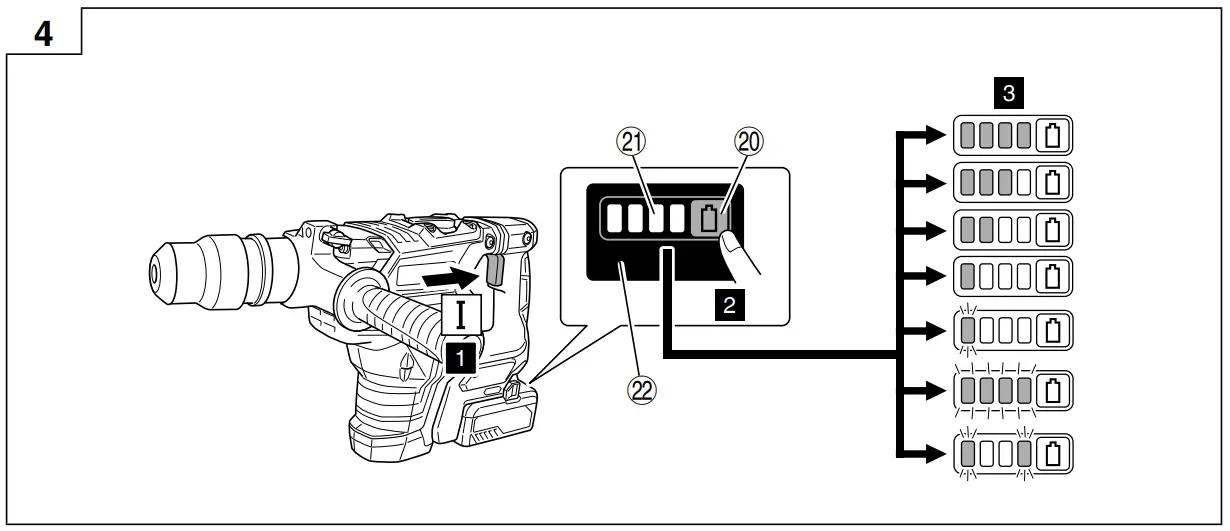
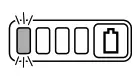 | Blinks ; The battery remaining power is nearly empty. Recharge the battery soonest possible. |
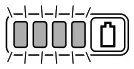 | Blinks ; Output suspended due to high temperature. Remove the battery from the tool and allow it to fully cool down. |
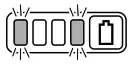 | Blinks ; Output suspended due to failure or malfunction. The problem may be the battery so please contact your dealer. |
| Warning |
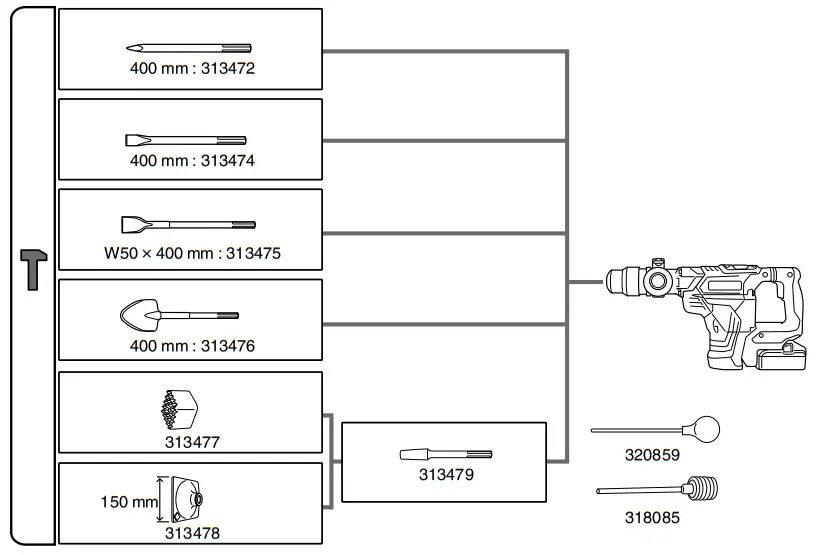
STANDARD ACCESSORIES
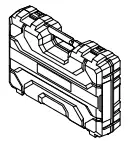
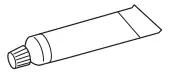
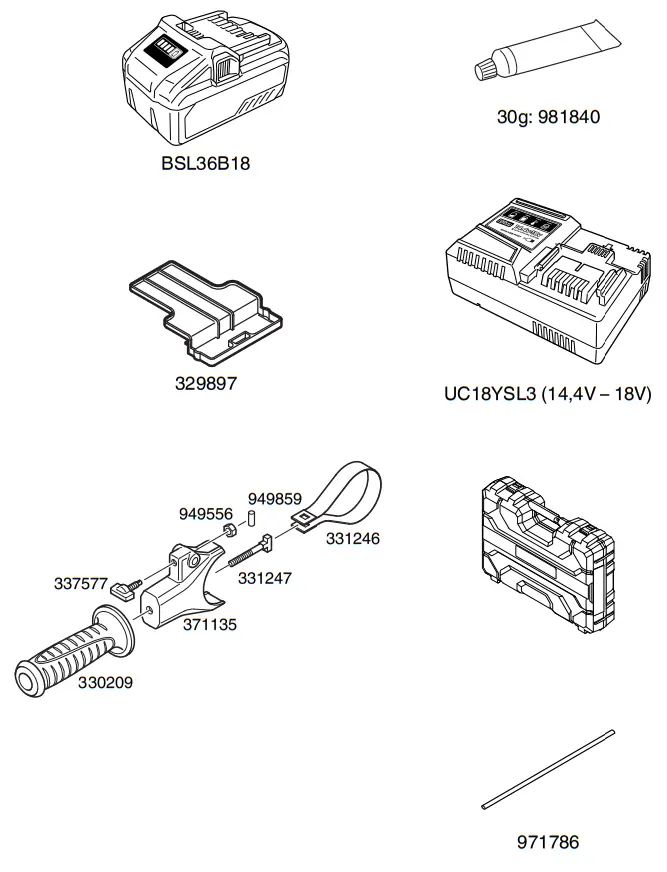
In addition to the main unit (1 unit), the package contains the accessories listed on page 259.
Standard accessories are subject to change without notice.
APPLICATIONS
Rotation and hammering function
○ Drilling anchor holes
○ Drilling holes in concrete
Hammering only function
○ Crushing concrete, chipping, digging, and squaring (Some applications need optional accessories)
SPECIFICATIONS
The specifi cations of this machine are listed in the Table on page 259.
NOTE
○ Existing batteries (BSL3660/3626X/3626/3625/3620, BSL18xx and BSL14xx series) cannot be used with this tool.
○ Due to HiKOKI’s continuing program of research and development, the specifi cations herein are subject to change without prior notice.
CHARGING
Before using the power tool, charge the battery as follows.
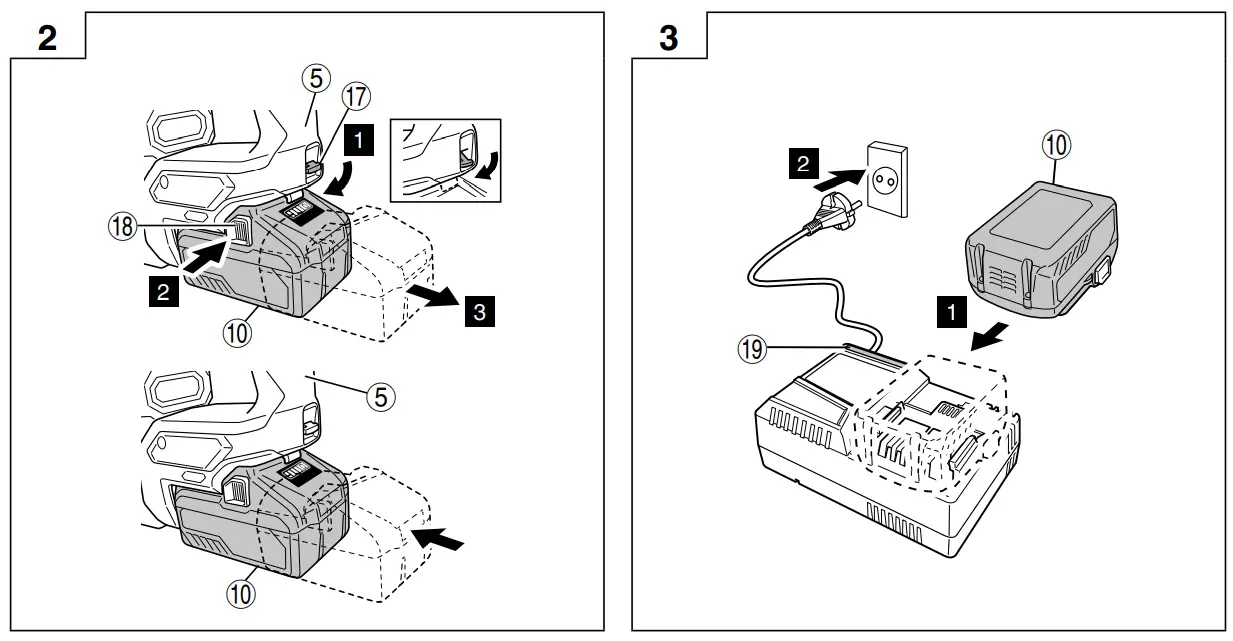
- Connect the charger’s power cord to the receptacle.
When connecting the plug of the charger to a receptacle, the charge indicator lamp will blink in red (At 1- second intervals). - Insert the battery into the charger.
Firmly insert the battery into the charger as shown in Fig. 3 (on page 2). - Charging
When inserting a battery in the charger, the charge indicator lamp will blink in blue.
When the battery becomes fully recharged, the charge indicator lamp will light up in green. (See Table 1)
(1) Charge indicator lamp indication
The indications of the charge indicator lamp will be as shown in Table 1, according to the condition of the charger or the rechargeable battery.
Table 1
| Indications of the charge indicator lamp | ||||
| Charge indicator lamp (RED / BLUE / GREEN / PURPLE) | Before charging | Blinks (RED) | Lights for 0.5 seconds. Does not light for 0.5 seconds. (off for 0.5 seconds) | Plugged into power source |
| While charging | Blinks (BLUE) | Lights for 0.5 seconds. Does not light for 1 second. (off for 1 second) | Battery capacity at less than 50% | |
| (BLUE) | Lights for 1 second. Does not light for 0.5 seconds. (off for 0.5 seconds) | Battery capacity at less than 80% | ||
| Lights (BLUE) | Lights continuously | Battery capacity at more than 80% | ||
| Charging complete | Lights (GREEN) | Lights continuously (Continuous buzzer sound: about 6 seconds) | ||
| Overheat standby | Blinks (RED) | Lights for 0.3 seconds. Does not light for 0.3 seconds. (off for 0.3 seconds) | Battery overheated. Unable to charge. (Charging will commence when battery cools) | |
| Charging impossible | Flickers (PURPLE) | Lights for 0.1 seconds. Does not light for 0.1 seconds. (off for 0.1 seconds) (Intermittent buzzer sound: about 2 seconds) | Malfunction in the battery or the charger | |
Regarding the temperatures and charging time of the rechargeable battery The temperatures and charging time will become as shown in Table 2.
| ,… Charger | UC18YSL3 | ||||||
| Battery | Type of battery | Li-ion | |||||
| Temperatures at which the battery can be recharged | -10°C — 50°C | ||||||
| Charging voltage I | V | 14. | 18 | ||||
| Charging time, approx. (At 20°C) | BSL14xx series | BSL18xx series | Multi voltseries | ||||
| (4 cells) | (8 cells) | (5 cells) | (10 cells) | (10 cells) | |||
| min. | BSL1415S : 15 BSL1415 : 15 BSL1415X : 15 BSL1420 : 20 BSL1425 : 25 BSL1430C: 30 | BSL1430 : 20 BSL1440 :26 BSL1450 : 32 BSL1460 : 38 | BSL1815S :15 BSL1815 :15 BSL1815X : 15 BSL1820 :20 BSL1825 :25 BSL1830C: 30 | BSL1830 : 20 BSL1840 :26 BSL1850 : 32 BSL1860 : 38 | BSL36A18 : 32 BSL36B18 : 52 | ||
| USB | Charging voltage | V | 5 | ||||
| Charging current | A | 2 | |||||
NOTE
The recharging time may vary according to the ambient temperature and power source voltage.
Disconnect the charger’s power cord from the receptacle.
Hold the charger firmly and pull out the battery.
NOTE
Be sure to pull out the battery from the charger after use, and then keep it.
Regarding electric discharge in case of new batteries, etc.
As the internal chemical substance of new batteries and batteries that have not been used for an extended period is not activated, the electric discharge might be low when using them the first and second time. This is a temporary phenomenon, and normal time required for recharging will be restored by recharging the batteries 2 – 3 times.
How to make the batteries perform longer.
- Recharge the batteries before they become completely exhausted.
When you feel that the power of the tool becomes weaker, stop using the tool and recharge its battery. If you continue to use the tool and exhaust the electric current, the battery may be damaged and its life will become shorter. - Avoid recharging at high temperatures.
A rechargeable battery will be hot immediately after use. If such a battery is recharged immediately after use, its internal chemical substance will deteriorate, and the battery life will be shortened. Leave the battery and recharge it after it has cooled for a while.
CAUTION
- If the battery is charged while it is heated because it has been left for a long time in a location subject to direct sunlight or because the battery has just been used, the charge indicator lamp of the charger lights for 0.3 seconds, does not light for 0.3 seconds (off for 0.3 seconds). In such a case, first let the battery cool, then start charging.
- When the charge indicator lamp flickers (at 0.2-second intervals), check for and take out any foreign objects in the charger’s battery connector. If there are no foreign objects, it is probable that the battery or charger is malfunctioning. Take it to your authorized Service Center.
- Since the built-in micro computer takes about 3 seconds to confirm that the battery being charged with UC18YSL3 is taken out, wait for a minimum of 3 seconds before reinserting it to continue charging. If the battery is reinserted within 3 seconds, the battery may not be properly charged.
MOUNTING AND OPERATION
| Action | Figure | Page |
| Removing and inserting the battery | 2 | 2 |
| Charging | 3 | 2 |
| Remaining battery indicator | 4 | 2 |
| Inserting SDS-max tools | 5 | 3 |
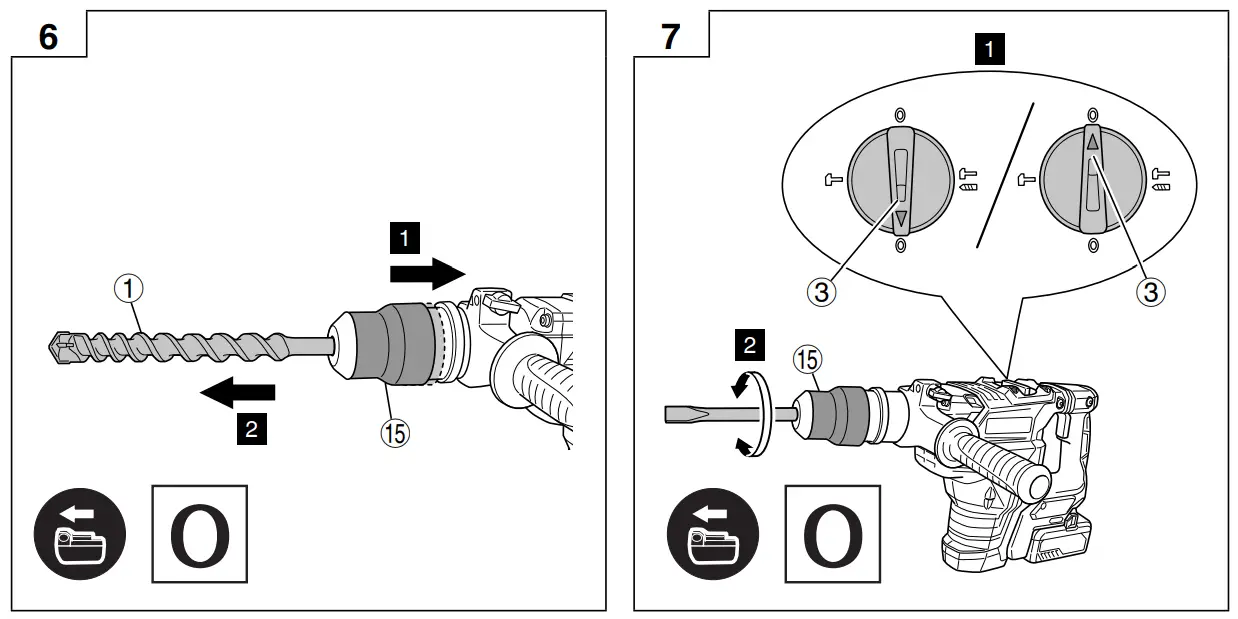
| Removing SDS-max tools | 6 | 3 |
| Changing tool direction | 7 | 3 |
| Selecting the operating mode | 8 | 3 |
| Install the stopper | 9 | 3 |
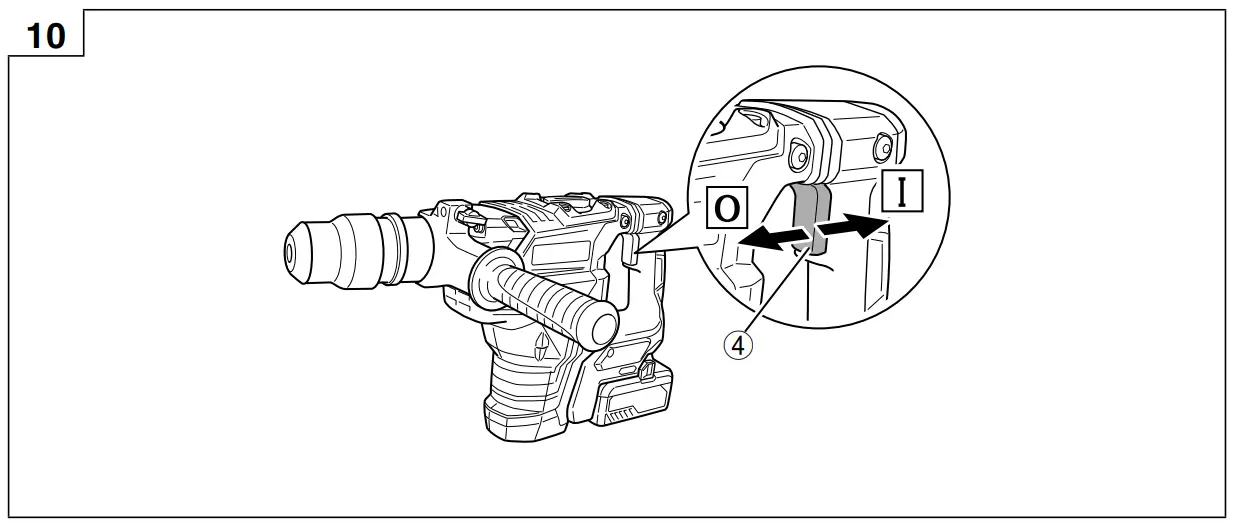
| Switching on and off | 10 | 4 |
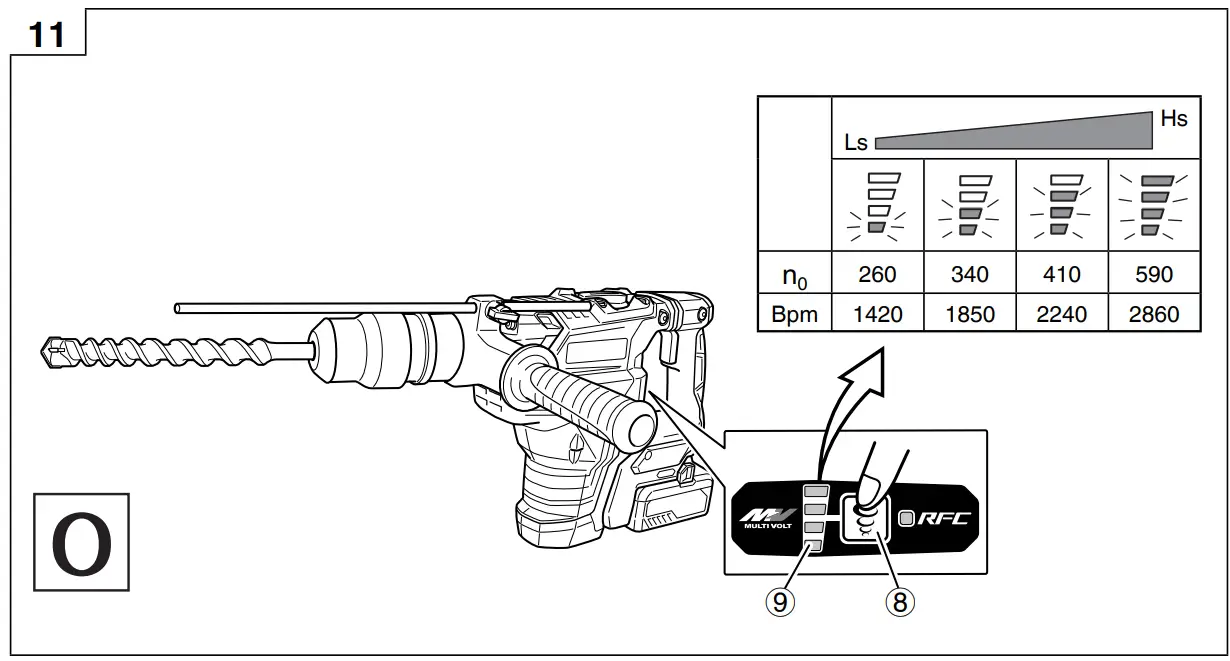
| Speed change-1 | 11 | 4 |
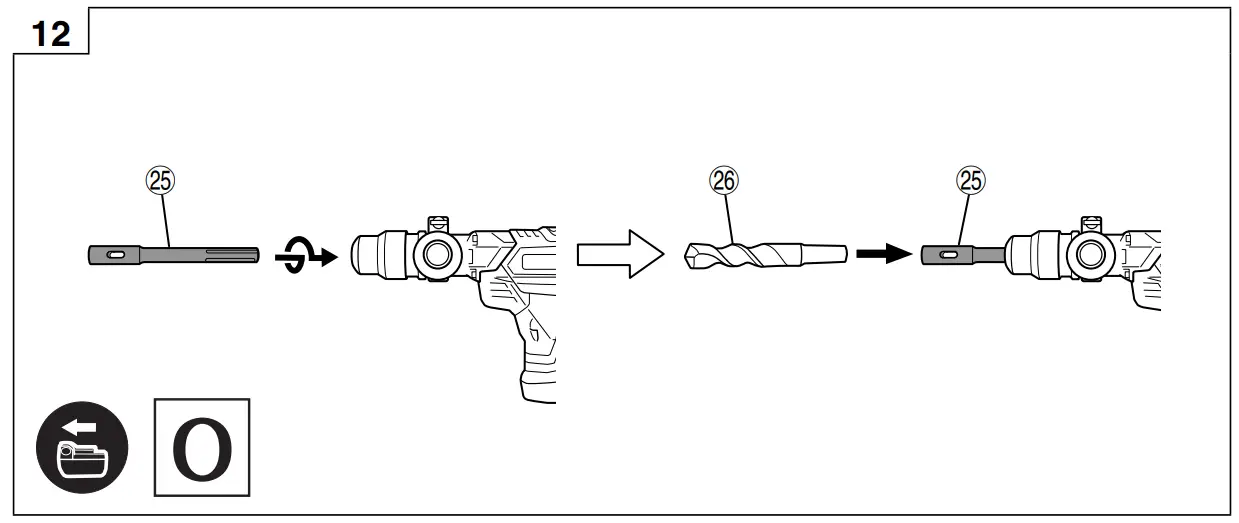
| Using taper shank adapter | 12 | 4 |
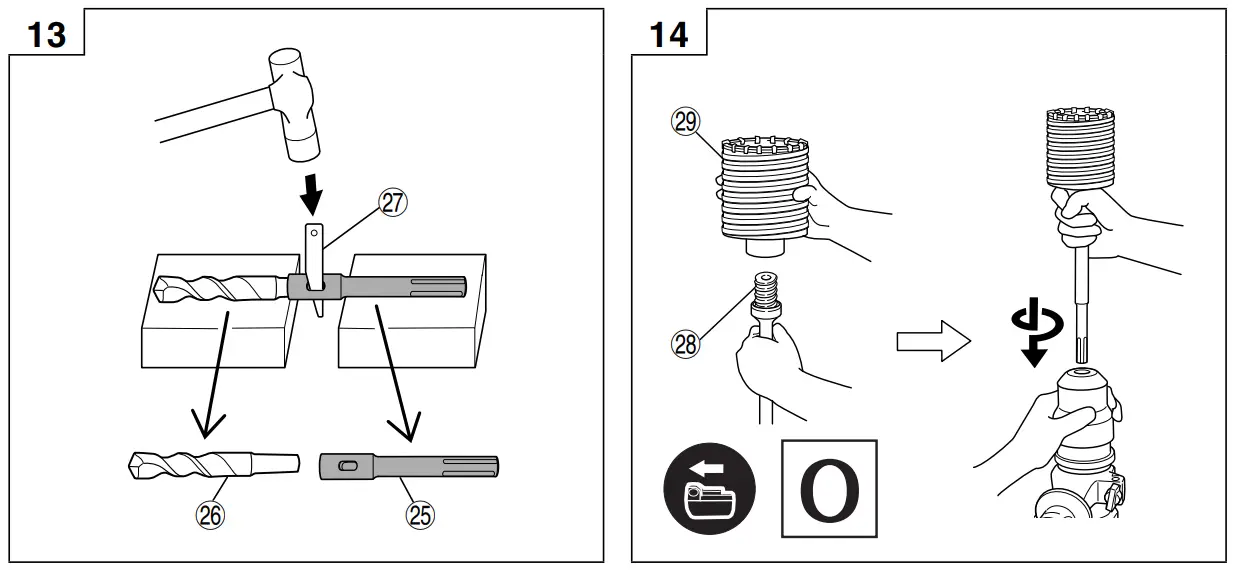
| Removing taper shank adapter | 13 | 5 |
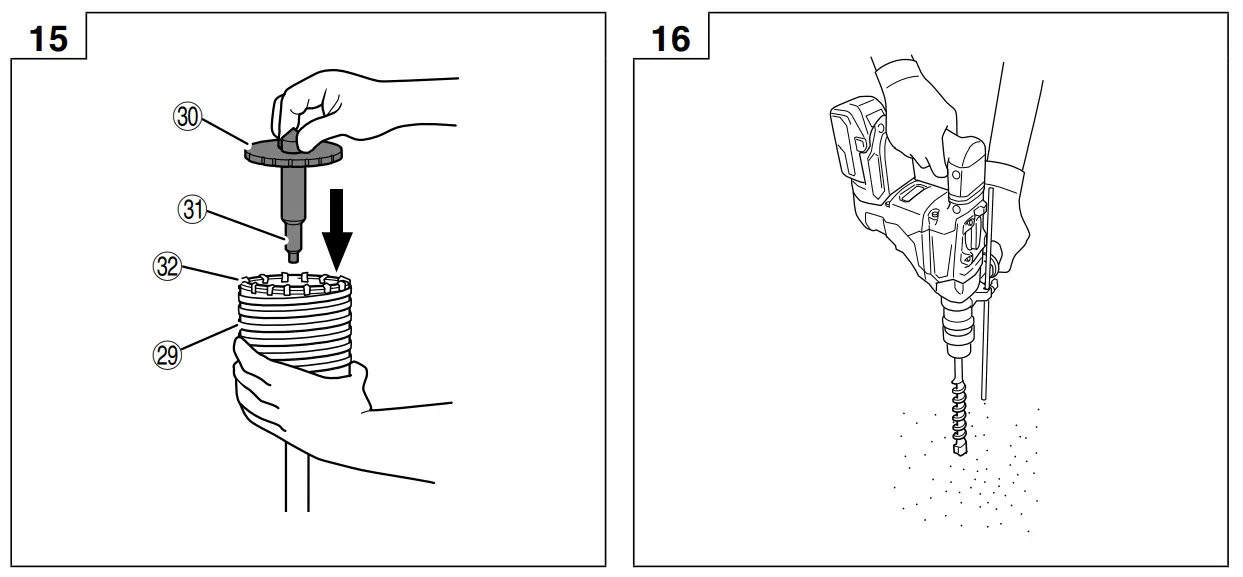
| Mounting core bit | 14 | 5 |
| Mounting guide plate and center pin | 15 | 5 |
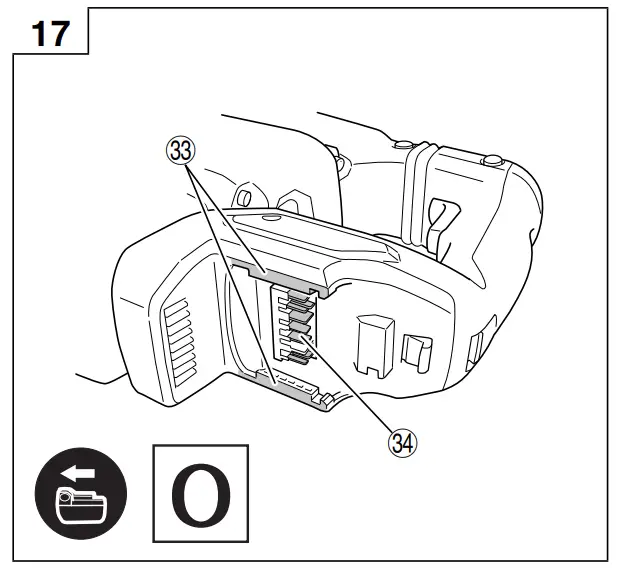
| Cleaning of the battery installation compartment | 17 | 5 |
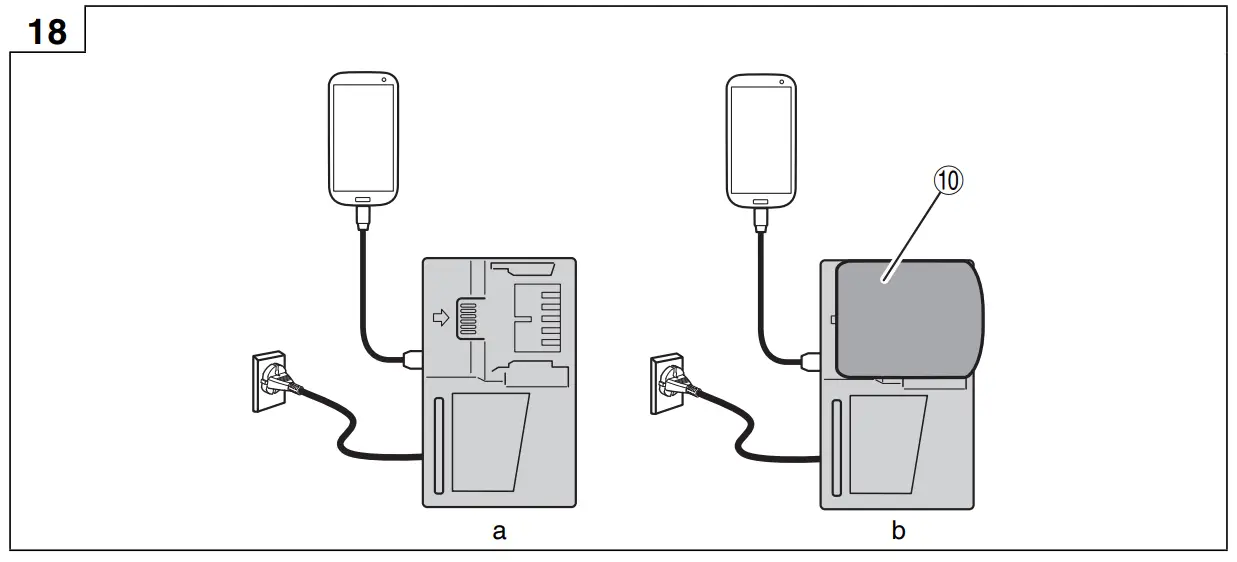
| Charging a USB device from a electrical outlet | 18- a | 6 |
| Charging a USB device and battery from a electrical outlet | 18-b | 6 |
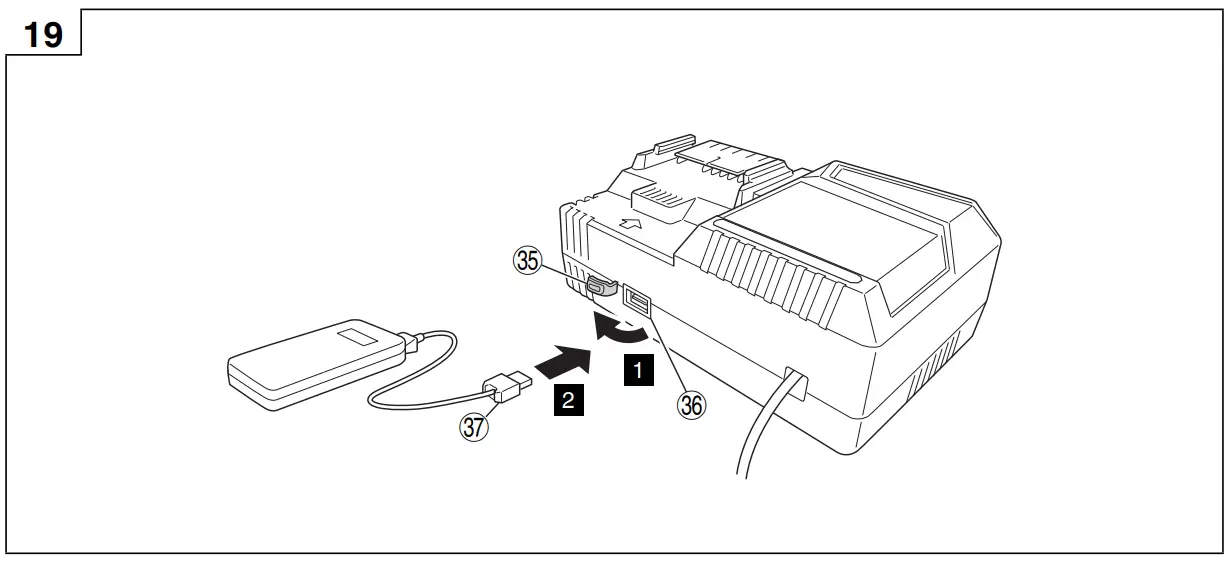
| How to recharge USB device | 19 | 6 |
| When charging of USB device is completed | 20 | 6 |
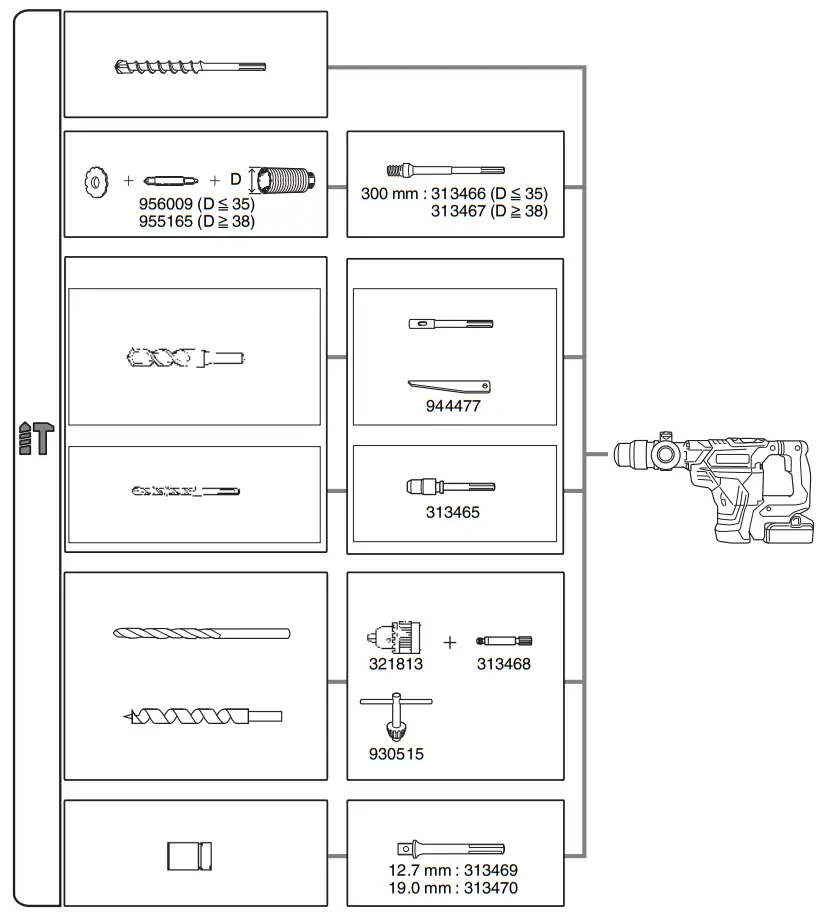
| Selecting accessories*2 | — | 260-262 |
*1 When drilling fragile materials, or when conducting chipping operations or alignment operations, change the tool’s rotation speed in accordance with the task by using the rotation speed selector switch.
NOTE
- Rotation speed cannot be adjusted until a battery is installed to the power tool and the switch has been triggered once.
- While the tool’s motor is operating, rotation speed cannot be adjusted by pressing the rotation speed selector switch.
To adjust rotation speed, switch off the tool. Once the motor has stopped, press the rotation speed selector switch to adjust the speed.
*2 For detailed information regarding each tool, contact a HiKOKI authorized service center.
Operate this Rotary Hammer by utilizing its own weight. The performance will not be better even if it is pressed or thrust forcibly against the work surface.
Hold this Rotary Hammer with a force just sufficient to counteract the reaction.
CAUTION
After long time of use, the cylinder case becomes hot.
Therefore, be careful not to burn your hands.
Warming up (Fig. 16)
The grease lubrication system in this unit may require warming up in cold regions.
Position the end of the bit so makes contact with the concrete, turn on the switch and perform the warming up operation. Make sure that a hitting sound is produced and then use the unit.
CAUTION
When the warming up operation is performed, hold the side handle and the main body securely with both hands to maintain a secure grip and be careful not to twist your body by the jammed drill bit.
ABOUT THE PROTECTION FUNCTIONS
This product features functions that are designed to protect the tool itself as well as the battery. While the switch is pulled, if any of the safeguard functions are triggered during operation, the display lamp will blink as described in Table 3. When any of the safeguard functions are triggered, immediately remove your finger from the switch and follow the instructions described under corrective action.
| Display lamp flashing | Cause | Solution |
 | Internal temperature has risen beyond the unit’s specified temperature. (Temperature increase protection function) | Turn off the unit and allow it to cool down for about 15 minutes. When the temperature goes down, the unit is ready for use. |
 | Excessive pressure applied to the tool has resulted in an overload. (Overload protection function) | Remove the cause of the overburdening. |
 | Sensor signal read error. (Control monitoring function) | Repair may be required. |
REACTIVE FORCE CONTROL
This product is equipped with a Reactive Force Control (RFC) feature that reduces jerking of the tool body.
If the tool bit is suddenly overburdened, any jerking of the tool body is reduced by activation of the slip clutch or by stopping of the motor by the sensor built into the tool body. If the motor is stopped because of overburdening detection by the controller, the RFC indicator lamp will blink while the switch is pulled. In addition, the lamp will continue blinking for approximately three seconds after the switch is released.
The motor will remain stopped while the lamp is blinking. (Fig. 21)
Because the RFC feature may not activate or its performance may be insufficient depending on the working environment and conditions, be careful not to suddenly overburden the tool bit while operating.
Possible causes of sudden overburdening
- Tool bit biting into material
- Impact against nails, metal or other hard objects
- Tasks involving prying or any excess application of pressure, etc.
Also, other causes include any combination of the aforementioned.
When the reactive force control (RFC) is triggered When the RFC is triggered and the motor stops, turn off the tool’s switch and remove the cause of the overburdening before continuing operation. 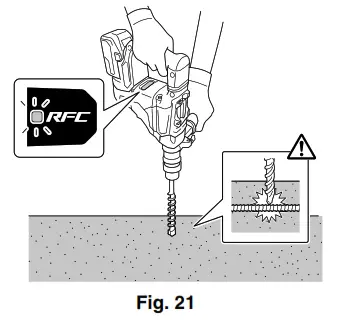
GREASE REPLACEMENT
This Rotary Hammer is of full air-tight construction to protect against dust and to prevent lubricant leakage.
Therefore, this Rotary Hammer can be used without lubrication for long periods. Replace the grease as described below.
Grease Replacement Period
After purchase, replace grease after every 6 months of usage. Ask for grease replacement at the nearest authorized Service Center.
MAINTENANCE AND INSPECTION
CAUTION
Be sure to turned off the switch and remove the battery before maintenance and inspection.
- Inspecting the tool
Since use of as dull tool will degrade efficiency and cause possible motor malfunction, sharpen or replace the tool as soon as abrasion is noted. - Inspecting the mounting screws
Regularly inspect all mounting screws and ensure that they are properly tightened. Should any of the screws be loose, retighten them immediately. Failure to do so could result in serious hazard. - Maintenance of the motor
The motor unit winding is the very “heart” of the power tool. Exercise due care to ensure the winding does not become damaged and/or wet with oil or water. - Inspection of terminals (tool and battery)
Check to make sure that swarf and dust have not collected on the terminals.
On occasion check prior, during and after operation.
CAUTION
Remove any swarf or dust which may have collected on the terminals.
Failure to do so may result in malfunction. - Cleaning on the outside
When the power tool is stained, wipe with a soft dry cloth or a cloth moistened with soapy water. Do not use chloric solvents, gasoline or paint thinner, for they melt plastics. - Cleaning of the battery installation compartment
After drilling concrete, if concrete dust has accumulated on the terminals or the area where the battery slides within the battery installation compartment, clean off the accumulated concrete dust with a dry cloth before using the tool. (Fig. 17)
Also, after cleaning, ensure that the battery can be installed and removed smoothly from the tool.
CAUTION
Using the tool when the battery is covered with concrete dust may lead to accidents such as the battery falling during use.
Furthermore, such use may cause a malfunction or contact failure between the battery and the terminals. - Storage
Store the power tool in a place in which the temperature is less than 40°C and out of reach of children.
NOTE
Storing lithium-ion batteries.
Make sure the lithium-ion batteries have been fully charged before storing them.
Prolonged storage (3 months or more) of batteries with a low charge may result in performance deterioration, significantly reducing battery usage time or rendering the batteries incapable of holding a charge.
However, significantly reduced battery usage time may be recovered by repeatedly charging and using the batteries two to five times.
If the battery usage time is extremely short despite repeated charging and use, consider the batteries dead and purchase new batteries.
CAUTION
In the operation and maintenance of power tools, the safety regulations and standards prescribed in each country must be observed.
Important notice on the batteries for the HiKOKI cordless power tools
Please always use one of our designated genuine batteries. We cannot guarantee the safety and performance of our cordless power tool when used with batteries other than these designated by us, or when the battery is disassembled and modified (such as disassembly and replacement of cells or other internal parts).
GUARANTEE
We guarantee HiKOKI Power Tools in accordance with statutory/country specifi c regulation. This guarantee does not cover defects or damage due to misuse, abuse, or normal wear and tear. In case of complaint, please send the Power Tool, undismantled, with the GUARANTEE CERTIFICATE found at the end of this Handling instruction, to a HiKOKI Authorized Service Center.
Information concerning airborne noise and vibration
The measured values were determined according to EN60745 and declared in accordance with ISO 4871.
Measured A-weighted sound power level: 105 dB (A)
Measured A-weighted sound pressure level: 94 dB (A)
Uncertainty K: 3 dB (A).
Wear hearing protection.
Vibration total values (triax vector sum) determined according to EN60745.
Hammer drilling into concrete:
Vibration emission value ah, HD = 11.8 m/s2
Uncertainty K = 2.6 m/s2
Equivalent chiselling value:
Vibration emission value ah, CHeq = 9.6 m/s2
Uncertainty K = 1.5 m/s2
The declared vibration total value has been measured in accordance with a standard test method and may be used for comparing one tool with another.
It may also be used in a preliminary assessment of exposure.
WARNING
- The vibration emission during actual use of the power tool can diff er from the declared total value depending in the ways in which the tool is used.
- Identify safety measures to protect the operator that are based on an estimation of exposure in the actual conditions of use (taking account of all parts of the operating cycle such as the times when the tool is switched off and when it is running idle in addition to the trigger time).
NOTE
Due to HiKOKI’s continuing program of research and development, the specifi cations herein are subject to change without prior notice.
TROUBLESHOOTING
Use the inspections in the table below if the tool does not operate normally. If this does not remedy the problem, consult your dealer or the HiKOKI Authorized Service Center.
- Power tool
Symptom Possible cause Remedy Tool doesn’t run No remaining battery power Charge the battery. Battery isn’t securely attached. Push in the battery until a click is heard. Concrete dust has accumulated on the terminals of the battery installation compartment as well as on the battery sliding grooves. Clean off the accumulated concrete dust with a dry cloth. The battery was attached while the switch trigger was ON. Attach the battery when the switch trigger is OFF. Tool suddenly stopped Tool was overburdened Get rid of the problem causing the overburden. Reactive force control was activated The battery is overheated. Let the battery cool down. Tool bits
-can’t be attached -fall offThe shape of the attachment portion doesn’t match For the SDS-max shank type, use a bit with a diameter that is within the designated range. Holes can’t be smoothly drilled. The drill is worn Replace with a new drill. Battery cannot be installed. Attempting to install a battery other than that specified for the tool. Please install a multi volt type battery.
| V | 36V |
| nO | 260 — 590 min-1 |
| Bpm | 1420 — 2860 min-1 |
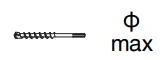 | 40 mm |
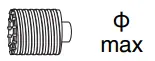 | 105 mm |
| 7,9 kg |
| DH36DMA | ||
| (2WC) | (NNK) | |
 | 2 | ― |
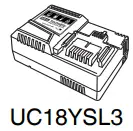 | 1 | ― |
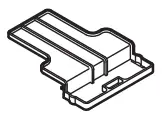 | 2 | ― |
 | 1 | 1 |
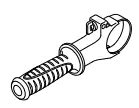 | 1 | 1 |
 | 1 | 1 |
 | 1 | 1 |
EC DECLARATION OF CONFORMITY
We declare under our sole responsibility that Cordless Rotary Hammer, identified by type and specific identification code *1), is in conformity with all relevant requirements of the directives *2) and standards *3). Technical fi le at *4) – See below.
The European Standard Manager at the representative office in Europe is authorized to compile the technical file.
The declaration is applicable to the product affixed CE marking.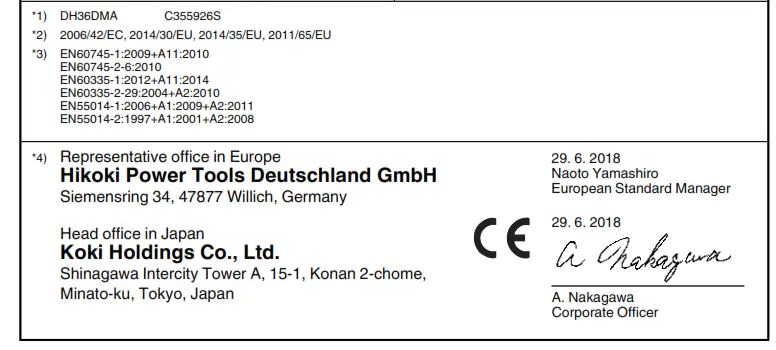
Koki Holdings Co., Ltd.
806 Code No. C99724771 G Printed in China
 Hikoki Powertools