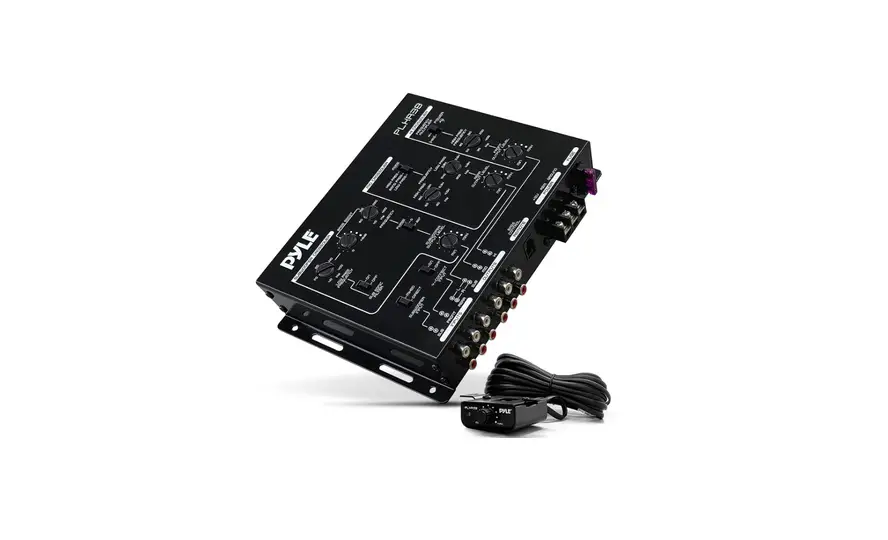

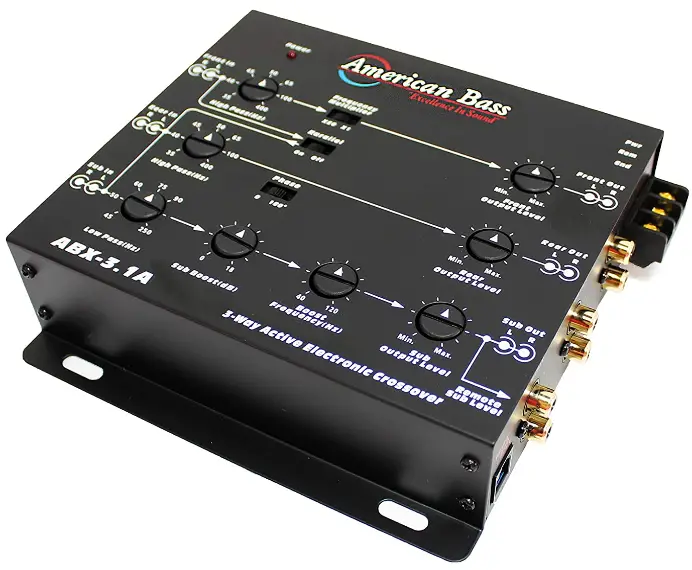
American Bass ABX-3.1A 3 Way Electronic Crossover
FEATURES
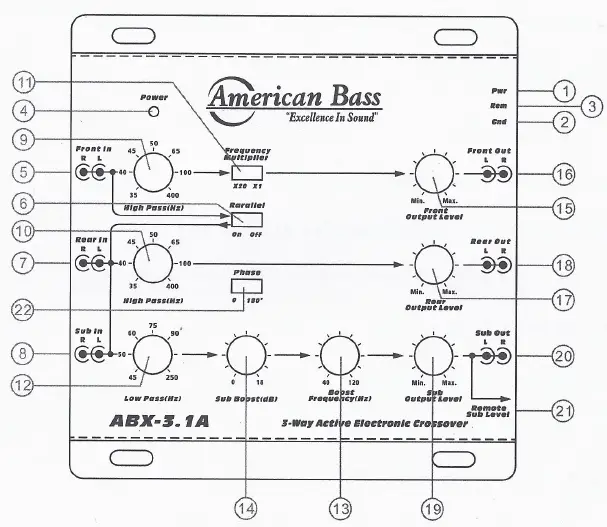
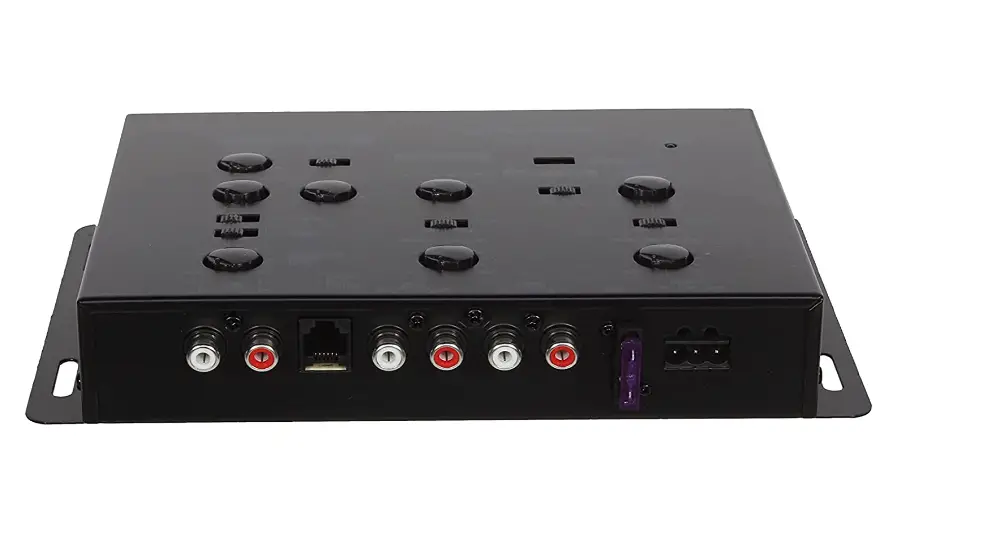
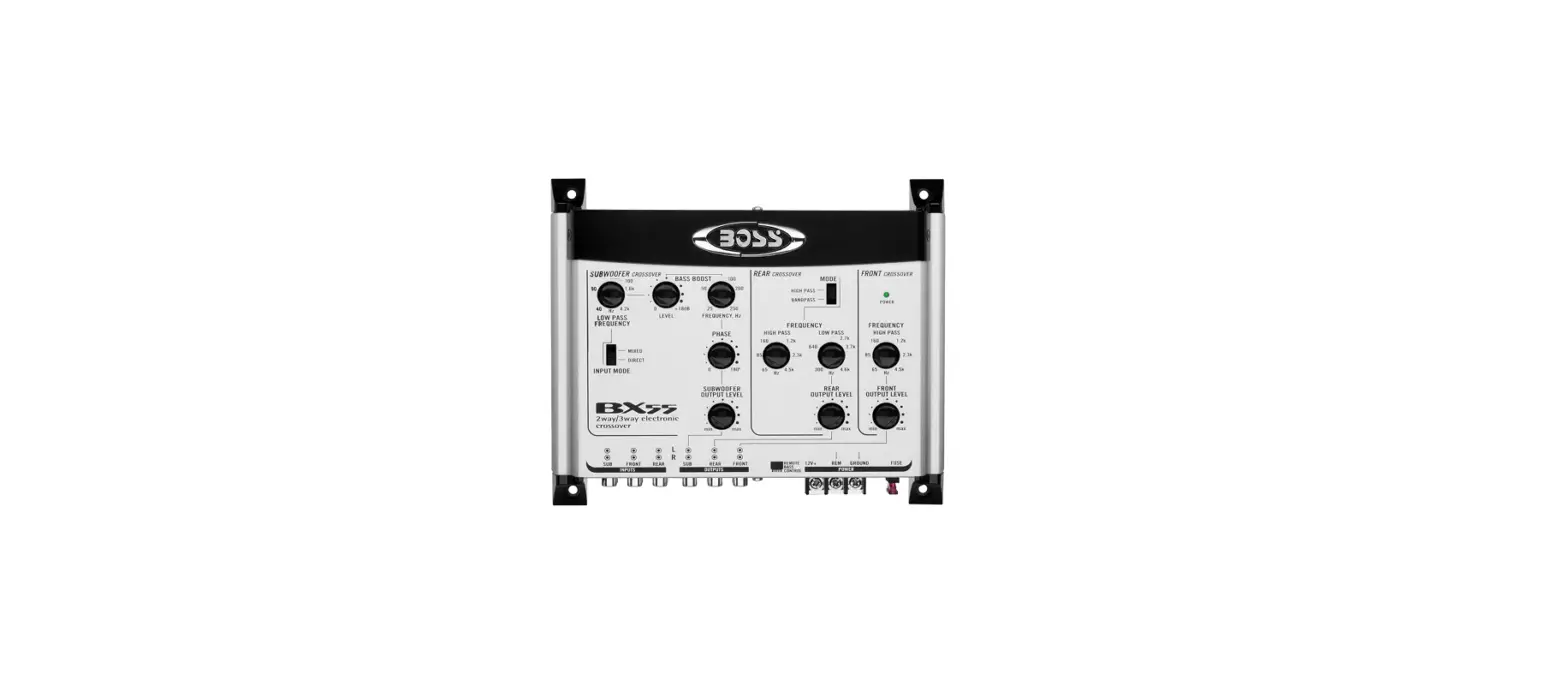
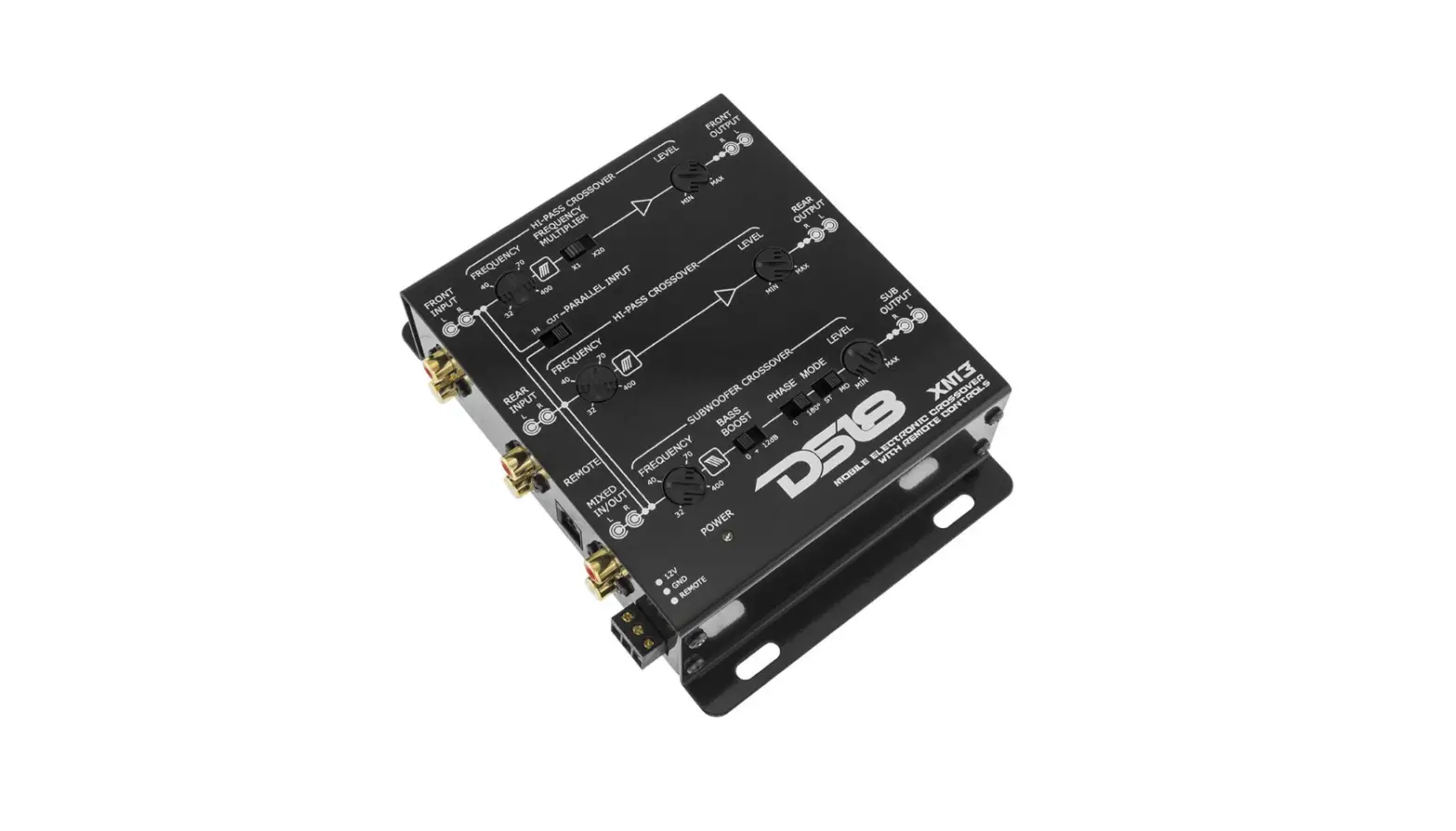
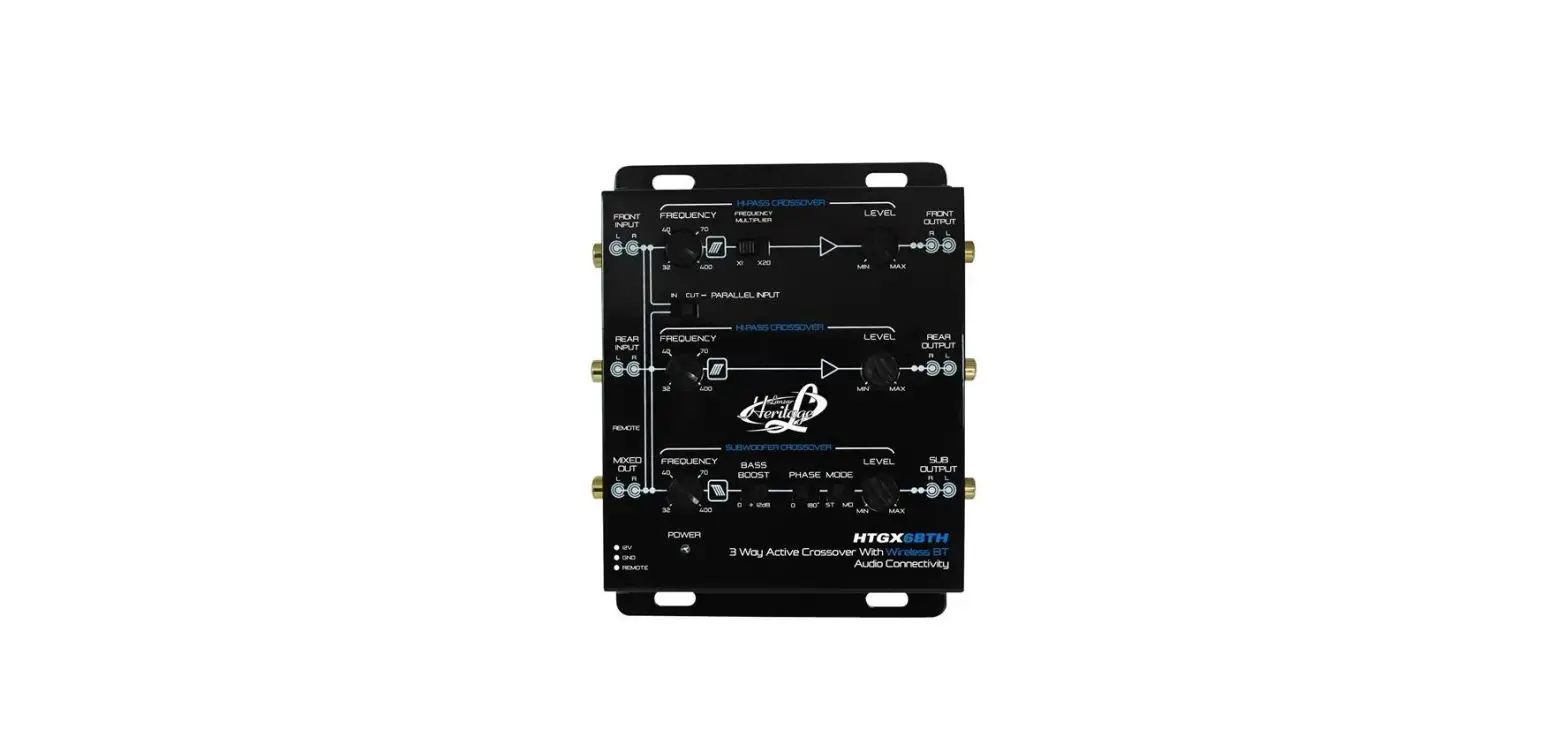
- POWER INPUT TERMINAL (12V).
- GROUND INPUT TERMINAL.
- REMOTE TURN-ON INPUT TERMINAL (REMOTE).
- POWER INDICATOR.
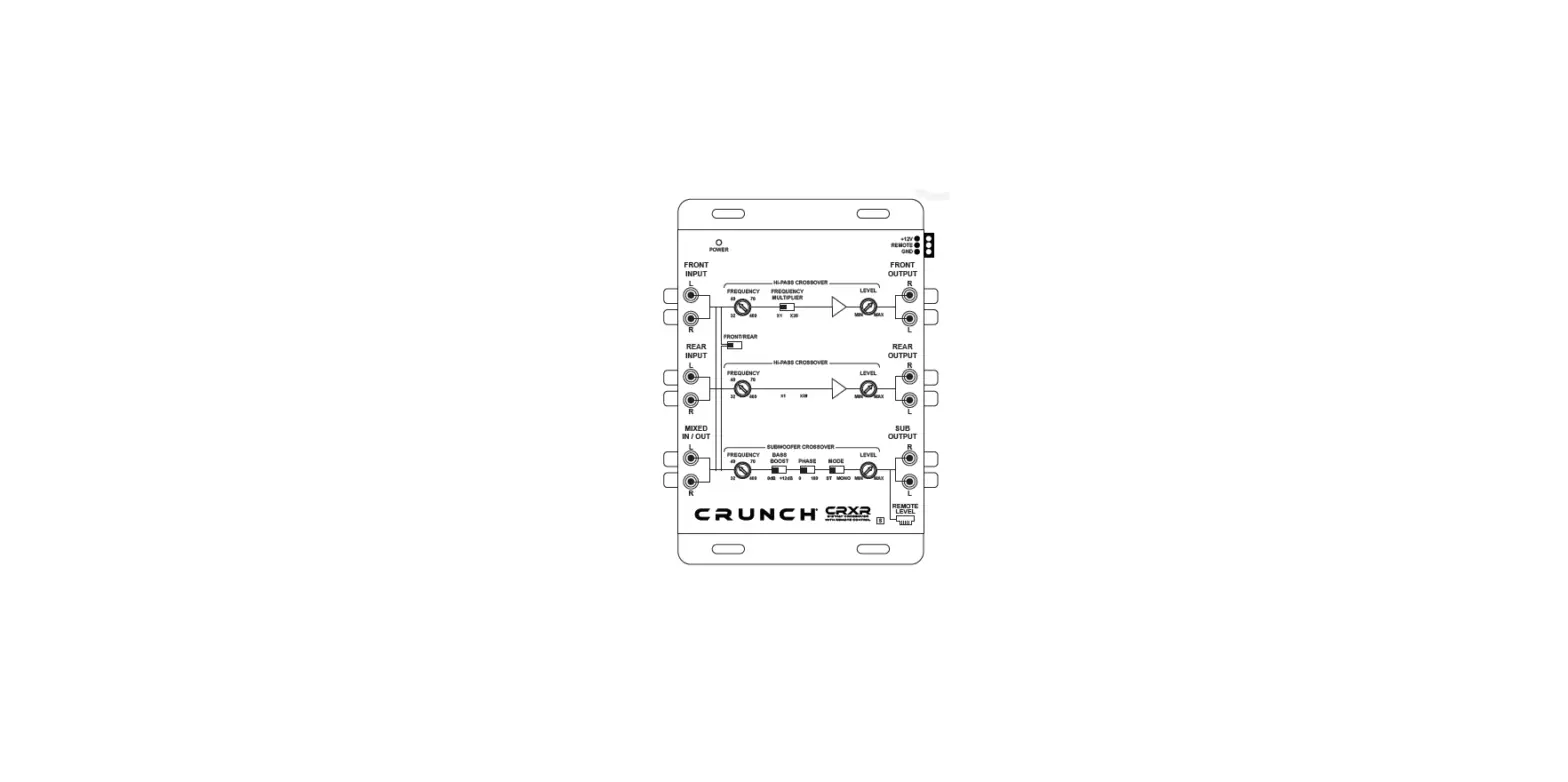
- FRONT INPUT.
- FRONT AND REAR PARALLEL SWITCH SELECT.
- REAR INPUT.
- SUB INPUT.
- FRONT HIGH PASS CONTROL.
- REAR HIGH PASS CONTROL.
- FRONT FREQUENCY MULTIPLIER CONTROL.
- SUB FREQUENCY CONTROL.
- BOOST FREQUENCY CONTROL.
- SUB BOOST CONTROL.
- FRONT OUTPUT LEVEL CONTROL.
- FRONT OUTPUT.
- REAR OUTPUT LEVEL CONTROL.
- REAR OUTPUT.
- SUB OUTPUT LEVEL CONTROL.
- SUB OUTPUT.
- REMOTE SUB LEVEL CONTROL.
- SUB PHASE SWITCH·SELECT.
NOISE CHECK & SYSTEM ADJUSTMENT
NOISE CHECK
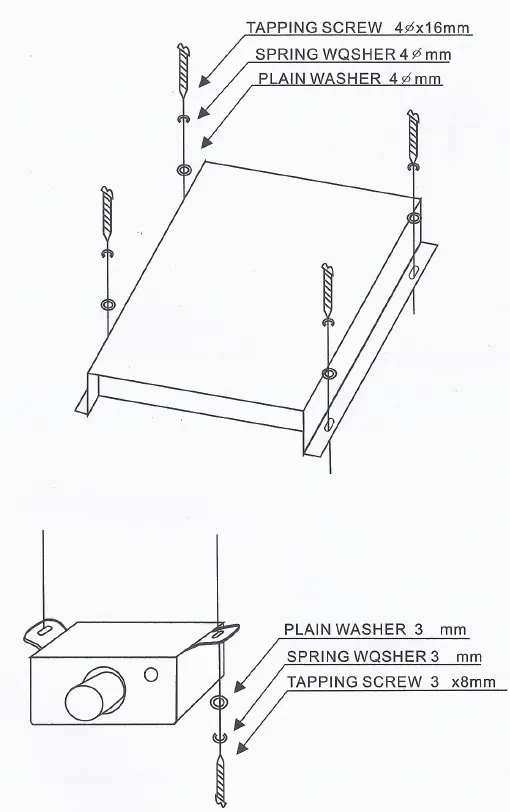
Check the entire audio system for noise before permanently securing the CROSSOVER mounting
- Start the engine.
- Tum the audio system on.
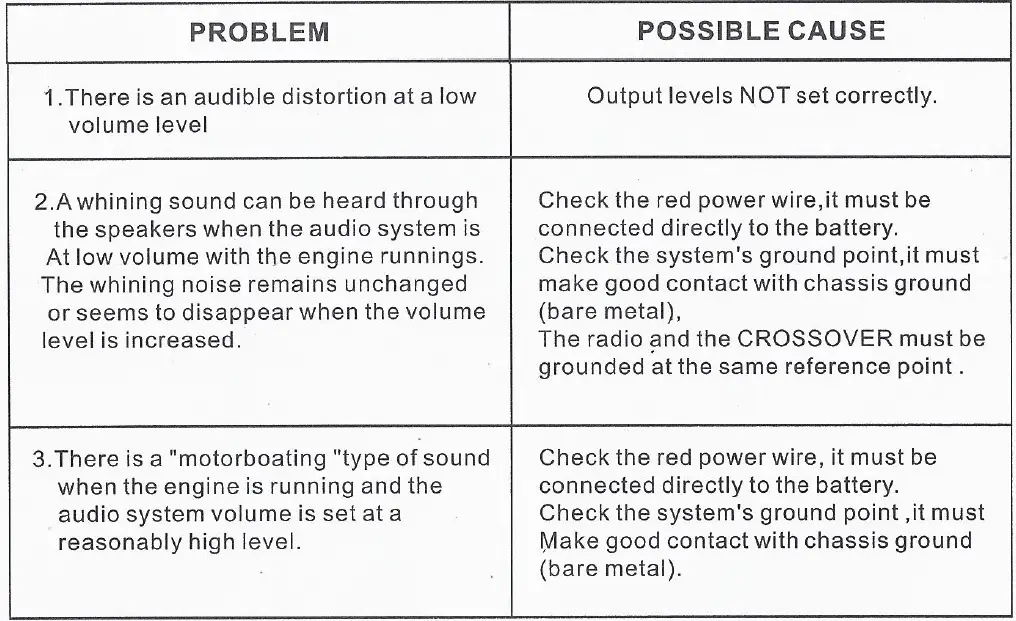
- Rev the engine and vary the VOLUME of the audio system to determine if there is any unwanted noise. If os ,turn both the audio system and the engine off. Do not secure the CROSSOVER mounting screws. Refer to the :Trouble Shooting Guide”at this manual.
- lf the audio system ctoes not have any noise, securely tighten the CROSSOVER mounting screws and double check the wiring cables for safe placement.
SYSTEM ADJUSTMENT
Prelimnary Adjustments
Pre-setting the system provides a necessary starting point for fine-tuning the entire audio system to maximum performance.
NOTE: DO NOT MOUNT CROSSOVER UNTIL THE FOLLOWING PROCEDURES HAVE BEEN COMPLETED.
- Preset each amplifier input gain adjustment at the amplifier to half of maximum.
- Before turning the audio system on ,preset-adjust the front, rear and sub-woofer output level controls, as well as the front channel high-pass and sub-woofer channel low-pass crossover points.
- Slowly turn the volume up and listen carefully for :Obvious trouble in sound (distortion, no sound no hiss. total silence).Turn the system off refer to “Trouble Shooting Guide” at this manual.
Caution
DO NOT ROUTE AUDIO CABLES AND POWER CABLES TOGETHER! THIS CAN CAUSE ENGINE NOISE IN YOUR AUDIO SYSTEM. ALWAYS DISCONNECT THE SYSTEM FROM THE BATTERY BEFORE ATTEMPTING TO MAKE OR ALTER ANY C0NNECTIONS. THIS PRODUCT IS DESIRED FOR USE IN ANY 12VOLTS NEGATIVE GROUND ELECTRICAL SYSTEM ONLY. INSTALLING THIS PRODUCT IN ANY POSITIVE GROUND ELECTRICAL SYSTEM COULD SERIOUSLY DAMAGE THE AUDIO SYSTEM.
ELECTRICAL & AUDIO CONNECTIONS
Precautions
- To prevent short circuits, be sure to disconnect the negative battery ground lead before wiring the system up.
- When you finish the installation, be sure to make one more check to be sure everything is done correctly.
- Reinstate all car parts theat were removed.
- Reconnect the negative battery ground lead.
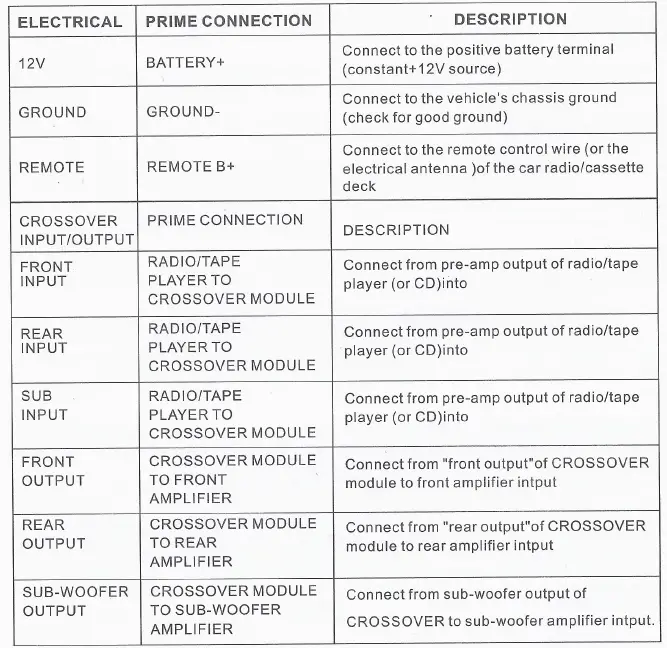
Primary Wiring Descriptions
FUNCTIONS
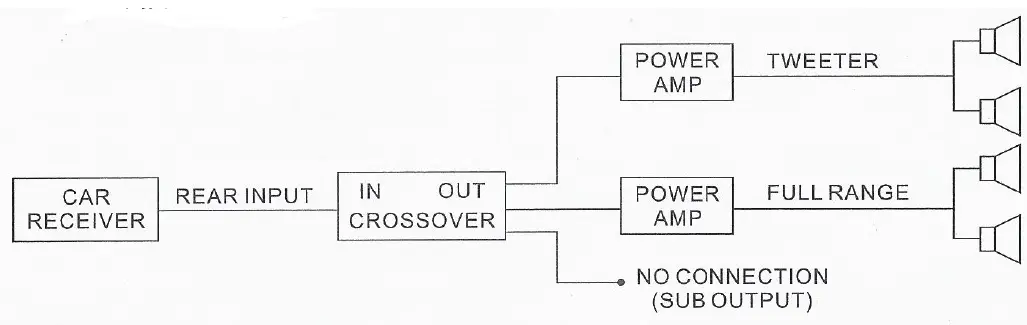
(A) 2-Channel Two-Way System (tweeter+ full range)
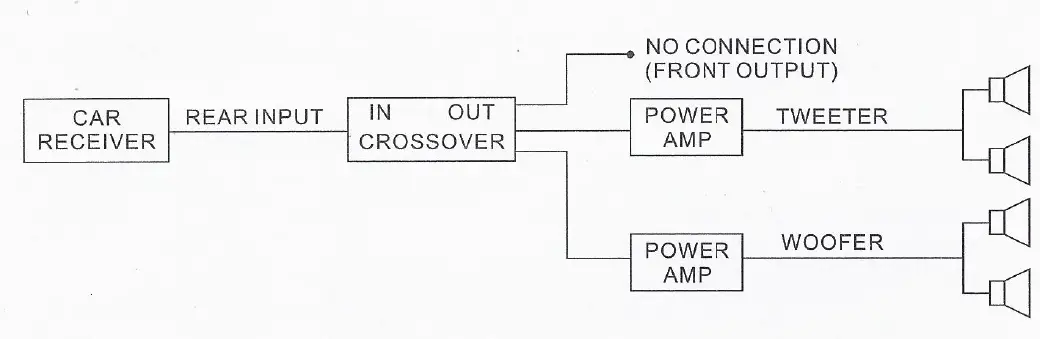
(B) 2-Channel Two-Way System (tweeter+ woofer)
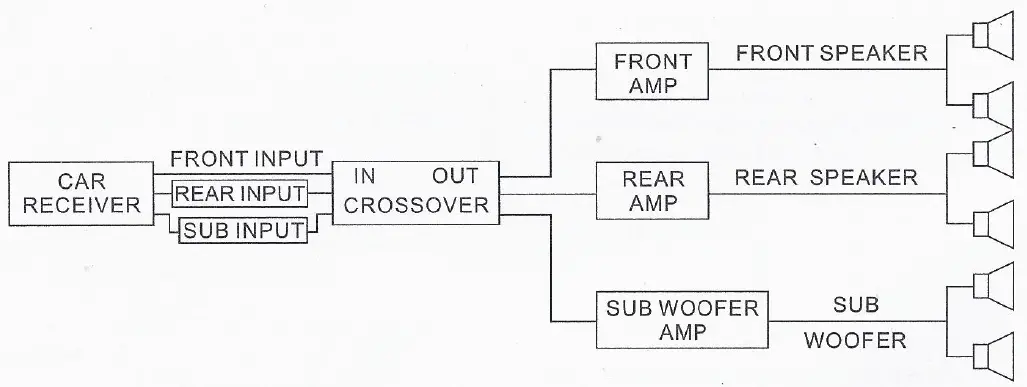
(C) 4-Channel TRI-AMP System
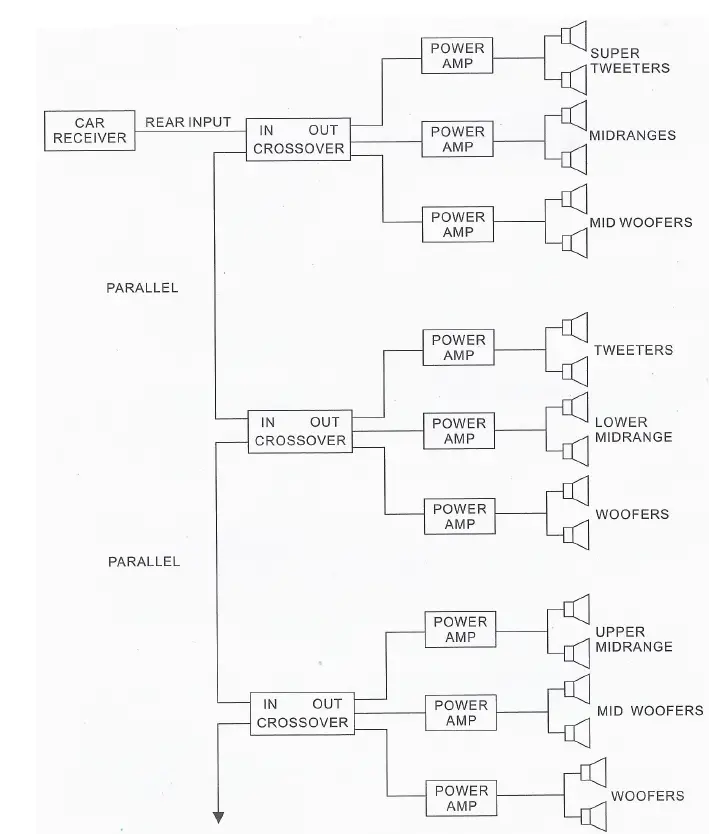
(D) 2-Channel multiple purpose system
INSTALLATION
TROUBLESHOOTING GUIDE
SPECIFICATIONS
- SUPPLY VOLTAGE: 11-15V DC
- INPUT CURRENT: 3amp max
- DISTORTION: 01%THD
- FREQUENCY RESPONSE: 10Hz-50KHz-3dB
- S/N RATIO (A WEIGHTED): >95dB
- SEPARATION: 60Db
- Crossover frequencies (continuously variable):
- Front High-pass: (x1): 35-400Hz; (x20): 700-8KHz
- Rear High-pass: (x1): 35-400Hz
- Sub Low-pass: 45-250Hz
- Sub boost: Single octave 0dB to 18dB (variable )at 40 to 120Hz(variable)
- Input impedance: >10K Ohms
- Output impedance: >1K Ohms
- Output voltage level: 8 volts max.
FEATURES AND SPECIFICATIONS SUBJECT TO CHANGE AND/ OR IMPROVEMENT WITHOUT NOTICE
FAQs
Low-pass, band-pass, and high-pass filters are combined to generate a 3-way crossover (LPF, BPF and HPF respectively). The BPF portion is created by combining the HPF and LPF sections.
A crossover serves as a filter, preventing unwanted frequencies from getting to a speaker or group of speakers. This is quite beneficial since it enables us to communicate a specific frequency range to each speaker, enabling the most effective and efficient playback.
For a three-way speaker, it is divided between the midrange/high frequency drivers and the low-frequency driver (subwoofer) (tweeter). Because it must send an even signal to the speakers without adding distortion, a correct crossover is crucial.
Yes. Crossover design is mostly responsible for sound quality. Even the best speaker drivers will generate poor sound if the crossover designs and voicing are poor. A system that blends premium speaker drivers, precisely crafted crossovers, and ideal cabinet geometry and design will always deliver the best sound.
They can start by using a crossover network or simply a few capacitors. Capacitors can last up to 30 years under ideal conditions before they start to degrade. Heavy use or faulty components may speed up this deterioration, which would reduce the speaker’s capacity to provide high-quality sound.
Because they are built on unibody frames like road vehicles, crossovers often offer a smoother, more comfortable ride, have superior handling, are easier to manoeuvre and park, and tend to stop more quickly than normal SUVs.
Since they need electricity to function, they are referred to as “active” objects. Passive (speaker) crossovers don’t require a power source to function, in contrast to active crossovers. Instead, they act as a filtering device by being placed in between the amplifier and the speakers. Passive crossovers frequently take the form of built-in speakers.
All input frequencies’ overall volume are increased as a result. The Level control should be changed to bring REL volume to the same level as the speaker (s). In a REL, a tuneable electrical circuit known as the crossover excludes frequencies that are outside the operating frequency of the sub bass system.
There are several advantages to using a speaker crossover in an audio system. The most important and obvious factor is clarity. By separating the bass from the treble and sending those frequencies to three different speaker drivers with skill in those frequencies, more accurate sounds will be produced.
Three-way crossovers employ the crossover frequencies for three drivers rather than two. To use it as a two-way system, you would have to pick between giving up treble, bass, or midrange; you couldn’t have all three. Options
Any audio system, including the one in your car, needs a crossover to send sound to the right driver. Accordingly, tweeters, woofers, and subwoofers should receive high, middle, and low frequencies, respectively. Every full-range speaker has a crossover network inside of it.
An ideal crossover has no losses and has no effect on the amount of power sent to the speaker as long as the sine wave is within the range of frequencies that the crossover itself allows through. The resistance of the inductor causes a little amount of power loss in real crossovers.
If you know the frequency range of your speakers and place the crossover point roughly 10 Hz above the lowest frequency, your speakers can handle cleanly. 80 Hz is the THX standard and the most widely used crossover frequency.
The crossover frequency is the frequency at which sound moves from one speaker to another. The electrical crossover elements in a passive speaker decide where the sound switches from the speaker channels to a subwoofer.
For a crossover network to perform at its optimum, film capacitors with low dielectric absorption and commensurate series resistance are typically used. Film capacitors are the finest choice for audio applications due to their characteristics.
By changing the motors driving a load, a distortion known as crossover distortion is produced. Although it can occasionally be found in other types of circuits as well, complementary, or “push-pull,” Class-B amplifier stages are where it most usually appears.