SVS
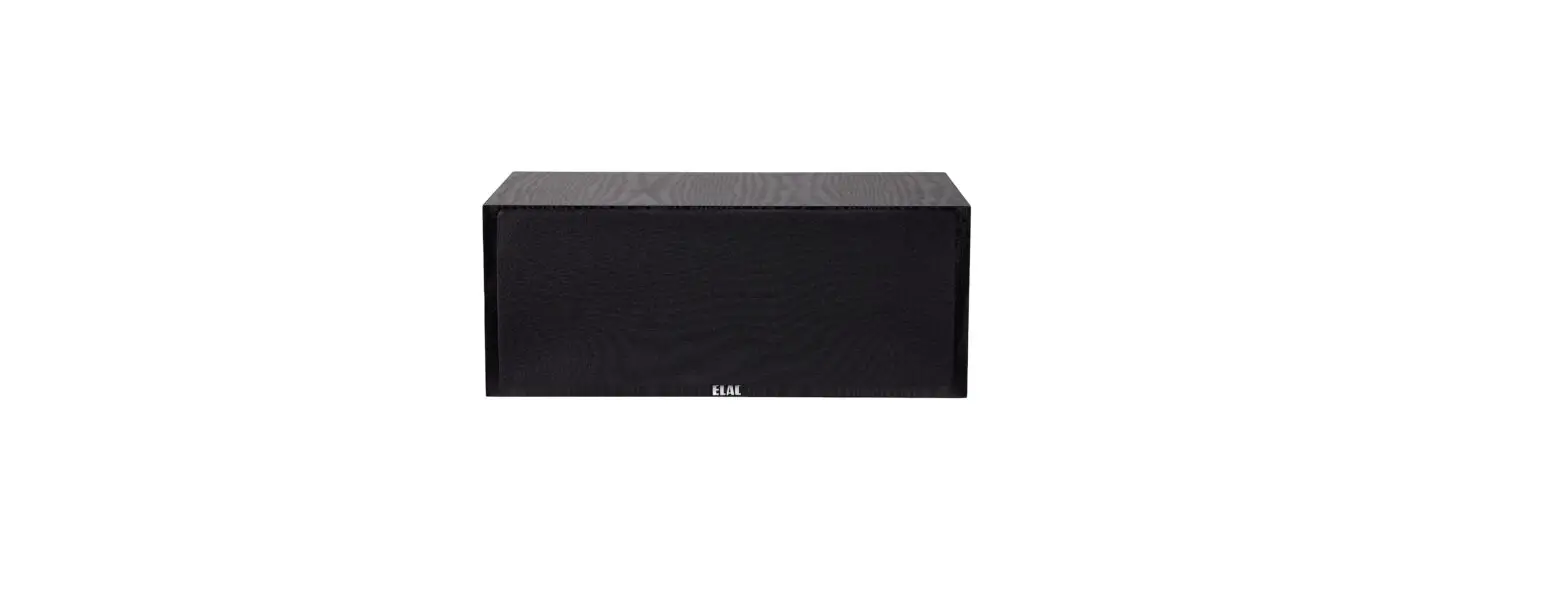
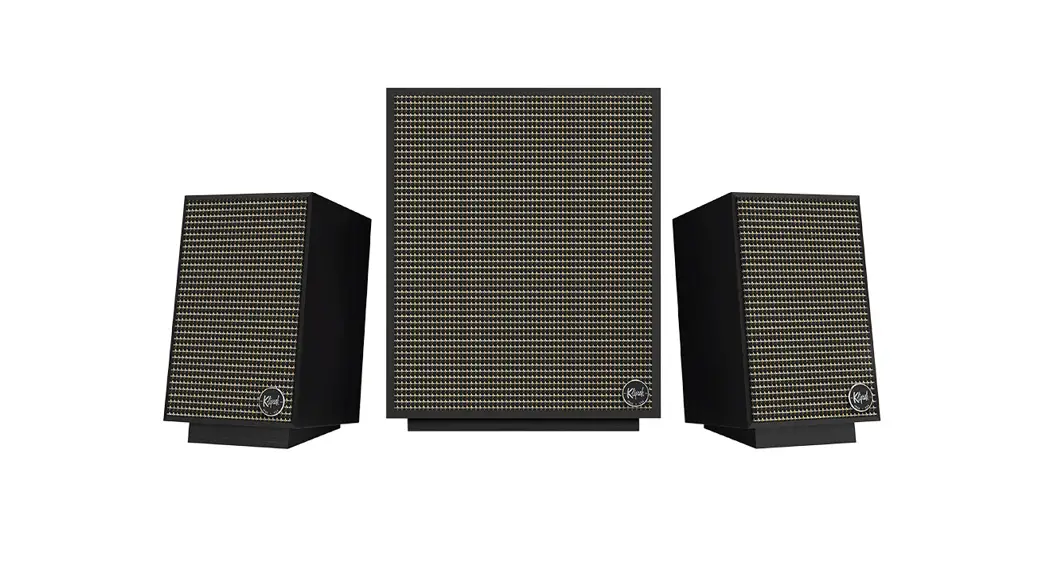
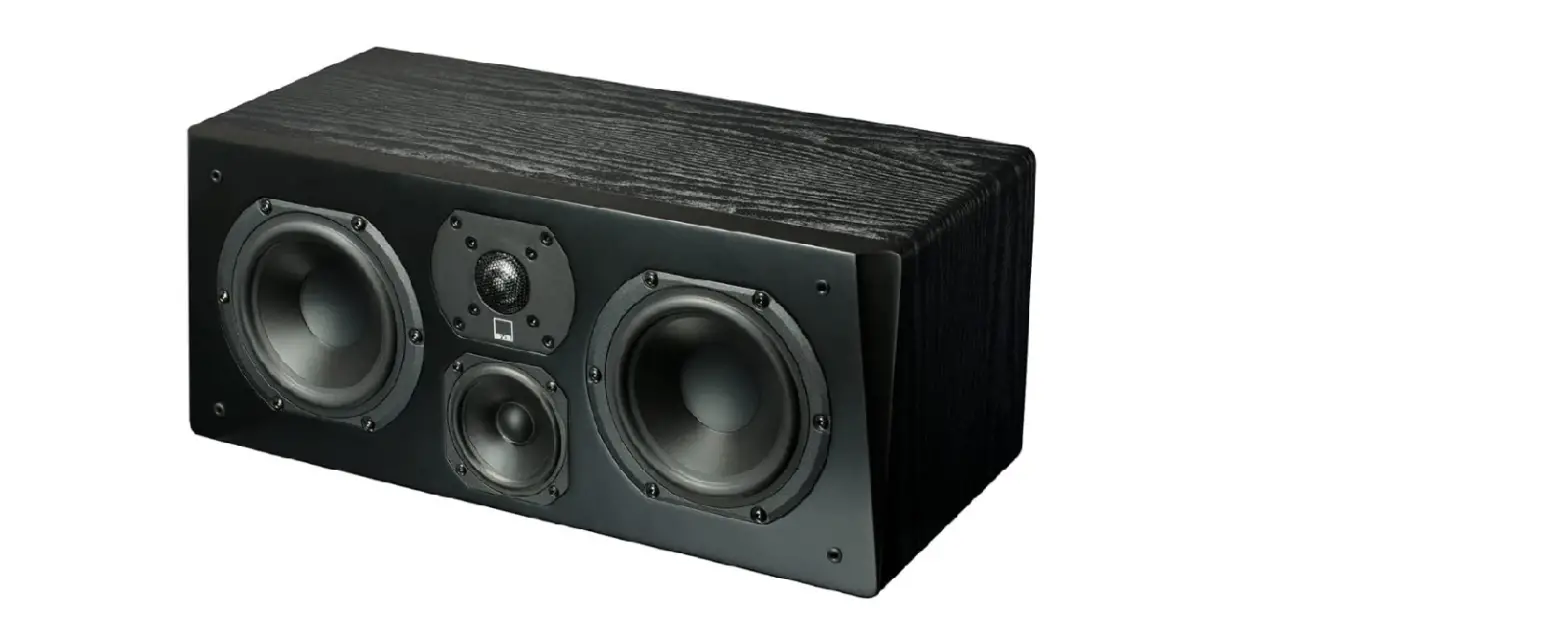
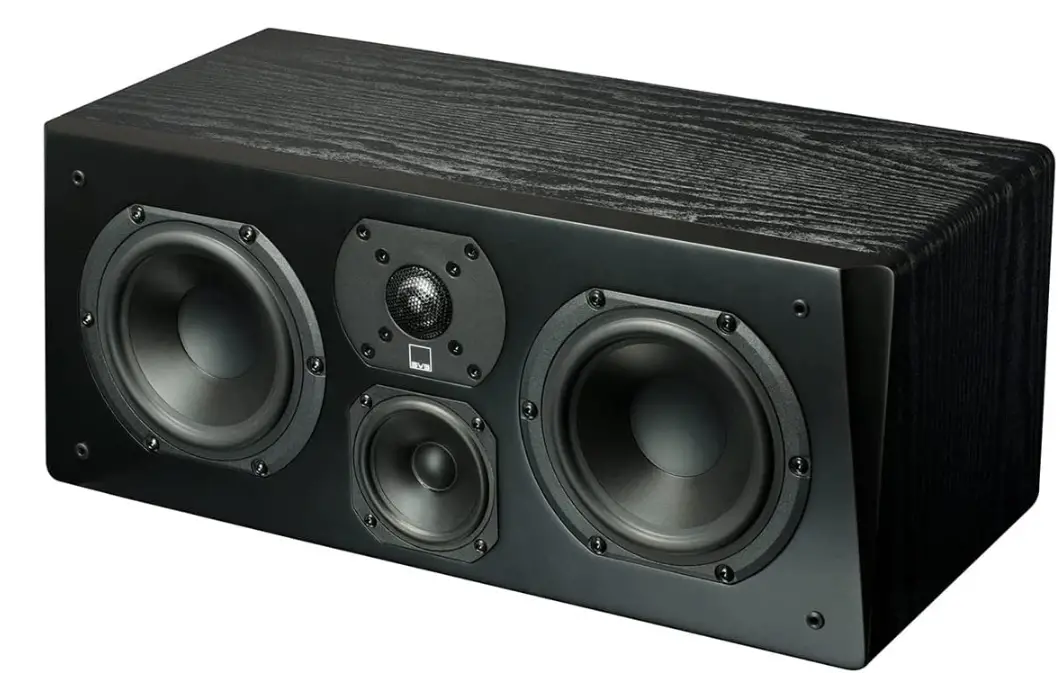
SVS Prime Center Speaker
Specifications
- SPEAKER TYPE: Center Channel Speakers
- BRAND: SVS
- MODEL NAME: Prime Center
- RECOMMENDED USES FOR PRODUCT: Music, Movies
- MOUNTING TYPE: Tabletop
- SENSITIVITY: 86dB (2.83V @ 1 meter full-space 300-3kHz)
- RECOMMENDED AMPLIFIER POWER: 20 – 200 watts
- RATED BANDWIDTH: 48Hz – 25kHz (±3dB)
- WOOFER: 5.25 inch
- DRIVER: 3.5 inch
- ITEM WEIGHT: 20 pounds
- PRODUCT DIMENSIONS: 18.6 x 9.2 x 7 inches
Introduction
A center speaker has a difficult job to do. It must be a soloist speaking on a wide soundstage with clarity and naturalness. A split second later, it must assume the function of a supporting band, blending with the surroundings to add to the realism of films and music. The Prime Center Speaker, a real three-way speaker that is uncommon for center channel speakers in its price range, meets both of these needs with unmatched precision thanks to its single aluminum dome tweeter, dedicated and independently sealed 3.5 midrange driver, and two 5.25 woofers. Voice acting is neutral and genuine, bringing vocals and language just forward enough to be audible and understandable.
However, when called upon to participate in transitions, such as a jet fighter soaring through the sky from the left rear channel to the front right, it blends in to produce a natural-looking transition. Like its Prime brothers, the Center is elegantly designed and will look stunning in any listening setting. It has Outstanding Design and Technology, Incredible Sound and Performance. The Prime Center channel, which freely borrows from the premium Ultra Center, has a real 3-way center channel with a tweeter and midrange driver that are vertically aligned. As a result, all listening positions in the room can hear conversations in perfect clarity because comb filtering and lobing in the horizontal axis are eliminated. Everyone will now have a comfortable zone and won’t have to strain to hear conversations.
Deep male voices are given full justice by the dual 5.25 woofers’ full and rich sound, which also packs a powerful punch for special effects. Additionally, the midrange driver is housed in a separate, totally sealed container to prevent those powerful woofers from modulating the delicate and crucial midrange frequencies. The Prime Center is attractively fashioned and communicates to the world that you are serious about high-performance home entertainment. It is available in premium-grade piano gloss black or handsome black ash finish.
Thank you, and congratulations on purchasing your new SVS Prime Speaker!
All it takes is one listen to the Prime Speakers to understand just how much passion SVS poured into the development of this new family of loudspeakers. Leveraging design and technology from the SVS Ultra Speaker family, the Prime Speakers feature premium drivers and high-quality crossover components simply not found anywhere else at this level. We’re proud to say that you won’t find speakers with better sound quality or performance value at this price.
If you ever have any questions about your SVS product, or need help setting them up, feel free to contact us directly.
www.svsound.com • [email protected] • (877) 626-5623
SETTING UP YOUR PRIME SPEAKER’S FOOT OPTIONS
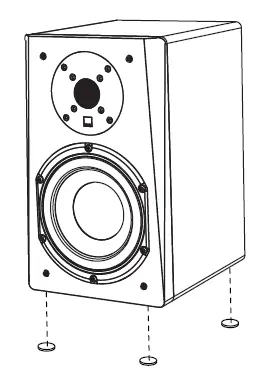
The Prime Tower speakers come packaged with two sets of foot support options that allow optimal placement on a variety of floor substrates. The Elastomer Isolation feet that come pre-installed on the Prime Towers can be removed (unscrew to remove) and replaced with the included Threaded Metal Spike kit. Both sets of feet are threaded to allow easy leveling of the Prime Towers if they should stand on an uneven surface.
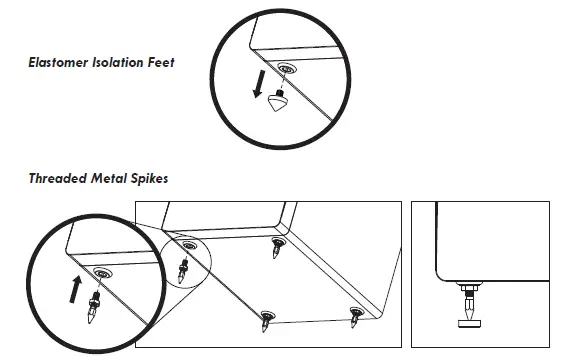
The Prime Bookshelf, Prime Center and Prime Satellite also include stick-on bumper kits that can be attached to the bottom of your speakers to protect them when placed on speaker stands and other surfaces.
SETTING UP YOUR PRIME SPEAKERS ACOUSTICS & ROOM PLACEMENT
FRONT LEFT/RIGHT LOUDSPEAKER PLACEMENT AND ROOM ACOUSTICS:
Proper placement of the front left/right speakers is essential to achieve the smoothest frequency response, optimal stereo imaging and the most spacious, three-dimensional soundstage.
Stereo imaging and soundstage are affected by loudspeaker location and the listening position, relative to each other and room boundaries. Moving the loudspeakers away from room boundaries will tend to improve stereo imaging and spaciousness by attenuating and delaying boundary reflections, thus optimizing direct sound and helping to preserve spatial information in the recording.
The amount of exposed glass, drywall and bare flooring in the room will increase the amount of reflected sound and exacerbate problems like slap echo and ringing. Conversely, furnishings like carpeting, drapes and upholstered furniture will reduce the amount of reflected sound in the room. The ratio of direct-to-reflected sound and the decay characteristics of the listening environment will have a large influence on the ultimate sound quality of any loudspeaker system. Dedicated room treatments like absorbers, diffusers and bass traps can greatly improve the sound quality of any listening environment, and are encouraged to extract the absolute best performance from any high-end loudspeaker system.
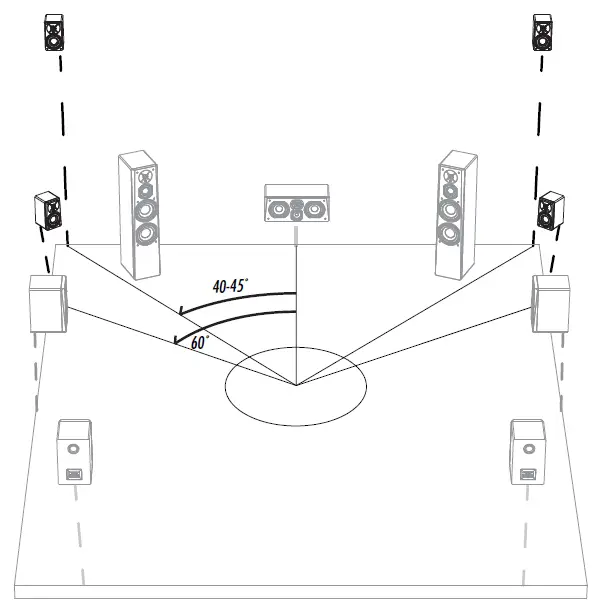
SVS recommends starting with the front loudspeakers located 30-degrees to the left and right (i.e., a 60-degree total window) of the listening position.
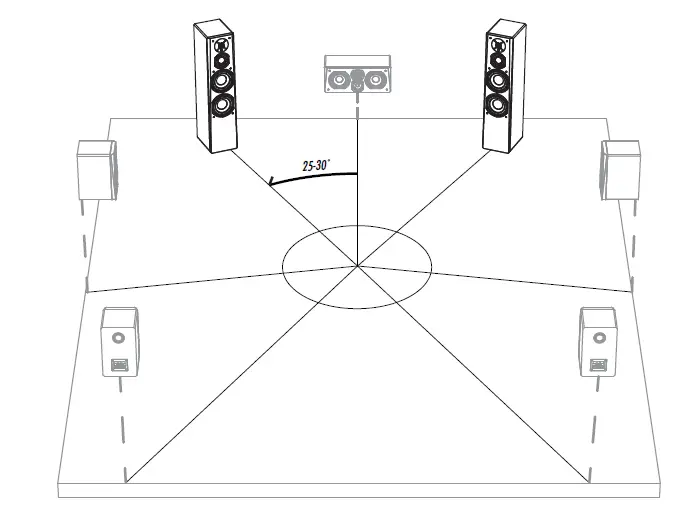
Toeing-in the loudspeakers 5-10 degrees can often improve imaging, however this is also a function of the distance from nearby boundaries and the ratio of direct- to-reflected sound, so experimentation with toe-in is recommended to obtain optimal results.
The location of the front loudspeakers relative to nearby boundaries will excite various room modes (a complex pattern of standing waves with associated peaks and nulls), which will affect the bass response of the loudspeakers. Generally, placing the loudspeakers closer to room boundaries (particularly corners) will increase the bass response. Conversely, moving the loudspeakers away from boundaries and corners will reduce the bass response. Due to the complex interaction of the loudspeakers with nearby boundaries/corners and your listening position, significant changes to the bass response can occur with very small changes in either loudspeaker location or listening position, so experimentation with both placement and listening position is recommended to obtain optimal results.
CENTER CHANNEL PLACEMENT
The center channel should be placed directly on-axis, relative to the primary seating position. As with the main front speakers, placing the tweeter at/near head level when seated is optimal. But depending on the placement of the video display or projection screen, this is not always possible.
If the center channel must be located below head level, then an upward tilt of the speaker is recommended to improve mid/high frequency response and dialogue intelligibility.
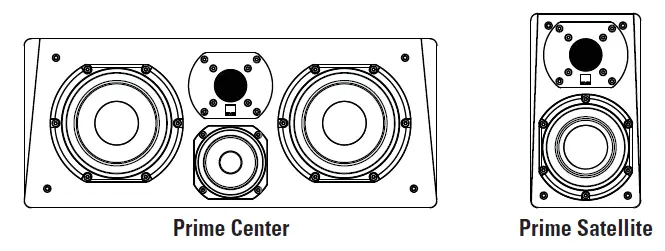
NOTE: When purchased as a matching surround package, the versatile Prime Satellite functions as all channels of the system, including the center channel.
SETTING UP YOUR PRIME SPEAKERS ROOM PLACEMENT (cont’d)
SURROUND SPEAKERS
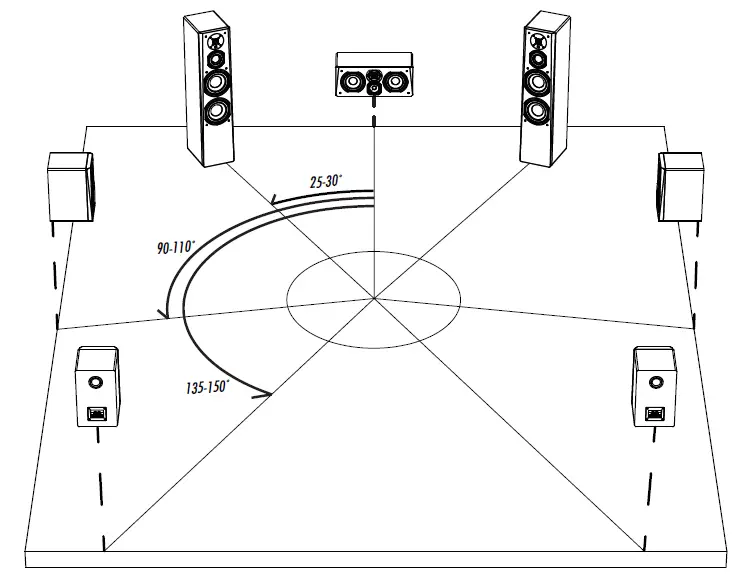
In a 5-channel system, the side surround speakers should be located 90-110 degrees off-axis. For the best sense of spaciousness, the tweeter height should be about 2 feet above ear level.
In a 7.1 system, dedicated rear surround speakers are placed behind the primary seating position for enhanced rear panning effects.
Place the rear surround speakers at 135-150 degrees off-axis, relative to the primary seating position. As with the side surround speakers, position the rear surround tweeters about 2 feet above head level when seated.
9.1 AND 11.1 SYSTEMS
The recent development of 9 and 11 channel surround sound processors brings Wide and Height ‘presence’ channels into the system to even further enhance sound stage spaciousness and immersion.
Since native Blu-ray formats are currently only available in 7.1, the use of Wide or Height speakers requires the use of an upconverting algorithm in the surround sound processor – like Audyssey DSX, DTS Neo:X and Dolby ProLogic IIz.
WIDE SPEAKER CHANNELS
The wide speaker channels are intended to be placed between the main front speakers and the side surround speakers. The goal of the wide speaker is to minimize any gaps in panning and imaging between the front main speakers and the side surround speakers and provide an additional sense of envelopment.
The optimal location for the wide speakers is about 60 degrees off-axis, relative to the primary seating position. Audyssey recommends that the wide speakers be placed at head level when seated.
HEIGHT SPEAKER CHANNELS
The height speaker channels should be placed in the upper left/right corners of the front stage. Typically, this will be 40-45 degrees off-axis and about 8 feet in height. A downward tilt of the speaker will improve mid/high frequency response and reduce ceiling bounce reflections.
The height speakers enhance imaging in the vertical plane, and can even be used to create sound effects which seem to come from directly above the listening position, which provides total immersion into the surround sound experience.
SETTING UP YOUR PRIME SPEAKERS SPEAKER MOUNTING
WALL-MOUNTING YOUR PRIME SATELLITES
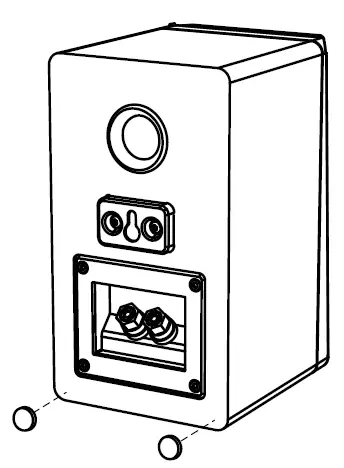
Each Prime Satellite comes from the factory ready to be wall-mounted. The pre-installed keyhole bracket makes hanging your Prime Satellite a simple and convenient process. Simply attach a screw to your wall at the desired mounting location, and insert the keyhole bracket of the speaker over the head of the screw until the speaker rests securely in place. Before hanging, be sure to attach a set of the included rubber bumpers to each lower back corner of the Prime Satellite. These will help keep the speaker level, and prevent spinning on the wall.
When attaching the screw to your wall, it is best to attach it directly into a structural part of the wall, like a stud. If mounting directly to a stud is not a viable option, using drywall or masonry anchors rated to support weights of 10 pounds or more will be sufficient.
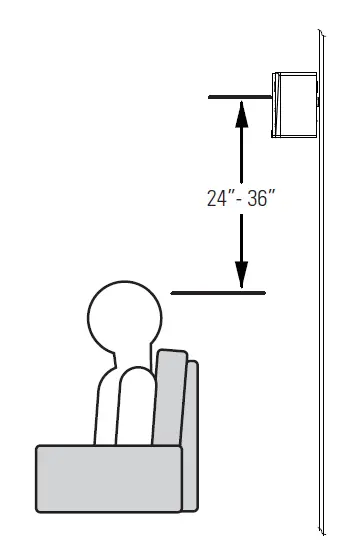
The mounted height of your surround speakers is important to consider when locating the optimal position for you Prime Satellites. For the best sense of spaciousness, we recommend that the tweeter height of your speaker should be about 24-36 inches above ear level at the listening position.
Please contact our Sound Experts if you have any questions or concerns about wall mounting your Prime Satellite.
[email protected] • (877) 626-5623
SETTING UP YOUR PRIME SPEAKERS SPEAKER CONNECTION
CONNECTING YOUR SPEAKERS
All Prime Speakers include terminals with convenient gold-plated 5-way binding posts, which will accept wires terminated with banana plugs, speaker pins, spade connectors and of course, bare wire. Simply attach each Prime Speaker to the appropriate amp channel of your receiver/power amplifier.
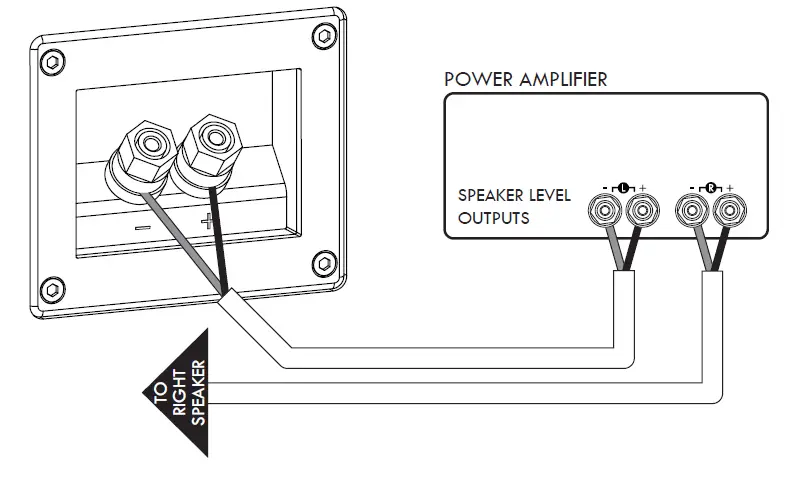
To assure proper performance of your speakers, always be sure to maintain proper polarity between the speaker and the amplifier.
| SPEAKER WIRE – GAUGE/LENGTH RECOMMENDATIONS
18 gauge (AWG) < 10ft |
| 16 gauge (AWG) < 25ft. |
| 14 gauge (AWG) < 50ft. |
| 12 gauge (AWG) < 75ft. |
CARING FOR YOUR PRIME SPEAKERS
Your Prime Speakers may be gently cleaned as follows:
- Use a dry microfiber duster to remove any loose surface dust.
- Use a water-damp microfiber cloth to remove fingerprints, smudges and other contaminants. Wipe in one direction only.
- Follow any damp cleaning immediately with a dry microfiber cloth. Again, dry wipe in one direction only.
5-YEAR UNCONDITIONAL WARRANTY
SVS offers the industry’s most comprehensive warranty on all our products. SVS warrants these Prime Speakers and all of its products to be free from defects in the workmanship for 5 years from date of purchase.
This, and all of the SVS customer Bill of Rights can be viewed online at www.svsound.com/bill-of-rights.
SHARE YOUR THOUGHTS
At SVS, we strive to deliver products that surpass every expectation and provide unbeatable value. After you have had an opportunity to install and audition your Prime Speakers, please share your comments for our team and other customers to see.
PRIME SPEAKER FEATURES AND SPECIFICATIONS
All specifications are subject to change. SVS is constantly working to improve our products and give you, the customer, the best listening experience from your purchase.
PRIME TOWER
FREQUENCY RESPONSE AND ELECTRO-ACOUSTIC DATA:
- Rated bandwidth: 30 Hz-25 kHz (+/-3 dB).
- Nominal impedance: 8 ohms.
- Sensitivity: 87 dB (2.83V @ 1 meter full-space, 300-3kHz).
- Recommended amplifier power: 20-250 watts.
LOUDSPEAKER PHYSICAL DESCRIPTION:
- Black ash and piano gloss black finish options.
- 5-way binding posts.
- Dual 1.7” wide-flared rear-firing ports.
- Cloth grille with pin/cup retention system.
- Cabinet Dimensions: 36″ (H) X 8″ (W) X 10.8″ (D).
- Overall Dimensions: 36.6″ (H) X 8″ (W) X 11.6″ (D) (includes grille, feet and binding posts).
- Weight Unboxed: 40.1 pounds.
DRIVER ARRAY AND TECHNICAL HIGHLIGHTS:
- 1″ tweeter features an FEA-optimized diffuser and aluminum dome.
- 5″ midrange driver features a polypropylene cone, aluminum shorting ring, cast ABS-fiberglass composite basket and vented voice coil former.
- Dual 6.5″ woofers feature long stroke motor and suspension, polypropylene cone, aluminum shorting ring, cast ABS-fiberglass composite basket and vented voice coil former.
SOUNDMATCH CROSSOVER NETWORK:
- 5-way crossover with premium-grade capacitors, air-core inductors and heavy-trace printed circuit boards.
- Tapered woofer array optimizes the transition to the midrange driver and reduces vertical axis lobing.
- Midrange-to-tweeter crossover: 2.1 kHz (12 dB/octave slopes).
- Top woofer (Combined Woofer) to midrange crossover frequency: 350 Hz (12 dB/octave slopes).
- Bottom woofer low pass frequency: 165 Hz (customized filter Q and slope).
CABINET CONSTRUCTION TECHNICAL HIGHLIGHTS:
- Separate sealed midrange enclosure shifts standing waves beyond the driver pass band, improving sound quality.
- Separate woofer enclosures with optimized port tuning frequencies for smooth and accurate bass response.
- Acoustically transparent and FEA optimized grilles minimize diffraction.
- Chamfered front baffle and flush-mounted drivers reduce edge diffraction and improved on-axis high frequency response.
- FEA-optimized cabinet and bracing eliminates resonances.
PRIME BOOKSHELF
FREQUENCY RESPONSE AND ELECTRO-ACOUSTIC DATA:
- Rated bandwidth: 48 Hz-25 kHz (+/-3 dB).
- Nominal impedance: 8 ohms.
- Sensitivity: 87 dB (2.83V @ 1 meter full-space, 300-3kHz).
- Recommended amplifier power: 20-150 watts.
LOUDSPEAKER PHYSICAL DESCRIPTION:
- Black ash and piano gloss black finish options.
- 5-way binding posts.
- 7” wide-flared rear-firing port.
- Cloth grille with pin/cup retention system.
- Elastomer stick-on bumper feet (adds 3mm to height).
- Cabinet Dimensions: 13.2″ (H) X 8″ (W) X 9.4″ (D).
- Overall Dimensions: 13.3″ (H) X 8″ (W) X 10.3″ (D) (includes grille, binding posts and bumper feet).
- Weight Unboxed: 15.5 pounds.
DRIVER ARRAY AND TECHNICAL HIGHLIGHTS:
- 1″ tweeter features FEA-optimized diffuser and aluminum dome.
- 5″ woofer features long stroke motor and suspension, polypropylene cone, aluminum shorting ring, cast ABS-fiberglass composite basket and vented voice coil former.
SOUNDMATCH CROSSOVER NETWORK:
- 2-way crossover with premium-grade capacitors, air-core inductors and heavy-trace printed circuit boards.
- Crossover network delivers outstanding phase coherency and time domain behavior.
- Tweeter-to-woofer crossover: 2.3 kHz (12 dB/octave slopes).
CABINET CONSTRUCTION TECHNICAL HIGHLIGHTS:
- Acoustically transparent and FEA optimized grilles minimize diffraction.
- Chamfered front baffle and flush-mounted drivers reduce edge diffraction and improved on-axis high frequency response.
- FEA-optimized cabinet and bracing eliminates resonances.
PRIME CENTER
FREQUENCY RESPONSE AND ELECTRO-ACOUSTIC DATA:
- Rated bandwidth: 48 Hz-25 kHz (+/-3 dB).
- Nominal impedance: 8 ohms.
- Sensitivity: 86 dB (2.83V @ 1 meter full-space, 300-3kHz).
- Recommended amplifier power: 20-200 watts.
LOUDSPEAKER PHYSICAL DESCRIPTION:
- Black ash and piano gloss black finish options.
- 5-way binding posts.
- Dual 1” wide-flared rear-firing ports.
- Cloth grille with pin/cup retention system.
- Elastomer stick-on bumper feet (adds 3mm to height).
- Cabinet Dimensions: 7.6″ (H) X 18.6″ (W) X 8.3″ (D).
- Overall Dimensions: 7.7″ (H) X 18.6″ (W) X 9.2″ (D) (includes grille, binding posts and bumper feet).
- Weight Unboxed: 20.2 pounds.
DRIVER ARRAY AND TECHNICAL HIGHLIGHTS:
- Vertically aligned tweeter and midrange reduces lobing and comb filtering along the horizontal axis.
- 1″ tweeter features FEA-optimized diffuser and aluminum dome.
- 5″ midrange driver features polypropylene cone, aluminum shorting ring, cast ABS-fiberglass composite basket and vented voice coil former.
- Dual 5.25″ woofers feature long stroke motor and suspension, polypropylene cone, aluminum shorting ring, cast ABS-fiberglass composite basket and vented voice coil former.
SOUNDMATCH CROSSOVER NETWORK:
- 3-way crossover with premium-grade capacitors, air-core inductors and heavy-trace printed circuit boards.
- Midrange-to-tweeter crossover: 2.4 kHz (12 dB/octave slopes).
- Woofer-to-midrange crossover: 350 Hz (12 dB/octave slopes).
CABINET CONSTRUCTION TECHNICAL HIGHLIGHTS:
- Separate sealed midrange enclosure shifts standing waves beyond the driver pass band, improving sound quality.
- Acoustically transparent and FEA optimized grilles minimize diffraction.
- Chamfered front baffle and flush-mounted drivers reduce edge diffraction and improved on-axis high frequency response.
- FEA-optimized cabinet and bracing eliminates resonances.
PRIME SATELLITE
FREQUENCY RESPONSE AND ELECTRO-ACOUSTIC DATA:
- Rated bandwidth: 69 Hz-25 kHz (+/-3 dB).
- Nominal impedance: 8 ohms.
- Sensitivity: 85 dB (2.83V @ 1 meter full-space, 300-3kHz).
- Recommended amplifier power: 20-150 watts.
LOUDSPEAKER PHYSICAL DESCRIPTION:
- Black ash and piano gloss black finish options.
- 5-way binding posts.
- 1” wide-flared rear-firing port.
- Cloth grille with pin/cup retention system.
- Elastomer stick-on bumper feet (adds 3mm to height).
- Keyway bracket for easy and convenient wall mounting (includes extra bumper pads for wall stand-off).
- Cabinet Dimensions: 8.75″ (H) X 4.9″ (W) X 5.53″ (D).
- Overall Dimensions: 8.85″ (H) X 4.9″ (W) X 6.3″ (D) (includes grille, bracket, binding posts and bumper feet).
- Weight Unboxed: 6.5 pounds.
DRIVER ARRAY AND TECHNICAL HIGHLIGHTS:
- 1″ tweeter features FEA-optimized diffuser and aluminum dome.
- 5″ woofer features polypropylene cone, aluminum shorting ring, cast ABS-fiberglass composite basket and vented voice coil former.
SOUNDMATCH CROSSOVER NETWORK:
- 2-way crossover with premium-grade capacitors, air-core inductors and heavy-trace printed circuit boards.
- Crossover network delivers outstanding phase coherency and time domain behavior.
- Tweeter-to-woofer crossover: 2.3 kHz (12 dB/octave slopes).
CABINET CONSTRUCTION TECHNICAL HIGHLIGHTS:
- Acoustically transparent and FEA optimized grilles minimize diffraction.
- Chamfered front baffle and flush-mounted drivers reduce edge diffraction and improved on-axis high frequency response.
- FEA-optimized cabinet and bracing eliminates resonances.
Frequently Asked Questions
Ideally, you shouldn’t adjust your different channels by more than one or two dB. using the receiver gain. If possible, avoid having your mains at +8 and your sub at -8. A little above or below zero is acceptable.
The bottom of your smartphone, which is typically where the microphone is, should be facing one of the drivers as you set it on top of the subwoofer. The test tone for phone calibration will then be played by the subwoofer.
LFE (Low Frequency Effect) is the separate audio data from a Dolby or DTS encoded audio track that is transmitted to the subwoofer. (A 5.1 or 7.1 audio track’s.1) Whether the speaker channels are set to Large or Small, LFE + Main is the low frequencies output to the subwoofer.
Go to Settings > System > Advanced> Reset Options > Reset Wi-fi, mobile, & Bluetooth on Android devices. For iOS and iPadOS devices, you’ll need to unpair every device first, then restart your phone or tablet by going to Settings > Bluetooth, selecting the info icon, then selecting Forget This Device for each device.
When Android Bluetooth stops working, you may occasionally only need to restart the device; this is especially true if it has been on for a while. So, all you have to do is toggle the Bluetooth connection on and off. The Bluetooth symbol will be visible; tap it to turn it off. To turn it on, tap it once more.
In general, speakers should be tuned to a loudness between 70 and 80 dB. Using a decibel meter, this can be determined. The positioning of the speakers, their separation, and the room’s acoustics are a few factors that affect this.
No, the middle shouldn’t be louder than the fronts when tuned properly. The center is not louder because of the setup’s numbers (or not as loud). These changes are available so you may take into account the volume variations across speaker models.
The best way to connect a subwoofer is through the receiver’s subwoofer output, which is usually designated SUB OUT or SUBWOOFER, using an LFE (Low-Frequency Effects) connection. This kind of subwoofer output is available on almost all home theatre receivers, processors, and certain stereo receivers.
Imagine doing the opposite of using a Y splitter to separate two different channels. The receiver is where this is done. The right sound can now be sent to the subwoofer after the left and right signals were integrated into one channel.
You can use an aux cable to connect the device if it supports aux. You will need to purchase a Bluetooth adapter and attach it straight to this port if your other devices use USB ports. Connect it to the speaker you already have.