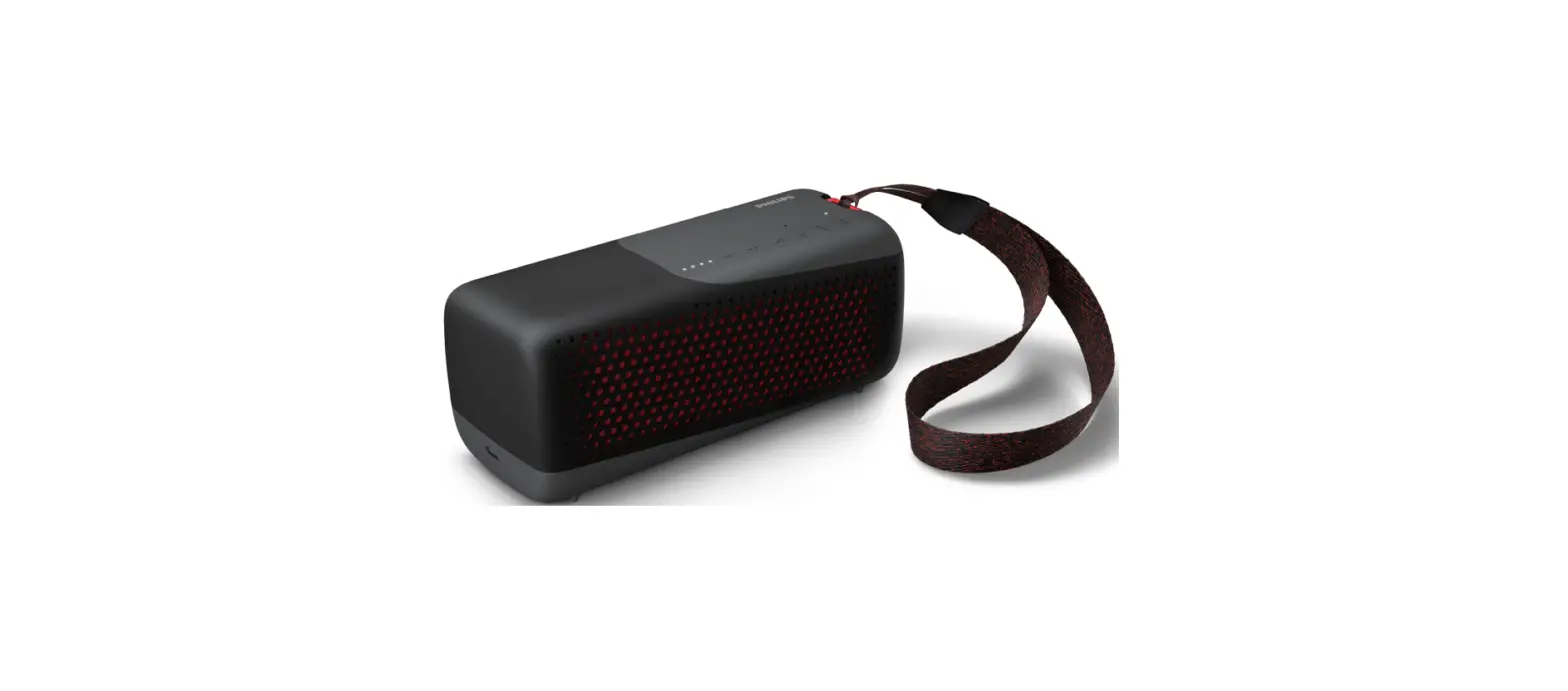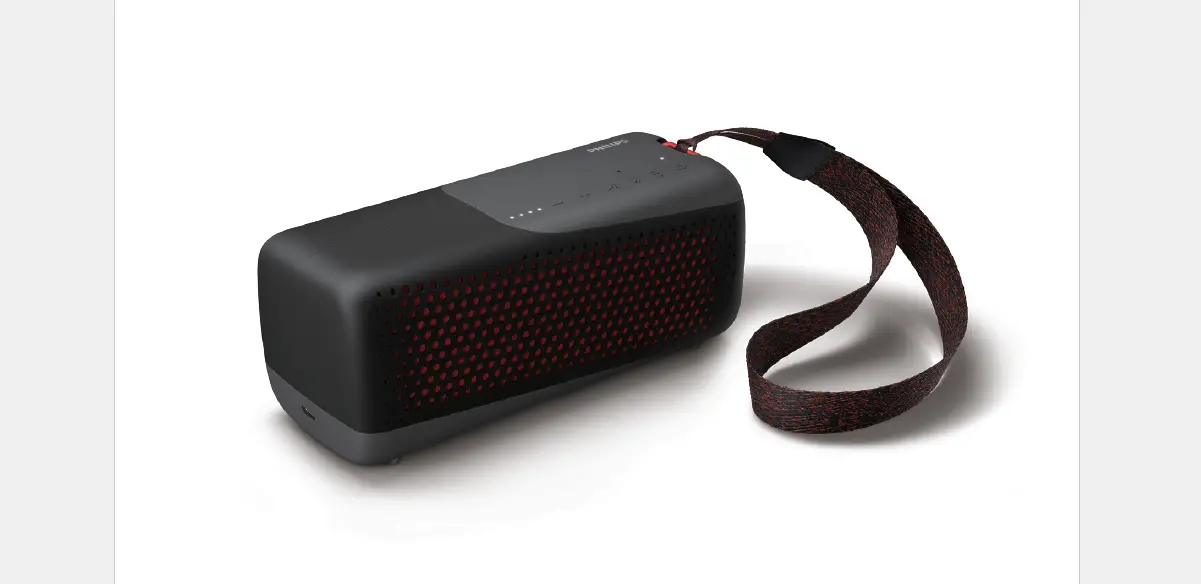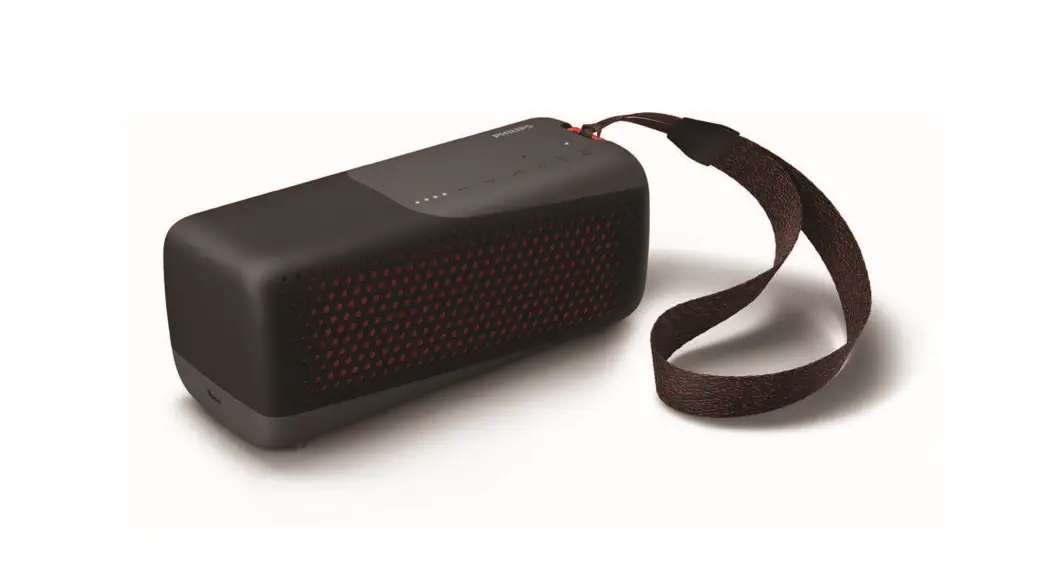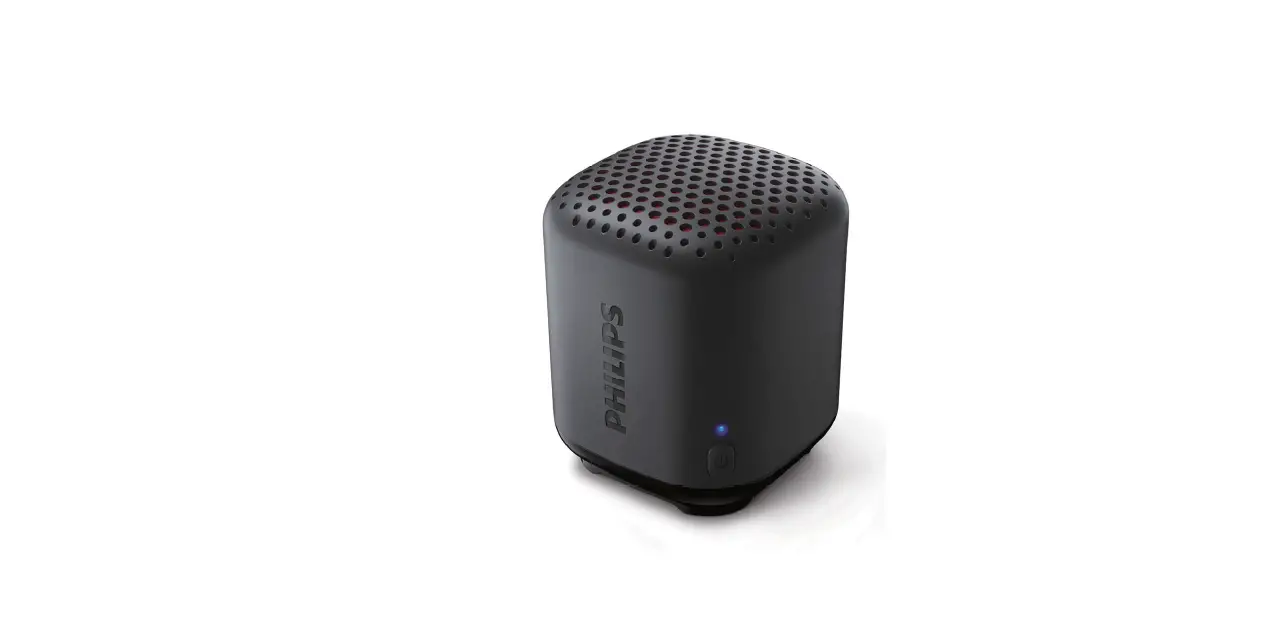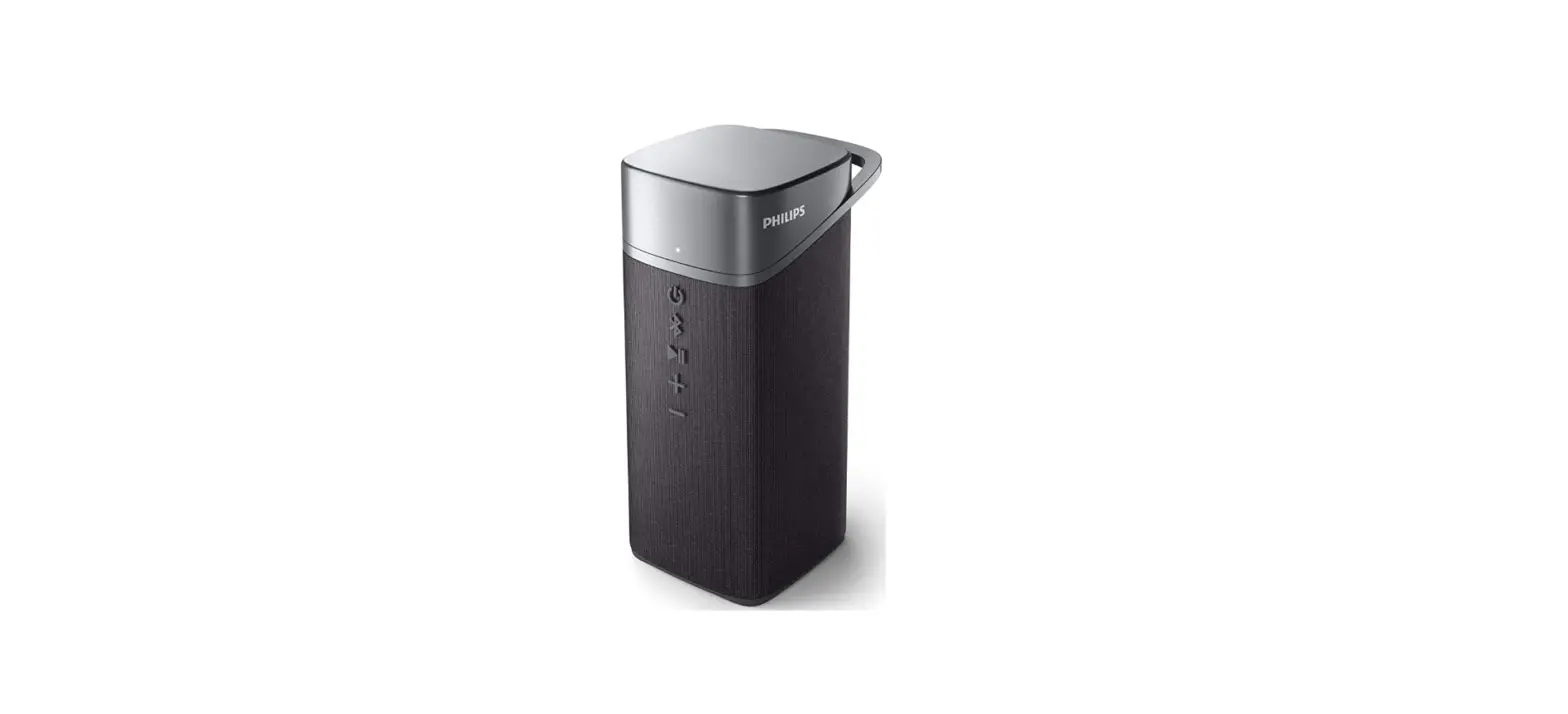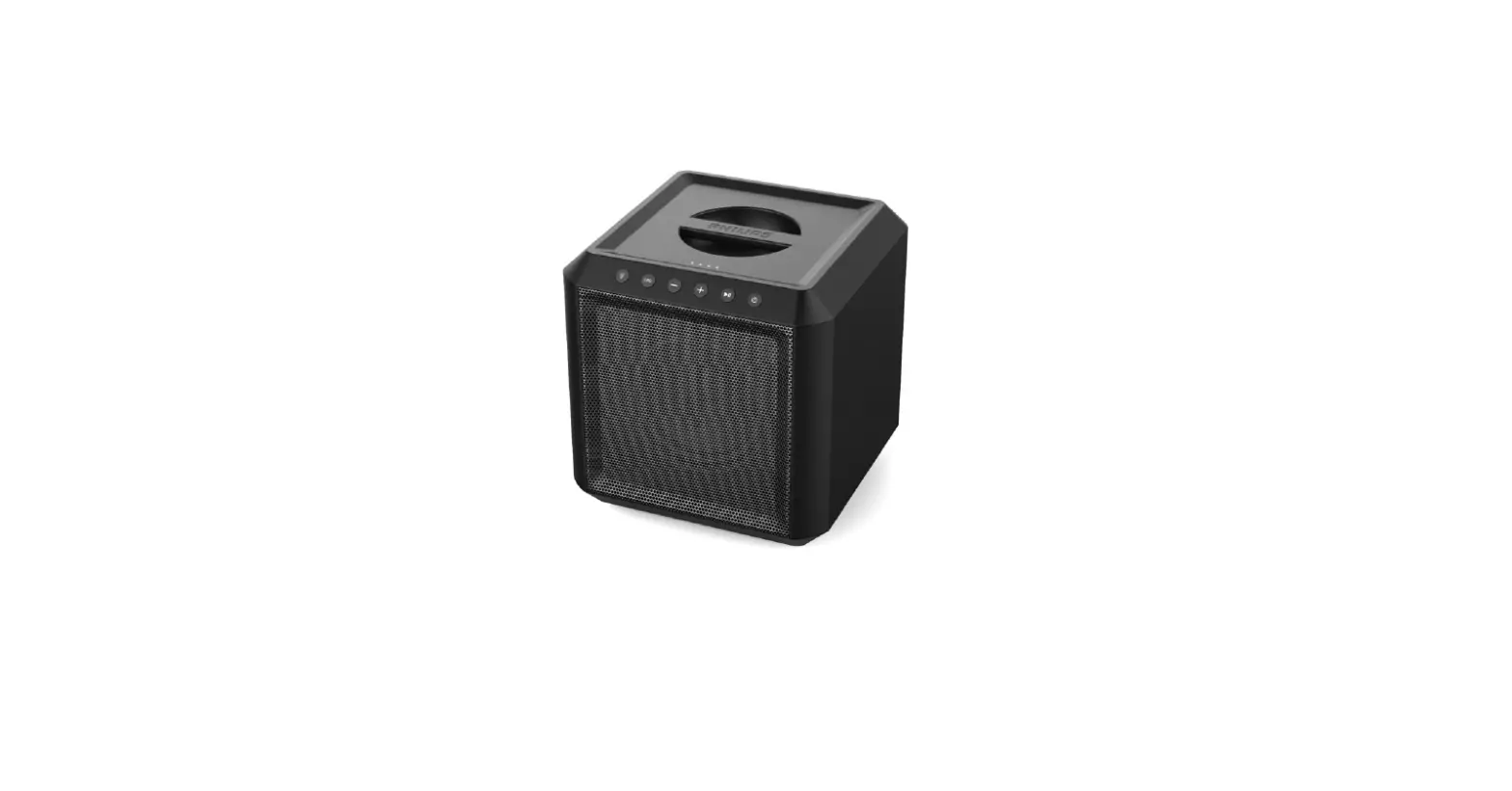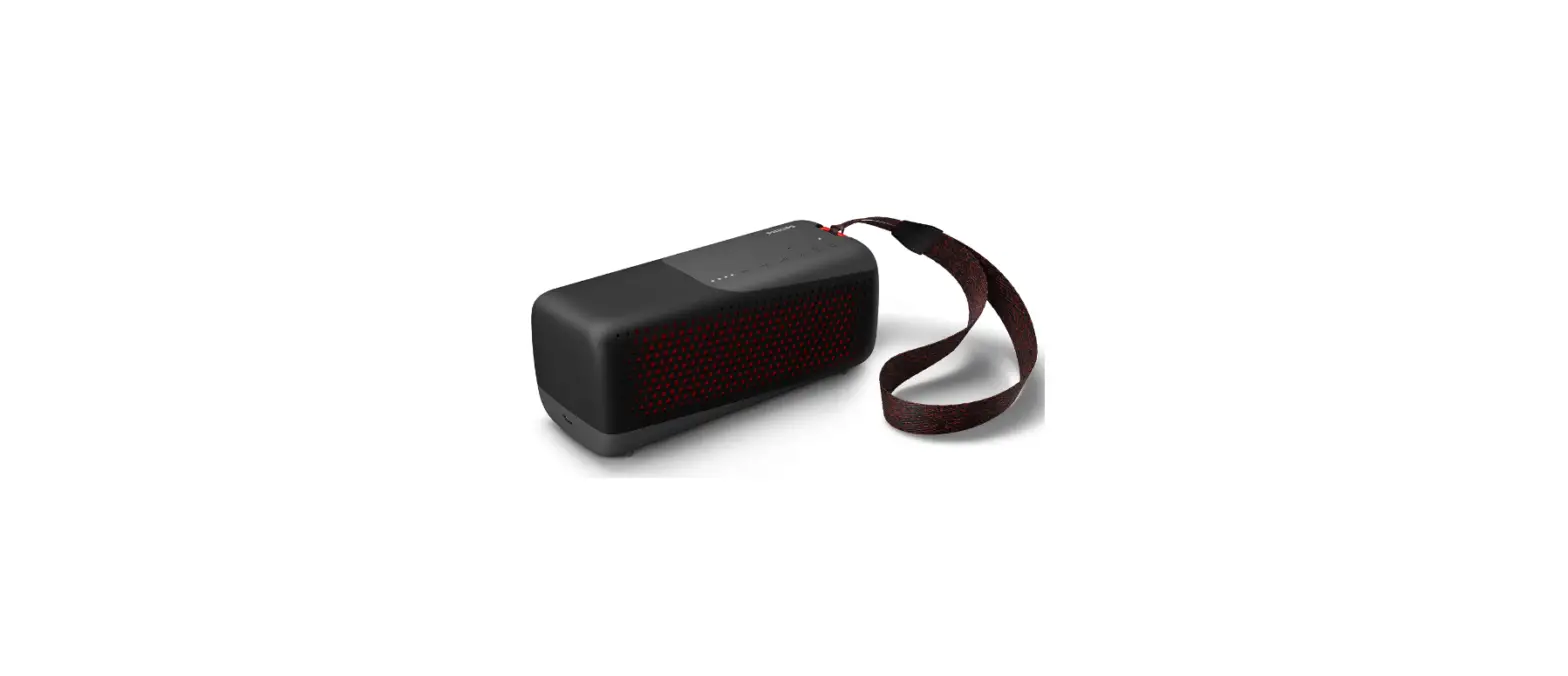

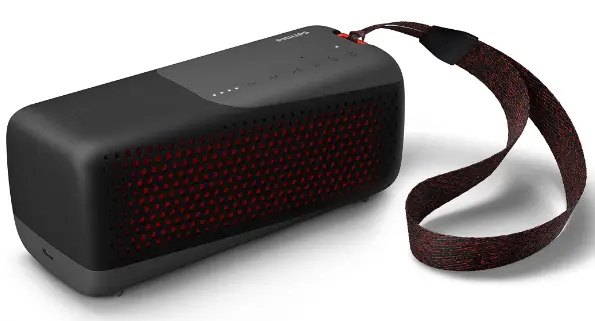
Philips S4807 Outdoors Wireless Bluetooth Speaker
Important Safety
Important safety instructions
- Make sure that the power supply voltage corresponds to the voltage on the back or the underside of the unit.
- The speaker shall not be exposed to dripping or splashing.
- Do not place any source of danger on the speaker (e.g. liquid filled objects, lit candles).
- Make sure that there is enough free space around the speaker for ventilation.
- Please use the speaker safely in an environment with temperature between 0℃ and 45℃.
- Only use attachments and accessories specified by the manufacturer.
Battery safety precautions
- Danger of explosion if a battery is incorrectly replaced. Replace only with the same or equivalent type.
- A battery (battery pack or battery installed) shall not be exposed to excessive heat such as sunshine, fire or the like.
- A battery in extreme high or low temperatures during use, storage or transportation, and low air pressure at high altitude can pose safety hazards.
- Do not replace a battery with an incorrect type that can defeat a safeguard (for example, some lithium battery types)
- Disposing a battery into fire or a hot oven, mechanically crushing or cutting a battery can result in an explosion.
- Leaving a battery in an extremely high temperature surrounding, or an extremely low air pressure environment may result in an explosion or leakage of flammable liquid or gas.
Warning
- Never remove the casing of this speaker.
- Never lubricate any part of this speaker.
- Place this speaker on a fat, hard and stable surface.
- Never place this speaker on other electrical equipment.
- Only use this speaker indoors. Keep this speaker away from water, moisture and liquid-filled objects.
- Keep this speaker away from direct sunlight, naked flames or heat.
- Risk of explosion if a battery is replaced by an incorrect type.
Your wireless speaker
Congratulations on your purchase, and welcome to philips! To fully benefit from the support that philips offers, register your product at www.philips.com/support
What’s in the box
Check and identify the contents of your package:
- Speaker
- USB cable
- Quick start guide
- Safety sheet
- Worldwide warranty
- Lanyard
Overview of the speaker
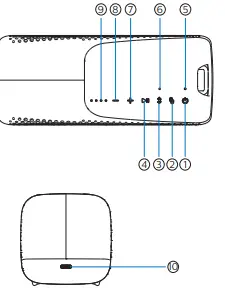
 Turn the speaker on or of.
 Press and hold to enter stereo pairing mode.
 Enter Bluetooth pairing mode.
- Clear Bluetooth pairing information.
 In Bluetooth mode, press to pause or resume play.
- Respond to an incoming call through Bluetooth connection.
- Press and hold to trigger voice assistant of your mobile device.
- Power/Bluetooth LED indicator
- Power/Bluetooth light.
- Microphone
 Increase volume.
 Decrease volume.
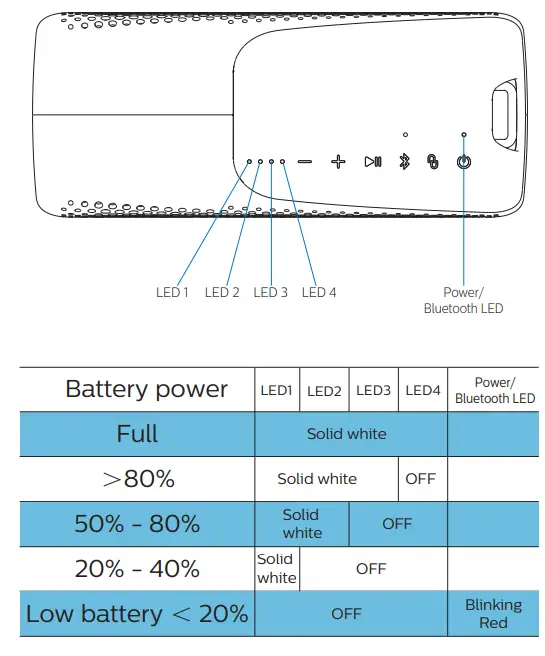
- Battery level indicators
- Show the charging progress.
- Show the battery level: To check battery status, press any other keys but not , as will trigger the power off
- DC IN
- Charge the built-in battery
 Turn the speaker on or of.
 Press and hold to enter stereo pairing mode.
 Enter Bluetooth pairing mode.
 In Bluetooth mode, press to pause or resume play.
 Increase volume.
 Decrease volume.
Get started
Always follow the instructions in this chapter in sequence.
Charge the built-in battery
The speaker is powered by a built-in rechargeable battery
Note
- Fully charge the built-in battery before using.
- When the speaker is turned on and the battery is low, the Power/Bluetooth LED indicator blinks red.
Connect the USB-C socket on the speaker to an outlet (5V 2A) by using the provided USB cable.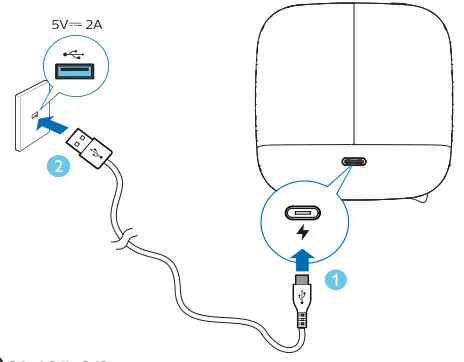
Power on
- When the speaker is being charged, Power/Bluetooth LED blinks red slowly.
- When the speaker is fullycharged, Power/Bluetooth LED is solid white.

Power off
- When the speaker is being charged,
- Power/Bluetooth LED blinks red slowly.
- When the speaker is fully charged,
- Power/Bluetooth LED is of.
Caution
- Risk of speaker damage! Make sure the power supply voltage corresponds to the voltage printed on the back or the underside of the speaker.
- Risk of electric shock! When unplug the
- USB cable, always pull the plug from the socket. Never pull the cable.
- Use only a USB cable specifed by the manufacturer or sold with this speaker.
TURN OFF
- Press to turn the speaker on.
- You will hear the prompt sound.
- To turn the speaker oF, press again.
- You will hear the prompt sound.
Note
The speaker will turn of automatically if there is no audio signal from Bluetooth for 15 minutes.
Play from Bluetooth devices
Play from Bluetooth devices
With this speaker, you can enjoy audio from your Bluetooth device..
Note
- Make sure that the Bluetooth function is enabled on your device.
- The maximum distance for pairing the speaker and your Bluetooth device is 20 meters (66 feet).
- Keep away from any other electronic device that may cause interference
- Press
 to turn the speaker on. It will enter Bluetooth pairing mode automatically. You can also press and hold
 for 3 seconds to enter Bluetooth pairing mode.
 - Enable Bluetooth and select “Philips S4807” in the Bluetooth list on your device for pairing.
- If a message prompts for permission for Bluetooth connection, confirm it.
- If a password is required, enter 0000 and then confirm.
- Play audio on your Bluetooth device to start music streaming.
 to turn the speaker on. It will enter Bluetooth pairing mode automatically. You can also press and hold
 for 3 seconds to enter Bluetooth pairing mode.
Note
- To disconnect a device, press and hold for 3 seconds until the Power/ Bluetooth LED indicator blinks white quickly.
- To clear the pairing information, pres and hold for 8 seconds until the Power/Bluetooth LED indicator blinks white slowly for 3 times.
Multi-point connection
Pairing
Pair the speaker to two devices, e.g. mobile phone and notebook
Switch between devices
- Music can only be played from one device at a time. The other device will be reserved for phone calls.
- Pause the audio from one device to start playing audio from the other device.
Note
- Receiving a call on Device 2 will pause playback on Device 1. The call will be routed automatically to your speaker.
- Ending the call will resume playback f r o m Device 1 automatically.
Control playback
During music playback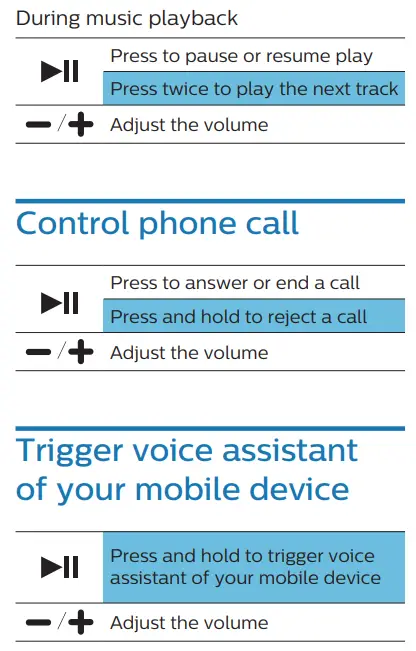
Pairing for stereo mode
Two identical wireless speakers (Philips S4807) can pair with each other for stereo sound
Note
- Any speaker can be used as the primary speaker.
- The speaker connected to a Bluetooth device can only be used as the primary speaker.
- Before stereo pairing, make sure that the secondary speaker is under Bluetooth pairing mode.
- Keep a maximum distance of 20 meters (66 feet) between the speaker and your Bluetooth device.
- In stereo mode, the button operation on the secondary speaker is as same as that of the primary speaker.
- Press to power on both speakers, and they will enter Bluetooth pairing mode automatically. The speaker connected to your Bluetooth device will be used as the primary speaker.
- On both speakers, press and hold to enter stereo pairing mode until the LED blinks red and white alternatively. You will hear a prompt sound when successfully connected and Power/Bluetooth LED is solid white.
- Press on either speaker. The music will be played through both speakers.
- To exit the stereo mode, press and hold the on either speaker.
Product information

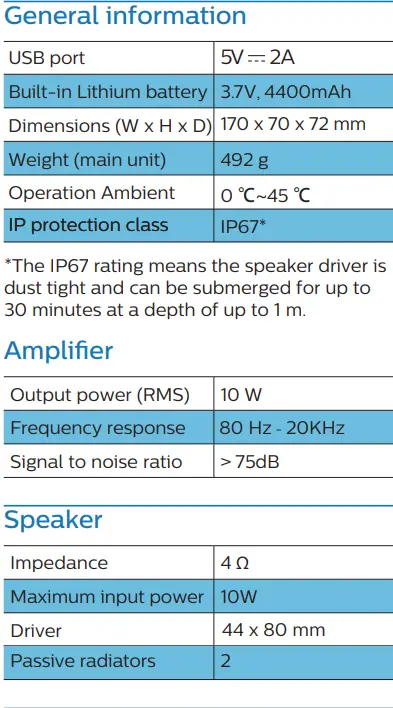
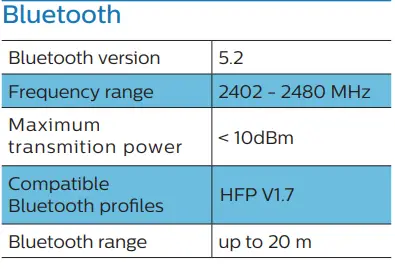
Troubleshooting
To keep the warranty valid, never try to repair the speaker yourself. If you encounter problems when using this speaker, check the following points before requesting service. If the problem remains unsolved, go to the Philips website (www.philips.com/support). When you contact philips, ensure that the speaker is nearby and the model number and serial number are available.
General
No power
- Make sure the speaker is fully charged.
- Make sure the USB socket of the speaker is properly connected.
- As a power-saving feature, the speaker turns of automatically 15 minutes after no audio signal is received.
No sound
- Adjust the volume on this speaker.
- Adjust the volume on the connected device.
- Make sure that your Bluetooth device is within the operational range.
- No response from the speaker
- Restart the speaker.
Bluetooth
- The audio quality is poor after connection with a Bluetooth-enabled device
- The Bluetooth reception is poor. Move the device closer to this speaker or remove any obstacle between them.
- Fail to find [Philips S4807] on your Bluetooth device for pairing
- Press and hold for 3 seconds to enter Bluetooth pairing mode, and then try again.
- Cannot connect with your Bluetooth device
- The Bluetooth function of your device is not enabled. Refer to the user manual of your device to fnd out how to enable the function.
- This speaker is not in pairing mode.
- This speaker is already connected to another Bluetooth-enabled device. Disconnect and try again
Notice
Any changes or modifications made to this device that are not expressly approved by MMD Hong Kong Holding Limited may void the user’s authority to operate the equipment.
Compliance
Hereby, TP Vision Europe B.V. declares that this product is in compliance with the essential requirements and other relevant provisions of Directive 2014/ 53/EU. You can nd the Declaration of Conformity on www.philips.com/support
Care of the environment
Disposal of your old product and battery
Your product is designed and manufactured with high quality materials and components, which can be recycled and reused. This symbol on a product means that the product is covered by European Directive 2012/19/EU. This symbol means that the product contains batteries covered by European Directive 2013/56/EU which cannot be disposed of with normal household waste.
Inform yourself about the local separate collection system for electrical and electronic products and batteries. Follow local rules and never dispose of the product and batteries with normal household waste. Correct disposal of old products and batteries helps prevent negative consequences for the environment and human health.
Removing the integrated batteries
Make sure the product is disconnected from power before removing the integrated battery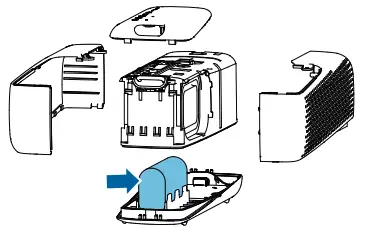
Environmental information
All unnecessary packaging has been omitted. We have tried to make the packaging easy to separate into three materials: cardboard (box), polystyrene foam (buffer) and polyethylene (bags, protective foam sheet). Your system consists of materials which can be recycled and reused if disassembled by a specialized company. Please observe the local regulations regarding the disposal of packaging materials, exhausted batteries and old equipment. Disposal of a battery into fire or a hot oven, or mechanically crushing or cutting of a battery, can result in an explosion.
FCC and IC statement
FCC information
The device complies with the FCC rules, Part 15. Operation is subject to the following two conditions: This device may not cause harmful interference, and. This device must accept any interference received, including interference that may cause undesired operation.
Warning: Changes or modifications not expressly approved by the party responsible for compliance could void the user’s authority to operate the equipment
Note: This equipment has been tested and found to comply with the limits for a Class B digital device, pursuant to Part 15 of the FCC Rules
These limits are designed to provide reasonable protection against harmful interference in a residential installation. This equipment generates, uses and can radiate radio frequency energy and, if not installed and used in accordance with the instructions, may cause harmful interference to radio communications. However, there is no guarantee that interference will not occur in a particular installation. If this equipment does cause harmful interference to radio or television reception, which can be determined by turning the equipment of and on, the user is encouraged to try to correct the interference by one or more of the following measures:
- Reorient or relocate the receiving antenna.
- Increase the separation between the equipment and receiver.
- Connect the equipment into an outlet on a circuit dfferent from that to which the receiver is connected.
- Consult the dealer or an experienced radio/TV technician for help.
RF Warning Statement
The device has been evaluated to meet general RF exposure requirements. The device can be used in portable exposure conditions without restriction.
IC-Canada: CAN ICES-3(B)/NMB-3(B)
This device contains licence-exempt transmitter(s)/receiver(s) that comply with Innovation, Science and Economic Development Canada’s licence-exempt RSS(s). Operation is subject to the following two conditions: 1. This device may not cause interference. 2. This device must accept any interference, including interference that may cause undesired operation of the device.
Trademark notice
Bluetooth
The Bluetooth® word mark and logos are registered trademarks owned by the Bluetooth SIG, Inc. and any use of such marks by MMD Hong Kong Holding Limited is under license. Other trademarks and trade names are those of their respective owners.
Trademarks
Specifications are subject to change without notice. Philips and the Philips Shield Emblem have registered trademarks of Koninklijke Philips N.V. and are used under license. This product has been manufactured by and is sold under the responsibility of MMD Hong Kong Holding Limited or one of its affiliates, and MMD Hong Kong Holding Limited is the warrantor in relation to this product. TAS4807_00_UM_V1.0
FAQS
There are two ways to go wireless—WiFi and Bluetooth. WiFi speakers connect to your home network. Because most run on AC power, they usually require an outlet. Bluetooth speakers pair directly with a device such as a phone or laptop.
When choosing what kind of speakers to use, there is one thing that matters above all else: sound quality. Almost across the board, Wi-Fi speakers have better sound quality than Bluetooth speakers. Bluetooth compresses the data more than Wi-Fi speakers.
Yes. You can use Bluetooth without Wi-Fi. In fact, Bluetooth does not need any internet access at all to be set up and used. However, you will find many Bluetooth devices are also capable of connecting to the internet
Bluetooth speakers connect at varying ranges. Most will reach distances of around 30 feet (9 meters) all the way up to 100 feet (30 meters), depending on the size and style you choose
They connect wirelessly to your smartphone, tablet, or other device, so there’s no additional wires, or anything else, that you need to make them work. Most are also fairly portable, making them easy to take them to the park, the beach, or anyplace else that a group of people may want to listen to music together
Bluetooth signals are transmitted via radio waves, a type of electromagnetic radiation. This means that they can travel through objects, including walls
Bluetooth allows for short-range data transfer between devices. As an example, it is commonly employed in headsets for mobile phones, enabling hands-free phone use. Wi-Fi, on the other hand, allows devices to connect to the Internet.
Wi-Fi networks and Bluetooth connections can be vulnerable points of access for data or identity theft.
Change the position or location of the unit or connected device. If the connected device has a cover on it, take it off to improve the communication distance. If the connected device is in a bag or in a pocket, try moving the position of the device. Place the devices closer together to improve signal transmission
Bluetooth technology offers convenience – from hands-free phone calls to wireless file-sharing to playing music on a vehicle’s speakers. But leaving your Bluetooth on all the time can be dangerous, and hackers are exploiting the technology to access private information, spread malicious software and more.
Bluetooth itself doesn’t use extra mobile data, but if you use a mobile or Wi-Fi network to connect to the internet and stream, say, a TV program, you’ll use up your data allowance (if you have one)
Yes, most wireless speakers use AC adaptors and plug into an ordinary power outlet or power strip. Some systems use rechargeable batteries to become ‘fully wireless’ but this feature requires charging and repositioning as regular chores in order to use this kind of surround sound system
NO! the speaker not include a microphone
YES! It allows for aux or memory card input to play music