 INSTRUCTION MANUAL
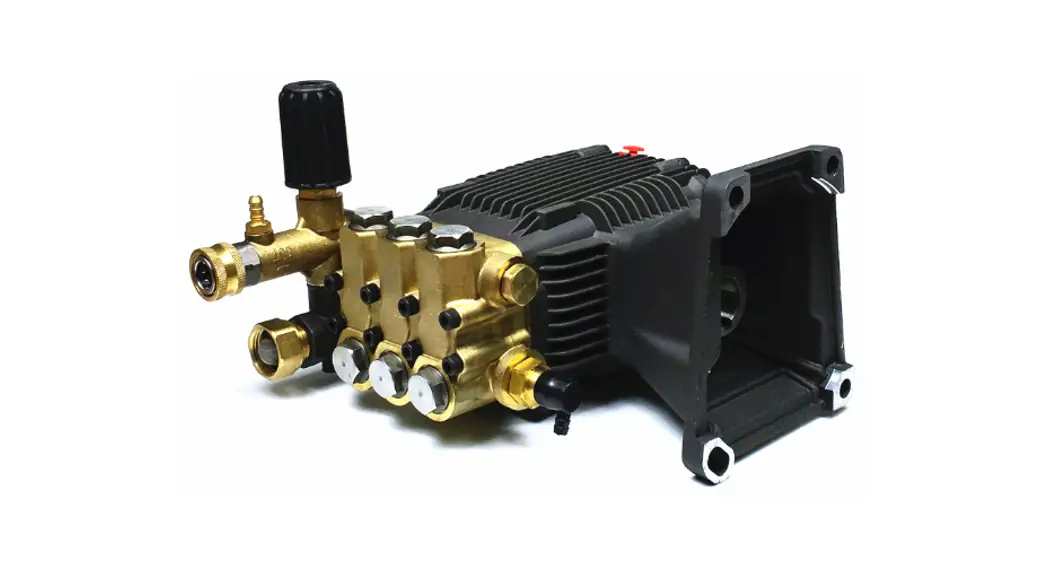
TOOLCY OEM QUALITY POWER WASHER PUMP
TECHNICAL SPECIFICATION
| Type | Triplex |
| Manifold | Brass |
| Crankcase | Aluminum Alloy |
| Bearing | Double Bearing |
| Self suction | NO |
| Inlet Connector | 3/4” NH Garden Hose |
| Outlet Connector | 3/8” Socket Outlet |
GENERAL SAFETY INFORMATION
 | The pump is designed to pump non-flammable or non-explosive fluids. These pumps are intended to pump clean filtered water only. |
 | – Do not operate in or around an explosive environment. |
 | – Always wear safety glasses or goggles and appropriate clothing. |
 | – Do not allow children to operate the pump. – Never point the high-pressure discharge at a person, any part of the body or animals. |
 | Do not operate gasoline engines in a confined area and always have adequate ventilation. |
 | – Do not exceed the pump specifications in speed or pressure. – Do not alter the pump from the manufacturers design. |
MISUSES
Do not put the pump into service until the plant or machinery in which it is incorporated has been declared compliant with the relevant national and local legal requirements.
Do not use the pump in a potentially explosive atmosphere.
Do not use the pump for flammable, toxic or corrosive liquids, or those with unsuitable density.
Do not take in liquids at temperatures higher than those specified in the technical data.
Do not use the pump for the supply of drinking water.
Do not use the pump on products for human consumption.
Do not use the pump on pharmaceutical products.
INSTALLATION
The mechanical connection between the pump and the motive power source may be made by means of a pulley and belt, or a flexible coupling, or througha direct flanged connection to the motive power source. The crankshaft mayturn in either direction. Connect the pump to filtered, clean water sources.
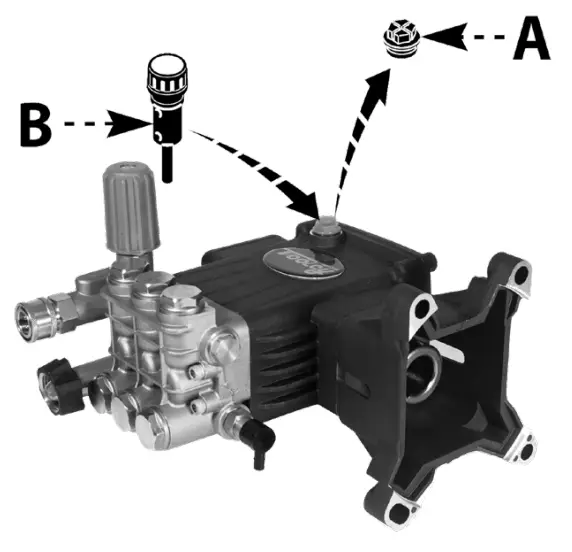
Unscrew the plugs fitted on the various ports in the factory by the manufacturer, and screw the plugs onto the ports not used, depending on connection requirements. Replace the oil plug (A), used for shipment with the breather plug (B) supplied.
(A) Temporary oil plug
(B) Oil plug with breather
INSTALLATION DIRECT DRIVE PUMPS
- Install the shaft key into the keyway and apply a light coating of anti-seize on the engine shaft.
- Align the two key ways and push the pump completely onto the engine.
- Install all bolts and tighten evenly.
- Remove protection cap of outlet and unloader valve.
- Install the appropriate water inlet fitting (3/4”-11.5 NH).
- Connect the water supply hose and outlet (M22x1.5-14 Hose or adapter) and high-pressure discharge hose/spray gun.
- Turn on the water supply.
- Open the spray gun to purge the system of any air.
- Start the engine.
- Adjust the engine speed at rated 3,400 RPM will get best performance.
- Open gun trigger check if pump is working well and installation and connection are all good.
NOTE:
Please read and save these instructions. Read carefully before attempting to assemble, install, operate or maintain the product described. Protect yourself and others by observing all safety information. Failure to comply with instructions could result in personal injury and/or property damage! Retain instructions for future reference.
MOUNTING THE PUMP
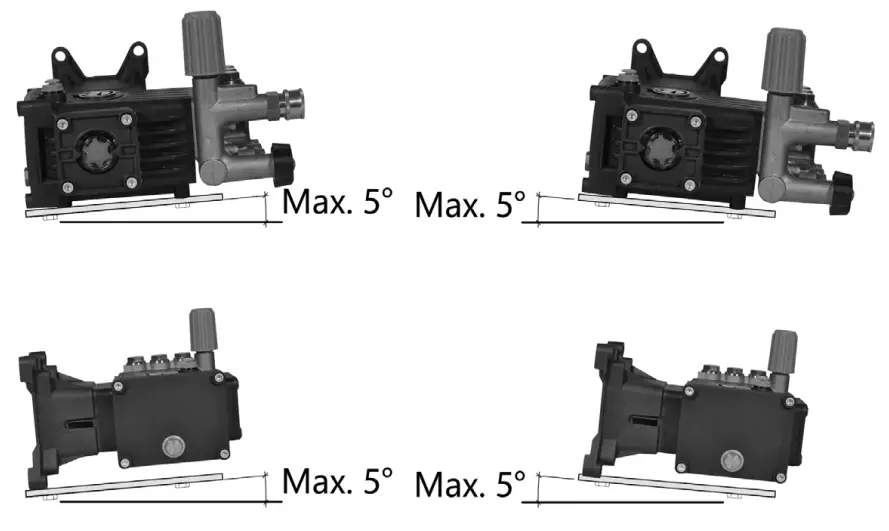
The pump must be installed on a horizontal surface with no flexible components between it and the mounting surface.
The illustration shows the maximum permitted pump installation angle beyond which proper lubrication of the crank mechanism is not ensured.
Secure the pump with screws of suitable diameter and length, fixing them through the holes provided in the pump body.
SAFETY RECOMMENDATIONS FOR USE
Befor start-up, the operator must perform the necessary safety checks.
In the event of leaks from the pressurised pipes, stop the pump at once and remove the cause of the leak.
Do not operate the pump above the limits set by the manufacturer to increase its performance.
If the system is to be shut down with ambient temperatures close to 0°c, run the pump without water for 10 seconds with the end of the delivery pipeline open to empty the system and pump of water and prevent ice from forming.
CHECKING THE OIL LEVEL
– Check the oil with the pump level and cold.
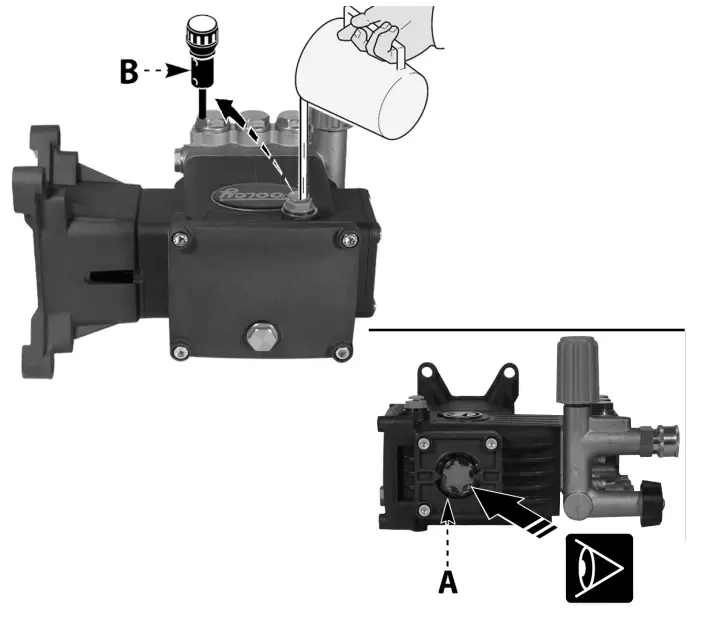
– Check the amount of oil through the level gauge (A).
– If necessary, top up with oil with the characteristics specified in the “Lubricants table”.
To top up with oil proceed as described below.
- Unscrew the plug (B) and pour oil in until it is halfway up the level gauge (A).
- Screw on the plug (B).
CHANGING THE OIL
Position the machine in which the pump is incorporated perfectly level, with the pump slightly warm. Do not release oil into the environment.
Dispose of spent oil in accordance with statutory requi rements.
To change the oil, proceed as described below:
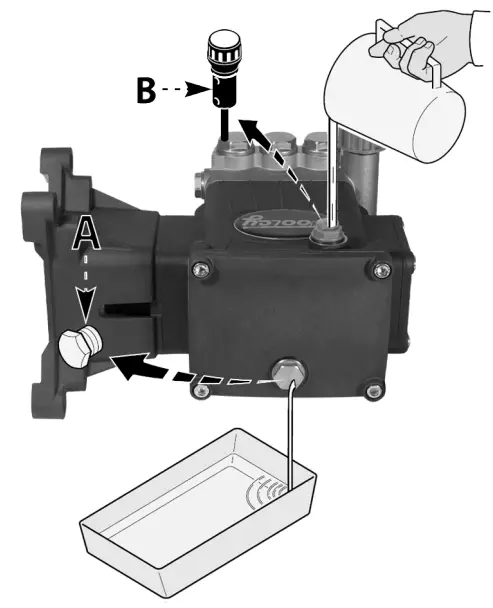
- Position a receptacle of suitable capacity to collect the spent oil.
- Unscrew the drain plug (A) and allow all the oil to flow out.
- Screw on the drain plug (A).
- Unscrew the filler plug (B).
- Pour in the fresh oil through the filler hole until the correct level is reached (see “Checking the oil level”).
- Screw on the filler plug (B).
TROUBLESHOOTING GUIDE
| Symptom | Possible Cause(s) | Corrective Action |
| Low Pressure | Worn nozzle | Replace nozzle, of proper size |
| Belt slippage | Tighten or replace; use correct belt | |
| Air leak in inlet plumbing | Disassemble, reseal and reassemble | |
| Relief valve studk, partially plugged or improperly adjusted valve seat worn | Clean, adjust relief valve; check for worn and dirty valve seats. Kit available | |
| Inlet suction strainer clogged or improperly sized | Clean. Use adequate size. Check more frequently | |
| Worn packing. Abrasives in pumped fluid or severe cavitation. Inadequate water | Install proper filter. Suction at inlet manifold must be limited to lifting less than 20 feet of water or -8.5 PSI vacuum | |
| Fouled or dirty inlet or discharge valves | Clean inlet and discharge valve assemblies | |
| Worn inlet, discharge valve block or dirty | Replace worn valves, valve seats and/or discharge hose | |
| Leaky discharge hose | ||
| Oil leak between crankcase and pumping section | Worn rod oil seals | Replace crankcase piston rod seals |
| Frequent or premature failure of the packing | Cracked, damaged or worn plunger | Replace plungers |
| Overpressure to inlet manifold | Reduce inlet pressure | |
| Material in the fluid being pumped | Install proper filtration on pump inlet plumbing | |
| Excessive pressure and/or temperature of fluid being pumped | Check pressures and fluid inlet temperature; be sure they are within specified range | |
| Running pump dry | Do not run pump without water | |
| Pump runs but produces no flow | Pump is not primed | Flood suction then restart pump |
| Pump fails to prime | Air is trapped inside pump | Disconnect discharge hose from pump. Flood suction hose, restart pump and run pump until all air has been evacuated |
| Pump looses prime, chattering noise, pressure fluctuates | Air leak in suction hose or inlet | Remove suction line and inspect it fora loose liner or debris lodged in hose. Avoid all unnecessary bends. Do not kink hose |
| Clogged suction strainer | Clean strainer | |
| Low pressure at nozzle | Unloader valve is by-passing | Make sure unloader is adjusted property and by-pass seat is not leaking |
| Incorrect or worn nozzle | Make sure nozzle is matched to the flow and pressure of the pump. If the nozzle is worn, replace | |
| Worn packing or valves | Replace packing or valves | |
| Pressure gauge fluctuates | Valves worn or blocked by foreign bodies | Clean or replace valves |
| Packing worn | Replace packing | |
| Pump runs extremely rough, pressure very low | Inlet restrictions and/or air leaks. | Clean out foreign material |
| Stuck inlet or discharge valve | Replace worn valves | |
| Slight leak, oil leaking in the area of crankshaft o-ring | Worn crankshaft seal or improperly installed oil seal | Remove oil seal retainer and replace damaged 0-ring and/or seals |
| Bad bearing | Replace bearing | |
| Water leakage from under manifold | Worn packing or cracked plunger | Install new packing or plunger |
| Excessive play in the end of the crankshaft pulley | Worn main bearing from excessive tension on drive belt | Replace crankcase bearing and/or tension drive belt |
| Water in crankcase | Humid air condensing into water inside the crankcase | Change oil intervals |
| Worn packing and/or cracked plunger | Replace packing. Replace plunger | |
| Loud knocking noise in pump | Cavitation or sucking air | Check water supply is turned on |
| Pulley loose on crankshaft | Check key and tighten set screw | |
| Broken or worn bearing | Replace bearing |