
intel UG-01166 Altera High-speed Reed-Solomon IP Core
About the High-speed Reed-Solomon IP Core
The Altera High-speed Reed-Solomon IP Core uses a highly parallel architecture for large applications that require throughput of 100 Gbps and greater. The IP core is suitable for 10G (such as optical transport networks (OTN)) or 100G Ethernet (IEEE 802.3bj/bm) applications.
Related Links
- Introduction to Intel FPGA IP Cores
- Provides general information about all Intel FPGA IP cores, including parameterizing, generating, upgrading, and simulating IP cores.
- Creating Version-Independent IP and Qsys Simulation Scripts
- Create simulation scripts that do not require manual updates for software or IP version upgrades.
- Project Management Best Practices
- Guidelines for efficient management and portability of your project and IP files.
- Reed-Solomon II IP Core User Guide
- The Reed-Solomon II IP core is highly parameterizable for low throughput applications.
High-speed Reed-Solomon IP Core Features
- High-performance greater than 100 Gbps encoder or decoder for error detection and correction:
- Fully parameterizable:
- Number of bits per symbol
- Number of symbols per codeword
- Number of check symbols per codeword
- Field polynomial
- Multichannels and backpressure for decoders
- Fracturable decoder that supports 100 Gbps Ethernet (GbE), 2 x 50 GbE, and 4 x 25 GbE
- Avalon® Streaming (Avalon-ST) interfaces
- Testbenches to verify the IP core
- IP functional simulation models for use in Intel-supported VHDL and Verilog HDL simulators
© 2016 Intel Corporation. All rights reserved. Intel, the Intel logo, Altera, Arria, Cyclone, Enpirion, MAX, Megacore, NIOS, Quartus and Stratix words and logos are trademarks of Intel Corporation in the US and/or other countries. Other marks and brands may be claimed as the property of others. Intel warrants performance of its FPGA and semiconductor products to current specifications in accordance with Intel’s standard warranty, but reserves the right to make changes to any products and services at any time without notice. Intel assumes no responsibility or liability arising out of the application or use of any information, product, or service described herein except as expressly agreed to in writing by Intel. Intel customers are advised to obtain the latest version of device specifications before relying on any published information and before placing orders for products or services.
DSP IP Core Device Family Support
Intel offers the following device support levels for Intel FPGA IP cores:
- Advance support—the IP core is available for simulation and compilation for this device family. FPGA programming file (.pof) support is not available for Quartus Prime Pro Stratix 10 Edition Beta software and as such IP timing closure cannot be guaranteed. Timing models include initial engineering estimates of delays based on early post-layout information. The timing models are subject to change as silicon testing improves the correlation between the actual silicon and the timing models. You can use this IP core for system architecture and resource utilization studies, simulation, pinout, system latency assessments, basic timing assessments (pipeline budgeting), and I/O transfer strategy (data-path width, burst depth, I/O standards tradeoffs).
- Preliminary support—Intel verifies the IP core with preliminary timing models for this device family. The IP core meets all functional requirements, but might still be undergoing timing analysis for the device family. You can use it in production designs with caution.
- Final support—Intelverifies the IP core with final timing models for this device family. The IP core meets all functional and timing requirements for the device family. You can use it in production designs.
DSP IP Core Device Family Support
| Device Family | Support |
| Arria® II GX | Final |
| Arria II GZ | Final |
| Arria V | Final |
| Arria 10 | Final |
| Cyclone® IV | Final |
| Cyclone V | Final |
| MAX® 10 FPGA | Final |
| Stratix® IV GT | Final |
| Stratix IV GX/E | Final |
| Stratix V | Final |
| Stratix 10 | Advance |
| Other device families | No support |
DSP IP Core Verification
Before releasing a version of an IP core, Intel runs comprehensive regression tests to verify its quality and correctness. Intel generates custom variations of the IP core to exercise the various parameter options and thoroughly simulates the resulting simulation models with the results verified against master simulation models.
High-speed Reed-Solomon IP Core Release Information
Use the release information when licensing the IP core.
Release Information
| Item | Description |
| Version | 16.1 |
| Release Date | November 2016 |
| Ordering Code | IP-RSCODEC-HS (IPR-RSCODEC-HS) |
| Product ID | 00FC (encoder and decoder) ???? (Fractuarable encoder and decoder) |
| Vendor ID | 6AF7 |
Intel verifies that the current version of the Quartus Prime software compiles the previous version of each IP core. Intel does not verify that the Quartus Prime software compiles IP core versions older than the previous version. The Intel FPGA IP Release Notes lists any exceptions.
Related Links
- Intel FPGA IP Release Notes
- Errata for Reed-Solomon IP core in the Knowledge Base
High-speed Reed-Solomon IP Core Performance and Resource Utilization
Decoder
Performance and Resource Utilization for Arria 10 Devices
Typical expected performance using the Quartus Prime software with with Arria 10 (10AX115R4F40I3SG) devices for RS(n,k) where n is the codeword length and k the number of information symbols. The M20K numbers in brackets indicate the M20K usage when you turn on True-dual port ROM.
| Parameters | ALM | Memory M20K | fMAX (MHz) | |||
| RS Code | Parallelism (P) | Latency | Favor ROM | |||
| (255,239) | 15 | 91 | 0 | 5092 | 3 | 351 |
| 1 | 4545 | 20 (12) | 335 | |||
| 132 | 0 | 5160 | 3 | 444 | ||
| 1 | 4583 | 20 (12) | 439 | |||
| (528,514) | 32 | 87 | 0 | 15,127 | 8 | 412 |
| 1 | 8,418 | 44 (25) | 361 | |||
| 115 | 0 | 15,053 | 8 | 429 | ||
| 1 | 8,467 | 44 (25) | 431 | |||
| (528,514) | 16 | 99 | 0 | 8282 | 4 | 377 |
| 1 | 4665 | 21 (13) | 374 | |||
| 127 | 0 | 8225 | 4 | 429 | ||
| 1 | 4712 | 21 (13) | 448 | |||
| continued… | ||||||
| Parameters | ALM | Memory M20K | fMAX (MHz) | |||
| RS Code | Parallelism (P) | Latency | Favor ROM | |||
| (528,514) | 8 | 132 | 0 | 5192 | 2 | 352 |
| 1 | 3313 | 11 (4) | 375 | |||
| 160 | 0 | 5174 | 2 | 473 | ||
| 1 | 3273 | 11 (4) | 461 | |||
| (544,514) | 136 | 134 | 0 | 96,606 | 34 | 321 |
| 1 | 70257 | 185 (110) | 317 | |||
| 194 | 0 | 95,982 | 34 | 340 | ||
| 1 | 70527 | 185 (110) | 330 | |||
| (544,514) | 34 | 151 | 0 | 28335 | 9 | 345 |
| 1 | 21058 | 45 (28) | 330 | |||
| 211 | 0 | 28044 | 9 | 394 | ||
| 1 | 21018 | 45 (28) | 380 | |||
Performance and Resource Utilization for Arria 10 Devices (Fracturable IP Core)
Typical expected performance using the Quartus Prime software with with Arria 10 (10AX115R4F40I3SG) and (10AX115R2F40I1SG) devices for RS(n,k) where n is the codeword length and k the number of information symbols.
| Parameters | ALM | Memory M20K | fMAX (MHz) | ||
| RS Code | Latency | I1 | I3 | ||
| (528,514) | 112 | 10,834 | 24 | 401 | 336 |
| 128 | 10,910 | 24 | 460 | 384 | |
| 164 | 10,812 | 25 | 440 | 363 | |
| 196 | 11,029 | 25 | 451 | 396 | |
Performance and Resource Utilization for Stratix V Devices
Typical expected performance using the Quartus Prime software with Stratix V (5SGXEA7H3F35C3) devices for RS(n,k) where n is the codeword length and k the number of information symbols.. The M20K numbers in brackets indicate the M20K usage when you turn on True-dual port ROM.
| Parameters | ALM | Memory M20K | fMAX (MHz) | |||
| RS Code | Parallelism (P) | Latency | Favor ROM | |||
| (255,239) | 15 | 91 | 0 | 4894 | 3 | 351 |
| 1 | 4426 | 20 | 335 | |||
| 123 | 0 | 5077 | 3 | 444 | ||
| 1 | 4354 | 20 | 439 | |||
| (528,514) | 32 | 87 | 0 | 14,948 | 8 | 390 |
| 1 | 8,418 | 44 (25) | 361 | |||
| 115 | 0 | 14,916 | 8 | 437 | ||
| continued… | ||||||
| Parameters | ALM | Memory M20K | fMAX (MHz) | |||
| RS Code | Parallelism (P) | Latency | Favor ROM | |||
| 1 | 7,735 | 44 (25) | 394 | |||
| (528,514) | 16 | 99 | 0 | 8126 | 4 | 377 |
| 1 | 4493 | 21 (13) | 374 | |||
| 127 | 0 | 8060 | 4 | 429 | ||
| 1 | 4523 | 21 (13) | 448 | |||
| (528,514) | 8 | 132 | 0 | 5174 | 2 | 352 |
| 1 | 3303 | 11 (4) | 375 | |||
| 160 | 0 | 5191 | 2 | 473 | ||
| 1 | 3244 | 11 (4) | 461 | |||
| (544,514) | 32 | 146 | 0 | 27090 | 8 | 286 |
| 1 | 19801 | 44 | 280 | |||
| 206 | 0 | 26724 | 8 | 365 | ||
| 1 | 19463 | 44 | 357 | |||
Encoder
Performance and Resource Utilization for Arria 10 Devices
Typical expected performance using the Quartus Prime software with with Arria 10 (10AX115R4F40I3SG) devices.
| Parameters | ALM | fMAX (MHz) | |
| RS Code | Parallelism (P) | ||
| (255,239) | 15 | 1,500 | 541 |
| (528,514) | 132 | 12,346 | 327 |
| 33 | 4,003 | 430 | |
| 16 | 2,666 | 484 | |
| 8 | 2,104 | 498 | |
| (544,514) | 136 | 25,750 | 309 |
| 32 | 9,824 | 381 | |
Performance and Resource Utilization for Stratix V Devices
Typical expected performance using the Quartus Prime software with Stratix V (5SGXEA7H3F35C3) devices.
| Parameters | ALM | fMAX (MHz) | |
| RS Code | Parallelism (P) | ||
| (255,239) | 15 | 2,095 | 546 |
| (528,514) | 132 | 11677 | 307 |
| 33 | 3917 | 416 | |
| 16 | 2633 | 473 | |
| continued… | |||
| Parameters | ALM | fMAX (MHz) | |
| RS Code | Parallelism (P) | ||
| 8 | 2004 | 462 | |
| (544,514) | 136 | 23819 | 306 |
| 32 | 9343 | 369 | |
High-speed Reed-Solomon IP Core Getting Started
Installing and Licensing IP Cores
The Quartus® Prime software installation includes the Intel FPGA IP library. This library provides useful IP core functions for your production use without the need for an additional license. Some MegaCore® IP functions in the library require that you purchase a separate license for production use. The OpenCore® feature allows evaluation of any Intel FPGA IP core in simulation and compilation in the Quartus Prime software. Upon satisfaction with functionality and performance, visit the Self Service Licensing Center to obtain a license number for any Intel FPGA product.
The Quartus Prime software installs IP cores in the following locations by default:
IP Core Installation Path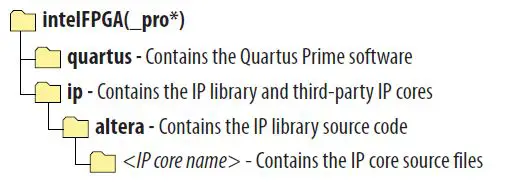
IP Core Installation Locations
| Location | Software | Platform |
| <drive>:\intelFPGA_pro\quartus\ip\altera | Quartus Prime Pro Edition | Windows |
| <drive>:\intelFPGA\quartus\ip\altera | Quartus Prime Standard Edition | Windows |
| <home directory>:/intelFPGA_pro/quartus/ip/altera | Quartus Prime Pro Edition | Linux |
| <home directory>:/intelFPGA/quartus/ip/altera | Quartus Prime Standard Edition | Linux |
OpenCore Plus IP Evaluation
The free OpenCore Plus feature allows you to evaluate licensed MegaCore IP cores in simulation and hardware before purchase. Purchase a license for MegaCore IP cores if you decide to take your design to production. OpenCore Plus supports the following evaluations:
- Simulate the behavior of a licensed IP core in your system.
- Verify the functionality, size, and speed of the IP core quickly and easily.
- Generate time-limited device programming files for designs that include IP cores.
- Program a device with your IP core and verify your design in hardware.
OpenCore Plus evaluation supports the following two operation modes:
© 2016 Intel Corporation. All rights reserved. Intel, the Intel logo, Altera, Arria, Cyclone, Enpirion, MAX, Megacore, NIOS, Quartus and Stratix words and logos are trademarks of Intel Corporation in the US and/or other countries. Other marks and brands may be claimed as the property of others. Intel warrants performance of its FPGA and semiconductor products to current specifications in accordance with Intel’s standard warranty, but reserves the right to make changes to any products and services at any time without notice. Intel assumes no responsibility or liability arising out of the application or use of any information, product, or service described herein except as expressly agreed to in writing by Intel. Intel customers are advised to obtain the latest version of device specifications before relying on any published information and before placing orders for products or services.
- Untethered—run the design containing the licensed IP for a limited time.
- Tethered—run the design containing the licensed IP for a longer time or indefinitely. This operation requires a connection between your board and the host computer.
All IP cores that use OpenCore Plus time out simultaneously when any IP core in the design times out.
Related Links
- Quartus Prime Licensing Site
- Quartus Prime Installation and Licensing
High-speed Reed-Solomon IP Core OpenCore Plus Timeout Behavior
All IP cores in a device time out simultaneously when the most restrictive evaluation time is reached. If a design has more than one IP core, the time-out behavior of the other IP cores may mask the time-out behavior of a specific IP core . All IP cores in a device time out simultaneously when the most restrictive evaluation time is reached. If there is more than one IP core in a design, a specific IP core’s time-out behavior may be masked by the time-out behavior of the other IP cores. For IP cores, the untethered time-out is 1 hour; the tethered time-out value is indefinite. Your design stops working after the hardware evaluation time expires. The Quartus Prime software uses OpenCore Plus Files (.ocp) in your project directory to identify your use of the OpenCore Plus evaluation program. After you activate the feature, do not delete these files.. When the evaluation time expires, out_data goes low .
Related Links
AN 320: OpenCore Plus Evaluation of Megafunctions
Catalog and Parameter Editor
The IP Catalog displays the IP cores available for your project. Use the following features of the IP Catalog to locate and customize an IP core:
- Filter IP Catalog to Show IP for active device family or Show IP for all device families. If you have no project open, select the Device Family in IP Catalog.
- Type in the Search field to locate any full or partial IP core name in IP Catalog.
- Right-click an IP core name in IP Catalog to display details about supported devices, to open the IP core’s installation folder, and for links to IP documentation.
- Click Search for Partner IP to access partner IP information on the web.
The parameter editor prompts you to specify an IP variation name, optional ports, and output file generation options. The parameter editor generates a top-level Quartus Prime IP file (.ip) for an IP variation in Quartus Prime Pro Edition projects. The parameter editor generates a top-level Quartus IP file (.qip) for an IP variation in Quartus Prime Standard Edition projects. These files represent the IP variation in the project, and store parameterization information.
IP Parameter Editor (Quartus Prime Pro Edition)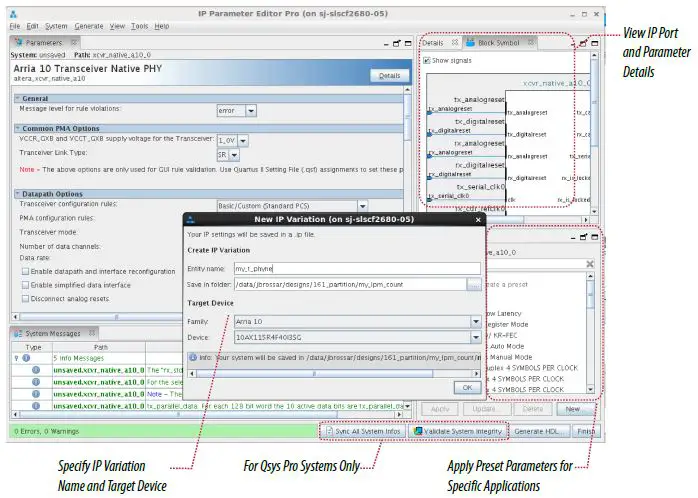
IP Parameter Editor (Quartus Prime Standard Edition)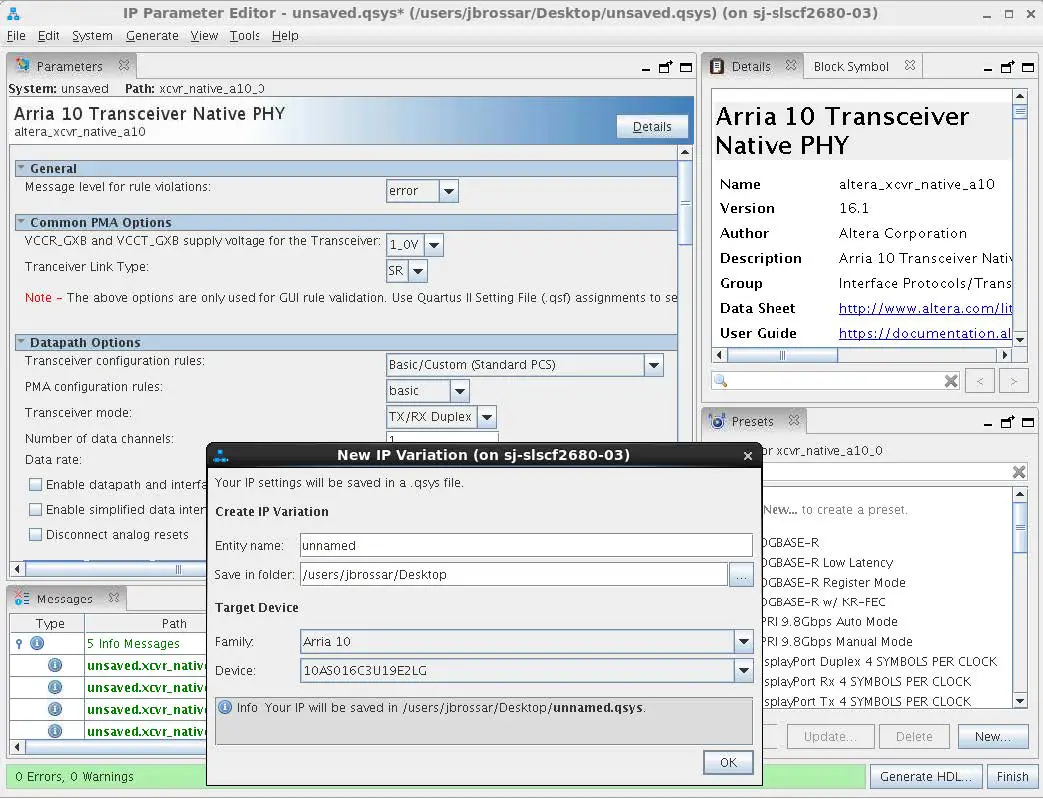
Generating IP Cores (Quartus Prime Pro Edition)
Configure a custom IP variation in the parameter editor. Double-click any component in the IP Catalog to launch the parameter editor. The parameter editor allows you to define a custom variation of the selected IP core. The parameter editor generates the IP variation and adds the corresponding .ip file to your project automatically.
IP Parameter Editor (Quartus Prime Pro Edition)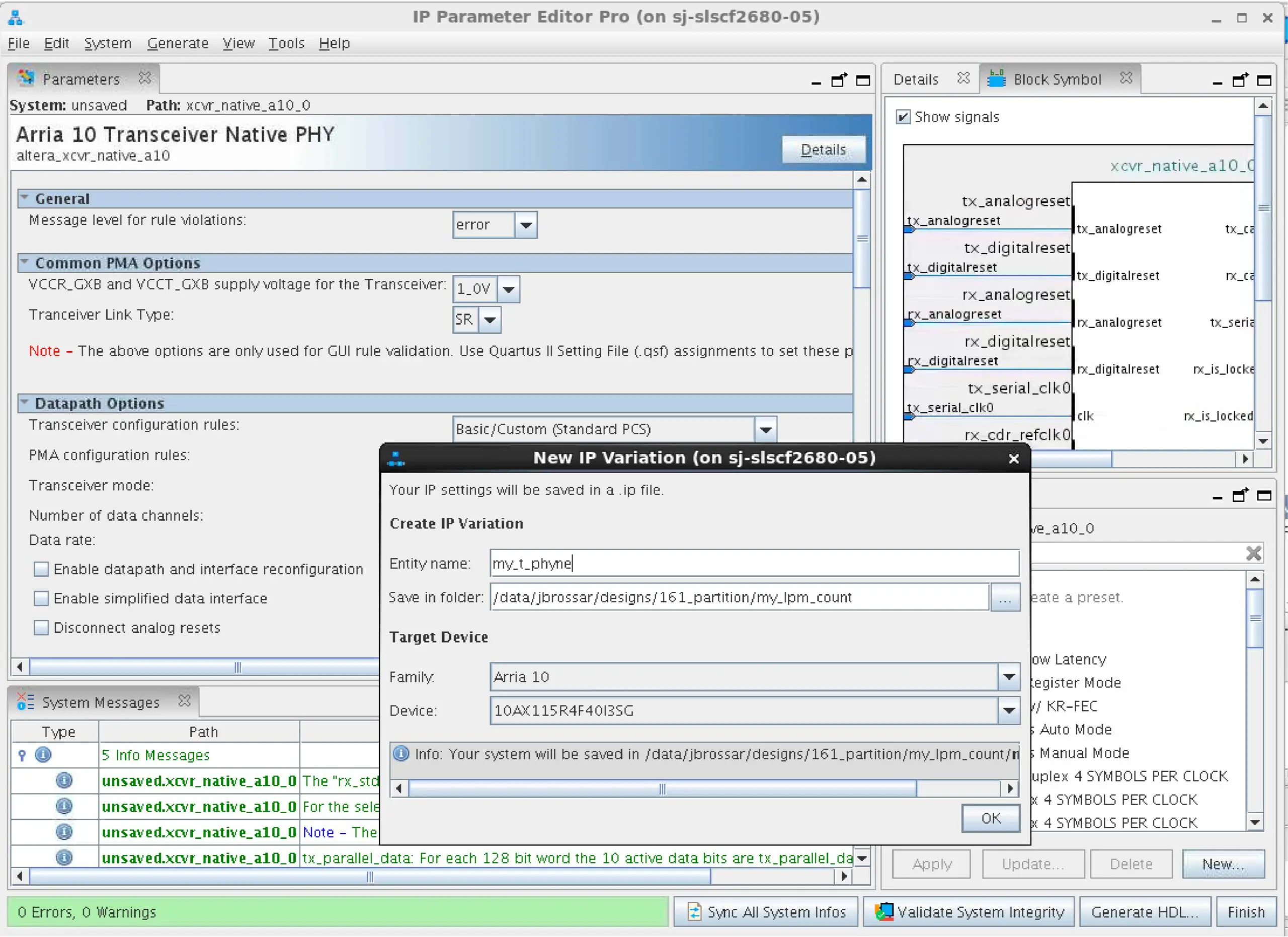
Follow these steps to locate, instantiate, and customize an IP variation in the parameter editor:
- Click Tools ➤ IP Catalog. To display details about device support, installation location, versions, and links to documentation, right-click any IP component name in the IP Catalog.
- To locate a specific type of component, type some or all of the component’s name in the IP Catalog search box. For example, type memory to locate memory IP components, or axi to locate IP components with AXI in the IP name. Apply filters to the IP Catalog display from the right-click menu.
- To launch the parameter editor, double-click any component. Specify a top-level name for your custom IP variation. The parameter editor saves the IP variation settings in a file named <your_ip>.ip. Click OK. Do not include spaces in IP variation names or paths.
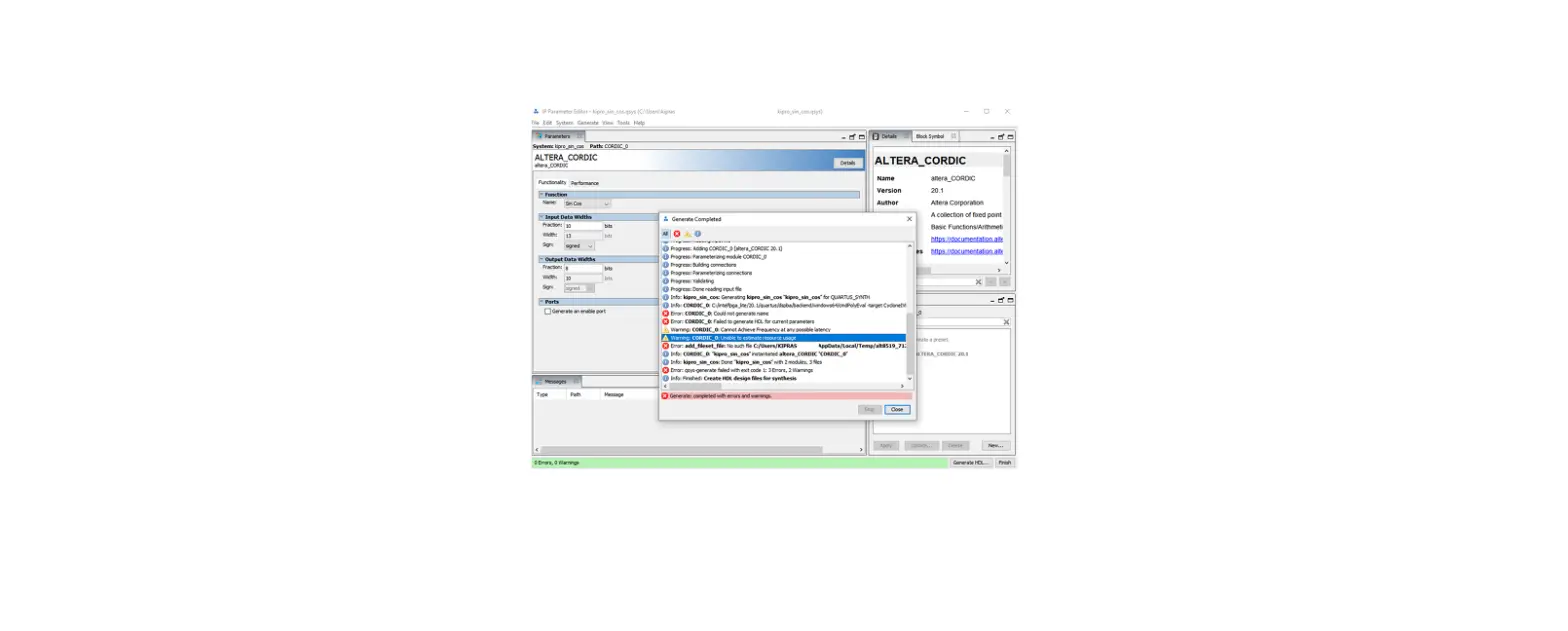
- Set the parameter values in the parameter editor and view the block diagram for the component. The Parameterization Messages tab at the bottom displays any errors in IP parameters:
- Optionally select preset parameter values if provided for your IP core. Presets specify initial parameter values for specific applications.
- Specify parameters defining the IP core functionality, port configurations, and device-specific features.
- Specify options for processing the IP core files in other EDA tools.
Note: Refer to your IP core user guide for information about specific IP core
- Click Generate HDL. The Generation dialog box appears.
- Specify output file generation options, and then click Generate. The synthesis and/or simulation files generate according to your specifications.
- To generate a simulation testbench, click Generate ➤ Generate Testbench System. Specify testbench generation options, and then click Generate.
- To generate an HDL instantiation template that you can copy and paste into your text editor, click Generate ➤ Show Instantiation Template.
- Click Finish. Click Yes if prompted to add files representing the IP variation to your project.
- After generating and instantiating your IP variation, make appropriate pin assignments to connect ports.
Note: Some IP cores generate different HDL implementations according to the IP core parameters. The underlying RTL of these IP cores contains a unique hash code that prevents module name collisions between different variations of the IP core. This unique code remains consistent, given the same IP settings and software version during IP generation. This unique code can change if you edit the IP core’s parameters or upgrade the IP core version. To avoid dependency on these unique codes in your simulation environment, refer to Generating a Combined Simulator Setup Script.core parameters. The underlying RTL of these IP cores contains a unique hash code that prevents module name collisions between different variations of the IP core. This unique code remains consistent, given the same IP settings and software version during IP generation. This unique code can change if you edit the IP core’s parameters or upgrade the IP core version. To avoid dependency on these unique codes in your simulation environment, refer to Generating a Combined Simulator Setup Script.
Related Links
- IP User Guide Documentation
- Intel FPGA IP Release Notes
IP Core Generation Output (Quartus Prime Pro Edition)
The Quartus Prime software generates the following output file structure for individual IP cores that are not part of a Qsys system.
Individual IP Core Generation Output (Quartus Prime Pro Edition)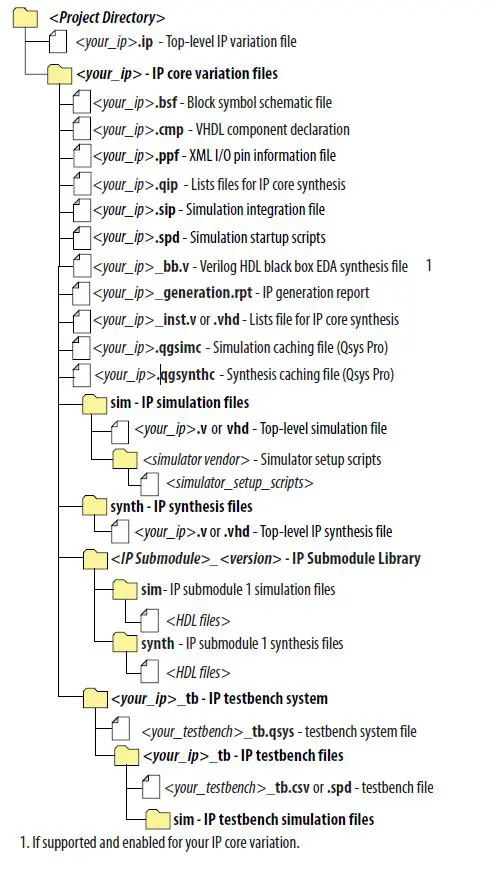
Files Generated for IP Cores
| File Name | Description |
| <my_ip>.ip | Top-level IP variation file that contains the parameterization of an IP core in your project. If the IP variation is part of a Qsys Pro system, the parameter editor also generates a .qsys file. |
| <my_ip>.cmp | The VHDL Component Declaration (.cmp) file is a text file that contains local generic and port definitions that you use in VHDL design files. |
| <my_ip>_generation.rpt | IP or Qsys generation log file. A summary of the messages during IP generation. |
| continued… | |
| File Name | Description |
| <my_ip>.qgsimc (Qsys Pro systems only) | Simulation caching file that compares the .qsys and .ip files with the current parameterization of the Qsys Pro system and IP core. This comparison determines if Qsys Pro can skip regeneration of the HDL. |
| <my_ip>.qgsynth (Qsys Pro systems only) | Synthesis caching file that compares the .qsys and .ip files with the current parameterization of the Qsys Pro system and IP core. This comparison determines if Qsys Pro can skip regeneration of the HDL. |
| <my_ip>.qip | Contains all information to integrate and compile the IP component. |
| <my_ip>.csv | Contains information about the upgrade status of the IP component. |
| <my_ip>.bsf | A symbol representation of the IP variation for use in Block Diagram Files (.bdf). |
| <my_ip>.spd | Required input file for ip-make-simscript to generate simulation scripts for supported simulators. The .spd file contains a list of files you generate for simulation, along with information about memories that you initialize. |
| <my_ip>.ppf | The Pin Planner File (.ppf) stores the port and node assignments for IP components you create for use with the Pin Planner. |
| <my_ip>_bb.v | Use the Verilog blackbox (_bb.v) file as an empty module declaration for use as a blackbox. |
| <my_ip>.sip | Contains information you require for NativeLink simulation of IP components. Add the .sip file to your Quartus Prime Standard Edition project to enable NativeLink for supported devices. The Quartus Prime Pro Edition software does not support NativeLink simulation. |
| <my_ip>_inst.v or _inst.vhd | HDL example instantiation template. Copy and paste the contents of this file into your HDL file to instantiate the IP variation. |
| <my_ip>.regmap | If the IP contains register information, the Quartus Prime software generates the .regmap file. The .regmap file describes the register map information of master and slave interfaces. This file complements the ..sopcinfo file by providing more detailed register information about the system. This file enables register display views and user customizable statistics in System Console. |
| <my_ip>.svd | Allows HPS System Debug tools to view the register maps of peripherals that connect to HPS within a Qsys Pro system. During synthesis, the Quartus Prime software stores the .svd files for slave interface visible to the System Console masters in the .sof file in the debug session. System Console reads this section, which Qsys Pro queries for register map information. For system slaves, Qsys Pro accesses the registers by name. |
| <my_ip>.v <my_ip>.vhd | HDL files that instantiate each submodule or child IP core for synthesis or simulation. |
| mentor/ | Contains a ModelSim® script msim_setup.tcl to set up and run a simulation. |
| aldec/ | Contains a Riviera-PRO script rivierapro_setup.tcl to setup and run a simulation. |
| /synopsys/vcs /synopsys/vcsmx | Contains a shell script vcs_setup.sh to set up and run a VCS® simulation. Contains a shell script vcsmx_setup.sh and synopsys_sim.setup file to set up and run a VCS MX® simulation. |
| /cadence | Contains a shell script ncsim_setup.sh and other setup files to set up and run an NCSIM simulation. |
| /submodules | Contains HDL files for the IP core submodule. |
| <IP submodule>/ | For each generated IP submodule directory Qsys Pro generates /synth and /sim sub-directories. |
2 High-speed Reed-Solomon IP Core Getting Started
Simulating Intel FPGA IP Cores
The Quartus Prime software supports IP core RTL simulation in specific EDA simulators. IP generation creates simulation files, including the functional simulation model, any testbench (or example design), and vendor-specific simulator setup scripts for each IP core. Use the functional simulation model and any testbench or example design for simulation. IP generation output may also include scripts to compile and run any testbench. The scripts list all models or libraries you require to simulate your IP core. The Quartus Prime software provides integration with many simulators and supports multiple simulation flows, including your own scripted and custom simulation flows. Whichever flow you choose, IP core simulation involves the following steps:
- Generate simulation model, testbench (or example design), and simulator setup script files.
- Set up your simulator environment and any simulation script(s).
- Compile simulation model libraries.
- Run your simulator.
High-speed Reed-Solomon IP Core Functional Description
This topic describes the IP core’s architecture, interfaces, and signals.
High-Speed Reed-Solomon Architecture
The encoder receives data packets and generates the check symbols; the decoder detects and corrects errors. The High-speed Reed-Solomon IP core has a parallelized architecture to achieve very high throughout. The inputs and outputs contain multiple data symbols. The fracturable decoder has preset parameters to support 4 x 25 GbE, 2 x 50 GbE and 1 x 100 GbE with parallelism p of 8, 16, and 32, respectively.
High-Speed Reed-Solomon Encoder
When the encoder receives data symbols, it generates check symbols for a given codeword and sends the input codeword together with the check symbols to the output interface. . The encoder may uses backpressure on the upstream component when it generates the check symbols and the parallelism is smaller than the number of check symbols
High-speed Reed-Solomon Encoding
Shows how a codeword is encoded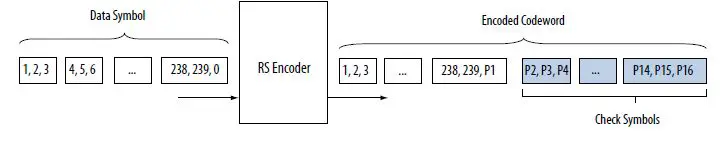
High-Speed Reed-Solomon Decoder
When the decoder receives the encoded codeword, it uses the check symbols to detect errors and correct them. The decoder is a streaming decoder that allows continuous input data with no backpressure on the upstream component.© 2016 Intel Corporation. All rights reserved. Intel, the Intel logo, Altera, Arria, Cyclone, Enpirion, MAX, Megacore, NIOS, Quartus and Stratix words and logos are trademarks of Intel Corporation in the US and/or other countries. Other marks and brands may be claimed as the property of others. Intel warrants performance of its FPGA and semiconductor products to current specifications in accordance with Intel’s standard warranty, but reserves the right to make changes to any products and services at any time without notice. Intel assumes no responsibility or liability arising out of the application or use of any information, product, or service described herein except as expressly agreed to in writing by Intel. Intel customers are advised to obtain the latest version of device specifications before relying on any published information and before placing orders for products or services.
Codeword Decoding
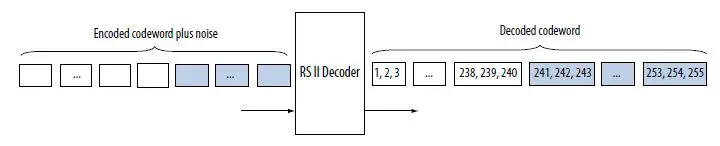
The received encoded codeword may differ from the original codeword due to the noise in the channel. The decoder detects errors using several polynomials to locate the error location and the error value. When the decoder obtains the error location and value, the decoder corrects the errors in a codeword, and sends the codeword to the output. As the number of errors increases, the decoder gets to a stage where it can no longer correct but only detect errors, at which point the decoder asserts the out_error signal.
High-Speed Reed-Solomon IP Core Parameters
Parameters
| Parameter | Legal Values | Default Value | Description |
| Reed-Solomon Core | Fractuarable 100G Ethernet or custom | Fracturable 100G Ethernet | – |
| Reed-Solomon module | Encoder or Decoder | Decoder | An encoder or a decoder. |
| Custom IP Core | |||
| Number of channels | 1 to 10 | 1 | Decoder only. |
| Number of bits per symbol | 3 to 12 | 8 | The number of bits per symbol (M). |
| Number of symbols per codeword | 1 to 2M – 1 | 255 | The total number of symbols per codeword (N). |
| Number of data symbols per codeword | 2 to N– 2 | 239 | The number of data symbols per codeword (K = N – R). Where R is the number of check symbols. |
| Field polynomial | Any valid polynomial | 285 | The primitive polynomial defining the Galois field. The parameter editor allows you to select only legal values. If you cannot find your intended field polynomial, contact Intel MySupport. |
| Parallelism | P < N/2 | – | The number of parallel inputs and outputs. The last output fills up with zeros. |
| Bypass Mode | On or off | Off | Turn on to produce the received codeword without error correction but with only error detection. This message is output after few clock cycles. |
| Fractuarable IP core Parameters | |||
| 100G Ethernet | On | On | A single 100G channels with parallelism 32. |
| continued… | |||
| Parameter | Legal Values | Default Value | Description |
| 2 x 50G Ethernet | On or off | Off | Two independent 50 GbE channels with parallelism 16. |
| 4 x 25G ethernet | On or off | Off | Four independent 25 GbE channels with parallelism 8. |
| Custom and Fracturable IP Core Parameters | |||
| Latency | N/P+ (BM speed x R) +10; with BMspeed is 4 or 6. | BMspeed is 4 | The latency as a function of the Berlekamp–Massey (BM) speed (decoder only). |
| Favor ROM | On or off | On | Uses M20K memory to reduce the ALMs. Savings are significant with large parallelism. |
| Use true dual-port ROM | No or yes | No | – |
| Refresh ROM content | No or yes | No | The IP core continuously rewrites the ROM contents. |
| Use backpressure | No or yes | No | Decoder only. When you select Yes, you can use the out_ready signal to assert when the source is ready, but this option might limit fMAX. |
| Decoder Output Signal Options | |||
| Output decoding failure | On or off | On | Turns on out_decfail signal |
| Output error symbol count | On of off | On | Turns on out_errors_out signal. |
| Output error symbol values | On or off | On | Turns on out_errorvalues_out signal. |
| Output start and end of packet | On or off. | On | Use Avalon-ST SOP and EOP signal to indicate start and end of packet |
High-speed Reed-Solomon IP Core Interfaces and Signals
The ready latency on the Avalon-ST input interface is 0; the number of symbols per beat is fixed to 1. The latency of the decoder is N/P+ (BM speed x R) + 10; the latency of the encoder is 6.
The clock and reset interfaces drive or receive the clock and reset signal to synchronize the Avalon-ST interfaces and provide reset connectivity. The status interface is a conduit interface that consists of three error status signals for a codeword. The decoder obtains the error symbol value, number of error symbols, and number of error bits in a codeword from the status signals.
Avalon-ST Interfaces
Avalon-ST interfaces define a standard, flexible, and modular protocol for data transfers from a source interface to a sink interface. The input interface is an Avalon-ST sink and the output interface is an Avalon-ST source. Avalon-ST interface signals can describe traditional streaming interfaces supporting a single stream of data without knowledge of channels or packet boundaries. Such interfaces typically contain data, ready, and valid signals.Avalon-ST interfaces support backpressure, which is a flow control mechanism where a sink can indicate to a source to stop sending data. The sink typically uses backpressure to stop the flow of data when its FIFO buffers are full or when it has congestion on its output.
High-speed Reed-Solomon IP Core Signals
Clock and Reset Signals
| Name | Avalon-ST Type | Direction | Description |
| clk_clk | clk | Input | The main system clock. The whole IP core operates on the rising edge of clk_clk . |
| reset_reset_n | reset_n | Input | An active low signal that resets the entire system when asserted. You can assert this signal asynchronously. However, you must deassert it synchronous to the clk_clk signal. When the IP core recovers from reset, ensure that the data it receives is a complete packet. |
Custom IP Core Avalon-ST Interface Signals
| Name | Avalon-ST Type | Direction | Description |
| in_ready | ready | Output | Data transfer ready signal to indicate that the sink is ready to accept data. The sink interface drives the in_ready signal to control the flow of data across the interface. The sink interface captures the data interface signals on the current clk rising edge. |
| in_valid | valid | Input | Data valid signal to indicate the validity of the data signals. When you assert the in_valid signal, the Avalon-ST data interface signals are valid. When you deassert the in_valid signal, the Avalon-ST data interface signals are invalid and must be disregarded. You can assert the in_valid signal whenever data is available. However, the sink only captures the data from the source when the IP core asserts the in_ready signal. |
| in_data[] | data | Input | Data input for each codeword, symbol by symbol. Valid only when you assert the in_valid signal. Width is P x M bits. For the encoder, the number of information symbols (N – CHECK) is not necessarily a multiple of P. It means that the last input symbol may have to be filled with zeros. |
| out_data | data | Output | Encoder output. In Qsys systems for the decoder, this Avalon-ST-compliant data bus includes all the Avalon-ST output data signals (out_error_out, out_decfail, out_symol_out),) with length log2(R+1) + 1. |
| out_decfail | data | Output | Decoding failure. |
| out_errors_out | error | Output | Number of error symbol that the IP core decides. Size is log2(R+1) |
| out_errorvalue s_out | error | Output | Error values. |
| out_ready | ready | Input | Data transfer ready signal to indicate that the downstream module is ready to accept data. The source provides new data (if available) when you assert the out_ready signal and stops providing new data when you deassert the |
| continued… | |||
| Name | Avalon-ST Type | Direction | Description |
| out_ready signal. If the source is unable to provide new data, it deasserts out_valid for one or more clock cycles until it is prepared to drive valid data interface signals. | |||
| out_symbols_ou t | data | Output | Contains decoded output when the IP core asserts the out_valid signal. The corrected symbols are in the same order that they are entered. |
| out_valid | valid | Output | Data valid signal. The IP core asserts the out_valid signal high, whenever a valid output is on out_data ; the IP core deasserts the signal when there is no valid output on out_data . |
Fractuarable IP Core Avalon-ST Interface Signals
| Name | Avalon-ST Type | Direction | Width | Description |
| in-valid | Valid | Input | 1 | Master valid signal. If in_valid is low it sets all valid_ch_in to low. |
| in-data | Data | Input | 320 symbols_in + 4 valid_ch_in + 2 mode_in + sync_in | Data input. |
| valid_ch_in | Part of in_data | Input | 4 | Input valid signal for each channel. |
| symbols_in | Part of in_data | Input | 32 | Input symbols. • 100 GbE one channel • 50 GbE two channels • 25 GbE four channels |
| mode_in | Part of in_data | Input | 2 | • 0: 1×100 GbE • 1: 2×50 GbE or 4x25GbE • 2: 4×25 GbE |
| sync_in | Part of in_data | Input | 1 | Synchronize the output channels. |
| out_valid | Valid | Output | 1 | Master valid signal. out_valid is valid if any valid_ch_out is valid, i.e. if valid_ch0 or valid_ch1 etc are valid. |
| out_data | Data | Output | 320 decoded symbols + 4 valid_out + 2 mode_out + 4 sop_out + 4 eop_out +4 decfail+ 12 errors_out | Output data. |
| errors_out | Part of out_data | Output | 12 | Number of error symbols that the IP core decides. |
| decfail | Part of out_data | Output | 4 | (Optional) decfail of each output channel |
| continued… | ||||
| Name | Avalon-ST Type | Direction | Width | Description |
| eop_out | Part of out_data | Output | 4 | (Optional) eop of each output channel |
| sop_out | Part of out_data | Output | 4 | (Optional) sop of each channels |
| mode_out | Part of out_data | Output | 2 | Output mode. |
| valid_ch_out | Part of out_data | Output | 4 | Valid signal for each channel |
| symbols_out | Part of out_data | Output | 320 | Output symbols: • 100 GbE one channel • 50 GbE two channels • 25 GbE four channels |
Document Revision History
| Date | Version | Changes |
| 2016.11.02 | 16.1 | • Added fracturable IP core parameters. • Added Output error symbol values parameter • Added Bypass mode parameter |
| 2016.05.02 | 16.0 | • Added new parameters: — Number of channels — Use backpressure — Use true dual-port ROM — Refresh ROM content — Output decoding failure — Output error symbol count — Output start and end of packet • Added out_decfail signal • Added True dual-port ROM performance data. • Changed description of parallelism parameter. • Changed out_error_out signal description |
| 2015.11.01 | 15.1 | Corrected encoder and decoder diagrams |
| 2015.05.01 | 15.0 | First release |
High-speed Reed-Solomon IP Core User Guide revision history.
© 2016 Intel Corporation. All rights reserved. Intel, the Intel logo, Altera, Arria, Cyclone, Enpirion, MAX, Megacore, NIOS, Quartus and Stratix words and logos are trademarks of Intel Corporation in the US and/or other countries. Other marks and brands may be claimed as the property of others. Intel warrants performance of its FPGA and semiconductor products to current specifications in accordance with Intel’s standard warranty, but reserves the right to make changes to any products and services at any time without notice. Intel assumes no responsibility or liability arising out of the application or use of any information, product, or service described herein except as expressly agreed to in writing by Intel. Intel customers are advised to obtain the latest version of device specifications before relying on any published information and before placing orders for products or services.
A High-Speed Reed-Solomon IP Core Document Archive
| IP Core Version | User Guide |
| 15.1 | High-speed Reed-Solomon IP Core User Guide |
If an IP core version is not listed, the user guide for the previous IP core version applies.
Related Links
About the High-speed Reed-Solomon, IP Core on page 3 Provides a list of user guides for previous versions of the High-speed Reed-Solomon IP core. © 2016 Intel Corporation. All rights reserved. Intel, the Intel logo, Altera, Arria, Cyclone, Enpirion, MAX, Megacore, NIOS, Quartus, and Stratix words and logos are trademarks of Intel Corporation in the US and/or other countries. Other marks and brands may be claimed as the property of others. Intel warrants the performance of its FPGA and semiconductor products to current specifications in accordance with Intel’s standard warranty but reserves the right to make changes to any products and services at any time without notice. Intel assumes no responsibility or liability arising out of the application or use of any information, product, or service described herein except as expressly agreed to in writing by Intel. Intel customers are advised to obtain the latest version of device specifications before relying on any published information and before placing orders for products or services.
 low.in