
Transmitter User Manual
Updated March 22, 2021
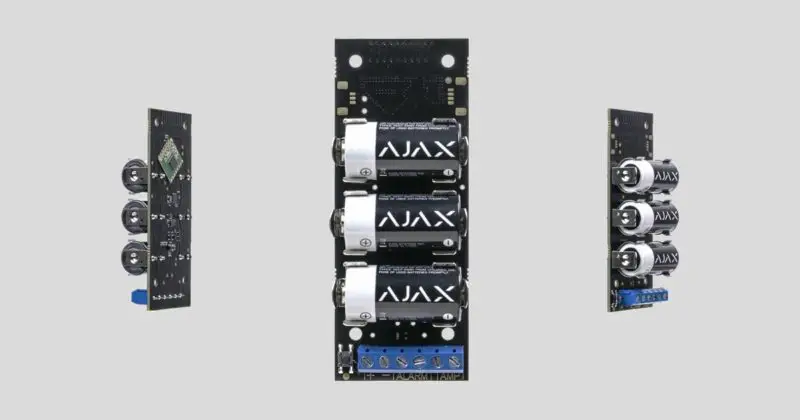
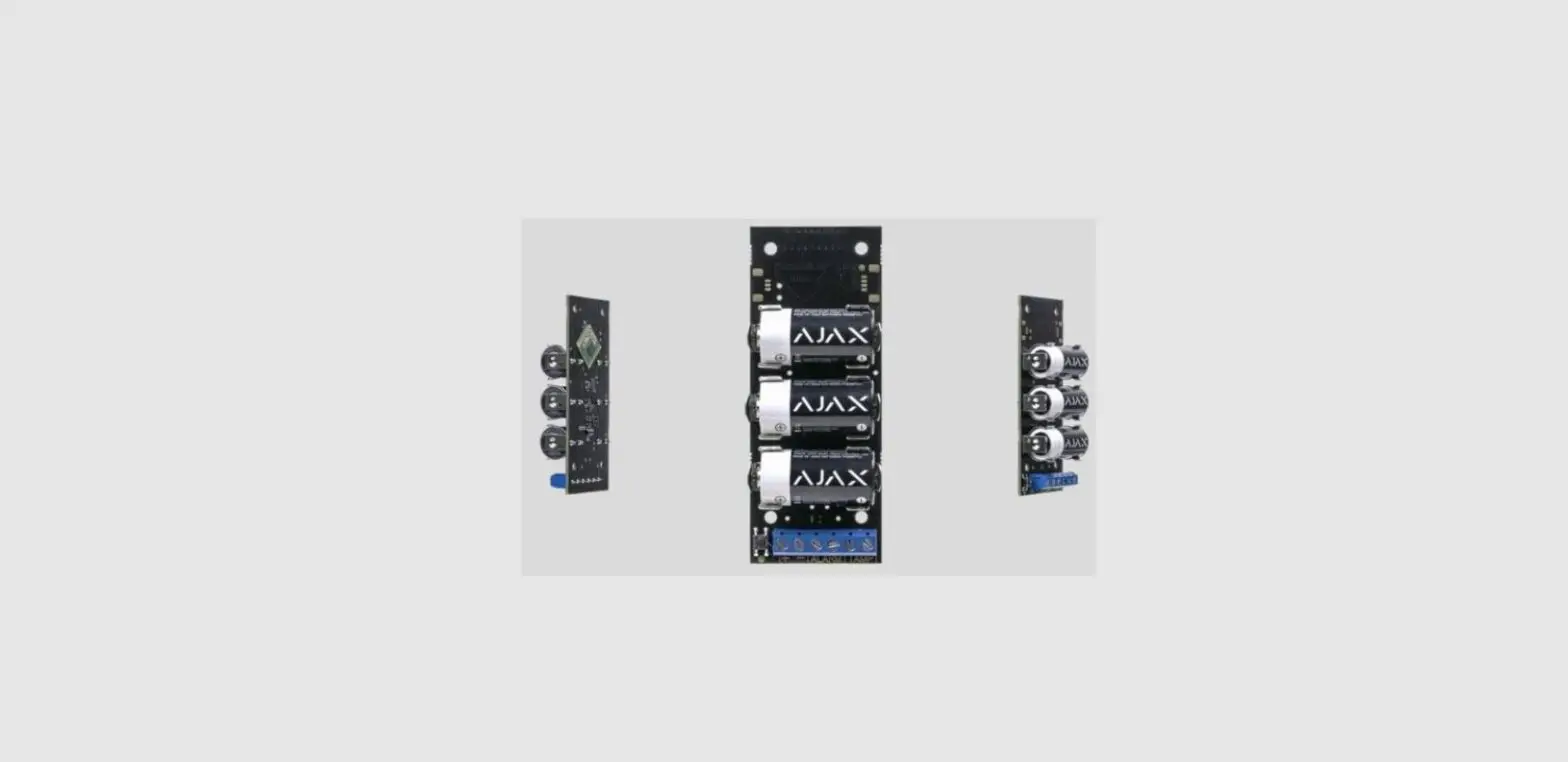
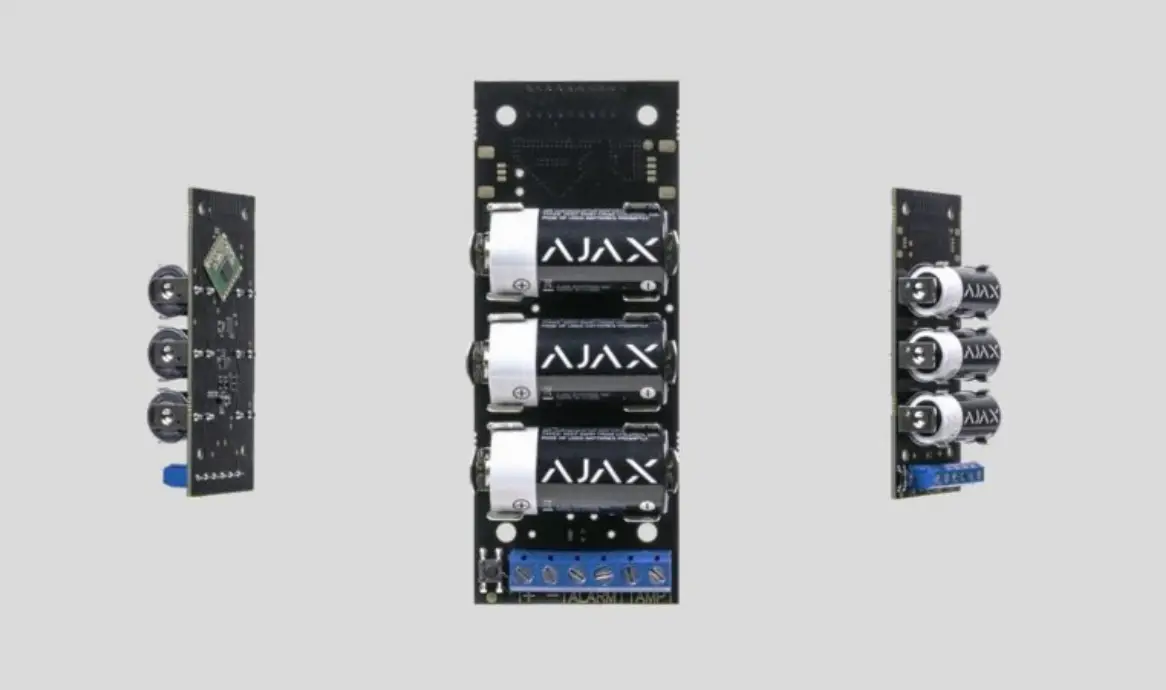
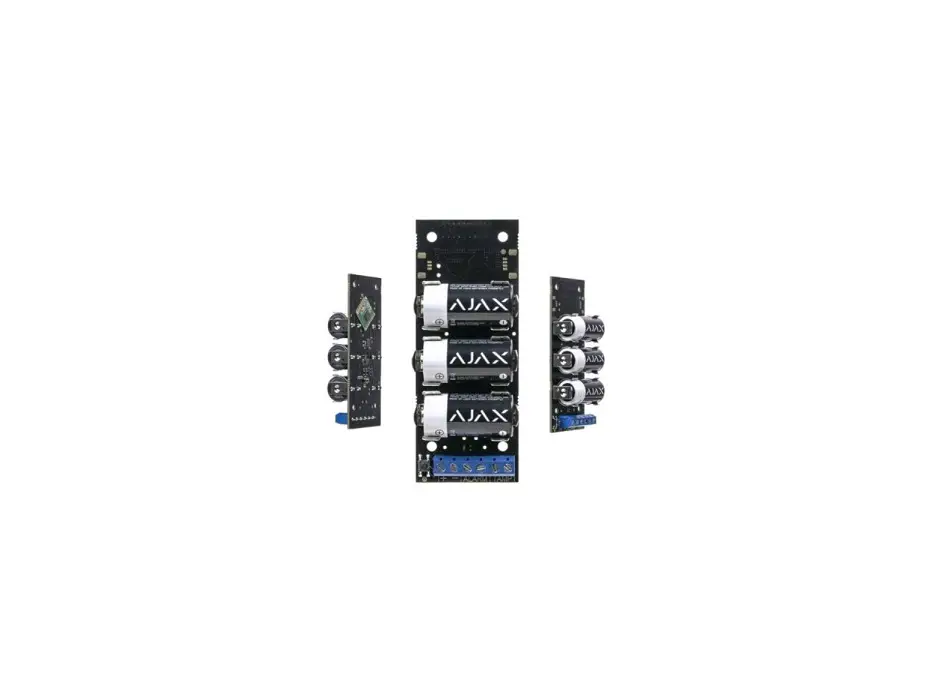
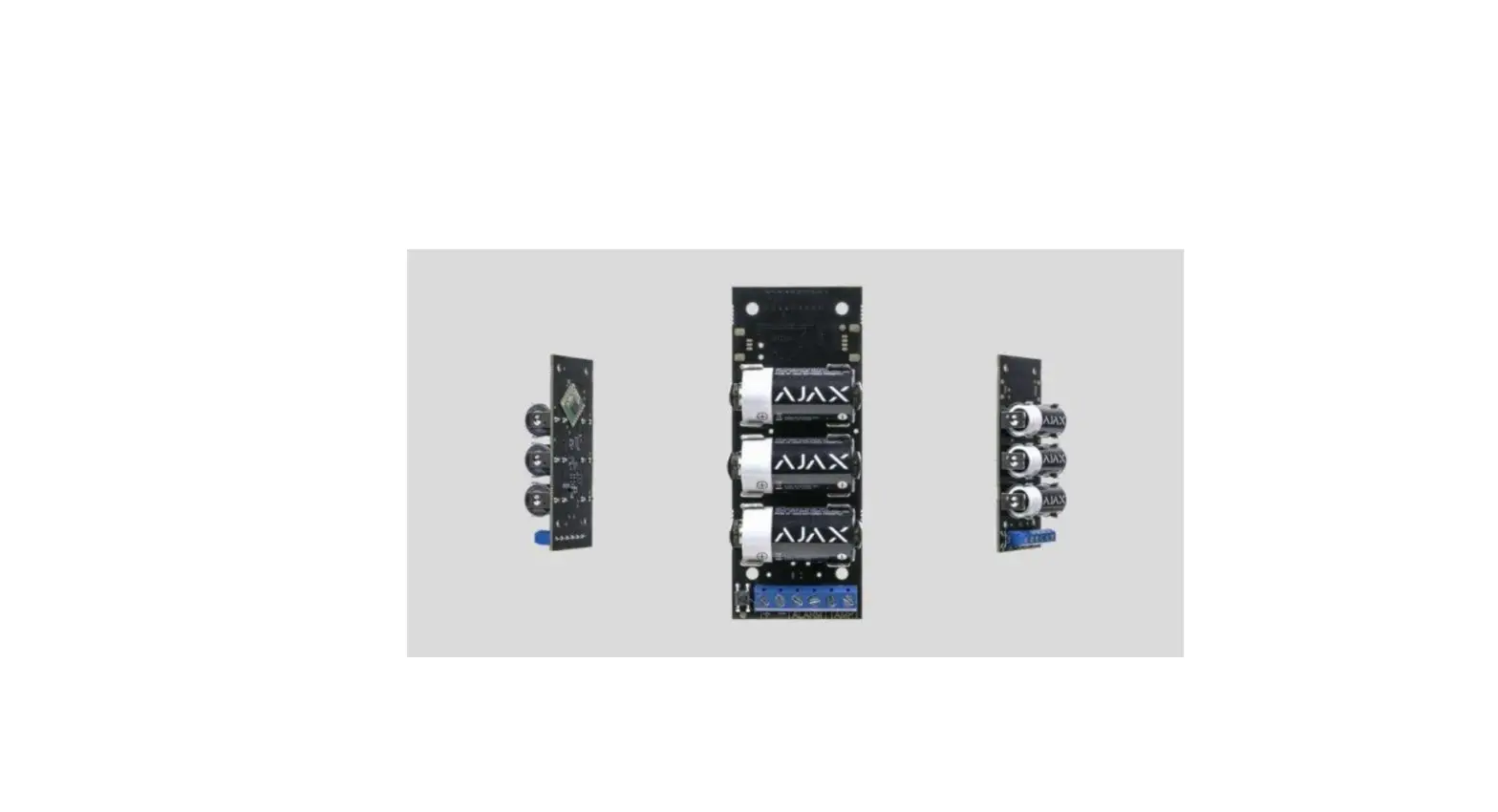
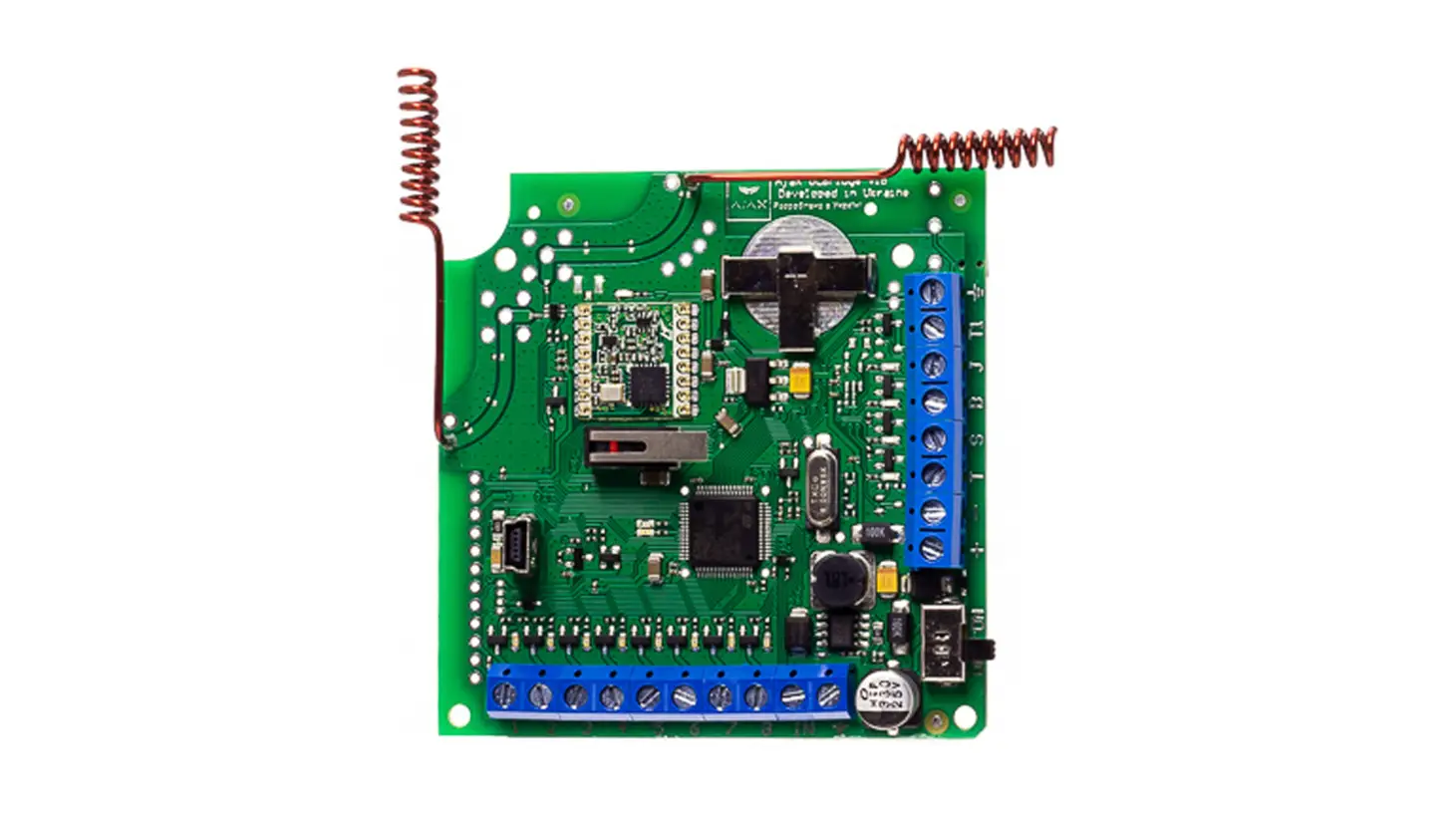
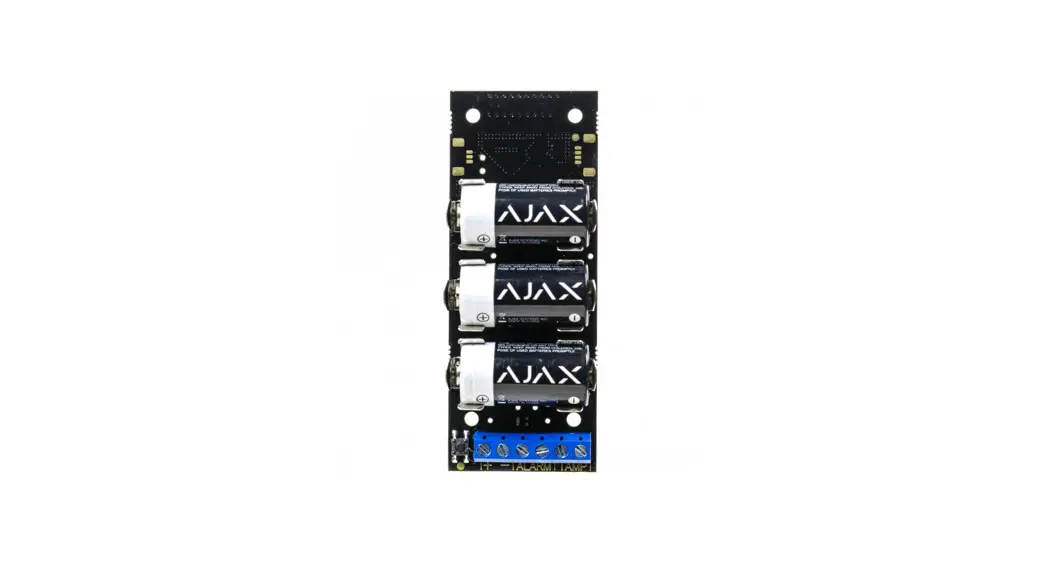
Transmitter is a module for connecting third-party detectors to Ajax security system. It transmits alarms and warns about the activation of the external detector tamper and it is equipped with own accelerometer, which protects it from dismounting. It runs on batteries and can supply power to the connected detector.
Transmitter operates within the Ajax security system, by connecting via the protected Jeweller protocol to the hub. It is not intended to use the device in third-party systems. Not compatible with the uartBridge or ocBridge Plus
The communication range can be up to 1,600 meters provided that there are no obstacles and the case is removed.
Transmitter is set up via a mobile application for iOS and Android based smartphones.
Buy integration module Transmitter
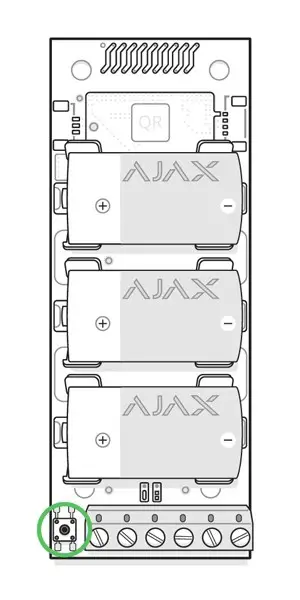
Functional Elements
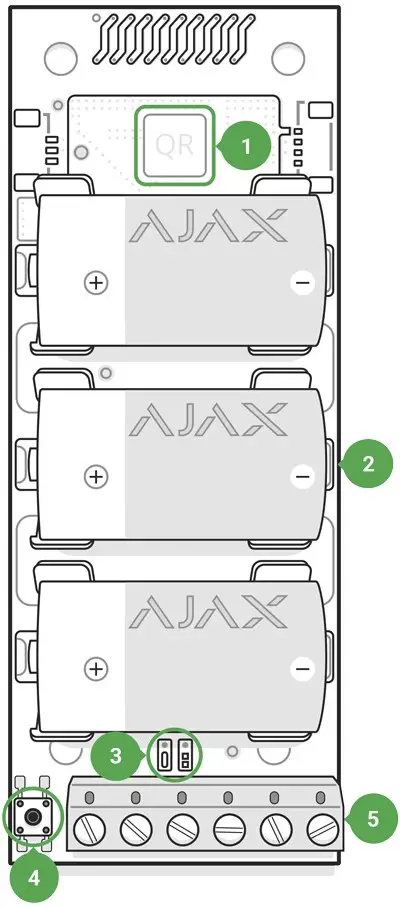
- QR code with the device registration key.
- Batteries contacts.
- LED indicator.
- ON/OFF button.
- Terminals for detector power supply, alarm and tamper signals.
Operation procedure
Transmitter is designed to connect third-party wired sensors and devices to the Ajax security system. The integration module receives information about alarms and tamper activation through the wires connected to the clamps.
Transmitter can be used to connect panic and medical buttons, indoor and outdoor motion detectors, as well as opening, vibration, breaking, re, gas, leakage and others wired detectors.
The type of alarm is indicated in the settings of the Transmitter. The text of noti cations about alarms and events of the connected device, as well as event codes transmitted to the central monitoring panel of the security company (CMS) depend on the selected type.
A total of 5 types of devices are available:
| Type | Icon |
| Intrusion alarm |  |
| Fire alarm |  |
| Medical alarm |  |
| Panic button |  |
| Gas concentration alarm |  |
Transmitter has 2 pairs of wired zones: alarm and tamper.
A separate pair of terminals ensures power supply to the external detector from the module batteries with 3.3 V.
Connecting to the hub
Before starting connection:
- Following the hub instruction recommendations, install the Ajax application on your smartphone. Create an account, add the hub to the application, and create at least one room.
- Go to the Ajax application.
- Switch on the hub and check the internet connection (via Ethernet cable and/or GSM network).
- Ensure that the hub is disarmed and does not start updates by checking its status in the mobile application.
Only users with administrative privileges can add the device to the hub
How to connect the Transmitter to the hub:
- Select the Add Device option in the Ajax application.
- Name the device, scan/write manually the QR Code (located on the body and packaging) and select the location room.
- Select Add — the countdown will begin.
- Switch on the device (by pressing on/off button for 3 seconds).
For the detection and interfacing to occur, the device should be located within the coverage area of the wireless network of the hub (at a single protected object).
Request for connection to the hub is transmitted for a short time at the time of switching on the device.
If the connection to the Ajax hub failed, the Transmitter will switch off after 6 seconds. You may repeat the connection attempt then.
The Transmitter connected to the hub will appear in the list of devices of the hub in the application. Update of device statuses in the list depends on the device inquiry time set in the hub settings, with the default value 36 seconds.
States
- Devices

- Transmitter

| Parameter | Value |
| Temperature | Temperature of the device. Measured on the processor and changes gradually |
| Jeweller Signal Strength | Signal strength between the hub and the device |
| Battery Charge | Battery level of the device. Displayed as a percentage How battery charge is displayed in Ajax apps |
| Lid | The tamper terminal state |
| Delay When Entering, sec | Delay time when entering |
| Delay When Leaving, sec | Delay time when exiting |
| Connection | Connection status between the hub and the Transmitter |
| Always Active | f active, the device is always in an armed mode |
| Alert if Moved | It turns on the Transmitter accelerometer, detecting device movement |
| Temporary Deactivation | Shows the status of the device temporary deactivation function: • No — the device operates normally and transmits all events. • Lid only — the hub administrator has disabled noti the device body. • Entirely — the device is completely excludedfrom the system operation by the hub administrator. The device does not follow system commands and does not report alarms or other events. • By number of alarms — the device is automatically disabled by the system when the number of alarms is exceeded (speci in the settings for Devices Auto Deactivation). The feature is coned in the Ajax PRO app. • By timer — the device is automatically disabled by the system when the recovery timer expires (speci Devices Auto Deactivation). The feature is coned in the Ajax PRO app. |
| Firmware | Detector e version |
| Device ID | Device identi |
Settings
- Devices
- Transmitter
- Settings


| Setting | Value |
| First | Device name, can be edited |
| Room | Selecting the virtual room to which the device is assigned |
| External Detector Contact Status | Selection of the external detector normal status: • Normally closed (NC) • Normally opened (NO) |
| External Detector Type | Selection of the external detector type: • Pulse • Bistable |
| Tamper status | Selection of the normal tamper mod for an external detector: • Normally closed (NC) • Normally opened (NO) |
| Alarm Type | Select alarm type of connected device: • Intrusion • Fire • Medical help • Panic button • Gas The text of SMS and notivents feed, as well as the code transmitted to the security company’s console, depends on the selected type of alarms |
| Always Active | When the mode is active, the Transmitter transmits alarms even when the system is disarmed |
| Delay When Entering, sec | Selecting delay time when entering |
| Delay When Leaving, sec | Selecting delay time on exit |
| Delays in Night Mode | Delay turned on when using night mode |
| Alert if Moved | The accelerometer turning on the Transmitter to provide an alarm in the event of device movement |
| Detector Power Supply | Turning the power on in 3.3 V external detector: • Disabled if disarmed • Always disabled • Always enabled |
| Arm in Night Mode | If active, the device will switch to armed mode when using night mode |
| Alert with a siren if an alarm is detected | If active, Sirens added to the system are sirens activated if an alarm is detected |
| Jeweller Signal Strength Test | Switches the device to the signal strength test mode |
| Attenuation Test | Switches the device to the signal fade test mode (available in detectors with firmware version 3.50 and later) |
| User Guide | Opens the device User Guide |
| Temporary deactivation | Two options are available: • Entirely — the device will not execute system commands or run automation scenarios. The system will ignore device alarms and not • Lid only — messages about triggering the tamper button of the device are ignored Learn more about device temporary deactivation The system can also automatically deactivate devices when the set number of alarms is exceeded or when the recovery timer expires. Learn more about auto deactivation of devices |
| Unpair Device | Disconnects the device from the hub and deletes its settings |
Set the following parameters in the Transmitter settings:
- The state of the external detector contact, which can be normally closed or normally open.
- The type (mode) of the external detector that can be bistable or pulse.
- The tamper mode, which can be normally closed or normally open.
- The accelerometer-triggered alarm — you can turn this signal off or on.
Select the power mode for the external detector:
- Turned off when the hub is disarmed — the module stops powering the external detector upon disarming and does not process signals from the
ALARM terminal. When arming the detector, the power supply resumes, but the alarm signals are ignored for the - Always disabled — the Transmitter saves energy by turning off the power of the external detector. The signals from the ALARM terminal are processed both in the pulse and bistable modes.
- Always active — this mode should be used if there are any problems in the “Turned off when the hub is disarmed”. When the security system is armed, signals from the ALARM terminal are processed no more than once in three minutes in the pulse mode. If the bistable mode is selected, such signals are processed instantly.
If the “Always active” operating mode is selected for the module, the external detector is powered only in the “Always active” or the “Turned off when the hub disarmed” mode, regardless of the security system status.
Indication
| Event | Indication |
| The Module is switched on and registered | The LED lights up when the ON button is brie pressed. |
| Registration failed | LED blinks for 4 seconds with an interval of 1 second, then blinks 3 times rapidly (and automatically switches OFF). |
| The Module is deleted from the list of hub devices | LED blinks for 1 minute with an interval of 1 second, then blinks 3 times rapidly (and automatically switches OFF). |
| The Module has received alarm/tamper signal | The LED lights up for 1 second. |
| Batteries are discharged | Smoothly lights up and goes out when the detector or tamper is activated. |
Performance testing
The Ajax security system allows conducting tests for checking the functionality of connected devices.
The tests do not start straight away but within a period of 36 seconds when using the standard settings. The test time start depends on the settings of the detector scanning period (the paragraph on “Jeweller” settings in hub settings).
Jeweller Signal Strength Test
Attenuation Test
Connection of the Module to the wired detectorа
Location of the Transmitter determines its remoteness from the hub and presence of any obstacles between the devices hindering the radio signal transmission: walls, inserted ge-size objects located within the room.
Check the signal strength level at the installation location
If the signal level is one division, we cannot guarantee stable operation of the security system. Take possible measures to improve the quality of the signal! As a minimum, move the device — even 20 cm shift can signiove the quality of reception.
If, after moving, the device still has a low or unstable signal strength, use a . radio signal range extender ReX
The Transmitter should be encased inside the wired detector case. The Module requires a space with the following minimum dimensions: 110 × 41 × 24 mm. If the installation of the Transmitter within the detector case is impossible, then any available radiotransparent case could be used.
- Connect the Transmitter to the detector through the NC/NO contacts (choose the relevant setting in the application) and COM.
 The maximum cable length for connecting the sensor is 150 m (24 AWG twisted pair). The value may vary when using different type of cable.
The function of the Transmitter’s terminals
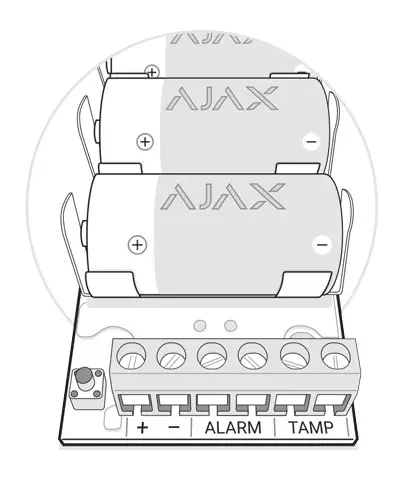
+ — — power supply output (3.3 V)
ALARM — alarm terminals
TAMP — tamper terminals
IMPORTANT! Do not connect external power to the Transmitter’s power outputs.
This may damage the device
2. Secure the Transmitter in the case. Plastic bars are included in the installation kit. It is recommendable to install the Transmitter on them.
Do not install the Transmitter:
- Near metal objects and mirrors (they can shield the radio signal and lead to its attenuation).
- Closer than 1 meter to a hub.
Maintenance and Battery Replacement
The device does not require maintenance when mounted in the housing of a wired sensor.
How long Ajax devices operate on batteries, and what affects this
Battery Replacement
Tech Specs
| Connecting a detector | ALARM and TAMPER (NO/NC) terminals |
| Mode for processing alarm signals from the detector | Pulse or Bistable |
| Power | 3 × CR123A, 3V batteries |
| Capability to power the connected detector | Yes, 3.3V |
| Protection from dismounting | Accelerometer |
| Frequency band | 868.0–868.6 MHz or 868.7 – 869.2 MHz, depends on sales region |
| Compatibility | Operates only with all Ajax , hubs and range extenders |
| Maximum RF output power | Up to 20 mW |
| Modulation | GFSK |
| Communication range | Up to 1,600 m (any obstacles absent) |
| Ping interval for the connection with the receiver | 12–300 sec |
| Operating temperature | From –25°С to +50°С |
| Operating humidity | Up to 75% |
| Dimensions | 100 × 39 × 22 mm |
| Weight | 74 g |
Complete Set
- Transmitter
- Battery CR123A — 3 pcs
- Installation kit
- Quick Start Guide
Warranty
Warranty for the “AJAX SYSTEMS MANUFACTURING” LIMITED LIABILITY COMPANY products is valid for 2 years after the purchase and does not apply to the pre-installed battery.
If the device does not work correctly, you should t service — in half of the cases, technical issues can be solved remotely!
The full text of the warranty
User Agreement
Technical support: [email protected]
References
 End user agreement - Ajax Systems
-
Jeweller radio technology | Ajax Systems
-
Current product lines of the Ajax security system
-
Current product lines of the Ajax security system
-
Current product lines of the Ajax security system
-
ocBridge Plus — Module for Ajax devices integration with wired systems
-
ReX — Intelligent radio signal range extender | Ajax Systems
-
Transmitter — Module for integrating the Ajax into another system
-
uartBridge — Module for Ajax devices integration with third-party wireless alarms systems
-
Software | Ajax Systems
-
Warranty - Ajax Systems
-
How battery charge is displayed in Ajax apps | Ajax Systems Support
-
What is Devices Auto Deactivation and how it works | Ajax Systems Support
-
How long Ajax devices operate on batteries, and what affects this | Ajax Systems Support
-
How to temporarily deactivate a device without removing it from the system | Ajax Systems Support
-
How to change batteries in the Transmitter | Ajax Systems Support
-
What is Attenuation Test | Ajax Systems Support
-
What is Jeweller Signal Strength Test | Ajax Systems Support
 End user agreement - Ajax Systems
 How battery charge is displayed in Ajax apps | Ajax Systems Support