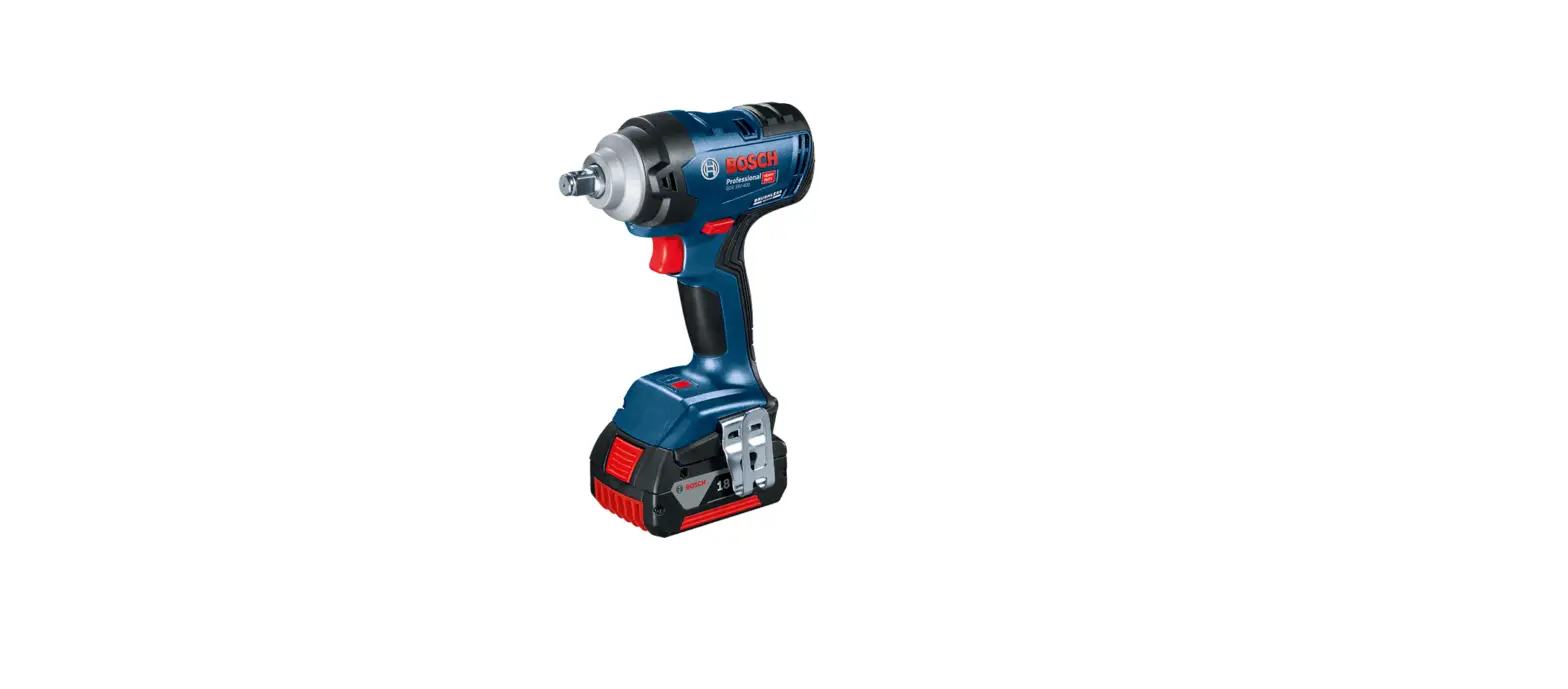
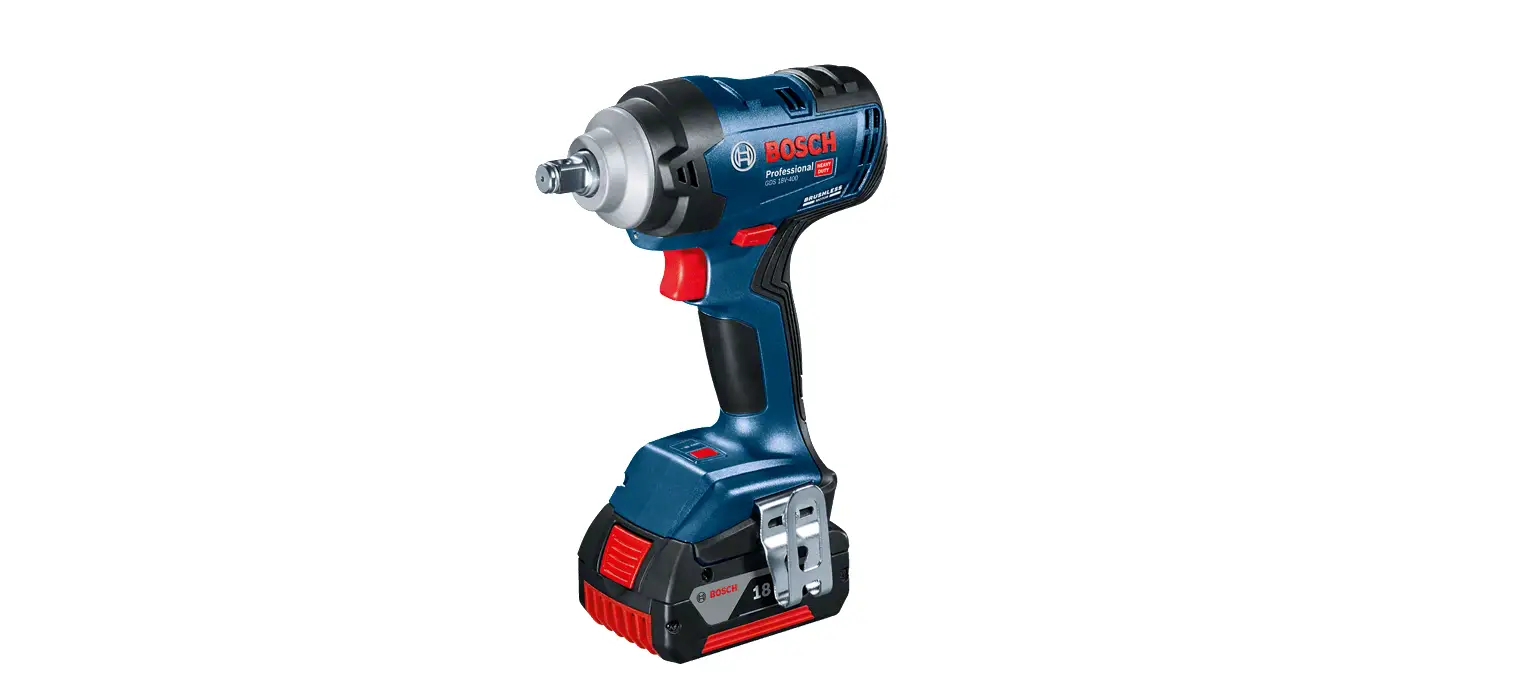
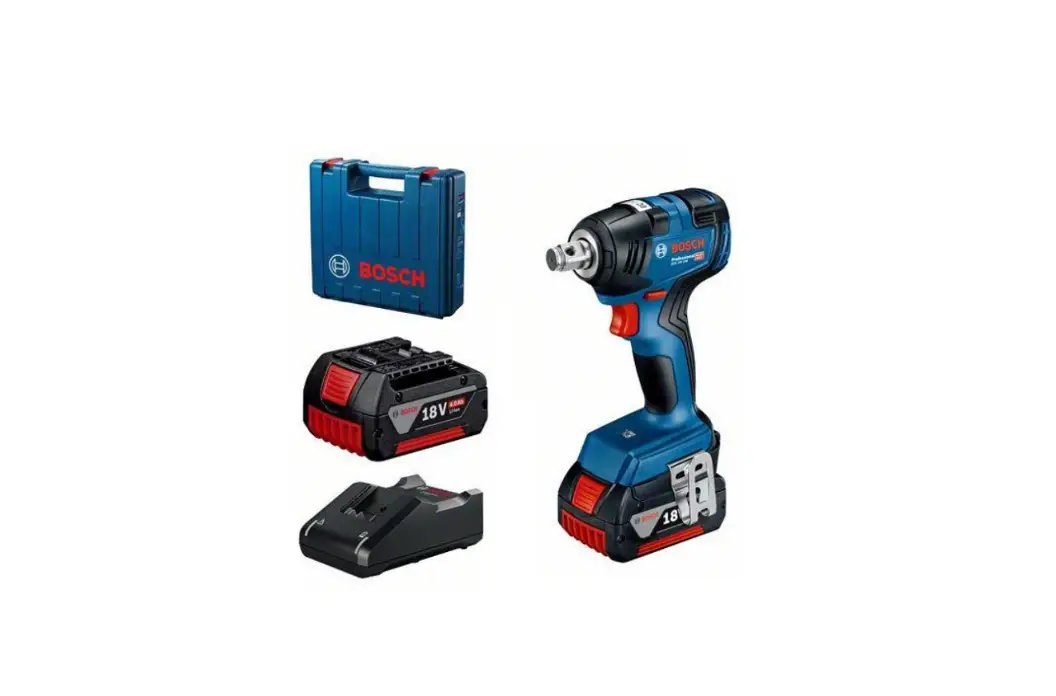
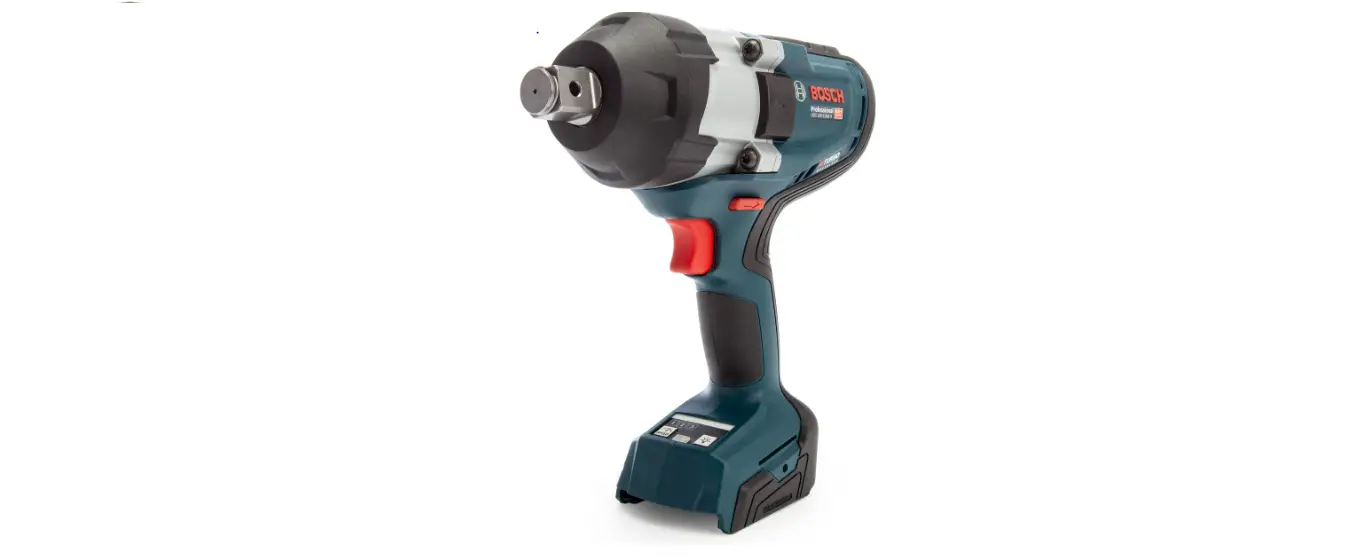
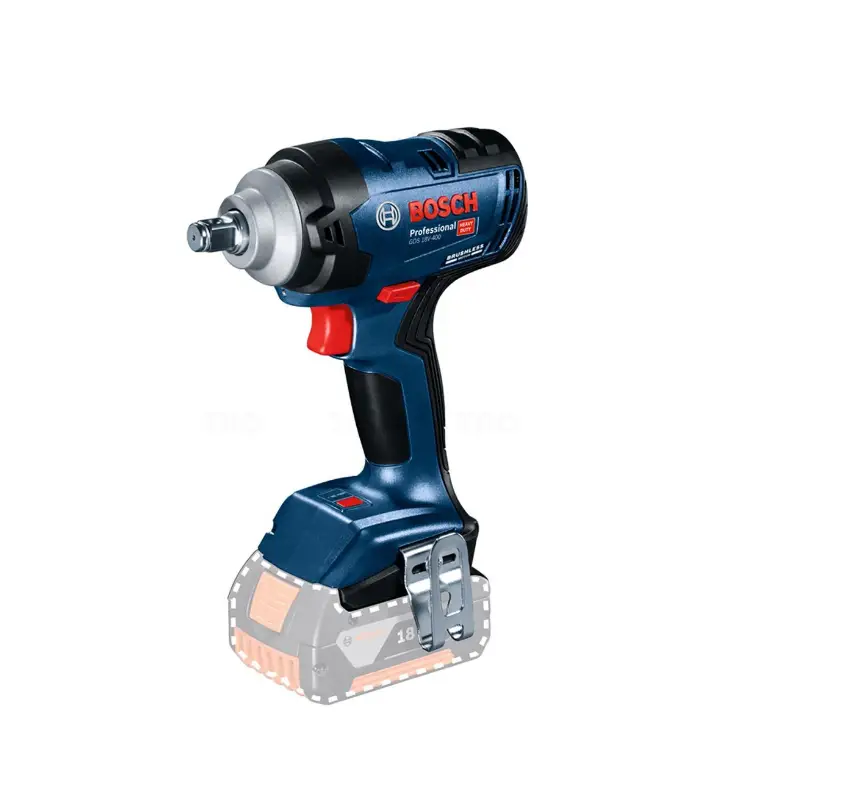
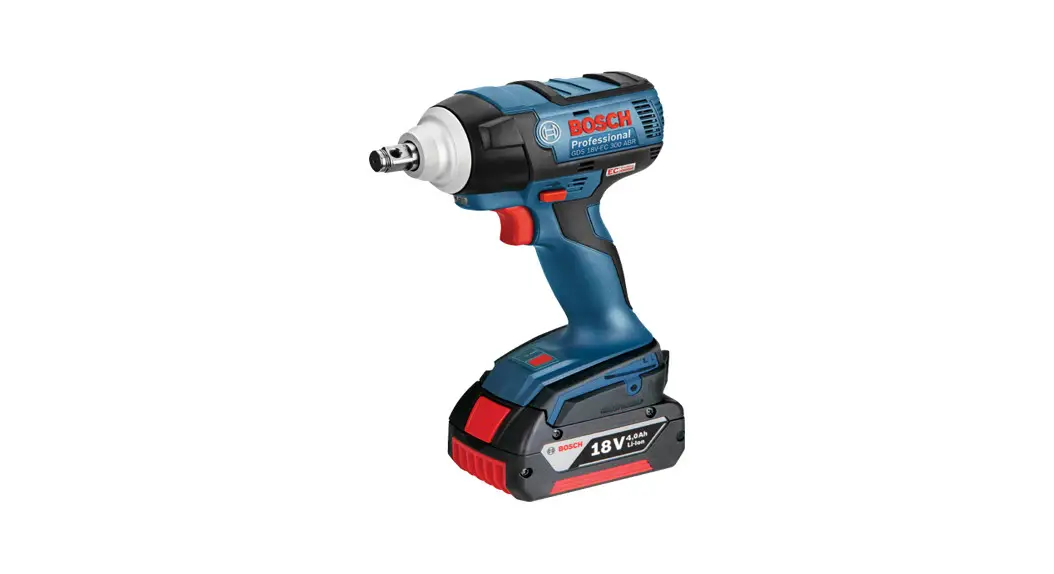
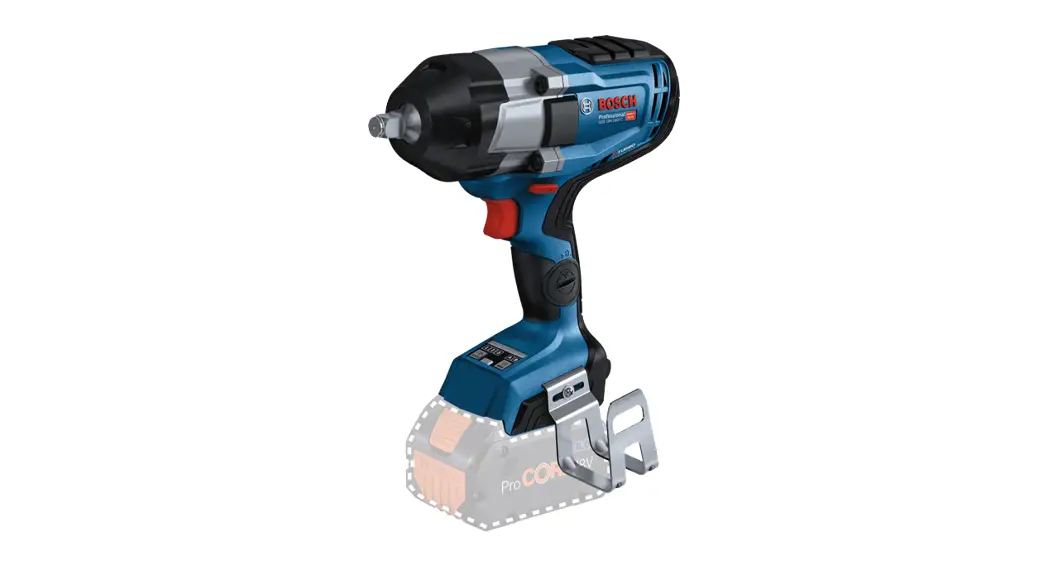
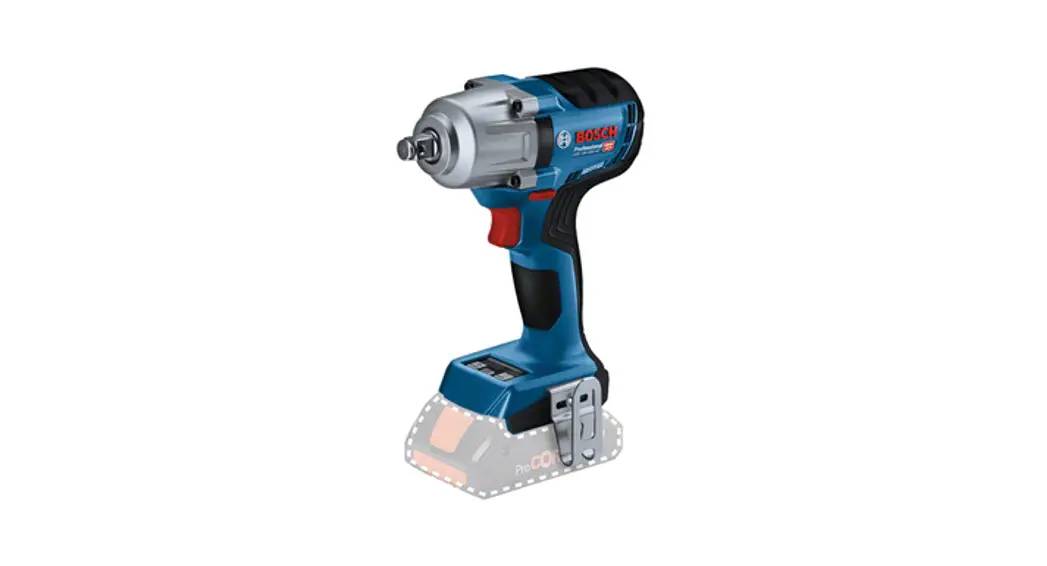
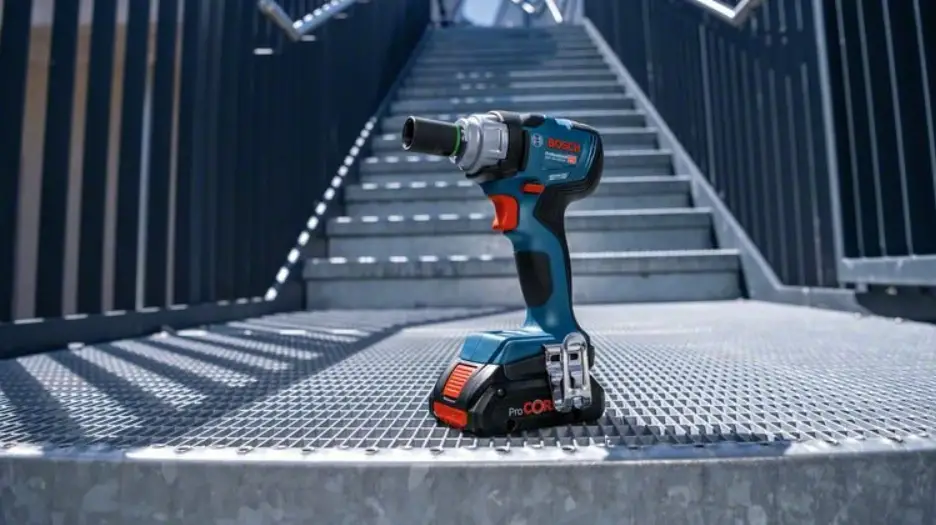
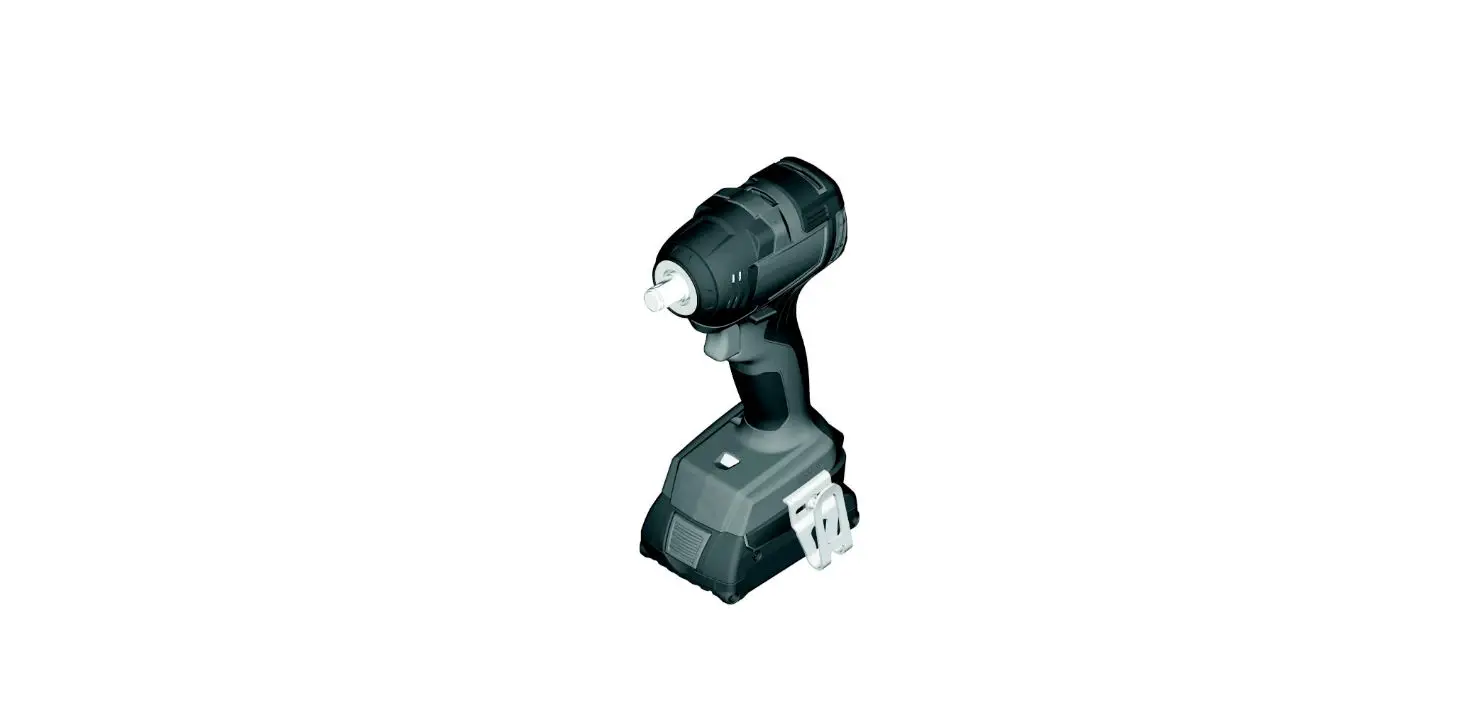
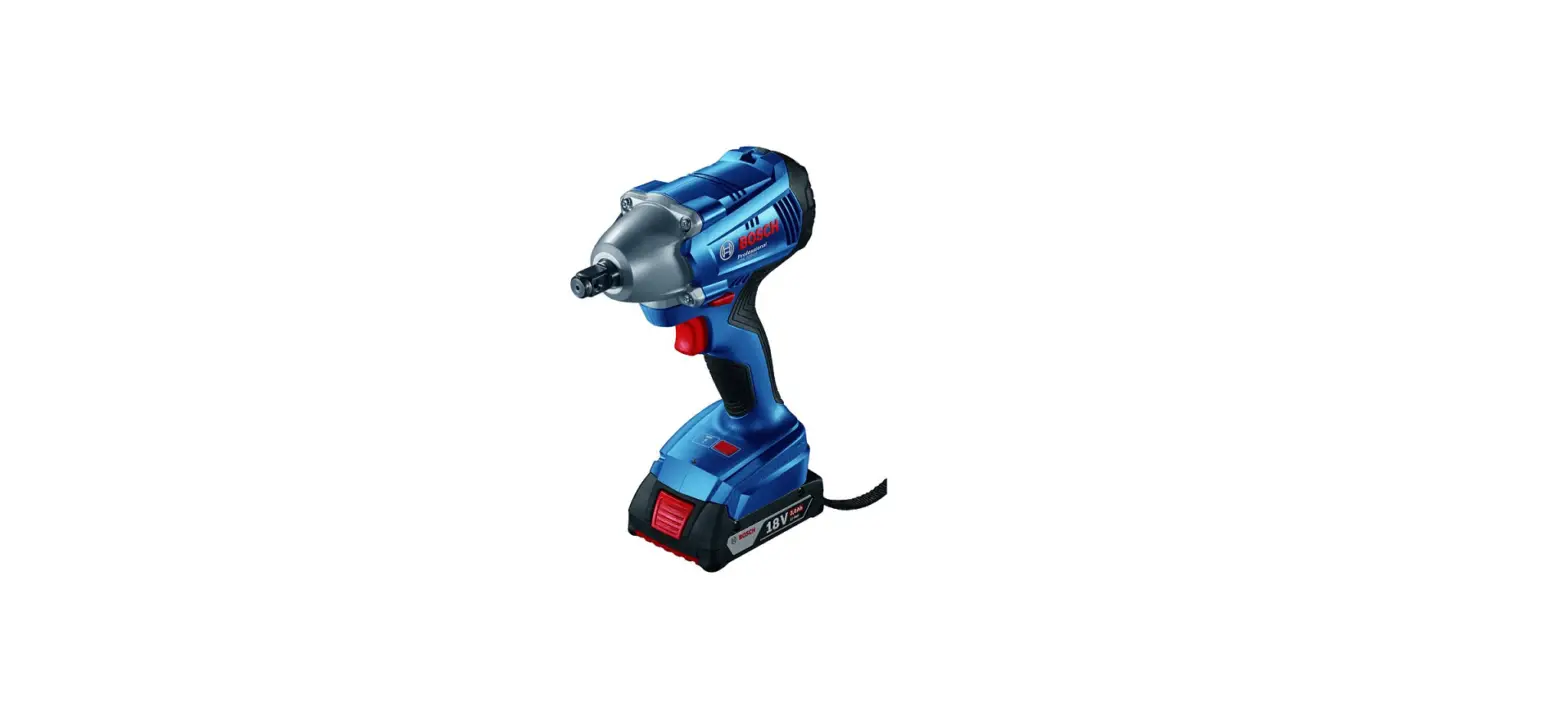
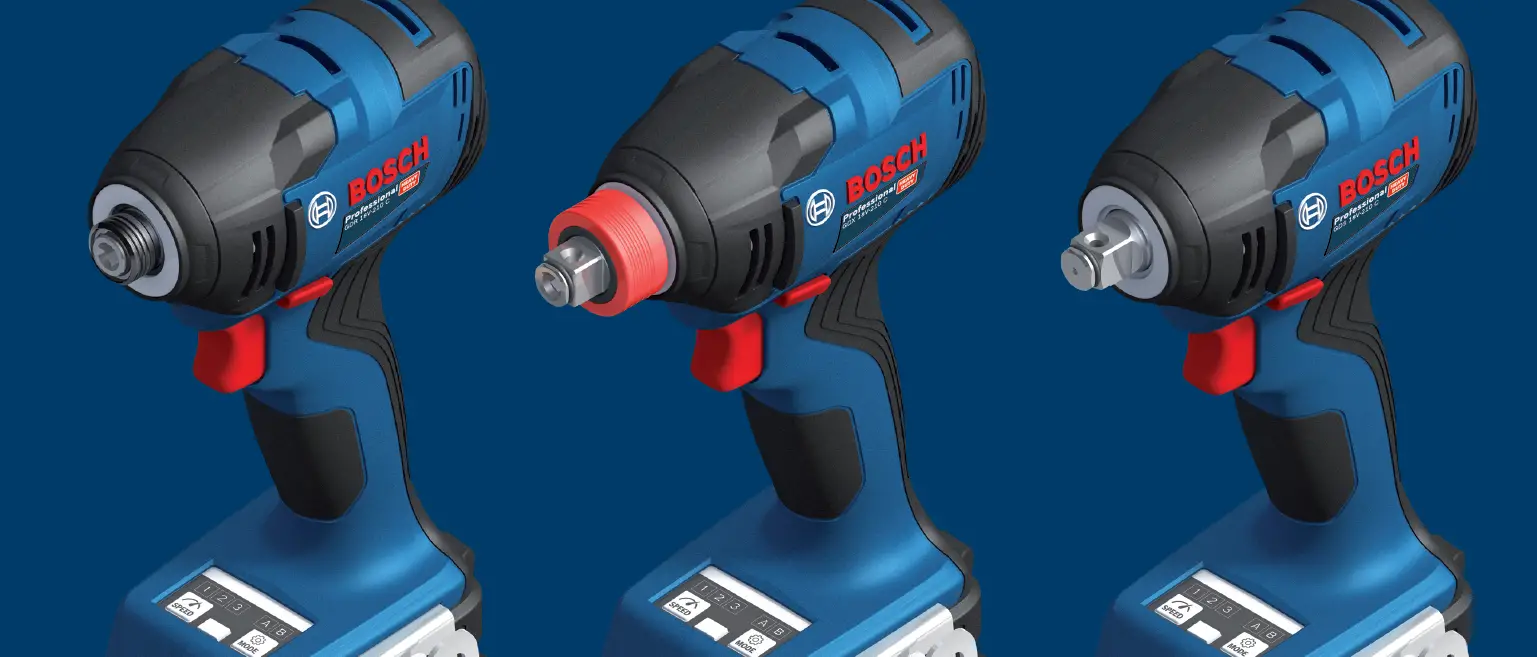
GDS 18V-1000 Cordless Impact Wrench
Product Information
The Bosch GDS Professional is a cordless impact wrench designed
for professional use. It comes in four models: 18V-1000, 18V-1050
H, 18V-1000 C, and 18V-1050 HC. The tool is manufactured by Robert
Bosch Power Tools GmbH in Stuttgart, Germany. The product
dimensions are not specified in the user manual.
Abgebildete Komponenten
- (1) Werkzeugaufnahme
- (2) Drehrichtungsumschalter
- (4) Leiterclip
- (5) Akku
- (6) Akku-Entriegelungstaste
- (7) User Interface
- (8) Ein-/Ausschalter
- (11) Zustandanzeige Elektrowerkzeug
- (12) Anzeige Modus
- (13) Taste Arbeitslicht (GDS 18V-1000, GDS 18V-1050 H)
- (14) Taste Modus (GDS 18V-1000 C, GDS 18V-1050 HC)
- (15) Arbeitslicht
- (16) Taste Drehzahlvorwahl
- (17) Anzeige Drehzahlvorwahlstufe
Technische Daten
| Akku-Schlagschrauber | GDS 18V-1000 | GDS 18V-1050 H | GDS 18V-1000 C | GDS 18V-1050 HC |
|---|---|---|---|---|
| Sachnummer | 3 601 JJ8 3.. | 3 601 JJ8 5.. | 3 601 JJ8 0.. | 3 601 JJ8 2.. |
| Nennspannung V= | 18 | 18 | 18 | 18 |
| LeerlaufdrehzahlA) min-1 | 0 – 1,000 | 0 – 1,050 | 0 – 1,000 | 0 – 1,050 |
| SchlagzahlA) min-1 | 0 – 2,300 | 0 – 2,400 | 0 – 2,300 | 0 – 2,400 |
| DrehmomentA) Nm | 0 – 1,000 | 0 – 1,050 | 0 – 1,000 | 0 – 1,050 |
| Max. AnzugsmomentA) Nm | 1,000 | 1,050 | – | – |
| Werkzeugaufnahme | – | 1/2″ Außenvierkant | – | 1/2″ Außenvierkant |
| Gewicht entsprechend kg | 2.3 | 2.6 | 2.3 | 2.6 |
| EPTA-Procedure 01:2014B) | – | – | CPC (Connected Professional) | CPC (Connected Professional) |
| empfohlene Umgebungstemperatur beim Laden | 0 … +35 °C | 0 … +35 °C | 0 … +35 °C | 0 … +35 °C |
| erlaubte Umgebungstemperatur beim Betrieb und bei Lagerung | – | – | – | – |
| kompatible Akkus | 18V Li-Ion | 18V Li-Ion | 18V Li-Ion | 18V Li-Ion |
| Signalabstand s | – | – | Bluetooth 4.0 | Bluetooth 4.0 |
Product Usage Instructions
- Always read the safety instructions before using the tool.
- Use a residual current device when operating the tool in damp
conditions to reduce the risk of electric shock. - Do not short-circuit the battery contacts, as this can cause
burns or fire. - Only use the tool with compatible Bosch 18V Li-Ion
batteries. - Refer to the user interface to check the status of the tool and
select the appropriate mode and speed. - Press the Ein-/Ausschalter (on/off switch) to start and stop
the tool. - Use the Werkzeugaufnahme (tool holder) to attach and detach
sockets or adapters. - Flip the Drehrichtungsumschalter (direction of rotation switch)
to change the direction of rotation. - Press the Akku-Entriegelungstaste (battery release button) to
release the battery from the tool. - Press the Taste Arbeitslicht (work light button) to turn on the
work light on GDS 18V-1000 and GDS 18V-1050 H models. - Press the Taste Modus (mode button) to select the appropriate
mode on GDS 18V-1000 C and GDS 18V-1050 HC models. - Use the Taste Drehzahlvorwahl (speed selection button) to
adjust the speed of the tool. - Refer to the Anzeige Drehzahlvorwahlstufe (speed selection
level display) to check the selected speed level.
Robert Bosch Power Tools GmbH 70538 Stuttgart GERMANY www.bosch-pt.com
1 609 92A 7X5 (2022.07) AS / 307
1 609 92A 7X5
GDS Professional
18V-1000 | 18V-1050 H | 18V-1000 C | 18V-1050 HC
de Originalbetriebsanleitung en Original instructions fr Notice originale es Manual original pt Manual original it Istruzioni originali nl Oorspronkelijke gebruiksaanwijzing da Original brugsanvisning sv Bruksanvisning i original no Original driftsinstruks fi Alkuperäiset ohjeet el tr Orijinal iletme talimati pl Instrukcja oryginalna cs Pvodní návod k pouzívání sk Pôvodný návod na pouzitie hu Eredeti használati utasítás
ru
uk
kk
ro Instruciuni originale bg mk sr Originalno uputstvo za rad sl Izvirna navodila hr Originalne upute za rad et Algupärane kasutusjuhend lv Instrukcijas oriinlvalod
lt Originali instrukcija ko ar fa
2 |
Deutsch ………………………………………….. Seite 7 English …………………………………………… Page 16 Français ………………………………………….. Page 25 Español ………………………………………… Página 35 Português ………………………………………. Página 44 Italiano …………………………………………. Pagina 54 Nederlands ……………………………………… Pagina 63 Dansk ……………………………………………. Side 72 Svensk ………………………………………….. Sidan 80 Norsk…………………………………………….. Side 88 Suomi ……………………………………………..Sivu 97 ………………………………………… 105 Türkçe…………………………………………… Sayfa 115 Polski ………………………………………….. Strona 124 Cestina ………………………………………… Stránka 134 Slovencina …………………………………….. Stránka 142 Magyar ……………………………………………Oldal 151 ……………………………………… 161 ……………………………………. 172 …………………………………………….. 182 Român ………………………………………… Pagina 193 …………………………………… 203 ………………………………….. 213 Srpski ………………………………………….. Strana 222 Slovenscina ……………………………………….Stran 231 Hrvatski ………………………………………..Stranica 240 Eesti………………………………………….. Lehekülg 248 Latviesu ………………………………………. Lappuse 257 Lietuvi k. ………………………………………Puslapis 266 ……………………………………….. 275 ………………………………………….. 284 ………………………………………….. 293
/
………………………………………….. I/i
1 609 92A 7X5 | (04.07.2022)
Bosch Power Tools
| 3
(1)
(8) (7)
(6)
(5)
GDS 18V-1050 HC
Bosch Power Tools
(2) (3) (4)
(9)
1 609 92A 7X5 | (04.07.2022)
4 |
(1)
(8) (7)
(6)
(5)
GDS 18V-1000
1 609 92A 7X5 | (04.07.2022)
(2) (4) (9)
Bosch Power Tools
A
(1) (10)
| 5
B
(1) (10)
GDS 18V-1050 H GDS 18V-1050 HC
B
GDS 18V-1000 GDS 18V-1000 C
1 2
GDS 18V-1000 PC
Bosch Power Tools
(10)
1 609 92A 7X5 | (04.07.2022)
6 |
C
D
(11)
(XX) (11)
(12)
(17)
(17)
(16)
(13) (16)
(14)
(15)
(15)
GDS 18V-1000 GDS 18V-1050 H
E
GDS 18V-1000 CPC GDS 18V-1050 HC
F
(2)
(2)
1 609 92A 7X5 | (04.07.2022)
Bosch Power Tools
Deutsch
Sicherheitshinweise
Allgemeine Sicherheitshinweise für Elektrowerkzeuge
WARNUNG Lesen Sie alle Sicherheitshinwei-
se, Anweisungen, Bebilderungen und technischen Daten, mit denen dieses Elektrowerkzeug versehen ist. Versäumnisse bei der Einhaltung der Sicherheitshinweise und nachfolgenden Anweisungen können elektrischen Schlag, Brand und/oder schwere Verletzungen verursachen.
Bewahren Sie alle Sicherheitshinweise und Anweisungen für die Zukunft auf.
Der in den Sicherheitshinweisen verwendete Begriff ,,Elektrowerkzeug” bezieht sich auf netzbetriebene Elektrowerkzeuge (mit Netzleitung) und auf akkubetriebene Elektrowerkzeuge (ohne Netzleitung).
Arbeitsplatzsicherheit
u Halten Sie Ihren Arbeitsbereich sauber und gut beleuchtet. Unordnung oder unbeleuchtete Arbeitsbereiche können zu Unfällen führen.
u Arbeiten Sie mit dem Elektrowerkzeug nicht in explosionsgefährdeter Umgebung, in der sich brennbare Flüssigkeiten, Gase oder Stäube befinden. Elektrowerkzeuge erzeugen Funken, die den Staub oder die Dämpfe entzünden können.
u Halten Sie Kinder und andere Personen während der Benutzung des Elektrowerkzeugs fern. Bei Ablenkung können Sie die Kontrolle über das Elektrowerkzeug verlieren.
Elektrische Sicherheit
u Der Anschlussstecker des Elektrowerkzeuges muss in die Steckdose passen. Der Stecker darf in keiner Weise verändert werden. Verwenden Sie keine Adapterstecker gemeinsam mit schutzgeerdeten Elektrowerkzeugen. Unveränderte Stecker und passende Steckdosen verringern das Risiko eines elektrischen Schlages.
u Vermeiden Sie Körperkontakt mit geerdeten Oberflächen wie von Rohren, Heizungen, Herden und Kühlschränken. Es besteht ein erhöhtes Risiko durch elektrischen Schlag, wenn Ihr Körper geerdet ist.
u Halten Sie Elektrowerkzeuge von Regen oder Nässe fern. Das Eindringen von Wasser in ein Elektrowerkzeug erhöht das Risiko eines elektrischen Schlages.
u Zweckentfremden Sie die Anschlussleitung nicht, um das Elektrowerkzeug zu tragen, aufzuhängen oder um den Stecker aus der Steckdose zu ziehen. Halten Sie die Anschlussleitung fern von Hitze, Öl, scharfen Kanten oder sich bewegenden Teilen. Beschädigte oder verwickelte Anschlussleitungen erhöhen das Risiko eines elektrischen Schlages.
Deutsch | 7
u Wenn Sie mit einem Elektrowerkzeug im Freien arbeiten, verwenden Sie nur Verlängerungskabel, die auch für den Außenbereich geeignet sind. Die Anwendung einer für den Außenbereich geeigneten Verlängerungsleitung verringert das Risiko eines elektrischen Schlages.
u Wenn der Betrieb des Elektrowerkzeuges in feuchter Umgebung nicht vermeidbar ist, verwenden Sie einen Fehlerstromschutzschalter. Der Einsatz eines Fehlerstromschutzschalters vermindert das Risiko eines elektrischen Schlages.
Sicherheit von Personen
u Seien Sie aufmerksam, achten Sie darauf, was Sie tun, und gehen Sie mit Vernunft an die Arbeit mit einem Elektrowerkzeug. Benutzen Sie kein Elektrowerkzeug, wenn Sie müde sind oder unter dem Einfluss von Drogen, Alkohol oder Medikamenten stehen. Ein Moment der Unachtsamkeit beim Gebrauch des Elektrowerkzeuges kann zu ernsthaften Verletzungen führen.
u Tragen Sie persönliche Schutzausrüstung und immer eine Schutzbrille. Das Tragen persönlicher Schutzausrüstung, wie Staubmaske, rutschfeste Sicherheitsschuhe, Schutzhelm oder Gehörschutz, je nach Art und Einsatz des Elektrowerkzeuges, verringert das Risiko von Verletzungen.
u Vermeiden Sie eine unbeabsichtigte Inbetriebnahme. Vergewissern Sie sich, dass das Elektrowerkzeug ausgeschaltet ist, bevor Sie es an die Stromversorgung und/oder den Akku anschließen, es aufnehmen oder tragen. Wenn Sie beim Tragen des Elektrowerkzeuges den Finger am Schalter haben oder das Gerät eingeschaltet an die Stromversorgung anschließen, kann dies zu Unfällen führen.
u Entfernen Sie Einstellwerkzeuge oder Schraubenschlüssel, bevor Sie das Elektrowerkzeug einschalten. Ein Werkzeug oder Schlüssel, der sich in einem drehenden Geräteteil befindet, kann zu Verletzungen führen.
u Vermeiden Sie eine abnormale Körperhaltung. Sorgen Sie fur einen sicheren Stand und halten Sie jederzeit das Gleichgewicht. Dadurch können Sie das Elektrowerkzeug in unerwarteten Situationen besser kontrollieren.
u Tragen Sie geeignete Kleidung. Tragen Sie keine weite Kleidung oder Schmuck. Halten Sie Haare und Kleidung fern von sich bewegenden Teilen. Lockere Kleidung, Schmuck oder lange Haare können von sich bewegenden Teilen erfasst werden.
u Wenn Staubabsaug- und -auffangeinrichtungen montiert werden können, sind diese anzuschließen und richtig zu verwenden. Verwendung einer Staubabsaugung kann Gefährdungen durch Staub verringern.
u Wiegen Sie sich nicht in falscher Sicherheit und setzen Sie sich nicht über die Sicherheitsregeln für Elektrowerkzeuge hinweg, auch wenn Sie nach vielfachem Gebrauch mit dem Elektrowerkzeug vertraut sind. Achtloses Handeln kann binnen Sekundenbruchteilen zu schweren Verletzungen führen.
Bosch Power Tools
1 609 92A 7X5 | (04.07.2022)
8 | Deutsch
Verwendung und Behandlung des Elektrowerkzeugs
u Überlasten Sie das Elektrowerkzeug nicht. Verwenden Sie für Ihre Arbeit das dafür bestimmte Elektrowerkzeug. Mit dem passenden Elektrowerkzeug arbeiten Sie besser und sicherer im angegebenen Leistungsbereich.
u Benutzen Sie kein Elektrowerkzeug, dessen Schalter defekt ist. Ein Elektrowerkzeug, das sich nicht mehr einoder ausschalten lässt, ist gefährlich und muss repariert werden.
u Ziehen Sie den Stecker aus der Steckdose und/oder entfernen Sie einen abnehmbaren Akku, bevor Sie Geräteeinstellungen vornehmen, Einsatzwerkzeugteile wechseln oder das Elektrowerkzeug weglegen. Diese Vorsichtsmaßnahme verhindert den unbeabsichtigten Start des Elektrowerkzeuges.
u Bewahren Sie unbenutzte Elektrowerkzeuge außerhalb der Reichweite von Kindern auf. Lassen Sie keine Personen das Elektrowerkzeug benutzen, die mit diesem nicht vertraut sind oder diese Anweisungen nicht gelesen haben. Elektrowerkzeuge sind gefährlich, wenn sie von unerfahrenen Personen benutzt werden.
u Pflegen Sie Elektrowerkzeuge und Einsatzwerkzeug mit Sorgfalt. Kontrollieren Sie, ob bewegliche Teile einwandfrei funktionieren und nicht klemmen, ob Teile gebrochen oder so beschädigt sind, dass die Funktion des Elektrowerkzeuges beeinträchtigt ist. Lassen Sie beschädigte Teile vor dem Einsatz des Gerätes reparieren. Viele Unfälle haben ihre Ursache in schlecht gewarteten Elektrowerkzeugen.
u Halten Sie Schneidwerkzeuge scharf und sauber. Sorgfältig gepflegte Schneidwerkzeuge mit scharfen Schneidkanten verklemmen sich weniger und sind leichter zu führen.
u Verwenden Sie Elektrowerkzeug, Zubehör, Einsatzwerkzeuge usw. entsprechend diesen Anweisungen. Berücksichtigen Sie dabei die Arbeitsbedingungen und die auszuführende Tätigkeit. Der Gebrauch von Elektrowerkzeugen fur andere als die vorgesehenen Anwendungen kann zu gefährlichen Situationen führen.
u Halten Sie Griffe und Griffflächen trocken, sauber und frei von Öl und Fett. Rutschige Griffe und Griffflächen erlauben keine sichere Bedienung und Kontrolle des Elektrowerkzeugs in unvorhergesehenen Situationen.
Verwendung und Behandlung des Akkuwerkzeugs
u Laden Sie die Akkus nur mit Ladegeräten auf, die vom Hersteller empfohlen werden. Durch ein Ladegerät, das für eine bestimmte Art von Akkus geeignet ist, besteht Brandgefahr, wenn es mit anderen Akkus verwendet wird.
u Verwenden Sie nur die dafür vorgesehenen Akkus in den Elektrowerkzeugen. Der Gebrauch von anderen Akkus kann zu Verletzungen und Brandgefahr führen.
u Halten Sie den nicht benutzten Akku fern von Büroklammern, Münzen, Schlüsseln, Nägeln, Schrauben oder anderen kleinen Metallgegenständen, die eine Überbrückung der Kontakte verursachen könnten. Ein
Kurzschluss zwischen den Akkukontakten kann Verbrennungen oder Feuer zur Folge haben.
u Bei falscher Anwendung kann Flüssigkeit aus dem Akku austreten. Vermeiden Sie den Kontakt damit. Bei zufälligem Kontakt mit Wasser abspülen. Wenn die Flüssigkeit in die Augen kommt, nehmen Sie zusätzliche ärztliche Hilfe in Anspruch. Austretende Akkuflüssigkeit kann zu Hautreizungen oder Verbrennungen führen.
u Benutzen Sie keinen beschädigten oder veränderten Akku. Beschädigte oder veränderte Akkus können sich unvorhersehbar verhalten und zu Feuer, Explosion oder Verletzungsgefahr führen.
u Setzen Sie einen Akku keinem Feuer oder zu hohen Temperaturen aus. Feuer oder Temperaturen über 130°C können eine Explosion hervorrufen.
u Befolgen Sie alle Anweisungen zum Laden und laden Sie den Akku oder das Akkuwerkzeug niemals außerhalb des in der Betriebsanleitung angegebenen Temperaturbereichs. Falsches Laden oder Laden außerhalb des zugelassenen Temperaturbereichs kann den Akku zerstören und die Brandgefahr erhöhen.
Service
u Lassen Sie Ihr Elektrowerkzeug nur von qualifiziertem Fachpersonal und nur mit Original-Ersatzteilen reparieren. Damit wird sichergestellt, dass die Sicherheit des Elektrowerkzeuges erhalten bleibt.
u Warten Sie niemals beschädigte Akkus. Sämtliche Wartung von Akkus sollte nur durch den Hersteller oder bevollmächtigte Kundendienststellen erfolgen.
Sicherheitshinweise für Schlagschrauber
u Halten Sie das Elektrowerkzeug an den isolierten Griffflächen, wenn Sie Arbeiten ausführen, bei denen die Schraube verborgene Stromleitungen oder die eigene Anschlussleitung treffen kann. Der Kontakt der Schraube mit einer spannungsführenden Leitung kann auch metallene Geräteteile unter Spannung setzen und zu einem elektrischen Schlag führen.
u Halten Sie das Elektrowerkzeug an den isolierten Griffflächen, wenn Sie Arbeiten ausführen, bei denen die Schraube verborgene Stromleitungen treffen kann. Der Kontakt der Schraube mit einer spannungsführenden Leitung kann auch metallene Geräteteile unter Spannung setzen und zu einem elektrischen Schlag führen.
u Verwenden Sie geeignete Suchgeräte, um verborgene Versorgungsleitungen aufzuspüren, oder ziehen Sie die örtliche Versorgungsgesellschaft hinzu. Kontakt mit Elektroleitungen kann zu Feuer und elektrischem Schlag führen. Beschädigung einer Gasleitung kann zur Explosion führen. Eindringen in eine Wasserleitung verursacht Sachbeschädigung.
u Verwenden Sie geeignete Suchgeräte, um verborgene Versorgungsleitungen aufzuspüren, oder ziehen Sie die örtliche Versorgungsgesellschaft hinzu. Kontakt
1 609 92A 7X5 | (04.07.2022)
Bosch Power Tools
mit Elektroleitungen kann zu Feuer und elektrischem Schlag führen. Beschädigung einer Gasleitung kann zur Explosion führen. Eindringen in eine Wasserleitung verursacht Sachbeschädigung oder kann einen elektrischen Schlag verursachen.
u Halten Sie das Elektrowerkzeug gut fest. Beim Festziehen und Lösen von Schrauben können kurzzeitig hohe Reaktionsmomente auftreten.
u Sichern Sie das Werkstück. Ein mit Spannvorrichtungen oder Schraubstock festgehaltenes Werkstück ist sicherer gehalten als mit Ihrer Hand.
u Bringen Sie vor allen Arbeiten am Elektrowerkzeug (z.B. Wartung, Werkzeugwechsel, etc.) sowie bei dessen Transport und Aufbewahrung den Drehrichtungsumschalter in Mittelstellung. Bei unbeabsichtigtem Betätigen des Ein-/Ausschalters besteht Verletzungsgefahr.
u Warten Sie, bis das Elektrowerkzeug zum Stillstand gekommen ist, bevor Sie es ablegen. Das Einsatzwerkzeug kann sich verhaken und zum Verlust der Kontrolle über das Elektrowerkzeug führen.
u Bei Beschädigung und unsachgemäßem Gebrauch des Akkus können Dämpfe austreten. Der Akku kann brennen oder explodieren. Führen Sie Frischluft zu und suchen Sie bei Beschwerden einen Arzt auf. Die Dämpfe können die Atemwege reizen.
u Öffnen Sie den Akku nicht. Es besteht die Gefahr eines Kurzschlusses.
u Durch spitze Gegenstände wie z. B. Nagel oder Schraubenzieher oder durch äußere Krafteinwirkung kann der Akku beschädigt werden. Es kann zu einem internen Kurzschluss kommen und der Akku brennen, rauchen, explodieren oder überhitzen.
u Verwenden Sie den Akku nur in Produkten des Herstellers. Nur so wird der Akku vor gefährlicher Überlastung geschützt.
Schützen Sie das Elektrowerkzeug vor Hitze, z. B. auch vor dauernder Sonneneinstrahlung, Feuer, Wasser und Feuchtigkeit. Es besteht Explosionsgefahr.
Schützen Sie den Akku vor Hitze, z. B. auch vor dauernder Sonneneinstrahlung, Feuer, Schmutz, Wasser und Feuchtigkeit. Es besteht Explosions- und Kurzschlussgefahr.
u Schließen Sie das Elektrowerkzeug an ein ordnungsgemäß geerdetes Stromnetz an. Steckdose und Verlängerungskabel müssen einen funktionsfähigen Schutzleiter besitzen.
u Einsatzwerkzeuge können beim Arbeiten heiß werden! Es besteht Verbrennungsgefahr beim Wechsel des Einsatzwerkzeugs. Verwenden Sie Schutzhandschuhe, um das Einsatzwerkzeug zu entnehmen.
u Vorsicht! Bei der Verwendung des Elektrowerkzeugs mit Bluetooth ® kann eine Storung anderer Gerate und Anlagen, Flugzeuge und medizinischer Gerate (z. B. Herzschrittmacher, Horgerate) auftreten. Ebenfalls kann eine Schadigung von Menschen und Tieren in un-
Deutsch | 9
mittelbarer Umgebung nicht ganz ausgeschlossen werden. Verwenden Sie das Elektrowerkzeug mit Bluetooth® nicht in der Nahe von medizinischen Geraten, Tankstellen, chemischen Anlagen, Gebieten mit Explosionsgefahr und in Sprenggebieten. Verwenden Sie das Elektrowerkzeug mit Bluetooth® nicht in Flugzeugen. Vermeiden Sie den Betrieb uber einen langeren Zeitraum in direkter Korpernahe. Die Wortmarke Bluetooth® wie auch die Bildzeichen (Logos) sind eingetragene Marken und Eigentum der Bluetooth SIG, Inc. Jegliche Verwendung dieser Wortmarke/Bildzeichen durch die Robert Bosch Power Tools GmbH erfolgt unter Lizenz.
Produkt- und Leistungsbeschreibung
Lesen Sie alle Sicherheitshinweise und Anweisungen. Versäumnisse bei der Einhaltung der Sicherheitshinweise und Anweisungen können elektrischen Schlag, Brand und/oder schwere Verletzungen verursachen. Bitte beachten Sie die Abbildungen im vorderen Teil der Betriebsanleitung.
Lesen Sie alle Sicherheitshinweise und Anweisungen. Versäumnisse bei der Einhaltung der Sicherheitshinweise und Anweisungen können elektrischen Schlag, Brand und/oder schwere Verletzungen verursachen. Bitte beachten Sie die Abbildungen im vorderen Teil der Betriebsanleitung.
Bestimmungsgemäßer Gebrauch
Das Elektrowerkzeug ist bestimmt zum Eindrehen und Lösen von Schrauben sowie zum Anziehen und Lösen von Muttern jeweils im angegebenen Abmessungsbereich. Daten und Einstellungen des Elektrowerkzeugs können bei eingesetztem Bluetooth® Low Energy Module GCY 42 mittels Bluetooth® Funktechnologie zwischen Elektrowerkzeug und einem mobilen Endgerät ubertragen werden.
Abgebildete Komponenten
Die Nummerierung der abgebildeten Komponenten bezieht sich auf die Darstellung des Elektrowerkzeuges auf der Grafikseite.
(1) Werkzeugaufnahme
(2) Drehrichtungsumschalter
(3) Abdeckung Bluetooth® Low Energy Module GCY 42
(4) Leiterclip (5) Akkua) (6) Akku-Entriegelungstastea)
(7) User Interface
(8) Ein-/Ausschalter
Bosch Power Tools
1 609 92A 7X5 | (04.07.2022)
10 | Deutsch
(9) Handgriff (isolierte Grifffläche) (10) Einsatzwerkzeug (z.B. Steckschlüssel)a)
User Interface (11) Zustandanzeige Elektrowerkzeug (12) Anzeige Modus (13) Taste Arbeitslicht
(GDS 18V-1000, GDS 18V-1050 H)
(14) Taste Modus (GDS 18V-1000 C, GDS 18V-1050 HC)
(15) Arbeitslicht
(16) Taste Drehzahlvorwahl
(17) Anzeige Drehzahlvorwahlstufe
a) Abgebildetes oder beschriebenes Zubehör gehört nicht zum Standard-Lieferumfang. Das vollständige Zubehör finden Sie in unserem Zubehörprogramm.
Technische Daten
Akku-Schlagschrauber
Sachnummer
Nennspannung
V=
LeerlaufdrehzahlA)
Einstellung 1
min-1
Einstellung 2
min-1
Einstellung 3
min-1
SchlagzahlA)
Einstellung 1
min-1
Einstellung 2
min-1
Einstellung 3
min-1
DrehmomentA)
Einstellung 1
Nm
Einstellung 2
Nm
Einstellung 3
Nm
Max. AnzugsmomentA)
Nm
Max. LösemomentA)
Nm
Maschinenschrauben-Ø
mm
Werkzeugaufnahme
Gewicht entsprechend
kg
EPTA-Procedure 01:2014B)
empfohlene Umgebungstem-
°C
peratur beim Laden
erlaubte Umgebungstempera-
°C
tur beim Betrieb und bei
Lagerung
kompatible Akkus
empfohlene Akkus für volle Leistung
empfohlene Ladegeräte
Datenübertragung Bluetooth®C)
Signalabstand
s
GDS 18V-1000 3 601 JJ8 3.. 18
GDS 18V-1050 H 3 601 JJ8 5.. 18
GDS 18V-1000 C GDS 18V-1050 HC
3 601 JJ8 0..
3 601 JJ8 2..
18
18
0800 01200 01750
0800 01200 01750
0800 01300 01750
0800 01300 01750
01600 02400 02600
01600 02400 02600
01600 02300 02600
01600 02300 02600
0350 0700 01000 1000 1600 M14M24
½” 3,34,4
0 … +35
20 … +50
0350 0750 01050 1050 1700 M14M24
¾” 3,34,4
0 … +35
20 … +50
0350 0650 01000 1000 1600 M14M24
½” 3,34,4
0 … +35
20 … +50
0350 0650 01050 1050 1700 M14M24
¾” 3,34,4
0 … +35
20 … +50
GBA 18V… ProCORE18V…
ProCORE18V… 5,5 Ah
GAL 18… GAX 18… GAL 36…
GBA 18V… ProCORE18V…
ProCORE18V… 5,5 Ah
GAL 18… GAX 18… GAL 36…
GBA 18V… ProCORE18V…
ProCORE18V… 5,5 Ah
GAL 18… GAX 18… GAL 36…
GBA 18V… ProCORE18V…
ProCORE18V… 5,5 Ah
GAL 18… GAX 18… GAL 36…
Bluetooth® 4.1 Bluetooth® 4.1
(Low Energy)
(Low Energy)
8
8
1 609 92A 7X5 | (04.07.2022)
Bosch Power Tools
Deutsch | 11
Akku-Schlagschrauber
GDS 18V-1000 GDS 18V-1050 H GDS 18V-1000 C GDS 18V-1050 HC
max. SignalreichweiteD)
m
30
30
A) Gemessen bei 2025 °C mit Akku ProCORE18V 8.0Ah.
B) Gemessen mit GBA 18V 1.5Ah und GBA 18V 12Ah.
C) Die mobilen Endgeräte mussen kompatibel zu Bluetooth® Low-Energy-Geräten (Version 4.1) sein und das Generic Access Profile (GAP) unterstutzen.
D) Die Reichweite kann je nach äußeren Bedingungen, einschließlich des verwendeten Empfangsgeräts, stark variieren. Innerhalb von geschlossenen Räumen und durch metallische Barrieren (z.B. Wände, Regale, Koffer etc.) kann die Bluetooth® Reichweite deutlich geringer sein.
Die Angaben gelten für eine Nennspannung [U] von 230 V. Bei abweichenden Spannungen und in länderspezifischen Ausführungen können diese Angaben variieren.
Geräusch-/Vibrationsinformationen
GDS 18V-1000 GDS 18V-1050 H GDS 18V-1000 C GDS 18V-1050 HC Geräuschemissionswerte ermittelt entsprechend EN 62841-2-2.
Der A-bewertete Geräuschpegel des Elektrowerkzeugs beträgt typischerweise
Schalldruckpegel
dB(A)
91
95
95
95
Schallleistungspegel
dB(A)
102
106
106
106
Unsicherheit K
dB
3
3
3
3
Gehörschutz tragen!
Schwingungsgesamtwerte ah (Vektorsumme dreier Richtungen) und Unsicherheit K ermittelt entsprechend EN 62841-2-2: Anziehen von Schrauben und Muttern maximaler zulässiger Größe
ah
m/s2
12
13
13,5
13,5
K
m/s2
1,5
1,5
1,5
1,5
Der in diesen Anweisungen angegebene Schwingungspegel und der Geräuschemissionswert sind entsprechend einem genormten Messverfahren gemessen worden und können für den Vergleich von Elektrowerkzeugen miteinander verwendet werden. Sie eignen sich auch für eine vorläufige Einschätzung der Schwingungs- und Geräuschemission.
Der angegebene Schwingungspegel und der Geräuschemissionswert repräsentieren die hauptsächlichen Anwendungen des Elektrowerkzeugs. Wenn allerdings das Elektrowerkzeug für andere Anwendungen, mit abweichenden Einsatzwerkzeugen oder ungenügender Wartung eingesetzt wird, können der Schwingungspegel und der Geräuschemissionswert abweichen. Dies kann die Schwingungs- und Geräuschemission über den gesamten Arbeitszeitraum deutlich erhöhen.
Für eine genaue Abschätzung der Schwingungs- und Geräuschemissionen sollten auch die Zeiten berücksichtigt werden, in denen das Gerät abgeschaltet ist oder zwar läuft, aber nicht tatsächlich im Einsatz ist. Dies kann die Schwingungs- und Geräuschemissionen über den gesamten Arbeitszeitraum deutlich reduzieren.
Legen Sie zusätzliche Sicherheitsmaßnahmen zum Schutz des Bedieners vor der Wirkung von Schwingungen fest wie zum Beispiel: Wartung von Elektrowerkzeug und Einsatzwerkzeugen, Warmhalten der Hände, Organisation der Arbeitsabläufe.
Montage
u Ziehen Sie vor allen Arbeiten am Elektrowerkzeug den Netzstecker aus der Steckdose.
u Bringen Sie vor allen Arbeiten am Elektrowerkzeug (z.B. Wartung, Werkzeugwechsel etc.) sowie bei dessen Transport und Aufbewahrung den Drehrichtungsumschalter in Mittelstellung. Bei unbeabsichtigtem Betätigen des Ein-/Ausschalters besteht Verletzungsgefahr.
u Nehmen Sie den Akku vor allen Arbeiten am Elektrowerkzeug (z.B. Wartung, Werkzeugwechsel etc.) sowie bei dessen Transport und Aufbewahrung aus dem Elektrowerkzeug. Bei unbeabsichtigtem Betätigen des Ein-/Ausschalters besteht Verletzungsgefahr.
Akku laden
u Benutzen Sie nur die in den technischen Daten aufgeführten Ladegeräte. Nur diese Ladegeräte sind auf den bei Ihrem Elektrowerkzeug verwendeten Li-Ionen-Akku abgestimmt.
Hinweis: Der Akku wird teilgeladen ausgeliefert. Um die volle Leistung des Akkus zu gewährleisten, laden Sie vor dem ersten Einsatz den Akku vollständig im Ladegerät auf.
Der Li-Ionen-Akku kann jederzeit aufgeladen werden, ohne die Lebensdauer zu verkürzen. Eine Unterbrechung des Ladevorganges schädigt den Akku nicht.
Der Li-Ionen-Akku ist durch die ,,Electronic Cell Protection (ECP)” gegen Tiefentladung geschützt. Bei entladenem Akku
Bosch Power Tools
1 609 92A 7X5 | (04.07.2022)
12 | Deutsch
wird das Elektrowerkzeug durch eine Schutzschaltung abgeschaltet: Das Einsatzwerkzeug bewegt sich nicht mehr. u Drücken Sie nach dem automatischen Abschalten des
Elektrowerkzeuges nicht weiter auf den Ein-/Ausschalter. Der Akku kann beschädigt werden. Beachten Sie die Hinweise zur Entsorgung.
Akku entnehmen Der Akku (5) verfügt über zwei Verriegelungsstufen, die verhindern sollen, dass der Akku beim unbeabsichtigten Drücken der Akku-Entriegelungstaste (6) herausfällt. Solange der Akku im Elektrowerkzeug eingesetzt ist, wird er durch eine Feder in Position gehalten. Zur Entnahme des Akkus (5) drücken Sie die Entriegelungstaste (6) und ziehen den Akku aus dem Elektrowerkzeug. Wenden Sie dabei keine Gewalt an.
Akku-Ladezustandsanzeige
Die grunen LEDs der Akku-Ladezustandsanzeige zeigen den Ladezustand des Akkus an. Aus Sicherheitsgrunden ist die Abfrage des Ladezustands nur bei Stillstand des Elektrowerkzeuges möglich. Drucken Sie die Taste fur die Ladezustandsanzeige oder
, um den Ladezustand anzuzeigen. Dies ist auch bei abgenommenem Akku möglich. Leuchtet nach dem Drucken der Taste fur die Ladezustandsanzeige keine LED, ist der Akku defekt und muss ausgetauscht werden.
Akku-Typ GBA 18V…
LEDs Dauerlicht 3× grün Dauerlicht 2× grün Dauerlicht 1× grün Blinklicht 1× grün
Akku-Typ ProCORE18V…
Kapazität 60-100 % 30-60 % 5-30 % 0-5 %
LEDs Dauerlicht 5× grün Dauerlicht 4× grün Dauerlicht 3× grün Dauerlicht 2× grün Dauerlicht 1× grün Blinklicht 1× grün
Kapazität 80-100 % 60-80 % 40-60 % 20-40 % 5-20 % 0-5 %
Bluetooth® Low Energy Module GCY 42 (Zubehör) einsetzen
Fur Informationen zum Bluetooth® Low Energy Module GCY 42 lesen Sie die zugehörige Bedienungsanleitung.
Werkzeugwechsel (siehe Bilder AB)
u Nehmen Sie den Akku vor allen Arbeiten am Elektrowerkzeug (z.B. Wartung, Werkzeugwechsel etc.) sowie bei dessen Transport und Aufbewahrung aus dem Elektrowerkzeug. Bei unbeabsichtigtem Betätigen des Ein-/Ausschalters besteht Verletzungsgefahr.
u Achten Sie beim Einsetzen eines Einsatzwerkzeugs darauf, dass es sicher auf der Werkzeugaufnahme sitzt. Wenn das Einsatzwerkzeug nicht sicher mit der Werkzeugaufnahme verbunden ist, kann es sich während des Schraubvorgangs lösen.
Schieben Sie das Einsatzwerkzeug (10) auf den Vierkant der Werkzeugaufnahme (1).
Betrieb
Funktionsweise
Die Werkzeugaufnahme (1) mit dem Einsatzwerkzeug wird durch einen Elektromotor über Getriebe und Schlagwerk angetrieben. Der Arbeitsvorgang gliedert sich in zwei Phasen: Schrauben und Festziehen (Schlagwerk in Aktion). Das Schlagwerk setzt ein, sobald die Schraubverbindung festfährt und somit der Motor belastet wird. Das Schlagwerk wandelt damit die Kraft des Motors in gleichmäßige Drehschläge um. Beim Lösen von Schrauben oder Muttern läuft dieser Vorgang umgekehrt ab.
Inbetriebnahme
u Beachten Sie die Netzspannung! Die Spannung der Stromquelle muss mit den Angaben auf dem Typenschild des Elektrowerkzeuges übereinstimmen. Mit 230 V gekennzeichnete Elektrowerkzeuge können auch an 220 V betrieben werden.
u Legen Sie das Elektrowerkzeug immer seitlich ab und stellen Sie es nicht auf den Akku. Je nach verwendeten Einsatzwerkzeug und Akku kann das Elektrowerkzeug umkippen.
Akku einsetzen Hinweis: Der Gebrauch von nicht für Ihr Elektrowerkzeug geeigneten Akkus kann zu Fehlfunktionen oder zur Beschädigung des Elektrowerkzeuges führen. Schieben Sie den geladenen Akku (5) in den Fuß des Elektrowerkzeugs hinein, bis der Akku sicher verriegelt ist.
Drehrichtung einstellen (siehe Bild E) Mit dem Drehrichtungsumschalter (2) können Sie die Drehrichtung des Elektrowerkzeuges ändern. Bei gedrücktem Ein-/Ausschalter (8) ist dies jedoch nicht möglich.
1 609 92A 7X5 | (04.07.2022)
Bosch Power Tools
Deutsch | 13
Rechtslauf: Zum Eindrehen von Schrauben und Anziehen von Muttern drücken Sie den Drehrichtungsumschalter (2) nach links bis zum Anschlag durch. Linkslauf: Zum Lösen bzw. Herausdrehen von Schrauben und Muttern drücken Sie den Drehrichtungsumschalter (2) nach rechts bis zum Anschlag durch.
Drehzahl/Schlagzahl einstellen Sie können die Drehzahl/Schlagzahl des eingeschalteten Elektrowerkzeugs stufenlos regulieren, je nachdem, wie weit Sie den Ein-/Ausschalter (8) eindrücken. Leichter Druck auf den Ein-/Ausschalter (8) bewirkt eine niedrige Drehzahl/Schlagzahl. Mit zunehmendem Druck erhöht sich die Drehzahl/Schlagzahl.
Zustandsanzeigen
Ein-/Ausschalten Drücken Sie zur Inbetriebnahme des Elektrowerkzeuges den Ein-/Ausschalter (8) und halten Sie ihn gedrückt. Das Arbeitslicht (15) leuchtet bei leicht oder vollständig gedrücktem Ein-/Ausschalter (8) und ermöglicht das Ausleuchten des Arbeitsbereiches bei ungünstigen Lichtverhältnissen. Um das Elektrowerkzeug auszuschalten, lassen Sie den Ein-/Ausschalter (8) los.
User Interface (siehe Bilder DE)
GDS 18V-1000 C / GDS 18V-1050 HC: Das User Interface (7) dient zur Drehzahlvorwahl und Vorwahl des Arbeitsmodus sowie zur Zustandsanzeige des Elektrowerkzeugs.
Zustandsanzeige Elektrowerkzeug (11) grün gelb
rot leuchtend
blau blinkend
Bedeutung/Ursache
Lösung
Status OK Kritische Temperatur ist erreicht oder Akku fast leer
Elektrowerkzeug ist uberhitzt oder Akku leer
Elektrowerkzeug ist mit mobilem Endgerät verbunden oder Einstellungen werden ubertragen
Elektrowerkzeug im Leerlauf laufen und abkuhlen lassen oder Akku bald tauschen bzw. laden
Elektrowerkzeug abkuhlen lassen oder Akku tauschen bzw. laden
Drehzahlvorwahl
Mit der Taste zur Drehzahlvorwahl (16) können Sie die benötigte Drehzahl in 3 Stufen vorwählen. Drücken Sie die Taste (16) so oft, bis die gewünschte Einstellung in der Drehzahlanzeige (17) signalisiert wird. Die gewählte Einstellung wird gespeichert.
GDS 18V-1000 C / GDS 18V-1050 HC: Sie können die Drehzahlvorwahl auch über die Bosch Toolbox App vorwählen.
Die erforderliche Drehzahl ist vom Werkstoff und den Arbeitsbedingungen abhängig und kann durch praktischen Versuch ermittelt werden.
Die Angaben in der nachfolgenden Tabelle sind empfohlene Werte.
Grundeinstellung Drehzahl bei Stufe
1
2
3
[min-1] [min-1] [min-1]Anzahl Drehzahlstufen
3
01100 02300 03400
Mit der Taste zur Drehzahlvorwahl (16) können Sie die be-
nötigte Drehzahl auch während des Betriebes vorwählen.
Arbeitslicht einschalten
GDS 18V-1000 / GDS 18V-1050 H: Zum Einschalten bzw. Ausschalten des Arbeitslichts (15) drücken Sie die Taste Arbeitslicht (13). u Blicken Sie nicht direkt in das Arbeitslicht, es kann Sie
blenden.
Arbeitsmodus wählen
GDS 18V-1000 C / GDS 18V-1050 HC: Das Elektrowerkzeug verfügt über 2 vordefinierte Arbeitsmodi A und B (12). Sie können über die Bosch Toolbox App zusätzlich unter A und B (12) Arbeitsmodi für verschiedene Anwendungen programmieren und bestehende Modi anpassen. Um zwischen den Arbeitsmodi A und B (12) zu wechseln, drücken Sie die Taste (14).
Arbeitshinweise
u Setzen Sie das Elektrowerkzeug nur ausgeschaltet auf die Mutter/Schraube auf. Sich drehende Einsatzwerkzeuge können abrutschen.
u Das Elektrowerkzeug mit eingesetztem Bluetooth® Low Energy Module GCY 42 (Zubehör) ist mit einer Funkschnittstelle ausgestattet. Lokale Betriebseinschränkungen, z. B. in Flugzeugen oder Krankenhäusern, sind zu beachten.
Bosch Power Tools
1 609 92A 7X5 | (04.07.2022)
14 | Deutsch
Das Drehmoment ist abhängig von der Schlagdauer. Das maximal erzielte Drehmoment resultiert aus der Summe aller, durch Schläge erzielten, Einzeldrehmomente. Das maximale Drehmoment wird nach einer Schlagdauer von 610 Sekunden erreicht. Nach dieser Zeit erhöht sich das Anziehdrehmoment nur noch minimal. Die Schlagdauer ist für jedes erforderliche Anziehdrehmoment zu ermitteln. Das tatsächlich erzielte Anziehdrehmoment ist stets mit einem Drehmomentschlüssel zu überprüfen.
Verschraubungen mit hartem, federndem oder weichem Sitz Werden im Versuch die in einer Schlagfolge erzielten Drehmomente gemessen und in ein Diagramm übertragen, erhält man die Kurve eines Drehmomentverlaufes. Die Höhe der Kurve entspricht dem maximal erzielbaren Drehmoment, die Steilheit zeigt, in welcher Zeit dies erreicht wird.
Ein Drehmomentverlauf hängt ab von folgenden Faktoren: Festigkeit der Schrauben/Muttern
Art der Unterlage (Scheibe, Tellerfeder, Dichtung)
Festigkeit des zu verschraubenden Materials
Schmierverhältnisse an der Schraubverbindung
Entsprechend ergeben sich folgende Anwendungsfälle: Harter Sitz ist gegeben bei Verschraubungen von Metall
auf Metall bei Verwendung von Unterlegscheiben. Nach einer relativ kurzen Schlagzeit ist das maximale Drehmoment erreicht (steiler Kennlinienverlauf). Unnötig lange Schlagzeit schadet nur der Maschine.
Federnder Sitz ist gegeben bei Verschraubungen von Metall auf Metall, jedoch bei Verwendung von Federringen, Tellerfedern, Stehbolzen oder Schrauben/Muttern mit konischem Sitz sowie bei Verwendung von Verlängerungen.
Weicher Sitz ist gegeben bei Verschraubungen von z. B. Metall auf Holz, oder bei Verwendung von Blei- oder Fiberscheiben als Unterlage.
Bei federndem bzw. weichem Sitz ist das maximale Anziehdrehmoment geringer als bei hartem Sitz. Ebenso ist eine deutlich längere Schlagzeit erforderlich.
Richtwerte für maximale Schrauben-Anziehdrehmomente Angaben in Nm, berechnet aus dem Spannungsquerschnitt; Ausnutzung der Streckgrenze 90 % (bei Reibungszahl ges = 0,12). Zur Kontrolle ist das Anziehdrehmoment stets mit einem Drehmomentschlüssel zu überprüfen.
Festigkeitsklassen Standard-Schrauben
Hochfeste Schrauben
nach DIN 267
3.6 4.6 5.6 4.8 6.6 5.8 6.8 6.9 8.8 10.9 12.9
M10
13 17.5 22 23 26 29 35 39 47 65 78
M12
22.6 30 37.6 40 45 50 60 67 80 113 135
M14
36 48 60 65 72 79 95 107 130 180 215
M16
55 73 92 98 110 122 147 165 196 275 330
M18
75 101 126 135 151 168 202 227 270 380 450
M20
107 143 178 190 214 238 286 320 385 540 635
M22
145 190 240 255 290 320 385 430 510 715 855
M24
185 245 310 325 370 410 490 455 650 910 1100
Tipps
Vor dem Eindrehen größerer, längerer Schrauben in harte Werkstoffe sollten Sie mit dem Kerndurchmesser des Gewindes auf etwa 2/3 der Schraubenlänge vorbohren.
Hinweis: Achten Sie darauf, dass keine metallischen Kleinteile in das Elektrowerkzeug eindringen.
Nach längerem Arbeiten mit kleiner Drehzahl sollten Sie das Elektrowerkzeug zur Abkühlung ca. 3 Minuten lang bei maximaler Drehzahl im Leerlauf drehen lassen.
Hinweise für den optimalen Umgang mit dem Akku Schützen Sie den Akku vor Feuchtigkeit und Wasser. Lagern Sie den Akku nur im Temperaturbereich von 20 °C bis 50 °C. Lassen Sie den Akku z.B. im Sommer nicht im Auto liegen. Eine wesentlich verkürzte Betriebszeit nach der Aufladung zeigt an, dass der Akku verbraucht ist und ersetzt werden muss. Beachten Sie die Hinweise zur Entsorgung.
Leiterclip
Mit dem Leiterclip (4) können Sie das Elektrowerkzeug z. B. an einer Leiter einhängen.
Die Schraube des Leiterclips muss mit einem Anzugsdrehmoment von 2,02,5 Nm festgezogen werden.
Steuerung via App
GDS 18V-1000 C / GDS 18V-1050 HC: Das Elektrowerkzeug kann mit einem Bluetooth®-Modul ausgestattet werden, das mit Funktechnik die Datenübertragung zu bestimmten mobilen Endgeräten mit Bluetooth®Schnittstelle erlaubt (z.B. Smartphone, Tablet). Um das Elektrowerkzeug via Bluetooth® steuern zu können, benötigen Sie die Bosch-App ,,Bosch Toolbox”. Laden Sie die App über einen entsprechenden App-Store (Apple App Store, Google Play Store) herunter. Wählen Sie anschließend in der App den Unterpunkt ,,My Tools” an. Das Display Ihres mobilen Endgeräts zeigt alle weiteren Schritte zur Verbindung des Elektrowerkzeugs mit dem Endgerät.
1 609 92A 7X5 | (04.07.2022)
Bosch Power Tools
Nachdem eine Verbindung zum mobilen Endgerät hergestellt wurde, stehen folgende Funktionen zur Verfügung: Registrierung und Personalisierung Statusprufung, Ausgabe von Warnmeldungen Allgemeine Informationen und Einstellungen Verwaltung Einstellung der Drehzahlstufen Einstellung der Arbeitsmodi
Wartung und Service
Wartung und Reinigung
u Reinigen Sie regelmäßig die Lüftungsschlitze Ihres Elektrowerkzeugs. Das Motorgebläse zieht Staub in das Gehäuse, und eine starke Ansammlung von Metallstaub kann elektrische Gefahren verursachen.
u Nehmen Sie den Akku vor allen Arbeiten am Elektrowerkzeug (z.B. Wartung, Werkzeugwechsel etc.) sowie bei dessen Transport und Aufbewahrung aus dem Elektrowerkzeug. Bei unbeabsichtigtem Betätigen des Ein-/Ausschalters besteht Verletzungsgefahr.
u Ziehen Sie vor allen Arbeiten am Elektrowerkzeug den Netzstecker aus der Steckdose.
u Halten Sie das Elektrowerkzeug und die Lüftungsschlitze sauber, um gut und sicher zu arbeiten.
Ist der Akku nicht mehr funktionsfähig, wenden Sie sich bitte an eine autorisierte Kundendienststelle für -Elektrowerkzeuge. Wenn ein Ersatz der Anschlussleitung erforderlich ist, dann ist dies von oder einer autorisierten Kundendienststelle für Elektrowerkzeuge auszuführen, um Sicherheitsgefährdungen zu vermeiden.
Kundendienst und Anwendungsberatung
Der Kundendienst beantwortet Ihre Fragen zu Reparatur und Wartung Ihres Produkts sowie zu Ersatzteilen. Explosionszeichnungen und Informationen zu Ersatzteilen finden Sie auch unter: www.bosch-pt.com Das Bosch-Anwendungsberatungs-Team hilft Ihnen gerne bei Fragen zu unseren Produkten und deren Zubehör. Geben Sie bei allen Rückfragen und Ersatzteilbestellungen bitte unbedingt die 10-stellige Sachnummer laut Typenschild des Produkts an.
Deutschland Robert Bosch Power Tools GmbH Servicezentrum Elektrowerkzeuge Zur Luhne 2 37589 Kalefeld Willershausen Kundendienst: Tel.: (0711) 400 40 460 E-Mail: [email protected] Unter www.bosch-pt.de können Sie online Ersatzteile bestellen oder Reparaturen anmelden. Anwendungsberatung: Tel.: (0711) 400 40 460
Deutsch | 15
Fax: (0711) 400 40 462 E-Mail: [email protected]
Weitere Serviceadressen finden Sie unter: www.bosch-pt.com/serviceaddresses
Transport
Die enthaltenen Li-Ionen-Akkus unterliegen den Anforderungen des Gefahrgutrechts. Die Akkus können durch den Benutzer ohne weitere Auflagen auf der Straße transportiert werden. Beim Versand durch Dritte (z.B.: Lufttransport oder Spedition) sind besondere Anforderungen an Verpackung und Kennzeichnung zu beachten. Hier muss bei der Vorbereitung des Versandstückes ein Gefahrgut-Experte hinzugezogen werden. Die empfohlenen Li-Ionen-Akkus unterliegen den Anforderungen des Gefahrgutrechts. Die Akkus können durch den Benutzer ohne weitere Auflagen auf der Straße transportiert werden. Beim Versand durch Dritte (z.B.: Lufttransport oder Spedition) sind besondere Anforderungen an Verpackung und Kennzeichnung zu beachten. Hier muss bei der Vorbereitung des Versandstückes ein Gefahrgut-Experte hinzugezogen werden. Versenden Sie Akkus nur, wenn das Gehäuse unbeschädigt ist. Kleben Sie offene Kontakte ab und verpacken Sie den Akku so, dass er sich nicht in der Verpackung bewegt. Bitte beachten Sie auch eventuelle weiterführende nationale Vorschriften.
Entsorgung
Elektrowerkzeuge, Akkus, Zubehör und Verpackungen sollen einer umweltgerechten Wiederverwertung zugeführt werden.
Werfen Sie Elektrowerkzeuge und Akkus/Batterien nicht in den Hausmüll!
Nur für EU-Länder: Gemäß der europäischen Richtlinie 2012/19/EU über Elektro- und Elektronik-Altgeräte und ihrer Umsetzung in nationales Recht müssen nicht mehr gebrauchsfähige Elektrowerkzeuge und gemäß der europäischen Richtlinie 2006/66/EG müssen defekte oder verbrauchte Akkus/Batterien getrennt gesammelt und einer umweltgerechten Wiederverwendung zugeführt werden. Bei unsachgemäßer Entsorgung können Elektro- und Elektronikaltgeräte aufgrund des möglichen Vorhandenseins gefährlicher Stoffe schädliche Auswirkungen auf die Umwelt und die menschliche Gesundheit haben.
Bosch Power Tools
1 609 92A 7X5 | (04.07.2022)
16 | English
Nur für Deutschland:
Informationen zur Rücknahme von Elektro-Altgeräten für private Haushalte Wie im Folgenden näher beschrieben, sind bestimmte Vertreiber zur unentgeltlichen Rücknahme von Altgeräten verpflichtet.
Vertreiber mit einer Verkaufsfläche für Elektro- und Elektronikgeräte von mindestens 400 m² sowie Vertreiber von Lebensmitteln mit einer Gesamtverkaufsfläche von mindestens 800 m², die mehrmals im Kalenderjahr oder dauerhaft Elektro- und Elektronikgeräte anbieten und auf dem Markt bereitstellen, sind verpflichtet, 1. bei der Abgabe eines neuen Elektro- oder Elektronikge-
räts an einen Endnutzer ein Altgerät des Endnutzers der gleichen Geräteart, das im Wesentlichen die gleichen Funktionen wie das neue Gerät erfüllt, am Ort der Abgabe oder in unmittelbarer Nähe hierzu unentgeltlich zurückzunehmen; Ort der Abgabe ist auch der private Haushalt, sofern dort durch Auslieferung die Abgabe erfolgt: In diesem Fall ist die Abholung des Altgeräts für den Endnutzer unentgeltlich; und
2. auf Verlangen des Endnutzers Altgeräte, die in keiner äußeren Abmessung größer als 25 cm sind, im Einzelhandelsgeschäft oder in unmittelbarer Nähe hierzu unentgeltlich zurückzunehmen; die Rücknahme darf nicht an den Kauf eines Elektro- oder Elektronikgerätes geknüpft werden und ist auf drei Altgeräte pro Geräteart beschränkt.
Der Vertreiber hat beim Abschluss des Kaufvertrags für das neue Elektro- oder Elektronikgerät den Endnutzer über die Möglichkeit zur unentgeltlichen Rückgabe bzw. Abholung des Altgeräts zu informieren und den Endnutzer nach seiner Absicht zu befragen, ob bei der Auslieferung des neuen Geräts ein Altgerät zurückgegeben wird.
Dies gilt auch bei Vertrieb unter Verwendung von Fernkommunikationsmitteln, wenn die Lager- und Versandflächen für Elektro- und Elektronikgeräte mindestens 400 m² betragen oder die gesamten Lager- und Versandflächen mindestens 800 m² betragen, wobei die unentgeltliche Abholung auf Elektro- und Elektronikgeräte der Kategorien 1 (Wärmeüberträger), 2 (Bildschirmgeräte) und 4 (Großgeräte mit mindestens einer äußeren Abmessung über 50 cm) beschränkt ist. Für alle übrigen Elektro- und Elektronikgeräte muss der Vertreiber geeignete Rückgabemöglichkeiten in zumutbarer Entfernung zum jeweiligen Endnutzer gewährleisten; das gilt auch für Altgeräte, die in keiner äußeren Abmessung größer als 25 cm sind, die der Endnutzer zurückgeben will, ohne ein neues Gerät zu kaufen.
Akkus/Batterien:
Li-Ion:
Bitte beachten Sie die Hinweise im Abschnitt Transport (siehe ,,Transport”, Seite 15).
u Integrierte Akkus dürfen zur Entsorgung nur von Fachpersonal entnommen werden. Durch das Öffnen der Gehäuseschale kann das Elektrowerkzeug zerstört werden.
Um den Akku aus dem Elektrowerkzeug zu entnehmen, betätigen Sie das Elektrowerkzeug so lange, bis der Akku vollständig entladen ist. Drehen Sie die Schrauben am Gehäuse heraus und nehmen Sie die Gehäuseschale ab, um den Akku zu entnehmen. Um einen Kurzschluss zu verhindern, trennen Sie die Anschlüsse am Akku einzeln nacheinander und isolieren Sie anschließend die Pole. Auch bei vollständiger Entladung ist noch eine Restkapazität im Akku enthalten, die im Kurzschlussfall freigesetzt werden kann.
English
Safety Instructions
General Power Tool Safety Warnings
WARNING
Read all safety warnings, instructions, illustrations and specifica-
tions provided with this power tool. Failure to follow all in-
structions listed below may result in electric shock, fire and/
or serious injury.
Save all warnings and instructions for future reference.
The term “power tool” in the warnings refers to your mainsoperated (corded) power tool or battery-operated (cordless) power tool.
Work area safety
u Keep work area clean and well lit. Cluttered or dark areas invite accidents.
u Do not operate power tools in explosive atmospheres, such as in the presence of flammable liquids, gases or dust. Power tools create sparks which may ignite the dust or fumes.
u Keep children and bystanders away while operating a power tool. Distractions can cause you to lose control.
Electrical safety
u Power tool plugs must match the outlet. Never modify the plug in any way. Do not use any adapter plugs with earthed (grounded) power tools. Unmodified plugs and matching outlets will reduce risk of electric shock.
u Avoid body contact with earthed or grounded surfaces, such as pipes, radiators, ranges and refrigerators. There is an increased risk of electric shock if your body is earthed or grounded.
u Do not expose power tools to rain or wet conditions. Water entering a power tool will increase the risk of electric shock.
u Do not abuse the cord. Never use the cord for carrying, pulling or unplugging the power tool. Keep cord away from heat, oil, sharp edges or moving parts. Damaged or entangled cords increase the risk of electric shock.
1 609 92A 7X5 | (04.07.2022)
Bosch Power Tools
u When operating a power tool outdoors, use an extension cord suitable for outdoor use. Use of a cord suitable for outdoor use reduces the risk of electric shock.
u If operating a power tool in a damp location is unavoidable, use a residual current device (RCD) protected supply. Use of an RCD reduces the risk of electric shock.
Personal safety
u Stay alert, watch what you are doing and use common sense when operating a power tool. Do not use a power tool while you are tired or under the influence of drugs, alcohol or medication. A moment of inattention while operating power tools may result in serious personal injury.
u Use personal protective equipment. Always wear eye protection. Protective equipment such as a dust mask, non-skid safety shoes, hard hat or hearing protection used for appropriate conditions will reduce personal injuries.
u Prevent unintentional starting. Ensure the switch is in the off-position before connecting to power source and/or battery pack, picking up or carrying the tool. Carrying power tools with your finger on the switch or energising power tools that have the switch on invites accidents.
u Remove any adjusting key or wrench before turning the power tool on. A wrench or a key left attached to a rotating part of the power tool may result in personal injury.
u Do not overreach. Keep proper footing and balance at all times. This enables better control of the power tool in unexpected situations.
u Dress properly. Do not wear loose clothing or jewellery. Keep your hair and clothing away from moving parts. Loose clothes, jewellery or long hair can be caught in moving parts.
u If devices are provided for the connection of dust extraction and collection facilities, ensure these are connected and properly used. Use of dust collection can reduce dust-related hazards.
u Do not let familiarity gained from frequent use of tools allow you to become complacent and ignore tool safety principles. A careless action can cause severe injury within a fraction of a second.
Power tool use and care
u Do not force the power tool. Use the correct power tool for your application. The correct power tool will do the job better and safer at the rate for which it was designed.
u Do not use the power tool if the switch does not turn it on and off. Any power tool that cannot be controlled with the switch is dangerous and must be repaired.
u Disconnect the plug from the power source and/or remove the battery pack, if detachable, from the power tool before making any adjustments, changing ac-
English | 17
cessories, or storing power tools. Such preventive safety measures reduce the risk of starting the power tool accidentally.
u Store idle power tools out of the reach of children and do not allow persons unfamiliar with the power tool or these instructions to operate the power tool. Power tools are dangerous in the hands of untrained users.
u Maintain power tools and accessories. Check for misalignment or binding of moving parts, breakage of parts and any other condition that may affect the power tool’s operation. If damaged, have the power tool repaired before use. Many accidents are caused by poorly maintained power tools.
u Keep cutting tools sharp and clean. Properly maintained cutting tools with sharp cutting edges are less likely to bind and are easier to control.
u Use the power tool, accessories and tool bits etc. in accordance with these instructions, taking into account the working conditions and the work to be performed. Use of the power tool for operations different from those intended could result in a hazardous situation.
u Keep handles and grasping surfaces dry, clean and free from oil and grease. Slippery handles and grasping surfaces do not allow for safe handling and control of the tool in unexpected situations.
Battery tool use and care
u Recharge only with the charger specified by the manufacturer. A charger that is suitable for one type of battery pack may create a risk of fire when used with another battery pack.
u Use power tools only with specifically designated battery packs. Use of any other battery packs may create a risk of injury and fire.
u When battery pack is not in use, keep it away from other metal objects, like paper clips, coins, keys, nails, screws or other small metal objects, that can make a connection from one terminal to another. Shorting the battery terminals together may cause burns or a fire.
u Under abusive conditions, liquid may be ejected from the battery; avoid contact. If contact accidentally occurs, flush with water. If liquid contacts eyes, additionally seek medical help. Liquid ejected from the battery may cause irritation or burns.
u Do not use a battery pack or tool that is damaged or modified. Damaged or modified batteries may exhibit unpredictable behaviour resulting in fire, explosion or risk of injury.
u Do not expose a battery pack or tool to fire or excessive temperature. Exposure to fire or temperature above 130°C may cause explosion.
u Follow all charging instructions and do not charge the battery pack or tool outside the temperature range specified in the instructions. Charging improperly or at temperatures outside the specified range may damage the battery and increase the risk of fire.
Bosch Power Tools
1 609 92A 7X5 | (04.07.2022)
18 | English
Service
u Have your power tool serviced by a qualified repair person using only identical replacement parts. This will ensure that the safety of the power tool is maintained.
u Never service damaged battery packs. Service of battery packs should only be performed by the manufacturer or authorized service providers.
Safety Warnings for Impact Wrenches
u Hold the power tool by insulated gripping surfaces, when performing an operation where the fastener may contact hidden wiring or its own cord. Fasteners contacting a “live” wire may make exposed metal parts of the power tool “live” and could give the operator an electric shock.
u Hold the power tool by insulated gripping surfaces, when performing an operation where the fastener may contact hidden wiring. Fasteners contacting a “live” wire may make exposed metal parts of the power tool “live” and could give the operator an electric shock.
u Use suitable detectors to determine if there are hidden supply lines or contact the local utility company for assistance. Contact with electric cables can cause fire and electric shock. Damaging gas lines can lead to explosion. Breaking water pipes causes property damage.
u Use suitable detectors to determine if utility lines are hidden in the work area or call the local utility company for assistance. Contact with electric lines can lead to fire and electric shock. Damaging a gas line can lead to explosion. Penetrating a water line causes property damage or may cause an electric shock.
u Hold the power tool securely. When tightening and loosening screws be prepared for temporarily high torque reactions.
u Secure the workpiece. A workpiece clamped with clamping devices or in a vice is held more secure than by hand.
u Before any work on the power tool (e.g. maintenance, tool change, etc.) as well as during transport and storage, set the rotational direction switch to the middle position. There is risk of injury from unintentionally pressing the on/off switch.
u Always wait until the power tool has come to a complete stop before placing it down. The application tool can jam and cause you to lose control of the power tool.
u In case of damage and improper use of the battery, vapours may be emitted. The battery can set alight or explode. Ensure the area is well ventilated and seek medical attention should you experience any adverse effects. The vapours may irritate the respiratory system.
u Do not open the battery. There is a risk of short-circuiting.
u The battery can be damaged by pointed objects such as nails or screwdrivers or by force applied externally. An internal short circuit may occur, causing the battery to burn, smoke, explode or overheat.
u Only use the battery with products from the manufacturer. This is the only way in which you can protect the battery against dangerous overload.
Protect the power tool against heat, e.g. against continuous intense sunlight, fire, water, and moisture. There is a risk of explosion.
Protect the battery against heat, e.g. against continuous intense sunlight, fire, dirt, water and moisture. There is a risk of explosion and short-circuiting.
u Connect the power tool to a mains supply that is properly connected to earth. The socket and extension cable must have a fully functioning protective conductor.
Products sold in GB only:
Your product is fitted with an BS 1363/A approved electric plug with internal fuse (ASTA approved to BS 1362).
If the plug is not suitable for your socket outlets, it should be cut off and an appropriate plug fitted in its place by an authorised customer service agent. The replacement plug should have the same fuse rating as the original plug.
The severed plug must be disposed of to avoid a possible shock hazard and should never be inserted into a mains socket elsewhere.
u Application tools can become hot during operation. There is a risk of burns when changing the application tool. Use protective gloves to remove the application tool.
u Caution! When using the power tool with Bluetooth®, a fault may occur in other devices and systems, aeroplanes and medical devices (e.g. pacemakers, hearing aids). Also, damage to people and animals in the immediate vicinity cannot be completely excluded. Do not use the power tool with Bluetooth® in the vicinity of medical devices, petrol stations, chemical plants, areas with a potentially explosive atmosphere or in blasting areas. Do not use the power tool with Bluetooth® in aircraft. Avoid using the product near your body for extended periods.
The Bluetooth® word mark and logos are registered trademarks owned by Bluetooth SIG, Inc. and any use of such marks by Robert Bosch Power Tools GmbH is under license.
Product Description and Specifications
Read all the safety and general instructions. Failure to observe the safety and general instructions may result in electric shock, fire and/or serious injury.
Please observe the illustrations at the beginning of this operating manual.
1 609 92A 7X5 | (04.07.2022)
Bosch Power Tools
English | 19
Read all the safety and general instructions. Failure to observe the safety and general instructions may result in electric shock, fire and/or serious injury. Please observe the illustrations at the beginning of this operating manual.
Intended Use
The machine is intended for driving in and loosening screws and bolts as well as for tightening and loosening nuts within the respective range of dimension. With the Bluetooth® Low Energy Module GCY 42 inserted, power tool data and settings can be transferred between the power tool and a mobile device by means of Bluetooth® wireless technology.
Product features
The numbering of the product features refers to the diagram of the power tool on the graphics page.
(1) Tool holder
(2) Rotational direction switch
(3) Bluetooth® Low Energy Module cover GCY 42
(4) Ladder clip (5) Rechargeable batterya) (6) Battery release buttona) (7) User interface (8) On/off switch (9) Handle (insulated gripping surface) (10) Application tool (e.g. impact socket)a)
User interface (11) Status indicator for power tool (12) Mode indicator (13) Worklight button
(GDS 18V-1000, GDS 18V-1050 H) (14) Mode button
(GDS 18V-1000 C, GDS 18V-1050 HC) (15) Worklight (16) Speed button (17) Speed preselection indicator a) Accessories shown or described are not included with the
product as standard. You can find the complete selection of accessories in our accessories range.
Technical Data
Cordless Impact Wrench
GDS 18V-1000 GDS 18V-1050 H GDS 18V-1000 C GDS 18V-1050 HC
Article number
3 601 JJ8 3..
3 601 JJ8 5..
3 601 JJ8 0..
3 601 JJ8 2..
Rated voltage
V=
18
18
18
18
No-load speedA)
Setting 1
min-1
0800
0800
0800
0800
Setting 2
min-1
01200
01200
01300
01300
Setting 3
min-1
01750
01750
01750
01750
Impact rateA)
Setting 1
min-1
01600
01600
01600
01600
Setting 2
min-1
02400
02400
02300
02300
Setting 3
min-1
02600
02600
02600
02600
TorqueA)
Setting 1
Nm
0350
0350
0350
0350
Setting 2
Nm
0700
0750
0650
0650
Setting 3
Nm
01000
01050
01000
01050
Max. tightening torqueA)
Nm
1000
1050
1000
1050
Max. breakaway torqueA)
Nm
1600
1700
1600
1700
Machine screw diameter
mm
M14M24
M14M24
M14M24
M14M24
Tool holder
½”
¾”
½”
¾”
Weight according to
kg
EPTA-Procedure 01:2014B)
3.34.4
3.34.4
3.34.4
3.34.4
Recommended ambient tem-
°C
perature during charging
0 to +35
0 to +35
0 to +35
0 to +35
Bosch Power Tools
1 609 92A 7X5 | (04.07.2022)
20 | English
Cordless Impact Wrench
GDS 18V-1000 GDS 18V-1050 H GDS 18V-1000 C GDS 18V-1050 HC
Permitted ambient temperat-
°C
ure during operation and dur-
ing storage
20 to +50
20 to +50
20 to +50
20 to +50
Compatible rechargeable batteries
GBA 18V… ProCORE18V…
GBA 18V… ProCORE18V…
GBA 18V… ProCORE18V…
GBA 18V… ProCORE18V…
Recommended batteries for full perfomance
ProCORE18V… 5.5 Ah
ProCORE18V… 5.5 Ah
ProCORE18V… 5.5 Ah
ProCORE18V… 5.5 Ah
Recommended chargers
GAL 18… GAX 18… GAL 36…
GAL 18… GAX 18… GAL 36…
GAL 18… GAX 18… GAL 36…
GAL 18… GAX 18… GAL 36…
Data transfer
Bluetooth®C)
Bluetooth® 4.1 Bluetooth® 4.1
(Low Energy)
(Low Energy)
Signal interval
s
8
8
Max. signal rangeD)
m
30
30
A) Measured at 2025 °C with rechargeable battery ProCORE18V 8.0Ah.
B) Measured with GBA 18V 1.5Ah and GBA 18V 12Ah.
C) The mobile terminal devices must be compatible with Bluetooth® Low Energy devices (version 4.1) and support the Generic Access Profile (GAP).
D) The signal range may vary greatly depending on external conditions, including the receiving device used. The Bluetooth® range may be significantly weaker inside closed rooms and through metallic barriers (e.g. walls, shelving units, cases, etc.).
The specifications apply to a rated voltage [U] of 230 V. These specifications may vary at different voltages and in country-specific models.
Noise/Vibration Information
GDS 18V-1000 GDS 18V-1050 H GDS 18V-1000 C GDS 18V-1050 HC Noise emission values determined according to EN 62841-2-2.
Typically, the A-weighted noise level of the power tool is
Sound pressure level
dB(A)
91
95
95
95
Sound power level
dB(A)
102
106
106
106
Uncertainty K
dB
3
3
3
3
Wear hearing protection!
Vibration total values ah (triax vector sum) and uncertainty K determined according to EN 62841-2-2:
Impact tightening of fasteners of the maximum capacity of the tool
ah
m/s2
12
13
13.5
13.5
K
m/s2
1.5
1.5
1.5
1.5
The vibration level and noise emission value given in these instructions have been measured in accordance with a standardised measuring procedure and may be used to compare power tools. They may also be used for a preliminary estimation of vibration and noise emissions.
The stated vibration level and noise emission value represent the main applications of the power tool. However, if the power tool is used for other applications, with different application tools or is poorly maintained, the vibration level and noise emission value may differ. This may significantly increase the vibration and noise emissions over the total working period.
To estimate vibration and noise emissions accurately, the times when the tool is switched off or when it is running but not actually being used should also be taken into account.
This may significantly reduce vibration and noise emissions over the total working period. Implement additional safety measures to protect the operator from the effects of vibration, such as servicing the power tool and application tools, keeping their hands warm, and organising workflows correctly.
Assembly
u Pull the plug out of the socket before carrying out any work on the power tool.
u Before any work on the power tool (e.g. maintenance, tool change, etc.) as well as during transport and storage, set the rotational direction switch to the middle
1 609 92A 7X5 | (04.07.2022)
Bosch Power Tools
position. There is risk of injury from unintentionally pressing the on/off switch.
u Remove the battery from the power tool before carrying out work on the power tool (e.g. maintenance, changing tool, etc.). The battery should also be removed for transport and storage. There is risk of injury from unintentionally pressing the on/off switch.
Charging the Battery
u Use only the chargers listed in the technical data. Only these chargers are matched to the lithium-ion battery of your power tool.
Note: The battery is supplied partially charged. To ensure full battery capacity, fully charge the battery in the charger before using your power tool for the first time. The lithium-ion battery can be charged at any time without reducing its service life. Interrupting the charging process does not damage the battery. The lithium-ion battery is protected against deep discharge by the “Electronic Cell Protection (ECP)”. When the battery is discharged, the power tool is switched off by means of a protective circuit: The application tool no longer rotates.
u Do not continue to press the On/Off switch after the power tool has automatically switched off. The battery can be damaged.
Follow the instructions on correct disposal.
Removing the Battery The battery (5) is equipped with two locking levels to prevent the battery from falling out when pushing the battery release button (6) unintentionally. As long as the battery is inserted in the power tool, it is held in position by means of a spring. To remove the battery (5), press the release button (6) and pull the battery out of the power tool. Do not use force to do this.
Battery charge indicator
The green LEDs on the battery charge indicator indicate the state of charge of the battery. For safety reasons, it is only possible to check the state of charge when the power tool is not in operation. Press the button for the battery charge indicator or to show the state of charge. This is also possible when the battery is removed. If no LED lights up after pressing the button for the battery charge indicator, then the battery is defective and must be replaced.
Battery model GBA 18V…
LEDs 3× continuous green light 2× continuous green light
Capacity 60-100 % 30-60 %
LEDs 1× continuous green light 1× flashing green light
English | 21
Capacity 5-30 % 0-5 %
Battery model ProCORE18V…
LEDs 5× continuous green light 4× continuous green light 3× continuous green light 2× continuous green light 1× continuous green light 1× flashing green light
Capacity 80-100 % 60-80 % 40-60 % 20-40 % 5-20 % 0-5 %
Inserting the Bluetooth® Low Energy Module GCY 42 (Accessory)
Read the corresponding operating instructions for information about the Bluetooth® Low Energy Module GCY 42.
Changing the Tool (see figures AB)
u Remove the battery from the power tool before carrying out work on the power tool (e.g. maintenance, changing tool, etc.). The battery should also be removed for transport and storage. There is risk of injury from unintentionally pressing the on/off switch.
u When working with an application tool, pay attention that the application tool is connected securely to the tool holder. When the application tool is not securely connected with the tool holder, it can come off during application.
Slide the application tool (10) onto the square drive of the tool holder (1).
Operation
Method of Operation
The tool holder (1) (with the application tool) is driven by an electric motor via a gear and impact mechanism. The working procedure is divided into two phases: Screwing in and tightening (impact mechanism in action). The impact mechanism is activated as soon as the screwed connection runs tight and load is therefore put on the motor. The impact mechanism then converts the power of the motor to steady rotary impacts. When loosening screws or nuts, the process is reversed.
Starting Operation
u Pay attention to the mains voltage. The voltage of the power source must match the voltage specified on the
Bosch Power Tools
1 609 92A 7X5 | (04.07.2022)
22 | English
rating plate of the power tool. Power tools marked with 230 V can also be operated with 220 V. u Products that are only sold in AUS and NZ: Use a residual current device (RCD) with a nominal residual current of 30 mA or less. u Always place the power tool down on its side and do not lay it on the battery. The power tool can tip over depending on the application tool and battery used.
Inserting the battery Note: The use of batteries unsuitable for your power tool can lead to malfunctions or damage to the power tool. Push the charged battery (5) into the base of the power tool until the battery is securely locked.
Set the rotational direction (see figure E) The rotational direction switch (2) is used to change the rotational direction of the power tool. However, this is not possible while the on/off switch (8) is being pressed. Right rotation: To drive in screws and tighten nuts, press the rotational direction switch (2) through to the left stop.
Status indications
Left Rotation: To loosen and unscrew screws and nuts, press the rotational direction switch (2) through to the right stop.
Adjusting the Speed/Impact Rate You can adjust the speed/impact rate of the power tool when it is on by pressing in the on/off switch (8) to varying extents. Applying light pressure to the on/off switch (8) results in a low rotational speed/impact rate. Applying increasing pressure to the switch increases the speed/impact rate.
Switching on/off To start the power tool, press and hold the on/off switch (8). The worklight (15) lights up when the on/off switch (8) is lightly or fully pressed, allowing the work area to be illuminated in poor lighting conditions. To switch off the power tool, release the on/off switch (8).
User interface (see figures DE)
GDS 18V-1000 C / GDS 18V-1050 HC: The user interface (7) is used to preselect the speed and working mode and to indicate the status of the power tool.
Status indicator for power tool (11) Green Yellow
Illuminated red
Flashing blue
Meaning/cause
Solution
Status OK
Critical temperature has been reached or re- Run the power tool at no load and allow it to
chargeable battery is almost empty
cool down, or replace or charge the battery
soon
Power tool has overheated or rechargeable Allow the power tool to cool down, or replace
battery is empty
or charge the battery
Power tool is connected to a mobile device or settings are being transferred
Speed preselection
With the speed preselection button (16), you can preselect the required speed in three stages. Press button (16) as often as needed until the required setting is indicated in the speed indicator (17). The selected setting will be saved.
GDS 18V-1000 C / GDS 18V-1050 HC: You can also preselect the speed using the Bosch Toolbox app.
The required speed depends on the material and the working conditions; it can be ascertained through practical tests.
The information in the table below describes the recommended values.
Number of speed settings 3
Basic speed setting at level
1
2
3
[min-1] [min-1] [min-1]01100 02300 03400
You can use the button for speed preselection (16) to preselect the required speed, even during operation.
Switching On the Worklight
GDS 18V-1000 / GDS 18V-1050 H: To switch the worklight (15) on or off, press the worklight button (13). u Do not look directly into the worklight; it can blind
you.
Selecting the working mode
GDS 18V-1000 C / GDS 18V-1050 HC: The power tool has two preset working modes A and B (12). You can also programme working modes for different applications and adjust existing modes via the Bosch Toolbox under A and B (12). To switch between the working modes A and B (12), press button (14).
1 609 92A 7X5 | (04.07.2022)
Bosch Power Tools
English | 23
Practical advice
u Only apply the power tool to the screw/nut when the tool is switched off. Rotating tool inserts can slip off.
u The power tool with inserted Bluetooth® Low Energy Module GCY 42 (accessory) is equipped with a radio interface. Local operating restrictions, e.g. in aircraft or hospitals, must be observed.
The torque depends on the impact duration. The maximum achieved torque results from the sum of all individual torques achieved through impact. Maximum torque is achieved after an impact duration of 610 seconds. After this duration, the tightening torque increases only minimally. The impact duration is to be determined for each required tightening torque. The tightening torque actually achieved should always be checked with a torque wrench.
Screw applications with hard, spring-loaded or soft seats When the achieved torques in an impact series are measured during a test and transferred into a diagram, the result is the curve of a torque characteristic. The height of the curve corresponds with the maximum reachable torque, and the steepness indicates the duration in which this is achieved.
A torque gradient depends on the following factors: Strength properties of the screws/nuts
Type of backing (washer, disc spring, seal)
Strength properties of the material being screwed/bolted together
Lubrication conditions at the screw/bolt connection
The following application cases result accordingly: A hard seat is a metal-to-metal screw application which
uses washers. After a relatively short impact duration, the maximum torque is reached (steep characteristic curve). Unnecessary long impact duration only causes damage to the machine.
A spring-loaded seat is also a metal-to-metal screw application but uses spring washers, disc springs, studs or screws/nuts with conical seats. It is also called a springloaded seat when extensions are used.
A soft seat is a screw application of e.g. metal on wood or a screw application that uses lead washers or fibre washers as backing.
For a spring-loaded seat as well as for a soft seat, the maximum tightening torque is lower than for a hard seat. Also, a clearly longer impact duration is required.
Guide values for maximum screw tightening torques
Figures given in Nm; calculated from the tensional cross-section; utilisation of the yield point: 90% (with friction coefficient µtotal = 0.12). As a control measure, always check the tightening torque with a torque wrench.
Property classes Standard screws
High-strength screws
according to DIN 3.6 4.6 5.6 4.8 6.6 5.8 6.8 6.9 8.8 10.9 12.9 267
M10
13 17.5 22 23 26 29 35 39 47 65 78
M12
22.6 30 37.6 40 45 50 60 67 80 113 135
M14
36 48 60 65 72 79 95 107 130 180 215
M16
55 73 92 98 110 122 147 165 196 275 330
M18
75 101 126 135 151 168 202 227 270 380 450
M20
107 143 178 190 214 238 286 320 385 540 635
M22
145 190 240 255 290 320 385 430 510 715 855
M24
185 245 310 325 370 410 490 455 650 910 1100
Tips
Before screwing larger, longer screws into hard materials, it is advisable to pre-drill a pilot hole with the core diameter of the thread to approx. 2/3 of the screw length.
Note: Ensure that no metal particles enter the power tool.
After working at a low speed for an extended period, you should operate the power tool at the maximum speed for approximately three minutes without load to cool it down.
Recommendations for optimal handling of the battery Protect the battery against moisture and water. Only store the battery within a temperature range of -20 to 50 °C. Do not leave the battery in your car in the summer, for example. A significantly reduced operating time after charging indicates that the battery has deteriorated and must be replaced. Follow the instructions on correct disposal.
Ladder clip
You can use the utility clip (4) for hanging the power tool to a ladder, for example.
The screw of the ladder clip must be tightened using a tightening torque of approx. 2.0 2.5 Nm.
Control Via App
GDS 18V-1000 C / GDS 18V-1050 HC: The power tool can be fitted with a Bluetooth® module which enables wireless data transfer to certain mobile devices with a Bluetooth® interface (e.g. smartphone, tablet). In order to control the power tool via Bluetooth®, you will need the “Bosch Toolbox” app. Download the app from the corresponding app store (Apple App Store, Google Play Store).
Bosch Power Tools
1 609 92A 7X5 | (04.07.2022)
24 | English
Then select the “My Tools” sub-item in the app. The display of your mobile terminal device will show you all subsequent steps required to connect the power tool to the terminal device. The following functions will be available when a connection has been established with the mobile device: Registration and personalisation Status check, output of warning messages General information and settings Management Setting the speed levels Setting the working modes
Maintenance and Service
Maintenance and Cleaning
u Clean the air vents on your power tool regularly. The motor’s fan will draw the dust inside the housing and excessive accumulation of powdered metal may cause electrical hazards.
u Remove the battery from the power tool before carrying out work on the power tool (e.g. maintenance, changing tool, etc.). The battery should also be removed for transport and storage. There is risk of injury from unintentionally pressing the on/off switch.
u Pull the plug out of the socket before carrying out any work on the power tool.
u To ensure safe and efficient operation, always keep the power tool and the ventilation slots clean.
If the battery is no longer working, please contact an authorised after-sales service agent for power tools. In order to avoid safety hazards, if the power supply cord needs to be replaced, this must be done by or by an aftersales service centre that is authorised to repair power tools.
After-Sales Service and Application Service
Our after-sales service responds to your questions concerning maintenance and repair of your product as well as spare parts. You can find explosion drawings and information on spare parts at: www.bosch-pt.com The Bosch product use advice team will be happy to help you with any questions about our products and their accessories. In all correspondence and spare parts orders, please always include the 10digit article number given on the nameplate of the product.
India Bosch Service Center 69, Habibullah Road, (Next to PSBB School), T. Nagar Chennai 600077 Phone: (044) 64561816 Bosch Service Center 18, Community Center Phase 1, Mayapuri
New Delhi 110064 Phone: (011) 43166190
Bosch Service Center Shop no 7&8, Aspen garden Walbhat road , Goregaon (E) Near to Ram Mandir Railway Station Mumbai 400063 Mobile: 09819952950
Malaysia Robert Bosch Sdn. Bhd.(220975-V) PT/SMY No. 8A, Jalan 13/6 46200 Petaling Jaya Selangor Tel.: (03) 79663194 Toll-Free: 1800 880188 Fax: (03) 79583838 E-Mail: [email protected] www.bosch-pt.com.my
Great Britain Robert Bosch Ltd. (B.S.C.) P.O. Box 98 Broadwater Park North Orbital Road Denham Uxbridge UB 9 5HJ At www.bosch-pt.co.uk you can order spare parts or arrange the collection of a product in need of servicing or repair. Tel. Service: (0344) 7360109 E-Mail: [email protected]
Israel Ledico Ltd. 31 Lazrov Street P.O. Box 6018 Rishon Le Ziyon [email protected]
Korea Tel.: 080-955-0909 (Hotline)
You can find further service addresses at:
www.bosch-pt.com/serviceaddresses
Transport
The contained lithium-ion batteries are subject to the Dangerous Goods Legislation requirements. The batteries are suitable for road-transport by the user without further restrictions.
When shipping by third parties (e.g.: by air transport or forwarding agency), special requirements on packaging and labelling must be observed. For preparation of the item being shipped, consulting an expert for hazardous material is required.
The recommended lithium-ion batteries are subject to legislation on the transport of dangerous goods. The user can transport the batteries by road without further requirements.
When shipping by third parties (e.g.: by air transport or forwarding agency), special requirements on packaging and labelling must be observed. For preparation of the item being
1 609 92A 7X5 | (04.07.2022)
Bosch Power Tools
shipped, consulting an expert for hazardous material is required.
Dispatch battery packs only when the housing is undamaged. Tape or mask off open contacts and pack up the battery in such a manner that it cannot move around in the packaging. Please also observe the possibility of more detailed national regulations.
Disposal
Power tools, rechargeable batteries, accessories and packaging should be sorted for environmental-friendly recycling.
Do not dispose of power tools and batteries/rechargeable batteries into household waste!
Only for EU countries:
According to the Directive 2012/19/EU on waste electrical and electronic equipment and its transposition into national law, power tools that are no longer usable, and, according to the Directive 2006/66/EC, defective or drained batteries must be collected separately and disposed of in an environmentally correct manner.
If disposed incorrectly, waste electrical and electronic equipment may have harmful effects on the environment and human health, due to the potential presence of hazardous substances.
Only for United Kingdom:
According to The Waste Electrical and Electronic Equipment Regulations 2013 (SI 2013/3113) (as amended) and the Waste Batteries and Accumulators Regulations 2009 (SI 2009/890) (as amended), products that are no longer usable must be collected separately and disposed of in an environmentally friendly manner.
Battery packs/batteries:
Li-ion:
Please observe the notes in the section on transport (see “Transport”, page 24).
u Integrated batteries may only be removed for disposal by qualified personnel. Opening the housing shell can destroy the power tool.
Before you can remove the battery from the power tool, you will need to use the power tool until the battery is completely discharged. Unscrew the screws on the housing and remove the housing shell in order to remove the battery. To prevent a short circuit, disconnect the connectors on the battery one at a time and then isolate the poles. Even when fully discharged, the battery still contains a residual capacity which can be released in case of a short circuit.
Radio Frequency Compliance Information (India) The Laser Range Finder with Bluetooth has been certified by the Government of India’s WPC (Wireless Planning and Coordination Wing) with Equipment Type Approval Number:
Français | 25
Français
Consignes de sécurité
Avertissements de sécurité généraux pour l’outil électrique
AVERTISSE- Lire tous les avertissements de sé-
MENT
curité, les instructions, les illustrations et les spécifications fournis
avec cet outil électrique. Ne pas suivre les instructions
énumérées ci-dessous peut provoquer un choc électrique,
un incendie et/ou une blessure sérieuse.
Conserver tous les avertissements et toutes les instruc-
tions pour pouvoir s’y reporter ultérieurement.
Le terme “outil électrique” dans les avertissements fait réfé-
rence à votre outil électrique alimenté par le secteur (avec
cordon d’alimentation) ou votre outil électrique fonctionnant
sur batterie (sans cordon d’alimentation).
Sécurité de la zone de travail
u Conserver la zone de travail propre et bien éclairée. Les zones en désordre ou sombres sont propices aux accidents.
u Ne pas faire fonctionner les outils électriques en atmosphère explosive, par exemple en présence de liquides inflammables, de gaz ou de poussières. Les outils électriques produisent des étincelles qui peuvent enflammer les poussières ou les fumées.
u Maintenir les enfants et les personnes présentes à l’écart pendant l’utilisation de l’outil électrique. Les distractions peuvent vous faire perdre le contrôle de l’outil.
Sécurité électrique
u Il faut que les fiches de l’outil électrique soient adaptées au socle. Ne jamais modifier la fiche de quelque façon que ce soit. Ne pas utiliser d’adaptateurs avec des outils électriques à branchement de terre. Des fiches non modifiées et des socles adaptés réduisent le risque de choc électrique.
u Éviter tout contact du corps avec des surfaces reliées à la terre telles que les tuyaux, les radiateurs, les cuisinières et les réfrigérateurs. Il existe un risque accru de choc électrique si votre corps est relié à la terre.
u Ne pas exposer les outils électriques à la pluie ou à des conditions humides. La pénétration d`eau à l’intérieur d’un outil électrique augmente le risque de choc électrique.
u Ne pas maltraiter le cordon. Ne jamais utiliser le cordon pour porter, tirer ou débrancher l’outil électrique. Maintenir le cordon à l’écart de la chaleur, du lubrifiant, des arêtes vives ou des parties en mouvement. Des cordons endommagés ou emmêlés augmentent le risque de choc électrique.
u Lorsqu’on utilise un outil électrique à l’extérieur, utiliser un prolongateur adapté à l’utilisation extérieure.
Bosch Power Tools
1 609 92A 7X5 | (04.07.2022)
26 | Français
L’utilisation d’un cordon adapté à l’utilisation extérieure réduit le risque de choc électrique.
u Si l’usage d’un outil électrique dans un emplacement humide est inévitable, utiliser une alimentation protégée par un dispositif à courant différentiel résiduel (RCD). L’usage d’un RCD réduit le risque de choc électrique.
Sécurité des personnes
u Rester vigilant, regarder ce que vous êtes en train de faire et faire preuve de bon sens dans votre utilisation de l’outil électrique. Ne pas utiliser un outil électrique lorsque vous êtes fatigué ou sous l’emprise de drogues, de l’alcool ou de médicaments. Un moment d’inattention en cours d’utilisation d’un outil électrique peut entraîner des blessures graves.
u Utiliser un équipement de protection individuelle. Toujours porter une protection pour les yeux. Les équipements de protection individuelle tels que les masques contre les poussières, les chaussures de sécurité antidérapantes, les casques ou les protections auditives utilisés pour les conditions appropriées réduisent les blessures.
u Éviter tout démarrage intempestif. S’assurer que l’interrupteur est en position arrêt avant de brancher l’outil au secteur et/ou au bloc de batteries, de le ramasser ou de le porter. Porter les outils électriques en ayant le doigt sur l’interrupteur ou brancher des outils électriques dont l’interrupteur est en position marche est source d’accidents.
u Retirer toute clé de réglage avant de mettre l’outil électrique en marche. Une clé laissée fixée sur une partie tournante de l’outil électrique peut donner lieu à des blessures.
u Ne pas se précipiter. Garder une position et un équilibre adaptés à tout moment. Cela permet un meilleur contrôle de l’outil électrique dans des situations inattendues.
u S’habiller de manière adaptée. Ne pas porter de vêtements amples ou de bijoux. Garder les cheveux et les vêtements à distance des parties en mouvement. Des vêtements amples, des bijoux ou les cheveux longs peuvent être pris dans des parties en mouvement.
u Si des dispositifs sont fournis pour le raccordement d’équipements pour l’extraction et la récupération des poussières, s’assurer qu’ils sont connectés et correctement utilisés. Utiliser des collecteurs de poussière peut réduire les risques dus aux poussières.
u Rester vigilant et ne pas négliger les principes de sécurité de l’outil sous prétexte que vous avez l’habitude de l’utiliser. Une fraction de seconde d’inattention peut provoquer une blessure grave.
Utilisation et entretien de l’outil électrique
u Ne pas forcer l’outil électrique. Utiliser l’outil électrique adapté à votre application. L’outil électrique adapté réalise mieux le travail et de manière plus sûre au régime pour lequel il a été construit.
u Ne pas utiliser l’outil électrique si l’interrupteur ne permet pas de passer de l’état de marche à arrêt et inversement. Tout outil électrique qui ne peut pas être commandé par l’interrupteur est dangereux et il faut le réparer.
u Débrancher la fiche de la source d’alimentation et/ou enlever le bloc de batteries, s’il est amovible, avant tout réglage, changement d’accessoires ou avant de ranger l’outil électrique. De telles mesures de sécurité préventives réduisent le risque de démarrage accidentel de l’outil électrique.
u Conserver les outils électriques à l’arrêt hors de la portée des enfants et ne pas permettre à des personnes ne connaissant pas l’outil électrique ou les présentes instructions de le faire fonctionner. Les outils électriques sont dangereux entre les mains d’utilisateurs novices.
u Observer la maintenance des outils électriques et des accessoires. Vérifier qu’il n’y a pas de mauvais alignement ou de blocage des parties mobiles, des pièces cassées ou toute autre condition pouvant affecter le fonctionnement de l’outil électrique. En cas de dommages, faire réparer l’outil électrique avant de l’utiliser. De nombreux accidents sont dus à des outils électriques mal entretenus.
u Garder affûtés et propres les outils permettant de couper. Des outils destinés à couper correctement entretenus avec des pièces coupantes tranchantes sont moins susceptibles de bloquer et sont plus faciles à contrôler.
u Utiliser l’outil électrique, les accessoires et les lames etc., conformément à ces instructions, en tenant compte des conditions de travail et du travail à réaliser. L’utilisation de l’outil électrique pour des opérations différentes de celles prévues peut donner lieu à des situations dangereuses.
u Il faut que les poignées et les surfaces de préhension restent sèches, propres et dépourvues d’huiles et de graisses. Des poignées et des surfaces de préhension glissantes rendent impossibles la manipulation et le contrôle en toute sécurité de l’outil dans les situations inattendues.
Utilisation des outils fonctionnant sur batteries et précautions d’emploi
u Ne recharger qu’avec le chargeur spécifié par le fabricant. Un chargeur qui est adapté à un type de bloc de batteries peut créer un risque de feu lorsqu’il est utilisé avec un autre type de bloc de batteries.
u N’utiliser les outils électriques qu’avec des blocs de batteries spécifiquement désignés. L’utilisation de tout autre bloc de batteries peut créer un risque de blessure et de feu.
u Lorsqu’un bloc de batteries n’est pas utilisé, le maintenir à l’écart de tout autre objet métallique, par exemple trombones, pièces de monnaie, clés, clous, vis ou autres objets de petite taille qui peuvent donner
1 609 92A 7X5 | (04.07.2022)
Bosch Power Tools
lieu à une connexion d’une borne à une autre. Le courtcircuitage des bornes d’une batterie entre elles peut causer des brûlures ou un feu.
u Dans de mauvaises conditions, du liquide peut être éjecté de la batterie; éviter tout contact. En cas de contact accidentel, nettoyer à l’eau. Si le liquide entre en contact avec les yeux, rechercher en plus une aide médicale. Le liquide éjecté des batteries peut causer des irritations ou des brûlures.
u Ne pas utiliser un bloc de batteries ou un outil fonctionnant sur batteries qui a été endommagé ou modifié. Les batteries endommagées ou modifiées peuvent avoir un comportement imprévisible provoquant un feu, une explosion ou un risque de blessure.
u Ne pas exposer un bloc de batteries ou un outil fonctionnant sur batteries au feu ou à une température excessive. Une exposition au feu ou à une température supérieure à 130°C peut provoquer une explosion.
u Suivre toutes les instructions de charge et ne pas charger le bloc de batteries ou l’outil fonctionnant sur batteries hors de la plage de températures spécifiée dans les instructions. Un chargement incorrect ou à des températures hors de la plage spécifiée de températures peut endommager la batterie et augmenter le risque de feu.
Maintenance et entretien
u Faire entretenir l’outil électrique par un réparateur qualifié utilisant uniquement des pièces de rechange identiques. Cela assure le maintien de la sécurité de l’outil électrique.
u Ne jamais effectuer d’opération d’entretien sur des blocs de batteries endommagés. Il convient que l’entretien des blocs de batteries ne soit effectué que par le fabricant ou les fournisseurs de service autorisés.
Consignes de sécurité pour visseuses à chocs
u Tenir l’outil électrique par les surfaces de préhension, au cours d’une opération où la fixation peut être en contact avec un câblage caché ou avec son propre cordon. Les fixations en contact avec un fil “sous tension” peuvent “mettre sous tension” les parties métalliques exposées de l’outil électrique et provoquer un choc électrique chez l’opérateur.
u Tenir l’outil électrique par les surfaces de préhension, au cours d’une opération où la fixation peut être en contact avec un câblage caché. Les fixations en contact avec un fil “sous tension” peuvent “mettre sous tension” les parties métalliques exposées de l’outil électrique et provoquer un choc électrique chez l’opérateur.
u Utilisez un détecteur approprié pour vérifier s’il n’y a pas de conduites cachées ou contactez votre société de distribution d’eau locale. Tout contact avec des câbles électriques peut provoquer un incendie ou un choc électrique. Tout endommagement d’une conduite de gaz peut provoquer une explosion. La perforation d’une conduite d’eau provoque des dégâts matériels.
Français | 27
u Utilisez un détecteur approprié pour vérifier s’il n’y a pas de conduites cachées ou contactez votre société de distribution d’eau locale. Tout contact avec des câbles électriques peut provoquer un incendie ou un choc électrique. Tout endommagement d’une conduite de gaz peut provoquer une explosion. La perforation d’une conduite d’eau provoque des dégâts matériels et peut provoquer un choc électrique.
u Maintenez bien l’outil électroportatif en place. Lors du serrage ou du desserrage des vis, des couples de réaction élevés peuvent survenir en peu de temps.
u Bloquez la pièce à travailler. Une pièce à travailler serrée par des dispositifs de serrage appropriés ou dans un étau est fixée de manière plus sûre que quand elle est tenue avec une main.
u Placez toujours le sélecteur de sens de rotation en position médiane avant d’effectuer des travaux sur l’outil électroportatif (p. ex. travaux d’entretien, changement d’accessoire, etc.) et avant de le transporter ou de le ranger. Il y a sinon risque de blessure lorsqu’on appuie par mégarde sur l’interrupteur Marche/Arrêt.
u Avant de poser l’outil électroportatif, attendez que celuici soit complètement à l’arrêt. L’outil risque de se coincer, ce qui entraînerait une perte de contrôle de l’outil électroportatif.
u Si l’accu est endommagé ou utilisé de manière non conforme, des vapeurs peuvent s’échapper. L’accu peut brûler ou exploser. Ventilez le local et consultez un médecin en cas de malaise. Les vapeurs peuvent entraîner des irritations des voies respiratoires.
u N’ouvrez pas l’accu. Risque de court-circuit.
u Les objets pointus comme un clou ou un tournevis et le fait d’exercer une force extérieure sur le boîtier risque d’endommager l’accu. Il peut en résulter un court-circuit interne et l’accu risque de s’enflammer, de dégager des fumées, d’exploser ou de surchauffer.
u N’utilisez l’accu qu’avec des produits du fabricant. Tout risque de surcharge dangereuse sera alors exclu.
Conservez l’outil électroportatif à l’abri de la chaleur (ensoleillement direct, flamme), de l’eau et de l’humidité. Il y a sinon risque d’explosion.
Conservez la batterie à l’abri de la chaleur, en la protégeant p. ex. de l’ensoleillement direct, du feu, de la saleté, de l’eau et de l’humidité. Il existe un risque d’explosion et de courts-circuits.
u Connectez l’outil électroportatif à un réseau électrique avec prise de terre conforme à la réglementation. La prise électrique et la rallonge doivent posséder un conducteur de mise à la terre.
u Les accessoires de travail s’échauffent fortement pendant leur utilisation! Il y a risque de blessure lors du changement d’accessoire. Utilisez des gants pour retirer l’accessoire de travail.
Bosch Power Tools
1 609 92A 7X5 | (04.07.2022)
28 | Français
u Attention ! En cas d’utilisation de l’outil électroportatif en mode Bluetooth, les ondes émises risquent de perturber le fonctionnement de certains appareils et installations ainsi que le fonctionnement des avions et des appareils médicaux (par ex. stimulateurs cardiaques, prothèses auditives). Les ondes émises peuvent aussi avoir un effet nocif sur les personnes et les animaux qui se trouvent à proximité immédiate de l’outil. N’utilisez pas l’outil électroportatif en mesure en mode Bluetooth à proximité d’appareils médicaux, de stations-service, d’usines chimiques et lorsque vous vous trouvez dans des zones à risque d’explosion ou dans des zones de dynamitage. N’utilisez pas l’outil électroportatif en mode Bluetooth® dans des avions. Évitez une utilisation prolongée de l’outil très près du corps.
Le nom de marque Bluetooth® et le logo associé sont des marques déposées de la Bluetooth SIG, Inc. Toute utilisation de cette marque/de ce logo par la société Robert Bosch Power Tools GmbH s’effectue sous licence.
Description des prestations et du produit
Lisez attentivement toutes les instructions et consignes de sécurité. Le non-respect des instructions et consignes de sécurité peut provoquer un choc électrique, un incendie et/ou entraîner de graves blessures.
Référez-vous aux illustrations qui se trouvent à l’avant de la notice d’utilisation.
Lisez attentivement toutes les instructions et consignes de sécurité. Le non-respect des instructions et consignes de sécurité peut provoquer un choc électrique, un incendie et/ou entraîner de graves blessures.
Référez-vous aux illustrations qui se trouvent au début de la notice d’utilisation.
Utilisation conforme
L’outil électroportatif est conçu pour le vissage et le dévissage de vis ainsi que pour le serrage et le desserrage des écrous dans les plages de dimensions indiquées. En cas d’utilisation d’un module Bluetooth® Low Energy GCY 42, les données et les réglages de l’outil électroportatif peuvent être transmis à un périphérique mobile par voie radio au moyen de la technologie Bluetooth®.
Éléments constitutifs
La numérotation des éléments de l’appareil se réfère à la représentation de l’outil électroportatif sur la page graphique. (1) Porte-outil (2) Sélecteur de sens de rotation (3) Cache pour module Bluetooth® Low Energy GCY 42 (4) Clip d’accrochage (5) Accua) (6) Bouton de déverrouillage d’accua) (7) Écran de contrôle (8) Interrupteur Marche/Arrêt (9) Poignée (surface de préhension isolée) (10) Accessoire de travail (par ex. douille)a)
Écran de contrôle (11) Affichage d’état de l’outil électroportatif (12) Affichage du mode (13) Touche éclairage
(GDS 18V-1000, GDS 18V-1050 H) (14) Touche mode
(GDS 18V-1000 C, GDS 18V-1050 HC) (15) LED d’éclairage (16) Touche présélection de vitesse (17) Affichage plage de vitesses présélectionnée a) Les accessoires décrits ou illustrés ne sont pas tous compris
dans la fourniture. Vous trouverez les accessoires complets dans notre gamme d’accessoires.
Caractéristiques techniques
Visseuse à choc sans-fil Référence Tension nominale Régime à videA) Réglage 1 Réglage 2 Réglage 3 Fréquence de frappeA) Réglage 1 Réglage 2 Réglage 3
GDS 18V-1000 GDS 18V-1050 H GDS 18V-1000 C GDS 18V-1050 HC
3 601 JJ8 3..
3 601 JJ8 5..
3 601 JJ8 0..
3 601 JJ8 2..
V=
18
18
18
18
tr/min tr/min tr/min
0800 01 200 01 750
0800 01 200 01 750
0800 01 300 01 750
0800 01 300 01 750
min-1
01 600
01 600
01 600
01 600
min-1
02 400
02 400
02 300
02 300
min-1
02 600
02 600
02 600
02 600
1 609 92A 7X5 | (04.07.2022)
Bosch Power Tools
Français | 29
Visseuse à choc sans-fil
GDS 18V-1000 GDS 18V-1050 H GDS 18V-1000 C GDS 18V-1050 HC
CoupleA)
Réglage 1
Nm
0350
0350
0350
0350
Réglage 2
Nm
0700
0750
0650
0650
Réglage 3
Nm
01000
01050
01000
01050
Couple de serrage maxiA)
Nm
1 000
1 050
1 000
1 050
Couple de dévissage maxiA)
Nm
1 600
1 700
1 600
1 700
Ø de vis
mm
M14M24
M14M24
M14M24
M14M24
Porte-outil
½”
¾”
½”
¾”
Poids selon
kg
EPTA-Procedure 01:2014B)
3,34,4
3,34,4
3,34,4
3,34,4
Températures ambiantes re-
°C
commandées pour la charge
0 … +35
0 … +35
0 … +35
0 … +35
Températures ambiantes au-
°C
torisées pour l’utilisation et
pour le stockage
20 … +50
20 … +50
20 … +50
20 … +50
Accus compatibles
GBA 18V… ProCORE18V…
GBA 18V… ProCORE18V…
GBA 18V… ProCORE18V…
GBA 18V… ProCORE18V…
Accus recommandés pour des performances maximales
ProCORE18V… 5,5 Ah
ProCORE18V… 5,5 Ah
ProCORE18V… 5,5 Ah
ProCORE18V… 5,5 Ah
Chargeurs recommandés
GAL 18… GAX 18… GAL 36…
GAL 18… GAX 18… GAL 36…
GAL 18… GAX 18… GAL 36…
GAL 18… GAX 18… GAL 36…
Transmission de données
Bluetooth®C)
Bluetooth® 4.1 Bluetooth® 4.1
(Low Energy)
(Low Energy)
Rapport signal/bruit
s
8
8
Portée de signal maximaleD)
m
30
30
A) Mesuré à 20-25 °C avec accu ProCORE18V 8.0Ah.
B) Mesuré avec GBA 18V 1.5Ah et GBA 18V 12Ah.
C) Les périphériques mobiles (smartphones, tablettes) doivent être compatibles avec la technologie Bluetooth® Low Energy (version 4.1) et prendre en charge le profil GAP [Generic Access Profile (GAP)].
D) La portée peut varier sensiblement selon les conditions extérieures et le type de périphérique mobile utilisé. Dans une pièce fermée et à travers des barrières métalliques (par exemple, parois murales, étagères, coffres, etc.), la portée du Bluetooth® peut se trouver fortement réduite.
Les données indiquées sont valables pour une tension nominale [U] de 230 V. Elles peuvent varier lorsque la tension diffère de cette valeur et sur certaines versions destinées à certains pays.
Informations sur le niveau sonore/les vibrations
GDS 18V-1000 GDS 18V-1050 H GDS 18V-1000 C GDS 18V-1050 HC Valeurs d’émissions sonores déterminées conformément à EN 62841-2-2.
Le niveau sonore en dB(A) typique de l’outil électroportatif est de :
Niveau de pression acous-
dB(A)
91
95
95
95
tique
dB(A)
102
106
106
106
Niveau de puissance acoustique
dB
3
3
3
3
Incertitude K
Portez un casque antibruit !
Valeurs globales de vibration ah (somme vectorielle sur les trois axes) et incertitude K conformément à EN 62841-2-2 : Serrage des vis et écrous de la taille maximale admissible
Bosch Power Tools
1 609 92A 7X5 | (04.07.2022)
30 | Français
GDS 18V-1000 GDS 18V-1050 H GDS 18V-1000 C GDS 18V-1050 HC
ah
m/s2
12
13
13,5
13,5
K
m/s2
1,5
1,5
1,5
1,5
Le niveau de vibration et la valeur d’émission sonore indiqués dans cette notice d’utilisation ont été mesurés selon une procédure de mesure normalisée et peuvent être utilisés pour établir une comparaison entre différents outils électroportatifs. Ils peuvent aussi servir de base à une estimation préliminaire du taux de vibration et du niveau sonore.
Le niveau de vibration et la valeur d’émission sonore indiqués s’appliquent pour les utilisations principales de l’outil électroportatif. Si l’outil électroportatif est utilisé pour d’autres applications, avec d’autres accessoires de travail ou sans avoir fait l’objet d’un entretien régulier, le niveau de vibration et la valeur d’émission sonore peuvent différer. Il peut en résulter des vibrations et un niveau sonore nettement plus élevés pendant toute la durée de travail.
Pour une estimation précise du niveau de vibration et du niveau sonore, il faut aussi prendre en considération les périodes pendant lesquelles l’outil est éteint ou bien en marche sans être vraiment en action. Il peut en résulter au final un niveau de vibration et un niveau sonore nettement plus faibles pendant toute la durée de travail.
Prévoyez des mesures de protection supplémentaires permettant de protéger l’utilisateur de l’effet des vibrations, par exemple : maintenance de l’outil électroportatif et des accessoires de travail, maintien des mains au chaud, organisation des procédures de travail.
Montage
u Débranchez le câble d’alimentation de la prise avant d’effectuer des travaux quels qu’il soient sur l’outil électroportatif.
u Avant d’effectuer des travaux sur l’outil électroportatif (p.ex. travaux d’entretien, changement d’outils, etc.) ainsi que pour la transporter ou la ranger, placez le sélecteur de sens de rotation en position médiane. Il y a sinon risque de blessure si vous appuyez par mégarde sur l’interrupteur Marche/Arrêt.
u Retirez l’accu de l’appareil électroportatif avant toute intervention (opérations d’entretien/de maintenance, changement d’accessoire, etc.) ainsi que lors de son transport et rangement. Il y a sinon risque de blessure lorsqu’on appuie par mégarde sur l’interrupteur Marche/ Arrêt.
Recharge de l’accu
u N’utilisez que les chargeurs indiqués dans les Caractéristiques techniques. Ils sont les seuls à être adaptés à l’accu Lithium-Ion de votre outil électroportatif.
Remarque : L’accu est fourni partiellement chargé. Pour obtenir les performances maximales, chargez l’accu jusqu’à sa pleine capacité avant la première utilisation.
L’accu Lithium-Ion peut être rechargé à tout moment, sans risquer de réduire sa durée de vie. Le fait d’interrompre le processus de charge n’endommage pas l’accu.
L’accu Lithium-Ion est protégé contre une décharge complète par « Electronic Cell Protection (ECP) » (l’électronique de protection des cellules). Lorsque l’accu est déchargé, l’outil électroportatif s’arrête grâce à un dispositif d’arrêt de protection : l’accessoire de travail ne tourne plus.
u Après l’arrêt automatique de l’outil électroportatif, n’appuyez plus sur l’interrupteur Marche/Arrêt. L’accu pourrait être endommagé.
Respectez les indications concernant l’élimination.
Retrait de l’accu L’accu (5) dispose de deux positions de verrouillage permettant d’éviter que l’accu tombe si l’on appuie par mégarde sur la touche de déverrouillage de l’accu (6). Tant que l’accu reste en place dans l’outil électroportatif, un ressort le maintient en position.
Pour retirer l’accu (5), appuyez sur la touche de déverrouillage (6) et dégagez l’accu de l’outil électroportatif. Ne forcez pas.
Indicateur de niveau de charge de l’accu
Les LED vertes de l’indicateur d’état de charge indiquent le niveau de charge de la batterie. Pour des raisons de sécurité, il n’est possible d’afficher l’état de charge que quand l’outil électroportatif est à l’arrêt.
Pour afficher le niveau de charge, appuyez sur le bouton de l’indicateur de niveau de charge ou . L’affichage du niveau de charge est également possible après retrait de l’accu.
Si aucune LED ne s’allume après avoir appuyé sur le bouton de l’indicateur de niveau de charge, la batterie est défectueuse et doit être remplacée.
Batterie de type GBA 18V…
LED 3 LED allumées en vert 2 LED allumées en vert 1 LED allumée en vert Clignotement en vert d’1 LED
Capacité 60100 % 3060 % 530 % 05 %
1 609 92A 7X5 | (04.07.2022)
Bosch Power Tools
Batterie de type ProCORE18V…
LED 5 LED allumées en vert 4 LED allumées en vert 3 LED allumées en vert 2 LED allumées en vert 1 LED allumée en vert Clignotement en vert d’1 LED
Capacité 80-100 % 60-80 % 40-60 % 20-40 % 5-20 % 0-5 %
Mise en place du module Bluetooth® Low Energy GCY 42 (accessoire)
Pour plus d’informations, veuillez lire la notice d’utilisation du module Bluetooth® Low Energy GCY 42.
Changement d’accessoire (voir figures AB)
u Retirez l’accu de l’appareil électroportatif avant toute intervention (opérations d’entretien/de maintenance, changement d’accessoire, etc.) ainsi que lors de son transport et rangement. Il y a sinon risque de blessure lorsqu’on appuie par mégarde sur l’interrupteur Marche/ Arrêt.
u Lors de la mise en place de l’accessoire de travail, veillez à bien le fixer sur le porte-outil. Si l’accessoire de travail n’est pas correctement fixé, il peut se détacher lors des vissages.
Placez l’accessoire de travail (10) sur le carré mâle du porteoutil (1).
Mise en marche
Fonctionnement
Le porte-outil (1) et l’accessoire de travail sont entraînés par un moteur électrique par l’intermédiaire d’un engrenage et d’un mécanisme de frappe.
L’opération se déroule en deux phases : vissage puis serrage (mécanisme de frappe en action).
Le mécanisme de frappe entre en action dès que la vis est serrée et que le moteur est sollicité. Le mécanisme de frappe transforme ainsi la puissance du moteur en impacts de rotation réguliers. Lors du desserrage des vis ou des écrous, l’opération se déroule dans l’ordre inverse.
Mise en marche
u Tenez compte de la tension du réseau ! La tension de la source de courant doit correspondre aux indica-
Affichages d’état
Affichage État de l’outil élec- Signification/cause troportatif (11)
Vert
État OK
Français | 31
tions se trouvant sur la plaque signalétique de l’outil électroportatif. Les outils électroportatifs marqués 230 V peuvent également fonctionner sur 220 V. u Posez toujours l’outil électroportatif sur le côté et pas debout sur l’accu. L’outil électroportatif peut sinon basculer suivant l’accessoire et l’accu utilisés.
Montage de l’accu Remarque : L’utilisation d’accus non conçus pour votre outil électroportatif peut entraîner des dysfonctionnements ou endommager l’outil électroportatif. Introduisez l’accu chargé (5) dans la base de l’outil électroportatif jusqu’à ce que l’accu soit bien verrouillé.
Sélection du sens de rotation (voir figure E) Le sélecteur de sens de rotation (2) permet d’inverser le sens de rotation de l’outil électroportatif. Cela n’est toutefois pas possible lorsqu’on appuie sur l’interrupteur Marche/ Arrêt (8). Rotation droite : Pour serrer des vis et des écrous, actionnez le sélecteur de sens de rotation (2) à fond vers la gauche. Rotation gauche : Pour desserrer ou dévisser des vis et des écrous, actionnez le sélecteur de sens de rotation (2) à fond vers la droite.
Réglage de la vitesse de rotation/de la fréquence de frappe Vous pouvez faire varier en continu la vitesse de rotation/la fréquence de frappe de l’outil électroportatif en jouant sur la pression exercée sur l’interrupteur Marche/Arrêt (8). Légère pression sur l’interrupteur Marche/Arrêt (8) faible vitesse de rotation/fréquence de frappe. Plus la pression augmente, plus la vitesse de rotation/la fréquence de frappe est élevée.
Mise en marche/arrêt Pour mettre en marche l’outil électroportatif, actionnez l’interrupteur Marche/Arrêt (8) et maintenez-le actionné. La LED d’éclairage (15) s’allume dès que l’interrupteur Marche/Arrêt (8) est enfoncé un peu ou complètement. Elle permet d’éclairer la zone de travail dans les endroits sombres. Pour arrêter l’outil électroportatif, relâchez l’interrupteur Marche/Arrêt (8).
Écran de contrôle (voir figures DE)
GDS 18V-1000 C / GDS 18V-1050 HC: L’écran de contrôle (7) sert à la présélection de vitesse, à la sélection des modes de fonctionnement et à l’affichage d’état de l’outil électroportatif.
Remède
Bosch Power Tools
1 609 92A 7X5 | (04.07.2022)
32 | Français
Affichage État de l’outil élec- Signification/cause troportatif (11)
Remède
Jaune
Température critique atteinte ou accu presque vide
Faire fonctionner l’outil électroportatif à vide et attendre qu’il refroidisse ou bien changer / recharger l’accu
Rouge non clignotant
Outil électroportatif en surchauffe ou accu Laisser refroidir l’outil électroportatif ou bien
vide
changer / recharger l’accu
Bleu clignotant
L’outil électroportatif est connecté à un péri- phérique mobile ou les réglages sont en train d’être transmis
Présélection de vitesse de rotation
La touche de présélection (16) offre le choix entre 3 plages de régime différentes. Actionnez la touche (16) de façon répétée jusqu’à ce qu’apparaisse le réglage souhaité au niveau de l’indicateur de vitesse (17). La position sélectionnée est mémorisée.
GDS 18V-1000 C / GDS 18V-1050 HC: Vous pouvez aussi effectuer la présélection de vitesse via l’application Bosch Toolbox.
La vitesse de rotation nécessaire dépend du type de matériau et des conditions de travail. Elle doit être déterminée en effectuant un essai de fraisage.
Le tableau ci-dessous indique les valeurs recommandées pour différentes applications.
Plage de régimes préréglée dans la position
1
2
3
[tr/min] [tr/min] [tr/min]Nombre de vitesses
3
01 100 02 300 03 400
La touche de présélection de vitesse (16) permet de présélectionner la plage de vitesses de rotation souhaitée, même quand l’outil électroportatif est en marche.
Activation de l’éclairage LED
GDS 18V-1000 / GDS 18V-1050 H: Pour activer et désactiver l’éclairage LED (15), actionnez la touche (13).
u Ne regardez pas directement les LED. Risque d’éblouissement.
Sélection du mode de fonctionnement
GDS 18V-1000 C / GDS 18V-1050 HC: L’outil électroportatif dispose de 2 modes de fonctionnement prédéfinis : A et B (12). Vous pouvez via l’application Bosch Toolbox personnaliser les modes de fonctionnement A et B (12) pour des applications spécifiques et modifier les réglages existants.
Pour commuter entre les modes A et B (12), actionnez la touche (14).
Instructions d’utilisation
u Positionnez l’outil électroportatif sur la vis/sur l’écrou seulement lorsqu’il est à l’arrêt. Un accessoire en rotation risque de glisser.
u En présence du module Bluetooth® Low Energy GCY 42 (accessoire), l’outil électroportatif est doté d’une interface radio. Observez les restrictions d’utilisation locales en vigueur, par ex. dans les avions ou dans les hôpitaux.
Le couple dépend de la durée des chocs. Le couple maximal atteint résulte de la somme des couples générés lors de chaque choc. Le couple maximal est atteint au bout d’une durée de choc de 6 à 10 secondes. Au-delà de cette durée, le couple de serrage n’augmente plus que faiblement. Il est nécessaire de déterminer la durée de chocs pour chaque couple de serrage. Contrôlez toujours le couple réellement atteint à l’aide d’une clé dynamométrique.
Vissages durs, élastiques et tendres Si l’on mesure et retranscrit sur un diagramme les couples obtenus lors d’une succession de chocs, on obtient la courbe caractéristique de couple. Le sommet de la courbe indique le couple maximum que l’on peut atteindre, la pente indique le temps pendant lequel ce couple est atteint.
L’évolution du couple et donc l’allure de la courbe dépendent des facteurs suivants : Résistance des vis/écrous
Nature du support (rondelle, rondelle élastique, joint)
Résistance du matériau à visser
Conditions de graissage à l’endroit du vissage
Il en résulte une distinction entre trois types de vissages : Un vissage dur désigne un vissage métal sur métal avec
utilisation de rondelles. Le couple maximal est atteint au bout d’une durée de chocs relativement courte (courbe à pente raide). Une prolongation inutile de la durée des chocs est préjudiciable à l’outil.
Un vissage élastique désigne un vissage métal sur métal, mais avec utilisation de rondelles élastiques, de rondelles ressorts, de goujons ou de vis/écrous coniques ainsi qu’avec utilisation de rallonges.
Un vissage tendre désigne un vissage métal sur bois p. ex. ou avec utilisation de rondelles en plomb ou en fibre comme intercalaire.
Dans le cas d’un vissage élastique ou tendre, le couple de serrage maximal est plus faible que dans le cas d’un vissage
1 609 92A 7X5 | (04.07.2022)
Bosch Power Tools
Français | 33
dur. Ces deux types de vissage nécessitent par ailleurs une durée de chocs plus longue que pour un vissage dur.
Valeurs indicatives pour les couples de serrage de vis maximaux Valeurs indiquées en Nm, calculées à partir de la section de résistance ; utilisation de la limite d’élasticité à 90 % (pour un coefficient de frottement µtot = 0,12). Contrôlez toujours le couple à l’aide d’une clé dynamométrique.
Classes de résis- Vis standard
Vis haute résistance
tance selon DIN 267
3.6 4.6 5.6 4.8 6.6 5.8 6.8 6.9 8.8 10.9 12.9
M10
13 17.5 22 23 26 29 35 39 47 65 78
M12
22.6 30 37.6 40 45 50 60 67 80 113 135
M14
36 48 60 65 72 79 95 107 130 180 215
M16
55 73 92 98 110 122 147 165 196 275 330
M18
75 101 126 135 151 168 202 227 270 380 450
M20
107 143 178 190 214 238 286 320 385 540 635
M22
145 190 240 255 290 320 385 430 510 715 855
M24
185 245 310 325 370 410 490 455 650 910 1100
Conseils Avant de visser des vis de gros diamètre ou très longues dans des matériaux durs, il est recommandé d’effectuer un préperçage au diamètre intérieur de filetage sur approximativement les 2/3 de la longueur de la vis.
Remarque : Veillez à ce qu’aucune pièce métallique (pièce de fixation par ex.) ne pénètre dans l’outil électroportatif.
Après avoir travaillé à une petite vitesse pendant une période relativement longue, faites tourner l’outil électroportatif à vide au régime maximal pendant une durée de 3 minutes environ afin de le laisser refroidir.
Indications pour l’utilisation optimale de l’accu Protégez l’accu de l’humidité et de l’eau. Ne stockez l’accu que dans la plage de températures de 20 à 50 °C. Ne laissez par ex. pas l’accu dans une voiture en plein été. Une baisse notable de l’autonomie de l’accu au fil des recharges effectuées indique que l’accu est arrivé en fin de vie et qu’il doit être remplacé. Respectez les indications concernant l’élimination.
Clip d’accrochage
Le clip d’accrochage (4) permet d’accrocher l’outil électroportatif p. ex. à un escabeau.
La vis du clip d’accrochage doit être serrée avec un couple de 2,02,5 Nm.
Pilotage de la lampe via l’application mobile
GDS 18V-1000 C / GDS 18V-1050 HC: L’outil électroportatif est ou peut être équipé d’un module Bluetooth® permettant de transmettre par ondes radio des données vers certains appareils mobiles pourvus d’une interface Bluetooth® (p.ex. smartphone, tablette).
Pour pouvoir piloter l’outil électroportatif via Bluetooth®, vous avez besoin de l’application « Bosch Toolbox ». Téléchargez l’application sur la plateforme dédiée (Apple App Store ou Google Play Store).
Sélectionnez ensuite dans l’application le sous-menu « My Tools ». Sur l’écran de votre appareil mobile (smartphone, tablette) sont alors indiquées toutes les étapes à suivre pour connecter l’outil électroportatif à l’appareil mobile. Une fois que la connexion avec l’appareil mobile a été établie, les fonctions suivantes sont disponibles : Enregistrement et personnalisation Vérification d’état, émission d’avertissements Informations générales et réglages Gestion Présélection des vitesses Réglage des modes de fonctionnement
Entretien et Service aprèsvente
Nettoyage et entretien
u Nettoyez régulièrement les ouïes d’aération de l’outil électroportatif. Le ventilateur du moteur attire la poussière à l’intérieur du carter et une accumulation excessive de poussière de métal accroît le risque de choc électrique.
u Retirez l’accu de l’appareil électroportatif avant toute intervention (opérations d’entretien/de maintenance, changement d’accessoire, etc.) ainsi que lors de son transport et rangement. Il y a sinon risque de blessure lorsqu’on appuie par mégarde sur l’interrupteur Marche/ Arrêt.
u Débranchez le câble d’alimentation de la prise avant d’effectuer des travaux quels qu’il soient sur l’outil électroportatif.
u Tenez toujours propres l’outil électroportatif ainsi que les fentes de ventilation afin d’obtenir un travail impeccable et sûr.
Au cas où l’accu venait à ne plus fonctionner, adressez-vous à un centre de service après-vente agréé pour outillage .
Bosch Power Tools
1 609 92A 7X5 | (04.07.2022)
34 | Français
Dans le cas où il s’avère nécessaire de remplacer le câble d’alimentation, confiez le remplacement à ou une station de Service Après-Vente agréée pour outillage afin de ne pas compromettre la sécurité.
Service après-vente et conseil utilisateurs
Notre Service après-vente répond à vos questions concernant la réparation et l’entretien de votre produit et les pièces de rechange. Vous trouverez des vues éclatées et des informations sur les pièces de rechange sur le site : www.bosch-pt.com L’équipe de conseil utilisateurs Bosch se tient à votre disposition pour répondre à vos questions concernant nos produits et leurs accessoires. Pour toute demande de renseignement ou toute commande de pièces de rechange, précisez impérativement la référence à 10 chiffres figurant sur l’étiquette signalétique du produit.
Maroc Robert Bosch Morocco SARL 53, Rue Lieutenant Mahroud Mohamed 20300 Casablanca Tel.: +212 5 29 31 43 27 E-Mail : [email protected]
France Réparer un outil Bosch n’a jamais été aussi simple, et ce, en moins de 5 jours, grâce à SAV DIRECT, notre formulaire de retour en ligne que vous trouverez sur notre site internet www.bosch-pt.fr à la rubrique Services. Vous y trouverez également notre boutique de pièces détachées en ligne où vous pouvez passer directement vos commandes. Vous êtes un utilisateur, contactez : Le Service Clientèle Bosch Outillage Electroportatif Tel.: 09 70 82 12 26 (Numéro non surtaxé au prix d’un appel local) E-Mail : [email protected] Vous êtes un revendeur, contactez : Robert Bosch (France) S.A.S. Service Après-Vente Electroportatif 126, rue de Stalingrad 93705 DRANCY Cédex Tel. : (01) 43119006 E-Mail : [email protected]
Vous trouverez d’autres adresses du service après-vente sous : www.bosch-pt.com/serviceaddresses
Transport
Les accus Lithium-ion sont soumis à la réglementation relative au transport de matières dangereuses. Pour le transport par voie routière, aucune mesure supplémentaire n’a besoin d’être prise. Lors d’une expédition par un tiers (par ex. transport aérien ou entreprise de transport), des mesures spécifiques doivent être prises concernant l’emballage et le marquage. Pour la préparation de l’envoi, faites-vous conseiller par un expert en transport de matières dangereuses.
1 609 92A 7X5 | (04.07.2022)
Les accus Lithium-ion recommandés sont soumis à la réglementation relative au transport de matières dangereuses. Pour le transport sur route par l’utilisateur, aucune autre mesure n’a besoin d’être prise. Lors d’une expédition par un tiers (par ex. transport aérien ou entreprise de transport), des mesures spécifiques doivent être prises concernant l’emballage et le marquage. Pour la préparation de l’envoi, faites-vous conseiller par un expert en transport de matières dangereuses. N’expédiez que des accus dont le boîtier n’est pas endommagé. Recouvrez les contacts non protégés et emballez l’accu de manière à ce qu’il ne puisse pas se déplacer dans l’emballage. Veuillez également respecter les réglementations supplémentaires éventuellement en vigueur.
Élimination des déchets
Les outils électroportatifs, les accus ainsi que leurs accessoires et emballages doivent être rapportés dans un centre de recyclage respectueux de l’environnement. Ne jetez pas les outils électroportatifs et les accus/piles avec les ordures ménagères !
Seulement pour les pays de l’UE : Conformément à la directive européenne 2012/19/UE relative aux déchets d’équipements électriques et électroniques (DEEE) et sa transposition dans le droit national français, les outils électroportatifs devenus inutilisables et conformément à la directive 2006/66/CE les piles/accus défectueux ou usagés doivent être mis de côté et rapportés dans un centre de collecte et de recyclage respectueux de l’environnement. En cas de non-respect des consignes d’élimination, les déchets d’équipements électriques et électroniques peuvent avoir un impact négatif sur l’environnement et la santé des personnes du fait des substances dangereuses qu’ils contiennent.
Accus/piles : Li-Ion : Veuillez respecter les indications se trouvant dans le chapitre Transport (voir « Transport », Page 34). u L’accu intégré ne doit être retiré que par une personne
qualifiée et uniquement pour sa mise au rebut. L’outil électroportatif risque d’être endommagé lors de l’ouverture du boîtier. Avant de retirer l’accu de l’outil électroportatif, faites fonctionner l’outil électroportatif jusqu’à ce que l’accu soit entièrement déchargé. Dévissez les vis du boîtier et retirez la coque du boîtier. Pour éviter tout court-circuit, débranchez les connexions de l’accu séparément, l’une après l’autre, et isolez ensuite les pôles. Même à l’état déchargé, l’accu conserve une capacité résiduelle risquant de produire un courant en cas de court-circuit.
Bosch Power Tools
Valable uniquement pour la France :
Español
Indicaciones de seguridad
Indicaciones generales de seguridad para herramientas eléctricas
ADVERTEN- Lea íntegramente las advertencias
CIA
de peligro, las instrucciones, las ilustraciones y las especificacio-
nes entregadas con esta herramienta eléctrica. En caso
de no atenerse a las instrucciones siguientes, ello puede
ocasionar una descarga eléctrica, un incendio y/o una lesión
grave.
Guardar todas las advertencias de peligro e instruccio-
nes para futuras consultas.
El término “herramienta eléctrica” empleado en las siguien-
tes advertencias de peligro se refiere a herramientas eléctri-
cas de conexión a la red (con cable de red) y a herramientas
eléctricas accionadas por acumulador (sin cable de red).
Seguridad del puesto de trabajo
u Mantenga el área de trabajo limpia y bien iluminada. Las áreas desordenadas u oscuras pueden provocar accidentes.
u No utilice herramientas eléctricas en un entorno con peligro de explosión, en el que se encuentren combustibles líquidos, gases o material en polvo. Las herramientas eléctricas producen chispas que pueden llegar a inflamar los materiales en polvo o vapores.
u Mantenga alejados a los niños y otras personas de su puesto de trabajo al emplear la herramienta eléctrica. Una distracción le puede hacer perder el control sobre la herramienta eléctrica.
Seguridad eléctrica
u El enchufe de la herramienta eléctrica debe corresponder a la toma de corriente utilizada. No es admisible modificar el enchufe en forma alguna. No emplear adaptadores en herramientas eléctricas dotadas con una toma de tierra. Los enchufes sin modificar adecuados a las respectivas tomas de corriente reducen el riesgo de una descarga eléctrica.
u Evite que su cuerpo toque partes conectadas a tierra como tuberías, radiadores, cocinas y refrigeradores. El riesgo a quedar expuesto a una sacudida eléctrica es mayor si su cuerpo tiene contacto con tierra.
Español | 35
u No exponga la herramienta eléctrica a la lluvia o a condiciones húmedas. Existe el peligro de recibir una descarga eléctrica si penetran ciertos líquidos en la herramienta eléctrica.
u No abuse del cable de red. No utilice el cable de red para transportar o colgar la herramienta eléctrica, ni tire de él para sacar el enchufe de la toma de corriente. Mantenga el cable de red alejado del calor, aceite, esquinas cortantes o piezas móviles. Los cables de red dañados o enredados pueden provocar una descarga eléctrica.
u Al trabajar con la herramienta eléctrica a la intemperie utilice solamente cables de prolongación apropiados para su uso al aire libre. La utilización de un cable de prolongación adecuado para su uso en exteriores reduce el riesgo de una descarga eléctrica.
u Si fuese imprescindible utilizar la herramienta eléctrica en un entorno húmedo, es necesario conectarla a través de un dispositivo de corriente residual (RCD) de seguridad (fusible diferencial). La aplicación de un fusible diferencial reduce el riesgo a exponerse a una descarga eléctrica.
Seguridad de personas
u Esté atento a lo que hace y emplee sentido común cuando utilice una herramienta eléctrica. No utilice la herramienta eléctrica si estuviese cansado, ni tampoco después de haber consumido drogas, alcohol o medicamentos. El no estar atento durante el uso de la herramienta eléctrica puede provocarle serias lesiones.
u Utilice un equipo de protección personal. Utilice siempre una protección para los ojos. El riesgo a lesionarse se reduce considerablemente si se utiliza un equipo de protección adecuado como una mascarilla antipolvo, zapatos de seguridad con suela antideslizante, casco, o protectores auditivos.
u Evite una puesta en marcha involuntaria. Asegurarse de que la herramienta eléctrica esté desconectada antes de conectarla a la toma de corriente y/o al montar el acumulador, al recogerla y al transportarla. Si transporta la herramienta eléctrica sujetándola por el interruptor de conexión/desconexión, o si alimenta la herramienta eléctrica estando ésta conectada, ello puede dar lugar a un accidente.
u Retire las herramientas de ajuste o llaves fijas antes de conectar la herramienta eléctrica. Una herramienta de ajuste o llave fija colocada en una pieza rotante puede producir lesiones al poner a funcionar la herramienta eléctrica.
u Evite posturas arriesgadas. Trabaje sobre una base firme y mantenga el equilibrio en todo momento. Ello le permitirá controlar mejor la herramienta eléctrica en caso de presentarse una situación inesperada.
u Lleve puesta una vestimenta de trabajo adecuada. No utilice vestimenta amplia ni joyas. Mantenga su pelo y vestimenta alejados de las piezas móviles. La vesti-
Bosch Power Tools
1 609 92A 7X5 | (04.07.2022)
36 | Español
menta suelta, el pelo largo y las joyas se pueden enganchar con las piezas en movimiento.
u Si se proporcionan dispositivos para la conexión de las instalaciones de extracción y recogida de polvo, asegúrese que éstos estén conectados y que sean utilizados correctamente. El empleo de estos equipos reduce los riesgos derivados del polvo.
u No permita que la familiaridad ganada por el uso frecuente de herramientas eléctricas lo deje caer en la complacencia e ignorar las normas de seguridad de herramientas. Una acción negligente puede causar lesiones graves en una fracción de segundo.
Uso y trato cuidadoso de herramientas eléctricas
u No sobrecargue la herramienta eléctrica. Utilice la herramienta eléctrica adecuada para su aplicación. Con la herramienta eléctrica adecuada podrá trabajar mejor y más seguro dentro del margen de potencia indicado.
u No utilice la herramienta eléctrica si el interruptor está defectuoso. Las herramientas eléctricas que no se puedan conectar o desconectar son peligrosas y deben hacerse reparar.
u Saque el enchufe de la red y/o retire el acumulador desmontable de la herramienta eléctrica, antes de realizar un ajuste, cambiar de accesorio o al guardar la herramienta eléctrica. Esta medida preventiva reduce el riesgo a conectar accidentalmente la herramienta eléctrica.
u Guarde las herramientas eléctricas fuera del alcance de los niños. No permita la utilización de la herramienta eléctrica a aquellas personas que no estén familiarizadas con su uso o que no hayan leído estas instrucciones. Las herramientas eléctricas utilizadas por personas inexpertas son peligrosas.
u Cuide las herramientas eléctricas y los accesorios. Controle la alineación de las piezas móviles, rotura de piezas y cualquier otra condición que pudiera afectar el funcionamiento de la herramienta eléctrica. En caso de daño, la herramienta eléctrica debe repararse antes de su uso. Muchos de los accidentes se deben a herramientas eléctricas con un mantenimiento deficiente.
u Mantenga los útiles limpios y afilados. Los útiles mantenidos correctamente se dejan guiar y controlar mejor.
u Utilice la herramienta eléctrica, los accesorios, los útiles, etc. de acuerdo a estas instrucciones, considerando en ello las condiciones de trabajo y la tarea a realizar. El uso de herramientas eléctricas para trabajos diferentes de aquellos para los que han sido concebidas puede resultar peligroso.
u Mantenga las empuñaduras y las superficies de las empuñaduras secas, limpias y libres de aceite y grasa. Las empuñaduras y las superficies de las empuñaduras resbaladizas no permiten un manejo y control seguro de la herramienta eléctrica en situaciones imprevistas.
Trato y uso cuidadoso de herramientas accionadas por acumulador
u Solamente recargar los acumuladores con los cargadores especificados por el fabricante. Existe un riesgo de incendio al intentar cargar acumuladores de un tipo diferente al previsto para el cargador.
u Utilice las herramientas eléctricas sólo con los acumuladores específicamente designados. El uso de otro tipo de acumuladores puede provocar daños e incluso un incendio.
u Si no utiliza el acumulador, guárdelo separado de objetos metálicos, como clips de papel, monedas, llaves, clavos, tornillos u otros objetos metálicos pequeños que pudieran puentear sus contactos. El cortocircuito de los contactos del acumulador puede causar quemaduras o un incendio.
u La utilización inadecuada del acumulador puede provocar fugas de líquido. Evite el contacto con él. En caso de un contacto accidental, enjuagar el área afectada con abundante agua. En caso de un contacto con los ojos, recurra además inmediatamente a ayuda médica. El líquido del acumulador puede irritar la piel o producir quemaduras.
u No emplee acumuladores o útiles dañados o modificados. Los acumuladores dañados o modificados pueden comportarse en forma imprevisible y producir un fuego, explosión o peligro de lesión.
u No exponga un paquete de baterías o una herramienta eléctrica al fuego o a una temperatura demasiado alta. La exposición al fuego o a temperaturas sobre 130 °C puede causar una explosión.
u Siga todas las instrucciones para la carga y no cargue nunca el acumulador o la herramienta eléctrica a una temperatura fuera del margen correspondiente especificado en las instrucciones. Una carga inadecuada o a temperaturas fuera del margen especificado puede dañar el acumulador y aumentar el riesgo de inc
References
 Invented for life | Bosch Global
 My Blog
-
Početna strana | Bosch u Srbiji
 Skånevik Ølen Kraftlag AS
 ЕлектроінÑтрументи Bosch | Bosch Professional
-
ÐлектроинÑтрументы Bosch | Bosch Professional
-
Bosch Power Tools | Bosch Power Tools
-
Select your country | Bosch Power Tools
-
Bosch Power Tools | Bosch Power Tools
-
Електроинструменти на Bosch | Електроинструменти на Bosch
-
Service worldwide
-
Elektrické nářadí Bosch | Elektrické nářadí Bosch
-
Bosch Elektrowerkzeuge und Zubehör | Bosch Elektrowerkzeuge
-
Bosch el-værktøj | Bosch el-værktøj
-
Bosch-sähkötyökalut | Bosch-sähkötyökalut
-
Outillage électroportatif Bosch | Outillage électroportatif Bosch
-
Ηλεκτρικά εργαλεία Bosch | Ηλεκτρικά εργαλεία Bosch
-
Bosch elektromos kéziszerszámok | Bosch elektromos kéziszerszámok
-
Elektronarzędzia Bosch | Elektronarzędzia Bosch
-
Scule electrice Bosch | Scule electrice Bosch
-
Bosch električni alati | Bosch električni alati
-
bosch-pt.ru
-
Elektrické náradie Bosch | Elektrické náradie Bosch
-
Invented for life | Bosch Global
-
Contato | Bosch no Brasil
-
Ana Sayfa | Bosch Türkiye
-
Početna | Bosch u Hrvatskoj
-
Domov | Bosch v Sloveniji
-
Herramientas eléctricas de Bosch | Bosch Professional
-
Herramientas eléctricas de Bosch | Bosch Professional
-
herramientasbosch.net
 Invented for life | Bosch Global
 My Blog
 Početna strana | Bosch u Srbiji
 Skånevik Ølen Kraftlag AS
 ЕлектроінÑтрументи Bosch | Bosch Professional
 ÐлектроинÑтрументы Bosch | Bosch Professional
 Bosch Power Tools | Bosch Power Tools
 Select your country | Bosch Power Tools
 Bosch Power Tools | Bosch Power Tools
 Elektrické nářadí Bosch | Elektrické nářadí Bosch
 Bosch Elektrowerkzeuge und Zubehör | Bosch Elektrowerkzeuge
 Bosch el-værktøj | Bosch el-værktøj
 Bosch-sähkötyökalut | Bosch-sähkötyökalut
 Outillage électroportatif Bosch | Outillage électroportatif Bosch
 Ηλεκτρικά εργαλεία Bosch | Ηλεκτρικά εργαλεία Bosch
 Bosch elektromos kéziszerszámok | Bosch elektromos kéziszerszámok
 Elektronarzędzia Bosch | Elektronarzędzia Bosch
 Scule electrice Bosch | Scule electrice Bosch
 Bosch električni alati | Bosch električni alati
 bosch-pt.ru
 Elektrické náradie Bosch | Elektrické náradie Bosch
 Invented for life | Bosch Global
 Contato | Bosch no Brasil
 Ana Sayfa | Bosch Türkiye
 Početna | Bosch u Hrvatskoj
 Domov | Bosch v Sloveniji
 Herramientas eléctricas de Bosch | Bosch Professional
 herramientasbosch.net