 DHUnx Telematic Node
User Manual 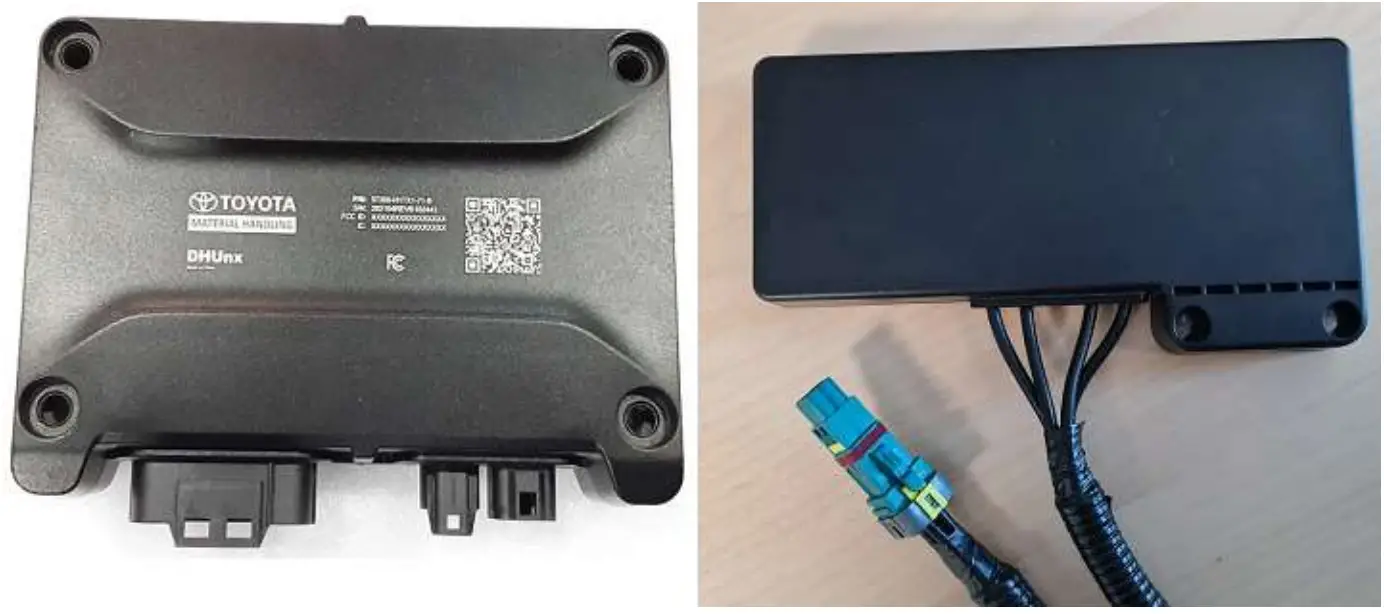
DHUnx User Manual
Model Name: DHUnx
Date: 9th of March 2022
DHUnx Telematic Node
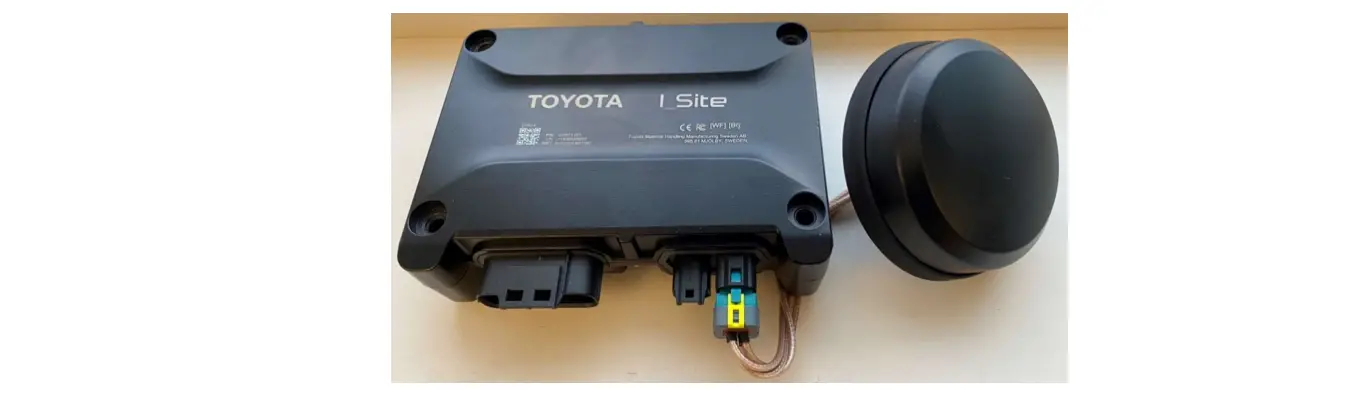
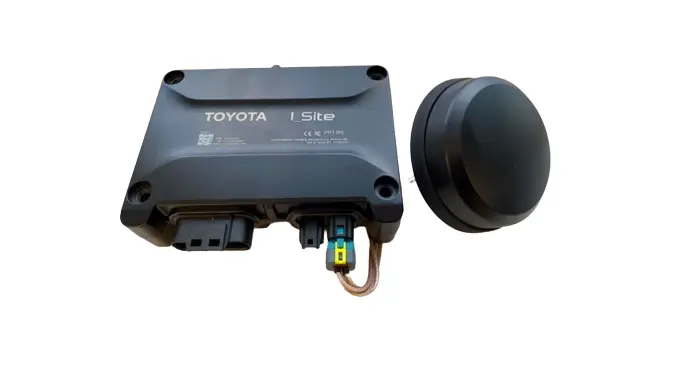
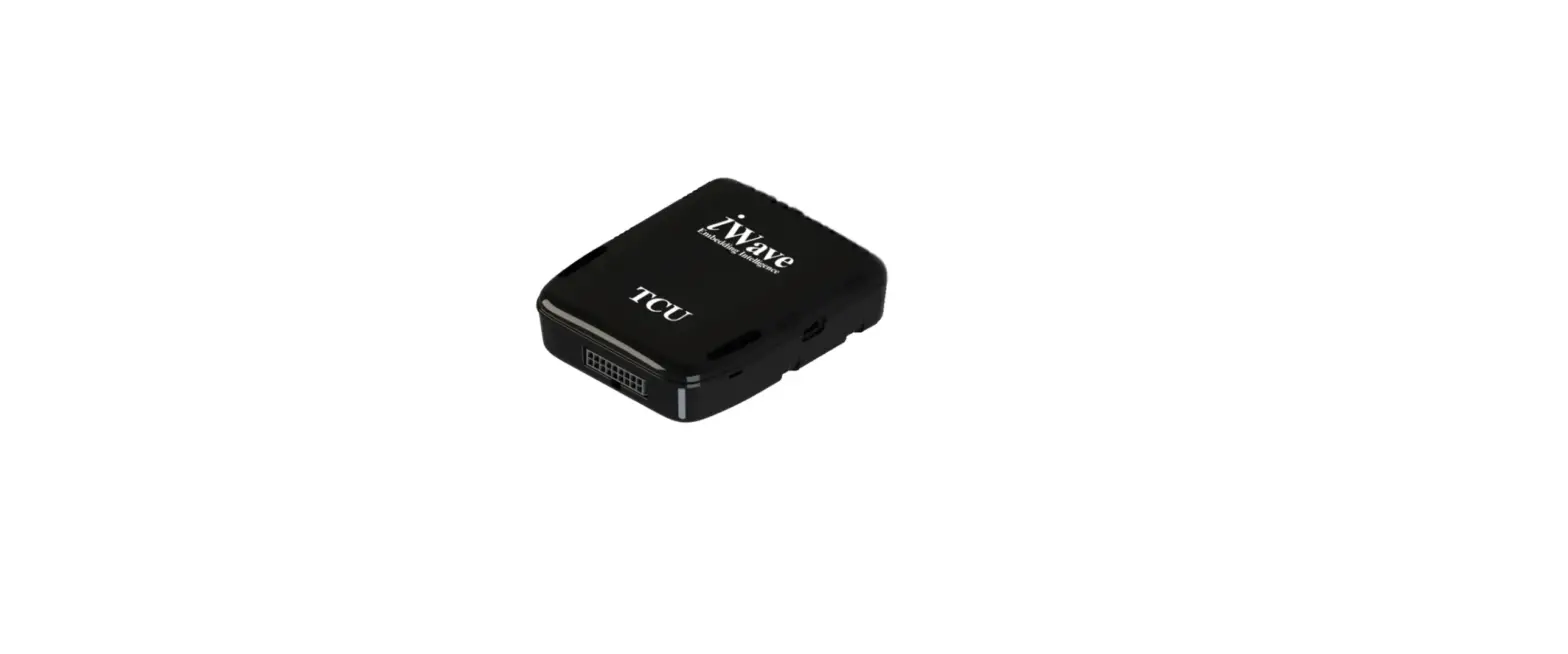
Picture showing the Toyota DHUnx unit to the left. Connected with a four-port mini-fakra to the Molex antenna to the right.
General
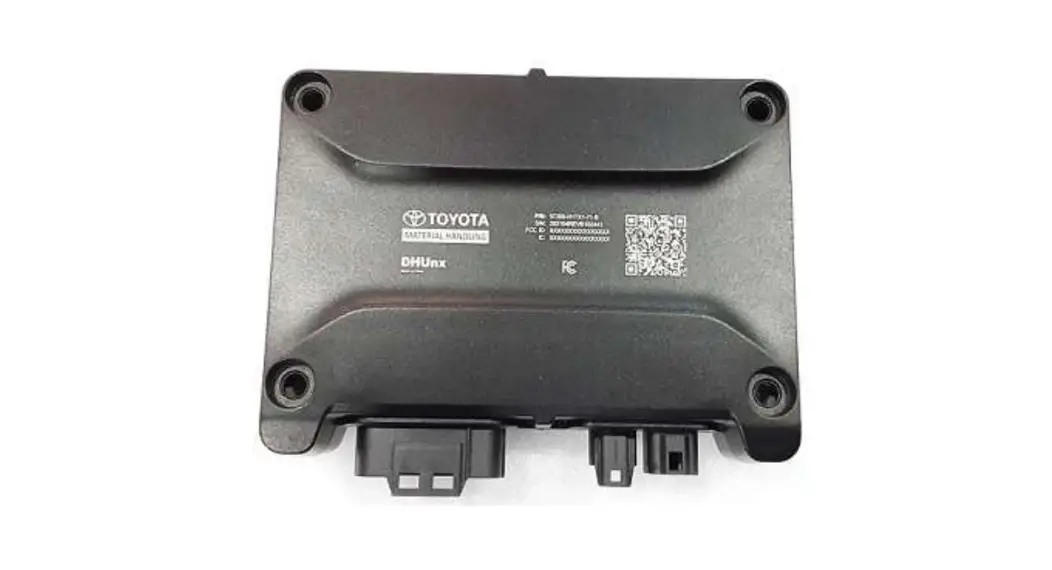
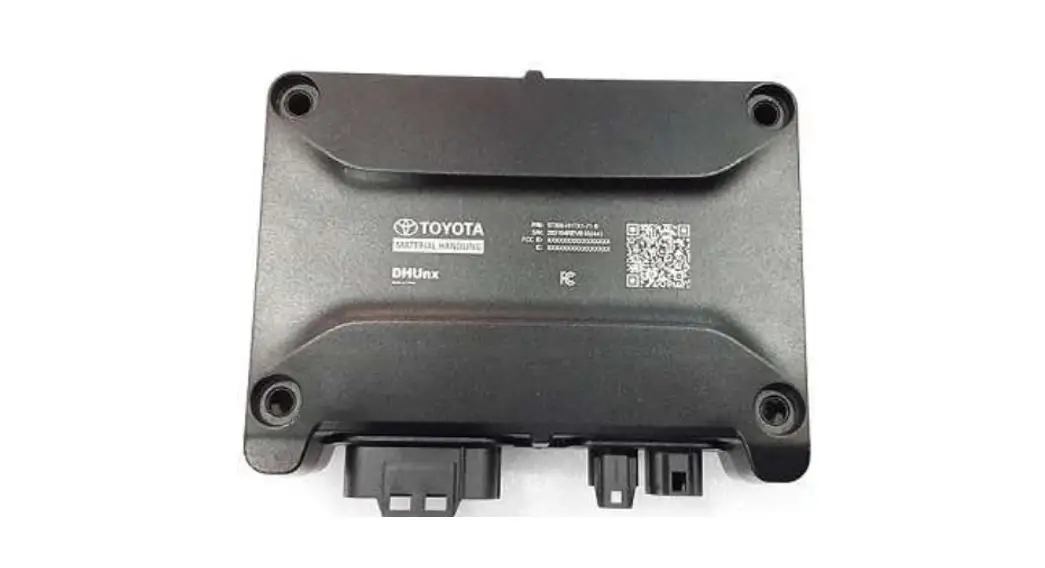
DHUnx is a telematic node, intended to be mounted into a Toyota forklift. It is always stationary installed in a forklift where it has several wired connections e.g., power, can buses etc. It also communicates wireless with LTE, WiFi and Bluetooth technology. It has an externa antenna connected.
Toyota Material Handling, Inc.
5559 Inwood Drive
Columbus, IN 47201, USA
Tel: +1 812 342 0060
www.toyotaforklift.com
Federal Registration Number: 0031326713
Information to the user
This product is communicating wirelessly with LTE and/or Bluetooth/WiFi.
Note:
This equipment has been tested and found to comply with the limits for a Class B digital device, pursuant to part 15 of the FCC Rules. These limits are designed to provide reasonable protection against harmful interference in a residential installation. This equipment generates, uses and can radiate radio frequency energy and, if not installed and used in accordance with the instructions, may cause harmful interference to radio communications. However, there is no guarantee that interference will not occur in a particular installation. If this equipment does cause harmful interference to radio or television reception, which can be determined by turning the equipment off and on, the user is encouraged to try to correct the interference by one or more of the following measures:
- Reorient or relocate the receiving antenna.
- Increase the separation between the equipment and receiver.
- Connect the equipment into an outlet on a circuit different from that to which the receiver is connected.
- Consult the dealer or an experienced radio/TV technician for help
Warning: Changes or modifications not expressly approved by the party responsible for compliance could void the user’s authority to operate the equipment.
- This device complies with part 15 of the FCC Rules. Operation is subject to the following two conditions: (1) This device may not cause harmful interference, and (2) this device must accept any interference received, including interference that may cause undesired operation
- The device for operation in the band 5150 5250 MHz is only for indoor use to prevent harmful interference to co-channel mobile satellite systems;
- The maximum antenna gain permitted for devices in the band 5250 5350 MHz and 5470 5725 MHz shall comply with the e.i.r.p. limit
- The maximum antenna gain permitted for devices in the band 5725 5825 MHz shall comply with the e.i.r.p. limits specified for point-to-point and non point-to-point operation as appropriate.
- High-power radars are allocated as primary users of the bands 5250 5350 MHz and 5650 5850 MHz and these radars could cause interference and/or damage to LE-LAN devices”
This device complies with ISED Canada licence-exempt RSS standard(s). Operation is subject to the following two conditions: (1) this device may not cause interference, and (2) this device must accept any interference, including interference that may cause undesired operation of the device.
Testing has been performed on the module in a co-located configuration with the identified module(s) to determine if new sources of interference are created when the two transmitter modules are simultaneously transmitting.
Warning:
- This device is approved for use in a mobile rf exposure environment. A minimum separation distance of 20 cm must be maintained between the antenna and nearby persons.
- The module may only be co-located in a host device with the following radio modules: Quectel EG25 FCC ID: XMR201903EG25G, IC ID: 10224A-201903EG25G and Quectel FC20, FCC ID: XMR201703FC20, IC ID: 10224A-201703FC20
List of applicable FCC rules
The following FCC rules are applicable to the equipment:
- CFR 47, Part 15, Subpart C
- CFR 47, Part 2, Subpart J Radiofrequency radiation exposure: mobile devices
Specific operational use conditions
Most of the installations are performed at Toyota production facilities by qualified personnel into a Toyota Forklift. However, after market installations also exists. The user can never operate the DHUnx directly.
Important: The DHUnx transmitting antenna must be installed and operated with minimum distance of 20 cm between the radiator and nearby persons.
Co-location
The following modules have been evaluated and may be co-located in a mobile configuration.
Cellular module Quectel
EG25: FCC ID: XMR201903EG25G
IC ID: 10224A-201903EG25G
WiFi/Bluetooth module Quectel FC20:
FCC ID: XMR201703FC20 IC ID: 10224A-201703FC20
RF exposure consideration
The application conditions are `Class B’ product, `Mobile’, always at least 20cm from a person’s body.
Warning
This device is approved for use in a mobile rf exposure environment. A minimum separation distance of 20 cm must be maintained between the antenna and nearby persons. The module may only be co-located in a host device with the following radio modules: Quectel Wireless Solutions Co., Ltd. FC20 and EG25.
Antennas
Molex Combination antenna, P/N 2144500750 for the version with shortest cable, 750mm. This length is used during certification for all tests, since this will transmit highest RF power due to minimum of cable loss. Other lengths exist in the forklift. But it can never be shorter than 750mm.
The antenna has four antenna elements. The antenna is always connected to the DHUnx antenna port with a Quad Mini Fakra (QMF) cable.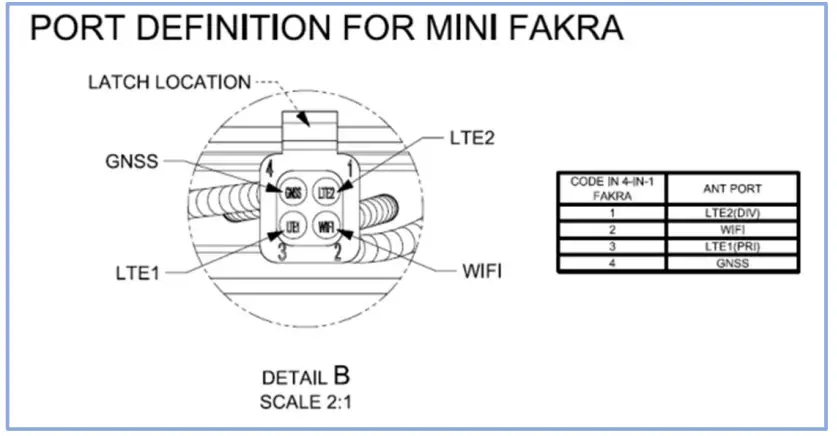
Antenna element LTE1
Main LTE/cellular main antenna. Can receive and transmit.
Antenna element LTE2
Main LTE/cellular diversity antenna. Can only receive.
Antenna element WiFi/Bluetooth
Wi-Fi/Bluetooth antenna. Can receive and transmit. 2.4GHz Wi-Fi/BT and 5GHz Wi-Fi.
Antenna element GNSS
GNSS/GPS antenna. Can only receive.
LTE1 Antenna Gain, measured with 750mm cable length in OTA chamber
| Description | Equipment | LTE1 Antenna (Cable Length:0.75m) | |||
| Frequency Range | VNA E5071C | 698- 960MHz | 1710- 2170MHz | 2300- 2400MHz | 2500- 2690MHz |
| Return Loss | VNA E5071C | < -5 dB | < -5 dB | < -5 dB | < -5 dB |
| Peak Gain | OTA Chamber | 2.6dBi | 3.3dBi | 2.7dBi | 2.0dBi |
| Average Total Efficiency | OTA Chamber | 50% | 55% | 47% | 42% |
| Polarization | OTA Chamber | Linear | |||
| Input Impedance | VNA E5071C | 50 ohms | |||
LTE2 Antenna Gain, measured with 750mm cable length in OTA chamber
| Description | Equipment | LTE2 Antenna (Cable Length:0.75m) | |||
| Frequency Range | VNA E5071C | 698- 960MHz | 1710- 2170MHz | 2300- 2400MHz | 2500- 2690MHz |
| Return Loss | VNA E5071C | < -5 dB | < -5 dB | < -5 dB | < -5 dB |
| Peak Gain | OTA Chamber | 2.5dBi | 2 6dBi | 1.8dBi | 2.0dBi |
| Average Total Efficiency | OTA Chamber | 50% | 48% | 46% | 36% |
| Polarization | OTA Chamber | Linear | |||
| Input Impedance | VNA E5071C | 50 ohms | |||
Wi-Fi/Bluetooth Antenna Gain, measured with 750mm cable length in OTA chamber
| Description | Equipment | WIFI Antenna (Cable Length:0.75m) | |
| Frequency Range | VNA E5071C | 2400-2500MHz | 5150-5850MHz |
| Return Loss | VNA E5071C | < -5 dB | < -5 dB |
| Peak Gain | OTA Chamber | 2.7dBi | 2.0dBi |
| Average Total Efficiency | OTA Chamber | 51% | 41% |
| Polarization | OTA Chamber | Linear | |
| Input Impedance | VNA E5071C | 50 ohms | |
GNSS Antenna Gain, measured with 750mm cable length in OTA chamber
| GNSS Patch Antenna (Typical) | |||||
| 1 | Frequency Range | 1561.098±2.046 MHz | I 1575.42±1.023 MHz | I 1602±5 MHz | |
| 2 | Return Loss | E-6dB | |||
| 3 | Impedance | 50 Ohm | |||
| 4 | Peak Gain | 2.5dBi | 0.4dBi | 2.2dBi | |
| 5 | Efficiency | 55% | 40% | 50% | |
| 6 | Polarization | RHCP | |||
| GNSS LNA (Cable Length:0.75m) | |||||
| 1 | Frequency Range | 1561 | 098±2.046 MHz | 11575.42±1.023 MHz | I 1602±5 MHz |
| 2 | DC Voltage | 3 to 5.5V | |||
| 3 | Gain | 27.5 ± 3dB | |||
| 4 | VSWR | C2.0 | |||
| 5 | Noise Figure | E2.5dB | |||
| 6 | DC Current | 9±3mA (at 3.3V) | |||
| 7 | Out-of-Band Attenuation | 500-1300MHz >45dB 1300-1400MHz >30dB 1700-3600MHz >40dB 3600-6000MHz >45dB | |||
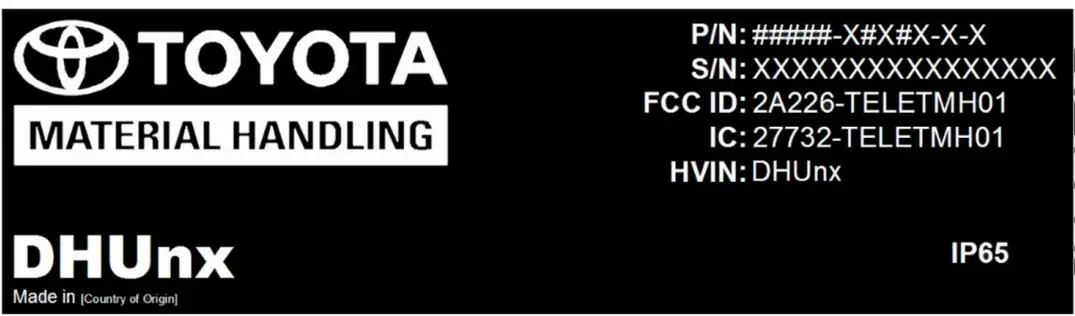
 Information on test modes and additional test
Testing has been performed on the module in a co-located configuration with the identified module(s) to determine if new sources of interference are created when the two transmitter modules are simultaneously transmitting.
Additional test requirements
This module is only authorized for FCC rule parts listed on the FCC grant. The host equipment manufacturer is responsible to test the host device for compliance with Unintentional Radiator requirements with the modules installed to determine if the host device in combination with the module(s) is in compliance with emissions requirements of CFR 47, Part 15, Subpart B and ICES-003.
Toyota Material Handling, Inc.
5559 Inwood Drive Columbus, IN 47201, USA
Tel: +1 812 342 0060
www.toyotaforklift.com
Federal Registration Number: 0031326713
 Warehouse Material Handling & Industrial Lift Equipment | Toyota Forklifts