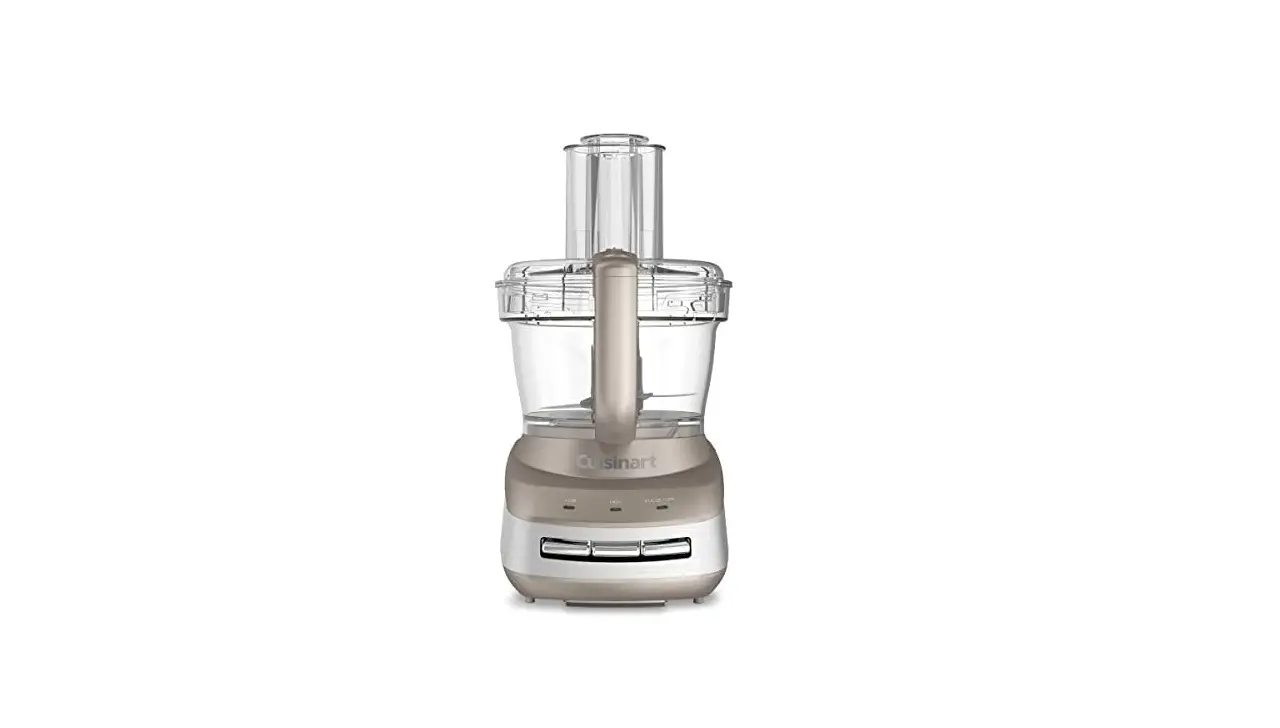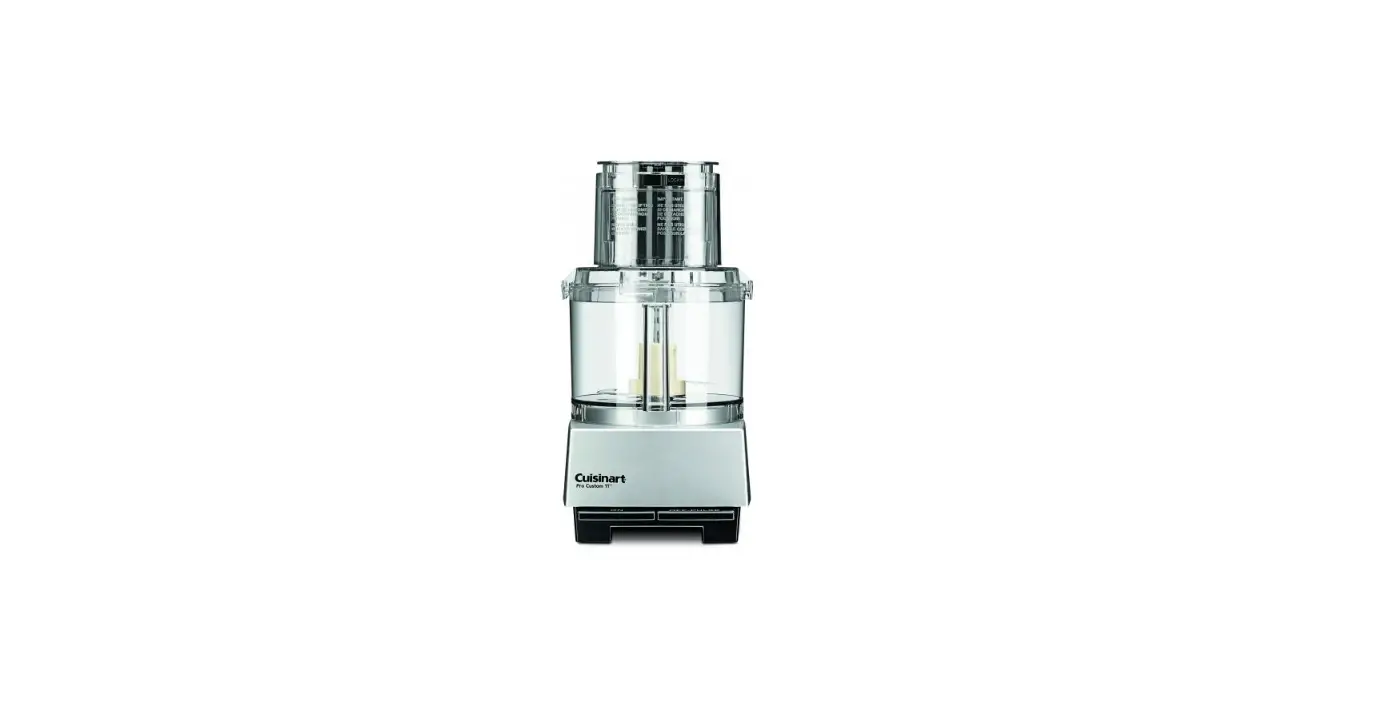

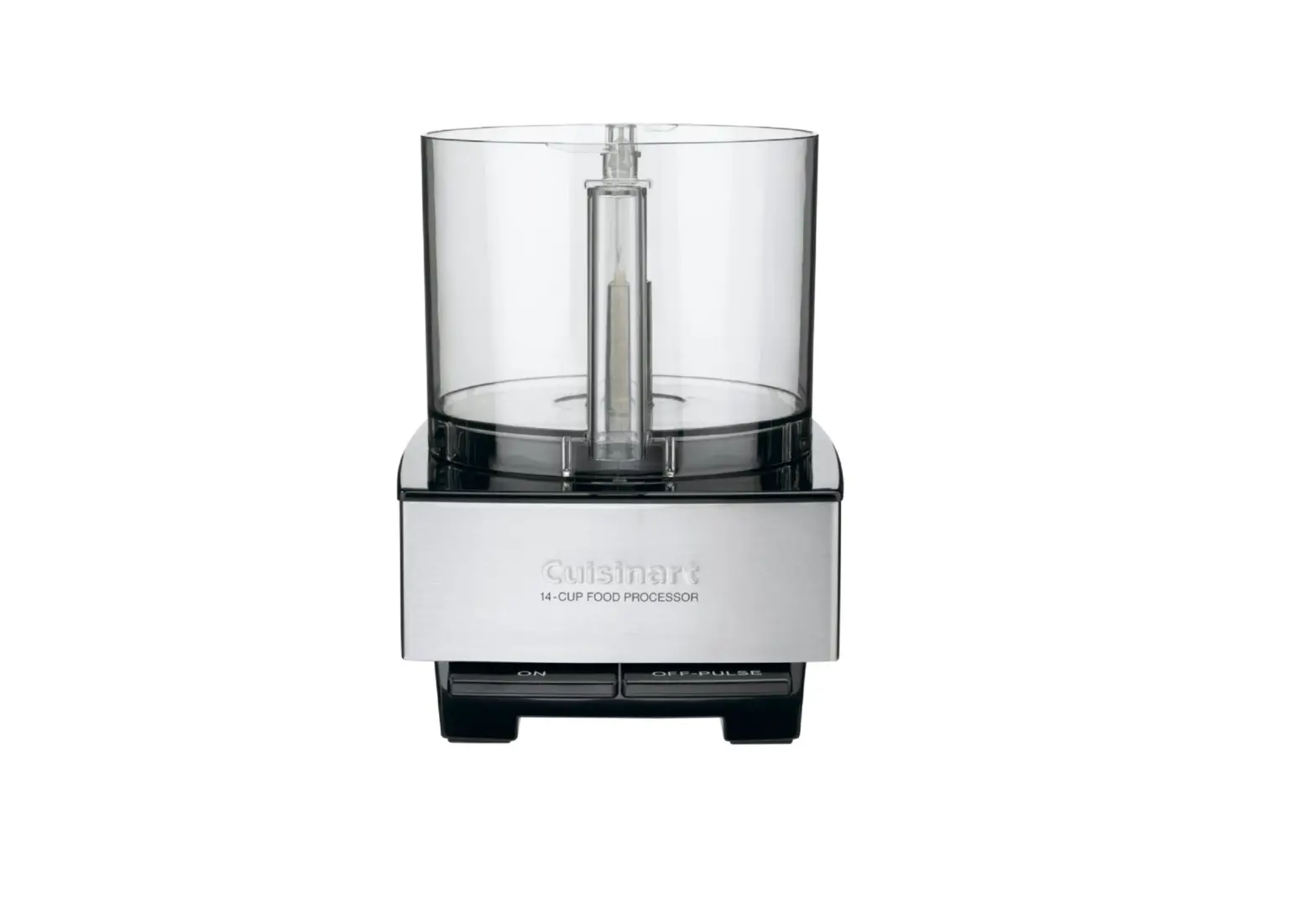
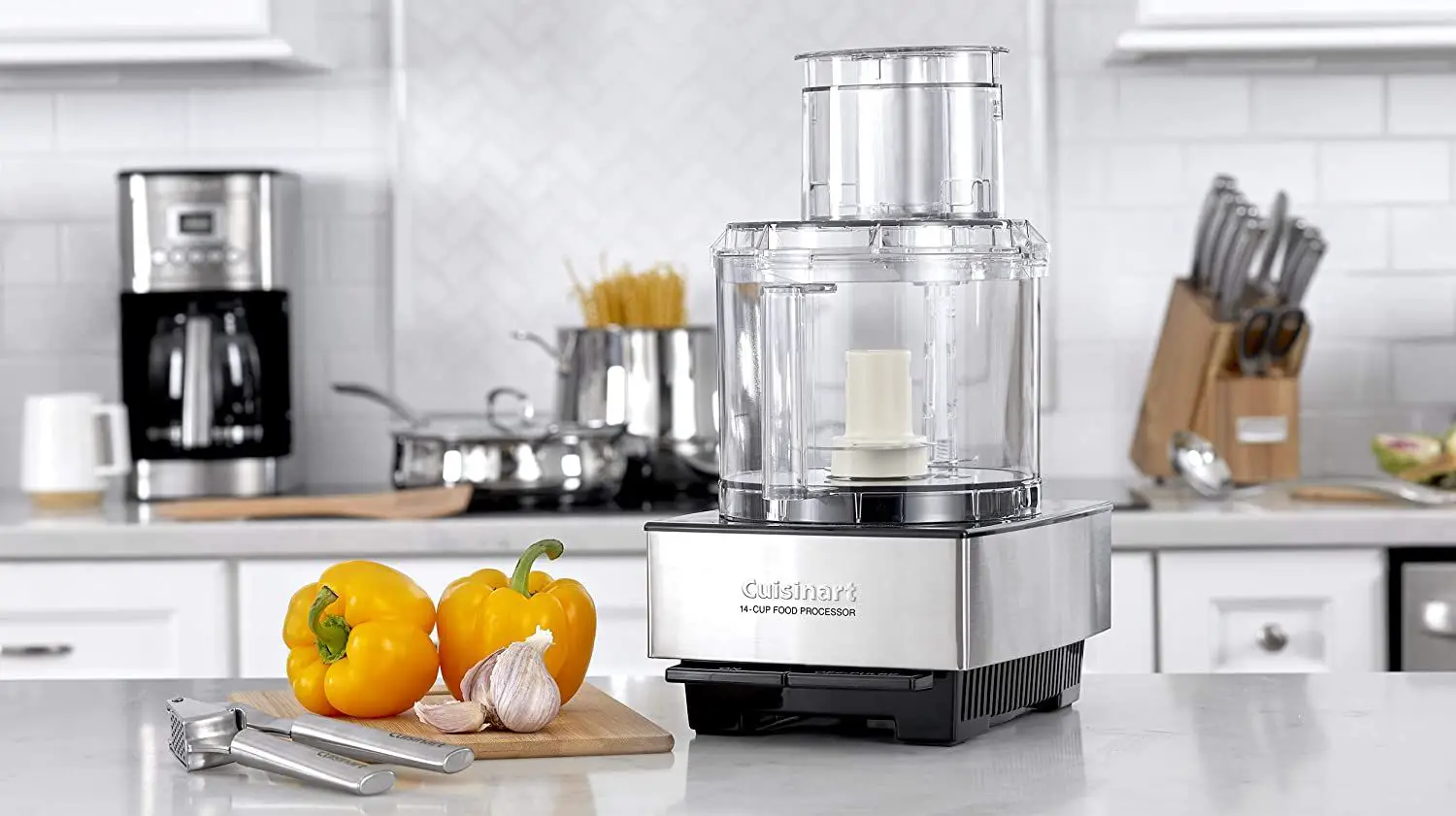
Cuisinart DLC-8SBCYP1 Custom Food Processor
IMPORTANT INSTRUCTIONS
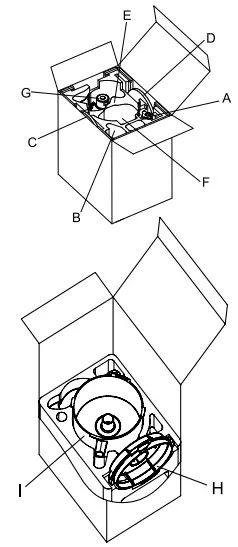
- Place the box on a low table or on the fl oor next to the kitchen counter or table where you plan to keep the food processor. Be sure the box is right-side up.
- Remove the cardboard panel and the instruction material.
- Remove the round cardboard insert and the thin slicing disc which is in a plastic bag inside a cardboard insert. THE BLADES ARE SHARP.
- You will see a rectangular upper plastic foam block that holds the processor parts, each fi tted into a cavity in the foam. The detachable stem (A) and cup (B) for the fl at the baking cover are in cavities at one short side of the foam block. Remove them first.
- The slicing disc (C) is on the long side and the shredding disc (D) on the other. Slide them out of their grooves WITH GREAT CARE; THE BLADES ARE SHARP. The work bowl cover (E) with pusher assembly (F) fitted on it is in the middle of the foam block. Grasp an edge of the work bowl cover and lift them straight up.
- (The sleeve on the pusher may slide down as you lift them out.) Now only the metal chopping blade (G) remains in the foam block. CAREFULLY
- REMOVE THE METAL BLADE BY GRASPING THE CENTER WHITE HUB AND LIFTING IT STRAIGHT UP. NEVER TOUCH THE BLADES, WHICH ARE RAZOR-SHARP.
- Lift out the upper plastic foam block.
- You will see a rectangular middle plastic foam block that holds fl at the baking cover (H) and work bowl (I). Lift them straight up, one by one, from the foam block.
- Lift out the middle plastic foam block.
- The machine base is at the bottom of the box.
- Remove the base by grasping the base housing with both hands and lifting it straight up.
Getting Ready
- Read all instructions.
- Blades are sharp. Handle them carefully.
- Unplug from outlet when not in use, before putting on or taking off parts and before cleaning. To unplug, grasp plug and pull from electrical outlet. Never pull cord.
- Do not use outdoors.
- Do not let cord hang over edge of table or counter, or touch hot surfaces.
- Do not operate any appliance with a damaged cord or plug, or after appliance has been dropped or damaged in any way.
- Return appliance to the nearest authorized service facility for examination, repair or electrical or mechanical adjustment
Operation
- Do not use pusher assembly if sleeve becomes detached from pusher.
- Keep hands as well as spatulas and other utensils away from moving blades or discs while processing food, to prevent possibility of severe personal injury or damage to food processor. A plastic scraper may be used, but must be used only when food processor motor is stopped.
- Avoid contact with moving parts. Never push food down by hand when slicing or shredding. Always use pusher.
- Make sure motor has completely stopped before removing cover. (If machine does not stop within 4 seconds when you turn cover, call 1-800-726-0190 for assistance.
- Do not use machine.)
- Never store any blade or disc on motor shaft. To reduce the risk of injury, no blade or disc should be placed on the shaft except when the bowl is properly locked in place and the processor is in use. Store blades and discs, as you would sharp knives, out of reach of children.
- Be sure cover is securely locked in place before operating food processor.
Parts
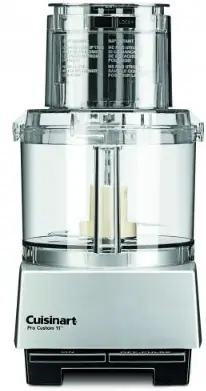
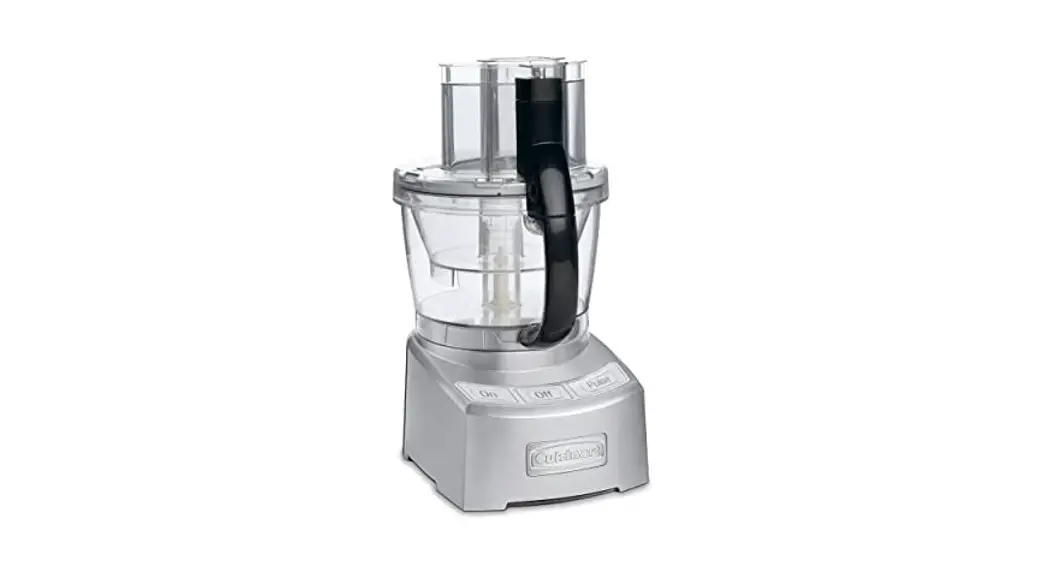
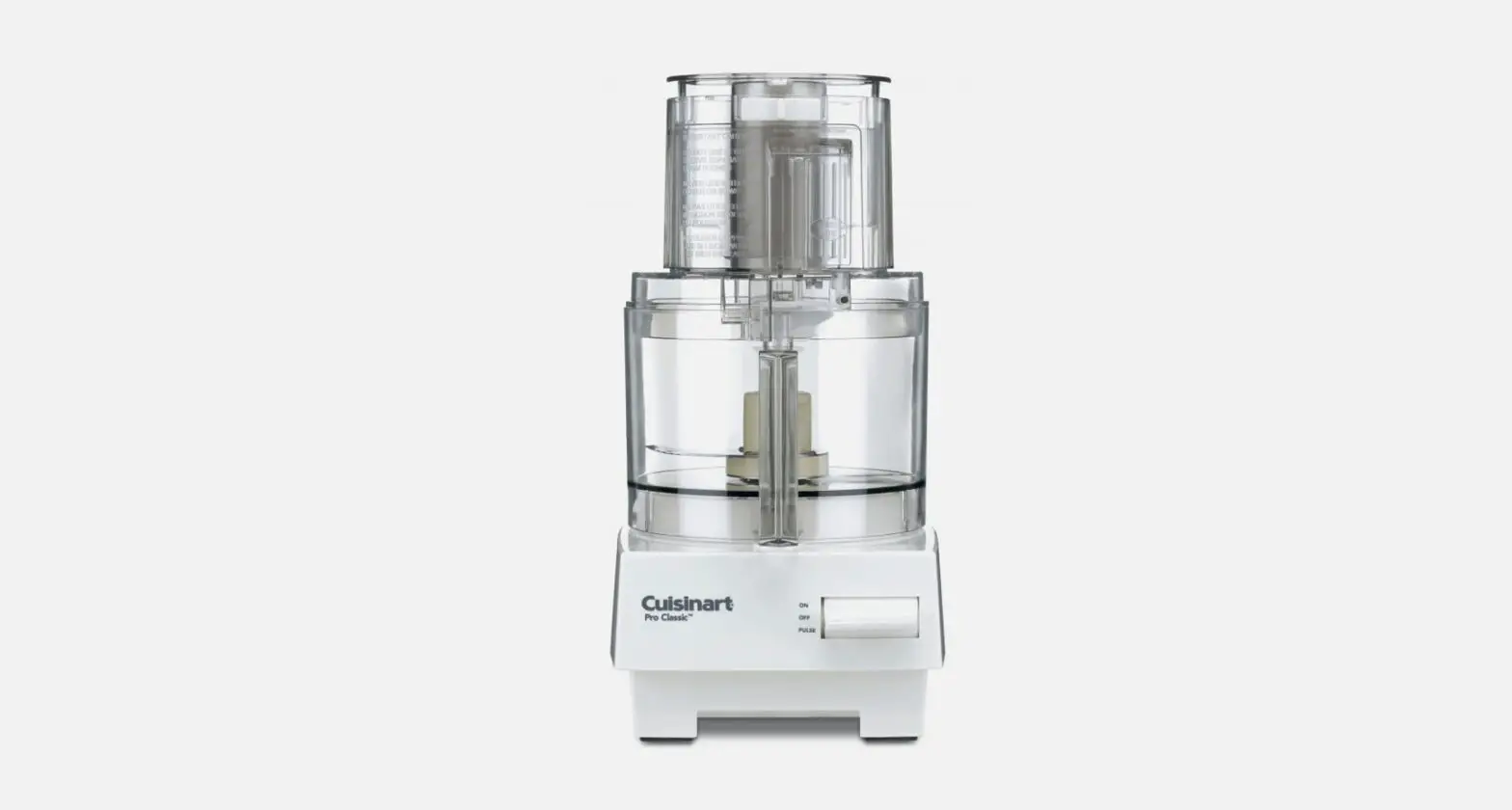
Your Cuisinart® Pro Custom 11™ Food Processor is a compact and versatile appliance that chops, minces, shreds, grates, slices, blends, purées, emulsifies, mixes and kneads – all with great efficiency and speed. The large feed tube allows you to slice large fruits and vegetables like potatoes, tomatoes and apples.
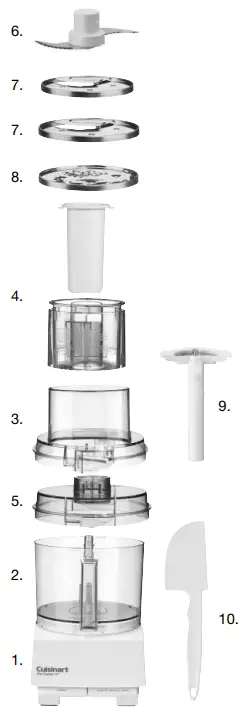
The machine includes:
- 1. Motor base with a vertically projecting shaft and two large control levers
- Work bowl
- Cover with a large feed tube
- Pusher assembly that slides over the feed tube
- Compact cover with cap for chopping ingredients for baking
- Sharp metal chopping blade
- Two serrated slicing discs: 1 medium and 1 thin
- Shredding disc
- Detachable stem that fits all discs
- Plastic spatula
- BPA free (not shown).
- All materials that come in contact with food or liquid are BPA free.
PROCESSOR GUIDELINES
The metal blade chops raw and cooked fruits, vegetables, meat, fish and cheese to the exact consistency you want – from coarse to fine, even to a purée. You control the texture. It chops nuts, makes nut butters, mayonnaise and sauces, and mixes tender, flaky pastry. The metal blade also mixes cakes, frosting, cookies, quick breads, muffins and biscuits, and kneads yeast dough. The standard slicing disc makes beautiful whole slices. It slices whole fruits and vegetables, cooked meat, semi-frozen raw meat and thin loaves of bread. The thin slicing disc is perfect for slicing cabbage, onions, radishes, mushrooms, celery, potatoes and cucumbers. The medium shredding disc processes most firm and hard cheese into long, attractive shreds. It also shreds vegetables like potatoes, carrots and zucchini, and processes nuts and chocolate to a grated texture.
TECHNIQUES FOR CHOPPING AND PURÉEING WITH THE METAL BLADE
To make mayonnaise:
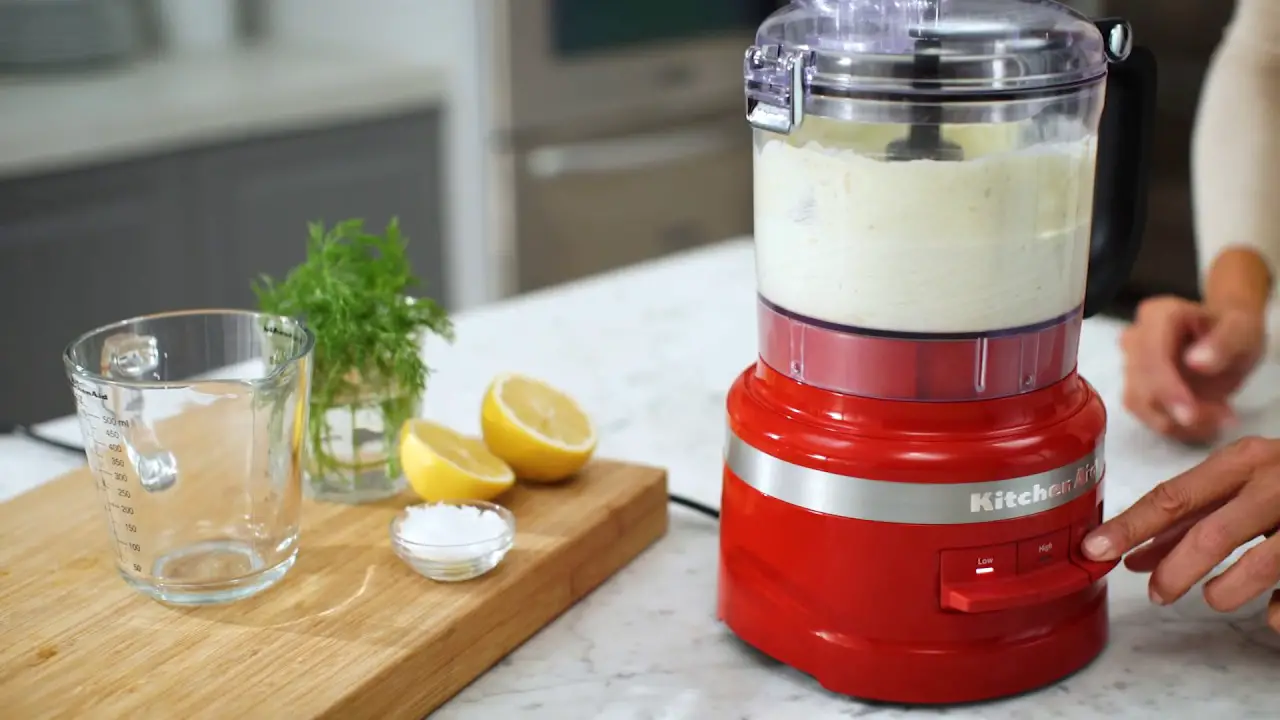
You can make foolproof homemade mayonnaise with your Pro Custom 11™. The work bowl and metal blade must be clean and dry. Foods prepared with raw eggs may contain salmonella or other potentially harmful bacteria. Because egg yolks are a fine growth medium for bacteria, we recommend that you cook them for use in mayonnaise, Hollandaise sauce, Caesar salad dressing, chilled soufflés, chilled chiffons, mousses and other recipes calling for raw egg yolks. For mayonnaise, we recommend using either the “cooked egg” mayonnaise recipe on page 26, or using the following method with pasteurized liquid eggs. For a “one egg” batch of basic mayonnaise made with pasteurized liquid eggs, place ¼ cup pasteurized liquid eggs, 2 tablespoons wine vinegar or lemon juice, 1 teaspoon dry mustard, ½ teaspoon kosher salt and a pinch of ground white pepper in the work bowl. With the machine running, add ½ cup of vegetable oil to the small pusher and allow to slowly drip into the mixture while processing. After all the oil has dripped through, add another ½ cup of vegetable oil to the small pusher and allow to drip through. The mixture will form a thick emulsion. For variation, you may experiment with using flavored vinegars, adding chopped, fresh herbs, dry herbs, or roasted garlic to taste. To make your mayonnaise a little lighter, add some well-drained plain, fat-free yogurt to taste.
Proofing the yeast
The expiration date is marked on the packages. To be sure your yeast is active, dissolve it in a small amount of warm liquid (about 1⁄3 cup for one package of dry yeast). The temperature of liquids used to dissolve and activate yeast must be between 105°F and 110°F. Yeast cells are not activated at temperatures lower than this, and they die when exposed to temperatures higher than 130°F. If the recipe includes a sweetener like sugar or honey, add a small amount with the yeast. If no sweetener is called for, add a pinch. The yeast proofs better with it. Allow the mixture to stand until it foams — up to 10 minutes.
Processing dry ingredients
Put the flour and other dry ingredients in the work bowl. If the recipe calls for herbs, oil or solid fats like butter, add them with the flour. Turn the machine on, and allow to run for about 20 seconds.
Adding liquids
All liquid should be added through the feed tube while the machine is running. Add liquid in a slow, steady stream, only as fast as dry ingredients absorb it. If liquid sloshes or splatters, stop adding it, but do not turn off machine. Wait until ingredients in bowl have mixed, then add remaining liquid slowly. Pour liquid onto dough as it passes under feed tube opening. Do not pour liquid directly onto bottom of work bowl. Follow the recipe carefully. It is important to add enough liquid to make the dough soft enough to knead. Kneading dough that is too stiff can strain the machine. All liquid except that used to activate yeast should be cold, to minimize the possibility of overheating the dough. You must never knead a yeast dough to a temperature higher than 100°F. Doing so will slow or even prevent the action of the yeast.
Kneading bread dough
Do not try to use the machine to knead dough that is too stiff to knead comfortably by hand. Doing so can strain the machine.
Kneading typical bread dough
After the dough starts to clean the inside of the work bowl completely and forms a ball, process it for 60 seconds to knead it. Stop the machine and test the dough to be sure it’s properly kneaded. Typical bread dough should have a soft, pliable texture and it should feel slightly sticky. Stretch the dough with your hands to test it. If it feels
Kneading typical sweet dough
Process dough for at least 30 seconds after all the ingredients are incorporated. It will not clean the inside of the work bowl. If necessary, scrape the bowl and process for 5 more seconds.
Adding other ingredients
Cheese, nuts and raisins may be added with the dry ingredients or during the final kneading. To leave them almost whole, add them through the feed tube 5 seconds before you stop kneading. For a finer texture, add them with the dry ingredients.
Rising
Put the dough in a large, lightly floured plastic food storage bag. Squeeze out all the air and close the bag, allowing space for the dough to rise. Or put the ball of dough in a large bowl coated with soft butter or vegetable oil. Roll the dough around to coat its entire surface. Cover it with a damp towel or a piece of oiled plastic wrap. Allow to rise in a warm, draft-free place — about 80°F. The rising time is usually about 1½ hours, but will vary from 45 minutes to several hours, depending on the type of flour and the humidity of the air. To test if the dough has risen sufficiently, press your finger in it. An indentation should remain. If it doesn’t, let the dough rise more and test again. When it has risen enough, punch the dough down. It is now ready to shape.
Shaping, finishing and baking If you shape the dough in loaf pans, coat them with vegetable oil cooking spray and fill them only half full. Allow to rise until dough is just slightly above the top of the pan. If shaping free-form loaves, let them rise on an oiled baking sheet until at least doubled in bulk.
Making consecutive batches You can make several batches of bread dough in a row. The motor in the Pro Custom 11™ Food Processor is extremely efficient. Follow the recipe for White Bread, page 29.
TROUBLESHOOTING YEAST DOUGH
The blade doesn’t incorporate ingredients
Always start the processor before adding liquid. Add liquid in a slow, steady stream, only as fast as dry ingredients absorb it. If you hear liquid sloshing, stop adding it, but do not turn off the machine. Instead, wait until the ingredients in the work bowl have mixed, then add the remaining liquid slowly. Pour liquid onto the dough as it passes under the feed tube; do not pour liquid directly onto the bottom of the work bowl. Butter or margarine, if not melted, must be cut into tablespoon-size pieces before being added to the work bowl.
Blade rises in work bowl
Blade may not have been pushed down as far as it will go before processing started. The machine may be overloaded. Stop it, carefully remove half the dough, and process in 2 batches. The excessively sticky dough can cause the blade to rise even though it cleans the inside of the work bowl. If the dough feels very sticky, reinsert the blade and immediately add 2 tablespoons of flour through the feed tube while the machine is running.
The dough doesn’t clean inside of the work bowl
- Amount of dough may exceed the maximum capacity of your food processor. Remove half and process in 2 batches. See page 18 for machine capacity.
- Dough may be too dry. If it feels crumbly, add water – 1 tablespoon at a time – while the machine is running, until the dough becomes moist and cleans the inside of the work bowl. Wait 10 seconds between additions of water.
- Dough may be too wet. While the machine is running, add 1 tablespoon of flour. If necessary, add more – 1 tablespoon at a time – until the dough cleans inside of the work bowl and forms a ball.
A nub of dough forms on top of the blade and does not become uniformly kneaded
Stop the machine, carefully remove the dough, divide it into 3 pieces and redistribute them evenly in the work bowl. Make sure that blade is firmly pressed back into place after removing the dough. Continue processing until the dough is uniformly soft and pliable.
The dough feels tough after kneading Divide the dough into 2 or 3 pieces and redistribute evenly in the bowl. Process 10 seconds or until uniformly soft and pliable.
MAINTENANCE
Any other servicing should be performed by an authorized service representative. Chopping certain foods may scratch or cloud the work bowl. Among them are ice, whole spices and oils, like wintergreen. If you like to prepare your own spice blends, you may want to keep a second bowl just for that purpose. The base housing is made of a durable, high-impact- resistant plastic. Its smooth surface will look new for years. Keep a sponge handy as you work to wipe spills from the base. Four rubber feet under the base help keep it stable on most work surfaces even when processing heavy loads. If the feet leave spots on the counter, spray them with a spot remover and wipe with a damp sponge. If any trace of the spot remains
FOR YOUR SAFETY
Like all powerful electrical appliances, a food processor should be handled with care. Follow these guidelines to protect you and your family from misuse that could cause injury.
- Handle metal blade and discs carefully. Their cutting edges are very sharp.
- Always place discs on flat, stable surface before connecting detachable stem.
- Never put blade or disc on motor shaft until work bowl is locked in place.
- Always be sure that the blade or disc is down on motor shaft as far as it will go.
- Always insert metal blade in work bowl before putting ingredients in bowl.
- When slicing or shredding food, always use pusher. Never put your fingers or spatula into feed tube.
- Always wait for blade or disc to stop spinning before you remove pusher assembly or cover from work bowl.
- Be careful to prevent metal blade from falling out of work bowl when emptying bowl. Remove blade before tilting bowl, or hold it in place with your finger, a spatula or spoon.
- Never use pusher assembly if sleeve becomes detached from pusher. Call Cuisinart Consumer Service immediately at 1-800-726-0190.
SOME TECHNICAL DATA The motor in your food processor operates on standard line operating current. The appropriate voltage and frequency for your machine are shown on a label under the base. An automatic, temperature-controlled circuit breaker in the motor ensures complete protection against motor burnout. If the processor runs for an exceptionally long time when chopping, mixing or kneading a thick or heavy mixture in successive batches, the motor may overheat. If this happens, the processor will stop. Turn it off and wait for the motor to cool off before proceeding. It will usually cool off within 10 minutes. In extreme cases, it could take an hour. Safety switches prevent the machine from operating when the work bowl or the cover is not locked into position. The motor stops within seconds when the motor is turned off, and a fast-stop circuit stops it instantly whenthe pusher assembly
is unlocked.
Appetizers
Guacamole
- Yield: 2¼ cups
- 1 large garlic clove, peeled
- 1 jalapeño, halved and seeded
- ½ cup tightly packed cilantro leaves
- 1 medium scallion, white part and
- 2 inches of green, cut into
- 1-inch pieces
- 3 ripe medium avocados, peeled, halved and pitted
- 3 tablespoons fresh lemon juicePinch cumin
- 1⁄4 teaspoon kosher salt
- 1⁄4 teaspoon chili powder
- 1 medium tomato, quartered, seeds removed
Soups
Chunky Gazpacho
- Yield: 4½ cups
- 1 small garlic clove, peeled
- ½ small jalapeño, halved and seeded
- 4 scallions, trimmed and cut into 1-inch pieces
- 1 celery stalk, cut into 1-inch pieces
- ½ medium bell pepper, cut into 3 pieces
- 2 tomatoes, seeded
- 2 cups tomato or vegetable juice
- 1 medium cucumber, peeled, halved lengthwise and seeded
- 2 tablespoons fresh lemon juice
- 1 teaspoon kosher salt
- 1⁄4 teaspoon freshly ground black pepper
Meats and Fish
Meatloaf
- Yield: 1½ pounds of meatloaf
- 1 small onion, quartered
- 1⁄3 cup loosely packed parsley leaves
- 1½ slices day-old bread, broken into pieces
- 1½ pounds boneless chuck, cut into
- 1-inch pieces*
- 3 tablespoons milk*
- 1 teaspoon kosher salt
- 1⁄8 teaspoon dried thyme
- 1 large egg
Vegetables
Mashed Potatoes
- ¼ cup hot milk
- 2 tablespoons butter, cut into
- 1-inch pieces
- ½ teaspoon kosher salt
- Freshly ground black pepper
- Pinch of nutmeg (optional)
- 3 large potatoes, peeled, boiled and drained
Salads
Sliced Tomatoes on Shredded Lettuce
- 1⁄4 cup loosely packed parsley leaves
- 1 medium shallot, peeled
- 11⁄2 tablespoons red wine vinegar
- 41⁄2 tablespoons vegetable oil
- 1⁄2 teaspoon Dijon mustard
- 1⁄2 teaspoon granulated sugar
- 1⁄2 teaspoon kosher salt
- Freshly ground black pepper
- 4 fi rm, ripe, medium tomatoes, cored and cut fl at at ends
- 1 medium head romaine lettuce, washed
Sauces
Pesto
- Yield: 11⁄3 cups
- 4 ounces imported Parmesan, room temperature, cut into
- 1-inch (2.5cm) pieces
- 4 small garlic cloves, peeled
- 22⁄3 cups tightly packed, fresh basil leaves
- 1⁄3 cup pine nuts
- 3⁄4 teaspoon kosher salt
- 1⁄3 cup olive oil
Pastry
Basic Pastry
This is the basic dough for pies, tarts and quiches.
- Yield: three 9-inch pie shells
- 22⁄3 cups unbleached, all-purpose fl our
- 2 sticks very cold, unsalted butter, cut into 1-inch pieces
- 1 teaspoon kosher salt
- 1⁄2 cup ice water
Quick Breads, Yeast Bread and Pizza
Cornbread
This is a particularly moist and flavorful cornbread which is best served warm.
- 4 tablespoons unsalted butter
- 1 cup yellow cornmeal
- 1 cup unbleached, all-purpose fl our
- 2 tablespoons granulated sugar
- 1⁄3 tablespoon baking powder
- 1⁄4 teaspoon baking soda
- 1⁄4 teaspoon kosher salt
- 11⁄3 cups buttermilk
- 2 large eggs
- 1⁄2 cup fresh, frozen or canned corn kernels
Desserts
Apple Pie
- Yield: One 9-inch pie
- Pastry for two 9-inch pie shells (see Basic Pastry recipe, page 27)
- 1⁄2 cup granulated sugar
- 3 tablespoons unbleached, all-purpose flour
- 3⁄4 teaspoon ground cinnamon
- 1⁄8 teaspoon ground nutmeg
- 2 pounds apples, peeled and cored
Warranty
Limited Three-Year Warranty
(U.S. and Canada ONLY) This warranty is available to consumers only. You are a consumer if you own a Cuisinart® Pro Custom 11™ Food Processor that was purchased at retail for personal, family or household use. Except as otherwise required under applicable law, this warranty is not available to retailers or other commercial purchasers or owners. We warrant that your Cuisinart® Pro Custom 11™ Food Processor will be free of defects in materials and workmanship under normal home use for 3 years from the date of original purchase. We recommend that you visit our website, www.cuisinart.com for a fast, efficient way to complete your product registration. However, product registration does not eliminate the need for the consumer to maintain the original proof of purchase in order to obtain the warranty benefits. In the event that you do not have proof of purchase date, the purchase date for purposes of this warranty will be the date of manufacture.
CALIFORNIA RESIDENTS ONLY California law provides that for In-Warranty Service, California residents have the option of returning a nonconforming product (A) to the store where it was purchased or (B) to another retail store that sells Cuisinart products of the same type. The retail store shall then, according to its preference, either repair the product, refer the consumer to an independent repair facility, replace the product, or refund the purchase price less the amount directly attributable to the consumer’s prior usage of the product. If neither of the above two options results in the appropriate relief to the consumer, the consumer may then take the product to an independent repair facility, if service or repair can be economically accomplished. Cuisinart and not the consumer will be responsible for the reasonable cost of such service, repair, replacement, or refund for nonconforming products under warranty. California residents may also, according to their preference, return nonconforming products directly to Cuisinart for repair or, if necessary, replacement by calling our Consumer Service Center toll-free at 1-800-726-0190. Cuisinart will be responsible for the cost of the repair, replacement, and shipping and handling for such nonconforming products under warranty.
BEFORE RETURNING YOUR CUISINART PRODUCT If your Cuisinart® Pro Custom 11™ Food Processor should prove to be defective within the warranty period, we will repair or, if we think necessary, replace it. To obtain warranty service, please call our Consumer Service Center toll-free at 1-800- 726-0190 or write to: Cuisinart, 7475 North Glen Harbor Blvd., Glendale, AZ 85307. To facilitate the speed and accuracy of your return, enclose $10.00 for shipping and handling. (California residents need only supply proof of purchase and should call 1-800-726-0190 for shipping instructions.) Please be sure to include your return address, daytime phone number, description of the product’s defect, product serial number, and any other information pertinent to the return. Please pay by check or money order made payable to Cuisinart. NOTE: For added protection and secure handling of any Cuisinart product that is being returned, we recommend you use a traceable, insured delivery service. Cuisinart cannot be held responsible for in-transit damage or for packages that are not delivered to us. Lost and/or damaged products are not covered under warranty. Your Cuisinart® Pro Custom 11™ Food Processor has been manufactured to the strictest specifications and has been designed for use only in 120 volt outlets and only with authorized accessories and replacement parts. This warranty expressly excludes any defects or damages caused by attempted use of this unit with a converter, as well as use with accessories, replacement parts or repair service other than those authorized by Cuisinart. This warranty does not cover any damage caused by accident, misuse, shipment or other than ordinary household use. This warranty excludes all incidental or consequential damages. Some states do not allow the exclusion or limitation of these damages, so these exclusions may not apply to you. You may also have other rights, which vary from state to state. Important: If the nonconforming product is to be serviced by someone other than Cuisinart’s Authorized Service Center, please remind the servicer to call our Consumer Service Center at 1-800-726-0190 to ensure that the problem is properly diagnosed, the product is serviced with the correct parts, and to ensure that the product is still under warranty.
FAQS
What is the best Cuisinart food processor to buy?
The Cuisinart 14-Cup Food Processor wins best overall by our testers, earning high ratings for ease of use, an extra-large feed tube, and top-level performance
How many cups is a Cuisinart DLC 8?
Cuisinart DLC-8SBCYP1 Pro Custom 11-Cup Food Processor, Brushed Chrome.
How many cups is the Cuisinart Pro Custom 11?
Read 119 Reviews Same page link. From the Cuisinart Pro Custom 11™ 11 Cup Food Processor’s cover with large feed tube and unique compact chopping/kneading cover, to its industrial quality motor,
What does Cuisinart Detachable Stem do?
Part of the core of your Cuisinart Food Processor, the detachable stem allows for compact storage and helps hold each of the accessory discs in place
What’s a better brand Cuisinart or KitchenAid?
While KitchenAid does feature high-quality products, we recommend the Cuisinart Stand Mixer.
Is an 8 cup food processor big enough for dough?
The best size food processor to use for making and kneading dough is one that holds 11 to 14 cups
Is 8 cup food processor enough?
A food processor is a kitchen workhorse, whether you’re cooking, baking, or making baby food. 8-cup food processors have enough room for all your cooking needs without taking up too much counter space.
Is 11 cup food processor too big?
10–13 cup food processors also provide enough space to knead dough, then let it rise right in the work bowl
Is Cuisinart a Chinese company?
Cuisinart (/ˈkwiːzɪnɑːrt/ kwee-zin-art) is an American home appliance brand owned by Conair Corporation
Is Cuisinart from China?
No, Cuisinart food processors, cookware, and other kitchen appliances are not made in the USA
Can you make shaved ice with a Cuisinart food processor?
Cuisinart SCM-10P1 Snow Cone Maker, Professional Motor and Blade Mechanism has Interlock Safety Feature that Creates Real Shaved Ice for Snow Cones, Slushies’, Frozen Lemonades or Adult Drinks, Red.
What is the plastic blade in a Cuisinart for?
DLC-8 replacement dough blade has shorter stubby plastic blades that are perfect for kneading dough or mixing batter
Is Cuisinart a high end brand?
Cuisinart is an affordable brand with a range of price points to suit most budgets. Cuisinart offers multiple cookware collections made of stainless steel, aluminum, hard-anodized aluminum, and copper.
Is Cuisinart made of stainless steel?
The Cuisinart cookware set is made from polished stainless steel and comes with a lifetime warranty.
How do you chop carrots in a Cuisinart food processor?
Once your carrots have been cleaned and prepped, turn your food processor on High. Place a carrot in the feed tubeOnce your carrots have been cleaned and prepped, turn your food processor on High. Place a carrot in the feed tubeOnce your carrots have been cleaned and prepped, turn your food processor on High. Place a carrot in the feed tube

![Cuisinart Completechef Cooking Food Processor [fpc-100] Instruction Booklet](https://static-data1.manualsee.com/1/img/278/17713/2020/12/Cuisinart-CompleteChef-Cooking-Food-Processor-FPC-100.jpg "Cuisinart Completechef Cooking Food Processor [fpc-100] Instruction Booklet")