IN_81507 Angiogenesis Glass Bottom
Product Information:
This product is a glass coverslip or glass slide with a bottom
made of Schott borosilicate glass, D 263M. It has a refractive
index of 1.523 and an Abbe number of 55. The glass bottom is
designed for use in various applications such as tube formation
assays and microscopy.
It is important to handle this product with caution as the glass
coverslip or slide is fragile and can break easily. Mishandling can
result in physical injury and damage to devices due to leakage of
the medium.
The shelf life of this product is 36 months.
Product Usage Instructions:
Surface Coating:
- Prepare your gel matrix according to the manufacturer’s
protocol or reference. - Let the gel polymerize under appropriate conditions.
- Use the gel matrix as soon as possible.
- If storage is needed, fill sterile water around the gel
matrix.
Tube Formation Assays:
In a tube formation assay, cells are seeded on top of the
polymerized gel matrix. Follow these steps:
- Prepare the gel matrix according to the surface coating
instructions above. - Seed the cells on top of the polymerized gel matrix.
- Conduct your experiment.
- Depending on the cell type, perform medium exchange as
required.
Seeding Cells in 2D:
To seed cells in a 2D configuration, follow these steps:
- Prepare the gel matrix according to the surface coating
instructions above. - Seed the cells on top of the polymerized gel matrix.
- Overlay the cell layer with medium and incubate for invasion of
the cells into the gel matrix.
Microscopy:
Note that when using gel matrices, the optical quality and the
use of high magnification objective lenses might be restricted.
Follow these tips:
- Be aware that the optical quality may be affected when using
gel matrices. - Consider limitations on using high magnification objective
lenses.
Immersion Oil:
When using ibidi Glass Bottom products with oil immersion
objectives, there is no known incompatibility with any immersion
oil on the market. All types of immersion oils can be used.
Chemical Compatibility:
For information on the chemical compatibility of this product,
please visit the FAQ section on ibidi.com.
Ordering Information:
| Cat. No. | Description |
|---|---|
| 81506 | Glass Bottom |
| 81501 | Glass Slide |
| 81507 | Glass Coverslip |
| 89646 | For research use only! |
Instructions
µ-Slide 15 Well 3D Glass Bottom (formerly µ-Slide Angiogenesis Glass Bottom)
The ibidi product family is comprised of a variety of µ-Slides, µ-Dishes, and µ-Plates, which have all been designed for high-end microscopic analysis of fixed or living cells.
The glass bottom versions are especially designed for TIRF, super resolution and single molecule applications. The µ-Slide 15 Well 3D Glass Bottom (formerly µ-Slide Angiogenesis Glass Bottom) is a cell culture product for tube formation, angiogenesis assays and direct cell culture. Cells can be grown on or in gel matrices, e.g. MatrigelTM or directly on the glass coverslip bottom.
Overview
This document is applicable to the following product numbers:
Cat. No. Product Name 81507 µ-Slide 15 Well 3D Glass Bottom: #1.5H (170 µm ±5 µm) D 263 M Schott glass, sterilized, individually packed
Material
The µ-Slide 15 Well 3D Glass Bottom is made with a glass coverslip bottom. It is not possible to detach the bottom. The µ-Slide 15 Well 3D Glass Bottom is intended for onetime use and not autoclavable since it is temperature stable only up to 80°C/175°F.
Geometry
The µ-Slide 15 Well 3D Glass Bottom provides standard slide format according to ISO 8037/1. The well-to-well distance of 9 mm (like 96 well plates) allows using multichannel pipettes.
Optical Properties of the Glass Coverslip Bottom
Refractive index nD Abbe number Thickness
Material
1.523
55
No. 1.5H (selected quality 170 µm, ± 5 µm)
Schott borosilicate glass, D 263M
Shipping and Storage
The µ-Slides, µ-Dishes and µ-Plates are sterilized and welded in a gas-permeable packaging. The shelf life under proper storage conditions (in a dry place, no direct sunlight) is listed in the following table.
Conditions
Shipping conditions Storage conditions
Ambient RT (1525°C)
25.50
7
5.75
Geometry of the µ-Slide 15 Well 3D Glass Bottom
Outer dimensions (w x l) Number of wells Volume inner well Diameter inner well Depth inner well Volume upper well Diameter upper well Height with/without lid Growth area inner well Coating area using 10 µl Bottom
25.5 x 75.5 mm2 15 10 µl 4 mm 0.8 mm 50 µl 5 mm 5.3/3.7 mm 0.125 cm2 0.23 cm2 Glass Bottom
19.75
75.50
Glass Bottom
Shelf Life 36 months
µ-Slide 15 Well 3D Glass Bottom
Page 1
9 9
Version 1.1 (2022-12-08)
Instructions
µ-Slide 15 Well 3D Glass Bottom (formerly µ-Slide Angiogenesis Glass Bottom)
Attention!
Be cautious when handling ibidi labware products with glass bottom! The glass coverslip or glass slide is very fragile and might break easily. Handle with care to avoid physical injury and damage to devices through leakage of the medium.
Surface
The µ-Slide 15 Well 3D Glass Bottom is manufactured with an uncoated glass coverslip. Washing steps (e.g. with PBS) before cell seeding can remove glass dust which is advantageous for direct cell growth on the surface.
Coating
In tube formation assays the µ-Slide 15 Well 3D Glass Bottom is coated with a 0.8 mm thick layer of gel matrix.
1. Prepare your gel matrix according to the manufacturer’s protocol or reference.
2. Fill the inner well with 10 µl liquid gel. Avoid air bubbles.
3. Let the gel polymerize under appropriate conditions. 4. Use as soon as possible. 5. If storage is needed fill sterile water around the
wells to generate a humidified environment to hinder evaporation. Non-gel based coatings are also possible. Please use 10 µl coating solution and calculate with an area to be coated of 0.23 cm2 per well. Further information about coatings is provided in Application Note 08 “Cell culture coating”.
Tube Formation Assays
In a tube formation assay cells are seeded on top of the polymerized gel matrix:
3. Cover the µ-Slide 15 Well 3D Glass Bottom with the supplied lid. Incubate at 37°C and 5 % CO2 as usual.
4. Conduct your experiment. 5. Depending on the cell type, medium exchange is
necessary every 12 days. Carefully aspirate the old medium and replace it by 50 µl fresh medium. For a detailed protocol please refer to Application Note 19 “Tube Formation” and Application Note 5 “Tube Formation in µ-Plate 96 Well 3D”. Further information about the optimization of experimental parameters and data analysis is provided in Application Note 27 “Tube Formation Data Analysis”.
Tip:
Air bubbles in the gel can be reduced by equilibrating the µ-Slide 15 Well 3D Glass Bottom before usage inside the incubator overnight. In case bent gel surfaces are created, increase or decrease the amount of gel used, until you get flat and even gels.
Tip:
For less evaporation the space in-between the wells can be filled with sterile water or agarose. Add agarose to water or buffer solution (e.g. 0.1 g to 10 ml water). Melt agarose solution using a microwave or boiling water bath and allow the solution to cool to 50°C.
Seeding Cells in 2D
You can also use the µ-Slide 15 Well 3D Glass Bottom for a standard 2D cell culture without gel matrix.
1. Trypsinize and count cells as usual. Dilute the cell suspension to the desired concentration. Depending on your cell type, we recommend 13 ×105 cells/ml.
2. Apply 50 µl of the cell suspension into the upper well. Do not touch the gel matrix with the pipet tip.
1. Trypsinize and count cells as usual. Dilute the cell suspension to the desired concentration. Depending on your cell type, application of a 1.8 4.3 × 10⁵ cells/ml suspension should result in a confluent layer within 23 days.
2. Apply 10 µl cell suspension into each well of the µSlide 15 Well 3D Glass Bottom. Avoid shaking as
µ-Slide 15 Well 3D Glass Bottom
Page 2
Version 1.1 (2022-12-08)
Instructions
µ-Slide 15 Well 3D Glass Bottom (formerly µ-Slide Angiogenesis Glass Bottom)
this will result in inhomogeneous distribution of the cells. 3. Cover the slide with the supplied lid. Incubate at 37°C and 5 % CO2 as usual. 4. After cell attachment, add 50 µl cell-free medium to fill the upper well.
Attention!
Avoid evaporation during seeding and cell culture in the incubator! We recommend placing the µ-Slide 15 Well 3D Glass Bottom in an extra humidity chamber (e.g. a Petri Dish with wetted paper).
Undemanding cells can be left in their seeding medium for up to three days and grow to confluence there. However, best results might be achieved when the medium is changed every 12 days. Carefully aspirate the old medium and replace it by 60 µl fresh medium per well.
Experimental Setups
Alternatively, the µ-Slide 15 Well 3D Glass Bottom can be used for the following assays:
· Fill the inner well with cells suspended inside a gel matrix. After gel polymerization, add 50 µl cell-free medium to fill the upper well.
· Sandwich Cell Culture: Fill the inner well with a gel matrix. Seed cells on top of the polymerized gel and imbed the cells with 50 µl gel in the upper well.
Overlay the cell layer with medium and incubate for invasion of the cells into the gel matrix.
Microscopy
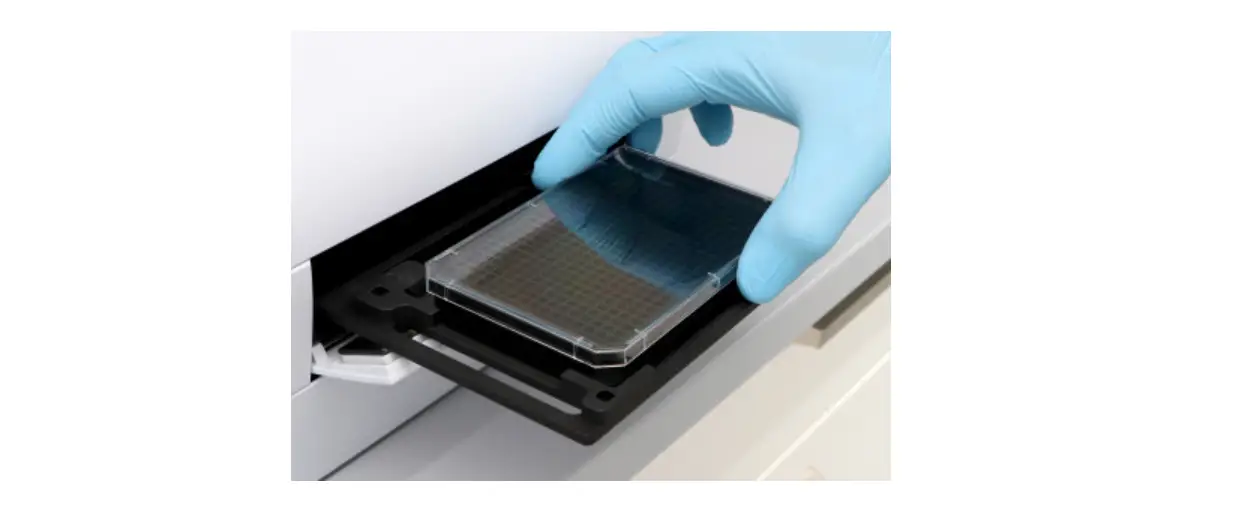
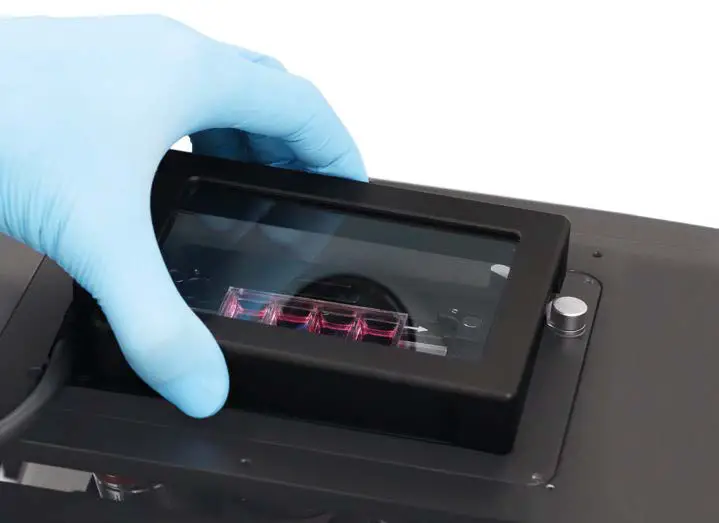
To analyze your cells, no special preparations are necessary. Cells can be directly observed live or fixed, preferably on an inverted microscope. The bottom cannot be removed. For optimal results in fluorescence microscopy and storage of fixed and stained samples, ibidi provides mounting media (50001 and 50011) optimized for µ-Dishes, µ-Slides, and µ-Plates.
Note:
When gel matrices are used the optical quality and the use of high magnification objective lenses might be restricted.
Tip:
For phase contrast imaging after the experiment, the upper well can be overfilled with additional 25 µl. Closing the lid eliminates the meniscus of the upper well. This will create perfect phase contrast images. Please keep in mind that this overfilling technique might lead to well-to-well crosstalk. Therefore, we recommend this for final examination using phase contrast microscopy only.
· Fill the inner well with a low volume of the gel matrix, e.g. 8 µl. Seed cells, spheroids or tissue pieces on top of the polymerized gel. If necessary gently shake the slide to make the cells slide into the center of the well.
· Fill the inner well with fibroblasts suspended inside a gel matrix. Seed cells on top of the polymerized gel.
µ-Slide 15 Well 3D Glass Bottom
Page 3
Version 1.1 (2022-12-08)
Instructions
µ-Slide 15 Well 3D Glass Bottom (formerly µ-Slide Angiogenesis Glass Bottom)
Immersion Oil
When using ibidi Glass Bottom products with oil immersion objectives, there is no known incompatibility with any immersion oil on the market. All types of immersion oils can be used.
Chemical Compatibility
The following table provides some basic information on the chemical and solvent compatibility of the µ-Slide 15 Well 3D Glass Bottom. For a full list of compatible solvents and more information on chemical compatibility, please
visit the FAQ section on ibidi.com.
Chemical / Solvent
Methanol Ethanol Formaldehyde Acetone Mineral oil Silicone oil Immersion oil
Compatibility
yes yes yes no yes yes See Immersion Oil on page 4.
Ordering Information
Our well-in-a-well family is available with different surfaces and in different formats. Please see the table below for choosing your µ-Slide or µ-Plate, respectively.
µ-Slide 15 Well 3D
Cat. No. Description
81506 81501 81507
µ-Slide 15 Well 3D ibiTreat: #1.5 polymer coverslip, tissue culture treated, sterilized, individually packed
µ-Slide 15 Well 3D Uncoated: #1.5 polymer coverslip, hydrophobic, sterilized, individually packed
µ-Slide 15 Well 3D Glass Bottom: #1.5H (170 µm ±5 µm) D 263 M Schott glass, sterilized, individually packed
µ-Plate 96 Well 3D
Cat. No. Description
89646
µ-Plate 96 Well 3D ibiTreat: #1.5 polymer coverslip, tissue culture treated, sterilized, individually packed
For research use only!
Further information can be found at ibidi.com. For questions and suggestions please contact us by e-mail [email protected] or by telephone +49 (0)89/520 4617 0. © ibidi GmbH, Lochhamer Schlag 11, 82166 Gra¨felfing, Germany.
µ-Slide 15 Well 3D Glass Bottom
Page 4
Version 1.1 (2022-12-08)
 ibidi – cells in focus