SEGWAY YT01 Kick Scooter
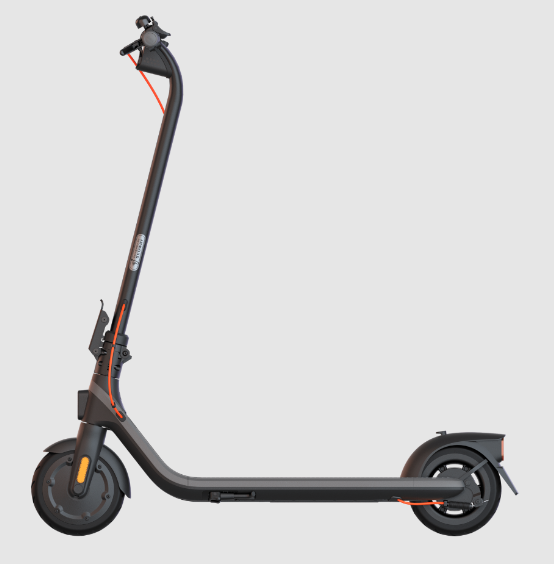
Product Information
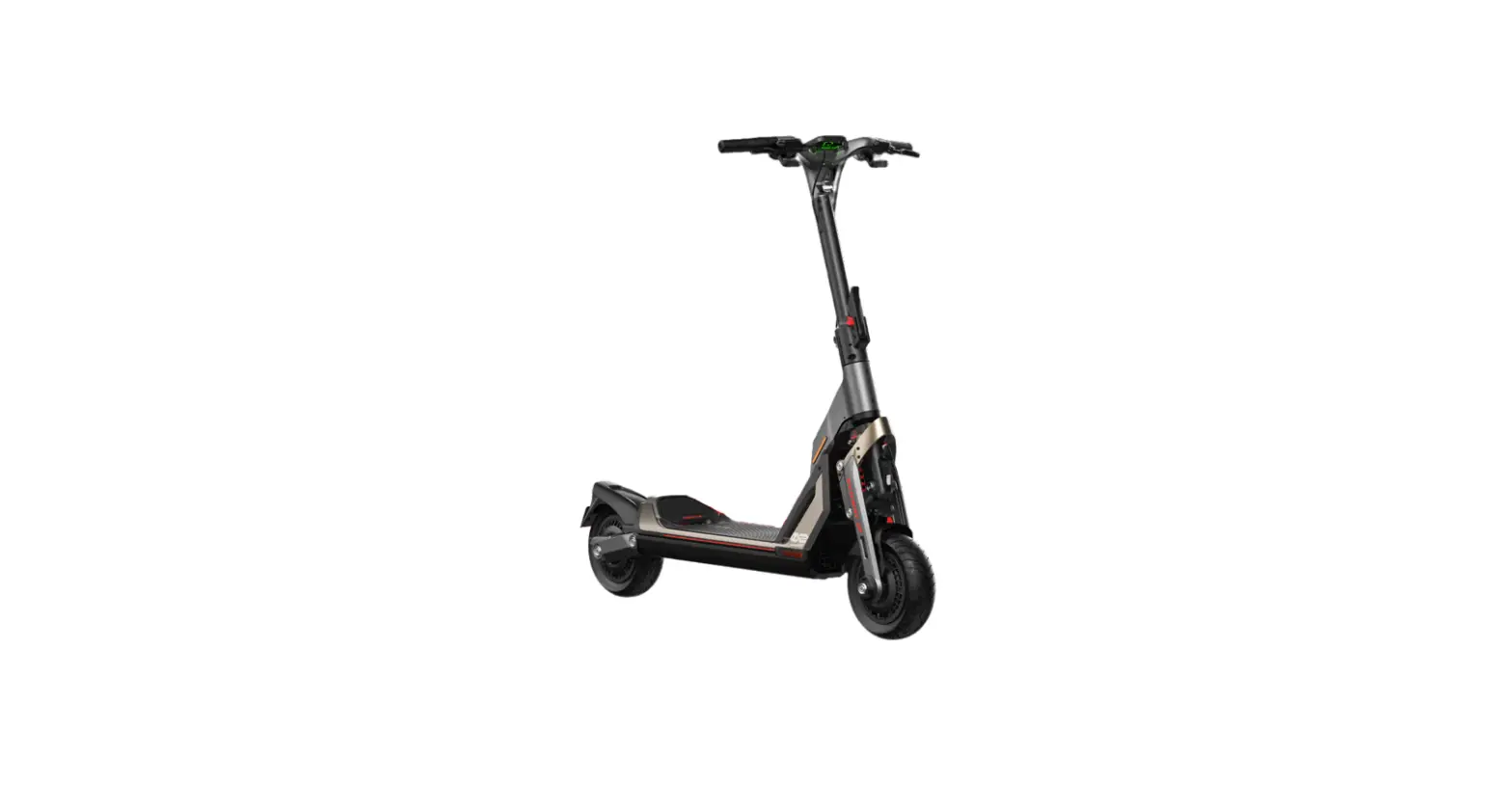
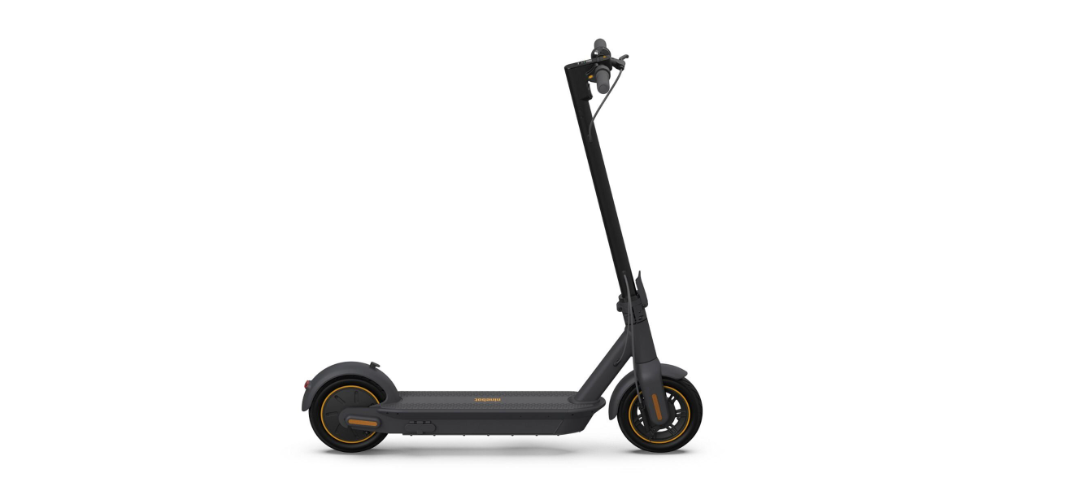
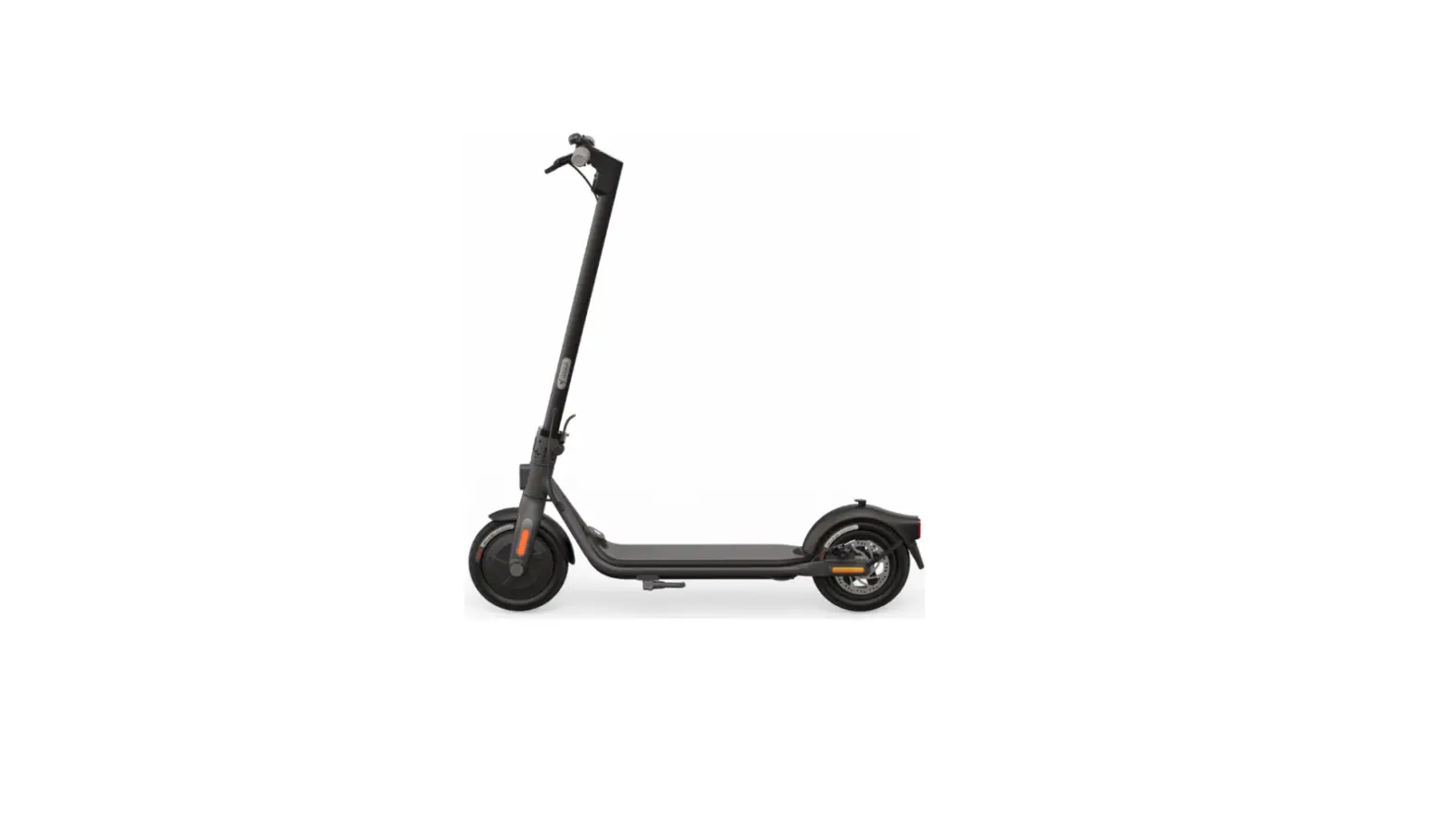
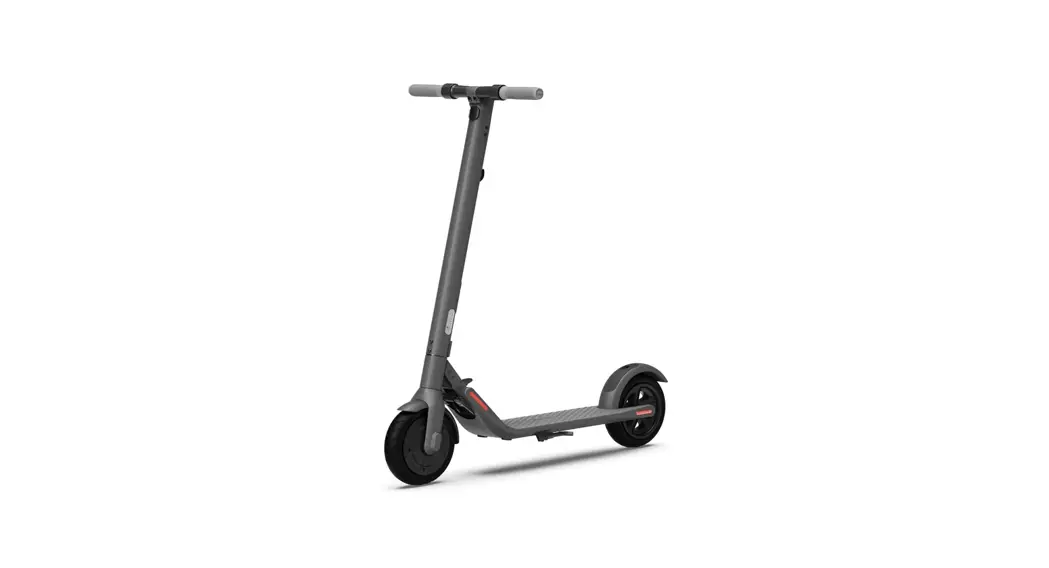
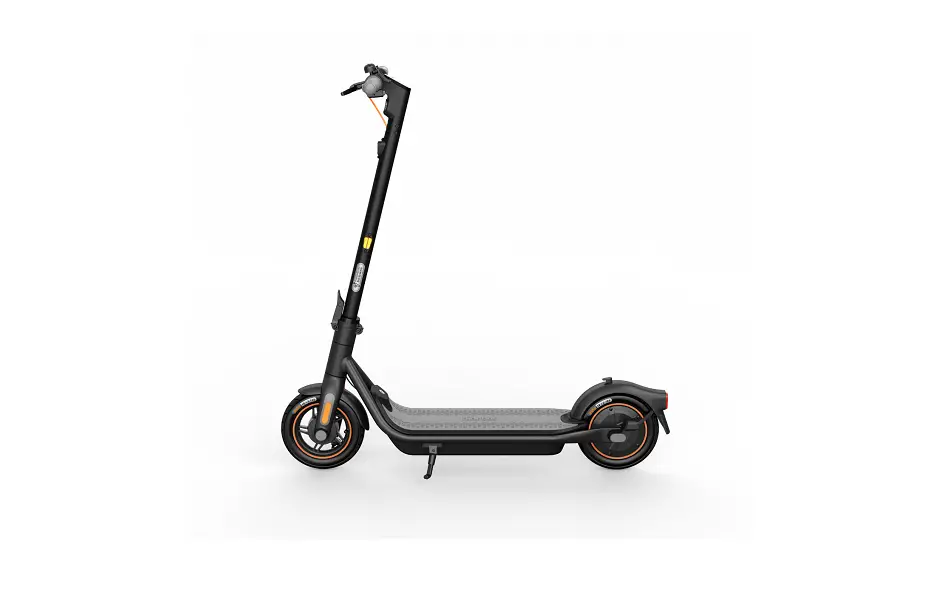
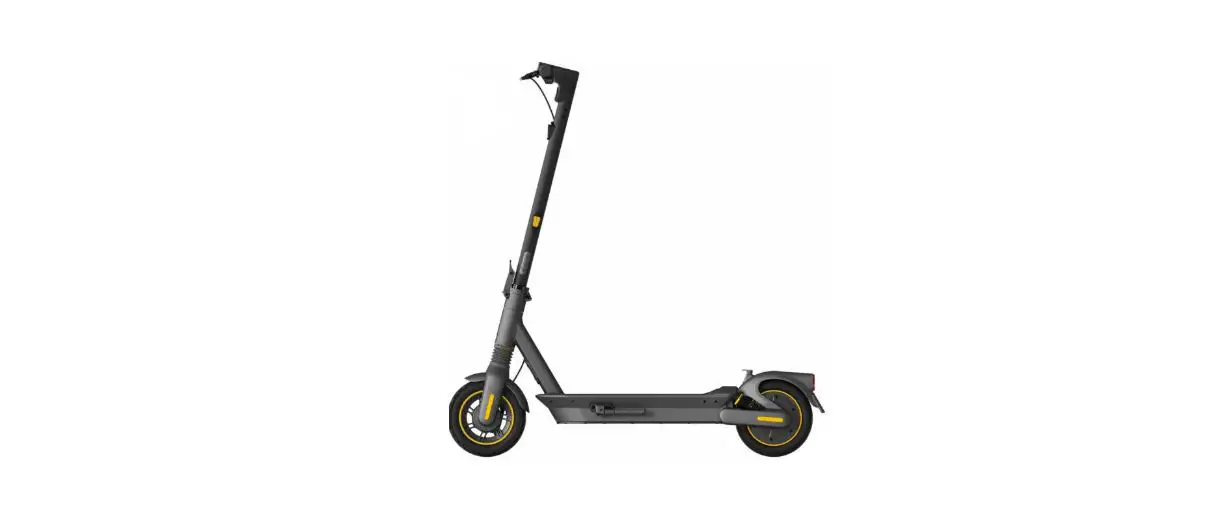
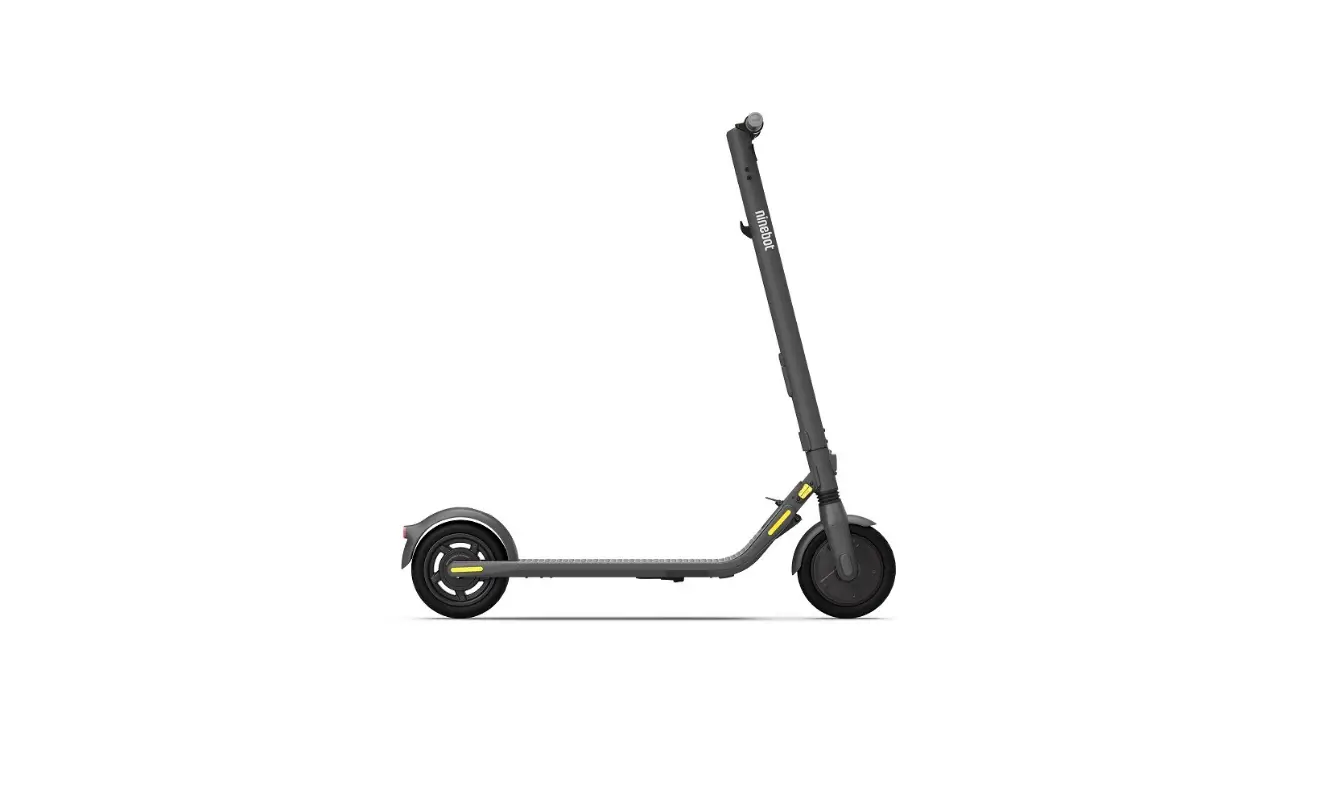
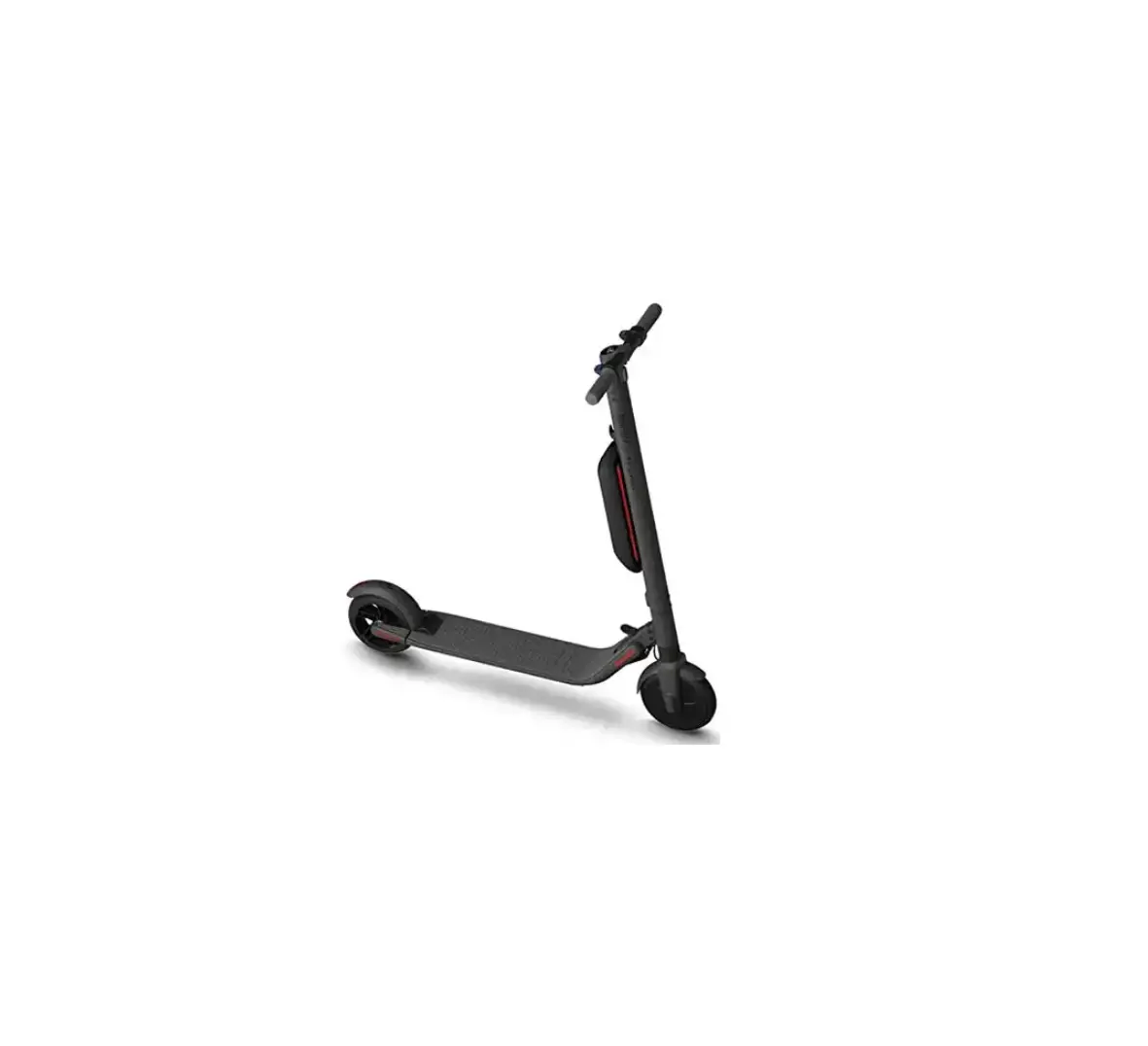
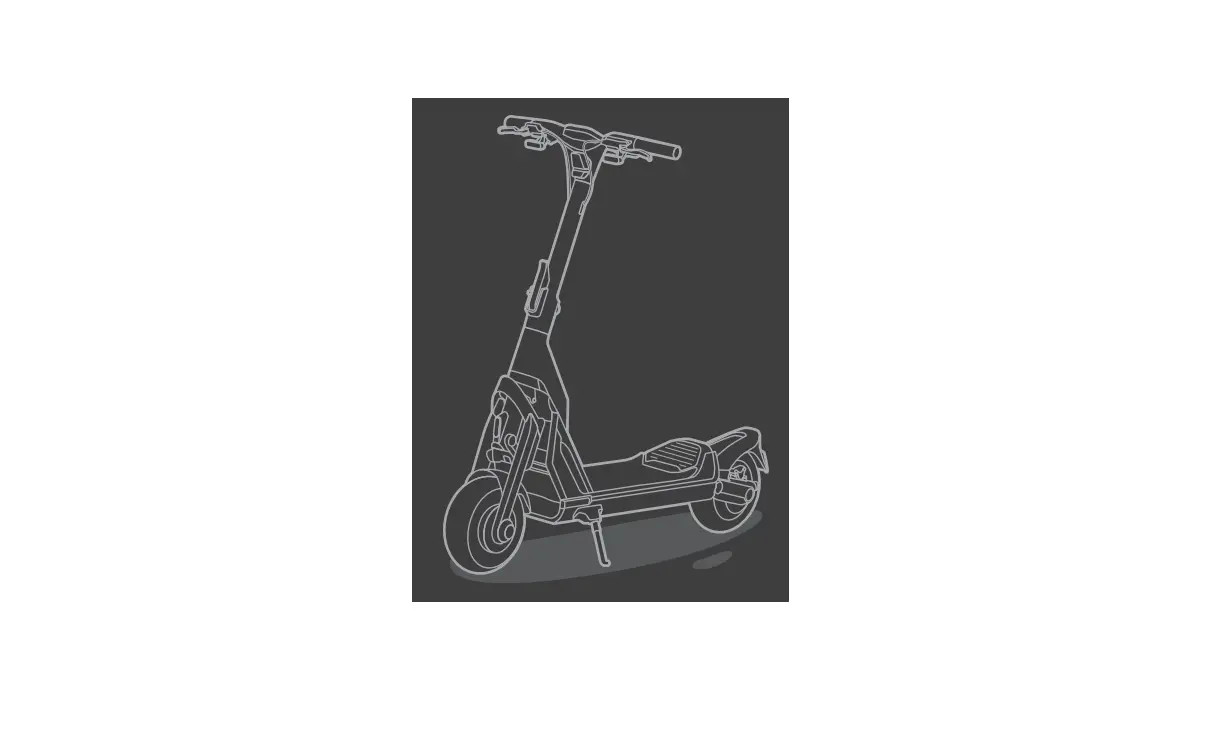
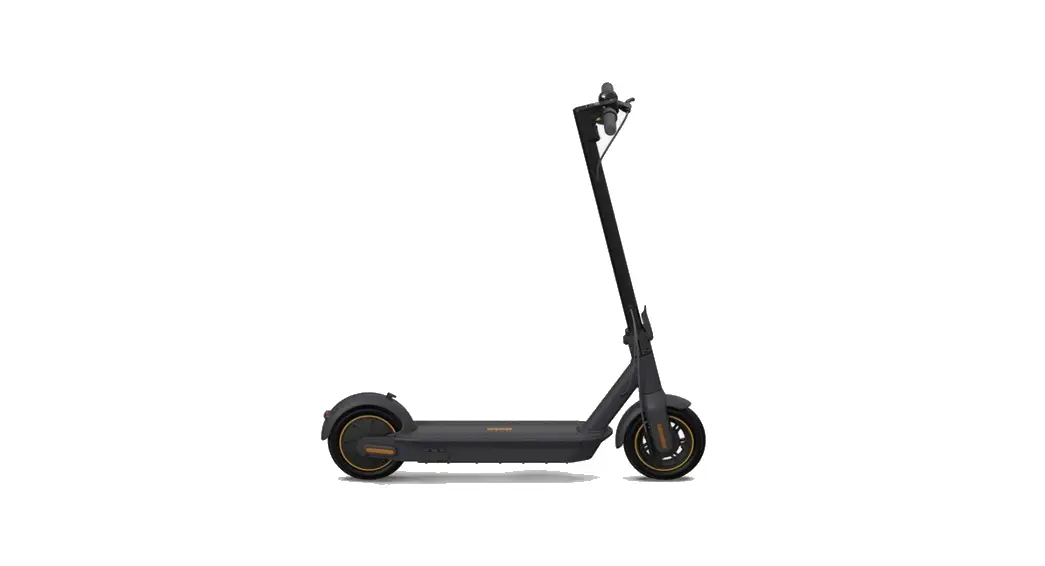
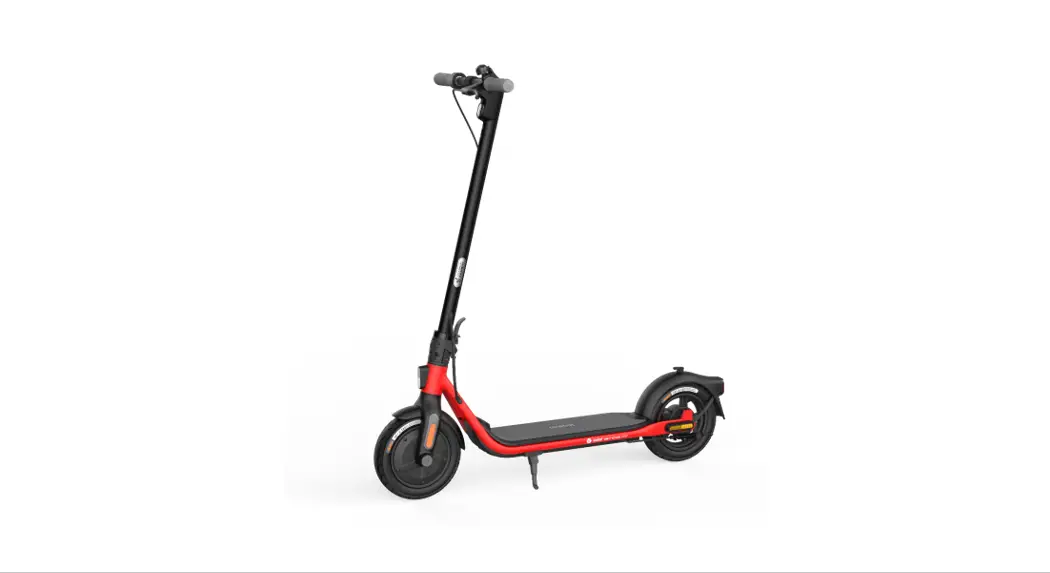
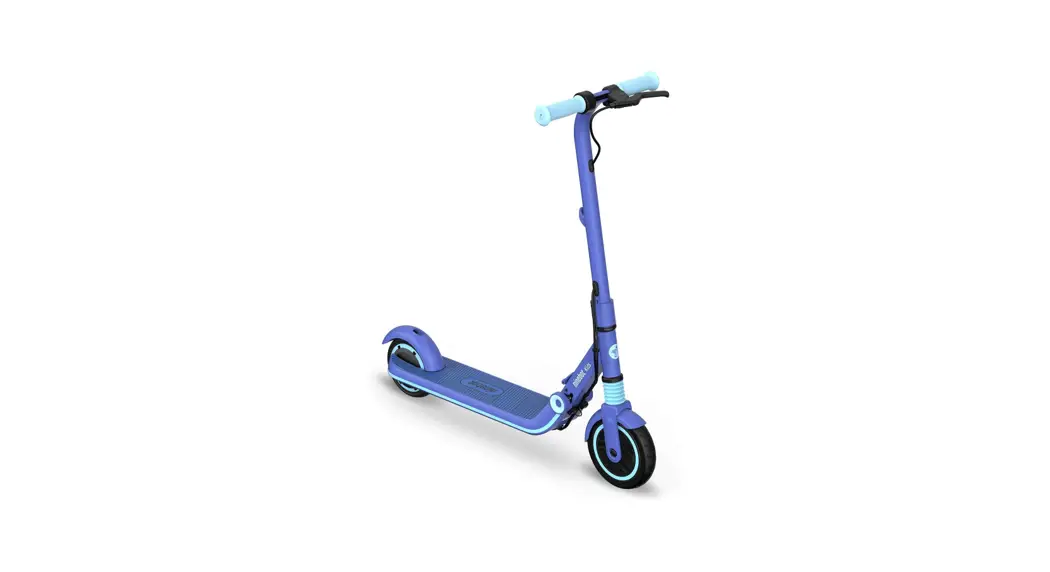
The Ninebot KickScooter is an electric scooter designed for riders aged 16-55 years. It comes in three models: F2, F2 Plus, and F2 Pro. The scooter features a variety of components including a handlebar with direction indicators, bell, brake lever, headlight, quick-release lever, folding mechanism, safety hook, reflector, front fork, front fender, disc brake, electronic throttle, dashboard with power button, snap hook, stem, footboard, hub motor, buckle, rear fender, rear light with reflector, insurance plate area, reflector, battery compartment, kickstand, charge port, and horn.
The scooter also includes a dashboard with a speedometer, direction indicator, headlight, Bluetooth connectivity, cruise mode, speed mode, battery level indicator, and power button. It offers three speed modes: ECO (Energy-saving mode), D (Standard mode), and S (Sport mode).
The specifications of the Ninebot KickScooter vary depending on the model:
- Ninebot KickScooter F2:
- Theoretical Range[1]: Approx. 25 miles (40 km)
- Typical Range[2]: Approx. 34 miles (55 km)
- Max. Slope: Approx. 18%
- Machine Weight: Approx. 37.9 lbs (17.2 kg)
- Battery: 36V, 460Wh 12.8Ah
- Motors: Nominal Power – 400W, Max Power – 800W
- Charging Time: Approx. 6.5 hours
- Tire Pressure: Most of the flat road conditions and typical
Belgian roads - IP Rating: IPX5
- Ninebot KickScooter F2 Plus:
- Theoretical Range[1]: Approx. 18 miles (30 km)
- Typical Range[2]: Approx. 28 miles (45 km)
- Max. Slope: Approx. 20%
- Machine Weight: Approx. 39 lbs (17.7 kg)
- Battery: 36V, 460Wh 12.8Ah
- Motors: Nominal Power – 400W, Max Power – 800W
- Charging Time: Approx. 8 hours
- Tire Pressure: Most of the flat road conditions and typical
Belgian roads - IP Rating: IPX5
- Ninebot KickScooter F2 Pro:
- Theoretical Range[1]: Approx. 28 miles (45 km)
- Typical Range[2]: Approx. 18 miles (30 km)
- Max. Slope: Approx. 18%
- Machine Weight: Approx. 39 lbs (17.7 kg)
- Battery: 36V, 460Wh 12.8Ah
- Motors: Nominal Power – 400W, Max Power – 800W
- Charging Time: Approx. 8 hours
- Tire Pressure: Most of the flat road conditions and typical
Belgian roads - IP Rating: IPX5
Product Usage Instructions
- Install the Segway-Ninebot app on your smartphone.
- Activate your KickScooter using the app.
- Visit www.segway.com or check the Segway-Ninebot app to download the latest user materials and firmware updates.
- Familiarize yourself with the components of the KickScooter as shown in the diagram provided in the manual.
- Before riding, ensure that all components are securely attached and functioning properly.
- To start the KickScooter, press the power button on the dashboard.
- Use the electronic throttle to control the speed.
- Switch between speed modes (ECO, D, S) as per your preference.
- Use the direction indicators to signal your intended direction.
- Activate the headlight for better visibility during low-light conditions.
- If equipped, engage cruise mode for a consistent speed without constant throttle input.
- Monitor the battery level indicator to ensure sufficient charge for your ride.
- When not in use, park the KickScooter using the kickstand.
- Charge the KickScooter by connecting it to a power source using the provided charge port.
- Follow all safety instructions and guidelines provided in the manual and app.
Diagram
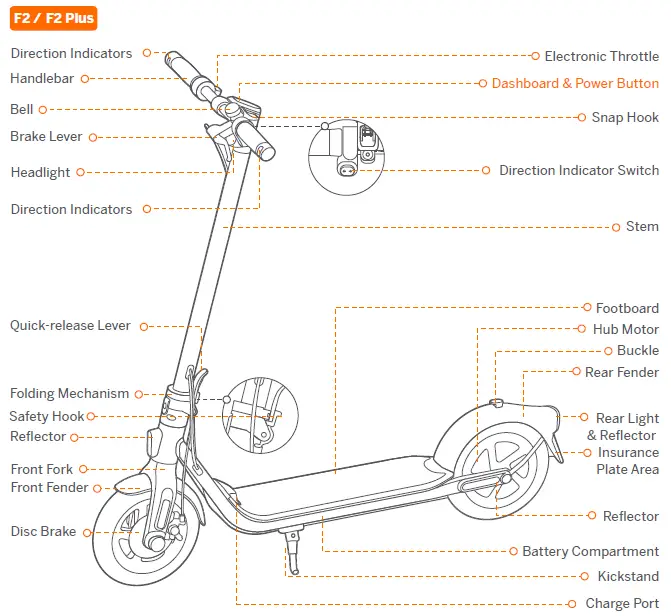
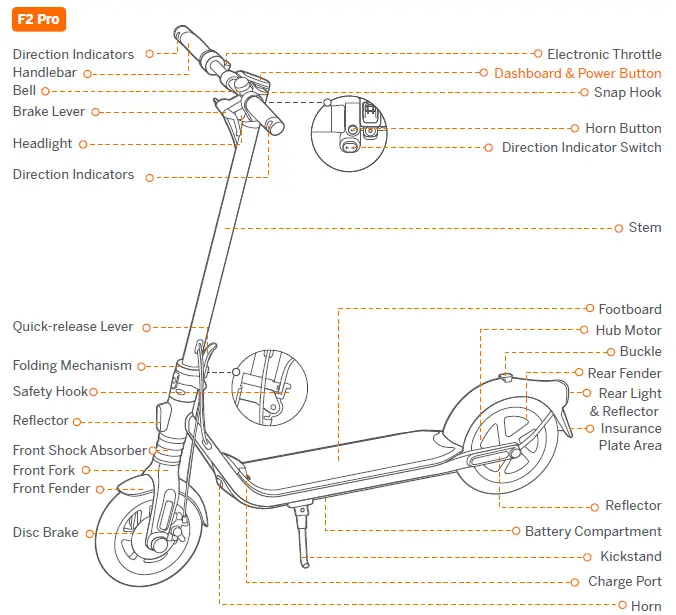
Dashboard & Power Button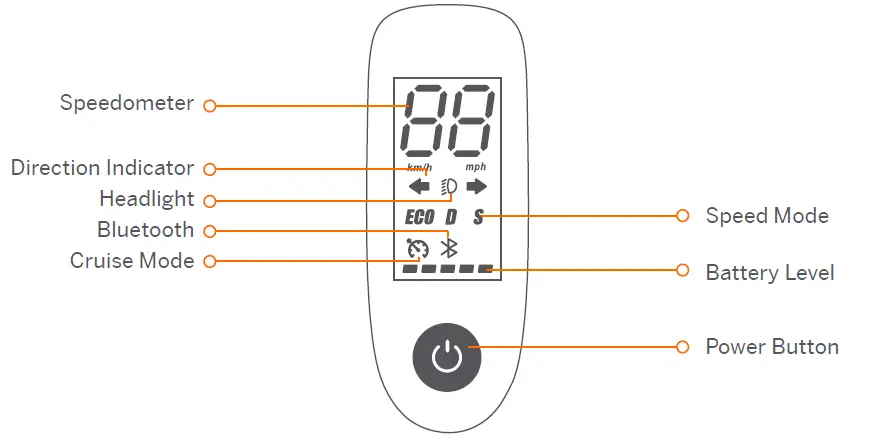
- Power Button: Press the button to power on; press and hold the button for 3 seconds to power off. When the KickScooter is on, press the button to turn on/off the headlight and the tail light; and press twice to switch between the speed modes.
- Speedometer: It displays the current speed of the scooter, as well as error codes.
*After setting the starting speed to 0 mph (0 km/h), the KickScooter will automatically enter Parking mode (P) upon powered on, and the KickScooter is unable to accelerate with “P” displayed on the speedometer. Rider has to exit Parking mode (P) by squeezing the brake lever once or accelerating the KickScooter to over 1.86 mph (3 km/h) before riding.
- Direction Indicator: When turning left or right, press the “←” (left) or “→” (right) switch on the direction indicator switch. Then the direction indicator will flash regularly which can be turned off by pressing the corresponding switch again.
- Walk Mode: Max. speed is 3.1 mph (5 km/h).
The headlight and rear light are always on and can’t be turned off.
* How to enable in the Segway-Ninebot app: Settings > Walk Mode.
- Speed Mode: There are three modes available. The top speed is as follows:
* The top speed and the accelerated speed of Sport mode (S) can be adjusted in Segway-Ninebot APP. (Current battery level will influence the maximum speed.)
| Name | F2 | F2 Plus | F2 Pro |
| Mode Model | 051201U | 051202U | 051203U |
| ECO (Energy-saving mode) | 9 mph (15 km/h) | ||
| D (Standard mode) | 16 mph (25 km/h) | ||
| S (Sport mode) | 18 mph (30 km/h) | 20 mph (32 km/h) | |
- Cruise mode: The symbol indicates that the cruise mode is activated.
* Enable Cruise mode via Segway-Ninebot APP, and it will function when rider presses and holds the throttle for more than 5 seconds, with the buzzer ringing a long beep. (KickScooter can not enter Cruise mode when its speed is slower than 3.1 mph (5 km/h).
- Bluetooth: It indicates that the scooter has been successfully connected to the mobile device.
- Battery Level: The total battery level equals 5 bars.
* The battery power is very low when the first battery bar is red. Please charge your KickScooter immediately.
Specifications
| Item | Parameter | ||
|
Product | Name | Ninebot KickScooter F2 | Ninebot KickScooter F2 Plus |
| Model | 051201U | 051202U | |
| Length × Width × Height | Approx. 45 × 22.4 × 47.8 in (1143.5 × 570 × 1214 mm) | ||
| Folded: Length × Width × Height | Approx. 45 × 22.4 × 19.1 in (1143.5 × 570 × 484 mm) | ||
| Net Weight | Approx. 37.9 lbs (17.2 kg) | Approx. 39 lbs (17.7 kg) | |
| Rider | Max. Payload | 265 lbs (120 kg) | |
| Recommended Age | 16-55 years | ||
| Required Height | 3’11”–6’6” (120–200 cm) | ||
|
Machine | Max. Speed | Approx. 18 mph (30 km/h) | |
| Theoretical Range[1] | Approx. 25 miles (40 km) | Approx. 34 miles (55 km) | |
| Typical Range[2] | Approx. 18 miles (30 km) | Approx. 28 miles (45 km) | |
| Max. Slope | Approx.18% | Approx. 20% | |
| Traversable Terrain | Most of the flat road conditions and typical Belgian roads | ||
| Operating Temperature | 14–104°F (-10–40°C) | ||
| Storage Temperature | 14–122°F (-10–50°C); recommended: 50–86°F (10~30℃) | ||
| IP Rating | IPX5 | ||
| Duration of Charging | Approx. 6.5 h | Approx. 8 h | |
|
Battery | Nominal Voltage | 36 V | |
| Max. Charging Voltage | 42 V | ||
| Nominal Energy | 367 Wh | 460 Wh | |
| Nominal Capacity | 10.2 Ah | 12.8 Ah | |
| Charging Ambient Temperature | 32–113°F (0–45°C) | ||
| Battery Management System | Over-heating, short circuit, over-current, over-discharge and over-charge protection | ||
| Motors | Nominal Power | 350 W | 400 W |
| Max. Power | 700 W | 800 W | |
|
Charger | Input Voltage | 100-240V~ 50/60Hz | |
| Max. Output Voltage | 42 V | ||
| Rated Output | 41 V 1.7 A | ||
| Output Power | 70 W | ||
| Tire | Tire Pressure | 42–48 psi | |
| Tires | 10-inch Self-sealing tubeless tires | ||
- Theoretical Range: Tested while riding with a full battery, 165 lbs (75 kg) load, 77°F (25°C), 70% of max. speed on average on pavement.
- Typical Range: Tested while riding with a full battery, 165 lbs (75 kg) load, 77°F (25°C), at the max. speed on pavement.
* Some of the factors that affect range include speed, load, number of starts and stops, ambient temperature, etc.
Recommended Maintenance Schedule
To ensure safe riding, day to day care and regular maintenance are essential. You, the owner, have control and knowledge of how often you use your scooter, how hard you use it and where you use it. It is the owner’s responsibility to perform regular checks and bring your scooter to authorized service center for inspection and service. Please refer to the maintenance schedule below.
Note: This maintenance schedule charges a service fee.
| Item | Component | Maintenance Method | Every 3 months | Every 6 months or every 310 miles (500 km) | Every 1 year or every 621 miles (1,000 km) | Every 3 years or every 6,214 miles (10,000 km) |
| Mainframe maintenance | Mainframe parts | Use a soft, wet cloth to wipe the mainframe clean. | √ | √ | √ | √ |
| Tire pressure | Inflate tires to 42-48 psi | √ | √ | √ | √ | |
| Tire wear | Check if the tires are cracked, deformed, or significantly worn. | √ | √ | √ | ||
| Screws on the stem top | Tighten the screws fixed with the handlebar and the stem. The suggested torque is 5.5±0.5 N·m. | √ | √ | √ | √ | |
| Tighten the screw on the throttle. The suggested torque is 0.9±0.06 N·m. Tighten the screws on the brake lever. The suggested torque is 6±1 N·m. Tighten the screws on the stem top. The suggested torque is 8.5±0.5 N·m. | √ | √ | √ | |||
| Screws on the folding mechanism | Tighten the fixing screws of the folding handle and the front fork, Two lateral screws at the side, the recommended torque is 15 ± 1N · m Fold and unfold, the upper vertical screw, the recommended torque is 15 ± 1N · m Fold the connecting rod, and fasten the connecting rod screws when rocking on the bike. The folding is smooth without shaking. | √ | √ | √ | ||
| Function inspection | Hub motor | To accelerate and decelerate, check if the hub motor is stalled or has abnormal sounds. | √ | √ | ||
| Front wheel maintenance | Check if the front wheel is stalled or gets shaky, or the axis shaft is unbalanced. | √ | √ | |||
| Brake adjustment | If the brake is too tight/loose, use the 4 mm Allen key to loosen the screw on the caliper. Then slightly adjust the brake line (decrease/increase the exposed length), and tighten the screw again. Test standard: the riding speed is 12.4 mph (20 km/h), and the braking distance is within 6m | √ | √ | √ | ||
| Drum brake | Front wheel can rotate normally without abnormal sound. Front wheel can be braked after squeezing the brake lever. | √ | √ | √ | ||
| Taillight | Squeeze the brake lever, the tail light works normally. | √ | √ | √ | ||
| Headlight | Check the headlight and see if it lights brightly. | √ | √ | √ | ||
| Direction indicators | Toggle the direction indicator button to the left/right respectively, check if the direction indicators on the left/right side flash normally. | √ | √ | √ | ||
| Dashboard | Power on the scooter, the dashboard works properly. | √ | √ | √ | ||
| Horn | Press the horn button and the sound is loud. | √ | √ | √ | ||
| Throttle | Press and hold the throttle then release it, checking for acceleration and deceleration. Note: Release it, check if the throttle will back to the position. | √ | √ | √ | ||
| Function inspection | Fault detection | After connecting with the Segway-Ninebot app:
| √ | √ | √ | |
| Charging | Charge the scooter:
Charging: red, Fully charged: green. | √ | √ | √ | ||
| Control buttons | Press or toggle the button 3 times without failure. | √ | √ | √ | ||
| Turning | Test with left turns and right turns (the steering angle is 60). No resistance or lag when turning. | √ | √ | |||
| Important parts | Battery assembly | The battery need to be replaced when it is charged and discharged for 500 times or the total mileage is more than 6,214 miles (10,000 km). Note: It is recommended to charge once every 60 days for long-term storage. | √ | |||
| Controller | After 3 years’ or 6,214 miles’ (10,000 km’s) riding, the abnormal parts of the kickscooter have to be repleced immediately. | |||||
| Hub motor | ||||||
| Functional parts | Rear wheel assembly | |||||
| Throttle & Brake lever | ||||||
| Front fork assembly | ||||||
| Folding mechanism | ||||||
| Drumbrake | ||||||
| Dashboard Cover |
Certifications
This product is certified to ANSI/CAN/UL-2272.
The battery complies with UN/DOT 38.3.
The battery complies with ANSI/CAN/UL-2271.
Federal Communications Commission (FCC) Compliance Statement for USA
This device complies with part 15 of the FCC rules.
Operation is subject to the following two conditions:
- This device may not cause harmful interference, and
- This device must accept any interference received, including interference that may cause undesired operation.
Any Changes or modifications not expressly approved by the party responsible for compliance could void the user’s authority to operate the equipment.
NOTE
This equipment has been tested and found to comply with the limits for a Class B digital device, pursuant to part 15 of the FCC Rules. These limits are designed to provide reasonable protection against harmful interference in a residential installation. This equipment generates, uses and can radiate radio frequency energy and, if not installed and used in accordance with the instructions, may cause harmful interference to radio communications. However, there is no guarantee that interference will not occur in a particular installation. If this equipment does cause harmful interference to radio or television reception, which can be determined by turning the equipment off and on, the user is encouraged to try to correct the interference by one or more of the following measures:
- Reorient or relocate the receiving antenna.
- Increase the separation between the equipment and receiver.
- Connect the equipment into an outlet on a circuit different from that to which the receiver is connected.
- Consult the dealer or an experienced radio/TV technician for help.
This equipment complies with FCC radiation exposure limits set forth for an uncontrolled environment. This equipment should be installed and operated with minimum distance 20cm between the radiator & your body.
Industry Canada (IC) Compliance Statement for Canada
This device complies with Industry Canada license-exempt RSS standard (s).
Operation is subject to the following two conditions:
- This device may not cause interference, and
- This device must accept any interference, including interference that may cause undesired operation of the device.
CAN ICES-3 (B)/NMB-3(B)
Neither Segway Inc. nor Ninebot is responsible for any changes or modifications not expressly approved by Segway Inc. or Ninebot. Such modifications could void the user’s authority to operate the equipment.
- Model: 051501U
- FCC ID: 2ALS8-KS0013
- IC ID: 22636-KS0013
Trademark
Ninebot is the trademark of Ninebot (Beijing) Tech Co., Ltd; Segway and the Rider Design are the registered trademarks of Segway Inc., App Store®/App Store, Apple logo® /Apple logo,iPadOS®/iPadOS, macOS®/macOS, Find My™/Find My and Works with Apple Find My logo™/ Works with Apple Find My logo are registered trademarks/trademarks of Apple Inc. , registered in the U.S. and other countries. IOS is a trademark or registered trademark of Cisco in the U.S. and other countries and is used under license.Google Play and the Google Play logo are trademarks of Google LLC.The Bluetooth® word mark and logos are registered trademarks owned by Bluetooth SIG, Inc. and any use of such marks by Segway-Ninebot is under license. Other trademarks and trade names are those of their respective owners.
The KickScooter is covered by relevant patents. For patent information, go to http://www.segway.com
We have attempted to include descriptions and instructions for all the functions of the KickScooter at the time of printing. However, due to constant improvement of product features and changes of design, your KickScooter may difer slightly from the one shown in this document. Scan the QR code or visit the Apple App Store (iOS) or the Google Play Store (Android) to download and install the App.
Please note that there are multiple Segway and Ninebot models with different functions, and some of the functions mentioned herein may not be applicable to your unit. The manufacturer reserves the right to change the design and functionality of the KickScooter product and documentation without prior notice.
© 2022 Ninebot (Beijing) Tech Co., Ltd. All rights reserved.
(※The Segway-Ninebot App can support KickScooter with built-in Bluetooth)
 Home | Segway