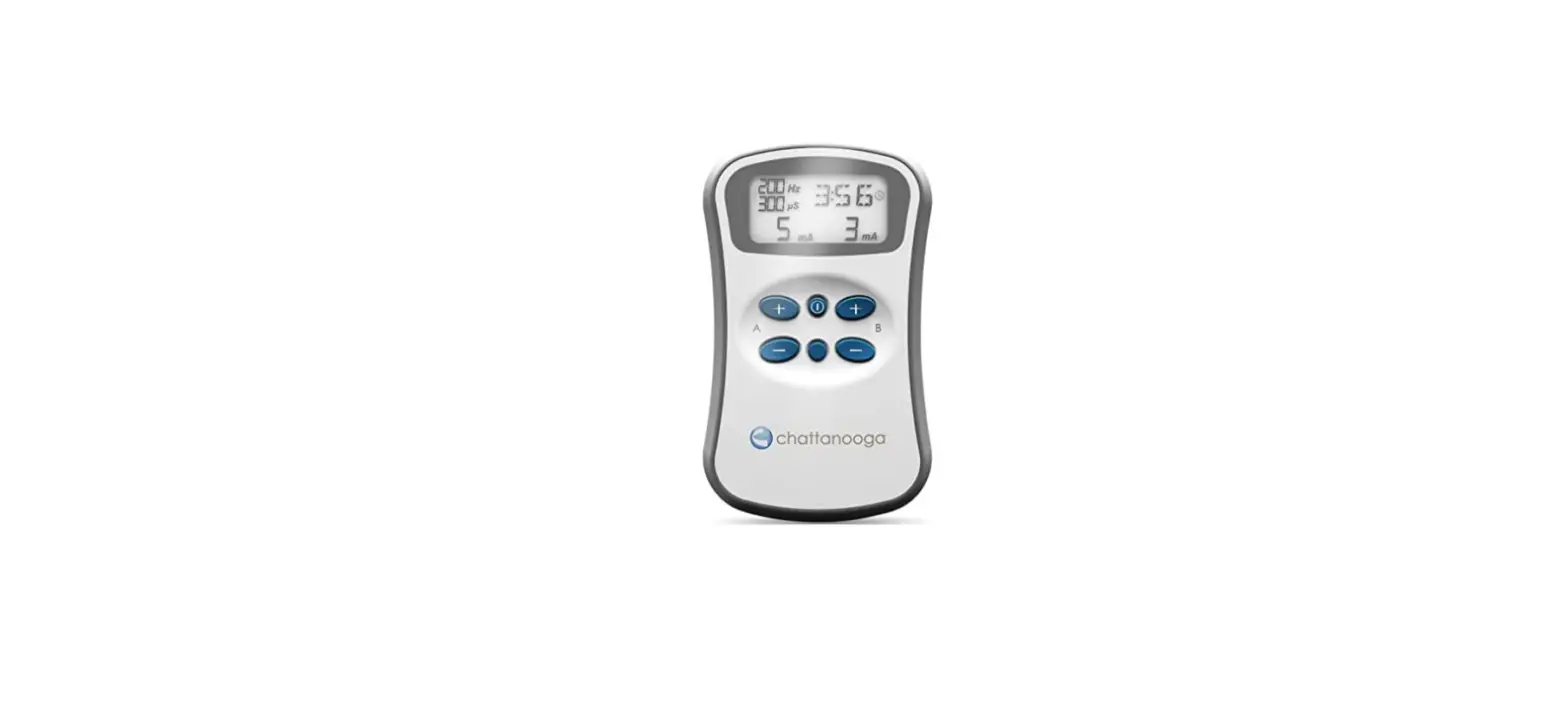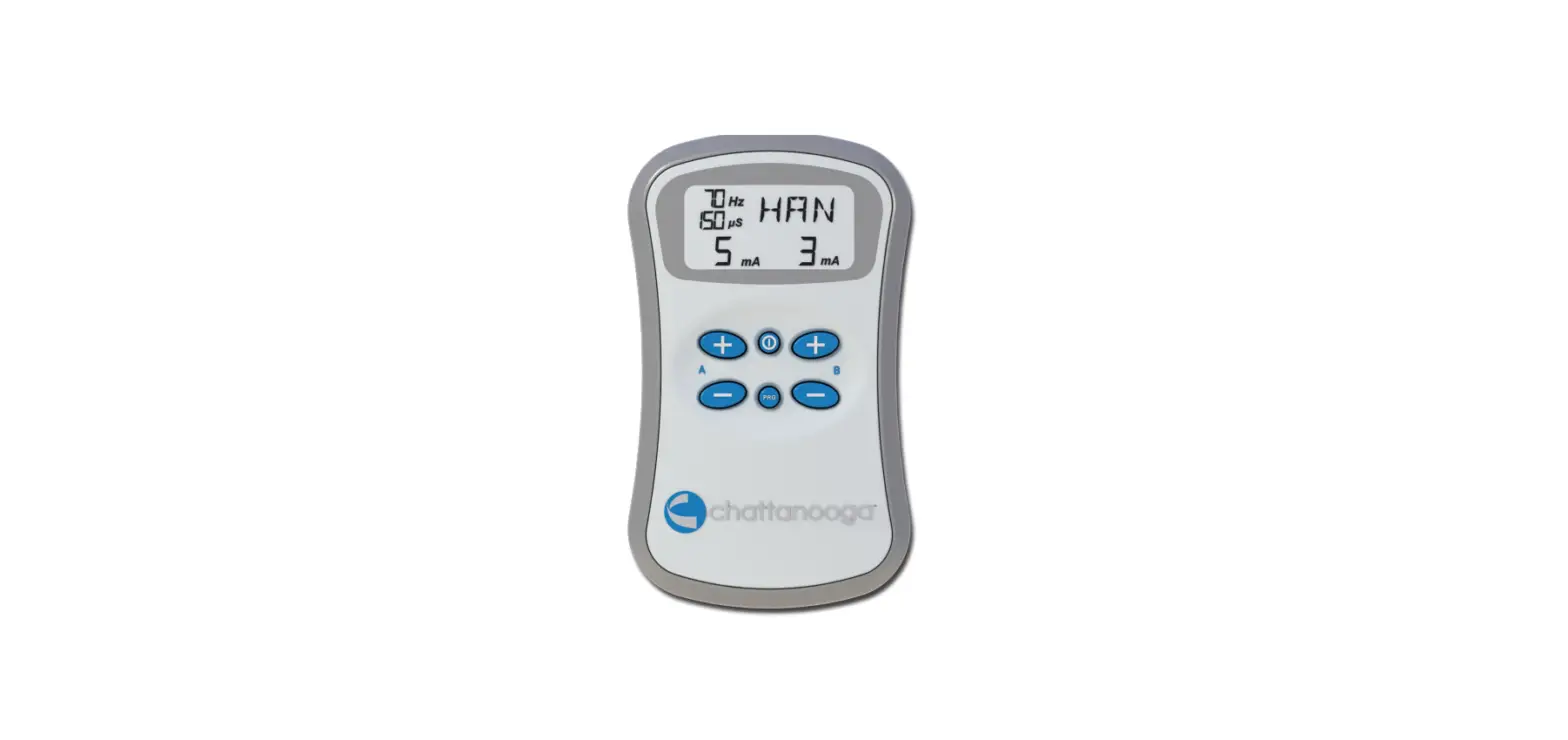

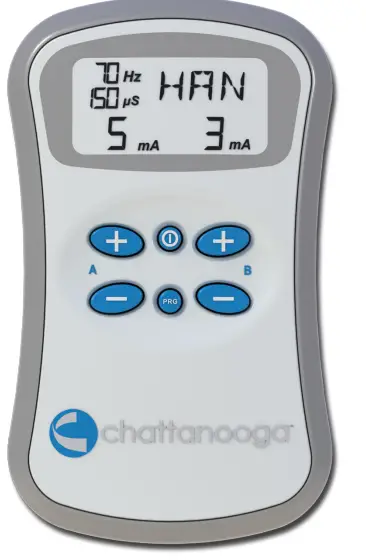
Chattanooga 36038 Primera DUAL CHANNEL TENS & NMES UNIT 
Symbols on the unit and case
Warnings
- This unit must be used with the guidance of a Physiotherapist or Doctor.
- Type BF equipment, Continuous Operation.
- Do not insert lead wires into a mains power supply.
- Do not immerse unit into water or any other substance.
- The unit is not protected from the ingress of water droplets from a shower of rain if used outside the carrying case.
- Do not use this unit in the presence of a flammable anaesthetic gas mixture and air or with Oxygen or Nitrous Oxide.
- If using rechargeable 9 Volt PP3 Nickel Metal Hydride batteries, be sure to use a CE approved battery charger. Never connect this unit directly to a battery charger or to any other mains powered equipment.
- Do not use Ni-Cad rechargeable batteries.
- Caution: Do not use lithium batteries unless they comply with IEC60086-4.
- Patient Electrodes are for single patient use only.
- Keep out of reach of children.
- Do not use this stimulator on your facial area unless you are under strict guidance from a qualified Clinician.
- Application of electrodes near the thorax may increase the risk of cardiac fibrillation.
- Operation in close proximity (e.g. 1m) to a shortwave or micro wave therapy equipment may produce instability in the stimulator output.
- Simultaneous connection of a patient to a high-frequency surgical equipment may result in burns at the site of the stimulator electrodes and possible damage to the stimulator.
- No modification of this equipment is allowed!
Intended Use
Chattanooga Primera ™ uses a small battery operated unit to provide a noninvasive, drug free method of controlling acute and principally long term intractable pain. It can also be used as adjunctive treatment in the management of post surgical traumatic pain problems. Mild electrical impulses are transmitted through the skin via surface electrodes to modify the body’s pain perception and/or to stimulate muscle and nerve fibres using precise electrical signals via various predetermined or programmable stimulation modulation options.
What is Pain?
When we feel pain it is the body’s process of informing us that something is wrong. To feel pain is important, without this feeling abnormal conditions may go undetected, creating damage or injury to critical parts of the body. Although pain is essential in warning our body of trauma or malfunction, nature may have gone too far in its design. Continued long-term chronic pain has no useful value apart from its importance in diagnosis. Pain begins when a coded signal travels to the brain where it is decoded, and analysed. The pain message travels from the injured area of the body along small diameter nerves leading to the spinal cord. At this point the message is switched to a different kind of nerve that travels up the spinal cord to the brain area. The brain then analyses the pain message, refers it back and the pain is felt.
What is TENS?
Transcutaneous Electrical Nerve Stimulation (TENS) uses a small battery operated unit to provide a non-invasive, drug free method of controlling acute and principally long term intractable pain. It can also be used as an adjunctive treatment in the management of post surgical traumatic pain problems. In TENS mild electrical impulses are transmitted through the skin via surface electrodes to modify the body’s pain perception. TENS does not cure problematic physiological conditions; it only helps to control the pain perception. TENS will not work for every user, please seek advice from your Doctor. There are millions of small nerve fibres throughout the body and it only requires a few impulses to produce chronic pain. In addition to small fibres, which allow the sensation of pain to be felt, the body is also made up of larger diameter nerve fibres. These larger nerve fibres transmit less unpleasant sensations such as touch or warmth, assisting us to form an impression of our environment. Stimulating the larger nerve fibres using TENS may have the effect of inhibiting the transmission of pain along the smaller nerve fibres to the spinal cord [known as the ‘Pain Gate Theory’].
What is STIM?
Neuromuscular Stimulation has been used for many years to stimulate muscle and nerve fibres to treat a number of muscle and nerve related conditions. Over the last 30 years numerous clinical trials and papers have been written. Chattanooga Primera ™ is a dual channel device combining several treatment programmes into one unit. Neuromuscular Stimulation is increasingly understood by Therapists and Doctors. There is a better understanding of the mechanisms which exist between nerves and muscles that makes it possible to stimulate the neuromuscular system with precise electrical signals. Chattanooga Primera ™ offers precision giving full control of Pulse Widths, Rates, Ramp up times, Work / Rest cycles as well as alternating or synchronous application if two channels are being applied.
Customer Care
We welcome constructive comments regarding our equipment particularly those that might help us to improve existing features, add new ones or develop new products for the future.
Contraindications & Precautions
- Before using this equipment you must first seek the advice of your Physiotherapist or Doctor.
- Read this operating manual before using the unit
- TENS and STIM should not be used:
- By patients fitted with a demand style cardiac pacemakers unless so advised by their Doctor
- During pregnancy [unless medically advised]
- By patients with undiagnosed pain conditions
- By patients with undiagnosed skin conditions
- With patients who have diminished mental capacity or physical competence who cannot handle the device properly
- On anaesthetised or desensitised skin
- When driving a vehicle or operating potentially dangerous equipment
- Do not place electrodes:
- Over carotid sinus nerves
- Over larynx or trachea
- Inside mouth
- Over the area of the heart unless so advised by your Doctor
- On your facial area unless under strict guidance from a qualified Clinician
- The patient should use the unit only as prescribed
- Do not immerse the unit in water or any other liquid
- If you experience skin irritation this may be due to over-stimulation.
- In this case leave the skin to heal and use TENS only for the periods prescribed.
- Turning the current up too high can cause skin irritation.
- In this case allow the skin to heal and use TENS at a lower intensity.
- Some people experience an allergic reaction to the adhesive coating on the surface of the electrode.
- If this happens use a different make of electrode or change the electrode.
- If it continues try reducing the pulse width.
- If the problem still persists try moving the electrode position each day by just the width of the electrode, making sure the electrode positioning is still over the dermatome
- Keep unit out of reach of children
- Only use CE approved skin electrodes
- If in doubt about the use of the Rehab unit, call your Doctor,
- Therapist, Clinician or you distributor for advice
Description of Unit & Functions
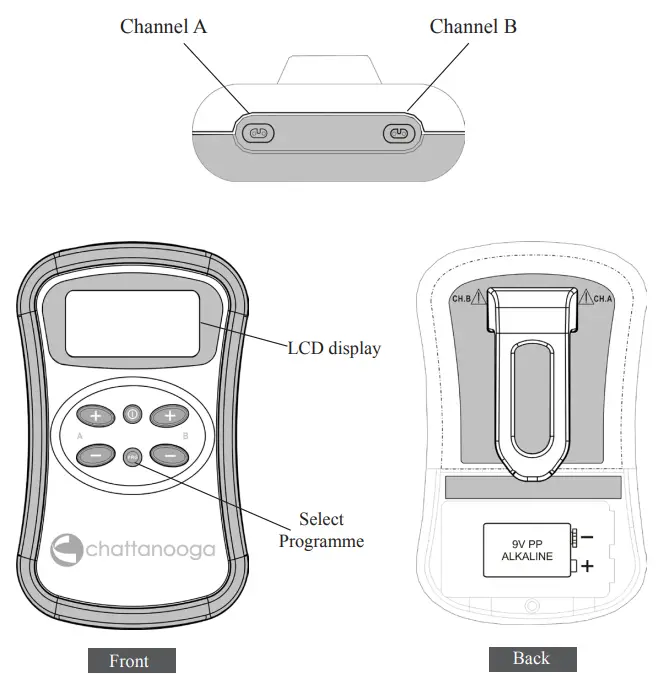
- PRG button
- Press the PRG [Programme] button to select:
- P01 – P07 or HAN for preset TENS programmes.
- P08 – P13 for preset STIM programmes.
- The summary of all programmes is on page 10.
- ON / OFF button
- Turns unit on, off and ends the current programme
Quick Start Instructions
- Insert a 9 volt PP3 Alkaline battery. Alternatively insert a rechargeable
- Nickel Hydride battery. Do not use Ni-Cad rechargeable batteries
- Insert lead wire/s to channel A and B if both channels are to be used.
- Switch on the unit by pressing the ON/OFF button.
- Press the PRG [Programme] button to select:
- P01 – P07 or HAN for preset TENS programmes.
- P08 – P13 for preset STIM programmes.
- The summary of all programmes is on page 10.
- To start press channel A + and B + button if you are using both channels, increase the stimulation to the desired level.
- To stop the programme, press the ON/OFF button which will turn the unit off.
Programmes
| Programme Number | Programme Description | Rate (Hz) | Pulse width (µS) | Work time (s) | Rest time (s) | Programme time | |
| TENS | P01 | CON | 80 | 200 | n/a | n/a | 1 hour |
| P02 | CON | 150 | 175 | n/a | n/a | 20 min | |
| P03 | CON | 2 | 175 | n/a | n/a | 20 min | |
| P04 | BST | 150 | 200 | n/a | n/a | 1 hour | |
| P05 | BST | 150 | 175 | n/a | n/a | 1 hour | |
| P06 | MOD | 100/65 | 200/100 | n/a | n/a | 1 hour | |
| P07 | MOD | 65/100 | 200/100 | – | – | 1 hour | |
| HAN | MOD | 2/70 | 250/150 | – | – | 30 min | |
| NMES | P08 | NMES | 12 | 200 | 5 | 5 | 15 min |
| P09 | NMES | 35 | 250 | 8 | 8 | 15 min | |
| P10 | NMES | 12 | 200 | 5 | 10 | 15 min | |
| P11 | NMES | 35 | 200 | 6 | 12 | 15 min | |
| P12 | NMES | 12 | 250 | 5 | 15 | 15 min | |
| P13 | NMES | 35 | 200 | 6 | 18 | 15 min |
- Key to Program Description for above
- CON = CONTINUOUS TENS
- BST = BURST TENS
- MOD = MODULATION TENS
- HAN = HAN TYPE OF MODULATION TENS
- NMES = NEURO MUSCULAR ELECTROSTIMULATION
Using the Chattanooga Primera ™ unit in TENS mode
RATE [Hz or pulses per second]
The RATE to be selected depends primarily on the electrode placement on the patient’s body. If one uses contiguous and dermatome (the electrodes alongside or over the area of pain) electrode placement, a higher rate of 80 Hz – 100 Hz is desirable. The patient should experience steady continuous stimulation. It has been found that an optimal setting of 80 or 90 Hz with a pulse width of 200 μS has good effect for most patients and is a good first choice for pain-gating. Patients using Trigger, motor or acupuncture points tend to respond to low rate stimulation 2 Hz – 10 Hz and pulse width of 200 μS. The desired effect is for the patient to feel individual pulses.
PULSE WIDTH [Duration]
The wider pulse widths will deliver stronger stimulation for any given intensity [mA] setting. By using a combination of intensity and pulse duration, it is felt that various pulse widths are capable of stimulating different groups of nerve fibres. The wider pulse duration is needed to recruit motor fibres, where as the narrow pulse duration is used more on the sensory fibres. The selection of which pulse duration to use is dependent upon the intended treatment protocol. Stimulating the larger nerve fibres is thought to reduce the speed and the amount at which information is transmitted along the smaller nerve fibres. Also under certain circumstances the brain is thought to produce its own analgesic pain-killing substances, known as endorphins or endogenous opioids.
Intensity [mA]
Patients respond differently to the level of intensity, this is due to differences in individual patient’s skin resistance, enervation and the type and condition of electrode being used. A good formula for setting the intensity is to increase the current so that the patient feels slight muscle contraction, but not strong enough to move a joint, and then slightly reduce the intensity so that it feels comfortable. When using low rate TENS settings, individual twitches will occur. The higher rate TENS settings will increase muscle tension. It is not advised to increase the intensity to experience strong muscle contraction.
Treatment Modes (TENS)
There are four treatment modes available on the Chattanooga Primera ™ unit:
- Conventional TENS or normal. Train of constant value pulses on both channels delivered with no interruption for entire treatment period.This is the most frequently used mode of the four TENS modes. The most common selection is 80 Hz with a 200 μS pulse width.
- Burst Mode. This mode is comparable to the low rate TENS technique except that each low rate pulse is substituted for by a short BURST of 9 pulses [200 μS] at 150 Hz. It is a combination of conventional and low rate TENS. The burst mode is often referred to as acupuncture – like TENS.
- Modulation TENS. This mode was designed to help prevent nerve accommodation that some patient’s experience. It is achieved by continuously cycling the pulse width and rate.
- Han TENS. Han TENS is a variation of modulated TENS. It is described as sequence of low and high frequency of stimulation [Dense-and-Disperse (DD) modes of stimulation] where 2 Hz is alternating with 70 Hz, each period lasting for 3 seconds.
How Long Do I Use TENS For?
This depends on the individual patient’s condition, accuracy of electrode placement, stimulation and the characteristics selected, but typically the onset of pain relief starts after 20 – 30 minutes. Generally TENS is used for longer periods of normally 1 hour 30 minutes per session. With some patients it can be much longer.
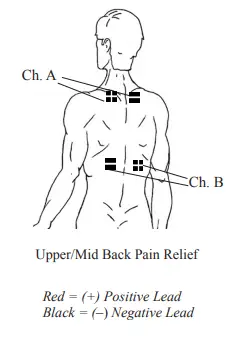
Electrode Placement (TENS)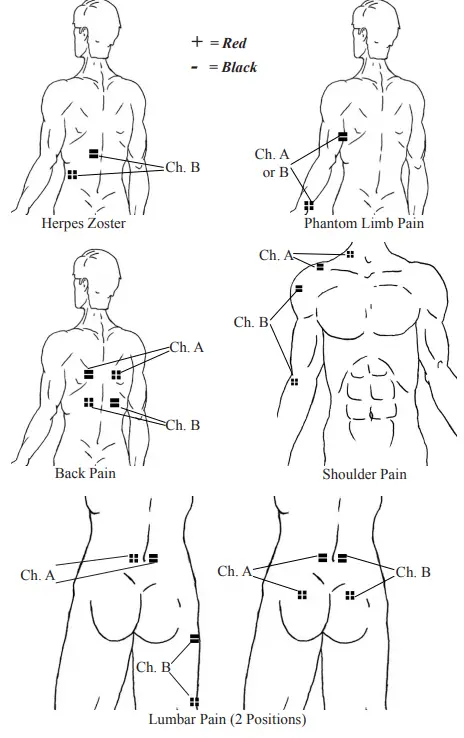
Electrode Positioning (NMES)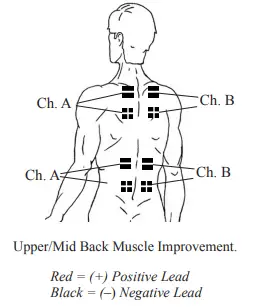
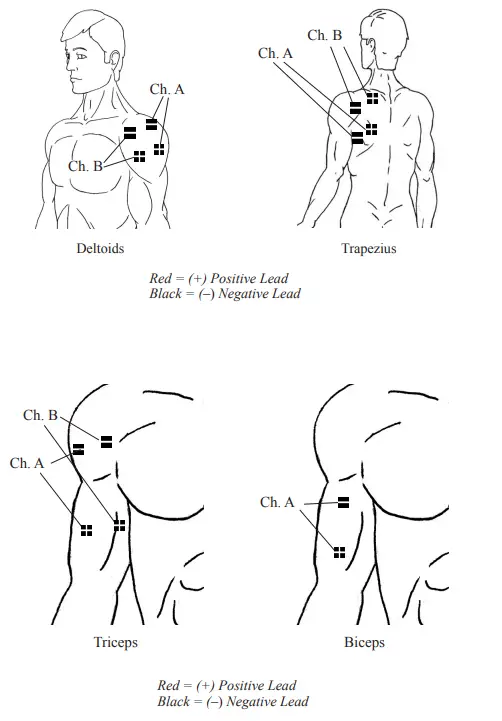
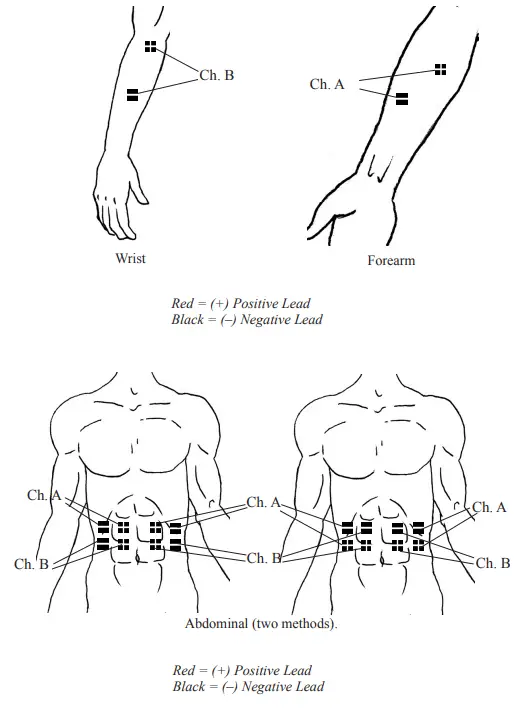
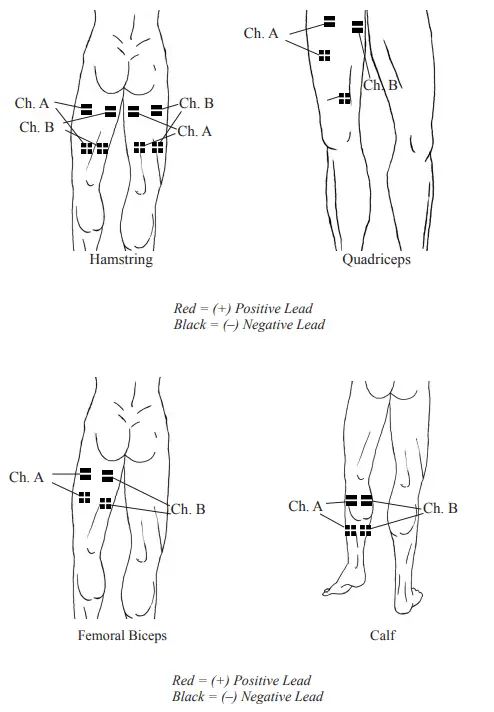
The placement of electrodes is one of the most important parameters in achieving effective pain relief using TENS. This is best left to your Physiotherapist or Doctor to advise as to which location is most appropriate. It may transpire that various positions need to be experimented with before the user finds the most effective positioning. The positioning may be via the contiguous, dermatome, myotome, motor, trigger or acupuncture points.
Dermatomes & Myotomes
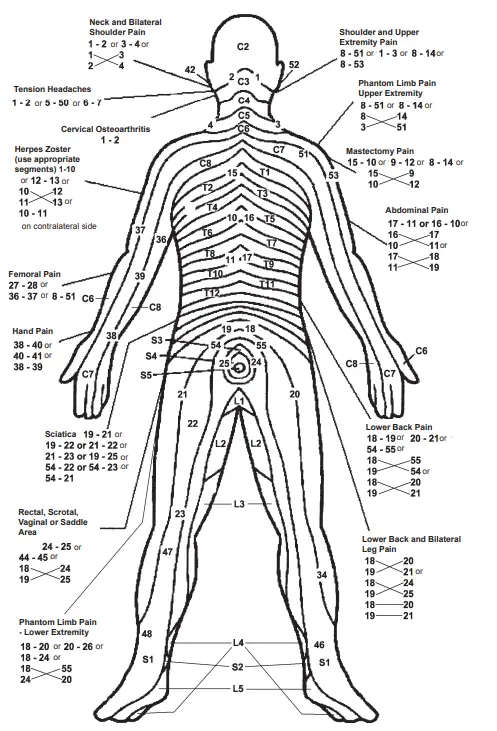
These are areas of the body enervated by a single nerve root via the spinal cord. Each nerve root serves a known area of the skin. The dermatomes are named after the nerve root which serves it. For details of dermatome sites refer to diagrams on pages 33 & 34.
Contiguous Placement
This form of electrode placement is the most common method used. It involves placing the red lead [proximal] alongside the spine where the dermatome [on which your pain lies] enters and exits. The black lead [distal] is normally placed over or near to the pain site. Your Physiotherapist or Doctor may direct the current to cross through the pain area or using the ‘bracket’ system allow the current to flow on either side of the pain site through the nerve branches that supply the pain location.
Acupuncture Points
The placement of the red and black electrodes on the skin forms the electrical circuit for TENS. It is the skin itself that creates the highest electrical resistance to stimulation. The Physiotherapist or Doctor may consider using acupuncture loci, which offer much lower resistance properties, as a more effective site for placing the electrodes. Accurately locating an acupuncture point can be difficult, please seek advice from you doctor or physiotherapist.
Electrodes Types and Tips
Self-Adhesive reusable long-term electrodes (with proper care) have a typical life span of 4/6 weeks. We recommend cleaning the skin with an alcohol-based wipe before placing the electrodes. The wipe should not contain fat as any grease will degrade the electrode stickiness. After use, place the electrodes back onto the plastic film and in the zip-tag plastic pouch. Store in a cool environment which is not too dry.Self-Adhesive reusable long-term electrodes (with proper care) have a typical life span of 4/6 weeks. We recommend cleaning the skin with an alcohol-based wipe before placing the electrodes. The wipe should not contain fat as any grease will degrade the electrode stickiness. After use, place the electrodes back onto the plastic film and in the zip-tag plastic pouch. Store in a cool environment which is not too dry.
A Few Good Tips [Self- Adhesive Electrodes]
- If you find the electrodes will not stick due to oily skin, cleanse the skin with soap and water, then rinse and dry the area around the electrode site.
- If this does not work, try cleansing the skin with a swab impregnated with alcohol.
- Clip away hairy skin using scissors; don’t use a razor to remove the hairs!
- The electrodes conductive material is water- based. If it becomes saturated (e.g. from perspiration), it will lose its adhesive qualities.
- After use leave the electrodes face up overnight to dry out (replace on plastic film in the morning).
- At some point the electrodes will become dry. Moisten the adhesive surface with a few drops of water, and apply onto the plastic film overnight.
- This procedure will increase the electrode life by few more days.
Care, Maintenance, Accessories and Disposal
WARNING! Only accessories supplied by DJO should be used!
CONTROL UNIT
- Wipe the surface after each use with a damp cloth or antiseptic wipe or baby wipe.
- Do not use cleaning sprays or alcohol based cleaning solutions.
- Expected service life is five years.
- Control unit disposal: must be disposed of in compliance with national regulatory requirements.
ACCESSORIES
Battery:
- To change the battery, open the battery door on the rear of the control unit by pressing down on the raised rib pattern just below the belt clip.
- Lift the battery out of the compartment. This is very easy and can be done by the user.
- Check periodically for any discharge from the battery.
- Remove battery completely from unit if not in use for any extended period of time (typically one week).
- Low battery indicator of 6.9 volts shown on LCD display, when flashing change battery for a new one.
- Preferably use a PP3 alkaline battery.
- Expected service life [of a standard 800 mAh, alkaline battery] is 24 hours.
- Battery disposal: must be disposed of in compliance with national regulatory requirements.
Lead Wires:
- The lead wires should be handled carefully and never stretched, as this can cause the stimulation to function below normal standards or not at all.
- Examine lead wires before each treatment for loose connections or damage.
- Avoid stretching and twisting the lead wires.
- Store the lead wires carefully after each use.
- Expected service life is six months, if looked after carefully.
- Lead wires Disposal: must be disposed of in compliance with national regulatory requirements
Self-Adhesive Electrodes:
- Check the short connectors have not become separated from the electrodes.
- Replace electrodes onto plastic film after use. If they drop onto the floor debris will adhere to conductive gel rendering the electrodes ineffective.
- Expected service life is a ten day period within two years of the manufacture date. Expiration date is clearly marked on each electrode package.
Electrode life can be considerably reduced by:
- The type and condition of the skin.
- Deep-seated moisturisers or make-up.
User’s Manual:
- Keep the user’s manual clean, dry and away from any open flame or heat source.
For the Best Results:
- Before each use cleanse the skin.
- After each use stick the pads on the shiny insert card and store in a cool and dry place, such as the fridge. (not freezer).
Accessories and Re-order codes
| Description | Item code |
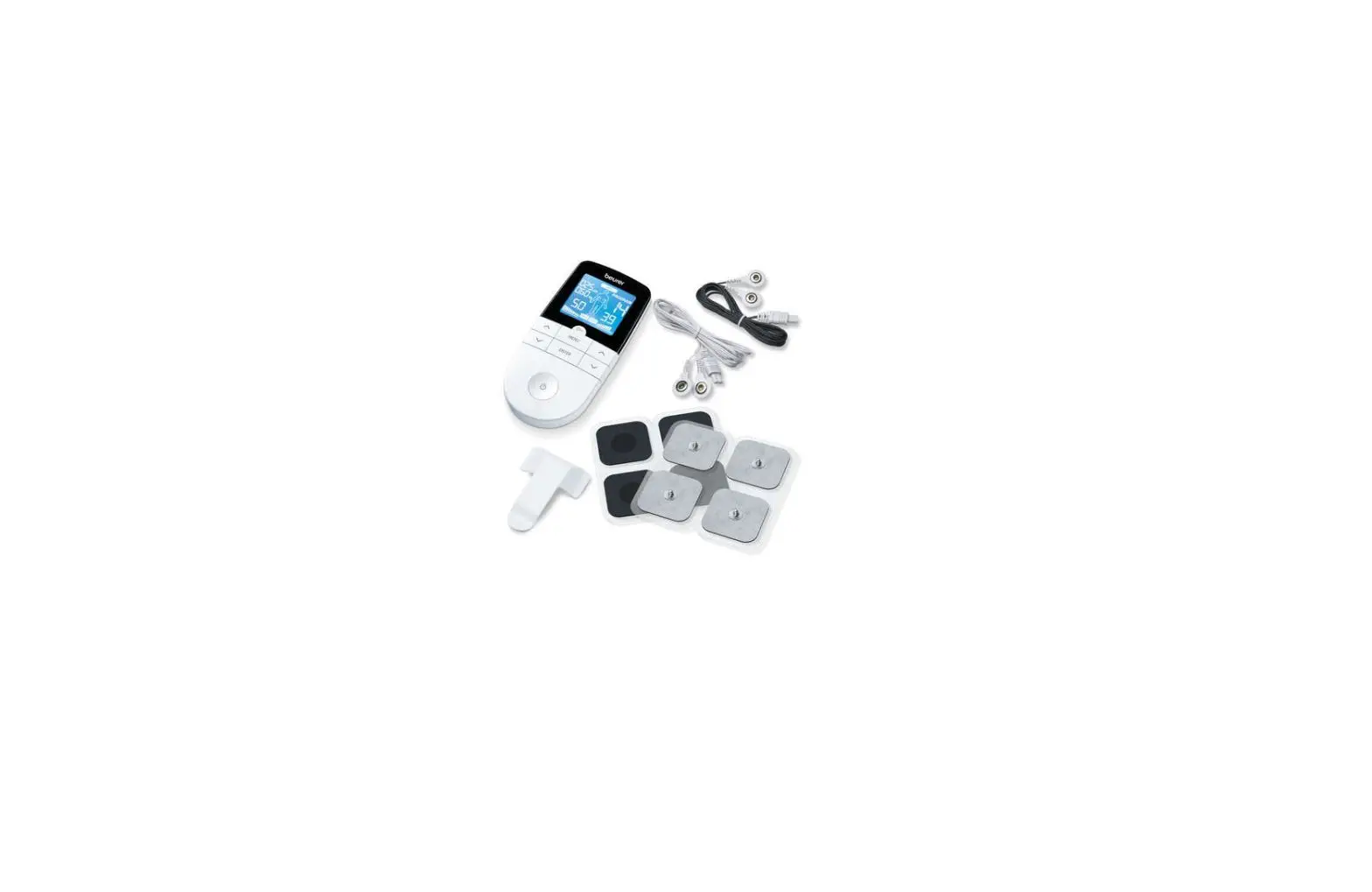
| Chattanooga Primera ™ TENS/NMES Complete Unit (International Contains: Main unit, Lead wires (2), Back Support Belt, Battery, Electrodes in the Plastic Case, English IFU (Spanish, French, German and Italian languages are for online download in PDF format). | 77621 |
Accessories: You can obtain replacement accessories from your authorized Chattanooga Primera ™ dealer:
| Description | Item code |
| Chattanooga Primera ™ User’s Manual (English) | 77622 |
| Plastic Carrying Case | 77623 |
| Chattanooga Primera ™ Unit Sliding Back Cover | 77616 |
| Leadwire Set – 2 each | 77619 |
| Electrode Positioner Belt for the Back | 77620 |
| Battery, Energizer 9-volt | 200001-01 |
| Dura-Stick Plus 5cm (2”) Round Electrodes | 42192 |
Conditions that respond to TENS
- Pain associated with major amputation.
- Post operative pain.
- Pain after cardiac surgery.
- Back pain.
- General pain.
Conditions that respond to STIM (NMES)
- Upper limb rehabilitation in early stroke.
- Arm function recovery in hemiplegic stroke.
- As a warm up prior to exercise.
- Maintains and improves movement.
- Increases and improves the blood supply to the muscle in cases of intermittent claudication
Information regarding electromagnetic compatibility and interference (EMC)
Our products are designed to produce very low levels of radio frequency (RF) emissions (interference), to be immune from effects of interference produced by other equipment operating in their vicinity and damage due to electrostatic discharge all when operating in a typical domestic and or clinical environment. They are certified to meet the international EMC standard EN60601-1-2. For more information please refer to the tables 201, 202, 204 and 206 overleaf.
Table 201: Guidance and manufacturer’s declaration – electromagnetic emission
This product is intended for use in the electromagnetic environment specified below. The customer or the user of the This product should ensure that it is used in such environment
| Emission test | Compliance | Electromagnetic environment guidance |
|
RF emission CISPR 11 |
Group 1 | This product uses RF energy only for its in- ternal function. Therefore, its RF emissions are very low and are not likely to cause any interference in nearby electronic equipment |
| RF emission CISPR 11 | Class B |
This product is suitable for use in all establish- ments , including domestic establishments and those directly connected to the public low voltage power supply network that supplies buildings used for domestic purposes |
| Harmonic emissions IEC 61000-3-2 | Not applicable | |
| Voltage fluctuations/ flicker emissions
IEC 61000-3-3 |
Not applicable | |
Table 202: Guidance and manufacturer’s declaration – electromagnetic immunity
This product is intended for use in the electromagnetic environment specified below. The customer or the user of this product should assure that it is used in such an environment, and that precautions regarding that environment are heeded.
| Immunity test | IEC 60601
test level | Compliance level | Electromagnetic environment guidance |
|
Electrostatic discharge (ESD) IEC 61000-4-2 |
6 kV contact ±8 kV air |
±6 kV contact ±8 kV air | Floors should be wood, con- crete or ceramic tile. If floors are covered with synthetic material, the relative humidity should be at least 30 %. |
|
Power frequency (50/60 Hz) magnetic field IEC 61000-4-8 |
3 A/m |
3 A/m | Power frequency magnetic fields should be at levels char- acteristic of a typical location in a typical commercial or hospital environment. |
Table 204: Guidance and manufacturer’s declaration – electromagnetic immunity
This product is intended for use in the electromagnetic environment specified below. The customer or the user of this product should assure that it is used in such an environment.
NOTE 1 At 80 MHz and 800 MHz, the higher frequency range applies.
NOTE 2 These guidelines may not apply in all situations. Electromagnetic propagation is affected by absorption and reflection from structures, objects and people.
Field strengths from fixed transmitters, such as base stations for radio (cellular/cordless) telephones and land mobile radios, amateur radio, AM and FM radio broadcast and TV broadcast cannot be predicted theoretically with accuracy. To assess the electromagnetic environment due to fixed RF transmitters, an electromagnetic site survey should be considered. If the measured field strength in the location in which this product is used exceeds the applicable RF compliance level above, this product should be observed to verify normal operation. If abnormal performance is observed, additional measures may be necessary, such as reorienting or relocating this product. b Over the frequency range 150 kHz to 80 MHz, field strengths should be less than 3 V/m.
| Immunity test | IEC 60601
test level | Compliance level | Electromagnetic environment guidance |
|
Conducted RF IEC 61000-4-6
Radiated RF IEC 61000-4-3 |
3 Vrms 150 kHz to 80 MHz
3 V/m 80 MHz to 2,5 GHz |
3 Vrms 150 kHz to 80 MHz
3 V/m 80 MHz to 2,5 GHz | Portable and mobile RF communications equipment should be used no closer to any part of this product, including cables, than the recommended separation distance calculated from the equa-
tion applicable to the frequency of the transmitter. Recommended separation distance
d = 1.2 √P 150 kHz to 80 MHz, d = 1.2 √P 80 MHz to 800 MHz d = 2.3 √P 800 MHz to 2.5GHz
where P is the maximum output power rating of the transmitter in watts (W) according to the transmitter manufactur- er and d is the recommended separation distance in meters (m). Field strengths from fixed RF transmit- ters, as determined by an electromag- netic site survey a , should be less than the compliance level in each frequency range b. Interference may occur in the vicinity of equipment marked with the following symbol: |
Table 206: Recommended separation distances between portable and mobile RF communications equipment and this product
This product is intended for use in an electromagnetic environment in which radiated RF disturbances are controlled. The customer or the user of this product can help prevent electromagnetic interference by maintaining a minimum distance between portable and mobile RF communications equipment (transmitters) and this product as recommended below, according to the maximum output power of the communications equipment
For transmitters rated at a maximum output power not listed above, the recommended separation distance d in meters (m) can be estimated using the equation applicable to the frequency of the transmitter, where P is the maximum output power rating of the transmitter in watts (W) according to the transmitter manufacturer.
NOTE 1 At 80 MHz and 800 MHz, the separation distance for the higher frequency range applies.
NOTE 2 These guidelines may not apply in all situations. Electromagnetic propagation is affected by absorption and reflection from structures, objects and people.
| Immunity test | IEC 60601
test level | Compliance level | Electromagnetic environment guidance |
|
Conducted RF IEC 61000-4-6
Radiated RF IEC 61000-4-3 |
3 Vrms 150 kHz to 80 MHz
3 V/m 80 MHz to 2,5 GHz |
3 Vrms 150 kHz to 80 MHz
3 V/m 80 MHz to 2,5 GHz | Portable and mobile RF communications equipment should be used no closer to any part of this product, including cables, than the recommended separation distance calculated from the equa-
tion applicable to the frequency of the transmitter. Recommended separation distance
d = 1.2 √P 150 kHz to 80 MHz, d = 1.2 √P 80 MHz to 800 MHz d = 2.3 √P 800 MHz to 2.5GHz
where P is the maximum output power rating of the transmitter in watts (W) according to the transmitter manufactur- er and d is the recommended separation distance in meters (m). Field strengths from fixed RF transmit- ters, as determined by an electromag- netic site survey a , should be less than the compliance level in each frequency range b. Interference may occur in the vicinity of equipment marked with the following symbol: |
Specifications
TENS and STIM(NMES)
- Dual channel: individually isolated circuits.
- Amplitude: 0-80 mA into 500 Ohm load ; indication only. Actual mA will tend to be less than indicated due to electrode impedance: at 1000 Ohms load (Electrodes in poor condition) the maximum will be limited to 70 mA, at 1500 Ohms load the maximum will be limited to 65 mA.
- Type: Constant Current, maximum output voltage 180 Volts +10 / -30 Volts.
- Waveform: Asymmetrical, rectangular bi-phasic with zero DC current.
- Selectable pulse width: 100 μS – 250 μS [2% accuracy].
- Pulse Rate selection: in the continuous mode 2 – 150 Hz [2% accuracy].
- Mode: Continuous, Burst , Modulated or HAN-Modulated.
- Burst mode: Bursts of 9 pulses [175 μS or 200 μS] at 150 Hz, over 2 seconds.
- Modulation mode: 6-second cycle of concurrent width modulation and pulse repetition rate modulation.
- TENS 6: Width starting at 200 μS and decreasing exponentially to 100μS in three seconds and then returning back to 200 μS in the next three seconds. Rate starting 100 Hz, decreasing exponentially to 65 Hz and then returning to 100 Hz.
- TENS 7: Width starting at 200 μS and decreasing exponentially to 100μS in three seconds and then returning back to 200 μS in the next three seconds.Rate starting 65 Hz, increasing exponentially to 100 Hz over 3 seconds and then returning to 62 Hz in the next 3 seconds.
- Han mode – variation of Modulated: a sequence of alternating Low frequency stimulation ( 2Hz, 260 μS) and High frequency stimulation ( 70Hz, 150 μS) each lasting 3 seconds.
- Battery: PP3 Alkaline, 9V.
- Expected average battery life [of standard 800 mAh, alkaline]: 24 h.
- Low Battery Indicator: If the battery goes below 6.9 volts +/- 0.2 volts the battery symbol will flash on/off once every second.
- If the battery voltage is below 6.6(+/-0.2) volts the unit will not turn on.
- Open Electrode Detect: If an open circuit is detected at the output of channel A or B the output current will be reset at zero.
Expected service life
5 years. Careful use and maintenance extends the life of the unit over the service life limit.
Physical dimensions
108 x 65 x 23 mm
Weight
70g without battery, 100g with battery.
Environmental Conditions for use
+5 to +40 degrees Centigrade. 15-93% Humidity.
Environmental conditions for storage & transport
-25 to +70 degrees Centigrade. 0-90% Humidity.
Issues and Solutions
| Issue | Possible Cause | Solution |
| Battery symbol on
LED flashing. | Low voltage. | Replace the battery. |
|
Display does not come on and there is no signal from the unit. | Battery discharged. | Replace the battery. |
| Battery incorrectly positioned. | Remove battery and reposition the battery in the compartment correctly. | |
|
Battery contacts bent. |
Use a tool (e.g., a standard small screwdriver) to push contacts in the battery compartment outward. | |
| Note: Depleted batteries are common, especially from above average use.
Never tamper with the battery. Discard the battery if there is any indication of damage to the battery. Low Battery Indicator: If the battery’s electromotive force goes below 6.9 (+/- 0.2) Volts the battery symbol will flash on/off once every second. If the battery voltage is below 6.6 (+/- 0.2) Volts the unit will not turn “ON”. Dispose of batteries responsibly and in full compliance with all laws. | ||
|
The unit turns “ON,” but does not carry out commands (e.g., mA intensity increases but then drops to 0mA and readjustment to higher than 10mA level is not possible.). | Open circuit detected: Poor connection between the electrodes and your body. | Turn unit “OFF.” Remove the PC Stim Electrode, and lubricate the electrode generously, reinsert the Electrode and then turn unit “ON.” |
| Open circuit detected: Lead wire connections
are not secure. | Turn unit “OFF,” unplug lead wires at all connection points and then replug all points, then turn unit “ON.” | |
|
Open circuit detected: Broken lead wires. | Turn unit “OFF,” Replace lead wires or PC Stim Electrode unit, then turn unit “ON.” | |
| Issue | Possible Cause | Solution |
| Battery symbol on
LED flashing. | Low voltage. | Replace the battery. |
|
Display does not come on and there is no signal from the unit. | Battery discharged. | Replace the battery. |
| Battery incorrectly positioned. | Remove battery and reposition the battery in the compartment correctly. | |
|
Battery contacts bent. |
Use a tool (e.g., a standard small screwdriver) to push contacts in the battery compartment outward. | |
| Note: Depleted batteries are common, especially from above average use.
Never tamper with the battery. Discard the battery if there is any indication of damage to the battery. Low Battery Indicator: If the battery’s electromotive force goes below 6.9 (+/- 0.2) Volts the battery symbol will flash on/off once every second. If the battery voltage is below 6.6 (+/- 0.2) Volts the unit will not turn “ON”. Dispose of batteries responsibly and in full compliance with all laws. | ||
|
The unit turns “ON,” but does not carry out commands (e.g., mA intensity increases but then drops to 0mA and readjustment to higher than 10mA level is not possible.). | Open circuit detected: Poor connection between the electrodes and your body. | Turn unit “OFF.” Remove the PC Stim Electrode, and lubricate the electrode generously, reinsert the Electrode and then turn unit “ON.” |
| Open circuit detected: Lead wire connections
are not secure. | Turn unit “OFF,” unplug lead wires at all connection points and then replug all points, then turn unit “ON.” | |
|
Open circuit detected: Broken lead wires. | Turn unit “OFF,” Replace lead wires or PC Stim Electrode unit, then turn unit “ON.” | |
Problem:
- Cannot reach maximum mA level; or
- The unit cuts off stimulation at certain level; or
- When increase the intensity, zero mA is flashing; or
- Power is cutting off when using
Solution:
It is normal behaviour in our and any other quality muscle stimulators (and TENS machines), and in most cases resolves itself – please read the guideance below. The stimulation intensity will drop to zero if you simply press the mA+ button and no electrodes are connected to the channel on which you increase the intensity. You should attach a pair of electrodes to the lead wire and the lead should be connected to the channel on which you increase the stimulation intensity (mA).
Our unit is designed to detect any poor or intermittent connection across the electrodes and to cut off the stimulation output (mA) when it does so. This is a safety precaution. It is designed to prevent the user from inadvertently turning up the output stimulation current in the presence of a poor or intermittent connection and then experiencing a large unexpected powerful surge in the stimulation, if and when the connection is re-established.
Reasons for no connection if you use surface skin electrodes:
- Check if both electrodes are connected to the same dual conductor lead wire, one electrode to the black connector (-) and another to red connector (+).
- Be sure the electrodes adhere to your skin well and completely (e.g., not worn, unattached or curled at the edges). The electrode’s conductive material is water-based and it will lose its adhesive qualities over time from perspiration, oil and debris the adhesive will collect. With care, maximum electrode lifespan can be achieved (see Care and Maintenance) but eventually the electrodes will need to be replaced. At some point the electrodes will become dry. Moisten the adhesive surface with a few drops of water, and apply onto the plastic film overnight. This procedure will give you a few more days of electrode life. If you find the electrodes will not stick due to oily skin, cleanse the skin with soap and water, then rinse and dry the area around the electrode site. If this does not work, try cleansing the skin with a swab impregnated with alcohol.
- The most common reason for the device to detect a break in the circuit and return the mA setting to zero is a non-visible break in the lead wires (see the care and maintenance section of this manual). To check if the cable is good, cross the red and black pin and increase mA on the unit. If the cable conducts the electricity, the mA will go above 10mA and you would feel the stimulation mild tickling in your fingers which holds the crossed pins. If you feel a mild electrical current, this means the problem is with surface skin electrodes.
Warranty.
DJO Vista, provides a warranty to the original purchaser, that this product will be free from defects in the material, components and workmanship, for a period of 2 years from the date of purchase by the distributor [invoice date from DJO to the appointed distributor]. If the distributor – from whom the product was purchased by the user – is satisfied that the product is defective, the user may return the unit directly to this distributor who will forward it to DJO. All such returns from the distributor to DJO must be authorised by DJO, in advance. The liability of DJO, under this limited product warranty does not extend to any misuse or abuse such as dropping or immersing the unit in water or other liquid substance or tampering with the unit or normal wear and tear. Any evidence of tampering will nullify this warranty.
Dermatome Charts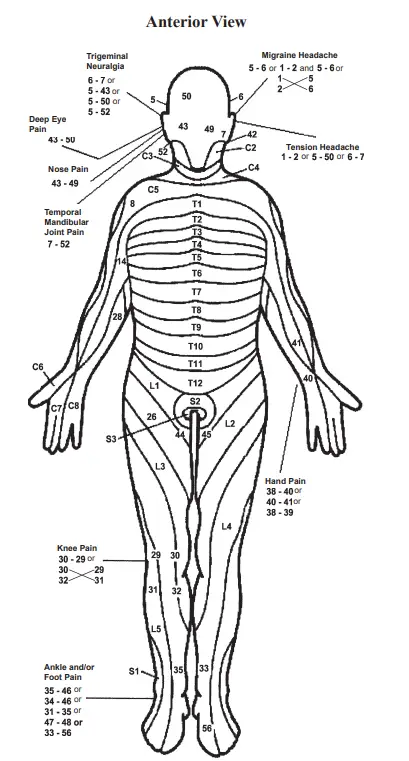
Posterior View.
Clinical References
Conventional TENS:
- Bates J.A.V, Nathan P.W. Transcutaneous electrical nerve stimulation for chronic pain. Anaesthesia 1980 August, Volume 35, Issue 8, 817–822. Ellis B. Transcutaneous electrical nerve stimulators: outpatient response to a temporary home-loan programme. Br J Therapy & Rehabilitation 1995: 2(8): 419-422.
- Chen C. et al. Does the pulse frequency of transcutaneous electrical nerve stimulation (TENS) influence hypoalgesia? A systematic review of studies using experimental pain and healthy human participants. Physiotherapy 2008: 94(1): 11-20.
- Claydon L. S. et al. Effects of simultaneous dual-site TENS stimulation on experimental pain. Eur J Pain 2008: 12(6): 696-704. Han J. S. et al. Effect of low and high frequency TENS on Met-enkephalin- Arg-Phe and dynorphin A immunoreactivity in human lumbar CSF. Pain 1991: 47(3): 295-8.
- Sluka K. A, Walsh D. Transcutaneous electrical nerve stimulation: basic science mechanisms and clinical effectiveness. J Pain 2003: 4(3): 109-21.
- Walsh D. M, Baxter D. (1996). Transcutaneous electrical nerve stimulation (TENS) : A review of experimental studies. Eur J Phys Med Rehabil 1996: 6(2): 42-50.
Neuromuscular Stimulation:
- Cabric M. Appell H.J, Resic A. Stereological Analysis of Capillaries in Electrostimulated Human Muscles. International Journal of Sports Medicine 1987 Oct: 8(5):327-330.
- Jansen J.K.S, Lomo T, Nirolaysen K. Hyperinnevation of skeletal muscle fibre. Dependence on muscle activity; Science 1973: 181, 559-561.
- McMiken D, Todd-Smith M, Colin T. Strengthening of human quadriceps muscles by cutaneous electrical stimulation. Scandinavian Journal of Rehabilitation on Medicine. 1983: 25-28.
- Pette D. Vrbová G. What does chronic electrical stimulation teach us about muscle plasticity? Muscle & Nerve 1999 Jun: 22(6):66-67.
- Romero JA, Sanford TL, Schroeder RV, Fahey TD. The effects of electrical stimulation of normal quadriceps on strength and girth. Med Sci Sports Exerc. 1982:14(3):194-197. 6. Siff M. Applications of Electrostimulation in Physical Conditioning: A Review. The Journal of Strength and Conditioning Research 1990 Jan: 4(1).
Special Notes!
The Chattanooga Primera ™ is equipped with a mA LOCKOUT. Forty-five seconds after the unit is turned“ON”, the intensity setting will lock. To make any adjustment to the intensity setting, you must first press the negative button to increase the mA.
Customer Service:
Please contact the selling dealer or DJO, LLC Service department. Your invoice of purchase and/or the rear cover of this manual should state the name and the contact details of your distributor. For assistance, if needed, in setting up, using or maintaining the unit, or report unexpected operation or events, please visit the manufacturer’s website for further details: http://www.djoglobal.com
- MDSS GmbH, Schiffgraben 41
- 30175 Hannover, Germany
- T: (+49)-511-6262 8630
- F: (+49) -511-6262 8633
- DJO, LLC
- 1430 Decision Street Vista, CA 92081 U.S.A
- T: + 33 (0) 5 59 52 86 90 F: + 33 (0) 5 59 52 86 91
- http://www.djoglobal.com
FAQS
Tens unit that you use to choose program and strength and length of pulse. Two Connectors that Go from unit to the Pads that attach to connectors. The pads are adhesive and come in two different sizes. Carrying case and batteries.
Our Primera TENS/NMES Device comes with the following:
A Primera Unit Carrying Case, 9-Volt Battery, Leadwires (2), Electrodes (2 packages of 4 electrodes), Electrode Positioner Belt (for the back) and a User Manual
Lead wires are not sold separately. If looking for newer TENS unit with lots of great muscle stimulator programs, try the Compex EDGE 2.0. Here is link https://www.amazon.com/dp/B0777X6XXX This product has battery, lead wires and electrodes available for purchase on Amazon
you can only adjust the intensity levels. There are many options available however on the device for Tens and NMES. works well
If you need more lead wires and want really good product, you should go with updated version of TENS that was taken over by Compex from Chattanooga. It is the new Compex Edge 2.0 with TENS. Here is link: https://www.amazon.com/Compex-Edge-Muscle-Stimulator-Bundle/dp/B0777X6XXX It costs more, but worth it. Much more powerful than this Chattanooga brand and other low cost TENS units sold on Amazon
Everything came included with mine, everything. Pads, cables, batteries, and an instruction booklet on how to use the unit. All in a travel case, too! I’m very pleased with it!
The Chattanooga Primer TENS uses pin connectors for electrode connectors. Here is link to additional electrodes if you need to purchase on Amazon.com
https://www.amazon.com/Chattanooga-Dura-Stick-Adhesive-Electrodes-Square/dp/B00N6G19BE Also, Note that Amazon.com and Motion Store are the only authorized sellers on Amazon.com for this product and any other DJO Global brand/product. Beware of other 3rd party marketplace sellers
Everything is included. Good value. Main control unit has two channels and two sets of lead wires. Four 2×2 inch pads and four 2×3.5 inch pads. Control unit let’s you choose from twelve programs and the strength of the pulse. Good product
We just started using it for the foot drop today. It will raise and lower the foot. We use it mostly for lifting the hand and fingers.
This unit is both Tens and NMES device. I used it for the pain…TENS.
Our Occupational Therapist uses the same unit. We use it for arm, fingers and legs that are weak or unproductive from a stroke. It was also ok’d to use by our Physical Therapist from a well known clinic.
Small. There is no size noted. There are two channels available
We have addressed your question with our Chattanooga department, they have informed us that unit comes with 4 electrodes
Our Primera TENS/NMES Device comes with the following:
A Primera Unit Carrying Case, 9-Volt Battery, Leadwires (2), Electrodes (2 packages of 4 electrodes), Electrode Positioner Belt (for the back) and a User Manual
Lead wires are not sold separately. If looking for newer TENS unit with lots of great muscle stimulator programs, try the Compex EDGE 2.0. Here is link https://www.amazon.com/dp/B0777X6XXX This product has battery, lead wires and electrodes available for purchase on Amazon