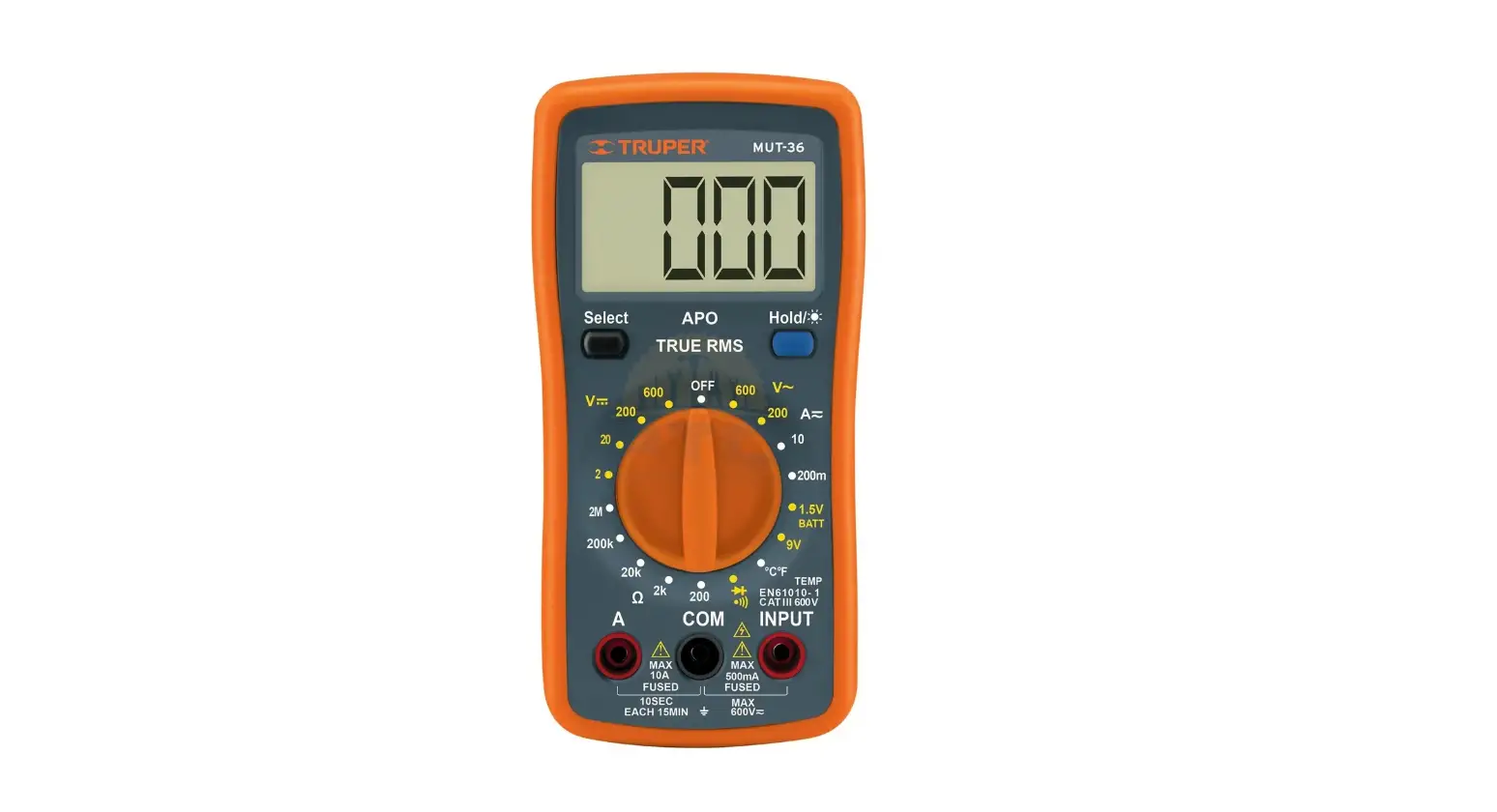
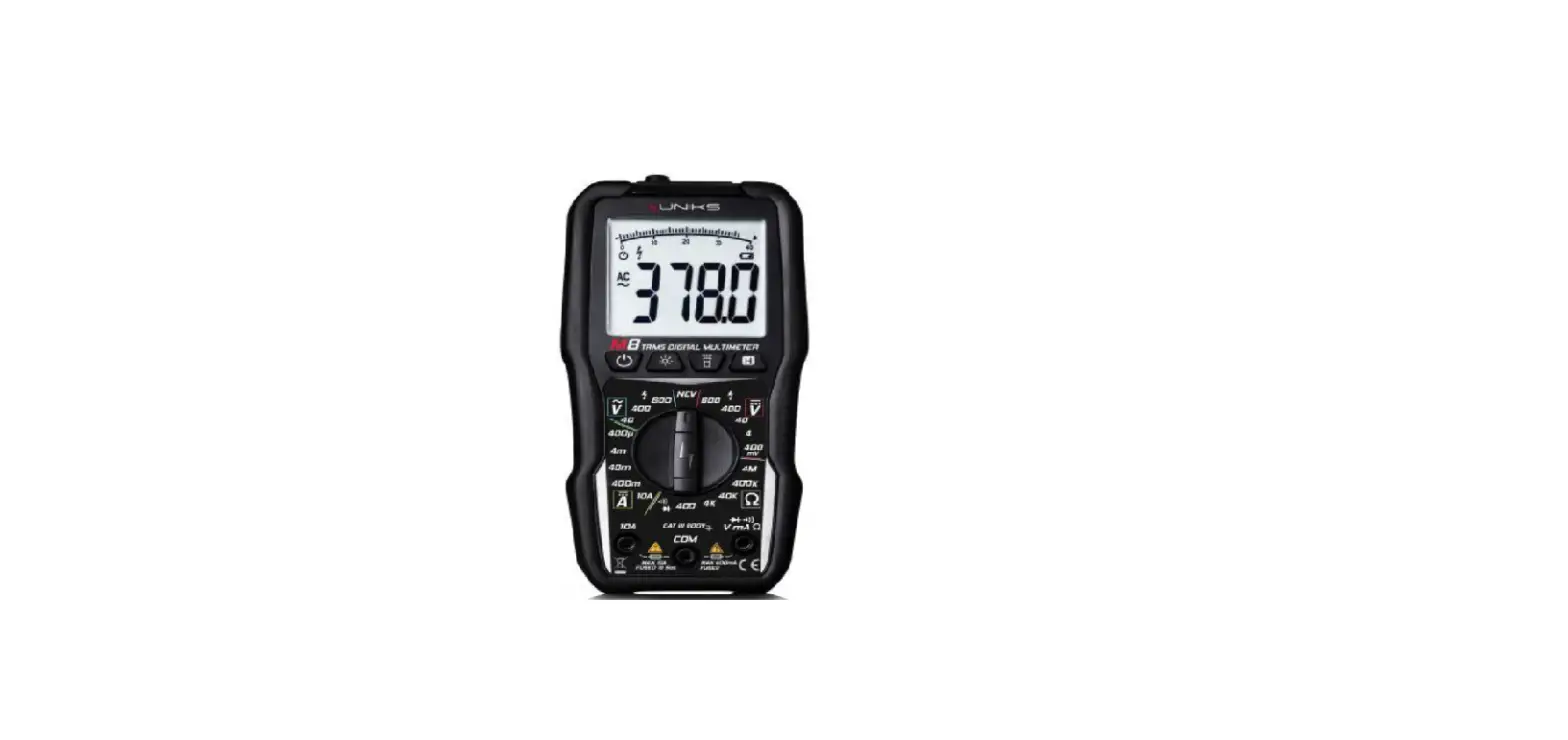
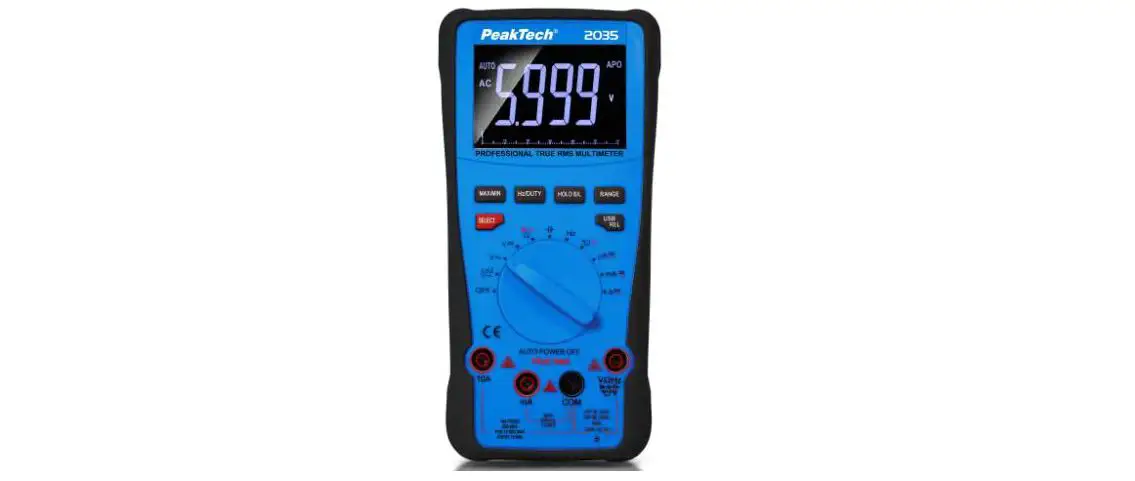
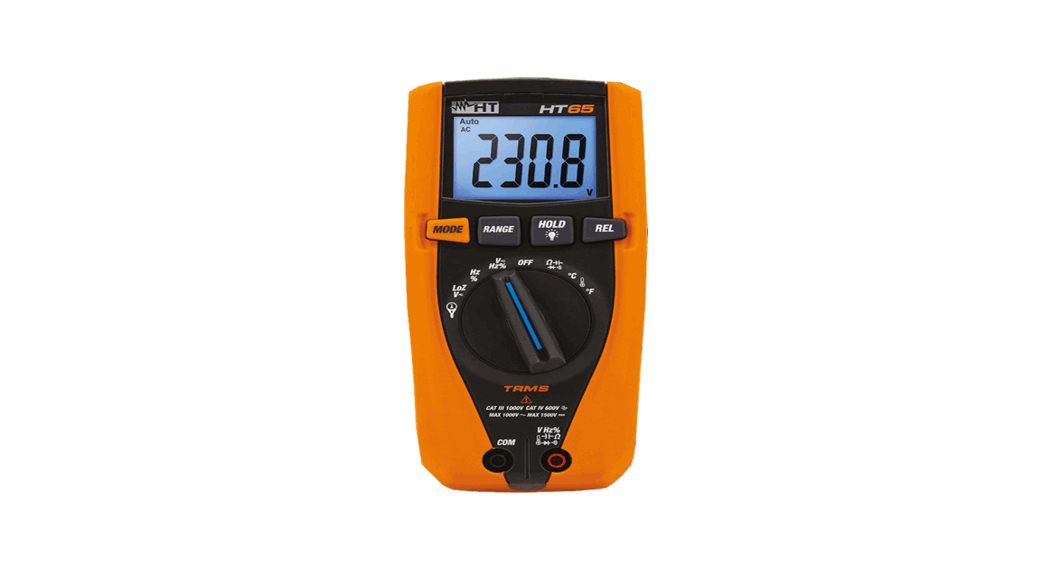
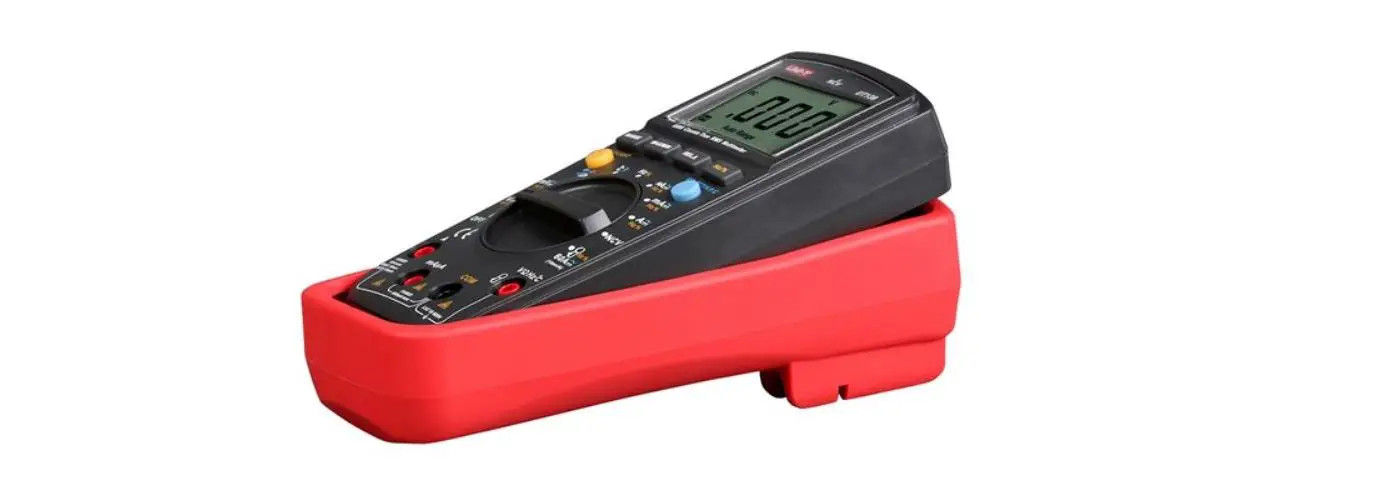
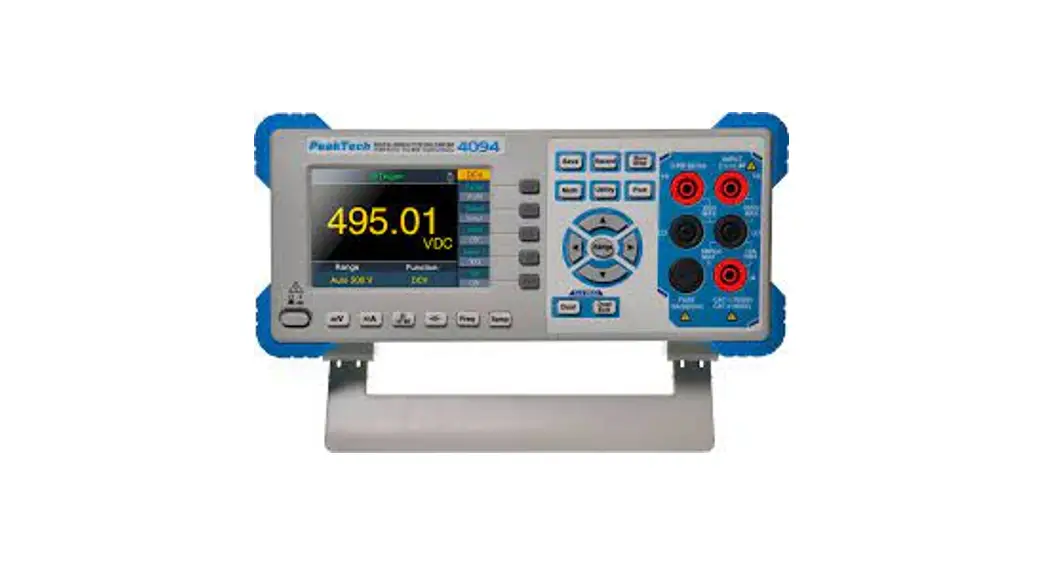
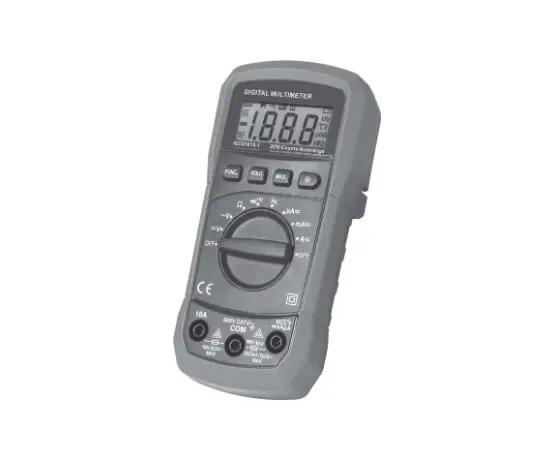
MUT-33 Digital Multimeter
Product Information: Product Name: 10401 MUT-33
Model Number: 10401 Brand: MUT-33 Product Usage
Instructions: 1. Terminal Usage: – Use the appropriate
terminals provided on the device for accurate measurements. Refer
to the user manual for terminal identification and usage
instructions. 2. Function Usage: – Select the desired function on
the device based on your measurement requirements. The device
should have a function selector knob or button for this purpose.
Refer to the user manual for detailed information on available
functions and their usage. 3. Range Selection: – Ensure that you
select the appropriate range for your measurements. The device
should have a range selector switch or button for this purpose.
Refer to the user manual for guidance on selecting the correct
range for different measurement scenarios. 4. Polarity: – Pay
attention to the polarity of the connections when making
measurements. The device should indicate the proper polarity for
each terminal or function. Make sure to connect the positive and
negative terminals correctly to obtain accurate readings. Note: For
detailed information on specific measurements, maintenance, and
troubleshooting, please refer to the complete user manual
accompanying the product. Please follow these instructions
carefully to ensure safe and accurate usage of the 10401 MUT-33
product.
Multímetro digital Digital multimeter
INSTRUCTIVO INSTRUCTIVE 10401 MUT-33
NOTA IMPORTANTE: Este producto no debe quedar expuesto a goteo o salpicaduras por líquidos. IMPORTANT NOTE: This product shall not be exposed to liquids dripping or spatter.
ADVERTENCIA
ESPAÑOL
Para evitar una posible descarga eléctrica o lesión personal y evitar daños al multímetro o al equipo que se está probando, siga las siguientes reglas:
Antes de utilizar el multímetro revise la carcasa. No utilice el multímetro si está dañado o si parte de la carcasa se ha removido. Revise que no tenga grietas o le falte plástico. Revise el aislamiento alrededor de los conectores.
Inspeccione que las puntas de prueba no tengan el aislamiento dañado o metal expuesto. Revise que las puntas de prueba tengan continuidad.
No aplique más que la tensión nominal tal como se marca en el multímetro, entre las terminales o entre cualquier terminal y la tierra.
Para prevenir que el multímetro se dañe, se debe colocar interruptor giratorio en la posición correcta y no debe haber ningún cambio de rango durante la medición.
Se debe tener especial cuidado cuando el multímetro esté trabajando en una tensión efectiva superior a 60 V en c.c. ó 30 V RMS en c.a., ya que existe el peligro de descarga eléctrica.
Use las terminales, funciones y rango adecuadas a las mediciones.
No utilice o almacene el multímetro en ambientes de alta temperatura, humedad, donde haya productos explosivos, inflamables y campos magnéticos fuertes. El desempeño del multímetro se puede deteriorar después de mojarse.
Cuando use las puntas de prueba mantenga los dedos detrás de las guardas para dedos.
Desconecte el circuito de alimentación y descargue todos los capacitores de alta tensión antes de probar resistencia, continuidad, diodos o hFE
Cambie la pila tan pronto aparezca el indicador de pila ” “. Cuando las pilas están bajas el multímetro puede producir lecturas falsas que conllevan a una descarga eléctrica y a lesiones personales.
Retire la conexión entre las puntas de prueba y el circuito que se está probando. Apague la energía del multímetro antes de abrir su carcasa.
Cuando dé servicio al multímetro use solamente piezas de repuesto del mismo número de modelo o de especificaciones eléctricas. No se debe alterar a voluntad el circuito interno del multímetro para evitar dañarlo o tener un accidente. Cuando dé servicio al multímetro, use un trapo suave y detergente suave para limpiar la superficie. Para evitar que la superficie del multímetro se corroa, dañe o produzca un accidente no se debe utilizar substancias abrasivas ni solventes. El multímetro es adecuado para uso en interiores. Apague el multímetro cuando no esté en uso y retire las pilas cuando no se use en determinado tiempo. Revise las pilas con frecuencia ya que puede tener fugas cuando no se utiliza en un tiempo prolongado. Cambie las pilas de inmediato si aparece alguna fuga. Una pila con fuga puede dañar el multímetro.
1. CARACTERÍSTICAS GENERALES
Visualización máxima:
Polaridad:
Método de medición: LCD: Velocidad de muestreo: Indicación de sobrecarga: Ambiente de operación: Ambiente de almacenaje: Indicador de pila baja: Características de la pila:
Electricidad estática: Medida del producto: Peso neto del producto:
LCD 3-1/2 dígitos (cuenta hasta 1 999) 15 mm (0,6”) Menos se indica automáticamente y más se superpone. Interruptor doble integral A/D. 45 mm x 23 mm 2 veces por segundo. Se muestra “1” 0 ºC ~ 40 ºC, a <80% HR -10 ºC ~ 50 ºC, a <85% HR Se muestra ” ” 3 V c.c. (Emplea 2 pilas AAA de Carbón-Zinc de 1.5 V c.c. incluidas) Alrededor de 4 mA 160 mm x 76 mm x 32 mm 155 g (incluye pilas)
2. DESCRIPCIÓN DE PARTES 1. LCD 2. Botón de luz de fondo 3. Botón de Hold 4. Tomacorriente hFE 5. Interruptor giratorio / interruptor de funciones 6. Conector VmA 7. Conector COM 8. Conector 10 A
1
3
2
4
5
8
6
7
3. ESPECIFICACIONES TÉCNICAS
Se garantiza la precisión por 1 año, 23 ºC 5 ºC, menos de 80% HR
TENSIÓN c.c.
Rango 200 mV 2 V 20 V 200 V 1 000 V
Resolución 100 µV 1 mV 10 mV 100 mV 1 V
Precisión (0,5% de rdg + 3 dgts)
(0,8% de rdg + 5 dgts)
(1% de rdg + 5 dgts)
Protección de sobrecarga: 220 V RMS c.a. para rango de 200 mV y 1 000 V c.c. o 750 V RMS para todos los rangos.
TENSIÓN c.a.
Rango 200 V 750 V
Resolución 100 mV 1 V
Precisión (2,0% de rdg + 10 dgts)
Respuesta: Respuesta promedio, calibrada en RMS de onda sinusoidal. Rango de frecuencia: 45 Hz ~ 450 Hz Protección de sobrecarga: 1 000 V c.c. ó 750 V RMS para todos los rangos.
CONTINUIDAD AUDIBLE
Rango
Descripción Zumbador inter-construido
suena si la resistencia es menor a 30 20
Protección de sobrecarga: 15 segundos máximo 220 V RMS.
CORRIENTE DIRECTA c.c.
Rango 200 µA 2 mA 20 mA 200 mA 10 A
Resolución 100 nA 1 µA 10 µA 100 µA 10 mA
Precisión
(1,8% de rdg + 2 dgts)
(2,0% de rdg + 2 dgts) (2,0% de rdg + 10 dgts)
Protección de sobrecaga: 500 mA / 250 V fusible (rango sin fusible 10 A). Medición de caída de tensión: 200 mV
RESISTENCIA
Rango 200 2 k 20 k 200 k 2 M
Resolución 0,1 1 10 100 1 k
Precisión (1,0% de rdg + 10 dgts)
(1,0% de rdg + 4 dgts)
Tensión máximo de circuito abierto: 3 V Protección de sobrecarga: 15 segundos máximo 220 V RMS.
TEMPERATURA (CON TERMOPAR TIPO K)
Rango -40 ºC ~ 150 ºC 150 ºC ~ 1 370 ºC -40 ºF ~ 320 ºF 320 ºF ~ 1 999 ºF
Resolución 1 ºC
1 ºF
Precisión (1,0% + 4 dgts) (1,5% + 15 dgts) (1,0% + 4 dgts) (1,5% + 15 dgts)
4. INSTRUCCIONES DE OPERACIÓN
MEDICIÓN DE TENSIÓN c.c. Y c.a. 1. Conecte la punta de prueba roja al conector “VmA”, la punta de prueba negra al conector “COM”. 2. Coloque el interruptor RANGO en el rango de TENSIÓN deseada. En caso de no saber de antemano la tensión que se va a medir coloque el interruptor en el rango más alto y reduzca hasta obtener una lectura satisfactoria. 3. Conecte las puntas de prueba al dispositivo o circuito que se va a medir. 4. Encienda el suministro eléctrico del dispositivo o circuito que se está midiendo, el valor de la tensión va a aparecer en la pantalla digital junto con la polaridad de la tensión.
MEDICIÓN DE CORRIENTE c.c. 1. La punta de prueba roja a “VmA”. La punta de prueba negra a “COM” (para mediciones entre 200 mA y 10 A conecte la punta de prueba roja con el conector “10 A” presionado a fondo). 2. Coloque el interruptor RANGO en el rango de corriente c.c. deseada. 3. Abra el circuito que se va a medir y conecte las puntas de prueba EN SERIE con la carga en la cual se va a medir. 4. Lea el valor actualizado en la pantalla digital. 5. De manera adicional, se diseñó una función “10 A” solamente para uso intermitente. El tiempo máximo de contacto con las puntas de prueba en el circuito es de 10 segundos, con un intervalo de tiempo mínimo de 15 minutos entre pruebas. MEDICIÓN DE RESISTENCIA 1. La punta de prueba roja en “VmA”. La punta de prueba negra a “COM”. 2. Coloque el interruptor RANGO en el rango deseado. 3. En caso que la resistencia que se está midiendo esté conectada a un circuito, apague el suministro eléctrico y descargue todos los capacitores antes de hacer la medición. 4. Conecte las puntas de prueba al circuito que se está midiendo. 5. Lea el valor de resistencia en la pantalla digital. MEDICIÓN DE DIODOS 1. La punta de prueba roja en “VmA”, la punta de prueba negra en “COM”. 2. Coloque el interruptor RANGO en el rango ” “. 3. Conecte la punta de prueba roja al ánodo del diodo a ser medido y la punta de prueba negra al cátodo. 4. Se va a mostrar la caída de tensión mV en caso que el diodo esté revertido, se muestra el número “1”
MEDICIÓN DE TEMPERATURA 1. Coloque el interruptor RANGO en el rango ºC ó ºF, va a mostrar la temperatura ambiente en valores ºC ó ºF 2. Conecte el termopar tipo K en los conectores “VmA” y “COM” 3. La pantalla lee el valor de temperatura en ºC ó ºF NOTA: El límite de temperatura medido por la sonda termopar junto con el multímetro es de 400 ºC (752 ºF) máximo en periodos cortos, en caso de necesitar medir temperaturas más altas debe adquirir una sonda termopar de mayor capacidad. PRUEBA DE CONTINUIDAD AUDIBLE 1. La punta de prueba roja a “VmA”, la punta de prueba negra a “COM”. 2. Coloque el interruptor RANGO en el rango ” “. 3. Conecte las puntas de prueba en dos puntos del circuito que se va a medir. El zumbador suena si la resistencia es menor a 30 20 MEDICIÓN DE TRANSISTOR hFE 1. Coloque el interruptor RANGO en el rango hFE 2. Determine si el transistor es tipo PNP o NPN y localice las puntas de prueba del emisor, la base y el colector. Inserte las puntas de prueba en los orificios adecuados en el tomacorriente hFE 3. El multímetro va a mostrar el valor hFE aproximado en la condición de corriente básica de 10 mA y VCE 2,8 V CAMBIO DE PILA Y FUSIBLE Casi nunca se necesita cambiar los fusibles y se funden casi siempre como resultado a un error del operario. Si aparece ” ” en la pantalla, indica que se deben cambiar las pilas. Para cambiar las pilas y el fusible (500 mA / 250 V) retire los dos tornillos en la parte de debajo de la carcasa. Solo retire el viejo y coloque el nuevo. Tenga cuidado de respetar la polaridad. 3 V c.c. (Emplea 2 pilas AAA de Carbón-Zinc de 1.5 V c.c. incluidas) Nota: La garantía no cubre las pilas.
WARNING!
ENGLISH
To avoid possible electric shock or personal injury, and to avoid possible damage to the Digital multimeter or to the equipment under test, please follow the following rules:
Before using the Digital multimeter inspect the case. Do not use the Digital multimeter if it is damaged or the case or part of the case is removed. Look for cracks or missing plastic. Pay attention to the insulation around the connectors.
Inspect the test leads for damaged insulation or exposed metal. Check the test leads for continuity.
Do not apply more than the rated voltage, as marked on the Digital multimeter, between the terminals or between any terminal and grounding.
The rotary switch should be placed in the right position and no changeover of range shall be made during measurement is conducted to prevent damaging the Digital multimeter.
When the Digital multimeter working at an effective voltage over 60 V in DC or 30 V rms in AC, special care should be taken for there is danger of electric shock.
Use the proper terminals, function, and range for your measurements.
Do not use or store the Digital multimeter in an environment of high temperature, humidity, explosive, flammable and strong magnetic fields. The performance of the Digital multimeter may deteriorate after dampened.
When using the test leads, keep your fingers behind the finger guards.
Disconnect circuit power and discharge all high-voltage capacitors before testing resistance, continuity, diodes or hFE.
Replace the battery as soon as the battery indicator ” ” appears. With a low battery, the Digital multimeter might produce false readings that can lead to electric shock and personal injury.
Remove the connection between the testing leads and the circuit being tested, and turn the Digital multimeter power off before opening the Digital multimeter case.
When servicing the Digital multimeter, use only the same model number or identical electrical specifications replacement parts. The internal circuit of the Digital multimeter shall not be altered at will to avoid damaging it or having an accident. Soft cloth and mild detergent should be used to clean the surface of the Digital multimeter when servicing. No abrasive and solvent should be used to prevent the surface of the Digital multimeter from corrosion, damage and accident. The Digital multimeter is suitable for indoor use. Turn the Digital multimeter power off and take out the battery when not in use for a long time. Constantly check the battery as it may leak when it has been used for some time, replace the battery as soon as leaking appears. A leaking battery will damage the Digital multimeter.
1. GENERAL CHARACTERISTICS
Maximum Display:
Polarity:
Measuring Method: LCD: Sampling Speed: Overcharge Indicator: Operation Environment: Storage Environment: Low Battery Indicator: Characteristics 3 V batteries DC: Static Electricity: Product Dimensions: Product Ney Weight:
LCD, 3-1/2 digits (counts up to 1 999) 15 mm (0,6″) Minus displays automatically and plus superimposes Integral dual switch 45 mm x 23 mm 2 times per second Displays “I” 0 ºC 104 ºF, at < 80% HR 14 ºF 122 ºF, at < 85% HR It displays ” ” Uses 2 CarbonZinc, Type AAA, 1,5 V DC included Around 4 mA 160 mm x 76 mm x 32 mm 155 g (includes battery)
2. PARTS DESCRIPTION
1. LCD 2. Back Light Button 3. Hold Button 4. hFE Outlet 5. Rotary Switch / Functions Switch 6. VmA Connector 7. COM Connector 8. 10 A Connector
1
3
2
4
5
8
6
7
3. TECHNICAL SPECIFICATIONS
Precision is guaranteed for 1-year, 23 ºC 5 ºC, minus 80% HR
VOLTAGE DC
Range 200 mV 2 V 20 V 200 V 1 000 V
Resolution 100 µV 1 mV 10 mV 100 mV 1 V
Accuracy (0,5 % of rdg + 3 dgts)
(0,8 % of rdg + 5 dgts)
(1 % of rdg + 5 dgts)
Overload protection: 220 V RMS AC for a 200-mV range and 1 000 V DC or 750 V RMS for all the ranges.
VOLTAGE AC
Range 200 V 750 V
Resolution 100 mV 1 V
Accuracy (2.0 % of rdg + 10 dgts)
Response: Average response, calibrated in RMS of sinewave Frequency Range: 45 Hz 450 Hz Overload Protection: 1 000 V DC or 750 V RMS for all the ranges
AUDIBLE CONTINUITY
Range
Description
Built-in buzzer is resistances is lower than 30 20
Overload Protection: 15 seconds, maximum 220 V RMS.
DIRECT CURRENT DC
Range 200 µA 2 mA 20 mA 200 mA 10 A
Resolution 100 nA 1 µA 10 µA 100 µA 10 mA
Accuracy
(1.8 % of rdg + 2 dgts)
(2.0 % of rdg + 2 dgts) (2.0 % of rdg + 10 dgts)
Overload Protection: 500 mA / 250 V fuse (range without fuse, 10 A). Voltage drop measurement: 200 mV
RESISTANCE
Range 200 2 k 20 k 200 k 2 M
Resolution 0,1 1 10 100 1 k
Accuracy (1.0 % of rdg + 10 dgts)
(1.0 % of rdg + 4 dgts)
Open Circuit Maximum Voltage: 3 V Overload Protection: 15 seconds maximum 220 V RMS
TEMPERATURE (WITH THERMOCOUPLE TYPE K)
Range -40 ºC – 150 ºC 150 ºC – 1 370 ºC -40 ºF – 320 ºF 320 ºF – 1 999 ºF
Resolution 1 ºC
1 ºF
Accuracy (1,0% + 4 dgts) (1,5% + 15 dgts) (1,0% + 4 dgts) (1,5% + 15 dgts)
4. OPERATION INSTRUCTIONS
MEASURING VOLTAGE DC AND AC
1. Connect the red test probe to the “VmA” connector; the black test probe to the “COM” connector.
2. Set the RANGE switch into the desired VOLTAGE range. If the voltage to be measured is unknown beforehand, set the switch in the higher range and reduce until getting a satisfactory reading.
3. Connect the test probes to the device or circuit to be measured.
4. Turn on the power of the device or circuit to be measured. Voltage value will shoe in the digital screen together with the voltage polarity.
MEASURING CURRENT DC
1. The red test probe to “VmA”. The black test probe to “COM” (for measurements between 200 mA and 10 A connect the red test probe to the “10 A” connector pressing fully down). 2. Set the RANGE switch in the DC current range needed. 3. Open the circuit to be measured and connect the test probes IN SERIES with the load to be measured. 4. Read the updated value in the digital screen. 5. Additionally, a “10 A” function was designed for intermittent use only. The maximum time of contact with the test probes in the circuit is 10 seconds with a minimum time interval od 15 minutes between tests. MEASURING RESISTANCE
1. The red test probe to “VmA”. The black test probe to “COM”. 2. Set the RANGE switch into the desired Wrange. 3. If the resistance you are measuring is connected to a circuit, turn off the power supply and discharge all the capacitors before carrying out the measurement. 4. Connect the test probes to the circuit to be measured. 5. Read the resistance value in the digital screen. MEASURING DIODE
1. The red test probe in “VmA”, the black test probe in “COM” 2. Set the RANGE switch in the ( ) range. 3. Connect the red test probe to the diode anode to be measured and the black test probe to the cathode. 4. A drop in mV voltage will be displayed if the diode is reversed. It displays number “1”.
MEASURING TEMPERATURE
1. Set the RANGE switch into the ºC or ºF range. It will show ambient temperature in ºC or ºF values.
2. Connect the thermocouple type K in the “VmA”, and “COM” connectors…
3. The display shows the temperature values in ºC or ºF.
NOTE: The temperature limit measured by the thermocouple altogether with the Digital multimeter is 752 ºF (400 ºC) maximum in short periods. If higher temperatures need to be measured, get a thermocouple probe with higher capacity.
AUDITIVE CONTINUITY TEST
1. The red test probe to “VmA”, the black test probe to “COM”.
2. Set the RANGE switch in the ” ” range.
3. Connect the test probes into 2 points in the circuit to be measured. The buzzer rings is resistance is lower to 30 20
MEASURING hFE TRANSISTOR
1. Set the RANGE switch into the hFE range.
2. Determine whether the transistor type is PNP or NPN. Locate the test probes from the emitter, the base and the connector. Insert the test probes in the right orifices in the hFE socket.
3. The Digital multimeter will show the hFE approximate value in the 10 mA and VCE 2,8 V
BATTERY AND FUSE REPLACEMENT
Fuses rarely need to be changed and almost always blow as a result of operator error. If ” ” appears in the display, indicates replace batteries.
To replace batteries and fuse /500 mA / 250 V), remove both screws below the housing. Just remove the old one and set a new one. Be careful to use the right polarity. 3 V batteries DC (Uses 2 CarbonZinc, Type AAA, 1,5 V DC included) Note: The warranty does not cover batteries.
Póliza de garantía Warranty Policy
MUT-33
10401
Garantía. Duración: 1 año. Cobertura: piezas, componentes y mano de obra contra defectos de fabricación o funcionamiento, excepto si se usó en condiciones distintas a las normales; cuando no fue operado conforme instructivo; fue alterado o reparado por personal no autorizado por Truper®. Para hacer efectiva la garantía presente el producto, póliza sellada o factura o recibo o comprobante, en el establecimiento donde lo compró o en Corregidora 35, Centro, Cuauhtémoc, CDMX, 06060, donde también podrá adquirir partes, componentes, consumibles y accesorios. Incluye los gastos de transportación del producto que deriven de su cumplimiento de su red de servicio. Tel. 800-018-7873. Made in/Hecho en China. Importador Truper, S.A. de C.V. Parque Industrial 1, Parque Industrial Jilotepec, Jilotepec, Edo. de Méx. C.P. 54257, Tel. 761 782 9100.
Warranty. Duration: 1 year. Coverage: parts, components and workmanship against manufacturing or operating defects, except if used under conditions other than normal; when it was not operated in accordance with the instructive; was altered or repaired by personnel not authorized by Truper®. To make the warranty valid, present the product, stamped policy or invoice or receipt or voucher, in the establishment where you bought it or in Corregidora 35, Centro, Cuauhtémoc, CDMX, 06060, where you can also purchase parts, components, consumables and accessories. It includes the costs of transportation of the product that derive from its fulfillment of its service network. . Phone number 800-018-7873. Made in China. Imported by Truper, S.A. de C.V. Parque Industrial 1, Parque Industrial Jilotepec, Jilotepec, Edo. de Méx. C.P. 54257, Phone number 761 782 9100.
Sello del establecimiento comercial / Stamp of the business Fecha de entrega / Delivery date
Truper, S.A. de C.V. www.truper.com 03-2023
 Truper® - Es mucha herramienta