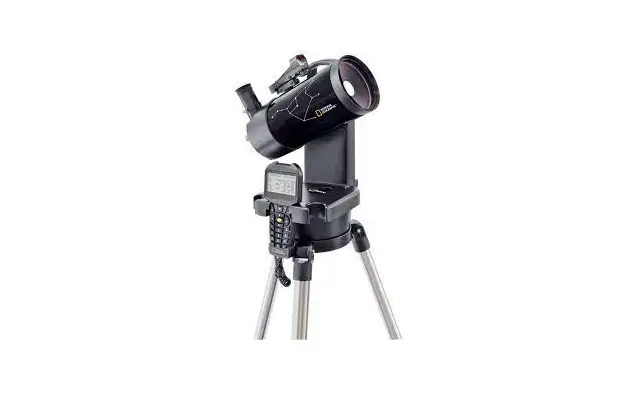
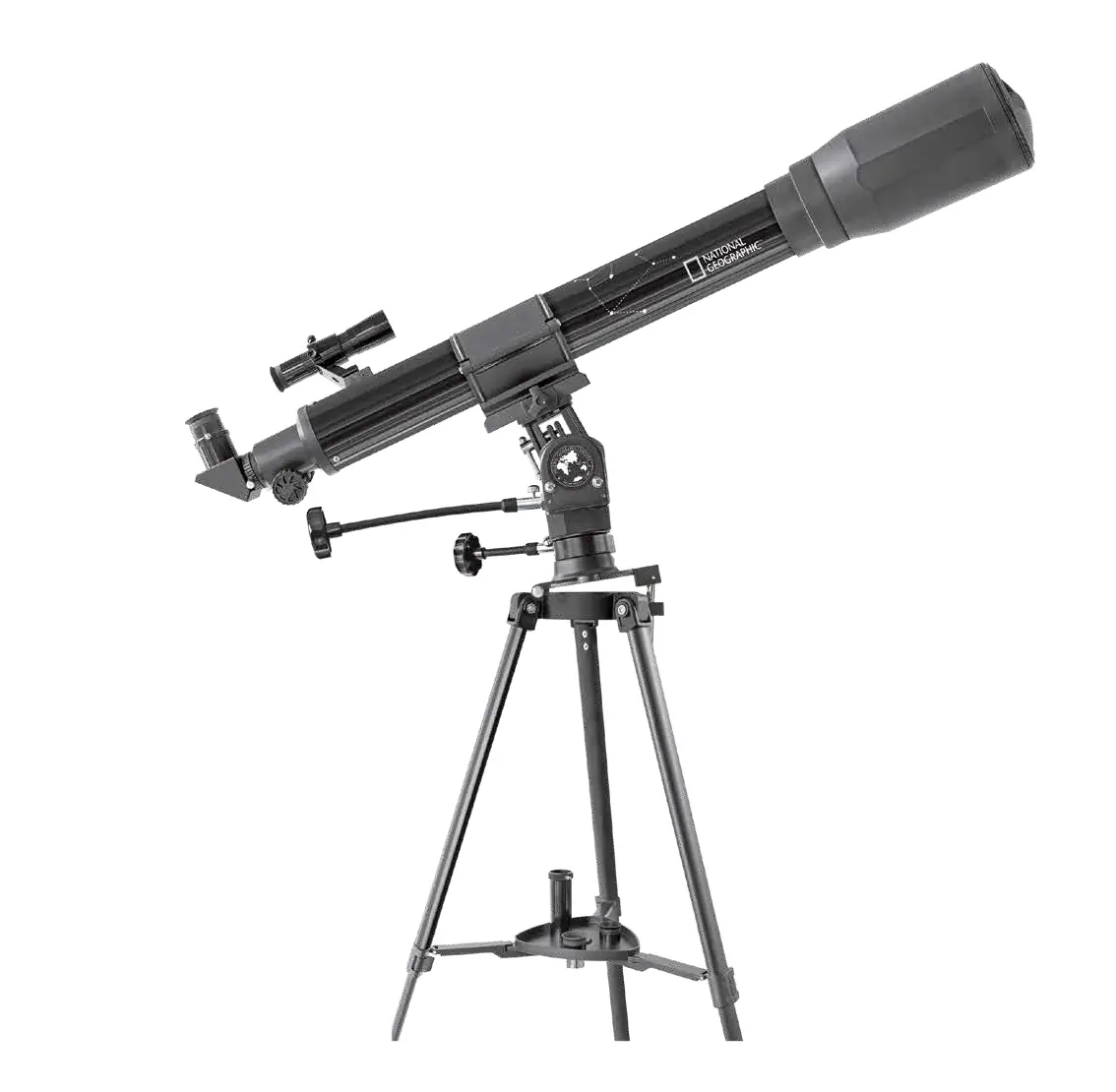
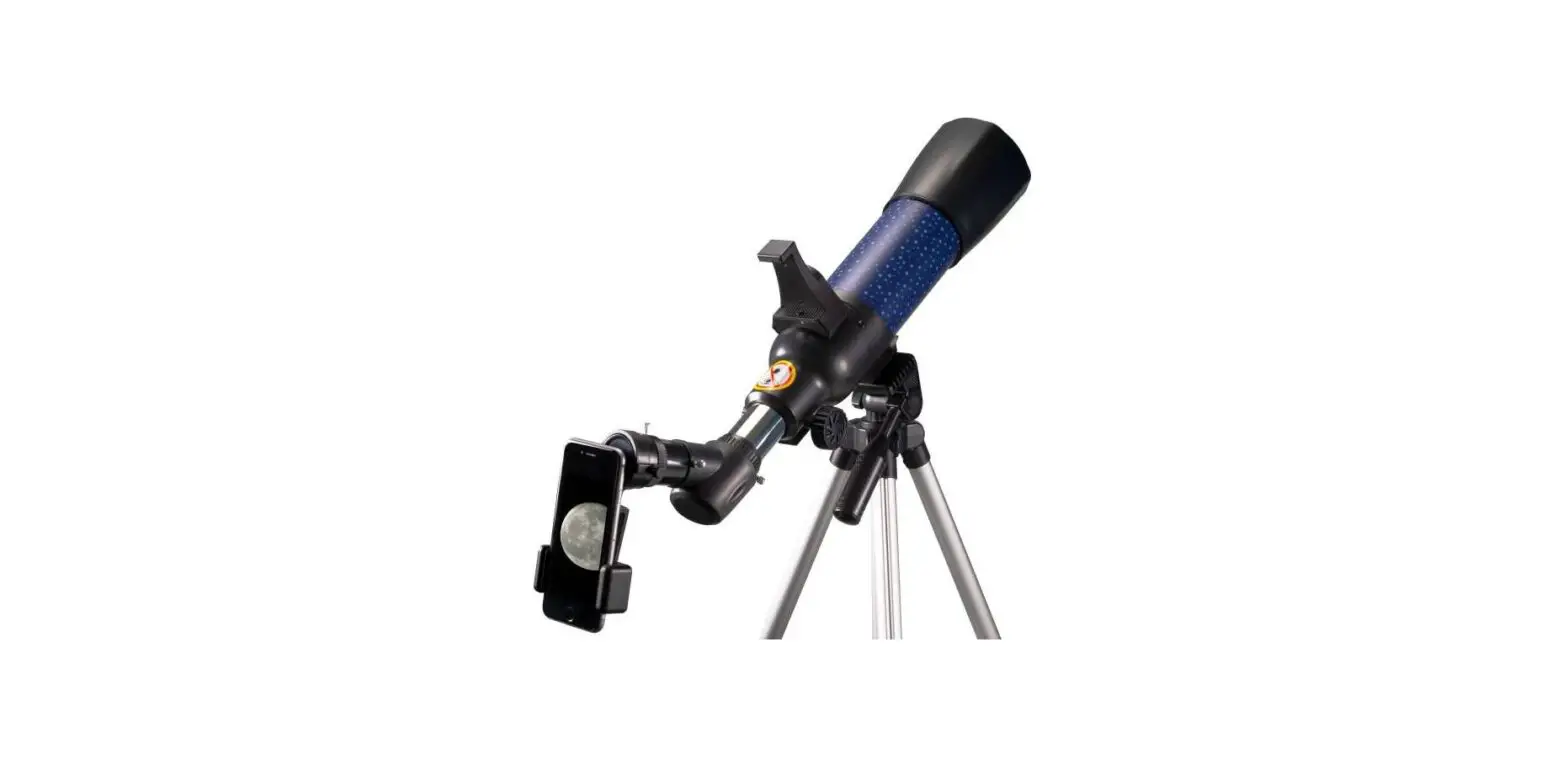
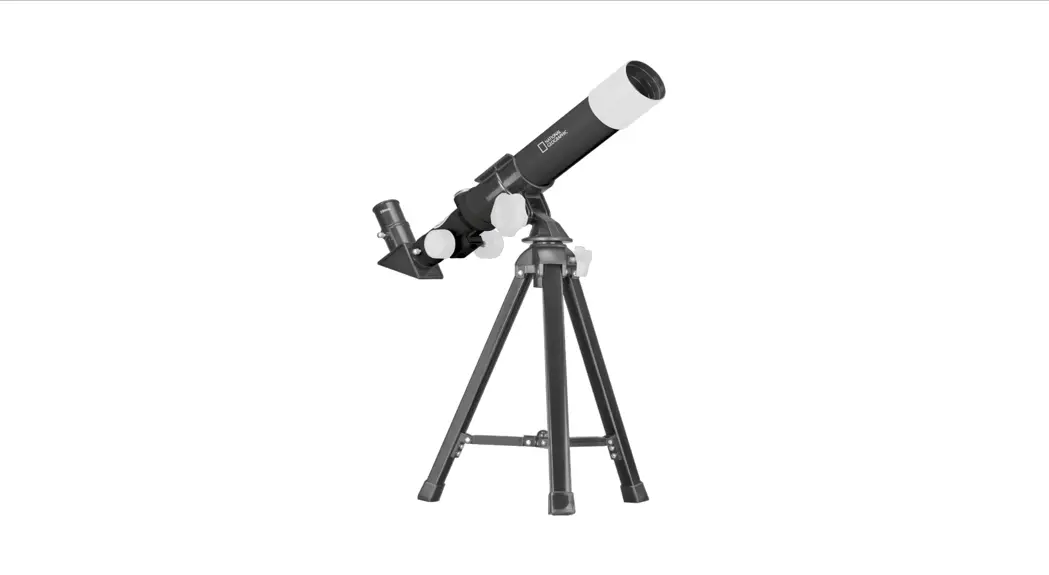
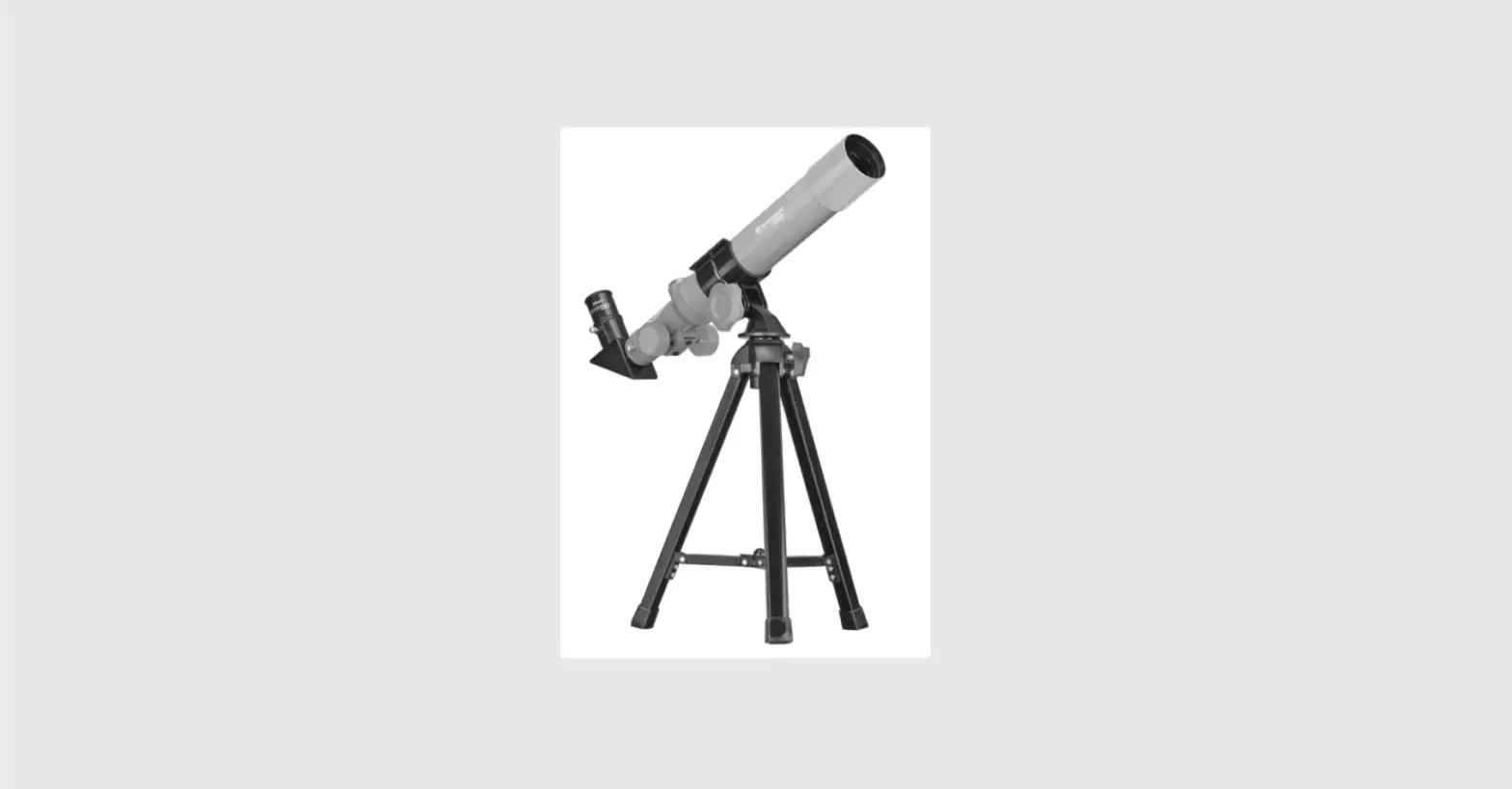
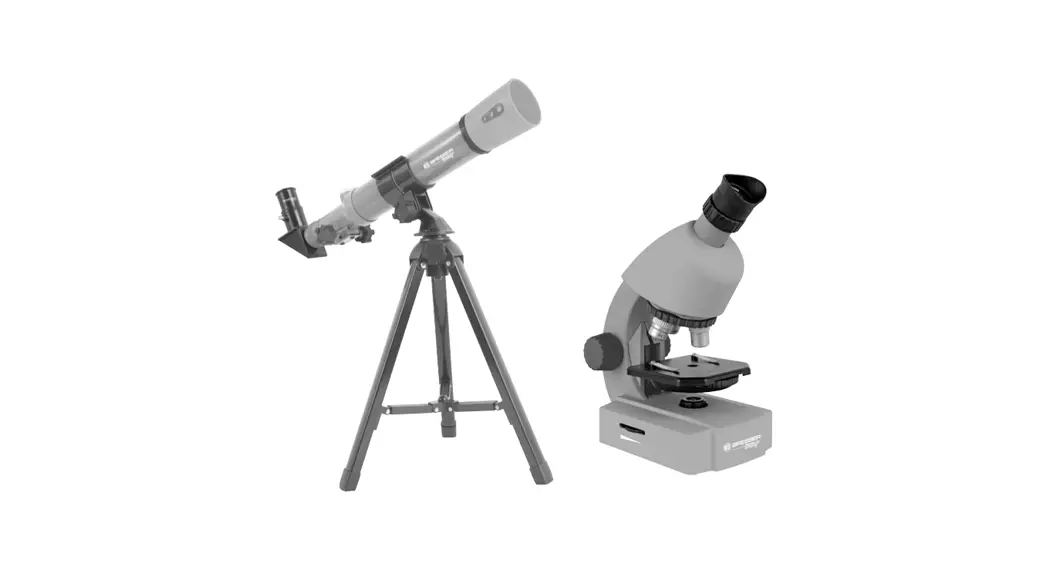
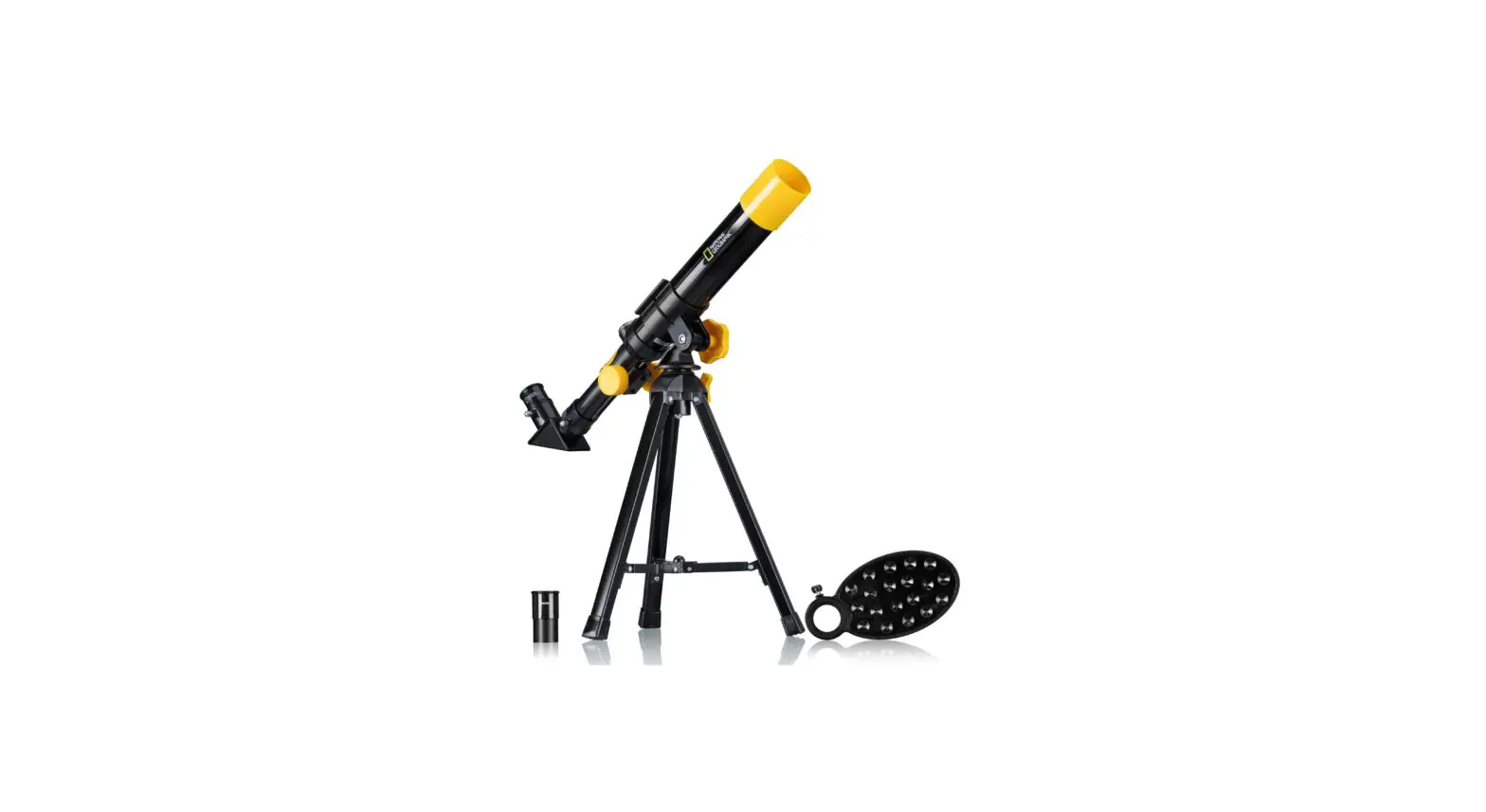
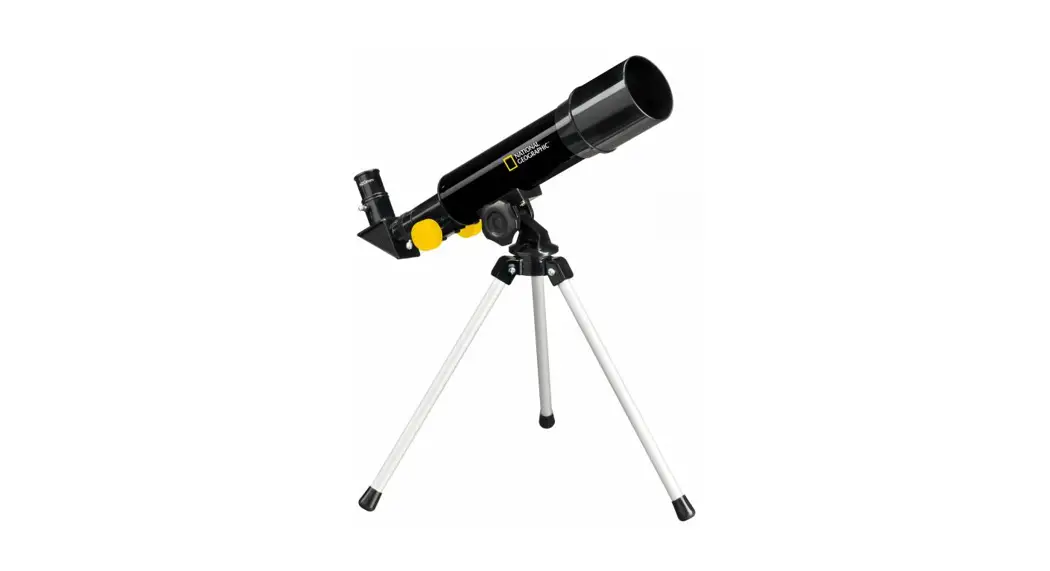
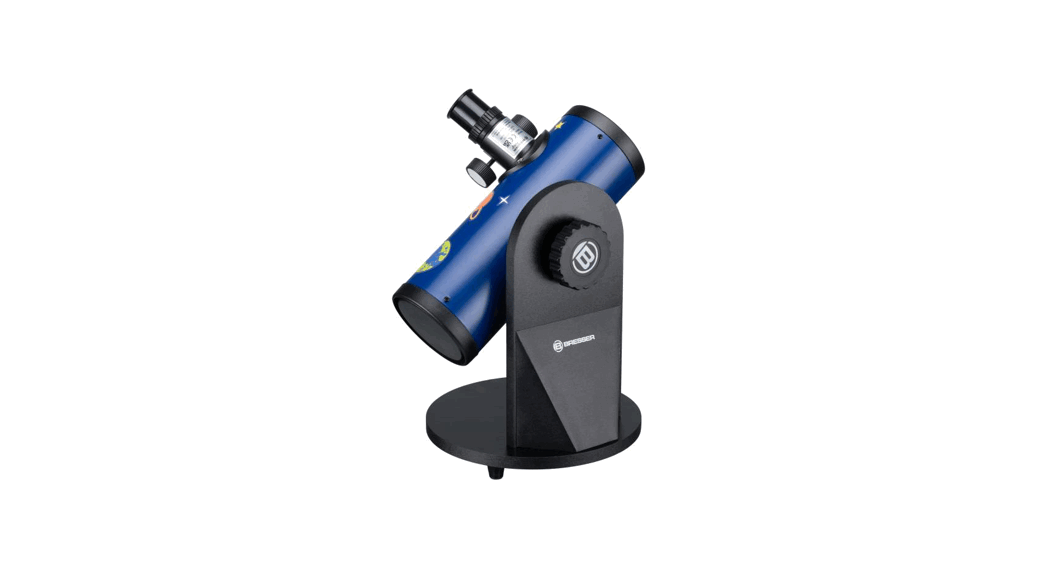
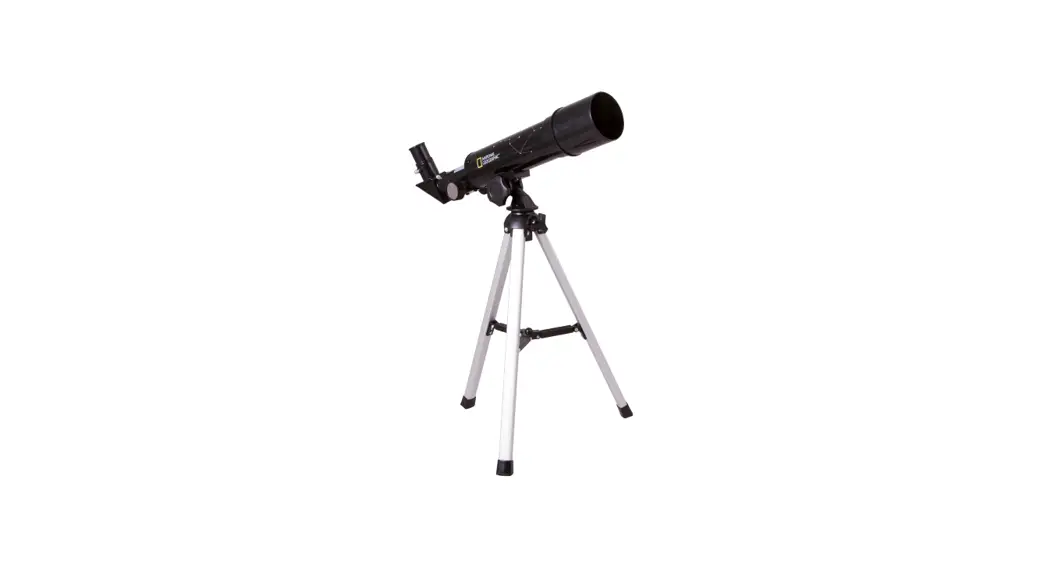
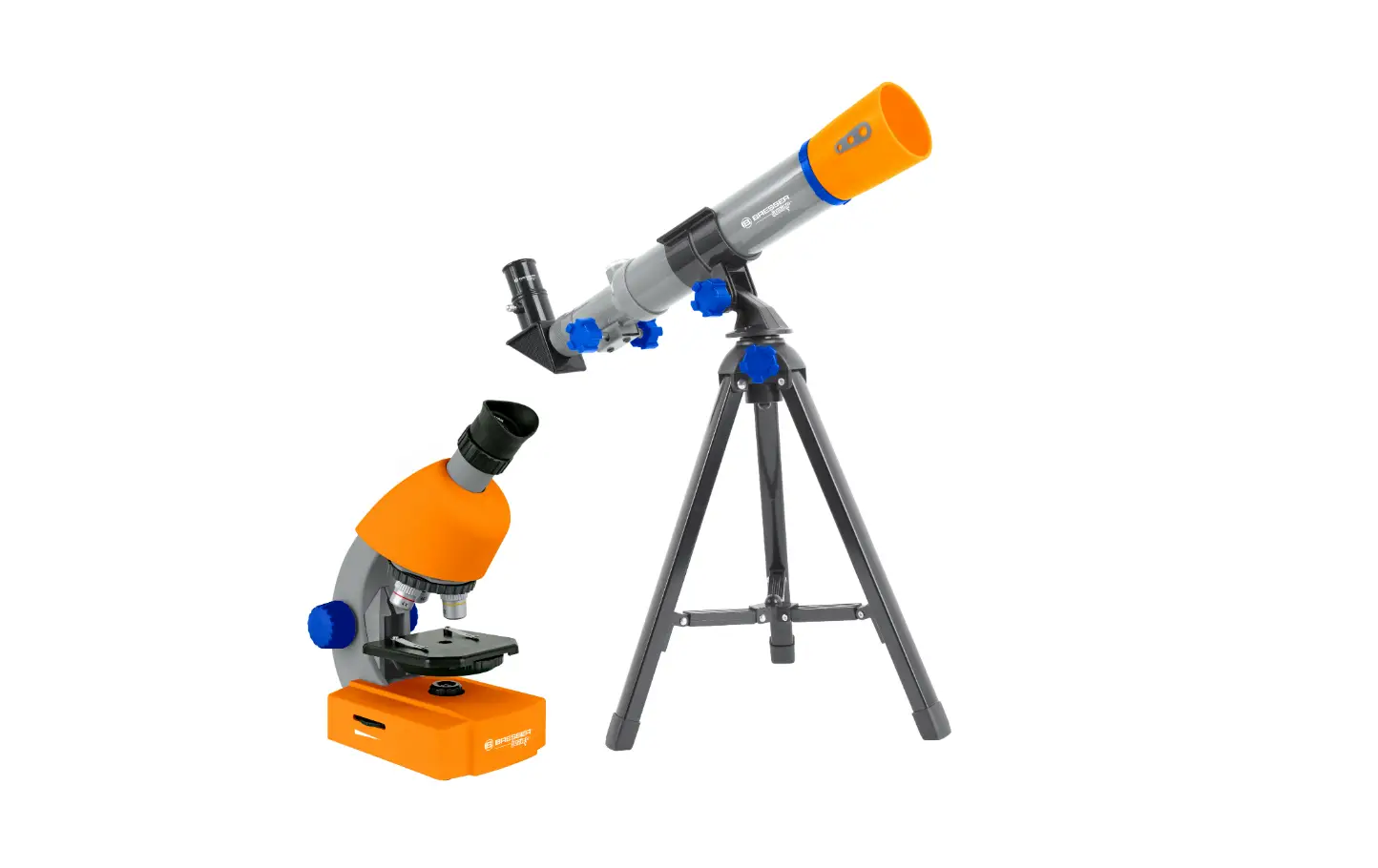
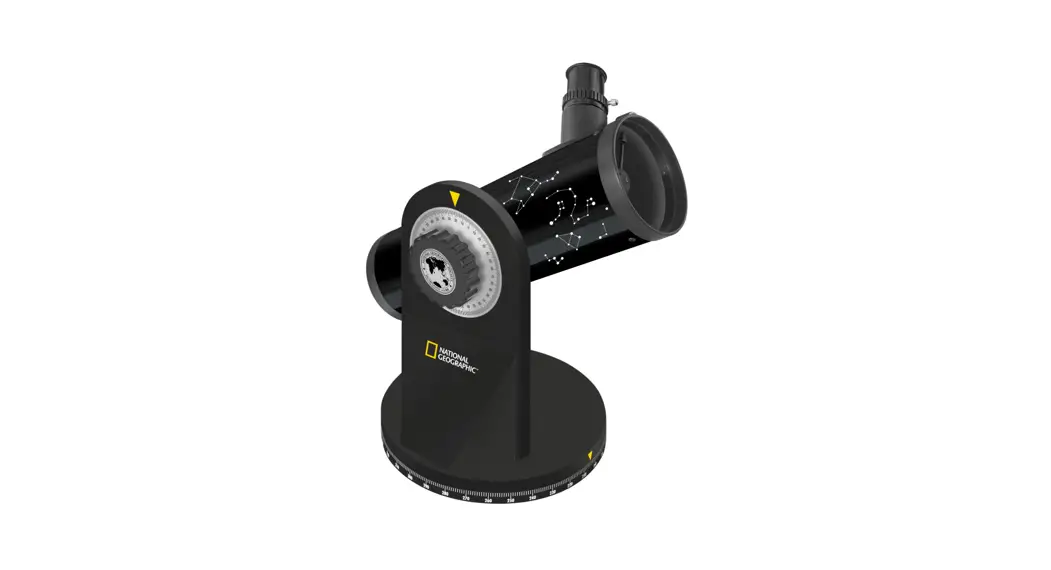
9118001 Telescope with Tabletop Tripod
Product Information: 50/360 TISCH-TELESKOP TABLE TELESCOPE
The 50/360 TISCH-TELESKOP TABLE TELESCOPE comes with a warning
not to look directly at the sun or in its direct proximity as this
may result in blindness. The telescope has a focus wheel, zenith
mirror, eyepieces (6 mm, 20 mm), telescope tube, lens hood,
objective lens, and tripod legs. It also has a locating screw for
vertical fine adjustment and for the vertical axis. The telescope
has azimuthal mounting that allows for movement up and down, left
and right, without adjusting the tripod. The eyepiece with the
highest focal width should be used at the beginning of
observation.
Product Usage Instructions
- Choose a stable surface like a table to set up the
telescope. - Mount the telescope to the tripod using the locating screw for
the vertical fine adjustment (7) (Fig. 1). - Place the zenith mirror (2) into the eyepiece holder and secure
it with the small screw on the connector (Fig. 2). - Set the eyepiece (3) into the opening of the zenith mirror (2)
(Fig. 2). Screw the eyepiece onto the zenith mirror using the screw
provided. - Put the eyepiece with the largest focal width (e.g. 20 mm) onto
the zenith mirror. - Look through the eyepiece (3) of the telescope (4) and aim at a
visible object such as a church tower in the distance. - Use the focus wheel (1) to adjust and make the object clear and
sharp. - Use the locating screw for the vertical fine adjustment (7) and
the locating screw for the vertical axis (8) to locate and lock
onto the position of an object to focus on it. - Choose an eyepiece with the highest focal width at the
beginning of observation. - Gradually move to eyepieces with smaller focal widths as
desired. The focal width is indicated in millimeters and is written
on each eyepiece. - Remember that the larger the focal width of an eyepiece, the
smaller the magnification. You can calculate the magnification
using a simple formula.
50/360
TISCH-TELESKOP TABLE TELESCOPE
DE Bedienungsanleitung EN Operating instructions FR Mode d’emploi NL Handleiding IT Istruzioni per l’uso ES Instrucciones de uso RU PL Instrukcja obslugi
Art.No. 9118001
(DE) WARNUNG: Schauen Sie mit diesem Gerät niemals direkt in die Sonne oder in die
Nähe der Sonne. Es besteht ERBLINDUNGSGEFAHR!
(EN) WARNING: Never use this device to look directly at the sun or in the direct proximity of the sun. Doing so may result in a risk of blindness.
(FR) AVERTISSEMENT! Ne regardez jamais avec cet apparareil directement ou à proximité du soleil ! Veillez y particulièrement, lorsque l`appareil est utilisé par
des enfants ! Il existe un DANGER DE PERTE DE LA VUE !
(NL) WAARSCHUWING! Kijk met dit optische instrument nooit direct naar of in de buurt van
de zon! Let hier vooral op als het instrument door kinderen wordt gebruikt! Er bestaat VERBLINDINGSGEVAAR!
(IT) ATTENZIONE! Non guardare mai direttamente il sole o vicino al sole con questo apparecchio ottico! Prestare particolare attenzione quando l’apparecchio viene usato da bambini! Pericolo di ACCECAMENTO!
(ES) ADVERTENCIA! No utilice nunca este aparato óptico para mirar directamente al sol a las inmediaciones de éste. Tome asimismo precauciones especiales
si va a ser utilizado por niños, pues existe el PELIGRO DE QUE SE QUEDEN CIEGOS.
(RU) ! ! , . .
OSTRZEENIE: Przyrzdu nie wolno wykorzystywa do patrzenia w sposób bezporedni na sloce ani miejsca znajdujce si w jego bezporednim otoczeniu. Takie postpowanie moe prowadzi do utraty wzroku.
2
DE Bedienungsanleitung…………………………………….4 EN Operating instructions …………………………………..8 FR Mode d’emploi………………………………………….. 12 NL Handleiding …………………………………………….. 16 IT Istruzioni per l’uso …………………………………….. 20 ES Instrucciones de uso ………………………………….. 24 RU …………………….. 28 PL Instrukcja obslugi ……………………………………… 32
f
D
E
cb j
H
Fig. 1
D C
Fig. 2
hg
i
c
d
b
c
Fig. 3
3
Allgemeine Warnhinweise
· ERBLINDUNGSGEFAHR! Schauen Sie mit diesem Gerät niemals direkt in die Sonne oder in die Nähe der Sonne. Es besteht ERBLINDUNGSGEFAHR!
· ERSTICKUNGSGEFAHR! Kinder sollten das Gerät nur unter Aufsicht benutzen. Verpackungsmaterialien (Plastiktüten, Gummibänder, etc.) von Kindern fernhalten! Es besteht ERSTICKUNGSGEFAHR!
· BRANDGEFAHR! Setzen Sie das Gerät speziell die Linsen keiner direkten Sonneneinstrahlung aus! Durch die Lichtbündelung könnten Brände verursacht werden.
· Bauen Sie das Gerät nicht auseinander! Wenden Sie sich im Falle eines Defekts an Ihren Fachhändler. Er nimmt mit dem Service-Center Kontakt auf und kann das Gerät ggf. zwecks Reparatur einschicken.
· Setzen Sie das Gerät keinen hohen Temperaturen aus. · Das Gerät ist für den Privatgebrauch gedacht. Achten Sie die Privatsphäre Ihrer Mitmenschen schauen
Sie mit diesem Gerät zum Beispiel nicht in Wohnungen!
Teileübersicht
1. Scharfeinstellungsrad 2. Zenitspiegel 3. Okulare (6 mm, 20 mm) 4. Fernrohr (Teleskop-Tubus) 5. Sonnenblende 6. Objektivlinse
7. Fixierschraube für die Höhenfeineinstellung (Auf- und Abwärtsbewegung)
8. Fixierschraube für die Vertikalachse (Rechtsund Linksdrehung)
9. Stativbeine
Bevor du beginnst, wählst du einen geeigneten Standort für dein Teleskop aus. Nutze hierfür einen stabilen Untergrund, z.B. einen Tisch). Das Teleskop wird über die Fixierschraube für die Höhenfeineinstellung (7) am Stativ befestigt (Fig. 1). Nun kannst du den Zenitspiegel (2) in die Okularhalterung einsetzen und ihn mit der kleinen Schraube am Stutzen befestigen (Fig. 2). Das Okular (3) setzt du als nächstes in die Öffnung des Zenitspiegels (2) ein (Fig. 2). Auch hier befindet sich eine Schraube, mit der du das Okular im Zenitspiegel festschrauben kannst.
Hinweis: Setze zuerst das Okular mit der größten Brennweite (z.B. 20 mm) in den Zenitspiegel ein. Die Vergrößerung ist dann zwar am geringsten, aber es wird dir leichter fallen, etwas zu beobachten.
Azimutale Montierung
Azimutale Montierung bedeutet nichts anderes, als dass du dein Teleskop auf- und abwärts und nach links und rechts bewegen kannst, ohne das Stativ zu verstellen. Mit Hilfe der Fixierschraube für die Höhenfeineinstellung (7) und der Fixierschraube für die Vertikalachse (8) kannst du dein Teleskop feststellen, um ein Objekt zu fixieren (d. h. fest anzublicken).
Welches ist das richtige Okular?
Wichtig ist zunächst, dass du für den Beginn deiner Beobachtungen immer ein Okular mit der höchsten Brennweite wählst. Du kannst dann nach und nach andere Okulare mit geringerer Brennweite wählen. Die Brennweite wird in Millimeter angegeben und steht auf dem jeweiligen Okular. Generell gilt: Je größer die Brennweite des Okulars, desto niedriger ist die Vergrößerung! Für die Berechnung der Vergrößerung gibt es eine einfache Rechenformel:
Brennweite des Fernrohrs : Brennweite des Okulars = Vergrößerung
4
DE
Die Vergrößerung ist auch von der Brennweite des Fernrohrs abhängig. Dieses Teleskop beinhaltet ein Fernrohr mit 360 mm Brennweite.
Beispiele: 360 mm : 20 mm = 18-fache Vergrößerung 360 mm : 6 mm = 60-fache Vergrößerung
Scharfeinstellungsrad
Schaue durch das Okular (3) des Fernrohrs (4) und peile ein gut sichtbares Objekt (z.B. einen Kirchturm) in einiger Entfernung an. Stelle es mit dem Scharfeinstellungsrad (1) scharf, wie es in Fig. 3 gezeigt wird.
Technische Daten
· Bauart: Achromatisch · Brennweite: 360 mm · Objektiv-Durchmesser: 50 mm
Hinweise zur Reinigung
· Reinigen Sie die Linsen (Okulare und/oder Objektive) nur mit einem weichen und fusselfreien Tuch (z. B. Microfaser). Das Tuch nicht zu stark aufdrücken, um ein Verkratzen der Linsen zu vermeiden.
· Zur Entfernung stärkerer Schmutzreste befeuchten Sie das Putztuch mit einer Brillen-Reinigungsflüssigkeit und wischen damit die Linsen mit wenig Druck ab.
· Schützen Sie das Gerät vor Staub und Feuchtigkeit! Lassen Sie es nach der Benutzung speziell bei hoher Luftfeuchtigkeit bei Zimmertemperatur einige Zeit akklimatisieren, so dass die Restfeuchtigkeit abgebaut werden kann.
Mögliche Beobachtungsobjekte
Nachfolgend haben wir für dich einige sehr interessante Himmelsobjekte ausgesucht und erklärt.
Mond Der Mond ist der einzige natürliche Satellit der Erde. Durchmesser: 3.476 km / Entfernung von der Erde: 384.400 km
Der Mond ist nach der Sonne das zweithellste Objekt am Himmel. Da der Mond einmal im Monat um die Erde kreist, verändert sich ständig der Winkel zwischen der Erde, dem Mond und der Sonne; man sieht das an den Zyklen der Mondphasen. Die Zeit zwischen zwei aufeinander folgenden Neumondphasen beträgt etwa 29,5 Tage (709 Stunden).
Sternbild ORION / M42 Rektaszension: 05h 35m (Stunden : Minuten) / Deklination: -05° 25′ (Grad : Minuten) Entfernung von der Erde: 1.344 Lichtjahre
Mit einer Entfernung von etwa 1.344 Lichtjahren ist der Orion-Nebel (M42) der hellste diffuse Nebel am Himmel, der mit dem bloßen Auge sichtbar ist, und ist somit ein lohnendes Objekt für Teleskope aller Größen, vom kleinsten Feldstecher bis zu den größten erdgebundenen Observatorien und dem Hubble Space Telescope. Der Nebel besteht zum Hauptteil aus einer riesigen Wolke aus Wasserstoffgas und Staub, die sich mit über 10 Grad gut über die Hälfte des Sternbildes des Orions erstreckt. Die Ausdehnung dieser gewaltigen Wolke beträgt mehrere hundert Lichtjahre.
5
Sternbild LEIER / M57 Rektaszension: 18h 53m (Stunden : Minuten) / Deklination: +33° 02′ (Grad : Minuten) Entfernung von der Erde: 2.412 Lichtjahre
Der berühmte Ringnebel M57 im Sternbild Leier wird oft als der Prototyp eines planetarischen Nebels angesehen; er gehört zu den Prachtstücken des Sommerhimmels der Nordhalbkugel. Neuere Untersuchungen haben gezeigt, dass es sich aller Wahrscheinlichkeit nach um einen Ring (Torus) aus hell leuchtender Materie handelt, die den Zentralstern umgibt (nur mit größeren Teleskopen sichtbar), und nicht um eine kugel- oder ellipsoidförmige Gasstruktur. Würde man den Ringnebel von der Seitenebene betrachten, würde er dem Dumbbell Nebel M27 ähneln. Wir blicken bei diesem Objekt genau auf den Pol des Nebels.
Sternbild Füchslein / M27 Rektaszension: 19h 59m (Stunden : Minuten) / Deklination: +22° 43′ (Grad : Minuten) Entfernung von der Erde: 1.360 Lichtjahre
Der Dumbbellnebel M27 oder Hantel-Nebel im Füchslein war der erste planetarische Nebel, der überhaupt entdeckt wurde. Am 12. Juli 1764 entdeckte Charles Messier diese damals neue und faszinierende Art von Objekten. Wir sehen dieses Objekt fast genau von seiner Äquatorialebene. Würde man den Dumbbellnebel von einem der Pole sehen, würde er wahrscheinlich die Form eines Ringes aufweisen und dem Anblick ähneln, den wir von dem Ringnebel M57 kennen. Dieses Objekt kann man bereits bei halbwegs guten Wetterbedingungen und kleinen Vergrößerungen gut sehen.
Kleines Teleskop-ABC
Was bedeutet eigentlich …
Brennweite: Alle Dinge, die über eine Optik (Linse) ein Objekt vergrößern, haben eine bestimmte Brennweite. Darunter versteht man den Weg, den das Licht von der Linse bis zum Brennpunkt zurücklegt. Der Brennpunkt wird auch als Fokus bezeichnet. Im Fokus ist das Bild scharf. Bei einem Teleskop werden die Brennweiten des Fernrohrs und des Okulars kombiniert.
Linse: Die Linse lenkt das einfallende Licht so um, dass es nach einer bestimmten Strecke (Brennweite) im Brennpunkt ein scharfes Bild erzeugt.
Okular (3): Ein Okular ist ein deinem Auge zugewandtes System bestehend aus einer oder mehreren Linsen. Mit einem Okular wird das im Brennpunkt einer Linse entstehende scharfe Bild aufgenommen und nochmals vergrößert.
Für die Berechnung der Vergrößerung gibt es eine einfache Rechenformel: Brennweite des Fernrohrs / Brennweite des Okulars = Vergrößerung
Bei einem Teleskop ist die Vergrößerung sowohl von der Brennweite des Okulars als auch von der Brennweite des Fernrohrs abhängig.
Daraus ergibt sich anhand der Rechenformel folgende Vergrößerung, wenn du ein Okular mit 20 mm und ein Fernrohr mit 360 mm Brennweite verwendest: 360 mm : 20 mm = 18-fache Vergrößerung
6
DE
Vergrößerung: Die Vergrößerung entspricht dem Unterschied zwischen der Betrachtung mit bloßem Auge und der Betrachtung durch ein Vergrößerungsgerät (z.B. Teleskop). Dabei ist die Betrachtung mit dem Auge einfach. Wenn nun ein Teleskop eine 18-fache Vergrößerung hat, so kannst du ein Objekt durch das Teleskop 18 Mal größer sehen als mit deinem Auge. Siehe auch ,,Okular”. Zenitspiegel (2): Ein Spiegel, der den Lichtstrahl im rechten Winkel umleitet. Bei einem geraden Fernrohr kann man so die Beobachtungsposition korrigieren und bequem von oben in das Okular schauen. Das Bild erscheint durch einen Zenitspiegel zwar aufrecht stehend, aber seitenverkehrt.
EG-Konformitätserklärung
Eine ,,Konformitätserklärung” in Übereinstimmung mit den anwendbaren Richtlinien und entsprechenden Normen ist von der Bresser GmbH erstellt worden. Der vollständige Text der EG-Konformitätserklärung ist unter der folgenden Internetadresse verfügbar: www.bresser.de/download/9118001/CE/9118001_CE.pdf
Entsorgung
Entsorgen Sie die Verpackungsmaterialien sortenrein. Beachten Sie bitte bei der Entsorgung des Geräts die aktuellen gesetzlichen Bestimmungen. Informationen zur fachgerechten Entsorgung erhalten Sie bei den kommunalen Entsorgungsdienstleistern oder dem Umweltamt. Beachten Sie bitte bei der Entsorgung des Geräts die aktuellen gesetzlichen Bestimmungen. Informationen zur fachgerechten Entsorgung erhalten Sie bei den kommunalen Entsorgungsdienstleistern oder dem Umweltamt.
Garantie
Die reguläre Garantiezeit beträgt 2 Jahre und beginnt am Tag des Kaufs. Um von einer verlängerten, freiwilligen Garantiezeit wie auf dem Geschenkkarton angegeben zu profitieren, ist eine Registrierung auf unserer Website erforderlich. Die vollständigen Garantiebedingungen sowie Informationen zu Garantiezeitverlängerung und Serviceleistungen können Sie unter www.bresser.de/garantiebedingungen einsehen.
7
General Warnings
· Risk of blindness — Never use this device to look directly at the sun or in the direct proximity of the sun. Doing so may result in a risk of blindness.
· Choking hazard — Children should only use the device under adult supervision. Keep packaging material, like plastic bags and rubber bands, out of the reach of children, as these materials pose a choking hazard.
· Risk of fire — Do not place the device, particularly the lenses, in direct sunlight. The concentration of light could cause a fire.
· Do not disassemble the device. In the event of a defect, please contact your dealer. The dealer will contact the Service Centre and can send the device in to be repaired, if necessary.
· Do not expose the device to high temperatures. · The device is intended only for private use. Please heed the privacy of other people. Do not use this
device to look into apartments, for example.
Parts overview
1. Focus wheel 2. Zenith mirror 3. Eyepieces (6 mm, 20 mm) 4. Telescope (Telescope tube) 5. Lens hood 6. Objective lens
7. Locating screw for the vertical fine adjustment (for moving upward and downward)
8. Locating screw for the vertical axis (for turning to the right and left)
9. Tripod legs
You should take some time to decide where you would like to set up your telescope. Choose a stable sur-
face like a table. Mount the telescope to the tripod with the locating screw for the vertical fine adjustment (7) (Fig. 1). You can now place the zenith mirror (2) into the eyepiece holder and secure it with the small screw on the connector (Fig. 2). Next, set the eyepiece (3) into the opening of the zenith mirror (2) (Fig. 2). Here too, there is a screw with which you can screw the eyepiece onto the zenith mirror.
Note: First, put the eyepiece with the largest focal width (e.g. 20 mm) onto the zenith mirror. While you’ll get the least amount of magnification, it will be easier for you to view things.
Azimuthal mounting
Azimuthal mounting means that you can move your telescope up and down, left and right, without having to adjust the tripod.
Use the locating screw for the vertical fine adjustment (7) and the locating screw for the vertical axis (8) to locate and lock onto the position of an object (to focus an object).
Which eyepiece is right?
It is important that you always choose an eyepiece with the highest focal width at the beginning of your observation. Afterward, you can gradually move to eyepieces with smaller focal widths. The focal width is indicated in millimetres and is written on each eyepiece. In general, the following is true: the larger the focal width of an eyepiece, the smaller the magnification. There is a simple formula for calculating the magnification:
Focal width of the telescope tube : Focal width of the eyepiece = Magnification
8
EN
The magnification also depends on the focal width of the telescope tube. This telescope contains a tube with a focal width of 360 mm.
Examples: 360 mm / 20 mm = 18X magnification 360 mm / 6 mm = 60X magnification
Focus wheel
Look through the telescope eyepiece (3) and hone in on a far away object that you can see well (for instance, a church tower). Focus in on the object with the focus knob (1) in the way shown in Fig. 3.
Technical data: · Design: achromatic · Focal width: 360 mm · Objective diameter: 50 mm
Notes on cleaning
· Clean the eyepieces and lenses only with a soft, lint-free cloth, like a microfibre cloth. To avoid scratching the lenses, use only gentle pressure with the cleaning cloth.
· To remove more stubborn dirt, moisten the cleaning cloth with an eyeglass-cleaning solution, and wipe the lenses gently.
· Protect the device from dust and moisture. After use, particularly in high humidity, let the device acclimatise for a short period of time, so that the residual moisture can dissipate before storing.
Possible observation targets
The following section details several interesting and easy-to-find celestial objects you may want to observe through your telescope.
The Moon The moon is Earth’s only natural satellite. Diameter: 3,476 km / Distance: 384,400 km from Earth (average)
The moon has been known to humans since prehistoric times. It is the second brightest object in the sky, after the sun. Because the moon circles the Earth once per month, the angle between the Earth, the moon and the sun is constantly changing; one sees this change in the phases of the moon. The time between two consecutive new moon phases is about 29.5 days (709 hours).
Constellation Orion: The Orion Nebula (M 42) Right Ascension: 05h 35m (hours : minutes) / Declination: -05° 22′ (Degrees : minutes) Distance: 1,344 light years from Earth
Though it is more than 1,344 light years from Earth, the Orion Nebula (M 42) is the brightest diffuse nebula in the sky. It is visible even with the naked eye and a worthwhile object for telescopes of all types and sizes. The nebula consists of a gigantic cloud of hydrogen gas with a diameter of hundreds of light years.
Constellation Lyra: The Ring Nebula (M 57) Right Ascension: 18h 53m (hours : minutes) / Declination: +33° 02′ (Degrees : minutes) Distance: 2,412 light years from Earth
9
The famous Ring Nebula (M57) in the Lyra constellation is often viewed as the prototype of a planetary nebula. It is one of the magnificent features of the Northern Hemisphere’s summer sky. Recent studies have shown that it is probably comprised of a ring (torus) of brightly shining material that surrounds the central star (only visible with larger telescopes), and not a gas structure in the form of a sphere or an ellipse. If you were to look at the Ring Nebula from the side, it would look like the Dumbbell Nebula (M 27). When viewed from Earth, we are looking directly at the pole of the nebula.
Constellation Vulpecula (Little Fox): The Dumbbell Nebula (M 27) Right Ascension: 19h 59m (hours : minutes) / Declination: +22° 43′ (Degrees : minutes) Distance: 1,360 light years from Earth
The Dumbbell Nebula (M 27) was the first planetary nebula ever discovered. On 12 July 1764, Charles Messier discovered this new and fascinating class of objects. We see this object almost directly from its equatorial plane. If we could see the Dumbbell Nebula from one of its poles, we would probably see the shape of a ring, something very similar to what we know as the Ring Nebula (M 57). In reasonably good weather, we can see this object well, even with low magnification.
Telescope ABC’s
What do the following terms mean?
Eyepiece (3): An eyepiece is a system made for your eye and comprised of one or more lenses. An eyepiece captures and magnifies the clear image that is generated in the focal point of a lens even more.
There is a simple formula for calculating the magnification: Focal width of the telescope tube / Focal width of the eyepiece = Magnification
In a telescope, the magnification depends on both the focal width of the telescope tube and the focal width of the eyepiece. From this formula, we see that if you use an eyepiece with a focal width of 20 mm and a telescope tube with a focal width of 360 mm, you will get the following magnification: 360 mm / 20 mm = 18 times magnification
Focal width: Everything that magnifies an object via an optic (lens) has a certain focal width. The focal width is the length of the path the light travels from the surface of the lens to its focal point. The focal point is also referred to as the focus. In focus, the image is clear. In the case of a telescope, the focal widths of the telescope tube and the eyepieces are combined.
Lens: The lens turns the light which falls on it around so that the light gives a clear image in the focal point after it has traveled a certain distance (focal width).
Magnification: The magnification corresponds to the difference between observation with the naked eye and observation through a magnification apparatus (e.g. a telescope). Observation with the eye is considered ‘single’, or 1X magnification. Accordingly, if a telescope has a magnification of 18X, then an object viewed through the telescope will appear 18 times larger than it would with the naked eye. See also ‘Eyepiece’.
10
EN
Zenith mirror (2): A mirror that deflects rays of light at a 90 degree angle. With a horizontal telescope tube, this device deflects the light upwards so that you can comfortably observe by looking downward into the eyepiece. The image in a zenith mirror appears upright, but rotated around its vertical axis (what is left appears right and vice versa).
EC Declaration of Conformity
Bresser GmbH has issued a “Declaration of Conformity” in accordance with applicable guidelines and corresponding standards. The full text of the EU declaration of conformity is available at the following internet address: www.bresser.de/download/9118001/CE/9118001_CE.pdf UKCA Declaration of Conformity Bresser GmbH has issued a ,,Declaration of Conformity” in accordance with applicable guidelines and corresponding standards. The full text of the UKCA declaration of conformity is available at the following internet address: www.bresser.de/download/9118001/UKCA/9118001_UKCA.pdf Bresser UK Ltd. · Suite 3G, Eden House, Enterprise Way, Edenbridge, Kent TN8 6HF, Great Britain
DISPOSAL
Dispose of the packaging materials properly, according to their type, such as paper or cardboard. Contact your local waste-disposal service or environmental authority for information on the proper disposal. Please take the current legal regulations into account when disposing of your device. You can get more information on the proper disposal from your local waste-disposal service or environmental authority.
Warranty
The regular warranty period is 2 years and begins on the day of purchase. To benefit from an extended voluntary guarantee period as stated on the gift box, registration on our website is required. You can consult the full warranty terms as well as information on extending the warranty period and details of our services at www.bresser.de/warranty_terms.
11
Consignes générales de sécurité
· RISQUE DE CECITE ! Ne jamais regarder directement le soleil à travers cet appareil en le pointant directement en sa direction. L’observateur court un RISQUE DE CECITE !
· RISQUE D’ETOUFFEMENT ! Les enfants ne doivent utiliser cet appareil que sous surveillance. Maintenez les enfants éloignés des matériaux d’emballage (sacs plastiques, bandes en caoutchouc, etc.) ! RISQUE D’ETOUFFEMENT !
· RISQUE D’INCENDIE ! Ne jamais orienter l’appareil en particuliers les lentilles de manière à capter directement les rayons du soleil ! La focalisation de la lumière peut déclencher des incendies.
· Ne pas démonter l’appareil ! En cas de défaut, veuillez vous adresser à votre revendeur spécialisé. Celui-ci prendra contact avec le service client pour, éventuellement, envoyer l’appareil en réparation.
· Ne pas exposer l’appareil à des températures trop élevées. · Les unité sont destinées à un usage privé. Respectez la sphère privée de vos concitoyens et n’utilisez pas
ces unité pour, par exemple, observer ce qui se passe dans un appartement !
Vue d’ensemble des pièces
1. Commande de mise au point 2. Miroir zénith 3. Oculaires (6 mm, 20 mm) 4. Lunette (Tubetélescope) 5. Pare-soleil 6. Lentilles de l’objectif
7. Vis de fi xation pour le réglage de haute précision (mouvement en amont et en aval)
8. Vis de fi xation pour l’axe vertical (rotation à droite et à gauche)
9. Trépied
Avant de commencer, tu dois chercher un endroit adapté pour ton télescope. Choisis pour cela une surface stable (une table, par exemple). Le télescope est fixé au trépied à l’aide de la vis de fixation pour la mise au point de la hauteur (7) (Fig. 1). Maintenant tu peux installer le miroir zénith (2) dans le support de l’oculaire et le fixer sur les supports avec la petite vis (Fig. 2). Installe ensuite l’oculaire (3) dans l’ouverture du miroir zénith (2) (Fig. 2). Ici il y a également une vis avec laquelle tu peux fixer l’oculaire sur le miroir zénith.
Indication : Installe d’abord l’oculaire avec la distance focale la plus élevée (par ex. 20 mm) dans le miroir zénith. Le grossissement sera par la suite plus petit, certes, mais il sera plus facile pour toi d’observer un objet.
Montage azimutal
Le montage azimutal signifie simplement que tu peux déplacer ton télescope vers la gauche et vers la droite, vers le haut et vers le bas sans être obligé de bouger le trépied. À l’aide de la vis de fixation pour la mise au point de la hauteur (7) et de la vis de fixation pour la mise au point de l’axe vertical (8) tu peux fixer ton télescope afin de pouvoir observer un objet.
Quel est le bon oculaire ?
Tout d’abord, il est important que tu choisisses un oculaire avec la distance focale la plus élevée pour commencer tes observations. Tu peux ensuite choisir d’autres oculaires avec une distance focale moins importante. La distance focale est donnée en millimètre et est indiquée sur l’oculaire en question. Informations générales : Plus la distance focale de l’oculaire est élevée, moins important est le grossissement ! Pour le calcul du grossissement, il existe une formule facile :
12
FR
Distance focale de la lunette : Distance focale de l’oculaire = grossissement Le grossissement dépend également de la distance focale de la lunette. Ce télescope comprend une lunette avec une distance focale de 360 mm.
Exemples: 360 mm / 20 mm = 18X grossissement
360 mm / 6 mm = 60X grossissement
Commande de mise au point
Regarde à travers l’oculaire (3) de la lunette (4) et vise un objet bien visible (par ex. un clocher) quelque soit
la distance. Mets le au point avec la roue de focalisation (1) comme indiqué dans Fig. 3.
Données techniques: Modèle: astronomique achromatique, Distance focale: 360 mm, Diamètre obj.: 50 mm
REMARQUE concernant le nettoyage
· Les lentilles (oculaires et/ou objectifs) ne doivent être nettoyé qu’avec un chiffon doux et ne peluchant pas (p. ex. microfibres). Le chiffon doit être passé sans trop le presser sur la surface, afin d’éviter de rayer les lentilles.
· Pour éliminer les traces plus coriaces, le chiffon peut être humidifié avec un produit liquide destiné au nettoyage de lunettes de vue avant d’essuyer la lentille avec le chiffon en exerçant une pression légère.
· Protégez l’appareil de la poussière et de l’humidité ! Après usage, et en particulier lorsque l’humidité de l’air est importante, il convient de laisser l’appareil reposer quelques minutes à température ambiante, de manière à ce que l’humidité restante puisse se dissiper.
Objets à observer possibles
Ci-après nous avons sélectionné et expliqué pour vous quelques corps célestes et amas stellaire très intéressants.
Lune La lune est le seul satellite naturel de la terre. Diamètre: 3476 Km / Distance: 384 400 Km de la terre.
La lune est connue depuis des temps préhistoriques. Elle est, après le soleil, le deuxième objet le plus brillant dans le ciel. Comme la lune fait le tour de la terre une fois par mois l`angle entre la terre, la lune et le soleil se modifie en permanence; on s`en aperçoit dans les cycles des quartiers de lune. La période entre deux phases lunaires successives de la Nouvelle Lune est de 29,5 jours env. (709 heures).
Constellation ORION / M42 L’ascension droite: 05h 35m (heures : minutes) / Déclinaison: -05° 22′ (degré : minutes) Distance : 1344 années lumière de la terre.
Avec une distance de 1344 années lumière env.la nébuleuse Orion (M42) est la nébuleuse diffuse la plus brillante dans le ciel – visible à l`oeil nu, et un objet valable pour des télescopes de toutes les tailles, des jumelles les plus petites jusqu’aux observatoires terrestres les plus grands et le Hubble Space Telescope.
Il s’agit de la partie principale d`un nuage nettement plus grand composé d`hydrogène et de poussière qui s`étend de 10 degrés au-delà de la moitié de la constellation de l`Orion. L`étendu de ce nuage immense est de plusieurs centaines d`années lumière.
13
Constellation LEIER / M57 L’ascension droite: 18h 53m (heures : minutes) / Déclinaison: +33° 02′ (degré : minutes) Distance : 2412 années lumière de la terre. La nébuleuse annulaire très connue M57 dans la constellation Leier est considérée souvent comme le prototype d`une nébuleuse planétaire. Elle fait partie des plus beaux objets du ciel d`été de l`hémisphère nord. Des examens plus récents ont montré qu`il s`agit, de toute vraisemblance, d`un anneau (Torus) de matière très rayonnante qui entoure l`étoile centrale (visible uniquement avec des télescopes plus grands), et non d`une structure gazeuse sphérique ou ellipsoïdale. Si l`on regardait la nébuleuse annulaire de profil elle ressemblerait à la nébuleuse M27 Dumbell. Avec cet objet nous voyons précisément le pôle de la nébuleuse.
Constellation Füchslein / M27 L’ascension droite: 19h 59m (heures : minutes) / Déclinaison: +22° 43′ (degré : minutes) Distance : 1360 années lumière de la terre. La nébuleuse M27 Dumbbell ou Hantelbebel dans le Füchslein était la première nébuleuse planétaire jamais découverte. Le 12. juillet 1764 Charles Messier a découvert cette nouvelle et fascinante classe d`objets. Nous voyons cet objet presque entièrement au niveau son équateur. Si l`on voyait la nébuleuse Dumbell de l`un des pôles il présenterait probablement la forme d`un anneau et ressemblerait à ce que nous connaissons de la nébuleuse annulaire M57. On peut déjà bien apercevoir cet objet avec des grossissements peu élevés lors de conditions météorologiques à peu près bonnes.
Petit abécédaire du télescope
Que signifie …
Distance focale: Toutes les choses, qui grossissent un objet sur une optique (lentille) ont une distance focale définie. Cela permet de comprendre le chemin que la lumière de la lentille emprunte jusqu’au centre. Le centre est également appelé foyer. Dans le foyer, l’image est nette. Dans un télescope, les distances focales de la lunette et de l’oculaire sont combinées.
Grossissement: Le grossissement correspond à la différence entre l’observation à l’oeil nu et l’observation à travers un appareil de grossissement (par ex. téléscope). Ainsi il est facile de contempler avec l’oeil. Si un télescope a désormais un grossissement 30 fois, tu peux voir un objet avec un grossissement 30 fois plus élevé qu’avec ton oeil. Voir également « oculaire ».
Lentille: La lentille change la direction de la lumière incidente de sorte qu’elle engendre une image nette après une certaine distance (distance focale) dans le centre.
Miroir zénith (2): Un miroir qui dévie le rayon de lumière dans l’angle à droite. Avec une lunette juste, on peut ainsi corriger la position d’observation et regarder tranquillement dans l’oculaire par au dessus. L’image à travers un miroir zénith apparaît certes à la verticale, mais inversée latéralement.
Oculaire (3): Un oculaire est un système orienté vers ton oeil composé d’une ou de plusieurs lentilles. Avec un oculaire, l’image nette du centre d’une lentille est enregistrée et à nouveau grossie.
14
FR
Pour le calcul du grossissement, il existe une formule facile: Distance focale de la lunette / Centre de l’oculaire = grossissement Dans un télescope, le grossissement dépend autant de la distance focale de l’oculaire que de la distance focale de la lunette. Puis, l’on obtient le grossissement suivant, à l’aide de la formule de calcul, si tu utilises un oculaire avec une distance focale de 20 mm et une lunette avec une distance focale de 360 mm. 360 mm : 20 mm = Grossissement 18fois
Déclaration de conformité CE
Bresser GmbH a émis une « déclaration de conformité » conformément aux lignes directrices applicables et aux normes correspondantes. Le texte complet de la déclaration UE de conformité est disponible a l’adresse internet suivante: www.bresser.de/download/9118001/CE/9118001_CE.pdf
ELIMINATION
Eliminez l’emballage en triant les matériaux. Pour plus d’informations concernant les règles applicables en matière d’élimination de ce type des produits, veuillez vous adresser aux services communaux en charge de la gestion des déchets ou de l’environnement.
Lors de l’élimination de l’appareil, veuillez respecter les lois applicables en la matière. Pour plus d’informations concernant l’élimination des déchets dans le respect des lois et réglementations applicables, veuillez vous adresser aux services communaux en charge de la gestion des déchets.
Garantie et Service
La garantie normale dure 2 ans à compter du jour d’achat. Afin de pouvoir profiter d’une extension degarantie (prestation non obligatoire), tel que mentionné sur la carte-cadeau, vous êtes tenu de vousinscrire sur notre site Web. Vous pouvez consulter l’intégralité des conditions de garantie ainsi que les informations quant au prolongementde la durée de la garantie et des prestations de services sous le lien suivant : www.bresser.de/warranty_terms.
15
Algemene waarschuwingen
· VERBLINDINGSGEVAAR! Kijk met dit toestel nooit direct naar de zon of naar de omgeving van de zon. Er bestaat VERBLINDINGSGEVAAR!
· VERSTIKKINGSGEVAAR! Kinderen mogen dit toestel alleen onder toezicht gebruiken. Verpakkingsmaterialen (Plastic zakken, elastiekjes, etc.) uit de buurt van kinderen houden! Er bestaat VERSTIKKINGSGEVAAR!
· BRANDGEVAAR! Stel het toestel met name de lenzen niet aan direct zonlicht bloot! Door de lichtbundeling kan brand ontstaan.
· Neem het toestel niet uit elkaar! Neem bij defecten a.u.b. contact op met de verkoper. Deze zal contact opnemen met een servicecenter en kan het toestel indien nodig voor reparatie terugsturen.
· Stel het apparaat niet bloot aan hoge temperaturen. · Deze toestel is alleen bedoeld voor privé-gebruik. Houd altijd de privacy van uw medemens in gedachten
kijk met dit toestel bijvoorbeeld niet in de woningen van anderen!
Onderdelen lijst
1. Focus-aandrijving 2. Zenitspiegel 3. Oculairen (6 mm, 20 mm) 4. Verrekijker (tubus van de telescoop) 5. Zonneklep
6. Objectieflens
7. Fixeerschroef voor de hoogte-fi jnafstelling (op en neer)
8. Fixeerschroef voor de verticale as (rechts en links draaien)
9. Statiefbeen
Voordat je begint, moet je een goede locatie voor je telescoop kiezen. Gebruik hiervoor een stabiele on-
dergrond, b.v. een tafel. De telescoop wordt met de blokkeerschroef voor de hoogtefijninstelling (7) aan het statief bevestigd (Fig. 1). Plaats de zenitspiegel (2) in de oculairhouder en bevestig hem met de kleine schroef aan de buis (Fig. 2). Vervolgens schuif je het oculair (3) in de opening van de zenitspiegel (2) (Fig. 2). Ook hier bevindt zich een schroef, waarmee je het oculair in de zenitspiegel kunt vastschroeven.
Opmerking: Plaats om te beginnen het oculair met de grootste brandpuntsafstand (bijv. 20 mm) in de zenitspiegel. De vergroting is dan wel het kleinst, maar je kunt zo gemakkelijker op een voorwerp focusseren.
Azimutale montering
Azimutale montering betekent niets anders dan dat je je telescoop omhoog en omlaag, naar links en naar rechts kan bewegen zonder het statief opnieuw in te stellen.
Met de blokkeerschroef voor de hoogtefijninstelling (7) en de blokkeerschroef voor de verticale as (8) kan je de telescoop vastzetten om een object te fixeren (d.w.z. vast te observeren).
Welk oculair moet ik kiezen?
Op de eerste plaats moet je aan het begin van al je observaties altijd een oculair met de grootste brandpuntsafstand kiezen. Daarna kun je dan steeds een ander oculair met een kleinere brandpuntsafstand nemen. De brandpuntsafstand wordt in millimeter weergegeven en staat op het oculair vermeld. Over het algemeen geldt: Hoe groter de brandpuntsafstand van het oculair, des te kleiner is de vergroting! Om de vergroting te berekenen kun je een eenvoudige rekenformule gebruiken: Brandpuntsafstand van de verrekijker : brandpuntsafstand van het oculair = de vergrotingsfactor
16
NL
Dat de vergroting ook afhangt van de brandpuntsafstand van de verrekijker. Deze telescoop heeft een brandpuntsafstand van 360 mm.
Voorbeelden: 360 mm / 20 mm = 18X vergroting 360 mm / 6 mm = 60X vergroting
Focus-aandrijving
Kijk door het oculair (3) van de telescoop (4) en richt hem op een goed zichtbaar object (bijv. een kerktoren) op enige afstand. Stel het beeld scherp met de scherpteregeling (1) zoals in Fig. 3 getoond.
Technische gegevens: · Constructie: achromatisch · Brandpuntsafstand: 360 mm · Objectief diameter: 50 mm
TIPS voor reiniging
· Reinig de lenzen (oculair en/of objectief) alleen met een zachte en pluisvrije doek (b. v. microvezel). Druk niet te hard op de doek om het bekrassen van de lens te voorkomen.
· Om sterke bevuiling te verwijderen kunt u de poetsdoek met een brillenreinigingsvloeistof bevochtigen en daarmee de lens poetsen zonder veel kracht te zetten.
· Bescherm het toestel tegen stof en vocht! Laat het toestel na gebruik zeker bij hoge luchtvochtigheid enige tijd op kamertemperatuur acclimatiseren zodat alle restvocht geëlimineerd wordt.
Suggesties voor te observeren hemellichamen
In het volgende hebben we voor u een paar bijzonder interessante hemellichamen en sterrenhopen uitgezocht en van uitleg voorzien.
Maan De maan is de enige natuurlijke satelliet van de aarde. Diameter: 3.476 km / Afstand: 384.400 km van de aarde verwijderd
De maan is sinds prehistorische tijden bekend. Na de zon is zij het meest heldere lichaam aan de hemel. Omdat de maan in een maand om de aarde draait, verandert de hoek tussen de aarde, de maan en de zon voortdurend; dat is aan de cycli van de maanfasen te zien. De tijd tussen twee op elkaar volgende nieuwemaanfasen bedraagt ongeveer 29,5 dag (709 uur).
Sterrenbeeld ORION / M42 Rechte klimming: 05h 35m (Uren : Minuten) / Declinatie: -05° 22′ (Graden : Minuten) Afstand: 1.344 lichtjaar van de aarde verwijderd
Met een afstand van circa 1.344 lichtjaar is de Orionnevel (M42) de meest heldere diffuse nevel aan de hemel – met het blote oog zichtbaar, en een bijzonder lonend object om met telescopen in alle uitvoeringen te bekijken, van de kleinste verrekijker tot de grootste aardse observatoria en de Hubble Space Telescope.
Wij zien het belangrijkste gedeelte van een nog veel grotere wolk van waterstofgas en stof, die zich met meer dan 10 graden over ruim de helft van het sterrenbeeld Orion uitstrekt. Deze enorme wolk heeft een omvang van meerdere honderden lichtjaren.
17
Sterrenbeeld LIER / M57 Rechte klimming: 18h 53m (Uren : Minuten) / Declinatie: +33° 02′ (Graden : Minuten) Afstand: 2.412 lichtjaar van de aarde verwijderd
De beroemde ringnevel M57 in het sterrenbeeld Lier wordt vaak gezien als het prototype van een planetaire nevel; hij hoort bij de hoogtepunten van de zomerhemel van het noordelijk halfrond. Recent onderzoek toont aan dat het waarschijnlijk een ring (torus) van helder oplichtend materiaal betreft die de centrale ster omringt (alleen met grotere telescopen waar te nemen), en niet een bol- of ellipsvormige gasstructuur. Als men de ringnevel van de zijkant zou bekijken, dan zag hij er ongeveer zo uit als de Halternevel M27. Wij kijken precies op de pool van de nevel.
Sterrenbeeld VOS / M27 Rechte klimming: 19h 59m (Uren : Minuten) / Declinatie: +22° 43′ (Graden : Minuten) Afstand: 1.360 lichtjaar van de aarde verwijderd
De Dumbbell-nevel M27 of Halternevel in het sterrenbeeld Vosje was de allereerste planetaire nevel die werd ontdekt. Op 12 juli 1764 ontdekte Charles Messier deze nieuwe en fascinerende klasse hemellichamen. Bij dit object kijken wij bijna precies op de evenaar. Zouden we echter naar een van de polen van de Halternevel kijken, dan had hij waarschijnlijk de vorm van een ring en zou ongeveer hetzelfde beeld geven, als we van de ringnevel M57 kennen.
Dit object is bij matig goed weer en kleine vergrotingen reeds goed zichtbaar.
Kleine telescoop-woordenlijst
Wat betekent eigenlijk…
Brandpuntsafstand: Alle dingen, die via een optisch systeem (met een lens) een object vergroten, hebben een bepaalde brandpuntsafstand. We verstaan hieronder de weg die het licht van de lens tot het brandpunt aflegt. Het brandpunt wordt ook wel de focus genoemd. In de focus is het beeld scherp. In een telescoop worden de brandpuntsafstanden van de kijker en van het oculair gecombineerd.
Lens: De lens buigt het binnenvallende licht zo om, dat er na een bepaalde afstand (de brandpuntsafstand) in het brandpunt een scherp beeld ontstaat.
Oculair (3): Een oculair is een naar je oog toe gericht systeem van één of meer lenzen. Het oculair neemt het in het brandpunt van een lens optredende scherpe beeld over en vergroot het nog eens uit.
Om de vergroting te berekenen kun je een eenvoudige rekenformule gebruiken: Brandpuntsafstand van de verrekijker / brandpuntsafstand van het oculair = de vergrotingsfactor
Bij een telescoop is de vergroting zowel afhankelijk van de brandpuntsafstand van het oculair als van de brandpuntsafstand van de telescoopbuis zelf.
Als je nu een oculair met 20 mm brandpuntsafstand en een telescoopbuis met 360 mm brandpuntsafstand neemt, krijg je aan de hand van de rekenformule de volgende vergroting: 360 mm : 20 mm = 18-voudige vergroting
18
NL
Vergroting: De vergroting is het verschil tussen het beeld met het blote oog en het beeld door een vergrotingsinstrument (bijv. een telescoop). De waarneming met het blote oog staat gelijk aan 1. Als je nu een telescoop met een 18-voudige vergrotingsfactor hebt, dan zie je het object door de telescoop 18 keer zo groot als met je ogen. Zie ook ,,Oculair”. Zenitspiegel (2): Een spiegel die de lichtstraal in een rechte hoek ombuigt. Bij een rechte telescoop wordt hiermee de observatiestand gecorrigeerd, zodat je gemakkelijk van boven in het oculair kunt kijken. Het beeld dat de zenitspiegel doorgeeft is weliswaar rechtopstaand, maar gespiegeld.
EG-conformiteitsverklaring
Een “conformiteitsverklaring” in overeenstemming met de van toepassing zijnde richtlijnen en overeenkomstige normen is door Bresser GmbH afgegeven. De volledige tekst van de EG-verklaring van overeenstemming is beschikbaar op het volgende internetadres: www.bresser.de/download/9118001/CE/9118001_CE.pdf
AFVAL
Scheid het verpakkingsmateriaal voordat u het weggooit. Informatie over het correct scheiden en weggooien van afval kunt u bij uw gemeentelijke milieudienst inwinnen. Let bij het weggooien van een apparaat altijd op de huidige wet- en regelgeving. Informatie over het correct scheiden en weggooien van afval kunt u bij uw gemeentelijke milieudienst inwinnen.
Garantie
De reguliere garantieperiode bedraagt 2 jaar en begint op de dag van aankoop. Om gebruik te maken van een verlengde vrijwillige garantieperiode zoals aangegeven op de geschenkverpakking is aangegeven dient het product op onze website geregistreerd te worden. De volledige garantievoorwaarden en informatie over de verlenging van de garantieperiode en servicediensten kunt u bekijken op www.bresser.de/warranty_terms.
19
Avvertenze di sicurezza generali
· PERICOLO PER LA VISTA! Mai utilizzare questo apparecchio per fissare direttamente il sole o altri oggetti nelle sue vicinanze. PERICOLO PER LA VISTA!
· PERICOLO DI SOFFOCAMENTO! I bambini possono utilizzare l’apparecchio soltanto sotto la vigilanza di un adulto. Tenere i materiali di imballaggio (sacchetti di plastica, elastici, ecc.) fuori dalla portata dei bambini! PERICOLO DI SOFFOCAMENTO!
· PERICOLO DI INCENDIO! Non esporre l’apparecchio, in particolare le lenti, ai raggi solari diretti. La compressione della luce può provocare un incendio.
· Non smontare l’apparecchio! In caso di guasto, rivolgersi al proprio rivenditore specializzato. Egli provvederà a contattare il centro di assistenza e se necessario a spedire l’apparecchio in riparazione.
· Non esporre l’apparecchio a temperature elevate. · L’apparecchio è stata realizzato solo per l’uso privato. Rispettare la privacy delle altre persone: ad esem-
pio non utilizzare l’apparecchio per guardare negli appartamenti altrui.
Sommario
1. Ghiera della messa a fuoco 2. Diagonale a specchio 3. Oculari (6 mm, 20 mm) 4. Cannocchiale (tubo ottico del telescopio) 5. Paraluce
6. Lente dell’obiettivo 7. Vite del movimento micrometrico in altezza 8. Sicura dell’azimut 9. Gamba dello stativo
Prima di iniziare, scegli un punto di installazione adatto per il tuo telescopio. A tale scopo, utilizza una
base stabile, ad es. un tavolo. Il telescopio va fissato sul treppiedi con la vite di arresto predisposta per la regolazione in altezza (7) (Fig. 1). Ora puoi inserire la diagonale a specchio (2) nel portaoculari e fissarla al portaoculari con la vite piccola (Fig. 2). Successivamente inserisci l’oculare (3) nell’ap-ertura della diago-
nale a specchio (2) (Fig. 2). Anche qui si trova una vite con la quale si può fissare l`oculare alla diagonale a specchio.
Importante: Inserisci inizialmente nella diagonale a specchio l`oculare con la focale maggiore (per es. 20 mm). L’ingrandimento risulterà al minimo, ma ti sarà più facile osservare.
Montaggio azimutale
Per montaggio azimutale non si intende dire altro che il telescopio può essere spostato verso l’alto e il basso e verso sinistra e destra senza dover spostare il treppiedi.
Con l’ausilio della vite di arresto per la regolazione in altezza (7) e la vite di fissaggio dell’asse verticale (8) è possibile bloccare il telescopio per fissare (osservare in maniera stabile) un oggetto.
Quale oculare usare?
Per prima cosa è importante cominciare sempre le tue osservazioni con l’oculare con la maggiore distanza focale. Successivamente potrai passare ad altri oculari con una focale minore. La distanza focale è indicata in millimetri ed è riportata su ciascun oculare. In generale vale quanto segue: quanto maggiore è la distanza focale dell’oculare, tanto più basso è l’ingrandimento. Per calcolare l’ingrandimento si usa una semplice formula:
Distanza focale del tubo ottico : focale dell’oculare = ingrandimento
20
IT
l’ingrandimento dipende anche dalla focale del tubo ottico del telescopio. Questo telescopio ha un tubo ottico con una focale di 360 mm.
Esempi: 360 mm / 20 mm = 18X ingrandimento 360 mm / 6 mm = 60X ingrandimento
Ghiera della messa a fuoco
Guarda attraverso l`oculare (3) del tubo ottico del telescopio (4) e punta un oggetto ben visibile (per esempio il campanile di una chiesa) posto ad una certa distanza. Metti a fuoco l`immagine con l`apposita ruota (1) come illustrato nella Fig 3.
Dati tecnici: · Tipo: acromatico · Distanza focale: 360 mm · Diametro obiettivo: 50 mm
NOTE per la pulizia
· Pulire le lenti (gli oculari e/o gli obiettivi) soltanto con un panno morbido e privo di pelucchi (es. in microfibra). Non premere troppo forte il panno per evitare di graffiare le lenti.
· Per rimuovere eventuali residui di sporco più resistenti, inumidire il panno per la pulizia con un liquido per lenti e utilizzarlo per pulire le lenti esercitando una leggera pressione.
· Proteggere l’apparecchio dalla polvere e dall’umidità! Dopo l’uso, in particolare in presenza di un’elevata percentuale di umidità dell’aria, lasciare acclimatare l’apparecchio a temperatura ambiente in modo da eliminare l’umidità residua.
Possibili oggetti di osservazione
Qui di seguito abbiamo indicato alcuni corpi celesti e ammassi stellari molto interessanti che abbiamo selezionato e spiegato apposta per Lei.
Luna La Luna è l’unico satellite naturale della Terra. Diametro: 3.476 km / Distanza: 384.400 km dalla terra
La Luna era conosciuta già dalla preistoria. È il secondo oggetto più luminoso nel cielo dopo il Sole. Siccome la Luna compie un giro completo intorno alla Terra in un mese, l’angolo tra la Terra, la Luna e il Sole cambia continuamente; ciò si vede anche dai cicli delle fasi lunari. Il periodo di tempo che intercorre tra due fasi successive di luna nuova è di circa 29,5 giorni (709 ore).
Costellazione ORIONE / M42 Ascensione retta: 05h 35m (ore: minuti) / Declinazione: -05° 22` (gradii : minuti) Distanza: 1.344 anni luce dalla terra
Con una distanza di circa 1.344 anni luce la nebulosa di Orione è la nebulosa diffusa più luminosa nel cielo. Visibile anche ad occhio nudo, costituisce comunque un degno oggetto di osservazione ai telescopi di ogni dimensione, dal più piccolo cannocchiale ai più grandi osservatori terrestri, fino all’Hubble Space Telescope.
21
Si tratta della parte principale di una nuvola in realtà ben più grossa di idrogeno e polvere che si estende per più di 10 gradi su più della metà della costellazione di Orione. L’estensione di questa nuvola gigantesca è di diverse centinaia di anni luce.
Costellazione LIRA / M57 Ascensione retta: 18h 53m (ore : minuti) / Declinazione: +33° 02` (gradi : minuti) Distanza: 2.412 anni luce dalla terra La famosa nebulosa anulare M57 viene spesso citata come esempio di nebulosa planetaria e di oggetto estivo da osservare nell`emisfero boreale. Recenti scoperte invece hanno confermato che si tratta, con tutta probabilità, di un anello (toro) di materia luminosa che circonda la stella centrale, e non un inviluppo sferoidale o ellissoidale. Osservandola dal piano su cui poggia l`anello, dovrebbe quindi assomigliare molto alla Nebulosa Manubrio M27 invece noi la vediamo in prossimità di uno degli assi polari
Costellazione Vulpecula / M27 Ascensione retta: 19h 59m (ore : minuti) / Declinazione: +22° 43` (gradi : minuti) Distanza: 1.360 anni luce dalla terra La Nebulosa Manubrio M27 o il Manubrio nella Vulpecula è stata la prima nebulosa planetaria ad essere scoperta. Il 12 luglio 1764 Charles Messier scoprì questa nuova classe affascinante di oggetti. Noi vediamo questo oggetto quasi esattamente dal suo piano equatoriale. Osservando la Nebulosa Manubrio da uno dei poli, la sua forma dovrebbe ricordare probabilmente la forma di un anello e quindi assomigliare alla nebulosa anulare M57 che già conosciamo. Questo oggetto è ben visibile anche in presenza di condizioni metereologiche quasi buone con ingrandimenti modesti.
Breve ABC del telescopio
Che cosa significa ….
… diagonale a specchio (2)? La diagonale a specchio è costituita da uno specchio che devia la luce ad angolo retto. In un tubo ottico diritto con la diagonale a specchio è possibile correggere la posizione di osservazione e guardare comodamente nell’oculare dall’alto. Quando si utilizza una diagonale a specchio, l’immagine è correttamente orientata dal basso verso l`alto, ma la sinistra e la destra sono invertite.
… distanza focale? Tutti gli oggetti che ingrandiscono un oggetto mediante una lente presentano una determinata distanza focale. Con tale termine si intende il percorso che la luce compie dalla lente al punto focale. Il punto focale è detto anche “fuoco”. Nel fuoco l`immagine è nitida. In un telescopio la distanza focale del tubo ottico e quella dell’oculare si combinano.
… ingrandimento? L’ingrandimento corrisponde alla differenza tra l’osservazione ad occhio nudo e l’osservazione compiuta con uno strumento di ingrandimento (per es. il telescopio). L’ingrandimento facilita l’osservazione. Pertanto, se un telescopio ha un ingrandimento di 18 volte (18X) attraverso di esso puoi vedere l’oggetto 30 volte più grande di come lo vedi ad occhio nudo. Vedi anche “Oculare”.
… lente? La lente devia la luce incidente in modo tale dopo aver percorso una terminata distanza (distanza focale) quest`ultima origina un’immagine nitida nel punto focale.
22
IT
… oculare (3)? Un oculare è il sistema, costituito da una o più lenti, che è rivolto verso l’occhio. Con l`oculare l`immagine nitida originata nel punto focale di una lente viene acquisita e ulteriormente ingrandita. Per calcolare l’ingrandimento si usa una semplice formula: distanza focale del tubo ottico: focale dell’oculare = ingrandimento In un telescopio l`ingrandimento dipende sia dalla distanza focale dell`oculare sia dalla distanza focale del tubo ottico. Quindi, sulla base della formula, con un oculare con una focale di 20 mm e un tubo ottico con una distanza focale di 360 mm si ha il seguente ingrandimento: 360 mm / 20 mm = ingrandimento 18X
Dichiarazione di conformità CE
Bresser GmbH ha redatto una “dichiarazione di conformità” in linea con le disposizioni applicabili e le rispettive norme. Su richiesta, è visionabile in qualsiasi momento. Il testo completo della dichiarazione di conformita UE e disponibile al seguente indirizzo Internet: www.bresser.de/download/9118001/CE/9118001_CE.pdf
ELIMINATION
Eliminez l’emballage en triant les matériaux. Pour plus d’informations concernant les règles applicables en matière d’élimination de ce type des produits, veuillez vous adresser aux services communaux en charge de la gestion des déchets ou de l’environnement. Lors de l’élimination de l’appareil, veuillez respecter les lois applicables en la matière. Pour plus d’informations concernant l’élimination des déchets dans le respect des lois et réglementations applicables, veuillez vous adresser aux services communaux en charge de la gestion des déchets.
Garanzia
Il periodo di garanzia regolare è di 2 anni a decorrere dalla data di acquisto. Per prolungare volontariamenteil periodo di garanzia come indicato sulla confezione regalo è necessario registrarsi al nostro sitoWeb. Le condizioni di garanzia complete e maggiori informazioni sul prolungamento della garanzia e suiservizi sono disponibili all’indirizzo www.bresser.de/warranty_terms.
23
Advertencias de carácter general
· ¡Existe PELIGRO DE CEGUERA! No mire nunca directamente al sol o cerca de él con este aparato. ¡Existe PELIGRO DE CEGUERA!
· ¡Existe PELIGRO DE ASFIXIA! Los niños solo deberían utilizar el aparato bajo supervisión. Mantener los materiales de embalaje (bolsas de plástico, bandas de goma) alejadas del alcance de los niños. ¡Existe PELIGRO DE ASFIXIA!
· ¡PELIGRO DE INCENDIO! No exponer el aparato especialmente las lentes a la radiación directa del sol. La concentración de la luz puede provocar incendios.
· No desmonte el aparato. En caso de que exista algún defecto, le rogamos que se ponga en contacto con su distribuidor autorizado. Este se pondrá en contacto con el centro de servicio técnico y, dado el caso, podrá enviarle el aparato para su reparación.
· No exponga el aparato a altas temperaturas. · La aparato están concebidos para el uso privado. Respete la privacidad de las personas de su entorno
por ejemplo, no utilice este aparato para mirar en el interior de viviendas.
Resumen
1. Modo de enfoque 2. Espejo cenital 3. Oculares (6 mm, 20 mm) 4. Telescopio (tubo del telescopio) 5. Parasol
6. Lente de objetivo 7. Tornillo de sujeción 8. Seguro azimut 9. Pata del trípode
Antes de empezar debes elegir un lugar apropiado para tu telescopio. Usa para ello un soporte estable, p. ej.
una mesa. El telescopio se sujeta al trípode mediante el tornillo de fijación para el ajuste de precisión de la altura (7) (Fig. 1). Ahora puedes colocar el espejo cenital (2) en el soporte del ocular y sujetarlo al tubo con el tornillito (Fig. 2). A continuación coloca el ocular (3) en la abertura del espejo cenital (2) (Fig. 2). También aquí hay un tornillo con el que puedes atornillar el ocular al espejo cenital.
Indicación: de momento, coloca el ocular en el espejo cenital con la mayor distancia focal (p. ej. 20 mm). Aunque éste sea el menor aumento, es la manera más fácil de que puedas ver algo.
Montaje azimutal
Montaje azimutal solo significa que puedes mover tu telescopio hacia arriba y hacia abajo y hacia la derecha y hacia la izquierda sin necesidad de regular el trípode. Con la ayuda del tornillo de fijación para el ajuste de precisión de la altura (7) y el tornillo de fijación para el eje vertical (8) puedes colocar tu telescopio para fijar un objeto (es decir, para observarlo fijamente).
¿Cuál es el ocular correcto?
Ante todo, es importante que para el comienzo de tus observaciones elijas siempre un ocular con la mayor distancia focal. Después puedes ir cambiando poco a poco a oculares de menor distancia focal. La distancia focal se indica en milímetros y se encuentra en el correspondiente ocular. En general vale lo siguiente: a mayor distancia focal del ocular, menor será el aumento. Para el cálculo del aumento existe una sencilla fórmula aritmética: Distancia focal del telescopio : Distancia focal del ocular = Aumento
El aumento también depende de la distancia focal del telescopio. Este telescopio tiene una distancia focal de 360 mm.
24
ES
Ejemplos: 360 mm / 20 mm = 18X aumento 360 mm / 6 mm = 60X aumento
Modo de enfoque
Mira por el ocular (3) del telescopio (4) y dirige la mirada a un objeto bien visible (p. ej. un campanario). Ajusta la nitidez con el tornillo micrométrico (1) como se muestra en la Fig. 3.
Datos técnicos: · Modelo: acromático · Distancia focal: 360 mm · Diámetro objetivo: 50 mm
NOTE per la pulizia
· Pulire le lenti (gli oculari e/o gli obiettivi) soltanto con un panno morbido e privo di pelucchi (es. in microfibra). Non premere troppo forte il panno per evitare di graffiare le lenti.
· Per rimuovere eventuali residui di sporco più resistenti, inumidire il panno per la pulizia con un liquido per lenti e utilizzarlo per pulire le lenti esercitando una leggera pressione.
· Proteggere l’apparecchio dalla polvere e dall’umidità! Dopo l’uso, in particolare in presenza di un’elevata percentuale di umidità dell’aria, lasciare acclimatare l’apparecchio a temperatura ambiente in modo da eliminare l’umidità residua.
Posibles objetos de observación
A continuación, le incluimos una recopilación de algunos cuerpos celestes y constelaciones que puede observar con el telescopio.
La luna La luna es el único satélite natural de la tierra. Diámetro: 3.476 km / Distancia: 384.400 km de la tierra
La luna se conoce desde tiempos prehistóricos. Después del sol, es el segundo objeto celeste más claro. Como la luna da una vuelta alrededor de la tierra cada mes, el ángulo entre la tierra, la luna y el se modifica continuamente; esto se ve en los ciclos de las fases lunares. El tiempo transcurrido entre dos fases de luna nueva consecutivos es de aproximadamente 29,5 días (709 horas).
Constelación ORION / M42 Ascensión recta: 05h 35m (Horas : Minutos) / Declinación: -05° 25′ (Grados : Minutos) Distancia: 1.344 años luz de la tierra
Con una distancia de aproximadamente 1.344 años luz la nebulosa Orión (M42) es la nebulosa difusa más clara del cielo, visible a simple vista, así como un objeto que puede alcanzarse con telescopios de todos los tamaños, desde los binoculares más sencillos hasta los observatorios terrestres más grandes y el telescopio Hubble Space.
Se trata en su mayor parte de una gran nube de gas de hidrógeno y polvo que se extiende a 10 grados a través de la constelación de Orión. La extensión de esta potente nebulosa es de varios cientos de años luz.
25
Constelación LEIER / M42 Ascensión recta: 18h 53m (Horas : Minutos) / Declinación: +33° 02′ (Grados : Minutos) Distancia: 2.412 años luz de la tierra
La famosa nebulosa del anillo M57 de la constelación de Lyra se considera con frecuencia el prototipo de una nebulosa planetaria; pertenece a las grandes bellezas del cielo de verano del hemisferio norte. Algunas investigaciones recientes han demostrado que, con toda probabilidad, se trata de un anillo de materia clara y brillante que rodea a la estrella central (sólo visible con telescopios de gran tamaño), y no de una estructura gaseosa en forma esférica o elíptica. Si la nebulosa del anillo se contemplara desde el lateral, se asemejaría a la nebulosa Dumbbell M27. En este objetos miramos exactamente al polo de la nebulosa.
Constelación de Vulpécula / M27 Ascensión recta: 19h 59m (Horas : Minutos) / Declinación: +22° 43′ (Grados : Minutos) Distancia: 1.360 años luz de la tierra La nebulosa Dumbbell M27 fue la primera nebulosa planetaria que se descubrió en el cielo. El 12 de julio de 1764 Charles Messier descubrió esta nueva y fascinante clase de objetos. En este caso vemos este objeto prácticamente desde su plano ecuatorial. Si la nebulosa se contemplara desde uno de los polos, probablemente presentaría la forma de un anillo y se asemejaría en su aspecto a lo que conocemos de la nebulosa del anillo M57. Este objeto puede verse bien incluso con oculares de poco aumento, siempre y cuando las condiciones atmosféricas sean adecuadas.
Pequeño ABC del telescopio
Qué significa realmente…
Aumento: El aumento corresponde a la diferencia entre la contemplación a simple vista y la contemplación mediante un aparato de ampliación (p. ej. telescopio). Así la contemplación con los ojos es sencilla. Si dispones de un telescopio de 18X aumentos, entonces con él podrás ver un objeto 18 veces mayor de lo que lo ves con los ojos. Véase también ,,Ocular”.
Distancia focal: Todas las cosas que aumentan un objeto mediante una óptica (lente), tienen una determinada distancia focal. Por ello se entiende el camino que recorre la luz desde la lente hasta el punto focal. El punto focal también se denomina foco. En foco, la imagen es nítida. En un telescopio se combinan las distancias focales del telescopio y del ocular.
Espejo cenital (2): Un espejo que desvía al rayo de luz en ángulo recto. En un telescopio recto se puede corregir así la posición de observación y mirar cómodamente desde arriba del ocular. No obstante, la imagen que se obtiene a través de un espejo cenital aparece vertical, pero con los lados invertidos.
Lente: La lente desvía la luz incidente de modo que tras un determinado recorrido (distancia focal) genera una imagen nítida en el punto focal.
Ocular (3): Un ocular es un sistema adaptado para tus ojos compuestos de una o varias lentes. Con un ocular se toma la imagen nítida producida en el punto focal de una lente y se aumenta de nuevo.
26
ES
Para el cálculo del aumento existe una sencilla fórmula aritmética: Distancia focal del telescopio : Distancia focal del ocular = Aumento En un telescopio el aumento depende tanto de la distancia focal del ocular como de la distancia focal del telescopio. Así, por medio de la fórmula aritmética se obtiene el siguiente aumento si empleas un ocular con 20 mm y un telescopio con 360 mm de distancia focal: 360 mm / 20 mm = aumento de 18X
Declaración de conformidad
Bresser GmbH ha emitido una “Declaración de conformidad” de acuerdo con las directrices y normas correspondientes. El texto completo de la declaración de conformidad de la UE está disponible en la siguiente dirección de Internet: www.bresser.de/download/9118001/CE/9118001_CE.pdf
SMALTIMENTO
Smaltire i materiali di imballaggio in maniera differenziata. Le informazioni su uno smaltimento conforme sono disponibili presso il servizio di smaltimento comunale o l’Agenzia per l’ambiente locale. Per lo smaltimento dell’apparecchio osservare le disposizioni di legge attuali. Le informazioni su uno smaltimento conforme sono disponibili presso il servizio di smaltimento comunale o l’Agenzia per l’ambiente locale.
Garantía
El período regular de garantía es 2 anos iniciándose en el día de la compra. Para beneficiarse de unperíodo de garantía más largo y voluntario tal y como se indica en la caja de regalo es necesario registrarseen nuestra página web. Las condiciones completas de garantía, así como información relativa a la ampliación de la garantía y servicios, puede encontrarse en www.bresser.de/warranty_terms.
27
· ! . !
· ! . ( , .) . !
· ! ! – !
· . . .
· · . .
.
1. 2. 3. (6 , 20 ) 4. 5. 6.
7. ( )
8. ( )
9.
, . , (, ). (. 1, 7). (3) (2) (.2).
: (, 20 ). , .
.
, (7) (8) , , .
?
, , , . : , . :
28
RU
÷ =
, . 360 .
: 20 : 360 ÷ 20 = 18X () 6 : 360 ÷ 6 = 60X ()
(, , ..). (1) (. 3).
: · : – · : 360 · ( ): 50
· ( / ) (, ). , .
· .
· ! , .
, .
– . . : 3 476 . / : 384 400 ( ).
. . , , . 29,5 (709 ).
( 42). : 05 35′ / : -05° 22′ : 1 344
(42) 1 344 , , , – .
29
10° .
/ 57. : 18 53′ / : +33° 02′ : 2 412 , . , , ( ). , , (27).
/ 27. : 19 59′ / : +22° 43′ : 1 360 / M27 – . 12 1764 . . , ( M57). .
?
: , , . , . ( « ») . :
: , ( ) .
(3): , . , . : / = , . , 20 360 : 360 / 20 = 18
30
RU
: , . 1 . (18) , , . . «». (2): 90 . , , . , , ( ).
Bresser GmbH. : www.bresser.de/download/9118001/CE/9118001_CE.pdf
. . . .
2 , . , , . , www.bresser.de/warranty_terms
31
Ogólne ostrzeenia
· Dzieci powinny uywa urzdzenia wylcznie pod nadzorem osoby doroslej. Materialy, z których wykonano opakowanie (worki plastikowe, gumki, itd.), przechowywa w miejscu niedostpnym dla dzieci! Istnieje NIEBEZPIECZESTWO UDUSZENIA SI!
· NIEBEZPIECZESTWO POARU! Nie naraa urzdzenia a w szczególnoci soczewek na bezporednie dzialanie promieni slonecznych! Skupienie promieni slonecznych moe spowodowa poar.
· Nie rozmontowywa urzdzenia! W przypadku usterki zwróci si do profesjonalnego sprzedawcy. On skontaktuje si z centrum obslugi i w razie potrzeby przele urzdzenie do naprawy.
· Nie naraa urzdzenia na dzialanie wysokiej temperatury. · Lornetka jest przeznaczona do uytku prywatnego. Naley szanowa sfer prywatn innych ludzi np.
nie naley przy pomocy tego urzdzenia zaglda do mieszka!
Lista elementów
1. Pokrtlo ostroci 2. Zwierciadlo zenitowe 3. Okulary (6 mm, 20 mm) 4. Teleskop (tubus teleskopu)
5. Oslona soczewki 6. Soczewka obiektywu
7. ruba ustalajca do precyzyjnej regulacji w pionie (do ruchu w gór i w dól)
8. ruba ustalajca do osi pionowej (do obrotu w prawo i w lewo)
9. Nóki statywu
Miejsce ustawienia teleskopu naley dobrze przemyle. Do tego celu naley wybra stabilne podloe, np. stól. Teleskop naley przymocowa do statywu za pomoc ruby ustalajcej do precyzyjnej regulacji w pionie (7) (Rys. 1), a nastpnie wloy zwierciadlo zenitowe (2) w uchwyt okularu, zabezpieczajc je niewielk rub znajdujc si na elemencie lczcym (Rys. 2). Nastpnie naley umocowa okular (3) w otworze zwierciadla zenitowego (2) (Rys. 2). Równie w tym przypadku naley przymocowa okular do zwierciadla zenitowego przewidzian do tego celu rub.
Uwaga: Jako pierwszy do zwierciadla zenitowego naley mocowa okular o najwikszej ogniskowej (np. 20 mm). Mniejsze powikszenie pozwoli na latwiejsz lokalizacj obiektów.
Monta azymutalny
Monta azymutalny oznacza, e teleskop mona porusza w gór i w dól oraz w lewo i w prawo bez koniecznoci regulacji statywu. Za pomoc ruby ustalajcej do precyzyjnej regulacji w pionie (7) oraz ruby ustalajcej do osi pionowej (8) dokonuje si lokalizacji i zablokowania ustawienia w pozycji obiektu (w celu wyostrzenia jego obrazu).
Jaki okular jest odpowiedni?
W chwili rozpoczcia obserwacji naley zawsze wybiera okular o najwikszej ogniskowej. Póniej mona przechodzi stopniowo na okulary o mniejszych ogniskowych. Warto ogniskowej wyraona jest w milimetrach i podana jest na kadym okularze. Naley pamita, e im wiksza ogniskowa okularu, tym mniejszy stopie powikszenia. Do obliczenia stopnia powikszenia sluy prosty wzór: Ogniskowa tubusu teleskopu: Ogniskowa okularu = Powikszenie Powikszenie jest równie zalene od ogniskowej tubusu teleskopu. Ten teleskop wyposaony jest w tubus o ogniskowej 360 mm.
Przyklady: 360 mm / 20 mm = powikszenie 18X 360 mm / 6 mm = powikszenie 60X
32
PL
Pokrtlo ostroci
Patrzc przez okular teleskopu (3) nakieruj teleskop na oddalony, dobrze widoczny obiekt (np. wie kocieln) i wyostrz obraz na obiekcie za pomoc pokrtla ostroci (1) w sposób przedstawiony na Rys. 3.
Dane techniczne
· Konstrukcja: achromatyczna · Ogniskowa: 360 mm · rednica obiektywu: 50 mm
WSKAZÓWKI dotyczce czyszczenia
· Czyci soczewki (okulary i/lub obiektywy) wylcznie mikk i niepozostawiajc wlókien szmatk (np. z mikrowlókna). Nie przyciska zbyt mocno szmatki, aby nie porysowa soczewek.
· Aby usun trwalsze zabrudzenia, zwily szmatk plynem do czyszczenia okularów i przetrze ni soczewki, lekko przyciskajc.
· Chroni urzdzenie przed kurzem i wilgoci! Po uyciu szczególnie przy duej wilgotnoci powietrza pozostawi urzdzenie przez pewien czas w temperaturze pokojowej, aby wyparowaly resztki wilgoci.
Przykladowe cele obserwacji
Poniszy rozdzial opisuje interesujce i latwe do odnalezienia obiekty na niebie, które mona zaobserwowa przy uyciu teleskopu.
Ksiyc Ksiyc jest jedynym naturalnym satelit Ziemi. rednica: 3 476 km / Odleglo od Ziemi (rednio): 384 400 km
Ksiyc znany jest ludzkoci od czasów prehistorycznych i jest on – po Slocu – drugim co do jasnoci obiektem na niebie. Jako e Ksiyc obiega Ziemi raz na miesic, kt pomidzy nim, Ziemi a Slocem stale si zmienia; zmiany te s widoczne w postaci faz Ksiyca. Okres pomidzy dwoma kolejnymi fazami nowiu wynosi ok. 29,5 dnia (709 godzin).
Gwiazdozbiór Oriona: Wielka Mglawica Oriona (M 42) Rektascensja: 5 godz. 35 m (godz.: min.) / Deklinacja: -05° 22′ (stopni : minut) Odleglo od Ziemi: 1 344 lata wietlne
Pomimo oddalenia od Ziemi o ponad 1 344 lata wietlne, Mglawica Oriona (M 42) jest najjaniejsz mglawic na niebie. Jest ona widoczna nawet golym okiem i stanowi interesujcy obiekt do obserwacji za pomoc teleskopów rónego rodzaju i wielkoci. Mglawica sklada si z ogromnej chmury wodoru gazowego o rednicy setek lat wietlnych.
Gwiazdozbiór Lutni: Mglawica Piercie (M 57) Rektascensja: 18 godz. 53 m (godz.: min.) / Deklinacja: +33° 02′ (stopni : minut) Odleglo od Ziemi: 2 412 lat wietlnych
Slynna Mglawica Piercie (M57) w gwiazdozbiorze Lutni czsto postrzegana jest jako pierwowzór mglawicy planetarnej. Stanowi ona jedno z najwspanialszych zjawisk widocznych na letnim niebie pólkuli pólnocnej. Najnowsze badania wykazaly, e sklada si ona najprawdopodobniej z piercienia (torusa) jasno lnicego materialu otaczajcego gwiazd centraln (widoczn tylko przy uyciu wikszych teleskopów) i nie posiada struktury gazowej w postaci kulistej lub eliptycznej. Spogldajc na Mglawic
33
Piercie z boku, przypomina ona Mglawic Hantle (M27). Patrzc z Ziemi, patrzymy dokladnie na biegun mglawicy.
Gwiazdozbiór Liska Mglawica Hantle (M 27) Rektascensja: 19h 59 m (godz.: min.) / Deklinacja: +22° 43′ (stopni : minut) Odleglo od Ziemi: 1 360 lat wietlnych
Mglawica Hantle (M27) byla pierwsz odkryt mglawic planetarn. Ten nowy, fascynujcy obiekt zostal odkryty 12 lipca 1764 roku przez Charlesa Messiera. Obiekt ten jest widoczny niemal dokladnie od strony plaszczyzny równikowej. Gdybymy mieli moliwo obejrzenia Mglawicy Hantle z jednego z jej biegunów, zobaczylibymy prawdopodobnie ksztalt piercienia, bardzo podobnego do znanej nam Mglawicy Piercie (M57). Przy dostatecznie dobrej pogodzie obiekt ten mona obserwowa wyranie nawet przy malym powikszeniu.
ABC teleskopu
Co oznaczaj ponisze terminy?
Okular (3): Okular to uklad obejmujcy jedn lub wicej soczewek dostosowany do ludzkiego oka. Okular ,,przechwytuje” i dodatkowo powiksza wyrany obraz uzyskiwany w ognisku soczewki.
Do obliczenia stopnia powikszenia sluy prosty wzór: Ogniskowa tubusu teleskopu / Ogniskowa okularu = Powikszenie
Powikszenie teleskopu jest równie zalene zarówno od ogniskowej tubusu teleskopu, jak i ogniskowej okularu. Jak wida z wzoru stosowanie okularu o ogniskowej 20 mm i tubusu teleskopu o ogniskowej 360 mm daje powikszenie obliczane nastpujco: 360 mm / 20 mm = powikszenie 18-krotne
Ogniskowa: Kady przyrzd, który powiksza obiekt metod optyczn (soczewka), posiada okrelon ogniskow. Ogniskowa to dlugo cieki, jak przebywa wiatlo od powierzchni soczewki do jej ogniska zwanego równie punktem skupienia. W punkcie skupienia obraz jest wyrany. W przypadku teleskopu ogniskowe tubusu teleskopu i okularów lcz si.
Soczewka: Soczewka odwraca padajce na ni wiatlo, dajc wyrany obraz w jej ognisku po przebyciu okrelonej odlegloci (ogniskowej).
Powikszenie: Powikszenie odnosi si do rónicy pomidzy wielkoci obiektu obserwowanego golym okiem a jego wielkoci obserwowan za pomoc przyrzdu powikszajcego (np. teleskopu). Wymiary obiektu obserwowanego golym okiem przyjmuje si jako powikszenie pojedyncze lub 1X. Tak wic jeli teleskop posiada powikszenie 18-krotne (18X), wówczas ogldany przez niego obiekt wydaje si 18 razy wikszy w porównaniu z obserwacj golym okiem. Patrz równie ,,Okular”. Zwierciadlo zenitowe (2): Lustro, które odbija promienie wiatla pod ktem 90 stopni. W przypadku poziomego tubusu teleskopu urzdzenie to odbija wiatlo w gór, pozwalajc na wygodn obserwacj przez okular skierowany w dól.
34
PL
Obraz w zwierciadle zenitowym wydaje si prosty, lecz obrócony wokól swojej osi pionowej (to, co znajduje si po lewej stronie, widoczne jest po prawej i odwrotnie).
Deklaracja zgodnoci WE
,,Deklaracja zgodnoci” zgodna ze stosowanymi dyrektywami i odpowiednimi normami zostala sporzdzona przez Bresser GmbH. Na yczenie jest ona w kadej chwili do wgldu. Pelny tekst deklaracji zgodnoci WE jest dostpny pod nastpujcym adresem internetowym: www.bresser.de/download/9118001/CE/9118001_CE.pdf
UTYLIZACJA
Materialy, z których wykonano opakowanie, naley utylizowa posortowane wedlug rodzaju. Informacje na temat wlaciwej utylizacji uzyskaj Pastwo w komunalnym przedsibiorstwie utylizacji odpadów lub w urzdzie ds. ochrony rodowiska. Przy utylizacji urzdzenia naley uwzgldni aktualne przepisy prawne. Informacje na temat wlaciwej utylizacji uzyskaj Pastwo w komunalnym przedsibiorstwie utylizacji odpadów lub w urzdzie ds. ochrony rodowiska.
Gwarancja
Standardowy okres gwarancji wynosi 2 lata i rozpoczyna si w dniu zakupu. Aby skorzysta z przedluonego okresu dobrowolnej gwarancji, jak podano na pudelku podarunkowym, wymagana jest rejestracja na naszej stronie internetowej. Pelne warunki gwarancji oraz informacje na temat przedluenia okresu gwarancji i szczególy naszych uslug mona znale na stronie www.bresser.de/warranty_terms.
35
© National Geographic Partners LLC. All rights reserved. NATIONAL GEOGRAPHIC KIDS and Yellow Border Design are trademarks of National Geographic Society, used under license.
Visit our website: kids.nationalgeographic.com
Bresser GmbH Gutenbergstr. 2 46414 Rhede Germany
www.bresser.de [email protected]
Bresser UK Ltd.
Suite 3G, Eden House Enterprise Way, Edenbridge, Kent TN8 6HF, Great Britain
Manual_9118001_Telescope_de-en-fr-nl-it-es-ru-pl_NGKIDS_v022023a
Irrtümer und technische Änderungen vorbehalten. Errors and technical changes reserved.
 bresser.de/garantiebedingungen