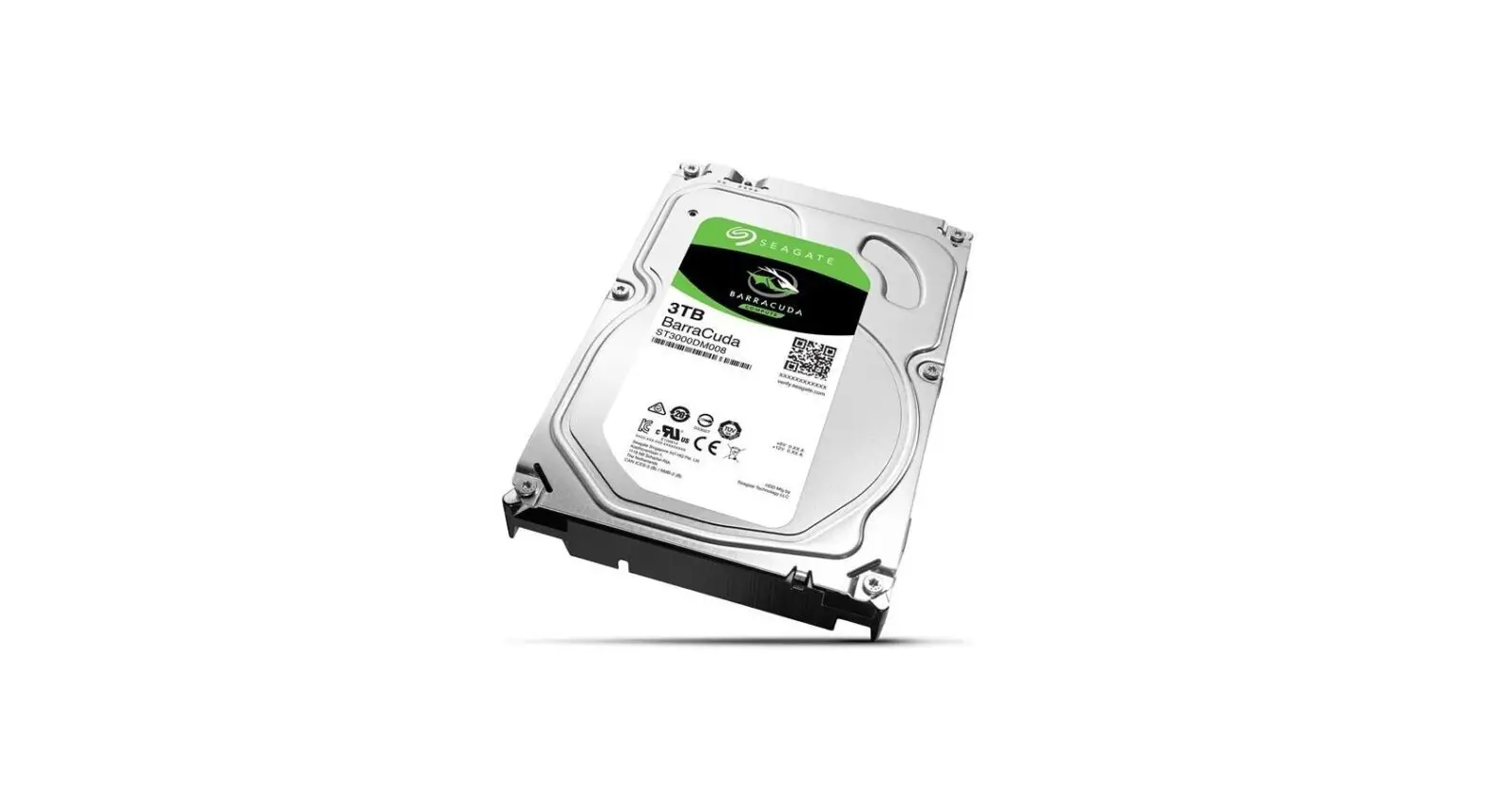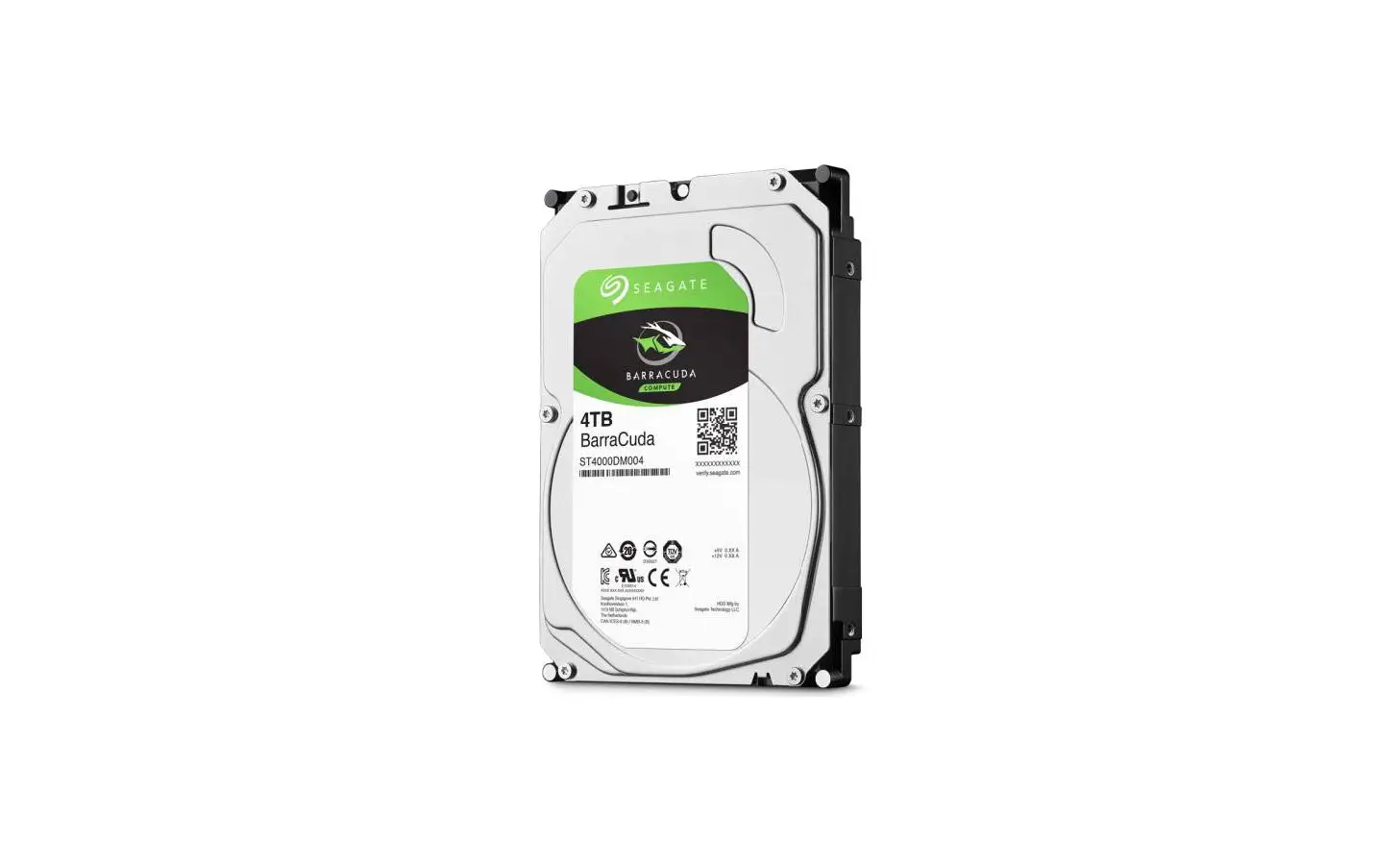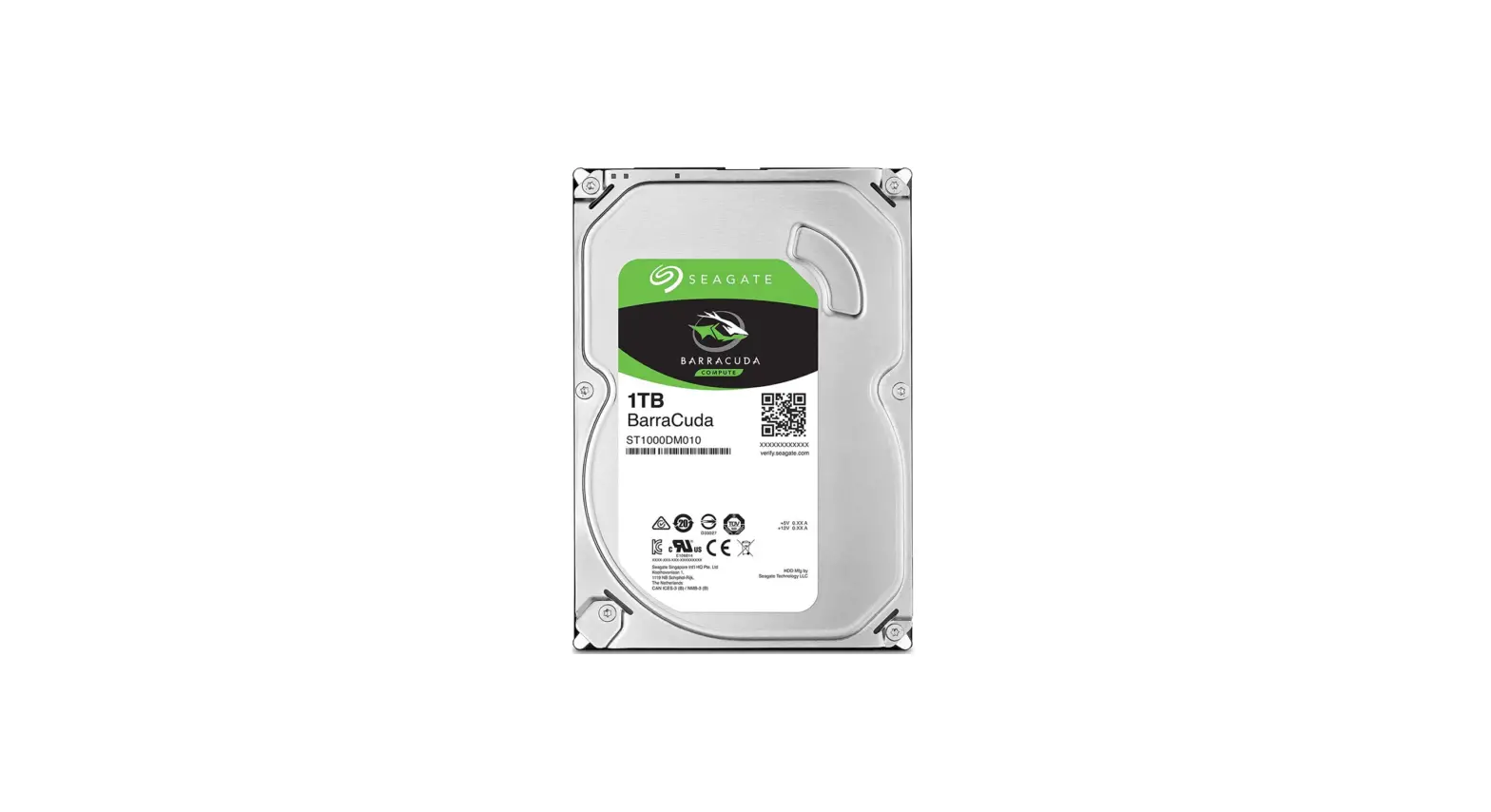

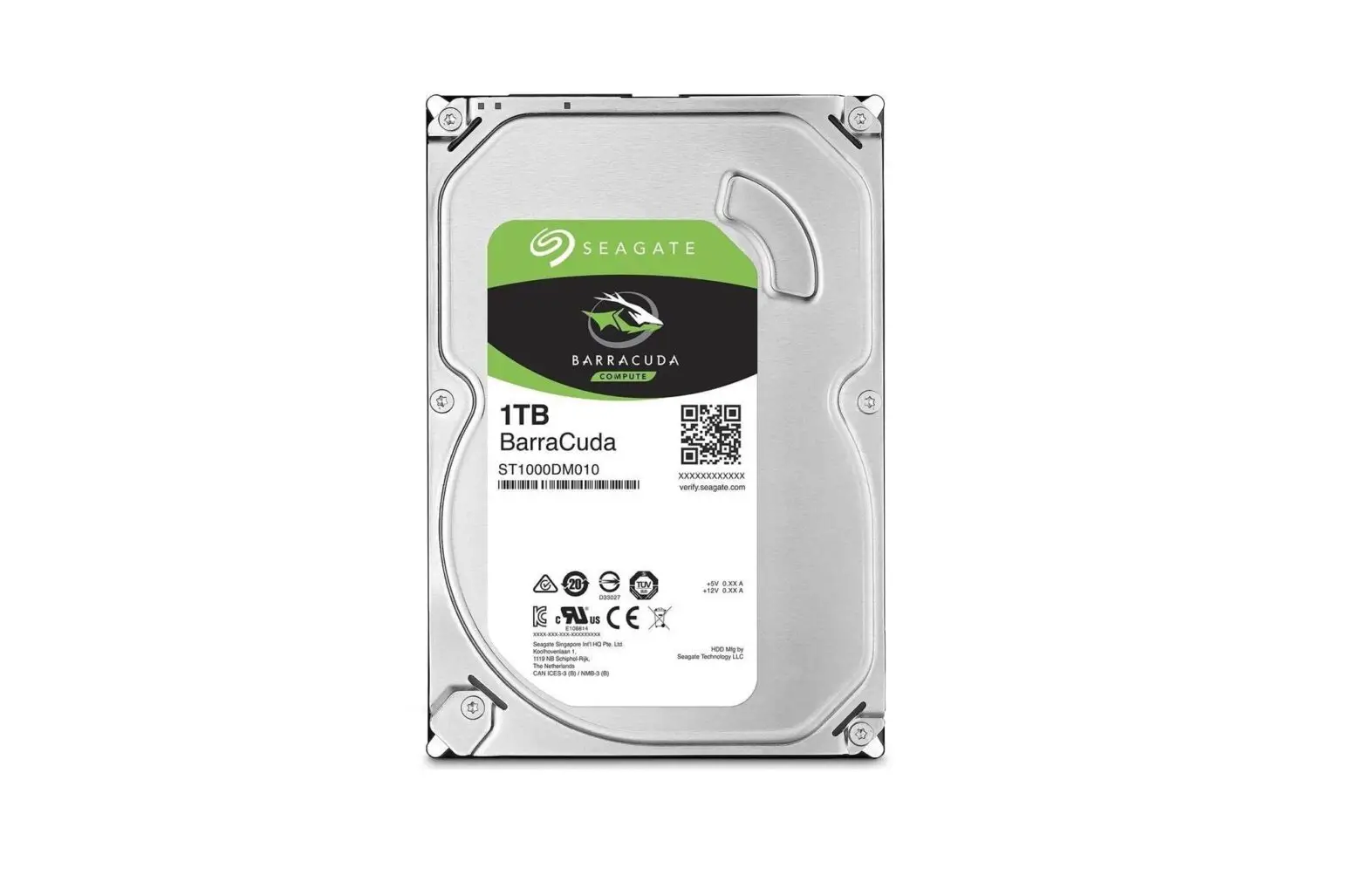
Seagate Barracuda ST1000DM010 Internal Hard Drive
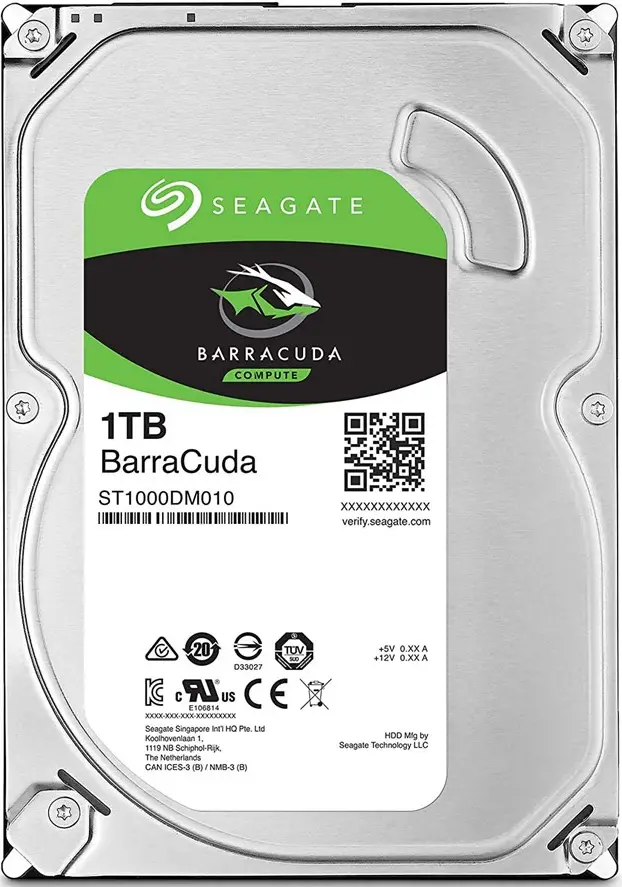
Introduction
This manual describes the functional, mechanical, and interface specifications for the following: Seagate® BarraCuda® model drives:
Standard models
- ST3000DM008
- ST2000DM006
- ST1000DM010
- ST500DM009
Self-Encryption models
- ST3000DM009
- ST2000DM007
Note
Previous generations of Seagate Self-Encrypting Drive models were called Full Disk Encryption (FDE) models before a differentiation between drive-based encryption and other forms of encryption was necessary.
These drives provide the following key features:
- 7200 RPM spindle
- Compliant with RoHS requirements in China and
- Full-track multiple-sector transfer capability without local processor
- High instantaneous (burst) data-transfer rates (up to 600MB per second).
- Native Command Queuing with command ordering to increase performance in demanding
- Quiet
- Seagate AcuTrac™ servo technology delivers dependable performance, even with hard drive track widths of only 75
- Seagate OptiCache™ technology boosts overall performance by as much as 45% over the previous generation.
- Seagate SmartAlign™ technology provides a simple, transparent migration to Advanced Format 4K sectors
- SeaTools diagnostic software performs a drive self-test that eliminates unnecessary drive returns.
- State-of-the-art cache and on-the-fly error correction algorithms.
- Support for M.A.R.T. drives monitoring and reporting.
- Supports latching SATA cables and
- TGMR recording technology provides the drives with increased areal density.
- Worldwide Name (WWN) capability uniquely identifies the drive.
About the SATA interface
The Serial ATA (SATA) interface provides several advantages over the traditional (parallel) ATA interface. The primary advantages include:
- Easy installation and configuration with true plug-and-play connectivity. It is not necessary to set any jumpers or other configuration
- Thinner and more flexible cabling for improved enclosure airflow and ease of
- Scalability to higher performance
In addition, SATA makes the transition from parallel ATA easy by providing legacy software support. SATA was designed to allow users to install a SATA host adapter and SATA disk drive in the current system and expect all of the existing applications to work as normal.
The SATA interface connects each disk drive in a point-to-point configuration with the SATA host adapter. There is no master/slave relationship with SATA devices like there is with parallel ATA. If two drives are attached to one SATA host adapter, the host operating system views the two devices as if they were both “masters” on two separate ports. This essentially means both drives behave as if they are Device 0 (master) devices.
The SATA host adapter and drive share the function of emulating parallel ATA device behavior to provide backward compatibility with existing host systems and software. The Command and Control Block registers, PIO and DMA data transfers reset, and interrupts are all emulated.
The SATA host adapter contains a set of registers that shadow the contents of the traditional device registers, referred to as the Shadow Register Block. All SATA devices behave like Device 0 devices. For additional information about how SATA emulates parallel ATA, refer to the “Serial ATA International Organization: Serial ATA Revision 3.2”. The specification can be downloaded from www.sata-io.org
Note
The host adapter may, optionally, emulate a master/slave environment to host software where two devices on separate SATA ports are represented to host software as Device 0 (master) and Device 1 (slave) accessed at the same set of host bus addresses. A host adapter that emulates a master/slave environment manages two sets of shadow registers. This is not a typical SATA environment.
Drive Specifications
Unless otherwise noted, all specifications are measured under ambient conditions, at 25°C, and nominal power. For convenience, the phrases the drive and this drive are used throughout this manual to indicate the following drive models
Specification summary tables
The specifications listed in Table 1 are for quick reference. For details on specification measurement or definition, refer to the appropriate section of this manual. Standard models Self-Encryption models
- ST3000DM008
- ST1000DM010
- ST3000DM009
- ST2000DM006
- ST500DM009
- ST2000DM007
Table 1 Drive specifications summary for 3TB, 2TB, 1TB, and 500GB models
| Drive Specification* | ST3000DM008 & ST3000DM009 | ST2000DM006 & ST2000DM007 | ST1000DM010 | ST500DM009 |
| Formatted capacity (512 bytes/sector)** | 3000GB (3TB); | 2000GB (2TB); | 1000GB (1TB); | 500GB |
| Guaranteed sectors | 5,860,533,168; | 3,907,029,168; | 1,953,525,168; | 976,773,168 |
| Heads | 6 | 6 / 4 | 2 | 2/1 |
| Disks | 3 | 3 / 2 | 1 | 1 |
| Bytes per sector
(4K physical emulated at 512-byte sectors) | 4096 | |||
| Default sectors per track | 63 | |||
| Default read/write heads | 16 | |||
| Default cylinders | 16,383 | |||
| Recording density (max) | 1807kFCI | |||
| Track density (avg) | 352ktracks/in | |||
| Areal density (avg) | 625Gb/in2 | |||
| Spindle speed | 7200 RPM | |||
| Internal data transfer rate (max) | 2147Mb/s | |||
| Average data rate, read/write (MB/s) | 156MB/s | |||
| Maximum sustained data rate, OD read (MB/s) | 210MB/s | |||
| I/O data-transfer rate (max) | 600MB/s | |||
| Cache buffer | 64MB | 32 MB | ||
| Height (max) | 26.1mm / 1.028 in | 20.17mm / 0.795 in | ||
| Width (max) | 101.6mm /4.0 in (+ 0.010 in) | |||
| Length (max) | 146.99mm / 5.787 in | |||
| Weight (typical) | 626g /1.38 lb | 626g/1.38lb
535g / 1.18 lb | 400g / 0.88lb | |
| Average latency | 4.16ms | |||
| Power-on to ready (typical) | <10.0s | |||
| Power-on to ready (max) | <17.0s | <10.0s | <8.5s | |
| Standby to ready (max) | <17.0s | <10.0s | <8.5s | |
| Average seek, read (typical) Average seek, write (typical) | <8.5ms
<9.5ms | |||
| Startup current 12V | 2.0A or 2.5A | 2.0A | ||
| Voltage tolerance (including noise) | 5V: ±5%
12V: +10% / -7.5% | |||
| Non-Operating ambient temperature (°C) | –40° to 70° | |||
| Operating ambient temperature (min °C) | 0° | |||
| Operating temperature (Drive case max °C) | 60° † | |||
| Drive Specification* | ST3000DM008 & ST3000DM009 | ST2000DM006 & ST2000DM007 | ST1000DM010 | ST500DM009 |
| Temperature gradient | 20°C per hour max (operating) 30°C per hour max (non-operating) | |||
| Relative humidity | 5% to 95% (operating)
5% to 95% (non-operating) | |||
| Relative humidity gradient (max) | 30% per hour | |||
| Wet bulb temperature (max) | 26°C max (operating) 29°C max (non-operating) | |||
| Altitude, operating | –304.8m to 3048m (–1000 ft to 10,000+ ft) | |||
| Altitude, non-operating (below mean sea level, max) | –304.8m to 12,192m (–1000 ft to 40,000+ ft) | |||
| Operational shock (max) | 80 Gs at 2ms | |||
| Non-operational shock (max) | 300 Gs at 2ms | 350 Gs at 2ms | ||
| Vibration, operating | 2Hz to 22Hz: 0.25 Gs, Limited displacement 22Hz to 350Hz: 0.50 Gs
350Hz to 500Hz: 0.25 Gs | |||
| Vibration, non-operating | 5Hz to 22Hz: 3.0 Gs 22Hz to 350Hz: 3.0 Gs
350Hz to 500Hz: 3.0 Gs | |||
| Drive acoustics, sound power Idle***
Seek | ||||
| 2.4 bels (typical)
2.6 bels (max) | 2.2 bels (typical)
2.3 bels (max) | |||
| 2.6 bels (typical)
2.7 bels (max) | 2.3 bels (typical)
2.4 bels (max) | |||
| Non-recoverable read errors | 1 per 1014 bits read | |||
| Annualized Failure Rate (AFR) | <1.0% based on 2400 POH | |||
| Rated Workload | Average annualized workload rating: <55 TB/year.
The AFR specification for the product assumes the I/O workload does not exceed the average annualized workload rate limit of 55 TB/year. Workloads exceeding the annualized rate may degrade the product AFR and impact reliability as experienced by the particular application. The average annualized workload rate limit is in units of TB per calendar year. | |||
| Warranty | To determine the warranty for a specific drive, use a web browser to access the following web page: http://www.seagate.com/support/warranty-and-replacements/
From this page, click on “Is my Drive under Warranty”. Users will be asked to provide the drive serial number, model number (or part number) and country of purchase. The system will display the warranty information for the drive. | |||
| Load/Unload cycles (25°C, 50% rel. humidity) | 300,000 | —- | ||
| Contact start-stop cycles (25°C, 50% rel. humidity) | —- | 50,000 | ||
| Supports Hotplug operation per the Serial ATA Revision 3.2 specification | Yes | |||
All specifications above are based on native configurations. One GB equals one billion bytes and 1TB equals one trillion bytes when referring to hard drive capacity. Accessible capacity may vary depending on the operating environment and formatting. During periods of drive idle, some offline activity may occur according to the S.M.A.R.T. specification, which may increase acoustic and power to operational levels. Seagate does not recommend operating at sustained case temperatures above 60°C. Operating at higher temperatures will reduce the useful life of the product.
Formatted capacity
| Model | Formatted capacity* | Guaranteed sectors | Bytes per sector |
| ST3000DM008 & ST3000DM009 | 3000GB | 5,860,533,168 |
4096 |
| ST2000DM006 & ST2000DM007 | 2000GB | 3,907,029,168 | |
| ST1000DM010 | 1000GB | 1,953,525,168 | |
| ST500DM009 | 500GB | 976,773,168 |
One GB equals one billion bytes and 1TB equals one trillion bytes when referring to hard drive capacity. Accessible capacity may vary depending on the operating environment and formatting.
LBA mode
When addressing these drives in LBA mode, all blocks (sectors) are consecutively numbered from 0 to n–1, where n is the number of guaranteed sectors as defined above. See Section 5.3.1, “Identify Device command” (words 60-61 and 100-103) for additional information about 48-bit addressing support of drives with capacities over 137GB.
Default logical geometry
- Cylinders: 16,383
- Read/write heads: 16
- Sectors per track: 63
LBA mode
When addressing these drives in LBA mode, all blocks (sectors) are consecutively numbered from 0 to n–1, where n is the number of guaranteed sectors as defined above.
Recording and interface technology
| Interface | SATA |
| Recording method | TGMR |
| Recording density (kFCI) | 1807 |
| Track density (ktracks/inch avg) | 352 |
| Areal density (Gb/in2) | 625 |
| Spindle speed (RPM) | 7200 ± 0.2% |
| Internal data transfer rate (Mb/s max) | 2147 |
| Maximum sustained data transfer rate, OD read (MB/s) | 210 |
| The average data rate, read/write (MB/s) | 156 |
| I/O data-transfer rate (MB/s max) | 600 |
Physical characteristics
| Maximum height | |
| 3TB and 2TB | 26.1mm / 1.028 in |
| 1TB and 500GB | 20.17mm / 0.794 in |
| Maximum width (all models) | 101.6mm / 4.0 in (± 0.010 in) |
| Maximum length (all models) | 146.99mm / 5.787 in |
| Typical weight | |
| 3TB | 626g / 1.38 lb |
| 2TB | 626g / 1.38 lb – or – 535g / 1.18 lb |
| 1TB and 500GB | 400g / 0.88lb |
| Cache buffer | |
| 3TB, 2TB and 1TB | 64MB |
| 500GB | 32MB |
Seek time
Seek measurements are taken with nominal power at 25°C ambient temperature. All times are measured using drive diagnostics. The specifications in the table below are defined as follows:
- Track-to-track seeks time is an average of all possible single-track seeks in both directions.
- Average seek time is a true statistical random average of at least 5000 measurements of seeks between random tracks, with less overhead.
| Typical seek times (ms) | Read | Write |
| Track-to-track | 1.0 | 1.2 |
| Average | 8.5 | 9.5 |
| Average latency | 4.16 | |
Note
These drives are designed to consistently meet the seek times represented in this manual. Physical seeks, regardless of mode (such as track-to-track and average), are expected to meet the noted values. However, due to the manner in which these drives are formatted, benchmark tests that include command overhead or measure logical seeks may produce results that vary from these specifications.
Start/stop times
| 3-disk
(3TB models) | 2-disk
(2TB models) | 1-disk
(1TB models) | 1-disk
(500GB models) | |
| Power-on to ready (in seconds) | 15 (typical)
17 (max) | 10 (typical)
12 (max) | 8.5 (typical) 10 (max) | |
| Power-on to ready (typical) | <10 | |||
| Standby to ready (in seconds) | 15 (typical)
17 (max) | 10 (typical)
12 (max) | 8.5 (typical) 10 (max) | |
| Ready to spindle stop (in seconds) | 10 (typical)
11 (max) | |||
Time-to-ready may be longer than normal if the drive power is removed without going through normal OS power-down procedures.
Power specifications
The drive receives DC power (+5V or +12V) through a native SATA power connector. Refer to Figure 1 on page 22.
Power consumption
Power requirements for the drives are listed in Table 2 and Table 3. Typical power measurements are based on an average of drives tested, under nominal conditions, using 5.0V and 12.0V input voltage at 25°C ambient temperature.
- Spinup power
Spinup power is measured from the time of power-on to the time that the drive spindle reaches operating speed.
- Read/write power and current
Read/write power is measured with the heads on track, based on a 16-sector write followed by a 32-ms delay, then a 16-sector read followed by a 32-ms delay.
- Operating power and current
Operating power is measured using 40 percent random seeks, 40 percent read/write mode (1 write for each 10 reads) and 20 percent drive idle mode.
- Idle mode power
Idle mode power is measured with the drive up to speed, with servo electronics active, and with the heads in a random track location.
- Standby mode
During Standby mode, the drive accepts commands, but the drive is not spinning, and the servo and read/write electronics are in power-down mode.
DC power requirements (3-disk: 3TB and 2TB models)
| Power dissipation (3-disk values shown) | Avg (watts 25° C) | Avg 5V typ amps | Avg 12V amps |
| Spinup | — | — | 2.0A or 2.5A |
| Idle2* † | 5.40 | 0.190 | 0.377 |
| Operating | 8.00 | 0.510 | 0.462 |
| Standby | 0.75 | 0.136 | 0.005 |
| Sleep | 0.75 | 0.136 | 0.005 |
DC power requirements (1-disk: 1TB and 500GB models)
| Power dissipation (1-disk values shown) | Avg (watts 25° C) | Avg 5V typ amps | Avg 12V typ amps |
| Spinup | — | — | 2.0 |
| Perf Idle* † | 4.6 | 0.378 | 0.224 |
| Operating | 5.3 | 0.656 | 0.243 |
| Standby | 0.94 | 0.350 | 0.010 |
| Sleep | 0.94 | 0.350 | 0.010 |
During periods of drive idle, some offline activity may occur according to the S.M.A.R.T. specification, which may increase acoustic and power to operational levels. 5W IDLE with DIPLM Enabled
Conducted noise
Input noise ripple is measured at the host system power supply across an equivalent 80-ohm resistive load on the +12 volt line or an equivalent 15-ohm resistive load on the +5 volt line.
- Using 12-volt power, the drive is expected to operate with a maximum of 120 mV peak-to-peak square-wave injected noise at up to 10MHz.
- Using 5-volt power, the drive is expected to operate with a maximum of 100 mV peak-to-peak square-wave injected noise at up to 10MHz
Note: Equivalent resistance is calculated by dividing the nominal voltage by the typical RMS read/write current.
Voltage tolerance
Voltage tolerance (including noise):
- 5V ±5%
- 12V +10% / -5%
Power-management modes
The drive provides programmable power management to provide greater energy efficiency. In most systems, users can control power management through the system setup program.
The drive features the following power-management modes:
| Power modes | Heads | Spindle | Buffer |
| Active | Tracking | Rotating | Enabled |
| Idle | Tracking | Rotating | Enabled |
| Standby | Parked | Stopped | Enabled |
| Sleep | Parked | Stopped | Disabled |
- Active mode
The drive is in Active mode during the read/write and seek operations. - Idle mode
The buffer remains enabled, and the drive accepts all commands and returns to Active mode any time disk access is necessary. - Standby mode
The drive enters Standby mode when the host sends a Standby Immediate command. If the host has set the standby timer, the drive can also enter Standby mode automatically after the drive has been inactive for a specific length of time. The standby timer delay is established using a Standby or Idle command. In Standby mode, the drive buffer is enabled, the heads are parked and the spindle is at rest. The drive accepts all commands and returns to Active mode any time disk access is necessary. - Sleep mode
The drive enters Sleep mode after receiving a Sleep command from the host. In Sleep mode, the drive buffer is dis- abled, the heads are parked and the spindle is at rest. The drive leaves Sleep mode after it receives a Hard Reset or Soft Reset from the host. After receiving a reset, the drive exits Sleep mode and enters Standby mode with all current translation parameters intact. - Idle and Standby timers
Each time the drive performs an Active function (read, write, or seek), the standby timer is reinitialized and begins counting down from its specified delay times to zero. If the standby timer reaches zero before any driving activity is required, the drive makes a transition to Standby mode. In both the Idle and Standby modes, the drive accepts all commands and returns to Active mode when disk access is necessary.
Environmental specifications
This section provides the temperature, humidity, shock, and vibration specifications. Ambient temperature is defined as the temperature of the environment immediately surrounding the drive. Above 1000ft. (305 meters), the maximum temperature is derated linearly by 1°C every 1000 ft. Refer to Section 3.4 Drive mounting for base plate measurement location.
Ambient temperature
| Non-Operating ambient temperature (°C) | –40° to 70° |
| Operating ambient temperature (min °C) | 0° |
| Operating temperature (Drive case max °C) | 60° † |
Seagate does not recommend operating at sustained case temperatures above 60°C. Operating at higher temperatures will reduce the useful life of the product.
Temperature gradient
| Operating | 20°C per hour (68°F per hour max), without condensation |
| Non-operating | 30°C per hour (86°F per hour max) |
Humidity
Relative humidity
| Operating | 5% to 95% non-condensing (30% per hour max) |
| Non-operating | 5% to 95% non-condensing (30% per hour max) |
Wet bulb temperature
| Operating | 26°C / 78.8°F (rated) |
| Non-operating | 29°C / 84.2°F (rated) |
Altitude
| Operating | –304.8m to 3048m (–1000 ft. to 10,000+ ft.) |
| Non-operating | –304.8m to 12,192m (–1000 ft. to 40,000+ ft.) |
Shock
All shock specifications assume that the drive is mounted securely with the input shock applied at the drive mounting screws. Shock may be applied in the X, Y or Z axis.
Operating shock
These drives comply with the performance levels specified in this document when subjected to a maximum operating shock of 80 Gs based on half-sine shock pulses of 2 ms during read operations. Shocks should not be repeated more than two times per second.
Non-operating shock 3TB and 2TB models
The non-operating shock level that the driver can experience without incurring physical damage or degradation in performance when subsequently put into operation is 300 Gs based on a non-repetitive half-sine shock pulse of 2 ms duration.
1TB and 500GB models
The non-operating shock level that the driver can experience without incurring physical damage or degradation in performance when subsequently put into operation is 350 Gs based on a non-repetitive half-sine shock pulse of 2 ms duration.
Operating vibration
The maximum vibration levels that the drive may experience while meeting the performance standards specified in this document are specified below.
| 2Hz to 22Hz | 0.25 Gs (Limited displacement) |
| 22Hz to 350Hz | 0.50 Gs |
| 350Hz to 500Hz | 0.25 Gs |
All vibration specifications assume that the drive is mounted securely with the input vibration applied at the drive mounting screws. Vibration may be applied in the X, Y, or Z axis. Throughput may vary if improperly mounted.
Non-operating vibration
The maximum non-operating vibration levels that the drive may experience without incurring physical damage or degradation in performance when subsequently put into operation are specified below.
| 5Hz to 22Hz | 3.0 Gs (Limited displacement) |
| 22Hz to 350Hz | 3.0 Gs |
| 350Hz to 500Hz | 3.0 Gs |
Acoustics
Drive acoustics are measured as overall A-weighted acoustic sound power levels (no pure tones). All measurements are consistent with ISO document 7779. Sound power measurements are taken under essentially free-field conditions over a reflecting plane. For all tests, the drive is oriented with the cover facing upward.
Note: For seek mode tests, the drive is placed in seek mode only.
The number of seeks per second is defined by the following equation: (Number of seeks per second = 0.4 / (average latency + average access time)
Table 4 Fluid Dynamic Bearing (FDB) motor acoustics
| Idle* | Seek | |
| 3 Disks
(3TB, 2TB) |
2.4 bels (typical) 2.6 bels (max) |
2.6 bels (typical) 2.7 bels (max) |
| 2 Disks
(2TB) | ||
| 1 Disk
(1TB and 500GB) | 2.2 bels (typical)
2.4 bels (max) | 2.4 bels (typical)
2.5 bels (max) |
During periods of drive idle, some offline activity may occur according to the S.M.A.R.T. specification, which may increase acoustic and power to operational levels.
Test for Prominent Discrete Tones (PDTs)
Seagate follows the ECMA-74 standards for the measurement and identification of PDTs. An exception to this process is the use of the absolute threshold of hearing. Seagate uses this threshold curve (originated in ISO 389-7) to discern tone audibility and to compensate for the inaudible components of sound prior to the computation of tone ratios according to Annex D of the ECMA-74 standards.
Electromagnetic immunity
When properly installed in a representative host system, the drive operates without errors or degradation in performance when subjected to the radio frequency (RF) environments defined in Table 5.
Table 5 Radiofrequency environments
| Test | Description | Performance level | Reference standard |
| Electrostatic discharge | Contact, HCP, VCP: ± 4 kV; Air: ± 8 kV | B | EN61000-4-2: 95 |
| Radiated RF immunity | 80MHz to 1,000MHz, 3 V/m,
80% AM with 1kHz sine 900MHz, 3 V/m, 50% pulse modulation @ 200Hz | A | EN61000-4-3: 96
ENV50204: 95 |
| Electrical fast transient | ± 1 kV on AC mains, ± 0.5 kV on external I/O | B | EN61000-4-4: 95 |
| Surge immunity | ± 1 kV differential, ± 2 kV common, AC mains | B | EN61000-4-5: 95 |
| Conducted RF immunity | 150kHz to 80MHz, 3 Vrms, 80% AM with 1kHz sine | A | EN61000-4-6: 97 |
| Voltage dips, interrupts | 0% open, 5 seconds
0% short, 5 seconds 40%, 0.10 seconds 70%, 0.01 seconds | C C C B | EN61000-4-11: 94 |
Reliability
Annualized Failure Rate (AFR)
The production disk drive shall achieve an annualized failure rate of <1.0% over a 5-year service life when used in Desktop Storage field conditions as limited by the following:
- 2400 power-on-hours per
- Typical workload
| Nonrecoverable read errors | 1 per 1014 bits read, max |
| Rated Workload | Average annualized workload rating: <55 TB/year.
The AFR specification for the product assumes the I/O workload does not exceed the average annualized workload rate limit of 55 TB/year. Workloads exceeding the annualized rate may degrade the product AFR and impact reliability as experienced by the particular application. The average annualized workload rate limit is in units of TB per calendar year. |
| Warranty | To determine the warranty for a specific drive, use a web browser to access the following web page: http://www.seagate.com/support/warranty-and-replacements/.
From this page, click on the “Is my Drive under Warranty” link. The following are required to be provided: the drive serial number, model number (or part number), and country of purchase. The system will display the warranty information for the drive. |
| Preventive maintenance | None required. |
Storage
Maximum storage periods are 180 days within the original unopened Seagate shipping package or 60 days unpackaged within the defined non-operating limits (refer to the environmental section in this manual). Storage can be extended to 1 year packaged or unpackaged under optimal environmental conditions (25°C, <40% relative humidity non-condensing, and non-corrosive environment). During any storage period, the drive’s non-operational temperature, humidity, wet bulb, atmospheric conditions, shock, vibration, magnetic, and electrical field specifications should be followed.
Agency certification and Safety certification
These products are certified to meet the requirements of UL60950-1, CSA60950-1, and EN60950 and so marked as to the certified agency.
Electromagnetic compatibility
Hard drives that display the CE mark comply with the European Union (EU) requirements specified in the Electromagnetic Compatibility Directive (2004/108/EC) as put into place on 20 July 2007. Testing is performed to the levels specified by the product standards for Information Technology Equipment (ITE). Emission levels are defined by EN 55022, and Class B and immunity levels are defined by EN 55024.
Drives are tested in representative end-user systems. Although CE-marked Seagate drives comply with the directives when used in the test systems, we cannot guarantee that all systems will comply with the directives. The drive is designed for operation inside a properly designed enclosure, with properly shielded I/O cable (if necessary) and terminators on all unused I/O ports. Computer manufacturers and system integrators should confirm EMC compliance and provide CE marking for their products.
Korean RRA
If these drives have the Korean Communications Commission (KCC) logo, they comply with paragraph 1 of Article 11 of the Electromagnetic Compatibility Control Regulation and meet the Electromagnetic Compatibility (EMC) Framework requirements of the Radio Research Agency (RRA) Communications Commission, Republic of Korea. These drives have been tested and comply with the Electromagnetic Interference/Electromagnetic Susceptibility (EMI/ EMS) for Class B products. Drives are tested in a representative, end-user system by a Korean-recognized lab.
- Family name: Barracuda
- Certificate number: KCC-REM-STX-Barracuda
Australian RCM Compliance Mark
Models displayed with the RCM compliance mark, comply with the mandatory standards as per the Australian Communications and Media Authority (ACMA) Electromagnetic Compatibility (EMC) regulatory arrangement.
FCC verification
These drives are intended to be contained solely within a personal computer or similar enclosure (not attached as an external device). As such, each drive is considered to be a subassembly even when it is individually marketed to the customer. As a subassembly, no Federal Communications Commission verification or certification of the device is required.
Seagate has tested this device in enclosures as described above to ensure that the total assembly (enclosure, disk drive, motherboard, power supply, etc.) does comply with the limits for a Class B computing device, pursuant to Subpart J, Part 15 of the FCC rules. Operation with non-certified assemblies is likely to result in interference to radio and television reception.
Radio and television interference. This equipment generates and uses radio frequency energy and if not installed and used in strict accordance with the manufacturer’s instructions, may cause interference to radio and television reception.
This equipment is designed to provide reasonable protection against such interference in a residential installation. However, there is no guarantee that interference will not occur in a particular installation. If this equipment does cause interference to radio or television, which can be determined by turning the equipment on and off, users are encouraged to try one or more of the following corrective measures:
- Reorient the receiving antenna.
- Move the device to one side or the other of the radio or TV.
- Move the device farther away from the radio or TV.
- Plug the computer into a different outlet so that the receiver and computer are on different branch outlets.
If necessary, users should consult the dealer or an experienced radio/television technician for additional suggestions. Users may find helpful the following booklet prepared by the Federal Communications Commission: How to Identify and Resolve Radio-Television Interference Problems. This booklet is available from the Superintendent of Documents, U.S. Government Printing Office, Washington, DC 20402. Refer to publication number 004-000-00345-4
Environmental protection
Seagate designs its products to meet environmental protection requirements worldwide, including regulations restricting certain chemical substances.
European Union Restriction of Hazardous Substances (RoHS) Directive
The European Union Restriction of Hazardous Substances (RoHS) Directive, restricts the presence of chemical substances, including Lead, Cadmium, Mercury, Hexavalent Chromium, PBB, and PBDE, in electronic products, effective July 2006. This drive is manufactured with components and materials that comply with the RoHS Directive.
China Requirements — China RoHS 2
China RoHS 2 refers to the Ministry of Industry and Information Technology Order No. 32, effective July 1, 2016, titled Management Methods for the Restriction of the Use of Hazardous Substances in Electrical and Electronic Products. To comply with China RoHS 2, we determined this product’s Environmental Protection Use Period (EPUP) to be 20 years in accordance with the Marking for the Restricted Use of Hazardous Substances in Electronic and Electrical Products, SJT 11364- 2014
- (Management Methods for the Restriction of the Use of Hazardous Substances in Electrical and Electronic Products _ China RoHS)
- (Name and Content of the Hazardous Substances in Product)
Hazardous Substances
|
Part Name |
Hazardous Substances | |||||
| Lead
(Pb) | Mercury
(Hg) | Cadmium
(Cd) | Hexavalent Chromium
(CF (VI)) | Polybrominated
biphenyls (PBB) | Polybrominated
diphenyl ethers (PBDE) | |
| PCBA | X | O | O | O | O | O |
| Chassis | X | O | O | O | O | O |
| SJ/T 11364
This table is prepared in accordance with the provisions of SJ/T 11364-2014 O: Indicates that the hazardous substance contained in all of the homogeneous materials for this part is below the limit requirement of GB/T26572. X: Indicates that the hazardous substance contained in at least one of the homogeneous materials used for this part is above the limit requirement of GB/T26572. | ||||||
Corrosive environment
Seagate electronic drive components pass accelerated corrosion testing equivalent to 10 years of exposure to light industrial environments containing sulfurous gases, chlorine, and nitric oxide, classes G and H per ASTM B845. However, this accelerated testing cannot duplicate every potential application environment. Users should use caution exposing any electronic components to uncontrolled chemical pollutants and corrosive chemicals as electronic drive component reliability can be affected by the installation environment. The silver, copper, nickel, and gold films used in Seagate products are especially sensitive to the presence of sulfide, chloride, and nitrate contaminants. Sulfur is found to be the most damaging. In addition, electronic components should never be exposed to condensing water on the surface of the printed circuit board assembly (PCBA) or exposed to an ambient relative humidity greater than 95%. Materials used in cabinet fabrication, such as vulcanized rubber, that can outgas corrosive compounds should be minimized or eliminated. The useful life of any electronic equipment may be extended by replacing materials near circuitry with sulfide-free alternatives.
Configuring and Mounting the Drive
This section contains the specifications and instructions for configuring and mounting the drive.
3.0 Handling and static-discharge precautions
After unpacking, and before installation, the drive may be exposed to potential handling and electrostatic discharge (ESD) hazards. Observe the following standard handling and static-discharge precautions:
Caution
- Before handling the drive, put on a grounded wrist strap, or ground oneself frequently by touching the metal chassis of a computer that is plugged into a grounded outlet. Wear a grounded wrist strap throughout the entire installation
- Handle the drive by its edges or frame only.
- The drive is extremely fragile—handle it with Do not press down on the drive top cover.
- Always rest the drive on a padded, antistatic surface until mounting it in the
- Do not touch the connector pins or the printed circuit
- Do not remove the factory-installed labels from the drive or cover them with additional Removal voids the warranty. Some factory-installed labels contain information needed to service the drive. Other labels are used to seal out dirt and contamination.
Configuring the drive
Each drive on the SATA interface connects point-to-point with the SATA host adapter. There is no master/slave relationship because each drive is considered a master in a point-to-point relationship. If two drives are attached to one SATA host adapter, the host operating system views the two devices as if they were both “masters” on two separate ports. Both drives behave as if they are Device 0 (master) devices.
SATA drives are designed for easy installation. It is usually not necessary to set any jumpers on the drive for proper operation; however, if users connect the drive and receive a “drive not detected” error, the SATA-equipped motherboard or host adapter may use a chipset that does not support SATA speed auto negotiation.
SATA cables and connectors
The SATA interface cable consists of four conductors in two differential pairs, plus three ground connections. The cable size may be 30 to 26 AWG with a maximum length of one meter (39.37 inches). See Table 7 for connector pin definitions. Either end of the SATA signal cable can be attached to the drive or host.
For direct backplane connection, the drive connectors are inserted directly into the host receptacle. The drive and the host receptacle incorporate features that enable the direct connection to be hot-pluggable and blind-mateable. For installations that require cables, users can connect the drive as illustrated in Figure 1.
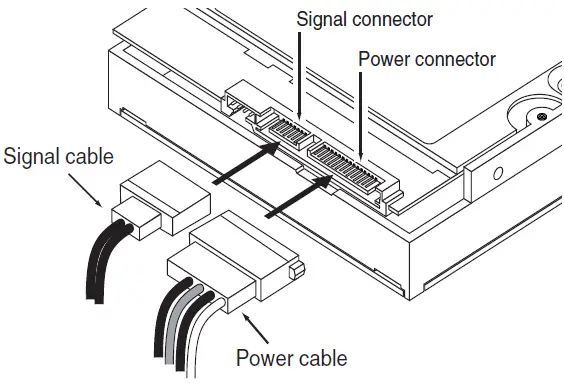
Each cable is keyed to ensure correct orientation. BarraCuda drives support latching SATA connectors.
Drive mounting
Users can mount the drive in any orientation using four screws in the side-mounting holes or four screws in the bottom-mounting holes. Refer to Figure 2 and Figure 3 for drive mounting dimensions.
Follow these important mounting precautions when mounting the drive:
- Allow a minimum clearance of 030 inches (0.76mm) around the entire perimeter of the drive for cooling.
- Use only 6-32 UNC mounting
- The screws should be inserted no more than 120 inches (3.05mm) into the bottom or side mounting holes.
- Do not overtighten the mounting screws (maximum torque: 6 inch-lb).
Figure 2 Mounting dimensions (2/3-disk: 2TB to 3TB models)
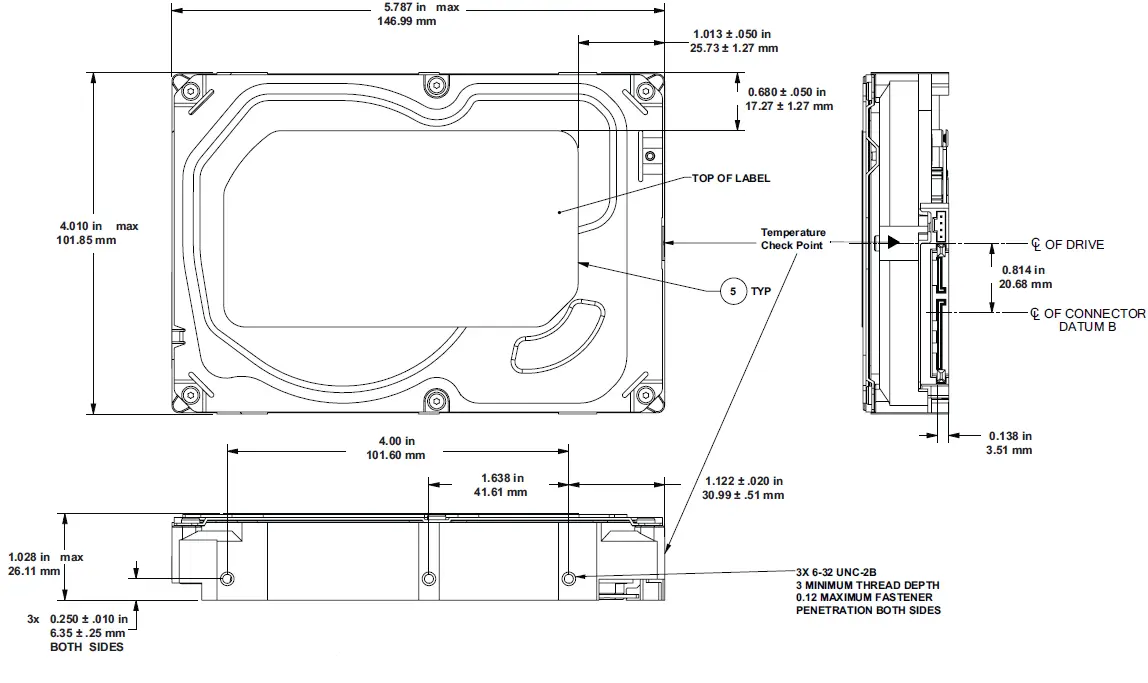
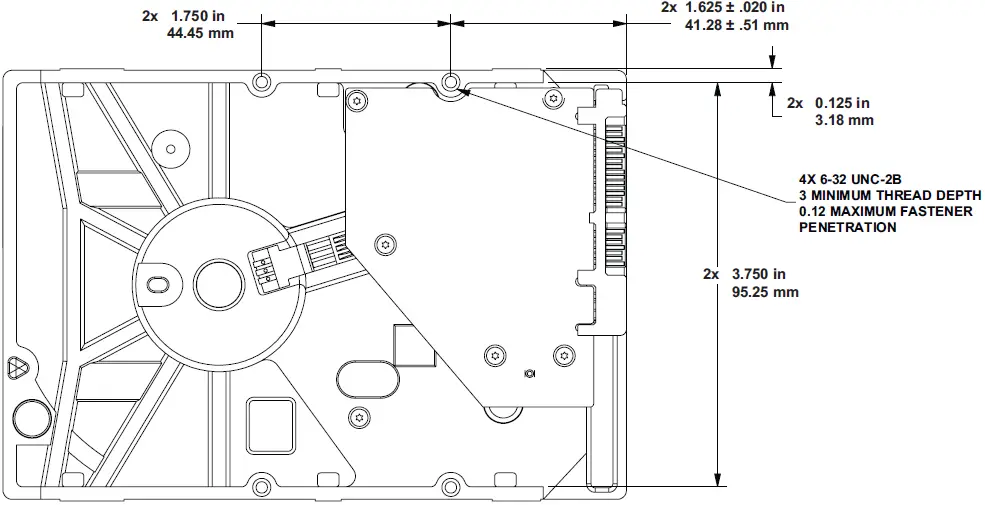
Note: Drawings are for mounting hole reference only. PCBA show in pictorial only and can vary based on specific customer configurations
Seagate utilizes two base decks for 1TB and 500GB capacities, as shown below.
Figure 3 Mounting dimensions (configuration 1)
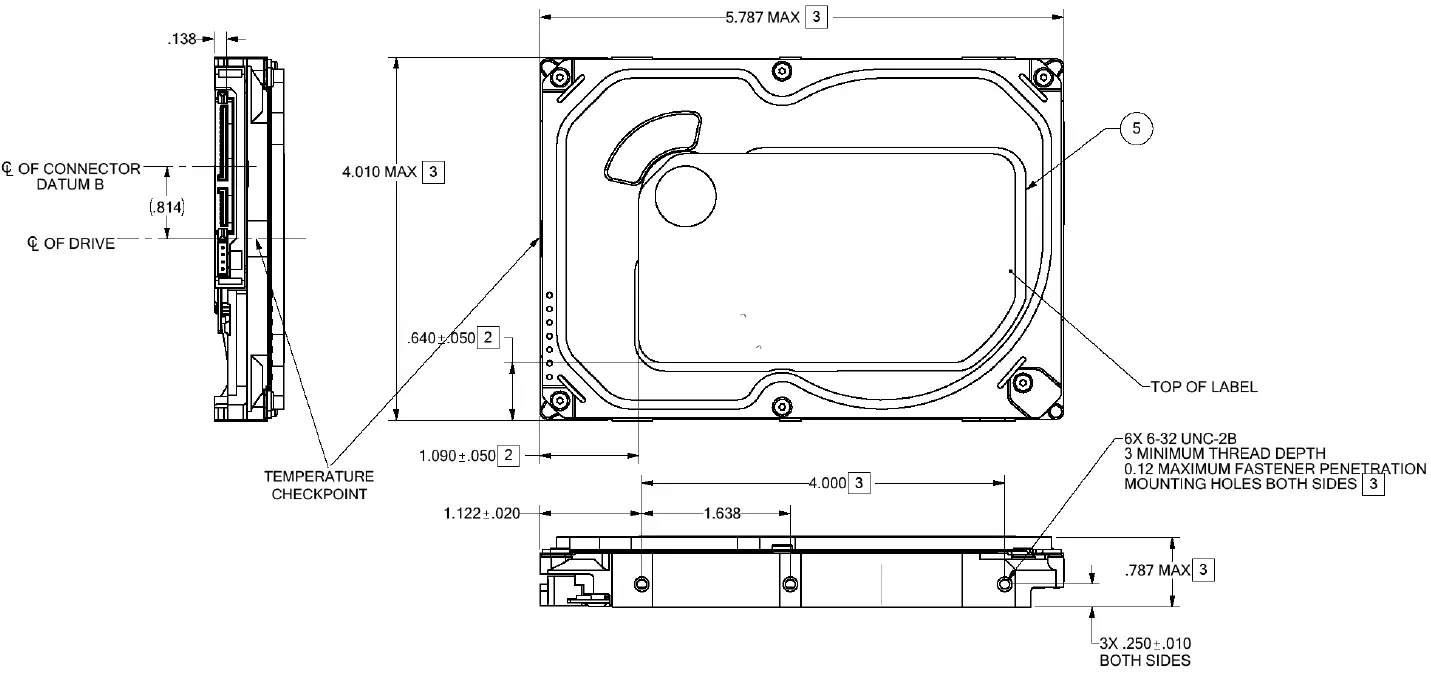
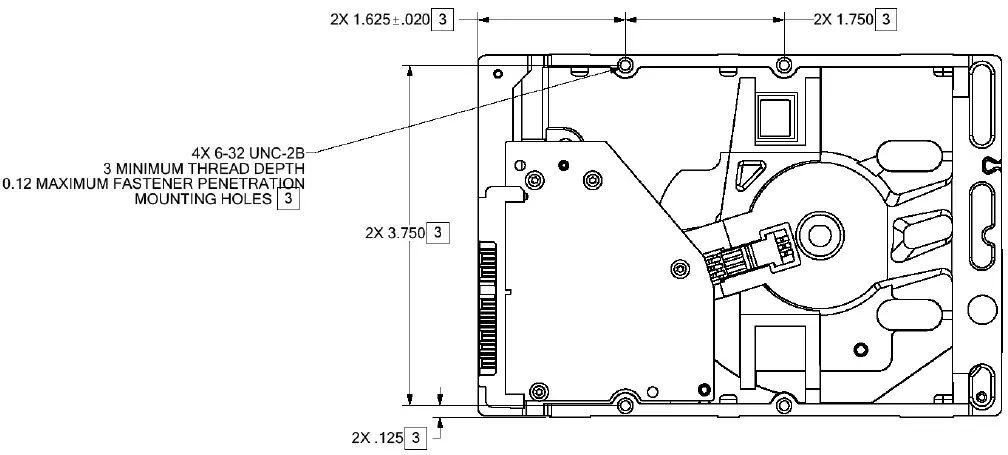
Note: Drawings are for mounting hole reference only. PCBA shows in pictorial only and can vary based on specific customer configurations.
Figure 4 Mounting dimensions (configuration 2)
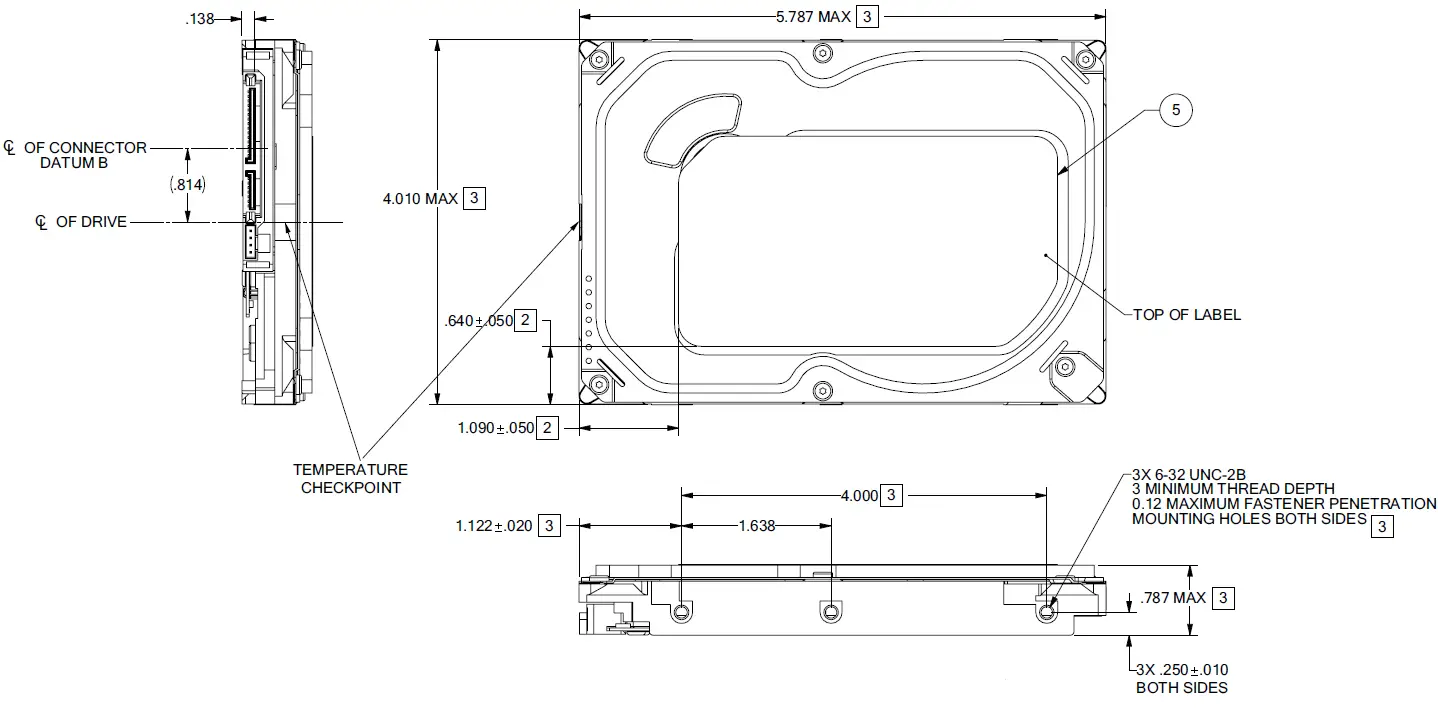
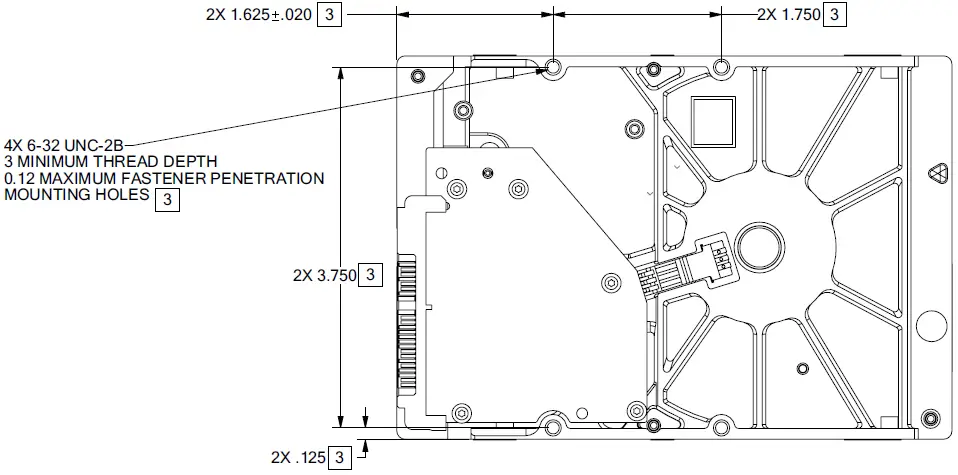
Note: Drawings are for mounting hole reference only. PCBA shows in pictorial only and can vary based on specific customer configurations.
About (SED) Self-Encrypting Drives
Self-encrypting drives (SEDs) offer encryption and security services for the protection of stored data, commonly known as “data at rest”. These drives are compliant with the Trusted Computing Group (TCG) Opal Storage Specifications as detailed in the following:
- TCG Storage Architecture Core Specification, Version 2.0 (see www.trustedcomputinggroup.org)
- TCG Storage Security Subsystem Class Opal Specification, Version 2.0 (see www.trustedcomputinggroup.org)
In case of conflict between this document and any referenced document, this document takes precedence. The Trusted Computing Group (TCG) is a standards organization sponsored and operated by companies in the computer, storage, and digital communications industry. Seagate’s SED models comply with the standards published by the TCG.
To use the security features in the drive, the host must be capable of constructing and issuing the following two SATA commands:
- Trusted Send
- Trusted Receive
These commands are used to convey the TCG protocol to and from the drive in their command payloads. Seagate Secure SEDs also support TCG Single User Mode, which can be disabled.
Data Encryption
Encrypting drives use one inline encryption engine within each drive employing AES-256 algorithms in Cipher Block Chaining (CBC) mode to encrypt all data prior to being written on the media and to decrypt all data as it is read from the media. The encryption engine is always in operation and cannot be disabled. The 32-byte Data Encryption Key (DEK) is a random number that is generated by the drive, never leaves the drive, and is inaccessible to the host system. The DEK is itself encrypted when it is stored on the media and when in volatile temporary storage (DRAM), which is external to the encryption engine. A unique data encryption key is used for each of the drive’s possible 16 data bands (see Section 4.5 Data Bands (TBD)).
Controlled Access
The drive has two security providers (SPs) called the “Admin SP” and the “Locking SP.” These act as gatekeepers to the drive security services. Security-related commands will not be accepted unless the user provides the correct credentials to prove that they are authorized to perform the command.
Admin SP
The Admin SP allows the drive’s owner to enable or disable firmware download operations (see Section 4.4 Drive Locking). Access to the Admin SP is available using the SID (Secure ID) password.
Locking SP
The Locking SP controls read/write access to the media and the cryptographic erase feature. Access to the Locking SP is available using the Admin or User passwords.
Default password
When the drive is shipped from the factory, all passwords are set to the value of MSID. This 32-byte random value can only be read by the host electronically over the interface. After receipt of the drive, it is the responsibility of the owner to use the default MSID password as the authority to change all other passwords to unique owner-specified values.
ATA Enhanced Security
The drive can utilize the system’s BIOS through the ATA Security API for cases that do not require password management and additional security policies. Furthermore, the drive’s ATA Security Erase Unit command shall support both Normal and Enhanced Erase modes with the following modifications/additions:
Normal Erase: Normal erase feature shall be performed by changing the Data Encryption Key (DEK) of the drive, followed by an overwrite operation that repeatedly writes a single sector containing random data to the entire drive. This write operation bypasses the media encryption. On reading back the overwritten sectors, the host will receive a decrypted version, using the new DEK of the random data sector (the returned data will not match what was written).
Enhanced Erase: Enhanced erase shall be performed by changing the Data Encryption Key of the drive.
Random Number Generator (RNG)
The drive has a 32-byte hardware RNG that it uses to derive encryption keys or, if requested to do so, to provide random numbers to the host for system use, including using these numbers as Authentication Keys (passwords) for the drive’s Admin and Locking SPs.
Drive Locking
In addition to changing the passwords, as described in Section 4.2.3 Default password, the owner should also set the data access controls for the individual bands.
The variable “LockOnReset” should be set to “PowerCycle” to ensure that the data bands will be locked if power is lost. In addition “ReadLockEnabled” and “WriteLockEnabled” must be set to true in the locking table in order for the band “LockOnReset” setting of “PowerCycle” to actually lock access to the band when a “PowerCycle” event occurs. This scenario occurs if the drive is removed from its cabinet. The drive will not honor any data read or write requests until the bands have been unlocked. This prevents the user data from being accessed without the appropriate credentials when the drive has been removed from its cabinet and installed in another system.
Data Bands (TBD)
When shipped from the factory, the drive is configured with a single data band called Band 0 (also known as the Global Data Band) which comprises LBA 0 through LBA max. The host may allocate additional bands (Band1 to Band15) by specifying a start LBA and an LBA range. The real estate for this band is taken from the Global Band.
Data bands cannot overlap but they can be sequential with one band ending at LBA (x) and the next beginning at LBA (x+1). Each data band has its own drive-generated encryption key. The host may change the Encryption Key (see Section 4.6 Cryptographic Erase) or the password when required.
Cryptographic Erase
A valuable feature of SEDs is the ability to perform a cryptographic erase. This involves the host telling the drive to change the data encryption key for a particular band. Once changed, the data is no longer recoverable since it was written with one key and will be read using a different key. Since the drive overwrites the old key with the new one and keeps no history of key to the older key, the user data can never be recovered. This is done in a matter of seconds and is very useful if the drive is to be scrapped or repurposed.
Authenticated Firmware Download
In addition to providing a locking mechanism to prevent unwanted firmware download attempts, the drive also only accepts download files that have been cryptographically signed by the appropriate Seagate Design Center.
Three conditions must be met before the drive will allow the download operation:
- The download must be a SED A standard drive (non-SED) file will be rejected.
- The download file must be signed and
- As with a non-SED drive, the download file must pass the acceptance criteria for the drive. For example, it must be applicable to the correct drive model and have compatible revision and customer
Power Requirements
The standard drive models and the SED drive models have identical hardware, however, the security and encryption portion of the drive controller ASIC is enabled and functional in the SED models. This represents a small additional drain on the 5V supply of about
30mA and a commensurate increase of about 150mW in power consumption. There is no additional drain on the 12V supply. See the tables in Section 2.8 Power specifications for power requirements on the standard (non-SED) drive models.
Supported Commands
The SED models support the following two commands in addition to the commands supported by the standard (non-SED) models as listed in Table 8:
- Trusted Send
- Trusted Receive
RevertSP
SED models will support the RevertSP feature which erases all data in all bands on the device and returns the contents of all SPs (Security Providers) on the device to their original factory state. In order to execute the RevertSP method the unique PSID (Physical Secure ID) printed on the drive label must be provided. PSID is not electronically accessible and can only be manually read from the drive label or scanned in via the 2D barcode.
SATA Interface
These drives use the industry-standard Serial ATA (SATA) interface that supports FIS data transfers. It supports ATA programmed input/output (PIO) modes 0 to 4; multiword DMA modes 0 to 2, and Ultra DMA modes 0 to 6. For detailed information about the SATA interface, refer to the “Serial ATA: High-Speed Serialized AT Attachment” specification.
Hot-Plug compatibility
BarraCuda drives incorporate connectors that enable users to hot plug these drives in accordance with the SATA Revision 3.2 specification. This specification can be downloaded from www.serialata.org.
SATA device plug connector pin definitions
Table 7 summarizes the signals on the SATA interface and power connectors
SATA connector pin definitions
| Segment | Pin | Function | Definition |
| Signal | S1 | Ground | 2nd mate |
| S2 | A+ | Differential signal pair A from Phy | |
| S3 | A- | ||
| S4 | Ground | 2nd mate | |
| S5 | B- | Differential signal pair B from Phy | |
| S6 | B+ | ||
| S7 | Ground | 2nd mate | |
| Key and spacing separate signal and power segments | |||
| Power | P1 | V33 | 3.3V power |
| P2 | V33 | 3.3V power | |
| P3 | V33 | 3.3V power, pre-charge, 2nd mate | |
| P4 | Ground | 1st mate | |
| P5 | Ground | 2nd mate | |
| P6 | Ground | 2nd mate | |
| P7 | V5 | 5V power, pre-charge, 2nd mate | |
| P8 | V5 | 5V power | |
| P9 | V5 | 5V power | |
| P10 | Ground | 2nd mate | |
| P11 | Ground or LED signal | If grounded, drive does not use deferred spin | |
| P12 | Ground | 1st mate. | |
| P13 | V12 | 12V power, pre-charge, 2nd mate | |
| P14 | V12 | 12V power | |
| P15 | V12 | 12V power | |
Notes
- All pins are in a single row, with a 27 mm (0.050 in) pitch.
- The comments on the mating sequence apply to the case of the backplane blind mate connector In this case, the mating sequences are:
- the ground pins P4 and
- the pre-charge power pins and the other ground
- the signal pins and the rest of the power
- There are three power pins for each One pin from each voltage is used for pre-charge when installed in a blind-mate backplane configuration.
- All used voltage pins (Vx) must be terminated.
Supported ATA commands
The following table lists SATA standard commands that the drive supports.
For a detailed description of the ATA commands, refer to the Serial ATA International Organization: Serial ATA Revision 3.2 (http://www.sata-io.org). See “S.M.A.R.T. commands” on page 36 for details and subcommands used in the S.M.A.R.T. implementation.
SATA standard commands
| Command name | Command code (in hex) |
| Check Power Mode | E5H |
| Device Configuration Freeze Lock | B1H / C1H |
| Device Configuration Identify | B1H / C2H |
| Device Configuration Restore | B1H / C0H |
| Device Configuration Set | B1H / C3H |
| Device Reset | 08H |
| Download Microcode | 92H |
| Execute Device Diagnostics | 90H |
| Flush Cache | E7H |
| Flush Cache Extended | EAH |
| Format Track | 50H |
| Identify Device | ECH |
| Idle | E3H |
| Idle Immediate | E1H |
| Initialize Device Parameters | 91H |
| Read Buffer | E4H |
| Read DMA | C8H |
| Read DMA Extended | 25H |
| Read DMA Without Retries | C9H |
| Read Log Ext | 2FH |
| Read Multiple | C4H |
| Read Multiple Extended | 29H |
| Read Native Max Address | F8H |
| Read Native Max Address Extended | 27H |
| Read Sectors | 20H |
| Read Sectors Extended | 24H |
| Read Sectors Without Retries | 21H |
| Read Verify Sectors | 40H |
| Read Verify Sectors Extended | 42H |
| Read Verify Sectors Without Retries | 41H |
| Recalibrate | 10H |
| Security Disable Password | F6H |
| Security Erase Prepare | F3H |
| Security Erase Unit | F4H |
| Command name | Command code (in hex) | |
| Security Freeze | F5H | |
| Security Set Password | F1H | |
| Security Unlock | F2H | |
| Seek | 70H | |
| Set Features | EFH | |
| Set Max Address | F9H | |
| Note: Individual Set Max Address commands are identified by the value placed in the Set Max Features register as defined to the right. | Address: Password: Lock: Unlock: Freeze Lock: | 00H
01H 02H 03H 04H |
| Set Max Address Extended
Set Multiple Mode | 37H
C6H | |
| Sleep | E6H | |
| S.M.A.R.T. Disable Operations | B0H / D9H | |
| S.M.A.R.T. Enable/Disable Autosave | B0H / D2H | |
| S.M.A.R.T. Enable Operations | B0H / D8H | |
| S.M.A.R.T. Execute Offline | B0H / D4H | |
| S.M.A.R.T. Read Attribute Thresholds | B0H / D1H | |
| S.M.A.R.T. Read Data | B0H / D0H | |
| S.M.A.R.T. Read Log Sector | B0H / D5H | |
| S.M.A.R.T. Return Status | B0H / DAH | |
| S.M.A.R.T. Save Attribute Values | B0H / D3H | |
| S.M.A.R.T. Write Log Sector | B0H / D6H | |
| Standby | E2H | |
| Standby Immediate | E0H | |
| Write Buffer | E8H | |
| Write DMA | CAH | |
| Write DMA Extended | 35H | |
| Write DMA FUA Extended | 3DH | |
| Write DMA Without Retries | CBH | |
| Write Log Extended | 3FH | |
| Write Multiple | C5H | |
| Write Multiple Extended | 39H | |
| Write Multiple FUA Extended | CEH | |
| Write Sectors | 30H | |
| Write Sectors Without Retries | 31H | |
| Write Sectors Extended | 34H | |
| Write Uncorrectable | 45H | |
Identify Device command
The Identify Device command (command code ECH) transfers information about the drive to the host following power-up. The data is organized as a single 512-byte block of data, whose contents are shown on page 29. All reserved bits or words should be set to zero. Parameters listed with an “x” are drive-specific or vary with the state of the drive. The following commands contain drive-specific features that may not be included in the SATA specification.
Table 9 Identify Device commands
| Word | Description | Value |
|
0 | Configuration information:
• Bit 15: 0 = ATA; 1 = ATAPI • Bit 7: removable media • Bit 6: removable controller • Bit 0: reserved |
0C5AH |
| 1 | Number of logical cylinders | 16,383 |
| 2 | ATA-reserved | 0000H |
| 3 | Number of logical heads | 16 |
| 4 | Retired | 0000H |
| 5 | Retired | 0000H |
| 6 | Number of logical sectors per logical track: 63 | 003FH |
| 7–9 | Retired | 0000H |
| 10–19 | Serial number: (20 ASCII characters, 0000H = none) | ASCII |
| 20 | Retired | 0000H |
| 21 | Retired | 0400H |
| 22 | Obsolete | 0000H |
| 23–26 | Firmware revision
(8 ASCII character string, padded with blanks to end of string) | x.xx |
| 27–46 | Drive model number:
(40 ASCII characters, padded with blanks to end of string) | |
| 47 | (Bits 7–0) Maximum sectors per interrupt on Read multiple and Write multiple (16) | 8010H |
| 48 | Reserved | 0000H |
| 49 | Standard Standby timer, IORDY supported and may be disabled | 2F00H |
| 50 | ATA-reserved | 0000H |
| 51 | PIO data-transfer cycle timing mode | 0200H |
| 52 | Retired | 0200H |
| 53 | Words 54–58, 64–70 and 88 are valid | 0007H |
| 54 | Number of current logical cylinders | xxxxH |
| 55 | Number of current logical heads | xxxxH |
| 56 | Number of current logical sectors per logical track | xxxxH |
| 57–58 | Current capacity in sectors | xxxxH |
| 59 | Number of sectors transferred during a Read Multiple or Write Multiple command | xxxxH |
| Word | Description | Value |
|
60–61 | Total number of user-addressable LBA sectors available (see Section 2.2 for related information)
*Note: The maximum value allowed in this field is: 0FFFFFFFh (268,435,455 sectors, 137GB). Drives with capacities over 137GB will have 0FFFFFFFh in this field and the actual number of user-addressable LBAs specified in words 100- 103. This is required for drives that support the 48-bit addressing feature. |
0FFFFFFFh* |
| 62 | Retired | 0000H |
| 63 | Multiword DMA active and modes supported (see note following this table) | xx07H |
| 64 | Advanced PIO modes supported (modes 3 and 4 supported) | 0003H |
| 65 | Minimum multiword DMA transfer cycle time per word (120 nsec) | 0078H |
| 66 | Recommended multiword DMA transfer cycle time per word (120 nsec) | 0078H |
| 67 | Minimum PIO cycle time without IORDY flow control (240 nsec) | 0078H |
| 68 | Minimum PIO cycle time with IORDY flow control (120 nsec) | 0078H |
| 69–74 | ATA-reserved | 0000H |
| 75 | Queue depth | 001FH |
| 76 | SATA capabilities | xxxxH |
| 77 | Reserved for future SATA definition | xxxxH |
| 78 | SATA features supported | xxxxH |
| 79 | SATA features enabled | xxxxH |
| 80 | Major version number | 01F0H |
| 81 | Minor version number | 0028H |
| 82 | Command sets supported | 364BH |
| 83 | Command sets supported | 7F09H |
| 84 | Command sets support extension (see note following this table) | 4163H |
| 85 | Command sets enabled | 30xxH |
| 86 | Command sets enabled | BE09H |
| 87 | Command sets enable extension | 4163H |
| 88 | Ultra DMA support and current mode (see note following this table) | xx7FH |
| 89 | Security erase time | 0039H |
| 90 | Enhanced security erase time | 0039H |
| 92 | Master password revision code | FFFEH |
| 93 | Hardware reset value | xxxxH |
| 94 | Automatic acoustic management | 8080H |
| 95–99 | ATA-reserved | 0000H |
| Word | Description | Value |
|
100–103 |
Total number of user-addressable LBA sectors available (see Section 2.2 for related information). These words are required for drives that support the 48- bit addressing feature. Maximum value: 0000FFFFFFFFFFFFh. | ST3000DM008 = 5,860,533,168
ST3000DM009 = 5,860,533,168 ST2000DM006 = 3,907,029,168 ST2000DM007 = 3,907,029,168 ST1000DM010 = 1,953,525,168 ST500DM009 = 976,773,168 |
| 104–107 | ATA-reserved | 0000H |
|
108–111 | The mandatory value of the world wide name (WWN) for the drive. NOTE: This field is valid if word 84, bit 8 is set to 1 indicating 64-bit WWN support. |
Each drive will have a unique value. |
| 112–127 | ATA-reserved | 0000H |
| 128 | Security status | 0001H |
| 129–159 | Seagate-reserved | xxxxH |
| 160–254 | ATA-reserved | 0000H |
| 255 | Integrity word | xxA5H |
- Note: Advanced Power Management (APM) and Automatic Acoustic Management (AAM) features are not supported.
- Note: See the bit descriptions below for words 63, 84, and 88 of the Identify Drive data.
| Description (if bit is set to 1) | ||
| Bit | Word 63 | |
| 0 | Multiword DMA mode 0 is supported. | |
| 1 | Multiword DMA mode 1 is supported. | |
| 2 | Multiword DMA mode 2 is supported. | |
| 8 | Multiword DMA mode 0 is currently active. | |
| 9 | Multiword DMA mode 1 is currently active. | |
| 10 | Multiword DMA mode 2 is currently active. | |
| Bit | Word 84 | |
| 0 | SMART error login is supported. | |
| 1 | SMART self-test is supported. | |
| 2 | Media serial number is supported. | |
| 3 | Media Card Pass Through Command feature set is supported. | |
| 4 | Streaming feature set is supported. | |
| 5 | GPL feature set is supported. | |
| 6 | WRITE DMA FUA EXT and WRITE MULTIPLE FUA EXT commands are supported. | |
| 7 | WRITE DMA QUEUED FUA EXT command is supported. | |
| 8 | 64-bit World Wide Name is supported. | |
| 9-10 | Obsolete. | |
| 11-12 | Reserved for TLC. | |
| 13 | IDLE IMMEDIATE command with IUNLOAD feature is supported. | |
| 14 | Shall be set to 1. | |
| 15 | Shall be cleared to 0. | |
| Bit | Word 88 | |
| 0 | Ultra DMA mode 0 is supported. | |
| 1 | Ultra DMA mode 1 is supported. | |
| 2 | Ultra DMA mode 2 is supported. | |
| 3 | Ultra DMA mode 3 is supported. | |
| 4 | Ultra DMA mode 4 is supported. | |
| 5 | Ultra DMA mode 5 is supported. | |
| 6 | Ultra DMA mode 6 is supported. | |
| 8 | Ultra DMA mode 0 is currently active. | |
| 9 | Ultra DMA mode 1 is currently active. | |
| 10 | Ultra DMA mode 2 is currently active. | |
| 11 | Ultra DMA mode 3 is currently active. | |
| 12 | Ultra DMA mode 4 is currently active. | |
| 13 | Ultra DMA mode 5 is currently active. | |
| 14 | Ultra DMA mode 6 is currently active. | |
Set Features command
This command controls the implementation of various features that the drive supports. When the drive receives this command, it sets BSY, checks the contents of the Features register, clears BSY, and generates an interrupt. If the value in the register does not represent a feature that the drive supports, the command is aborted. Power-on default has the read lookahead and writes caching features enabled. The acceptable values for the Features register are defined as follows:
Table 10 Set Features command
| 02H | Enable write cache (default). |
| 03H | Set transfer mode (based on value in Sector Count register). Sector Count register values: |
| 00H Set PIO mode to default (PIO mode 2). | |
| 01H Set PIO mode to default and disable IORDY (PIO mode 2). | |
| 08H PIO mode 0 | |
| 09H PIO mode 1 | |
| 0AH PIO mode 2 | |
| 0BH PIO mode 3 | |
| 0CH PIO mode 4 (default) | |
| 20H Multiword DMA mode 0 | |
| 21H Multiword DMA mode 1 | |
| 22H Multiword DMA mode 2 | |
| 40H Ultra DMA mode 0 | |
| 41H Ultra DMA mode 1 | |
| 42H Ultra DMA mode 2 | |
| 43H Ultra DMA mode 3 | |
| 44H Ultra DMA mode 4 | |
| 45H Ultra DMA mode 5 | |
| 46H Ultra DMA mode 6 | |
| 10H | Enable use of SATA features |
| 55H | Disable read look-ahead (read cache) feature. |
| 82H | Disable write cache |
| 90H | Disable use of SATA features |
| AAH | Enable read look-ahead (read cache) feature (default). |
| F1H | Report full capacity available |
Note: At power-on, or after a hardware or software reset, the default values of the features are as indicated above.
S.M.A.R.T. commands
S.M.A.R.T. provides near-term failure prediction for disk drives. When S.M.A.R.T. is enabled, the drive monitors predetermined drive attributes that are susceptible to degradation over time. If self-monitoring determines that a failure is likely, S.M.A.R.T. makes a status report available to the host. Not all failures are predictable. S.M.A.R.T. predictability is limited to the attributes the drive can monitor. For more information on S.M.A.R.T. commands and implementation, see the Draft ATA-5 Standard.
SeaTools diagnostic software activates a built-in drive self-test (DST S.M.A.R.T. command for D4H) that eliminates unnecessary drive returns. The diagnostic software ships with all new drives and is also available at: http://seatools.seagate.com
This drive is shipped with S.M.A.R.T. features disabled. Users must have a recent BIOS or software package that supports S.M.A.R.T. to enable this feature. The table below shows the S.M.A.R.T. command codes that the drive uses.
| Code in features register | S.M.A.R.T. command |
| D0H | S.M.A.R.T. Read Data |
| D2H | S.M.A.R.T. Enable/Disable Attribute Autosave |
| D3H | S.M.A.R.T. Save Attribute Values |
| D4H | S.M.A.R.T. Execute Off-line Immediate (runs DST) |
| D5H | S.M.A.R.T. Read Log Sector |
| D6H | S.M.A.R.T. Write Log Sector |
| D8H | S.M.A.R.T. Enable Operations |
| D9H | S.M.A.R.T. Disable Operations |
| DAH | S.M.A.R.T. Return Status |
Note: If an appropriate code is not written to the Features Register, the command is aborted and 0x04 (abort) is written to the Error register
Seagate Technology LLC
AMERICAS Seagate Technology LLC 10200 South De Anza Boulevard, Cupertino, California 95014, United States, 408-658-1000 ASIA/PACIFIC Seagate Singapore International Headquarters Pte. Ltd. 7000 Ang Mo Kio Avenue 5, Singapore 569877, 65-6485-3888 EUROPE, MIDDLE EAST, AND AFRICA Seagate Technology SAS 16-18 rue du Dôme, 92100 Boulogne-Billancourt, France, 33 1-4186 10 00
Publication Number: 100804187, Rev. A
FAQ’s
Although smaller drives (those under 12TB) accounted for the bulk of problems, overall failure rates were minimal, with an average AFR of 1.01% across all drives.
The 1TB storage is sufficient for numerous backups. Spin speeds of 7200 rpm produce quick performance. Lag and load times are reduced via a 64MB cache. Up to 6GB/s (600MB/s) of transfer speeds are supported.
64 MB of cache. 180 MB/s internal transfer rate. Electricity use is 5.3 W.
An internal SATA SSD made with the most recent QLC NAND technology is the Seagate® BarraCuda Q1.
Unsurpassed Reliability the Seagate® BarraCuda® 2.5-inch HDDs, which are now offered in 5TB sizes. The widest range of 2.5-inch hard drives is available, with capacities of up to 5TB and both 7mm and 15mm form factors appropriate for various computing applications.
The Seagate Barracuda is a line of hard disc drives first released in 1993 and later upgraded to solid-state drives by Seagate Technologies.
But, whether you’re talking about an internal drive for a server, desktop, or an external HDD, three to five years is still about how long they survive. With so many internal moving parts, something will ultimately break down.
Hard drives can malfunction for a variety of reasons, such as human error, hardware malfunction, firmware corruption, media damage, heat, water damage, power problems, and accidents.
In my experience, Seagate 3.5″ internal HDDs are highly dependable. They hardly ever show any e2fsck disc check failures when used for Linux Live Disk persistence.
Data loss could result from a virus or malware deleting and stealing information from your hard drive. Several things can physically harm someone. For instance, a sudden increase in the power supply can damage the components of your hard disc, leading to failure.
Although smaller drives (those under 12TB) accounted for the bulk of problems, overall failure rates were minimal, with an average AFR of 1.01% across all drives.
The 1TB storage is sufficient for numerous backups. Spin speeds of 7200 rpm produce quick performance. Lag and load times are reduced via a 64MB cache. Up to 6GB/s (600MB/s) of transfer speeds are supported.
64 MB of cache. 180 MB/s internal transfer rate. Electricity use is 5.3 W.
An internal SATA SSD made with the most recent QLC NAND technology is the Seagate® BarraCuda Q1.
Download this PDF Link: Seagate Barracuda ST1000DM010 Internal Hard Drive User Manual

![Seagate Barracuda [st5000lm000-2u8170, St4000lm024-2u817v] User Manual](https://static-data1.manualsee.com/1/img/37/16952/2020/12/ST5000LM000-2U8170-1568x1568.jpg "Seagate Barracuda [st5000lm000-2u8170, St4000lm024-2u817v] User Manual")