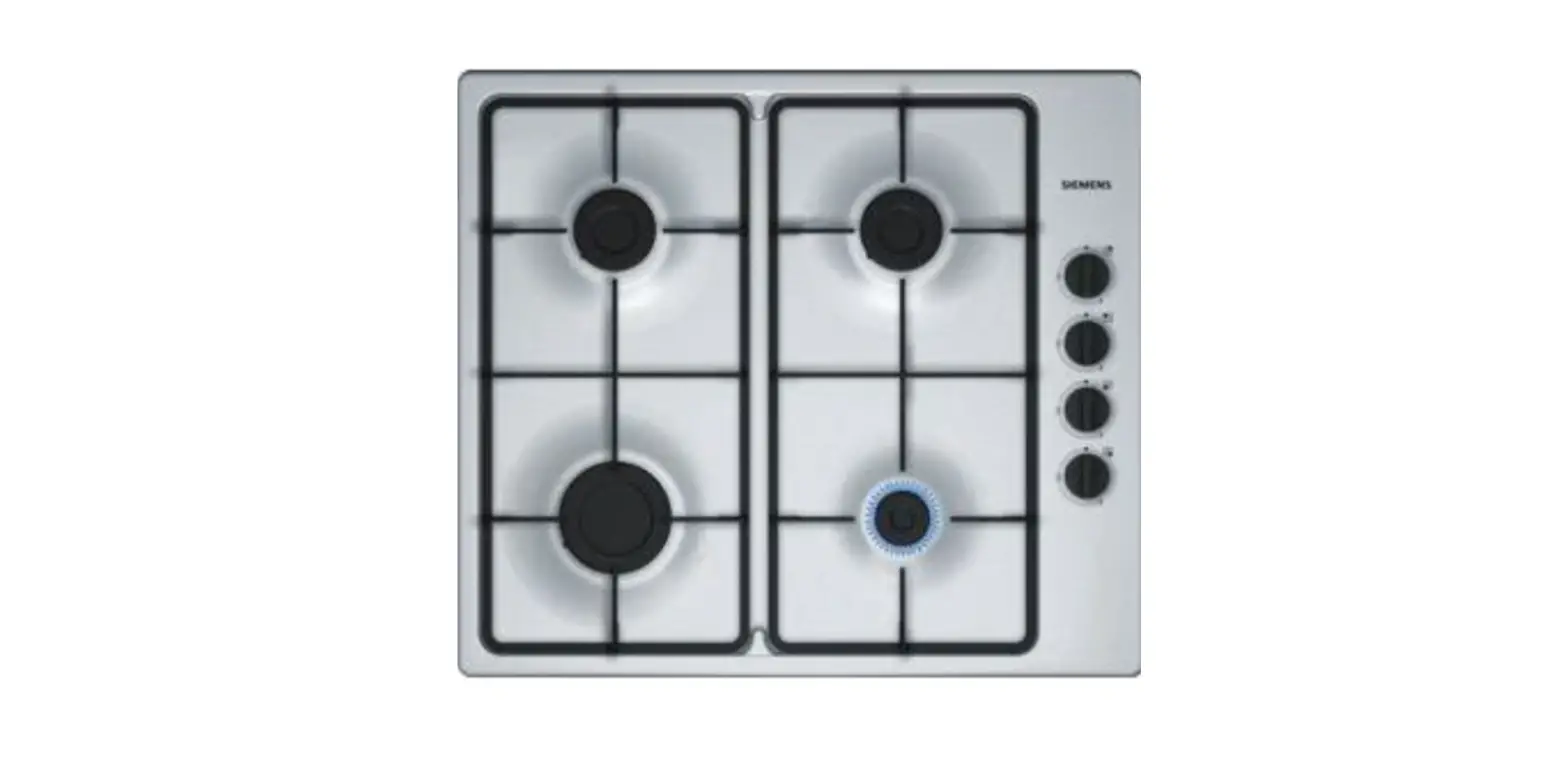
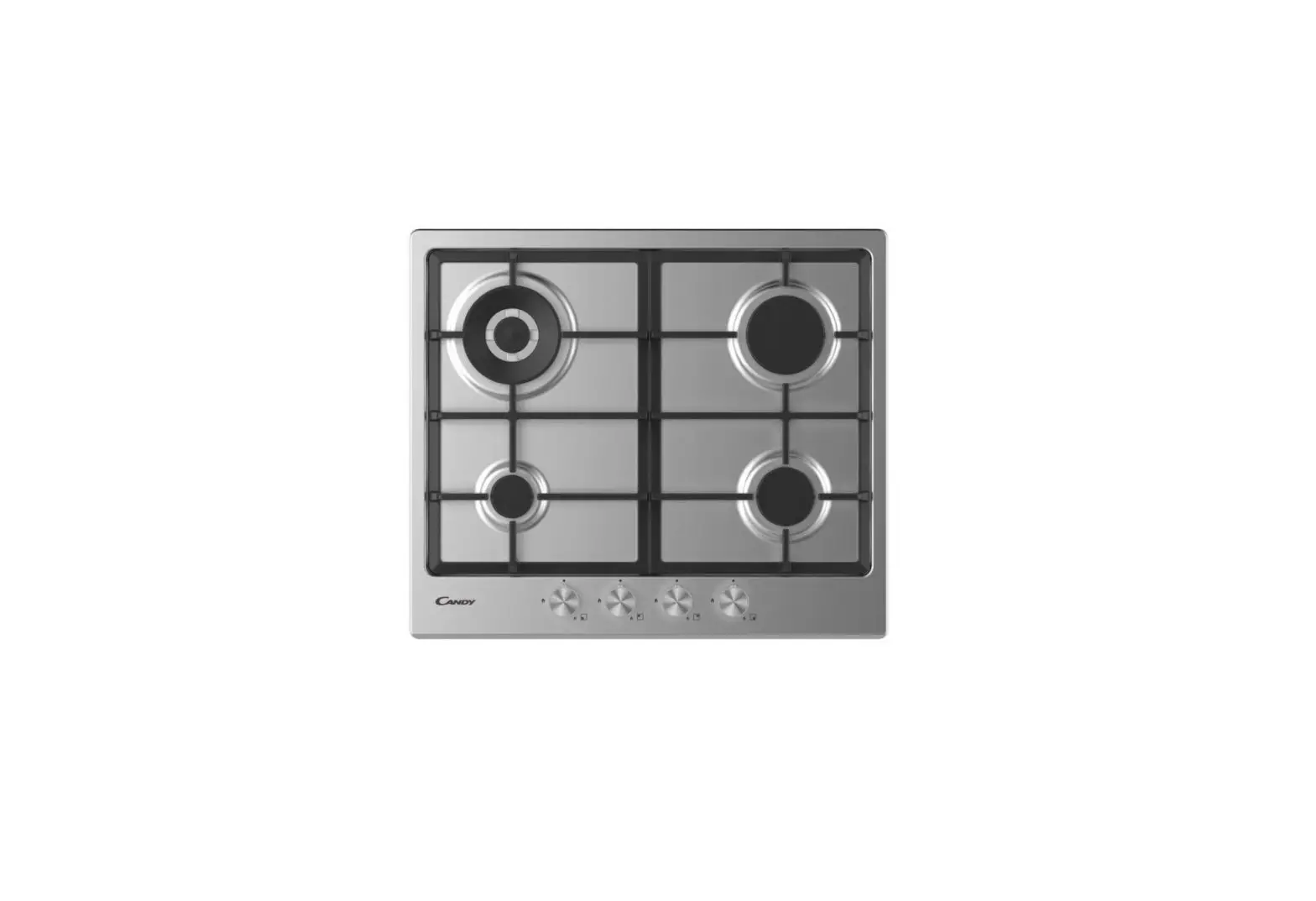
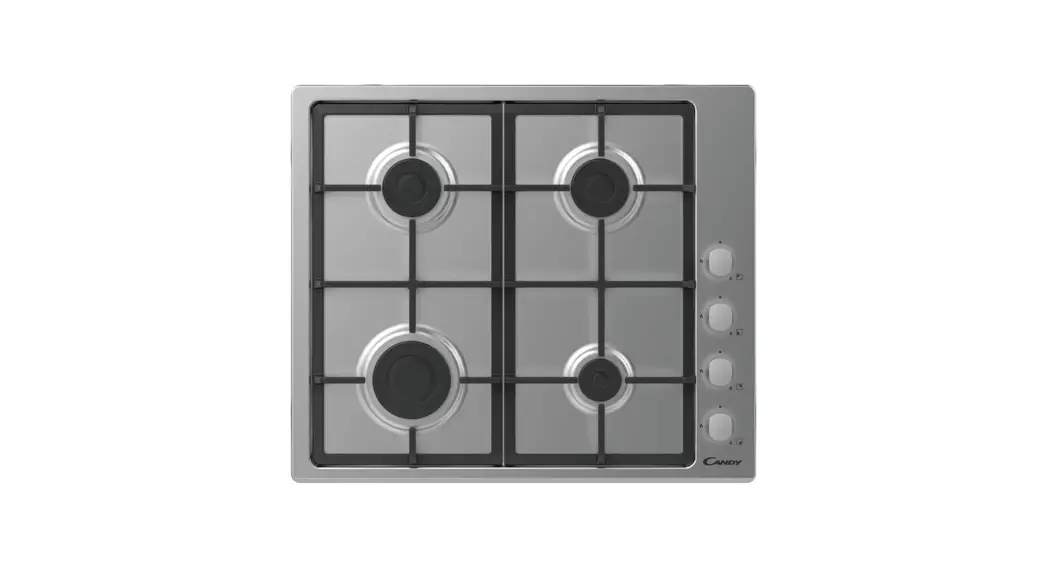
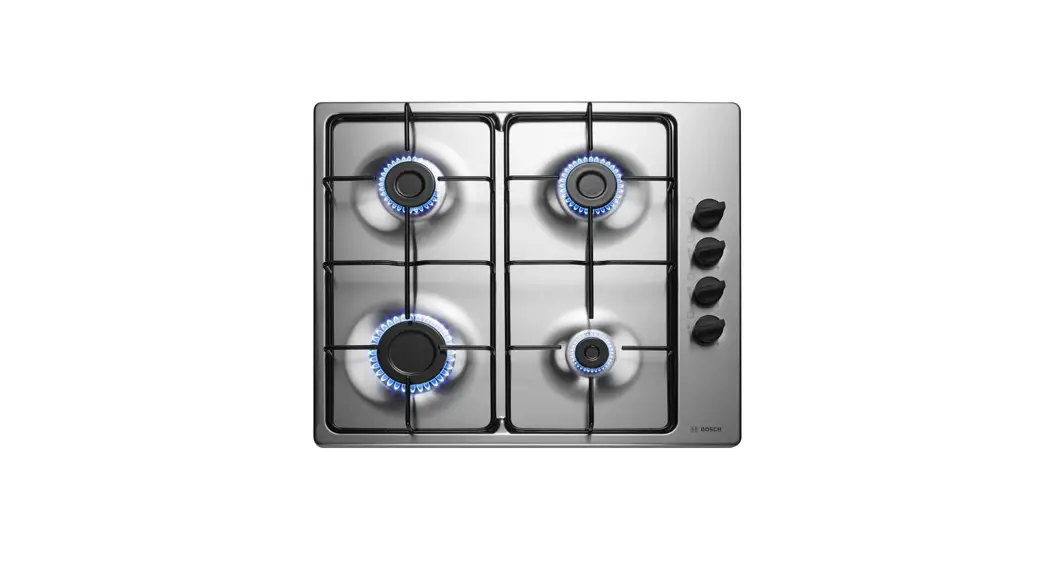
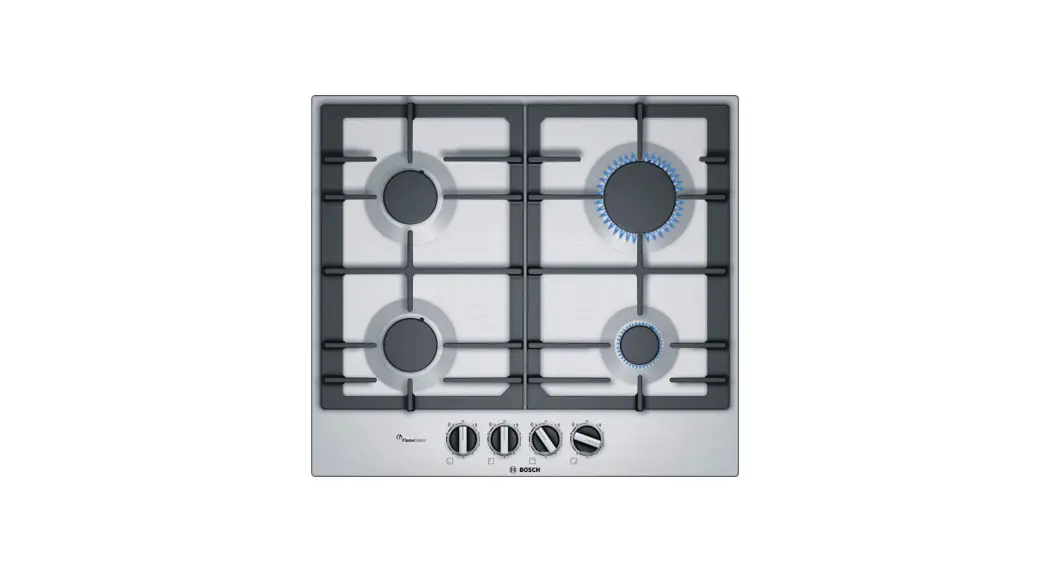
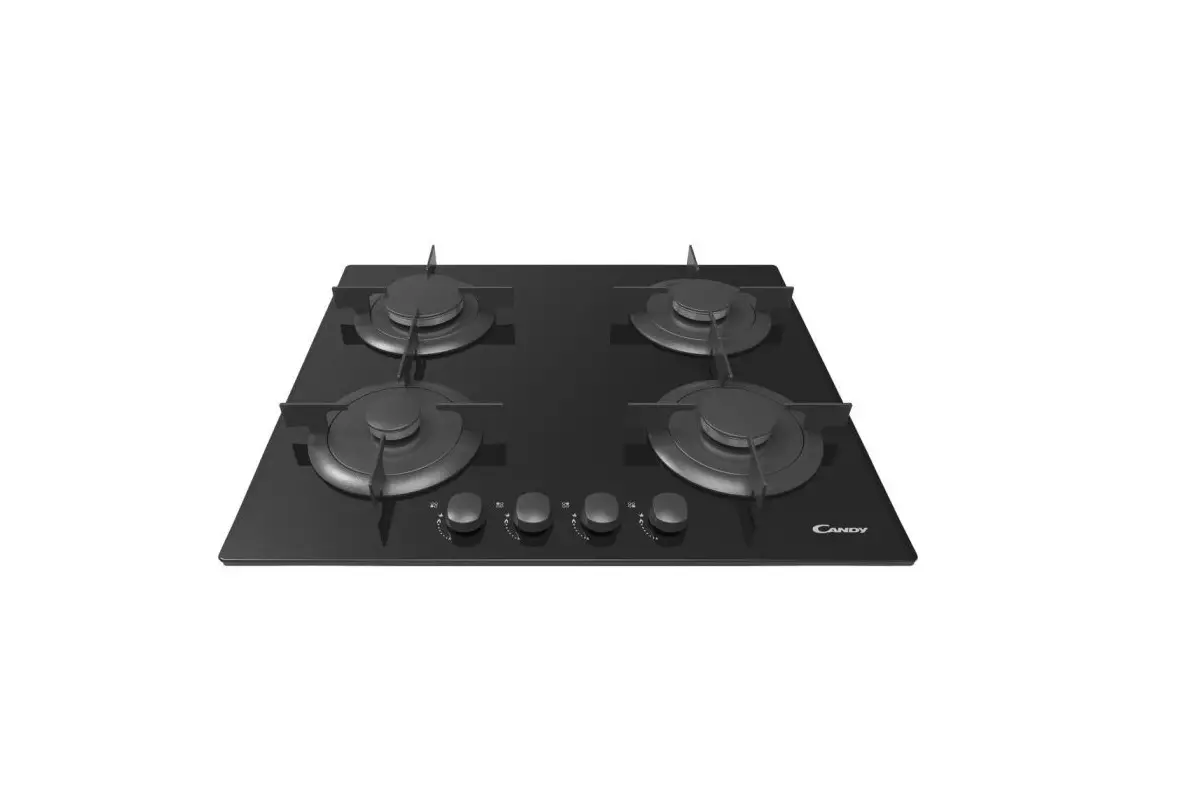
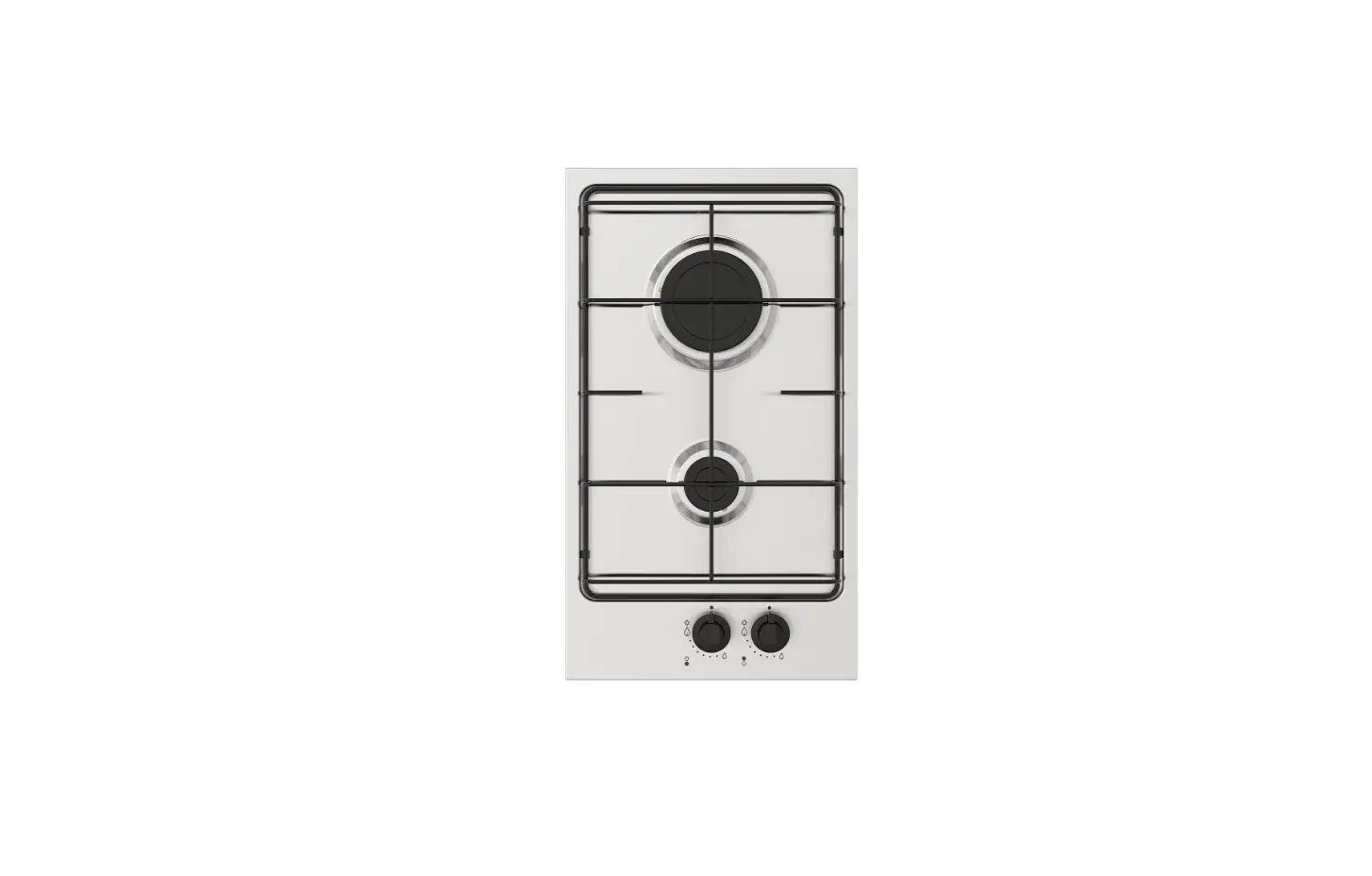
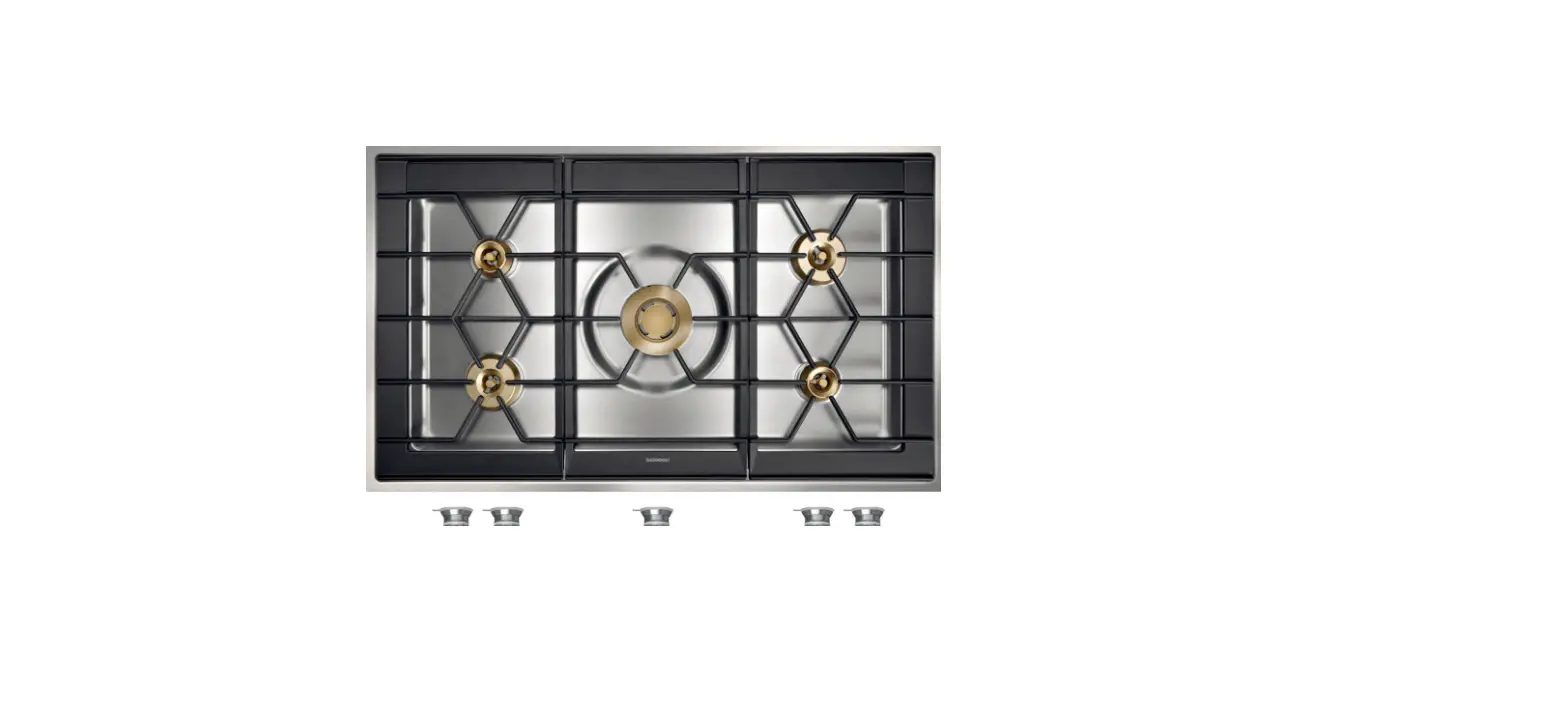
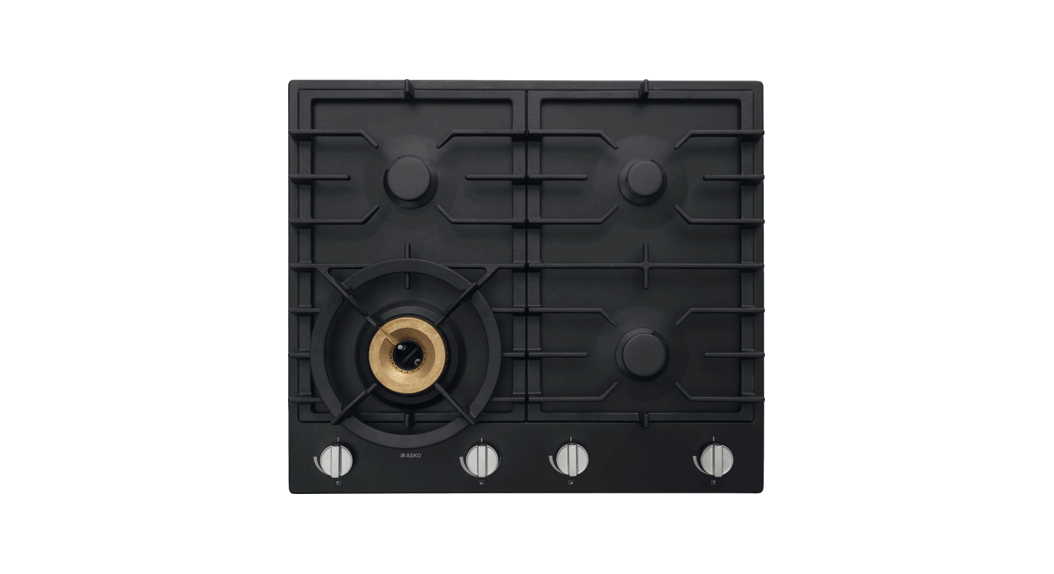
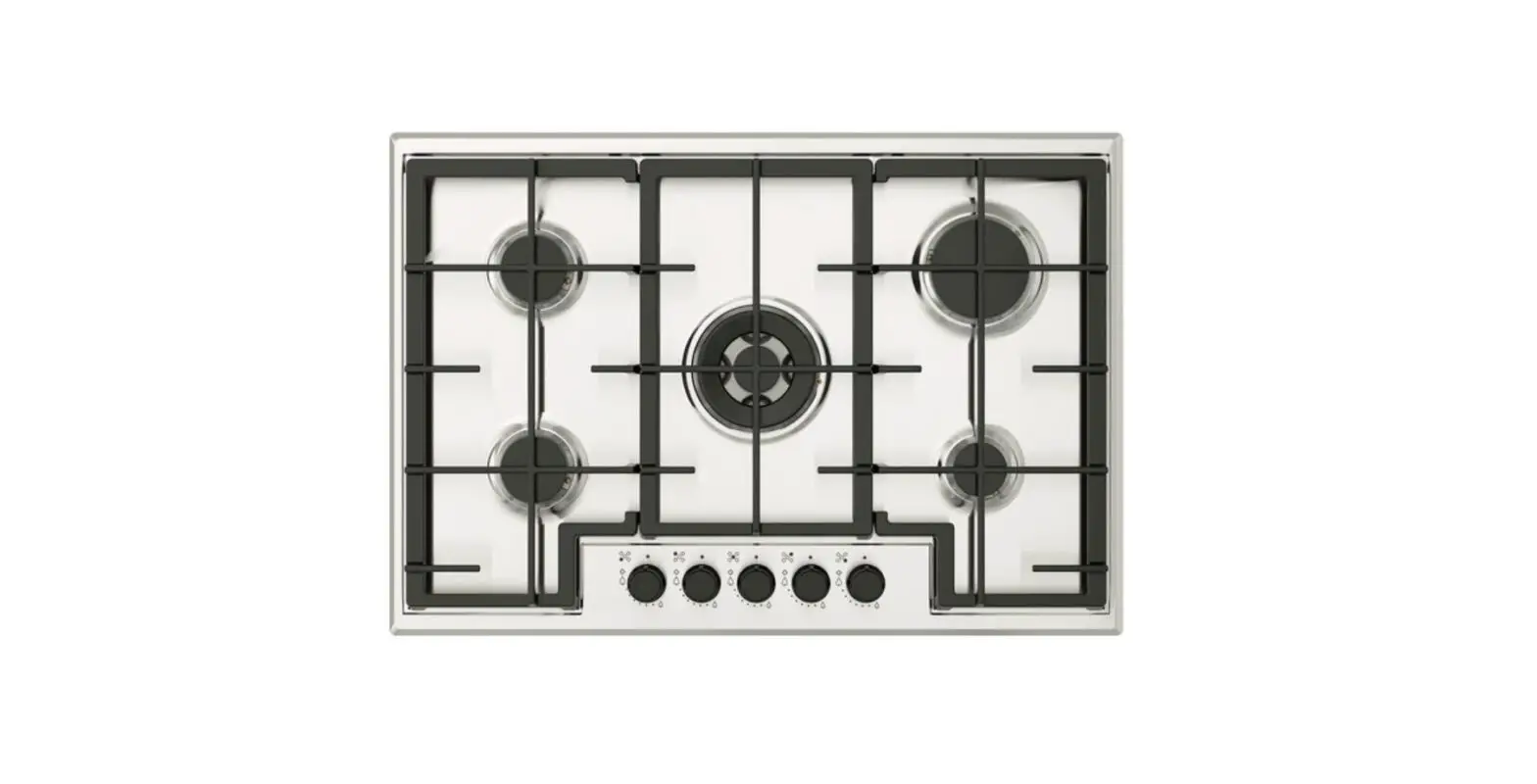
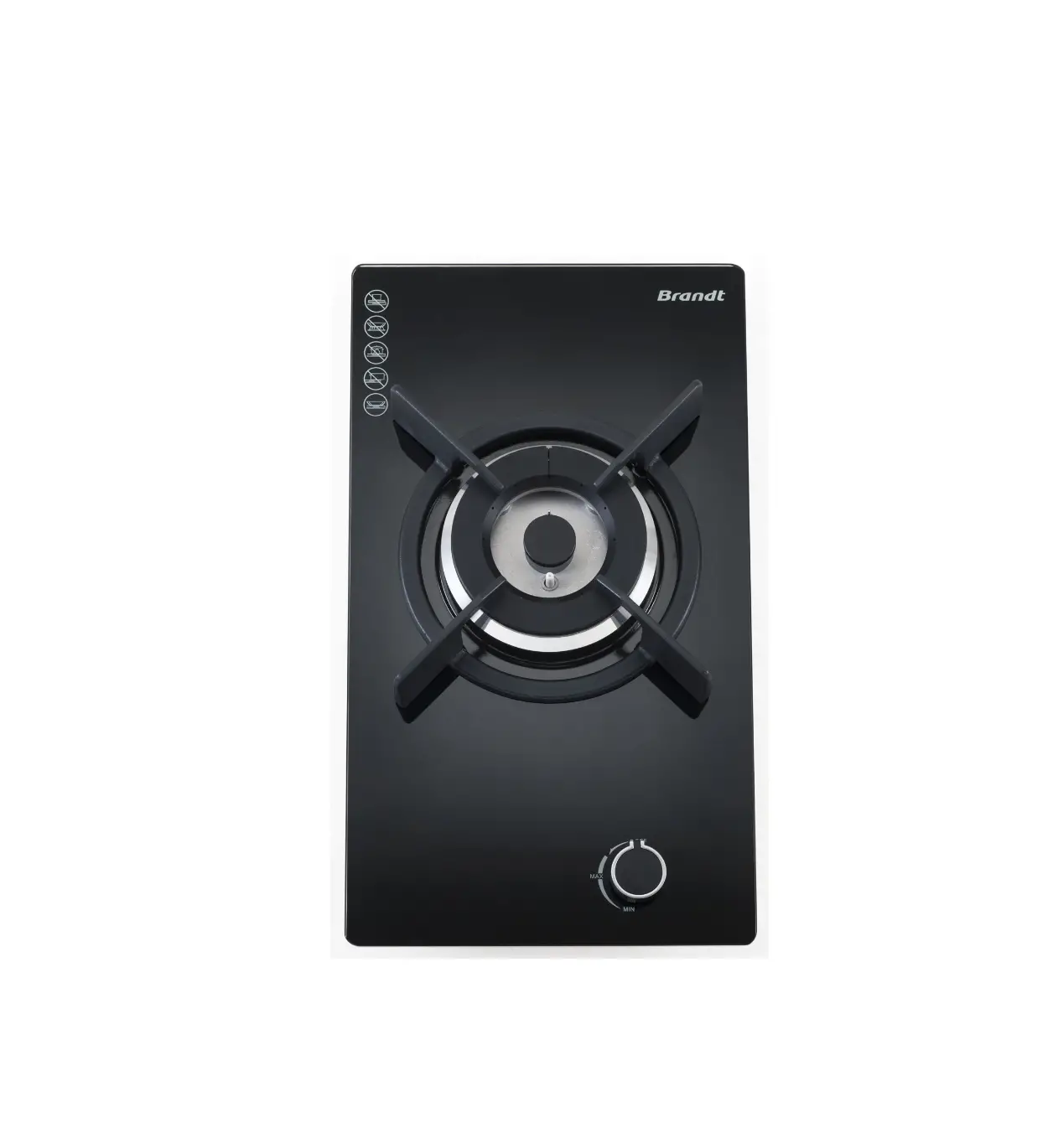
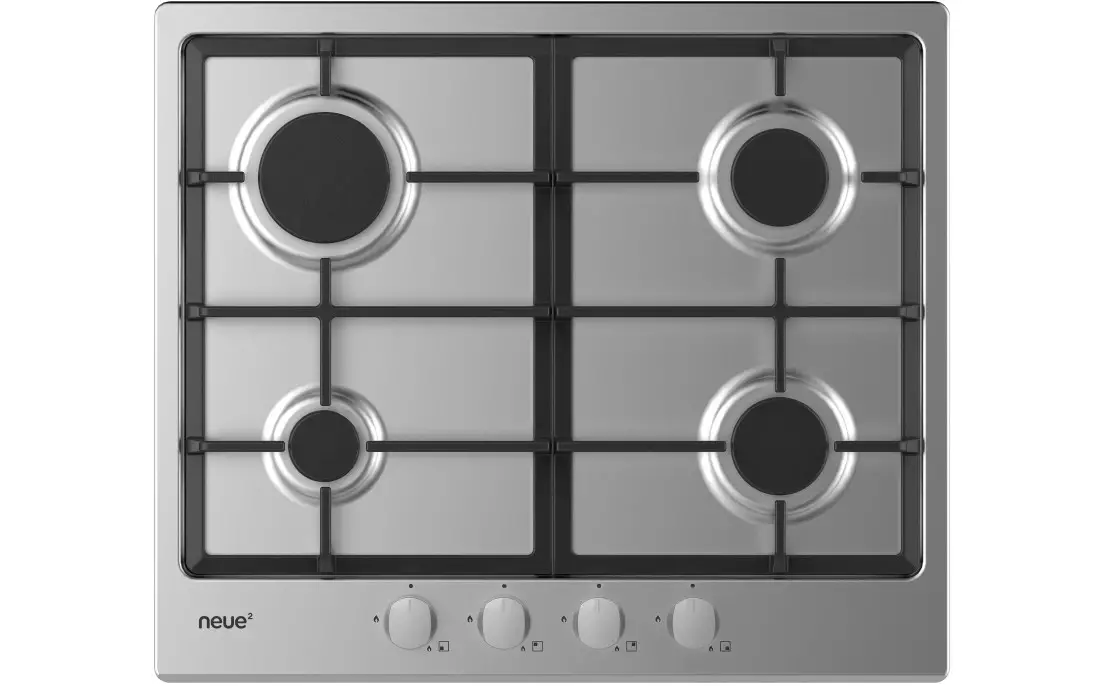
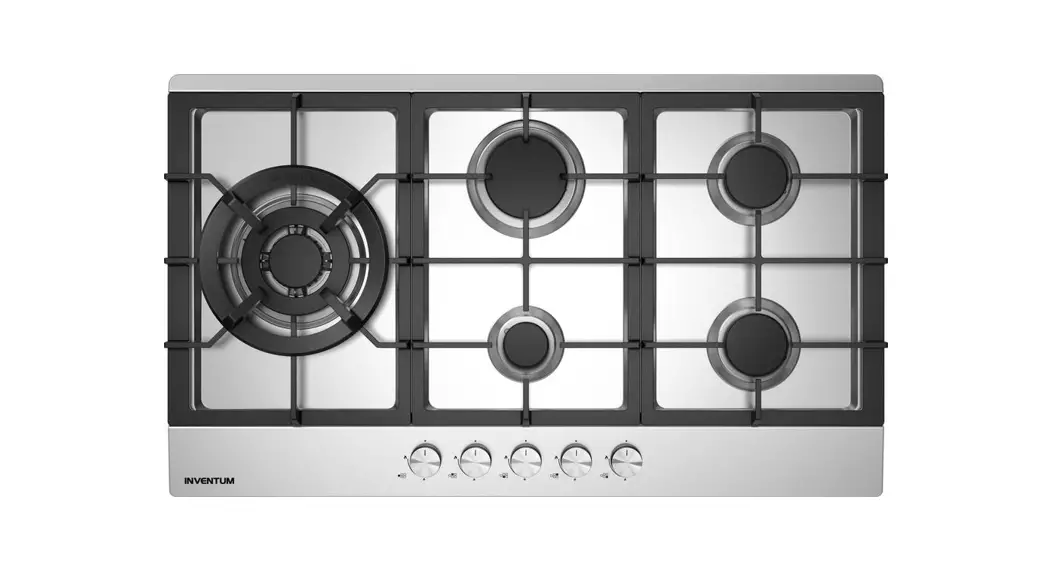
CHW6 Stainless Steel Built-in Gas 4 Zone Hobs
Product Information:
This product is a gas-powered cooking appliance that should be
installed in a well-ventilated space. It is designed for domestic
use only and must be connected to the main electricity supply. The
appliance requires an electrical connection and a gas connection.
It is important to follow the instructions provided in the user
manual for proper installation and usage.
Product Usage Instructions:
- Building In:
- If a hob of 60 cm is fitted above an oven without fan cooling,
openings must be created within the built-in furniture for air
circulation. The size of these openings should be at least 300
cm2. - When a 75 cm hob is fitted over a built-in oven, the oven must
be fan cooled.
- If a hob of 60 cm is fitted above an oven without fan cooling,
- Electrical Connection:
- The appliance must be connected to the mains supply following
the wiring instructions provided. - If the appliance does not have a supply cord and plug, means
for disconnection from the supply mains must be incorporated in the
fixed wiring.
- The appliance must be connected to the mains supply following
- Suitable Location:
- The appliance must be installed in accordance with the
regulations and used in a well-ventilated space.
- The appliance must be installed in accordance with the
- Gas Connection:
- For liquid gas (cylinder gas), use pressure regulators that
comply with the relevant national standards. - Use only pipes, washers, and sealing washers that comply with
the relevant national standards. - The gas connection should be carried out following the provided
sequence and using the specified parts. - After installation, check for leaks on the pipe connections
using a soapy solution. Do not use a flame for this check. - If gas can be smelt in the vicinity of the appliance, turn off
the gas supply and contact an engineer. Do not search for a leak
with a naked flame.
- For liquid gas (cylinder gas), use pressure regulators that
- Adapting the Hob to Different Types of Gas:
- Instructions for adapting the hob to different types of gas are
not provided in the given text-extract.
- Instructions for adapting the hob to different types of gas are
- Regulating the Minimum Flame:
- Instructions for regulating the minimum flame are not provided
in the given text-extract.
- Instructions for regulating the minimum flame are not provided
- Using the Gas Burner:
- If there is no electricity on the appliance, use a lighter to
ignite the burner by following these steps:- Push in and turn the knob anti-clockwise to the ignition
symbol. - While pushing in the button, ignite the burner using a
lighter. - Keep the button pushed in for 5 seconds after ignition.
- Push in and turn the knob anti-clockwise to the ignition
- If there is no electricity on the appliance, use a lighter to
HOBS USER INSTRUCTIONS TABLES DE CUISSON NOTICE D’EMPLOI VARNÉ DESKY NÁVOD POUZIT UND BEDIENUNGSANLEITUNG INSTALLATIONS ENCIMERAS INSTRUCCIONES DE USO INSTRUKCJE UYCIA I MONTAU ANKASTRE OCAK KULLANIM KLAVUZU NAVODILA ZA UPORABO VGRADNJO IN PRIKLJUCITEV PIANI COTTURA ISTRUZIONI PER L’USO PLACAS INSTRUÇÕES DE UTILIZAÇÃO TZHELYLAPOK HASZNÁLATI UTASÍTÁS PLITE MANUAL DE UTILIZARE KOOKPLAATS MANUAL DE UTILIZARE VARNÉ DOSKY NÁVOD NA OBSLUHU
012-22
GB 02 FR 06 CZ 10 DE 14 ES 18 PL 22 TR 26 RU 31 SI 36 IT 40 PT 44 HU 48 RO 52 NL 56 UK 60 SK 64
· CHG6 · CHW6
CANDY HOOVER GROUP S.R.L. · Via Comolli 16 · 20861 Brugherio (MB) Italy
SAFETY INSTURUCTIONS
We recommend you keep the instructions for installation and use for later reference, and before installing the hob, note its serial number in case you need to get help from the after sales service. WARNING: the appliance and its accessible parts become hot during use. Care should be taken to avoid touching heating elements. Children under 8 years of age must be kept away from the appliance unless they are continuously supervised. WARNING: use only hob guards designed by the Manufacturer of the cooking appliance or indicated by the Manufacturer of the appliance in the instructions for use as suitable or hob guards incorporated in the appliance. The use of inappropriate guards can cause accidents. WARNING: unattended cooking on a hob with fat or oil can be dangerous and may result in fire. NEVER try to extinguish a fire with water, but switch off the appliance and then cover flame e.g. with a lid or a fire blanket. WARNING: danger of fire: do not store items on the cooking surfaces. WARNING: if the surface is cracked, do not touch the glass and switch off the appliance to avoid the possibility of electric shock. This appliance can be used by children aged from 8 years and above and people with reduced physical, sensory or mental capabilities or lack of experience and knowledge if they have been given supervision or instruction concerning use of the appliance in a safe way and understand the hazards involved. Children should be supervised to ensure that they do not play with the appliance. Cleaning and user maintenance shall not be made by children without supervision. CAUTION: the cooking process must be supervised. A short term cooking process has to be supervised continuously. It is strongly recommended to keep children away from the cooking zones while they are in operation or when they are switched off, so long as the residual heat indicator is on, in order to prevent the risks of serious burns. This appliance is not intended to be operated by means of an external timer or separate remote control system. If present do not to stare into halogen lamp hob elements. Connect a plug to the supply cable that is able to bear the voltage, current and load indicated on the tag and having the earth contact. The socket must be suitable for the load indicated on the tag and must be having the earth contact connected and in operation. The earth conductor is yellow-green in color. This operation should be carried out by a suitably qualified professional. In case of
incompatibility between the socket and the appliance plug, ask a qualified electrician to substitute the socket with another suitable type. The plug and the socket must be conformed to the current norms of the installation country. Connection to the power source can also be made by placing an omnipolar breaker between the appliance and the power source that can bear the maximum connected load and that is in line with current legislation. The yellow-green earth cable should not be interrupted by the breaker. The socket or omnipolar breaker used for the connection should be easily accessible when the appliance is installed. The disconnection may be achieved by having the plug accessible or by incorporating a switch in the fixed wiring in accordance with the wiring rules. If the supply cord is damaged, it must be replaced by Manufacturer, its service agent or similarly qualified people in order to avoid a hazard. The earth conductor (yellow-green) must be longer than 10 mm on the terminal block side. The internal conductors section should be appropriate to the power absorbed by the hob (indicated on the tag). The type of power cable must be HO5V2V2-F. Do not put metallic objects such as knives, forks, spoons or lids on the hob. They could heat up. Aluminum foil and plastic pans must not be placed on heating zones. After every use, some cleaning of the hob is necessary to prevent the build-up of dirt and grease. If left, this is recooked when the hob is used and burns giving off smoke and unpleasant smells, not to mention the risks of fire propagation. Never use a steam or high pressure spray to clean the appliance. Do not touch the heat zones during operation or for a while after use. Never cook food directly on the glass ceramic hob. Always use the appropriate cookware.Always place the pan in the center of the unit that you are cooking on. Do not place anything on control panel. Do not use the hob as a working surface. Do not use the surface as a cutting board. Do not store heavy items above the hob. If they drop onto the hob, they may cause damage. Do not use the hob for storage of any items. Do not slide cookware across the hob. No additional operation/setting is required in order to operate the appliance at the rated frequencies
02 GB
1. INSTRUCTIONS FOR THE INSTALLER
INSTALLING A DOMESTIC APPLIANCE CAN BE A COMPLICATED OPERATION WHICH IF NOT CARRIED OUT CORRECTLY, CAN SERIOUSLY AFFECT CONSUMER SAFETY. IT IS FOR THIS REASON THAT THE TASK SHOULD BE UNDERTAKEN BY A PROFESSIONALLY QUALIFIED PERSON WHO WILL CARRY IT OUT IN ACCORDANCE WITH THE TECHNICAL REGULATIONS IN FORCE. IN THE EVENT THAT THIS ADVICE IS IGNORED AND THE INSTALLATION IS CARRIED OUT BY AN UNQUALIFIED PERSON, THE MANUFACTURER DECLINES ALL RESPONSIBILITY FOR ANY TECHNICAL FAILURE OF THE PRODUCT WHETHER OR NOT IT RESULTS IN DAMAGE TO GOODS OR INJURY TO INDIVIDUALS.
1.1 BUILDING IN
2.1. ELECTRICAL CONNECTION
The hob may be installed in any worktop which is heat resistant to a temperature of 100°C, and has a thickness of 25-45 mm. The dimensions of the insert to be cut out of the worktop are in shown in Figure 2. When there is an accessible space between the built-in hob and the cavity below, a dividing wall made of insulating material should be inserted (wood or a similar material) (Figure 3). If the hob is fitted next to a cabinet on either side, the distance between the hob and the cabinet must be at least 15 cm; while the distance between the cut out and the rear wall must be at least 7 cm. The distance between the hob and any other unit or appliance above it (e.g. An extractor hood) must be no less than 70 cm (Figure 4). Metal objects in the drawer may reach high temperatures due to air recirculation. It is therefore recommended to use an intermediate wood panel. Important – The diagram in figure 1 shows how the sealant should be applied. The Hob unit is fitted by attaching the Fixing Clamps supplied, using the holes at the base of the unit.
Check the data on the rating plate, located on the outside of the unit, to ensure that the supply and input voltage are suitable. Before connection, check the earthing system. By Law, this appliance must be earthed. If this regulation is not complied with, the Manufacturer will not be responsible for any damage caused to persons or property. If a plug is not already attached, fit a plug appropriate to the load indicated on the rating plate. The earth wire is coloured yellow/green. The plug should always be accessible. Where the Hob is connected direct to the electricity supply, a circuit breaker must be fitted. If the power supply cord is damaged this is to be replaced by a qualified engineer so as to prevent any potential risk. The earth wire ( green and yellow coloured ) must be at least 10 mm longer than the live and neutral wires. The section of the cable used must be of the correct size in relation to the absorbed power of the hob. Please check rating plate for the power details and ensure that the power supply cord is of the type 3×0.75 mm² H05 V2V2-F.
If a hob of 60 cm is fitted above an oven which is not equipped with fan
cooling system it is recommended that openings are created within the
LIVE
L Brown Wire
built in furniture to ensure correct air circulation. The size of these openings must be at least 300 cm2 and placed as shown in Figure 5.
Mains Supply EARTH
Green/Yellow Wire
NEUTRAL N Blue Wire
Power Cable
When a 75 cm hob is fitted over a built in oven, the latter must be fan
cooled.
If an appliance is not fitted with a supply cord and a plug, or with other
means for disconnection from the supply mains having a contact
1.2. SUITABLE LOCATION
This appliance must be installed in accordance with the regulations in force and only used in a well ventilated space. Read the instructions before installing or using this appliance.
separation in all poles that provide full disconnection under overvoltage category III conditions, the instructions shall state that means for disconnection must be incorporated in the fixed wiring in accordance with the wiring rules.
A gas-powered cooking appliance produces heat and humidity in the area in which it is installed. For this reason you should ensure good
2.2. GAS CONNECTION
ventilation either by keeping all natural air passages open or by installing an extractor hood with an exhaust flue. Intensive and prolonged use of the appliance may require extra ventilation, such as the opening of a window or an increase in speed of the electric fan, if you have one. If a hood can not be installed, an electric fan should be fitted to an outside wall or window to ensure that there is adequate ventilation. The electric fan should be able to carry out a complete change of air in the kitchen 3-5 times every hour. The installer should follow the relevant national standards.
These instructions are for qualified personnel, installation of equipment must be in line with the relevant national standard. (For U.K. only: by law the gas installationcommissioning must be carried out by a “Gas Safe” installer) All work must be carried out with the electricity supply disconnected. The rating plate on the hob shows the type of gas with which it is designed to be used. Connection to the mains gas supply or gas cylinder should be carried out after having checked that it is regulated for the type of gas with which it will be supplied. If it is not correctly regulated see the instructions in the following paragraphs to change
gas setting.
2. ELECTRICAL CONNECTION (FOR U.K. ONLY)
For liquid gas (cylinder gas) use pressure regulators which comply with the relevant national standards.
Warning – this appliance must be earthed This appliance is designed for domestic use only. Connection to the main
Use only pipes,washers and sealing washers which comply with the relevant national standards.
supply must be made by a competant electrician, ensuring that all current regulations concerning such installations are observed. The appliance must only be connected to a suitably rated spur point, a 3 pin 13 amp plug/socket is not suitable. A double pole switch must be provided and the circuit must have appropriate fuse protection. Further details of the power requirement of the individual product will be found in the users’ instruction and on the appliance rating plate. In the case of built-in product you are advised, should you wish to use a longer cable than the one supplied, that a suitably rated heat resistant type must be used.
For some models a conic link is furnished to outfit for the installation in the countries where this type of link is obligatory; in picture 8 it is pointed out how to recognize the different types of links (CY = cylindrical, CO = conic). In every case the cylindrical part of the link has to be connected to the hob. When connecting the hob to the gas supply via use offlexible hoses please ensure that the maximum distance covered by the hose does not exceed 2 metres. The flexible tube shall be fitted in such a way that it cannot come into contact with a moveable part of the housing unit (e.g. a drawer) and does
The wiring must be connected to the mains supply as follows:
CONNECT
TO SPUR TERMINAL
not pass through any space where it may become crushed/ kinked or damaged in any way.
Green & Yellow Wire Blue Wire Brown Wire
Earth Connection Neutral Connection Live Connection
To prevent any potential damage to the hob please carry out the installation following this sequence (picture 6):
Note: We do not advocate the use of earth leakage devices with electric cooking appliances installed to spur points because of the «nuisance tripping» which may occur. You are again reminded that the appliance must be correctly earthed, the manufacturer declines any responsibility for any event occurring as a result of incorrect electrical installation.
1)As illustrated, assemble parts in sequence: A: 1/2 Male Adaptor Cylindirical B: 1/2 Seal C: 1/2 Female Gas Adaptor Conical-Cylindirical or
Cylindirical-Cylindirical
03 GB
2)Tighten the joints with the spanner, remembering to twist the pipes into position.
3)Attach fitting C to mains gas supply using rigid copper pipe or flexible steel pipe.
IMPORTANT: carry out a final check for leaks on the pipe connections using a soapy solution. NEVER USE A FLAME. Also, make sure that the flexible pipe cannot come into contact with a moving part of the cabinet (eg.adrawer) and that it is not situated where it could be damaged.
Warning: If gas can be smelt in the vicinity of this appliance turn off the gas supply to the appliance and call the engineer directly. Do not search for a leak with a naked flame.
2.3. ADAPTING THE HOB TO DIFFERENT TYPES OF GAS
To adapt the Hob for use with different types of gas, carry out the following instructions: ·Remove the grids and burners ·Insert on hexagonal spanner (7 mm) into the burner support (Figure 7) ·Unscrew the injector and replace it with one suitable for the gas to be used (see gas type table)
2.4. REGULATING THE MINIMUM FLAME
3.1. USING THE GAS BURNER
To ignite the burners, place a lighted taper close to the burner, press in and turn the control knob anti-clockwise. If the burners have not been used for a couple of days, wait for a few seconds before lighting the burner, this will allow any air present in the pipes to escape. For appliances fitted with electronic ignition carry out the following: · Push in and turn the knob anticlockwise to the ignition symbol. · gnite the burner by pressing the sparker button. For hobs fitted with automatic ignition simply push in and turn the knob to the ignition symbol. The ignition system will continue to generate sparks as long as the control knob is being pressed. If the burner has not ignited within 5 seconds, turn the knob to the 0 position and repeat the operation. For models fitted with a safety tap (which cuts-off the flow of gas if the flame is accidentally extinguished) the burners are ignited and described above, but care must be taken. Prior to switching on the gas hob ensure that the burners and burner caps are correctly placed within their position.
Warning: If there is no electricity on appliance, to ignite the burner a lighter should be used; – Push in and turn the knob anti-clockwise to the ignition symbol, – While pushing in the button ignite the burner by using a lighter and keep button pushed in 5 seconds after ignition.
GENERAL ADVISE For best results, use cooking vessels with a flat surface. The size of the surface should match the gas burner side as follows. Table A.
After lighting the burners, turn the control knob to the minimum setting and then remove the knob (this can easily be removed by applying gentle pressure). Using a small «Terminal» type screwdriver the regulating screw can be adjusted as in Figure 9. Turning the screw clockwise reduces the gas flow, whilst turning it anticlockwise increases the flow Use this adjustment to obtain a flame of approximately 3 to 4 mm in length and then replace the control knob. When the gas supply available is LPG – the screw to set the idle flame must be turned (clockwise) to the end stop. When you have carried out the new gas regulation, replace the old gas rating plate on your appliance with one (supplied with hob) suitable for the type of gas for which it has been regulated.
3. USE OF HOB – USER INSTRUCTIONS
This appliance must only be used for the purpose for which it is intended, domestic cooking, and any other use will be considered improper and could therefore be dangerous. The Manufacturer will not be responsible for any damage or loss resulting from improper use.
Before using burner, be sure, grid perimeters center the burner as below figure. If you are using Cast Iron Grids; underneath the grid, position of it is stated. Be sure for the exact grid is used in correct position.
Burner Type
Ø pan/pot Power G20/20 mbar G30/28-30 mbar
(cm)
(kW) (methane)
(LPG)
AUX Auxiliary
10 – 18 1,00
95 l/h
73 g/h
SR Semi Rapid 12 – 22 1,75 167 l/h
127 g/h
R Rapid
16 – 26 2,70 257 l/h
196 g/h
UR Ultrarapid 16 – 26 3,50 334 l/h
255 g/h
DC 4 kW MONO 16 – 26 4,00 381 l/h
291 g/h
Table A
For smaller containers the gas burner should be regulated so that the flame does not overlap the base of the pan. Vessels with a concave or convex base should not be used. WARNING: If a flame is accidentally extinguished, turn the knob to the off position and do not attempt to re-ignite if for at least 1 minute. If over the years the gas taps become stiff to turn it is necessary to lubricate them. Such operation must be carried out only by qualified Service Engineers.
4. MAINTENANCE AND CLEANING
Before cleaning the hob, ensure the appliance has cooled down. Remove the plug from the socket or (if connected directly) switch off the electricity supply.
Cleaning and user maintenance shall not be made by children without supervision
Never use abrasives, corrosive detergents, bleaching agents or acids. Avoid any acid or alkaline substances (lemon, juice, vinegar etc.) on the enamelled, varnished or stainless steel sections.
When cleaning the enamelled, varnished or chrome sections, use warm soapy water or a non caustic detergent. For stainless steel use an appropriate cleaning solution.
The burners can be cleaned with soapy water. To restore their original shine, use a household stainless steel cleaner. After cleaning, dry the burners and replace. It is important the Burners are replaced correctly.
Chromed grids and burners Chromed grids and burners have a tendency to discolour with use. This does not jeopardize the functionality of the hob.
Our After Sales Service Centre can provide spare parts if required. 04 GB
5. AFTERCARE
Before calling out a Service Engineer please check the following: · that the plug is correctly inserted and fused; · that the gas supply is not faulty.
If the fault cannot be detected: Switch off the appliance and call the After Service Centre. DO NOT TAMPER WITH THE APPLIANCE.
6. PROTECTION OF THE ENVIRONMENT
This appliance is marked according to the European directive 2012/19/EU on Waste Electrical and Electronic Equipment (WEEE). WEEE contains both polluting substances (which can cause negative consequences for the environment) and basic components (which can be re-used). It is important to have WEEE subjected to specific treatments, in order to remove and dispose properly all pollutants, and recover and recycle all materials. Individuals can play an important role in ensuring that WEEE does not become an environmental issue; it is essential to follow some basic rules: · WEEE shall not be treated as household waste. · WEEE shall be handed over to the relevant collection points managed by the municipality or by registered companies. In many countries, for large WEEE, home collection could be present. · When you buy a new appliance, the old one may be returned to the retailer who has to collect it free of charge on a one-to-one basis, as long as the equipment is of equivalent type and has the same functions as the supplied equipment.
The Manufacturer will not be responsible for any inaccuracy resulting from printing or transcript errors contained in this brochure. We reserve the right to carry out modifications to products as required, including the interests of consumption, without prejiudice to the characteristics relating to safety or function.
“Val d only for Cyprus”
Table 1
Burner Plate Burner Type FFD Aux 1kW Sr 1,75 kW R 2,7 kW UR 3,5 kW Dc 4 kW Mono
4 Gas Aux/SR/R/DC 4 Mono
UH60MF YES 1 1 1 1
4 Gas Aux/2SR/R UH60MF
YES 1 2 1 –
5 Gas UR/2R/SR/AUX
UH75MF YES 1 1 2 1 –
Nominal Heat Input
9,45 kW
7,2 kW
11,65 kW
G20/20 mbar G30/28-30 mbar Installation Class Voltage V/Frequency Hz Electrical Input Power Electric Ignition Product Dimension
900 l/h 688 g/h
3 220-240 V/ 50-60 Hz
1 YES 595×510
686 l/h 524 g/h
3 220-240 V/ 50-60 Hz
1 YES 595×510
1110 l/h 848 g/h
3 220-240 V/ 50-60 Hz
1 YES 745×510
This appliance has been designed for non-professional, i.e. domestic, use.
5 Gas DC/2R/SR/AUX
UH75MF YES 1 1 2 1
12,15 kW
1158 l/h 884 g/h
3 220-240 V/ 50-60 Hz
1 YES 745×510
5 Gas DC/R/2SR/AUX
UH75MF YES 1 2 1 1
11,2 kW
1067 l/h 815 g/h
3 220-240 V/ 50-60 Hz
1 YES 745×510
3 Gas Aux/R/DC 4 Mono
UH60MF YES 1 1 1
7,7 kW
734 l/h 560 g/h
3 220-240 V/ 50-60 Hz
1 YES 595×510
05 GB
CONSIGNES DE SÉCURITÉ
Nous vous recommandons de conserver les instructions d’installation et d’utilisation pour pouvoir les consulter ultérieurement. Avant d’installer la table de cuisson, notez son numéro de série, au cas où vous auriez besoin de l’aide du service après-vente. AVERTISSEMENT : l’appareil et ses parties accessibles chauffent pendant l’utilisation. Évitez de toucher les éléments chauffants. Les enfants de moins de 8 ans doivent être tenus hors de portée de l’appareil, sauf s’ils sont surveillés en permanence. AVERTISSEMENT : n’utilisez qu’un dispositif de protection de votre table de cuisson conçu par le fabricant de votre appareil ou indiqué, dans le manuel d’utilisation, comme étant compatible, ou bien le dispositif de protection fourni avec l’appareil. L’utilisation d’un dispositif de protection non approprié peut causer des accidents. AVERTISSEMENT : l’utilisation de la table de cuisson sans surveillance avec manipulation de graisse ou d’huile peut être dangereux et provoquer un incendie. N’essayez JAMAIS d’éteindre un feu avec de l’eau, mais éteignez l’appareil, puis couvrez la flamme avec un couvercle ou une couverture anti-feu, par exemple. AVERTISSEMENT, risque d’incendie : ne stockez pas d’éléments sur les surfaces de cuisson. AVERTISSEMENT : si la surface est fissurée, ne touchez pas le verre de la table et éteignez l’appareil pour éviter tout risque d’électrocution. Cet appareil peut être utilisé par des enfants âgés de 8 ans et plus, par des personnes dont les capacités physiques, sensorielles ou mentales sont réduites ou par des personnes dénuées d’expérience et de connaissances, mais qui ont été informées sur la manière d’utiliser l’appareil en toute sécurité, si elles comprennent les risques impliqués. Surveillez les enfants afin qu’ils ne jouent pas avec l’appareil. L’entretien et le nettoyage ne doivent pas être effectués par des enfants sans surveillance. ATTENTION : la cuisson demande d’être surveillée. Les cuissons de courte durée doivent être surveillées en permanence. Il est chaudement recommandé d’éloigner les enfants de la zone de cuisson lorsqu’elle fonctionne ou même quand elle est éteinte, mais que l’indicateur de chaleur résiduelle est encore visible, afin d’éviter tout risque de brûlures graves. Cet appareil n’est pas conçu pour être actionné par un temporisateur externe ou un système séparé de commande à distance. Si votre table de cuisson est dotée d’éléments halogènes, n’en fixez pas la lumière. Brancher le câble d’alimentation sur une prise de courant qui supporte le voltage (le courant et la charge sont indiqués sur l’étiquette) et vérifier la présence d’une mise à la terre. La prise d’alimentation doit supporter la charge indiquée sur l’étiquette et être dotée d’une mise à la terre en état de fonctionnement. Le câble conducteur de mise à la terre est jaune et vert. Cette opération doit être exécutée par du personnel qualifié. En cas d’incompatibilité entre la prise d’alimentation et la fiche du câble de l’appareil, demander à un électricien professionnel de remplacer la prise
d’alimentation par un dispositif compatible. La fiche du câble d’alimentation et la prise d’alimentation doivent être conformes aux normes en vigueur dans le pays d’installation. Il est possible de brancher l’appareil à la prise d’alimentation en installant un disjoncteur multipolaire qui supporte la charge électrique maximale, conformément aux lois en vigueur, entre l’appareil et la prise d’alimentation. Le conducteur jaune et vert de mise à la terre ne doit pas être bloqué par le disjoncteur. La prise d’alimentation ou le disjoncteur multipolaire utilisé pour le branchement doit rester à tout moment accessible lors de l’installation de l’appareil. Le débranchement doit se faire en accédant à la prise d’alimentation ou en prévoyant un interrupteur sur le circuit électrique fixe, conforme aux normes électriques. Si le câble d’alimentation est endommagé, il doit être remplacé par le fabricant, son agent d’entretien ou des personnes dotées du même type de qualification, afin d’éviter tout risque. Le conducteur de mise à la terre (jaune et vert) doit être plus long de 10 mm du côté de la plaque à bornes. Le diamètre interne du câble conducteur doit être proportionné à la puissance absorbée par la table de cuisson (indiquée sur l’étiquette). Le câble d’alimentation requis est le suivant : H05V2V2-F. Ne déposez jamais d’objets en métal, tels que des couteaux, fourchettes, cuillers ou couvercles sur la table de cuisson. Ils pourraient devenir brûlants. Ne posez jamais de papier aluminium ou de récipients en plastique sur les zones chauffantes. Après chaque utilisation, il convient de nettoyer la table de cuisson, afin d’éviter l’accumulation de saleté et de graisse. Dans le cas contraire, les résidus risquent de brûler lors de la prochaine utilisation de la table de cuisson, causant fumées et odeurs déplaisantes, pour ne pas mentionner les risques d’incendie. N’utilisez jamais de vaporisateur, ni de jet à haute pression pour nettoyer l’appareil. Ne touchez pas les zones chauffantes pendant qu’elles fonctionnent, ni pendant un certain temps après leur utilisation. Ne faites jamais cuire d’aliments directement sur la table de cuisson vitrocéramique. Utilisez toujours des ustensiles de cuisson adéquats. Placez toujours votre casserole au centre du foyer que vous utilisez. Ne déposez jamais aucun objet sur le panneau de commande. N’utilisez jamais votre table de cuisson comme plan de travail. N’utilisez pas la surface de la table de cuisson comme planche à découper. Ne rangez pas d’objets lourds sur votre table de cuisson. S’ils tombaient sur la table de cuisson, ils risqueraient de l’endommager. N’utilisez pas la table de cuisson pour ranger des objets. Ne faites pas glisser d’ustensiles de cuisine sur la table de cuisson. Aucun réglage/opération supplémentaire n’est requis pour faire fonctionner l’appareil aux fréquences nominales
06 FR
1. INSTALLATION
La mise en place fonctionnelle des appareils ménagers dans leur environnement est une opération délicate qui, si elle n’est pas correctement effectuée, peut avoir de graves conséquences sur la sécurité des consommateurs. Dans ces conditions, il est impératif de confier cette tâche à un professionnel qui la réalisera conformément aux normes techniques en vigueur. Si malgré cette recommandation, le consommateur réalisait lui-même l’installation, le constructeur déclinerait toute responsabilité en cas de défaillance technique du produit entraînant ou non des dommages aux biens et/ou aux personnes.
1.1. ENCASTREMENT
Le fil de terre (couleur vert et jaune) doit être au moins 10mm plus long que les fils de phase et neutre.
Le meuble ou le support dans lequel doit être encastrée la table, ainsi que les parois du meuble qui pourraient juxtaposer celui-ci, doivent être d’une matière résistant à une température élevée (jusqu’à 100°C) et d’une épaisseur comprise entre 25 et 45 mm. Les dimensions d’encastrement sont indiquées sur le schéma 2.
La section du câble utilisé doit être de la bonne taille par rapport à la puissance absorbée de la table de cuisson. Veuillez vérifier la plaque signalétique pour les détails de puissance et veiller à ce que le cordon d’alimentation électrique soit de type 3×0.75 mm² l’H05 V2V2-F.
Si, en fonction de l’installation de la table, la partie inférieure de son caisson se trouve à proximité d’une zone normalement accessible lors de manipulations et/ou de rangements, placer une cloison (bois ou similaire) pour éviter tous risques de brûlure ou de détérioration (schéma 3). Si la plaque de cuisson est installée juste à côté d’un meuble, la
Alimentation
PHASE L TERRE NEUTRE N
Fil Marron Fil Vert/jaune Fil Bleu
Câble électrique d’alim
distance entre la plaque de cuisson et le meuble doit être d’au moins 15 cm, tandis que la distance entre la découpe et le mur situé à l’arrière doit être d’au moins 7 cm. La distance entre la découpe et la paroi
Un système de déconnexion doit être incorporé dans le compteur conformément aux règles de câblage.
arrière doit être d’au moins 7 cm. La distance entre la table et tout autre appareil ou meuble situé au dessus (par exemple une hotte) doit être au moins de 70 cm (voir schéma 4). Les objets en métal contenus dans le tiroir peuvent atteindre une température très élevée, à cause du système de recirculation d’air. Il est donc recommandé d’interposer un panneau en bois. Attention : Lors de la mise en place, un soin particulier doit être porté au joint entourant le bord de la table afin d’éviter toute infiltration dans le meuble support (schéma 1). Lors de la mise en place du joint sur la partie arrière, veiller à ne pas obstruer les passages d’air nécessaires à la combustion.
2.2. RACCORDEMENT GAZ
L’appareil doit être installé et raccordé conformément aux règles En vigueur dans le pays d’installa-tion. Une attention particulière sera accordée aux dispositions applicables en matière De ventilation. Tous les travaux d’installation doivent être effectués avec l’électricité déconnectée. La plaque signalétique sur la plaque indique le type de gaz qui doit être utilisé. Le raccordement au réseau d’approvisionnement en gaz
Le caisson de la table est équipé en dessous de 4 emplacements prévus pour recevoir les brides de fixation destinées à l’immobilisation
cylindre doit être effectuée qu’après avoir vérifié qu’il est réglementé pour le type de gaz avec lequel il sera distribué. S’il n’est pas
de la table sur le meuble. Placer les 4 brides de fixation de manière à ce
correctement réglementé, voir les instructions dans les paragraphes
que la table de travail soit parfaitement plaquée au meuble.
suivants pour modifier les paramètres du gaz.
Si une table de 60 cm de large est installée au-dessus d’un four qui n’est pas équipé de ventilation tangentielle, il est recommandé de créer des ouvertures dans le caisson de cuisine pour faire ainsi circuler l’air. La taille de ces ouvertures doit être au moins de 300 cm² et placées comme indiqué sur le schéma 5. Si c’est une table de 75cm de large qui est installée au-dessus du four, ce dernier doit être équipé d’une ventilation tangentielle.
Pour le gaz liquide (bouteille de gaz), utiliser des régulateurs de pression conformes aux normes en vigueur. Utilisez uniquement des tuyaux, des rondelles et des rondelles d’étanchéité conformes aux normes en vigueur. Pour certains modèles un lien conique est fourni pour installation l’appareil, dans les pays où ce type de lien est obligatoire ; sur le schéma 8, il est indiqué comment reconnaître les différents types de liens (CY = cylindrique, CO = conique). Dans tous les cas, la partie
1.2. CARACTERISTIQUES REQUISES
cylindre du lien doit être connecté à la table. Lorsque vous connectez la table de cuisson à l’alimentation du gaz via
Cet appareil doit être installé en conformité avec la réglementation en vigueur et utilisé uniquement dans un espace ventilé. Lisez les instructions avant d’installer ou utiliser cet appareil.
l’utilisation de tuyaux flexibles, veuillez faire en sorte que la distance maximum couverte par le tuyau ne dépasse pas 2 mètres. Le tube flexible doit être installé de manière à ne pas entrer en contact
Une utilisation intensive et prolongée de l’appareil peut requérir une ventilation plus importante, telle que l’ouverture d’une fenêtre ou une puissance d’aspiration plus intense de la VMC si vous en êtes équipés. S’il n’est pas possible d’installer une hotte, une VMC devrait être installée sur un mur donnant sur l’extérieur ou sur une fenêtre. La VMC devrait être en mesure d’apporter un changement complet de l’air de la cuisine 3 à 5 fois par heure. L’installateur doit installer la VMC conformément aux règles en vigueur dans le pays d’installation.
avec un élément mobile de la cuisine (par exemple un tiroir) et à ne pas passer dans un espace pouvant être encombré. Pour éviter tout dommage potentiel à la table de cuisson, veuillez effectuer l’installation suivant les indications du schéma 6.
1) Comme illustré dans le schéma, assembler les pièces en séquence : A: ½ Adaptateur Cylindrique mâle B: ½ Obturation
2.1. RACCORDEMENT ELECTRIQUE
C: ½ Adaptateur gaz Femelle conique-cylindrique ou cylindriquecylindrique.
“L’installation recevant l’appareil cité en référence doit être conforme à la norme en vigueur dans le pays d’installation”. Le constructeur décline toute responsabilité en cas de non respect de cette disposition.
2) Serrer les joints avec des clés à molette, pensez à placer les tuyaux en position. 3) Fixer le raccord C au réseau d’approvisionne-ment en gaz à l’aide tuyau rigide ou en acier flexi-ble.
Vérifier les données sur la plaque signalétique, située à l’extérieur de
l’unité, pour assurer que l’alimentation et le voltage conviennent. Avant le branchement, vérifier le système de mise à la terre.
IMPORTANT: effectuer une dernière vérification pour détecter les fuites sur les raccords de tuyauterie en utilisant une solution
Attention : vérifier la continuité de la terre de l’installation avant de procéder au raccordement. Notre responsabilité ne saurait être engagée pour tout incident ou ses conséquences éventuelles qui pourraient survenir à l’usage d’un appareil non
savonneuse. Ne jamais utiliser une flamme. Aussi, assurez vous que le tuyau flexible ne peut pas entrer en contact avec une partie mobile du meuble de cuisine (par exemple un tiroir) et qu’il ne se trouve pas à un endroit où il pourrait être endommagé.
relié à la terre, ou relié à une terre dont la continuité serait
défectueuse. Si une prise n’est pas déjà fournie, installer une prise appropriée pour la charge indiquée sur la plaque signalétique.
Attention: Si vous sentez des émanations de gaz en provenance de l’appareil, coupez immédiatement l’alimentation en gaz et appelez directement une personne qualifiée. Ne cherchez pas une fuite à
La prise devrait toujours être accessible. Le fil de terre est de couleur jaune / vert.
l’aide d’une flamme.
Lorsque la table de cuisson est reliée directement à l’approvisionnement en électricité, un disjoncteur doit être installé.
Si le cordon d’alimentation est endommagé, il doit être remplacé par un technicien qualifié afin d’éviter tout risque potentiel.
07 FR
2.3. ADAPTER LA TABLE A DIFFERENTS TYPES DE GAZ
Pour adapter la table de cuisson à différents types de gaz, veuillez exécuter les instructions suivantes: · Enlever les grilles, chapeaux et corps de brûleurs · Insérez une clé à pipe (7 mm) dans le support du brûleur (schéma 7) · Dévisser le/les injecteurs et le/les remplacer par un/des injecteurs adaptés au gaz à utiliser (voir le type de gaz préconisé sur la table) · Visser le/les injecteurs à fond · Régler la bague d’air · Replacer les corps de brûleurs, le chapeau de brûleur et les grilles.
2.4. REGULER LA FLAMME AU MINIMUM
Pour les tables de cuisson équipées d’allumage électronique intégré, il suffit de pousser et tourner le bouton sur le symbole d’allumage. Le système d’allumage continuera à produire des étincelles aussi longtemps que le robinet de gaz est actionné. Si le brûleur ne s’enflamme pas dans les 5 secondes, tournez le bouton vers la position 0 et répéter l’opération. Pour les modèles équipés d’un robinet de sécurité par thermocouple (qui coupe l’écoulement du gaz si la flamme est accidentellement éteint), les brûleurs sont allumés et décrit ci-dessus, mais il faut prendre soin de garder la manette de commandes enfoncée pendant 5 ou 6 secondes après que la flamme est allumée.
ATTENTION : Avant d’allumer la table gaz, veillez à ce que les brûleurs et les chapeaux de brûleur soient correctement placés dans leur position.
Après l’allumage du brûleur, tourner le bouton de commande au réglage minimum, puis enlever la manette de commande (ce qui peut facilement être enlevé par appliquer une légère pression). En utilisant un petit «Terminal » type tournevis, la vis de réglage peut être ajustée (cf Schéma 9). En tournant la vis dans le sens des aiguilles d’une montre, cela réduit le débit de la flamme, alors qu’en tournant dans le sens inverse, cela l’augmente. Utilisez ce réglage pour obtenir une flamme d’environ 3 à 4 mm de longueur, puis replacer la manette de commande. Lorsque l’approvisionnement en gaz disponible est du butane/propane (gaz de bouteilles), la vis pour régler la flamme au ralenti doit être tournée dans le sens des aiguilles d’une montre, jusqu’à la butée.
Lorsque vous avez effectué la régulation du gaz, remplacer l’ancienne plaque signalétique de votre appareil avec celle adaptée au type de gaz installé (fournie avec plaque de cuisson).
3. UTILISATION DE LA TABLE
Cet appareil ne doit être utilisé que pour des fins pour lesquelles il est destiné : la cuisson domestique. Toute autre utilisation sera considérée comme abusive et peut donc être dangereuse. Le fabricant ne sera pas responsable pour tout dommage ou perte découlant d’une utilisation abusive.
Avant d’utiliser le brûleur, assurez-vous que les périmètres de la grille centrent le brûleur tel qu’illustré à la figure ci-dessous. Si vous utilisez des grilles en fonte; sous la grille, leur position est indiquée. Assurez-vous que la grille adéquate est utilisée dans la bonne position.
Avvertenza: se non c’è elettricità sull’apparecchio, per accendere il bruciatore dovrebbe essere usato un accendino; – Premere e ruotare la manopola in senso antiorario fino al simbolo di accensione, – Premendo il pulsante, accendere il bruciatore usando un accendino e tenere premuto il pulsante entro 5 secondi dopo l’accensione.
CONSEIL Pour de meilleurs résultats, la taille de casseroles à fond plat doit correspondre à la taille des brûleurs comme suit :
Type de brûleurs
Ø casserole (cm)
Puissance totale (kW)
G20/20 mbar (Gaz de naturel:
Méthane)
G30/28-30 mbar (Butane/Propane)
AUX Brûleur auxiliaire 10 – 18 1,00 95 l/h
73 g/h
SR Brûleur semi-rapide 12 – 22 1,75 167 l/h
127 g/h
R Brûleur rapide
16 – 26 2,70 257 l/h
196 g/h
UR Brûleur ultrarapide 16 – 26 3,50 334 l/h
255 g/h
DC 4 kW MONO
16 – 26 4,00 381 l/h
291 g/h Table A
Pour les petites casseroles/poêles, le brûleur à gaz doit être réglé de telle manière que la flamme ne chevauche pas le fond de la casserole. Les récipients à fond concave ou convexe ne doivent pas être utilisés.
ATTENTION: Si un brûleur est accidentellement éteint, tournez le bouton vers la position fermée et ne pas tenter de relancer pendant au moins 1 minute.
Si au fil des années les robinets de gaz deviennent raides, il est nécessaire de les lubrifier. Cette opération doit être effectuée que par un technicien agréé.
4. MAINTENANCE ET ENTRETIEN
3.1. UTILISATION DU BRÛLEUR À GAZ
Pour allumer les brûleurs, placez une flamme (allume-feu, allumette, briquet etc…) près du brûleur, appuyez et tournez la manette de commande. Si les brûleurs n’ont pas été utilisés depuis quelques jours, attendre quelques secondes avant d’allumer le brûleur, ce qui permettra l’air éventuellement présent dans les tuyaux de s’échapper. Pour les appareils équipés d’allumage électronique, effectuer les opérations suivantes: · Pousser et tourner la manette de commande sur le symbole d’allumage. · Allumer le brûleur en appuyant sur le bouton d’allumage
Avant de nettoyer la table de cuisson, assurez-vous que cet appareil est refroidi. Retirez la fiche de la prise ou (s’il est connecté directement), éteindre l’alimentation d’électricité. Le nettoyage et l’entretien par l’utilisateur ne doit pas être fait par des enfants sans surveillance. Ne jamais utiliser de produits abrasifs, de détergents corrosifs, agents de blanchiment ou d’acides. Éviter les substances acides ou alcalines (citron, jus, vinaigre etc…) sur l’émail ou l’acier. Lors du nettoyage de l’émail, vernis ou des sections chromées, utilisez de l’eau chaude savonneuse ou un détergent non corrosif. Pour l’acier inoxydable, utilisez une solution de nettoyage appropriée. Les brûleurs peuvent être nettoyés avec de l’eau savonneuse. Pour restaurer leur éclat d’origine, utilisez un nettoyant ménager pour acier inoxydable. Après nettoyage, séchez les brûleurs et les replacer. Il est important que les brûleurs soient remplacés correctement à leur position. Grilles chromées et brûleurs Les grilles chromées et les brûleurs ont tendance à foncer à l’utilisation. Il s’agit d’un phénomène normal et inévitable, mais elle ne compromet pas la fonctionnalité de la table de cuisson. Si besoin, des pièces de rechange sont disponibles dans notre centre de service après-vente.
5. ASSISTANCE TECHNIQUE
Avant d’appeler le Service d’Assistance Technique, vérifier les points suivants: · La prise est bien insérée ; · L’approvisionnement en gaz n’est pas défectueux. Si la panne ne peut être identifiée: Éteignez l’appareil (ne pas l’utiliser) et appeler le Service d’Assistance Technique.
08 FR
6. PROTECTION DE L’ENVIRONNEMENT
Le présent appareil est marqué conformément à la directive 2012/19/UE relative aux déchets d’équipements électriques et électroniques (DEEE). Les DEEE contiennent à la fois des substances polluantes (qui peuvent avoir des conséquences négatives sur l’environnement) et des éléments de base (réutilisables). Il est important de soumettre les DEEE à des traitements spécifiques, en vue d’extraire et d’éliminer de façon appropriée toutes les substances polluantes, puis de récupérer et recycler tous les matériaux. Chacun peut jouer un rôle important quant à la protection de l’environnement contre les DEEE. Pour atteindre cet objectif, il est impératif de suivre quelques règles élémentaires : · Les DEEE ne doivent pas être traités comme des déchets ménagers. · Ils doivent être remis aux points de collecte appropriés gérés par la municipalité ou par des sociétés immatriculées. Dans plusieurs pays, il est possible de collecter à domicile les DEEE volumineux. · Lorsque vous achetez un nouvel appareil, vous devez retourner l’ancien au vendeur qui le récupère gratuitement, au cas par cas, à condition que l’équipement soit de type équivalent et possède les mêmes fonctions que celui fourni.
Le constructeur décline toute responsabilité concernant d’éventuelles inexactitudes imputables à des erreurs d’impression ou de transcription contenue dans cette notice. Le constructeur se réserve le droit de modifier les produits en cas de nécessité, même dans l’intérêt de l’utilisation, sans causer de préjudices aux caractéristiques de fonctionnement de sécurité des appareils.
Table 1
Plaque de brûleur Brûleur Type FFD Aux 1kW Sr 1,75 kW R 2,7 kW UR 3,5 kW Dc 4 kW Mono
4 Gas Aux/SR/R/DC 4 Mono
UH60MF OUI 1 1 1 1
4 Gas Aux/2SR/R UH60MF
OUI 1 2 1 –
5 Gas UR/2R/SR/AUX
UH75MF OUI 1 1 2 1 –
5 Gas DC/2R/SR/AUX
UH75MF OUI 1 1 2 1
Entrée de chaleur nominale
9,45 kW
7,2 kW
11,65 kW
12,15 kW
G20/20 mbar G30/28-30 mbar Classe d’installation Voltage/Frequency V/Hz Puissance électrique Allumage électronique intégré Dimensions appareil (LxP) mm
900 l/h 688 g/h
3 220-240 V/ 50-60 Hz
1 OUI 595×510
686 l/h 524 g/h
3 220-240 V/ 50-60 Hz
1 OUI 595×510
1110 l/h 848 g/h
3 220-240 V/ 50-60 Hz
1 OUI 745×510
1158 l/h 884 g/h
3 220-240 V/ 50-60 Hz
1 OUI 745×510
Cet appareil a été dessiné pour un usage non professionnel, usage domestique uniquement
5 Gas DC/R/2SR/AUX
UH75MF OUI 1 2 1 1
11,2 kW
1067 l/h 815 g/h
3 220-240 V/ 50-60 Hz
1 OUI 745×510
3 Gas Aux/R/DC 4 Mono
UH60MF OUI 1 1 1
7,7 kW
734 l/h 560 g/h
3 220-240 V/ 50-60 Hz
1 OUI 595×510
09 FR
BEZPECNOSTNÍ OPATENÍ
Doporucujeme vám, abyste si uchovali pokyny pro instalaci a pouzití pro pozdjsí potebu, a ped instalací varné desky si poznamenejte její sériové císlo pro pípad, ze byste potebovali pomoc poprodejního servisu. UPOZORNNÍ: Spotebic a jeho pístupné cásti se bhem pouzívání zahívají na vysokou teplotu. Dávejte pozor, abyste se nedotkli topných clánk. Dti do 8 let vku musejí být mimo dosah spotebice, pokud nejsou pod neustálým dohledem. UPOZORNNÍ: Pouzívejte pouze ochrannou zábranu varné desky navrzenou výrobcem varného spotebice nebo zábranu, kterou výrobce spotebice oznací v návodu k pouzití za vhodnou, nebo zábranu zabudovanou do spotebice. Pouzití nevhodných ochranných zábran mze zpsobit nehody. UPOZORNNÍ: Vaení bez dozoru na varné desce s tukem nebo olejem mze být nebezpecné a zpsobit pozár. Nikdy se nepokousejte uhasit pozár vodou; vypnte spotebic, a potom zakryjte plamen nap. poklickou nebo protipozární dekou. UPOZORNNÍ: Nebezpecí pozáru: na varném povrchu nic neskladujte. UPOZORNNÍ:Pokud je povrch prasklý, nedotýkejte se skla a spotebic vypnte, aby nedoslo k úrazu elektrickým proudem. Tento spotebic smjí pouzívat dti starsí 8 let a osoby se snízenými fyzickými, smyslovými nebo dusevními schopnostmi nebo bez paticných zkuseností a znalostí, pokud jsou pod dohledem osoby odpovdné za jejich bezpecnost, pípadn byly poucené o bezpecném pouzívání spotebice a rozumjí mozným nebezpecím. Dti by mly být dohledem, aby se zajistilo, ze si se spotebicem nebudou hrát. Dti nesmjí bez dozoru dosplých spotebic cistit, ani provádt cinnosti údrzby. POZOR: Vaení musí probíhat pod dohledem. Na krátký proces vaení je nutné dohlízet neustále. Drazn doporucujeme, aby se dti nepiblizovaly k varným zónám v dob, kdy jsou v provozu nebo jsou vypnuté, ale indikátor zbytkového tepla svítí, aby se zabránilo riziku vázných popálenin. Tento spotebic není urcen k pouzívání pomocí externího casovace nebo samostatného dálkového ovládání. Je-li jimi varná deska vybavena, nedívejte se po delsí dobu na prvky varné desky s halogenovými zárovkami Pipojte zástrcku k napájecímu kabelu, který je schopen vydrzet naptí, proud a zátz uvedené na stítku a který je opaten uzemovacím kontaktem. Zásuvka musí být vhodná pro zatízení uvedené na stítku a musí mít zapojený a funkcní uzemovací kontakt. Uzemovací vodic má zlutozelenou barvu. Tuto operaci by ml provádt odborník s vhodnou kvalifikací. V pípad neslucitelnosti mezi
zásuvkou a zástrckou spotebic pozádejte kvalifikovaného elektrikáe, aby zásuvku nahradil jiným vhodným typem. Zástrcka i zásuvka musejí odpovídat platným normám zem instalace. Pipojení k napájecímu zdroji lze provést také tak, ze mezi spotebicem a zdrojem energie, který zvládne maximální pipojenou zátz a který je v souladu se stávajícími právními pedpisy, je umístn omnipolární vypínac. Zlutozelený uzemovací kabel by neml být perusen vypínacem. Zásuvka nebo omnipolární vypínac pouzívaný pro pipojení by ml být pi instalaci spotebice snadno pístupný. Odpojení lze zajistit pístupnou zástrckou nebo zaclenním spínace v pevném zapojení v souladu s pravidly elektroinstalace. Je-li napájecí kabel poskozen, musí jej vymnit výrobce, jeho autorizovaný servis nebo podobn kvalifikované osoby, aby nedoslo ke vzniku nebezpecných situací. Zemnící vodic (zlutozelený) musí být na stran svorkovnice delsí nez 10 mm. Vnitní cást vodic by mla odpovídat výkonu absorbovanému varnou deskou (uvedeno na stítku). Typ napájecího kabelu musí být HO5V2V2F. Na varnou desku nepokládejte zádné kovové pedmty jako noze, vidlicky, lzíce nebo poklicky. Mohly by se zahát na velmi vysokou teplotu. Na zóny ohevu se nesmjí umisovat hliníkové fólie ani plastové nádoby. Po kazdém pouzití je nutné varnou desku vycistit, aby se zabránilo hromadní necistot a mastnoty. Pokud se tyto necistoty a mastnota na varné desce ponechají, jsou pi jejím pouzívání znovu zahívány a spalovány za vzniku koue a nepíjemných zápach, nemluv o riziku síení pozáru. K cistní spotebice nikdy nepouzívejte páru ani vysokotlaký postik. Nedotýkejte se tepelných zón bhem provozu a po njakou dobu po pouzití Jídlo nepipravujte nikdy pímo na sklokeramické varné desce. Vzdy pouzívejte odpovídající nádobí. Nádobu vzdy umístte do stedu jednotky, na které vaíte. Nic nepokládejte na ovládací panel. Varnou desku nepouzívejte jako pracovní plochu. Povrch desky nepouzívejte jako krájecí prkénko. Nad varnou deskou neukládejte tzké pedmty. Pokud by na desky spadly, mohly by zpsobit její poskození. Na varnou desku neodkládejte zádné pedmty. Nádobí po varné desce neposunujte. K provozování spotebice pi jmenovitých frekvencích nejsou nutné zádné dalsí úkony ani nastavování
10 CZ
1. POKYNY PRO INSTALATÉRA
INSTALACE DOMÁCÍCH SPOTEBIC MZE BÝT SLOZITÁ OPERACE, KTERÁ, POKUD NENÍ PROVEDENA SPRÁVN, MZE VÁZN OHROZIT BEZPECNOST UZIVATELE. Z TOHOTO DVODU POZÁDEJTE O INSTALACI KVALIFIKOVANÉHO SERVISNÍHO TECHNIKA, KTERÝ INSTALACI PROVEDE PODLE PLATNÝCH PEDPIS. V PÍPAD NEOPRÁVNNÉ INSTALACE VÝROBCE NENESE ZÁDNOU ODPOVDNOST ZA TECHNICKÉ ZÁVADY VÝROBKU, KTERÉ MOHOU VÉST KE POSKOZENÍ VÝROBKU NEBO ZRANNÍ OSOB.
1.1 VESTAVBA
Varnou desku lze instalovat do pracovní desky, která je z teplu odolného materiálu do 100°C a má tlousku 25-45 mm. Rozmry výezu v pracovní desce jsou na obrázku 2. Pokud není volný prostor mezi varnou deskou a skíkou pod ní, je nutné instalovat vhodné mezidno (devné nebo z podobného materiálu) (obrázek 3). Pokud varná deska na njaké stran sousedí se skíní, vzdálenost mezi varnou deskou a skíní musí být alespo 15 cm, zatímco vzdálenost mezi výezem a zadní stnou musí být alespo 7 cm.
Vzdálenost mezi varnou deskou a spotebicem nad ní (nap. odsavac par) musí být nejmén 70 cm (obrázek 4). Kovové pedmty v zásuvce mohou v dsledku recirkulace vzduchu dosáhnout vysokých teplot. Doporucuje se proto pouzít devnou vlozku. Dlezité – Obrázek 1 znázoruje aplikaci tsnní.
Varná deska se upevuje pomocí dodaných upevovacích svorek, pomocí otvor ve spodní cásti spotebice.
Pokud je 60 cm varná deska nad troubou, která není vybavená chladicím ventilátorem, doporucujeme udlat vtrací otvory v nábytku pro zajistní správné ventilace. Velikost otvor musí být nejmén 300 cm2 a umístní podle obrázku 5. Pokud je 75 cm varná deska nad troubou, musí být pidán chladicí Ventilátor.
1.2 VHODNÉ MÍSTO INSTALACE
Tento spotebic musí být instalován v souladu s platnými pedpisy a pouzívat na dobe vtraném míst. Ped instalací a pouzitím spotebice si pectte pokyny k pouzití.
PLynové spotebice produkují teplo a vlhkost v míst instalace. Z tohoto dvodu musíte zajistit dostatecnou ventilaci udrzením volných pirozených otvor nebo instalací odsavace.
Intenzivní a dlouhodobé pouzití spotebice mze vyzadovat extra ventilaci, jako je otevení okna nebo zvýsení výkonu ventilátoru, pokud je.
Pokud nelze instalovat odsavac, je nutné instalovat ventilátor do vnjsí stny nebo okna. Elektrický ventilátor musí být schopný vymnit vzduch 3-5 násobku objemu kuchyn kazdou hodinu, instalatér musí dodrzovat platná pravidla.
2.1. PIPOJENÍ K ELEKTRICKÉ SÍTI
Zkontrolujte data na výrobním stítku, na vnjsí stran pístroje, pro kontrolu, zda naptí odpovídá naptí elektrické sít. Ped pipojením zkontrolujte uzemnní. Tento spotebic musí být uzemnný. Pokud tuto podmínku nesplníte, výrobce nenese zádnou odpovdnost za poskození spotebice nebo úrazy osob. Pokud pívodní kabel není vybavený zástrckou, pipojte vhodnou zástrcku podle údaj na výrobním stítku.
Uzemovací systém je barevn oznacený zlutozelenou. Zástrcka musí zstat i po instalaci snadno pístupná.
Pokud je varná deska pipojená pímo k elektrické síti, musíte instalovat odpojovací zaízení. Pokud se poskodí pívodní kabel, musí jej vymnit kvalifikovaný servisní technik, aby se zabránilo moznému nebezpecí.
Uzemovací vodic (zlutozelený) musí být nejmén o 10 mm delsí nez zivý a neutrální vodic.Pouzijte vhodný kabel podle parametr výkonu trouby. Zkontrolujte výrobní stítek a ujistte se, zda je pívodní kabel typu 3×0.75 mm² H05 V2V2-F.
Napájení
Zivý
L
Uzemnní
Neutrální N
Hndý vodic Zelenozlutý vodic Modrý vodic
Pívodní kabel
Pokud spotebic není vybaven pívodním kabelem se zástrckou, nebo jiným typem odpojovacího aízení nabízejícím odstup kontaktu v odpojeném stavu podle pozadavk proti peptí III kategorie, musíte uskutecnit toto pipojení podle platných smrnic.
2.2. PIPOJENÍ PLYNU
Tyto pokyny jsou pro kvalifikovaného technika, instalace musí být v souladu s národními pedpisy.
Vsechny práce se musí provádt pi odpojeném napájení.
Výrobní stítek na varné desce definuje typ plynu, pro který je navrzená. Pipojení k hlavní pípojce plynu nebo k plynové láhvi mze být provedeno po ovení, ze je vhodný pro typ pivádného plynu. Pokud není správn regulovaný, viz pokyny v následujících odstavcích pro úpravu nastavení.
Pro tekutý plyn (plyn v láhvi) pouzijte regulátor tlaku plynu vyhovující mezinárodním standardm.
Nkteré modely jsou vybavené kónickou pípojkou pro instalace v zemích, kde je tento typ povinný; v obrázku 8 je popsané jak rozeznat rzné typy spoj (CY = cylindrický, CO = kónický). V kazdém pípad, cylindrická cást pipojení musí být pipojená k varné desce.
Pokud pipojujete varnou desku k pípojce plynu pomocí ohebné hadice, zajistte, aby maximální délka hadice nepesahovala 2 metry.
Flexibilní trubku je nutné pipevnit tak, aby nepisla do kontaktu s pohyblivými díly skíky (nap.suplíkem) a nepecházela pes pílis úzké prostory.
Abyste zabránili moznému nebezpecí, provete instalaci v následujícím poadí (obrázek 6):
1) Podle obrázku sestavte díly v poadí: A: 1/2 cylindrický adaptér, B: 1/2 tsnní, C: 1/2 kónický-cylindrický nebo cylindrickýcylindrický adaptér plynu
2) Utáhnte spoje klestmi, umístte trubky do správné pozice.
3) Pipevnte díl C k hlavní pípojce plynu pomocí pevné mdné trubky nebo ohebné ocelové trubky.
DLEZITÉ: provete konecnou kontrolu tsnosti spoj pomocí roztoku vody a saponátu. Nikdy nepouzívejte plamen. Také se ujistte, zda ohebná trubka není v kontaktu s pohyblivými díly skíky (nap. suplíkem) a není instalovaná v míst, kde se mze poskodit.
Upozornní: Pokud ucítíte plyn v okolí spotebice, okamzit vypnte pívod plynu a kontaktujte servisního technika. Nepokousejte se najít únik plynu pomocí plamene.
11 CZ
2.3. ZMNA VARNÉ DESKY NA JINÝ DRUH PLYNU
Pro úpravu varné desky na jiný typ plynu provete následující kroky: · sejmte mízky a hoáky · vlozte klíc (7 mm) do podlozky hoáku (obrázek 7) · vysroubujte trysku a nahrate vhodnou pro daný typ pouzívaného plynu (viz tabulku typ Plynu)
2.4. NASTAVENÍ MINIMÁLNÍHO PLAMENE
Po zapálení hoák, otocte ovládacím knoflíkem na minimální nastavení a poté sejmte ovládací knoflík (mzete jej sejmout jemným potazením).
Pomocí malého sroubováku nastavte regulacní sroub podle obrázku 9. Otocením sroubu ve smru hodinových rucicek snízíte plamen, otocením proti smru hodinových rucicek plamen zvtsíte. Pomocí tohoto nastavení nastavte plamen o délce piblizn 3 az 4 a poté nasate ovládací knoflík.
Pokud je dodávaný plyn LPG (plyn v láhvích) – sroub pro nastavení pocátecního plamene musíte otocit ve smru hodinových rucicek do konce.
Po dokoncení nastavení plynu nahrate výrobní stítek s typem plynu za nový, podle instalovaného Plynu.
3. POUZITÍ VARNÉ DESKY
Tento spotebic se musí pouzívat pouze k úcelm, pro které byl navrzený a to pro vaení v domácnosti. Jakékoli jiné pouzití je nesprávné a mze být nebezpecné. Výrobce nenese zádnou odpovdnost za poskozené vyplývající z nesprávného pouzití tohoto spotebice.
Ped pouzitím hoáku se ujistte, ze obvod mízky je na stedu hoáku, jak ukazuje obrázek. Pokud pouzíváte litinovou mízku, je ve spodní poloze. Ujistte se, ze je pouzitá mízka je ve správné pozici.
Pokud se hoák nezapálí do 5 sekund, otocte knoflík na pozici 0 a postup opakujte. Pro modely vybavené bezpecnostním ventilem (který vypne pívod plynu v pípad náhodného zhasnutí plamene) se hoák zapaluje podle výse uvedeného postupu, ale knoflík musíte drzet stisknutý 6 sekund po zapálení plamene.
UPOZORNNÍ: Ped zapnutím varné desky se ujistte, zda jsou hoáky a vícka hoák správn nasazené.
Varování: Pokud do zaízení neproudí elektina, mli byste pro zapálení hoáku pouzít zapalovac. – stisknte a otocte proti smru hodinových rucicek knoflík se symbolem zapalování, – drzte knoflík stlacený a pomocí zapalovace zapalte hoák, po zapálení drzte knoflík stlacený jest dalsích 5 sekund.
VSEOBECNÉ POKYNY Pro nejlepsí výsledky pouzívejte nádobí s rovným dnem, které vyhovují prmru hoák. Tabulka A.
Typ hoáku
Ø pánev (cm)
AUX Pomocný hoák SR Plrychlý hoák R Silný hoák UR Ultra hoák DC 4 kW MONO
10 – 18 12 – 22 16 – 26 16 – 26 16 – 26
Výkon (kW)
1,00 1,75 2,70 3,50 4,00
G20/20 mbar (Metan)
95 l/h 167 l/h 257 l/h 334 l/h 381 l/h
G30/28-30 mbar (LPG)
73 g/h 127 g/h 196 g/h 255 g/h 291 g/h Tabulka A
Pro mensí nádoby nastavte plyn tak, aby plamen nepesahoval za okraj dna nádoby. Nepouzívejte nádoby s vypuklým dnem.
UPOZORNNÍ: Pokud plamen necekan zhasne, otocte knoflíkem do pozice vypnuté a nepokousejte se jej zapalovat do 1 minuty.
Pokud se knoflík po letech pouzití otácí tzko, je nutné jej namazat. Tuto cinnost smí provádt pouze kvalifikovaný technik.
4. ÚDRZBA A CISTNÍ
Ped cistním varné desky se ujistte, zda dostatecn vychladla. Odpojte zástrcku od elektrické zásuvky nebo vypnte jistic. Cistní a údrzbu nesmí provádt dti bez dohledu. K cistní nepouzívejte drsné, korosivní prostedky, blidla, nebo kyseliny. Vyhnte se jakýkoli kyselinám (citrónová sáva, ocet, apod.) Na smaltovaném nebo nerezovém povrchu.
Pokud cistíte smaltovaný, lakovaný nebo chrómový povrch, pouzijte roztok saponátu a vody. Pro nerezovou ocel pouzívejte vhodný cisticí prostedek.
Hoáky mzete cistit vodou se saponátem. K obnovení pvodního lesku pouzijte cistic na nerezovou ocel. Po vycistní nechte hoáky vysusit a vrate na své místo. Je dlezité nasadit hoáky správn.
3.1. POUZITÍ PLYNOVÉHO HOÁKU
K zapálení hoák pilozte zdroj oteveného plamene k hoáku, stisknte a otocte knoflíkem ovládání plynu proti smru hodinových rucicek. Pokud jste hoák nepouzívali nkolik dní, ped zapálením pockejte nkolik sekund, toto odstraní pítomný vzduch v trubkách. Pro spotebice s elektrickým zapalováním provete následující kroky: · stisknte a otocte knoflík proti smru hodinových rucicek na symbol zapálení. · zapalte hoák stisknutím tlacítka jiskení. Pro varné desky vybavené automatickým zapalováním pouze stisknte a otocte knoflík na symbol zapálení. Systém zapalování opakuje jiskení, dokud drzíte stisknutí ovládací knoflík.
Chromové mízky a hoáky Chromové mízky a hoáky mají pi pouzití tendenci ztmavnout. Toto je normální a neodvratný fenomén, ale nemá vliv na funkcnost varné desky. V pípad poteby jsou náhradní díly dostupné v servisním stedisku.
5. SERVIS
Díve nez zavoláte servis, zkontrolujte následující: · je pipojená zástrcka k síové zásuvce; · není problém v pípojce plynu.
Pokud nelze závadu odstranit: vypnte spotebic, nedemontujte jej a kontaktujte autorizované servisní stedisko.
12 CZ
6. OCHRANA ZIVOTNÍHO PROSTEDÍ
Tento spotebic je oznacen v souladu s evropskou smrnicí 2012/19/EU o odpadu z elektrického a elektronického zaízení (WEEE). WEEE obsahuje jak skodlivé látky (které mohou vyvolat nepíznivý dopad na zivotní prostedí), tak i suroviny (které lze pouzít opakovan). Je nutno pouzívat speciální zacházení vzhledem k WEEE, aby se vsechny necistoty likvidovaly správn a bylo mozno recyklovat vsechny materiály. Jednotlivci mohou hrát významnou úlohu pi zajisování toho, aby se z WEEE nestal ekologický problém; je nezbytné dodrzovat nkterá základní pravidla: · WEEE nelikvidujte jako bzný domovní odpad. · WEEE pedávejte na píslusná sbrná místa ízená mstskými úady nebo registrovanými spolecnostmi. V ad zemí mze být pouzíván systém domácího odbru velkých WEEE. · Kdyz kupujete nový spotebic, mzete starý vrátit prodejci, který jej musí zdarma odebrat na principu kus za kus, pokud jde o zaízení odpovídajícího typu, které má stejné funkce jako dodávané zaízení.
Výrobce nenese zádnou odpovdnost za nepednosti vyplývající z tisku nebo pekladu v tomto návodu. Vyhrazujeme si právo na zmny výrobku, vcetn bod o spoteb, bez pedchozího upozornní, které nemají vliv na funkcnost nebo bezpecnost výrobku.
Tabulka 1
Deska hoáku Hoák Type
FFD Aux 1kW Sr 1,75 kW R 2,7 kW UR 3,5 kW Dc 4 kW Mono
4 Gas Aux/SR/R/DC 4 Mono
UH60MF ANO 1 1 1 1
4 Gas Aux/2SR/R UH60MF
ANO 1 2 1 –
5 Gas UR/2R/SR/AUX
UH75MF ANO 1 1 2 1 –
Jmenovitý tepelný vstup
9,45 kW
7,2 kW
11,65 kW
G20/20 mbar G30/28-30 mbar Instalacní tída Naptí/frekvence V / Hz Píkon Elektrické zapalování Rozmry spotebice
900 l/h 688 g/h
3 220-240 V/ 50-60 Hz
1 ANO 595×510
686 l/h 524 g/h
3 220-240 V/ 50-60 Hz
1 ANO 595×510
1110 l/h 848 g/h
3 220-240 V/ 50-60 Hz
1 ANO 745×510
Tento spotebic je navrzený pro nekomercní pouzití v domácnosti.
5 Gas DC/2R/SR/AUX
UH75MF ANO 1 1 2 1
12,15 kW
1158 l/h 884 g/h
3 220-240 V/ 50-60 Hz
1 ANO 745×510
5 Gas DC/R/2SR/AUX
UH75MF ANO 1 2 1 1
11,2 kW
1067 l/h 815 g/h
3 220-240 V/ 50-60 Hz
1 ANO 745×510
3 Gas Aux/R/DC 4 Mono
UH60MF ANO 1 1 1
7,7 kW
734 l/h 560 g/h
3 220-240 V/ 50-60 Hz
1 ANO 595×510
13 CZ
SICHERHEITSHINWEISE Wir empfehlen, diese Anleitung für die Montage sowie zum späteren Nachschlagen aufzubewahren. Notieren Sie sich vor der Montage des Kochfelds die Seriennummer für den Fall, dass Sie die Hilfe des Kundendienstes in Anspruch nehmen müssen. WARNUNG: Während des Gebrauchs werden das Gerät und dessen zugänglichen Teile heiß. Es muss darauf geachtet werden, die Heizelemente nicht zu berühren. Kinder unter 8 Jahren müssen vom Gerät ferngehalten oder permanent beaufsichtigt werden. WARNUNG: Verwenden Sie ausschließlich einen Kochfeldschutz, der vom Hersteller des Kochgeräts entwickelt wurde, vom Gerätehersteller in der Bedienungsanleitung als geeignet genannt wird oder Bestandteil des Kochfelds ist. Die Benutzung eines ungeeigneten Kochfeldschutzes kann zu Unfällen führen. WARNUNG: Unbeaufsichtigtes Kochen auf einem Kochfeld mit Fett oder Öl kann gefährlich sein und zu einem Brand führen. Versuchen Sie NIEMALS, einen Brand mit Wasser zu löschen, sondern schalten Sie das Gerät aus und ersticken Sie die Flamme dann (z. B. mit einem Deckel oder einer Feuerlöschdecke). WARNUNG: Brandgefahr: Legen Sie niemals Gegenstände auf den Kochflächen ab. WARNUNG: Falls die Oberfläche zerbrochen ist, dürfen Sie das Glas keinesfalls anfassen. Schalten Sie das Gerät aus, um die Möglichkeit eines Stromschlags zu vermeiden. Dieses Gerät darf von Kindern ab 8 Jahren und Personen mit eingeschränkten körperlichen, sensorischen oder geistigen Fähigkeiten oder ohne Erfahrung und Wissen benutzt werden, wenn sie beaufsichtigt werden oder Anweisungen für den sicheren Gebrauch des Geräts erhalten und die damit verbundenen Gefahren verstanden haben. Kinder sollten beaufsichtigt werden, um sicherzugehen, dass sie nicht am Gerät herumspielen. Kinder dürfen das Gerät nur unter Beaufsichtigung reinigen und instandhalten. ACHTUNG: Der Kochvorgang muss beaufsichtigt werden. Ein kurzzeitiger Kochvorgang muss permanent überwacht werden. Es wird dringend empfohlen, Kinder von den Kochzonen fernzuhalten, wenn diese in Betrieb sind oder nachdem sie ausgeschaltet wurden, solange die Restwärmeanzeige noch aktiv ist, um die Gefahr schwerer Verbrennungen zu vermeiden. Das Gerät ist nicht dafür vorgesehen, mit Hilfe einer externen Zeitschaltuhr oder einer separaten Fernsteuerung betrieben zu werden. Vermeiden Sie es, in die Halogenlampenelemente des Kochfelds (sofern vorhanden) zu blicken. Schließen Sie einen Stecker an das Stromkabel an, der für die auf dem Typenschild angegebenen Spannungs-, Strom- und Belastungswerte geeignet ist und einen Schutzkontakt hat. Die Steckdose muss für die auf dem Typenschild angegebene Last geeignet sein und über einen
funktionsfähigen Schutzkontakt verfügen. Der Schutzleiter hat die Farbe Gelb-Grün. Diese Arbeit darf nur von qualifiziertem Personal durchgeführt werden. Falls Steckdose und Gerätestecker nicht kompatibel sind, wenden Sie sich an einen qualifizierten Elektriker, um einen entsprechenden Austausch vorzunehmen. Stecker und Steckdose müssen den geltenden Vorschriften des jeweiligen Landes entsprechen. Der Anschluss an die Spannungsversorgung kann auch erfolgen, indem ein allpoliger Trennschalter zwischen Gerät und Spannungsquelle installiert wird, der für die maximale angeschlossene Last geeignet ist und den geltenden Vorschriften entspricht. Der gelb-grüne Schutzleiter darf nicht vom Trennschalter unterbrochen werden. Die für den Anschluss verwendete Steckdose bzw. der allpolige Trennschalter muss leicht erreichbar sein, wenn das Gerät installiert ist. Die Trennung kann durch einen zugänglichen Stecker oder einen vorschriftsmäßig in die Festverdrahtung eingebundenen Schalter erfolgen. Ein beschädigtes Netzkabel muss durch den Hersteller, seinen Wartungstechniker oder ähnlich qualifizierte Personen ausgetauscht werden, um mögliche Gefahren zu vermeiden. Der Schutzleiter (gelb-grün) muss auf der Klemmleistenseite länger als 10 mm sein. Der interne Leiterabschnitt muss für die (auf dem Typenschild angegebene) vom Kochfeld absorbierte Leistung ausgelegt sein. Das Stromkabel muss vom Typ HO5V2V2-F sein. Metallobjekte wie Messer, Gabeln, Löffel und Deckel dürfen nicht auf der Kochfläche abgelegt werden. Sie könnten heiß werden. Auf den Kochzonen dürfen weder Aluminiumfolie noch Kunststoffschalen abgelegt werden. Das Kochfeld muss nach jeder Benutzung gereinigt werden, damit sich kein Schmutz und Fett ablagert. Andernfalls werden solche Reste bei der nächsten Benutzung erhitzt und können verbrennen, was zu Rauchentwicklung und unangenehmen Gerüchen, schlimmstenfalls sogar zur Brandentwicklung führen kann. Reinigen Sie das Gerät keinesfalls mit einem Dampfoder Hochdruckspray. Während des Betriebs sowie für eine gewisse Zeit danach dürfen die Kochzonen nicht berührt werden. Lebensmittel dürfen keinesfalls direkt auf dem Glaskeramik-Kochfeld gegart werden. Benutzen Sie stets geeignetes Kochgeschirr. Stellen Sie das Kochgefäß immer in die Mitte des jeweiligen Kochfelds. Stellen Sie nichts auf das Bedienfeld. Benutzen Sie das Kochfeld nicht als Arbeitsfläche. Benutzen Sie das Kochfeld nicht als Schneidunterlage. Lagern Sie keine schweren Gegenstände über dem Kochfeld. Beim Herunterfallen könnten Sie das Kochfeld beschädigen. Benutzen Sie das Kochfeld nicht als Ablagefläche. Schieben Sie Kochtöpfe nicht über das Kochfeld. Es ist kein zusätzlicher Vorgang oder eine andere Einrichtung erforderlich, um das Gerät mit der angegebenen Spannung zu betreiben.
14 DE
1. INSTALLATIONSANWEISUNG
Die Installation eines Haushaltsgeräts kann unter Umständen eine komplexe Arbeit sein; wenn diese nicht korrekt ausgeführt wird, könnte es zu schweren Beeinträchtigungen der Sicherheit des Benutzers kommen. Das ist der Grund, warum sie von einem qualifizierten Fachmann unter Einhaltung der geltenden technischen Regeln durchgeführt werden soll. Falls diese Empfehlung nicht beachtet und die Installation des Gerätes durch eine nicht qualifizierte Person durchgeführt werden sollte, lehnt der Hersteller jede Verantwortung für eventuelle technische Fehler des Produktes ab, gleichviel, ob es zu Schäden an Personen oder Sachen führt.
1.1. EINBAU
Die Arbeitsplatte, in der diese Kochmulde eingebaut werden soll, kann aus beliebigem Material sein, vorausgesetzt, es ist hitzebeständig und kann eine Temperatur von 100°C aushalten. Die Arbeitsplatte kann zwischen 25 und 40 mm dick sein. Die Einbaumaße entnehmen Sie bitte der Abb. 2. Wenn unter der Kochmulde ein zugängliches Möbelteil vorhanden ist, muss zwischen der Kochmulde und der unteren Möbelnische eine Trennplatte aus isolierendem, hitzebeständigem Material (Holzplatte o.Ä.) dazwischen gebaut werden (s. Abb. 3). Wenn das Kochfeld neben einem Schrank angebracht wird, muss der Abstand zwischen Schrank und Kochfeld mindestens 15 cm betragen, wohingegen der Abstand zwischen Ausschnitt und Rückwand mindestens 7 cm betragen muss. Der Abstand zwischen der Kochmulde und einem eventuell darüber befindlichen Element (z.B. Dunstabzugshaube) muss mindestens 70 cm betragen (s. Abb. 4). Metallgegenstände in der Schublade können hohe Temperaturen aufgrund der Luftzirkulierung erreichen. Es wird daher empfohlen, eine Abtrennung aus Holz einzusetzen. Wichtig: Entnehmen Sie der Abb. 1, wie die Dichtungsstreifen angebracht werden müssen. Die Befestigung an das Möbel erfolgt mit Fixierbügel, die als Zubehör zur Mulde mitgeliefert werden. Am Geräteboden sind die Bohrungen zum Verschrauben der Fixierbügel bereits vorhanden. Falls unter der Kochmulde (60 cm) ein Backofen ohne Kühlungsventilator installiert sein sollte, müssen in der Einbaunische Öffnungen angebracht werden, damit die Luftzirkulation gewährleistet ist. Diese Öffnungen müssen eine freie Oberfläche von mindestens 300 cm² gewährleisten, verteilt wie in der Abb. 5 gezeigt. Unter der Kochmulde mit 75 cm Breite kann nur ein Backofen mit Kühlungsventilator installiert werden.
1.2. GEEIGNETER STANDORT
Das Gerät sollte gemäß den Installationsanweisungen installiert werden und genügend Belüftung gewährleistet werden. Lesen Sie bitte die Anweisungen, bevor Sie das Gerät installieren.
Beim Gebrauch eines Gasherdes entstehen Hitze und Feuchtigkeit, die sich im Raum verbreiten. Daher ist es wichtig, eine ausreichende Belüftung des Raumes zu gewährleisten, entweder durch Lüftungsöffnungen oder durch eine Dunstabzugshaube mit Außenanschluss. Bei einem längeren Gebrauch des Gerätes ist es ratsam, die Belüftung zu fördern, z.B. durch zusätzliches Öffnen eines Fensters oder durch Erhöhung der Dunstabzugsleistung.
Sollte der Einbau einer Dunstabzugshaube nicht möglich sein, ist die Verwendung eines Elektroventilators vonnöten, der entweder an der Außenwand oder am Fenster angebracht wird, sofern der Raum über ausreichend Lufteinlassöffnungen verfügt. Der Elektroventilator muss eine Leistung aufweisen, die ausreicht, um den 3- bis 5- fachen Luftvolumen der Küche pro Stunde auszutauschen. Beachten Sie bitte die im jeweiligen Land geltenden Standardregeln für Gasinstallationen.
2.1. ELEKTRISCHER ANSCHLUSS
Überprüfen Sie die auf dem Matrikelschild angegebenen Daten. Das Matrikelschild befindet sich auf der unteren Seite des Gerätegehäuses. Notieren Sie alle Daten wie Matrikel- und Seriennummer am besten direkt auf dem Deckblatt der Bedienungsanleitung, da diese Angaben in einem eventuellen Servicefall vom Kundendienst benötigt werden. Überprüfen Sie, dass die Netzspannung und die Leistung für den Betrieb des Gerätes geeignet sind. Vor dem elektrischen Anschluss ist die einwandfreie Erdung der elektrischen Hausinstallation zu prüfen. Die Erdung des Gerätes ist gesetzlich vorgeschrieben. Der Hersteller weist jede Verantwortung für Sach- oder Personenschäden zurück, die auf fehlende bzw. mangelhafte Erdung zurückzuführen sind. Bei den Modellen, die ohne Stecker geliefert werden, ist ein genormter Stecker an das Kabel zu montieren, welcher für die auf das Matrikelschild angegebene
Belastung geeignet ist. Der Erdleiter ist durch das gelb-grüne Kabel gekennzeichnet. Der Stecker muss in jedem Fall zugänglich sein.
Soll das Gerät an einer festen Anschlussdose angeschlossen werden, ist zwischen dem Gerät und dem Versorgungsnetz eine der Last entsprechende, genormte Abschaltvorrichtung einzubauen. Sollte das Netzkabel beschädigt sein, muss dieser durch einen qualifizierten Fachmann ausgewechselt werden. Der gelb-grüne Erdleiter muss mindestens 10 mm länger sein als die Phasenleiter. Der Querschnitt der Kabel muss der Leistung der Kochmulde entsprechen (s. Matrikelschild). Benutzen Sie ausschließlich ein Netzkabel des Typs 3×0.75 mm² H05 V2V2-F.
Strom-
PHASE
versorgungs- ERDE
netz
NULL
L Broun Gelb/Grün
N Blau
Netzkabel
Die Abschaltung muss mit einer festen Verdrahtung im Einklang mit den Verkabelungsregeln durchgeführt werden. Um das Gerät direkt an das Stromnetz anzuschließen, beachten Sie bei der Verkabelung die elektronischen Vorschriften sowie die Bedingungen eines Überspannungsschutz Klasse 3.
2.2. GASANSCHLUSS
Diese Anweisung richtet sich an das für die Installation autorisierte Fachpersonal und muss lt. geltenden Richtlinien ausgeführt werden. Jeder Eingriff am Gerät muss bei ausgeschalteter Stromversorgung erfolgen. Auf dem Gerät finden Sie Aufkleber, auf denen der Gastyp angegeben ist, für den die Kochmulde eingestellt ist. Der Anschluss am Gasversorgungsnetz bzw. an der Gasflasche muss unter Berücksichtigung der geltenden Vorschriften durchgeführt werden. Stellen Sie sicher, dass das Gerät für das von Ihnen verwendete Gas eingestellt ist. Sollte das Gerät mit Flüssiggas aus Gasflaschen betrieben werden, benutzen Sie bitte nur vorschriftsmäßige Druckregler, die den geltenden Normen entsprechen. Benutzen Sie ausschließlich genormte Schläuche und Dichtungen, die den nationalen Standards entsprechen. Bei einigen Modellen wird ein konischer Anschlussadapter mitgeliefert, da die Gasinstallation in einigen Ländern diesen Adapter vorschreibt. In der Abb. 8 werden die zwei unterschiedlichen Adaptertypen dargestellt (CY: zylindrisch, CO: konisch). In jedem Fall muss die zylindrische Seite des Anschlussadapters an die Gaskochmulde angeschlossen werden. Werden bei der Installation biegsame Rohre benutzt, achten Sie bitte darauf, dass sie nicht länger als 2 Meter sind. Der Schlauch soll so eingebaut werden, so dass er nicht mit einem beweglichen Teil des Gehäuses in Berührung kommen kann (z.B. einer Schublade). Der Schlauch darf nicht durch Räumlichkeiten verlegt werden indem er Überlastungen standhalten muss. Um den Installationsvorgang zu erleichtern und um Undichtigkeiten am Gasrohr zu vermeiden, empfiehlt es sich, den Anschluss des Gasversorgungsrohres in der untenstehenden Reihenfolge vorzunehmen (s. Abb. 6) 1. Montieren Sie die Teile in der abgebildeten Reihenfolge: A: 1/2 Anschlussstutzen zylindrisch B: 1/2 Dichtung C: 1/2 Gasadapter konisch-zylindrisch bzw. zylindrisch-zylindrisch
2) Schrauben Sie das Verbindungsstück mit dem Sechskantschlüssel fest an. Richten Sie dabei die bewegliche Verbindung in die gewünschte Position.
3) Verbinden Sie den Rohrbogen C mit dem Gasversorgungsnetz entweder mit einem starren Rohr aus Kupfer oder mit einem biegsamen aus Stahl.
15 DE
Achtung: Nach der Montage überprüfen Sie die Verbindungen auf ihre Dichtigkeit durch Beschmieren mit einfachem Seifenwasser. Benutzen Sie hierzu niemals eine offene Flamme! Versichern Sie sich außerdem, dass das biegsame Rohr nicht eingeklemmt oder beschädigt werden kann (z.B. durch eine Schublade des Einbauschrankes). Achtung: Sollten Sie Gasgeruch in der Nähe des Gerätes wahrnehmen, schalten Sie die Gasversorgung umgehend ab und rufen Sie den Kundendienst. Suchen Sie Gasleckagen niemals mit offener Flamme!
2.3. UMSTELLUNG AUF EINE ANDERE GASART
Für die Länder, für die das Gerät für den Betrieb mit einer anderen Gasart zugelassen ist, kann das Gerät von der werkseitigen Einstellung auf eine andere Gasart umgestellt werden. Gehen Sie dabei wie folgt vor: · Topfträger entfernen · Brennerdeckel und Brennerköpfe entfernen · Schrauben Sie die Düsen ab und ersetzen Sie diese mit einer für die gewünschte Gasart geeigneten Düse (s. Tabelle der Gasarten) Anmerkung: In Deutschland und Österreich ist der Betrieb nur für Erdgas vorgesehen.
2.4. EINSTELLEN DER GASMINDESTZUFUHR
· Drücken Sie und drehen Sie den Schalterknopf gegen den Uhrzeigersinn bis zum Zündungssymbol · Zünden Sie den Brenner durch Betätigen der Zündungstaste Für Geräte mit automatischer Zündvorrichtung genügt es, den Schalterknopf zu drücken und bis zum Zündsymbol zu drehen. Solange Sie den Knopf gedrückt halten, werden kleine Funken durch die Zündvorrichtung entladen. Wenn die Flamme sich nicht innerhalb von 5 Sekunden anzündet, drehen Sie den Schalterknopf wider auf die Position 0 und wiederholen Sie den Vorgang. Bei den Geräten mit Sicherheitsgashahn wird die Gaszufuhr bei einem ungewollten Auslöschen der Flamme automatisch unterbrochen. Das Zünden der Brenner erfolgt bei diesen Geräten wie oben beschrieben, jedoch muss der Schalterknopf mindestens 5-6 Sekunden nach Entzünden der Flamme gedrückt gehalten werden. Nach dieser Zeit ist die Sicherheitsvorrichtung eingeschaltet und die Flamme bleibt stabil.
ACHTUNG: Bevor Sie das Gaskochfeld einschalten, überprüfen Sie, dass die Brenner richtig aufliegen und die Funktion der Zündkerzen nicht beeinträchtigen.
Warnung: Wenn das Gerät keinen Strom bekommt, soll der Brenner mit einem Anzünder angezündet werden. – Gasregler eindrücken und festhalten, auf Zündsymbol drehen. – Mit einem Anzünder die Zündflamme zünden. Nach dem Anzünden den Gasregler 5 Sekunden gedrückt halten.
Zünden Sie jeden Brenner und drehen Sie den entsprechenden Drehschalter auf die kleinste Stufe, ziehen Sie dann den Drehschalter durch leichte Kraftanwendung heraus. Mithilfe eines Schraubendrehers regulieren Sie die Einstellschraube wie in der Abb. 9 dargestellt. Durch Drehen der Einstellschraube im Uhrzeigersinn wird die Gaszufuhr reduziert, in die andere Richtung dagegen erhöht. Stellen Sie die Schraube so ein, dass die Flamme ca. 3-4 mm lang ist und setzen Sie schließlich den Drehschalter wieder ein. Nach der Einstellung der Gasflamme ersetzen Sie das Matrikelschild mit der alten Gasart durch ein neues (mitgeliefertes) Matrikelschild entsprechend der neuen Gasart.
3. BEDIENUNGSANLEITUNG
Dieses Gerät ist ausschließlich für den Gebrauch gedacht, Speisen zuzubereiten. Jede andere Verwendung wäre zweckentfremdend und gegebenenfalls gefährlich. Der Hersteller kann für eventuelle Schäden, die auf einen ungeeigneten, fehlerhaften und unvernünftigen Einsatz zurückzuführen sind, nicht haftbar gemacht werden. Vor der Verwendung der Kochstellen müssen Sie darauf achten, dass die Kochstellen sich mittig zur Gitterrosteingrenzung befinden, wie unten in der Abbildung gezeigt. Wenn Sie Gitterroste aus Gusseisen verwenden, ist die Position unter dem Gitter markiert. Achten Sie darauf, dass der richtige Gitterost in der richtigen Position verwendet wird.
3.1. INBETRIEBNAHME DER BRENNER
Um die Brenner des Kochfeldes anzuzünden, nähern Sie eine Flamme an den gewünschten Brenner. Drücken Sie dann und drehen Sie den entsprechenden Schalterknopf gegen den Uhrzeigersinn. Für Geräte mit elektronischer Zündvorrichtung gehen Sie wie folgt vor:
ALLGEMEINER HINWEIS Um die Flamme optimal und energiesparend auszunutzen, benutzen Sie nur Töpfe und Pfannen, deren Durchmesser für den jeweiligen Brenner geeignet ist. Vergleichen Sie dazu folgende Tabelle A:
Brennertyp
Topfdurch- Leistung messer (cm) (kW)
AUX Hilfsbrenner 10 – 18 1,00 SR Normalbrenner 12 – 22 1,75 R Schnellbrenner 16 – 26 2,70 UR Ultrabrenner 16 – 26 3,50 DC 4 kW MONO 16 – 26 4,00
G20/20 mbar (Erdgas)
95 l/h 167 l/h 257 l/h 334 l/h 381 l/h
G30/28-30 mbar (LPG)
73 g/h 127 g/h 196 g/h 255 g/h 291 g/h
Tabelle A
Bei Pfannen oder Töpfen mit kleinem Durchmesser regulieren Sie die Leistung des Brenners so, dass die Flamme den Topf- bzw. Pfannenboden nicht überlappt. Verwenden Sie bitte nur Pfannen oder Töpfe mit flachem Boden! HINWEIS: Sollte die Flamme ungewollt ausgehen, schalten Sie die Gaszufuhr durch Drehen des Schalterknopfes aus und warten Sie mindestens eine Minute, bevor Sie den Brenner wieder anzünden. Sollten die Gashähne mit der Zeit schwergängig werden, müssen sie mit einem geeigneten Schmierstoff neu geschmiert werden. Dieser Vorgang darf ausschließlich durch den Werkskundendienst durchgeführt werden.
4. WARTUNG UND REINIGUNG
Vor jedem Vorgang zur Reinigung des Gerätes schalten Sie den Strom durch Ziehen des Steckers aus der Steckdose oder durch Ausschalten der Haussicherung ab. Bevor Sie das Gerät reinigen, warten Sie, bis es vollständig abgekühlt ist. Die Reinigung und Wartung des Gerätes darf nicht durch Kinder ohne Aufsicht durchgeführt werden. Verwenden Sie bitte niemals scheuernde oder korrosive Reinigungsmittel, auch kleine Bleichmittel oder Säuren. Achten Sie darauf, dass keine säurehaltigen bzw. ätzenden Substanzen (Zitronensäure, Essig. o.Ä.) auf die emaillierten bzw. lackierten Flächen liegen bleiben. Reinigen Sie die emaillierten, verchromten oder lackierten Teile mit lauwarmem Seifenwasser oder mit nicht scheuernden Flüssigmitteln. Für die Edelstahlteile verwenden Sie bitte die handelsüblichen Mittel zur Pflege von Edelstahl. Reinigen Sie die Gasbrenner mit Seifenwasser. Um den ursprünglichen Glanz zu bewahren, verwenden Sie einen handelsüblichen Spezialreiniger für Aluminiumlegierungen. Nach der Reinigung sind die Brenner sorgfältig zu trocken, bevor sie wieder aufgesetzt werden. Kontrollieren Sie bitte unbedingt, dass die Brenner wieder richtig aufliegen, da eine fehlerhafte Montage der Brenner zur mangelhaften Verbrennung des Gases führen kann. Gitterroste und Chromteile Die Gitterroste und die verchromten Teile neigen mit der Zeit dazu, sich zu verfärben.
16 DE
Dies ist ein natürliches Phänomen, das sich zwar nicht vermeiden lässt, jedoch in keiner Weise die Funktion des Gerätes beeinträchtigt. Auf Wunsch sind entsprechende Ersatzteile erhältlich. Fragen Sie bitte bei beim Werkskundendienst nach.
5.TECHNISCHER KUNDENDIENST
Sollte Ihr Gerät einmal nicht ordnungsgemäß funktionieren, kontrollieren Sie bitte folgendes, bevor Sie den technischen Kundendienst rufen: · überprüfen Sie, dass das Gerät stromversorgt ist · überprüfen Sie, dass die Gaszufuhr in Ordnung ist. Sollte die Ursache für die Funktionsstörung nicht ermittelt werden können, trennen Sie das Gerät vom Stromnetz und rufen Sie den Kundendienst. Unternehmen Sie nichts auf eigene Faust!
· Wenn Sie ein neues Gerät erwerben, kann das alte Gerät möglicherweise an den Händler übergeben werden, der es kostenlos auf einer 1:1-Basis sammeln muss, solange das Gerät von dem gleichen Typ ist und dieselben Funktionen hat wie das gelieferte Gerät.
Der Hersteller übernimmt keine Haftung für eventuelle Fehler, die durch den Druck, die Transkription oder Übersetzung dieser Broschüre entstanden sein könnten, ab. Wir behalten uns das Recht vor, technische Änderungen im Interesse der Konsumenten an den Produkten vorzunehmen, ohne die Sicherheitseigenschaften oder die Funktion der Geräte zu verändern.
6. UMWELTGERECHTE ENTSORGUNG
Dieses Gerät ist in Übereinstimmung mit der europäischen Richtlinie 2012/19/EU zu elektrischen und elektronischen Altgeräten (WEEE) gekennzeichnet. Elektrische und elektronische Altgeräte enthalten sowohl Schadstoffe (die negative Auswirkungen auf die Umwelt haben können) als auch Basiskomponenten (die wiederverwendet werden können). Es ist wichtig, dass elektrische und elektronische Altgeräte spezifischer Handhabung unterliegen, damit alle Schadstoffe angemessen entfernt und entsorgt und alle Materialien wiederverwertet und recycelt werden. Verbraucher spielen eine wichtige Rolle bei der Gewährleistung, dass elektrische und elektronische Altgeräte nicht zu Umweltproblemen werden; es ist wichtig, einige grundlegende Regeln zu befolgen: · Elektrische und elektronische Altgeräte können nicht als Haushaltsabfall behandelt werden. · Elektrische und elektronische Altgeräte sollten an relevante Sammelpunkte übergeben werden, die von der Stadtverwaltung oder eingetragenen Unternehmen verwaltet werden. In vielen Ländern können bei großen elektrischen und elektronischen Altgeräten heimische Sammeldienste verfügbar sein.
Tabelle 1
Brennerplatte Brenner Type FFD Aux 1kW Sr 1,75 kW R 2,7 kW UR 3,5 kW Dc 4 kW Mono
4 Gas Aux/SR/R/DC 4 Mono
UH60MF JA 1 1 1 1
4 Gas Aux/2SR/R UH60MF
JA 1 2 1 –
5 Gas UR/2R/SR/AUX
UH75MF JA 1 1 2 1 –
5 Gas DC/2R/SR/AUX
UH75MF JA 1 1 2 1
Nennwärmebelastung
9,45 kW
7,2 kW
11,65 kW
12,15 kW
G20/20 mbar G30/28-30 mbar Installationsklasse Spannung/Frequenz V/Hz Gesamtanschlusswert Elektrische Zündung Gerätemaße
900 l/h 688 g/h
3 220-240 V/ 50-60 Hz
1 JA 595×510
686 l/h 524 g/h
3 220-240 V/ 50-60 Hz
1 JA 595×510
1110 l/h 848 g/h
3 220-240 V/ 50-60 Hz
1 JA 745×510
1158 l/h 884 g/h
3 220-240 V/ 50-60 Hz
1 JA 745×510
Dieses Gerät ist für die nichtprofessionelle Benutzung, d.h. Für Haushaltsnutzung, vorgesehen
5 Gas DC/R/2SR/AUX
UH75MF JA 1 2 1 1
11,2 kW
1067 l/h 815 g/h
3 220-240 V/ 50-60 Hz
1 JA 745×510
3 Gas Aux/R/DC 4 Mono
UH60MF JA 1 1 1
7,7 kW
734 l/h 560 g/h
3 220-240 V/ 50-60 Hz
1 JA 595×510
17 DE
INSTRUCCIONES DE SEGURIDAD Recomendamos mantener las instrucciones de instalación y uso para consultas futuras. Antes de instalar la placa de cocción, anote el número de serie por si fuese necesario solicitar asistencia al servicio posventa. ADVERTENCIA: El electrodoméstico y las partes accesibles de este se calientan durante el funcionamiento. Debe prestarse atención para no tocar los elementos térmicos. Los niños de menos de 8 años deben mantenerse alejados del electrodoméstico, a menos que estén constantemente vigilados. ADVERTENCIA: Utilice solamente las protecciones que incorpora el electrodoméstico, las protecciones diseñadas por el fabricante del equipo de cocina o las protecciones que indica el fabricante en las instrucciones de uso, según corresponda. El uso de protecciones inadecuadas puede causar accidentes. ADVERTENCIA: Dejar desatendida la placa de cocción mientras se cocina con grasa o aceite puede ser peligroso y originar un incendio. NUNCA intente apagar el fuego con agua; apague la placa de cocción y cubra la llama con una tapa o una manta ignífuga, por ejemplo. ADVERTENCIA: Peligro de incendio; no coloque objetos en las superficies de cocción. ADVERTENCIA: Si la superficie se agrieta, no toque el cristal y apague el electrodoméstico para evitar la posibilidad de sufrir una descarga eléctrica. Pueden utilizarlo niños a partir de 8 años de edad y personas con facultades físicas, sensoriales o mentales reducidas, o con falta de experiencia y conocimiento, si lo emplean bajo supervisión o se les instruye acerca de la seguridad del producto y entienden los riesgos que comporta. Es preciso vigilar a los niños para asegurarse de que no jueguen con el electrodoméstico. Los niños no deben limpiar ni mantener el producto sin supervisión. PRECAUCIÓN: El proceso de cocción debe supervisarse. Los procesos de cocción breves deben vigilarse de manera continua. Con el fin de evitar el riesgo de quemaduras graves, es muy recomendable mantener a los niños alejados de las zonas de cocción mientras estén funcionado, pero también cuando se apaguen mientras el indicador de calor residual siga encendido. Este electrodoméstico no está diseñado para funcionar con un temporizador externo ni con ningún sistema de control remoto separado. No mire fijamente a las lámparas halógenas de la placa de cocción. Conecte un enchufe en el cable que transporta la tensión, la corriente y la carga indicadas en la etiqueta y que tiene el contacto de masa. La toma de corriente debe adecuarse a la carga indicada en la etiqueta y disponer de un contacto de masa conectado y operativo. El conductor de tierra es de color amarillo verdoso. Esta operación debe realizarla un profesional debidamente cualificado. Si la toma de corriente es incompatible con el enchufe del electrodoméstico, pida a un electricista profesional que sustituya la toma por otra
adecuada. El enchufe y la toma deben cumplir las normas actuales del país donde se instala el electrodoméstico. En la conexión con la fuente de alimentación también puede utilizarse un contactor omnipolar entre la fuente y el electrodoméstico. Este debe soportar la carga conectada máxima y cumplir la legislación vigente. El contactor no debe interrumpir el cable de tierra de color amarillo verdoso. La toma de corriente o el contactor omnipolar empleados deben estar fácilmente accesibles cuando se instala el electrodoméstico. La desconexión puede realizarse mediante el enchufe accesible o mediante la incorporación de un interruptor en el cableado fijo con arreglo a las normativas de cableado. Para evitar riesgos, el fabricante, su representante de servicio o cualquier otra persona cualificada deben cambiar los cables de alimentación que estén dañados. El conductor de tierra (amarillo verdoso) debe tener una longitud superior a 10 mm por el lado del bloque de conexión. La sección de los conductores internos debe adecuarse al consumo de potencia de la placa de cocción (indicado en la etiqueta). El cable de alimentación debe ser de tipo HO5V2V2-F. No coloque objetos metálicos, como cuchillos, tenedores, cucharas o tapas, en la placa de cocción. Podrían calentarse. En las superficies calientes no deben colocarse recipientes de plástico y papel de aluminio. Después de cada uso, es preciso limpiar un poco la placa de cocción para evitar que se acumule suciedad y grasa. La suciedad y la grasa que no se eliminen se recalentarán y se quemarán cuando se utilice de nuevo la placa de cocción, con lo que se generará humo y se desprenderán olores desagradables, sin olvidar el riesgo de propagación del fuego. Nunca utilice vapor o aerosoles a alta presión para limpiar el electrodoméstico. No toque las superficies calientes durante el funcionamiento o inmediatamente después del uso. Nunca cocine los alimentos directamente sobre la placa vitrocerámica. Utilice siempre utensilios de cocina adecuados. Coloque siempre el recipiente en el centro de la zona en la que esté cocinando. No coloque nada en el panel de control. No utilice la placa de cocción como superficie de trabajo. No utilice la superficie como tabla para cortar. No coloque objetos pesados encima de la placa de cocción. Podrían ocasionar daños si se cayesen en la placa de cocción. No acumule objetos en la placa de cocción. No deslice los utensilios de cocina por la placa de cocción. · No se requiere ninguna operación/ajuste adicional para hacer funcionar el aparato a las frecuencias nominales.
18 ES
1. INSTRUCCIONES PARA EL INSTALADOR
LA INSTALACIÓN DE UN ELECTRODOMÉSTICO PUEDE SER UNA OPERACIÓN QUE PUEDE AFECTAR GRAVEMENTE A LA SEGURIDAD DEL USUARIO SI NO SE REALIZA ADECUADAMENTE. POR ELLO ES UNA TAREA QUE HA DE REALIZAR UNA PERSONA AUTORIZADA Y CUALIFICADA QUE PUEDA HACER LA INSTALACIÓN DE ACUERDO CON LA NORMATIVA TÉCNICA EN VIGOR. EN CASO DE DESATENDER ESTA ADVERTENCIA Y QUE QUIEN REALICE LA INSTALACIÓN NO SEA UNA PERSONA CUALIFICADA, EL FABRICANTE NO ASUME RESPONMSABILIDAD ALGUNA POR POSIBLES FALLOS TÉCNICOS DEL PRODUCTO DERIVEN O NO EN DAÑOS MATERIALES O PERSONALES.
1.1. INTEGRACIÓN
La placa puede instalarse en cualquier superficie que sea resistente al calor a 100ºC y cuyo grosor sea de entre 25 y 45 mm. Las dimensiones para el corte de la superficie y la inclusión de la placa se muestran en la Figura 2. En caso de haber espacio entre la placa incrustada y la cavidad inferior, ha de colocarse una separación divisoria hecha de un material aislante (madera o similar) (Figura 3). Si la placa se instala junto a un mueble en cualquiera de sus laterales, la distancia entre la placa y el mueble debe ser de al menos 15 cm, mientras que la distancia entre el corte y la pared posterior debe ser de al menos 7 cm. La distancia entre la placa y otra unidad o electrodoméstico que tenga encima (por ejemplo, el extractor) tiene que ser superior a 70 cm (Figura 4). Los objetos metálicos del cajón pueden alcanzar temperaturas elevadas debido a la recirculación del aire. Por consiguiente, se recomienda utilizar un panel de madera intermedio. Importante el diagrama de la figura 1 muestra cómo ha de aplicarse el sellado. La placa se encaja con las sujeciones proporcionadas utilizando los agujeros de la base de la unidad.
Si se coloca una placa de 60 cm encima de un horno que no disponga de un sistema de refrigeración por ventilador, se recomienda la creación de aperturas en el mueble en el que se vaya a colocar para garantizar una circulación correcta del aire. La dimensión de estas aperturas ha de ser de al menos 30 cm2 y han de hacerse como se muestra en la Figura 5. Cuando se coloque una placa de 75 cm sobre un horno, el honro ha de tener un sistema de refrigeración por ventilador.
1.2. UBICACIÓN IDEAL
Este aparato debe ser instalado según normativa vigente y utilizado en un espacio lo suficientemente ventilado. Lea las instrucciones antes de instalar o de utilizar este aparato. Un electrodoméstico que funciona con gas produce calor y humedad en la zona en la que se coloca. Por ello ha de asegurarse una buena ventilación así como conductos de ventilación natural o extractores de gran potencia. La utilización intensa y prolongada del electrodoméstico puede requerir una ventilación adicional tal como abrir una ventana o aumentar la velocidad del ventilador eléctrico si dispone de uno. Si no puede instalar una campana extractora debe disponerse de un ventilador eléctrico en la pared exterior o en la ventana para que se formen corrientes de aire en la zona. El ventilador eléctrico tiene que poder cambiar el aire de la cocina entre 3 y 5 veces en una hora. El instalador ha de tener en cuenta los estándares nacionales pertinentes.
2.1. CONEXIÓN ELÉCTRICA
Comprobar la placa informativa situada en la parte exterior de la unidad para asegurar que el voltaje de entrada es el adecuado. Antes de la conexión compruebe la toma de tierra. Por ley este electrodoméstico tiene que tener toma de tierra. En caso de no cumplirse ese requisito el Fabricante no se responsabiliza de daños personales o materiales. Si no se adjunta enchufe alguno conecte un enchufe adecuado con la carga indicada en la placa de información. El cable de la toma de tierra es verde/amarillo. El enchufe tiene que estar siempre accesible. Cuando la Cocina se conecta directamente a la corriente eléctrica ha de instalarse también un cortacircuitos. Si el cable está dañado le corresponde a una persona autorizada su sustitución para evitar posibles riesgos. El cable de la toma de tierra (verde o amarillo) tiene que tener una longitud mínima de 10 mm más que los cables neutro y de corriente. La sección del cable utilizada tiene que tener la dimensión correcta según la potencia que requiera la placa.
Compruébese la placa de información para información sobre suministro eléctrico y asegúrese de que el cable eléctrico es del tipo3x0.75 mm² H05 V2V2-F.
CORRIENTEL L Cable Marrón
Suministro TOMA DE TIERRA Cable verde/Amarillo
eléctrico NEUTRON
N Cable Azul
Cable de corriente
Los medios de desconexión deben ser incorporados en el cableado fijo en conformidad con las reglas del cableado. Si una unidad no dispone de cable eléctrico y un enchufe, y no dispone de otros medios de desconexión de la red eléctrica como por ejemplo una separación de contacto de los polos que proporcione una desconexión total según las condiciones de sobrecarga de voltaje de la categoría III, las instrucciones han de indicar que han de incorporarse al cableado fijo medios de desconexión de acuerdo con las normas de cableado.
2.2. CONEXIÓN DEL GAS
Estas instrucciones son para el personal cualificado, la instalación del equipo ha de hacerse de acuerdo con los estándares nacionales de aplicación. (Sólo para el Reino Unido: por leu la instalación/conexión del gas tiene que realizarlo un instalador “Corgi” autorizado). Todos los trabajos han de realizarse con la corriente desconectada. La placa de información de la placa muestra el tipo de gas para el que está diseñada. La conexión con el suministro de gas o el cilindro de gas debe realizarse una vez comprobada la regulación del tipo de gas suministrado. Si no está correctamente regulado véanse las instrucciones en los apartados siguientes para cambiar la configuración del gas. Para el caso de gas líquido (gas en cilindro) utilícense reguladores de presión que cumplan los estándares nacionales pertinentes. Utilícense sólo tuberías, lavadores y lavadores de sellado que cumplan los estándares nacionales pertinentes. En algunos modelos se proporciona una conexión cónica para colocar en el momento de la instalación en países en los que este tipo de conexión es obligatoria; en la imagen 8 se señala cómo reconocer los diferentes tipos de conexiones (CY= cilíndrica; CO= cónica). En cada caso la parte cilíndrica de la conexión tiene que conectarse a la placa. Cuando se conecte la placa al gas mediante los latiguillos flexibles asegúrese de que la distancia máxima que abarca el latiguillo no excede los dos metros. El tubo flexible se deberá instalar de tal forma que no pueda entrar en contacto con alguna parte móvil de la unidad de la vivienda (por ejemplo, un cajón) y no atraviese algún espacio susceptible de bloqueo. Para evitar posibles daños en la placa proceda con la instalación como se indica en la secuencia (imagen 6): 1) Como se muestra, montaje de las piezas en la secuencia A: Adaptador cilíndrico macho ½ B: Sello ½ C: Adaptador de Gas Cónico-Cilíndrico Hembra ½ o CilíndricoCilíndrico
2) Ajustar las juntas con la llave inglesa, recuérdese colocar las tuberías.
3) Adjuntar la pieza C al gas utilizando una tubería rígida de cobre o una tubería flexible de acero.
IMPORTANTE: realícese una comprobación final de posibles péridas en las conexiones de las tuberías ustilzando una solución jabonosa. No utilice jamás llamas para dicha comprobación. Asegúrese también que la tubería flexible no puede tocar pieza móvil alguna de la caldera (por ejemplo, la parte inferior) y que no se encuentra en un lugar donde pueda dañarse.
19 ES
Advertencia: si huele a gas cerca de la unidad corte el suministro de gas y llámese directamente al técnico. No busque la fuga mediante llama directa.
2.3. ADAPTACIÓN DE LA PLACA A DISTINTOS TIPOS DE GAS
Para adaptar la placa a los distintos tipos de gas, síganse las instrucciones siguientes: · retire las rejillas y los quemadores · inserte una llave hexagonal (de 7 mm) en el soporte del quemador (Imagen 7) · Desenrosque el inyector y sustitúyase por uno adecuado al tipo de gas que se va a utilizar (véase la tabla del tipo de gas)
2.4. REGULACIÓN DE LA LLAMA MÍNIMA
Una vez encendidos los quemadores, gire el mando de control al mínimo y luego retire el mando (se puede retirar con facilidad presionando ligeramente). Con un destornillador pequeño tipo “Terminal” se puede ajustar el regulador como se muestra en la Imagen 9. Girar el tornillo en el sentido de las agujas del reloj reduje el flujo de gas, mientras que si se gira en sentido contrario el flujo aumenta Utilice este ajuste para lograr una llama de unos 3 ó 4 mm de altura y vuelva a colocar el mando de control. Cuando el tipo de gas disponible es LPG (Bombona) el tornillo para configurar la llama permanente ha de girarse (en el sentido de las agujas del reloj) hasta el final. Cuando se realice un nuevo ajuste del gas sustitúyase la placa de información del gas anterior que figura en la unidad por una (que se proporciona con la placa) adecuada para el tipo de gas para el que está regulada)
3. UTILIZACIÓN DE LA PLACA INSTRUCCIONES PARA EL USUARIO
La unidad sólo puede utilizarse para el fin para el que está diseñado, la cocina casera, y otros posibles utilizaciones se considerarán inadecuados y podrían ser peligrosos. El Fabricante declina toda responsabilidad por daños o pérdidas que puedan derivarse de una utilización inadecuada.
Antes de utilizar el hornillo, asegúrese de que esté centrado en el hornillo el perímetro de la rejilla, según se muestra en la ilustración siguiente. En caso de utilizar rejillas de hierro fundido: bajo la misma se indica su posición. Asegúrese de utilizar la rejilla exacta y en la posición correcta.
* enciéndase el quemador presionando el botón de chispa. Para las placas de ignición automática simplemente empújese hacia dentro y gírese el mando hasta la posición de ignición. El sistema de ignición seguirá generando chispazos hasta que presione el mando del gas. Si el quemador no se prende en 5 segundos gírese el mando a la posición 0 y repítase la operación. En el caso de modelos con válvula de seguridad (que interrumpe el flujo de gas si la llama de apaga por accidente), los quemadores se encienden como se describe arriba, pero ha de mantenerse pulsado el mando durante 5 o 6 segundos una vez prendida la llama.
ATENCIÓN: Antes de encender la placa de gas asegúrese de que los quemadores y los mandos correspondientes están en la posición adecuada.
Advertencia: si no hay electricidad en el artefacto, para encender el quemador se debe usar un encendedor; – Presione y gire la perilla en sentido antihorario hasta el símbolo de encendido, – Mientras presiona el botón, encienda el quemador utilizando un encendedor y mantenga pulsado el botón en 5 segundos después del encendido.
CONSEJO GENERAL Para un mejor resultado la dimensión de la base de la batería de cocina ha de coincidir con la dimensión del quemador tal y como se indica. Tabla A.
Tipo de Quemador
AUX Quemador Auxiliar SR Quemador Semi-rápido R Quemador Rápido UR Ultra Rápido DC 4 kW MONO
Ø batería (cm)
10 – 18 12 – 22 16 – 26 16 – 26 16 – 26
Potencia G20/20 mbar G30/28-30 mbar
(kW) (Metano)
(LPG)
1,00 95 l/h 1,75 167 l/h 2,70 257 l/h 3,50 334 l/h 4,00 381 l/h
73 g/h 127 g/h 196 g/h 255 g/h 291 g/h
Tabla A
En caso de recipientes más pequeños el quemador ha de regularse con el fin de que la llama no sobrepase la base de la cazuela o sartén. No es recomendable utilizar baterías con bases cóncavas o convexas.
ADVENTENCIA: Si un quemador se apaga por accidente, gire el mando hasta la posición de apagado y no intente volver a encender la llama hasta que transcurra como mínimo 1 minuto.
Si con los años los reguladores del gas se endurecen y resulta difícil girarlos será necesario lubricarlos. Esta operación sólo la puede realizar, única y exclusivamente, personas del Servicio Técnico cualificadas.
4. MANTENIMIENTO Y LIMPIEZA
Antes de limpiar la placa ésta tiene que estar fría. Desenchúfese o (si está conectada directamente) desconéctese de la corriente.
La limpieza y el mantenimiento que debe realizar el usuario no será realizada por niños sin supervisión. No utilice jamás detergentes abrasivos y corrosivos, lejía o ácidos. Evite los ácidos o sustancias parecidas (zumo de limón, vinagre, etc.) en las secciones lacadas, barnizadas o de acero inoxidable.
3.1. UTILIZACIÓN DEL QUEMADOR DE GAS
Para limpiar las zonas esmaltadas, barnizadas o cromadas utilícese agua templada con jabón o detergente no cáustico. Después de limpiarla séquense los quemadores y vuelvan a colocarse. Es importante que los Quemadores se coloquen correctamente.
Para encender los quemadores colóquese una vela encendida al quemador, presionar y girar el mando de control en el sentido contrario a las agujas del reloj. Si los quemadores no se han utilizado en un par de días espérese unos segundos antes de encender el quemador, esto permitirá que se elimine el aire que haya en los conductos. Para unidades de ignición eléctrica realícese lo siguiente: * empuje hacia dentro y gire el mando en el sentido contrario a las agujas del reloj hasta el símbolo de ignición.
Rejillas cromadas y quemadores Las rejillas cromadas y los quemadores tienen tendencia a ponerse oscuros con el uso. Es algo normal e inevitable, pero es algo que no altera en absoluto el funcionamiento de la placa de cocina. En todo caso en nuestro centro de servicio de post-venta pueden encontrarse piezas de recambio.
20 ES
5. SERVICIO TÉCNICO
Antes de llamar al Servicio Técnico compruebe lo siguiente: · que el enchufe está correctamente insertado y que el fusible funciona; · que no hay problema con el suministro de gas. Si no puede identificarse el fallo: Desenchufe la placa no intente averiguarlo- llame al Servicio Técnico.
6. PROTECCIÓN DEL MEDIOAMBIENTE
Este aparato está etiquetado conforme a la Directiva europea 2012/19/EU sobre residuos de aparatos eléctricos y electrónicos. (RAEE). La RAEE contiene tanto sustancias contaminantes (que pueden generar consecuencias negativas para el medio ambiente) como componentes básicos (que pueden reutilizarse). Es importante someter los RAEE a tratamientos específicos, con el fin de retirar y eliminar correctamente todos los contaminantes y reciclar todos los materiales. Los usuarios pueden desempeñar una función importante para garantizar que los RAEE no representen un problema ambiental; es esencial que se sigan algunas reglas: · Los RAEE no se deben tratar como residuos domésticos. · Los RAEE se deben depositar en los puntos de recolección correspondientes gestionados por la municipalidad o por empresas registradas. En muchos países, para los RAEE de gran tamaño, puede existir la recolección domiciliaria. · Cuando compre un nuevo aparato, el anterior debe devolverse al vendedor que lo debe recolectar gratuitamente de manera individual, siempre que el equipo sea de un tipo equivalente y que tenga las mismas funciones que el equipo entregado.
El Fabricante no se responsabiliza de las posibles imprecisiones derivadas de la impresión o transcripción que se contengan en este libreto. Nos reservamos el derecho de realizar las modificaciones necesarias de los productos, incluidos los intereses de consumo, sin perjuicio de las características relacionadas con la seguridad o el funcionamiento.
Tabla 1
Placa del quemador Quemador Type FFD Aux 1kW Sr 1,75 kW R 2,7 kW UR 3,5 kW Dc 4 kW Mono
4 Gas Aux/SR/R/DC 4 Mono
UH60MF Si 1 1 1 1
4 Gas Aux/2SR/R UH60MF
Si 1 2 1 –
5 Gas UR/2R/SR/AUX
UH75MF Si 1 1 2 1 –
5 Gas DC/2R/SR/AUX
UH75MF Si 1 1 2 1
Entrada nominal de calor
9,45 kW
7,2 kW
11,65 kW
12,15 kW
G20/20 mbar G30/28-30 mbar Clase de instalación Voltaje / Frecuencia V / Hz Potencia de entrada Ignición eléctrica Dimensión del producto
900 l/h 688 g/h
3 220-240 V/ 50-60 Hz
1 Si 595×510
686 l/h 524 g/h
3 220-240 V/ 50-60 Hz
1 Si 595×510
1110 l/h 848 g/h
3 220-240 V/ 50-60 Hz
1 Si 745×510
1158 l/h 884 g/h
3 220-240 V/ 50-60 Hz
1 Si 745×510
Este electrodoméstico está pensado para aquellos que no son profesionales, es decir, uso casero.
5 Gas DC/R/2SR/AUX
UH75MF Si 1 2 1 1
11,2 kW
1067 l/h 815 g/h
3 220-240 V/ 50-60 Hz
1 Si 745×510
3 Gas Aux/R/DC 4 Mono
UH60MF Si 1 1 1
7,7 kW
734 l/h 560 g/h
3 220-240 V/ 50-60 Hz
1 Si 595×510
21 ES
INSTRUKCJE DOTYCZCE BEZPIECZESTWA Zalecamy zachowanie instrukcji instalacji i obslugi na przyszlo, a przed zainstalowaniem plyty odnotowanie numeru seryjnego urzdzenia, gdyby konieczne bylo skorzystanie z pomocy obslugi posprzedaowej. OSTRZEENIE: urzdzenie i niektóre z jego elementów nagrzewaj si w trakcie dzialania. Naley zachowa ostrono, aby nie dotkn elementów grzejnych. Dzieci poniej 8 roku ycia powinny przebywa z dala od urzdzenia, chyba e s one pod stalym nadzorem osoby doroslej. OSTRZEENIE: naley korzysta wylcznie z oslon plyty kuchennej zaprojektowanych przez producenta urzdzenia lub wskazanych przez niego w instrukcji obslugi jako odpowiednie lub z oslon plyty kuchennej wbudowanych w urzdzenie. Stosowanie nieprawidlowych oslon moe doprowadzi do wypadków. OSTRZEENIE: przyrzdzanie na plycie potraw z uyciem tluszczu lub oleju moe by niebezpieczne i moe skutkowa poarem. NIGDY nie naley próbowa gasi poaru wod. Naley wylczy urzdzenie, a nastpnie zakry plomie, na przyklad pokrywk lub kocem ganiczym. OSTRZEENIE: niebezpieczestwo poaru: powierzchnie plyty kuchennej nie slu do przechowywania przedmiotów. OSTRZEENIE: jeli powierzchnia jest pknita, nie dotykaj szyby i wylcz urzdzenie, aby unikn ryzyka poraenia prdem. Urzdzenie to moe by obslugiwane przez dzieci powyej 8 roku ycia oraz osoby o ograniczonej zdolnoci fizycznej, czuciowej lub psychicznej bd nieposiadajce dowiadczenia i wiedzy, jeli s one pod nadzorem lub poinstruowano je w zakresie bezpiecznej obslugi urzdzenia i zrozumialy one ewentualne zagroenia. Dzieci powinny by pod nadzorem osoby doroslej, która zapewni, e nie bd si one bawi tym urzdzeniem. Czyszczenie i konserwacja urzdzenia nie powinny by przeprowadzane przez dzieci bez nadzoru. PRZESTROGA: proces gotowania powinien by nadzorowany. Krótki proces gotowania powinien by stale nadzorowany. Aby unikn ryzyka mocnych oparze, dzieci powinny przebywa z dala od dzialajcych powierzchni grzejnych, równie tu po wylczeniu ich, dopóki wieci si lampka informujca o gorcej jeszcze powierzchni. Urzdzenie to nie powinno by sterowane przez zewntrzny regulator czasowy lub osobny system sterowania zdalnego. W przypadku urzdze z wbudowanymi lampami halogenowymi nie naley si w lampy te wpatrywa. Podlczy wtyczk do kabla zasilajcego odpowiedniego do wymaganego napicia, prdu i obcienia wskazanego na tabliczce oraz posiadajcego styk uziemiajcy. Gniazdko musi by odpowiednie do obcienia wskazanego na tabliczce i musi posiada podlczony oraz dzialajcy styk uziemiajcy. Przewód uziemiajcy jest koloru ólto-zielonego. Czynno t powinien przeprowadzi odpowiednio wykwalifikowany specjalista. W razie niekompatybilnoci pomidzy
gniazdkiem a wtyczk urzdzenia naley poprosi wykwalifikowanego elektryka o wymian gniazdka na inne odpowiedniego typu. Wtyczka oraz gniazdko powinny by zgodne z obowizujcymi w danym kraju przepisami w zakresie instalacji elektrycznej. Podlczenie do ródla zasilania mona wykona równie poprzez umieszczenie pomidzy urzdzeniem a ródlem zasilania wielobiegunowego wylcznika, który wytrzyma maksymalne podlczone obcienie i który bdzie zgodny z obowizujcymi przepisami. ólto-zielony kabel uziemiajcy nie powinien by przerwany przez ten wylcznik. Gniazdko oraz wylcznik wielobiegunowy zastosowany do podlczenia powinien by po zainstalowaniu urzdzenia latwo dostpny. Rozlczania mona dokonywa dziki dostpnej wtyczce lub wbudowanemu przelcznikowi w stalym okablowaniu, zgodnie z obowizujcymi przepisami w zakresie okablowania. W razie uszkodzenia kabla zasilajcego powinien go wymieni producent, serwisant lub inna wykwalifikowana osoba, aby unikn zagroenia. Przewód uziemiajcy (ólto-zielony) na stronie zacisku musi by dluszy ni 10 mm. Przekrój przewodów wewntrznych musi by dostosowany do wartoci mocy pobieranej przez plyt kuchenn (podanej na tabliczce znamionowej). Kabel zasilajcy musi by typu HO5V2V2-F. Nie umieszcza na plycie kuchennej przedmiotów metalowych, takich jak noe, widelce, lyki lub pokrywki. Mog si one nagrza. Nie umieszcza na strefach grzejnych folii aluminiowej i naczy plastikowych. Po kadym uyciu plyt kuchenn naley przynajmniej w pewnym stopniu wyczyci, aby zapobiec nawarstwianiu si brudu i tluszczu. Pozostawiony brud lub tluszcz przy kolejnym uyciu plyty kuchennej bdzie si przypalal, powodujc nieprzyjemny zapach, a take mogc doprowadzi do ryzyka powstania poaru. Nigdy nie uywa do czyszczenia urzdzenia pary lub wody rozpylanej pod wysokim cinieniem. Nie dotyka stref grzejnych podczas ich dzialania lub tu po wylczeniu ich. Nigdy nie gotowa jedzenia bezporednio na szklano-ceramicznej plycie kuchennej. Zawsze korzysta z odpowiednich garnków. Zawsze umieszcza patelni na rodku strefy, na której zamierza si gotowa. Nie umieszcza nic na panelu sterowania. Nie uywa plyty kuchennej jako blatu roboczego. Nie uywa powierzchni jako deski do krojenia. Nie przechowywa nad plyt kuchenn cikich przedmiotów. Jeli spadn one na plyt kuchenn, mog spowodowa uszkodzenia. Nie uywa plyty kuchennej do przechowywania jakichkolwiek elementów. Nie przesuwa garnków/patelni po plycie kuchennej. Do obslugi urzdzenia na czstotliwociach znamionowych nie jest wymagane wykonanie adnej dodatkowej operacji/ustawienia
22 PL
1. INSTRUKCJE DLA INSTALATORA
INSTALACJA URZDZENIA DOMOWEGO MOE BY SKOMPLIKOWAN OPERACJ, KTÓRA JEELI NIE BDZIE WYKONANA PRAWIDLOWO, MOE POWANIE ZAGROZI BEZPIECZESTWU UYTKOWNIKA. DLATEGO TE, ZADANIE TO POWINNO BY WYKONANE PRZEZ OSOB O ODPOWIEDNICH KWALIFIKACJACH ORAZ ZGODNIE Z OBOWIZUJCYMI PRZEPISAMI. W PRZYPADKU ZIGNOROWANIA NINIEJSZEGO ZALECENIA I WYKONANIA INSTALACJI PRZEZ OSOB BEZ ODPOWIEDNICH KWALIFIKACJI, PRODUCENT NIE PONOSI ADNEJ ODPOWIEDZIALNOCI ZA JAKIEKOLWIEK USTERKI TECHNICZNE, BEZ WZGLDU NA TO, CZY SPOWODUJ ONE SZKODY W MIENIU, CZY TE USZKODZENIA CIALA U LUDZI.
1.1. ZABUDOWA
Plyt mona zamontowa w dowolnym blacie kuchennym, który jest odporny na dzialanie temperatury do 100C oraz posiada grubo 2545 mm. Wymiary otworu, który naley wyci w blacie kuchennym, podane s na Rysunku 2. Jeeli pod zabudowan plyt znajduje si dostpna przestrze, konieczne jest zamontowanie przegrody z materialu izolacyjnego (np. drewna) (Rysunek 3). Jeli plyta jest zamontowana obok szafki po obu stronach, odleglo midzy plyt a szafk musi wynosi co najmniej 15 cm; natomiast odleglo midzy wyciciem a tyln cian musi wynosi co najmniej 7 cm. Odleglo pomidzy plyt i szafk lub jakimkolwiek urzdzeniem zamontowanym nad kuchenk (np. okapem) musi by nie mniejsza ni 70 cm (Rysunek 4). Metalowe przedmioty w szufladzie mog osiga wysokie temperatury w wyniku recyrkulacji powietrza. Dlatego zaleca si stosowanie poredniego panelu drewnianego. Uwaga – Na Rysunku 1 pokazano sposób przyklejenia uszczelki.
Plyt naley zamocowa przy uyciu uchwytów znajdujcych si w jej wyposaeniu, korzystajc z otworów wykonanych w podstawie plyty.
W przypadku montowania plyty o szerokoci 60 cm nad piekarnikiem, który nie jest wyposaony w obieg chlodzcy, zaleca si utworzenie otworów w zabudowie w celu zapewnienia prawidlowego przeplywu powietrza. Wielko tych otworów powinna wynosi co najmniej 300 cm2 i naley je rozmieci w sposób pokazany na Rysunku 5. W przypadku montowania plyty o szerokoci 75 cm nad piekarnikiem do zabudowy, piekarnik musi by wyposaony w obieg chlodzcy.
1.2. ODPOWIEDNIE POMIESZCZENIE
Urzdzenie pusi by zainstalowane zgodnie z obowizujcymi przepisami i w miejscu dobrze wentylowanym. Prosz zapozna si z instrukcj przed przystapieniem do instalacji. W przestrzeni, w której zainstalowana jest kuchenka gazowa powstaj due iloci ciepla i pary. Dlatego te, konieczne jest zapewnienie dobrej wentylacji poprzez utrzymywanie naturalnego obiegu powietrza lub poprzez zamontowanie okapu kuchennego z wycigiem. W przypadku dlugiego i intensywnego uytkowania kuchenki, konieczne moe by zastosowanie dodatkowej wentylacji, na przyklad poprzez otwarcie okna lub zwikszenie obrotów wentylatora. Przy braku moliwoci zamontowania okapu, w cianie zewntrznej lub w oknie naley zainstalowa wentylator elektryczny pod warunkiem, e pomieszczenie posiada otwory odpowietrzajce. Wentylator elektryczny powinien zapewnia peln wymian powietrza w kuchni w tempie 3-5 razy na godzin. Instalator powinien przestrzega obowizujcych w danym kraju przepisów.
2.1. PODLCZENIE DO SIECI ELEKTRYCZNEJ
Upewni si, e napicie w sieci odpowiada napiciu podanemu na tabliczce znamionowej znajdujcej si na obudowie urzdzenia. Przed podlczeniem, sprawdzi obwód uziemienia. Zgodnie z przepisami prawa, niniejsze urzdzenie musi by uziemione. W razie nie przestrzegania tego wymagania, producent nie poniesie adnej odpowiedzialnoci za jakiekolwiek szkody w stosunku do osób lub mienia. Jeeli kabel zasilajcy nie posiada wtyczki, naley zamontowa wtyczk dopasowan do obcienia wskazanego na tabliczce znamionowej urzdzenia. Przewód uziemienia jest w kolorze óltozielonym. Wtyczka powinna by zawsze dostpna. W przypadku gdy plyta podlczona jest bezporednio do sieci elektrycznej, konieczne jest zainstalowanie wylcznika automatycznego. W razie uszkodzenia kabla zasilajcego, musi on by wymieniony przez wykwalifikowanego elektryka w celu wyeliminowania potencjalnych zagroe.
Przewód uziemienia (w kolorze óltozielonym) musi by co najmniej 10 mm dluszy ni przewód fazowy i neutralny. Przekrój poprzeczny kabla zasilajcego musi by o wielkoci dostosowanej do mocy pobieranej przez plyt.
Sprawdzi na tabliczce znamionowej dane dotyczce podlczenia do sieci elektrycznej oraz upewni si, e kabel zasilajcy jest typu 3×0.75 mm² H05 V2V2-F.
FAZOWY
Zacisk sieci zasilajcej
UZIEMIENIE NEUTRALNY
L Przewód brzowy Przewód óltozielony
N Przewód niebieski
Kabel zasilajcy
Wylcznik musi by podlczony do okablowania zgodnie z obowizujacymi przepisami. Jeli urzdzenie nie posiada kabla i wtyczki lub innego rozwizania umolwiajcego odlczenie od odpowiednio zabezpieczonej sieci elektrycznej pozwalajcej na pelne odlczenie przy wystpieniu nadnapicia spelniajcego warunki kategorii III,instrukcja stwierdza, e sposoby odlczenia musz by wbudowane w instalacj elektryczn, zgodnie z zasadami okablowania.
2.2. PODLCZENIE DO GAZU
Ponisze instrukcje przeznaczone s dla wykwalifikowanego personelu, instalacja urzdzenia musi by zgodna z obowizujcymi normami krajowymi. (Wylcznie dla Wielkiej Brytanii: zgodnie z przepisami prawa, instalacja gazowa i jej odbiór musz by przeprowadzone przez instalatora zarejestrowanego w CORGI) Wszystkie prace musz by wykonane przy odlczonym zasilaniu elektrycznym. Na tabliczce znamionowej urzdzenia wskazany jest rodzaj gazu do którego zostalo ono przystosowane. Podlczenie do sieci gazowej lub do butli z gazem plynnym naley przeprowadzi po uprzednim upewnieniu si, e urzdzenie jest wyregulowane dla danego rodzaju gazu, który ma by podlczony. Jeeli urzdzenie nie jest prawidlowo wyregulowane, patrz instrukcje w kolejnym punkcie na temat zmiany ustawie gazowych. W przypadku butli z gazem plynnym (butli gazowej) naley zastosowa regulator cinienia zgodny z obowizujcymi normami krajowymi. Naley stosowa wylcznie rury, podkladki i uszczelki, które s zgodne z obowizujcymi normami krajowymi. W niektórych modelach, na wyposaeniu urzdzenia znajduje si lcznik stokowy, przeznaczony do zamontowania na terenie krajów, w których ten typ lcznika jest obligatoryjny; na rysunku 8 pokazano w jaki sposób rozróni poszczególne typy lcznika (CY = cylindryczny, CO = stokowy). W kadym przypadku, cylindryczna cz lcznika musi by podlczona do plyty gazowej. W przypadku podlczania plyty do gazu przy uyciu przewodów elastycznych, naley zapewni, aby maksymalna odleglo lczenia tym przewodem nie przekroczyla 2 metrów. Gitkiej rurki, powinny by wyposaone w taki sposób, e nie moe wej w kontakt z ruchom cz mieszkania (np. szuflady) i nie przechodzi przez wszelkie miejsca, gdzie moe sta si zgnieciony / zalamane lub uszkodzone w inny sposób. Aby zapobiec ewentualnemu uszkodzeniu plyty, naley zachowa nastpujc kolejno podczas instalacji (rysunek 6): 1) Jak pokazano na rysunku, kolejno zamontowa: A: Lcznik cylindryczny mski 1/2″ B: Uszczelka 1/2″ C: Lcznik gazowy damski stoek-cylinder lub cylinder -cylinder 1/2″
2) Zacisn polczenie przy uyciu kluczy, pamitajc o uloeniu przewodów rurowych w odpowiednim poloeniu.
3) Podlczy lcznik C do domowej instalacji gazowej przy uyciu sztywnego przewodu miedzianego lub stalowego przewodu elastycznego.
23 PL
UWAGA: sprawdzi szczelno polcze przewodów rurowych przy uyciu roztworu wody z mydlem. Nigdy nie naley do tego celu uywa plomienia. Naley równie upewni si, e przewód elastyczny nie wejdzie w kontakt z ruchom czci szafki (np. szuflad), oraz e jest on uloony w sposób wykluczajcy jego uszkodzenie.
Ostrzeenie: Jeeli w pobliu urzdzenie wyczuwalny jest gaz, naley natychmiast odci doplyw gazu do urzdzenia i wezwa instalatora. Nie próbowa wykrywania nieszczelnoci przy pomocy otwartego plomienia.
2.3. PRZYSTOSOWANIE PLYTY DO RÓNYCH RODZAJÓW GAZU
W celu przystosowania plyty do rónych rodzajów gazu, naley wykona nastpujce czynnoci: · Zdj ruszty i palniki · Umieci klucz szecioktny (7 mm) we wsporniku palnika(Rysunek 7) · Odkrci dysze i wymieni je na dysze odpowiednie do danego rodzaju gazu (patrz tabela rodzajów gazu).
2.4. REGULACJA PLOMIENIA MINIMALNEGO
Po zapaleniu palników, ustawi pokrtlo w pozycji plomienia minimalnego i nastpnie zdj pokrtlo (mona je latwo zdj wywierajc niewielki nacisk). Przy uyciu malego wkrtaka mona nastpnie wyregulowa rub regulacyjn w sposób pokazany na Rysunku 9. Obracanie ruby w kierunku zgodnym z ruchem wskazówek zegara powoduje zmniejszenie przeplywu gazu, natomiast obracanie w kierunku przeciwnym do ruchu wskazówek zegara powoduje zwikszenie przeplywu. Regulacj naley przeprowadza do momentu uzyskania plomienia o dlugoci okolo 3-4 mm, poczym naley zaloy pokrtlo. W przypadku korzystania z butli z gazem plynnym (LPG) rub do regulacji plomienia minimalnego naley obróci (zgodnie z kierunkiem ruchu wskazówek zegara) a do oporu.
Po przeprowadzeniu regulacji dla nowego rodzaju gazu, naley wymieni star tabliczk znamionow umieszczon na urzdzeniu na now tabliczk (znajdujc si na wyposaeniu plyty) odpowiedni dla rodzaju gazu, dla którego przeprowadzono regulacj.
3. UYTKOWANIE PLYTY – INSTRUKCJE DLA UYTKOWNIKA
Urzdzenie moe by uywane wylcznie do celu, do którego zostalo przeznaczone, tzn. do przyrzdzania potraw w gospodarstwie domowym, i jego uywanie do wszelkich innych celów bdzie traktowane jako niewlaciwe i moe by niebezpieczne. Producent nie ponosi odpowiedzialnoci za wszelkie szkody spowodowane niewlaciwym uytkowaniem urzdzenia.
Przed uyciem palnika naley upewni si, e obwody siatki rodkuj palnik zgodnie z poniszym rysunkiem. W przypadku korzystania z siatek eliwnych; pod siatk znajduje si jej pozycja. Naley upewni si, e w wlaciwa siatka stosowana jest w prawidlowym poloeniu.
3.1. UYWANIE PALNIKÓW GAZOWYCH
Aby zapali palnik, naley umieci w jego pobliu zapalon wieczk, nacisn i obróci pokrtlo w kierunku przeciwnym do ruchu wskazówek zegara. Jeeli palniki nie byly uywane przez klika dni, naley odczeka kilka sekund przed zapaleniem palnika, pozwoli to na wydostanie si powietrza zgromadzonego w przewodach rurowych. W przypadku urzdze wyposaonych w zapalacze elektroniczne, naley wykona nastpujce czynnoci:
nacisn i obróci pokrtlo w kierunku przeciwnym do ruchu wskazówek zegara do pozycji symbolu zaplonu, zapali palnik naciskajc na przycisk iskrownika. W przypadku plyt wyposaonych w zapalcze automatyczne, wystarczy po prostu nacisn i obróci pokrtlo do pozycji symbolu zaplonu. System zaplonowy bdzie generowal iskry przez caly czas, gdy nacinity jest kurek gazowy. Jeeli palnik nie zostanie zapalony po uplywie 5 sekund, naley obróci pokrtlo do pozycji 0 i powtórzy czynno. W przypadku modeli wyposaonych w zabezpieczenie przeciwwyplywowe (które odcina doplyw gazu w razie przypadkowego zganicia plomienia), zapalanie palników odbywa si w sposób opisany powyej, przy czym naley pamita, e po zapaleniu plomienia pokrtlo naley jeszcze przytrzyma w pozycji wcinitej przez 5 do 6 sekund.
UWAGA: Przed wlczeniem plyty gazowej, naley upewni si, e palniki i nakrywki palników s prawidlowo umieszczone na swoich miejscach.
Ostrzeenie: Jeli w urzdzeniu nie ma prdu, w celu uruchomienia palnika naley uy zapalniczki: – Wcisn i obróci pokrtlo w lewo w kierunku symbolu zaplonu – Naciskajc przycisk, zapali palnik za pomoc zapalniczki i przytrzyma przycisk wcinity przez 5 sekund po zapaleniu.
UWAGA OGÓLNA W celu maksymalnego wykorzystania palników, naley uywa naczy z plaskim dnem o rednicy odpowiednio dopasowanej do wielkoci palnika. Tabela A.
Typ palnika
rednica naczynia/ garnka (cm)
AUX Quemador Auxiliar 10 – 18
SR Quemador Semi-rápido 12 – 22
R Quemador Rápido
16 – 26
UR Ultra Rápido
16 – 26
DC 4 kW MONO
16 – 26
Moc (kW)
1,00 1,75 2,70 3,50 4,00
G20/20 mbar G30/28-30 mbar
(Metan)
(LPG)
95 l/h 167 l/h 257 l/h 334 l/h 381 l/h
73 g/h 127 g/h 196 g/h 255 g/h 291 g/h Tabele A
W przypadku korzystania z mniejszych naczy, palnik naley wyregulowa tak, aby plomie nie wychodzil poza brzeg naczynia. Naczynia z wypuklym lub wklslym dnem nie powinny by uywane.
OSTRZEENIE: W razie przypadkowego zganicia plomienia, naley wylczy palnik i spróbowa powtórnie go zapali dopiero po uplywie co najmniej 1 minuty.
Jeeli z biegiem lat kurki gazowe zaczn si ciko obraca, konieczne bdzie ich naoliwienie. Czynno ta moe by przeprowadzona wylcznie przez wykwalifikowany personel serwisu.
4. CZYSZCZENIE I KONSERWACJA
Przed przystpieniem do czyszczenia, naley upewni si, e plyta wystygla. Wyjc wtyczk z gniazdka zasilania lub (w przypadku podlczenie bezporedniego) wylczy zasilanie elektryczne.
Do czyszczenia plyty nigdy nie naley uywa rodków ciernych, rodków zawierajcych substancje rce, wybielajce lub kwasy. Naley równie unika stosowania substancji kwanych lub alkalicznych (sok z cytryny, ocet itp.) do czci emaliowanych, lakierowanych lub wykonanych ze stali nierdzewnej.
OSTRZEENIE Do czyszczenia plyt gazowych nie wolno uywa oczyszczaczy parowych.”
24 PL
Podczas czyszczenia emaliowanych, lakierowanych lub chromowanych czci, naley uywa cieplej wody z mydlem lub detergentu nie zawierajcego substancji rcych. Do czyszczenie czci ze stali nierdzewnej, naley uywa odpowiedniego roztworu czyszczcego.
Palniki mona czyci wod z mydlem. Aby przywróci ich oryginalny blask, naley stosowa domowy plyn do czyszczenia stali nierdzewnej. Po wyczyszczeniu, palniki naley wysuszy i umieci na plycie. Istotne jest, aby palniki byly umieszczone dokladnie na swoim miejscu.
Chromowane ruszty i palniki Chromowane ruszty i palniki maja tendencj do ciemnienia w miar ich uywania. Jest to zjawisko normalne i nieuchronne, w adnym stopniu jednak nie pogarszajce funkcjonalnoci plyty gazowej. W kadym bd razie, s one dostpne w naszym centrum serwisowym jako czci zamienne.
5. OBSLUGA SERWISOWA
Przed zadzwonieniem do pracownika serwisu, naley upewni si, e: · wtyczka jest prawidlowa umieszczona w gniazdku; · nie ma awarii zasilania gazowego.
Jeeli nie mona zidentyfikowa ródla usterki: urzdzenie naley wylczy – nie próbowa go samodzielnie naprawia – zadzwoni do centrum serwisowego.
6. OCHRONA RODOWISKA
Urzdzenie to jest oznaczone zgodnie z Dyrektyw Europejsk 2012/19 / UE w sprawie zuytego sprztu elektrycznego i elektronicznego (WEEE). Zuyty sprzt elektryczny i elektroniczny zawiera zarówno substancje zanieczyszczajce (o negatywnym oddzialywaniu na rodowisko naturalne), jak i podstawowe elementy (które mona uytkowa wielokrotnie). Wane, aby zuyty sprzt elektryczny i elektroniczny poddawa specjalnej obróbce w celu bezpiecznego usunicia i pozbycia si wszystkich rodków zanieczyszczajcych i odzyskania wszystkich surowców wtórnych.
Poszczególne osoby odgrywaj wan rol w zapobieganiu szkodliwemu oddzialywaniu zuytego sprztu elektrycznego i elektronicznego na rodowisko, wane aby przestrzega kilku podstawowych zasad: · Zuyty sprzt elektryczny i elektroniczny nie moe by traktowany jako odpad komunalny. · Zuyty sprzt elektryczny i elektroniczny przekazuje si do wlaciwych punktów zbiórki prowadzonych przez gminy lub koncesjonowane firmy. W wielu krajach, gdzie jest duo zuytego sprztu elektrycznego i elektronicznego, odbiera si go z domów. · gdy kupuje si nowe urzdzenie, zuyte mona zwróci do sprzedawcy, który musi je przyj bezplatnie, na zasadzie zamiany jeden za jeden, o ile urzdzenie to jest tego samego rodzaju i ma takie same funkcje, jak urzdzenie dostarczone.
Producent nie ponosi odpowiedzialnoci za jakiekolwiek niedokladnoci spowodowane bldami w druku lub w transkrypcji zawarte w niniejszej broszurze. Zastrzegamy sobie prawo do dokonywania modyfikacji produktu zgodnie z potrzebami, w tym w interesie konsumenta, bez uszczerbku dla charakterystyki dotyczcej bezpieczestwa lub funkcjonalnoci.
Tabela 1
Plyta palnika Palnik Type FFD Aux 1kW Sr 1,75 kW R 2,7 kW
4 Gas Aux/SR/R/DC 4 Mono
UH60MF TAK 1 1 1
4 Gas Aux/2SR/R UH60MF
TAK 1 2 1
UR 3,5 kW
Dc 4 kW Mono Nominalne cieplo wejciowe
1
9,45 kW
–
7,2 kW
G20/20 mbar G30/28-30 mbar Klasa instalacji Napicie / Czstotliwo V / Hz Moc elektryczna pobierana Zaplon elektryczny Wymiary produktu
900 l/h 688 g/h
3 220-240 V/ 50-60 Hz
1 TAK 595×510
686 l/h 524 g/h
3 220-240 V/ 50-60 Hz
1 TAK 595×510
Niniejsze urzdzenie przeznaczone jest do uytku domowego.
5 Gas UR/2R/SR/AUX
UH75MF TAK 1 1 2 1 –
11,65 kW
1110 l/h 848 g/h
3 220-240 V/ 50-60 Hz
1 TAK 745×510
5 Gas DC/2R/SR/AUX
UH75MF TAK 1 1 2 1
12,15 kW
1158 l/h 884 g/h
3 220-240 V/ 50-60 Hz
1 TAK 745×510
5 Gas DC/R/2SR/AUX
UH75MF TAK 1 2 1 1
11,2 kW
1067 l/h 815 g/h
3 220-240 V/ 50-60 Hz
1 TAK 745×510
3 Gas Aux/R/DC 4 Mono
UH60MF TAK 1 1 1
7,7 kW
734 l/h 560 g/h
3 220-240 V/ 50-60 Hz
1 TAK 595×510
25 PL
GÜVENLK TALMATLARI
Kurulum ve kullanim talimatlarini daha sonra bavurmak üzere saklamanizi ve ocain kurulumunu gerçekletirmeden önce, sati sonrasi servis almaniz gerektiinde kullanmak üzere seri numarasini not etmenizi tavsiye ederiz. UYARI: Cihaz ve eriilebilir parçalari kullanim sirasinda sicak olur. Isitma elemanlarina dokunmamaya dikkat edilmelidir. 8 yaindan küçük çocuklar, sürekli olarak gözetim altinda olmadiklari sürece cihazdan uzak tutulmalidir. UYARI: Yalnizca piirme cihazinin Üreticisi tarafindan tasarlanmi veya kullanim talimatlarinda Üretici tarafindan belirtilen ocak korumalarini ya da cihazla birlikte verilen ocak korumalarini kullanin. Uygun olmayan korumalarin kullanilmasi kazalara neden olabilir. UYARI: Gözetimsiz bir ekilde, kati veya sivi ya ile ocain üzerinde yapilan piirme ilemleri tehlikeli olabilir ve yangina neden olabilir. Yangini HÇBR ZAMAN suyla söndürmeyi denemeyin; bunun yerine cihazi kapatin ve kapak ya da yangin battaniyesi gibi bir aletle alevlerin üzerini örtün. UYARI: Yangin tehlikesi: Piirme yüzeylerinde eya birakmayin. UYARI: Yüzeyde çatlak varsa cama dokunmayin ve elektrik çarpmasi olasiliini önlemek için cihazi kapatin. Bu cihaz, gözetim altinda veya cihazin güvenli bir ekilde kullanimina ilikin talimatlarin verilmesi ve ilgili tehlikelerin anlailmasi halinde 8 yaindan büyük çocuklar ve fiziksel, duyusal ya da zihinsel engeli bulunan veya yeterli deneyim ve bilgiye sahip olmayan kiiler tarafindan kullanilabilir. Çocuklar, cihaz ile oynamadiklarindan emin olmak amaciyla gözetim altinda tutulmalidir. Temizlik ve kullanici bakimi ilemleri, gözetim altinda olmayan çocuklar tarafindan yapilmamalidir. DKKAT: Piirme ilemi gözetim altinda yapilmalidir. Kisa süreli bir piirme ilemi sürekli olarak gözetim altinda tutulmalidir. Ciddi yanik riskini önlemek için piirme bölgeleri çaliir durumdayken veya kapaliyken, kalinti isi göstergesi açik olduu sürece çocuklarin bu bölgelerden uzak tutulmalari önemle tavsiye edilir. Bu cihaz, harici zamanlayici veya ayri bir uzaktan kumanda sistemi yoluyla kullanilmak için deildir. Varsa, halojen lambali ocak elemanlarina dorudan bakmayin. Besleme kablosuna etikette belirtilen gerilimi, akimi ve yükü kaldirabilecek, toprak balantisi olan bir fi takin. Prizin etikette belirtilen yüke uygun, toprak balantisi yapilmi ve çaliir durumda olmasi gerekir. Topraklama iletkeni sariyeil renklidir. Bu ilem yalnizca uygun yetkinlie sahip personel tarafindan gerçekletirilmelidir.
Prizle cihazin fii arasinda uyumsuzluk olmasi durumunda, yetkin
 Haier Europe
 Hoover - Yenilik Hayat Buldu | Hoover