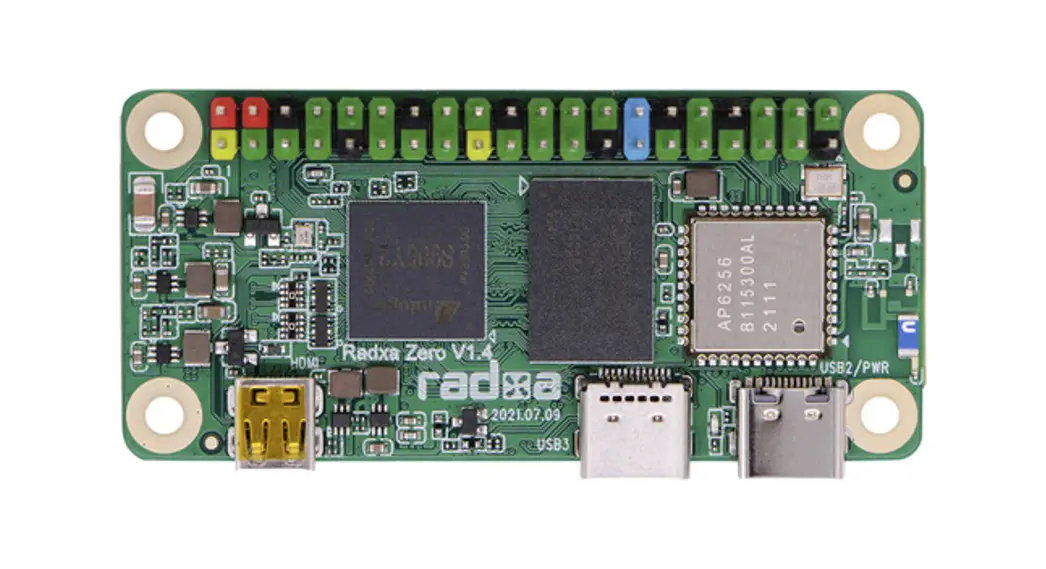
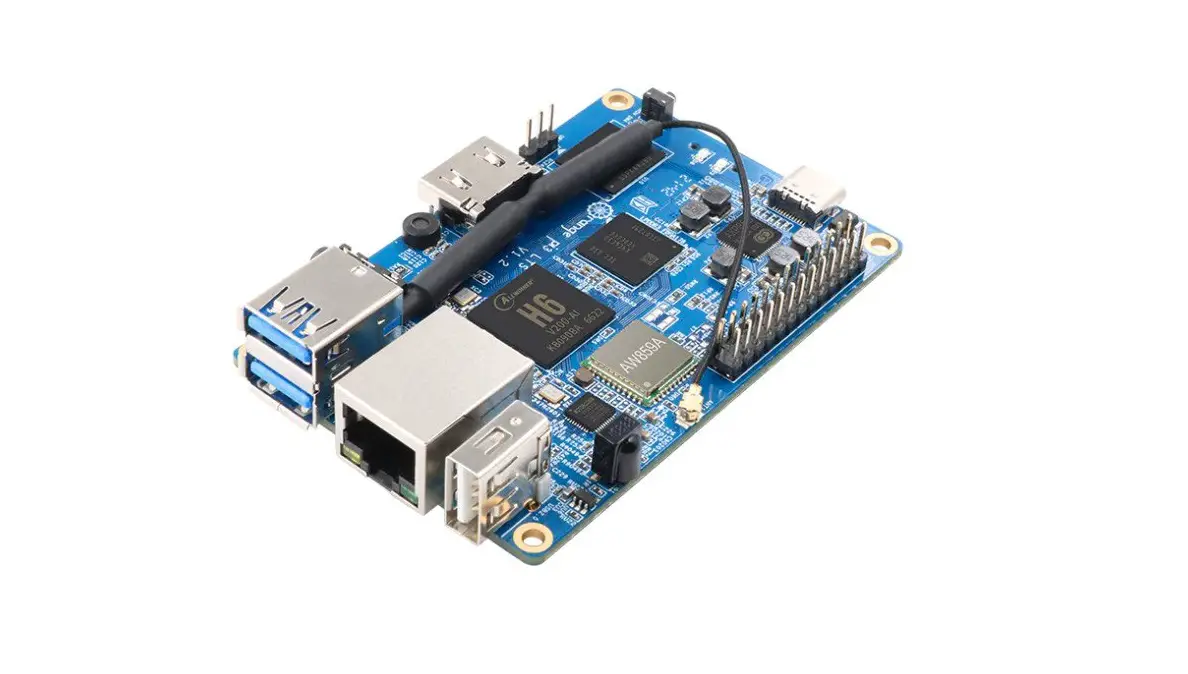
ROCK 3C Single Board Computer
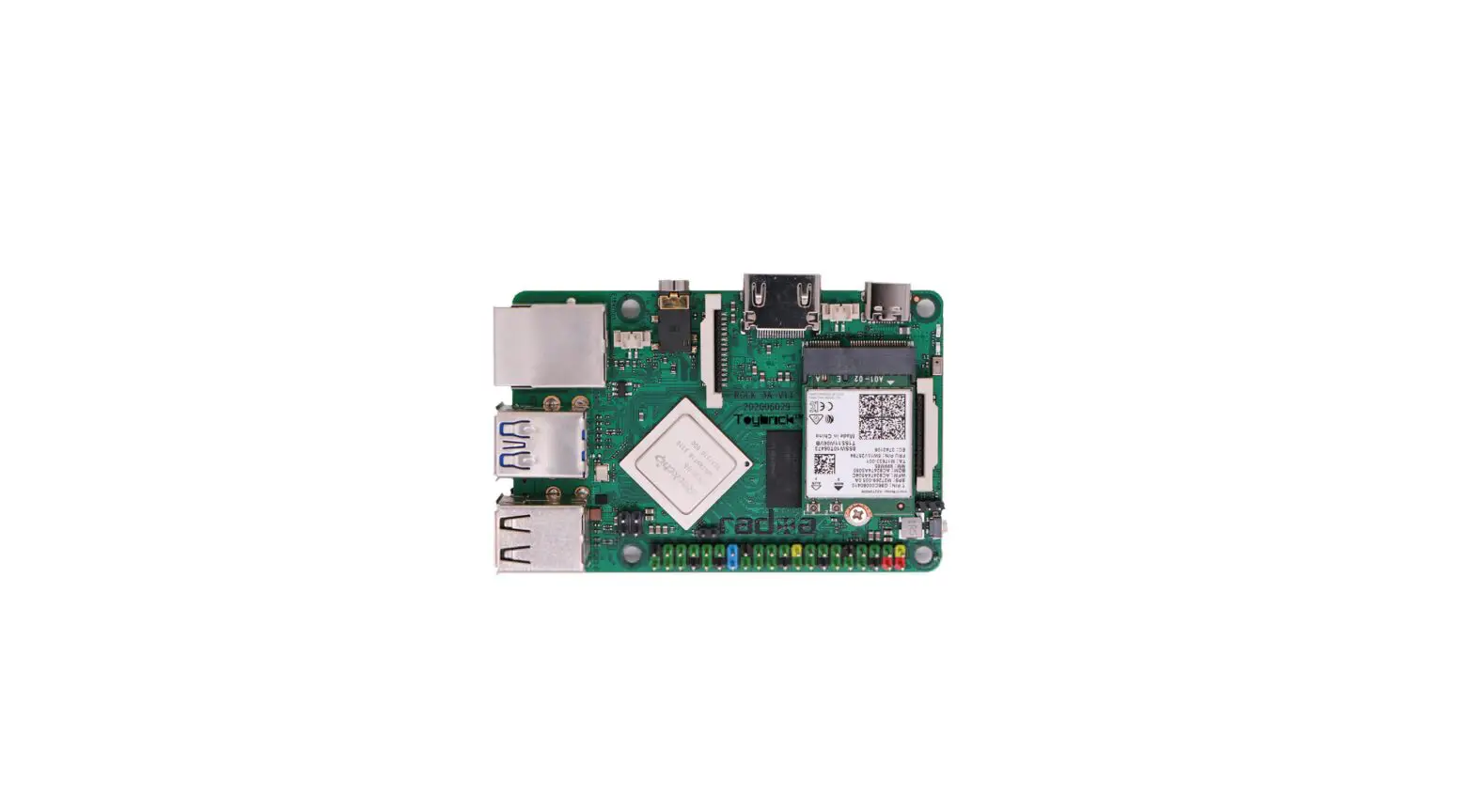
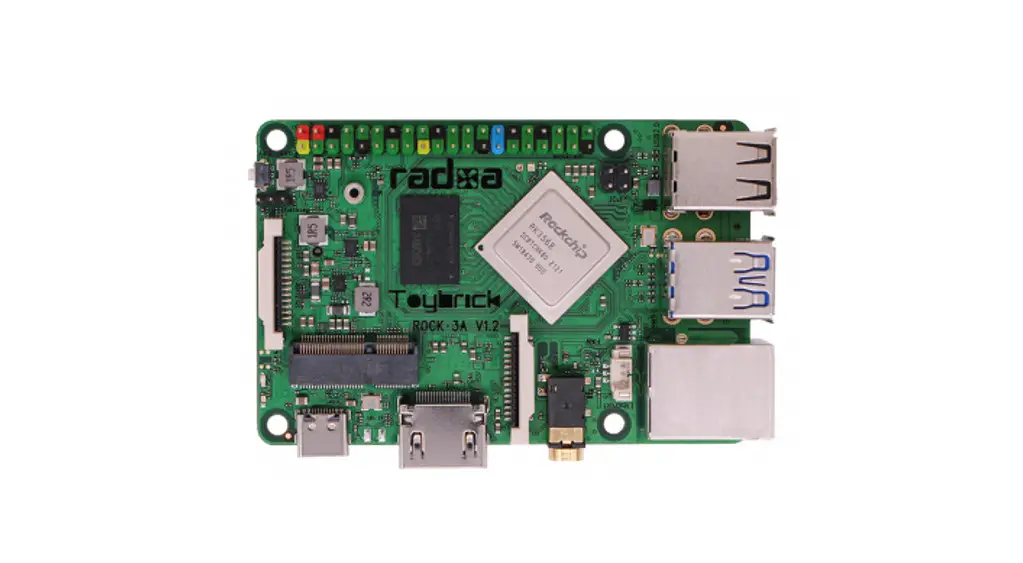
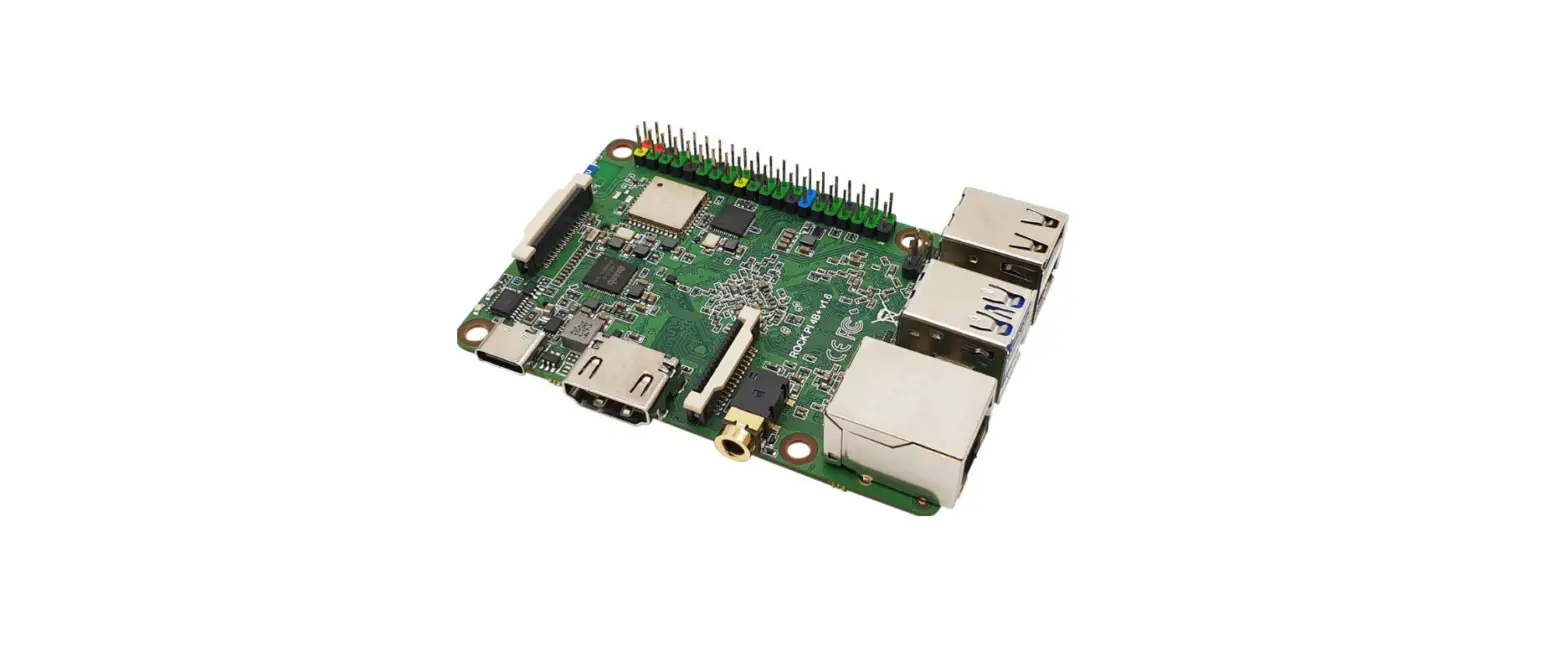
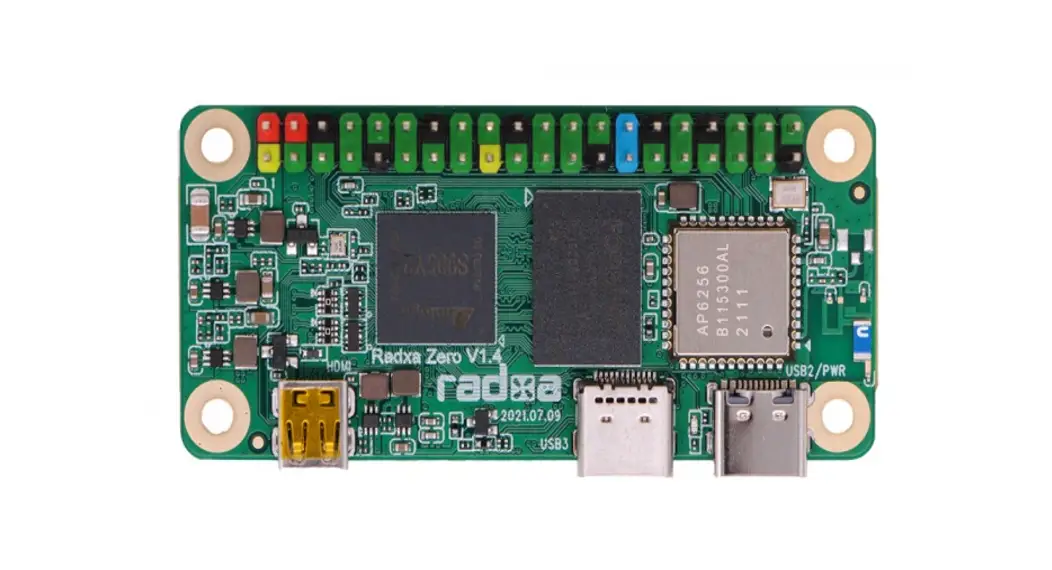
Radxa ROCK 3C
User Manual
Revision: 1.0
Date: 2023-3-15
Introduction
The Radxa ROCK 3C is a Single Board Computer (SBC) that offers
class-leading performance in an ultra-small form factor. It is
designed for makers, IoT enthusiasts, hobbyists, and PC DIY
enthusiasts to build and tinker with their ideas.
Features
Hardware
- Quad-core ARMv8 processor
- Supports up to 4GB LPDDR4 RAM
- Supports eMMC storage module
- H.264/H.265 decoder up to 4K@60fps
- H.264/H.265 encoder up to 1080P@60fps
Interfaces
- 802.11 b/g/n/ac Wireless LAN support (WiFi 5)
- Bluetooth 5.0
- 1x HDMI 2.0 port supporting displays up to 1080P@60fps
resolution - 1x SD Card slot
- 2x USB2 HOST ports
- 1x USB2 OTG/HOST port
- 1x USB3 HOST port
- 1x Gigabit Ethernet port with PoE support (requires PoE
HAT) - 1x M.2 MKey connector for NVMe SSD or SATA SSD
- 1x camera port supporting 2-lane MIPI CSI
- 1x display port supporting 2-lane MIPI DSI
- 3.5mm audio jack with microphone (supports up to 24bit/96KHz
audio) - 40x user GPIO supporting various interface options
Software
- ARMv8 Instruction Set
- Debian/Ubuntu Linux support
- Android 11 support
- Hardware access/control library for Linux/Android
Electrical Specification
Power Requirements
The recommended power source capacity is at least 5V/3A without
M.2 SSD or 5V/4A with M.2 SSD.
Radxa ROCK 3C User Manual
Well established form factor Single Board Computer
Revision 1.0
2023-3-15
Radxa ROC 3C User Manual
Contents
1 Revision
2
2 Introduction
3
3 Features
4
3.1 Hardware . . . . . . . . . . . . . . . . . . . . . . . . . . . . . . . . . . . . . . 4
3.2 Interfaces . . . . . . . . . . . . . . . . . . . . . . . . . . . . . . . . . . . . . . 5
3.3 Software . . . . . . . . . . . . . . . . . . . . . . . . . . . . . . . . . . . . . . . 5
4 Electrical Specification
5
4.1 Power Requirements . . . . . . . . . . . . . . . . . . . . . . . . . . . . . . . . 5
4.2 GPIO Voltage . . . . . . . . . . . . . . . . . . . . . . . . . . . . . . . . . . . . 6
5 Peripherals
6
5.1 GPIO Interface . . . . . . . . . . . . . . . . . . . . . . . . . . . . . . . . . . . 6
5.1.1 GPIO Alternate Functions . . . . . . . . . . . . . . . . . . . . . . . . . 6
5.2 eMMC Module Connector . . . . . . . . . . . . . . . . . . . . . . . . . . . . . 6
5.3 Camera and Display Interfaces . . . . . . . . . . . . . . . . . . . . . . . . . . 7
5.4 USB . . . . . . . . . . . . . . . . . . . . . . . . . . . . . . . . . . . . . . . . . 7
5.5 HDMI . . . . . . . . . . . . . . . . . . . . . . . . . . . . . . . . . . . . . . . . . 7
5.6 Audio Jack . . . . . . . . . . . . . . . . . . . . . . . . . . . . . . . . . . . . . 7
5.7 M.2 Connector . . . . . . . . . . . . . . . . . . . . . . . . . . . . . . . . . . . 7
5.8 Operating Conditions . . . . . . . . . . . . . . . . . . . . . . . . . . . . . . . 8
5.9 Fan Connector . . . . . . . . . . . . . . . . . . . . . . . . . . . . . . . . . . . 8
6 Availability
8
7 Support
8
Radxa Computer
1
Radxa ROC 3C User Manual 1 Revision
Version 1.0
Date 18/05/2023
Changes from previous version First version
Radxa Computer
2
Radxa ROC 3C User Manual
2 Introduction
Radxa ROCK 3C is a Single Board Computer (SBC) in an ultrasmall form factor that offers classleading performance while leveraging outstanding mechanical compatibility. Radxa ROCK 3C offers makers, IoT enthusiasts, hobbyists, PC DIY enthusiasts and others a reliable and extremely capable platform for building and tinkering their ideas into reality.
Radxa Computer
3
Radxa ROC 3C User Manual
3 Features
3.1 Hardware
Rockchip RK3566 SoC Quadcore Arm® Cortex®A55 (ARMv8) 64bit @ 1.6GHz Arm MaliTMG522EE, OpenGL® ES1.1/2.0/3.2, Vulkan® 1.1, OpenCLTM 2.0 1GB / 2GB LPDDR4 available Storage is supported by eMMC storage, micro SD card and SSD through the M.2 con
nector Display via HDMI or MIPI DSI. They can not work at the same time H.264/H.265 decoder up to 4K@60fps H.264/H.265 encoder up to 1080P@60fps
Radxa Computer
4
Radxa ROC 3C User Manual
3.2 Interfaces
802.11 b/g/n/ac Wireless LAN support ing WiFi 5
BT 5.0 1x HDMI 2.0 port supporting displays
up to 1080P@60fps resolution 1x SD Card slot 2x USB2 HOST ports 1x USB2 OTG/HOST port 1x USB3 HOST port 1x Gigabit Ethernet port. It supports
PoE with addon PoE HAT 1x M.2 MKey connector for NVMe SSD
or SATA SSD 1x camera port supporting 2lane MIPI
CSI
1x display port supporting 2lane MIPI DSI
3.5mm jack with microphone. The HD codec supports up to 24bit/96KHz au dio
40x user GPIO supporting various inter face options:
up to 5 x UART 1 x SPI bus up to 2 x I2C bus 1 x PCM/I2S up to 6 x PWM up to 28 x GPIO 2 x 5V DC power in 2 x 3.3V power pin
3.3 Software
ARMv8 Instruction Set Debian/Ubuntu Linux support Android 11 support Hardware access/control library for Linux/Android
4 Electrical Specification
4.1 Power Requirements
Radxa ROCK 3C can only be powered by +5V. USB TypeC® 5V 5V Power from the GPIO PIN 2 & 4
The recommended power source capacity is at least 5V/3A without M.2 SSD or 5V/4A using with M.2 SSD.
Radxa Computer
5
Radxa ROC 3C User Manual
4.2 GPIO Voltage
GPIO Voltage Level Tolerance
All GPIO 3.3V
3.63V
5 Peripherals
5.1 GPIO Interface Radxa ROCK 3C offers 40P GPIO expansion which is compatible with most accessories on the market.
5.1.1 GPIO Alternate Functions
Function5 Function4
Function3
Function2 Function1 Pin# Pin# Function1 Function2 Function3 Function4
Function5
+3.3V
1
I2C3_SDA_M0 UART3_RX_M0 GPIO1_A0 3
I2C3_SCL_M0 UART3_TX_M0 GPIO1_A1 5
PWM14_M0
GPIO3_C4 7
GND
9
GPIO3_A1 11
I2S3_MCLK_M0
GPIO3_A2 13
GPIO3_B0 15
+3.3V
17
PWM15_IR_M1 I2S3_SCLK_M1 SPI3_MOSI_M1 GPIO4_C3 19
UART9_TX_M1 PWM12_M1 I2S3_SDO_M1 SPI3_MISO_M1 GPIO4_C5 21
PWM14_M1 I2S3_MCLK_M1 SPI3_CLK_M1 GPIO4_C2 23
GND
25
I2C4_SDA_M0 I2S2_SDI_M1
GPIO4_B2 27
GPIO3_B3 29
GPIO3_B4 31
UART5_RX_M1
I2S1_SCLK_RX_M2
GPIO3_C3 33
I2S3_LRCK_M0
GPIO3_A4 35
I2S1_SCLK_RX_M0
GPIO1_A4 37
GND
39
2
+5.0V
4
+5.0V
6
GND
8
GPIO0_D1 UART2_TX_M0
10
GPIO0_D0 UART2_RX_M0
12
GPIO3_A3
I2S3_SCLK_M0
14
GND
16
GPIO3_B1 UART4_RX_M1 PWM8_M0
18
GPIO3_B2 UART4_TX_M1 PWM9_M0
20
GND
22
GPIO3_C1
I2S1_SDO2_M2
24
GPIO4_C6 SPI3_CS0_M1 PWM13_M1 UART9_RX_M1 I2S3_SDI_M1
26
GPIO4_D1 SPI3_CS1_M1
28
GPIO4_B3
I2C4_SCL_M0 I2S2_SDO_M1
30
GND
32
GPIO3_C2 UART5_TX_M1
I2S1_SDO3_M2
34
GND
36
GPIO3_A7
38
GPIO3_A6
I2S3_SDI_M0
40
GPIO3_A5
I2S3_SDO_M0
5.2 eMMC Module Connector
ROCK 3C offers a high speed eMMC socket for eMMC modules which can be used for OS and data storage. The eMMC socket is compatible with readily available industrial pinout and
Radxa Computer
6
Radxa ROC 3C User Manual
form factor hardware. The maximum eMMC size supported is 128GB.
5.3 Camera and Display Interfaces Radxa ROCK 3C has 1x 2lane MIPI CSI camera connector and 1x 2lane MIPI DSI display connector. These connectors are backwards compatible with standard industrial camera and display peripherals.
5.4 USB Radxa ROCK 3C has two USB2 HOST connectors, one USB3 HOST connector and one USB2 OTG/HOST connector. The board has a hardware switch to set the USB2 operation to ei ther HOST or OTG. The power output across these ports is 2.8A in aggregate over the four connectors.
5.5 HDMI Radxa ROCK 3C has one HDMI port supporting CEC and HDMI 2.0 with resolutions up to 1080P@60fps.
5.6 Audio Jack The ROCK 3C supports nearCDquality analogue audio output via a 4ring 3.5mm head phone jack. The HD codec supports up to 24 bit at 96Hz. The analog audio output can drive 32 Ohm headphones directly. The headphone jack also supports a mic line input.
5.7 M.2 Connector Radxa ROCK 3C offers a M.2 MKey 2230 connector with PCIe 2.1 1lane and SATA 3.0 combo interfaces, providing high speed storage access. The M.2 MKey can be configured either to support NVMe SSD or SATA devices, an additional adapter board is required for SATA support.
Radxa Computer
7
Radxa ROC 3C User Manual
5.8 Operating Conditions
The ROCK 3C has been designed to operate between 0°C to 50°C. The ROCK 3C is built on a highperformance mobile chipset which is designed to operate for extended durations on batteries with efficiency at its core. As with all electronic devices heat is a byproduct of operation which increases with performance and workload; during basic use cases such as web browsing, editing text or listening to music the SoC will auto matically select the dedicated hardware accelerators to reduce heat generation. Radxa ROCK 3C limits its SoC maximum internal temperature to 85°C before throttling the clock speeds to maintain reliability within the allowed temperature range. If the ROCK 3C is intended to be used continuously in high performance applications, it may be necessary to use external cooling methods (for example, heat sink, fan, etc.) which will allow the SoC to continue running at maximum clock speed indefinitely below its predefined 85°C peak temperature limiter.
5.9 Fan Connector
Radxa ROCK 3C has a 2pin 1.25mm header that enables users to connect to a 5V fan (or other peripheral). The fan can be PWM controlled without speed feedback.
6 Availability
Radxa guarantees availability of the ROCK 3C until at least September 2032.
7 Support
For support, please see the hardware documentation section of the Radxa Wiki website and post questions to the Radxa forum.
Radxa Computer
8
FCC WARNING FCC Caution: Any changes or modifications not expressly approved by the party responsible for compliance could void the user’s authority to operate this equipment. This device complies with Part 15 of the FCC Rules. Operation is subject to the following two conditions: (1) This device may not cause harmful interference, and (2) this device must accept any interference received, including interference that may cause undesired operation. This device and its antenna(s) must not be co-located or operating in conjunction with any other antenna or transmitter.
15.105 Information to the user. (b) For a Class B digital device or peripheral, the instructions furnished the user shall include the following or similar statement, placed in a prominent location in the text of the manual: Note: This equipment has been tested and found to comply with the limits for a Class B digital device, pursuant to part 15 of the FCC Rules. These limits are designed to provide reasonable protection against harmful interference in a residential installation. This equipment generates, uses and can radiate radio frequency energy and, if not installed and used in accordance with the instructions, may cause harmful interference to radio communications. However, there is no guarantee that interference will not occur in a particular installation. If this equipment does cause harmful interference to radio or television reception, which can be determined by turning the equipment off and on, the user is encouraged to try to correct the interference by one or more of the following measures: –Reorient or relocate the receiving antenna. –Increase the separation between the equipment and receiver. –Connect the equipment into an outlet on a circuit different from that to which the receiver is connected. –Consult the dealer or an experienced radio/TV technician for help.
This equipment complies with FCC radiation exposure limits set forth for an uncontrolled environment. This equipment should be installed and operated with minimum distance 20 cm between the radiator and your body.
Radiation Exposure Statement: This equipment complies with FCC radiation exposure limits set forth for an uncontrolled environment. This transmitter must not be co-located or operating in conjunction with any other antenna or transmitter. The availability of some specific channels and/or operational frequency bands are country dependent and are firmware programmed at the factory to match the intended destination. The firmware setting is not accessible by the end user. The final end product must be labelled in a visible area with the following: “Contains Transmitter Module 2A3PA-RADXA-ROCK3C”
Radxa Computer
Requirement per KDB996369 D03
2.2 List of applicable FCC rules
List the FCC rules that are applicable to the modular transmitter. These are the rules that specifically establish the bands of operation, the power, spurious emissions, and operating fundamental frequencies. DO NOT list compliance to unintentional-radiator rules (Part 15 Subpart B) since that is not a condition of a module grant that is extended to a host manufacturer. See also Section 2.10 below concerning the need to notify host manufacturers that further testing is required.3
Explanation: This module meets the requirements of FCC part 15C(15.247).FCC Part 15.407
2.3 Summarize the specific operational use conditions
Describe use conditions that are applicable to the modular transmitter, including for example any limits on antennas, etc. For example, if point-to-point antennas are used that require reduction in power or compensation for cable loss, then this information must be in the instructions. If the use condition limitations extend to professional users, then instructions must state that this information also extends to the host manufacturer’s instruction manual. In addition, certain information may also be needed, such as peak gain per frequency band and minimum gain.
Explanation: The EUT only have one Chip antenna, Yes, the module contains a permanently attached antenna, The 2.4G antenna gain is 1.5dBi. 5G antenna gain is 2.3dBi The use condition of the prototype is mobile.
2.4 Limited module procedures
If a modular transmitter is approved as a “limited module,” then the module manufacturer isresponsible for approving the host environment that the limited module is used with. The manufacturer of a limited module must describe, both in the filing and in the installation instructions, the alternative means that the limited module manufacturer uses to verify that the host meets the necessary requirements to satisfy the module limiting conditions.
A limited module manufacturer has the flexibility to define its alternative method to address the conditions that limit the initial approval, such as: shielding, minimum signaling amplitude, buffered modulation/data inputs, or power supply regulation. The alternative method could include that the limited module manufacturer reviews detailed test data or host designs prior to giving the host manufacturer approval.
This limited module procedure is also applicable for RF exposure evaluation when it is necessary to demonstrate compliance in a specific host. The module manufacturer must state how control of the product into which the modular transmitter will be installed will be maintained such that full compliance of the product is always ensured. For additional hosts other than the specific host originally granted with a limited
Radxa Computer
module, a Class II permissive change is required on the module grant to register the additional host as a specific host also approved with the module. Explanation: The module is a single module.
2.5 Trace antenna designs
For a modular transmitter with trace antenna designs, see the guidance in Question 11 of KDB Publication 996369 D02 FAQ Modules for Micro-Strip Antennas and traces. The integration information shall include for the TCB review the integration instructions for the following aspects: layout of trace design, parts list (BOM), antenna, connectors, and isolation requirements.
a) Information that includes permitted variances (e.g., trace boundary limits, thickness, length, width, shape(s), dielectric constant, and impedance as applicable for each type of antenna);
b) Each design shall be considered a different type (e.g., antenna length in multiple(s) of frequency, the wavelength, and antenna shape (traces in phase) can affect antenna gain and must be considered);
c) The parameters shall be provided in a manner permitting host manufacturers to design the printed circuit (PC) board layout;
d) Appropriate parts by manufacturer and specifications;
e) Test procedures for design verification; and
f) Production test procedures for ensuring compliance.
The module grantee shall provide a notice that any deviation(s) from the defined parameters of the antenna trace, as described by the instructions, require that the host product manufacturer must notify the module grantee that they wish to change the antenna trace design. In this case, a Class II permissive change application is required to be filed by the grantee, or the host manufacturer can take responsibility through the change in FCC ID (new application) procedure followed by a Class II permissive change application.
Explanation: No, The module has no tracking antenna design, is Chip antenna.
2.6 RF exposure considerations
It is essential for module grantees to clearly and explicitly state the RF exposure conditions that permit a host product manufacturer to use the module. Two types of instructions are required for RF exposure information: (1) to the host product manufacturer, to define the application conditions (mobile, portable xx cm from a person’s body); and (2) additional text needed for the host product manufacturer to provide to end users in their end-product manuals. If RF exposure statements and use conditions are not provided, then the host product manufacturer is required to take responsibility of the module through a change in FCC ID (new application).
Explanation: This module complies with FCC RF radiation exposure limits set forth for an
uncontrolled environment, This equipment should be installed and operated with a minimum
distance of 20 centimeters between the radiator and your body.” This module is designed to
comply with the FCC statement,
FCC ID:2A3PA-RADXA-ROCK3C
Radxa Computer
2.7 Antennas
A list of antennas included in the application for certification must be provided in the instructions. For modular transmitters approved as limited modules, all applicable professional installer instructions must be included as part of the information to the host product manufacturer. The antenna list shall also identify the antenna types (monopole, PIFA, dipole, etc. (note that for example an “omni-directional antenna” is not considered to be a specific “antenna type”)).
For situations where the host product manufacturer is responsible for an external connector, for example with an RF pin and antenna trace design, the integration instructions shall inform the installer that unique antenna connector must be used on the Part 15 authorized transmitters used in the host product. The module manufacturers shall provide a list of acceptable unique connectors.
Explanation: The EUT only have one Chip antenna, Yes, the module contains a permanently attached antenna, The 2.4G antenna gain is 1.5dBi. 5G antenna gain is 2.3dBi
2.8 Label and compliance information
Grantees are responsible for the continued compliance of their modules to the FCC rules. This
includes advising host product manufacturers that they need to provide a physical or e-label stating “Contains FCC ID” with their finished product. See Guidelines for Labeling and User Information for RF Devices KDB Publication 784748.
Explanation:The host system using this module, should have label in a visible area indicated the following texts: “Contains FCC ID: 2A3PA-RADXA-ROCK3C
2.9 Information on test modes and additional testing requirements5
Additional guidance for testing host products is given in KDB Publication 996369 D04 Module Integration Guide. Test modes should take into consideration different operational conditions for a stand-alone modular transmitter in a host, as well as for multiple simultaneously transmitting modules or other transmitters in a host product.
The grantee should provide information on how to configure test modes for host product evaluation for different operational conditions for a stand-alone modular transmitter in a host, versus with multiple, simultaneously transmitting modules or other transmitters in a host.
Grantees can increase the utility of their modular transmitters by providing special means, modes, or instructions that simulates or characterizes a connection by enabling a transmitter. This can greatly simplify a host manufacturer’s determination that a module as installed in a host complies with FCC requirements.
Explanation: WiFiRanger, A LinOra Company can increase the utility of our modular transmitters by providing instructions that simulates or characterizes a connection by enabling a transmitter.
2.10 Additional testing, Part 15 Subpart B disclaimer
The grantee should include a statement that the modular transmitter is only FCC authorized for the specific rule parts (i.e., FCC transmitter rules) listed on the grant, and that the host product manufacturer is responsible for compliance to any other FCC rules that apply to the host not covered by the modular transmitter grant of certification. If the grantee markets their product as being Part 15
Radxa Computer
Subpart B compliant (when it also contains unintentional-radiator digital circuity), then the grantee shall provide a notice stating that the final host product still requires Part 15 Subpart B compliance testing with the modular transmitter installed. Explanation: The host shoule be evaluated by the FCC Subpart B. This product uses Chip antenna with a maximum The 2.4G antenna gain is 1.5dBi. 5G antenna gain is 2.3dBi
Radxa Computer
 Radxa Forum
 Rock3 - Radxa Wiki