
Intracom Telecom G5EVOBS2729 WiBAS G5 Evo-BS Wireless broadband
Overview
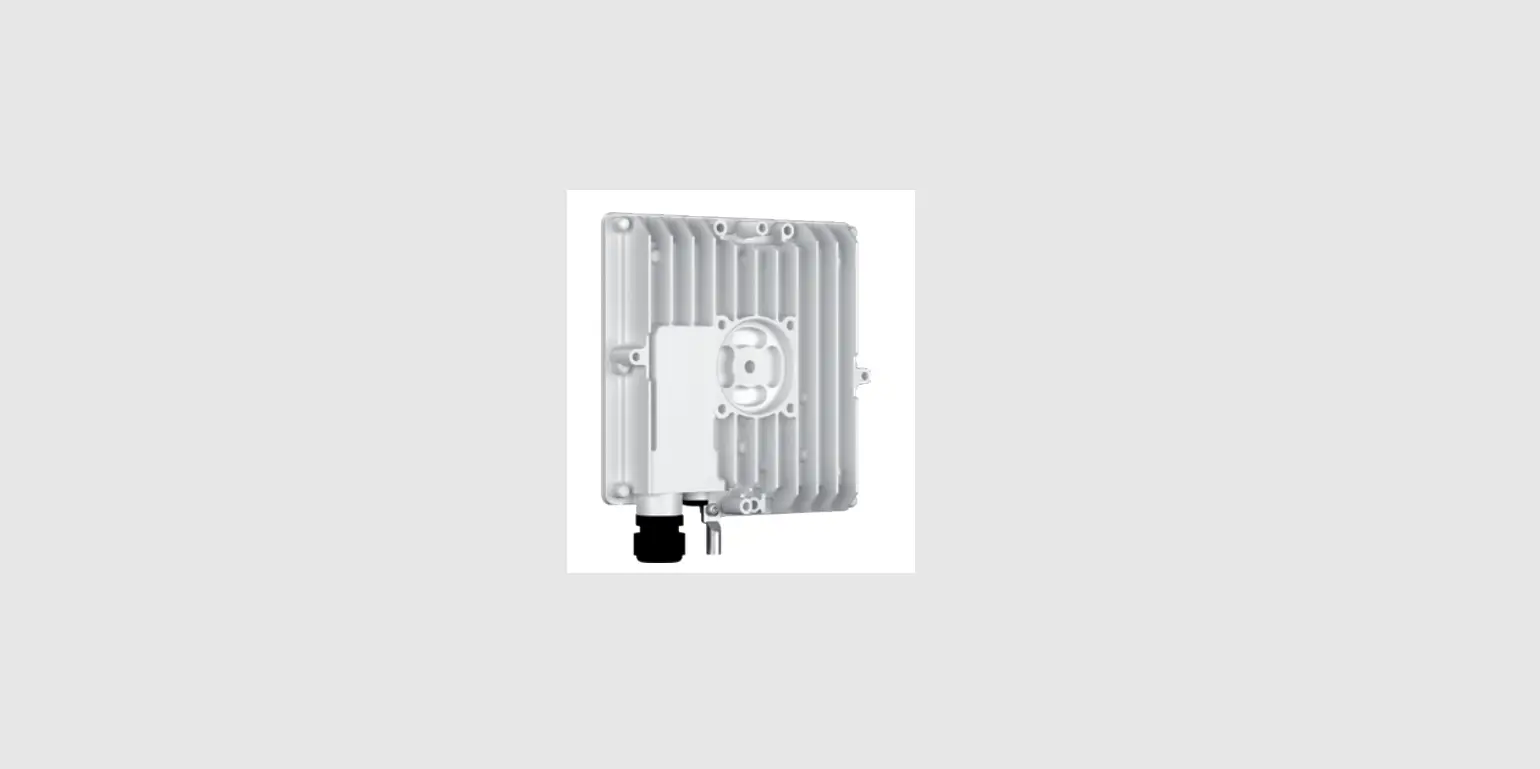
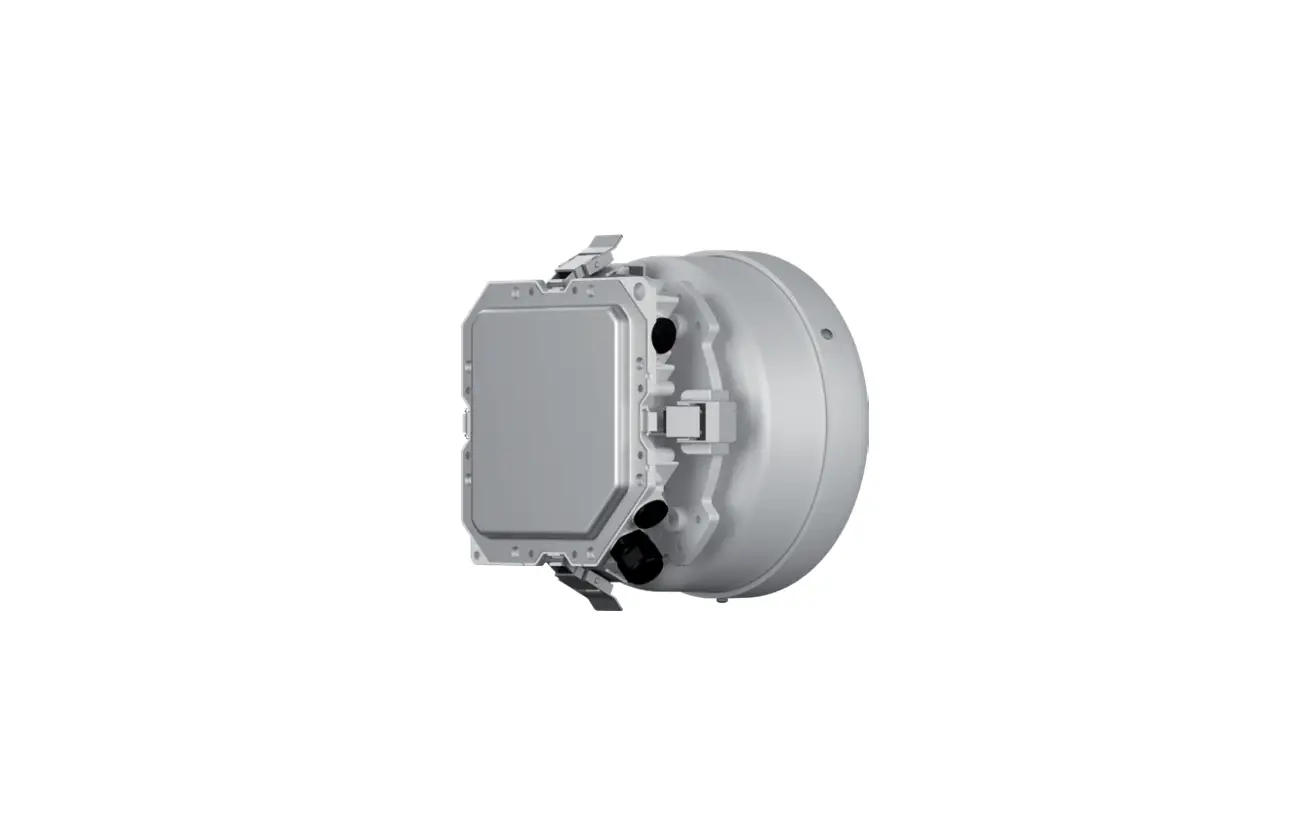
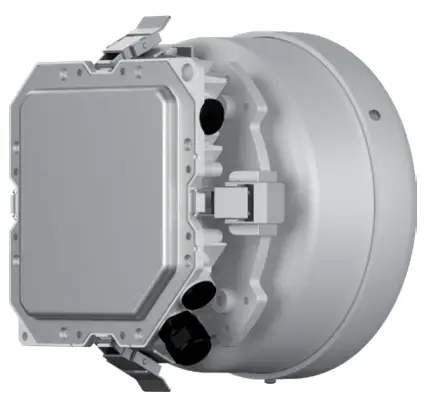
Intracom Telecom is committed to the goal of fulfilling any requirement for broadband FWA of the highest quality in suburban and rural residential areas, and further expanding its MW portfolio with a new generation of Point-to-Multipoint hub / Point-to-Point Node. WiBAS™ G5 Evo-BS is a compact base station that offers the highest capacity, convenience, performance, and power-saving features in the market while blending discreetly with the surrounding environment. WiBAS™ G5 Evo-BS offers advanced networking features, extended coverage, and leading PtMP/PtP radio technology in the 24.25-29.50 GHz area-licensed bands. It enables state-of-the-art IP connectivity in zero-footprint installations at hard-to-reach home and business subscriber locations. Zero-touch provisioning capabilities make the deployment of the network effortless and the improved modem technology enables advanced and dense PtMP networks – up to 60 terminal stations per sector. With a variety of sectoral antennas from 90 to 360-degree coverage, WiBAS™ G5 Evo-BS offers great deployment flexibility with a large area footprint. Due to its small size, the WiBAS™ G5 Evo-BS is not demanding heavy telecom infrastructures leading to simpler deployment practices for the network operators. The flexible airframe structure and variable TDD DL/UL split of the system allow WiBAS™ G5 Evo-BS to co-exist with 3GPP based 5G deployments without interference. WiBAS™ G5 Evo-BS can be deployed in 2+0 configuration offering sector redundancy, ensuring delivery of uninterrupted Service Level Agreements.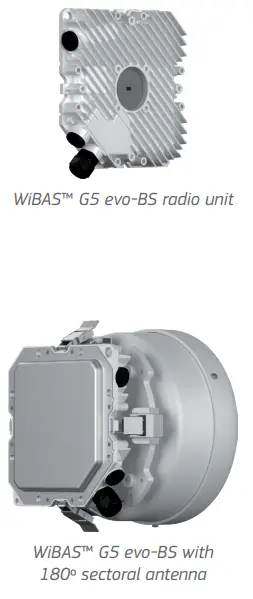
System Specifications
| WiBAS™ G5 evo-BS | |
| Sector Capacity (100 MHz Channel) (Downlink / Uplink) | 700 / 100(1) (100 MHz) |
| Modulation (adaptive) | Up to 1024-QAM |
| Subscriber Density (Terminals / Sector) | 60 |
| Operating Modes | • TDD (4:1, DL:UL split ratio) • TDD (8:1, 2:1, 1:1, 1:2, DL:UL split ratio)(2) |
| Power Supply | Power over Ethernet (PoE) injector with input: • DC (-48 V), or • AC (100 V to 240 V, 50 Hz to 60 Hz) |
| Power Consumption (typ.), W | 43 |
| Dimensions (H x W x D), mm | 200 x 200 x 40 |
| Weight, kg | 2.0 (excluding the antenna) |
| Protection Against Dust & Water | Class IP67 / IEC 60529 |
| Temperature: | |
| Operation / Storage | -33 oC to +55 oC |
| Transportation | -40 oC to +70 oC |
| Interfaces / Ports | |
| 1 x GbE (RJ-45) | Traffic / NMS / PoE input |
| 1 x GbE (SFP) | Traffic / NMS |
| 1 x Sync | GNSS Synchronization |
Performance / System Throughput
| Split Ratio 4:1 (Downlink) | ||||||
| DL Phymode | L1 throughput (Mbit/s) per frame size (Bytes)(3) | |||||
| 128 | 256 | 512 | 1024 | 1518 | 1900 | |
| 1024-QAM 5/6 | 701 | 648 | 623 | 610 | 605 | 606 |
| 1024-QAM 19/24 | 681 | 635 | 612 | 601 | 597 | 596 |
| 512-QAM 19/24 | 607 | 566 | 545 | 535 | 532 | 530 |
| 256-QAM 19/24 | 532 | 496 | 478 | 469 | 466 | 465 |
| 128-QAM 19/24 | 458 | 427 | 411 | 404 | 401 | 400 |
| 64-QAM 19/24 | 383 | 357 | 344 | 338 | 336 | 335 |
| 16-QAM 5/6 | 246 | 230 | 221 | 217 | 216 | 215 |
| 16-QAM 3/4 | 221 | 206 | 199 | 195 | 194 | 194 |
| 4-QAM 5/6 | 123 | 115 | 111 | 109 | 108 | 108 |
| 4-QAM 1/3 | 111 | 103 | 99 | 98 | 97 | 97 |
| 4-QAM 1/2 | 73 | 68 | 66 | 65 | 64 | 64 |
| Split Ratio 4:1 (Uplink) | ||||||
| UL Phymode | L1 throughput (Mbit/s) per frame size (Bytes)(3) | |||||
| 128 | 256 | 512 | 1024 | 1518 | 1900 | |
| 256-QAM 19/24 | 100 | 96 | 93 | 91 | 90 | 90 |
| 128-QAM 19/24 | 89 | 83 | 80 | 79 | 78 | 78 |
| 64-QAM 19/24 | 76 | 71 | 68 | 67 | 66 | 66 |
| 16-QAM 5/6 | 47 | 44 | 43 | 42 | 42 | 41 |
| 16-QAM 3/4 | 43 | 40 | 38 | 38 | 37 | 37 |
| 4-QAM 5/6 | 24 | 22 | 21 | 21 | 21 | 21 |
| 4-QAM 1/3 | 21 | 20 | 19 | 19 | 19 | 19 |
| 4-QAM 1/2 | 14 | 13 | 13 | 13 | 12 | 12 |
Operating Frequencies, Radio Performance & Antennas
| WiBAS™ G5 Evo-BS | |
| Operating Frequencies, GHz (Rx / Tx) | 24.25 – 26.50 26.50 – 28.50 27.50 – 29.50 |
| RF Channel Arrangement | CEPT ERC Rec.T/R 13-02E FCC Part 30 |
| Channel Size, MHz | 40 / 50 / 75 / 100 / 112 |
| Tx Power, max., dBm | 19 (1024-QAM) |
| Sensitivity (4-QAM 1/2 DL), dBm 50 / 56 MHz channel 100 / 112 MHz channel | -86.4 / -85.9 -83.4 / -82.9 |
| Antenna Type / Gain | Sectoral 90° / 19 dBi Sectoral 90° / 15.5 dBi Sectoral 180° / 13.5 dBi Omnidirectional 360° / 10 dBi Parabolic 1.4° / 42.8 dBi |
Features / Networking
Radio
- ETSI EN 302 326-1 V1.2.2 Annex E
- ETSI EN 302 326-2 V1.2.2
- ETSI EN 302 326-3 V1.3.1
- Based on ETSI TS 102 123
- FCC Part 30
TDD Synchronization
- External GNSS module
- 5G NR compliant airframe (3GPP TS 38.213)
Ethernet
- IEEE 802.3-2008 (100 / 1000Base-T)
- IEEE 802.3 (Optical Gigabit Ethernet 1000Base-SX/LX)
Scalability
- Up to 60 terminal stations per sector
Ethernet Standards & Functionality
- IEEE 802.1Q (VLAN-aware bridging)
- Ethernet CoS (PCP)
- VLAN point-to-point services
- IEEE 802.1ad (Provider Bridges), Q-in-Q
- Configurable EtherType
- 1:1 VLAN translation/bundling on UNI trunk ports
- L2CP processing
- MEF CE 2.0 port-based (EPL/EP-LAN) and VLAN-based (EVPL/EVP-LAN) services
- MTU size: up to 9600 bytes
Ethernet QoS
- Ingress packet classification per Interface, VLAN ID, L2 PCP, L3 DSCP, MPLS EXP or combinations
- Classification actions supported: police, deny, remark
- Remarking of L2 PCP
- Ingress bandwidth profile (policing): Two-Rate Three-Color per UNI/EVC/CoS
Air Interface Scheduling
- Egress classification based on VLAN, inner VLAN CoS, PCP, DSCP, MPLS EXP criteria
- Traffic shaping per TS (DL/UL)
- Two-stage hierarchical scheduling of service flows established between HUB and Terminals
- Second level: Traffic prioritization within a service flow based on class of service
- Eight (8) queues, packet scheduling strict-priority (SP)
- Configurable queue size to cope with traffic burstiness (e.g. for TCP traffic)
- First level: Scheduling between multiple service flows based on service class and shaping per service flow
- Eight (8) priority queues (6 available for user traffic)
- Three service classes:
- Real-Time Variable Rate (RTVR) for guaranteed service
- Non-Real-Time Variable Rate (NRTVR) for guaranteed service
- Best-Effort (BE) for non-guaranteed service
- Advanced scheduling with WFQ or PFS
Bridge Security
- MAC Security and Port Flooding
- MAC Learning Enable/Disable (P2P VLAN Cross-Connect)
- Storm Control and Split Horizon
Air Interface Security
- Proprietary “closed” system architecture
Ethernet OAM
- IEEE 802.1ag (CFM)
- IEEE 802.1ah (EFM)
- ITU-T Y.1731 (Performance Monitoring)
Management
- Through uni|MS™ / Web interface / CLI:
- NTP, SNMPv2c, SNMPv3, SYSLOG, TACACS+, RMON (RFC 2819)
- Telnet / SSH, HTTP / HTTPS, FTP / SFTP
- Historical statistics
EMC / EMI
- ETSI EN 301 489-1
- EΤSI ΕN 301 489-4
- EΝ 55032
- EΝ 61000-3-2
- EN 61000-3-3
- FCC Part 15 subpart B
Health and Safety
- EΝ 60950-1, EN 60950-22, EN 50385, EN 60215
- OET Bulletin 65
RoHS
- EN 50581
Environmental
- ETSI EN 300 019-2-4, Class 4.1 / (Mechanical 4M5) (Operation)
- ETSI EN 300 019-2-2, Class 2.3 (Transportation)
- ETSI EN 300 019-2-1, Class 1.2 (Storage)
Reliability
- MTBF > 50 years
 Corporate Website: Information about the Group | Deutsche Telekom
 :: INTRACOM TELECOM ::