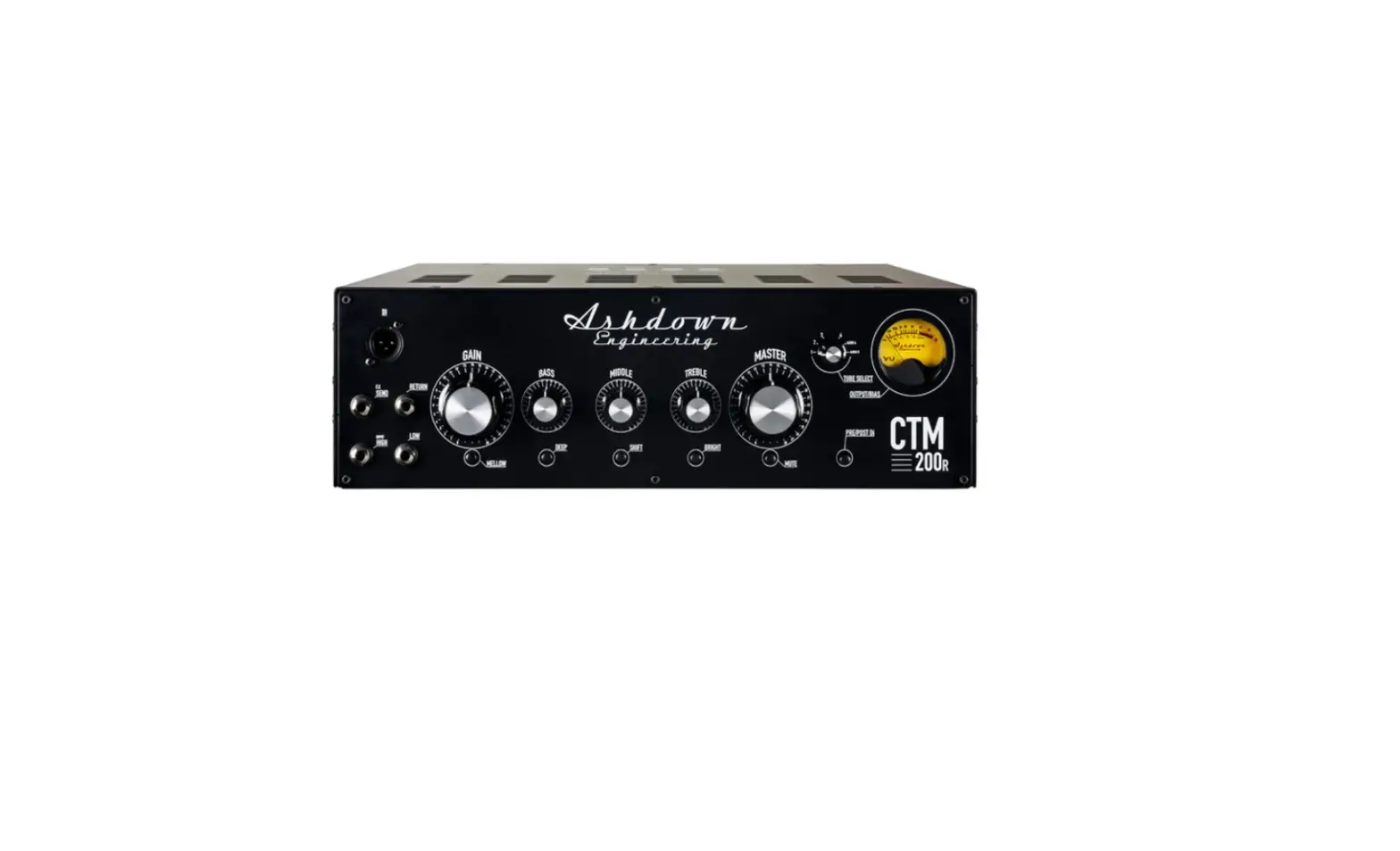
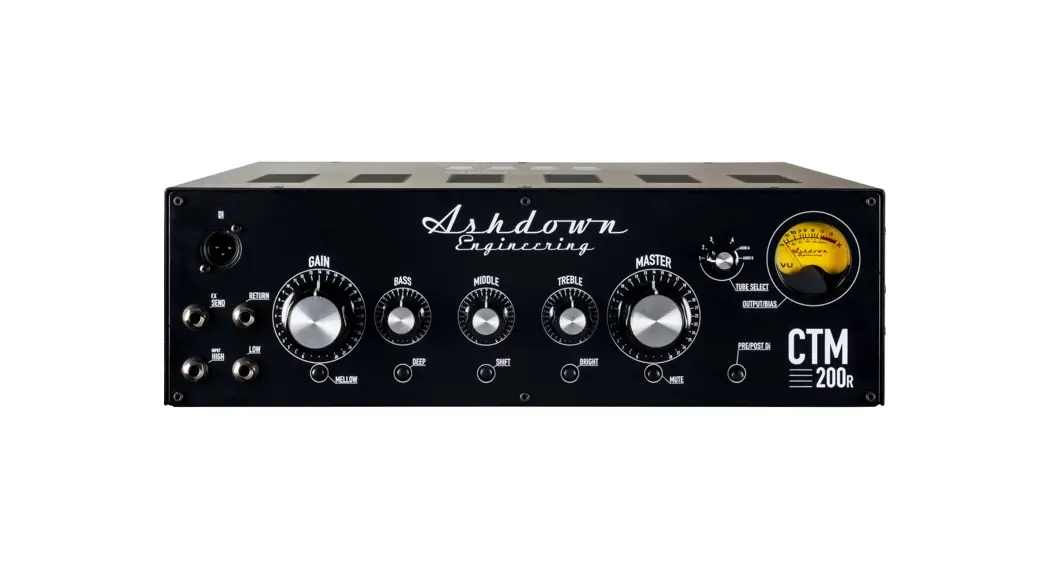
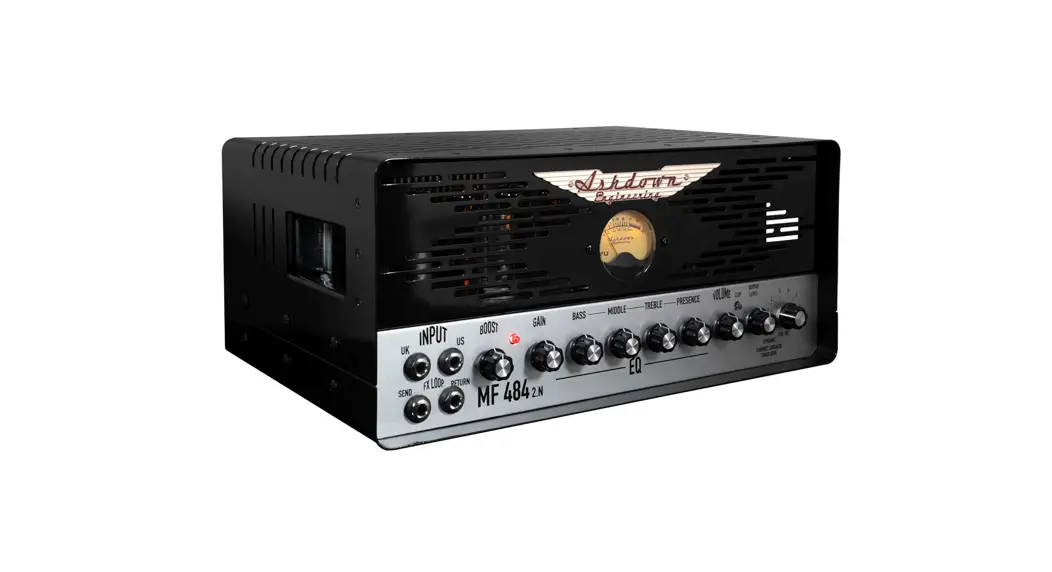
CTM-300 300 Watt Tube Bass Head
Product Information
The Ashdown Engineering CTM-300 is an all-tube amplifier that
combines classic tones with modern features and reliability. With a
power output of 300W, this valve masterpiece is handbuilt in the UK
Ashdown Custom Shop using the finest components for long-lasting
performance. The amplifier is housed in an 18mm Marine grade birch
ply cabinet, featuring heavy-duty flip-style handles and an
internal fan for cooling.
Front Panel
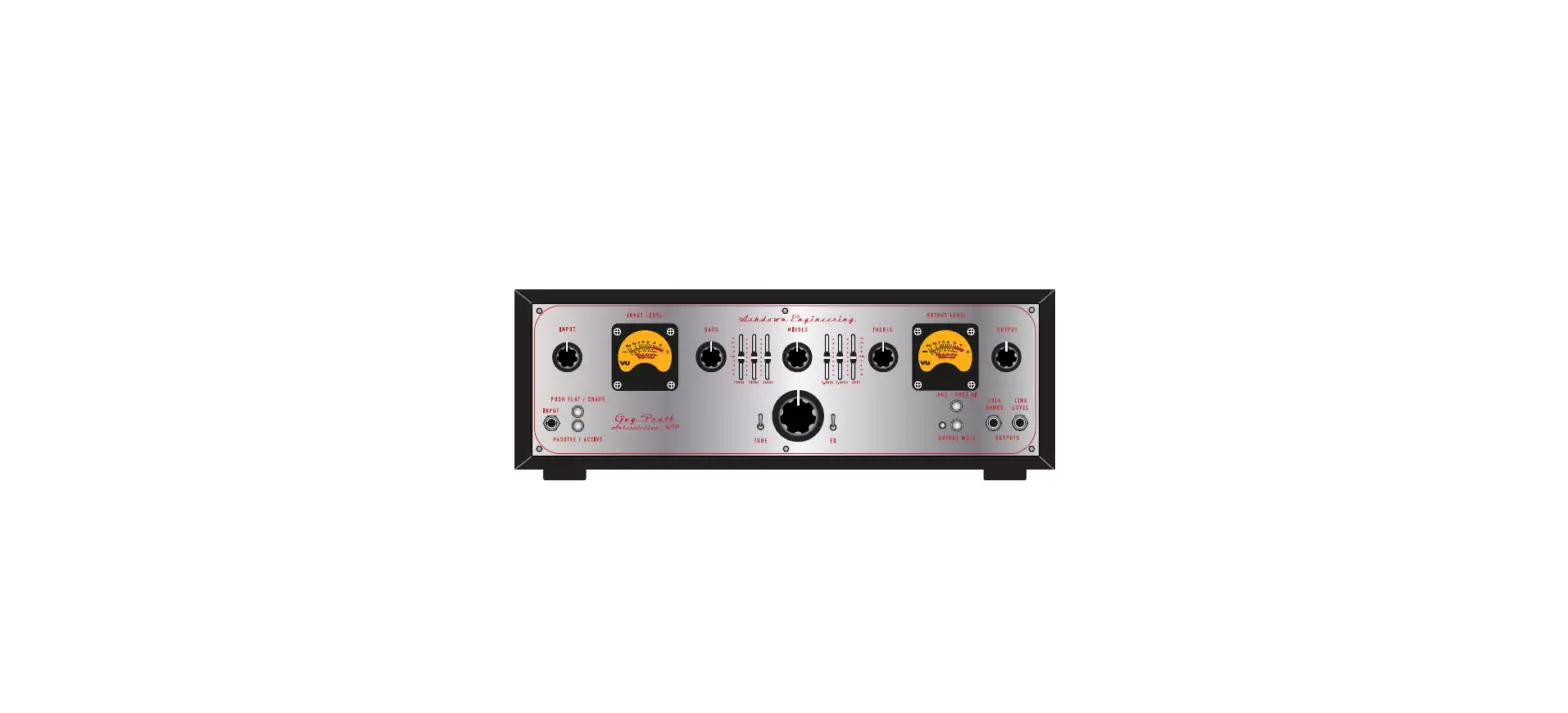
- EFFECTS SEND AND RETURN: These 1/4″ jack
sockets allow you to connect to external effects devices or pedal
boards. - EQ CONTROLS: Use the MIDDLE, BASS, and TREBLE
controls to adjust the overall tone of the sound. - MID SHIFT: This button shifts the MIDDLE
control to operate at different points in the frequency
spectrum. - BASS SHIFT: This button shifts the Bass
control to operate at different points in the frequency
spectrum. - BRIGHT: When in the up position, this switch
adds overall brightness to the sound. Note that it is not effective
when the GAIN control is set to full. - MELLOW: This switch slightly softens the
overall tone. - GAIN: Adjusts the level of the signal sent to
the MASTER section. Lower values produce cleaner sounds, while
higher values create richer, more distorted sounds. - MASTER: Controls the overall output volume of
the amplifier. - MUTE: When in the in position, this switch
mutes the output of the amplifier.
Back Panel
- PRE/POST: This switch determines whether the
signal from the DI OUTPUT is taken before or after the EQ
section. - VU METER: Provides a visual indication of the
output level of the amplifier and acts as a bias meter.
Product Usage Instructions
- Connect your Ashdown Engineering CTM-300 amplifier to a power
source. - If desired, connect external effects devices or a pedal board
to the EFFECTS SEND and RETURN jacks on the front panel. - Adjust the EQ controls (MIDDLE, BASS, and TREBLE) to achieve
your desired tone. - If needed, use the MID SHIFT and BASS SHIFT buttons to further
adjust the frequency spectrum of the MIDDLE and Bass controls. - Activate the BRIGHT switch for added brightness to the sound
(not effective when GAIN control is set to full). - If desired, engage the MELLOW switch to slightly soften the
overall tone. - Adjust the GAIN control to set the level of the signal sent to
the MASTER section. Lower values result in cleaner sounds, while
higher values create more distortion. - Use the MASTER control to adjust the overall output volume of
the amplifier. - If necessary, mute the output of the amplifier by switching the
MUTE switch to the in position. - Choose whether the DI OUTPUT signal is taken before or after
the EQ section using the PRE/POST switch on the back panel. - Monitor the output level of the amplifier and check the bias
using the VU METER on the front panel.
For any further assistance or technical support, please refer to
the user manual or contact our friendly in-house service
center.
ENGLISH / FRANÇAIS / DEUTSCH / ESPAÑOL
USER MANUAL
THANK YOU
Thank you for purchasing your Ashdown Engineering Amplifier and welcome to the family! We really think you’ve made the right choice and know that this amplifier will give you years of great tone and service. It is a machine though and needs to be looked after, please read through this user manual which will help you get the most out of your new Amp and keep it running as long as some of our happiest and very famous customers.
REGISTER ONLINE
Please register this product online so we can make sure we give you years of customer support through our friendly in-house service centre.
Here is where you need to visit to register your product: http://www.ashdownmusic.com/pages/register-your-product
ASHDOWN ENGINEERING – CTM-300
USER GUIDE
INTRODUCTION
Taking inspiration from the classic tube heads of the past, Ashdown presents the all-tube CTM-300, a 300W valve masterpiece that melds classic tones with modern features, construction and reliability.
Handbuilt in the UK Ashdown Custom Shop the CTM 300 head is housed within an 18mm Marine grade birch ply cabinet that features heavy duty flip style handles and an internal fan to keep things cool. This is an amplifier that is built to last using only the finest components to ensure years of trouble-free performance night after night.
FRONT PANEL
BACK PANEL
ASHDOWN ENGINEERING – CTM-300
USER GUIDE
FACILITIES AND CONTROLS (NOTE THAT THESE VARY ACCORDING TO THE MODEL)
INPUTS There are two instrument inputs marked LOW and HIGH. The LOW input is highly sensitivity and also high impedance to suit the output from PASSIVE (Low Output) basses – The HIGH input is low sensitivity and lower impedance to suit the output from ACTIVE (High Output) basses. Plugging an active (High Output) bass into the LOW input will overload the input, creating a fatter, warmer and more distorted sound. Experiment by plugging your bass into either input to achieve the desired sound. On models with a single input this will be suitable for both Passive and Active basses.
EFFECTS SEND AND RETURN These 1/4″ jack sockets should be used to connect to an external effects device or pedal board. The EFFECTS SEND output should connect to the INPUT of the effects unit, and the output of the effects unit should be connected to the EFFECTS RETURN input Note that the signal level is at instrument level so this loop is suitable for effects pedals.
EQ CONTROLS Use the MIDDLE, BASS and TREBLE controls to effect the overall tone of the sound.
MID SHIFT Causes the MIDDLE control to operate at different points in the frequency spectrum dependant on the button being either in or out.
CTM-300
USER GUIDE
BASS SHIFT Causes the Bass control to operate at different points in the frequency spectrum dependant on the button being either in or out.
BRIGHT Adds an overall brightness to the sound when in the up position. (Note: The BRIGHT switch is not effective when the GAIN control is set to full).
MELLOW Softens the overall tone slightly
GAIN This controls the level of the signal sent to the MASTER section. To achieve a cleaner sound, turn the GAIN control down and the MASTER up. To achieve a richer, more distorted sound, turn the GAIN control up and the MASTER down.
MASTER This controls the overall output volume of the amplifier.
MUTE In the in position, this switch mutes the out put of the amplifier (useful for tuning, etc.).
ASHDOWN ENGINEERING – CTM-300
USER GUIDE
PRE/POST This switch determines whether the signal from the DI OUTPUT (see Rear Panel Facilities) is taken before/PRE the EQ section (down position) or after/POST (up position).
VU METER The VU meter provides a visual indication of the output level of the amplifier. It also acts as a bias meter, please see the following page for more details.
CTM-300
USER GUIDE
SPECIFICATIONS:
Inputs
High Input Low Input Effects Return Line Input
Impedance – 3.9M ohms Impedance – 10k ohms Impedance – 22k ohms Impedance – 22k ohms
Input range 150mv to 20v p – p Input range 300mv to 40v p – p Input level 0dbu nominal Input range 300mV
Outputs
Effects Send D.I.Output Speaker Outputs Frequency Response
Impedance – 22k ohms Level 0dbu nominal
420 ohms balanced
pre ground lift Level -20dbu nominal
Minimum Impedance – 2 ohms
-3db at 22hz and 25khz
Equalisation
Bass Middle Treble Shape
+/- 15db @ 100hz +/- 15db @ 660hz +/- 15db @ 7khz shelving + 8db @ 50hz + 10db @ 10khz
Signal to Noise Distortion Output Power
Better than 80db (E.Q. Flat) Less than 0.5% Thd 300watts into 4 ohms
ASHDOWN ENGINEERING – CTM-300
WILL STILL WORK AT REDUCED POWER
IDEAL SETTING
KEEP OUT! DO NOT SET ANY TUBE THIS HIGH
USER GUIDE
THE VU METER
The VU meter fitted to the CTM is a dual function meter detailed as follows: By using the push button selector switch marked “AUDIO / BIAS” the functions are accessed in the following manner:
1/ “AUDIO” – In audio mode the meter is set to read the audio output of each of the six power tubes and each can be measured by utilising the rotary selector switch on the front panel. Whilst playing this is the normal mode of operation of the meter and the reading obtained will be a direct indication of the power being produced by each output tube, the meter is calibrated so that when the needle reaches the start of the red section the power tube being measured will be producing maximum clean volume. The switch can be rotated to select any of the power tubes and its relative output will be indicated on the meter, note that when performing this test you will need to play at equal volume for each test.
CTM-300
USER GUIDE
2/ “BIAS” – In this mode the meter will glow RED. To check the bias of the output tubes proceed as follows: Run the amplifier for at least 10 mins to allow the output tubes to fully heat up with the amplifier set to mute. Standby on. Select.. Tube 1 and with an insulated jewelers screwdriver gently adjust the trimmer situated on the rear panel. The reading to aim for is the needle just at the start of the red ie 0db. Note that although each tube can be adjusted individually it is possible to get tubes that cannot be adjusted to the correct reading, these can still be used providing the reading is not in the red, a lower reading is acceptable and will note impact audibly on the power output or sound quality of the amplifier. Please also note that the trimmers are 25 turn types to make adjustment easy, This type of adjuster has no end stop so if you reach a point where the adjuster will not give any more adjustment then the output tube will have to be replaced if the reading is to high ie in the RED. Repeat this for each of the four output tubes in turn.
RETURN THE METER TO “audio” MODE AFTER BIASING. DO NOT RUN THE AMPLIFIER IN BIAS MODE WHILST PLAYING.
Note there is a protection fuse fitted to each of the output tubes and if no reading is obtained on the meter this fuse will have failed. The protection fuses are situated next to the output they are protecting the correct rating is 315Ma quick blow, in the event of a blown fuse they MUST be replaced with fuses of the correct rating and type.
A continually blowing fuse would indicate either an incorrectly biased output tube or a defective output tube.
MERCI
Merci d’avoir acheté votre amplificateur Ashdown Engineering et bienvenue dans la famille! Nous pensons vraiment que vous avez fait le bon choix et nous savons que L’amplificateur vous donnera des années de son et de service exceptionnels.
C’est une machine et doit être entretenue, veuillez lire à travers ce manuel d’utilisation qui vous aidera à tirer le meilleur parti de votre nouvel ampli et faites-le fonctionner aussi longtemps que certains de nos
les clients les plus heureux et les plus célèbres.
INSCRIVEZ-VOUS EN LIGNE
Veuillez enregistrer ce produit en ligne afin que nous puissions nous assurer que nous vous offrons des années d’assistance à la clientèle grâce à notre centre de
service interne convivial.
Voici où vous devez vous rendre pour enregistrer votre produit: http://www.ashdownmusic.com/pages/register-your-product
ASHDOWN ENGINEERING – CTM-300
MODE D’EMPLOI
INTRODUCTION
S’inspirant des têtes de tube classiques du passé, Ashdown présente le CTM-300 tout tube, un chef-d’oeuvre de soupape de 300 W qui allie des tons classiques avec des caractéristiques, une construction et une fiabilité modernes.
Fabriquée à la main au Royaume-Uni Ashdown Custom Shop, la tête CTM 300 est logée dans une armoire à plis de bouleau de qualité marine de 18 mm dotée de poignées robustes de style rabattable et d’un ventilateur interne pour garder les choses au frais. Il s’agit d’un amplificateur conçu pour durer en utilisant uniquement les meilleurs composants afin de garantir des années de performances sans problème nuit après nuit.
PANNEAU AVANT
BACK PANEL
ASHDOWN ENGINEERING – CTM-300
MODE D’EMPLOI
INSTALLATIONS ET COMMANDES (notez que ceux-ci varient selon le modèle)
CONTRIBUTIONS Il y a deux entrées d’instrument marquées LOW et HIGH. L’entrée LOW a une sensibilité élevée et une impédance élevée pour s’adapter à la sortie des basses PASSIVE (Low Output) – L’entrée HIGH est une faible sensibilité et une impédance inférieure pour s’adapter à la sortie des basses ACTIVE (High Output). Brancher une basse active (High Output) dans l’entrée LOW surchargera l’entrée, créant un son plus gros, plus chaud et plus déformé. Expérimentez en branchant votre basse sur l’une ou l’autre des entrées pour obtenir le son souhaité. Sur les modèles avec une seule entrée, cela conviendra aux basses passives et actives.
ENVOI ET RETOUR D’EFFETS Ces prises jack 1/4 “doivent être utilisées pour se connecter à un appareil d’effets externe ou à un pédalier. La sortie EFFECTS SEND doit être connectée à l’entrée INPUT de l’unité d’effets et la sortie de l’unité d’effets doit être connectée à l’entrée EFFECTS RETURN. Notez que le niveau du signal est au niveau de l’instrument, cette boucle convient donc aux pédales d’effets.
COMMANDES EQ Utilisez les commandes MIDDLE, BASS et TREBLE pour affecter la tonalité générale du son.
CHANGEMENT MOYEN Fait fonctionner la commande MIDDLE à différents points du spectre de fréquences, selon que le bouton est soit à l’intérieur soit à l’extérieur.
CTM-300
MODE D’EMPLOI
BASSE CHANGEMENT Fait fonctionner la commande des graves à différents points du spectre de fréquences selon que le bouton est soit à l’intérieur soit à l’extérieur.
BRILLANT Ajoute une luminosité globale au son lorsqu’il est en position haute. (Remarque: le commutateur BRIGHT n’est pas efficace lorsque la commande GAIN est réglée sur pleine).
MOELLEUX Adoucit légèrement le ton général
GAIN Ceci contrôle le niveau du signal envoyé à la section MASTER. Pour obtenir un son plus clair, tournez la commande GAIN vers le bas et le MASTER vers le haut. Pour obtenir un son plus riche et déformé, tournez la commande GAIN vers le haut et le MASTER vers le bas.
MAÎTRE Ceci contrôle le volume de sortie global de l’amplificateur.
MUET En position in, ce commutateur coupe la sortie de l’amplificateur (utile pour l’accord, etc.).
ASHDOWN ENGINEERING – CTM-300
MODE D’EMPLOI
PRÉ / POST Ce commutateur détermine si le signal de la sortie DI OUTPUT (voir Fonctions du panneau arrière) est pris avant / PRE la section EQ (position basse) ou après / POST (position haute).
VU MÈTRE Le VU-mètre fournit une indication visuelle du niveau de sortie de l’amplificateur. Il agit également comme un compteur de biais, veuillez consulter la page suivante pour plus de détails.
CTM-300
MODE D’EMPLOI
CARACTÉRISTIQUES:
Contributions
Entrée élevée Faible entrée Retour d’effets Ligne d’entrée
Impédance – 3.9M ohms Impédance – 10k ohms Impédance – 22k ohms Impédance – 22k ohms
Plage d’entrée 150mv to 20v p – p Plage d’entrée 300mv to 40v p – p Niveau d’entrée 0dbu nominal Plage d’entrée 300mV
Les sorties
Envoi d’effets
Impédance – 22k ohms Niveau 0dbu nominal
D.I.Production
420 ohms équilibré
Niveau de pré-élévation au sol
-20dbu nominal
Sorties haut-parleurs Le minimum Impédance – 2 ohms
Fréquence de réponse -3db at 22hz and 25khz
Égalisation
Basse Milieu Tripler Forme
+/- 15db @ 100hz +/- 15db @ 660hz +/- 15db @ 7khz rayonnage + 8db @ 50hz + 10db @ 10khz
Signal au bruit Distorsion Puissance de sortie
Mieux que 80db (E.Q. Plat) Moins que 0.5% Thd 100watts dans 4 ohms
ASHDOWN ENGINEERING – CTM-300
FONCTIONNERA TOUJOURS À RÉDUIT POUVOIR
CADRE IDÉAL
EXCLURE! NE DÉFINISSEZ
AUCUN TUBE AUSSI
HAUT
MODE D’EMPLOI
LE VU METER
Le VU-mètre installé sur le CTM est un compteur à double fonction détaillé comme suit: En utilisant le sélecteur à bouton-poussoir marqué «AUDIO / BIAS», les fonctions sont accessibles de la manière suivante:
1 / “AUDIO” – En mode audio, le compteur est réglé pour lire la sortie audio de chacun des six tubes de puissance et chacun peut être mesuré en utilisant le sélecteur rotatif sur le panneau avant. Pendant la lecture, c’est le mode de fonctionnement normal du compteur et la lecture obtenue sera une indication directe de la puissance produite par chaque tube de sortie, le compteur est calibré de sorte que lorsque l’aiguille atteint le début de la section rouge, le tube de puissance en cours de mesure produira un volume propre maximal. Le commutateur peut être tourné pour sélectionner l’une des lampes de puissance et sa sortie relative sera indiquée sur le compteur, notez que lors de l’exécution de ce test, vous devrez jouer à volume égal pour chaque test.
CTM-300
MODE D’EMPLOI
2 / “BIAS” – Dans ce mode, le compteur deviendra ROUGE. Pour vérifier la polarisation des tubes de sortie, procédez comme suit: Faites fonctionner l’amplificateur pendant au moins 10 minutes pour permettre aux tubes de sortie de chauffer complètement avec l’amplificateur réglé pour couper le son. Veille activée. Sélectionnez .. Tube 1 et avec un tournevis bijoutier isolé, ajustez doucement la tondeuse située sur le panneau arrière. La lecture à viser est l’aiguille juste au début du rouge, c’est-à-dire 0db. Notez que bien que chaque tube puisse être ajusté individuellement, il est possible d’obtenir des tubes qui ne peuvent pas être ajustés à la lecture correcte, ceux-ci peuvent toujours être utilisés à condition que la lecture ne soit pas dans le rouge, une lecture inférieure est acceptable et notera l’impact de manière audible sur le puissance de sortie ou qualité sonore de l’amplificateur. Veuillez également noter que les trimmers sont de 25 types de tours pour faciliter le réglage.Ce type de réglage n’a pas de butée de fin de course, donc si vous atteignez un point où le régleur ne donnera plus de réglage, le tube de sortie devra être remplacé si la lecture est trop élevé c’est-à-dire dans le ROUGE. Répétez cette opération pour chacun des quatre tubes de sortie à tour de rôle.
REVENEZ LE COMPTEUR EN MODE «audio» APRÈS LE BIASING. NE PAS FAIRE FONCTIONNER L’AMPLIFICATEUR EN MODE BIAS PENDANT LA JOUER.
Notez qu’un fusible de protection est installé sur chacun des tubes de sortie et si aucune lecture n’est obtenue sur le compteur, ce fusible aura échoué. Les fusibles de protection sont situés à côté de la sortie qu’ils protègent le calibre correct est 315Ma à fusion rapide, en cas de fusible grillé, ils DOIVENT être remplacés par des fusibles de calibre et de type corrects.
Un fusible qui saute continuellement indiquerait soit un tube de sortie mal polarisé, soit un tube de sortie défectueux.
VIELEN DANK
Vielen Dank für den Kauf Ihres Ashdown Engineering Amplifier und herzlich willkommen in der Familie! Wir glauben wirklich, dass Sie die richtige Wahl getroffen haben und wissen, dass dieser Verstärker Ihnen jahrelang großartigen
Klang und Service bietet. Es ist jedoch eine Maschine und muss gepflegt werden, bitte lesen durch dieses Benutzerhandbuch, das Ihnen hilft, das Beste aus Ihnen herauszuholen Ihren neuen Verstärker und lassen Sie ihn so lange laufen wie
einige unserer glücklichste und sehr berühmte Kunden
ONLINE REGISTRIEREN
Bitte registrieren Sie dieses Produkt online, damit wir Ihnen durch unser freundliches internes Servicecenter jahrelangen Kundensupport bieten können.
Hier müssen Sie besuchen, um Ihr Produkt zu registrieren: http://www.ashdownmusic.com/pages/register-your-product
ASHDOWN ENGINEERING – CTM-300
BENUTZERHANDBUCH
EINFÜHRUNG
Wie sein großer Bruder, der CTM-300, orientiert sich unser CTM-100 an den klassischen Ventilköpfen der Vergangenheit und kombiniert sein 100-W-AllventilDesign mit modernen Funktionen, Konstruktion und Zuverlässigkeit.
Der CTM-100-Kopf ist robust gebaut und befindet sich in einem 18-mmBirkenlagenschrank in Marinequalität, der über robuste Flip-Style-Griffe und einen internen Lüfter verfügt, um die Dinge kühl zu halten. Dies ist ein Verstärker, der für eine lange Lebensdauer ausgelegt ist und nur die besten Komponenten verwendet, um jahrelange störungsfreie Leistung Nacht für Nacht zu gewährleisten.
FRONTBLENDE
RÜCKSEITE
ASHDOWN ENGINEERING – CTM-300
BENUTZERHANDBUCH
EINRICHTUNGEN UND KONTROLLEN (beachten Sie, dass diese je nach Modell variieren)
EINGÄNGE Es gibt zwei Instrumenteneingänge, die mit LOW und HIGH gekennzeichnet sind. Der LOW-Eingang ist hochempfindlich und auch hochohmig, um dem Ausgang von PASSIVE-Bässen (Low Output) zu entsprechen. Der HIGH-Eingang ist niedrigempfindlich und hat eine niedrigere Impedanz, um dem Ausgang von ACTIVE-Bässen (High Output) zu entsprechen. Wenn Sie einen aktiven Bass (High Output) an den LOW-Eingang anschließen, wird der Eingang überlastet und ein dickerer, wärmerer und verzerrterer Klang erzeugt. Experimentieren Sie, indem Sie Ihren Bass an einen der Eingänge anschließen, um den gewünschten Klang zu erzielen. Bei Modellen mit einem einzigen Eingang ist dies sowohl für passive als auch für aktive Bässe geeignet.
EFFEKTE SENDEN UND RÜCKGABE Diese 1/4 “-Buchsenbuchsen sollten zum Anschluss an ein externes Effektgerät oder eine Pedalplatine verwendet werden. Der EFFECTS SEND-Ausgang sollte mit dem INPUT der Effekteinheit verbunden sein, und der Ausgang der Effekteinheit sollte mit dem EFFECTS RETURN-Eingang verbunden sein. Beachten Sie, dass der Signalpegel auf Instrumentenebene liegt, sodass diese Schleife für Effektpedale geeignet ist.
EQ-STEUERUNGEN Verwenden Sie die Regler MIDDLE, BASS und TREBLE, um den Gesamtklang des Sounds zu beeinflussen.
CTM-300
BENUTZERHANDBUCH
MITTLERE SCHALTUNG Bewirkt, dass der MIDDLE-Regler an verschiedenen Punkten im Frequenzspektrum arbeitet, abhängig davon, ob die Taste entweder ein- oder ausgeht.
BASS VERLAGERN Bewirkt, dass der Bass-Regler an verschiedenen Punkten im Frequenzspektrum arbeitet, je nachdem, ob die Taste ein- oder ausgeht.
HELL Fügt dem Klang in der oberen Position eine Gesamthelligkeit hinzu. (Hinweis: Der BRIGHT-Schalter ist nicht wirksam, wenn der GAIN-Regler auf voll gestellt ist.)
MILD Weicht den Gesamtton leicht auf
DAZUGEWINNEN Dies steuert den Pegel des an die MASTER-Sektion gesendeten Signals. Um einen saubereren Klang zu erzielen, drehen Sie den GAIN-Regler nach unten und den MASTER nach oben. Drehen Sie den GAIN-Regler nach oben und den MASTER nach unten, um einen satteren, verzerrteren Klang zu erzielen.
MEISTER Dies steuert die Gesamtausgangslautstärke des Verstärkers.
ASHDOWN ENGINEERING – CTM-300
BENUTZERHANDBUCH
STUMM In der Ein-Position schaltet dieser Schalter den Ausgang des Verstärkers stumm (nützlich zum Stimmen usw.).
VOR / POST Dieser Schalter bestimmt, ob das Signal vom DI-AUSGANG (siehe Rückwandeinrichtungen) vor / PRE des EQ-Abschnitts (untere Position) oder nach / POST (obere Position) empfangen wird.
VU METER Das VU-Messgerät zeigt visuell den Ausgangspegel des Verstärkers an. Es fungiert auch als Bias-Messgerät. Weitere Informationen finden Sie auf der folgenden Seite.
CTM-300
BENUTZERHANDBUCH
SPEZIFIKATIONEN:
Eingänge
Hoher Eingang Niedrige Eingangs Effekte kehren zurück Leitungseingang
Impedanz – 3.9M ohms Impedanz – 10k ohms Impedanz – 22k ohms Impedanz – 22k ohms
Eingabebereich 150mv to 20v p – p Eingabebereich 300mv to 40v p – p Eingangspegel 0dbu nominal Eingabebereich 300mV
Ausgänge
Effekte senden D.I.Ausgabe Lautsprecherausgänge Frequenzgang
Impedanz – 22k ohms Niveau 0dbu nominal 420 ohms ausgewogen vor Bodenlift Niveau -20dbu nominal Minimum Impedanz – 2 ohms -3db at 22hz and 25khz
Ausgleich
Bass Mitte Verdreifachen Gestalten
+/- 15db @ 100hz +/- 15db @ 660hz +/- 15db @ 7khz Aufschieben + 8db @ 50hz + 10db @ 10khz
Signal-Rausch Verzerrung Ausgangsleistung
Besser als 80db (E.Q. Eben) Weniger als 0.5% Thd 100watts in 4 ohms
ASHDOWN ENGINEERING – CTM-300
BENUTZERHANDBUCH
WIRD NOCH ARBEITEN BEI REDUZIERTEN
MACHT
IDEALE EINSTELLUNG
HALTEN SIE SICH RAUS! SETZEN SIE KEINE TUBE DAS HOCH
DAS VU-METER
Das an der Gemeinschaftsmarke angebrachte VU-Messgerät ist ein Doppelfunktionsmessgerät, das wie folgt beschrieben wird: Mit dem mit ,,AUDIO / BIAS” gekennzeichneten Druckknopfwahlschalter wird auf folgende Weise auf die Funktionen zugegriffen:
1 / ,,AUDIO” – Im Audiomodus ist das Messgerät so eingestellt, dass es die Audioausgabe jeder der sechs Leistungsröhren anzeigt. Jede Messung kann mithilfe des Drehwahlschalters an der Vorderseite gemessen werden. Während des Spielens ist dies die normale Betriebsart des Messgeräts und der erhaltene Messwert ist eine direkte Anzeige der von jeder Ausgangsröhre erzeugten Leistung. Das Messgerät ist so kalibriert, dass die Leistungsröhre erreicht wird, wenn die Nadel den Anfang des roten Abschnitts erreicht Wenn gemessen wird, ergibt sich ein maximales Reinigungsvolumen. Der Schalter kann gedreht werden, um eine der Leistungsröhren auszuwählen. Die relative Leistung wird auf dem Messgerät angezeigt. Beachten Sie, dass Sie bei der Durchführung dieses Tests für jeden Test mit gleicher Lautstärke spielen müssen.
CTM-300
BENUTZERHANDBUCH
2 / ,,BIAS” – In diesem Modus leuchtet das Messgerät ROT. Um die Vorspannung der Ausgangsröhren zu überprüfen, gehen Sie wie folgt vor: Lassen Sie den Verstärker mindestens 10 Minuten lang laufen, damit sich die Ausgangsröhren bei stummgeschaltetem Verstärker vollständig erwärmen können. Standby ein. Wählen Sie .. Rohr 1 und stellen Sie mit einem isolierten JuwelierSchraubendreher den Trimmer auf der Rückseite vorsichtig ein. Der zu zielende Messwert ist die Nadel direkt am Anfang der roten dh 0db. Beachten Sie, dass, obwohl jede Röhre einzeln eingestellt werden kann, es möglich ist, Röhren zu erhalten, die nicht auf den richtigen Messwert eingestellt werden können. Diese können jedoch weiterhin verwendet werden, sofern der Messwert nicht im roten Bereich liegt. Ein niedrigerer Messwert ist akzeptabel und stellt einen hörbaren Einfluss auf den Messwert fest Ausgangsleistung oder Klangqualität des Verstärkers. Bitte beachten Sie auch, dass die Trimmer 25 Umdrehungen haben, um die Einstellung zu vereinfachen. Diese Art von Einsteller hat keinen Endanschlag. Wenn Sie also einen Punkt erreichen, an dem der Einsteller keine weitere Einstellung mehr vornimmt, muss die Ausgangsröhre ersetzt werden, wenn der Messwert angezeigt wird ist zu hoch dh in der ROTEN. Wiederholen Sie dies nacheinander für jede der vier Ausgangsröhren.
Schalten Sie das Messgerät nach dem BIASING wieder in den Audio-Modus. LAUFEN SIE DEN VERSTÄRKER NICHT IM BIAS-MODUS, WÄHREND SIE SPIELEN.
Beachten Sie, dass an jeder Ausgangsröhre eine Schutzsicherung angebracht ist. Wenn am Messgerät kein Messwert angezeigt wird, ist diese Sicherung ausgefallen. Die Schutzsicherungen befinden sich neben dem Ausgang, den sie schützen. Die richtige Nennleistung beträgt 315 mA. Im Falle einer durchgebrannten Sicherung MÜSSEN sie durch Sicherungen mit der richtigen Nennleistung und dem richtigen Typ ersetzt werden.
Eine kontinuierlich durchbrennende Sicherung würde entweder eine falsch vorgespannte Ausgangsröhre oder eine defekte Ausgangsröhre anzeigen.
GRACIAS
¡Gracias por comprar su amplificador de ingeniería Ashdown y bienvenido a la familia! Realmente creemos que ha tomado la decisión correcta y sabemos que
este amplificador le brindará años de excelente tono y servicio. Sin embargo, es una máquina y debe cuidarse, lea a través de este manual de usuario que lo ayudará a aprovechar al máximo su nuevo amplificador y
manténgalo funcionando mientras algunos de nuestros clientes más felices y muy famosos.
REGISTRO EN LÍNEA
Registre este producto en línea para que podamos asegurarnos de brindarle años de atención al cliente a través de nuestro amigable centro de servicio interno.
Aquí es donde debe visitar para registrar su producto: http://www.ashdownmusic.com/pages/register-your-product
ASHDOWN ENGINEERING – CTM-300
GUÍA DEL USUARIO
INTRODUCCIÓN
Al igual que su hermano mayor, el CTM-300, nuestro CTM-100 toma las señales sónicas de los cabezales de válvula clásicos del pasado y combina su diseño de 100 vatios con todas las válvulas con características, construcción y confiabilidad modernas.
Construido resistente, el cabezal CTM-100 está alojado dentro de un gabinete de capa de abedul de grado marino de 18 mm que cuenta con manijas estilo abatible de alta resistencia y un ventilador interno para mantener las cosas frescas. Este es un amplificador que está construido para durar utilizando solo los mejores componentes para garantizar años de rendimiento sin problemas noche tras noche.
FRONT PANEL
BACK PANEL
ASHDOWN ENGINEERING – CTM-300
GUÍA DEL USUARIO
INSTALACIONES Y CONTROLES (tenga en cuenta que estos varían según el modelo)
ENTRADAS Hay dos entradas de instrumento marcadas LOW y HIGH. La entrada LOW es de alta sensibilidad y también alta impedancia para adaptarse a la salida de los bajos PASIVOS (salida baja) – La entrada ALTA es de baja sensibilidad e impedancia más baja para adaptarse a la salida de los bajos ACTIVOS (salida alta). Conectar un bajo activo (salida alta) a la entrada LOW sobrecargará la entrada, creando un sonido más grueso, cálido y distorsionado. Experimente conectando su bajo en cualquiera de las entradas para lograr el sonido deseado. En modelos con una sola entrada, esto será adecuado tanto para bajos pasivos como activos.
EFECTOS ENVIAR Y DEVOLVER Estos conectores jack de 1/4 “deben usarse para conectar a un dispositivo de efectos externo o una pedalera. La salida EFFECTS SEND debe conectarse a la INPUT de la unidad de efectos, y la salida de la unidad de efectos debe conectarse a la entrada EFFECTS RETURN. Tenga en cuenta que el nivel de la señal está al nivel del instrumento, por lo que este bucle es adecuado para pedales de efectos.
CONTROLES DE EQ Utilice los controles MIDDLE, BASS y TREBLE para afectar el tono general del sonido.
CTM-300
GUÍA DEL USUARIO
CAMBIO MEDIO Hace que el control MIDDLE opere en diferentes puntos del espectro de frecuencias dependiendo de que el botón esté dentro o fuera.
CAMBIO DE GRAVES Hace que el control de graves opere en diferentes puntos del espectro de frecuencias dependiendo de que el botón esté dentro o fuera.
BRILLANTE Agrega un brillo general al sonido cuando está en la posición hacia arriba. (Nota: El interruptor BRIGHT no es efectivo cuando el control GAIN está ajustado al máximo).
MELOSO Suaviza ligeramente el tono general
GANAR Controla el nivel de la señal enviada a la sección MASTER. Para lograr un sonido más limpio, baje el control GAIN y suba MASTER. Para lograr un sonido más rico y distorsionado, suba el control GAIN y baje MASTER.
MAESTRO Esto controla el volumen de salida general del amplificador.
ASHDOWN ENGINEERING – CTM-300
GUÍA DEL USUARIO
SILENCIO En la posición de entrada, este interruptor silencia la salida del amplificador (útil para sintonizar, etc.).
PRE / PUESTO Este conmutador determina si la señal de DI OUTPUT (ver Instalaciones del panel trasero) se toma antes / PRE de la sección EQ (posición hacia abajo) o después / POST (posición hacia arriba).
MEDIDOR VU El medidor de VU proporciona una indicación visual del nivel de salida del amplificador. También actúa como un medidor de sesgo; consulte la página siguiente para obtener más detalles.
CTM-300
GUÍA DEL USUARIO
ESPECIFICACIONES:
Entradas
Entrada alta Bajos insumos Retorno de efectos Entrada de línea
Impedancia – 3.9M ohms Rango de entrada 150mv to 20v p – p Impedancia – 10k ohms Rango de entrada 300mv to 40v p – p Impedancia – 22k ohms Nivel de entrada 0dbu nominal Impedancia – 22k ohms Rango de entrada 300mV
Salidas Envío de efectos D.I.Producción
Salidas de altavoz Respuesta frecuente
Impedancia – 22k ohms Nivel 0dbu nominal 420 ohms equilibrada Nivel previo a la elevación del suelo
-20dbu nominal Mínima Impedancia – 2 ohms -3db at 22hz and 25khz
Igualdad
Bajo Medio Triplicar Forma
+/- 15db @ 100hz +/- 15db @ 660hz +/- 15db @ 7khz arrinconamiento + 8db @ 50hz + 10db @ 10khz
Señal a ruido Distorsión Potencia de salida
Mejor que 80db (E.Q. Plana) Menos que 0.5% Thd 100watts dentro 4 ohms
ASHDOWN ENGINEERING – CTM-300
SEGUIRÁ FUNCIONANDO A LA REDUCIDA
PODER
TORNO IDEAL
¡PROHIBIDA LA ENTRADA!
NO ESTABLEZCA NINGUNA
TUBO TAN ALTO
GUÍA DEL USUARIO
EL MEDIDOR VU
El medidor de VU instalado en el CTM es un medidor de función dual que se detalla a continuación: Utilizando el interruptor selector de botón pulsador marcado como “AUDIO / BIAS”, se accede a las funciones de la siguiente manera:
1 / “AUDIO” – En el modo de audio, el medidor está configurado para leer la salida de audio de cada uno de los seis tubos de potencia y cada uno se puede medir utilizando el interruptor selector giratorio en el panel frontal. Mientras se reproduce, este es el modo normal de funcionamiento del medidor y la lectura obtenida será una indicación directa de la potencia producida por cada tubo de salida, el medidor se calibra de modo que cuando la aguja llegue al inicio de la sección roja, el tubo de potencia que se esté midiendo producirá un volumen limpio máximo. El interruptor se puede girar para seleccionar cualquiera de los tubos de potencia y su salida relativa se indicará en el medidor, tenga en cuenta que al realizar esta prueba deberá tocar al mismo volumen para cada prueba.
CTM-300
GUÍA DEL USUARIO
2 / “BIAS” – En este modo, el medidor se iluminará en ROJO. Para comprobar la polarización de los tubos de salida, proceda de la siguiente manera: Haga funcionar el amplificador durante al menos 10 minutos para permitir que los tubos de salida se calienten completamente con el amplificador en silencio. Espera encendido. Seleccione .. Tubo 1 y con un destornillador de joyero aislado ajuste suavemente el recortador situado en el panel trasero. La lectura a la que se debe apuntar es la aguja justo al comienzo del rojo, es decir, 0db. Tenga en cuenta que aunque cada tubo se puede ajustar individualmente, es posible obtener tubos que no se pueden ajustar a la lectura correcta, estos aún se pueden usar siempre que la lectura no esté en rojo, una lectura más baja es aceptable y notará un impacto audible en la lectura. potencia de salida o calidad de sonido del amplificador. Tenga en cuenta también que los recortadores son de 25 vueltas para facilitar el ajuste.Este tipo de ajustador no tiene tope final, por lo que si llega a un punto en el que el ajustador no dará más ajuste, entonces el tubo de salida deberá reemplazarse si es demasiado alto, es decir, en ROJO. Repita esto para cada uno de los cuatro tubos de salida uno por uno.
DEVUELVA EL MEDIDOR AL MODO “audio” DESPUÉS DE LA SEÑALIZACIÓN. NO HAGA FUNCIONAR EL AMPLIFICADOR EN MODO DE SESGO MIENTRAS SE JUEGA.
Tenga en cuenta que hay un fusible de protección instalado en cada uno de los tubos de salida y si no se obtiene una lectura en el medidor, este fusible habrá fallado. Los fusibles de protección están situados junto a la salida que están protegiendo, la clasificación correcta es 315Ma de acción rápida, en caso de que se queme un fusible DEBEN ser reemplazados por fusibles de la clasificación y tipo correctos.
Un fusible que se quema continuamente indicaría un tubo de salida con polarización incorrecta o un tubo de salida defectuoso.
 Register Your Product – Ashdown Engineering