 Instructions for
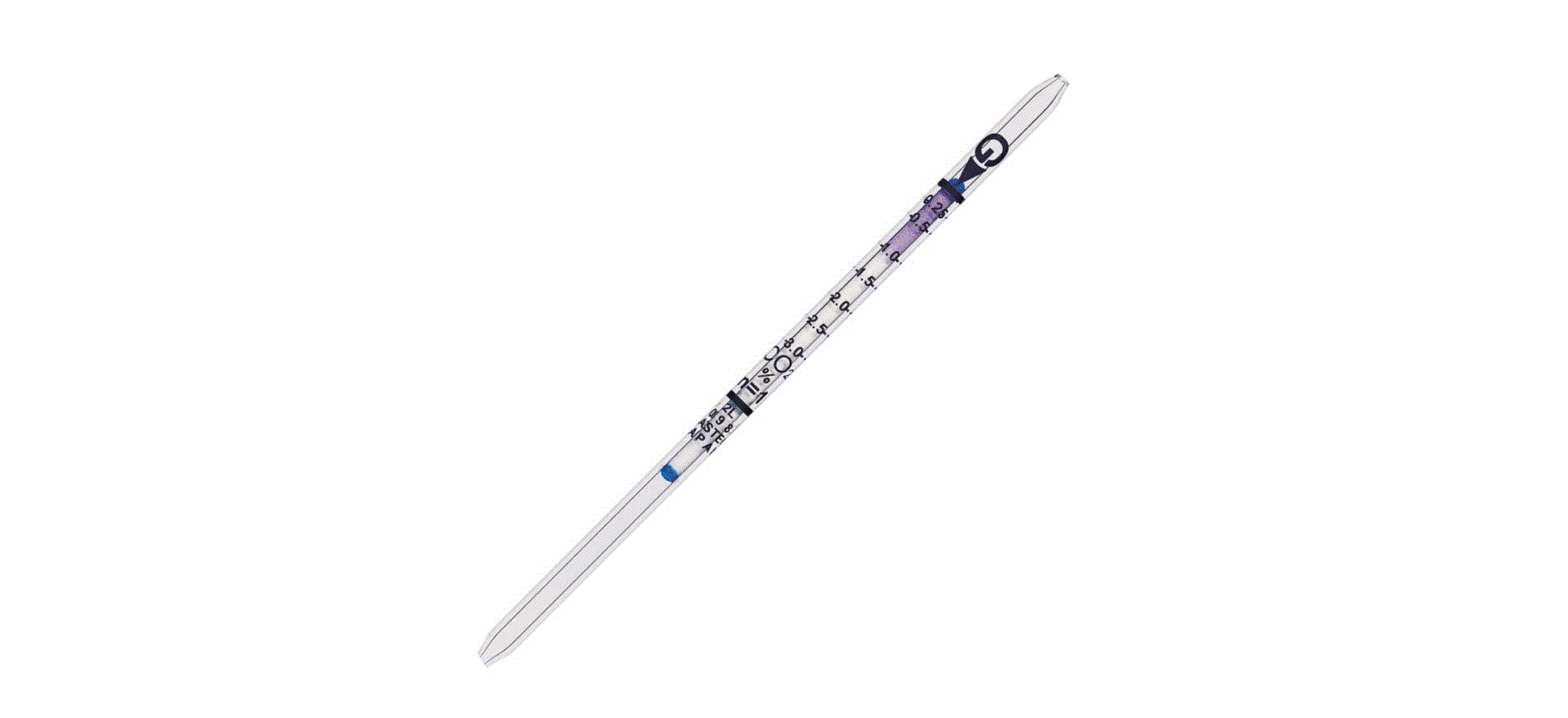
Amines Detector Tube
No.180
FOR SAFE OPERATION:
Carefully read this manual and the instruction manual of your Gastec Gas Sampling Pump.
 WARNING:
- Use only Gastec detector tubes in a Gastec pump.
- Do not interchange or use non-Gastec parts or components in Gastec’s detector tube and pump system.
- Using non-Gastec parts or components in Gastec’s detector tube and pump system or using a non-Gastec detector tube with a Gastec pump or using a Gastec detector tube with a non-Gastec pump may damage your detector tube and pump system, or may cause serious injuries, or death to the end-user. It will also void all warranties, and guarantees regarding performance and data accuracy.
CAUTION: If you do not observe the following precautions, you may suffer injuries or damage the product.
- When breaking the tube ends, keep away from eyes.
- Do not touch the broken glass tubes, broken pieces and reagent with bare hand(s).
- The sampling time represents the time necessary to draw the air sample through the tube. The tube must be positioned in the desired sampling area for the entire sampling time or until the flow finish indicator indicates the end of the sampling.
 NOTES: For maintaining performance and reliability of the test results, observe the following.
- Use Gastec Gas Sampling Pump together with Gastec Detector Tubes only for the purposes specified in the instruction manual of the detector tube.
- Use this tube within the temperature range of 0 – 40°C (32 – 104°F).
- Use this tube within the relative humidity range of 0 – 90%.
- This tube may be interfered with by the coexisting gases. Please refer to the table “INTERFERENCES” below.
- The shelf life and storage condition of the tube are marked on the label of the tube box.
APPLICATION OF THE TUBE:
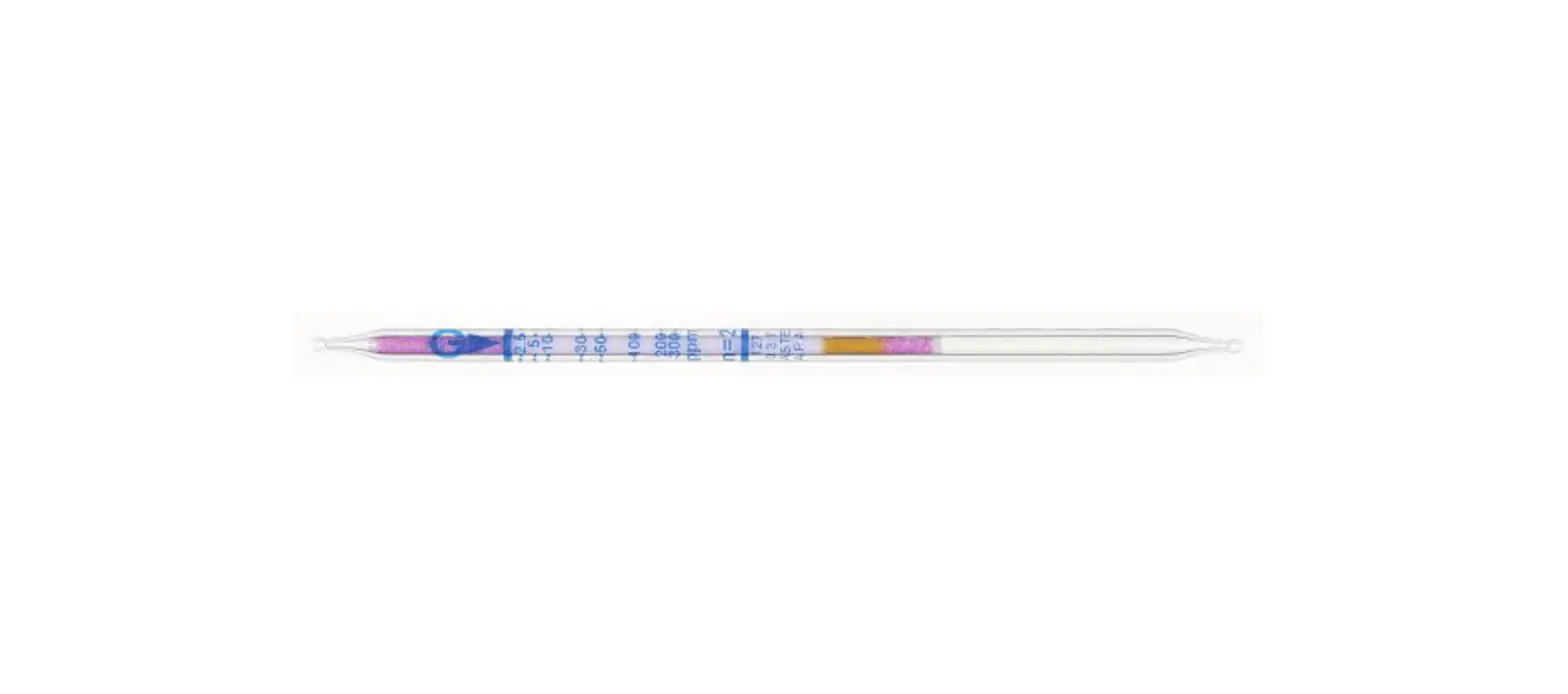
Use this tube for detecting Amines in the air or in industrial areas and for determining the environ-mental atmospheric condition.
SPECIFICATION:
(Because of Gastec’s commitment to continued improvement, specifications are subject to change without notice.)

| Measuring Range | 5 – 100 ppm |
| Number of Pump Strokes | 1 |
| Stroke Correction Factor | 1 |
| Sampling Time | 30 seconds per pump stroke |
| Detecting Limit | 0.5 ppm (n = 1) |
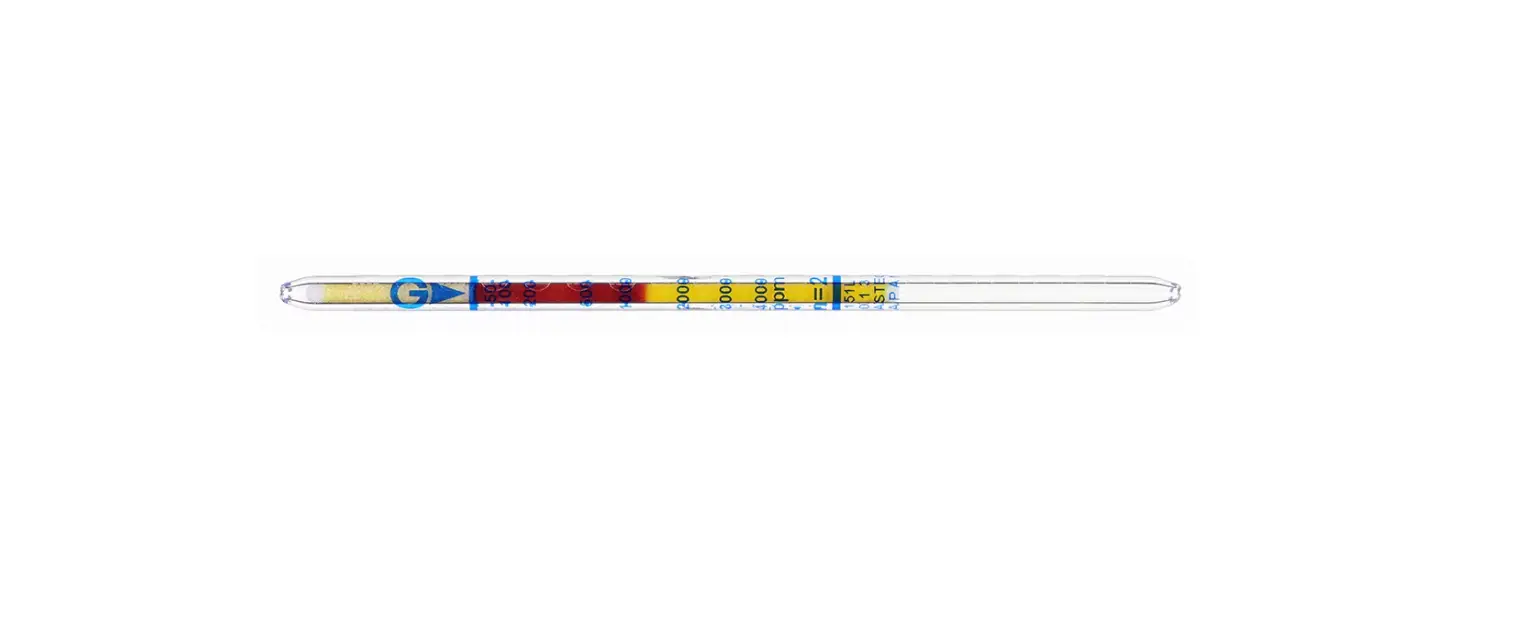
| Colour Change | Pink → Yellow to Brown |
| Reaction Principle | 2R ・NH₂ + H₂SO₄ → (R・NH₃)₂SO₄ |
Coefficient of Variation: 10% (for 5 to 20 ppm), 5 % (for 20 to 100 ppm)
** Shelf Life: Please refer to the validity date printed on the tube box.
** Store the tubes in a dark and cool place.
CORRECTION FOR TEMPERATURE, HUMIDITY AND PRESSURE:
Temperature correction table: Correct for temperature with the table below.
| Temperature°C(°F) | 0(32) | 5(41) | 10(50) | 15(59) | 20(68) | 25(77) | 30(86) | 35(95) | 40(104) |
| Correction Factor | 2.0 | 2. | 1. | 1. | 1.0 | 0.9 | 0.8 | 0.7 | 0.6 |
Humidity: No correction is required between 0 – 90% R.H.
Pressure: To correct for pressure, use the formula below
Tube Reading* (ppm) ×1013 (hPa)
__________________________
Atmospheric Pressure (hPa)
*This value is after other correction(s), if any, are applied.
MEASUREMENT PROCEDURE:
- For checking the leakage of the pump, insert a freshly sealed detector tube into the pump. Follow instructions provided with the pump operation manual.
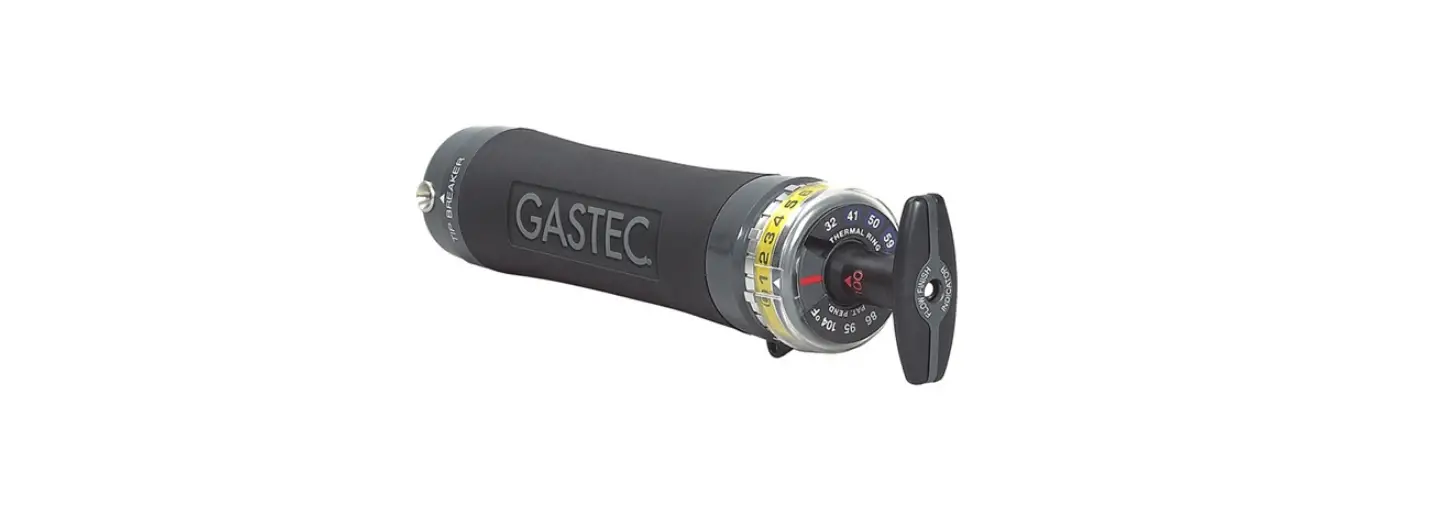
- Break tips off a fresh detector tube with the tube tip breaker in the pump.
- Insert the tube into the pump inlet with the arrow (
 ) on the tube pointing toward the pump.
 - Make certain the pump handle is all the way in. Align the guide marks on the pump body with the guide marks on the handle.
- Pull the handle all the way out until it locks on one pump stroke (100mL). Wait 30 seconds and confirm the completion of the sampling. For monoethanolamine measurement, repeat the above sampling procedure two more times.
- Read the concentration level at the interface where the stained reagent meets the unstained reagent.
- If necessary, multiply the readings by the correction factors of the temperature and atmospheric pressure respectively.
 ) on the tube pointing toward the pump.
INTERFERENCES:
| Substance | Concentration | Interference | Changes colour by itself to |
| Aniline, Hydrazine, Pyridine | + | Yellow to Brown | |
| Amidos | No | No discolouration | |
| Amines, Ammonia | + | Yellow to Brown |
This table of interference gases primarily expresses the interference of each coexisting gas in the concentration range, that is equivalent to the gas concentration. Therefore, the test result may show positive results due to other substances not listed in the table. If more information is needed, please contact us or our distributors in your territory.
APPLICATION FOR OTHER SUBSTANCES:
The Tube 180 can also be used to detect the following substances with correction factors.
| Substance | Correction Factor | No. of Pump Strokes | Measuring Range (ppm) | Changes colour to |
| Allylamine | 2. | 1 | 8.5 -170 | Yellow |
| Ammonia | 0.3 | 1 | 1/5/30 | Yellow |
| Isopropylamine | 1. | 1 | 5.5 -110 | Pale yellowish orange |
| Ethylamine | 1.0 | 1 | 5 -100 | Yellow |
| N – Ethyl Morphorine | 1.0 | 1 | 5 -100 | Yellow |
| Ethylene diamine | 3. | 1 | 14 – 280 | Yellow |
| Diisopropylamine | 1.0 | 1 | 5 -100 | Pale orange |
| Diethylamine | 1. | 1 | 5.5 -110 | Pale brown |
| Diethylethanolamine | 1. | 1 | 6 -120 | Pale brown |
| Cyclohexyl amine | 1. | 1 | 7 -140 | Pale yellowish orange |
| Di – n – Butylamine | 1.0 | 1 | 5 -100 | Pale orange |
| Dipropylamine | 0.8 | 1 | 4 – 80 | Yellow |
| Dimethyl aminopropylamine | 2. | 1 | 8 -160 | Grayish Red |
| Dimethylamine | 1. | 1 | 5.5 -110 | Pale yellowish orange |
| Dimethylethanolamine | 1. | 1 | 6.5 -130 | Pale Orange to yellow |
| N, N – Dimethylethylamine | 0.8 | 1 | 4 – 80 | Yellow |
| Tetramethylenediamine | 2. | 1 | 8.5 -170 | Purple to yellow |
| Triethyl Amine | 0.9 | 1 | 4/5/90 | Yellow |
| Trimethylamine | 0.7 | 1 | 3/5/70 | Yellow |
| n – Butylamine | 2. | 1 | 8 -160 | Grayish red to brown |
| t – Butylamine | 1. | 1 | 5.5 -110 | Pale brown |
| Propylamine | 1. | 1 | 6 -120 | Pale yellowish orange |
| Propyleneimine | 1. | 1 | 5.5 -110 | Yellow |
| n – Hexylamine | 2. | 1 | 9 -180 | Pale Orange |
| Methylamine | 1.0 | 1 | 5 -100 | Pale brown to yellow |
| N – Methyl Morpholine | 1.0 | 1 | 5 -100 | Yellow |
| Monoethanolamine | 1. | 3 | 7 -140 | Yellow |
| Morpholine | 2. | 1 | 9 -180 | Yellow |
| n-Methyl pyrrolidone | 3. | 1 | 13.5 – 270 | White |
CORRECTION FACTOR:
Detector tubes are primarily designed to measure specific gases. But it is also possible to measure other substances of similar chemical properties with the aid of a correction factor or chart. The correction factor is a number which is multiplied by the concentration as interpreted from the colour on the detector tube. The correction factor may also be presented as a chart on the tube if the correction relationship is nonlinear. Therefore, make use of the correction factor/chart measurement ranges as a reference. Moreover, this factor may vary slightly between production batches.
For a more precise factor please contact your Gastec distributor.
INSTRUCTIONS ON DISPOSAL:
The reagent of the tube does not use toxic substances. When disposing the tube regardless of whether it has been used or not, follow the rules and regulations of your local government.
WARRANTY:
If you have any questions regarding gas detection and the quality of the tubes, please feel free to contact your Gastec representatives.
Manufacturer: Gastec Corporation
8-8-6 Fukayanaka, Ayase-City, Kanagawa 252-1195, Japan
https://www.gastec.co.jp/
Telephone +81-467-79-3910 Facsimile +81-467-79-3979
IM00180E5
Printed in Japan
22H1D
 GASTEC CORPORATION | For all types of gas and vapour