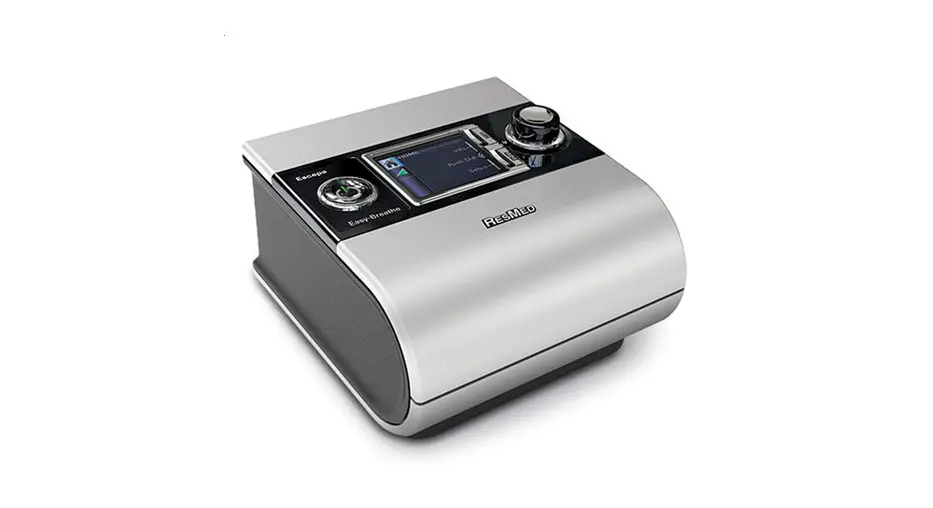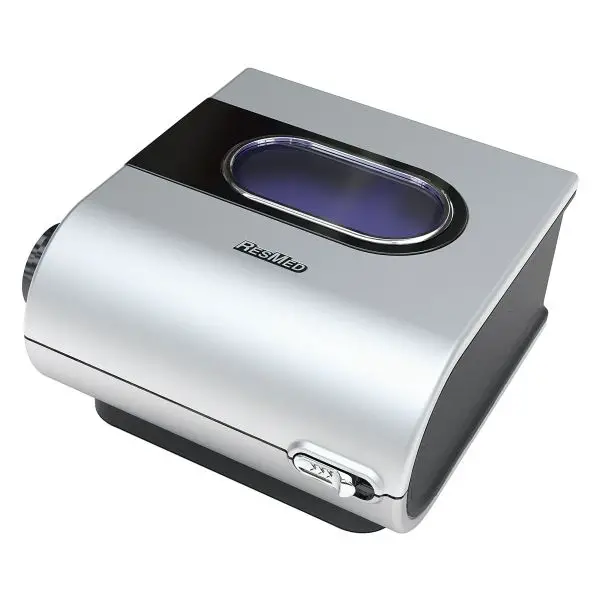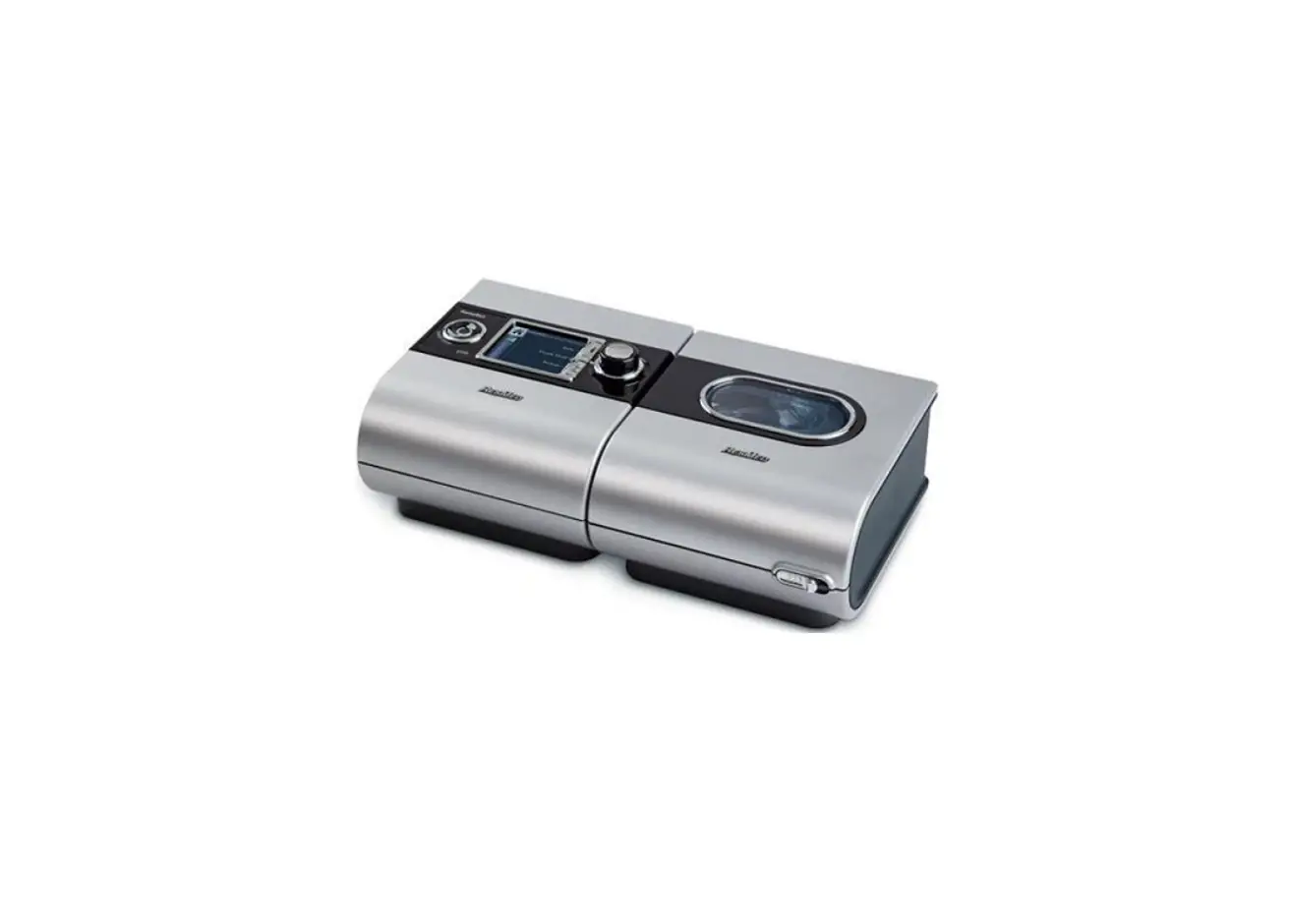

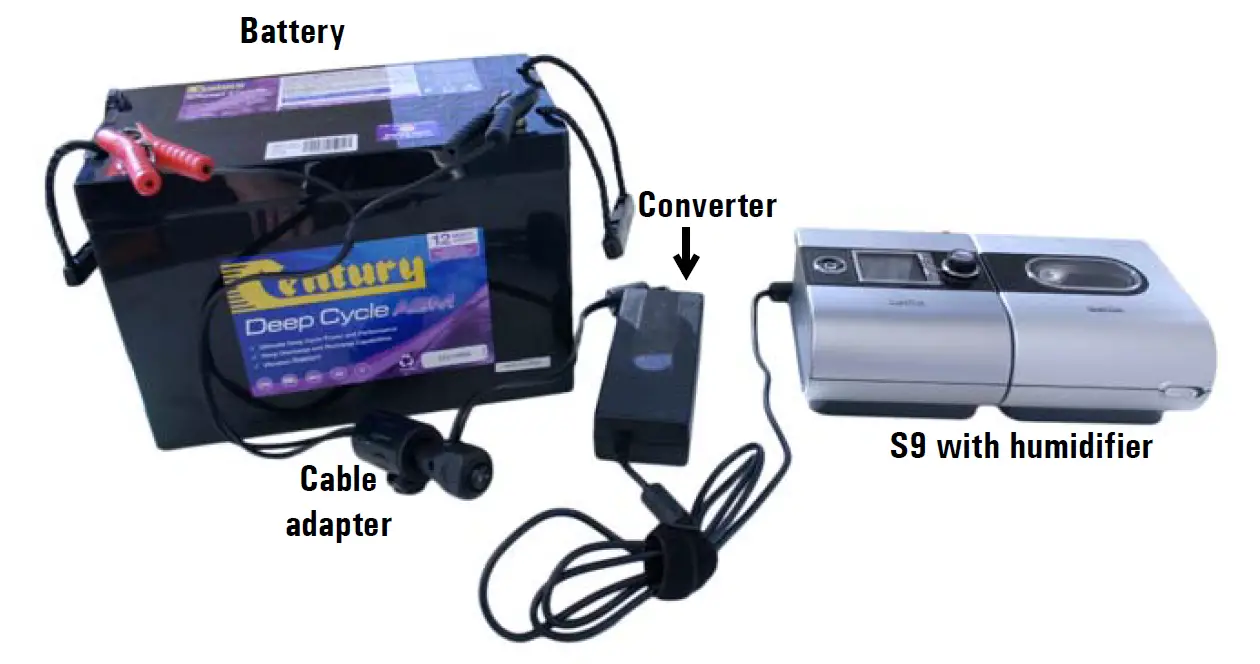
ResMed Battery Cable Adapter Converter and S9 with Humidifier
Introduction
Many people choose to run their ResMed device (flow generator or ventilator) on battery power in situations where mains power is not available. Whether you are planning a camping holiday or preparing power back-up in an area prone to power failure, the following guide will help you understand the requirements for running a flow generator and/or humidifier from battery power.
Running a ResMed device
If you wish to run a ResMed device from a battery, and you intend to use the battery for a single night before recharging, refer to the following pages to confirm your exact battery and inverter/converter requirements.
Batteries
Battery basics
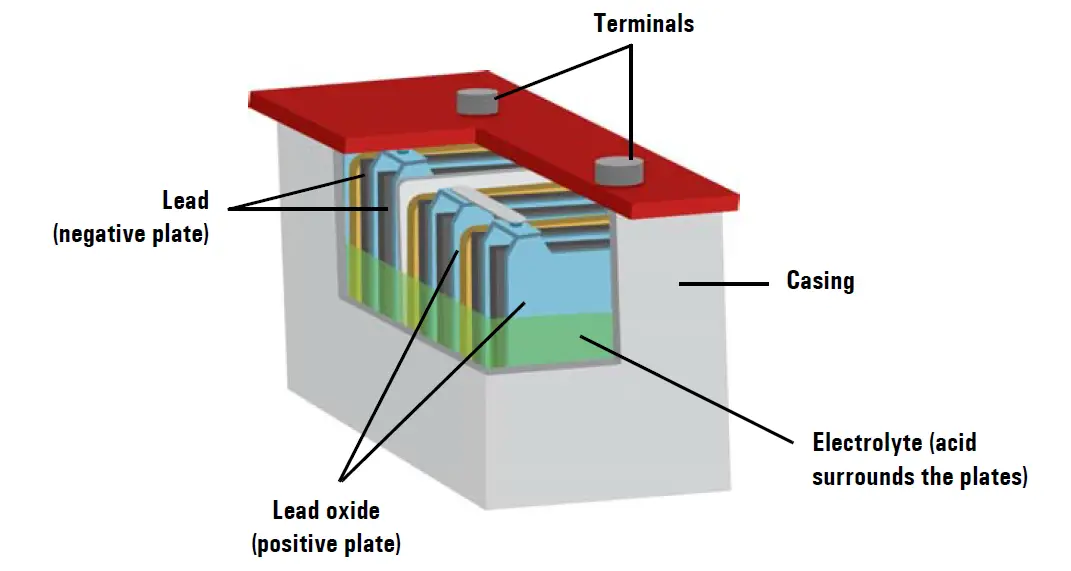
The batteries typically used to run flow generators or ventilators are rechargeable lead-acid batteries. They work on a simple principle: two dissimilar metals are immersed in an electrolyte which produces a flow of electrical current between the two metals. This is a flooded lead-acid battery. Modern rechargeable batteries usually have 6 banks of plates or cells producing 2.11 volts per cell, for a terminal voltage of 12.66 volts.
Lead-acid battery construction
Types of batteries
Not all batteries are created equal. They are manufactured differently for different purposes.
Automotive batteries
Modern car batteries are designed to supply a surge of high current to crank the engine of a car. This is achieved by manufacturing the battery with a large number of thin plates to maximise the surface area of the plates. The plates are composed of a lead “sponge”, similar in appearance to a very fine foam sponge. If subjected to deep discharge, this sponge will quickly be consumed and fall to the bottom of the cells. Automotive batteries should never be discharged by more than about 30% before recharge. A car battery will only last about 30 deep cycles, while they may last for thousands of cycles in normal starting use (2-5% discharge).
Automotive batteries are rated in Cold Cranking Amps (CCA). This is the amount of current that the battery is able to supply for 30 seconds at -20°C while maintaining a terminal voltage of 7.2 volts or more.
Deep-cycle batteries
The major difference between a true deep cycle battery and other types of batteries is that the plates are solid lead. They are manufactured with much thicker plates in each cell and can be discharged as much as 80% or more.
Deep-cycle batteries are rated in amp-hours (AH): this means the current that can be drawn from the battery for a specified time, for example, a battery rated at 50 AH is able to supply 1 amp for 50 hours, or 2 amps for 25 hours and so on. This only works up to a point, as there are constraints on the maximum performance.
Note: There is no direct correlation between CCA and AH – one can not be calculated from the other
Marine batteries
Marine batteries are manufactured with thick plates in their cells to facilitate deeper discharges and are also rated in amp-hours. Most marine batteries are not true deep-cycle, but a type of hybrid. Most marine batteries may be safely discharged up to 60% before recharging.
Caution: Check with the battery manufacturer for recommendations of discharge rate. The information supplied should be used as a guide only.
Other types of batteries
AGM, or Absorbed Glass Mat
A newer type of sealed battery uses Absorbed Glass Mats, or AGM between the plates. This is a very fine fibre boron-silicate glass mat. These batteries have all the advantages of gelled batteries (see below), but can withstand more severe use. The plates in AGM batteries are tightly packed and rigidly mounted, and will withstand shock and vibration better than any conventional battery. AGM batteries have several advantages over both gelled and flooded batteries, at about the same cost as gelled batteries:
- Since all the electrolyte is contained in the glass mats, they cannot spill, even if broken. This also means that since they are non-hazardous, the shipping costs are lower. In addition, since there is no liquid to freeze and expand, they are practically immune to freezing damage.
- The charging voltages are the same as for any standard battery – there is no need for any special adjustments or problems with incompatible chargers.
- AGM batteries have a very low self-discharge – from 1% to 3% per month is typical. This means that they can sit in storage for much longer periods without charging.
Gelled electrolyte
Gelled batteries, or gel cells contain acid that has been “gelled” by the addition of silica gel, turning the acid into a solid mass that looks like thick jelly. The advantage of these batteries is that it is impossible to spill acid even if the battery is broken.
A disadvantage of gel cells is that they must be charged at a lower voltage than flooded or AGM batteries. If overcharged, voids can develop in the gel which will never heal, causing a loss in battery capacity. In hot climates, water loss can be enough over 2-4 years to cause premature battery death.
Battery maintenance
Lead-acid batteries are perishable. During the discharge process, lead sulphate crystals are formed in the pores and on the surfaces of the positive and negative plates inside the battery. This creation of crystals is commonly called lead sulphation and accounts for over 80% of deep-cycle battery failure. The longer sulphation occurs, the larger and harder the lead sulphate crystals become. The positive plates will be light brown and the negative plates will be a dull, off-white colour. These crystals lessen a battery’s capacity and its ability to be recharged.
The best way to prevent sulphation is to recharge as soon after discharge as possible, and if the battery is to be stored for more than two weeks, top up the charge frequently.
- Add a battery conditioner in accordance with the manufacturer’s instructions. This is a chemical additive which prolongs battery life.
- Check electrolyte levels regularly and top up only with demineralised water as required.
- Buy a hydrometer and check the specific gravity of the electrolyte in each cell of the battery.
This will detect damaged or collapsed cells before they leave you stranded with a useless battery.
Storing a battery
- If the battery has filler caps, check the electrolyte level in each cell. If required, add only demineralised water to the recommended level, but do not overfill.
- Clean the top of the battery and the terminal posts.
- Fully charge the battery.
- Store it in a dry, cool place (above freezing), where it can be easily recharged.
- Most importantly, prevent sulphation by keeping the battery charged at 100% state-of-charge level by frequent recharging. Once every two weeks is recommended
Caution: Always check with the battery manufacturer for charging instructions. Damage to the cells or reduction in service life may result from incorrect charging.
Inverters
There are several different types of inverters available. The most common types are pure sine wave or modified sine wave. A pure sine wave inverter produces an output waveform that is the same as a domestic power outlet. They are more difficult to manufacture and are the most expensive. The outputs of the two different types look like this: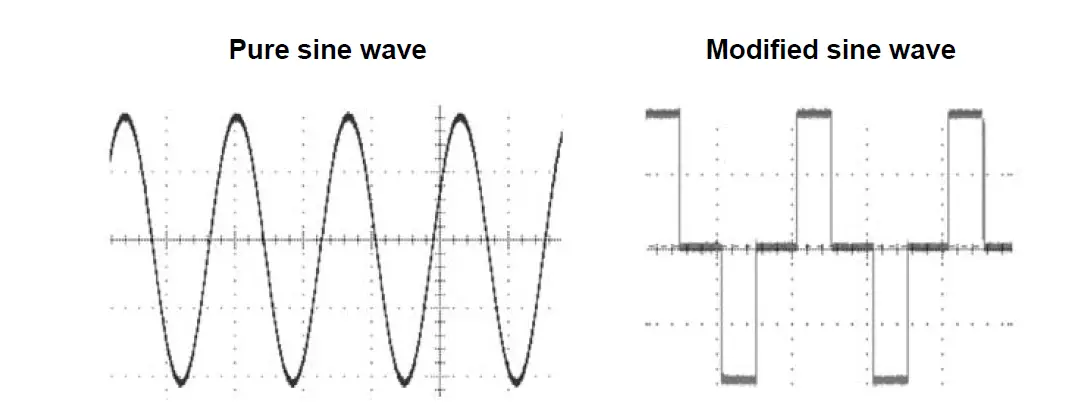
Power ratings
In addition to the output waveform, inverters also carry a power rating. This indicates the amount of power the inverter is capable of delivering. Most inverters will have a continuous rating and a surge or peak rating. The continuous rating indicates the power level it is capable of delivering under sustained use without overload. The surge, or peak rating, refers to a level that can be delivered for short periods. How long the inverter is capable of delivering its surge rated power output will vary from one manufacturer to another. Pure sine wave Modified sine wave+
Warning
It is also recommended that the inverter is certified by an accredited testing and certification organisation, such as VDE, TSU or BSI in addition to CE markings for EU countries or UL markings for the USA. Please contact your local ResMed office for more information.
Minimum inverter requirements
The following table is a guide to the minimum inverter requirements for each product. Power ratings quoted are continuous ratings:
| Inverter type | Products | ||||
| Modified sine wave – 150 watt | • AutoSet CS™ 2/VPAP™ Adapt SV
• S7 series • S8™ series | • C-Series Tango™
• S8™ II series | |||
| • S9™ series • S9 series + H5i | • VPAP™ III series | ||||
| • VPAP™ series • VPAP™ Auto | • VPAP™ Malibu | ||||
| Inverter type | All products (except S9) with humidifier – HumidAire 2i™, HumidAire 3i™, H4i™, H5i™, C-Series heated humidifier | ||||
| • AutoSet CS™ 2/VPAP™ Adapt SV | |||||
| Pure sine wave – | |||||
| 300 watt continuous | • C-Series | Tango™ | • S7 | series | • S8™ series |
| Peak/Surge rating – | • S8™ II series • Stellar™ series | • VPAP™ III series | |||
| 500 watt | • VPAP™ series • VPAP™ Auto | • VPAP™ Malibu | |||
Note: The VPAP series inverters are to be used in conjunction with the Battery Adapter Cable (p/n 22006).
Note: The original HumidAire™ must not be used with inverters!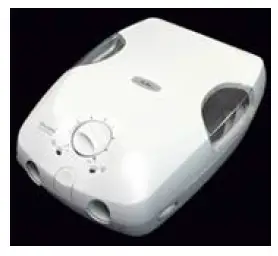 Caution
The C-Series Tango with C-Series heated humidifier is 110V only.
Warning
Other ResMed heated humidifiers must not be used with inverters. Damage to the unit or serious injury to the user may result. If you are using another brand of heated humidifier, check with the manufacturer for their recommendation.
Converters
ResMed supplies the following converters for the following products:
| Product | Converter |
| VPAP series | DC-24 converter (p/n 26932) to be used in conjunction with the Battery Adapter Cable (p/n 22006) |
| S9 series | DC/DC converter 24V/90W (p/n 36970) |
| Stellar series | Stellar DC/DC converter (p/n 24922) |
| Air10 series | Air10 DC/DC converter (p/n 37297) |
Why use a converter?
- The converter is more efficient than an inverter.
- The converter provides electrical protection to the device in the event that the adapter leads are connected incorrectly to the battery.
- The converter provides regulation of the battery voltage: a fully charged battery has a terminal voltage of 13.5 volts and will reduce as the battery is discharged.
- The converter will shutdown automatically when the voltage drops below 10.5 volts for a 12 volt battery, or 21 volts for a 24 volt battery. This will protect the battery from damage due to being allowed to fully discharge.
- The converter provides electrical isolation to the device.
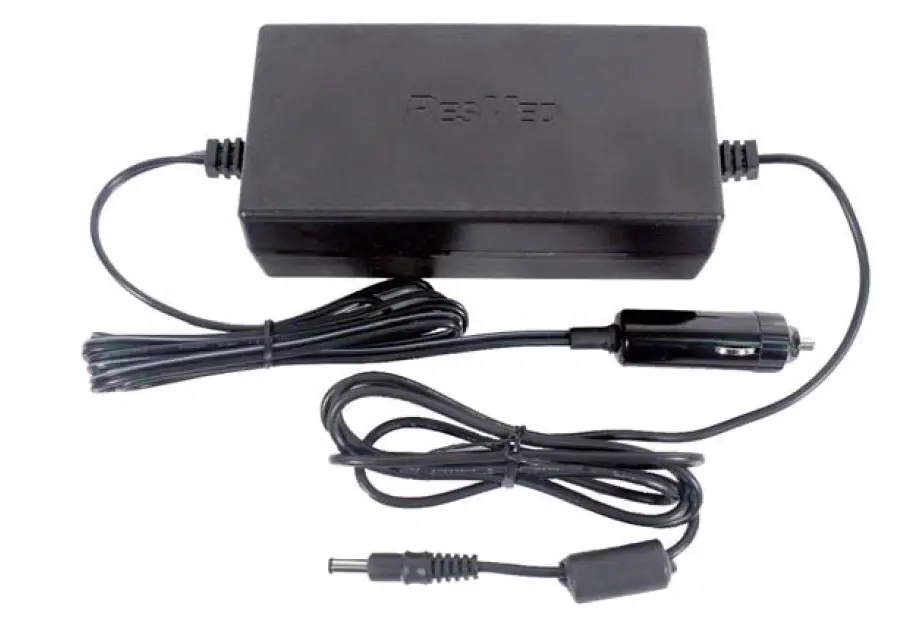
Connecting a converter/inverter to a battery
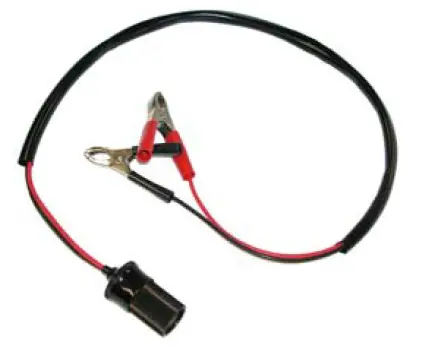
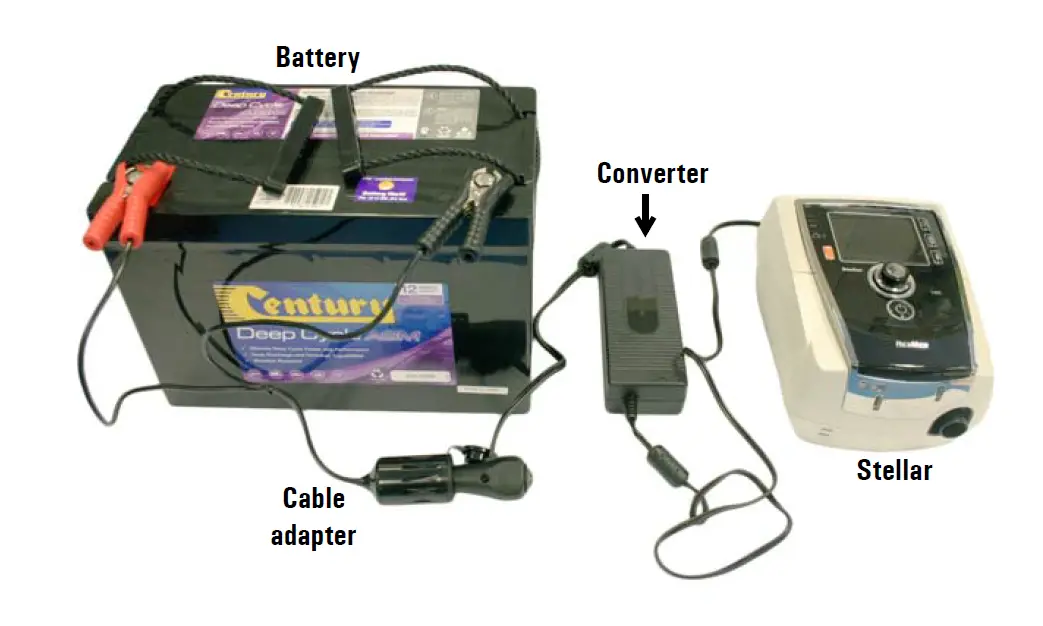
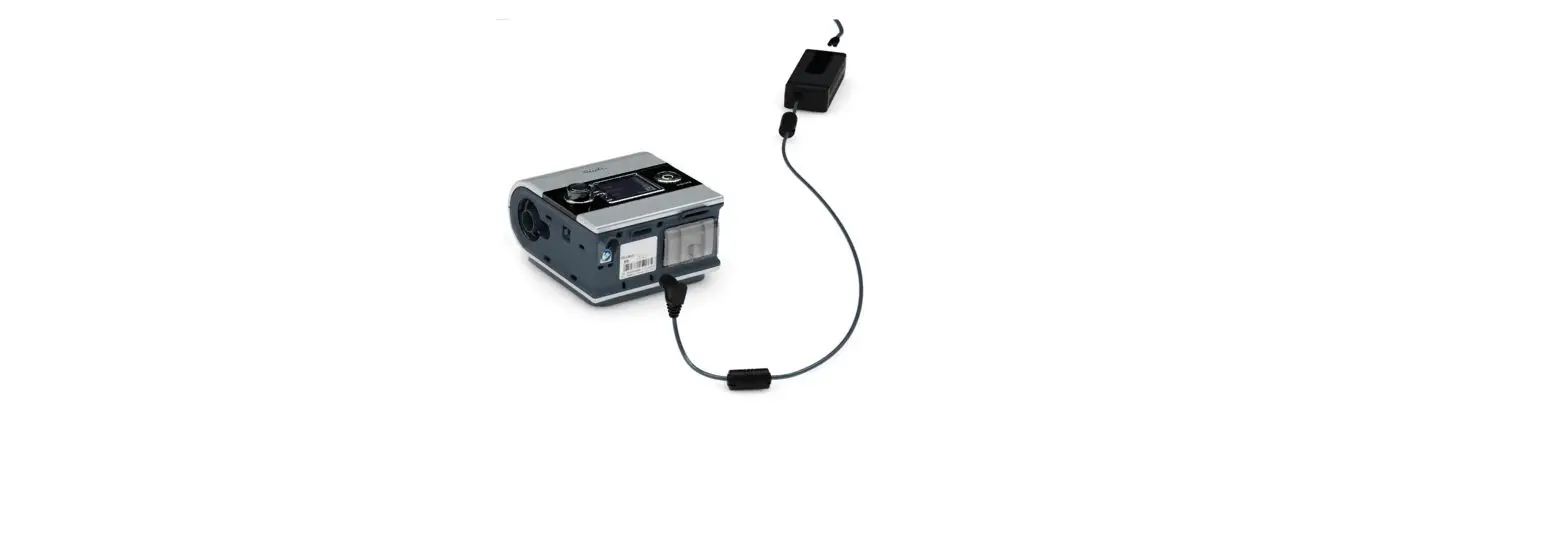
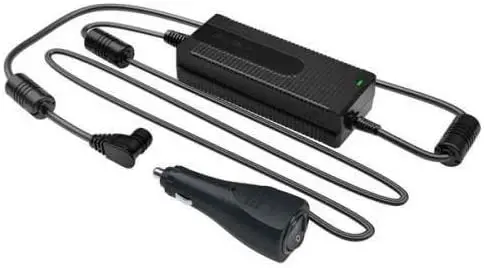
Most converters and inverters come with a car cigarette lighter plug fitted to provide a connection to the car battery. They can be connected to an auxiliary battery via the cigarette lighter outlet of a car or 4WD vehicle. If you need to connect directly to the battery terminals (e.g. if the battery is out of the vehicle), you will need an adapter cable, as pictured here.
This cable provides a more energy-efficient connection than the car cigarette lighter socket as it by-passes the car electrical system.
Warning
Do not attempt to start the vehicle engine while using the flow generator/ventilator powered from the vehicle battery as dangerous voltage spikes are produced that can damage the unit.
Battery size tables
ResMed devices powered with inverter
Note: As treatment pressure varies widely with automatic devices, 95th percentile pressure is used for all AutoSet products.
C-Series Tango
| Product | Treatment pressure* (cm H2O) | Current draw at 12 V DC (amps) | Battery size for 8 hours use (amp-hours) (includes 50% safety margin) |
| • C-Series Tango | 6 | 0.63 | 8 |
| 8 | 0.73 | 9 | |
| 10 | 0.84 | 10 | |
| 12 | 0.94 | 11 | |
| 16 | 1.16 | 14 | |
| 20 | 1.39 | 17 | |
| • C-Series Tango + C-Series heated humidifier (set to 4) | 6 | 2.73 | 33 |
| 8 | 2.91 | 35 | |
| 10 | 3.11 | 37 | |
| 12 | 3.24 | 39 | |
| 16 | 3.54 | 43 | |
| 20 | 3.91 | 47 |
S8 Series
| Product | Treatment pressure* (cm H2O) | Current draw at 12 V DC (amps) | Battery size for 8 hours use (amp-hours) (includes 50% safety margin) |
| • S8 Lightweight • S8 Escape | 6 | 1.02 | 12 |
| 8 | 1.12 | 13 | |
| 10 | 1.24 | 15 | |
| 12 | 1.36 | 16 | |
| 16 | 1.62 | 19 | |
| 20 | 1.90 | 23 | |
| • S8 Lightweight + HumidAire 3i • S8 Escape + HumidAire 3i | 6 | 3.75 | 45 |
| 8 | 3.84 | 46 | |
| 10 | 3.96 | 48 | |
| 12 | 4.09 | 49 | |
| 16 | 4.34 | 52 | |
| 20 | 4.63 | 56 | |
| • S8 Elite • S8 AutoScore • S8 AutoSet Vantage • S8 AutoSet Spirit • S8 AutoSet C • S8 Respond (product code 33127) | 6 | 1.13 | 14 |
| 8 | 1.27 | 15 | |
| 10 | 1.40 | 17 | |
| 12 | 1.52 | 18 | |
| 16 | 1.81 | 22 | |
| 20 | 2.12 | 25 | |
| • S8 Elite + HumidAire 3i • S8 AutoScore + HumidAire 3i • S8 AutoSet Vantage + HumidAire 3i • S8 AutoSet Spirit + HumidAire 3i • S8 AutoSet C + HumidAire 3i • S8 Respond (product code 33127) + HumidAire 3i | 6 | 3.86 | 46 |
| 8 | 4.00 | 48 | |
| 10 | 4.12 | 50 | |
| 12 | 4.25 | 51 | |
| 16 | 4.54 | 54 | |
| 20 | 4.85 | 58 |
S8 II series
| Product | Treatment pressure* (cm H2O) | Current draw at 12 V DC (amps) | Battery size for 8 hours use (amp-hours) (includes 50% safety margin) |
| • S8 Escape II (EPR-setting 3) | 5 | 0.41 | 5 |
| 10 | 0.61 | 8 | |
| 15 | 0.86 | 11 | |
| 20 | 1.17 | 14 | |
| • S8 Escape II (EPR-setting 3, full time) + H3i (set to 4) | 5 | 4.99 | 60 |
| 10 | 4.91 | 59 | |
| 15 | 5.93 | 71 | |
| 20 | 6.08 | 73 | |
| • S8 Escape II (EPR-setting 3, full time) + H4i (set to 4) | 5 | 8.49 | 102 |
| 10 | 9.6 | 115 | |
| 15 | 9.38 | 113 | |
| 20 | 11.26 | 135 | |
| • S8 Elite II • S8 AutoScore II • S8 AutoSet Spirit II • S8 AutoSet • S8 Respond (product code 33137) | 6 | 0.91 | 11 |
| 8 | 0.94 | 11 | |
| 10 | 1.09 | 13 | |
| 12 | 1.20 | 14 | |
| 16 | 1.48 | 18 | |
| 20 | 1.76 | 21 | |
| • S8 Elite II + HumidAire 3i • S8 AutoScore II + HumidAire 3i • S8 AutoSet Spirit II + HumidAire 3i • S8 AutoSet + HumidAire 3i • S8 Respond (product code 33137) + HumidAire 3i | 6 | 3.46 | 41 |
| 8 | 3.36 | 40 | |
| 10 | 3.66 | 44 | |
| 12 | 3.84 | 46 | |
| 16 | 3.77 | 45 | |
| 20 | 4.51 | 54 |
S9 series
| Product | Treatment pressure* (cm H2O) | Current draw at 12 V DC (amps) | Battery size for 8 hours use (amp-hours) (includes 50% safety margin) |
| • S9 Elite (EPR Setting 0) • S9 AutoSet (EPR Setting 0) | 6 | 0.89 | 11 |
| 8 | 0.95 | 12 | |
| 10 | 1.02 | 12 | |
| 12 | 1.08 | 13 | |
| 16 | 1.23 | 15 | |
| 20 | 1.41 | 17 | |
| • S9 Elite + H5i (EPR Setting 0, H5i setting 3) • S9 AutoSet + H5i (EPR Setting 0, H5i setting 3) | 6 | 2.57 | 31 |
| 8 | 2.76 | 33 | |
| 10 | 3.01 | 36 | |
| 12 | 3.32 | 40 | |
| 16 | 3.77 | 45 | |
| 20 | 4.10 | 49 | |
| • S9 Elite + H5i (EPR Setting 0, H5i setting 6) • S9 AutoSet + H5i (EPR Setting 0, H5i setting 6) | 6 | 4.94 | 59 |
| 8 | 5.45 | 65 | |
| 10 | 5.90 | 71 | |
| 12 | 6.18 | 74 | |
| 16 | 6.47 | 78 | |
| 20 | 6.69 | 80 | |
| • S9 Elite + H5i + Climate control (EPR Setting 0, CC setting 27° C) • S9 AutoSet + H5i + Climate control (EPR Setting 0, CC setting 27° C) | 6 | 3.05 | 37 |
| 8 | 3.69 | 44 | |
| 10 | 4.12 | 49 | |
| 12 | 4.48 | 54 | |
| 16 | 6.06 | 73 | |
| 20 | 7.25 | 87 | |
| • S9 Elite + H5i + Climate control (EPR Setting 0, CC setting 30° C) • S9 AutoSet + H5i + Climate control (EPR Setting 0, CC setting 30° C) | 6 | 3.32 | 40 |
| 8 | 3.78 | 45 | |
| 10 | 4.20 | 50 | |
| 12 | 4.71 | 57 | |
| 16 | 5.68 | 68 | |
| 20 | 6.49 | 78 | |
| IPAP pressure (cm H2O) | |||
| • S9 VPAP ST-A/ S9 COPD | 10 | 1.19 | 15 |
| 15 | 1.29 | 16 | |
| 20 | 1.40 | 17 | |
| 25 | 1.47 | 18 | |
| 30 | 1.90 | 23 | |
| EPAP pressure (cm H2O) | |||
| • S9 VPAP Adapt SV-A/ S9 AutoSet CS-A | 5 | 1.66 | 20 |
| 10 | 2.33 | 28 | |
| 15 | 3.01 | 37 | |
| • S9 VPAP Adapt SV-A/ S9 AutoSet CS-A + H5i (set to 3) | 5 | 2.93 | 36 |
| 10 | 3.53 | 43 | |
| 15 | 4.79 | 58 | |
| • S9 VPAP Adapt SV-A/ S9 AutoSet CS-A + H5i (set to 6) | 5 | 4.94 | 60 |
| 10 | 5.51 | 67 | |
| 15 | 6.95 | 84 | |
| • S9 VPAP Adapt SV-A/ S9 AutoSet CS-A + H5i + ClimateLine (set to 30°C) | 5 | 7.28 | 88 |
| 10 | 8.04 | 97 | |
| 15 | 8.94 | 108 | |
VPAP III series
| Product | IPAP pressure (cm H2O) | Current draw at 12 V DC (amps) | Battery size for 8 hours use (amp-hours) (includes 50% safety margin) |
| • VPAP III • VPAP™ III ST | 5 | 1.19 | 15 |
| 10 | 1.42 | 17 | |
| 15 | 1.67 | 20 | |
| 20 | 1.93 | 23 | |
| 25 | 2.21 | 27 | |
| • VPAP III + HumidAire 2i • VPAP III ST + HumidAire 2i | 5 | 3.57 | 43 |
| 10 | 3.81 | 46 | |
| 15 | 4.06 | 49 | |
| 20 | 4.32 | 52 | |
| 25 | 4.59 | 55 | |
| • VPAP™ III ST-A • VPAP III ST-A with QuickNav | 5 | 1.65 | 20 |
| 10 | 1.86 | 22 | |
| 15 | 2.11 | 25 | |
| 20 | 2.41 | 29 | |
| 25 | 2.76 | 33 | |
| 30 | 3.15 | 38 | |
| • VPAP III ST-A + HumidAire 2i • VPAP III ST-A with QuickNav + HumidAire 2i | 5 | 4.04 | 48 |
| 10 | 4.25 | 51 | |
| 15 | 4.49 | 54 | |
| 20 | 4.79 | 58 | |
| 25 | 5.15 | 62 | |
| 30 | 5.54 | 66 |
Note: The values in the table are based on a respiratory rate of 20 breaths per minute. Power consumption (and recommended battery capacity) will increase with higher respiratory rates.
VPAP series (VPAP Auto 25, VPAP ST, VPAP S, VPAP IV, VPAP IV ST, S8 Auto 25)
| Product | IPAP pressure (cm H2O) | Current draw at 12 V DC (amps) | Battery size for 8 hours use (amp-hours) (includes 50% safety margin) |
| • VPAP series | 10 | 1.38 | 17 |
| 15 | 1.55 | 19 | |
| 20 | 1.79 | 22 | |
| 25 | 2.09 | 26 | |
| • VPAP series + H4i (set to 4) | 10 | 7.84 | 95 |
| 15 | 8.22 | 99 | |
| 20 | 8.90 | 107 | |
| 25 | 10.75 | 130 |
AutoSet CS2/VPAP Adapt
| Device settings | Inverter | |||
| EEP | Median pressure support | Current draw at 12 V DC (amps) | Battery size for 8 hours use (amp-hours) (includes 50% safety margin) | Battery size for 8 hours use (amp- hours) with H2i (includes 50% safety margin) |
| 4 | 6 | 1.88 | 23 | 56 |
| 6 | 6 | 1.97 | 24 | 57 |
| 8 | 6 | 2.11 | 26 | 58 |
| 10 | 5 | 2.23 | 27 | 60 |
VPAP Malibu
| Product | AutoSet pressure (cm H2O) | Current draw at 12 V DC (amps) | Battery size for 8 hours use (amp-hours) (includes 50% safety margin) |
| • VPAP Malibu | 10 | 1.56 | 21 |
| 20 | 2.35 | 29 | |
| • VPAP Malibu + Humidaire 2i | 10 | 6.58 | 79 |
| 20 | 7.53 | 91 |
VPAP Auto
| • VPAP Auto | ||||
| AutoSet pressure <=10 | AutoSet pressure >10 | |||
| PS (cm H2O) | Current draw at 12 V DC (amps) | Battery size for 8 hours use (amp-hours) (includes 50% safety margin) | Current draw at 12 V DC (amps) | Battery size for 8 hours use (amp-hours) (includes 50% safety margin) |
| 2 | 0.89 | 11 | 1.40 | 17 |
| 4 | 0.87 | 10 | 1.32 | 16 |
| 6 | 0.86 | 10 | 1.23 | 15 |
| 8 | 0.89 | 11 | 1.17 | 14 |
| 10 | 0.85 | 10 | 1.07 | 13 |
| • VPAP Auto + Humidaire 3i | ||||
| AutoSet pressure <=10 | AutoSet pressure >10 | |||
| PS (cm H2O) | Current draw at 12 V DC (amps) | Battery size for 8 hours use (amp-hours) (includes 50% safety margin) | Current draw at 12 V DC (amps) | Battery size for 8 hours use (amp-hours) (includes 50% safety margin) |
| 2 | 8.59 | 103 | 8.85 | 108 |
| 4 | 8.59 | 103 | 8.85 | 108 |
| 6 | 8.59 | 103 | 8.85 | 108 |
| 8 | 8.59 | 103 | 8.85 | 108 |
| 10 | 8.59 | 103 | 8.85 | 108 |
Stellar series
| Product | IPAP pressure (cm H2O) | Current draw at 12 V DC (amps) | Battery size for 8 hours use (amp-hours) (includes 50% safety margin) |
| • Stellar | 10 | 1.25 | 16 |
| 15 | 1.27 | 16 | |
| 20 | 1.42 | 18 | |
| 25 | 1.59 | 20 | |
| 30 | 1.77 | 22 | |
| 35 | 2.21 | 27 | |
| 40 | 2.47 | 30 | |
| • Stellar + H4i (set to 4) | 10 | 7.21 | 87 |
| 15 | 7.79 | 94 | |
| 20 | 8.57 | 103 | |
| 25 | 9.31 | 112 | |
| 30 | 10.55 | 127 | |
| 35 | 11.82 | 142 | |
| 40 | 12.49 | 150 |
ResMed devices powered with converter
S8 series
Note: As treatment pressure varies widely with automatic devices, 95th percentile pressure is used for all AutoSet products.
| Product | Treatment pressure* (cm H2O) | Current draw at 12 V DC (amps) | Battery size for 8 hours use (amp-hours) (includes 50% safety margin) | |
| • S8 Lightweight • S8 Escape | 6 | 0.80 | 10 | |
| 8 | 0.90 | 11 | ||
| 10 | 1.02 | 12 | ||
| 12 | 1.12 | 13 | ||
| 16 | 1.37 | 16 | ||
| 20 | 1.66 | 20 | ||
| • S8 Elite | 6 | 0.90 | 11 | |
| • S8 AutoScore | ||||
| 8 | 0.98 | 12 | ||
| • S8 AutoSet Vantage | ||||
| 10 | 1.09 | 13 | ||
| • S8 AutoSet Spirit | ||||
| • S8 AutoSet C | ||||
| 12 | 1.21 | 14 | ||
| • S8 Respond | ||||
| 16 | 1.46 | 18 | ||
| 20 | 1.73 | 21 |
S8 II series
Note: As treatment pressure varies widely with automatic devices, 95th percentile pressure is used for all AutoSet products.
| Product | Treatment pressure* (cm H2O) | Current draw at 12 V DC (amps) | Battery size for 8 hours use (amp-hours) (includes 50% safety margin) | |
| • S8 Elite II | 6 | 0.57 | 7 | |
| • S8 AutoScore II | ||||
| 8 | 0.70 | 8 | ||
| • S8 AutoSet Spirit II | ||||
| 10 | 0.84 | 10 | ||
| • S8 AutoSet | ||||
| • S8 Respond | ||||
| 12 | 0.96 | 12 | ||
| 16 | 1.22 | 15 | ||
| 20 | 1.51 | 18 | ||
| • S8 Escape II (EPR-setting 3) | 5 | 0.41 | 5 | |
| 10 | 0.61 | 7 | ||
| 15 | 0.86 | 10 | ||
| 20 | 1.17 | 14 |
S9 Series
| Product | Treatment pressure* (cm H2O) | Current draw at 12 V DC (amps) | Battery size for 8 hours use (amp-hours) (includes 50% safety margin) |
| • S9 AutoSet/ Elite/ Escape/ Escape Auto | 6 | 0.39 | 5 |
| 8 | 0.46 | 6 | |
| 10 | 0.55 | 7 | |
| 12 | 0.65 | 8 | |
| 16 | 0.9 | 11 | |
| 20 | 1.0 | 13 | |
| • S9 AutoSet/ Elite/ Escape/ Escape Auto + H5i (H5i setting 3) | 6 | 1.25 | 15 |
| 8 | 1.62 | 20 | |
| 10 | 2.03 | 25 | |
| 12 | 2.39 | 29 | |
| 16 | 3.19 | 39 | |
| 20 | 4.03 | 49 | |
| • S9 AutoSet/ Elite/ Escape/ Escape Auto + H5i (H5i setting 6) | 6 | 4.61 | 56 |
| 8 | 4.84 | 59 | |
| 10 | 4.99 | 60 | |
| 12 | 5.17 | 63 | |
| 16 | 5.58 | 67 | |
| 20 | 6.04 | 73 | |
| • S9 AutoSet/ Elite/ Escape/ Escape Auto+ H5i + Climate control (CC setting 30° C) | 6 | 4.27 | 52 |
| 8 | 5.08 | 61 | |
| 10 | 5.58 | 67 | |
| 12 | 5.77 | 70 | |
| 16 | 6.15 | 74 | |
| 20 | 6.59 | 79 | |
| IPAP pressure (cm H2O) | |||
| • S9 VPAP S/ VPAP ST | 10 | 0.52 | 7 |
| 15 | 0.80 | 10 | |
| 20 | 1.17 | 15 | |
| 25 | 1.57 | 19 | |
| • S9 VPAP S/ VPAP ST+ H5i (H5i setting 3) | 10 | 1.41 | 17 |
| 15 | 1.90 | 23 | |
| 20 | 3.07 | 37 | |
| 25 | 3.44 | 42 | |
| Product | Treatment pressure* (cm H2O) | Current draw at 12 V DC (amps) | Battery size for 8 hours use (amp-hours) (includes 50% safety margin) |
| • S9 VPAP S/ VPAP ST+ H5i (H5i setting 6) | 10 | 4.87 | 59 |
| 15 | 5.10 | 62 | |
| 20 | 5.95 | 72 | |
| 25 | 6.35 | 77 | |
| • S9 VPAP S/ VPAP ST + H5i + Climate control (CC setting 30° C) | 10 | 4.66 | 56 |
| 15 | 5.69 | 69 | |
| 20 | 6.1 | 74 | |
| 25 | 6.41 | 77 | |
| EPAP pressure (cm H2O) | |||
| • S9 VPAP Adapt SV-A, AutoSet CS/CS-A | 5 | 0.61 | 8 |
| 10 | 0.76 | 10 | |
| 15 | 0.95 | 12 | |
| • S9 VPAP Adapt SV-A, AutoSet CS/CS-A + H5i (H5i setting 3) | 5 | 2.45 | 30 |
| 10 | 3.05 | 37 | |
| 15 | 3.75 | 45 | |
| • S9 VPAP Adapt SV-A, AutoSet CS/CS-A + H5i (H5i setting 6) | 5 | 4.47 | 54 |
| 10 | 5.24 | 63 | |
| 15 | 6.06 | 73 | |
| • S9 VPAP Adapt SV-A, AutoSet CS/CS-A + H5i + Climate control (CC setting 30° C) | 5 | 5.85 | 71 |
| 10 | 6.35 | 77 | |
| 15 | 7.05 | 85 | |
| Max IPAP (cm H2O) | |||
| • S9 VPAP Auto | 15 | 0.54 | 7 |
| 20 | 0.75 | 9 | |
| 25 | 1.00 | 12 | |
| • S9 VPAP Auto + H5i (H5i setting 3) | 15 | 1.27 | 16 |
| 20 | 2.01 | 25 | |
| 25 | 2.26 | 28 | |
| • S9 VPAP Auto + H5i (H5i setting 6) | 15 | 3.89 | 47 |
| 20 | 5.10 | 62 | |
| 25 | 5.42 | 65 | |
| • S9 VPAP Auto + H5i + Climate control (CC setting 30° C) | 15 | 3.05 | 37 |
| 20 | 4.29 | 52 | |
| 25 | 5.34 | 65 | |
Note: Where the H5i is being used figures will vary dependant upon relative humidity
Air10 series
| Product | IPAP pressure (cm H2O) | Current draw at 12 V DC (amps) | Battery size for 8 hours use (amp-hours) (includes 50% safety margin) |
| • AirStart 10 + SlimLine tubing | 6 | 0.39 | 5 |
| 8 | 0.48 | 6 | |
| 10 | 0.53 | 7 | |
| 12 | 0.61 | 8 | |
| 16 | 0.80 | 10 | |
| 20 | 1.01 | 13 | |
| • AirStart 10 + SlimLine tubing+ humidifier (set to 4) | 6 | 1.28 | 16 |
| 8 | 1.49 | 18 | |
| 10 | 1.66 | 20 | |
| 12 | 1.84 | 23 | |
| 16 | 2.28 | 28 | |
| 20 | 2.66 | 32 | |
| • AirStart 10 + SlimLine tubing+ humidifier (set to 8) | 6 | 3.14 | 38 |
| 8 | 3.31 | 40 | |
| 10 | 3.44 | 42 | |
| 12 | 3.67 | 45 | |
| 16 | 4.00 | 48 | |
| 20 | 4.34 | 53 | |
| • AirSense 10 CPAP/Elite/ AutoSet/AutoSet for Her + ClimateLineAir (set to 30°C) | 6 | 1.06 | 13 |
| 8 | 1.20 | 15 | |
| 10 | 1.52 | 19 | |
| 12 | 1.96 | 24 | |
| 16 | 2.68 | 33 | |
| 20 | 3.50 | 42 | |
| • AirSense 10 CPAP/Elite/ AutoSet/AutoSet for Her + SlimLine tubing | 6 | 0.70 | 9 |
| 8 | 0.79 | 10 | |
| 10 | 0.93 | 12 | |
| 12 | 1.06 | 13 | |
| 16 | 1.23 | 15 | |
| 20 | 1.66 | 20 |
| Product | IPAP pressure (cm H2O) | Current draw at 12 V DC (amps) | Battery size for 8 hours use (amp-hours) (includes 50% safety margin) |
| • AirSense 10 CPAP/Elite/ AutoSet/AutoSet for Her + SlimLine tubing + humidifier (set to 4) | 6 | 1.73 | 21 |
| 8 | 2.00 | 24 | |
| 10 | 2.30 | 28 | |
| 12 | 2.61 | 32 | |
| 16 | 3.33 | 40 | |
| 20 | 4.19 | 51 | |
| • AirSense 10 CPAP/Elite/ AutoSet/AutoSet for Her+ SlimLine tubing + humidifier (set to 8) | 6 | 3.44 | 42 |
| 8 | 3.49 | 42 | |
| 10 | 3.66 | 44 | |
| 12 | 3.86 | 47 | |
| 16 | 4.18 | 51 | |
| 20 | 4.59 | 56 | |
| • AirSense 10 CPAP/Elite/ AutoSet/AutoSet for Her + ClimateLine Air tubing + humidifier (set to Auto) | 6 | 3.12 | 38 |
| 8 | 3.55 | 43 | |
| 10 | 3.77 | 46 | |
| 12 | 4.02 | 49 | |
| 16 | 4.21 | 51 | |
| 20 | 4.35 | 53 | |
| • AirSense 10 CPAP/Elite/ AutoSet/AutoSet for Her + ClimateLine Air tubing (set to 30°C) + humidifier (set to 8) | 6 | 4.71 | 57 |
| 8 | 4.77 | 58 | |
| 10 | 4.92 | 60 | |
| 12 | 5.12 | 62 | |
| 16 | 5.37 | 65 | |
| 20 | 5.61 | 68 |
VPAP Malibu
| Product | AutoSet pressure (cm H2O) | Current draw at 12 V DC (amps) | Battery size for 8 hours use (amp-hours) (includes 50% safety margin) |
| • VPAP Malibu | 10 | 1.09 | 13 |
| 20 | 1.74 | 21 |
VPAP Auto
| AutoSet pressure <=10 | AutoSet pressure >10 | |||
| PS (cm H2O) | Current draw at 12 V DC (amps) | Battery size for 8 hours use (amp-hours) (includes 50% safety margin) | Current draw at 12 V DC (amps) | Battery size for 8 hours use (amp-hours) (includes 50% safety margin) |
| 2 | 0.67 | 8 | 1.15 | 14 |
| 4 | 0.69 | 8 | 1.10 | 13 |
| 6 | 0.69 | 8 | 1.03 | 12 |
| 8 | 0.67 | 8 | 0.95 | 11 |
| 10 | 0.63 | 8 | 0.90 | 11 |
VPAP series (VPAP Auto 25, VPAP ST, VPAP S, VPAP IV, VPAP IV ST, S8 Auto 25)
| IPAP (cm H2O) | Current draw at 12 V DC (amps) | Battery size for 4 hours use (amp-hours) (includes 50% safety margin) | Battery size for 8 hours use (amp-hours) (includes 50% safety margin) |
| 10 | 1.0 | 6 | 12 |
| 15 | 1.2 | 7 | 14 |
| 20 | 1.5 | 9 | 18 |
| 25 | 1.8 | 11 | 22 |
Stellar series
| Product | IPAP (cm H2O) | Current draw at 12 V DC (amps) | Battery size for 8 hours use (amp-hours) (includes 50% safety margin) |
| • Stellar | 10 | 0.66 | 8 |
| 15 | 0.76 | 10 | |
| 20 | 0.86 | 11 | |
| 25 | 0.97 | 12 | |
| 30 | 1.11 | 14 | |
| 35 | 1.24 | 15 | |
| 40 | 1.38 | 17 |