
RiaRSRTM Canine AChR Ab
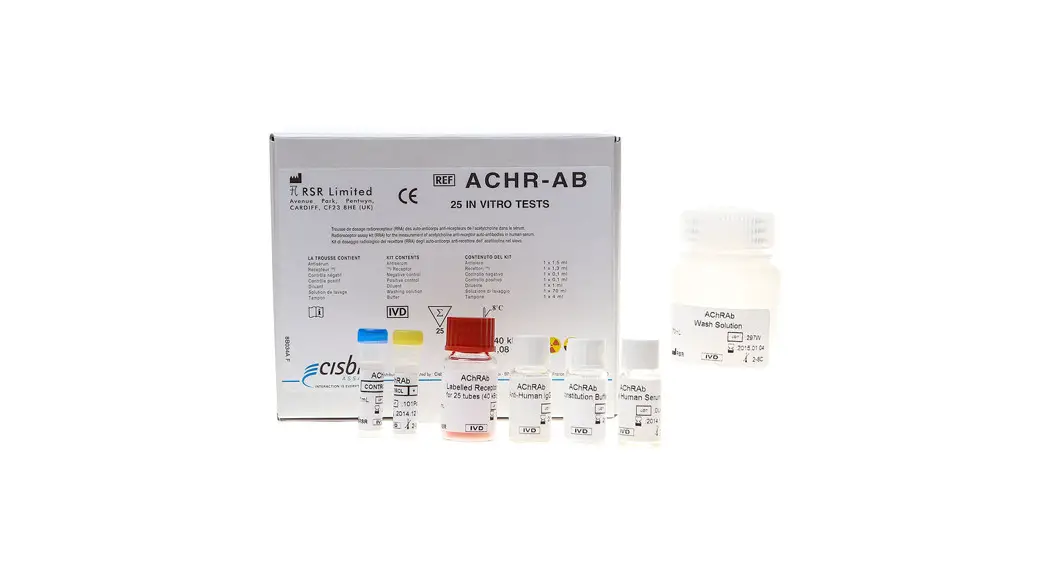
Canine Acetylcholine Receptor Autoantibody RIA Kit
Instructions for use
FOR RESEARCH USE ONLY
RSR Limited
Parc Ty Glas, Llanishen, Cardiff
CF14 5DU United Kingdom
Tel.: +44 29 2068 9299
Fax: +44 29 2075 7770
Email: [email protected]
Website: www.rsrltd.com
INTENDED USE
The RSR Canine Acetylcholine Receptor autoantibody (cAChR Ab) RIA kit is intended for use by professional persons only, for the quantitative determination of cAChR Ab in canine serum. Canine serum autoantibodies reactive with canine acetylcholine receptor (cAChR) are implicated in impaired neuromuscular transmission at the neuromuscular junction, specifically associated with canine myasthenia gravis (MG). Measurement of the antibodies can be of considerable value in disease diagnosis.
REFERENCES
C.W Dewey et al Clinical Forms of Acquired Myasthenia Gravis in Dogs: 25 Cases (1988-1995).
J. of Veterinary Internal Medicine (1997) 11: 50 57
G.D Shelton et al Acquired Myasthenia Gravis. Selective Involvement
of Esophageal, Pharyngeal and Facial Muscles. J. of Veterinary Internal Medicine (1990) 4: 281 284
ASSAY PRINCIPLE
The assay depends on the use of recombinant canine AChR complexed with 125I-labelled alpha bungarotoxin. The 125I-labelled cAChR are then incubated with test sera and the resulting complexes immunoprecipitated with anti-IgG antibody. The higher the concentration of autoantibody, the greater the amount of radioactivity precipitated.
STORAGE AND PREPARATION OF SERUM SAMPLES
Sera to be analyzed should be assayed soon after separation or stored, preferably in aliquots, at or below 20oC. 10 L is sufficient for one assay (duplicate 5 L determinations). Repeated freeze-thawing or increases in storage temperature must be avoided. Do not use lipemic or haemolysed serum samples. On the day of assay, thaw the sera at room temperature and mix gently to ensure homogeneity. Centrifuge serum prior to assay (preferably for 5 min at about 10,000 rpm i.e. about 10,000 g in a microfuge) to remove any particulate matter. Please do not omit this centrifugation step if sera are cloudy or contain particulates.
SYMBOLS
| Symbol | Meaning |
| RUO | For Research Use Only |
| LOT | Catalog Number |
| REF | Lot Number |
 | Consult Instructions |
 | Manufactured by |
 | Sufficient for |
 | Expiry Date |
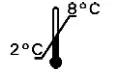 | Store |
 | Negative Control |
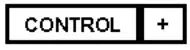 | Positive Control |
MATERIALS REQUIRED AND NOT SUPPLIED
3.5 mL assay tubes (round-bottomed tubes are recommended when using precipitation enhancer) Suitable rack for assay tubes Pipettes capable of dispensing 5 L, 25 L, 50 L, 0.75 mL and 1 mL Vortex mixer Refrigerated centrifuge capable of 1500g Gamma counter
PREPARATION OF REAGENTS SUPPLIED FOR
| A | 128lLabelled Canine AChR-20kBq/vial 2 vials (at manufacture) Lyophilised |
| Reconstitute each vial with 0.75 mL of reconstitution buffer (B) and mix gently to dissolve. Use immediately. | |
| B | Reconstitution Buffer for 125 I Labelled Canine AChR 4 mL Ready for use |
| C | Negative Control 0.1 mL Ready for use |
| D | Positive Control (See label for concentration range) 0.1 mL Ready for use. |
| E | Normal Serum 1 mL Ready for use |
| F | Anti-IgG Ab 1.5 mL Ready for use |
| 0 | Precipitation Enhancer 1 mL Ready for use |
| Mix thoroughly immediately before use | |
| H | Wash Solution 60 mL Ready for use and keep at 2 – 8°C except when in use. |
ASSAY PROCEDURE
Allow all reagents, except wash solution, to stand at room temperature (20 25oC) for at least 30 minutes before use. An Eppendorf-type repeating pipette is recommended for steps 2, 4, 6, 7, and 10.
- Pipette 5 L (in duplicate) of negative control (C), positive control (D) and test sera (undiluted), into labeled assay tubes.
- Pipette 50 L of freshly reconstituted 125I labeled cAChR (A + B) into each tube and into two additional empty tubes for total counts.
- Mix each tube gently on a vortex mixer; cover the tubes with a suitable cover and incubate at room temperature (20 25ºC) for 2 hours.
- Pipette 50 L of anti-IgG Ab (F) into each tube (excluding the two total count tubes).
- Mix each tube gently on a vortex mixer; cover the tubes with a suitable cover and incubate at room temperature (20 25ºC) for 2 hours.
- Pipette 25 L of precipitation enhancer (G) into each tube (excluding the two total count tubes).
- Pipette 1 mL of cold (2 8oC) wash solution (H) into each tube (excluding the two total count tubes) and mix gently on a vortex mixer.
- Centrifuge each tube at 1500g for 20 minutes at 2 8oC.
- Aspirate or decant the supernatants. 10. Pipette 1 mL of cold (2 8oC) wash solution
(H) into each tube (excluding the two total count tubes) and resuspend the pellet gently using a vortex mixer. - Repeat steps 8 and 9.
- Count each tube (including total count tubes) for 125I for 2 minutes using a gamma counter.
RESULT ANALYSIS
The radioactivity in the pellet represents the amount of 125I-labelled cAChR bound by the cache Ab. This can be expressed as nanomoles of labeled cAChR bound per litre of test serum using the following equation:
nmol/ L cAChR bound = (cpm test sample- CPM negative control) x A/C x K x B x 2.22
where; A is the decay factor for 125I between the receptor manufacture day and the day of assay; B is the counter efficiency; C is the volume of serum used in the assay (i.e. 5 L) and K is the specific activity (Ci/mmol) of the 125I-labelled cAChR, Values for A and K are provided with each kit lot on a separate sheet.
TYPICAL RESULTS (example only; not for calculation of actual results)
| cpm | nmol/L | |
| Negative Control | 1004 | 0.0 |
| Positive Control | 7688 | 4.1 |
ASSAY CUT OFF
| Negative | <1.0 nmol/L |
| Positive | a 1.0 nmol/L |
This cut-off has been validated at RSR. However, each laboratory should establish its own normal and pathological reference ranges for cAChR Ab levels. Also it is recommended that each laboratory include its own panel of control samples in the assay.
Assay Linearity
The relationship between canine acetylcholine receptor antibody concentration and cpm bound in the assay is only linear over a limited range. To overcome this problem, antibody-positive sera can be diluted several times in the normal serum (E) provided and assayed. Antibody concentrations can then be calculated using binding data from within the linear range. The linear range for different patient sera is often different.
CLINICAL EVALUATION
Clinical Specificity
Sera from 24 individual healthy dogs were assayed in the cAChR Ab RIA. 23 (96%) were identified as being negative for cAChR Ab.
Clinical Sensitivity
Sera from 4 dogs diagnosed with myasthenia gravis were assayed in the cAChR Ab RIA. All 4 were identified as being positive for cAChR Ab.
SAFETY CONSIDERATIONS
Precipitation Enhancer
Signal word: Warning
Hazard statement(s) H373: May cause damage to organs through prolonged or repeated exposure
Precautionary statement(s) P260: Do not breathe dust/fume/gas/mist/vapors/spray
P314: Get medical advice/attention if you feel unwell
This kit is intended for in vitro use by professional persons only. Follow the instructions carefully. Observe expiry dates stated on the labels and the specified shelf life for reconstituted reagents. Refer to Safety Data Sheet for more detailed safety information. The kit contains radioactive material. Users should make themselves aware of, and observe, any national and local legislation and codes of practice governing the use, storage, transportation, and disposal of radioactive materials. Avoid all actions likely to lead to ingestion. Avoid contact with skin and clothing. Wear protective clothing and, where appropriate, personal dosimeters. Radioactive materials should only be used by authorized personnel and in designated areas. Material of human origin used in the preparation of the kit has been tested and found non-reactive for HIV1 and 2 and HCV antibodies and HBsAg but should, nonetheless, be handled as potentially infectious. Wash hands thoroughly after handling. Monitor hands and clothing before leaving the designated area. Wash hands thoroughly if contamination has occurred and before leaving the laboratory. Sterilize all potentially contaminated waste, including test specimens, before disposal. Materials of animal origin used in the preparation of the kit have been obtained from animals certified as healthy but these materials should be handled as potentially infectious. Some components contain small quantities of sodium azide as the preservative. With all kit components, avoid ingestion, inhalation, injection or contact with skin, eyes or clothing. Avoid the formation of heavy metal azides in the drainage system by flushing any kit component away with copious amounts of water.
ASSAY PLAN
| Allow all reagents, (excluding wash solution (H)) and samples to stand at room temperature (20-25°C) for at least 30 minutes before use | |
| Pipette: | 5 pL negative control (C), positive controls (D) and test sera (all undiluted) |
| Pipette: | 50 µL 7251 labelled cAChR (A) (freshly reconstituted (B)) into all tubes plus two additional empty tubes for total counts |
| Mix: | Mix tubes gently on vortex mixer and cover |
| Incubate: | 2 hours at room temperature |
| Pipette: | 50 A anti-IgG Ab (F) into all tubes (excluding the two total count tubes) |
| Mix: | Mix tubes gently on vortex mixer and cover |
| Incubate: | 2 hours at room temperature |
| Pipette: | 25 ul_ precipitation enhancer (G) into all tubes (excluding the two total count tubes) |
| Pipette: | 1 mL cold (2 – 8°C) wash solution (H) (excluding the two total count tubes) |
| Mix: | Mix tubes gently on vortex mixer |
| Centrifuge: | Centrifuge tubes at 1500g for 20 minutes at 2 – 8°C |
| Aspirate/Decant: | Aspirate or decant supernatants |
| Pipette: | 1 mL cold (2 – 8°C) wash solution (H) (excluding the two total count tubes) |
| Mix: | Mix tubes on vortex mixer to resuspend pellet |
| Centrifuge: | Centrifuge tubes at 1500g for 20 minutes at 2 – 8°C |
| Aspirate/Decant: | Aspirate or decant supernatants |
| Count tubes for 1251 for 2 minutes using a gamma counter | |