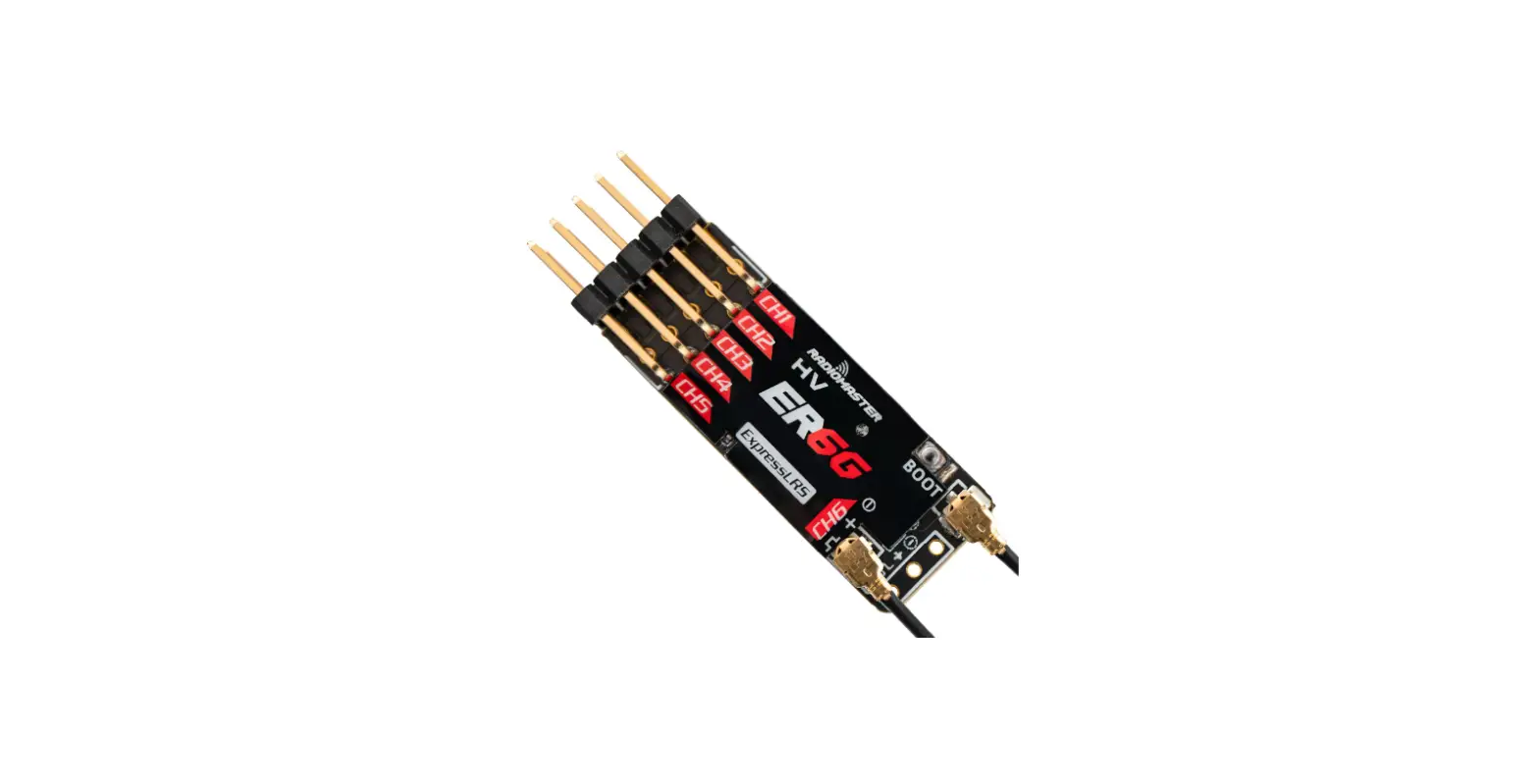
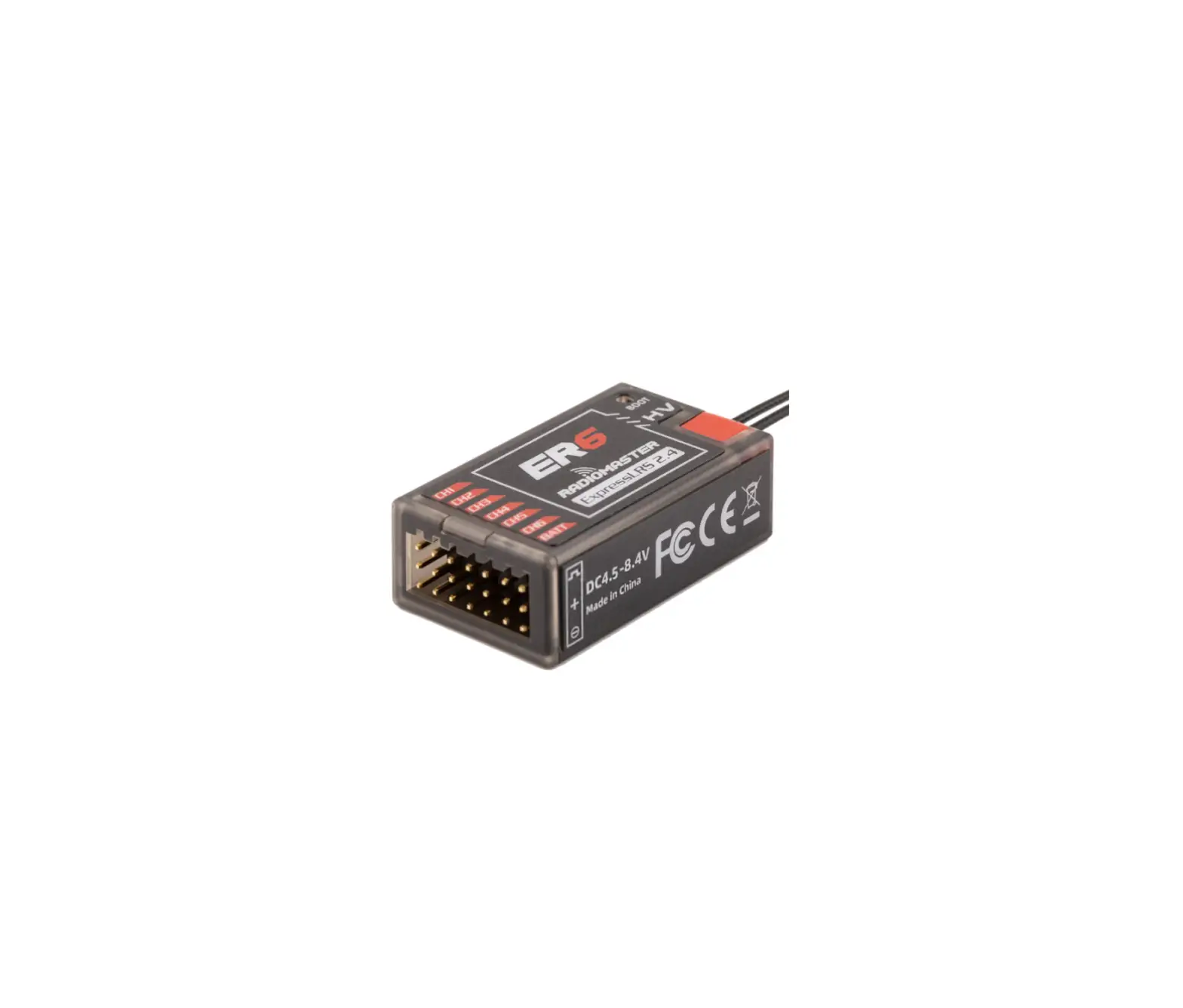
ER6GV ExpressLRS Receiver
Radiomaster ER6GV ExpressLRS Receiver
The Radiomaster ER6GV ExpressLRS Receiver is a high-performance,
reliable, and flexible receiver with a built-in Vario for gliders.
It offers fast response speed and ultra-long range. The receiver
has a dual-antenna with telemetry power up to 50mw.
Product Features:
- Power supply: DC 3.5 – 8.4V
- Antenna type: 15cm high sensitivity antenna
- Wireless protocol: ExpressLRS 3.2 pre-installed
- Output channel: 6CH PWM
- Telemetry power: maximum 50mw (LUA Adjustable)
- Built-in high-precision air pressure sensor
Product Usage Instructions:
ELRS LUA Settings:
The recommended ELRS LUA settings on the remote-control end
are:
- Standard servos: Packet Rate – 100Hz Full, Telem Ratio – Std
(1:8), Switch Mode – 8ch - Performance servos: Packet Rate – 333Hz Full, Telem Ratio – Std
(1:8), Switch Mode – 8ch
Calibration of Telemetry Voltage:
Calibration of the telemetry voltage will be required on your
radio. Navigate to the telemetry page on your radio and locate the
RxBt sensor. Edit the sensor settings and adjust the offset until
the displayed reading matches the actual voltage of the battery in
the model. If there is a large difference, adjustment of the ratio
may also be required.
Channel Usage:
Channel 6 on the receiver must not be used as the power input
channel and may not be used as a servo output channel. Power from
an ESC or Receiver battery must only be applied on Channels 1 to
5.
ExpressLRS Arming Requirements:
ExpressLRS Arming requirements and the use of Channel 5: CH5 is
required by ExpressLRS to set the Arm state of the RF module in
your radio. It is recommended to assign CH5 to a switch such as
your throttle cut switch as this will provide benefits such as
dynamic. Using the ExpressLRS LUA or the Wifi WebUI, you can assign
different channels to the CH5 output of your receiver. Please visit
https://www.expresslrs.org/ to learn more on the importance of
setting up arming.
Recommended Battery:
The ER6GV can work stably with a 1S Lipo receiver battery.
ER6GV
Radiomaster ER6GV ExpressLRSER6GV ExpressLRS ER6GV Vario
2.EXT-V 35V 35V
1.ELRS LUA –
100Hz Full
Std (1:8)
8ch
– 333Hz Full
Std (1:8)
8ch
3.ER6GVEXT-VPCBEXT-V EXT-VER6GV
4.RxBt Offset Ratio
5.6 ESC 15
6.ExpressLRS CH5 / CH5 ExpressLRS LUA Wifi WebUI CH5
https://www.expresslrs.org/
Radiomaster ER6GV ER6GVvario6 ER6GV50mw ER6GV1S Lipo
DC 3.5 – 8.4V
CH1
15cm
ExpressLRS 3.2
6CH PWM
50mw
CH2
Vario
DC 4.0 – 35V
5.0
42*13*8mm
CH3
Radiomaster 2.4Ghz
CH4
Radiomaster ER6GV
CH6 3pin
EXT-V
CH5 BOOT
1.LED 10 2.ExpressLRS LUA[BIND] 3.
3 LED 3 10
Binding phrase
1. ExpressLRS LUAWIFIWIFI ExpressLRSWIFITX WIFI WebUIExpressLRShttp://10.0.0.1/
2. 60LEDWIFI WIFITX WIFIWebUIExpressLRS http://10.0.0.1/
WIFI WIFIExprersLRS TX WIFIexpresslrs URLhttp://10.0.0.1/
WIFI WIFIExprersLRS RX WIFIexpresslrs URLhttp://10.0.0.1/
ER6GV
Thank you for purchasing the Radiomaster ER6GV ExpressLRS receiver. The ER6GV receiver is based on the revolutionary ExpressLRS system. It offers high performance, high reliability, flexible configuration, fast response speed and ultra-long range. The ER6GV Receiver has a built in Vario for use in gliders.
Important:
1.The recommended ELRS LUA settings on the remote-control end are:
– Standard servos:
Packet Rate
100Hz Full
Telem Ratio
Std (1:8)default if unsure
Switch Mode 8ch
– Performance servos:
Packet Rate
333Hz Full
Telem Ratio
Std (1:8)
Switch Mode 8ch
2: The maximum input voltage for the EXT-V (external voltage input) telemetry reading is 35V. Do not exceed 35V or the receiver will be damaged. 3: The EXT-V (external voltage input) of the ER6GV is accessed via the EXT-V solder pad on the PCB. A single wire must be soldered to this pad and connected to the positive wire of the battery or ESC. If no EXT-V power source is found, the ER6GV will default to reading the voltage on the receiver pins, only one voltage input can be used at the any given time.
4: Calibration of the telemetry voltage will be required on your radio. Navigate to the telemetry page on your radio and locate the RxBt sensor. Edit the sensor settings and adjust the offset until the displayed reading matches the actual voltage of the battery in the model. If there is a large difference, adjustment of the ratio may also be required.
5: Channel 6 on the receiver must not be used as the power input channel and may out be used as a servo output channel. Power from an ESC or Receiver battery must only be applied on Channels 1 to 5.
6: ExpressLRS Arming requirements and the use of Channel 5: CH5 is required by ExpressLRS to set the Arm state of the RF module in your radio. It is recommended to assign CH5 to a switch such as your throttle cut switch as this will provide benefits such as dynamic. Using the ExpressLRS LUA or the Wifi WebUI, you can assign different channels to the CH5 output of your receiver. See example to the right:
Please visit https://www.expresslrs.org/ to learn more on the importance of setting up arming.
The Radiomaster ER6GV receiver has been specially designed for glider pilots who require a compact and slim receiver with a built in vario function. It can drive up to 6 servos and has built-in receiver voltage telemetry and flight battery telemetry with the ability to automatically detect which voltage input to use. The ER6GV features a dual-antenna with telemetry power up to 50mw. The ER6GV can work stably with a 1S Lipo receiver battery.
Product Features:
Power supply: DC 3.5 – 8.4V
Antenna type: 15cm high sensitivity antenna
CH1
Wireless protocol: ExpressLRS 3.2 pre-installed
Output channel: 6CH PWM
Telemetry power: maximum 50mw (LUA
CH2
Adjustable)
Built-in high-precision air pressure sensor
(Vario)
Battery voltage detection range: DC 4.0 – 35V
CH3
Weight: 5.0 grams
Dimensions: 42*13*8mm
CH4
Firmware:
Device Category: Radiomaster 2.4Ghz
Device: RadioMaster ER6G/ER6GV 2400 PWM RX
CH5
CH6 3pin
EXT-V
BOOT
Binding method (Traditional):
1. The first time you power on your receiver, the LED will double blink. This indicates that the receiver is in bind mode. If this is not the case, hold down the boot button for 10 seconds to reset the receiver. 2. Open the ExpressLRS LUA on your remote controller and select [BIND], then confirm. 3. A successful bind is indicated by the light being a steady on, indicating that frequency binding was successful.
Binding method (Passphrase).
1. Open the ExpressLRS LUA and navigate to the Wifi Connectivity page. Select the Enable Wifi option and connect to your radios wifi with a mobile phone, tablet or PC (See TX Wifi notes below). Open the WebUI (Express LRS web page on http://10.0.0.1/) and choose a unique bind phrase. Note Bind phrases are not secret and can be read. Save and Reboot.
2. Power up the receiver and wait 60 seconds for the LED to blink rapidly to indicate Wifi mode. Connect your phone, tablet or PC to the receivers Wifi (See TX Wifi notes below). Open the WebUI (Express LRS web page on http://10.0.0.1/) and enter the matching bind phrase previously entered on your radio. Note Bind phrases are not secret and can be read. Save and Reboot. Once a radio and a receiver have the same bind phrase set they will automatically bind.
Note: To bind the receiver a second time or to another radio, power cycle the receiver 3 times. On the third power cycle, the LED will double blink indicating bind mode. If you cannot successfully enter bind mode with the 3 power cycle method, you can hold down the boot button for 10 seconds to reset the receiver to bind mode or use the passphrase method below. WARNING: All previous settings in the receiver will be erased and need to be set again when using the reset button.
TX Wifi notes
RX Wifi notes:
WiFi default network name: ExpressLRS TX WiFi default network name: ExpressLRS RX
WiFi default password: expresslrs
WiFi default password: expresslrs
Default URL: http://10.0.0.1/ (Open in browser) Default URL: http://10.0.0.1/ (Open in browser)
 High-performance Open Source Radio Control Link - ExpressLRS