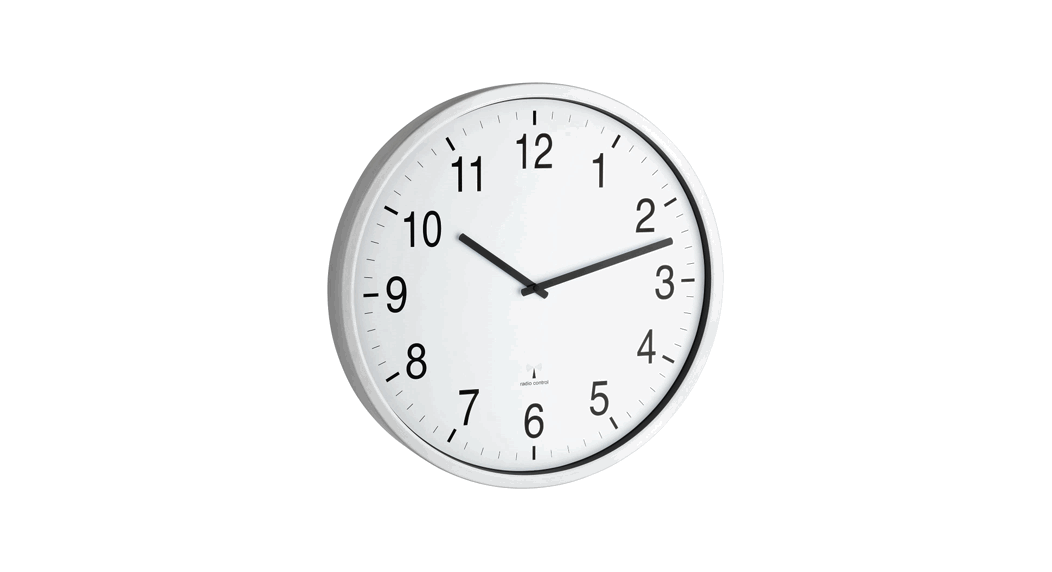
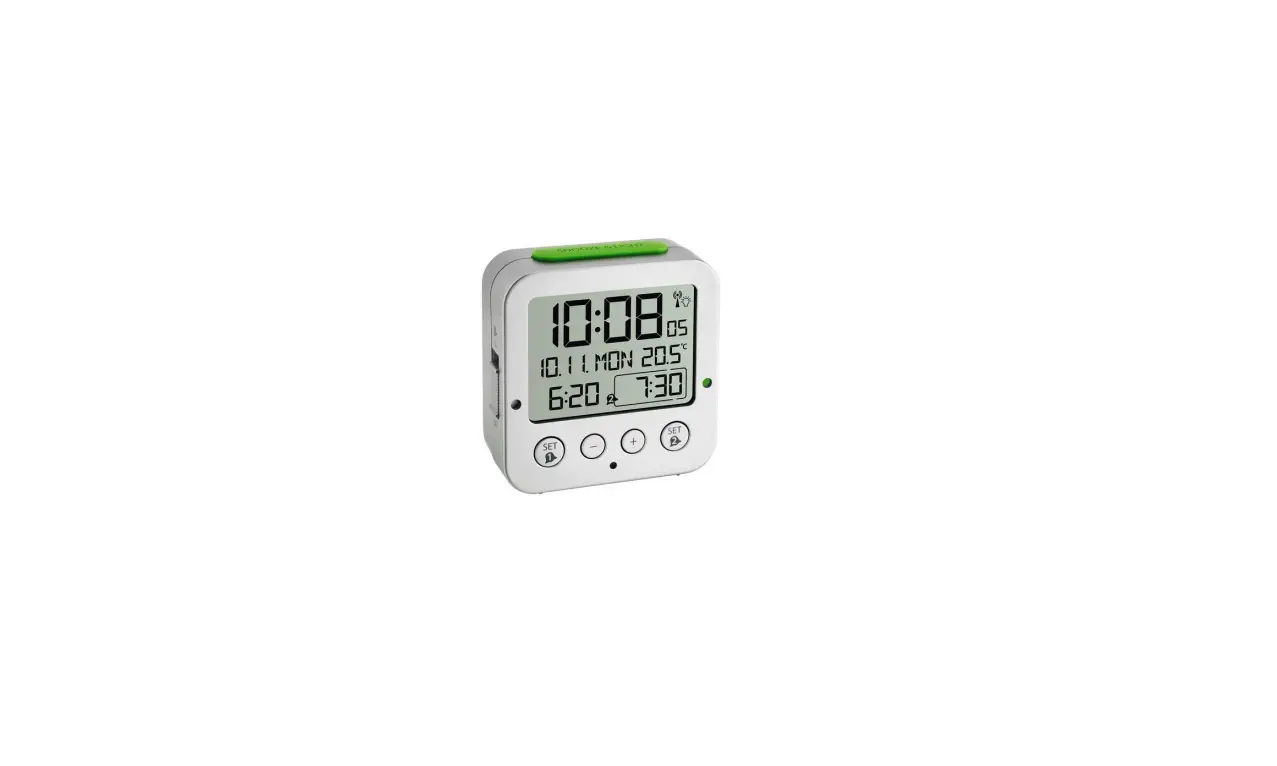
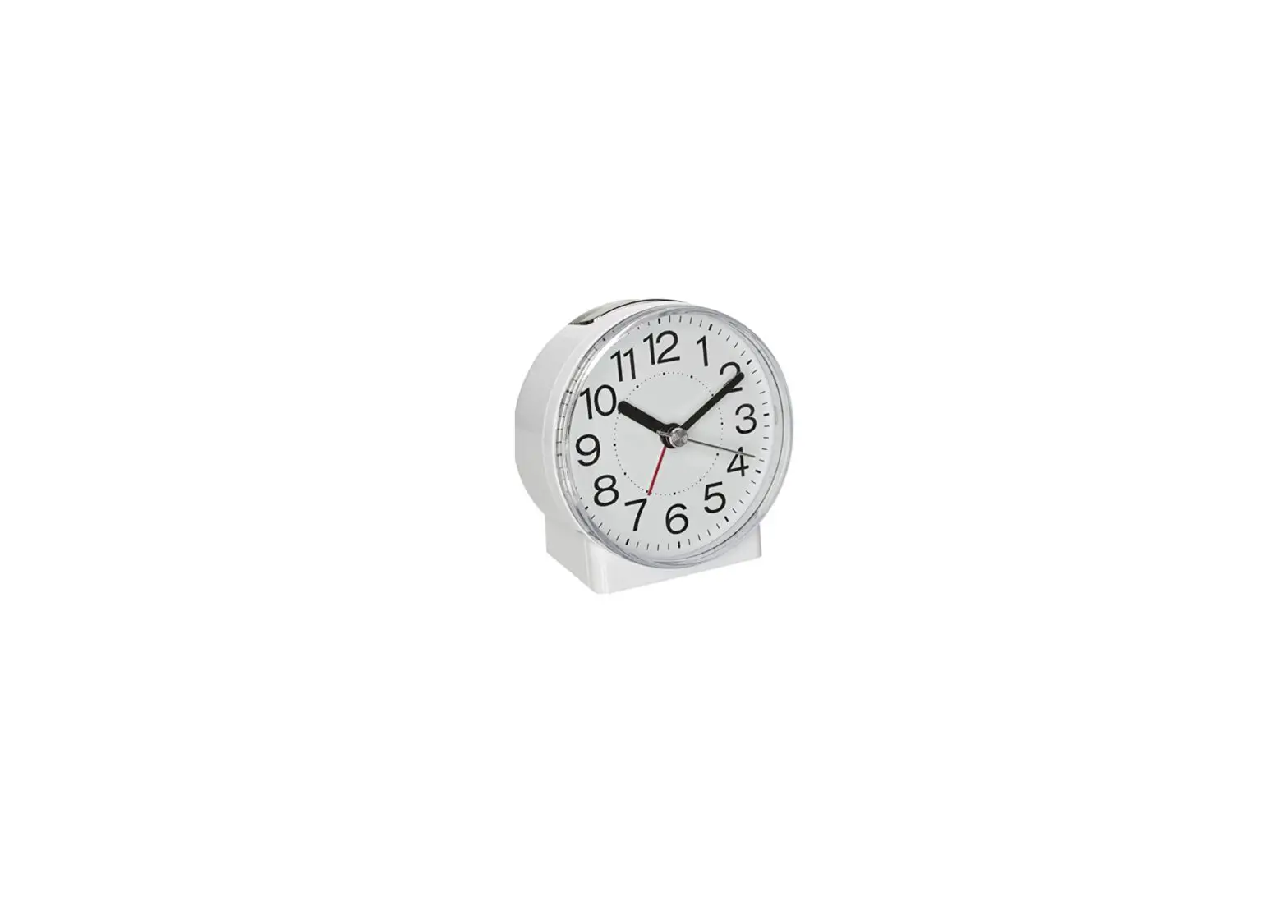
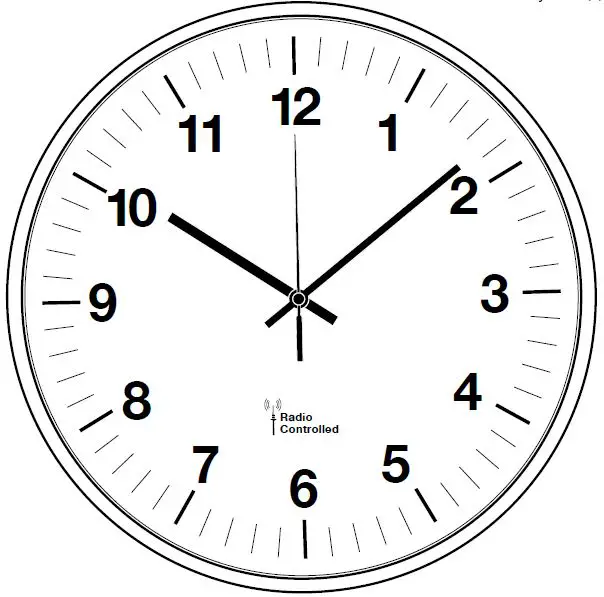
60.4524.01 Radio Wall Clock
Product Information: Product Name: Funkuhr mit Sonnenauf- und
untergang Model Number: TFA_No. 60.4524 Manufacturer: TFA Website:
www.tfa-dostmann.de Product Usage Instructions: 1. Before you use
this product, make sure to read and understand the user manual. 2.
Ensure that you have received all the components mentioned in the
user manual. 3. Insert batteries into the device following the
instructions provided. 4. To receive the radio-controlled time
signal, place the device in an open area with a clear view of the
sky. 5. Once the device receives the radio signal, it will
automatically set the time and date. 6. If the device fails to
receive the radio signal, you can manually set the time and date
using the buttons on the device. 7. Refer to the user manual for
detailed instructions on how to operate the device and make manual
settings. 8. The device also features a moon phase display. Refer
to the user manual for information on interpreting the moon phase
display. Note: For more detailed instructions, refer to the
complete user manual available for download on the manufacturer’s
website. Please note that the provided text-extract from the user
manual is incomplete, and additional information may be required to
provide a comprehensive response.
TFA_No. 60.4524_Anleitung 30.09.2022 13:10 Uhr Seite 1
Bedienungsanleitung Operating Instructions Mode d’emploi Istruzioni per l’uso Gebruiksaanwiijzing Instrucciones de uso
Instruction manuals
www.tfa-dostmann.de/en/service/downloads/instruction-manuals Kat. Nr. 60.4524.01
TFA_No. 60.4524_Anleitung 30.09.2022 13:10 Uhr Seite 2
k Bedienungsanleitung t Instruction manual p Mode d’emploi
C Istruzioni per l’uso N Gebruiksaanwijzing m Instrucciones de uso
k Bedienungsanleitung t Instruction manual p Mode d’emploi
C Istruzioni per l’uso N Gebruiksaanwijzing m Instrucciones de uso
k
Vielen Dank, dass Sie sich für dieses Gerät aus dem Hause TFA entschieden haben.
Bevor Sie mit dem Gerät arbeiten
· Lesen Sie sich bitte die Bedienungsanleitung genau durch.
Die Bedienungsanleitung liegt dem Gerät bei oder zum Download unter www.tfa-dostmann.de/service/downloads/anleitungen
· Verwenden Sie das Gerät nicht anders, als in der Anleitung dargestellt wird.
· Durch die Beachtung der Bedienungsanleitung vermeiden Sie auch Beschädigungen des Gerätes und die Gefährdung Ihrer gesetzlichen Mängelrechte durch Fehlgebrauch.
· Beachten Sie besonders die Sicherheitshinweise!
· Bewahren Sie die Bedienungsanleitung gut auf!
2
t
Thank you for choosing this instrument from TFA.
Before you use this product
· Please make sure you read the instruction manual carefully.
· The operating instructions are enclosed with the device or can be downloaded at www.tfa-dostmann.de/en/service/downloads/instructionmanuals
· This product should only be used as described within these instructions.
· Following and respecting the instructions in your manual will prevent damage to your instrument and loss of your statutory rights arising from defects due to incorrect use.
· Please take particular note of the safety advice!
· Please keep this instruction manual safe for future reference.
p
Nous vous remercions d’avoir choisi l’appareil de la société TFA.
Avant d’utiliser votre appareil
· Veuillez lire attentivement le mode d’emploi.
· Le mode d’emploi est joint à l’appareil ou peut être téléchargé à l’adresse suivante www.tfa-dostmann.de/en/service/downloads/instructionmanuals
· N’utilisez jamais l’appareil à d’autres fins que celles décrites dans le présent mode d’emploi.
· En respectant ce mode d’emploi, vous éviterez d’endommager votre appareil et de perdre vos droits légaux en cas de défaut si celui-ci résulte d’une utilisation non-conforme.
· Suivez bien toutes les consignes de sécurité !
· Conservez soigneusement le mode d’emploi !
C
Vi ringraziamo per aver scelto l’apparecchio della TFA.
Prima di utilizzare l’apparecchio
· Leggete attentamente le istruzioni per l’uso.
· Le istruzioni per l’uso sono allegate all’apparecchio o possono essere scaricate da www.tfa-dostmann.de/en/service/downloads/instructionmanuals
· Non utilizzate il prodotto in maniera diversa da quanto descritto in queste istruzioni.
· Seguendo le istruzioni per l’uso, eviterete anche di danneggiare il prodotto e di pregiudicare, a causa di un utilizzo scorretto, i diritti del consumatore che vi spettano per legge.
· Prestate particolare attenzione alle misure di sicurezza!
· Conservate con cura le istruzioni per l’uso.
N
Hartelijk dank dat u voor dit apparaat van de firma TFA hebt gekozen.
Voordat u met het apparaat gaat werken
· Leest u a.u.b. de gebruiksaanwijzing aandachtig door.
· De gebruiksaanwijzing is bij het apparaat gevoegd of kan worden gedownload van www.tfa-dostmann.de/en/service/downloads/instructionmanuals
· Gebruik het product niet anders dan in deze handleiding is aangegeven.
· Door rekening te houden met wat er in de handleiding staat, vermijdt u ook beschadigingen van het product en riskeert u niet dat uw wettelijke rechten door verkeerd gebruik niet meer gelden.
· Volg in elk geval de veiligheidsinstructies op!
· De gebruiksaanwijzing goed bewaren a.u.b.!
m
Muchas gracias por haber adquirido este dispositivo de TFA.
Antes de utilizar el dispositivo
· Lea detenidamente las instrucciones de uso.
· Las instrucciones de uso se adjuntan al dispositivo o pueden descargarse de www.tfa-dostmann.de/en/service/downloads/instructionmanuals
· No emplee el dispositivo de modo distinto al especificado en estas instrucciones.
· Si sigue las instrucciones de uso, evitará que se produzcan daños en el dispositivo y no comprometerá a sus derechos por vicios, previstos legalmente debido a un uso incorrecto.
· Tenga en cuenta ante todo las advertencias de seguridad.
· Guarde las instrucciones de uso en un sitio seguro.
3
TFA_No. 60.4524_Anleitung 30.09.2022 13:10 Uhr Seite 3
k Bedienungsanleitung
C Istruzioni per l’uso
Fig. 1
t Instruction manual
N Gebruiksaanwijzing
p Mode d’emploi
m Instrucciones de uso
A 1
A2 A3
j
Dkujeme, ze jste si vybrali výrobek znacky TFA.
Ped pouzitím
· Následující instrukce k pouzití ctte velmi pozorn.
· Návod k pouzití je pilozen u zaízení nebo je mozné si ho stáhnout z www.tfa-dostmann.de/en/service/downloads/instructionmanuals
· Tento produkt je mozné pouzívat pouze tak jak je popsáno v návodu k pouzití.
· Pozorným pectením a dodrzením instrukcí obsazených v tomto manuálu pedejdete poskození pístroje a ztrát práv vyplývající z poskození vlivem nesprávného pouzití.
· Dbejte zvýsené pozornosti bezpecnostním pokynm.
· Uchovejte si manuál pro pípad budoucího pouzití.
U
Tack för att du väljer detta instrument från TFA.
Innan du använder den här produkten
· Var god se till att du läser igenom bruksanvisningen noggrant.
· Bruksanvisningen följer med enheten eller kan laddas ner på www.tfa-dostmann.de/en/service/downloads/instructionmanuals
· Denna produkt ska endast användas enligt beskrivningen inom dessa anvisningar.
· Att följa och respektera anvisningarna i din manual kommer att förhindra skador på ditt instrument och förlust av dina lagstadgade rättigheter som uppstår på grund av felaktig användning.
· Vänligen ta särskild hänsyn till säkerhetsråden!
· Vänligen förvara denna instruktionsbok säkert för framtida referens.
P
Dzikujemy, e zdecydowali si Pastwo na to urzdzenie firmy TFA.
Zanim zaczniecie Pastwo uytkowa to urzdzenie
· Prosimy
zapozna
si
dokladnie z instrukcj obslugi.
· Instrukcja obslugi jest zalczona do urzdzenia lub moe zosta
pobrana ze strony: www.tfa-dostmann.de/en/service/downloads/instructionmanuals
· Nie naley uywa urzdzenia inaczej, ni zostalo to przedstawione w instrukcji.
· Przestrzegajc instrukcji unikniecie Pastwo uszkodze urzdzenia oraz zagroenia utraty swoich ustawowych praw konsumenckich
poprzez nieprawidlowe uytkowa-
nie. · Przestrzegajcie szczególnie
zasad bezpieczestwa ! · Zachowujcie instrukcj obslugi
w dobrym stanie !
4
A 4
A 5 A 6
A 12
A 11
A 10 A 9
A 8
A 7
5
TFA_No. 60.4524_Anleitung 30.09.2022 13:10 Uhr Seite 4
Fig. 2
B 1
B 3
B 5
B 2
B 4
B 6
C 3
C 2
6
Fig. 3 Mondphase / Moon phase / Phase lunaire / Fasi lunari / Maanstand / Fase de la luna
· Das Display zeigt Ihnen die aktuelle Mondphase an: · The actual moon phase is shown on the display: · L’affichage vous indique la phase lunaire actuelle :
· Sul display viene visualizzata la fase lunare attuale: · Het display toont u de actuele maanfase: · La pantalla le indica la fase actual de la luna:
C 1
A
B
C
D
E
F
G
H
A: Neumond E: Vollmond
B: Zunehmende Sichel F: Abnehmender Mond
C: Halbmond (erstes Viertel) G: Halbmond (letztes Viertel)
D: Zunehmender Mond H: Abnehmende Sichel
A: New moon E: Full Moon
B: Waxing crescent F: Waning gibbous
C: Half-moon (first quarter) G: Half-moon (last quarter)
D: Waxing gibbous H: Waning crescent
A : Nouvelle lune B : Premier croissant E : Pleine lune F : Gibbeuse décroissante
C : Premier quartier G : Dernier quartier
D : Gibbeuse croissante H : Dernier croissant
A: Luna nuova E: Luna piena
B: Falce crescente F: Luna calante
C: Primo quarto G: Ultimo quarto
D: Luna crescente H: Falce calante
A: Nieuwe maan B: Toenemende sikkel E: Volle maan F: Afnemende maan
C: Halve maan (eerste kwartier) D: Toenemende maan G: Halve maan (laatste kwartier) H: Afnemende sikkel
A: Luna nueva E: Luna llena
B: Cuarto creciente F: Luna menguante
C: Media luna (primer cuarto) G: Media luna (último cuarto)
D: Luna creciente H: Cuarto menguante
7
TFA_No. 60.4524_Anleitung 30.09.2022 13:10 Uhr Seite 5
Funkuhr mit Sonnenauf- und untergang
1. Lieferumfang
· Funkuhr · Bedienungsanleitung
2. Einsatzbereich und alle Vorteile Ihres neuen Gerätes auf einen Blick
· Besonders großes und übersichtliches Display · Mit vollständigem Datum und ausgeschriebenem Wochentag auf Deutsch (8 Sprachen) · Funkuhr mit höchster Genauigkeit · Manuelle Zeiteinstellung und Zeitzonen-Korrektur möglich · Sonnenauf- und -untergangszeit · Mondphase · Weckalarm mit Schlummerfunktion · Ideal für zuhause, das Büro, das Wartezimmer, den Eingangs- oder Empfangsbereich und als Geschenk · Zum Aufstellen oder an die Wand hängen
3. Sicherheitshinweise · Das Produkt ist ausschließlich für den oben beschriebenen Einsatzbereich geeignet. · Verwenden Sie das Produkt nicht anders, als in dieser Anleitung dargestellt wird.
WARNUNG
· Halten Sie das Gerät und die Batterien außerhalb der Reichweite von Kindern. · Kleinteile können von Kindern (unter drei Jahren) verschluckt werden. · Batterien enthalten gesundheitsschädliche Säuren und können bei Verschlucken lebensgefährlich sein. Wurde eine Batterie
verschluckt, kann dies innerhalb von 2 Stunden zu schweren inneren Verätzungen und zum Tode führen. Wenn Sie vermuten, eine Batterie könnte verschluckt oder anderweitig in den Körper gelangt sein, nehmen Sie sofort medizinische Hilfe in Anspruch. · Batterien nicht ins Feuer werfen, kurzschließen, auseinandernehmen oder aufladen. Explosionsgefahr! · Um ein Auslaufen der Batterien zu vermeiden, sollten schwache Batterien möglichst schnell ausgetauscht werden. · Verwenden Sie nie gleichzeitig alte und neue Batterien oder Batterien unterschiedlichen Typs. · Achten Sie auf die richtige Polarität beim Einlegen der Batterien. Entfernen Sie die Batterien, wenn Sie das Gerät längere Zeit nicht verwenden. · Sollte eine Batterie ausgelaufen sein, vermeiden Sie Kontakt mit Haut, Augen und Schleimhäuten. Spülen Sie ggf. umgehend die betroffenen Stellen mit Wasser und suchen Sie einen Arzt auf.
8
Funkuhr mit Sonnenauf- und untergang
ACHTUNG
· Das eigenmächtige Reparieren, Umbauen oder Verändern des Gerätes ist nicht gestattet. · Setzen Sie das Gerät keinen extremen Temperaturen, Vibrationen und Erschütterungen aus. · Reinigen Sie das Gerät mit einem weichen, leicht feuchten Tuch. Keine Scheuer- oder Lösungsmittel verwenden! · Das Gerät ist nur für den Betrieb in Innenräumen geeignet. Vor Feuchtigkeit schützen!
4. Bestandteile
A: LCD-Anzeige (Fig. 1):
A 1: Uhrzeit A 3: DCF-Empfangssymbol A 5: Snooze-Symbol A 7: Mondphase A 9: Wochentag A 11: Städte-Code
A 2: Alarmsymbol A 4: Sommerzeit-Symbol A 6: Batteriesymbol A 8: Uhrzeit für Sonnenuntergang A 10: Datum A 12: Uhrzeit für Sonnenaufgang
B: Tasten (Fig. 2):
B 1: SET Taste B 3: UP Taste B 5: WAVE Taste
B 2: ALARM Taste B 4: DOWN Taste B 6: RESET Knopf
C: Gehäuse (Fig. 2):
C 1: Wandaufhängung C 3: Batteriefach
C 2: Ständer (ausklappbar)
5. Inbetriebnahme
5.1 Batterien einlegen
· Entfernen Sie die Schutzfolie vom Display. · Öffnen Sie das Batteriefach und legen Sie vier neue Batterien 1,5 V AA polrichtig ein. · Ein Signalton ertönt und alle LCD-Segmente werden kurz angezeigt. Schließen Sie den Batteriedeckel wieder.
5.2 Empfang der Funkzeit
· Die Uhr versucht nun, das Funksignal zu empfangen und das DCF-Empfangssymbol blinkt. Wenn der Zeitcode nach einigen Minuten empfangen wurde, werden die funkgesteuerte Zeit und das DCF-Empfangssymbol ständig im Display angezeigt. Während der Sommerzeit erscheint DST auf dem Display.
9
TFA_No. 60.4524_Anleitung 30.09.2022 13:10 Uhr Seite 6
Funkuhr mit Sonnenauf- und untergang
· Ist kein Funkempfang erfolgt, können Sie die Initialisierung auch manuell starten. Halten Sie die WAVE Taste für drei Sekunden gedrückt.
· Das DCF-Empfangssymbol blinkt. · Unterbrechen Sie den Empfangsversuch, indem Sie die WAVE Taste noch einmal für drei Sekunden gedrückt halten. Das
DCF-Empfangssymbol verschwindet. · Der DCF-Signalempfang findet täglich um 1:00, 2:00, 3:00, 4:00 und 5:00 Uhr morgens statt. · Es gibt drei verschiedene Empfangszustände:
blinkt Empfang aktiv
bleibt stehen Empfang erfolgreich
verschwindet kein Empfang
· Falls die Funkuhr kein DCF-Funksignal empfangen kann (z.B. wegen Störungen, Übertragungsdistanz, etc.), kann die Zeit manuell eingestellt werden.
5.3 Hinweis: Empfang der Funkzeit
· Die Zeitübertragung erfolgt von einer Atomuhr in der Nähe von Frankfurt am Main durch ein DCF-77 (77,5 kHz) Frequenzsignal mit einer Reichweite von ca. 1.500 km. Ihre Funkuhr empfängt das Signal, wandelt es um und zeigt immer die exakte Zeit an. Auch die Umstellung von Sommer- und Winterzeit erfolgt automatisch.
· Vermeiden Sie die Nähe von Störquellen wie Computerbildschirmen, Fernsehgeräten oder massiven Metallgegenständen. In Stahlbetonbauten (Kellern, Aufbauten) ist das empfangene Signal natürlicherweise schwächer. In Extremfällen wird empfohlen, das Gerät in Fensternähe zu platzieren.
· Nachts sind die atmosphärischen Störungen meist geringer. Ein einziger Empfang pro Tag genügt, um die Genauigkeit (±1 Sekunde) zu gewährleisten.
6. Bedienung
6.1 Manuelle Einstellungen
· Halten Sie die SET Taste für drei Sekunden gedrückt, um in den Einstellmodus zu gelangen. · Der erste einstellbare Wert blinkt im Display. · Machen Sie mit der UP oder DOWN Taste die gewünschte Einstellung. · Durch Drücken der SET Taste bestätigen Sie die Einstellung und gelangen zum nächsten Wert.
· Die Reihenfolge ist wie folgt:
DCF Empfang on/off (Voreinstellung: RCC ON) Zeitzone -12/+12 (Voreinstellung: (ZONE 00) Sprachauswahl für den Wochentag (Voreinstellung: GERMAN) Standortwahl Land (Voreinstellung: GER) Standortwahl Stadt (Voreinstellung: BER)
10
Funkuhr mit Sonnenauf- und untergang
Jahr, Monat, Tag Stunden, Minuten
· Halten Sie die UP oder DOWN Taste im jeweiligen Einstellmodus gedrückt, gelangen Sie in den Schnelllauf. Das Gerät verlässt automatisch den Einstellmodus, wenn länger als 15 Sekunden keine Taste gedrückt wird.
6.1.1 DCF Empfang
· Standardgemäß ist der DCF-Empfang aktiviert (RCC ON) und nach erfolgreichem Empfang des DCF-Funksignals ist keine manuelle Einstellung erforderlich.
· Bei deaktiviertem Empfang (RCC OFF) müssen Sie Uhrzeit und Datum manuell einstellen. Es erscheint keine Zeitzone. · Ist der DCF-Funkuhrempfang aktiviert, wird bei erfolgreichem Empfang die manuell eingestellte Zeit überschrieben.
6.1.2 Einstellung der Zeitzone
· Im Einstellungsmodus können Sie die Zeitzonenkorrektur vornehmen. · Die Zeitzonenkorrektur wird benötigt, wenn das DCF Signal empfangen werden kann, die Zeitzone sich aber von der DCF
Zeit unterscheidet (z.B. +1=eine Stunde später).
6.1.3 Spracheinstellung für den Wochentag
· Im Einstellungsmodus können Sie die Sprachauswahl für den Wochentag vornehmen: Deutsch (GERMAN), Französisch (FRENCH), Spanisch (SPANISH), Italienisch (ITALIAN), Dänisch (DANISH), Niederländisch (DUTCH), Schwedisch (SWEDISH), Englisch (ENGLISH).
6.1.4 DCF Standortwahl
· Nach der Eingabe des Codes von Land und Stadt Ihres Standortes im Einstellungsmodus werden die Auf- und Untergangszeit für die Sonne und die Mondphase (Fig. 3) für das heutige Datum automatisch berechnet.
· Eine Tabelle für die Standortwahl finden Sie am Ende der Anleitung. Es kann unter 158 europäischen Städten ausgewählt werden.
7. Einstellung des Weckalarms
· Drücken Sie die ALARM Taste im Normalmodus, um in den Alarmmodus zu gelangen. AL und die zuletzt eingestellte Weckzeit werden auf dem Display angezeigt.
· Halten Sie die ALARM Taste für drei Sekunden gedrückt, um in den Einstellmodus zu gelangen. · Die Stundenanzeige blinkt. · Stellen Sie mit der UP oder DOWN Taste die Stunden ein. · Bestätigen Sie die Eingabe mit der ALARM Taste und stellen Sie auf gleiche Weise die Minuten ein. · Drücken Sie die ALARM Taste noch einmal, um zur aktuellen Uhrzeit zurückzukehren. · Der Alarm ist aktiviert und das Alarmsymbol erscheint auf dem Display.
11
TFA_No. 60.4524_Anleitung 30.09.2022 13:10 Uhr Seite 7
Funkuhr mit Sonnenauf- und untergang
· Zum Deaktivieren/Aktivieren des Alarms drücken Sie die UP Taste im Alarmmodus. · Das Alarmsymbol verschwindet/erscheint auf dem Display. · Bei aktiviertem Alarm beginnt der Wecker zu klingeln, wenn die eingestellte Weckzeit erreicht ist. Das Alarmsymbol blinkt. · Drücken Sie auf eine beliebige Taste (außer SET) und der Alarm wird beendet. · Drücken Sie auf die SET Taste, um die Snooze-Funktion zu aktivieren. · Der Alarm wird für die Dauer von ca. 5 Minuten unterbrochen. · Das Snooze Symbol blinkt. · Drücken Sie auf eine beliebige Taste, um die Snooze-Funktion zu beenden.
8. Batteriewechsel · Sobald das Batteriesymbol im Display erscheint, wechseln Sie bitte die Batterien.
9. Fehlerbeseitigung Problem Keine Anzeige
Kein DCF Funkempfang
Unkorrekte Anzeige
Unkorrekte Anzeige Sonnenauf-/Untergang und Mondphase
Lösungen
Batterien polrichtig einlegen Batterien wechseln
DCF-Empfang im Einstellmodus aktivieren (RCC ON) Initialisierung manuell starten Empfangsversuch in der Nacht abwarten Anderen Aufstellort für das Gerät wählen Uhrzeit manuell einstellen
RESET Knopf drücken Batterien wechseln
Standort im Einstellmodus einstellen
Wenn Ihr Gerät trotz dieser Maßnahmen immer noch nicht funktioniert, wenden Sie sich an den Händler, bei dem Sie das Produkt gekauft haben.
10. Entsorgung Dieses Produkt und die Verpackung wurden unter Verwendung hochwertiger Materialien und Bestandteile hergestellt, die recycelt und wiederverwendet werden können. Dies verringert den Abfall und schont die Umwelt. Entsorgen Sie die Verpackung umweltgerecht über die eingerichteten Sammelsysteme.
12
Funkuhr mit Sonnenauf- und untergang
Entsorgung des Elektrogeräts
Entnehmen Sie nicht festverbaute Batterien und Akkus aus dem Gerät und entsorgen Sie diese getrennt. Dieses Gerät ist entsprechend der EU-Richtlinie über die Entsorgung von Elektro- und Elektronik-Altgeräten (WEEE) gekennzeichnet.
Dieses Produkt darf nicht mit dem Hausmüll entsorgt werden. Der Nutzer ist verpflichtet, das Altgerät zur umweltgerechten Entsorgung bei einer ausgewiesenen Annahmestelle für die Entsorgung von Elektro- und Elektronikgeräten abzugeben. Die Rückgabe ist unentgeltlich. Beachten Sie die aktuell geltenden Vorschriften!
Entsorgung der Batterien
Batterien und Akkus dürfen keinesfalls in den Hausmüll. Sie enthalten Schadstoffe, die bei unsachgemäßer Entsorgung der Umwelt und der Gesundheit Schaden zufügen können. Als Verbraucher sind Sie gesetzlich verpflichtet, gebrauchte Batterien und Akkus zur umweltgerechten Entsorgung beim Handel oder entsprechenden Sammelstellen gemäß nationalen oder lokalen Bestimmungen abzugeben. Die Rückgabe ist unentgeltlich.
Die Bezeichnungen für enthaltene Schadstoffe sind: Cd=Cadmium, Hg=Quecksilber, Pb=Blei.
11. Technische Daten Spannungsversorgung Gehäusemaße Gewicht
Batterien 4 x 1,5 V AA (nicht inklusive) 360 x 235 x 28 (84) mm 869 g (nur das Gerät)
Diese Anleitung oder Auszüge daraus dürfen nur mit Zustimmung von TFA Dostmann veröffentlicht werden. Die technischen Daten entsprechen dem Stand bei Drucklegung und können ohne vorherige Benachrichtigung geändert werden. Die neuesten technischen Daten und Informationen zu Ihrem Produkt finden Sie auf unserer Homepage unter Eingabe der Artikel-Nummer in das Suchfeld.
EU-Konformitätserklärung Hiermit erklärt TFA Dostmann, dass der Funkanlagentyp 60.4524 der Richtlinie 2014/53/EU entspricht. Der vollständige Text der EU-Konformitätserklärung ist unter der folgenden Internetadresse verfügbar: www.tfa-dostmann.de/service/downloads/ce
www.tfa-dostmann.de
E-Mail: [email protected] TFA Dostmann GmbH & Co.KG, Zum Ottersberg 12, 97877 Wertheim, Deutschland
09/22
13
TFA_No. 60.4524_Anleitung 30.09.2022 13:10 Uhr Seite 8
Radio-controlled clock with sunrise and sunset
1. Delivery contents
· Radio-controlled clock · Instruction manual
2. Range of application and all the benefits of your new instrument at a glance
· Large and easy to read display · With the entire date and weekday written in full letters in English (8 languages) · Highest precision radio-controlled clock · Manual setting option and time zone correction · Sunrise and sunset times · Moon phase · Alarm with snooze function · Ideal for home, office, waiting room, lobby or entrance hall and as a gift · Wall mounting or table stand
3. Safety notices · This product is exclusively intended for the range of application described above. · This product should only be used as described within these instructions.
WARNING
· Keep this device and the batteries out of reach of children. · Small parts can be swallowed by children (under three years old). · Batteries contain harmful acids and may be hazardous if swallowed. If a battery is swallowed, this can lead to serious inter-
nal burns and death within two hours. If you suspect a battery could have been swallowed or otherwise caught in the body, seek medical help immediately. · Batteries must not be thrown into a fire, short-circuited, taken apart or recharged. Risk of explosion! · Low batteries should be changed as soon as possible to prevent damage caused by leaking. · Never use a combination of old and new batteries together, nor batteries of different types. · Make sure the polarities are correct. Remove the batteries if the device will not be used for an extended period of time. · Avoid contact with skin, eyes and mucous membranes when handling leaking batteries. In case of contact, immediately rinse the affected areas with water and consult a doctor.
CAUTION
· Unauthorized repairs, alterations or changes to the product are prohibited.
14
Radio-controlled clock with sunrise and sunset
· Do not expose the device to extreme temperatures, vibrations or shocks. · Clean the instrument with a soft damp cloth. Do not use solvents or scouring agents. · The device is suitable for indoor use only. Protect it from moisture!
4. Elements
A: LCD display (Fig. 1):
A 1: Time A 3: DCF reception symbol A 5: Snooze symbol A 7: Moon phase A 9: Day of the week A 11: City code
A 2: Alarm symbol A 4: Daylight Saving Time (DST) symbol A 6: Battery symbol A 8: Time of sun setting A 10: Date A 12: Time of sun rising
B: Buttons (Fig. 2):
B 1: SET button B 3: UP button B 5: WAVE button
B 2: ALARM button B 4: DOWN button B 6: RESET button
C: Housing (Fig. 2):
C 1: Wall mounting hole C 3: Battery compartment
C 2: Stand (fold out)
5. Getting started
5.1 Insert the batteries
· Remove the protective film from the display. · Open the battery compartment and insert four new AA 1.5 V batteries, polarity as illustrated. · The device will alert you with a beep and all LCD segments will be displayed for a short moment. Close the battery cover again.
5.2 Radio-controlled time reception
· The clock will now scan the DCF frequency signal and the DCF symbol flashes on the display. When the time code is successfully received after some minutes, the radio-controlled time and the DCF symbol will be shown steadily on the display. In Daylight Saving Time DST is shown on the display.
· If there is no reception, you can start the initialisation manually. Press and hold the WAVE button for three seconds. · The DCF symbol flashes. · Interrupt the reception by pressing the WAVE button again for three seconds. The DCF reception symbol disappears.
15
TFA_No. 60.4524_Anleitung 30.09.2022 13:10 Uhr Seite 9
Radio-controlled clock with sunrise and sunset
· The DCF reception always takes place daily at 1:00, 2:00, 3:00, 4:00 and 5:00 o’clock in the morning.
· There are three different reception states: flashing Reception is active remains Reception is successful disappears No reception
· If the clock cannot detect the DCF-signal (e.g. due to interference, transmitting distance, etc.), the time can be set manually.
5.3 Note on radio-controlled time
· The time is transmitted from an atomic clock near Frankfurt am Main by a DCF-77 (77.5 kHz) frequency signal with a range of about 1,500 km. Your radio-controlled clock receives the signal, converts it and always shows the exact time. The adjustment of Daylight Saving Time and Standard Time is also automatic.
· Make sure to avoid the vicinity of any source of interference such as computer screens, TV sets or solid metal objects. Within concrete walls (reinforced with steel) such as basements, the received signal is naturally weakened. In extreme cases, please place the unit close to a window to improve reception.
· During night-time, the atmospheric interference is usually less severe. A single daily reception is adequate to keep the accuracy deviation under 1 second.
6. Operation
6.1 Manual settings
· Press and hold the SET button for three seconds to enter the setting mode. · The first adjustable value flashes on the display. · Use the UP or DOWNbutton to make the desired setting. · Confirm with the SET button and go to the next setting.
· The sequence is shown as follows:
DCF reception on/off (default: RCC ON) Time zone -12/+12 (default: ZONE 00) Day-of-week language: (default: German) Location selection country (default: GER) Location selection city (default: BER) Year, month, day Hours, minutes
· Press and hold the UP or DOWN button in the respective setting mode for quick setting. The device will automatically quit the setting mode if no button is pressed for 15 seconds.
16
Radio-controlled clock with sunrise and sunset
6.1.1 DCF reception
· By default, the DCF reception is activated (RCC ON) and after successful reception of the DCF signal no manual adjustment is necessary.
· Once the DCF time reception is deactivated (RCC OFF), the clock and date must be manually set. No time zone will appear. · If the DCF reception is activated, the manually set time will be overwritten by the DCF time when the signal is received suc-
cessfully.
6.1.2 Time zone setting
· In the setting mode you can make the time zone correction · The time zone correction is needed for countries where the DCF signal can be received but the time zone is different from
the DCF time (e.g. +1=one hour plus).
6.1.3 Day-of-the week language
· In the setting mode you can set the day-of-the week language: GERMAN, FRENCH, SPANISH, ITALIAN, DANISH, DUTCH, SWEDISH and ENGLISH.
6.1.4 Location selection
· After entering the code for country and city of your location in the setting mode, the sunrise and sunset times and the moon phase (Fig. 3) for today’s date are automatically calculated.
· A table for location selection can be found at the end of the instructions. You can choose from 158 European cities.
7. Alarm time setting
· Press the ALARM button in normal mode to enter the alarm mode. AL and the last adjusted alarm time appear on the display.
· Press and hold the ALARM button for three seconds to enter the setting mode. · The hour digits flash. · Press the UP or DOWN button to adjust the hours. · Confirm the setting with the ALARM button and set minutes in the same way. · Press the ALARM button again to return to the current time. · The alarm is activated and the alarm symbol appears on the display. · To deactivate/activate the alarm, press the UP button in alarm mode. · The alarm symbol disappears/appears on the display. · When the alarm is activated, the alarm starts to ring when the set alarm time is reached. The alarm symbol flashes. · Press any button (except SET) and the alarm will stop. · Press the SET button to activate the snooze function. · The alarm will be interrupted for about 5 minutes.
17
TFA_No. 60.4524_Anleitung 30.09.2022 13:10 Uhr Seite 10
Radio-controlled clock with sunrise and sunset
· The snooze symbol flashes. · Press any button to stop the snooze function.
8. Battery replacement · Change the batteries when the battery symbol appears on the display.
9. Troubleshooting Problem No display
No DCF reception
Incorrect indication
Incorrect display of sunrise/sunset and moon phase
Solution
Ensure the batteries’ polarities are correct Change the batteries
Activate DCF reception in setting mode (RCC ON) Start the initialization manually Wait for an attempt reception during the night Choose another place for your device Set the clock manually
Press the RESET button Change the batteries
Set your location in setting mode
If your device fails to work despite these measures, contact the retailer where you purchased the product.
10. Waste disposal
This product and its packaging have been manufactured using high-grade materials and components which can be recycled and reused. This reduces waste and protects the environment.
Dispose of the packaging in an environmentally friendly manner using the collection systems that have been set up.
Disposal of the electrical device
Remove non-permanently installed batteries and rechargeable batteries from the device and dispose of them separately. This product is labelled in accordance with the EU Waste Electrical and Electronic Equipment Directive (WEEE). This product must not be disposed of in ordinary household waste. As a consumer, you are required to take end-oflife devices to a designated collection point for the disposal of electrical and electronic equipment, in order to ensure environmentally-compatible disposal. The return service is free of charge. Observe the current regulations in place!
18
Radio-controlled clock with sunrise and sunset
Disposal of the batteries
Never dispose of empty batteries and rechargeable batteries with ordinary household waste. They contain pollutants which, if improperly disposed of, can harm the environment and human health. As a consumer, you are required by law to take them to your retail store or to an appropriate collection site depending on national or local regulations in order to protect the environment. The return service is free of charge.
The symbols for the contained heavy metals are: Cd=cadmium, Hg=mercury, Pb=lead. .
11. Specifications Power consumption: Housing dimension Weight
4 x AA 1,5 V batteries (not included) 360 x 235 x 28 (84) mm 869 g (device only)
No part of this manual may be reproduced without written consent of TFA Dostmann. The technical data are correct at the time of going to print and may change without prior notice. The latest technical data and information about this product can be found in our homepage by simply entering the product number in the search box.
EU Declaration of conformity Hereby, TFA Dostmann declares that the radio equipment type 60.4524 is in compliance with Directive 2014/53/EU. The full text of the EU declaration of conformity is available at the following internet address: www.tfa-dostmann.de/service/downloads/ce
www.tfa-dostmann.de
E-Mail: [email protected] TFA Dostmann GmbH & Co.KG, Zum Ottersberg 12, 97877 Wertheim, Germany
09/22
19
TFA_No. 60.4524_Anleitung 30.09.2022 13:10 Uhr Seite 11
Horloge radio-pilotée avec lever et coucher du soleil
1. Contenu de la livraison
· Horloge radio-pilotée · Mode d’emploi
2. Aperçu du domaine d’utilisation et de tous les avantages de votre nouvel appareil
· Grand écran très clair · Avec la date complète et le jour de la semaine affiché en toutes lettres en français (8 langues) · Horloge radio-pilotée de grande précision · Option de réglage manuel de l’heure et du fuseau horaire · Heure de lever et de coucher du soleil · Phase lunaire · Réveil avec fonction de répétition « snooze » · Idéal pour la maison, le bureau, le hall d’entrée, la salle d’attente, la réception ou bien encore comme cadeau · Peut être posée sur une surface plane ou fixée au mur
3. Consignes de sécurité · Le produit est destiné uniquement à l’utilisation décrite ci-dessus. · N’utilisez jamais l’appareil à d’autres fins que celles décrites dans le présent mode d’emploi.
AVERTISSEMENT
· Placez votre appareil et les piles hors de la portée des enfants. · Les petites pièces peuvent être avalées par les enfants (de moins de trois ans). · Les piles contiennent des acides nocifs pour la santé et peuvent être mortelles dans le cas d’une ingestion. Si une pile a été
avalée, elle peut entraîner des brûlures internes graves ainsi que la mort dans l’espace de 2 heures. Si vous craignez qu’une pile ait pu être avalée ou ingérée d’une autre manière, quelle qu’elle soit, contactez immédiatement un médecin d’urgence. · Ne jetez jamais de piles dans le feu, ne les court-circuitez pas, ne les démontez pas et ne les rechargez pas. Risque d’explosion ! · Une pile faible doit être remplacée le plus rapidement possible afin d’éviter toute fuite. · N’utilisez jamais simultanément de piles anciennes avec des piles neuves ou des piles de types différents. · Veillez à la bonne polarité des piles. Retirez les piles si vous n’utilisez pas votre appareil pendant une durée prolongée. · Évitez tout contact de la peau, des yeux et des muqueuses avec le liquide des piles. En cas de contact, rincez immédiatement les zones concernées à l’eau et consultez un médecin.
20
Horloge radio-pilotée avec lever et coucher du soleil
ATTENTION
· Vous ne devez en aucun cas réparer, démonter ou modifier l’appareil par vous-même. · Évitez d’exposer l’appareil à des températures extrêmes, à des vibrations ou à des chocs. · Pour le nettoyage de votre appareil, utilisez un chiffon doux et humide. N’utilisez pas de solvants ou d’agents abrasifs ! · L’appareil est conçu pour fonctionner uniquement à l’intérieur. Protégez l’appareil contre l’humidité !
4. Composants
A : Affichage LCD (Fig. 1) :
A 1 : Horloge A 3 : Symbole de réception DCF A 5 : Symbole de répétition « snooze » A 7 : Phase lunaire A 9 : Jour de la semaine A 11 : Code de la ville
A 2 : Symbole de réveil A 4 : Symbole de l’heure d’été A 6 : Symbole de pile A 8 : Heure de coucher du soleil A 10 : Date A 12 : Heure de lever du soleil
B : Touches(Fig. 2) :
B 1 : Touche SET B 3 : Touche UP B 5 : Touche WAVE
B 2 : Touche ALARM B 4 : Touche DOWN B 6 : Bouton RESET
C : Boîtier (Fig. 2) :
C 1 : OEillet de suspension C 3 : Compartiment à piles
C 2 : Support (dépliable)
5. Mise en service
5.1 Insertion des piles
· Enlevez le film de protection de l’écran. · Ouvrez le compartiment à piles et insérez quatre nouvelles piles de type 1,5 V AA en respectant la polarité +/-. · Un signal sonore se fait entendre et tous les segments LCD s’allument brièvement. Refermez le couvercle.
5.2 Réception de l’heure radio · L’horloge cherche le signal radio et le symbole de réception DCF clignote. En cas de réception correcte après quelques
minutes, l’heure radio et le symbole de réception DCF apparaissent en continu sur l’écran. Pendant l’heure d’été, « DST » apparaît sur l’écran.
21
TFA_No. 60.4524_Anleitung 30.09.2022 13:10 Uhr Seite 12
Horloge radio-pilotée avec lever et coucher du soleil
· S’il n’y a pas de réception, vous pouvez également activer manuellement la réception. Maintenez la touche WAVE appuyée pendant trois secondes.
· Le symbole de réception DCF clignote. · Interrompez la tentative de réception en maintenant encore une fois la touche WAVE appuyée pour trois secondes. Le sym-
bole de réception DCF disparaît. · La réception du signal DCF a lieu une fois par heure à 1:00, 2:00, 3:00, 4:00 à 5:00 heures du matin. · Il y a 3 états de réception différents :
Clignote Réception en cours
Reste en arrêt Réception a abouti
Disparaît Pas de réception
· Si votre horloge radio-pilotée ne peut pas recevoir le signal DCF (par exemple en cas de perturbations, d’une distance de transmission excessive etc.), vous pouvez régler l’horaire manuellement.
5.3 Consignes pour la réception de l’heure radio
· La transmission de l’heure radio s’effectue via une horloge atomique près de Francfort-sur-le-Main, avec un signal DCF-77 (77,5 kHz) d’une portée d’environ 1 500 km. Votre horloge radio-pilotée reçoit le signal, le convertit et affiche l’heure précise. Le passage de l’heure d’hiver à l’heure d’été et vice-versa s’effectue également automatiquement.
· Évitez la proximité de sources d’interférence telles que les écrans d’ordinateur, les téléviseurs ou les objets métalliques solides. Dans les bâtiments en béton armé (caves, greniers aménagés), le signal reçu est affaibli. Dans les cas extrêmes, nous vous conseillons de placer l’appareil près d’une fenêtre.
· La nuit, les perturbations s’affaiblissent en règle générale. Une seule réception par jour suffit pour maintenir d’éventuels écarts en dessous d’1 seconde.
6. Utilisation
6.1 Réglages manuels
· Maintenez la touche SET appuyée pendant trois secondes pour accéder au mode de réglage. · La première valeur réglable clignote sur l’écran. · Utilisez la touche UP ou DOWN pour effectuer le réglage souhaité. · Appuyez sur la touche SET pour confirmer le réglage et passer à la valeur suivante.
· L’ordre est le suivant :
Réception de l’heure radio DCF on/off (par défaut : RCC ON) Le fuseau horaire -12/+12 (par défaut : ZONE 00) Réglage de la langue des jours de la semaine (par défaut : GERMAN) Choix du site – pays (par défaut : GER) Choix du site- cité (par défaut : BER)
22
Horloge radio-pilotée avec lever et coucher du soleil
Année, mois, jour Heures, minutes
· Maintenez la touche UP ou DOWN appuyée au cours d’un mode de réglage pour parvenir à l’affichage rapide. L’appareil quitte automatiquement le mode de réglage si aucune touche n’est pressée pendant 15 secondes.
6.1.1 Réception DCF
· Par défaut, la réception DCF est activée (RCC ON) et après une réception réussie du signal DCF, aucun réglage manuel n’est nécessaire.
· Si la réception est désactivée (RCC OFF), l’heure et la date doivent être réglées manuellement. Aucun fuseau horaire n’apparaît.
· Lorsque la réception du signal DCF est activée et a abouti, l’heure ajustée manuellement sera remplacée par l’heure radio.
6.1.2 Réglage du fuseau horaire
· En mode de réglage, vous pouvez régler la correction du fuseau horaire. · Vous avez la possibilité d’utiliser un autre fuseau horaire si votre horloge radio-pilotée peut recevoir le signal DCF mais
l’heure de votre fuseau horaire est différente de l’heure DCF (par exemple : +1 = une heure plus tard).
6.1.3 Réglage de la langue pour le jour de la semaine
· Langues au choix pour les jours de la semaine : Allemand (GERMAN), Français (FRENCH), Espagnol (SPANISH), Italien (ITALIAN), Danois (DANISH), Néerlandais (DUTCH), Suédois (SWEDISH) et Anglais (ENGLISH).
6.1.4 Choix du site
· Après l’entrée du pays et de la cité de votre site en mode de réglage, l’heure de lever et coucher du soleil et la phase de la lune (Fig. 3) sont automatiquement calculées pour la date d’aujourd’hui.
· Vous trouverez un tableau pour le choix du site à la fin du mode d’emploi. Il est possible de choisir parmi 158 villes européennes.
7. Réglage du réveil
· Appuyez sur la touche ALARM en mode normal pour entrer en mode d’alarme. AL et l’heure de réveil réglée précédemment apparaissent sur l’écran.
· Maintenez la touche ALARM appuyée pendant trois secondes pour accéder au mode de réglage. · L’affichage de l’heure clignote. · Réglez l’heure avec la touche UP ou DOWN. · Validez le réglage au moyen de la touche ALARM et procédez de la même manière pour le paramétrage des minutes. · Appuyez une nouvelle fois sur la touche ALARM afin de retourner à affichage de l’heure actuelle. · Le réveil est activé et le symbole de réveil apparaît sur l’écran.
23
TFA_No. 60.4524_Anleitung 30.09.2022 13:10 Uhr Seite 13
Horloge radio-pilotée avec lever et coucher du soleil
· Pour désactiver/activer le réveil, appuyez sur la touche UP au mode d’alarme. · Le symbole de réveil apparaît/disparaît sur l’écran. · Lorsque l’heure de réveil fixée est atteinte, le réveil se met à sonner (si la fonction de réveil est activée). Le symbole de
réveil clignote. · Appuyez sur une touche de votre choix (sauf sur la touche SET) pour éteindre le réveil. · Appuyez sur la touche SET pour activer la fonction de répétition « snooze ». · L’alarme s’interrompt pendant 5 minutes. · Le symbole de répétition « snooze » clignote sur l’écran. · Appuyez sur une touche de votre choix pour terminer la fonction de répétition « snooze ».
8. Remplacement des piles · Si le symbole de piles apparaît sur l’écran, changez les piles.
9. Dépannage Problème Aucun affichage
Aucune réception de DCF possible
Affichage incorrect
Affichage incorrect du lever/coucher du soleil et de la phase de la lune
Solution
Contrôlez la bonne polarité des piles Changez les piles
Activez la réception DCF en mode de réglage (RCC ON) Activez manuellement la réception Attendez la réception du signal de nuit Choisissez une autre position pour votre appareil Réglez l’heure manuellement
Appuyez sur le bouton RESET Changez les piles
Réglez le site en mode réglage
Si votre appareil ne fonctionne toujours pas malgré ces mesures, adressez-vous au vendeur chez qui vous l’avez acheté.
10. Traitement des déchets
Ce produit et son emballage ont été fabriqués avec des matériaux de haute qualité qui peuvent être recyclés et réutilisés. Cela permet de réduire les déchets et de protéger l’environnement.
Éliminez les emballages de manière respectueuse de l’environnement par le biais des systèmes de collecte établis.
24
Horloge radio-pilotée avec lever et coucher du soleil
Pour en savoir plus : www.quefairedemesdechets.fr
Mise au rebut de l’appareil électrique
Retirez de l’appareil les piles et les batteries rechargeables qui ne sont pas installées de façon permanente et jetezles séparément. Cet appareil est conforme aux normes de l’UE relatives au traitement des déchets électriques et électroniques (WEEE). L’appareil usagé ne doit pas être jeté dans les ordures ménagères. L’utilisateur s’engage, pour le respect de l’environnement, à déposer l’appareil usagé dans un centre de traitement agréé pour les déchets électriques et électroniques. Respectez les réglementations en vigueur !
Élimination des piles
Les piles et les batteries rechargeables ne doivent pas être jetées dans les détritus ménagers. Elles contiennent des polluants qui peuvent nuire à l’environnement et à la santé si elles sont éliminées de manière inappropriée. En tant qu’utilisateur, vous avez l’obligation légale de rapporter les piles et les batteries rechargeables usagées à votre revendeur ou de les déposer dans une déchetterie proche de votre domicile conformément à la réglementation nationale et locale. La collecte est gratuite.
Les métaux lourds sont désignés comme suit : Cd = cadmium, Hg = mercure, Pb = plomb.
11. Caractéristiques techniques
Alimentation
Piles 4 x 1,5 V AA (non incluses)
Dimensions du boîtier
360 x 235 (28) x 84 mm
Poids
869 g (appareil seulement)
La reproduction, même partielle, du présent mode d’emploi est strictement interdite sans l’accord explicite de TFA Dostmann. Les caractéristiques techniques de ce produit ont été actualisées au moment de l’impression et peuvent être modifiées sans avis préalable. Les dernières données techniques et les informations concernant votre produit peuvent être consultées en entrant le numéro de l’article sur notre site Internet.
Déclaration de conformité UE Le soussigné, TFA Dostmann, déclare que l’équipement radioélectrique du type 60.4524 est conforme à la directive 2014/53/UE. Le texte complet de la déclaration UE de conformité est disponible à l’adresse Internet suivante : www.tfa-dostmann.de/service/downloads/ce
www.tfa-dostmann.de
E-Mail : [email protected] TFA Dostmann GmbH & Co.KG, Zum Ottersberg 12, 97877 Wertheim, Allemagne
09/22
25
TFA_No. 60.4524_Anleitung 30.09.2022 13:10 Uhr Seite 14
Orologio radiocontrollato con alba e tramonto del sole
1. La consegna include
· Orologio radiocontrollato · Istruzioni per l’uso
2. Utilizzi e vantaggi del vostro nuovo apparecchio
· Display grande e ben leggibile · Con data completa e giorno della settimana scritto per esteso in italiano (8 lingue) · Orologio radiocontrollato della massima precisione · Possibilità di impostazione manuale dell’ora e di correzione del fuso orario · Orario di alba e tramonto · Fasi lunari · Sveglia con funzione snooze · Ideale per casa, ufficio, atrio, sala d’attesa o come regalo · Montaggio a muro o sistemazione su piano d’appoggio
3. Avviso di sicurezza · Il prodotto è adatto esclusivamente agli utilizzi di cui sopra. · Non utilizzate il prodotto in maniera diversa da quanto descritto in queste istruzioni.
AVVERTENZA
· Tenere il dispositivo e le batterie lontano dalla portata dei bambini. · Le piccole parti possono essere ingerite dai bambini (sotto i tre anni) · Le batterie contengono acidi nocivi per la salute. Se ingerite, le batterie possono essere mortali. Se una batteria venisse
ingerita, potrebbe causare gravi ustioni interne e portare alla morte nel giro di due ore. Se si sospetta che una batteria sia stata ingerita o inserita nel corpo in altra maniera, consultare immediatamente un medico. · Non gettare le batterie nel fuoco, non polarizzarle in maniera scorretta, non smontarle e non cercare di ricaricarle. Pericolo di esplosione! · Sostituire quanto prima le batterie esauste, in modo da evitare perdite. · Non utilizzate mai contemporaneamente batterie usate e batterie nuove né batterie di tipi diversi. · Inserire le batterie rispettando attentamente le polarità indicate. Rimuovere le batterie, se non si utilizza l’apparecchio per un periodo prolungato. · Evitare il contatto del liquido delle batterie con la pelle, gli occhi e le mucose. In casi di contatto, sciacquare subito la zona interessata con acqua e consultare un medico.
26
Orologio radiocontrollato con alba e tramonto del sole
ATTENZIONE
· Non sono consentite riparazioni, alterazioni o modifiche non autorizzate del dispositivo. · Non esporre l’apparecchio a temperature estreme, vibrazioni e urti. · Per pulire l’apparecchio utilizzare solo un panno morbido leggermente inumidito. Non usare solventi o prodotti abrasivi. · Adatto solo all’uso in ambienti interni. Proteggere dall’umidità!
4. Componenti
A: Display LCD (Fig. 1):
A 1: Orologio A 3: Simbolo di ricezione DCF A 5: Simbolo snooze A 7: Fase lunare A 9: Giorno della settimana A 11: Codice della città
A 2: Simbolo della sveglia A 4: Simbolo dell’ora legale A 6: Simbolo della batteria A 8: Orario di tramonto A 10: Data A 12: Orario di alba
B: Tasti (Fig. 2):
B 1: Tasto SET B 3: Tasto UP B 5: Tasto WAVE
B 2: Tasto ALARM B 4: Tasto DOWN B 6: Tasto RESET
C: Struttura esterna (Fig. 2):
C 1: Foro per sospensione alla parete C 3: Vano batteria
C 2: Supporto (pieghevole)
5. Messa in funzione
5.1 Inserire le batterie
· Rimuovere il foglio protettivo dal display. · Aprire il vano batteria e inserire 4 batterie nuove tipo AA da 1,5 V, rispettando le corrette polarità. · Viene emesso un segnale acustico e tutti i segmenti appaiono brevemente. Richiudere il coperchio.
5.2 Ricezione dell’ora radiocontrollata · L’orologio inizia a ricevere il segnale radio e il simbolo della ricezione del segnale DCF inizia a lampeggiare. Se il codice
dell’ora è stato ricevuto dopo alcuni minuti, l’ora radiocontrollata e il simbolo della ricezione del segnale DCF sono costantemente visualizzati sul display. Durante il periodo di ora legale sul display appare DST.
27
TFA_No. 60.4524_Anleitung 30.09.2022 13:10 Uhr Seite 15
Orologio radiocontrollato con alba e tramonto del sole
· In caso di mancata ricezione del segnale, è possibile avviare l’inizializzazione manualmente. Tenere premuto per tre secondi il tasto WAVE.
· Il simbolo della ricezione del segnale DCF lampeggia. · Interrompere l’operazione di ricezione tenendo premuto nuovamente il tasto WAVE per tre secondi. Il simbolo della rice-
zione del segnale DCF scompare. · La ricezione del segnale DCF avviene ogni giorno ore 01:00, 02:00, 03:00, 04:00 e 05:00 del mattino. · Ci sono 3 differenti stati di ricezione:
lampeggiante Ricezione attiva
si ferma Ricezione molto buona
scompare Nessuna ricezione
· Nel caso in cui l’orologio non riesca a ricevere il segnale DCF (a causa di guasti, della distanza di trasmissione, ecc.), l’ora può essere impostata manualmente.
5.3 Indicazione per la ricezione dell’ora radiocontrollata
· L’ora viene trasmessa da un orologio atomico vicino Francoforte con un segnale a frequenza DCF – 77 (77,5 kHz) entro un raggio di 1.500 km. Il vostro orologio radiocontrollato riceve il segnale e lo converte per visualizzare l’ora precisa. Anche il passaggio tra ora solare e ora legale è automatico.
· Tenerlo lontano da eventuali fonti di interferenza come monitor di computer, televisori o oggetti metallici solidi. All’interno di strutture in cemento armato (seminterrati, sovrastrutture) la ricezione del segnale è naturalmente più debole. In casi estremi si consiglia di sistemare l’unità vicino ad una finestra.
· Durante le ore notturne, le interferenze dovute ad agenti atmosferici sono normalmente meno influenti. Una singola ricezione giornaliera è sufficiente a mantenere la deviazione al di sotto di un secondo.
6. Uso
6.1 Impostazioni manuali
· Tenere premuto il tasto SET per tre secondi per passare alla modalità di impostazione. · Il primo valore regolabile lampeggia sul display. · Utilizzare il tasto UP o DOWN per effettuare l’impostazione desiderata. · Premere il tasto SET per confermare l’impostazione e passare al valore successivo.
· L’ordine è il seguente:
Ricezione del segnale radio DCF on/off (predefinito: RCC ON) Fuso orario -12/+12 (predefinito: ZONE 00) Lingua nella quale verrà indicato il giorno della settimana (predefinito: GERMAN) Selezione della posizione – paese (predefinito: GER) Selezione della posizione – città (predefinita: BER)
28
Orologio radiocontrollato con alba e tramonto del sole
Anno, mese, data Ore, minuti
· Tenere premuto il tasto UP o DOWN in modalità impostazione per procedere velocemente. L’apparecchio esce automaticamente dalla modalità impostazione se non si preme alcun tasto per più di 15 secondi.
6.1.1 Ricezione DCF
· La ricezione DCF è attiva per impostazione predefinita (RCC ON). Dopo l’avvenuta ricezione del segnale DCF non è necessaria alcuna regolazione manuale.
· Se la ricezione del segnale radio è disattivata (RCC OFF) è necessario impostare l’ora e la data manualmente. Il fuso orario non appare.
· Se il segnale DCF è attivato, in caso di corretta ricezione del segnale DCF, l’ora impostata in modo manuale viene sostituita.
6.1.2 Impostazione del fuso orario
· In modalità di impostazione è possibile effettuare la correzione del fuso orario. · La correzione del fuso orario è attiva dove è possibile ricevere il segnale DCF ma il fuso orario differisce da quello tedesco
(ad esempio, +1 = un’ora dopo).
6.1.3 Impostazione della lingua per il giorno della settimana
· In modalità di impostazione è possibile impostare la lingua per il giorno della settimana: Tedesco (GERMAN), Francese (FRENCH), Spagnolo (SPANISH), Italiano (ITALIAN), Danese (DANISH), Olandese (DUTCH), Svedese (SWEDISH) e Inglese (ENGLISH).
6.1.4 Selezione della posizione
· Dopo l’inserimento del paese e della città della vostra posizione in modalità di impostazione, vengono calcolati automaticamente gli orari di alba e tramonto del sole e la fase lunare (Fig. 3) per la data di oggi.
· Alla fine delle istruzioni si trova una tabella per la selezione della posizione. È possibile scegliere tra 158 città europee.
7. Impostazione della sveglia
· Premere il tasto ALARM in modalità normale per attivare la modalità di allarme. AL e l’ultima ora della sveglia impostata vengono visualizzati sul display.
· Tenere premuto il tasto ALARM per tre secondi per passare alla modalità di impostazione. · L’indicazione dell’ora lampeggia. · Impostare le ore con il tasto UP o DOWN. · Confermare con il tasto ALARM e inserire i minuti procedendo nello stesso modo. · Premere nuovamente il tasto ALARM per ritornare alla visualizzazione dell’ora attuale. · La funzione sveglia è attivata e sul display appare il simbolo della sveglia. · Per disattivare/attivare la funzione sveglia premere il tasto UP in modalità di allarme.
29
TFA_No. 60.4524_Anleitung 30.09.2022 13:10 Uhr Seite 16
Orologio radiocontrollato con alba e tramonto del sole
· Sul display scompare/appare il simbolo della sveglia. · All’attivazione dell’allarme, quando l’orario di allarme inserito viene raggiunto, la sveglia comincia a suonare. Il simbolo
della sveglia lampeggia. · Premere un tasto a piacere (ad eccezione il tasto SET) per arrestare l’allarme. · Per attivare la funzione snooze, premere il tasto SET. · Il suono della sveglia verrà interrotto per 5 minuti. · Il simbolo snooze lampeggia. · Premere un tasto a piacere per arrestare la funzione snooze.
8. Sostituzione delle batterie · Cambiare le batterie, se il simbolo della batteria appare sul display.
9. Guasti Problema Nessuna indicazione
Nessuna ricezione del segnale DCF
Indicazione non corretta
Indicazione non corretta per orario di alba e tramonto / fasi lunari
Risoluzione del problema
Inserire le batterie rispettando le corrette polarità Sostituire le batterie
Attivare la ricezione DCF in modalità di impostazione (RCC ON) Avviare l’inizializzazione manualmente Attendere il tentativo notturno di ricezione Cercare nuove posizioni per il dispositivo Impostare manualmente l’ora
Premere il tasto RESET Sostituire le batterie
Impostare la posizione in modalità di impostazione
Qualora il vostro apparecchio continui a non funzionare nonostante queste procedure, rivolgetevi al rivenditore presso il quale lo avete acquistato.
10. Smaltimento Questo prodotto e il suo imballaggio sono stati realizzati utilizzando materiali e componenti di alta qualità che possono essere riciclati e riutilizzati. Questo riduce i rifiuti e protegge l’ambiente. Smaltire gli imballaggi in modo ecologico attraverso i sistemi di raccolta in vigore.
30
Orologio radiocontrollato con alba e tramonto del sole
Smaltimento del dispositivo elettrico
Rimuovere dal dispositivo le batterie estraibili e le batterie ricaricabili estraibili e smaltirle separatamente. Questo apparecchio è contrassegnato in conformità alla Direttiva UE sullo smaltimento delle apparecchiature elettriche ed elettroniche (WEEE). Questo prodotto non deve essere smaltito insieme ai rifiuti domestici. Il consumatore è tenuto a consegnare il vecchio apparecchio presso un punto di raccolta per lo smaltimento di apparecchiature elettriche ed elettroniche ai fini di uno smaltimento ecologico. La restituzione è gratuita. Osservare i regolamenti in vigore!
Smaltimento delle batterie
È assolutamente vietato gettare le batterie e le batterie ricaricabili tra i rifiuti domestici. Contengono sostanze tossiche che possono danneggiare l’ambiente e la salute se smaltite in modo improprio. In qualità di consumatori, siete tenuti per legge a smaltire le batterie usate presso i punti vendita o consegnarle presso altri enti preposti al riciclaggio in conformità alle vigenti disposizioni nazionali o locali, ai fini di uno smaltimento ecologico. La restituzione è gratuita.
Le sigle dei metalli pesanti contenuti sono: Cd=cadmio, Hg=mercurio, Pb=piombo
11. Dati tecnici Alimentazione Dimensioni esterne Peso
4 batterie AA da 1,5 V (non incluse) 360 x 235 x 28 (84) mm 869 g (solo apparecchio)
È vietata la pubblicazione delle presenti istruzioni o di parti di esse senza una precedente autorizzazione della TFA Dostmann. I dati tecnici corrispondono allo stato del prodotto al momento della stampa e possono cambiare senza preavviso. È possibile trovare dati tecnici e informazioni aggiornate sul prodotto inserendo il numero di articolo sul nostro sito.
Dichiarazione di conformità UE Il fabbricante, TFA Dostmann, dichiara che il tipo di apparecchiatura radio 60.4524 è conforme alla direttiva 2014/53/UE. Il testo completo della dichiarazione di conformità UE è disponibile al seguente indirizzo Internet: www.tfa-dostmann.de/service/downloads/ce
www.tfa-dostmann.de
E-Mail: [email protected] TFA Dostmann GmbH & Co.KG, Zum Ottersberg 12, 97877 Wertheim, Germania
09/22
31
TFA_No. 60.4524_Anleitung 30.09.2022 13:10 Uhr Seite 17
Radiografische klok met zonsopgang en zonsondergang
1. Levering · Radiografische klok
· Gebruiksaanwijzing
2. Toepassing en alle voordelen van uw nieuwe apparaat in één oogopslag
· Groot en overzichtelijk display · Met volledige datum en uitgeschreven weekdag in het Nederlands (8 talen) · Radiografische klok met hoge precisie · Handmatige tijdinstelling en tijdzonecorrectie mogelijk · Tijdstip van zonsopgang en zonsondergang · Maanstand · Alarm met snooze-functie · Ideaal voor thuis, op kantoor, in de wachtkamer, voor de ingang of ontvangstruimte en als geschenk · Om op te hangen of neer te zetten
3. Veiligheidsinstructies · Het product is uitsluitend geschikt voor de hierboven beschreven doeleinden. · Gebruik het product niet anders dan in deze handleiding is aangegeven.
WAARSCHUWING
· Houd het apparaat en de batterijen buiten de reikwijdte van kinderen. · Het apparaat bevat kleine onderdelen, die door kinderen (jonger dan drie jaren) ingeslikt kunnen worden. · Batterijen bevatten zuren die de gezondheid schaden. Het inslikken van batterijen kan levensgevaarlijk zijn. Als een batterij
wordt ingeslikt, kan dit binnen 2 uur tot ernstige interne brandwonden en tot fataal letsel leiden. Als u denkt dat de batterijen zijn ingeslikt of in een willekeurig lichaamsdeel terecht zijn gekomen, dient u onmiddellijk medische hulp te zoeken. · Batterijen niet in het vuur gooien, niet kortsluiten, niet uit elkaar halen of opladen. Explosiegevaar! · Zwakke batterijen moeten zo snel mogelijk worden vervangen om lekkage van de batterijen te voorkomen. · Gebruik nooit tegelijkertijd oude en nieuwe batterijen of batterijen van een verschillend type. · Let op de juiste polariteit bij het plaatsen van de batterijen. Verwijder de batterijen, als u het apparaat langere tijd niet gebruikt. · Als een batterij heeft gelekt, vermijd dan contact met de huid, ogen en slijmvliezen. Spoel in geval van contact met batterijzuur de desbetreffende plekken onmiddellijk af met water en raadpleeg een arts.
LET OP
· Het eigenmachtig repareren, verbouwen of veranderen van het apparaat is niet toegestaan.
32
Radiografische klok met zonsopgang en zonsondergang
· Stel het apparaat niet bloot aan extreme temperaturen, trillingen en schokken. · Maak het apparaat met een zachte, enigszins vochtige doek schoon. Geen schuur- of oplosmiddelen gebruiken! · Alleen geschikt voor het gebruik in binnenruimtes. Tegen vocht beschermen.
4. Onderdelen
A: LCD-display (Fig. 1):
A 1: Tijd A 3: DCF-ontvangstsymbool A 5: Snooze-symbool A 7: Maanstand A 9: Weekdag A 11: Stadcode
A 2: Alarmsymbool A 4: Zomertijdsymbool A 6: Batterijsymbool A 8: Tijdstip van zonsondergang A 10: Datum A 12: Tijdstip van zonsopgang
B: Toetsen (Fig. 2):
B 1: SET toets B 3: UP toets B 5: WAVE toets
B 2: ALARM toets B 4: DOWN toets B 6: RESET knop
C: Behuizing (Fig. 2):
C 1: Wandbevestiging C 3: Batterijvak
C 2: Standaard (uitklapbaar)
5. Inbedrijfstelling
5.1 Plaatsen van de batterijen
· Verwijder de beschermfolie van het display. · Open het batterijvak en plaats er 4 nieuwe batterijen 1,5 V AA in. · U hoort een signaal en alle segmenten van het scherm verschijnen kort. Sluit het deksel weer.
5.2 Ontvangst van de zendergestuurde tijd
· Het apparaat probeert het tijdsignaal te ontvangen en het DCF-ontvangstsymbool knippert. Als na enkele minuten de ontvangst succesvol is, verschijnt de zendergestuurde tijd en het DCF-ontvangstsymbool permanent op het display. Gedurende de zomertijd verschijnt DST op het display.
· Als er geen ontvangst is, kunt u de initiatie ook handmatig starten. Druk op de WAVE toets en houdt deze drie seconden lang ingedrukt.
· Het DCF-ontvangstsymbool knippert.
33
TFA_No. 60.4524_Anleitung 30.09.2022 13:10 Uhr Seite 18
Radiografische klok met zonsopgang en zonsondergang
· U kunt de ontvangstpoging onderbreken, door de WAVE toets gedurende drie seconden ingedrukt te houden. Het DCF-ontvangstsymbool verdwijnt.
· Het DCF-signaalontvangst vindt dagelijks om 1:00, 2:00, 3:00, 4:00 en om 5 uur ‘s morgens plaats. · Er zijn 3 verschillende ontvangsttoestanden:
Knippert Ontvangst is actief
Blijft op het display Ontvangst is goed
Verdwijnt Geen ontvangst
· Als de radiografische klok geen DCF-signaal ontvangt (wegens storingen, afstand, enz.), kunt u de tijd ook handmatig instellen.
5.3 Aanwijzing voor de ontvangst van de zendergestuurde tijd
· De tijd wordt verzonden vanuit een atoomklok bij Frankfurt am Main door een DCF-77 (77,5 kHz) frequentiesignaal met een bereik van ca. 1.500 km. Uw radiografische klok ontvangt dit signaal en zet het om in de precieze tijd. Zelfs de overgang van zomer- naar wintertijd gebeurt automatisch.
· Vermijd de nabijheid van storingsbronnen zoals computermonitoren, televisies of vaste metalen voorwerpen. In ruimten met gewapend beton (kelders, torenflats) wordt het signaal uiteraard verzwakt ontvangen. In extreme gevallen is het aan te bevelen, het toestel dichter bij het raam te zetten.
· ‘s Nachts zijn atmosferische storingen over het algemeen minder ernstig. Eén enkel ontvangst per dag is voldoende om de tijdsafwijking onder 1 seconde te houden.
6. Bediening
6.1 Handmatige instellingen
· Druk op de SET toets en houdt deze drie seconden ingedrukt, om in de instelmodus te komen. · De eerste instelbare waarde knippert op het display. · Gebruik de UP of DOWN toets om de gewenste instelling te maken. · Druk op de SET toets om de instelling te bevestigen en naar de volgende waarde te gaan.
· De volgorde is als volgt:
DCF-ontvangst on/off (standardinstelling: RCC ON) Tijdzone +12/-12 (standaardinstelling: ZONE 00) Taalinstelling voor de weekdagen (standaardinstelling: GERMAN) Land voor locatiekeuze (standaard: GER) Stad voor locatiekeuze (standaard: BER) Jaar, maand, dag Uren, minuten
34
Radiografische klok met zonsopgang en zonsondergang
· Houdt de UP of DOWN toets in de overeenkomstige instelmodus ingedrukt en u komt in de snelloop. Het apparaat verlaat automatisch de instelmodus, als er langer dan 15 seconden geen toets wordt ingedrukt.
6.1.1 DCF-ontvangst
· Normaal is de standaard DCF-ontvangst ingeschakeld (RCC ON) en na een succesvol ontvangst van het DCF-signaal is een handmatige aanpassing niet nodig.
· Nadat u de ontvangst gedeactiveerd heeft (RCC OFF), moet u de tijd en de datum handmatig instellen. Op het display verschijnt geen tijdzone.
· Bij geactiveerde DCF-ontvangst wordt de handmatig ingestelde tijd overschreven als de ontvangst succesvol is.
6.1.2 Instelling van de tijdzone
· In de instelmodus kunt u een correctie van de tijdzone maken. · Instellen van een correctie voor de tijdzone is vereist wanneer het DCF-signaal wel kan worden ontvangen, maar de tijdzone
van de DCF-tijd afwijkt (bijvoorbeeld, +1 = één uur later).
6.1.3 Taalinstelling voor de weekdag
· In de instelmodus kunt u een taalkeuze maken voor de weekdagen: Duits (GERMAN), Frans (FRENCH), Spaans (SPANISH), Italiaans (ITALIAN), Deens (DANISH), Nederlands (DUTCH), Zweeds (SWEDISH) en Engels (ENGLISH).
6.1.4 Locatiekeuze
· Het tijdstip voor het zonsopgang en ondergaan en maanstand (Fig. 3) worden automatisch voor de datum van vandaag berekend, zodra u in de instelmodus uw standplaats met behulp van land en stad hebt ingevoerd.
· Zie de lijst aan het einde van deze gebruiksaanwijzing voor alle stadcodes. Er kan gekozen worden uit 158 steden.
7. Alarm instelling
· Druk op de ALARM toets in de normaalmodus, om in de wektijdmodus te komen. AL en de laatst ingestelde wektijd verschijnen op het display.
· Druk op de ALARM toets en houdt deze drie seconden ingedrukt, om in de instelmodus te komen. · De uuraanduiding knippert. · Stel het uur met de UP of DOWN toets in. · Bevestig de instelling met de ALARM toets en stel op dezelfde manier de minuten in. · Druk nog eens op de ALARM toets om naar de actuele tijd terug te keren. · De alarmfunctie is geactiveerd en het alarmsymbool verschijnt op het display. · Voor het deactiveren/activeren van het alarm druk op de UP toets in de alarm modus. · Het alarmsymbool verdwijnt/verschijnt van het display. · Wanneer de ingestelde wektijd bereikt is begint de wekker te rinkelen (bij actief alarm). Het alarmsymbool knippert. · Druk op een willekeurige toets (met uitzondering van de SET toets) en het alarm zal stoppen.
35
TFA_No. 60.4524_Anleitung 30.09.2022 13:10 Uhr Seite 19
Radiografische klok met zonsopgang en zonsondergang
· Om de snoozefunctie te activeren druk op de SET toets. · Het weksignaal wordt voor 5 minuten onderbroken. · Het snooze symbool knippert. · Druk op een willekeurige toets en de snoozefunctie zal stoppen.
8. Batterijwissel · Vervang de batterijen als het batterijsymbool op het display verschijnt.
9. Storingswijzer Probleem
Oplossing
Geen weergave
Batterijen in de juiste poolrichting plaatsen Vervang de batterijen
Geen DCF-radio ontvangst
DCF-ontvangst in de instelmodus activeren (RCC ON) Initiatie handmatig starten Ontvangstpoging in de nacht afwachten Zoek een nieuwe opstellingsplaats voor het apparaat Tijd handmatig instellen
Geen correcte weergave
Op RESET toets drukken Vervang de batterijen
Geen correcte weergave Locatie in instelmodus instellen van zonsopgang/ondergang en maanfase
Neem contact op met de verkoper bij wie u dit product gekocht heeft als uw apparaat ondanks deze maatregelen nog steeds niet werkt.
10. Afvoeren Dit product en de verpakking zijn vervaardigd van hoogwaardige materialen en onderdelen, die kunnen worden gerecycled en hergebruikt. Dit vermindert afval en spaart het milieu. Voer de verpakking op milieuvriendelijke wijze af via de daarvoor bestemde inzamelsystemen.
Afvoeren van het elektrisch apparaat
Verwijder niet vast ingebouwde batterijen en accu’s uit het apparaat en voer die gescheiden af. Dit apparaat is gemarkeerd in overeenstemming met de EU-richtlijn (WEEE) betreffende afgedankte elektrische en elektronische apparatuur.
36
Radiografische klok met zonsopgang en zonsondergang
Dit product mag niet met het huisvuil worden weggegooid. De gebruiker is verplicht om de apparatuur in te leveren bij een als zodanig erkende inleverpunt voor het afvoeren van afgedankte elektrische en elektronische apparatuur om een milieuvriendelijk afvoeren te garanderen. Inleveren is gratis. Neem de geldende voorschriften in acht!
Afvoeren van batterijen
Batterijen en accu’s mogen niet met het huisvuil worden weggegooid. Zij bevatten schadelijke stoffen die schadelijk kunnen zijn voor het milieu en de gezondheid indien zij op onjuiste wijze worden afgevoerd. Als consument bent u wettelijk verplicht om gebruikte batterijen en accu’s bij uw verkoper in te leveren of naar de daarvoor bestemde inleverpunten volgens de nationale of lokale bepalingen te brengen om een milieuvriendelijk afvoeren te garanderen. Inleveren is gratis.
De benamingen van de zware metalen zijn: Cd=cadmium, Hg=kwik, Pb=lood
11. Technische gegevens Spanningsvoorziening Afmetingen behuizing Gewicht
Batterijen 4 x 1,5 V AA (niet inclusief) 360 x 235 x 28 (84) mm 869 g (alleen het apparaat)
Deze gebruiksaanwijzing of gedeelten eruit mogen alleen met toestemming van TFA Dostmann worden gepubliceerd. De technische gegevens van dit apparaat zijn actueel bij het ter perse gaan en kunnen zonder voorafgaande informatie worden gewijzigd. De nieuwste technische gegevens en informatie over uw product kunt u vinden door het invoeren van het artikelnummer op onze homepage.
EU-conformiteitsverklaring Hierbij verklaar ik, TFA Dostmann, dat het type radioapparatuur 60.4524 conform is met Richtlijn 2014/53/EU. De volledige tekst van de EU-conformiteitsverklaring kan worden geraadpleegd op het volgende internetadres: www.tfa-dostmann.de/service/downloads/ce
www.tfa-dostmann.de
E-Mail: [email protected] TFA Dostmann GmbH & Co.KG, Zum Ottersberg 12, 97877 Wertheim, Duitsland
09/22
37
TFA_No. 60.4524_Anleitung 30.09.2022 13:10 Uhr Seite 20
Reloj radiocontrolado con salida y puesta del sol
1. Entrega
· Reloj radiocontrolado · Instrucciones de uso
2. Ámbito de aplicación y ventajas de su nuevo dispositivo
· Pantalla extra grande y clara · Con fecha completa y día de la semana escrito en español (8 idiomas) · Reloj radiocontrolado de gran precisión · Posibilidad de ajuste manual de la hora y de la zona horaria · Hora de la salida y puesta del sol · Fase de la luna · Alarma despertador con función snooze · Ideal para la casa, la oficina, sala de espera, el área de vestíbulo, la zona de recepción o como regalo · Montaje de pared o sobremesa
3. Advertencias de seguridad · El producto solo es adecuado para el ámbito de aplicación descrito anteriormente. · No emplee el dispositivo de modo distinto al especificado en estas instrucciones.
ADVERTENCIA
· Mantenga el dispositivo y las pilas fuera del alcance de los niños. · Las piezas pequeñas pueden ser tragadas por los niños (menores de tres años). · Las pilas contienen ácidos nocivos para la salud y pueden ser peligrosas si se ingieren. Si se ingiere una pila le puede cau-
sar dentro de 2 horas, quemaduras internas y llegar a la muerte. Si sospecha que se ha ingerido una pila o ha entrado en el cuerpo de otro modo, busque inmediatamente ayuda médica. · No tire las pilas al fuego, no las cortocircuite, desmonte ni recargue. ¡Riesgo de explosión! · Las pilas con un estado de carga bajo deben cambiarse lo antes posible para evitar fugas. · No utilice simultáneamente pilas nuevas y usadas o pilas de diferente tipo. · Compruebe que la polaridad sea la correcta al introducir las pilas. Extraiga las pilas si no va a usar el dispositivo por un largo período de tiempo. · Evite el contacto del líquido de las pilas con la piel, ojos y mucosas. En caso de contacto, enjuague la zona afectada con agua y acuda al médico sin pérdida de tiempo.
ATENCIÓN
· No está permitido realizar reparaciones, transformaciones o modificaciones por su cuenta en el dispositivo.
38
Reloj radiocontrolado con salida y puesta del sol
· No exponga el dispositivo a temperaturas extremas, vibraciones ni sacudidas extremas. · Limpie el dispositivo con un paño suave, ligeramente humedecido. ¡No utilice productos abrasivos o disolventes! · Sólo para el uso en lugares secos bajo techo. ¡Protegerlo de la humedad!
4. Componentes
A: Pantalla LCD (Fig. 1):
A 1: Hora A 3: Símbolo de recepción DCF A 5: Símbolo de snooze A 7: Fase de la luna A 9: Día de la semana A 11: Código de la ciudad
A 2: Símbolo de la alarma A 4: Símbolo de horario de verano A 6: Símbolo de la pila A 8: Hora de la puesta del sol A 10: Fecha A 12: Hora de la salida del sol
B: Teclas (Fig. 2):
B 1: Tecla SET B 3: Tecla UP B 5: Tecla WAVE
B 2: Tecla ALARM B 4: Tecla DOWN B 6: Botón RESET
C: Cuerpo (Fig. 2):
C 1: Colgador para pared C 3: Compartimento de las pilas
C 2: Soporte (desplegable)
5. Puesta en marcha
5.1 Introducir las pilas
· Despegue la película protectora de la pantalla. · Abra el compartimento de las pilas e introduzca 4 pilas nuevas 1,5 V AA con la polaridad correcta. · Se emite una señal acústica corta y todos los segmentos LCD se muestran brevemente. Cierre de nuevo la tapa del com-
partimiento.
5.2 Recepción de la hora radiocontrolada
· El reloj está tratando de recibir la señal de radio y el símbolo de recepción DCF parpadea. Una vez que se ha recibido el código de horario después de algunos minutos se muestra la hora radiocontrolada y el símbolo de recepción DCF aparece constantemente en la pantalla. Durante el tiempo de verano aparece DST en la pantalla.
· Si no ha recibido ninguna señal DCF, puede comenzar la inicialización manualmente. Mantenga pulsada la tecla WAVE durante tres segundos.
· El símbolo de recepción DCF parpadea.
39
TFA_No. 60.4524_Anleitung 30.09.2022 13:10 Uhr Seite 21
Reloj radiocontrolado con salida y puesta del sol
· Interrumpa el proceso de recepción pulsando de nuevo la tecla WAVE durante tres segundos. El símbolo de recepción DCF desaparece.
· La recepción de la señal DCF se llevará a cabo diariamente a las 1:00, 2:00, 3:00, 4:00 y 5:00 de la mañana. · Hay 3 tipos de símbolos recibidos:
parpadea Recepción activa
se detiene Recepción exitosa
desaparece Ninguna recepción
· Si su reloj radiocontrolado no es capaz de recibir la señal DCF (p. ej, debido a interferencias, distancia de transmisión, etc.), puede ajustar la hora manualmente.
5.3 Indicaciones para la recepción de la hora radiocontrolada
· La transmisión de la hora se realiza por medio de un reloj atómico en las proximidades de Frankfurt am Main por una señal de frecuencia DCF-77 (77,5 kHz) con un alcance de aprox. 1.500 km. Su reloj radiocontrolado recibe la señal, la convierte y muestra siempre la hora exacta. Incluso el cambio de la hora de verano e invierno se produce automáticamente.
· Evite la proximidad a otros dispositivos eléctricos (ordenadores, televisores radioteléfonos) y objetos metálicos macizos. En construcciones de hormigón armado (sótanos, superestructuras), la señal recibida es evidentemente más débil. En casos extremos se aconseja de emplazar el dispositivo cerca de una ventana.
· Por las noches las alteraciones atmosféricas suelen ser reducidas. Si además se recibe como mínimo una vez al día, es suficiente para garantizar la precisión y mantener desviaciones inferiores a 1 segundo.
6. Manejo
6.1 Ajustes manuales
· Mantenga pulsada la tecla SET durante tres segundos para acceder al modo de ajuste. · El primer valor ajustable parpadea en la pantalla. · Puede utilizar la tecla UP o DOWN para realizar el ajuste deseado. · Pulse la tecla SET para confirmar el ajuste y pasar al valor siguiente.
· La sucesión se indica como sigue:
Recepción DCF on/off (nivel preseleccionado: RCC ON) Zona horaria -12/+12 (nivel preseleccionado: ZONE 00) Idioma para el día de la semana (nivel preseleccionado: GERMAN) Selección de la ubicación – país (nivel preseleccionado: GER) Selección de la ubicación ciudad (nivel preseleccionado: BER) Año, mes, día Horas, minutos
40
Reloj radiocontrolado con salida y puesta del sol
· Mantenga pulsada la tecla UP o DOWN en el modo de ajuste, accederá a la pasada rápida. El dispositivo sale automáticamente del modo de ajuste si no se presiona ninguna tecla durante 15 segundos.
6.1.1 Recepción de DCF
· De manera predeterminada, la recepción DCF es activada (RCC ON) y después de la recepción exitosa de la señal DCF no es necesario un ajuste manual.
· Con la recepción desactivada (RCC OFF) debe ajustar la hora y la fecha manualmente. No aparece ninguna zona horaria. · Si la recepción de la señal de radio se activa y la recepción es correcta el tiempo ajustado manualmente se sobrescribe.
6.1.2 Ajuste de la zona horaria
· En el modo de ajuste puede ajustar la corrección de la zona horaria. · La corrección de la zona horaria es necesaria cuando se puede recibir la señal DCF, la zona horaria es diferente de la hora
DCF (por ejemplo: +1 = una hora más tarde).
6.1.3 Configuración del idioma para el día de la semana
· En el modo de ajuste puede ajustar el idioma para el día de la semana: alemán (GERMAN), francés (FRENCH), español (SPANISH), italiano (ITALIAN), danés (DANISH), holandés (DUTCH), sueco (SWEDISH) y inglés (ENGLISH).
6.1.4 Selección de la ubicación
· Después de introducir el país y la ciudad de su ubicación en el modo de ajuste, se calculan automáticamente las horas de salida y puesta del sol y la fase de la luna (Fig. 3) para la fecha de hoy.
· Al final de las instrucciones encontrará una tabla para seleccionar la ubicación. Puede elegir entre 158 ciudades europeas.
7. Ajuste de la alarma
· Pulse la tecla ALARM en el modo normal, para acceder al modo de alarma. AL y la indicación de la última hora de la alarma ajustada se muestran en la pantalla.
· Mantenga pulsada la tecla ALARM durante tres segundos para acceder al modo de ajuste. · La indicación de la hora parpadea en la pantalla. · Ajuste las horas con la tecla UP o DOWN. · Confirme la entrada con la tecla ALARM y introduzca de la misma manera los minutos. · Pulse otra vez la tecla ALARM, para volver a la hora actual. · La función de la alarma se encuentra activada y el símbolo de la alarma aparece en la pantalla. · Para desactivar/activar la función de la alarma, pulse la tecla UP en el modo de alarma. · El símbolo de alarma desaparece/aparece en la pantalla. · Con la alarma activada, el despertador comienza a sonar, cuando se ha alcanzado la hora de la alarma establecida. El sím-
bolo de alarma parpadea. · Pulse cualquier tecla (excepto la tecla SET) para terminar la alarma.
41
TFA_No. 60.4524_Anleitung 30.09.2022 13:10 Uhr Seite 22
Reloj radiocontrolado con salida y puesta del sol
· Pulse la tecla SET para activar la función de snooze. · El sonido de la alarma se interrumpe durante 5 minutos. · El símbolo snooze parpadea. · Pulse cualquier tecla para terminar la función snooze.
8. Cambio de las pilas · Cuando aparece en la pantalla el símbolo de la pila, cambie las pilas.
9. Averías Problema Ninguna indicación
Ninguna recepción DCF
Indicación incorrecta
Indicación incorrecta de la salida/puesta de sol y de la fase lunar
Solución
Asegúrese que las pilas estén colocadas con la polaridad correcta Cambiar las pilas
Activar la recepción DCF en el modo de ajuste (RCC ON) Comenzar la inicialización manualmente Intentar la recepción de noche Elegir otro lugar para el dispositivo Ajustar la hora manualmente
Pulse el botón RESET Cambiar las pilas
Ajustar la ubicación en el modo de ajuste
Si a pesar de haber seguido estos pasos, el dispositivo no funciona, diríjase al establecimiento donde adquirió el producto.
10. Eliminación
Este producto y su embalaje han sido fabricados con materiales y componentes de alta calidad que pueden ser reciclados y reutilizados. Así se reducen los residuos y se protege el medio ambiente.
Eliminar el embalaje de una forma respetuosa con el medio ambiente a través de los sistemas de recogida establecidos.
Eliminación de los dispositivos eléctricos
Retire las pilas y baterías recargables que no están instaladas de forma permanente y deséchelas por separado del producto. Este dispositivo está identificado conforme a la Directiva de la UE sobre residuos de aparatos eléctricos y electrónicos (WEEE).
42
Reloj radiocontrolado con salida y puesta del sol
No deseche este producto junto con la basura doméstica. El usuario está obligado a llevar el dispositivo usado a un punto de recogida de aparatos eléctricos y electrónicos acreditado para que sea eliminado de manera respetuosa con el medio ambiente. La devolución es gratuita. Tenga en cuenta las normas vigentes actuales.
Eliminación de las pilas
Las pilas y baterías no pueden desecharse en ningún caso junto con la basura doméstica. Contienen contaminantes que pueden perjudicar el medio ambiente y la salud si se eliminan de forma inadecuada. Como consumidor, está obligado legalmente a depositar las pilas y baterías usadas de manera respetuosa con el medio ambiente en el comercio especializado o bien en los centros de recogida y reciclaje previstos para ello según el reglamento nacional o local. La devolución es gratuita.
Las denominaciones de los metales pesados que contienen son: Cd=cadmio, Hg=mercurio, Pb=plomo.
11. Datos técnicos Alimentación de tensión Dimensiones de cuerpo Peso
Pilas 4 x 1,5 V AA (no incluidas) 360 x 235 x 28 (84) mm 869 g (solo dispositivo)
Estas instrucciones o extractos de las mismas no pueden ser publicados sin la autorización de la TFA Dostmann. Los datos técnicos de este producto corresponden al estado en el momento de la impresión y pueden ser modificados sin previo aviso. Los actuales datos técnicos e informaciones sobre su producto los puede encontrar bajo el número de artículo en nuestra página web.
Declaración UE de conformidad Por la presente, TFA Dostmann declara que el tipo de equipo radioeléctrico 60.4524 es conforme con la Directiva 2014/53/UE. El texto completo de la declaración UE de conformidad está disponible en la dirección Internet siguiente: www.tfa-dostmann.de/service/downloads/ce
www.tfa-dostmann.de
E-Mail: [email protected] TFA Dostmann GmbH & Co.KG, Zum Ottersberg 12, 97877 Wertheim, Alemania
09/22
43
TFA_No. 60.4524_Anleitung 30.09.2022 13:10 Uhr Seite 23
Städteliste / City list / Liste des villes / Elenco di città / Stadlijst / Lista de ciudades
No. City Germany (GER)
City code No. 23
City Rostock
City code No. City
City code
ROS Bosnia & Herzegovina (BA)
1
Berlin
BER 24 Saarbrücken
SAA 41
Sarajevo
SAR
2
Bremen
BRE 25 Stuttgart
STU
3
Köln
KOE 26 Ulm
ULM Croatia (CRO)
4
Dortmund
DOR 27 Würzburg
WUR 42
Split
SPL
5
Dresden
DRE
43
Zagreb
ZAG
6
Düsseldorf
DUS Austria (AUS)
7
Erfurt
ERF 28 Bregenz
BRE Czech (CZR)
8
Frankfurt
FRA 29 Graz
GRZ 44
Brno
BRN
9
Freiburg
FRE 30 Innsbruck
INN 45
Prague
PRG
10 Hamburg
HAM 31 Linz
LNZ
11 Hannover
HAN 32 Salzburg
SLZ Denmark (DAN)
12 Hof
HOF 33 Vienna
WIE 46
Aalborg
ALB
13 Kaiserslautern
KAI 34 Villach
VIL 47
Copenhagen
KOB
14 Kassel
KAS 35 Wels
WEL 48
Odense
ODE
15 Kiel
KIE
16 Leipzig
LEI Belgium (BEL)
Finland (FIN)
17 Magdeburg
MAG 36 Antwerp
ANT 49
Helsinki
HEL
18 München
MUN 37 Bruges
BRG
19 Nürnberg
NUR 38 Brussels
BRU France (FRA)
20 Osnabrück
OSN 39 Libramont
LIB 50
Ajaccio
AJA
21 Passau
PAS 40 Liege
LIE 51
Biarritz
BIA
22 Regensburg
REG
52
Bordeaux
BOR
44
Städteliste / City list / Liste des villes / Elenco di città / Stadlijst / Lista de ciudades
No. City 53 Brest
City code No. City BRE Ireland (IRL)
City code No. 91
City Verona
54 Cherbourg-Octeville CHE 71 Dublin
DUB
55 Clermont-Ferrand
CMF
Liechtenstein (LI)
56 Dijon
DIJ Italy (ITA)
92
Vaduz
57 Lille
LIL 72 Ancona
ANC
58 Lyon
LYO 73 Bari
BAR Luxemburg (LUX)
59 Marseille
MRS 74 Bolzano
BOZ 93
Luxembourg
60 Metz
MET 75 Cagliari
CAG
61 Nantes
NAN 76 Florence
FIR Monaco (MON)
62 Nice
NIC 77 Foggia
FOG 94
Monte Carlo
63 Orleans
ORL 78 Genoa
GEN
64 Paris
PAR 79 Lecce
LEC Netherlands (NET)
65 Perpignan
PER 80 Messina
MES 95
Amsterdam
66 Rouen
ROU 81 Milan
MIL 96
Arnhem
67 Strasbourg
STR 82 Naples
NAP 97
Eindhoven
68 Toulouse
TOU 83 Palermo
PAL 98
Groningen
84 Parma
PAR 99
Rotterdam
Greece (GR)
85 Perugia
PER 100 The Hague
69 Athens
AHN 86 Rome
ROM
87 San Remo
SRE Norway (NOR)
Hungary (HUN)
88 Triest
TRI 101 Bergen
70 Budapest
BUD 89 Turin
TOR 102 Lillehammer
90 Venice
VEN 103 Oslo
City code VER
VDZ
LUX
MCM
AMS ARN EIN GRO ROT DHA
BGN LIL OSL 45
TFA_No. 60.4524_Anleitung 30.09.2022 13:10 Uhr Seite 24
Städteliste / City list / Liste des villes / Elenco di città / Stadlijst / Lista de ciudades
No. City Poland (POL)
City code No. City Slovenia (SLO)
City code No. 133
City Gothenburg
104 Cracow 105 Gdansk 106 Poznan 107 Warsaw
KRA GDA POZ WAR
115 Ljubliana
Spain (ESP) 116 Alicante 117 Andorra
LUB 134 135
Karlstad Stockholm
ALI Switzerland (SWI) AND 136 Basel
Portugal (POR)
118 Badajoz 119 Barcelona
BAD 137 BAR 138
Berne Chur
108 Faro
FAR 120 Bilbao
BIL 139 Geneva
109 Lisbon 110 Porto
LIS 121
POR 122 123
Cordoba Eivissa Ibiza La Coruña
COR 140 IBZ 141 LCO 142
Lucerne Lugano Sion
Russian Federation (RUS) 111 St. Petersburg
124
125 PET 126
Las Palmas Leon Madrid
LPA 143 LEO 144 MAD
St. Gallen Zurich
127 Malaga
MAL United Kingdom (GB)
Serbia (SRB)
128 Palma de Mallorca
PAL 145 Aberdeen
112 Belgrade
BEO 129 130
Salamanca Sevilla
SAL 146 SEV 147
Belfast Birmingham
Slovakia (SLK) 113 Bratislava 114 Kosice
131
132 BRV
Valencia Zaragoza
KOS Sweden (SWE)
VAL 148 ZAR 149
150 151
Cardiff Glasgow London Manchester
City code GOT KAR STO
BAS BRN CHU GEN LUC LUG SIO SGL ZUR
ABD BEL BIR CAR GLW LON MAN
Städteliste / City list / Liste des villes / Elenco di città / Stadlijst / Lista de ciudades
No. City
City code
152 Newcastle upon Tyne NEC
153 Plymouth
PLY
Lithuania (LT)
154 Vilnius
VNO
Bulgaria (BG)
155 Sofia
SOF
Romania (RO)
156 Bucharest
BUH
Cyprus (CY)
157 Nicosia
NIC
Northen Ireland (IRL)
158 Belfast
BFS
46
47
 Testseite für dostmann.de
 Info-tri | Ministères Écologie Énergie Territoires
 ᐅ Messgeräte, die begeistern | TFA Dostmann