 LAS TOTALLY AWESOME SAFETY DATA SHEET User Manual
 LAS TOTALLY AWESOME SAFETY DATA SHEET User Manual
IDENTIFICATION
Product name: LA’S TOTALLY AWESOME ALL PURPOSE CLEANER • DEGREASER SPOT REMOVER
- Additional identification
- Chemical name: Water-based Mixture
- The product is designed, packaged, and labeled for consumer use per USCPSC guidelines. Consumer container size ranges from 16 to 128 fluid ounces
- Recommended use and restriction on use
- Recommended use and restriction on use
- Recommended use: All Purpose Cleaner & Degreaser
- Restrictions on use: Follow Label Directions.
- Responsible Party
- Company Name: AWESOME PRODUCTS, INC.
- Address: 6370 Altura Blvd
- Buena Park, CA 90620 USA Telephone: 1-800-482-2875
- Emergency telephone number: 1-714-562-8873
HAZARD(S) IDENTIFICATION
- Hazard Classification
- Health Hazards
- Skin Corrosion/Irritation Category 2
- Causes Serious Eye Irritation Category 2
- May be harmful if inhaled (aspirated) Category 2
- Toxicity Acute toxicity values for, oral dermal or inhalation are not known however this product in thought to be relatively non-toxic when used in accordance with label instructions.
- It does not contain any chemicals subject to the reporting requirements of SARA Section 313 (40 CFR 372).
- Label Elements
- Hazard Symbols
- Signal Word Danger
- Hazard Statements:
- Causes skin irritation and serious eye irritation. Harmful if inhaled (aspirated).
SAFETY DATA SHEET
- Precautionary Statement:
- Prevention: Wash thoroughly after handling. Wear protective eyewear Obtain special instructions before use. Do not handle until all safety precautions have been read and understood. Use additional personal protective equipment as required.
- Response: If in eyes: Rinse cautiously with water for several minutes. Remove contact lenses if present and easy to do. Continue rinsing. IF ON SKIN: Wash with plenty of water. If skin irritation occurs: Get medical advice/attention immediately if
- ingested or aspirated call a POISON CENTER (1-800-222-1222) or consult a doctor. See product label for specific treatment. Remove contaminated clothing and launder it before reuse.
- Storage: Store in closed containers in a restricted location.
- Disposal: Dispose of contents/container to an appropriate treatment and disposal facility in accordance with applicable laws, regulations, and product characteristics at time of disposal.
- Other hazards not resulting in GHS classification: None identified
COMPOSITION/INFORMATION ON INGREDIENTS
Trade secret information: We reserve the right to withhold specific chemical identities and/or percentages of composition as trade secrets.
FIRST-AID MEASURES
- General information: IF exposed or concerned: Get medical advice/attention.
- Ingestion: Rinse mouth. Get medical attention if symptoms occur.
- Inhalation: Remove the exposed person to fresh air if adverse effects are observed.
- Skin Contact: Take off contaminated clothing and launder it before re-use. Wash skin thoroughly with soap and water. If skin irritation occurs, get medical attention.
- Eye contact: Rinse cautiously with water for several minutes. Remove contact lenses if present and easy to do. Continue rinsing. Immediately call a POISON CENTER (1-800-222-1222 in USA) or doctor/physician.
- Most important symptoms/effects, acute and delayed:
- Symptoms: Symptoms may be delayed.
- Immediate Medical Attention and Special Treatment Requirements:
- Treatment: Treat symptomatically
FIRE-FIGHTING MEASURES
- General Fire Hazards: The product is water-based, No unusual fire or explosion hazards were noted. Extinguishing Media:
- Suitable Unsuitable:
- Specific hazards: Appropriate to the primary fire source. Product will tolerate CO2, dry chemicals, foam, water spray, and water fog.
- Avoid water-reactive media.
- The material will not burn until water has boiled off or evaporated. When heated hazardous gases may be released including carbon monoxide, Closed containers may rupture on heating.
- Special Protective Equipment and Precautions for Firefighters
- Special procedures: Special protective
- equipment: Dike runoff areas to avoid release to storm sewers or navigable waterways.
- Wear full protective fire gear including self-containing breathing apparatus operated in the positive pressure mode with full face piece, coat, pants, gloves and boots for all fires involving chemicals
ACCIDENTAL RELEASE MEASURES
- Personal precautions, protective equipment and emergency procedures:
- Methods and material for containment and cleaning up:
- Do not handle damaged containers or spilled material unless wearing appropriate protective clothing. Keep unauthorized personnel away. Ventilate area if spilled in a confined space or other poorly ventilated areas. Personal Protective Equipment must be worn,
- Dike spillage area for later recovery and disposal. Pick up free liquid for recycling and/or disposal. Residual liquid can be absorbed on inert material. Wash area with soap and water. Spilled liquid and dried film are slippery. Use care to avoid falls.
- Stop the flow of material, if this is without risk. Prevent entry into waterways, sewer, basements or confined areas.
- Environmental Precautions: Avoid release to the environment. Do not contaminate water sources or allow to enter storm sewers. Safely prevent further spillage.
HANDLING AND STORAGE
- Precautions for safe handling: Do not handle until all safety precautions have been read and understood. Obtain special instructions before use. Do not get in eyes. Avoid contact with skin. Observe good industrial hygiene practices. Provide adequate ventilation. Use personal protective equipment as required. Wash hands thoroughly after handling. Launder contaminated clothing before reuse. Avoid environmental contamination. Avoid breathing mists or vapors. When using do not eat, drink or smoke. Keep containers closed when not in use.
- Handling Temperature: Conditions for safe storage, including any incompatibilities:
- Ambient indoor storage. Do not allow to freeze.
- Store away from water-reactive, acidic, and other incompatible materials. Do not store in open, unlabeled or mislabeled containers. Keep away from children.
EXPOSURE CONTROLS/PERSONAL PROTECTION
Control Parameters:
Occupational Exposure Limits
- Engineering Controls: Use material in a well-ventilated area only. Adequate ventilation should be
- provided. Mechanical ventilation or local exhaust ventilation may be required.
- Individual Protection Measures:
- General information: Provide easy access to water supply and eye wash facilities. Good general
- ventilation (typically 10 air changes per hour) should be used. Ventilation rates should be matched to conditions. If applicable, use process enclosures, local exhaust ventilation, or other engineering controls to maintain airborne levels below
- recommended exposure limits. If exposure limits have not been established, maintain airborne levels to an acceptable level.
- Eye/face protection: Wear tight-fitting goggles or face shield.
- Skin Protection: Hand Protection: Use good industrial hygiene practices to limit or avoid skin contact. If contact may occur wear chemically protective gloves
- Other skin protection: Wear an apron or protective clothing in case of contact. Do not wear rings, watches or similar apparel that could entrap the material.
- Respiratory Protection: Under normal use conditions, the respirator is not usually required. Use appropriate respiratory protection if exposure to mist or vapors is likely. Use self-contained breathing apparatus for entry into confined space, for other
- poorly ventilated areas and for large spill clean-up sites.
- Hygiene measures: Observe good industrial hygiene practices. Do not get in eyes. Avoid contact with skin. Wash contaminated clothing before reuse. Wash hands before breaks and immediately after handling the product.
PHYSICAL AND CHEMICAL PROPERTIES
- Appearance
- Physical state: Liquid
- Color: Yellow/Amber
- Odor: Bland
- Odor threshold: No data available.
- Chemical Properties
- pH Range: 11-12 (Alkaline)
- Freezing point: Approximately that of water
- Boiling Point: Approximately that of water
- Flash Point: Boils without Flashing)
- Evaporation rate: Approximately that of water
- Flammability (solid, gas):
- Upper limit – upper (%): Not Flammable.
- Lower limit – lower (%): Not Flammable.
- Explosive limit – upper (%): Not Explosive
- Explosive limit – lower (%): Not Explosive.
- Vapor pressure: Approximately that of water
- Vapor density: Approximately that of water vapor
- Relative density: 1.04 68 °F (20 °C) Solubility
- In water: Miscible
- Other: No data available.
- Auto-ignition temperature: Not Flammable
- Decomposition temperature: Boils without decomposing.
- Viscosity: Similar to that of water.
- Other information
- Bulk density: 8.5 lb/gal
- Percent Non-Volatile Solids: Approximately 4 %
- Volatile Organic Compounds (VOC): Less than 2%
STABILITY AND REACTIVITY
- Reactivity: Stable under ambient conditions
- Chemical Reactivity: Performance deteriorates in the presence of acidic material…
- Hazardous Polymerization or Not expected to occur. Other Reactions:
- Conditions to Avoid: Do not freeze or blend with acids.
- Incompatible Materials: Strong acids and water-reactive chemicals or metals.
- Hazardous Decomposition Products:
- Thermal decomposition or combustion following loss of water
TOXICOLOGICAL INFORMATION
- Information on likely routes of exposure
- Inhalation: Avoid inhaling mist.
- Ingestion: Do not swallow.
- Skin Contact: Causes skin irritation. Wash off with water if exposed.
- Eye contact: Causes serious eye irritation.
- Information on toxicological effects Acute Toxicity
- Oral: Swallowing material may cause irritation of the gastrointestinal lining, nausea, vomiting, diarrhea, and abdominal pain. Swallowing this material causes irritation of mouth, esophagus and stomach, with nausea, vomiting, diarrhea and
- abdominal pain. Seek immediate medical attention.
- Dermal: Not classified for acute toxicity based on available data.
- Inhalation: Avoid inhalation of mists or vapors. Not classified for acute toxicity based on available data.
- Skin Corrosion/Irritation: Prolonged or repeated skin contact as from clothing wet with material may cause dermatitis. Symptoms may include redness, edema, drying, and cracking of the skin.
- Serious Eye Damage/Eye Irritation:
- Mist may cause irritation. Causes serious eye irritation.
- Respiratory sensitization: No data available
- Skin sensitization: Not a skin sensitizer.
- Aspiration Hazard: No data available
- Chronic Effects Carcinogenicity: It is not anticipated that the hazard of carcinogenicity will result from workplace exposure to this product or its solutions.
- IARC Monographs on the Evaluation of Carcinogenic Risks to Humans:
- Not classifiable as to its carcinogenicity to humans.
- US. National Toxicology Program (NTP) Report on Carcinogens: See section 8 of this SDS
- US. OSHA Specifically Regulated Substances (29 CFR 1910.1001-1050): See section 8 of this SDS
- Germ Cell Mutagenicity:
- Not classified per NIOSH
- Reproductive Toxicity:
- Not classified per NIOSH.
- .Specific Target Organ Toxicity – Repeated Exposure:
- Prolonged or repeated skin contact product mixture may cause dermatitis with redness, edema, drying, and cracking of the skin.
ECOLOGICAL INFORMATION
- Ecotoxicity: Product considered toxic to aquatic life.
- Waste from normal product use may be disposed of in an EPA Permitted Publicly Owned Treatment Works (POTW) in compliance with applicable Federal / Provincial / State / Local / Municipal pretreatment requirements or a qualified Septic system.
DISPOSAL CONSIDERATIONS
- Disposal instructions: Treatment, storage, transportation, and disposal must be in accordance with applicable Federal, State/Provincial, and Local regulations. Dispose of packaging or containers in accordance with local, regional, national and international regulations. Empty container contains product residue which may exhibit hazards of the product
TRANSPORT INFORMATION
- DOT
- Not Regulated
- IMDG
- Not regulated.
- IATA
- Not regulated
Shipping descriptions may vary based on the mode of transport, quantities, the temperature of the material, package size, and/or origin and destination It is the responsibility of the transporting organization to follow all applicable laws, regulations and rules relating to the transportation of the material. Review classification requirements before shipping materials at elevated temperatures.
REGULATORY INFORMATION
- US Federal Regulations:
- Toxic Substances Control Act (TSCA)
- The ingredients in this product are listed or are exempt from listing on the U.S. Toxic Substances Control Act (TSCA) Chemical Substance Inventory.
- Superfund Amendments and Reauthorization Act of 1986 (SARA)
- This product does not contain any SARA 302 Extremely Hazardous Substances in regulated quantities.
- US State Regulations: None identified.
- Canadian Regulations: +++ Diethylene Glycol Monobutyl Ether appears on Canada’s Natural Health Products Ingredients Database as “butoxy diglycol” for use as a Fragrance Ingredient, Solvent, or Viscosity Degreasing Agent effective September 14, 2015.
OTHER INFORMATION
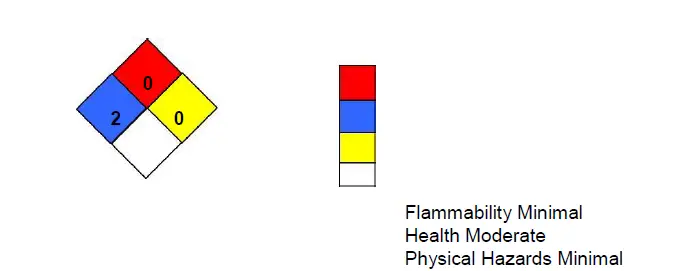
HMIS Hazard ID
Hazard rating: 0 – Minimal; 1 – Slight; 2 – Moderate; 3 – Serious; 4 – Severe; *Chronic health effect This document has been prepared using data from sources considered technically reliable. It does not constitute a warranty, express or implied, as to the accuracy of the information contained herein. Actual conditions of use and handling are beyond the seller’s control. The user is responsible to evaluate all available information when using the product for any particular use and complying with all Federal, State, Provincial and Local laws and regulations