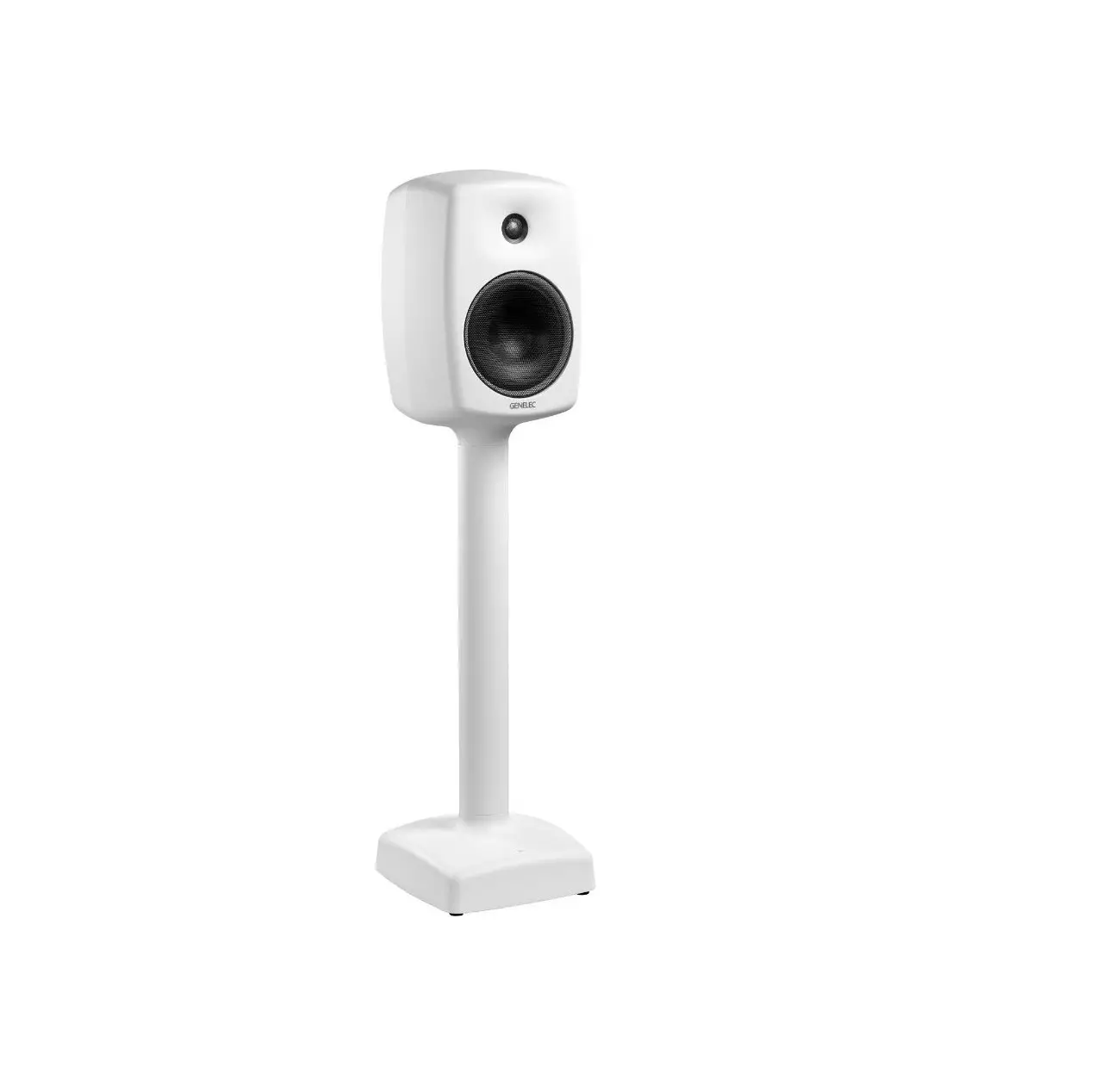
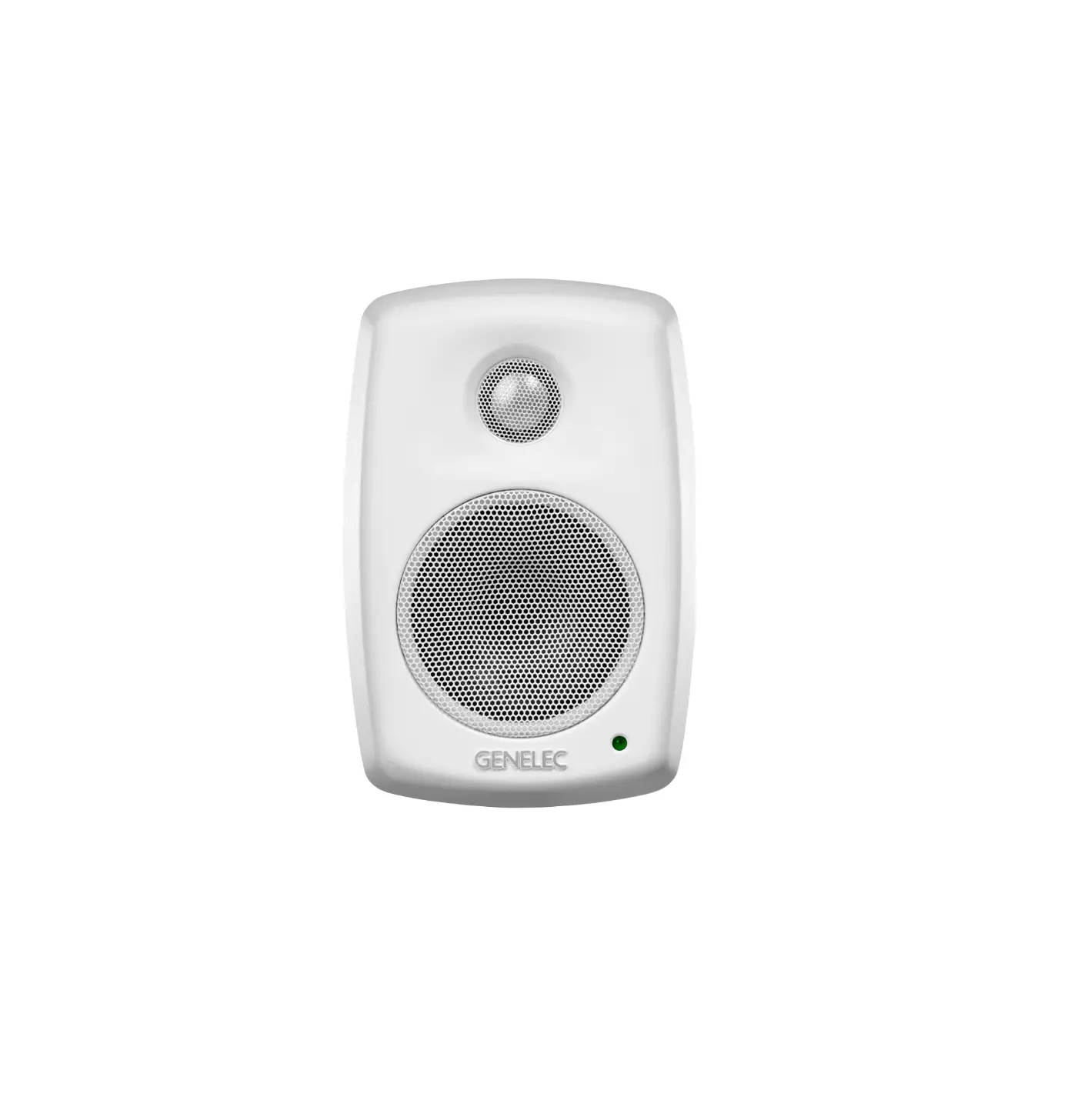
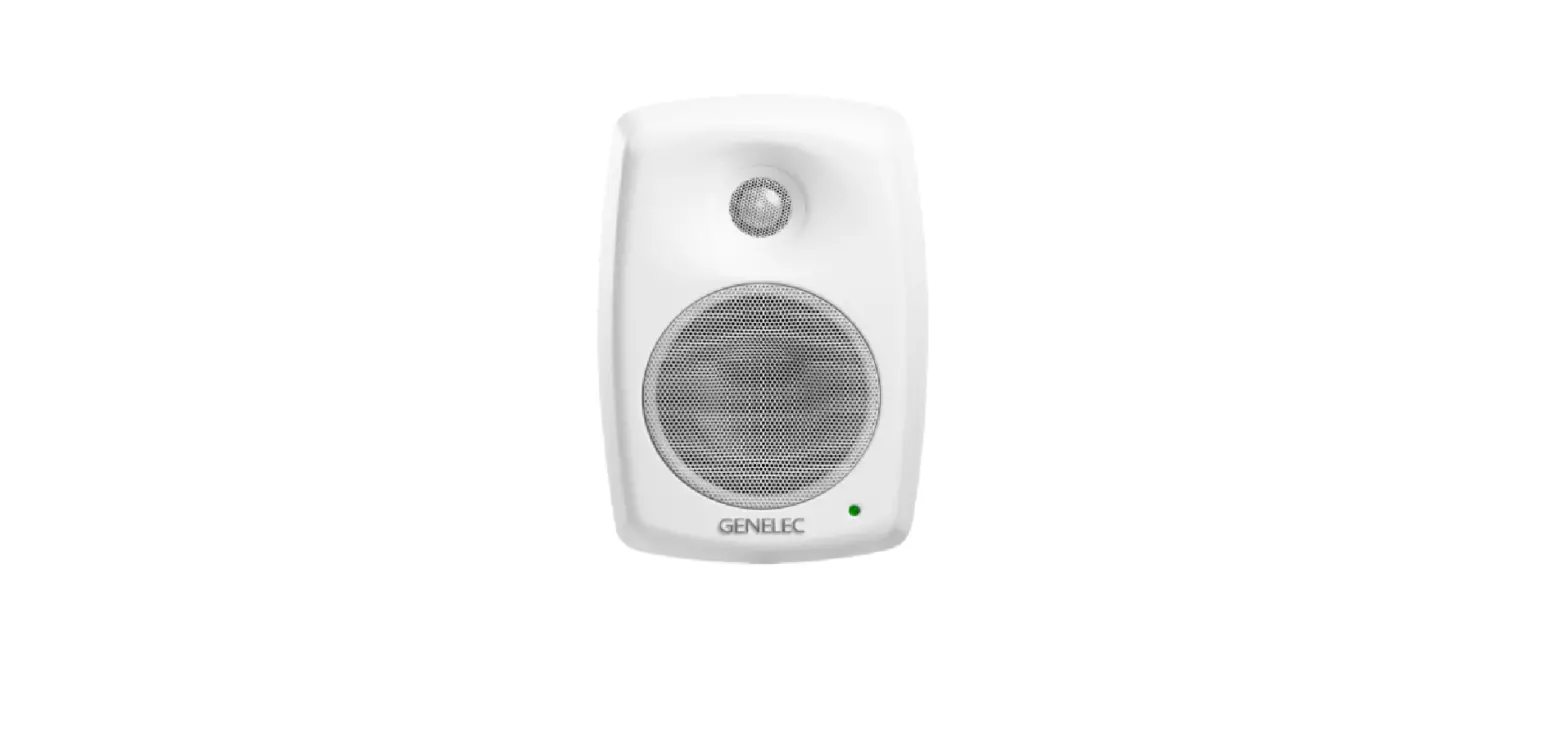
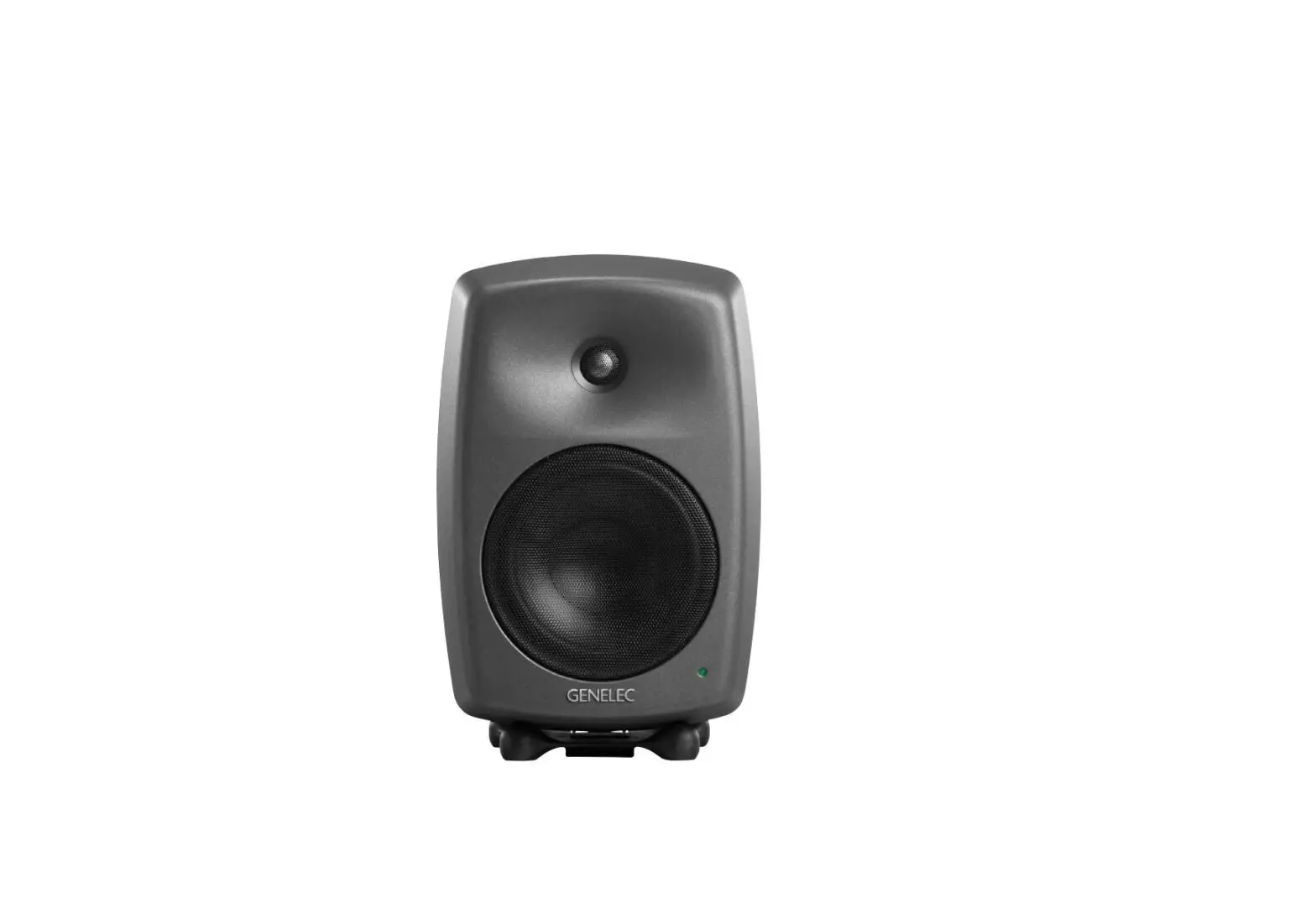
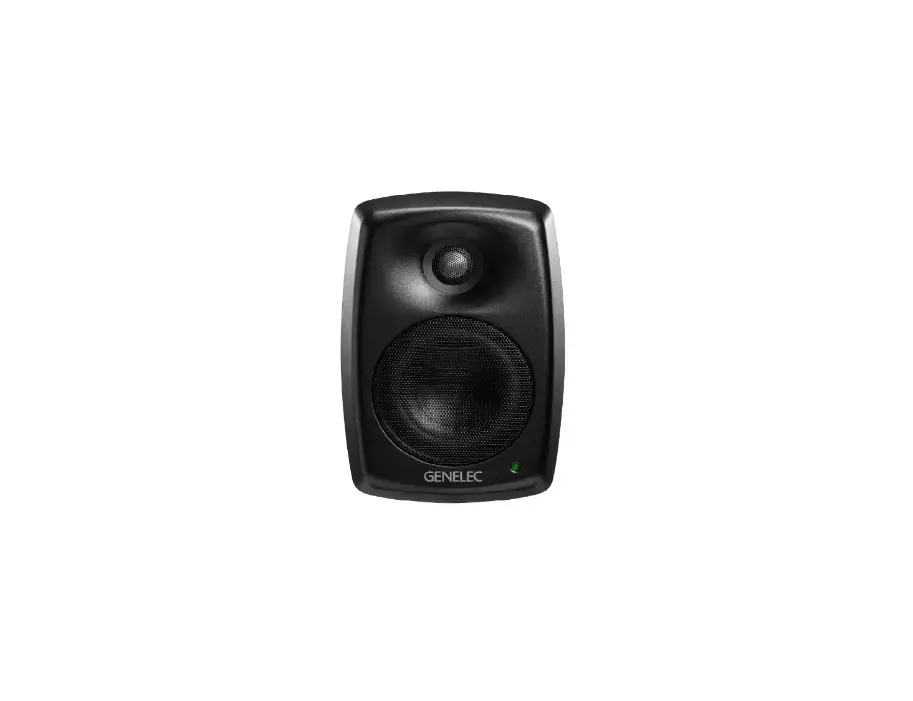
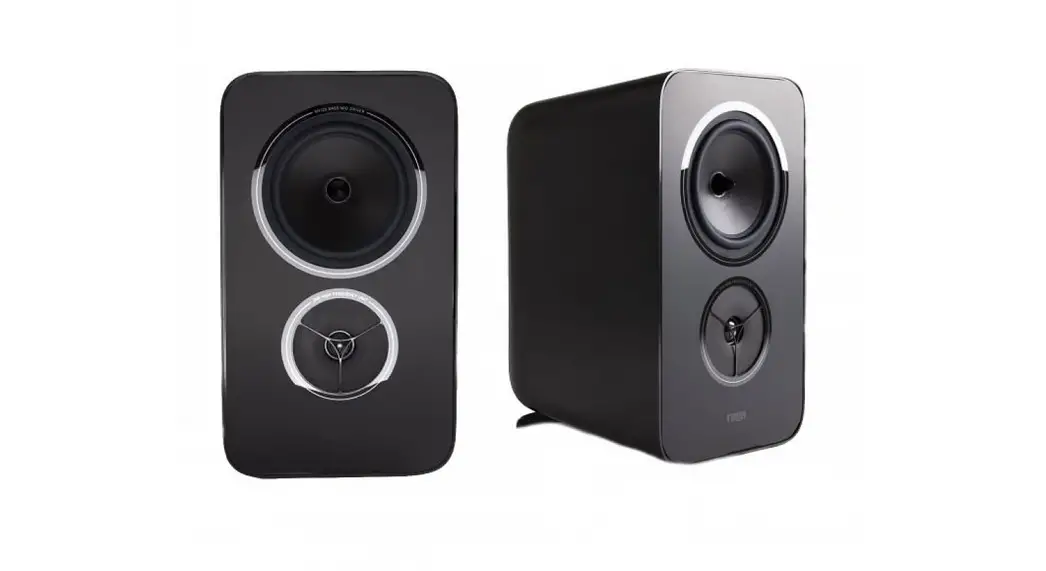
4040A Active Loudspeaker
Genelec 4040A Active Loudspeaker
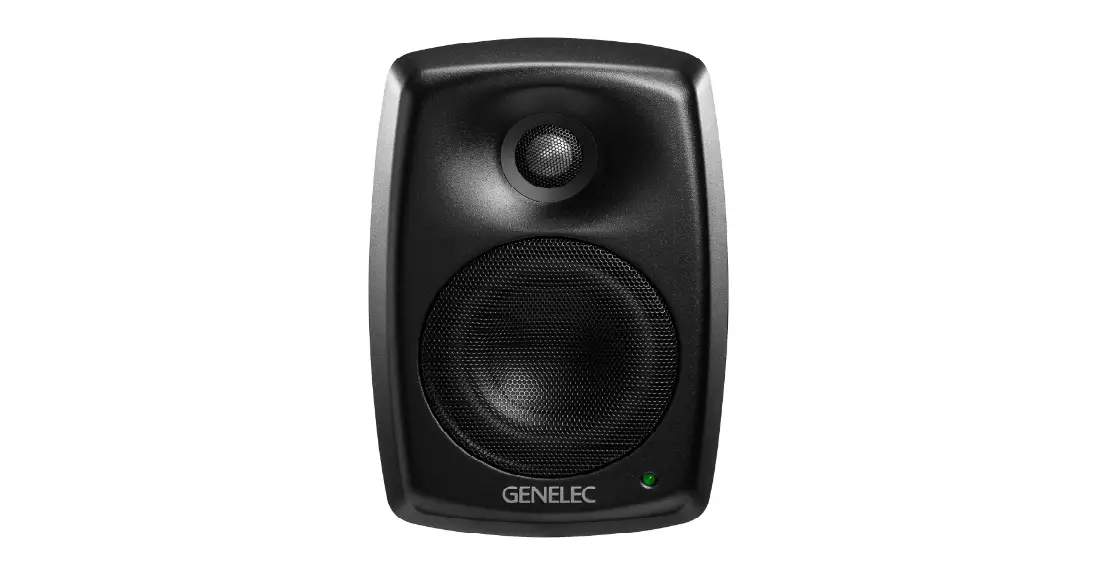
The Genelec 4040A is a bi-amplified, two-way active loudspeaker
designed for fixed installations. It comes equipped with drivers,
power amplifiers, active crossover filters, and protection
circuitry. The loudspeaker is designed for indoor use only in
temperatures between 15 to 35 degrees Celsius and relative humidity
between 20% and 90%. The Minimum Diffraction Enclosure (MDE)
loudspeaker enclosure is made of die-cast aluminum and shaped to
reduce edge diffraction. Combined with the advanced Directivity
Control Waveguide (DCW), this design provides excellent frequency
balance in difficult acoustic environments.
Positioning The Loudspeaker
After unpacking, place the loudspeaker in its required listening
position, taking note of the line of the acoustic axis. The axis
should be pointed towards the center of the listening area.
Connections
Connect the audio signal and 12 V trigger voltage to the 5-pole
plug provided with the loudspeaker and secure the connections by
tightening the screws on each pole. Push the plug into the
connector on the loudspeaker. Never connect the 4040A to the
loudspeaker outputs of a power amplifier or an integrated amplifier
or receiver. Once the connections have been made, the loudspeaker
is ready to be switched on.
Controls
- Level Control: Adjusts the input sensitivity
of the loudspeaker to match the output of the signal source. - Autostart Off Time: Sets the shutoff delay of
the Autostart function. When set to OFF, the loudspeaker shuts off
one hour after ending the playback. In the ON setting, the delay is
15 minutes. - Led Off: Turns off the green power indicator
LED. However, the overload indication by red colored LED remains
active. - Bass Roll-Off: Affects the low frequency
roll-off of the loudspeaker and attenuates its energy output near
the cut-off frequency (55 Hz). Attenuation levels of -2, -4 or -6
dB can be selected. - Bass Tilt: Offers three attenuation levels for
the bass response of the loudspeaker below 800 Hz, usually
necessary when the loudspeaker is placed near a wall or other room
boundaries. The attenuation levels are -2 dB (switch 3 ON), -4 dB
(switch 4 ON), and -6 dB (both switches ON). - Treble Tilt: Adjusts the treble response of
the loudspeaker at frequencies above 4 kHz. Two attenuation levels,
-2 dB (switch 3 ON) or -4 dB (switch 2 ON) are available for
smoothening down an excessively bright sounding system, while the
+2 dB setting (switch 4 ON) provides slightly increased treble
level suitable for heavily damped surroundings.
4040A
Operating Manual
Genelec 4040A Active Loudspeaker
General
The bi-amplified Genelec 4040A is a powerful but compact two way active loudspeaker designed for fixed installations. As an active loudspeaker, it contains drivers, power amplifiers, active crossover filters and protection circuitry. The 4040A is designed for indoor use only, in temperatures between 15 to 35 degrees Celsius and relative humidity between 20 % and 90 %.
The MDETM (Minimum Diffraction EnclosureTM) loudspeaker enclosure is made of die-cast aluminium and shaped to reduce edge diffraction. Combined with the advanced Directivity Control WaveguideTM (DCWTM), this design provides excellent frequency balance in difficult acoustic environments.
Positioning The Loudspeaker
Each 4040A is supplied with an integrated amplifier unit, mains cable, a 5-pin connector for audio signal and 12 V trigger voltage, a keyhole type wallmount and an operating manual. After unpacking, place the loudspeaker in its required listening position, taking note of the line of the acoustic axis. The axis should be pointed towards the center of the listening area.
Connections
Before connecting up, ensure that the loudspeakers and the signal source have been switched off. The power switch of the 4040A is located on the back panel (see Figure 3). Connect the loudspeaker to an earthed mains connection with the supplied mains cable. Never connect the loudspeaker to an unearthed mains supply or using an unearthed mains cable. Audio input is via a 10 kOhm balanced Phoenix connector. The connector also has two pins for 12 V trigger voltage for power switching. The pin sequence of the connector is shown in Figure 2.
Connect the signal cable and 12 V trigger voltage to the 5-pole plug provided with the loudspeaker and secure the connections by tightening the screws on each pole. Push the plug into the connector on the loudspeaker.
Never connect the 4040A to the loudspeaker outputs of a power amplifier or an integrated amplifier or receiver.
Once the connections have been made, the loudspeaker is ready to be switched on.
Controls
Level Control
The input sensitivity of the loudspeaker can be matched to the output of the signal source by adjusting the rotary level control on the rear panel.
Autostart Sensitivity This control sets the triggering sensitivity of the signal sensing Autostart function. In case of a high background noise level in the audio network, the automatic shutoff may not function as the circuit detects the noise and misinterprets it as a valid signal. Switching the “Autostart Sensitivity” switch to “ON” reduces the triggering sensitivity and gives better immunity to noise in the signal network. On the other hand, if a very low playback level is desirable, the Autostart function works better in the more sensitive “OFF” setting. The required triggering voltages are approximately 0.4 mV (OFF) and 1.4 mV (ON).
Autostart Off Time This control sets the shutoff delay of the Autostart function. When the switch is set to “OFF”, the loudspeaker shuts off one hour after ending the playback. In the “ON” setting, the delay is 15 minutes.
Led Off This switch turns off the green power indicator LED. However, the overload indication by red coloured LED remains active.
Tone Controls The frequency response of the Genelec 4040A can be adjusted to match the acoustic environment by setting the tone control switches on the rear panel. The controls are “Bass Roll-Off”, “Bass Tilt” and “Treble Tilt”. An acoustic measuring system is recommended for analyzing the effects of the adjustments, however, careful listening with suitable test recordings can also lead to good results if a test system is not available. Table 1 shows some examples of typical settings in various situations. Figure 4 shows the effect of the controls on the anechoic frequency response.
Bass Roll-Off The Bass Roll-Off control (switches 1 to 3 in switch group 1) affects the low frequency roll-off of the loudspeaker and attenuates its
ACOUSTIC AXIS 225 mm 8 7/8″
Figure 1: Location of the acoustic axis
Figure 2: Audio and 12 V trigger connector pin sequence
energy output near the cut-off frequency (55 Hz). Attenuation levels of -2, -4 or -6 dB can be selected.
Bass Tilt The Bass Tilt control (switches 2 to 4 in switch group 2) offers three attenuation levels for the bass response of the loudspeaker below 800 Hz, usually necessary when the loudspeaker is placed near a wall or other room boundaries. The attenuation levels are -2 dB (switch 3 “ON”), -4 dB (switch 4 “ON”) and -6 dB (both switches “ON”).
Treble Tilt The Treble Tilt control (switches 2 to 4 in switch group 3) adjusts the treble response of the loudspeaker at frequencies above 4 kHz. Two attenuation levels, -2 dB (switch 3 “ON”) or -4 dB (switch 2 “ON”) are available for smoothening down an excessively bright sounding system, while the +2 dB setting (switch 4 “ON”) provides slightly increased treble level suitable for heavily damped surroundings.
The factory setting for all tone controls is “OFF” to give a flat anechoic frequency response. Always start adjustment by setting all switches to “OFF” position. Measure or listen systematically through the different combinations of settings to find the best frequency balance.
WALL MOUNT BRACKET INSTALLED
MAINS CONNECTOR
MAINS POWER SWITCH
SUGGESTED TONE CONTROL SETTINGS
1234
1234
-6 dB BASS TILT
-4 dB BASS TILT
FREE STANDING IN A ROOM:
ALL TONE CONTROLS OFF
-6 -4 -2
BASS ROLLOFF dB
AUTO START SENSITIVITY
AUTO OFF TIME LED OFF
-6 -4 -2 BASS
TILT dB
-4 -2 +2 TREBLE
TILT dB
MIN MAX LEVEL
ON MAINS INPUT
50 / 60 Hz 170 W 230 V~ SERIAL NUMBER
OFF
4040A ACTIVE SPEAKER SYSTEM MADE IN FINLAND www.genelec.com
REMOTE MAINS SWITCHING GND +12V
GND + _ BALANCED INPUT SIGNAL
292-4040T-6
CONTROL SWITCHES
SENSITIVITY ADJUSTMENT
BALANCED SIGNAL INPUT CONNECTOR AND 12 V TRIGGER INPUT
Figure 3: Control and connector layout on the rear panel of an 4040A.
Speaker Mounting Position Flat anechoic response Free standing in a damped room Free standing in a reverberant room In a corner
Treble Tilt None None None None
Bass Tilt None -2 dB -4 dB -4 dB
Table 1: Suggested tone control settings for differing acoustical environments
Bass Roll-Off None None None -4 dB
Mounting Considerations
Align The Loudspeakers Correctly Always place the loudspeakers so that their acoustic axes (see Figure 1) are aimed towards the center of the listening area. Only vertical placement is preferred, as it minimises acoustical cancellation problems around the crossover frequency.
Minimise Reflections Acoustic reflections from objects close to the loudspeakers like walls, cabinets etc. can cause unwanted colouration or blurring of the sound image. These can be minimised by placing the loudspeaker clear of reflective surfaces.
Minimum Clearances
Sufficient clearance for cooling of the amplifier and functioning of the reflex port must be ensured if the loudspeaker is installed in a restricted space such as a cabinet or integrated into a wall structure. The surroundings of the loudspeaker must always be open to the listening room with a minimum clearance of 5 centimeters (2″) behind, above and on both sides of the loudspeaker. The space
adjacent to the amplifier (back panel of the enclosure) must either be ventilated or sufficiently large to dissipate heat so that the ambient temperature does not rise above 35 degrees Celsius (95°F).
Mounting Options
The Genelec 4040A offers several mounting options: It can be fitted to Omnimount® Series 30 and König & Meyer loudspeaker mounts or the keyhole wall mount adapter provided with the loudspeaker on two sets of M6x10 mm threaded holes on the back of the enclosure. On the base of the enclosure is an M10x10 mm threaded hole which can be used for securing the loudspeaker to its base. See Genelec Accessories Catalogue on www.genelec.com for a complete list of mounting hardware options.
Autostart And Remote Control
The 4040A is equipped with an Autostart function, which automatically turns the amplifier to Standby mode if an input signal has not been detected for approximately 3 hours (Auto Off Time switch set to “OFF”) or 15 minutes (Auto Off Time switch set to “ON”), and back to “ON” mode when the signal returns.
The triggering sensitivity can be selected with the Autostart Sensitivity switch (see chapter Autostart Sensitivity above).
The amplifier mode can also be switched by a 12 V DC trigger type remote control. The remote control wires can be connected to the first two (starting from left) poles of the Phoenix connector (See Figure 2 for the connector pin sequence). Remote control overrides the Autostart function.
Maintenance
No user serviceable parts are to be found within the loudspeaker. Any maintenance or repair of the 4040A unit should only be undertaken by qualified service personnel.
Safety Considerations
Although the 4040A has been designed in accordance with international safety standards, the following warnings and cautions should be observed to ensure safe operation and to maintain the loudspeaker under safe operating conditions:
·Servicing and adjustment must only be performed by qualified service personnel. ·The loudspeaker must not be opened. ·Do not use this product with an unearthed mains cable or an unearthed mains connection as this may compromise electrical safety. ·Do not expose the loudspeaker to water or moisture. Do not place any objects filled with liquid, such as vases on the loudspeaker or near it. ·This loudspeaker is capable of producing sound pressure levels in excess of 85dB, which may cause permanent hearing damage. ·Free flow of air behind the loudspeaker is necessary to maintain sufficient cooling. Do not obstruct airflow around the loudspeaker. ·Note that the amplifier is not completely disconnected from the AC mains service unless the mains power cord is removed from the amplifier or the mains outlet.
Guarantee
This product is guaranteed for a period of two years against faults in materials or workmanship. Refer to supplier for full sales and guarantee terms.
4040A Operating Manual
Genelec Oy 4040A 90 d
B r 85
A 80 90
BASS ROLL-OFF
85
80
BASS TILT 75
(dBr) vs freq (Hz) 31 Jul 12 TREBLE TILT
30 50 100 200
500 1k
2k
5k 10k 20k Hz
Figure 4: The effect of the tone controls to the free field response of
the 4040A.
Genelec Oy 4040A 90 d B r 85 A 80
75
70
65
60
(dBr) vs freq (Hz) 31 Jul 12 0° 15° 30°
45° 60°
30 50 100 200
500 1k
2k
5k 10k 20k Hz
Figure 5: The upper curve group shows the horizontal directivity
characteristics of the 4040A measured at 1 m. The lower curve shows
the system’s power response.
SYSTEM SPECIFICATIONS
4040A
Lower cut-off frequency, -3 dB Upper cut-off frequency, -3 dB
55 Hz 20 kHz
Free field frequency response of system (± 3.0 dB)
55 Hz – 20 kHz
Maximum short term sine wave acoustic output 109 dB SPL on axis in half space, averaged from 100 Hz to 3 kHz@ 1 m
Maximum long term RMS acoustic output in same conditions with IEC weighted noise (limited by driver unit protection circuit) @ 1 m
101 dB SPL
Self generated noise level in free field @ 1m on 10 dB axis (A-weighted)
Harmonic distortion at 90 dB SPL @ 1m on axis
Freq. 50 to 100 Hz > 100 Hz
< 3 % < 0.5 %
Drivers: Bass Treble
165 mm (6 1/2″) 19 mm (3/4″) metal dome
Weight:
9.9 kg (22 lbs)
Dimensions: Height Width Depth
350 mm (13 13/16″) 237 mm (9 3/8″) 223 mm (8 13/16″)
CROSSOVER SECTION
4040A
Input connector Balanced Phoenix connector Pin 1 gnd, pin 2 +, pin 3 –
Input impedance
10 kOhm balanced
Input level for maximum short term output of 100 dB SPL @ 1m:
Adjustable from +6 to -6 dBu
Crossover frequency, Bass/Treble
2.5 kHz
Treble tilt control operating range in 2 dB steps From +2 to -4 dB & MUTE @ 15 kHz
Bass roll-off control operating range in 2 dB steps From 0 to -6 dB @ 55 Hz
Bass tilt control operating range in 2 dB steps
From 0 to -6 dB @100 Hz & MUTE
The `CAL’ position is with all tone controls set to `off’ and the input sensitivity control to maximum (fully clockwise)
AMPLIFIER SECTION
Bass amplifier short term output power Treble amplifier short term output power
Long term output power is limited by driver unit protection circuitry Amplifier system distortion at nominal output
THD Signal to Noise ratio, referred to full output
Bass Treble Mains voltage
Voltage operating range Power consumption
Idle Standby Full output
4040A 120 W 120 W
0.05 %
100 dB 100 dB 100, 120, 220 or 230 V according to region ±10 %
15 W <0.5 W 170 W
Genelec Document D0107R001. Copyright Genelec Oy 9.2012. All data subject to change without prior notice
International enquiries: Genelec, Olvitie 5 FIN-74100, Iisalmi, Finland Phone +358 17 83881 Fax +358 17 812 267 Email [email protected]
www.genelec.com
In the U.S. please contact: Genelec Inc., 7 Tech Circle Natick, MA 01760, U.S.A. Phone +1 508 652 0900 Fax +1 508 652 0909 Email [email protected]
In China please contact: Beijing Genelec Audio Co. Ltd. Jianwai SOHO, Tower 12, Room 2605 39 East 3rd Ring Road, Chaoyang District Beijing 100022, China Phone +86 10 5869 7915 Fax +86 10 5869 7914
In Sweden please contact Genelec Sverige Ellipsvägen 10B P.O. Box 5521, S-141 05 Huddinge Phone +46 8 449 5220 Fax +46 8 708 7071 Email [email protected]
 World Leader in Studio Monitors - Genelec.com