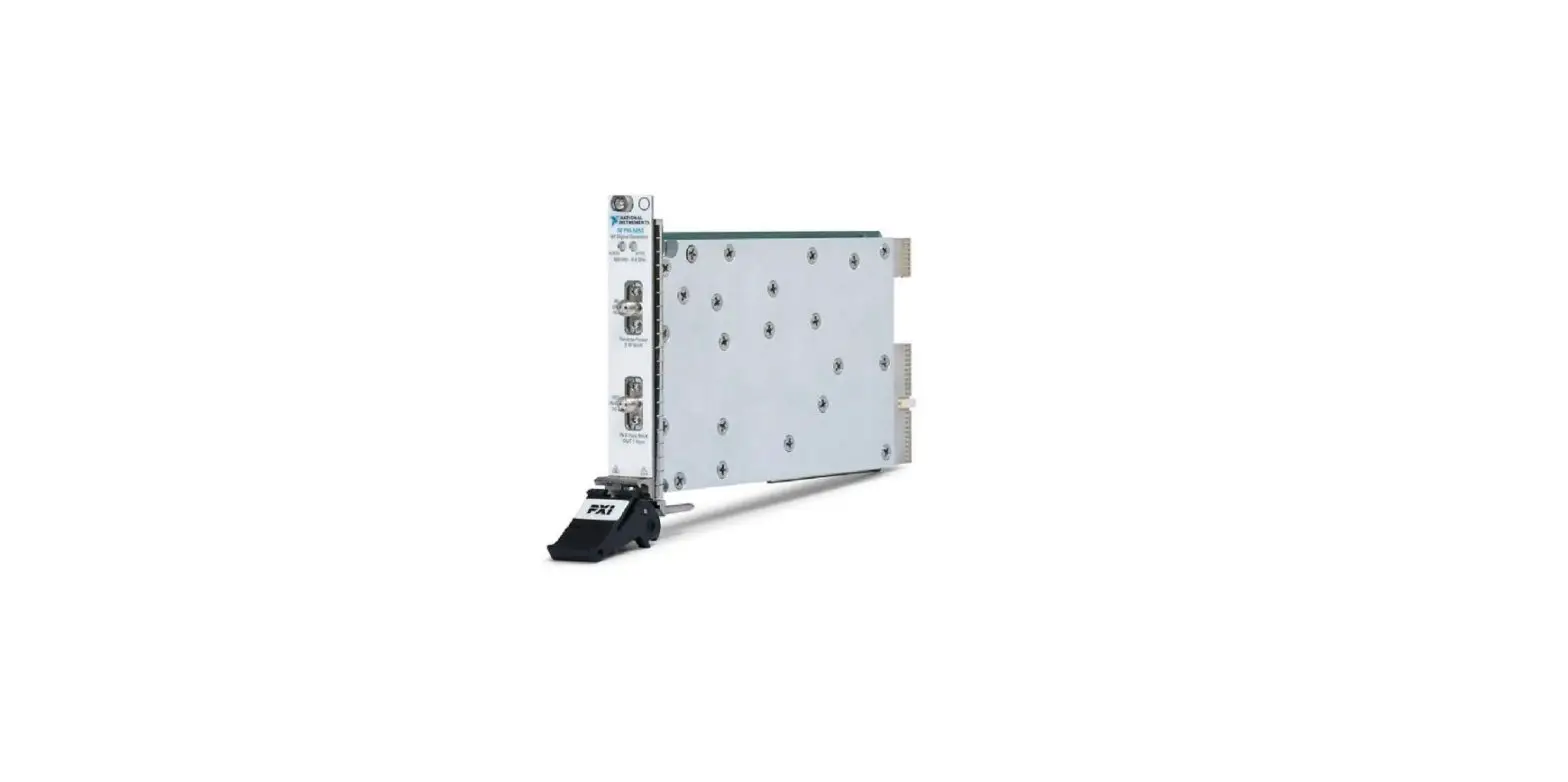
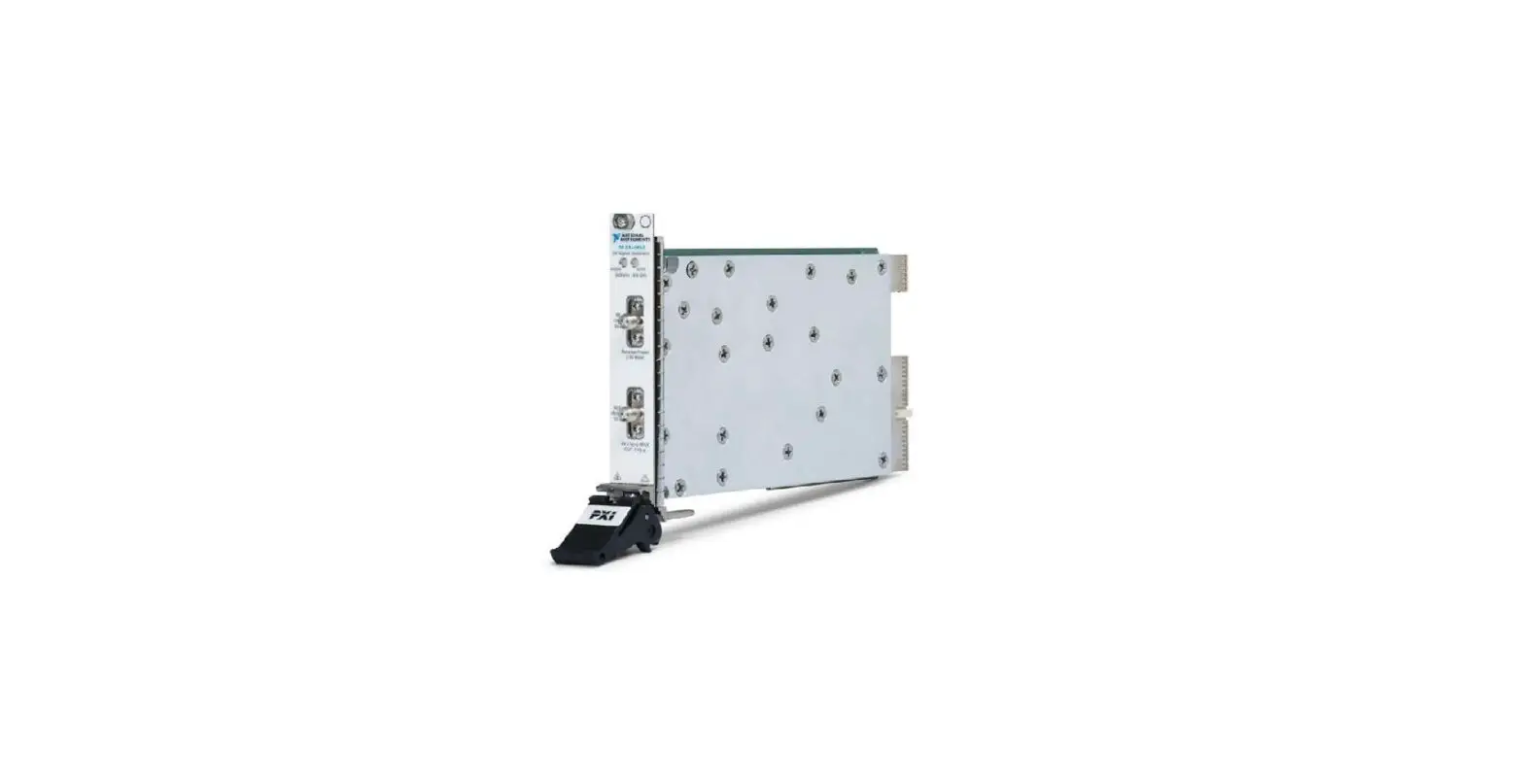
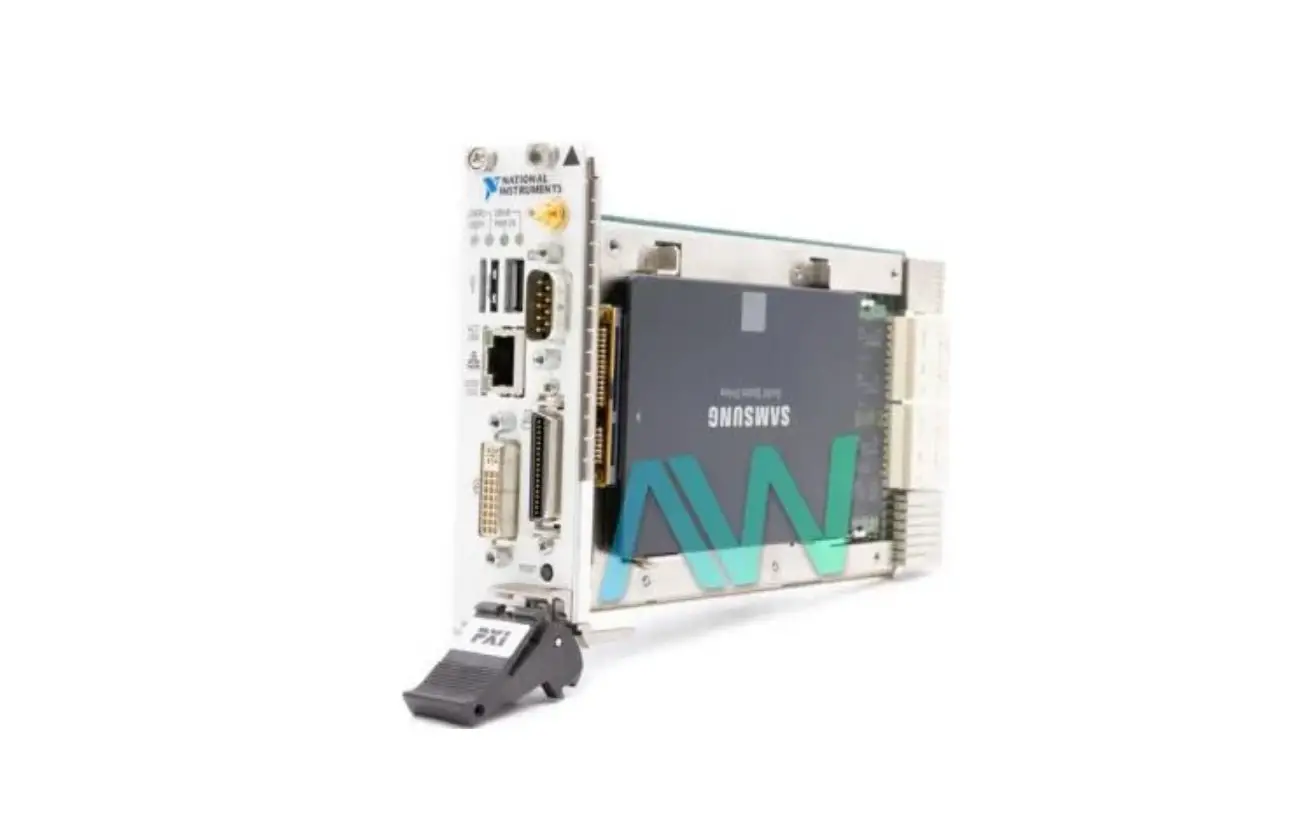
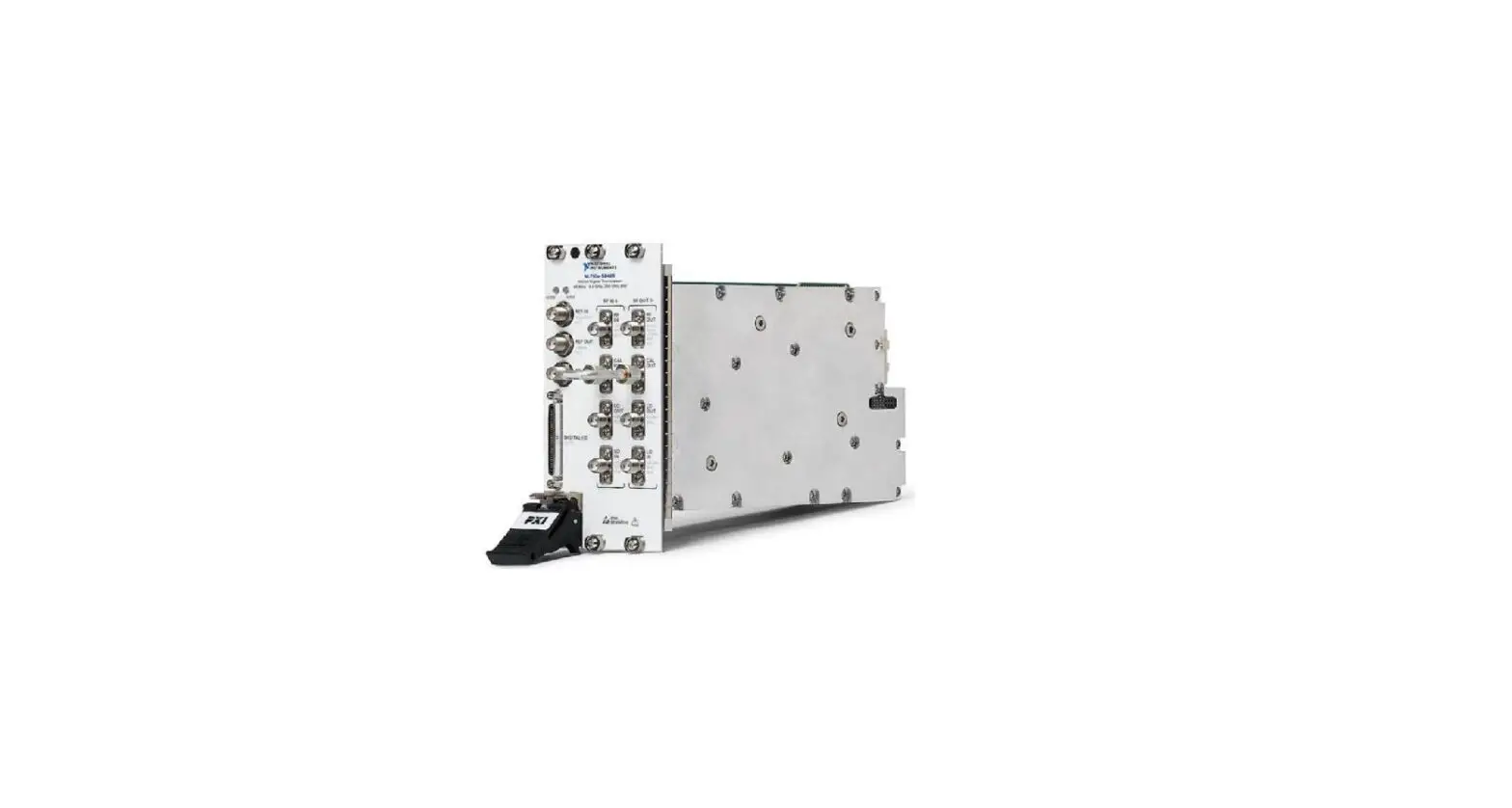
PXI-5650 1.3 GHz RF Analog Signal Generator
Product Information: PXI-5650 1.3 GHz RF Analog Signal
Generator
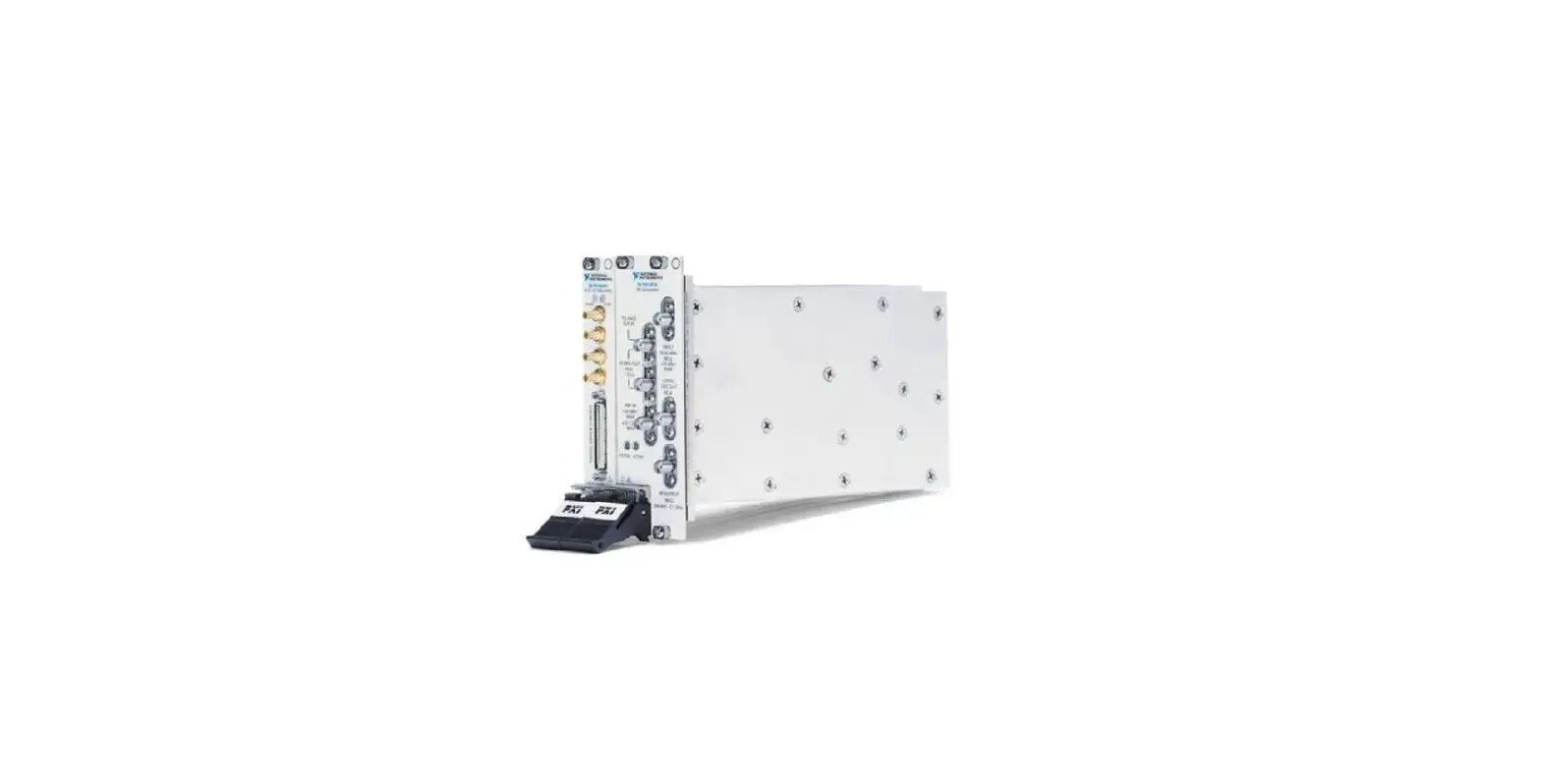
The PXI-5650 is a high-performance RF analog signal generator
designed to generate signals in the frequency range of 500 kHz to
1.3 GHz. It is equipped with advanced features and specifications
to meet the needs of various applications.
Specifications
- Frequency Range: 500 kHz to 1.3 GHz
- Resolution: Variable
- Accuracy: High precision
Conditions
The PXI-5650 operates under specific conditions to ensure
optimal performance. These conditions include:
- Stated operating conditions
- Conditions covered by the model warranty
- Supplemental testing, if applicable
Frequency Settling Time
The frequency settling time of the PXI-5650 is the time it takes
for the signal generator to stabilize at a new frequency after a
change in the settings. The settling time is an important factor to
consider when precise frequency changes are required. Please refer
to the user manual for specific settling time values based on
different frequency settings.
Reference Clock
The PXI-5650 utilizes a reference clock to ensure accurate
frequency generation. The reference clock acts as a stable time
base for the signal generator, allowing it to generate precise
signals within the specified frequency range.
Definitions
Warranted specifications: These are the performance
characteristics of the PXI-5650 that are guaranteed under stated
operating conditions and covered by the model warranty.
Specifications: Unless otherwise noted, all specifications of
the PXI-5650 are warranted, meaning they meet the defined
performance criteria.
Product Usage Instructions
Follow the instructions below to use the PXI-5650 RF Analog
Signal Generator effectively:
- Ensure that the signal generator is connected to a stable power
source and properly grounded. - Refer to the user manual for any specific setup or
configuration requirements based on your application. - Power on the PXI-5650 and allow it to initialize.
- Set the desired frequency range using the appropriate controls
or input methods. The frequency range should be within the
specified limits of 500 kHz to 1.3 GHz. - Adjust the resolution settings as needed to achieve the desired
signal precision. - Verify the accuracy of the generated signal by comparing it
with a reference standard or instrument. - If necessary, perform supplemental testing to ensure the signal
generator meets your specific requirements. - When finished, power off the PXI-5650 and disconnect it from
the power source.
For further details on operating instructions, troubleshooting,
and advanced features, please refer to the comprehensive user
manual provided with the PXI-5650 RF Analog Signal Generator.
PXI-5650
SPECIFICATIONS
PXI-5650
1.3 GHz RF Analog Signal Generator
Contents
Definitions…………………………………………………………………………………………………………………2 Conditions………………………………………………………………………………………………………………… 2 Frequency…………………………………………………………………………………………………………………. 2
Frequency Settling Time……………………………………………………………………………………… 3 Reference Clock………………………………………………………………………………………………………… 3
Internal Clock……………………………………………………………………………………………………..3 Internal Reference Output (REF IN/OUT connector)……………………………………………….3 External Reference Input (REF IN/OUT connector)……………………………………………….. 4 Spectral Purity……………………………………………………………………………………………………………4 Harmonics…………………………………………………………………………………………………………. 5 Nonharmonics……………………………………………………………………………………………………. 6 Amplitude………………………………………………………………………………………………………………….7 Power Level Accuracy………………………………………………………………………………………… 8 Amplitude Settling Time………………………………………………………………………………………9 Signal-to-Noise Ratio…………………………………………………………………………………………..9 Voltage Standing Wave Ratio (VSWR)…………………………………………………………………. 9 Reverse Power Handling…………………………………………………………………………………….10 Modulation……………………………………………………………………………………………………………… 10 Frequency Modulation (FM)……………………………………………………………………………….10 Frequency Shift Keying (FSK)…………………………………………………………………………… 11 On-Off Keying (OOK)……………………………………………………………………………………….12 DC Power Requirements……………………………………………………………………………………………14 Calibration……………………………………………………………………………………………………………….14 Physical Dimensions………………………………………………………………………………………………… 14 Environment……………………………………………………………………………………………………………. 15 Operating Environment………………………………………………………………………………………15 Storage Environment………………………………………………………………………………………….15 Shock and Vibration………………………………………………………………………………………………….15 Compliance and Certifications……………………………………………………………………………………16 Safety……………………………………………………………………………………………………………… 16 Electromagnetic Compatibility…………………………………………………………………………… 16 CE Compliance ……………………………………………………………………………………………….. 16 Online Product Certification………………………………………………………………………………. 17 Environmental Management………………………………………………………………………………. 17
Definitions
Warranted specifications describe the performance of a model under stated operating conditions and are covered by the model warranty.
The following characteristic specifications describe values that are relevant to the use of the model under stated operating conditions but are not covered by the model warranty. · Typical specifications describe the performance met by a majority of models. · Nominal specifications describe an attribute that is based on design, conformance testing,
or supplemental testing.
Specifications are Warranted unless otherwise noted.
Conditions
Minimum or maximum warranted specifications are valid under the following conditions unless otherwise noted. · 30 minutes warm-up time · Calibration cycle maintained · Temperature of 0 °C to 55 °C
Typical specifications are valid under the following condition unless otherwise noted. · Over ambient temperature ranges of 23 °C ± 5 °C
Frequency
Range1 Resolution Accuracy
500 kHz to 1.3 GHz <3 Hz Refer to the Reference Clock section.
1 Tunable down to 100 kHz with amplitude uncalibrated.
2 | ni.com | PXI-5650 Specifications
Frequency Settling Time2
Table 1. Narrow Loop Bandwidth
Settling Time (ppm)
Median (ms)
Maximum (ms)
0.01 0.1
6.5
13
1.5
6.53
Table 2. Wide Loop Bandwidth
Settling Time (ppm)
Median (ms)
Maximum (ms)
0.01
1.0
5.0
0.1
0.3
1.0
1.0
0.2
0.7
Reference Clock
Internal Clock
Initial accuracy Temperature (15 ºC to 35 ºC) Aging
±3 ppm, maximum ±1 ppm, maximum ±5 ppm per year, maximum
Internal Reference Output (REF IN/OUT connector)
Frequency Amplitude Coupling Output impedance
10 MHz 1 Vpk-pk into 50 AC 50
2 The frequency settling time specification includes only frequency settling and excludes any residual amplitude settling that may occur as the result of a large frequency change.
3 Frequency steps that span the full range of a voltage-controlled oscillator (VCO) require more settling time than steps that remain close together within one VCO or steps that switch between VCOs. The maximum specification covers this worst-case frequency settling time.
PXI-5650 Specifications | © National Instruments | 3
External Reference Input (REF IN/OUT connector)
Frequency Amplitude Input impedance Lock time to external reference
10 MHz ±10 ppm 0.2 Vpk-pk to 1.5 Vpk-pk into 50 50 <1 s
Spectral Purity
Table 3. Single Sideband (SSB) Phase Noise at 10 kHz Offset4
Frequency
Phase Noise (dBc/Hz)
100 MHz 500 MHz 1 GHz
<-125, typical <-111 <-105
Residual FM, 1 GHz (300 Hz to 3 kHz, RMS)
Jitter5 (seconds, RMS), 622 MHz with 1 kHz to 5 MHz jitter bandwidth
<0.8 Hz RMS, typical <200 fs, typical
4 Wide loop bandwidth has very similar phase noise performance at 10 kHz offset, but this noise level extends to approximately 300 kHz offset before it starts rolling down at approximately 20 dB per decade until it reaches the far out noise density.
5 Measured at 0 dBm output power.
4 | ni.com | PXI-5650 Specifications
Figure 1. Measured Phase Noise at 500 MHz and 1 GHz (0 dBm Output Power)
70
500 MHz
80
1.0 GHz
90
100
dBc/Hz
110
120
130
140
150 100
1 k
10 k
100 k
1 M
Frequency Offset (Hz)
10 M
Harmonics
500 kHz to <1.3 GHz (0 dBm to -40 dBm output power)
-15 dBc, typical
Figure 2. Typical Spectrum at 1.3 GHz
0
10
20
30
Power (dBm)
40
50
60
70
80
90
500 k
400 M 800 M
1.2 G
1.6 G
2 G
Frequency (Hz)
2.4 G 2.7 G
PXI-5650 Specifications | © National Instruments | 5
Figure 3. Typical Second Harmonic (HD 2) and Third Harmonic (HD 3) Levels (0 dBm Output Power)
15
HD 2
25
HD 3
Harmonic Level (dBC)
50
75
90
500 k
200 M
400 M
600 M
800 M
1 G
1.2 G 1.3 G
Frequency (Hz)
Nonharmonics
Narrow Loop Bandwidth
Table 4. Nonharmonic Products at 0 dBm to -20 dBm Output Power
Frequency
<3 kHz Offset (dBc), >3 kHz Offset (dBc) >100 kHz Offset (dBc) Typical
500 kHz to <50 MHz <-57 50 MHz to 1.3 GHz <-65
<-57
<-57
<-65
<-70
6 | ni.com | PXI-5650 Specifications
Wide Loop Bandwidth
Table 5. Nonharmonic Products at 0 dBm to -20 dBm Output Power
Frequency
<3 MHz Offset (dBc), Typical >3 MHz Offset (dBc), Typical
500 kHz to <50 MHz <-57
<-57
50 MHz to 1.3 GHz <-44
<-70
Subharmonic products 500 kHz to 1.3 GHz
Not applicable6
Amplitude
Resolution
<0.1 dB
Table 6. Amplitude Range
Frequency
Amplitude (dBm)
500 kHz to <10 MHz 10 MHz to <50 MHz 50 MHz to <500 MHz 500 MHz to <1.3 GHz
-90 to 5 -90 to 8 -90 to 10 -90 to 10
Maximum available power Minimum available power
2 dB above maximum specified amplitude, typical
10 dB below minimum specified amplitude, typical
6 No harmonic multiplication in this band.
PXI-5650 Specifications | © National Instruments | 7
Power (dBm)
Figure 4. Measured Maximum Available Power
20 18 16 14
12 10
8
6
4
2
0
500 k
200 M
400 M
600 M
800 M
1 G
Frequency (Hz)
1.2 G 1.3 G
Power Level Accuracy
Frequency
Table 7. Power Level Accuracy (15 °C to 35 °C) >-40 dBm Output Power (dB) -40 dBm Output Power (dB)
500 kHz to <10 MHz ±1.6
±2.2
10 MHz to 1.3 GHz ±0.75
±1.8
8 | ni.com | PXI-5650 Specifications
Figure 5. Typical Power Accuracy, -40 dBm to 0 dBm, 5 dB Steps
1.0
0.5
Error (dB)
0.0
0.5
1.0 0
0.5 G
1 G
Frequency (Hz)
1.3 G
Amplitude Settling Time
0.05 dB of final value 0.25 dB of final value
<500 ms, typical <10 ms, typical
Signal-to-Noise Ratio
0 dBm output power
<-140 dBc/Hz, typical
Voltage Standing Wave Ratio (VSWR)
500 kHz to 1.3 GHz Output impedance
<1.8:1, typical 50
PXI-5650 Specifications | © National Instruments | 9
VSWR
2.0 1.8 1.6 1.4 1.2 1.0 0.8 0.6 0.4 0.2
0 0
Figure 6. Measured VSWR
0.5 G
1 G
Frequency (Hz)
Reverse Power Handling
RF DC
0.5 watts, +27 dBm7 25 volts
0 dBm 0 dBm
1.3 G
Modulation
Frequency Modulation (FM)
Modulation waveform types External modulation source
Sine, triangle, square Not supported
Table 8. FM Typical Maximum Deviation
Frequency Range
Typical Maximum Deviation (Sine Wave)
500 kHz to <50 MHz 50 MHz to <100 MHz 100 MHz to <200 MHz 200 MHz to <400 MHz
500 kHz 125 kHz 250 kHz 500 kHz
7 If the requested output power is less than -3 dBm, the RF reverse power handling is +15 dBm for signals 10 MHz.
10 | ni.com | PXI-5650 Specifications
Table 8. FM Typical Maximum Deviation (Continued)
Frequency Range
Typical Maximum Deviation (Sine Wave)
400 MHz to <800 MHz 800 MHz to 1.3 GHz
1 MHz 2 MHz
Modulation waveform frequency Characteristic deviation accuracy8 Typical distortion8 SINAD8
1 Hz to 100 kHz <±3.5% <0.1% >65 dB
Frequency Shift Keying (FSK)
Modulation waveform types PRBS User-defined
Modulation format
5-order to 31-order Up to 1,022 bit 2-FSK
Table 9. FSK Typical Maximum Deviation
Frequency Range
Typical Maximum Deviation (kHz)
500 kHz to <50 MHz 50 MHz to <100 MHz 100 MHz to <200 MHz 200 MHz to <400 MHz
250 31.25 62.5 125
8 1 kHz sine wave, 10% of maximum deviation; noise bandwidth of 10 kHz.
PXI-5650 Specifications | © National Instruments | 11
Table 9. FSK Typical Maximum Deviation (Continued)
Frequency Range
Typical Maximum Deviation (kHz)
400 MHz to <800 MHz
250
800 MHz to 1.3 GHz
500
FSK characteristic deviation accuracy (100 kHz rate, 10% of maximum deviation) Symbol rate
PRBS User-defined Pulse shaping
<±10%
763 Hz to 100 kHz 763 Hz to 100 kHz Not supported
Figure 7. FSK Modulation Eye Diagram, 1.0 GHz Carrier, 100 kHz Symbol Rate, 500 kHz Deviation, Ninth-Order PRBS
750 k
500 k
Frequency (Hz)
250 k
0
250 k
500 k
750 k 0
10 µ
20 µ
30 µ
40 µ
50 µ
Time (sec)
On-Off Keying (OOK)
Modulation waveform types PRBS User-defined
5-order to 31-order Up to 1,024 bit
12 | ni.com | PXI-5650 Specifications
Table 10. OOK Typical Amplitude
Frequency Range
Typical Amplitude (dBm)
500 kHz to <10 MHz 10 MHz to <50 MHz 50 MHz to 1.3 GHz
-3 to 5 -3 to 8 -3.5 to 10
Symbol rate PRBS User-defined
Pulse shaping
153 Hz to 100 kHz 153 Hz to 100 kHz Not supported
Figure 8. OOK Diagram, 1.0 GHz Carrier, 100 kHz Symbol Rate, Ninth-Order PRBS
10
0
Power Level (dBm)
20
40
60 0
50 µ
100 µ
150 µ
Time (sec)
200 µ
PXI-5650 Specifications | © National Instruments | 13
Figure 9. OOK Diagram, 1.0 GHz Carrier, 200 kHz Symbol Rate, Ninth-Order PRBS
10 0
10
Power Level (dBm)
20
30
40
50
60 0
50 µ
100 µ
150 µ
Time (sec)
200 µ
DC Power Requirements
Voltage (VDC) +3.3 +12
Table 11. DC Power Requirements
Maximum Current (A)
Typical Current (A)
1.00
0.90
1.00
0.80
Calibration
Interval
1 year
Physical Dimensions
PXI-5650 module
Weight
3U, one slot, PXI module 2.0 cm × 13.0 cm × 21.6 cm (0.8 in. × 5.1 in. × 8.5 in.)
415 g (14.6 oz)
14 | ni.com | PXI-5650 Specifications
Environment
Maximum altitude Pollution Degree Indoor use only.
Operating Environment
Ambient temperature range
Relative humidity range
Storage Environment
Ambient temperature range Relative humidity range
Shock and Vibration
Nonoperational shock
Random vibration nonoperating
2,000 m (800 mbar) (at 25 °C ambient temperature) 2
0 °C to 55 °C (Tested in accordance with IEC 60068-2-1 and IEC 60068-2-2. Meets MIL-PRF-28800F Class 3 low temperature limit and MIL-PRF-28800F Class 2 high temperature limit.) 10% to 90%, noncondensing (Tested in accordance with IEC 60068-2-56.)
-40 °C to 70 °C (Tested in accordance with IEC 60062-2-1 and IEC 60068-2-2.) 5% to 95%, noncondensing (Tested in accordance with IEC 60068-2-56.)
30 g peak, half-sine, 11 ms pulse (Tested in accordance with IEC 60068-2-27. Test profile developed in accordance with MIL-PRF-28800F.) 5 Hz to 500 Hz, 2.4 grms (Tested in accordance with IEC 60068-2-64. Nonoperating test profile exceeds the requirements of MIL-PRF-28800F, Class 3.)
PXI-5650 Specifications | © National Instruments | 15
Compliance and Certifications
Safety
This product is designed to meet the requirements of the following electrical equipment safety standards for measurement, control, and laboratory use: · IEC 61010-1, EN 61010-1 · UL 61010-1, CSA C22.2 No. 61010-1
Note For UL and other safety certifications, refer to the product label or the Online Product Certification section.
Electromagnetic Compatibility
This product meets the requirements of the following EMC standards for electrical equipment for measurement, control, and laboratory use: · EN 61326-1 (IEC 61326-1): Class A emissions; Basic immunity · EN 55011 (CISPR 11): Group 1, Class A emissions · EN 55022 (CISPR 22): Class A emissions · EN 55024 (CISPR 24): Immunity · AS/NZS CISPR 11: Group 1, Class A emissions · AS/NZS CISPR 22: Class A emissions · FCC 47 CFR Part 15B: Class A emissions · ICES-001: Class A emissions
Note In the United States (per FCC 47 CFR), Class A equipment is intended for use in commercial, light-industrial, and heavy-industrial locations. In Europe, Canada, Australia, and New Zealand (per CISPR 11), Class A equipment is intended for use only in heavy-industrial locations.
Note Group 1 equipment (per CISPR 11) is any industrial, scientific, or medical equipment that does not intentionally generate radio frequency energy for the treatment of material or inspection/analysis purposes.
Note For EMC declarations, certifications, and additional information, refer to the Online Product Certification section.
CE Compliance
This product meets the essential requirements of applicable European Directives, as follows: · 2014/35/EU; Low-Voltage Directive (safety) · 2014/30/EU; Electromagnetic Compatibility Directive (EMC)
16 | ni.com | PXI-5650 Specifications
Online Product Certification
Refer to the product Declaration of Conformity (DoC) for additional regulatory compliance information. To obtain product certifications and the DoC for this product, visit ni.com/ certification, search by model number or product line, and click the appropriate link in the Certification column.
Environmental Management
NI is committed to designing and manufacturing products in an environmentally responsible manner. NI recognizes that eliminating certain hazardous substances from our products is beneficial to the environment and to NI customers. For additional environmental information, refer to the Minimize Our Environmental Impact web page at ni.com/environment. This page contains the environmental regulations and directives with which NI complies, as well as other environmental information not included in this document.
Waste Electrical and Electronic Equipment (WEEE)
EU Customers At the end of the product life cycle, all NI products must be disposed of according to local laws and regulations. For more information about how to recycle NI products in your region, visit ni.com/environment/weee.
RoHS
National Instruments (RoHS) National Instruments RoHS ni.com/environment/rohs_china(For information about China RoHS compliance, go to ni.com/environment/rohs_china.)
PXI-5650 Specifications | © National Instruments | 17
Information is subject to change without notice. Refer to the NI Trademarks and Logo Guidelines at ni.com/trademarks for information on NI trademarks. Other product and company names mentioned herein are trademarks or trade names of their respective companies. For patents covering NI products/technology, refer to the appropriate location: Help»Patents in your software, the patents.txt file on your media, or the National Instruments Patent Notice at ni.com/patents. You can find information about end-user license agreements (EULAs) and third-party legal notices in the readme file for your NI product. Refer to the Export Compliance Information at ni.com/legal/export-compliance for the NI global trade compliance policy and how to obtain relevant HTS codes, ECCNs, and other import/export data. NI MAKES NO EXPRESS OR IMPLIED WARRANTIES AS TO THE ACCURACY OF THE INFORMATION CONTAINED HEREIN AND SHALL NOT BE LIABLE FOR ANY ERRORS. U.S. Government Customers: The data contained in this manual was developed at private expense and is subject to the applicable limited rights and restricted data rights as set forth in FAR 52.227-14, DFAR 252.227-7014, and DFAR 252.227-7015.
© 2006–2017 National Instruments. All rights reserved.
371885H-01 December 19, 2017
References
 Engineer Ambitiously - NI
-
Engineer Ambitiously - NI
-
Engineering a Healthy Planet - NI
-
Managing Critical Substances - NI
-
Product Take-Back Program and Recycling - NI
-
Trade Compliance - NI
-
National Instruments Patents - NI
-
NI Trademarks and Logo Guidelines - NI
-
Product Certifications - NI
-
Product Take-Back Program and Recycling - NI
-
Engineering a Healthy Planet - NI
 PXI-5650 National Instruments Analog Signal Generator | Apex Waves
 Engineer Ambitiously - NI
 Product Certifications - NI
 PXI-5650 National Instruments Analog Signal Generator | Apex Waves