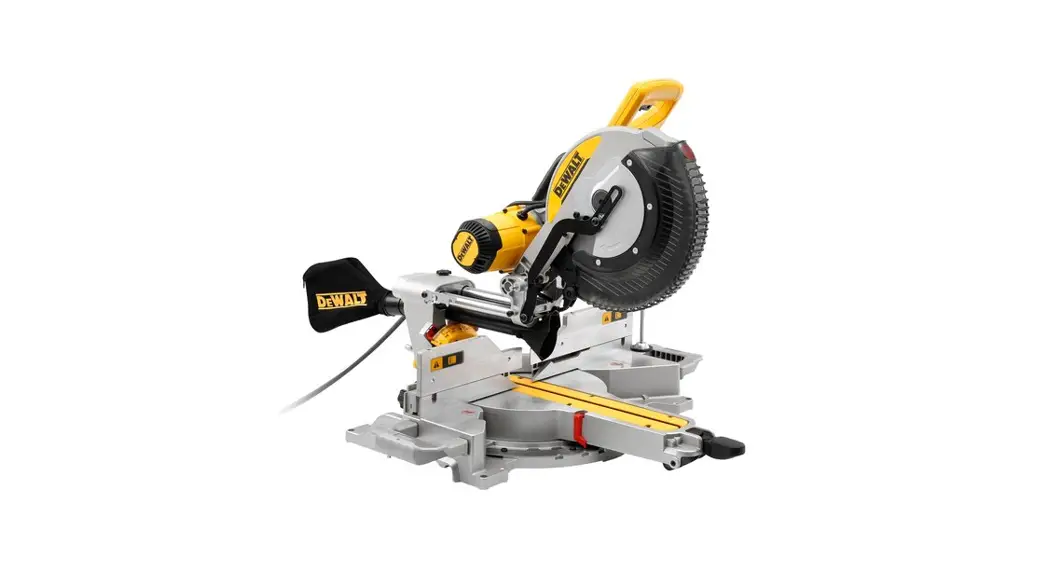
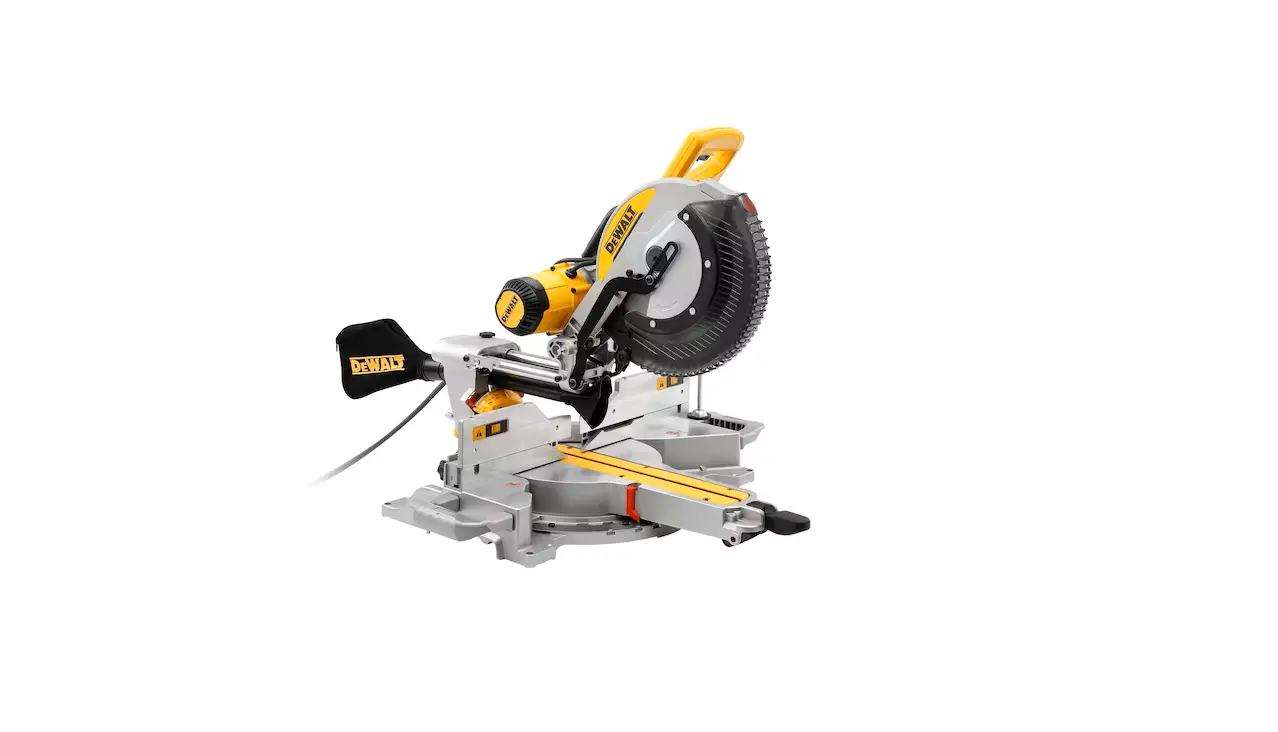
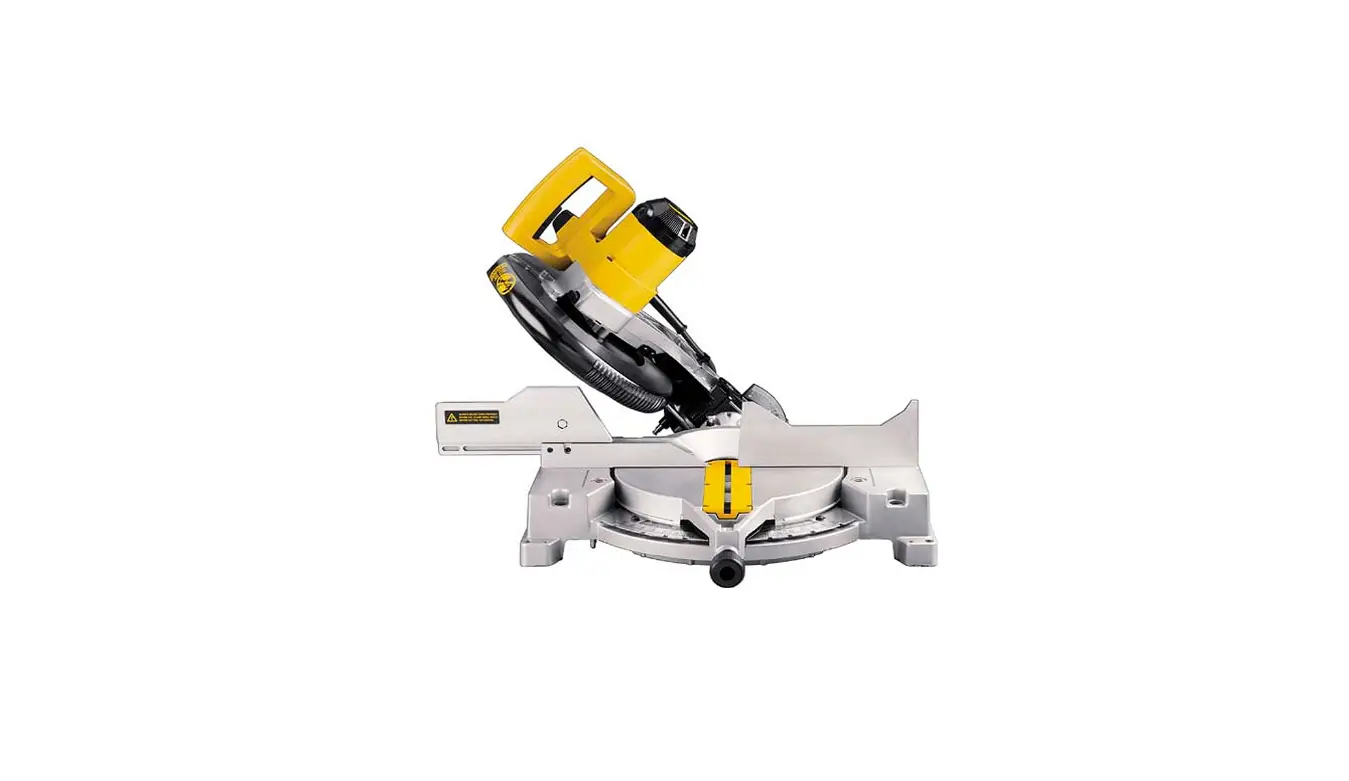
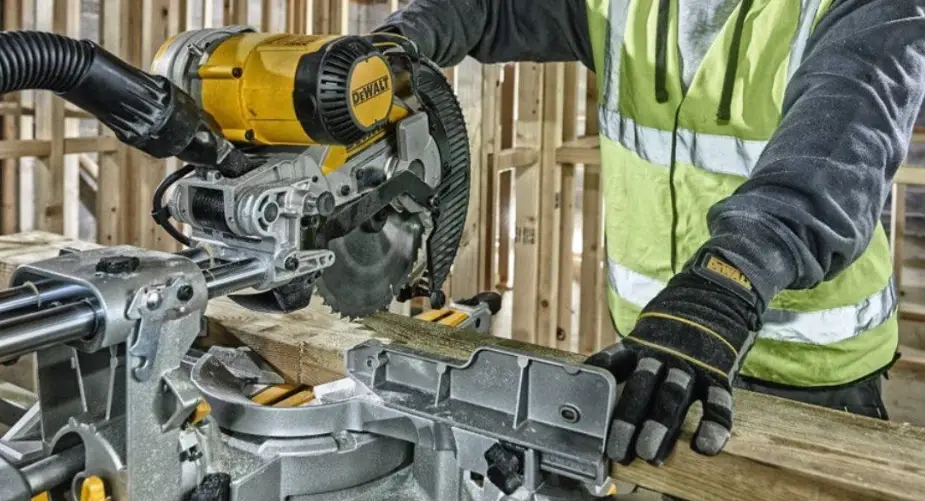
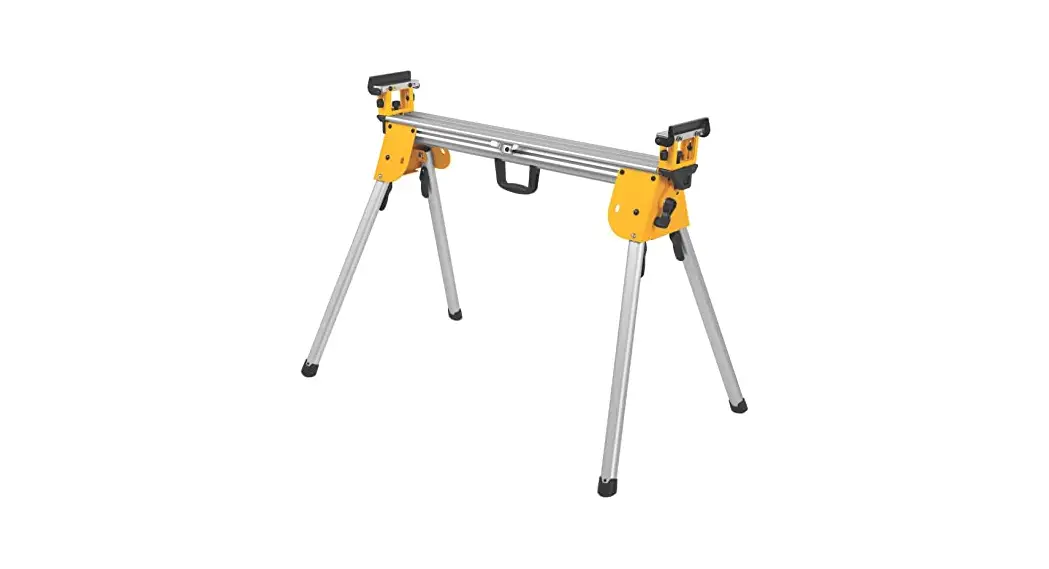
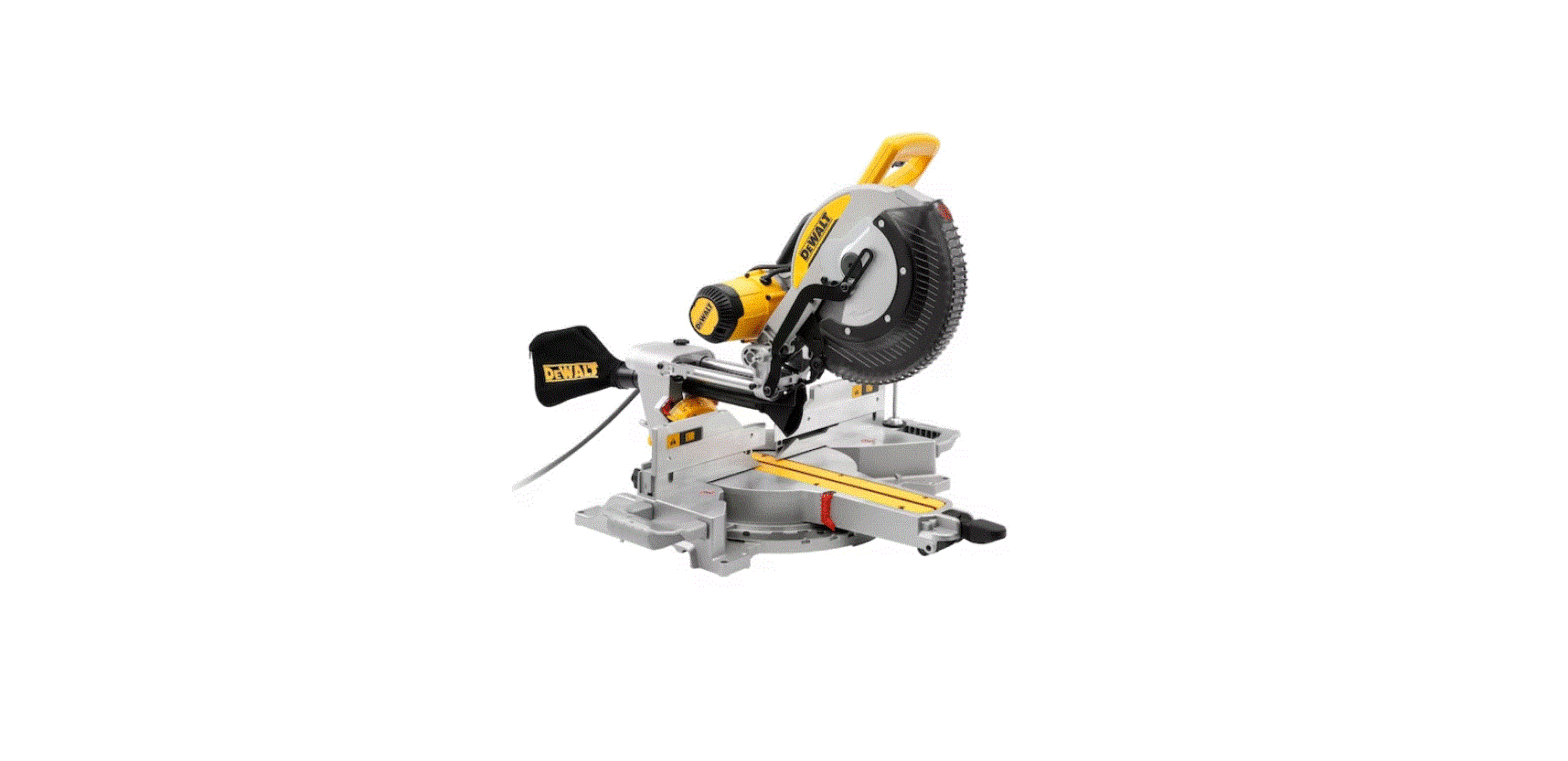
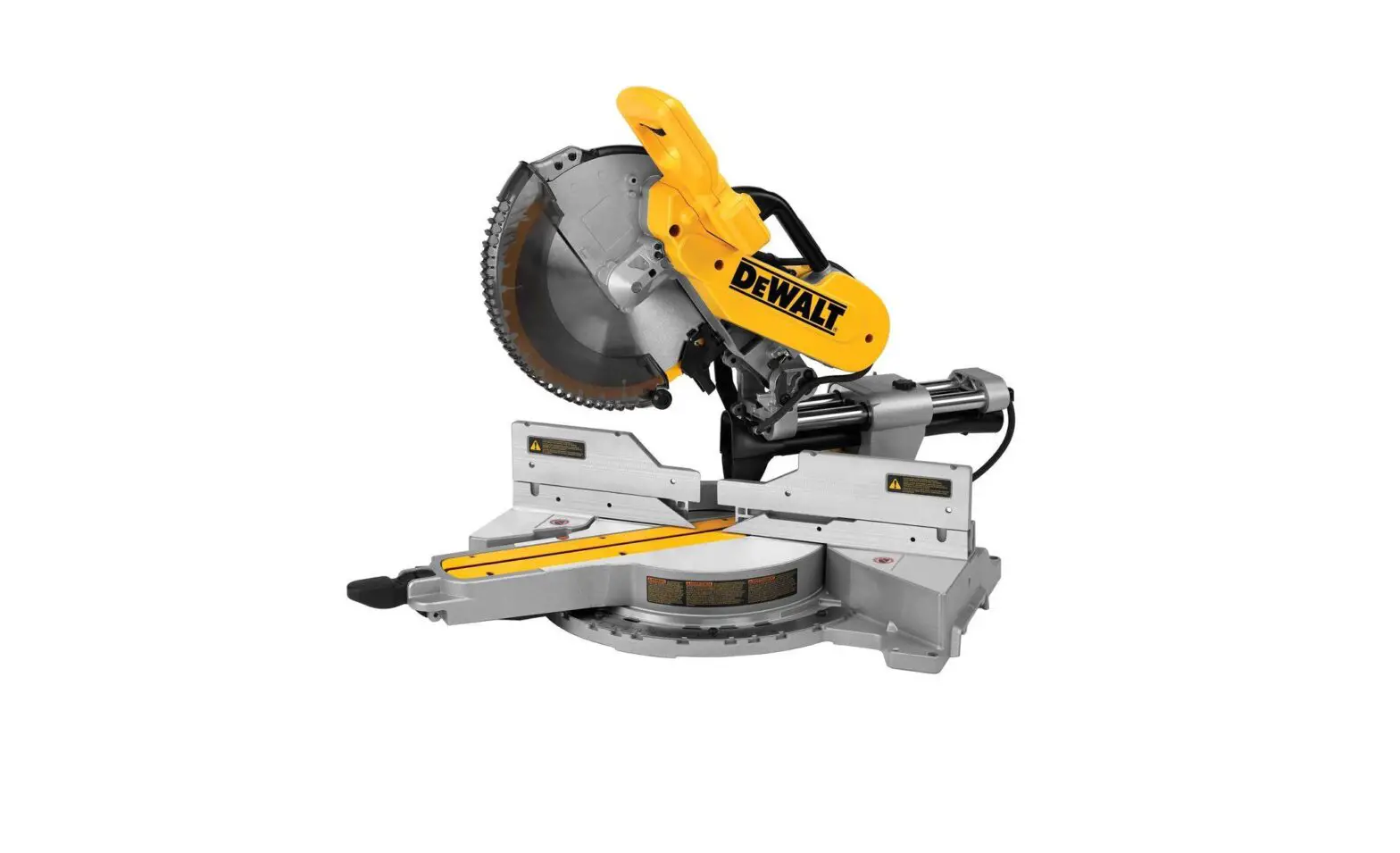
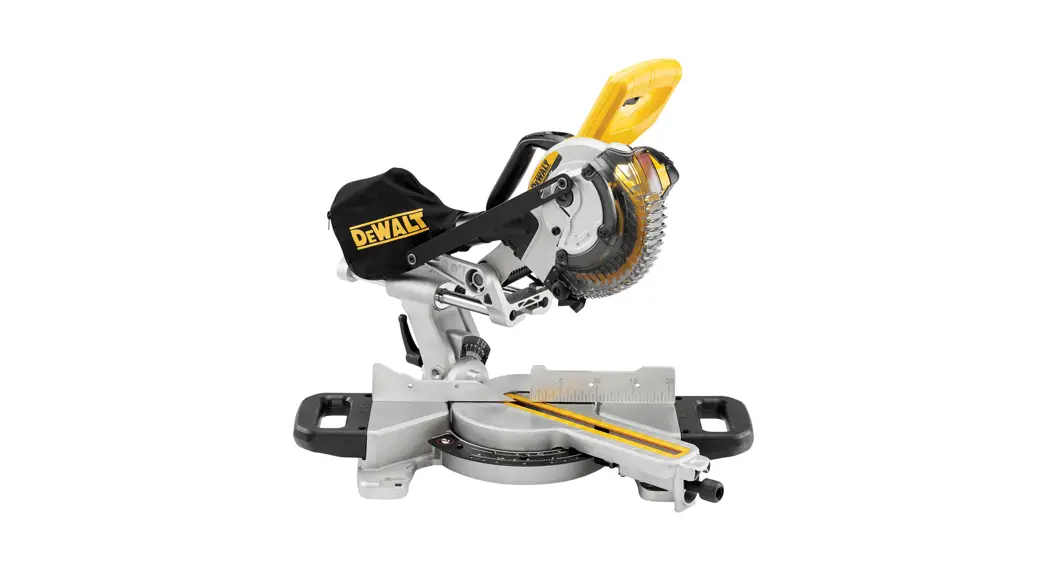
DWS713 15 Amp 10 in. Electric Single-Bevel Compound Miter Saw
Product Information
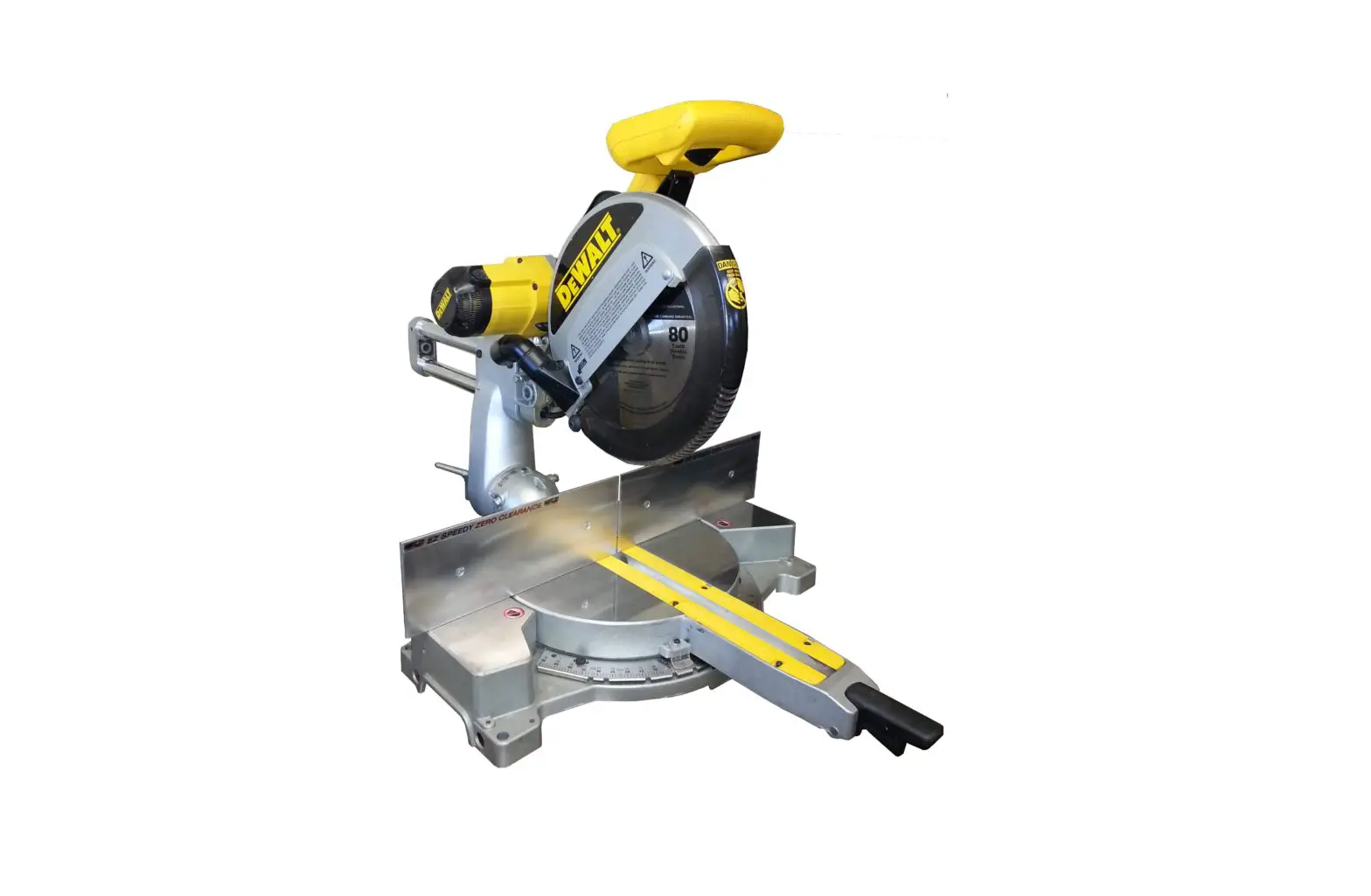
The DWS713 is a compound miter saw from DEWALT. It features a
15-amp motor and a stainless steel detent plate with 14 positive
stops for improved accuracy. The saw can make miter cuts up to 50
degrees to the left and 60 degrees to the right, as well as bevel
cuts up to 48 degrees to the left and 3 degrees to the right. It
also has a cam-lock with miter detent override, allowing for quick
and accurate angle adjustments. The saw comes with a dust bag to
help keep the work area clean.
Product Usage Instructions
Before using the DWS713, read all safety warnings and
instructions provided with the saw. Failure to follow these
instructions may result in electric shock, fire, and/or serious
injury.
- Ensure that the work area is clean and well lit. Do not operate
power tools in explosive atmospheres. - Keep children and bystanders away while operating the saw.
- Ensure that the power tool plug matches the outlet. Do not
modify the plug in any way. - Avoid body contact with earthed or grounded surfaces such as
pipes, radiators, ranges, and refrigerators. - Do not expose the saw to rain or wet conditions.
- Install the blade according to the instructions provided with
the saw. - Adjust the miter and bevel angles to the desired settings using
the cam-lock with miter detent override. - Secure the workpiece with the sliding fence and vertical
material clamp. - Turn on the saw using the trigger switch and make the cut,
keeping hands away from the blade. - After use, turn off the saw and wait for the blade to stop
spinning before removing the workpiece. - Clean the saw and work area after use.
If you have any questions or concerns about the DWS713 or any
other DEWALT tool, call their customer service hotline at
1-800-4-DEWALT (1-800-433-9258).
Instruction Manual Guide D’utilisation Manual de instrucciones
DWS713
10″ (254 mm) Compound Miter Saw Scie à onglets combinée de 254 mm (10 po) Sierra de Inglete Compuesta de 254 mm (10″)
Final Page Size: 8.5 x 11 in
If you have questions or comments, contact us. Pour toute question ou tout commentaire, nous contacter.
Si tiene dudas o comentarios, contáctenos.
1-800-4-DEWALT
English (original instructions)
1
Français (traduction de la notice d’instructions originale)
14
Español (traducido de las instrucciones originales)
28
Definitions: Safety Alert Symbols and Words
This instruction manual uses the following safety alert symbols and words to alert you to hazardous situations and your risk of personal injury or property damage.
DANGER: Indicates an imminently hazardous situation which, if not avoided, will result in death or serious injury.
WARNING: Indicates a potentially hazardous situation which, if not avoided, could result in death or serious injury. CAUTION: Indicates a potentially hazardous situation which, if not avoided, may result in minor or moderate injury. (Used without word) Indicates a safety related message.
NOTICE: Indicates a practice not related to personal injury which, if not avoided, may result in property damage.
Fig. A
12
13
19 10
English
1 2
15
1
4 13
2
18 9
12
3
8
7
20
6
5
19
8
4
3
18
9 15
3
1 Trigger switch 2 Operating handle 3 Mounting holes 4 Lower guard 5 Miter lock knob 6 Miter detent latch 7 Miter scale
17
8 Miter scale screws 9 Hand indentations 10 Sliding fence 11 Bevel lock knob 12 Dust port 13 Carrying handle 14 Fence lock knob
10 14
16
11
3
15 Clamp mounting holes 16 6 mm hex wrench 17 Head lock knob 18 Base fence 19 Vertical material clamp 20 Miter detent override switch
WARNING! Read all safety warnings and all instructions. Failure to follow the warnings and instructions may result in electric shock, fire and/or serious injury. WARNING: To reduce the risk of injury, read the instruction manual.
if you have any questions or comments about this or any DEWALT tool, call us toll free at: 1-800-4-DEWALT (1-800-433-9258).
1
English
GENERAL POWER TOOL SAFETY WARNINGS WARNING: Read all safety warnings, instructions, illustrations and specifications provided with this power tool. Failure to follow all instructions listed below may result in electric shock, fire and/or serious injury.
SAVE ALL WARNINGS AND INSTRUCTIONS FOR FUTURE REFERENCE
The term “power tool” in the warnings refers to your mains-operated (corded) power tool or batteryoperated (cordless) power tool.
1) Work Area Safety a ) Keep work area clean and well lit. Cluttered or dark areas invite accidents.
b ) Do not operate power tools in explosive atmospheres, such as in the presence of flammable liquids, gases or dust. Power tools create sparks which may ignite the dust or fumes.
c ) Keep children and bystanders away while operating a power tool. Distractions can cause you to lose control.
2) Electrical Safety a ) Power tool plugs must match the outlet. Never modify the plug in any way. Do not use any adapter plugs with earthed (grounded) power tools. Unmodified plugs and matching outlets will reduce risk of electric shock.
b ) Avoid body contact with earthed or grounded surfaces such as pipes, radiators, ranges and refrigerators. There is an increased risk of electric shock if your body is earthed or grounded.
c ) Do not expose power tools to rain or wet conditions. Water entering a power tool will increase the risk of electric shock.
d ) Do not abuse the cord. Never use the cord for carrying, pulling or unplugging the power tool. Keep cord away from heat, oil, sharp edges or moving parts. Damaged or entangled cords increase the risk of electric shock.
e ) When operating a power tool outdoors, use an extension cord suitable for outdoor use. Use of a cord suitable for outdoor use reduces the risk of electric shock.
f ) If operating a power tool in a damp location is unavoidable, use a ground fault circuit interrupter (GFCI) protected supply. Use of a GFCI reduces the risk of electric shock.
3) Personal Safety a ) Stay alert, watch what you are doing and use common sense when operating a power tool. Do not use a power tool while you are tired or under the influence of drugs, alcohol or medication. A moment of inattention while operating power tools may result in serious personal injury.
b ) Use personal protective equipment. Always wear eye protection. Protective equipment such as dust mask, non-skid safety shoes, hard hat, or hearing protection used for appropriate conditions will reduce personal injuries.
c ) Prevent unintentional starting. Ensure the switch is in the off position before connecting to power source and/or battery pack, picking up or carrying the tool. Carrying power tools with your finger on the switch or energizing power tools that have the switch on invites accidents.
d ) Remove any adjusting key or wrench before turning the power tool on. A wrench or a key left attached to a rotating part of the power tool may result in personal injury.
e ) Do not overreach. Keep proper footing and balance at all times. This enables better control of the power tool in unexpected situations.
f ) Dress properly. Do not wear loose clothing or jewelry. Keep your hair, clothing and gloves away from moving parts. Loose clothes, jewelry or long hair can be caught in moving parts.
g ) If devices are provided for the connection of dust extraction and collection facilities, ensure these are connected and properly used. Use of dust collection can reduce dustrelated hazards.
h ) Do not let familiarity gained from frequent use of tools allow you to become complacent and ignore tool safety principles. A careless action can cause severe injury within a fraction of a second.
4) Power Tool Use and Care a ) Do not force the power tool. Use the correct power tool for your application. The correct power tool will do the job better and safer at the rate for which it was designed.
b ) Do not use the power tool if the switch does not turn it on and off. Any power tool that cannot be controlled with the switch is dangerous and must be repaired.
c ) Disconnect the plug from the power source and/or the battery pack from the power tool before making any adjustments, changing accessories, or storing power tools. Such preventive safety measures reduce the risk of starting the power tool accidentally.
d ) Store idle power tools out of the reach of children and do not allow persons unfamiliar with the power tool or these instructions to operate the power tool. Power tools are dangerous in the hands of untrained users.
e ) Maintain power tools. Check for misalignment or binding of moving parts, breakage of parts and any other condition that may affect the power tool’s operation. If damaged, have the power tool repaired before use. Many accidents are caused by poorly maintained power tools.
2
f ) Keep cutting tools sharp and clean. Properly maintained cutting tools with sharp cutting edges are less likely to bind and are easier to control.
g ) Use the power tool, accessories and tool bits, etc. in accordance with these instructions, taking into account the working conditions and the work to be performed. Use of the power tool for operations different from those intended could result in a hazardous situations.
h ) Keep handles and grasping surfaces dry, clean and free from oil and grease. Slippery handles and grasping surfaces do not allow for safe handling and control of the tool in unexpected situations.
5) Service
a ) Have your power tool serviced by a qualified repair person using only identical replacement parts. This will ensure that the safety of the power tool is maintained.
Safety Instructions for Miter Saws
a ) Miter saws are intended to cut wood or wood-like products, they cannot be used with abrasive cut-off wheels for cutting ferrous material such as bars, rods, studs, etc. Abrasive dust causes moving parts such as the lower guard to jam. Sparks from abrasive cutting will burn the lower guard, the kerf insert and other plastic parts.
b ) Use clamps to support the workpiece whenever possible. If supporting the workpiece by hand, you must always keep your hand at least 100 mm from either side of the saw blade. Do not use this saw to cut pieces that are too small to be securely clamped or held by hand. If your hand is placed too close to the saw blade, there is an increased risk of injury from blade contact.
c ) The workpiece must be stationary and clamped or held against both the fence and the table. Do not feed the workpiece into the blade or cut “freehand” in any way. Unrestrained or moving workpieces could be thrown at high speeds, causing injury.
d ) Never cross your hand over the intended line of cutting either in front or behind the saw blade. Supporting the workpiece “cross handed” i.e. holding the workpiece to the right of the saw blade with your left hand or vice versa is very dangerous.
e ) Do not reach behind the fence with either hand closer than 100 mm from either side of the saw blade, to remove wood scraps, or for any other reason while the blade is spinning. The proximity of the spinning saw blade to your hand may not be obvious and you may be seriously injured.
f ) Inspect your workpiece before cutting. If the workpiece is bowed or warped, clamp it with the outside bowed face toward the fence. Always make certain that there is no gap between the workpiece, fence and table along the line of the cut. Bent or warped workpieces can twist or shift and may cause binding on the spinning saw blade while cutting. There should be no nails or foreign objects in the workpiece.
g ) Do not use the saw until the table is clear of all tools, wood scraps, etc., except for the workpiece. Small debris or loose pieces of wood or other objects that contact the revolving blade can be thrown with high speed.
h ) Cut only one workpiece at a time. Stacked multiple workpieces cannot be adequately clamped or braced and may bind on the blade or shift during cutting.
i ) Ensure the miter saw is mounted or placed on a level, firm work surface before use. A level and firm work surface reduces the risk of the miter saw becoming unstable.
j ) Plan your work. Every time you change the bevel or miter angle setting, make sure the fence will not interfere with the blade or the guarding system. Without turning the tool “ON” and with no workpiece on the table, move the saw blade through a complete simulated cut to assure there will be no interference or danger of cutting the fence.
k ) Provide adequate support such as table extensions, saw horses, etc. for a workpiece that is wider or longer than the table top. Workpieces longer or wider than the miter saw table can tip if not securely supported. If the cut-off piece or workpiece tips, it can lift the lower guard or be thrown by the spinning blade.
l ) Do not use another person as a substitute for a table extension or as additional support. Unstable support for the workpiece can cause the blade to bind or the workpiece to shift during the cutting operation pulling you and the helper into the spinning blade.
m ) The cut-off piece must not be jammed or pressed by any means against the spinning saw blade. If confined, i.e. using length stops, the cut-off piece could get wedged against the blade and thrown violently.
n ) Always use a clamp or a fixture designed to properly support round material such as rods or tubing. Rods have a tendency to roll while being cut, causing the blade to “bite” and pull the work with your hand into the blade.
o ) Let the blade reach full speed before contacting the workpiece. This will reduce the risk of the workpiece being thrown.
p ) If the workpiece or blade becomes jammed, turn the miter saw off. Wait for all moving parts to stop and disconnect the plug from the power source and/or remove the battery pack. Then work to free the jammed material. Continued sawing with a jammed workpiece could cause loss of control or damage to the miter saw.
q ) After finishing the cut, release the switch, hold the saw head down and wait for the blade to stop before removing the cut-off piece. Reaching with your hand near the coasting blade is dangerous.
r ) Hold the handle firmly when making an incomplete cut or when releasing the switch before the saw head is completely in the down position. The braking action of the saw may cause the saw head to be suddenly pulled downward, causing a risk of injury.
Additional Safety Rules for Miter Saws WARNING: Do not allow familiarity (gained from frequent use of your saw) to replace safety rules. Always remember that a careless fraction of a second is sufficient to inflict severe injury.
· DO NOT OPERATE THIS MACHINE until it is completely assembled and installed according to the instructions. A machine incorrectly assembled can cause serious injury.
· OBTAIN ADVICE from your supervisor, instructor, or another qualified person if you are not thoroughly familiar with the operation of this machine. Knowledge is safety.
· FOLLOW ALL WIRING CODES and recommended electrical connections to prevent shock or electrocution. Protect electric supply line with at least a 15 ampere time-delay fuse or a circuit breaker.
· MAKE CERTAIN the blade rotates in the correct direction. The teeth on the blade should point in the direction of rotation as marked on the saw.
· TIGHTEN ALL CLAMP HANDLES, knobs and levers prior to operation. Loose clamps can cause parts or the workpiece to be thrown at high speeds.
· BE SURE all blade and blade clamps are clean, recessed sides of blade clamps are against blade and arbor screw is tightened securely. Loose or improper blade clamping may result in damage to the saw and possible personal injury.
· DO NOT OPERATE ON ANYTHING OTHER THAN THE DESIGNATED VOLTAGE for the saw. Overheating, damage to the tool and personal injury may occur.
· DO NOT WEDGE ANYTHING AGAINST THE FAN to hold the motor shaft. Damage to tool and possible personal injury may occur.
· NEVER CUT FERROUS METALS or masonry. Either of these can cause the carbide tips to fly off the blade at high speeds causing serious injury.
· NEVER PLACE HANDS CLOSER THAN 4″ (100 mm) FROM THE BLADE.
· NEVER HAVE ANY PART OF YOUR BODY IN LINE WITH THE PATH OF THE SAW BLADE. Personal injury will occur.
· NEVER APPLY BLADE LUBRICANT TO A RUNNING BLADE. Applying lubricant could cause your hand to move into the blade resulting in serious injury.
· DO NOT place either hand in the blade area when the saw is connected to the power source. Inadvertent blade activation may result in serious injury.
· NEVER REACH AROUND OR BEHIND THE SAW BLADE. A blade can cause serious injury.
· DO NOT REACH UNDERNEATH THE SAW unless it is unplugged and turned off. Contact with saw blade may cause personal injury.
· SECURE THE MACHINE TO A STABLE SUPPORTING SURFACE. Vibration can possibly cause the machine to slide, walk, or tip over, causing serious injury.
· USE ONLY CROSSCUT SAW BLADES recommended for miter saws. For best results, do not use carbide tipped blades with hook angles in excess of 7 degrees. Do not use blades with deep gullets. These can deflect and contact the guard, and can cause damage to the machine and/or serious injury.
· USE ONLY BLADES OF THE CORRECT SIZE AND TYPE specified for this tool to prevent damage to the machine and/or serious injury.
· INSPECT BLADE FOR CRACKS or other damage prior to operation. A cracked or damaged blade can come apart and pieces can be thrown at high speeds, causing serious injury. Replace cracked or damaged blades immediately.
· CLEAN THE BLADE AND BLADE CLAMPS prior to operation. Cleaning the blade and blade clamps allows you to check for any damage to the blade or blade clamps. A cracked or damaged blade or blade clamp can come apart and pieces can be thrown at high speeds, causing serious injury.
· DO NOT USE WARPED BLADES. Check to see if the blade runs true and is free from vibration. A vibrating blade can cause damage to the machine and/or serious injury.
· DO NOT use lubricants or cleaners (particularly spray or aerosol) in the vicinity of the plastic guard. The polycarbonate material used in the guard is subject to attack by certain chemicals.
· KEEP GUARD IN PLACE and in working order.
· ALWAYS USE THE KERF PLATE AND REPLACE THIS PLATE WHEN DAMAGED. Small chip accumulation under the saw may interfere with the saw blade or may cause instability of workpiece when cutting.
· USE ONLY BLADE CLAMPS SPECIFIED FOR THIS TOOL to prevent damage to the machine and/or serious injury.
· CLEAN THE MOTOR AIR SLOTS of chips and sawdust. Clogged motor air slots can cause the machine to overheat, damaging the machine and possibly causing a short which could cause serious injury.
· NEVER LOCK THE SWITCH IN THE “ON” POSITION. Severe personal injury may result.
· NEVER STAND ON TOOL. Serious injury could occur if the tool is tipped or if the cutting tool is unintentionally contacted.
· ADDITIONAL INFORMATION regarding the safe and proper operation of power tools (i.e., a safety video) is available from the Power Tool Institute, 1300 Sumner Avenue, Cleveland, OH 44115-2851 (www.powertoolinstitute.com). Information is also available from the National Safety Council, 1121 Spring Lake Drive, Itasca, IL 60143-3201. Please refer to the American National Standards Institute ANSI 01.1 Safety Requirements for Woodworking Machines and the
U.S. Department of Labor OSHA 1910.213 Regulations. WARNING: Cutting plastics, sap coated wood, and other materials may cause melted material to accumulate on the blade tips and the body of the saw blade, increasing the risk of blade overheating and binding while cutting.
English
WARNING: ALWAYS use safety glasses. Everyday eyeglasses are NOT safety glasses. Also use face or dust mask if cutting operation is dusty. ALWAYS WEAR CERTIFIED SAFETY EQUIPMENT:
· ANSI Z87.1 eye protection (CAN/CSA Z94.3),
· ANSI S12.6 (S3.19) hearing protection,
· NIOSH/OSHA/MSHA respiratory protection. WARNING: Some dust created by power sanding, sawing, grinding, drilling, and other construction activities contains chemicals known to the State of California to cause cancer, birth defects or other reproductive harm. Some examples of these chemicals are:
· lead from lead-based paints,
· crystalline silica from bricks and cement and other masonry products, and
· arsenic and chromium from chemically-treated lumber.
Your risk from these exposures varies, depending on how often you do this type of work. To reduce your exposure to these chemicals: work in a well ventilated area, and work with approved safety equipment, such as those dust masks that are specially designed to filter out microscopic particles.
· Avoid prolonged contact with dust from power sanding, sawing, grinding, drilling, and other construction activities. Wear protective clothing and wash exposed areas with soap and water. Allowing dust to get into your mouth, eyes, or lay on the skin may promote
absorption of harmful chemicals. WARNING: Use of this tool can generate and/or disperse dust, which may cause serious and permanent respiratory or other injury. Always use NIOSH/OSHA approved respiratory
protection appropriate for the dust exposure. Direct particles away from face and body. WARNING: Always wear proper personal hearing protection that conforms to ANSI S12.6 (S3.19) during use. Under some conditions and duration of use, noise from this product may contribute to hearing loss.
· Air vents often cover moving parts and should be avoided. Loose clothes, jewelry or long hair can be caught in moving parts.
· An extension cord must have adequate wire size (AWG or American Wire Gauge) for safety. The smaller the gauge number of the wire, the greater the capacity of the cable, that is, 16 gauge has more capacity than 18 gauge. An undersized cord will cause a drop in line voltage resulting in loss of power and overheating. When using more than one extension to make up the total length, be sure each individual extension contains at least the minimum wire size. The following table shows the correct size to use depending on cord length and nameplate ampere rating. If in doubt, use the next heavier gauge. The lower the gauge number, the heavier the cord.
Minimum gauge for Cord sets
Volts
Total length of Cord in Feet (meters)
120 V
25 (7.6) 50 (15.2) 100 (30.5) 150 (45.7)
240 V
50 (15.2) 100 (30.5) 200 (61.0) 300 (91.4)
Ampere Rating
More not Than More
American Wire gauge
Than
0
6
18
16
16
14
6
10
18
16
14
12
10
12
16
16
14
12
12
16
14
12
Not Recommended
The label on your tool may include the following symbols. The symbols and their definitions are as follows:
V ……………………. volts
or AC……….. alternating current
Hz ………………….. hertz
or AC/DC…. alternating or direct current
min………………… minutes
…………………. Class II Construction (double insulated)
or DC…… direct current …………………. Class I Construction (grounded)
no ………………….. no load speed n ……………………. rated speed
…/min………….. per minute
…………………. earthing terminal
BPM……………….. beats per minute
………………… safety alert symbol
IPM ………………… impacts per minute
………………… visible radiation
RPM ……………….. revolutions per minute
………………… wear respiratory protection
sfpm ………………. surface feet per minute
………………… wear eye protection
SPM ……………….. strokes per minute
………………… wear hearing protection
A……………………. amperes
………………… read all documentation
W…………………… watts
For your convenience and safety, the following warning labels are on your miter saw.
ON GUARD:
DANGERKEEP AWAY FROM BLADE.
ON UPPER GUARD: PROPERLY SECURE BRACKET WITH BOTH SCREWS BEFORE USE.
3
English
ON TABLE: (2 PLACES) WARNING: TO REDUCE THE RISK OF INJURY, USER MUST READ INSTRUCTION MANUAL BEFORE OPERATING MITER SAW. KEEP HANDS AND BODY OUT OF THE PATH OF THE SAW BLADE. CONTACT WITH BLADE WILL RESULT IN SERIOUS INJURY. DO NOT OPERATE SAW WITHOUT GUARDS IN PLACE. CHECK LOWER GUARD FOR PROPER CLOSING BEFORE EACH USE. ALWAYS TIGHTEN ADJUSTMENT KNOBS BEFORE USE. DO NOT PERFORM ANY OPERATION FREEHAND. CLAMP SMALL PIECES BEFORE CUTTING. NEVER REACH IN BACK OF SAW BLADE. NEVER CROSS ARMS IN FRONT OF BLADE. TURN OFF TOOL AND WAIT FOR SAW BLADE TO STOP BEFORE MOVING WORKPIECE, CHANGING SETTINGS OR MOVING HANDS. REMOVE BATTERY PACK BEFORE ADJUSTING, CHANGING BLADE OR SERVICING. TO REDUCE THE RISK OF INJURY, RETURN CARRIAGE TO THE FULL REAR POSITION AFTER EACH CROSSCUT OPERATION. THINK! YOU CAN PREVENT ACCIDENTS.
ON TABLE: (2 PLACES)
Electrical Connection
Be sure your power supply agrees with the nameplate marking. 120 volts, AC means that your saw will operate on alternating current only. A voltage decrease of 10 percent or more will cause a loss of power and overheating. All DEWALT tools are factory tested. If this tool does not operate, check the power supply.
Specifications
Capacity of cut
50° miter left and right
48° bevel left: 3° right
Baseboard vertically against fence
Max. Height 4.25″ (108 mm)
Max. Width 0.625″ (16 mm)
0° miter
Max. Height 3.5″ (89 mm)
Result Width 3.5″ (89 mm)
Max. Width 6.1″ (155 mm)
Result Height 1.25″ (32 mm)
45° miter
Max. Height 3.5″ (89 mm)
Result Width 2.4″ (61 mm)
Max. Width 4.2″ (107 mm)
Result Height 1.25″ (32 mm)
45° bevel
Max. Height 2.3″ (58 mm)
Result Width 3.5″ (89 mm)
Max. Width 6.1″ (155 mm)
Result Height .75″ (19 mm)
31.6° miter and 33.9° bevel
Max. Width 5.25″ (133 mm)
Result Height .9″ (23 mm)
Drive
120 Volt motor 2200 Watts (Max In) 15 Amp motor 5000 RPM Cut helical gears with roller and ball bearings Carbide tooth blade Automatic electric brake
Unpacking Your Saw
Check the contents of your miter saw carton to make sure that you have received all parts. In addition to this instruction manual, the carton should contain: 1 DWS713 miter saw 1 DEWALT 10″ (254 mm) dia. saw blade 1 6 mm hex wrench 1 Dust bag 1 Miter lock knob 1 Vertical material clamp 1 Instruction manual
COMPONENTS (FIG. A) WARNING: Never modify the power tool or any part of it. Damage or personal injury could result.
Refer to Figure A at the beginning of this manual for a complete list of components.
Intended Use This heavy duty miter saw is designed for professional wood cutting applications. DO nOT use under wet conditions or in presence of flammable liquids or gases. This miter saw is a professional power tool. DO nOT let children come into contact with the tool. Supervision is required when inexperienced operators use this tool.
Familiarization (Fig. A, B)
Open the box and lift the saw out by the convenient carrying handle 13 , as shown in Figure B. The miter lock knob 5 is not assembled for shipping. Remove the miter lock knob from the packaging and screw onto the saw. Refer to Figure A for position. Place the saw on a smooth, flat surface such as a workbench or strong table. Examine Figure A to become familiar with the saw and its various parts. The section on
adjustments will refer to these terms and you must know what and where the parts are. CAUTION: Pinch Hazard. To reduce the risk of injury, keep thumb underneath the handle when pulling the handle down. The lower guard will move up as the handle is pulled down which could cause pinching.The handle is placed close to the guard for special cuts. Press down lightly on the operating handle 2 and pull head lock knob 17 and rotate a quarter turn. Gently release the downward pressure and allow the arm to rise to its full height. Use the lock down pin when carrying the saw from one place to another. To lock the arm, rotate head lock knob a quarter turn and press down on the arm until the arm locks in place. Always use the carrying handle 13 to transport the saw or the hand indentations 9 shown in Figure A.
Fig. B
13
Bench Mounting (Fig. A)
Mounting holes 3 are provided in all four feet to facilitate bench mounting, as shown in Figure A. There are round countersunk holes for use with screws and square holes for use with the miter saw stand “carraige bolt” or M8 (5/16″) or smaller bolts. Use either hole, it is not necessary to use both. Always mount your saw firmly to prevent movement. To enhance the tool’s portability, it can be mounted to a piece of 1/2″ (12.7 mm) or thicker plywood which can then be clamped to your work support or moved to other job sites and reclamped. nOTE: If you elect to mount your saw to a piece of plywood, make sure that the mounting screws don’t protrude from the bottom of the wood. The plywood must sit flush on the work support. When clamping the saw to any work surface, clamp only on the clamping bosses where the mounting screw holes are located. Clamping at any other point will surely interfere with the
proper operation of the saw. CAUTION: To prevent binding and inaccuracy, be sure the mounting surface is not warped or otherwise uneven. If the saw rocks on the surface place a thin piece of material under one saw foot until the saw sits firmly on the mounting surface. IMPORTANT SAFETY INSTRUCTIONS
Transporting the Saw (Fig. A, C) WARNING: To reduce the risk of serious personal injury, turn off the tool and disconnect it from the power source before attempting to move it, change accessories or make any adjustments. WARNING: To reduce the risk of serious personal injury, ALWAYS lock the miter lock knob 5 ,
bevel lock knob 11 , head lock knob, and fence lock knob 14 before transporting saw. WARNING: The miter lock knob should be used only when carrying or storing the saw.
NEVER use the lock knob for any cutting operation.
In order to conveniently carry the miter saw from place to place, a carrying handle 13 has been included on the top of the saw arm and hand indentations 9 in the base, as shown in Figure A. To transport the saw, lower the arm and rotate the head lock knob 17 a quarter turn. It will snap into the lock position.
4
Fig. C
English 6. Remove the blade screw 21 , outer blade clamp 22 , and blade 23 . The inner blade
clamp 24 may be left on the spindle. Fig. F 23 22
21 17
24
ASSEMBLY AND ADJUSTMENTS WARNING: To reduce the risk of serious personal injury, turn unit off and disconnect it from power source before making any adjustments or removing/installing attachments or accessories. An accidental start-up can cause injury. nOTE: Your miter saw is fully and accurately adjusted at the factory at the time of manufacture. If readjustment due to shipping and handling or any other reason is required, follow the steps below to adjust your saw.
Once made, these adjustments should remain accurate. Take a little time now to follow these directions carefully to maintain the accuracy of which your saw is capable.
Changing or Installing a New Saw Blade (Fig. DF) WARNING: To reduce the risk of serious personal injury, turn off the tool and disconnect it from the power source before attempting to move it, change
accessories or make any adjustments. CAUTION:
· Never depress the spindle lock button while the blade is under power or coasting.
· Do not cut ferrous metal (containing iron or steel) or masonry or fiber cement product with this miter saw.
Removing the Blade 1. Unplug the saw.
2. Raise the arm to the upper position and raise the lower guard 4 as far as possible.
3. Loosen, but do not remove guard bracket screw 25 until the bracket can be raised far enough to access the blade screw. Lower guard will remain raised due to the position of the guard bracket screw.
4. Depress the spindle lock button 35 while carefully rotating the saw blade by hand until the lock engages.
5. Keeping the button depressed, use the other hand and the 6 mm hex wrench 16 provided to loosen the blade screw 21 . (Turn clockwise, left-hand threads.) Fig. D 4
Installing a Blade
1. Unplug the saw.
2. With the arm raised, the lower guard held open and the guard bracket raised, place the blade 23 on the spindle against the inner blade clamp 24 with the teeth at the bottom of the blade pointing toward the back of the saw.
3. Assemble the outer blade clamp 22 onto the spindle.
4. Install the blade screw 21 and, engaging the spindle lock, tighten the screw firmly with the 6 mm hex wrench provided. (Turn counterclockwise, left-hand threads.)
5. Return the guard bracket to its original position and firmly tighten the guard bracket
screw 25 to hold bracket in place. WARNING:
· The guard bracket must be returned to its original position and the screw tightened before activating the saw.
· Failure to do so may allow the guard to contact the spinning saw blade resulting in damage to the saw and severe personal injury.
Miter Scale Adjustment (Fig. A, G)
Place a square against the saw’s fence and blade. (Do not touch the tips of the blade teeth with the square. To do so will cause an inaccurate measurement.) Unlock miter lock knob 5 and swing the miter arm until the miter detent locks it at the 0° miter position. Do not lock miter lock knob. If the saw blade is not exactly perpendicular to the base fence 18 , loosen the three miter scale screws 8 that hold the miter scale 7 to the base and move the scale/miter arm assembly left or right until the blade is perpendicular to the fence, as measured with the square. Retighten the three screws. Pay no attention to the reading of the miter pointer at this point.
Fig. G
25
7
16
5
Miter Pointer Adjustment (Fig. A, H)
Fig. E
Unlock miter lock knob 5 and squeeze the miter detent latch 6 to move the miter arm to
the zero position. Unlock the miter lock knob to allow the miter detent to snap into place as
you rotate the miter arm toward zero. Observe the pointer 37 and miter scale 7 through the
viewing opening shown in Figure H. If the pointer does not indicate exactly zero, loosen the
pointer screw, adjust the pointer to 0° and retighten.
35
5
English Fig. H
To bevel UP TO 48° left, the sliding fence can be adjusted to the left to provide clearance. To adjust the sliding fence, loosen the fence lock knob 14 and slide the fence to the left. Make a dry run with the saw turned off and check for clearance. Adjust the sliding fence to be as close to the blade as practical to provide maximum workpiece support, without interfering with arm up and down movement. Tighten the fence lock knob securely. When the bevel operations are complete, don’t forget to relocate the sliding fence to the right.
Fig. K
7
37
Bevel Square to Table (Fig. I, J)
To align the blade square to the rotary table, lock the arm in the down position. Place a square against the blade taking care to not have the square on top of a tooth. Loosen the bevel lock knob 11 so that you can move the bevel arm. Move the bevel arm as necessary so that the blade is at 0° bevel to the table. If the bevel arm needs adjustment, locate the right side bevel stop as shown in Figure J, and adjust the stop screw 26 as necessary.
Fig. I
14
Guard Actuation and Visibility (Fig. L) CAUTION: Pinch Hazard. To reduce the risk of injury, keep thumb underneath the handle when pulling the handle down. The lower guard will move up as the handle is pulled down which could cause pinching. The blade guard on your saw has been designed to automatically raise when the arm is brought down and to lower over the blade when the arm is raised. The guard can be raised by hand when installing or removing saw blades or for inspection of the saw. NEVER RAISE THE BLADE GUARD MANUALLY UNLESS THE SAW IS TURNED OFF. nOTE: Certain special cuts will require that you manually raise the guard. Refer to Cutting Large Material under Special Cuts. The front section of the guard is louvered for visibility while cutting. Although the louvers dramatically reduce flying debris, there are openings in the guard and safety glasses should be worn at all times.
Fig. L
Bevel Pointer (Fig. J)
If the bevel pointer 27 does not indicate zero, loosen the screw 28 that holds it in place and move the pointer as necessary. sUggEsTiOn: For accuracy, set the top edge so that it aligns with zero.
Bevel Stop (Fig. A, J)
To set the 45° bevel stop, first loosen the left side fence lock knob 14 and slide the sliding fence 10 as far as it will go to the left. Move the arm to the left until it stops on the left bevel stop screw 29 . If the bevel pointer does not indicate exactly 45°, turn the screw downwards. Move the arm to the left and tighten the bevel clamp knob 11 firmly when the bevel pointer indicates exactly 45°. Adjust the left side bevel stop screw 29 upwards until it firmly touches the bevel stop. To achieve 3° right bevel or 48° left bevel, the stop screws must be adjusted to allow the arm to move to the desired location. The bevel stops will need readjustment to the zero and 45° positions after cuts are made.
Fig. J
29
11 26
28
27
Fence Adjustment (Fig. K) WARNING: To reduce the risk of serious personal injury, turn off the tool and disconnect it from the power source before attempting to move it, change accessories or make any adjustments.
Automatic Electric Brake
Your saw is equipped with an automatic electric blade brake which stops the saw blade within 5 seconds of trigger release. This is not adjustable.
On occasion, there may be a delay after trigger release to brake engagement. On rare occasions, the brake may not engage at all and the blade will coast to a stop.
If a delay or “skipping” occurs, turn the saw on and off 4 or 5 times. If the condition persists, have the tool serviced by an authorized DEWALT service center.
Always be sure the blade has stopped before removing it from the kerf plate. The brake is not a substitute for guards or for ensuring your own safety by giving the saw your complete attention.
Controls
Your compound miter saw has several main controls, which will be discussed briefly here. For more information on these controls, see the respective sections later in the manual.
Miter Control (Fig. A) The miter lock knob 5 and miter detent latch 6 allow you to miter your saw 50° left and right. To miter the saw, unlock miter lock knob 5 by rotating the knob counter clockwise, squeeze the miter detent latch 6 and set the miter angle desired on the miter scale. Lock miter lock knob by rotating clockwise until tight. Override the miter detent latch by unlocking the miter lock knob and pushing the miter detent override switch 20 downward. To exit the override, push the miter detent override switch upward.
Bevel Lock (Fig. J) The bevel lock knob 11 allows you to bevel the saw 48° left and 3° to the right. To loosen the handle and adjust the bevel setting, turn the handle counterclockwise, the saw head bevels easily to the left. To tighten, turn the handle clockwise. Bevel degree markings are on the bottom front of the saw arm (Fig. J).
6
Head Downlock Pin (Fig. A)
To lock the saw head in the down position, push the head down, rotate head lock knob 17 90° and the spring loaded pin will lock in and release the saw head. This will hold the saw head safely down for moving the saw from place to place. To release, pull out the head lock knob and rotate 90°.
OPERATION WARNING: To reduce the risk of serious personal injury, turn unit off and disconnect it from power source before making any adjustments or removing/installing
attachments or accessories. An accidental start-up can cause injury. WARNING: Always use eye protection. All users and bystanders must wear eye protection that conforms to ANSI Z87.1 (CAN/CSA Z94.3).
Plug the saw into any household 60 Hz power source. Refer to the nameplate for voltage. Be sure the cord will not interfere with your work.
Body and Hand Position (Fig. M1M4)
WARNING: To reduce the risk of serious personal injury, ALWAYS use proper hand position
as shown. WARNING: To reduce the risk of serious personal injury, ALWAYS hold securely in anticipation of
a sudden reaction.
Proper positioning of your body and hands when operating the miter saw will make cutting
easier, more accurate and safer. Never place hands near cutting area. Place hands no closer than
4″ (100 mm) from the blade. Hold the workpiece tightly to the table and the fence when cutting.
Keep hands in position until the trigger has been released and the blade has completely stopped.
ALWAYS MAKE DRY RUNS (UNPOWERED) BEFORE FINISH CUTS SO THAT YOU CAN CHECK THE
PATH OF THE BLADE. DO NOT CROSS ARMS, AS SHOWN IN FIGURE M3.
Keep both feet firmly on the floor and maintain proper balance. As you move the miter arm
left and right, follow it and stand slightly to the side of the saw blade. Sight through the guard
louvers when following a pencil line. Fig. M1
Fig. M2
Fig. N
30
English 31
1
Dust Extraction (Fig. O) WARNING: To reduce the risk of serious personal injury, turn unit off and disconnect it from power source before making any adjustments or removing/installing attachments or accessories. An accidental start-up can cause injury. Your saw has a built-in dust port 12 that allows either the supplied dust bag 32 or a shop vacuum system to be connected.
To Attach the Dust Bag 1. Fit the dust bag 32 to the dust port 12 as shown in Figure O.
Fig. O
32
12
Fig. M3
Fig. M4
Trigger Switch (Fig. N)
To turn the saw on, push the lock-off lever 30 to the left, then depress the trigger switch 1 . The saw will run while the switch is depressed. Allow the blade to spin up to full operating speed before making the cut. To turn the saw off, release the switch. Allow the blade to stop before raising the saw head. There is no provision for locking the switch on. A hole 31 is provided in the trigger for insertion of a padlock to lock the switch off.
Always be sure the blade has stopped before removing it from the kerf.
To Empty the Dust Bag
1. Remove dust bag 32 from the saw and gently shake or tap the dust bag to empty.
2. Reattach the dust bag back onto the dust port 12 .
You may notice that all the dust will not come free from the bag. This will not affect cutting performance but will reduce the saw’s dust collection efficiency. To restore your saw’s dust collection efficiency, depress the spring inside the dust bag when you are emptying it and tap it
on the side of the trash can or dust receptacle. CAUTION: Never operate this saw unless the dust bag or DEWALT dust extractor is in place. Wood dust may create a breathing hazard.
Cutting With Your Saw
nOTE: Although this saw will cut wood and many non-ferrous materials, we will limit our discussion to the cutting of wood only. The same guidelines apply to the other materials. DO nOT CUT FERROUs (iROn AnD sTEEl) MATERiAls OR MAsOnRY WiTh This sAW. Do not use any abrasive blades.
Crosscuts
Cutting of multiple pieces is not recommended but can be done safely by ensuring that each piece is held firmly against the table and fence. A crosscut is made by cutting wood across the grain at any angle. A straight crosscut is made with the miter arm at the zero degree position. Set the miter arm at zero, hold the wood on the table and firmly against the fence. Turn on the saw by squeezing the trigger switch.
When the saw comes up to speed (about 1 second) lower the arm smoothly and slowly to cut
through the wood. let the blade come to a full stop before raising arm. CAUTION: Always use a work clamp to maintain control and reduce the risk of workpiece damage and personal injury.
Miter crosscuts are made with the miter arm at some angle other than zero. This angle is often 45° for making corners, but can be set anywhere from zero to 50° left or right. After selecting the desired miter angle, be sure to tighten the miter lock knob. Make the cut as described above.
To cut through an existing pencil line on a piece of wood, match the angle as close as possible. Cut the wood a little too long and measure from the pencil line to the cut edge to determine which direction to adjust the miter angle and recut. This will take some practice, but it is a commonly used technique.
7
English
Bevel Cuts (Fig. A)
A bevel cut is a crosscut made with the saw blade at a bevel to the wood. In order to set the bevel, loosen the bevel clamp knob 11 and move the saw to the left as desired. (It is necessary to move the sliding fence to allow clearance). Once the desired bevel angle has been set, tighten the bevel clamp knob firmly.
Bevel angles can be set from 3° right to 48° left and can be cut with the miter arm set between zero and 50° right or left. Ensure the sliding fence has been adjusted properly. When cutting left bevel, or right miter compound cuts, it will be necessary to remove the adjustable fence 10 .
Quality of cut
The smoothness of any cut depends on a number of things contributing to the quality of the cut are: material being cut, blade type, blade sharpness and rate of cut all contribute to the quality of the cut.
When smoothest cuts are desired for molding and other precision work, a sharp (6080 tooth carbide) blade and a slower, even cutting rate will produce the desired results.
Ensure that material does not creep while cutting. Clamp it securely in place. Always let the blade come to a full stop before raising arm.
If small fibers of wood still split out at the rear of the workpiece, apply a piece of masking tape on the wood where the cut will be made. Saw through the tape and carefully remove tape when the cut is finished.
For varied cutting applications, refer to the list of recommended saw blades for your saw and select the one that best fits your needs. Refer to Saw Blades under Accessories for correct saw blade.
Clamping the Workpiece (Fig. A) WARNING: To reduce the risk of serious personal injury, turn off the tool and disconnect it from the power source before attempting to move it, change
accessories or make any adjustments. WARNING: A workpiece that is clamped, balanced and secure before a cut may become unbalanced after a cut is completed. An unbalanced load may tip the saw or anything the saw is attached to, such as a table or workbench. When making a cut that may become unbalanced, properly support the workpiece and ensure the saw is firmly bolted to a stable
surface. Personal injury may occur. WARNING: The clamp foot must remain clamped above the base of the saw whenever the clamp is used. Always clamp the workpiece to the base of the sawnot to any other part of
the work area. Ensure the clamp foot is not clamped on the edge of the base of the saw. CAUTION: Always use a work clamp to maintain control and reduce the risk of workpiece damage and personal injury.
If you cannot secure the workpiece on the table and against the fence by hand, (irregular shape, etc.) or your hand would be less than 4″ (100 mm) from the blade, a clamp or other fixture should be used.
For best results use the vertical material clamp 19 provided with your saw. Additional DW7090 clamps can be purchased at your local retailer or DEWALT service center.
Other aids such as spring clamps, bar clamps or C-clamps may be appropriate for certain sizes and shapes of material. Use care in selecting and placing these clamps. Take time to make a dry run before making the cut. The left fence will slide from side to side to aid in clamping.
To Install Clamp (Fig. A)
1. Insert the vertical material clamp 19 into one of the four clamp mounting holes 15 on the base.
2. Lifting up on the arm of the clamp can rapidly adjust the height, then use the fine adjust knob to firmly clamp the workpiece.
nOTE: Place the clamp on the opposite side of the base when beveling. ALWAYS MAKE DRY RUNS (UNPOWERED) BEFORE FINISH CUTS TO CHECK THE PATH OF THE BLADE. ENSURE THE
CLAMP DOES NOT INTERFERE WITH THE ACTION OF THE SAW OR GUARDS. WARNING: A workpiece that is clamped, balanced and secure before a cut may become unbalanced after a cut is completed. An unbalanced load may tip the saw or anything the saw is attached to, such as a table or workbench. When making a cut that may become unbalanced, properly support the workpiece and ensure the saw is firmly bolted to a
stable surface. WARNING: The clamp foot must remain clamped above the base of the saw whenever the clamp is used. Always clamp the workpiece to the base of the sawnot to any other part of the work area. Ensure the clamp foot is not clamped on the edge of the base of the saw.
Support for Long Pieces WARNING: To reduce the risk of serious personal injury, turn off the tool and disconnect it from the power source before attempting to move it, change accessories or make any adjustments.
ALWAYS SUPPORT LONG PIECES.
Never use another person as a substitute for a table extension; as additional support for a workpiece that is longer or wider than the basic miter saw table or to help feed, support or pull the workpiece.
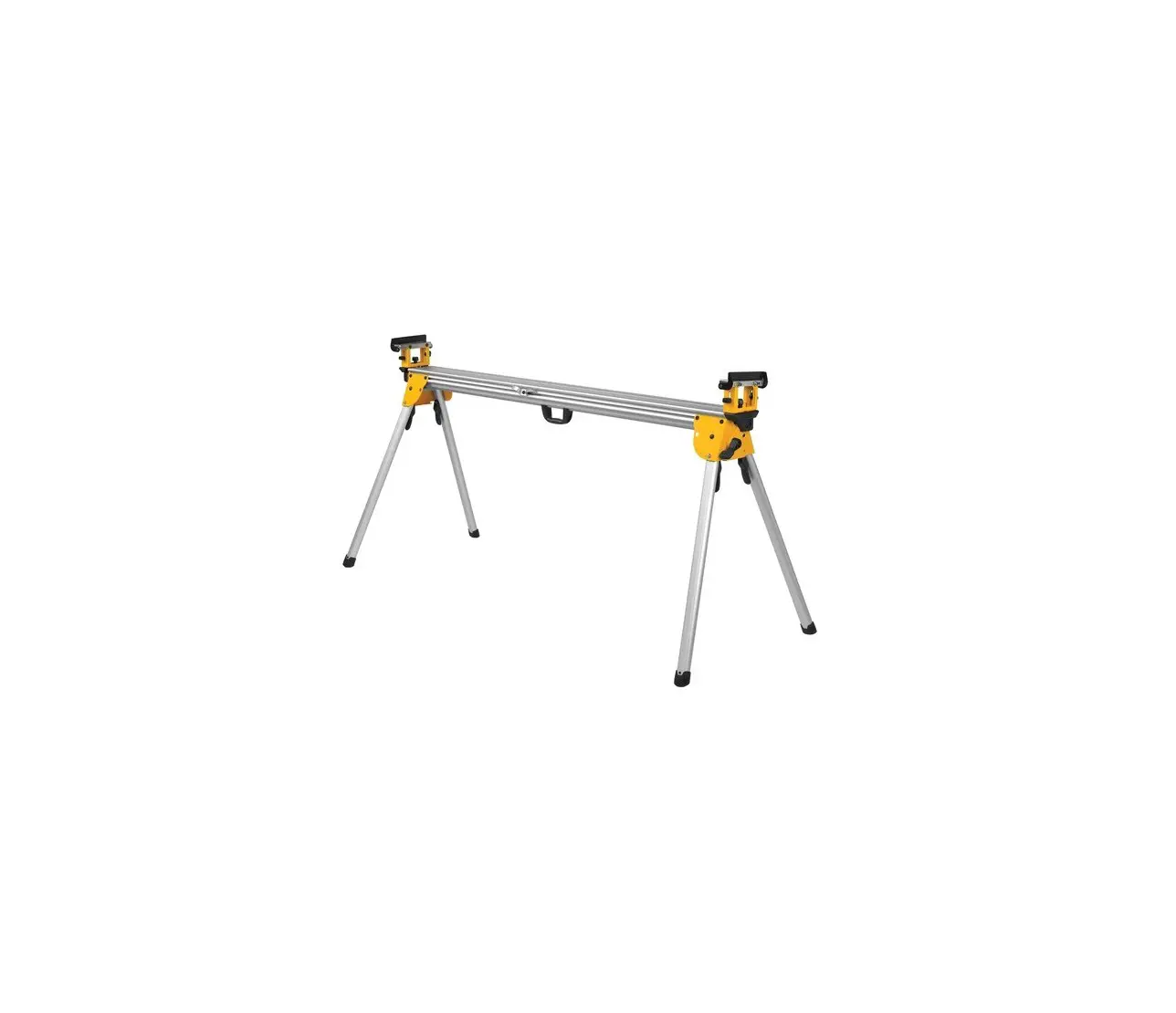
For best results, use the DWX723, DWX724, DWX725B or DWX726 miter saw stand to extend the table width of your saw. These are available from your dealer at extra cost.
Support long workpieces using any convenient means such as sawhorses or similar devices to keep the ends from dropping.
Cutting Picture Frames, Shadow Boxes and Other Four-Sided Projects (Fig. P)
To best understand how to make the items listed here, we suggest that you try a few simple projects using scrap wood until you develop a “FEEL” for your saw.
Your saw is the perfect tool for mitering corners like the one shown in Figure P. Sketch A in Figure P shows a joint made by using the bevel adjustment to bevel the edges of the two boards at 45° each to produce a 90° miter corner. For this joint the miter arm was locked in the zero position and the bevel adjustment was locked at 45°. The wood was positioned with the broad flat side against the table and the narrow edge against the fence. The cut could also be made by mitering right and left with the broad surface against the fence.
Cutting Trim Molding and Other Frames (Fig. P)
Sketch B in Figure P shows a joint made by setting the miter arm at 45° to miter the two boards to form a 90° corner. To make this type of joint, set the bevel adjustment to zero and the miter arm to 45°. Once again, position the wood with the broad flat side on the table and the narrow edge against the fence.
The two sketches in Figure P are for four sided objects only.
As the number of sides changes, so do the miter and bevel angles. The chart below gives the proper angles for a variety of shapes. The chart assumes that all sides are of equal length. For a shape that is not shown in the chart, use the following formula. 180° divided by the number of sides equals the miter or bevel angle.
No. Sides 4 5 6 7 8 9 10
EXAMPLES Angle Miter or Bevel 45° 36° 30° 25.7° 22.5° 20° 18°
Fig. P
A
B
Cutting Compound Miters (Fig. Q, R)
A compound miter is a cut made using a miter angle and a bevel angle at the same time. This is the type of cut used to make frames or boxes with slanting sides like the one shown in Figure Q.
nOTE: If the cutting angle varies from cut to cut, check that the bevel clamp knob and the miter
lock knob are securely tightened. These knobs must be tightened after making any changes in
bevel or miter.
The chart (Table 1) will assist you in selecting the proper bevel and miter settings for common compound miter cuts. To use the chart, select the desired angle “A” (Figure R) of your project and locate that angle on the appropriate arc in the chart. From that point follow the chart straight down to find the correct bevel angle and straight across to find the correct miter angle.
Set your saw to the prescribed angles and make a few trial cuts. Practice fitting the cut pieces together until you develop a feel for this procedure and feel comfortable with it.
EXAMPlE: To make a 4 sided box with 26° exterior angles (Angle A, Figure R), use the upper right
arc. Find 26° on the arc scale. Follow the horizontal intersecting line to either side to get miter
angle setting on saw (42°). Likewise, follow the vertical intersecting line to the top or bottom to
get the bevel angle setting on the saw (18°). Always try cuts on a few scrap pieces of wood to
verify settings on saw.
Fig. Q
Fig. R
Angle A
Miter Scale (Fig. A)
The miter scale 7 is used when calculating angles. To calculate the proper miter angle, divide 180° by the number of sides of the box or frame. Refer to Examples.
8
When Mitering to the Right
To increase the miter angle when mitering to the right, move the arm to align the appropriate vernier mark with the closest mark on the miter scale to the right. To decrease the miter angle when mitering to the right, move the arm to align the appropriate vernier mark with the closest mark on the miter scale to the left.
When Mitering to the Left
To increase the miter angle when mitering to the left, move the arm to align the appropriate vernier mark with the closest mark on the miter scale to the left. To decrease the miter angle when mitering to the left, move the arm to align the appropriate vernier mark with the closest mark on the miter scale to the right.
Cutting Base Molding
ALWAYS MAKE A DRY RUN WITHOUT POWER BEFORE MAKING ANY CUTS.
Straight 90° Cuts (Fig. S) Position the wood against the fence as shown in Figure S. Turn on the saw, allow the blade to reach full speed and lower the arm smoothly through the cut.
Fig. S
English
inside corner
Outside corner
Left side*
1. Position molding with bottom of molding against the base of the saw
2. Miter left 45° 3. Save left side of cut
1. Position molding with bottom of molding against the base of the saw
2. Miter right 45° 3. Save left side of cut
Right side
1. Position molding with bottom of the molding resting on the base of the saw
2. Miter right 45° 3. Save right side of cut
1. Position molding with bottom of the molding against the base of the saw
2. Miter left 45° 3. Save right side of cut
* NOTE: If the cut must be made somewhere other than 1″ (25.4 mm) from the end of the molding: cut off the molding at 90° approx. 1″ (25.4 mm) longer than your final length then make the miter cut as described above.
Another method of making the cut is to make a zero degree miter, 45° bevel cut. Your saw can cut a bevel 6.2″ (157.5 mm) wide.
Cutting Base Molding Laying Flat and Using the Bevel Feature · All cuts made with the saw set at 45° bevel and 0 miter. · All cuts made with back of molding laying flat on the saw. · Move the left side fence out of the path of the blade before attempting any of the
following cuts.
inside corner
Outside corner
Left side
1. Position molding with top of molding against the fence
2. Save left side of cut
1. Position molding with bottom of the molding against the fence
2. Save left right of cut
Right side
1. Position molding with bottom of the molding against the fence
2. Save right side of cut
1. Position molding with top of molding against the fence
2. Save right side of cut
Cutting Base Molding up to 3.5″ (88.9 mm) High Vertically Against The Fence (Fig. L, S)
Position molding as shown in Figure S.
All cuts are made with the back of the molding against the fence and bottom of the molding against the base.
inside corner
Outside corner
Left side
1. Miter left 45° 2. Save left side of cut
1. Miter right 45° 2. Save left side of cut
Right side
1. Miter right 45° 2. Save right side of cut
1. Miter left 45° 2. Save right side of cut
Material up to 3.5″ (88.9 mm) can be cut as described above. For wider boards [up to 4.25″ (107.95 mm)] several minor concessions must be made.
When cutting a board between 3.5″ (88.9 mm) and 4.25″ (107.95 mm) in width the roller on the tip of the guard could hang up on the workpiece. If this occurs, simply place your right thumb on the upper side of the guard and roll the guard up just enough to clear the workpiece, as shown in Figure L. Once you have cleared the workpiece, you can release the guard and it will continue to open as the cut progresses.
When mitering to the right side of a base molding wider than 3.5″ (88.9 mm) standing vertically against the fence as in Figure S, the saw can only cut through the board up to 1 inch (25,4 mm) from the end of the board. Trying to cut more than 1 inch (25,4 mm) will cause the saw’s gear case to interfere with the workpiece. If you want to cut base molding between 31/2″ (88.9 mm) and 4.25″ (107.95 mm) wide vertically follow the directions below.
Cutting 3.5″4-1/4″ (88.9 mm107.95 mm) Base Molding Vertically Against the Fence (Fig. S)
· Position molding as shown in Figure S.
· All cuts made with the back of the molding against the fence
Cutting Crown Molding
Your miter saw is better suited to the task of cutting crown molding than any tool made. In order to fit properly, crown molding must be compound mitered with extreme accuracy. The two flat surfaces on a given piece of crown molding are at angles that, when added together, equal exactly 90°. Most, but not all, crown molding has a top rear angle (the section that fits flat against the ceiling) of 52° and a bottom rear angle (the part that fits flat against the wall) of 38°. Your miter saw has special pre-set miter detent points at 31.62° left and right for cutting crown molding at the proper angle. There is also a mark on the Bevel scale at 33.85°. The Bevel Setting/Type of Cut chart gives the proper settings for cutting crown molding. (The numbers for the miter and bevel settings are very precise and are not easy to accurately set on your saw.) Since most rooms do not have angles of precisely 90°, you will have to fine tune your settings anyway.
PRETEsTing WiTh sCRAP MATERiAl is EXTREMElY iMPORTAnT! For Cutting Crown Molding Laying Flat and Using the Compound Features (Fig. T) 1. Move the left side fence 10 out of the path of the blade before attempting any of the
following cuts. 2. Molding laying with broad back surface down flat on saw table 34 (Fig. T). 3. The settings below are for all Standard (U.S.) crown molding with 52° and 38° angles.
Fig. T
10 34
9
English
BEVEl sETTing
TYPE OF CUT
lEFT siDE, insiDE CORnER
33.9°
1. Top of molding against fence 2. Miter table set right 31.6°
3. Save left end of cut
RighT siDE, insiDE CORnER
33.9°
1. Bottom of molding against fence 2. Miter table set left 31.6°
3. Save left end of cut
lEFT siDE, OUTsiDE CORnER
33.9°
1. Bottom of molding against fence 2. Miter table set left 31.6°
3. Save right end of cut
RighT siDE, OUTsiDE CORnER
33.9°
1. Top of molding against fence 2. Miter table set right 31.6°
3. Save right end of cut
When setting bevel and miter angles for all compound miters, remember that:
The angles presented for crown moldings are very precise and difficult to set exactly. Since they can easily shift slightly and very few rooms have exactly square corners, all settings should be tested on scrap molding.
PRETEsTing WiTh sCRAP MATERiAl is EXTREMElY iMPORTAnT!
Alternative Method for Cutting Crown Molding (Fig. U)
Place the molding on the table at an angle between the fence 10 and the saw table 34 , as shown in Figure U. Use of the crown molding fence accessory (DW7084) is highly recommended because of its degree of accuracy and convenience. The crown molding fence accessory is available at extra cost from your local dealer.
The advantage to cutting crown molding using this method is that no bevel cut is required. Minute changes in the miter angle can be made without affecting the bevel angle. This way, when corners other than 90° are encountered, the saw can be quickly and easily adjusted for them. Use the crown molding fence accessory (DW7084) to maintain the angle at which the molding will be on the wall.
Fig. U
34 10
Fig. V 10
Fig. W
23 RIGHT
10
23
WRONG
Bowed Material (Fig. X, Y) When cutting bowed material always position it as shown in Figure X and never like that shown in Figure Y. Positioning the material incorrectly will cause it to pinch the blade near the completion of the cut.
Fig. X
Instructions for Cutting Crown Molding Angled Between the Fence and Base of the Saw for All Cuts
1. Angle the molding so the bottom of the molding (part which goes against the wall when installed) is against the fence and the top of the molding is resting on the base of the saw, as shown in Figure U.
2. The angled “flats” on the back of the molding must rest squarely on the fence and base of the saw.
inside corner
Outside corner
Left side
1. Miter right 45° 2. Save right side of cut
1. Miter left 45° 2. Save right side of cut
Fig. Y
Right side
1. Miter left 45° 2. Save left side of cut
1. Miter right 45° 2. Save left side of cut
Special Cuts
NEVER MAKE ANY CUT UNLESS THE MATERIAL IS SECURED ON THE TABLE AND AGAINST THE FENCE.
Aluminum Cutting (Fig, A, V, W) ALWAYS USE THE APPROPRIATE SAW BLADE MADE ESPECIALLY FOR CUTTING ALUMINUM. These are available at your local DEWALT retailer or DEWALT service center. Certain workpieces, due to their size, shape or surface finish, may require the use of a clamp or fixture to prevent movement during the cut. Position the material so that you will be cutting the thinnest cross section, as shown in Figure V. Figure W illustrates the wrong way to cut these extrusions. Use a stick wax cutting lubricant when cutting aluminum. Apply the stick wax directly to the saw blade 23 before cutting. Never apply stick wax to a moving blade.
The wax, available at most hardware stores and industrial mill supply houses, provides proper lubrication and keeps chips from adhering to the blade.
Be sure to properly secure workpiece. Refer to Saw Blades under Accessories for correct saw blade.
10
Cutting Plastic Pipe or Other Round Material Plastic pipe can be easily cut with your saw. It should be cut just like wood and ClAMPED OR hElD FiRMlY TO ThE FEnCE TO KEEP iT FROM ROlling. This is extremely important when making angle cuts. Cutting Large Material (Fig. L) Occasionally you will encounter a piece of wood a little too large to fit beneath the lower guard. To clear the guard over the wood, with the motor off and your right hand on the operating handle, place your right thumb outside of the upper portion of the guard and roll the guard up just enough to clear the wood, as shown in Figure L. Release the guard prior to starting the motor. The guard mechanism will function properly during the cut. Only do this when necessary. NEVER TIE, TAPE, OR OTHERWISE HOLD THE GUARD OPEN WHEN OPERATING THIS SAW.
MAINTENANCE WARNING: To reduce the risk of serious personal injury, turn unit off and disconnect it from power source before making any adjustments or removing/installing
attachments or accessories. An accidental start-up can cause injury. WARNING: To reduce the risk of serious personal injury, DO NOT touch the sharp points on the blade with fingers or hands while performing any maintenance. DO NOT use lubricants or cleaners (particularly spray or aerosol) in the vicinity of the plastic guard. The polycarbonate material used in the guard is subject to attack by certain chemicals. 1. All bearings are sealed. They are lubricated for life and need no further maintenance. 2. Periodically clean all dust and wood chips from around AND UNDER the base and the
rotary table. Even though slots are provided to allow debris to pass through, some dust will accumulate. 3. The brushes are designed to give you several years of use. To replace the brushes refer to Brushes or return the tool to the nearest service center for repair. A list of service center locations is packed with your tool.
Brushes (Fig. Z) WARNING: To reduce the risk of serious personal injury, turn off the tool and disconnect it from the power source before attempting to move it, change accessories or make any adjustments. Inspect carbon brushes regularly by unplugging the tool, removing the motor end cap 36 by removing the two screws that secure it, and removing the brush cap that holds the spring-loaded brush assembly. Keep brushes clean and sliding freely in their guides. Always replace a used brush in the same orientation in the holder as it was prior to its removal. If the brush is worn down to approximately 1/2″ (12.7 mm), the spring will no longer exert pressure and they must be replaced. Use only identical DEWALT brushes. Use of the correct grade of brush is essential for proper operation of electric brake. New brush assemblies are available at DEWALT service centers. The tool should be allowed to “run in” (run at no load) for 10 minutes before use to seat new brushes. The electric brake may be erratic in operation until the brushes are properly seated (worn in). Always replace the brush inspection cap after inspection or servicing the brushes. While “running in” DO NOT TIE, TAPE, OR OTHERWISE LOCK THE TRIGGER SWITCH ON. HOLD BY HAND ONLY.
Fig. Z
36
Cleaning WARNING: Blow dirt and dust out of all air vents with clean, dry air at least once a week. To minimize the risk of eye injury, always wear ANSI Z87.1 approved eye protection when
performing this procedure. WARNING: Never use solvents or other harsh chemicals for cleaning the non-metallic parts of the tool. These chemicals may weaken the plastic materials used in these parts. Use a cloth dampened only with water and mild soap. Never let any liquid get inside the tool; never immerse any part of the tool into a liquid.
Accessories WARNING: Since accessories, other than those offered by DEWALT, have not been tested with this product, use of such accessories with this tool could be hazardous. To reduce the risk of injury, only DEWALT recommended accessories should be used with this product. Recommended accessories for use with your tool are available at extra cost from your local dealer or authorized service center. If you need assistance in locating any accessory, please contact
English
DEWALT Industrial Tool Co., 701 East Joppa Road, Towson, MD 21286, call 1-800-4-DEWALT (1-800-433-9258) or visit our website: www.dewalt.com.
Optional Accessories The following accessories, designed for your saw, may be helpful. Use care in selecting and using accessories.
Clamp: DW7090 Used for firmly clamping workpiece to the saw fence for precision cutting.
Dust Bag: DW7053 included with some models Equipped with a zipper for easy emptying, the dust bag will capture the majority of the sawdust produced (not shown).
Crown Molding Fence: DW7084 Used for precision cutting of crown molding.
Miter saw stands: DWX723, DWX724, DWX725B, DWX726 Provides stable and accurate work platform for miter saws.
saw Blades ALWAYS USE 10″ (254 mm) SAW BLADES WITH 5/8″ (16 mm) ARBOR HOLES. SPEED RATING MUST BE AT LEAST 5500 RPM. Never use a smaller diameter blade. It will not be guarded properly. Use crosscut blades only! Do not use blades designed for ripping, combination blades or blades with hook angles in excess of 7 degrees.
BLADE DESCRIPTIONS
APPLICATION
DIAMETER
TEETH
Construction Saw Blades (thin kerf with anti-stick rim)
General Purpose
10″ (254 mm)
40
Fine Crosscuts
10″ (254 mm)
60
Woodworking Saw Blades (provide smooth, clean cuts)
Fine crosscuts
10″ (254 mm)
80
Non-ferrous metals
10″ (254 mm)
80
NOTE: For cutting non-ferrous metals, use only saw blades with TCG teeth designed for this purpose.
Repairs WARNING: To assure product SAFETY and RELIABILITY, repairs, maintenance and adjustment (including brush inspection and replacement, when applicable) should be performed by a DEWALT factory service center or a DEWALT authorized service center. Always use identical replacement parts.
Register Online
Thank you for your purchase. Register your product now for:
· WARRAnTY sERViCE: Registering your product will help you obtain more efficient warranty service in case there is a problem with your product.
· COnFiRMATiOn OF OWnERshiP: In case of an insurance loss, such as fire, flood or theft, your registration of ownership will serve as your proof of purchase.
· FOR YOUR sAFETY: Registering your product will allow us to contact you in the unlikely event a safety notification is required under the Federal Consumer Safety Act.
Register online at www.dewalt.com/register.
Three Year Limited Warranty
DEWALT will repair, without charge, any defects due to faulty materials or workmanship for three years from the date of purchase. This warranty does not cover part failure due to normal wear or tool abuse. For further detail of warranty coverage and warranty repair information, visit www.dewalt.com or call 1-800-4-DEWALT (1-800-433-9258). This warranty does not apply to accessories or damage caused where repairs have been made or attempted by others. THIS LIMITED WARRANTY IS GIVEN IN LIEU OF ALL OTHERS, INCLUDING THE IMPLIED WARRANTY OF MERCHANTABILITY AND FITNESS FOR A PARTICULAR PURPOSE, AND EXCLUDES ALL INCIDENTAL OR CONSEQUENTIAL DAMAGES. Some states do not allow limitations on how long an implied warranty lasts or the exclusion or limitation of incidental or consequential damages, so these limitations may not apply to you. This warranty gives you specific legal rights and you may have other rights which vary in certain states or provinces.
In addition to the warranty, DEWALT tools are covered by our:
1 YEAR FREE sERViCE
DEWALT will maintain the tool and replace worn parts caused by normal use, for free, any time during the first year after purchase.
90 DAY MOnEY BACK gUARAnTEE
If you are not completely satisfied with the performance of your DEWALT Power Tool, Laser, or Nailer for any reason, you can return it within 90 days from the date of purchase with a receipt for a full refund no questions asked.
lATin AMERiCA: This warranty does not apply to products sold in Latin America. For products sold in Latin America, see country specific warranty information contained in the packaging, call the local company or see website for warranty information.
FREE WARning lABEl REPlACEMEnT: If your warning labels become illegible or are missing, call 1-800-4-DEWALT (1-800-433-9258) for a free replacement.
11
English
TROUBLE! Saw will not start
Saw makes unsatisfactory cuts
Blade does not come up to speed Machine vibrates excessively Does not make accurate miter cuts
Material pinches blade
Troubleshooting Guide
BE SURE TO FOLLOW SAFETY RULES AND INSTRUCTIONS
WHAT’S WRONG?
WHAT TO DO
Saw not plugged in
Plug in saw.
Fuse blown or circuit breaker tripped
Replace fuse or reset circuit breaker.
Cord damaged
Have cord replaced by authorized service center.
Brushes worn out Dull blade Blade mounted backwards Gum or pitch on blade
Have brushes replaced by authorized service center or replace them yourself. Refer to Brushes. Replace blade. Refer to Changing or Installing a New Saw Blade. Turn blade around. Refer to Changing or Installing a New Saw Blade. Remove blade and clean with turpentine and coarse steel wool or household oven cleaner.
Incorrect blade for work being done Extension cord too light or too long
Change the blade type. Refer to Saw Blades under Accessories. Replace with adequate size cord. Refer to Additional Saftey Rules for Miter Saws.
Low house current
Contact your electric company.
Saw not mounted securely to stand or work bench Stand or bench on uneven floor Damaged saw blade Miter scale not adjusted correctly Blade is not square to fence Blade is not perpendicular to table Workpiece moving
Tighten all mounting hardware. Refer to Bench Mounting. Reposition on flat level surface. Refer to Familiarization. Replace blade. Refer to Changing or Installing a New Saw Blade. Check and adjust. Refer to Miter Scale Adjustment under Assembly and Adjustments. Check and adjust. Refer to Miter Scale Adjustment under Assembly and Adjustments. Check and adjust fence. Refer to Bevel Square to Table under Assembly and Adjustments. Clamp workpiece securely to fence or glue 120 grit sandpaper to fence with rubber cement.
Cutting bowed material
Refer to Bowed Material under Special Cuts.
12
English
TABLE 1: COMPOUND MITER CUT (POSITION WOOD WITH BROAD FLAT SIDE ON THE TABLE AND THE NARROW EDGE AGAINST THE FENCE)
8-SIDED BOX
6-SIDED BOX
SQUARE BOX
SET THIS MITER ANGLE ON SAW ANGLE OF SIDE OF BOX (ANGLE A)
SET THIS BEVEL ANGLE ON SAW 13
FRAnçAis
Définitions : symboles et termes d’alarmes sécurité
Ces guides d’utilisation utilisent les symboles et termes d’alarmes sécurité suivants pour vous prévenir de situations dangereuses et de risques de dommages corporels ou matériels. DANGER : indique une situation dangereuse imminente qui, si elle n’est pas évitée, entraînera la mort ou des blessures graves.
AVERTISSEMENT : indique une situation potentiellement dangereuse qui, si elle n’est pas évitée, pourrait entraîner la mort ou des blessures graves. ATTENTION : indique une situation potentiellement dangereuse qui, si elle n’est pas évitée, pourrait entraîner des blessures légères ou modérées. (Si utilisé sans aucun terme) Indique un message propre à la sécurité.
AVIS : indique une pratique ne posant aucun risque de dommages corporels mais qui par contre, si rien n’est fait pour l’éviter, pourrait poser des risques de dommages matériels.
Fig. A
12 13
1
19
2
10 15
1
4 13
2
18 9
12
3
8
7
20
6
5
19
8
4
3
18
10
14
16
9
15
17
3
11 3
1 Gâchette 2 Poignée de manoeuvre 3 Trous de montage 4 Protecteur inférieur 5 Bouton de verrouillage des onglets 6 Verrou du cran des onglets 7 Échelle des onglets
8 Vis de l’échelle des onglets 9 Encoches pour mains 10 Guide coulissant 11 Bouton de verrouillage en biseau 12 Capteur de poussière 13 Poignée de transport 14 Bouton de verrouillage du guide
14
15 Trous de montage du serre-joint 16 6 mm Clé hexagonale 17 Bouton de verrouillage de la tête 18 Guide de base 19 Serre-joint vertical du matériau 20 Bouton de libération du cran des
onglets
AVERTISSEMENT! lire tous les avertissements de sécurité et toutes les directives. Le non-respect des avertissements et des directives pourrait se solder par un choc électrique, un incendie et/ou une blessure grave. AVERTISSEMENT : afin de réduire le risque de blessures, lire le mode d’emploi de l’outil.
Pour toute question ou remarque au sujet de cet outil ou de tout autre outil DEWALT, composez le numéro sans frais : 1-800-4-DEWALT (1-800-433-9258).
AVERTISSEMENTS DE SÉCURITÉ GÉNÉRAUX POUR LES OUTILS
ÉLECTRIQUES AVERTISSEMENT : lisez tous les avertissements de sécurité, toutes les instructions, les illustrations et les caractéristiques fournis avec cet outil électrique. Ne pas suivre toutes les instructions comprises aux présentes peut conduire à un choc électrique, un incendie et/ou des blessures graves.
CONSERVER TOUS LES AVERTISSEMENTS ET TOUTES LES DIRECTIVES POUR UN USAGE ULTÉRIEUR
Le terme « outil électrique » cité dans les avertissements se rapporte à votre outil électrique à alimentation sur secteur (avec fil) ou par piles (sans fil).
1) Sécurité du lieu de travail
a ) Tenir l’aire de travail propre et bien éclairée. Les lieux encombrés ou sombres sont propices aux accidents.
b ) Ne pas faire fonctionner d’outils électriques dans un milieu déflagrant, tel qu’en présence de liquides, de gaz ou de poussières inflammables. Les outils électriques produisent des étincelles qui pourraient enflammer la poussière ou les vapeurs.
c ) Éloigner les enfants et les personnes à proximité pendant l’utilisation d’un outil électrique. Une distraction pourrait en faire perdre la maîtrise à l’utilisateur.
2) Sécurité en matière d’électricité
a ) Les fiches des outils électriques doivent correspondre à la prise. Ne jamais modifier la fiche d’aucune façon. Ne jamais utiliser de fiche d’adaptation avec un outil électrique mis à la terre. Le risque de choc électrique sera réduit par l’utilisation de fiches non modifiées correspondant à la prise.
b ) Éviter tout contact physique avec des surfaces mises à la terre comme des tuyaux, des radiateurs, des cuisinières et des réfrigérateurs. Le risque de choc électrique est plus élevé si votre corps est mis à la terre.
c ) Ne pas exposer les outils électriques à la pluie ou à l’humidité. La pénétration de l’eau dans un outil électrique augmente le risque de choc électrique.
d ) Ne pas utiliser le cordon de façon abusive. Ne jamais utiliser le cordon pour transporter, tirer ou débrancher un outil électrique. Tenir le cordon éloigné de la chaleur, de l’huile, des bords tranchants et des pièces mobiles. Les cordons endommagés ou enchevêtrés augmentent les risques de choc électrique.
e ) Pour l’utilisation d’un outil électrique à l’extérieur, se servir d’une rallonge convenant à cette application. L’utilisation d’une rallonge conçue pour l’extérieur réduira les risques de choc électrique.
f ) S’il est impossible d’éviter l’utilisation d’un outil électrique dans un endroit humide, brancher l’outil dans une prise ou sur un circuit d’alimentation dotés d’un disjoncteur de fuite à la terre (GFCI). L’utilisation de ce type de disjoncteur réduit les risques de choc électrique.
3) Sécurité personnelle
a ) Être vigilant, surveiller le travail effectué et faire preuve de jugement lorsqu’un outil électrique est utilisé. Ne pas utiliser d’outil électrique en cas de fatigue ou sous l’influence de drogues, d’alcool ou de médicaments. Un simple moment d’inattention en utilisant un outil électrique peut entraîner des blessures corporelles graves.
b ) Utiliser des équipements de protection individuelle. Toujours porter une protection oculaire. L’utilisation d’équipements de protection comme un masque antipoussière, des chaussures antidérapantes, un casque de sécurité ou des protecteurs auditifs lorsque la situation le requiert réduira les risques de blessures corporelles.
c ) Empêcher les démarrages intempestifs. S’assurer que l’interrupteur se trouve à la position d’arrêt avant de relier l’outil à une source d’alimentation et/ou d’insérer un bloc-piles, de ramasser ou de transporter l’outil. Transporter un outil électrique alors que le doigt repose sur l’interrupteur ou brancher un outil électrique dont l’interrupteur est à la position de marche risque de provoquer un accident.
d ) Retirer toute clé de réglage ou clé avant de démarrer l’outil. Une clé ou une clé de réglage attachée à une partie pivotante de l’outil électrique peut provoquer des blessures corporelles.
e ) Ne pas trop tendre les bras. Conserver son équilibre en tout temps. Cela permet de mieux maîtriser l’outil électrique dans les situations imprévues.
f ) S’habiller de manière appropriée. Ne pas porter de vêtements amples ni de bijoux. Garder les cheveux, les vêtements et les gants à l’écart des pièces mobiles. Les vêtements amples, les bijoux ou les cheveux longs risquent de rester coincés dans les pièces mobiles.
g ) Si des composants sont fournis pour le raccordement de dispositifs de dépoussiérage et de ramassage, s’assurer que ceux-ci sont bien raccordés et utilisés. L’utilisation d’un dispositif de dépoussiérage peut réduire les dangers engendrés par les poussières.
h ) Ne pas laisser votre connaissance acquise suite l’utilisation fréquente des outils vous permettre de baisser la garde et ignorer les principes de sécurité de l’outil. Un acte irréfléchi peut causer une blessure grave en une fraction de seconde.
FRAnçAis
4) Utilisation et entretien d’un outil électrique
a ) Ne pas forcer un outil électrique. Utiliser l’outil électrique approprié à l’application. L’outil électrique approprié effectuera un meilleur travail, de façon plus sûre et à la vitesse pour laquelle il a été conçu.
b ) Ne pas utiliser un outil électrique dont l’interrupteur est défectueux. Tout outil électrique dont l’interrupteur est défectueux est dangereux et doit être réparé.
c ) Débrancher la fiche de la source d’alimentation et/ou du bloc-piles de l’outil électrique avant de faire tout réglage ou changement d’accessoire ou avant de ranger l’outil. Ces mesures préventives réduisent les risques de démarrage accidentel de l’outil électrique.
d ) Ranger les outils électriques hors de la portée des enfants et ne permettre à aucune personne n’étant pas familière avec un outil électrique ou son mode d’emploi d’utiliser cet outil. Les outils électriques deviennent dangereux entre les mains d’utilisateurs inexpérimentés.
e ) Entretien des outils électriques. Vérifier si les pièces mobiles sont mal alignées ou coincées, si des pièces sont brisées ou présentent toute autre condition susceptible de nuire au bon fonctionnement de l’outil électrique. En cas de dommage, faire réparer l’outil électrique avant toute nouvelle utilisation. Beaucoup d’accidents sont causés par des outils électriques mal entretenus.
f ) S’assurer que les outils de coupe sont aiguisés et propres. Les outils de coupe bien entretenus et affûtés sont moins susceptibles de se coincer et sont plus faciles à maîtriser.
g ) Utiliser l’outil électrique, les accessoires, les forets, etc. conformément aux présentes directives en tenant compte des conditions de travail et du travail à effectuer. L’utilisation d’un outil électrique pour toute opération autre que celle pour laquelle il a été conçu est dangereuse.
h ) Gardez vos mains et les surfaces de prise sèches, propres et libres de graisse et de poussière. Les mains et les surfaces de prise glissante ne permettent pas la manutention et le contrôle sécuritaires de l’outil dans les situations imprévues.
5) Réparation
a ) Faire réparer l’outil électrique par un réparateur professionnel en n’utilisant que des pièces de rechange identiques. Cela permettra de maintenir une utilisation sécuritaire de l’outil électrique.
Consignes de sécurité propres aux scies à onglet
a ) Les scies à onglet ont été conçues pour découper le bois ou des produits similaires. Elles ne peuvent être utilisées avec des meules à tronçonner pour découper des matériaux ferreux tels barres, tiges, montants, etc. Les poussières abrasives pourront enrayer les pièces mobiles comme le carter inférieur. Les étincelles provenant de la découpe abrasive pourront brûler le carter inférieur, la plaque du trait de scie ou toute autre pièce en plastique.
b ) Utilisez des serre-joints pour soutenir les pièces de travail lorsque possible. Si vous soutenez la pièce de travail à la main, vous devez toujours garder votre main à au moins 100 mm de chaque côté de la lame de la scie. Ne pas utiliser cette scie pour couper des pièces trop petites pour être arrimées ou tenues manuellement de façon sécuritaire. Si la main s’approche trop près de la lame, les risques de dommages corporels par contact avec la lame augmentent.
c ) La pièce à travailler doit être fixe et bien arrimée, ou maintenue, contre le guide et la table. Ne jamais alimenter la pièce à travailler vers la lame ou couper à main levée. Une pièce non maintenue ou mobile pourrait être éjectée à grande vitesse et causer des dommages corporels.
d ) Ne jamais laisser la main traverser la ligne de coupe, que ce soit devant ou derrière la lame. Le fait de maintenir la pièce en croisant les bras (la maintenir du côté droit de la scie avec la main gauche, ou inversement) est extrêmement dangereux.
e ) Ne pas atteindre l’arrière du guide avec une ou l’autre des mains plus près de 100 mm de chaque côté de la lame de la scie, pour retirer les résidus de bois ou pour toute autre raison pendant que la lame tourne. La proximité de la lame en mouvement avec la main pourrait ne pas être évidente et poser des risques de dommages corporels graves.
f ) Vérifier la pièce avant la coupe. Si la pièce est gauchie ou voilée, l’arrimer avec la courbe externe orientée vers le guide. S’assurer systématiquement qu’il n’y a aucun espace entre la pièce, le guide et la table le long de la ligne de coupe. Les pièces gauchies ou voilées peuvent se tordre ou bouger et causer un grippage au niveau de la lame en mouvement pendant la coupe. La pièce devrait être exempte de clous ou de tout autre objet étranger.
g ) Ne pas utiliser la scie tant que la table ne sera pas débarrassée de tout outil, débris de bois, etc., autre que la pièce à travailler. Les petits débris, morceaux de bois, ou autres objets qui entreraient en contact avec la scie en mouvement pourraient être éjectés violemment.
h ) Couper une pièce à la fois. Les pièces mises les unes sur les autres ne peuvent être arrimées de façon adéquate et pourraient rester coincées dans la lame ou bouger pendant la coupe.
i ) S’assurer que la scie à onglet est montée ou installée sur une surface plane et ferme avant son utilisation. Une surface plane et ferme réduit les risques d’instabilité de la scie à onglet.
j ) Planifier le travail. À chaque changement de réglage d’angle de biseau ou d’onglet, vérifier que le guide n’interfèrera pas avec la lame et le dispositif de protection.
15
FRAnçAis
Alors que l’outil n’est pas en `”MARCHE” et qu’aucune pièce ne se trouve sur la table, déplacer la lame tout du long pour simuler une coupe complète pour s’assurer qu’il n’y aura aucune interférence ou risque de couper le guide.
k ) Offrir un soutien adéquat, tel que rallonges de table, chevalets, etc., pour toute pièce plus longue ou plus large que la table de l’établi. Les pièces plus longues ou plus larges que la table de scie à onglet pourraient tomber si elles ne sont pas soigneusement soutenues. Si c’était le cas, aussi bien pour la pièce ou la découpe, elles pourraient soulever le carter inférieur ou être rejetées par la lame en mouvement.
l ) Ne pas utiliser un autre individu comme substitut à une rallonge ou à un support additionnel. Le soutien instable de la pièce pourra gripper la lame ou faire bouger la pièce pendant la découpe, et attirer l’utilisateur et son aide vers la lame en mouvement.
m ) La découpe ne doit pas être coincée ou appuyée en aucune façon contre la lame en mouvement. Si elle était coincée (à l’aide de butées longitudinales), la découpe pourrait être bloquée contre la lame et rejetée violemment.
n ) Utiliser systématiquement un serre-joint ou un dispositif de fixation pour soutenir correctement des matériaux arrondis comme les barreaux ou la tubulure. Les barreaux ont tendance à rouler pendant la coupe, gripper la lame et attirer la pièce et la main vers la lame.
o ) Laisser la lame tourner à plein régime avant de la mettre en contact avec la pièce. Cela réduira les risques que la pièce soit éjectée.
p ) Si la pièce ou la lame se grippait, arrêter la scie à onglet. Attendre l’arrêt complet de toutes les pièces mobiles, déconnecter l’outil du secteur et/ou retirer le bloc-piles. Et alors seulement, libérer le matériau coincé. Le fait de continuer à scier alors que la pièce est grippée pourra causer la perte de contrôle de la scie à onglet et l’endommager.
q ) Une fois la coupe terminée, relâchez l’interrupteur, maintenir la tête de scie abaissée et attendre l’arrêt complet de la lame avant de retirer la découpe. Approcher la main d’une lame au ralenti est dangereux.
r ) Maintenir fermement la poignée pour effectuer une coupe partielle ou pour libérer l’interrupteur alors que la tête de scie n’est pas encore complètement abaissée. Le freinage de la scie pourrait abaisser soudainement la tête de scie, et poser des risques de dommages corporels.
Règles de sécurité additionnelles relatives aux scies à onglet AVERTISSEMENT : ne pas laisser une bonne connaissance de l’outil (acquise par l’utilisation fréquente de la scie) prendre préséance sur les règles de sécurité. Toujours se souvenir qu’une fraction de seconde d’imprudence est suffisante pour infliger de graves blessures.
· NE PAS UTILISER CETTE MACHINE tant qu’elle n’est pas complètement assemblée et installée, conformément aux instructions données. Une machine incorrectement assemblée pose des risques de dommages corporels graves.
· DEMANDER CONSEIL à un supérieur, un instructeur, ou à toute autre personne qualifiée, si l’on n’est pas complètement familier avec l’utilisation de cette machine. Le savoir est source de sécurité.
· SE CONFORMER AUX NORMES DU CODE EN MATIÈRE DE CÂBLAGE et connexions électriques pour prévenir tout risque de décharges électriques ou d’électrocution. Protéger la ligne électrique avec un fusible temporisé d’au moins 15 ampères ou un disjoncteur.
· S’ASSURER QUE la lame tourne dans le bon sens. Les dents de la lame devraient pointer dans le sens de rotation indiqué sur la scie.
· RESSERRER TOUS LES LEVIERS DE VERROUILLAGE, boutons et autres leviers avant toute utilisation. Les dispositifs de fixation lâches posent des risques d’éjection rapide et violente de la pièce à travailler.
· S’ASSURER que l’ensemble lame et serre-lames est propre, que les côtés encastrés des serrelames se trouvent contre la lame et que la vis de l’arbre est resserrée soigneusement. Une lame mal ou incorrectement arrimée pose des risques de dommages matériels et corporels.
· NE PAS UTILISER LA SCIE SUR TOUTE AUTRE TENSION AUTRE QUE CELLE SPÉCIFIÉE. Surchauffe, dommages à l’outil et dommages corporels pourraient survenir.
· NE RIEN BLOQUER CONTRE LE VENTILATEUR pour maintenir l’arbre de moteur. Des dommages à l’outil et dommages corporels pourraient survenir.
· NE JAMAIS COUPER DES MÉTAUX MÉTAUX ou la maçonnerie. Ce genre de coupes pourrait faire éclater les pointes au carbure de la lame et les projeter violemment posant des risques de dommages corporels graves.
· NE JAMAIS PLACER LES MAINS PLUS DE 100 mm (4 po) DE LA LAME.
· NE JAMAIS LAISSER AUCUNE PARTIE DU CORPS ENTRER DANS LE SILLAGE DE LA LAME SCIE, car cela pose des risques de dommages corporels.
· NE JAMAIS APPLIQUER DE LUBRIFIANT À LAMES SUR UNE LAME EN MOUVEMENT. Lors de l’application du lubrifiant, les mains pourraient rencontrer la lame et provoquer des dommages corporels graves.
· NE PAS approcher les mains de la lame lorsque la scie est branchée sur une source d’alimentation. L’activation accidentelle de la lame pose des risques de dommages corporels graves.
· NE JAMAIS APPROCHER LES MAINS DE LA LAME, NI AUTOUR NI DERRIÈRE. Une lame peut causer des dommages corporels graves.
· NE PAS PASSER LES MAINS SOUS LA SCIE à moins qu’elle ne soit à l’arrêt et débranchée. Tout contact avec la lame de scie pose des risques de dommages corporels.
· ARRIMER SOIGNEUSEMENT LA MACHINE À UN SUPPORT STABLE. Les vibrations pourraient faire glisser la machine, ou bouger ou basculer, posant des risques de dommages corporels graves.
· UTILISER UNIQUEMENT DES LAMES DE SCIE À COUPE TRANSVERSALE recommandées pour scies à onglet. Pour optimiser les résultats, ne pas utiliser de lames à pointes de carbure avec un angle d’attaque supérieur à 7 degrés. Ne pas utiliser des lames à creux de dent profonds. Elles pourraient changer de course et toucher le carter, et poser des risques de dommages matériels et/ou corporels graves.
· UTILISER UNIQUEMENT DES LAMES DE LA TAILLE ET DU TYPE CORRECTS indiqués pour cet outil pour prévenir tout dommage matériel et/ou corporel grave.
· VÉRIFIER QUE LES LAMES NE COMPORTENT AUCUNE FISSURE ni aucun autre dommage avant chaque utilisation. Une lame fissurée ou endommagée peut se casser et des morceaux pourraient être éjectés violemment, et causer des dommages corporels graves. Changer immédiatement toute lame fissurée ou endommagée.
· NETTOYER LA LAME ET LES SERRE-LAMES avant chaque utilisation. Leur nettoyage permettra de vérifier qu’ils ne comportent aucun dommage. Une lame ou un serre-lame fissuré ou endommagé peut se casser et des morceaux pourraient être éjectés violemment, et causer des dommages corporels graves.
· NE PAS UTILISER DE LAMES VOILÉES. Vérifier que la lame tourne correctement et sans vibration. Une lame qui vibre pose des risques de dommages matériels et corporels graves.
· NE PAS utiliser de lubrifiant ou de nettoyant (particulièrement en vaporisateur ou en aérosol) à proximité du carter en plastique. Le matériau en polycarbonate utilisé pour le carter peut être attaqué par certains produits chimiques.
· MAINTENIR LES DISPOSITIFS DE PROTECTION EN PLACE et en bon état de marche.
· UTILISER SYSTÉMATIQUEMENT LA PLAQUE DE TRAIT ET LA REMPLACER SI ELLE EST ENDOMMAGÉE. De petits débris s’accumulant sous la scie pourraient interférer avec la lame de scie et causer l’instabilité de la pièce lors de la coupe.
· UTILISER UNIQUEMENT LES SERRE-LAMES RECOMMANDÉS POUR CET OUTIL pour prévenir tout dommage matériel et/ou corporel grave.
· ÉLIMINER DES ORIFICES D’AÉRATION DU MOTEUR tout débris ou sciure. Des orifices d’aération bouchés pourraient causer la surchauffe de la machine et l’endommager. Cela pourrait aussi provoquer un court-circuit qui poserait de risques de dommages corporels graves.
· NE JAMAIS VERROUILLER L’INTERRUPTEUR EN POSITION DE MARCHE (ON), car cela pose des risques de dommages corporels graves.
· NE JAMAIS MONTER SUR L’OUTIL. De sérieux dommages corporels pourraient en résulter si l’outil basculait ou en cas de contact involontaire avec l’organe de coupe.
· DES INFORMATIONS COMPLÉMENTAIRES sur la sécurité et l’utilisation correcte des outils électriques (ex. : vidéo sécurité) sont à votre disposition auprès du Power Tool Institute (l’Institut des outils électriques), 1300 Sumner Avenue, Cleveland, OH 44115-2851 (www. powertoolinstitute. com). Des informations sont aussi à votre disposition auprès du National Safety Council (Conseil National de la Sécurité), 1121 Spring Lake Drive, Itasca, IL 60143-3201. Se reporter aux standards de l’institut : American National Standards Institute ANSI 01.1, Directives de sécurité pour les machines à bois et à la réglementation OSHA 1910. 213 du Ministère du
travail américain. AVERTISSEMENT : le fait de découper des plastiques, du bois enduit de sève ou autres matériaux pouvant causer l’accumulation de matériaux fondus sur les pointes de lame et le
corps de lame, augmente les risques de surchauffe et de grippage lors de la coupe. AVERTISSEMENT : porter SYSTEMATIQUEMENT des lunettes de protection. Les lunettes courantes NE sont PAS des lunettes de protection. Utiliser aussi un masque antipoussières si la découpe doit en produire beaucoup. PORTER SYSTÉMATIQUEMENT UN ÉQUIPEMENT DE SÉCURITÉ HOMOLOGUÉ :
· Protection oculaire ANSI Z87.1 (CAN/CSA Z94.3) ;
· Protection auditive ANSI S12.6 (S3.19) ;
· Protection des voies respiratoires NIOSH/OSHA/MSHA. AVERTISSEMENT : les scies, meules, ponceuses, perceuses ou autres outils de construction peuvent produire des poussières contenant des produits chimiques reconnus par l’État californien pour causer cancers, malformations congénitales ou être nocifs au système reproducteur. Parmi ces produits chimiques, on retrouve :
· Le plomb dans les peintures à base de plomb ;
· La silice cristallisée dans les briques et le ciment, ou autres produits de maçonnerie ; et
· L’arsenic et le chrome dans le bois ayant subi un traitement chimique.
Le risque associé à de telles expositions varie selon la fréquence à laquelle on effectue ces travaux. Pour réduire toute exposition à ces produits : travailler dans un endroit bien aéré, en utilisant du matériel de sécurité homologué, tel un masque antipoussières spécialement conçu pour filtrer les particules microscopiques.
· Limiter toute exposition prolongée avec les poussières provenant du ponçage, sciage, meulage, perçage ou toute autre activité de construction. Porter des vêtements de protection et nettoyer à l’eau savonneuse les parties du corps exposées. Le fait de laisser la poussière pénétrer dans la bouche, les yeux ou la peau peut favoriser l’absorption de produits
chimiques dangereux. AVERTISSEMENT : cet outil peut produire et/ou répandre de la poussière susceptible de causer des dommages sérieux et permanents au système respiratoire. Utiliser systématiquement un appareil de protection des voies respiratoires homologué par le NIOSH ou l’OSHA. Diriger les particules dans le sens opposé au visage et au corps.
16
AVERTISSEMENT : pendant l’utilisation, porter systématiquement une protection auditive individuelle adéquate homologuée ANSI S12.6 (S3.19). Sous certaines conditions et suivant la durée d’utilisation, le bruit émanant de ce produit pourrait contribuer à une perte de l’acuité auditive.
· Prendre des précautions à proximité des évents, car ils cachent des pièces mobiles. Vêtements amples, bijoux ou cheveux longs risquent de rester coincés dans ces pièces mobiles.
· Pour la sécurité de l’utilisateur, utiliser une rallonge de calibre adéquat (AWG, American Wire Gauge [calibrage américain normalisé des fils électriques]). Plus le calibre est petit, et plus sa capacité est grande. Un calibre 16, par exemple, a une capacité supérieure à un calibre 18. L’usage d’une rallonge de calibre insuffisant causera une chute de tension qui entraînera perte de puissance et surchauffe. Si plus d’une rallonge est utilisée pour obtenir une certaine longueur, s’assurer que chaque rallonge présente au moins le calibre de fil minimum. Le tableau ci-dessous illustre les calibres à utiliser selon la longueur de rallonge et l’intensité nominale indiquée sur la plaque signalétique. En cas de doute, utiliser le calibre suivant. Plus le calibre est petit, plus la rallonge peut supporter de courant.
Calibre minimum pour les cordons d’alimentation
Volts
longueur totale du cordon d’alimentation en mètre (pieds)
120 V
7,6 (25) 15,2 (50) 30,5 (100) 45,7 (150)
240 V
15,2 (50) 30,5 (100) 61,0 (200) 91,4 (300)
Ampères
Plus que Pas plus
AWg
que
0
6
18
16
16
14
6
10
18
16
14
12
10
12
16
16
14
12
12
16
14
12 Non recommandé
L’étiquette apposée sur votre outil peut inclure les symboles suivants. Les symboles et leur définition sont indiqués ci-après :
V ……………………. volts
or AC……….. courant alternatif
Hz ………………….. hertz
or AC/DC…. courant alternatif ou continu
min ………………… minutes
…………………. fabrication classe II (double isolation)
or DC…… courant continu …………………. fabrication classe I (mis à la terre)
no ………………….. vitesse à vide n ……………………. vitesse nominale
…/min………….. par minute
…………………. borne de terre
BPM ……………….. battements par minute
…………………. symbole d’avertissement
IPM ………………… impacts par minute
………………… radiation visible
RPM ……………….. révolutions par minute
………………… protection respiratoire
sfpm ………………. pieds linéaires par minute (plpm) SPM (FPM) ……… fréquence par minute A ……………………. ampères W…………………… watts
………………… protection oculaire ………………… protection auditive ………………… lire toute la documentation
Pour des raisons de fonctionnalité et de sécurité, les étiquettes d’avertissement suivantes figurent sur votre scie à onglet.
SUR LE PARE-MAIN :
DANGER RESTEZ À L’ÉCART DE LA LAME.
SUR LE PARE-MAIN SUPÉRIEUR : FIXEZ BIEN LE SUPPORT DE FIXATION AVEC LES DEUX VIS AVANT D’UTILISER LE PRODUIT.
SUR LA TABLE : (À 2 ENDROITS) AVERTISSEMENT : POUR RÉDUIRE TOUT RISQUE DE DOMMAGES CORPORELS, L’UTILISATEUR DOIT LIRE LE MANUEL DE L’UTILISATEUR AVANT TOUTE UTILISATION DE LA SCIE A ONGLET. GARDEZ VOS MAINS ET VOTRE CORPS HORS DE PORTÉE DE LA TRAJECTOIRE DE LA LAME DE LA SCIE. TOUT CONTACT AVEC LA LAME ENTRAÎNERA UNE BLESSURE GRAVE. VÉRIFIER LE BON FONCTIONNEMENT DE LA FERMETURE DU CARTER AVANT CHAQUE UTILISATION. RESSERRER SYSTÉMATIQUEMENT LES BOUTONS DE RÉGLAGE AVANT CHAQUE UTILISATION. NE JAMAIS UTILISER LA SCIE À MAIN LEVÉE. ARRIMER LES PETITES PIÈCES AVANT LA COUPE. NE JAMAIS PASSER LES MAINS DERRIÈRE LA LAME. NE JAMAIS CROISER LES BRAS DEVANT LA LAME. ARRÊTER L’OUTIL ET ATTENDRE L’ARRÊT COMPLET DE LA LAME DE SCIE AVANT DE DÉPLACER LA PIÈCE, DE MODIFIER LES RÉGLAGES OU DE DÉPLACER LES MAINS. RETIRER LE BLOCPILES AVANT D’AJUSTER OU CHANGER LA LAME OU AVANT TOUT ENTRETIEN. POUR RÉDUIRE TOUT RISQUE DE DOMMAGES CORPORELS, RAMENER LE CHARIOT DANS SA POSITION ARRIÈRE EXTRÊME APRÈS CHAQUE COUPE TRANSVERSALE. RÉFLÉCHISSEZ ! VOUS PRÉVIENDREZ DES ACCIDENTS.
SUR LA TABLE : (À 2 ENDROITS)
FRAnçAis
Connexion électrique
S’assurer que votre bloc d’alimentation est compatible avec l’inscription de la plaque signalétique. 120 volts, c.a. signifie que votre scie ne peut uniquement fonctionner qu’en courant alternatif. Une diminution de tension de 10 pour cent ou plus risquera de provoquer une perte de puissance et une surchauffe. Tous les outils DEWALT sont testés en usine. Si l’outil ne fonctionne pas, vérifier l’alimentation.
Caractéristiques
Capacité de coupe
Onglet à 50 °, à gauche ou à droite
Biseau de 48 ° à gauche; 3 ° à droite
Plinthe verticalement contre le guide
Hauteur max. 108 mm (4,25 po)
Largeur max. 16 mm (0,625 po)
Onglet à 0 °
Hauteur max. 89 mm (3,5 po)
Largeur résultante 89 mm (3,5 po)
Largeur max. 155 mm (6,1 po)
Hauteur résultante 32 mm (1,25 po)
Onglet à 45 °
Hauteur max. 89 mm (3,5 po)
Largeur résultante 61 mm (2,4 po)
Largeur max. 107 mm (4,2 po)
Hauteur résultante 32 mm (1,25 po)
Biseau à 45 °
Hauteur max. 58 mm (2,3 po)
Largeur résultante 89 mm (3,5 po)
Largeur max. 155 mm (6,1 po)
Hauteur résultante 19 mm (0,75 po)
Onglet à 31,6 ° et biseau à 33,9 °
Largeur max. 133 mm (5,25 po)
Hauteur résultante 23 mm (0,9 po)
Entraînement
Moteur 120 V
2200 Watts (Max In)
Moteur de 15 A
5000 tr/min
Engrenages hélicoïdaux taillés avec roulements à billes et à rouleaux
Lame à pointes carburées
Frein électrique automatique
Déballage de la scie
Vérifier le contenu de la boîte pliante de la scie à onglets pour s’assurer que toutes les pièces ont bien été livrées. En plus de ce mode d’emploi, le carton devrait contenir : 1 Scie à onglets DWS713 1 Lame de scie DEWALT de dia. 254 mm (10 po) 1 6 mm Clé hexagonale 1 Sac de poussière 1 Bouton de verrouillage des onglet 1 Serre-joint vertical du matériau 1 Guide d’utilisation
DESCRIPTION (FIG. A) AVERTISSEMENT : ne jamais modifier l’outil électrique ni aucun de ses composants, car il y a risques de dommages corporels ou matériels.
Reportez-vous en Figure A au début de ce manuel pour obtenir la liste complète des composants.
Usage prévu Cette scie à onglet industrielle a été conçue pour la découpe professionnelle du bois. nE PAs l’utiliser en milieu ambiant humide ou en présence de liquides ou de gaz inflammables. Cette scie à onglet est un outil électrique de professionnels. nE PAs la laisser à la portée des enfants. Une supervision est nécessaire auprès de tout utilisateur non expérimenté
Familiarisation (Fig. A, B)
Ouvrir la boîte et sortir la scie en la prenant par la poignée de transport 13 commode, comme indiqué à la Figure B.
Le bouton de verrouillage des onglets 5 n’est pas assemblé pour l’expédition. Retirez le bouton de verrouillage des onglets de l’emballage et vissez-le sur la scie. Consultez la Figure A pour la position.
Placer la scie sur une surface lisse et plane, telle qu’un établi ou une table solide.
Observer les Figure A afin de vous familiariser avec la scie et ses diverses pièces. La rubrique concernant les réglages renverra à ces termes et il faut savoir quelles sont les différentes pièces et où elles se trouvent.
17
FRAnçAis
ATTENTION : risque de pincement. Pour réduire le risque de blessures, garder le pouce sous la poignée lors de son abaissement. Lors de l’abaissement de la poignée, le dispositif de protection inférieur se déplacera vers le haut et pourrait pincer l’utilisateur. La poignée est placée près du carter pour des coupes particulières. Appuyez légèrement sur la poignée de manoeuvre 2 , tirez sur le bouton de verrouillage de la tête 17 et tournez d’un 1/4 de tour. Relâchez doucement la presse vers le bas et laissez le bras se lever à sa pleine hauteur. Utilisez une tige de verrouillage lorsque vous transportez la scie d’un endroit à l’autre. Pour verrouiller le bras, tournez le bouton de verrouillage de tête de 1/4 de tour et appuyez sur le bras jusqu’à ce qui se verrouille en place. Utilisez toujours la poignée de transport 13 pour transporter la scie ou les encoches pour mains 9 comme illustré dans la Figure A.
Fig. B
13
Montage sur établi (Fig. A)
Les trous de montage 3 sont présents tous les quatre pieds pour faciliter l’installation sur l’établi, comme illustré dans la Figure A. Ce sont des trous fraisés arrondis avec des vis et des trous carrés pour l’utilisation avec les « boulons de carrosserie » ou M8 (5/16 po) ou des boulons du support de la scie à onglets ou des boulons plus petits. Toujours fixer fermement la scie afin d’empêcher tout déplacement. Pour améliorer la portabilité de l’outil, on peut le monter sur une pièce de contreplaqué de 12,7 mm (1/2 po) ou plus d’épaisseur et qui peut à son tour être fixée à votre support de pièce, ou déplacée vers un autre site de travail et fixée de nouveau. REMARQUE : Si la scie doit être fixée à une pièce de contreplaqué, s’assurer que les vis de montage ne dépassent pas de la partie inférieure du bois. Le contreplaqué doit reposer à plat sur le support de la pièce. Lors de la fixation de la scie à toute surface de travail, ne la fixer que sur les brides de fixation où se situent les trous des vis de montage. L’utilisation des brides de fixation à
tout autre endroit nuira à coup sûr au fonctionnement adéquat de la scie. ATTENTION : pour éviter tout grippage et manque de précision, s’assurer que la surface de montage n’est pas tordue et ne présente pas d’autre défaut. Si la scie bascule sur la surface, placer une pièce de matériau de faible épaisseur sous l’un des pieds de la scie, jusqu’à ce que cette dernière soit fermement assise sur la surface de montage. IMPORTANTES DIRECTIVES DE SÉCURITÉ
Transport de la scie (Fig. A, C) AVERTISSEMENT : pour réduire tout risque de dommages corporels, éteindre l’outil et le débrancher avant de le déplacer, de changer les accessoires ou de réaliser
des réglages. AVERTISSEMENT : afin de réduire le risque de blessure corporelle grave, verrouillez TOUJOURS le bouton de verrouillage des onglets 5 , le bouton de verrouillage en biseau 11 , le bouton de verrouillage de la tête et le bouton de verrouillage du guide 14 avant de
transporter la scie. AVERTISSEMENT : le bouton de verrouillage des onglets doit être utilisé seulement lors du transport ou de l’entreposage de la scie. Ne JAMAIS utiliser le bouton de verrouillage pour toute coupe. Afin de bien transporter la scie à onglets d’un endroit à l’autre, une poignée de transport 13 a été incluse sur le dessus de bras de la scie les encoches pour mains 9 à la base, comme illustré dans la Figure A. Pour transporter la scie, baissez le bras et tournez le bouton de verrouillage de la tête 17 d’un quart de tour. Il cliquera en position de verrouillage.
Fig. C
ASSEMBLAGE ET AJUSTEMENTS AVERTISSEMENT : pour réduire le risque de blessures graves, éteindre l’outil et retirer le débrancher avant d’effectuer tout réglage et d’enlever ou d’installer tout accessoire. Un démarrage accidentel peut provoquer des blessures. REMARQUE : La scie à onglets est réglée en usine de manière complète et précise au moment de sa fabrication. Si un nouveau réglage est requis à cause de l’expédition, du transport ou d’une autre raison, suivre la procédure suivante pour régler la scie. Lorsque ces réglages ont été effectués, ils devraient conserver leur précision. Passer maintenant quelques instants à suivre ces directives attentivement afin de profiter de l’intégralité de la précision dont la scie est capable.
Changement ou pose d’une lame de scie neuve (Fig. DF) AVERTISSEMENT : pour réduire tout risque de dommages corporels, éteindre l’outil et le débrancher avant de le déplacer, de changer les accessoires ou de réaliser
des réglages. ATTENTION : · ne jamais enfoncer le bouton de verrouillage de la broche lorsque la lame est sous tension ou qu’elle continue de tourner après l’arrêt de la scie. · ne pas couper du métal ferreux (contenant du fer ou de l’acier), de la maçonnerie ou du fibrociment avec cette scie à onglets. Dépose de la lame 1. Débrancher la scie. 2. Soulever le bras jusqu’à la position supérieure, puis lever le pare-main inférieur 4 aussi haut
que possible. 3. Desserrer la vis du support du pare-main 25 sans l’enlever de manière à ce que le support
puisse être levé suffisamment haut pour accéder à la vis de la lame. Le pare-main inférieur demeurera levé en raison de la position de la vis du support de pare-main. 4. Enfoncer le bouton de verrouillage de la broche 35 tout en tournant avec soin la lame de scie manuellement de manière à engager le dispositif de verrouillage. 5. Maintenir le bouton enfoncé et utiliser l’autre main et la 6 mm clé hexagonale 16 pour desserrer la vis de la lame 21 . (Tourner dans le sens horaire, filets inversés.)
Fig. D 4
25
16
Fig. E
35
6. Retirez la vis de la lame 21 , le serre-lame extérieur 22 et la lame 23 . Le serre-lame intérieur 24 peut être laissé sur la tige.
17
18
Fig. F 23
22 21
Fig. H
FRAnçAis
24
Pose d’une lame 1. Débrancher la scie. 2. Avec le bras relevé, le dispositif de protection inférieur ouvert sur son support, placer la
lame 23 sur la broche contre l’attache de lame de fixation intérieure 24 , les dents se trouvant au bas de la lame et pointant vers l’arrière de la scie. 3. Assembler l’attache de lame extérieure 22 sur la broche. 4. Poser la vis de la lame 21 et, tout en engageant le bouton de verrouillage de la broche, serrer fermement la vis avec la 6 mm clé hexagonale. (Tourner dans le sens antihoraire, filets inversés.) 5. Remettre le support de pare-main à sa position d’origine, puis serrer fermement la vis du
support 25 de pare-main afin de maintenir le support en place. AVERTISSEMENT : · Le support du pare-main doit être remis à sa position d’origine et la vis doit être serrée avant d’activer la scie. · Si vous négligez de le faire, le pare-main risque d’entrer en contact avec la lame de scie tournante et ainsi causer des dommages à la scie et des blessures corporelles graves.
Réglage de l’échelle d’onglets (Fig. A, G)
Placer une équerre contre le guide de la scie et contre la lame. (Ne pas toucher aux extrémités des dents de scie avec l’équerre. Cela nuira à la précision des mesures.) Déverrouillez le bouton de verrouillage des onglets 5 et tournez le bras jusqu’à ce que le cran des onglets le verrouille à la position des onglets 0 °. Ne pas verrouiller le bouton de verrouillage des onglets. Si la lame de la scie n’est pas exactement perpendiculaire au guide de base 18 , dévissez les trois vis de l’échelle des onglets 8 qui maintiennent l’échelle des onglets 7 à la base et déplacez l’assemblage de l’échelle/du bras des onglets vers la gauche ou la droite jusqu’à ce que la lame soit perpendiculaire au guide, mesuré au moyen d’une équerre. Revissez les trois vis. Ne faites pas attention à la lecture de l’indicateur en ce moment.
Fig. G
7 37
Biseau en équerre avec la table (Fig. I, J)
Pour aligner la lame perpendiculaire à la table rotative, verrouillez le bras dans la position vers le bas. Placez une équerre contre la lame en prenant soin de ne pas avoir l’équerre au-dessus d’une dent. Dévissez le bouton de verrouillage en biseau 11 afin que vous puissiez déplacer le bras en biseau. Déplacez le bras en biseau au besoin afin que la lame soit à un biseau de 0 ° de la table. Si le bras en biseau a besoin d’ajustement, sur la butée en biseau du côté droit, comme illustré dans la Figure J, ajustez la vis de la butée 26 au besoin.
Fig. I
Pointeur de biseau (Fig. J)
Si le pointeur de biseau 27 n’indique pas zéro, desserrer la vis 28 qui le fixe en place et déplacer le pointeur au besoin. sUggEsTiOn : Pour plus de précision, régler le bord supérieur de sorte qu’il s’aligne avec le zéro.
Butée de biseau (Fig. A, J)
Pour mettre la butée en biseau à 45 °, dévissez d’abord le bouton de verrouillage du guide 14 du côté gauche et glissez le guide coulissant 10 aussi loin que possible vers la gauche. Déplacez le bras vers la gauche jusqu’à ce qu’il s’arrête sur la vis de la butée en biseau 29 gauche. Si l’indicateur en biseau n’indique pas exactement 45 °, tournez la vis vers le bas. Déplacez le bras vers la gauche et vissez solidement le bouton du serre-joint en biseau 11 lorsque l’indicateur en biseau indique exactement 45 °. Ajustez la vis de la butée en biseau 29 du côté gauche vers le haut jusqu’à ce qu’elle fermement la butée en biseau. Pour atteindre les 3 ° de biseau à droite ou les 48 ° de biseau à gauche, les vis de butée doivent être ajustées de sorte que le bras se déplace à la position souhaitée. Il sera alors nécessaire de régler de nouveau les butées de biseau à zéro et à 45 ° après des coupes.
Fig. J
29 7
5
11
26
Réglage du pointeur d’onglets (Fig. A, H)
Déverrouillez le bouton de verrouillage des onglets 5 et appuyez sur le verrou du cran des onglets 6 pour déplacer le bras des onglets à la position zéro. Déverrouillez le bouton de
28
verrouillage des onglets pour permettre au cran des onglets de cliquer en place lorsque
vous tournez le bras des onglets à zéro. Par la fenêtre, observer le pointeur 37 et l’échelle à
onglets 7 illustrés à la Figure H. Si le pointeur n’indique pas exactement zéro, desserrer la vis du
27
pointeur, régler le pointeur à 0° et resserrer la vis.
19
FRAnçAis
Réglage du guide (Fig. K) AVERTISSEMENT : pour réduire tout risque de dommages corporels, éteindre l’outil et le débrancher avant de le déplacer, de changer les accessoires ou de réaliser des réglages. Pour biseauter JUSQU’À 48 ° à gauche, le guide coulissant peut être ajusté à gauche pour fournir de l’espace. Pour ajuster le guide coulissant, dévissez le bouton de verrouillage du guide 14 et glissez le guide vers la gauche. Faites un essai à vide avec la scie éteinte et vérifiez s’il y a de l’espace. Ajustez le guide coulissant pour qu’il soit aussi prêt que possible de la lame permettant un soutien maximum de la pièce de travail, sans interférer avec le mouvement vers le haut et le bas du bras. Vissez solidement le bouton de verrouillage du guide. Lorsque les opérations en biseau sont terminées, n’oubliez pas de relocaliser le guide coulissant vers la droite.
Fig. K
14
Activation et visibilité du pare-main (Fig. L) ATTENTION : risque de pincement. Pour réduire le risque de blessures, garder le pouce sous la poignée lors de son abaissement. Lors de l’abaissement de la poignée, le dispositif de protection inférieur se déplacera vers le haut et pourrait pincer l’utilisateur. Le pare-main de la lame de votre scie est conçu pour se soulever automatiquement lorsque le bras est descendu et pour s’abaisser par-dessus la lame lorsque le bras est levé. Il est possible de soulever manuellement le pare-main lors de l’installation ou de la dépose de lames de scie ou pour inspecter la scie. NE JAMAIS SOULEVER MANUELLEMENT LE PARE-MAIN DE LA LAME LORSQUE LA SCIE N’EST PAS HORS TENSION. REMARQUE : Certaines découpes spéciales de matériaux requièrent de soulever manuellement le pare-main. Consulter Découpe de grands matériaux sous Découpes spéciales. La partie frontale du pare-main est persiennée pour offrir plus de visibilité pendant la découpe. Bien que les persiennes réduisent radicalement les projections de débris, il s’agit d’ouvertures dans le pare-main; il faut donc toujours porter des lunettes de sécurité.
Fig. L
contraire des aiguilles d’une montre, appuyez sur le verrou du cran des onglets 6 et réglez l’angle des onglets désiré sur l’échelle des onglets. Verrouillez le bouton de verrouillage des onglets en tournant dans le sens des aiguilles d’une montre jusqu’à ce qu’il soit serré. Libérez le verrou du cran des onglets en déverrouillant le bouton de verrouillage des onglets et en poussant le bouton de libération du cran des onglets 20 vers le bas. Pour cesser la libération, poussez le bouton de libération du cran des onglets vers le haut.
Verrouillage en biseau (Fig. J)
Le bouton de verrouillage en biseau 11 vous permet de biseauter la scie à 48 ° vers la gauche et à 3 ° vers la droite. Pour dévissez la poignée et ajustez le réglage du biseau, tournez la poignée dans le sens contraire des aiguilles d’une montre, la tête de la scie biseaute facilement vers la gauche. Pour visser, tournez la poignée dans le sens des aiguilles d’une montre. Les marques des degrés des biseaux sont situées en bas du devant du bras de la scie (Fig. J).
Tige de verrouillage bas de la tête (Fig. A)
Pour verrouiller la tête de la scie en position basse, poussez la tête vers le bas, tournez le bouton de verrouillage de la tête 17 à 90 ° et la tige à ressort se verrouillera et relâchera la tête de la scie. Cela maintiendra solidement la tête de la scie pour déplacer la scie d’un endroit à l’autre. Pour relâcher, retirez le bouton de verrouillage de la tête et tournez à 90 °.
UTILISATION AVERTISSEMENT : pour réduire le risque de blessures graves, éteindre l’outil et retirer le débrancher avant d’effectuer tout réglage et d’enlever ou d’installer tout
accessoire. Un démarrage accidentel peut provoquer des blessures. AVERTISSEMENT: toujours porter une protection oculaire. Tous les utilisateurs et spectateurs doivent porter une protection oculaire conforme à la norme ANSI Z87.1 (CAN/ CSA Z94.3).
Brancher la scie à une source d’alimentation domestique standard de 60 Hz. Se reporter à la plaque signalétique pour la tension. S’assurer que le cordon ne nuira pas avec votre travail.
Position du corps et des mains (Fig. M1M4)
AVERTISSEMENT : pour réduire tout risque de dommages corporels graves, adopter
SYSTÉMATIQUEMENT la position des mains illustrée. AVERTISSEMENT : pour réduire tout risque de dommages corporels graves, maintenir
SYSTÉMATIQUEMENT l’outil fermement pour anticiper toute réaction soudaine.
Un positionnement adéquat de votre corps et de vos mains lors de l’utilisation de la scie à onglets
rendra la coupe plus facile, plus précise et plus sûre. Ne jamais placer vos mains à proximité
de la zone de coupe. Ne pas mettre les mains à moins de 100 mm (4 po) de la lame. Maintenir
fermement la pièce en place contre la table et le guide pendant l’opération de coupe. Garder les
mains en position jusqu’au relâchement de la détente et à l’arrêt complet de la lame. TOUJOURS
EFFECTUER DES ESSAIS À BLANC (SANS ALIMENTATION) AVANT DE RÉALISER VOS COUPES AFIN
DE VÉRIFIER LA TRAJECTOIRE DE LA LAME. NE PAS CROISER LES BRAS, COMME ILLUSTRÉ EN
FIGURE M3.
Garder les pieds ancrés au sol afin de maintenir son équilibre. Au moment de déplacer le bras
d’onglet vers la gauche ou la droite, le suivre et se tenir légèrement sur le côté de la lame de la
scie. Observer au travers des persiennes du pare-main pour suivre un trait tiré au crayon.
Fig. M1
Fig. M2
Frein électrique automatique
Votre scie est équipée d’un frein de lame électrique automatique qui arrête la lame de la scie dans les 5 secondes qui suivent le relâchement de la détente. Cela n’est pas réglable. Un délai peut parfois se produire entre le relâchement de la détente et l’engagement du frein. En de rares occasions, le frein peut ne pas s’engager du tout et la lame ralentira jusqu’à s’arrêter complètement. Si un délai ou un « saut » se produit, allumer et éteindre la scie 4 ou 5 fois. Si le problème persiste, faire réparer l’outil par un centre de réparation agréé DEWALT. S’assurer systématiquement de l’arrêt complet de la lame avant de la retirer de la plaque de trait. Le frein ne doit pas se substituer aux dispositifs de protection ni à la complète attention de l’utilisateur pour assurer sa propre sécurité.
Commandes
Votre scie à onglets combinée a de nombreuses commandes principales qui seront abordées brièvement ici. Pour de plus amples renseignements sur ces commandes, consultez les sections respectives plus loin dans le guide.
Commandes des onglets (Fig. A) Le bouton de verrouillage des onglets 5 et le verrou du cran des onglets 6 vous permettent de placer votre scie en biseau à 50 ° à gauche et à droite. Pour placer votre scie en biseau, déverrouillez le bouton de verrouillage des onglets 5 en tournant le bouton dans le sens
20
Fig. M3
Fig. M4
Gâchette (Fig. N)
Pour mettre la scie en marche, poussez le levier de verrouillage 30 vers la gauche, puis appuyez sur la gâchette 1 . La scie fonctionnera tant que l’interrupteur restera appuyé. Laissez la lame
tourner à plein régime avant de commencer la découpe. Pour arrêter la scie, relâchez la gâchette. Attendez l’arrêt complet de la lame avant de relever la tête de scie. La gâchette ne peut être verrouillée en marche. Un trou 31 est prévu dans l’interrupteur pour y insérer un cadenas et verrouiller la scie à l’arrêt.
Assurez-vous systématiquement de l’arrêt complet de la lame avant de la retirer de la plaque de trait.
Fig. N
30
31
1
Dépoussiérage (Fig. O) AVERTISSEMENT : pour réduire le risque de blessures graves, éteindre l’outil et retirer le débrancher avant d’effectuer tout réglage et d’enlever ou d’installer tout accessoire. Un démarrage accidentel peut provoquer des blessures. Votre scie est équipée d’une buse de dépoussiérage intégrée 12 qui permet la connexion soit du sac à poussière 32 fourni ou d’un système d’aspirateur d’atelier. Pour connecter le sac à poussière 1. Ajustez le sac à poussière 32 sur la buse de dépoussiérage 12 , comme illustré en Figure O.
Fig. O
32
12
Pour vider le sac à poussière 1. Retirez le sac à poussière 32 de la scie puis secouez-le ou tapotez-le pour le vider. 2. Reconnectez le sac à poussière sur la buse de dépoussiérage 12 . Il se peut que toute la poussière ne soit pas évacuée du sac. Cela n’affectera pas les performances de coupe, mais réduira l’efficacité d’aspiration de la poussière. Pour restaurer son rendement d’aspiration, appuyez sur le ressort à l’intérieur du sac à poussière lorsque vous le videz et tapotez
le sac sur les côtés du réceptacle de récupération utilisé, poubelle ou autre. ATTENTION : ne pas utiliser cette scie sans que le sac à poussière ou un extracteur de poussière DEWALT soit en place la poussière de bois pose des risques au système respiratoire.
Découpe à l’aide de votre scie
REMARQUE : Bien que cette scie puisse couper du bois et de nombreux matériaux non métalliques, nous traiterons uniquement de la coupe de bois. Les mêmes directives s’appliquent aux autres matériaux. nE PAs COUPER À l’AiDE DE CETTE sCiE DEs MATÉRiAUX FERREUX (FER ET ACiER) OU DE lA MAçOnnERiE. Ne pas utiliser de lames abrasives. Coupes transversales La découpe de plusieurs pièces n’est pas recommandée, mais elle peut être effectuée en toute sécurité en s’assurant que chaque pièce est maintenue fermement en place contre la table et le guide. Une coupe transversale est une coupe de bois effectuée à travers les fibres du bois, à n’importe quel angle. Une coupe transversale droite s’effectue avec le bras d’onglet en position de zéro degré. Régler et verrouiller le bras d’onglet à zéro, maintenir fermement le bois en place sur la table et contre le guide. Presser sur la détente pour actionner la scie. Lorsque la scie atteint son plein régime (en environ 1 seconde), baisser doucement et lentement le bras pour découper le bois. laisser la lame s’arrêter complètement avant de relever le bras.
FRAnçAis
ATTENTION : utilisez toujours un pinceur de travail pour conserver la maîtrise de la pièce et réduire le risque de dommages à votre pièce et de blessure corporelle.
Les coupes transversales à l’onglet s’effectuent avec le bras d’onglet disposé à un angle différent de zéro. L’angle est souvent de 45 ° pour couper des coins, mais peut être défini comme n’importe quelle valeur entre 0 et 50 °, à gauche ou à droite. Après avoir sélectionné l’angle des onglets désiré, assurez de visser le bouton de verrouillage des onglets. Effectuer la coupe comme il est décrit ci-dessus.
Pour couper une pièce en suivant une ligne au crayon, essayer de faire correspondre le plus possible l’angle. Couper d’abord la pièce un peu plus longue puis mesurer de la ligne au crayon au bord coupé pour déterminer la direction de réglage de l’angle d’onglet puis couper de nouveau. Il faut un peu de pratique mais cette technique demeure toutefois très utilisée.
Coupes en biseau (Fig. A)
Une coupe en biseau est une coupe transversale effectuée avec la lame de la scie en biseau dans le bois. Pour régler le biseau, dévissez le bouton du serre-joint en biseau 11 et déplacez la scie vers la gauche selon les besoins. (Il est nécessaire de déplacer le guide coulissant pour laisser de l’espace). Une fois que l’angle désiré du biseau a été réglé, vissez solidement le bouton du serrejoint en biseau.
Les angles de biseaux peuvent être réglés à partir de 3 ° vers la droite à 48 ° vers la gauche et peuvent être coupés avec le bras à onglets réglé entre zéro et 50 ° à droite ou à gauche. Assurezvous que le guide coulissant est bien ajusté. Lorsque vous effectuez des coupes combinées à onglets en biseau à gauche, il sera nécessaire de retirer le guide ajustable 10 .
Qualité de coupe
La fluidité de coupe dépendra d’un certain nombre de facteurs contribuant à la qualité de la coupe qui sont : le matériau à découper, le type de lame, le tranchant de la lame et la cadence de coupe.
Lorsque des coupes lisses sont souhaitées, notamment dans le cas de moulures ou d’autres travaux de précision, une lame aiguisée (6080 dents à pointes carburées) et une vitesse de coupe plus faible et plus régulière, produiront le résultat souhaité.
S’assurer que le matériau ne se déplace pas pendant l’opération de coupe en le fixant solidement en position. Toujours laisser la lame s’arrêter complètement avant de relever le bras.
Si de petites fibres de bois sont toujours projetées à l’arrière de la pièce, placer un morceau de ruban adhésif de carrossier sur le bois à l’endroit où la coupe sera effectuée. Couper de part en part du ruban et le décoller soigneusement à la fin de la coupe.
Pour différentes applications de coupe, consulter la liste de lames de scie recommandées pour votre outil et sélectionner celle qui s’adapte le mieux à vos besoins. Consulter Lames de Scie
sous Accessoires.
Fixation de la pièce (Fig. A) AVERTISSEMENT : pour réduire tout risque de dommages corporels, éteindre l’outil et le débrancher avant de le déplacer, de changer les accessoires ou de réaliser
des réglages. AVERTISSEMENT : une pièce de travail qui est abloquée, équilibrée et fixée avant d’être coupée peut devenir déséquilibrée après la coupe. Une charge déséquilibrée risque de faire basculer la scie ou toute chose à laquelle la scie est fixée, comme une table ou un établi. Au moment de couper une pièce qui risque d’être déséquilibrée, s’assurer qu’elle est bien soutenue et que la scie est bien boulonnée à une surface stable. Sinon, il y aurait risque de
blessures corporelles. AVERTISSEMENT : chaque fois qu’un presseur est utilisé, le pied du presseur doit demeurer solidement fixé au-dessus de la base de la scie. Toujours abloquer la pièce à la base de la scie et non à une autre partie de la zone de travail. S’assurer que le pied du presseur n’est pas fixé
sur le bord de la base de la scie. ATTENTION : utilisez toujours un pinceur de travail pour conserver la maîtrise de la pièce et réduire le risque de dommages à votre pièce et de blessure corporelle.
Si la pièce ne peut être maintenue manuellement sur la table et contre le guide (à cause d’une forme irrégulière ou d’une autre raison) ou que la main se trouve à moins de 100 mm (4 po) de la lame, il faut utiliser un serre-joint ou une autre fixation.
Pour les meilleurs résultats, utilisez le serre-joint vertical du matériau 19 fourni avec votre scie. Des serre-joints DW7090 supplémentaires peuvent être achetés chez votre détaillant local ou un centre de services DEWALT.
D’autres accessoires tels que des pinces à ressort, serres à barre ou serre-joint en C peuvent convenir à certaines tailles et formes de matériaux. Être attentif lors de la sélection et de la pose de ces serres-joints. Prendre le temps d’effectuer un essai à blanc avant d’entamer la coupe. Le guide de gauche coulisse d’un côté à l’autre pour faciliter l’opération de serrage.
Installation de la bride (Fig. A)
1. Insérez le serre-joint vertical du matériau 19 dans un des quatre trous de montage du serrejoint 15 à la base.
2. Lever le bras du serre-joint peut rapidement ajuster la hauteur, puis utilisez bouton de réglage précis pour serrer solidement la pièce de travail.
REMARQUE: Placer la bride du côté opposé à la base pour le biseautage. TOUJOURS EFFECTUER DES MARCHES À SEC (SANS ALIMENTATION) AVANT DE RÉALISER VOS COUPES AFIN DE VÉRIFIER LA TRAJECTOIRE DE LA LAME. S’ASSURER QUE LA BRIDE N’OBSTRUE PAS LE MOUVEMENT DE LA
SCIE OU DES DISPOSITIFS DE PROTECTION. AVERTISSEMENT : une pièce qui est encastrée, équilibrée et fixée avant d’être coupée peut être déséquilibrée après avoir été coupée. Une charge déséquilibrée peut faire incliner la scie
21
FRAnçAis
ou toute chose à laquelle la scie est fixée comme une table ou un banc d’établi. Pour effectuer la coupe d’une pièce pouvant devenir déséquilibrée, bien soutenir la pièce et s’assurer que la
scie est bien boulonnée à une surface stable. AVERTISSEMENT : le pied de la bride doit être encastré au-dessus de la base de la scie chaque fois que la bride est utilisée. Toujours serrer la pièce à la base de la scie et non à une autre partie de la zone de travail. S’assurer que le pied de la bride n’est pas serré au bord de la base de la scie.
Soutien des pièces longues AVERTISSEMENT : pour réduire tout risque de dommages corporels, éteindre l’outil et le débrancher avant de le déplacer, de changer les accessoires ou de réaliser des réglages.
SOUTENEZ TOUJOURS LES PIÈCES LONGUES.
Ne jamais utiliser une personne pour remplacer une rallonge de table, comme soutien supplémentaire pour une pièce dont la longueur ou la largeur dépasse le banc de scie de base ou pour aider à alimenter, soutenir la pièce ou pour la tirer.
Pour les meilleurs résultats, utilisez le support de la scie à onglets DWX723, DWX724, DWX725B ou DWX726 pour accroître la largeur de la table de votre scie. Ceux-ci sont disponibles chez votre détaillant pour un coût supplémentaire.
Soutenir les longues pièces à l’aide de tout moyen commode, par exemple un chevalet de sciage ou un appareil similaire, afin d’empêcher les extrémités de tomber.
Découpe de cadres, de coffrages et d’autres objets à quatre faces
(Fig. P)
Pour mieux comprendre comment façonner les éléments mentionnés ici, nous vous suggérons de commencer par des projets simples en utilisant des chutes de bois jusqu’à ce que vous soyez bien familiarisé avec votre outil.
La scie est l’outil parfait pour réaliser des coins à l’onglet comme celui illustré à la Figure P. Le diagramme A de la Figure P illustre un assemblage réalisé à l’aide du réglage de biseau pour biseauter les arêtes des deux planches à 45 ° chacune afin de produire un coin à 90 °. Pour réaliser cet assemblage, le bras d’onglet était bloqué à la position zéro et le réglage de biseau était bloqué à 45 °. Le morceau de bois était positionné avec le large côté plat contre la table et l’arête étroite contre le guide. Il aurait également été possible de découper à l’onglet à droite et à gauche en maintenant la surface large contre le guide.
Découpe de moulures de garnissage et d’autres cadres (Fig. P)
Le diagramme B de la Figure P illustre un assemblage réalisé en réglant le bras d’onglet à 45 ° pour couper à onglet les deux planches afin de former un coin à 90 °. Pour réaliser ce type d’assemblage, régler le biseau sur zéro et le bras d’onglet sur 45 °. Le morceau de bois était à nouveau positionné avec le large côté plat contre la table et l’arête étroite contre le guide.
Les deux diagrammes de la Figure P correspondent à des objets à quatre côtés.
Lorsque le nombre de côtés change, les angles d’onglets et de biseau changent aussi. Le tableau ci-dessous indique les angles adéquats pour diverses formes. Le tableau suppose que tous les côtés sont de mêmes longueurs. Pour réaliser une forme qui n’apparaît pas dans le tableau, utiliser la formule suivante : 180 ° divisés par le nombre de côtés donnent l’angle d’onglets ou de biseau.
Pas de côté 4 5 6 7 8 9 10
EXEMPLES Onglet ou biseau d’angle 45 ° 36 ° 30 ° 25,7 ° 22,5 ° 20 ° 18 °
Fig. P
A
B
un trait vertical à partir de ce point pour lire l’angle de biseau adéquat et un trait horizontal pour lire l’angle d’onglet adéquat.
Régler la scie sur les angles prescrits et effectuer quelques coupes d’essai. S’entraîner à assembler
les pièces coupées jusqu’à maîtriser cette procédure.
EXEMPlE : Pour fabriquer une boîte à 4 côtés avec des angles extérieurs à 26 ° (Angle A,
Figure R), utiliser l’arc supérieur droit. Trouver la valeur 26 ° sur l’échelle de l’arc. Suivre la ligne
horizontale intersectante jusqu’à l’un des deux axes pour obtenir le réglage de l’angle d’onglet
pour votre scie (42 °). Suivre de même la ligne verticale intersectante vers le bas ou vers le haut
pour obtenir le réglage de l’angle de biseau pour la scie (18 °). Toujours essayer les coupes sur des
chutes de bois afin de vérifier les réglages de la scie.
Fig. Q
Fig. R
Angle A
Échelle à onglets (Fig. A)
Utiliser l’échelle des onglets 7 lors du calcul d’angles. Pour cal
 DEWALT® Power Tools Official Site | Guaranteed Tough®
 Resource for Power Tool Information and Safety Education