
LG LAIWB3 AI Module for Refrigerator
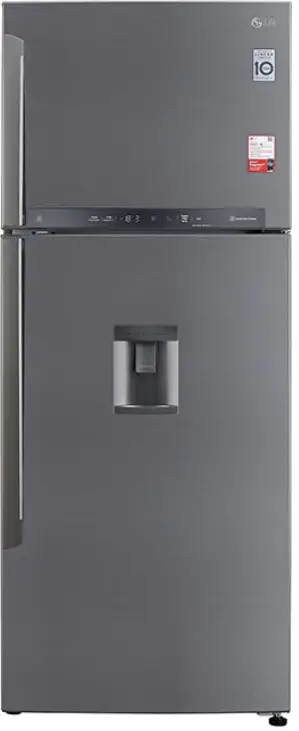
- Be sure to read the safety precautions before use and installation, and use it correctly.
- This is to protect the safety of users and installers and prevent property damage.
- After reading the user manual, keep it in a place where the user can see it at any time.
Introduce
Summary
LAIWB3 is a module that supports Wi-Fi, Bluetooth wireless communication, refrigerator voice recognition and artificial intelligence processing and is designed to operate independently. It supports multiple interfaces and has the advantage of being able to connect various external devices. In addition, it has high performance based on CPU and has specialized functions for artificial intelligence, so it can be applied to home appliances that use artificial intelligence. In addition, it provides scalability to connect with various devices, and provides data transfer rates of up to 72 Mbit/s in case of Wi-Fi. It can operate as a single Wi-Fi module or connect to a host via a serial interface. In case of Bluetooth, music streaming function is provided through paring with other devices.
Major Features and Specifications
- ARM Cortex-A53 Quad
- WLAN: IEEE 802.11b/g/n 1X1 2.4Ghz (up to 72.2Mbps)
- Support WLAN TX/RX LDPC
- Hardware-based AES/TKIP encryption support
- Supports Bluetooth BDR/EDR/LE 5.0
- Linux-based integrated SW development environment support
- TCP/IP Stack support
- Refrigerator control through server-based natural language voice recognition
- Input power: DC 12V
- Mic. spec: 2Ch. Analog MEMS Mic.1
- Speaker: Supports interface connection through external board

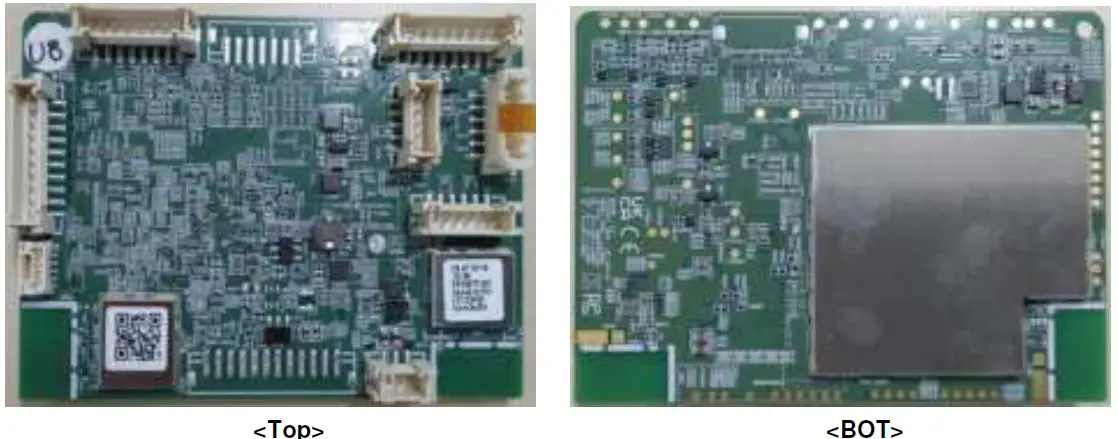
Hardware Configuration
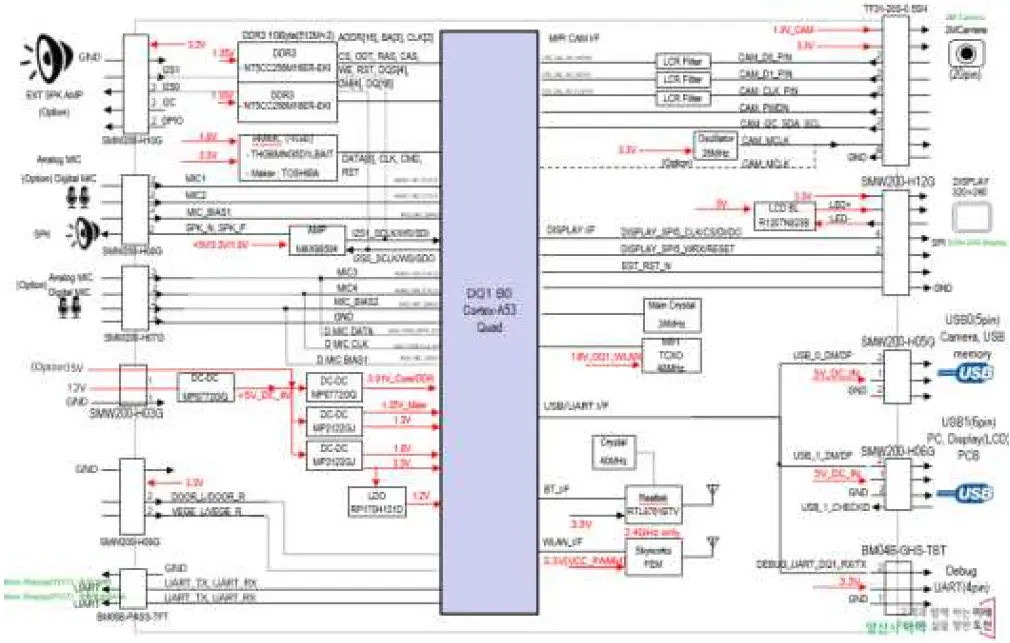
Block Diagram
Command Information
UART communication with refrigerator PCBA via CN602. For other internal communication, refer to block diagram .
Electrical Characteristics
Absolute maximum ratings
Absolute maximum ratings. Exceeding one of the absolute maximum ratings will result in poor performance or It can be caused damage.
| Rating | Min. | Max. | Unit |
| Supply voltage | 10.8 | 13.2 | V |
| Typical WIFI Output Power(Conduction) | 17(±1) | dBm | |
| Typical Bluetooth Output Power(Conduction) | 7 (±1) | dBm | |
| Storage temperature | -20 | +85 | °C |
| WIFI Frequency | 2412 – 2462 MHz | ||
| Bluetooth Frequency | 2402 – 2480 MHz | ||
Electro Static Discharge (ESD)
The LAIWB3 can withstand ESD voltages up to 1000 V Human Body Model (HBM).According to JESD22-A114, JESD22-A115, it can withstand up to 450 V CDM (Charge Device Model).
Recommended Operation Condition
Recommended operation condition
| Rating | Min. | Typ. | Max. | Unit |
| *Supply Voltage VCC | 11.4 | 12 | 12.6 | V |
| Operating temperature of module | -20 | +25 | +85 | ㅇC |
Current Consumption
This is the data measuring power consumption in a scenario where the voice recognition module is in operation mode and the voice recognition function is used.
Condition : Tamb=25oC, VCC=12 V
Power consumption in Normal mode. *Output power value is based on WLAN module’s antenna port Typ. output
| Max Output Power* | Typ. Current | Comments |
| +17 dBm (Tolerance ±1 dBm) | 180 mA | 11 Mbps, 320MHz, In Case of voice recognition operation. |
| Max Output Power* | Typ. Power Consumption | Comments |
| +17 dBm (Tolerance ±1 dBm) | 2,160 mW | 11 Mbps, 320MHz, In Case of voice recognition operation. |
Antenna Characteristics(WLAN, Bluetooth Antenna)
Condition: antenna port radiation test of WLAN module VCC= 12 V, Temp= 0 to +70C, covered with shield-can.
RF Characteristics
| Frequency(MHz) | Efficiency (%) | Avg. Gain(dBi) | Peak Gain(dBi) |
| 2400 | 53.01 | -2.76 | +1.83 |
| 2442 | 70.55 | -1.52 | +2.6 |
| 2485 | 62.75 | -2.02 | +1.36 |
Interface
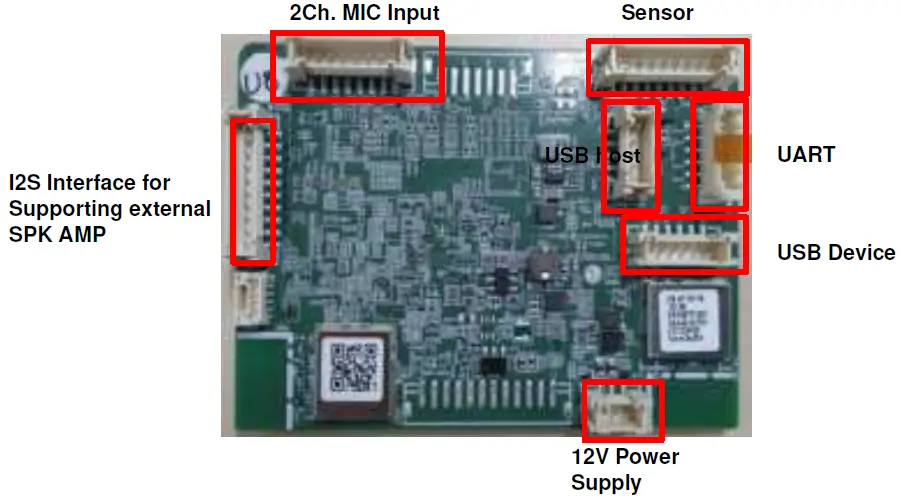 LAIWB3(AI Module) Connector option for connection of external Interface
| Connector type | Description | |
| CN500 | 3 pin 2.00 mm pin header | Power Supply |
| CN602 | 6 pin 2.00 mm pin header | UART Interface to connect Refigerator Board |
| CN401 | 8 pin 2.00 mm pin header | MIC input(2ch) |
| CN600 | 5 pin 2.00 mm pin header | USB Host |
| CN605 | 6 pin 2.00 mm pin header | USB Device |
| CN403 | 10 pin 2.00 mm pin header | I2S Interface for supporting external SPK AMP |
| CN611 | 9 pin 2.00 mm pin header | Sensor(GPIO) |
Package Characteristics
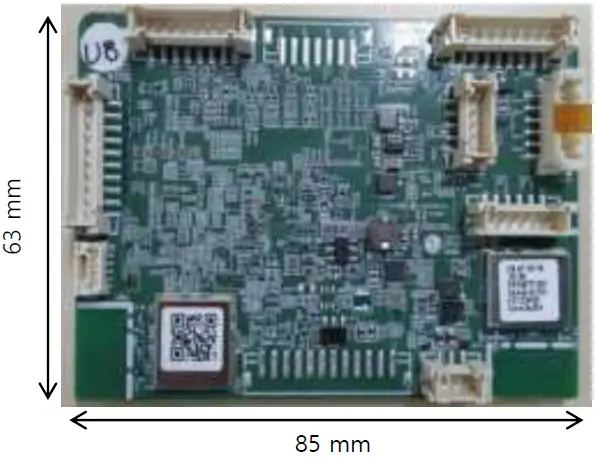
Mechanical Characteristics of LAIWB3(AI Module) PCB

Standard Compliance
IEEE / IETF
IEEE Standard
| Standard | Revision | Description |
| 802.11 | 802.11 R2003 | WLAN MAC& PHY |
| 802.11b | 802.11 R2003 | High rate DSSS (5,5/11 Mbit/s) |
| 802.11d | 802.11 R2003 | Operation in different regulatory domains |
| 802.11e | D9,0 Aug. 2004 | QoS enhancements |
| 802.11g | -2003 | Extended rate PHY (ERP-PBCC, DSS-OFDM) |
| 802.11i | -2004 | Security enhancements |
| 802.11k | Draft 11.0, 2008 | Wireless network management |
| 802.11n | Spec released Oct 29tn 2009 | Longer Range, Faster Throughput |
| 802.11r | Draft 9.0, 2008 | Fast BSS transition |
| 802.11h | 1997 edition | Bridge tunneling |
| RFC1023 | Inherent | Frame encapsulation |
Wi-Fi
Wi-Fi Standard
| Specification | Description | Revision |
| Wi-Fi 802.11b with WPA system inter Operability test plan for IEEE 802.11b devices | 802.11b devices with WPA | 2.1 |
| Wi-Fi 802.11g with WPA system inter Operability test plan | 802.11g devices with WPA | 2.0 |
Bluetooth
Bluetooth Characteristic
| Specification | Description | Revision |
| Bluetooth 5 Dual Mode(BR+EDR/Low Energy Controller) | Compliance with previous version(v2.1+LE) | 5.0 |
| Support Profile | A2DP, AVRCP, GAVDP, SPP | – |
Regulation Statement
FCC
- Part 15.19 Statement
This device complies with Part 15 of the FCC Rules. Operation is subject to the following two conditions:
- this device may not cause harmful interference, and
- This device must accept any interference received, including interference that may cause undesired operation.
- Part 15.105 Statement(Class B)
This equipment has been tested and found to comply with the limits for a Class B digital device, pursuant to part 15 of the FCC Rules. These limits are designed to provide reasonable protection against harmful interference in a residential installation. This equipment generates, uses and can radiate radio frequency energy and, if not installed and used in accordance with the instructions, may cause harmful interference to radio communications. However, there is no guarantee that interference will not occur in a particular installation. If this equipment does cause harmful interference to radio or television reception, which can be determined by turning the equipment off and on, the user is encouraged to try to correct the interference by one or more of the following measures:
- Reorient or relocate the receiving antenna.
- Increase the separation between the equipment and receiver.
- Connect the equipment into an outlet on a circuit different from that to which the receiver is connected.
- Consult the dealer or an experienced radio/TV technician for help.
- Part 15.21 Statement
Any changes or modifications not expressly approved by the party responsible for compliance could void the user’s authority to operate this equipment. This device must not be co-located or operating in conjunction with any other antenna or transmitter.
- Responsible Party Information (Supplier’s Declaration of Conformity)
LG Electronics USA
1000 Sylvan Avenue Englewood Cliffs New Jersey, United States, 07632
Regulatory notice to host manufacturer according to KDB 996369 D03 OEM Manual v01
- List of applicable FCC rules
This module has been granted modular approval as below listed FCC rule parts.
- FCC Rule parts 15.247
- Summarize the specific operational use conditions
The OEM integrator should use equivalent antennas which is the same type and equal or less gain then an antenna listed in this instruction manual.
- RF exposure considerations
The module has been certified for integration into products only by OEM integrators under the following condition:
- The antenna(s)must be installed such that a minimum separation distance of at least 20 cm is maintained between the radiator(antenna) and all persons at all times.
- The transmitter module must not be co-located or operating in conjunction with any other antenna or transmitter except in accordance with FCC multi-transmitter product procedures.
As long as the two conditions above are met, further transmitter testing will not be required. OEM integrators should provide the minimum separation distance to end-users in their end-product manuals.
- Antennas List
This module is certified with the following integrated antenna.
- Type: Pattern Antenna
- Max. peak Antenna gain : 2.6 dBi (2400 – 2485 MHz)
Any new antenna type, higher gain than listed antenna should be met the requirements of FCC rule 15.203 and 2.1043 as permissive change procedure.
Label and compliance information
- End Product Labeling
The module is labeled with it sown FCC ID and IC Certification Number. If the FCC ID and IC Certification Number are not visible when the module is installed inside another device, then the outside of the device into which the module is installed must also display a label referring to the enclosed module. In that case, the final end product must be labeled in a visible area with the following:
- Contains FCC ID: BEJ-LAIWB3
- Contains IC: 2703N-LAIWB3
- Information on test modes and additional testing requirements
OEM integrator is still responsible for testing their end-product for any additional Compliance requirements required with this module installed(for example, digital device emissions, PC peripheral requirements, additional transmitter in the host, etc.).
- Additional testing, Part 15 Subpart B disclaimer
The final host product also requires Part 15 subpart B compliance testing with the modular transmitter installed to be properly authorized for operation as a Part 15 digital device.
ISED
- RSS-GEN, Sec. 7.1.3–(licence-exempt radio apparatus)
This device complies with Industry Canada licence-exempt RSS standard(s). Operation is subject to the following two conditions:
- This device may not cause interference, and
- This device must accept any interference, including interference that may cause undesired operation of the device.
RF Exposure
The antenna (or antennas) must be installed so as to maintain at all times a distance minimum of at least 20 cm between the radiation source (antenna) and any individual. This device may not be installed or used in conjunction with any other antenna or transmitter.