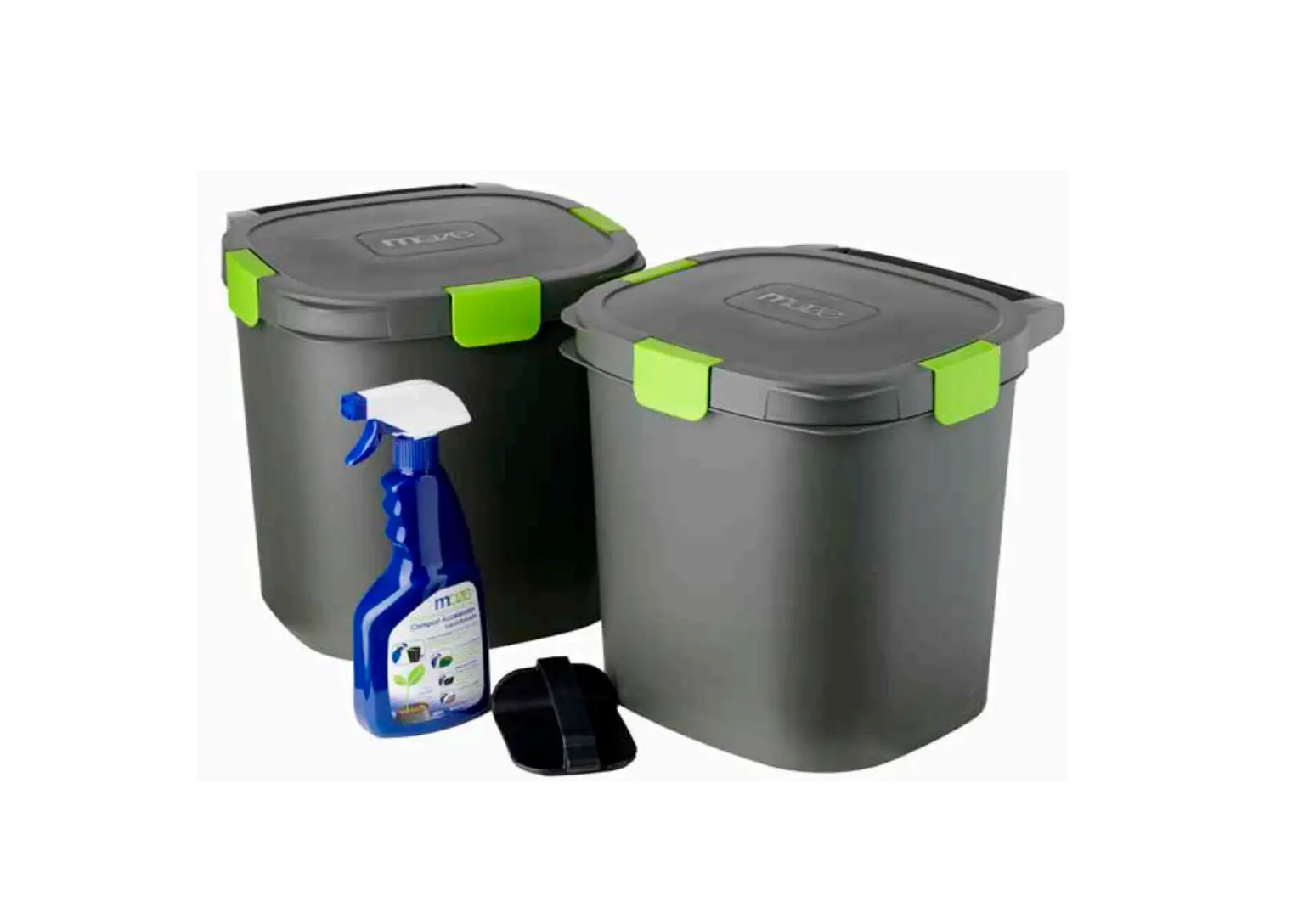
MCI-S15GR-LB Bokashi Organko Essential from Food Waste to Food Resource
Product Information:
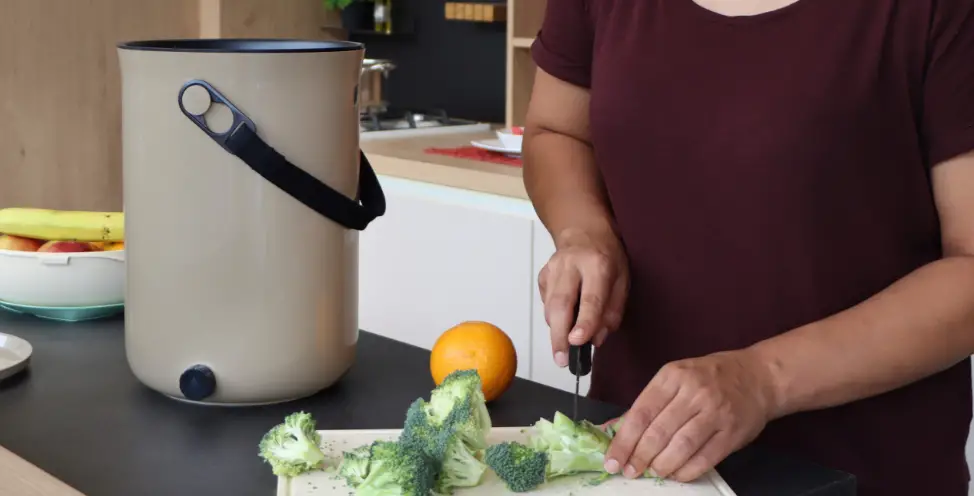
The Bokashi Organko Essential is a 15.3-liter composter made
from post-consumer recycled plastics. It is an air-tight bokashi
bin designed for fermenting organic waste using effective
microorganisms. The composter comes with several parts, including a
lid, dosage container, presser, draining sieve, container, handle,
tap, drain cup, and base. The dimensions of the Bokashi Organko
Essential are 314.5mm x 352mm x 302mm. The Bokashi Organko
Essential + Base has dimensions of 352mm x 302mm x 698mm.
Product Usage Instructions:
- Pull the tap until you hear a click sound. This step may
already be completed. - When not in use, make sure the tap is turned closed. (only for
models with base) - Dissassemble the composter if needed.
- To use the Bokashi Organko, follow these steps:
- Add 8-10 sprays of Liquid Bokashi or 20 grams of Grain
Bokashi. - Dilute with water in a ratio of 1:200 to water plants. Keep off
foliage. - For cleaning drains, use the undiluted liquid.
- When the composter is full, leave it air-tight for 14 days to
ferment. - Continue to drain liquid every 3-4 days.
- Add 8-10 sprays of Liquid Bokashi or 20 grams of Grain
- What to put into the Bokashi Organko:
- You can dispose of almost all organic waste in the Bokashi
Organko composter. It is advisable to cut larger pieces of food
into smaller ones. - Do not put vinegar, juice, milk, oil, water, larger bones,
ashes, or animal feces into the composter. - You can put fruit and vegetables, citrus and banana peels,
prepared food, cooked and raw meat, fish, cheese, yogurt, eggs,
smaller bones, bread, tea bags, and a smaller amount of tissues
into the composter.
- The undiluted liquid is suitable for cleaning drains and septic
tank sanitation. It can also be used for controlling weeds. - The diluted liquid is high in nutrients and can be used for
watering indoor and garden plants. Dilute it with water in a ratio
of 1:200 (5ml of liquid per 1L of water).
Fermentation is a natural process of decomposing organic waste
with effective microorganisms without the unpleasant odors of
rotting food. The fermented mass retains all the vitamins and
minerals. If some pesticides or other harmful compounds are present
in the waste, effective microorganisms will support degradation.
The mixture of fermented organic waste represents a first-class
resource for further compost preparation suitable for food
production.
USER MANUAL
BOKASHI ORGANKO ESSENTIAL
From food waste to food resource.
Distributed by www.mazeproducts.com.au 1300 449 107
1
PARTS
(a) (b) (c) (d) (e) (f)
(g) (h)
(i)
Lid (a) Dosage container (b) Presser (c) Draining sieve
(d)
Container (e)
Handle (f)
Tap (g)
Drain cup (h)
Base (i)
BOKASHI ORGANKO ESSENTIAL
BOKASHI ORGANKO ESSENTIAL + BASE
BOKASHI ORGANKO
ESSENTIAL SET + BASE
x
x
x
x
x
x
x
x
x
x
x
x
x
x
x
x
x
x
x
x
x
/
x
x
/
x
x
2
DIMENSIONS
BOKASHI ORGANKO ESSENTIAL
314,5 mm
352 mm
302 mm
386,5 mm
BOKASHI ORGANKO ESSENTIAL + BASE
352 mm
302 mm
698 mm
BOKASHI ORGANKO ESSENTIAL SET + BASE
x
352 mm
302 mm 3
Pull the tap until
you hear “click” sound.
*This step may already be completed.
When not used, make sure the tap is turned closed.
(only for models with base) 4
DISSASEMBLING 5
HOW TO USE BOKASHI ORGANKO IN EASY STEPS
8-10 Sprays of Liquid Bokashi *20 grams If using Grain Bokashi
8-10 Sprays of Liquid Bokashi *20 grams If using Grain Bokashi
6
Dilute with water in a ratio
1:200 to water plants.
*Keep off of foliage
00
Undiluted for cleaning drains.
When full, leave air-tight for 14 days to ferment.
*Continue to drain liquid every 3-4 days
7
MORE ABOUT BOKASHI ORGANKO ESSENTIAL
Bokashi Organko Essential is a 15,3-liter composter made from post-consumer recycled plastics. It’s an air-tight bokashi bin for fermenting organic waste using bo-
WHAT TO PUT INTO BOKASHI ORGANKO?
You can dispose of almost all organic waste in the Bokashi Organko composter. It is advisable to cut larger pieces of food into smaller ones, as this will contribute to
You should not put the following items into the Bokashi Organko composter:
Vinegar Juice Milk Oil Water
OTHER Larger bones
Ashes Animal feces
8
It is allowed to put the following food into the Bokashi Organko composter:
Fruit and vegetables Citrus and banana peels
Prepared food Cooked and raw meat
Fish Cheese Yogurt
Eggs Smaller bones
Bread Tea bags
Smaller amount of tissues
9
WHAT TO DO WITH BOKASHI LIQUID?
WHAT TO DO WITH FERMENTED MASS?
Fermentation is a natural process of decomposing organic waste with effective micro-organisms without the unpleasant odors of rotting food. During the process, the mass retains all the vitamins and minerals. In order to achieve that, it is necessary to add BOKASHI every time you add a new layer of waste into the composter. During the process, you will also get bokashi liquid that needs to be drained regularly (by opening the tap at the bottom and making sure that the drain cup is under it 6 .
The undiluted liquid is suitable for the cleaning of drains and septic tank sanitation and can be very useful for controlling weeds. The diluted liquid is high in nutrients and is very useful for watering indoor plants and garden plants 7 . In this case, take care that you dilute it with water in a ratio of 1:200 (5ml of liquid per 1L of water).
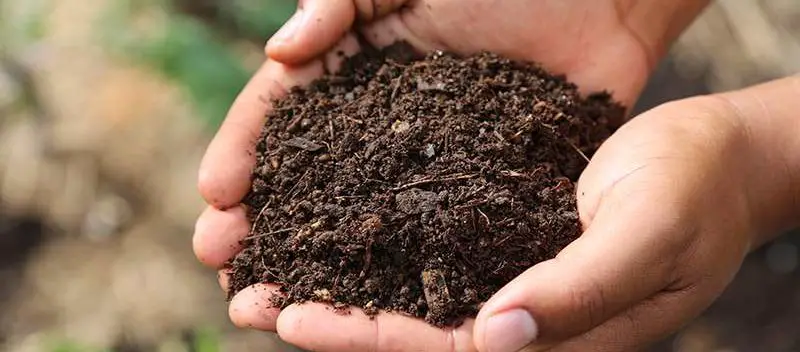
During the formation process with effective microorganisms, the mass keeps all the essential nutrients, vitamins, and minerals. If some pesticides or other harmful compounds are present in the waste, effective microorganisms will support degradation. The mixture of fermented organic waste represents a first-class resource for further compost preparation suitable for food production.
If you have a garden and want to use it there, the fermented mass of organic waste must be processed by composting first. First dig a 30 cm deep hole in your garden and empty the fermented mass from Bokashi Organko into it. Cover it with soil, make sure there is no oxygen, and leave it for 2 weeks before sowing. Either way, the mass will totally decompose in 2-3 months 9a
The second option in the garden is putting the fermented mass on the traditional compost pile, where it needs to be covered.
Even more, you can make a hole near a tree and dig fermented mass into it. Make sure you don’t dig it too close to the tree roots as fermented mass is very acid and needs time to stabilize. Cover it with soil and feel indescribable happiness after giving this oxygen provider some quality food 9b . If you don’t have a garden, you can put the mass from the Bokashi Organko composter into the big container for organic waste, that is meant to separate organic waste from other municipal solid waste 99c .
10
POTENTIAL TROUBLESHOOTING
WHERE CAN I STORE BOKASHI
ORGANKO?
– Optimal temperature is around 20°C. – Avoid direct sunlight. – Keep indoors, away from environmental factors.
WHAT SHOULD I DO IF MOULD
APPEARS?
DARK MOLD: Something went wrong in the process (you did not keep the composter closed, you added too little bokashi bran or irregularly, you neglected to drain bokashi liquid regularly). In this case, empty the composter in your garden, add an equal amount of Bokashi bran as there is waste, cover it with soil and leave it for 4 weeks. You can use it in your garden after that period passes.
WHITE MOULD: White mould can appear when you fill the composter very slowly or there is a lot of air in the composter. White mould is not harmful, so don’t worry. If it still bothers you, put a piece of thick paper on top of the waste after covering it with bokashi bran.
WHY DOES MY BOKASHI BIN
SMELL?
– Optimal temperature is around 20°C. – Avoid direct sunlight. – Keep indoors, away from environmental factors.
WHAT SHOULD I DO IF MOULD
APPEARS?
The bokashi bin smell is completely normal as long it does not stink like rotten food. The smell is a good indicator that the process has succeeded; a sweet-sour smell is expected. When properly sealed, your Bokashi Organko should not affect the odours in your kitchen. If it does, there might be something wrong, and you should try the following:
– Add more organic waste to your Bokashi Organko composter. – Add more Bokashi bran. – Make sure that organic waste is not too wet. – Drain the bokashi liquid regularly. – Make sure the process is anaerobic (less or without oxygen). – Take care that the temperature is not too high.
You can find the most frequently asked questions and answers here
https://knowledge.skaza.com/
The waste mixture in the Bokashi Organko composter, bokashi liquid and bokashi bran are not suitable for consumption.
The lid may not be used as a cutting board but only for the disposal of the waste.
Suitable for dishwashing at a max. temperature of 55°C or in eco mode. Do not put the lid in the dishwasher.
Do not expose the product to direct sunlight or low temperatures.
11
TAKE A LOOK AT OTHER PRODUCTS THAT WILL HELP YOU MANAGE ORGANIC bokashiorganko.com/product-catalog
Read more about Bokashi composting by scanning (or clicking) the QR code.
Distributed by
www.mazeproducts.com.au 1300 449 107
12
 Bokashi Organko | Product Catalog | Food waste and bokashi composting
 Maze - Australia | Composting - Greenhouses - Water Savings - Planters