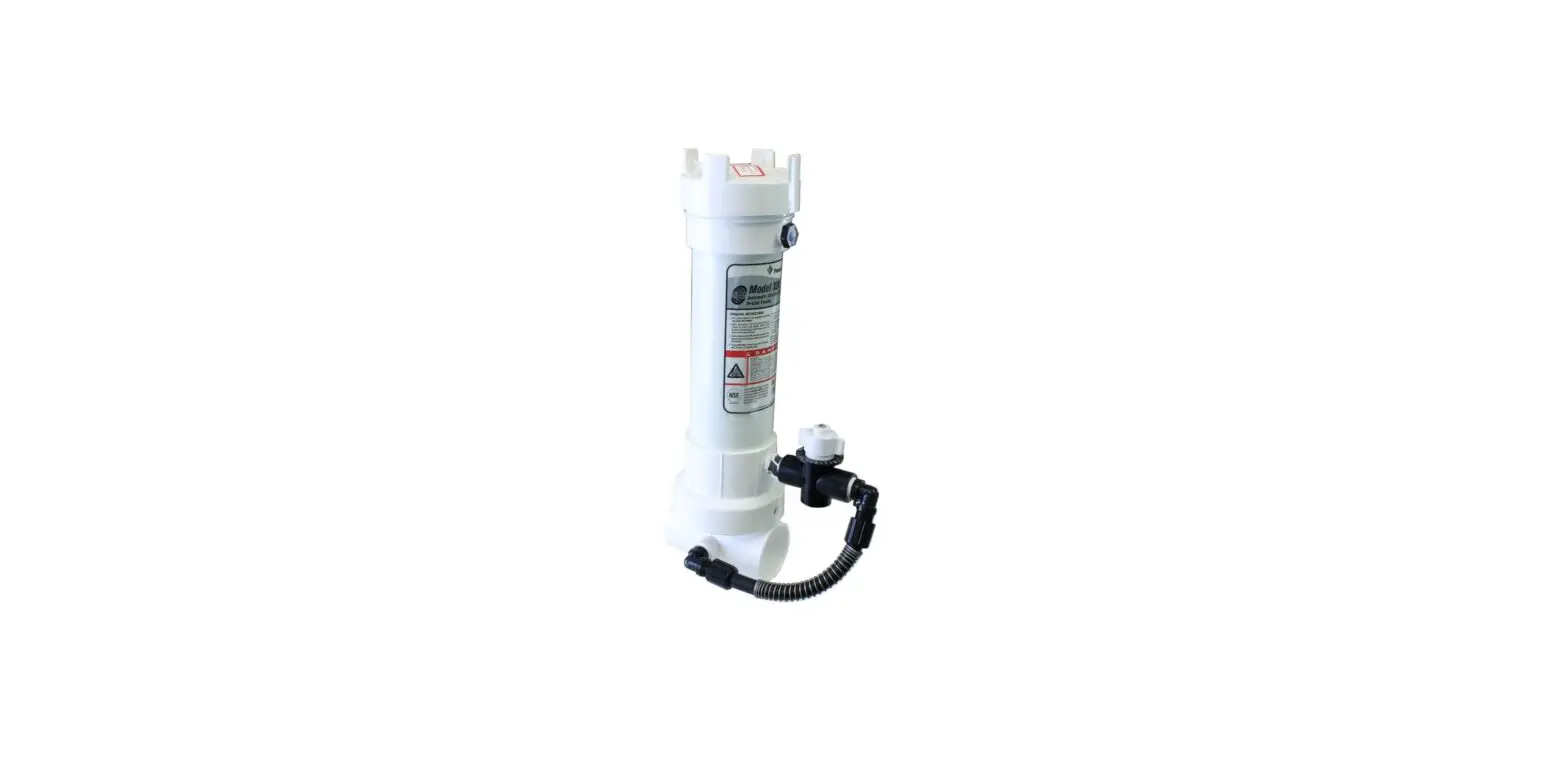

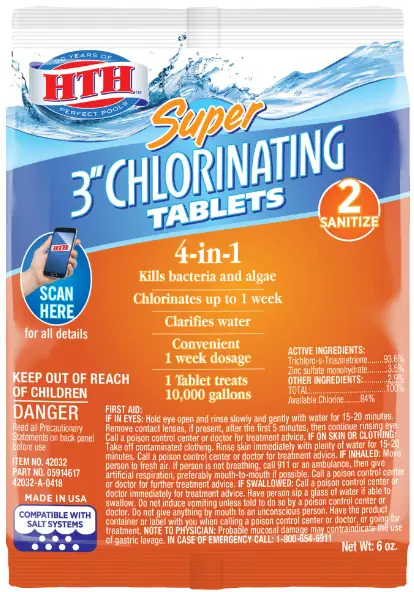
Lonza HTH Super 3 Chlorinating Tablets
SAFETY DATA SHEET
HTH Super 3″ Chlorinating Tablets
- Version 1.0
- SDS Number: 000000025218
- Revision Date: 2018.03.28
IDENTIFICATION
| Product name | : | HTH Super 3″ Chlorinating Tablets |
| Product code | : | 000000025218 |
Manufacturer or supplier’s details
| Company | : | Arch Chemicals, Inc. 1200 Bluegrass Lakes Parkway Alpharetta, GA 30004 United States of America (USA) |
| E-mail address | : | [email protected] |
| Emergency telephone number | : | In case of emergency call CHEMTREC US: 1-800-424-9300, CHEMTREC WORLDWIDE: +1-703-527-3887. |
HAZARDS IDENTIFICATION
GHS Classification
| Acute toxicity (Oral) | : | Category 4 |
| Skin corrosion/irritation | : | Category 2 |
| Serious eye damage | : | Category 1 |
| Specific target organ toxicity – single exposure | : | Category 3 (Respiratory system) |
GHS label elements
| Hazard pictograms | : | ||
| Signal word | : | Danger | |
| Hazard statements | : | H302 Harmful if swallowed. H315 Causes skin irritation. H318 Causes serious eye damage. H335 May cause respiratory irritation. | |
| Precautionary statements | : | Prevention: P260 Do not breathe vapours. P264 Wash hands thoroughly after handling. P270 Do not eat, drink or smoke when using this product. P271 Use only outdoors or in a well-ventilated area. P280 Wear protective gloves/ protective clothing/ eye protection/ face protection. Response: P301 + P312 IF SWALLOWED: Call a POISON CENTER/doctor if you feel unwell. P301 + P330 + P331 IF SWALLOWED: Rinse mouth. Do NOT | |
- Version 1.0
- SDS Number: 000000025218
- Revision Date: 2018.03.28
induce vomiting
P302 + P352 IF ON SKIN: Wash with plenty of water. P332 + P313 If skin irritation occurs: Get medical advice/ attention. P305 + P351 + P338 IF IN EYES: Rinse cautiously with water for several minutes. Remove contact lenses, if present and easy to do. Continue rinsing.
- P310 Immediately call a POISON CENTER/doctor.
- P304 + P340 IF INHALED: Remove person to fresh air and keep comfortable for breathing.
- P321 Specific treatment (see supplemental first aid instructions on this label).
- P362 Take off contaminated clothing and wash before reuse.
Storage
- P403 + P233 Store in a well-ventilated place. Keep the container tightly closed.
- P405 Store locked up.
Disposal: P501 Dispose of contents/container in accordance with local regulations.
Other hazards None known.
COMPOSITION/INFORMATION ON INGREDIENTS
Chemical nature: Chloroisocyanurates
Hazardous components
| Chemical name | CAS-No. | Concentration (%) |
| 1,3,5-Trichloro-1,3,5-triazinane-2,4,6-trione | 87-90-1 | 93.60 |
| zinc sulphate | 7446-19-7 | 3.50 |
| filter aid | 1.50 |
FIRST-AID MEASURES
| General advice | : | Call a poison control center or doctor for treatment advice. For 24- hour emergency medical assistance, call Arch Chemical Emergen- cy Action Network at 1-800-654-6911. Have the product container or label with you when calling a poison control center or doctor, or going for treatment. |
| If inhaled | : | IF INHALED: Move person to fresh air. If person is not breathing, call 911 or an ambulance, then give artificial respiration, preferably mouth-to-mouth if possible. Call a poison control center or doctor for further treatment advice. |
| In case of skin contact | : | IF ON SKIN OR CLOTHING: Take off contaminated clothing. Rinse skin immediately with plenty of water for 15-20 minutes. Call a poison control center or doctor for treatment advice. |
| In case of eye contact | : | IF IN EYES: Hold eye open and rinse slowly and gently with water for 15-20 minutes. Remove contact lenses, if present, after the first 5 minutes, then continue rinsing eye. Call a poison control center or doctor for treatment advice. |
| If swallowed | : | IF SWALLOWED: Call a poison control center or doctor immediately for treatment advice. Have person sip a glass of water if able to swallow. Do not induce vomiting unless told to do so by a poison control center or doctor. Do not give anything by mouth to an un- conscious person. |
| Notes to physician | : | Probable mucosal damage may contraindicate the use of gastric lavage. |
FIREFIGHTING MEASURES
| Suitable extinguishing media | : | Water only. |
| Specific hazards during firefighting | : | During a fire, irritating and highly toxic gases may be generated by thermal decomposition or combustion. Closed containers may explode (due to the build up of steam pres- sure) when exposed to extreme heat. |
| Further information | : | Use water to cool containers exposed to fire. On small fires, use water spray or fog. On large fires, use heavy deluge or fog streams. Flooding amounts of water may be required before ex- tinguishment can be accomplished. Do not use dry extinguishers containing ammonium compounds. |
ACCIDENTAL RELEASE MEASURES
| Personal precautions, protective equipment and emergency procedures | : | Response to a large quantity spill (100 pounds or greater) or when dusting or decomposition gas exposure could occur requires the use of a positive pressure full-face supplied air respirator or self-contained breathing apparatus (SCBA), chemical resistant gloves, coveralls, and boots. In case of fire, this personal protective equipment should be used in addition to normal firefighter equipment. Compatible materials for response to this material are: neoprene. Protection concerns must also address the following: If this materi- al becomes damp/wet or contaminated in a container, the for- mation of nitrogen trichloride gas may occur and an explosive con- dition may exist. |
| Environmental precautions | ||
| Air | : | Vapors may be suppressed by the use of water fog. |
| Water | : | This material is heavier than water. This material is soluble in water. Stop water flow or divert water flow around spill if possible and safe to do so. Begin monitoring for available chlorine and pH immediately. |
| Soil | : | Do not contaminate spill material with any organic materials, am- monia, ammonium salts or urea. Clean up all spill material with clean, dry dedicated equipment and place in a clean dry container. |
| Advice on safe handling | : | Do not take internally. Avoid contact with skin, eyes and clothing. Upon contact with skin or eyes, wash off with water. Avoid breathing dust, mist, vapor or gas. |
| Conditions for safe storage | : | Store in a cool dry ventilated location, away from sources of igni- tion or other incompatible conditions and chemicals. Keep contain- er(s) closed. Avoid creating dusts. |
EXPOSURE CONTROLS/PERSONAL PROTECTION
Components with workplace control parameters
| Components | CAS-No. | Value type (Form of exposure) | Control parameters / Permissible concentration | Basis |
| filter aid | Not Assigned | (Respirable fraction.) | ACGIH | |
| TWA (Res- portable fraction.) | 1 mg/m3 | ACGIH | ||
| REL | 2 mg/m3 (as Al) | NIOSH/GUIDE | ||
| TWA | 2 mg/m3 (as Al) | Z1A | ||
| TWA (Res- parable fraction.) | 1 mg/m3 | CAD ON OEL |
Appropriate engineering controls
| Engineering measures | : | Local exhaust ventilation or other engineering controls are normally required when handling or using this product to keep air borne exposures below the TLV, PEL or other recommended exposure limit. |
| Remarks | : | Wear impervious gloves to avoid skin contact. A full impervious suit is recommended if exposure is possible to a large portion of the body. |
| Eye protection | : | Use chemical goggles. |
| Skin and body protection | : | Nitrile Natural Rubber Neoprene (This includes: gloves, boots, apron, and protective suit) |
| Protective measures | : | An eye wash and safety shower should be provided in the immediate work area. |
PHYSICAL AND CHEMICAL PROPERTIES
| Appearance | : | tablet |
| Colour | : | white |
| Odour | : | Sharp, chlorine-like, bleach odor |
| Odour Threshold | : | no data available |
| pH | : | 2.6, 1 % |
| Melting point/freezing point | : | Not applicable |
| Boiling point/boiling range | : | no data available |
| Flash point | : | no data available |
| Evaporation rate | : | Not applicable |
| Flammability (solid, gas) | : | Product is not known to be flammable, combustible or pyrophoric. |
| Upper explosion limit | : | Not applicable |
| Lower explosion limit | : | Not applicable |
| Vapour pressure | : | Not applicable |
| Relative vapour density | : | no data available |
| Relative density | : | > 1 (20 °C) |
| Water solubility | : | 12 g/l (25 °C) |
| Partition coefficient: n- octanol/water | : | no data available |
| Auto-ignition temperature | : | no data available |
| Decomposition temperature | : | 225 °C |
| Viscosity, dynamic | : | no data available |
| Viscosity, kinematic | : | no data available |
| Oxidizing properties | : | Oxidizing |
| Molecular weight | : | 232.41 g/mol |
STABILITY AND REACTIVITY
| Possibility of hazardous reactions | : | Product will not undergo hazardous polymerization.Product is an |
| oxidizer. | ||
| Conditions to avoid | : | Sparks, open flame, other ignition sources, and elevated temperatures. Contact with small amounts of water may result in an exothermic reaction with the liberation of toxic fumes. Damp or slightly wet product (will evolve nitrogen trichloride) May be unstable at temperatures above 225 Deg. C (437 Deg. F) |
| Incompatible materials | : | Organic materials Oils Grease Sawdust Reducing agents nitrogen-containing compounds Oxidizing Acids Bases Dry fire extinguishers containing ammonium compounds |
| Hazardous decomposition prod- ucts | : | Nitrogen trichloride Chlorine nitrous oxides cyanates Carbon monoxide, Carbon dioxide |
TOXICOLOGICAL INFORMATION
| Information on likely routes of exposure | : | Inhalation, skin, eyes, ingestion |
Acute toxicity
| Acute oral toxicity (LD50) | : | 490 mg/kg Species: Rat |
| Acute inhalation toxicity (LC50) | : | approximately 0.54 mg/l Species: Rat Exposure time: 4 h Test atmosphere: dust/mistRemarks: (Nose Only) |
| Acute inhalation toxicity (LC50) | : | approximately 2.16 mg/l Species: Rat Exposure time: 1 h Test atmosphere: dust/most remarks: (Nose Only) |
| Acute dermal toxicity (LD50) | : | > 2,000 mg/kg Species: Rabbit |
Skin corrosion/irritation
| Skin irritation | : | Remarks: DRY MATERIAL CAUSES MODERATE SKIN IRRITATION. WET MATERIAL CAUSES SKIN BURNS. |
Serious eye damage/eye irritation
| Eye irritation | : | Remarks: Corrosive to eyes |
Respiratory or skin sensitization
| Sensitization | : | Remarks: Negative skin sensitizer, guinea pig – Buehler Method |
Carcinogenicity
| IARC | No component of this product present at levels greater than or equal to 0.1% is identified as probable, possible or confirmed human carcinogen by IARC. |
| OSHA | No component of this product present at levels greater than or equal to 0.1% is on OSHA’s list of regulated carcinogens. |
| NTP | No component of this product present at levels greater than or equal to 0.1% is identified as a known or anticipated carcinogen by NTP. |
Repeated dose toxicity
| : | Remarks: There are no known or reported effects from repeated exposure. Toxicological investigation indicates it does not produce significant effects from chronic exposure. |
ECOLOGICAL INFORMATION
Ecotoxicity
| Toxicity to fish (LC50) | : | 0.32 mg/l Species: Rainbow trout (Salmo gairdneri), Exposure time: 96 h |
| Toxicity to fish (LC50) | 0.30 mg/l Species: Bluegill sunfish Exposure time: 96 h | |
| Toxicity to daphnia and other aquatic invertebrates (LC50) | : | 0.21 mg/l Species: Daphnia magna, Exposure time: 48 h |
| Toxicity to terrestrial organisms | : | Dietary LC50(Anas platyrhynchos (Mallard duck)): > 10,000 ppm Exposure time: 8 d |
| Acute Oral LD50(Anas platyrhynchos (Mallard duck)): 1,600 mg/kg | ||
| Dietary LC50(Colinus virginianus (Bobwhite quail)): 7,422 ppm Exposure time: 8 d |
Persistence and degradability
no data available
Bioaccumulative potential
Components: 1,3,5-Trichloro-1,3,5-triazinane-2,4,6-trione
| Partition coefficient: n- octanol/water | : | log Pow: 0.94 Method: Calculation method |
- Mobility in soil
- no data available
Other adverse effects
| Ozone-Depletion Potential | : | Regulation: US. EPA Clean Air Act (CAA) Section 602 Ozone- Depleting Substances (40 CFR 82, Subpt. A, App A & B) Remarks: This product neither contains, nor was manufactured with a Class I or Class II ODS as defined by the U.S. Clean Air Act Section 602 (40 CFR 82, Subpt. A, App.A + B). |
| Additional ecological information | : | Highly toxic to fish and other aquatic organisms. |
DISPOSAL CONSIDERATIONS
Disposal methods
| Waste from residues | : | If this product becomes a waste, it DOES NOT meet the criteria of a hazardous waste as defined under 40 CFR 261, in that it does not exhibit the characteristics of hazardous waste of Subpart C, nor is it listed as a hazardous waste under Subpart D. |
TRANSPORT INFORMATION
IATA
| UN number | : | 3077 |
| Proper shipping name | : | Environmentally hazardous substance, solid, n.o.s. |
| (Trichloro-s-triazinetrione, zinc sulphate) | ||
| Transport hazard class | : | 9 |
| Packing group | : | III |
| Labels | : | 9MI |
| Environmental hazards | : | yes |
| IMDG | ||
| UN number | : | 3077 |
| Proper shipping name | : | Environmentally hazardous substance, solid, n.o.s. |
| (Trichloro-s-triazinetrione, zinc sulphate) | ||
| Transport hazard class | : | 9 |
| Packing group | : | III |
| Labels | : | 9 |
| EmS Number 1 | : | F-A |
| EmS Number 2 | : | S-F |
| Environmental hazards | : | Marine pollutant: yes |
| ADR | ||
| UN number | : | 3077 |
| Proper shipping name | : | ENVIRONMENTALLY HAZARDOUS SUBSTANCE, SOLID, N.O.S. |
| (Trichloro-s-triazinetrione, zinc sulphate) | ||
| Transport hazard class | : | 9 |
| Packing group | : | III |
| Classification Code | : | M7 |
| Hazard Identification Number | : | 90 |
| Labels | : | 9 |
| Environmental hazards | : | yes |
| RID | ||
| UN number | : | 3077 |
| Proper shipping name | : | ENVIRONMENTALLY HAZARDOUS SUBSTANCE, SOLID, N.O.S. |
| (Trichloro-s-triazinetrione, zinc sulphate) | ||
| Transport hazard class | : | 9 |
| Packing group | : | III |
| Classification Code | : | M7 |
| Hazard Identification Number | : | 90 |
| Labels | : | 9 |
| Environmental hazards | : | yes |
DOT
| UN number | : | 3077 |
| Proper shipping name | : | Environmentally hazardous substance, solid, n.o.s. |
| (Trichloro-s-triazinetrione, zinc sulphate) | ||
| Transport hazard class | : | 9 |
| Packing group | : | III |
| Labels | : | 9 |
| Emergency Response Guidebook Number | : | 171 |
| Environmental hazards | : | yes |
TDG
| UN number | : | 3077 |
| Proper shipping name | : | ENVIRONMENTALLY HAZARDOUS SUBSTANCE, SOLID, N.O.S. |
| (Trichloro-s-triazinetrione, zinc sulphate) | ||
| Transport hazard class | : | 9 |
| Packing group | : | III |
| Labels | : | 9 |
| Environmental hazards | : | yes |
| Special precautions for user | : |
| 49CFR (DOT) Material is not regulated for ground transportation within the US if shipped in non-bulk packages. Material is not regulated as a marine pollutant for ground transportation within the US if shipped in non-bulk packages (reference 49CFR 171.4(c)). | |
| Transport in bulk according to Annex II of MARPOL 73/78 and the IBC Code | : | Not applicable |
REGULATORY INFORMATION
This chemical is a pesticide product registered by the United States Environmental Protection Agency and is subject to certain labeling requirements under federal pesticide law. These require-ments differ from the classification criteria and hazard information required for safety data sheets (SDS), and for workplace labels of non-pesticide chemicals.
| Signal word | : | DANGER! |
| Hazard statements | : | Harmful if swallowed. May be fatal if absorbed through skin. May be fatal if inhaled. Corrosive. Causes skin burns. Corrosive. Causes irreversible eye damage. This pesticide is toxic to fish. |
| EPA No. | : | 1258-1338 |
EPCRA – Emergency Planning and Community Right-to-Know Act CERCLA Reportable Quantity
| Components | CAS-No. | Component RQ (lbs) | Calculated product RQ (lbs) |
| zinc sulphate | 7446-19-7 | 1000 | 28571 |
SARA 311/312 Hazards
See above: SECTION 2. Hazard Identification-GHS Classification
SARA 302
No chemicals in this material are subject to the reporting requirements of SARA Title III, Section 302.
SARA 313
This material does not contain any chemical components with known CAS numbers that exceed the threshold (De Minimis) reporting levels established by SARA Title III, Section 313.
Clean Air Act
- This product does not contain any hazardous air pollutants (HAP), as defined by the U.S. Clean Air Act Section 112 (40 CFR 61).
- This product does not contain any chemicals listed under the U.S. Clean Air Act Section 112(r) for Accidental Release Prevention (40 CFR 68.130, Subpart F).
- This product does not contain any chemicals listed under the U.S. Clean Air Act Section 111 SOCMI Intermediate or Final VOCs (40 CFR 60.489).
Clean Water Act
- The following Hazardous Chemicals are listed under the U.S. CleanWater Act, Section 311, Table 117.3:
| Components | CAS-No. | Component RQ (lbs) |
| zinc sulphate | 7446-19-7 | 1000 |
| filter aid | 17927-65-0 | 5000 |
The following Hazardous Substances are listed under the U.S. CleanWater Act, Section 311, Table 116.4A:
| Components | CAS-No. | Concentration |
| zinc sulphate | 7446-19-7 | |
| filter aid | 17927-65-0 |
This product does not contain any toxic pollutants listed under the U.S. Clean Water Act Section 307
US State Regulations
Massachusetts Right To Know
| Components | CAS-No. |
| 1,3,5-Trichloro-1,3,5-triazinane-2,4,6-trione | 87-90-1 |
| zinc sulphate | 7446-19-7 |
| filter aid |
Pennsylvania Right To Know
| Components | CAS-No. |
| 1,3,5-Trichloro-1,3,5-triazinane-2,4,6-trione | 87-90-1 |
| zinc sulphate | 7446-19-7 |
| filter aid |
New Jersey Right To Know
| Components | CAS-No. |
| 1,3,5-Trichloro-1,3,5-triazinane-2,4,6-trione | 87-90-1 |
| zinc sulphate | 7446-19-7 |
| filter aid |
California Prop. 65
This product does not contain any chemicals known to State of California to cause cancer, birth defects, or any other reproductive harm.
OTHER INFORMATION
Arch is a wholly-owned subsidiary of Lonza and continues to operate as Arch Chemicals, Inc. Revision Date : 2018.03.28 The information provided in this Safety Data Sheet is correct to the best of our knowledge, information, and belief at the date of its publication. The information given is designed only as a guidance for safe handling, use, processing, storage, transportation, disposal and release and is not to be considered a warranty or quality specification. The information relates only to the specific material designated and may not be valid for such material used in combination with any other materials or in any process unless specified in the text.