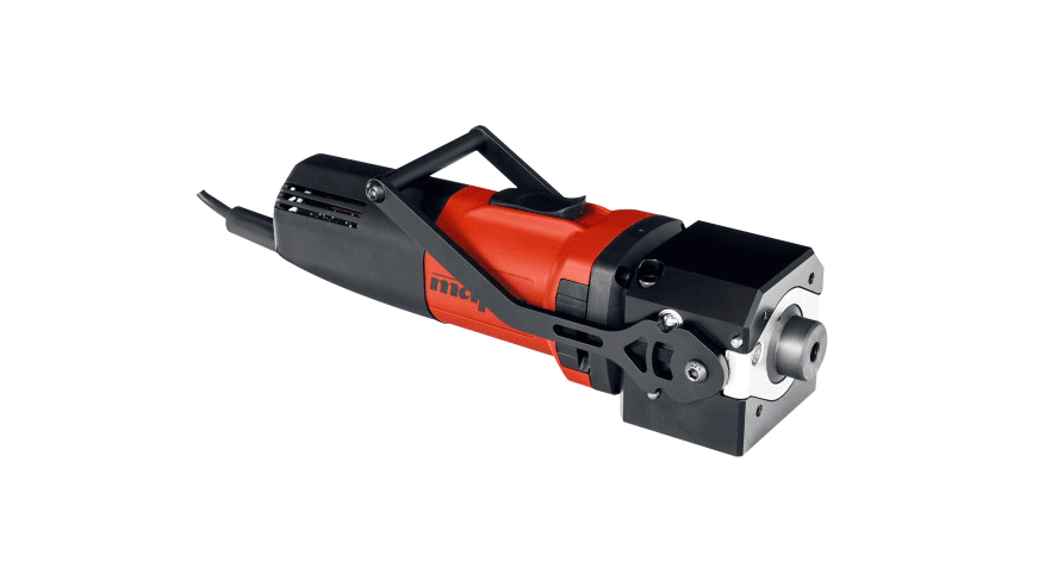
ZH 320 Ec Carpentry Planing Machine
Product Information
The product is the ZH 320 Ec Carpenter’s Plane. It is a
woodworking tool used for planing and shaping wood surfaces.
The machine identification is 170181.1020/i.
Technical Data
- Main Voltage: Not specified
- Power Consumption: Not specified
- No-load Speed: Not specified
- Planing Width: Not specified
- Planing Depth: Not specified
- Weight: Not specified
The emissions of the product are not specified.
The scope of supply includes the ZH 320 Ec Carpenter’s Plane and
the original operating instructions.
The product is equipped with safety devices to ensure safe
usage.
The product should be used according to its intended
purpose.
There may be residual risks associated with using the product,
so caution should be exercised.
Product Usage Instructions
- Please read all safety instructions and directions before using
the product. - Ensure that the mains connection is properly set up.
- Adjust the settings of the Carpenter’s Plane according to your
requirements. - Hold the Carpenter’s Plane firmly and position it on the wood
surface to be planed. - Switch on the power and guide the Carpenter’s Plane along the
wood surface, applying gentle pressure. - Continue planing until the desired result is achieved.
- Switch off the power and disconnect the mains connection when
finished using the Carpenter’s Plane. - Store the Carpenter’s Plane in a safe and dry place, away from
children.
For more detailed instructions on setting and adjustment, please
refer to the relevant sections in the user manual.
Always follow safety guidelines and use the product responsibly
to avoid electric shock, fire, and serious injuries.
ZH 320 Ec
170181.1020/i
Zimmereihobel
Originalbetriebsanleitung
6
Carpenter’s plane
Translation of the original operating instructions
14
Rabot de charpente
Traduction de la notice d’emploi originale
22
Piallatrice
Traduzione delle istruzioni d’uso originali
30
Timmersschaaf
Vertaling van de originele gebruiksaanwijzing
38
Cepilladora de carpintero Traducción del manual de instrucciones original
46
Ammattilais-höylä
Käännös alkuperäiskäyttöohjeesta
55
Elhyvel
Översättning av originalbruksanvisningen
63
Tømrerhøvl
Oversættelse af den originale betjeningsvejledning 71
Tesaský hoblík
79
Peklad pvodního provozního návodu
88
Strug ciesielski
Tlumaczenie oryginalnej instrukcji obslugi
96
Tesarski oblic
Prevod izvirnih navodil za uporabo
104
WARNUNG Lesen Sie alle Sicherheitshinweise und Anweisungen. Versäumnisse bei der Einhaltung der Sicherheitshinweise und Anweisungen können elektrischen Schlag, Brand und/oder schwere Verletzungen verursachen. Bewahren Sie alle Sicherheitshinweise und Anweisungen für die Zukunft auf.
WARNING Please read all safety instructions and directions. Failure to comply with the safety instructions and directions can cause electric shock, fire and/or serious injuries. Please retain all safety instructions and directions for future reference.
AVERTISSEMENT Veuillez lire toutes les consignes de sécurité et instructions. Tout non-respect des consignes de sécurité et instructions risque d’être à l’origine de décharges électriques, d’incendies et/ou de blessures graves. Conservez toutes les consignes et instructions pour pouvoir les relire à tout moment.
AVVERTENZA Leggere tutte le avvertenze di sicurezza e le istruzioni. La mancanza del rispetto delle avvertenze di sicurezza e delle istruzioni possono causare scossa elettrica, incendio e/o gravi lesioni. Conservare tutte le avvertenze di sicurezza e le istruzioni per il futuro.
WAARSCHUWING Lees alle veiligheidsaanwijzingen en instructies. Nalatigheid bij het naleven van de veiligheidsinstructies en aanwijzingen kan elektrische schok, brand en/of ernstige letsels veroorzaken. Bewaar alle veiligheidsaanwijzingen en instructies voor later gebruik.
ADVERTENCIA Lea todas las indicaciones de seguridad e instrucciones. Si no se cumplen las indicacionesde seguridad e instrucciones, se pueden producir descargas eléctricas, incendios y/o lesiones graves. Guarde todas las indicaciones de seguridad e instrucciones para el futuro.
VAROITUS Lue kaikki turvaohjeet ja käyttöohjeet. Laiminlyönti turvaohjeiden ja käyttöohjeiden noudattamisessa voi aiheuttaa sähköiskun, tulipalon ja/tai vakavia vammoja. Säilytä kaikki turvaohjeet ja käyttöohjeet tulevaisuuden varalle.
VARNING Läs alla säkerhetsanvisningar och anvisningar. Underlåtenhet att följa säkerhetsanvisningar och anvisningar kan orsaka elstötar, brand och/eller allvarliga personskador. Behåll alla säkerhetsanvisningar och anvisning för framtida användning.
ADVARSEL Læs alle sikkerhedshenvisninger og instruktioner. En manglende overholdelse af sikkerhedshenvisningerne og instruktionerne kan føre til elektrisk stød, brand og/eller alvorlige kvæstelser. Opbevar alle sikkerhedshenvisninger og instruktioner til fremtidig brug.
. , / . .
OSTRZEENIE Przeczyta wszystkie przepisy bezpieczestwa i wskazówki. Zaniedbanie przestrzegania przepisów bezpieczestwa i wskazówek moe prowadzi do poraenia prdem, poaru i/lub cikich zranie. Zachowa wszystkie przepisy bezpieczestwa i wskazówki na przyszlo.
UPOZORNNÍ Pectte si vsechna bezpecnostní upozornní a pokyny. Zanedbání bezpecnostních upozornní a pokyn mze zpsobit zásah elektrickým proudem, pozár a/nebo vázná zranní. Vsechna bezpecnostní upozornní a pokyny si ponechejte pro pozdjsí pouzití.
OPOZORILO Preberite vsa varnostna opozorila in napotke. Neupostevanje varnostnih opozoril in napotkov lahko povzroci udar elektricnega toka, pozar in/ali hude telesne poskodbe. Vsa varnostna opozorila in napotke shranite za prihodnjo uporabo.
-3-
English
Table of Contents
1
Signs and symbols …………………………………………………………………………………………… 15
2
Product information ………………………………………………………………………………………….. 15
2.1
Manufacturer´s data …………………………………………………………………………………………. 15
2.2
Machine identification ……………………………………………………………………………………….. 15
2.3
Technical data …………………………………………………………………………………………………. 16
2.4
Emissions ……………………………………………………………………………………………………….. 16
2.5
Scope of supply ……………………………………………………………………………………………….. 16
2.6
Safety devices …………………………………………………………………………………………………. 17
2.7
Use according to intended purpose…………………………………………………………………….. 17
2.8
Residual risks ………………………………………………………………………………………………….. 17
3
Safety instructions ……………………………………………………………………………………………. 17
4
Setting / Adjustment …………………………………………………………………………………………. 18
4.1
Mains connection …………………………………………………………………………………………….. 18
4.2
Dust extraction ………………………………………………………………………………………………… 18
4.3
Blade change ………………………………………………………………………………………………….. 19
5
Operation………………………………………………………………………………………………………… 19
5.1
Initial operation ………………………………………………………………………………………………… 19
5.2
Switching on and off …………………………………………………………………………………………. 19
5.3
Depth of cut adjustment ……………………………………………………………………………………. 19
5.4
Work instructions ……………………………………………………………………………………………… 19
5.5
Chip ejection……………………………………………………………………………………………………. 20
6
Service and maintenance ………………………………………………………………………………….. 20
6.1
Tool ……………………………………………………………………………………………………………….. 20
6.2
Storage …………………………………………………………………………………………………………… 20
7
Troubleshooting……………………………………………………………………………………………….. 21
8
Optional accessories ………………………………………………………………………………………… 21
9
Exploded drawing and spare parts list ………………………………………………………………… 21
-14-
1 Signs and symbols
This symbol appears at places where you will find instructions for your own safety. Non-compliance with these instructions may result in very serious injuries. This symbol indicates a potentially hazardous situation. If this situation is not avoided, the product or objects in its vicinity may get damaged.
This symbol indicates tips for the user and other useful information.
2 Product information
for machines with product no. 924401, 924420, 924422 or 924425 2.1 Manufacturer´s data MAFELL AG, Beffendorfer Straße 4, D-78727 Oberndorf / Neckar, Phone +49 (0)7423/812-0, Fax +49 (0)7423/812-218 2.2 Machine identification All details required for machine identification are available on the attached rating plate.
CE symbol to document compliance with the basic safety and health requirements according to Appendix I of the Machinery Directive. For EU countries only Do not dispose of electric tools together with household waste material! In accordance with the European directive 2002/96/EC on waste electrical and electronic equipment and transposition into national law, obsolete electrical tools must be collected separately and recycled in an environmentally-compatible manner. To reduce the risk of injury, please read the operating instructions.
Always wear ear protectors during work.
-15-
2.3 Technical data Universal motor, radio and TV interference suppressed Power input (permanent operation) Speed of planing shaft
Planing width Chip removal Cutting speed at normal load Weight without mains cable Extractor connection diameter
while idling at normal load
Inside / outside
230 V~, 50 Hz
2700 W 8500 rpm 8500 rpm 320 mm (12 5/8 in.) 0 – 3 mm (0 – 1/8 in.) 32.9 m/s (108 ft/sec.) 14 kg (30.8 lbs) 75/80 mm (2 15/16 3 1/8 in.)
2.4 Emissions
The values stated are emission levels. Although there is a correlation between emission and imission level, it cannot be reliably derived from this whether additional precautions are necessary. Factors influencing the current immission level existing at the workplace comprise the duration of exposure, the room characteristic, other sources of noise, etc. such as e.g. the number of machines and other adjacent machining operations. In addition, the permissible immission level may differ from country to country. This information is nevertheless suitable for providing the machine user with an improved assessment of the hazard and risk.
2.4.1 Noise emission specifications Noise emission values determined according to EN 62841:
Sound pressure level Uncertainty Sound power level Uncertainty
LPA = 99 dB (A) KPA = 1,5 dB (A) LPA = 110 dB (A) KPA = 1,5 dB (A)
The noise measurement is recorded using the planing shaft included in the standard equipment.
2.4.2 Vibration specifications The typical hand-arm vibration is 2.7 m/s2.
2.5 Scope of supply Carpenter’s plane ZH 320 Ec complete with:
1 set reversible blades 1 operating tool 1 operating manual 1 folder “Safety Instructions”
-16-
2.6 Safety devices
Danger These devices are required for the machine’s safe operation and may not be removed or rendered inoperative.
The machine is equipped with the following safety devices:
– Large base plate – Handles – Index mechanisms – Hose connector
2.7 Use according to intended purpose The carpenter’s plane is exclusively intended for processing solid wood using HL-reversible blades. Dimension and quality of the spacer blocks, blade carriers and reversible blades used must correspond to the parts listed in the spare parts list. The order numbers can be found in the spare parts list. Any other use than described above is not permissible. The manufacturer cannot be held liable for any damage arising from such other use. So as to use the machine as intended, comply with the operating, maintenance and repair instructions specified by Mafell.
2.8 Residual risks
Danger Even if used in accordance with its intended purpose and despite conforming with the safety instructions, residual risks caused by the intended use will always remain.
– Touching the running planing shaft below the base plate.
– Touching the sharp planing blades with stationary planing shaft.
– Touching the sharp planing blade edges when changing the blades.
– Touching the running planing shaft through the chip ejector.
– Ejection of incorrectly fitted planing blades. – Breakage and ejection of parts of the planing
blades.
– Machine or workpiece get flung off when planing from within the workpiece.
– Touching live parts with the housing open and the mains plug not removed.
– Hearing can be impaired when working for long periods without ear protectors.
– Emission of harmful wood dusts during longer operation without extraction.
3 Safety instructions
Danger
Always observe the following safety instructions and the safety regulations applicable in the respective country of use!
General instructions:
– Children and adolescents must not operate this machine. This rule does not apply to young persons receiving training and being supervised by an expert.
– Never work without the protection devices prescribed for the respective operating sequence and do not make any changes to the machine that could impair safety.
– When operating the machine outdoors, use of an earth-leakage circuit-breaker is recommended.
– Damaged cables or plugs must be immediately replaced.
– Always check before beginning work whether the protection and work devices are safely attached and not damaged. Damaged protection devices and parts must be repaired or exchanged appropriately.
– Consider environmental influences. Do not expose the machine to rain and avoid working in a damp or wet environment as well as near to combustible liquids and gases.
– Do not carry the machine by its cable and do not use the cable to pull the plug out of the socket outlet.
– Pay attention that the cable is protected against oil and heat and is not pulled across sharp edges.
-17-
– Avoid sharp bends in the cable. Especially when transporting and storing the machine, do not wind the cable around the machine.
– Only allow an electrician to carry out work on the electrical parts of the machine.
– Store the machine in a dry, locked place outside the reach of children.
Instructions on the use of personal protective equipment:
– Always wear ear protectors during work. – Always where a dust mark during work.
Instructions on operation:
– Wait fort he cutter top stop before setting the tool down. An exposed rotating cutter may engage the surface leading to possible loss of control and serious injury.
– Hold the power tool by insulated gripping surfaces, because the cutter may contact its own cord. Cutting a “live” wire may make exposed metal parts of the power tool “live” and could give the operator an electric shock.
– Use clamps or another practical way to secure and support the workpiece to a stable platform. Holding the workpiece by your hand or against the body leaves it unstable and may lead to loss of control.
– Provide for an unobstructed and slip-proof location with adequate lighting.
– The power plug must be pulled before replacing tools, making adjustments and repairing malfunctions (this also comprises removing jammed chips).
– Do not work on workpieces which are too small or too large for the capability of the machine.
– The switch may not be wedged. – Only begin planing the workpiece when the planing
shaft has achieved its full speed. – Examine the workpiece for foreign objects. Never
attempt to plane over nails or other metal objects.
– During planing, always lead the connecting cable away from the machine to the side (Fig. 1).
– An even feed during planing increases the life time of blades and machine and reduces the risk of accidents. Do not reverse plane or plunge plane!
– Planing blades must be reversed or replaced in good time, as blunt blades do not only increase the danger of backlash, but also place an unnecessary strain on the motor.
– Never reach into the planing shaft or into the chip ejector while the machine is running.
– The wood dust arising during planing impairs the necessary view and is partly injurious to health. If the machine is used for longer periods, it must therefore be connected to a chip extractor, e.g. a portable small extractor, if the work is not carried out outdoors or in a sufficiently ventilated room. The air velocity must be at least 20 m/s (65.6 ft/sec.).
Instructions on service and maintenance: – Regularly cleaning the machine, especially the
adjusting devices and guides, constitutes an important safety factor. – Only original MAFELL spare parts and accessories may be used. Otherwise the manufacturer will not accept any warranty claims and cannot be held liable.
– Use a suitable tool, e.g. a piece of wood to clean a clogged ejection nozzle. Do not reach into the ejection nozzle.
4 Setting / Adjustment
4.1 Mains connection The carpenter’s plane is equipped with protective insulation according to Class I and may therefore only be connected to socket outlets with protective earth conductor.
Prior to commissioning make sure that the mains voltage complies with the operating voltage stated on the machine’s rating plate.
4.2 Dust extraction Connect the machine to a suitable external dust extractor during all work generating a considerable amount of dust. The air velocity must be at least 20 m/s (65.6 ft / sec.).
The internal diameter of hose connector is 75 mm ( 2 15/16 in.).
-18-
4.3 Blade change
Danger
Pull the power plug during all service work.
Sharp planing blades guarantee a regular planing pattern and put less strain on the motor. Blunt planing blades must therefore be reversed or exchanged.
Prior to the blade exchange, release screws 13 (Fig. 3) at the lateral cover and tilt away the cover 14. Screw the hexagon head screws 10 (Fig. 2) approx. 1 – 2 turns into the spacer blocks 12 using the openended spanner (width across flats 8). Pull the spacer blocks with blade and blade carrier 9 laterally from the planing shaft.
Clean all parts and the blade chamber inside the planing shaft.
Always reverse both blades or fit new blades. Pay attention that the blades are fitted on the pins in the spacer block first and only then the blade carriers. Afterwards, insert the blades including the carrier system laterally into the planing shaft and pay attention that blade carrier and blades do not laterally protrude beyond the shaft body. First only lightly, then firmly tighten the clamping screws from the centre outwards using the open-ended spanner (width across flats 8) included in the supply (8.4 Nm). Tilt the cover back again and tighten the screws. The planing shaft has been preset at the factory. An adjustment of the fitted blades is therefore not necessary and may not be carried out, as otherwise the permissible projection of the blades beyond the shaft body may be exceeded.
5 Operation
5.1 Initial operation Personnel entrusted to work with the machine must be made aware of the operating instructions, calling particular attention to the chapter “Safety instructions”.
5.2 Switching on and off
Before switching on, pay attention that the machine’s planing shaft does not rest on the support or on the workpiece. For this purpose, lift the carpenter’s plane with both hands by the handles 1 and 4 (Fig. 4).
· Switching on: First unlock the switch-on lock by pressing the locking lever 15 (Fig. 4) to the front. Then actuate the control lever 2. As this is a switch without locking device, the machine will only run for as long as this switch is pressed.
The built-in electronic system provides for jerk-free acceleration when the machine is switched on and under load readjusts the speed to the fixed setting.
In addition, this electronic system adjusts the motor down in case of overload, i.e. the planing shaft will stop. The load on the machine must then be reduced until the planing shaft has reached its full speed. After that, continue to plane at reduced feed speed.
· Switching off: To switch off, release the switch trigger 2. The switch-on lock automatically takes effect again and secures the machine against accidental switch-on.
On switching off the machine, the automatic brake takes effect simultaneously. This shortens the slowing time of the machine to approx. 1 – 3 seconds.
5.3 Depth of cut adjustment
The chip removal can be set to between 0 and 3 mm (0 1/8 in.). This is done with the handle 5 (Fig. 4) for depth of cut adjustment. The set planing depth can be read off scale 6.
During normal operation, the chip removal should remain restricted to approx. 2 mm (1/16 in.). To avoid overloading the motor, the maximum chip removal should only be used in extreme cases.
5.4 Work instructions
Thanks to its balanced weight distribution, the carpenter’s plane has a good grip. It can be guided using the handles 1 and 4 (Fig. 4).
For planing, the machine’s front contact area is placed onto the workpiece such that the planing shaft does not engage. After switching on and as soon as the planing shaft has reached its full speed, the carpenter’s plane is guided over the timber applying an even pressure. An even feed results in a regular planing pattern and reduces the strain on the machine.
When the carpenter’s plane is overloaded, the speed of the planing shaft drops. It is then necessary to wait until the planing shaft has reached its full speed
-19-
again. Afterwards, it is possible to continue working with reduced feed. When working with a full planing width, the lever with guide roller 7 is tilted downwards and tensioned with the knurled knob 8. This provides the plane with a lateral guide. After planing, immediately switch off the machine by releasing the switch and do not put down with running planing shaft. When resetting the chip removal to 0, the plane may be put down on a flat surface without damaging the support, even if the blades are in an unfavourable position.
5.5 Chip ejection The carpenter’s plane is designed such that during planing with appropriate feed speed and fully utilised planing width, an efficient chip ejection is ensured. In the process, the chips are ejected to the side so that the view onto the workpiece is not obstructed.
6 Service and maintenance
Danger Pull the power plug during all service work.
MAFELL machines are designed to be low in maintenance.
The ball bearings used are greased for life. When the machine has been in operation for a longer period of time, we recommend to hand the machine in at an authorised MAFELL customer service shop for inspection. Only use our special grease, order No. 049040 (1 kg tin) for all greasing points.
6.1 Tool The planing shaft, spacer blocks, blade carriers and blades used on the machine should be regularly deresinified as a clean tool improves the cutting quality. Deresinification is carried out by placing the spacer blocks, blade carriers and reversible blades for 24 hours in petroleum or a commercial deresinificaton agent.
Aluminium tools may only be deresinified with solvents which do not corrode the aluminium.
6.2 Storage If the machine is not used for a longer period of time, it has to be carefully cleaned. Spray bright metal parts with a rust inhibitor.
-20-
7 Troubleshooting
Danger
Determining the causes for existing defects and eliminating these always requires increased attention and caution. Pull the mains plug beforehand!
Some of the most frequent defects and their causes are listed in the following chart. In case of other defects, contact your dealer or the Mafell customer service.
Defect Machine cannot be switched on
Cause No mains voltage Mains fuse defective Carbon brushes worn
Machine switches off automatically during idling or stops during planing Speed decreases during planing
Irregular planing pattern
Mains failure Machine overloaded
Excessive chip removal Feed rate too fast Blunt blades Blunt blades Uneven feed
Chip ejection blocked
Excessive chip removal Feed rate too fast Blunt blades Wood is too damp Extended planing without extraction
Elimination Check power supply Replace fuse Take the machine to a Mafell customer service shop Check mains back-up fuses Reduce feed speed
Reduce chip removal Reduce feed speed Reverse or exchange blades Reverse or exchange blades Plane with constant pressure and reduced feed
Connect to an external extraction, e.g. portable dust extractor
8 Optional accessories
– Reversible blades (1 pair) – Reversible blades (3 pairs) – Clamping jaws – Blade holder (1 pair) – Reducing socket ZH-RS
Order No. 091791 Order No. 091889 Order No. 202295 Order No. 091790 Order No. 207877
9 Exploded drawing and spare parts list
The corresponding information in respect of spare parts can be found on our homepage: www.mafell.com
-21-
 Home: Mafell AG