
 View :: Compare :: Select – www.ProSelecta.com
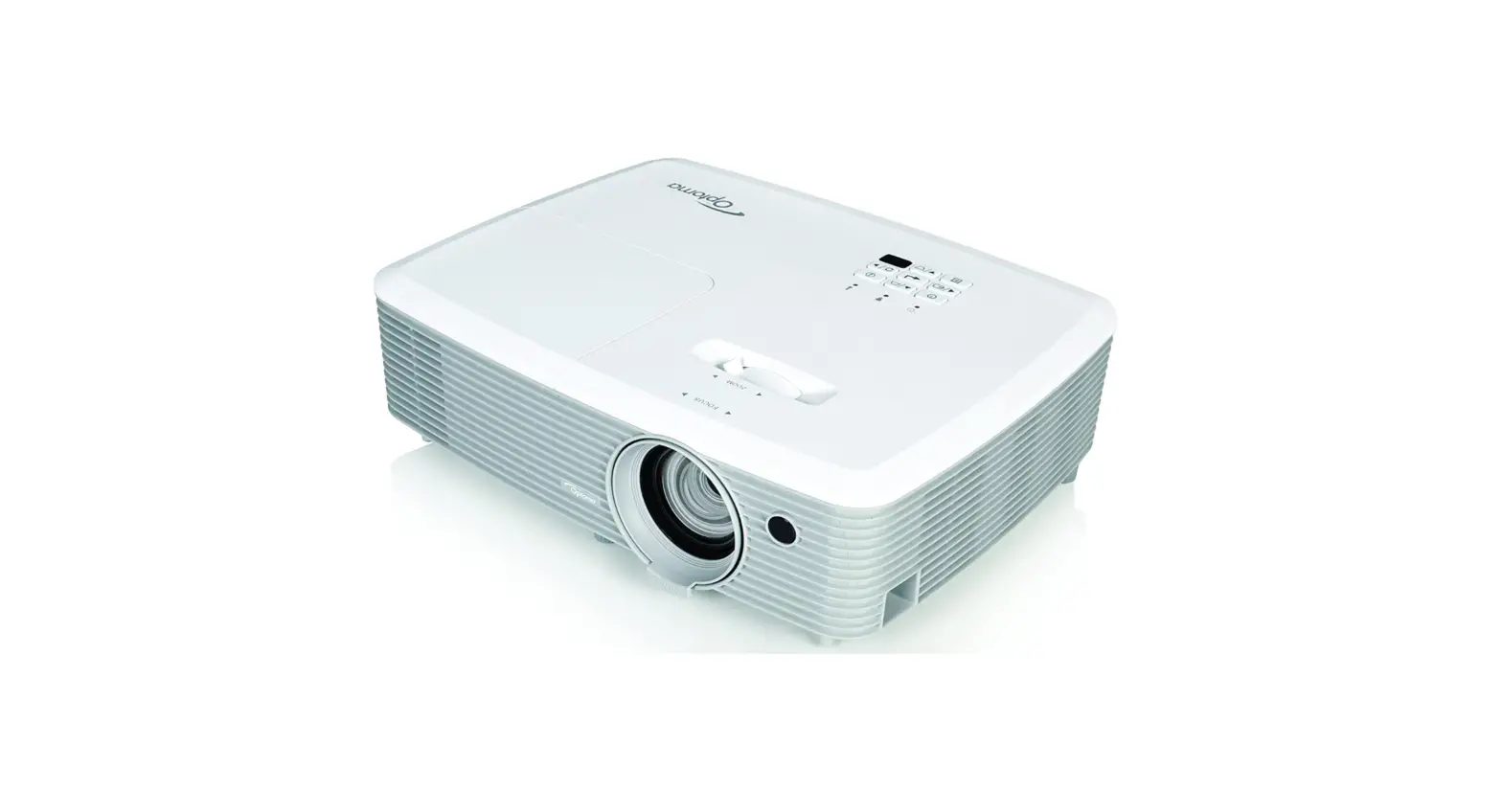
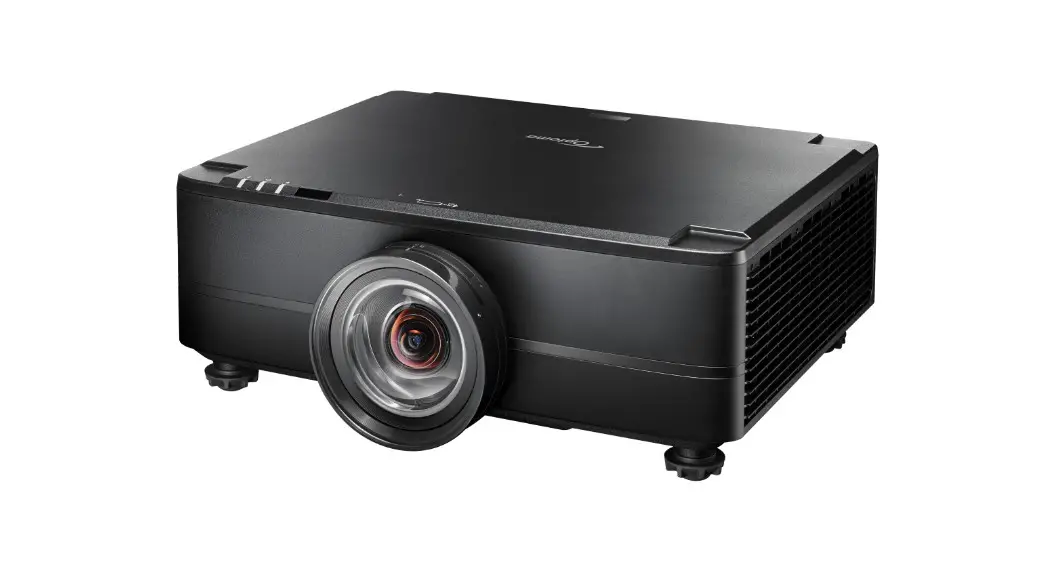
DLP® Projector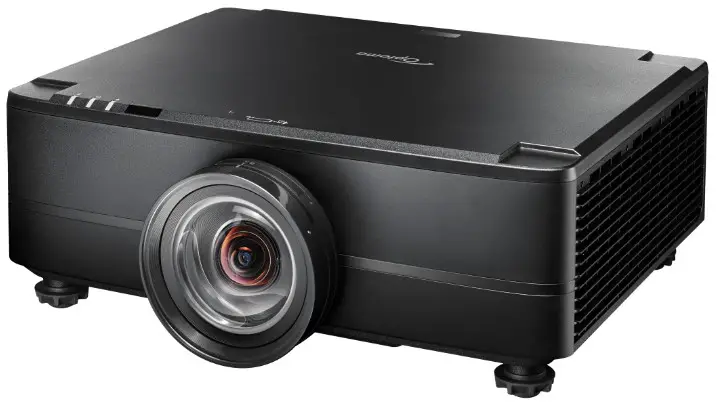

SAFETY
 The lightning flash with arrow head within an equilateral triangle is intended to alert the user to the presence of uninsulated “dangerous voltage within the product’s enclosure that may be of sufficient magnitude to constitute a risk of electric shock to persons. A The exclamation point within an equilateral triangle is intended to alert the user to the presence of important operating and maintenance (servicing) instructions in the literature accompanying the appliance.
 This product is herewith confirmed to comply with the requirements set out in the Council Directives on the Approximation of the laws of the Member States relating to Electromagnetic Compatibility Directive 2004/108/EEC. Warning
- This product must not be used in residential areas.
- This product may cause interference if used in residential areas.
Such use must be avoided unless the user takes special measures to reduce electromagnetic emissions to prevent interference to the reception of radio and television broadcasts.
Important Safety Instruction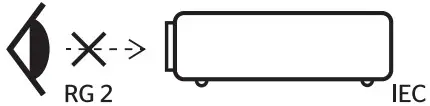
- Do not stare into the beam, RG2.
As with any bright source, do not stare into the direct beam, RG2 IEC 62471-5:2015. - Do not block any ventilation openings. To ensure reliable operation of the projector and to protect from overheating, it is recommended to install the projector in allocation that does not block ventilation. As an example, do not place the projector on a crowded surface. Do not put the projector in an enclosure such as a book case or a cabinet that restricts air flow.
- To reduce the risk of fire and/or electric shock, do not expose the projector to rain or moisture. Do not install near heat sources such as radiators, heaters, stoves or any other apparatus such as amplifiers that emits heat.
- Do not let objects or liquids enter the projector. They may touch dangerous voltage points and short out parts that could result in fire or electric shock.
- Do not use under the following conditions:
– In extremely hot, cold or humid environments.
(i) Ensure that the ambient room temperature is within 5°C — 40°C (41°F — 104°F)
(ii) Relative humidity is 10% — 85%
– In areas susceptible to excessive dust and dirt.
– Near any appliance generating a strong magnetic field. In direct sunlight. - Do not use the unit if it has been physically damaged or abused. Physical damage/abuse would be (but not limited to):
– Unit has been dropped.
– Power supply cord or plug has been damaged.
– Liquid has been spilled on to the projector.
– Projector has been exposed to rain or moisture.
– Something has fallen in the projector or something is loose inside. - Do not place the projector on an unstable surface. The projector may fall over resulting in injury or the projector may become damaged.
- Do not block the light coming out of the projector lens when in operation. The light will heat the object and could melt, cause bums or start a fire.
- Please do not open or disassemble the projector as this may cause electric shock.
- Do not attempt to service the unit yourself. Opening or removing covers may expose you to dangerous voltages or other hazards. Please call Optoma before you send the unit for repair.
- See projector enclosure for safety related markings.
- The unit should only be repaired by appropriate service personnel.
- Only use attachments/accessories specified by the manufacturer.
- Do not look straight into the projector lens during operation. The bright light may harm your eyes.
- When switching the projector off, please ensure the cooling cycle has been completed before disconnecting power. Allow 90 seconds for the projector to cool down.
- Turn off and unplug the power plug from the AC outlet before cleaning the product.
- Use a soft dry cloth with mild detergent to clean the display housing. Do not use abrasive cleaners, waxes or solvents to clean the unit.
- Disconnect the power plug from the AC outlet if the product will not be used for a long period of time.
- Do not setup the projector in places where it might be subjected to vibration or shock.
- Do not touch the lens with bare hands.
- Remove battery/batteries from remote control before storage. If the battery/batteries are left in the remote for long periods, they may leak.
- Do not use or store the projector in places where smoke from oil or cigarettes may be present, as it can adversely affect the quality of the projector performance.
- Please follow the correct projector orientation installation as non standard installation may affect the projector performance.
- Use a power strip and/or surge protector. As power outages and brown-outs can KILL devices.
Cleaning the Lens
- Before cleaning the lens, be sure to turn off the projector and unplug the power cord to allow it to completely cool down.
- Use a compressed air tank to remove the dust.
- Use a special cloth for cleaning lens and gently wipe the lens. Do not touch the lens with your fingers.
- Do not use alkaline/acid detergents or volatile solvents such as alcohol for cleaning lens. If the lens is damaged due to the cleaning process, it is not covered by the warranty.
Warning
- Do not use a spray containing flammable gases to remove dust or dirt from the lens. This may cause a fire due to excessive heat inside the projector.
- Do not clean the lens if the projector is warming up as this may cause the lens’ surface film to peel off.
- Do not wipe or tap the lens with a hard object.
- MOUNT ABOVE THE HEADS OF CHILDREN. The use of a ceiling mount is recommended with this product to place it above the eyes of children.
WARNING: MOUNT ABOVE THE HEADS OF CHILDREN.” Additional warning against eye exposure for close exposures less than 1 m.
Laser Safety Information
- Complies with 21 CFR 1040.10 and 1040.11 except for conformance as a Risk Group 2 LIP as defined in IEC 62471-5:Ed. 1.0. For more information see Laser Notice No. 57, dated May 8, 2019. IEC 60825- 1:2014: CLASS 1 LASER PRODUCT – RISK GROUP 2
 IEC/EN 60825-1:2014 CLASS 1 LASER PRODUCT RISK GROUP 2 Complies with 21 CFR 1040.10 and 1040.11 except for conformance as a Risk Group 2 LIP a s defined i n IEC 62471-5:Ed. 1.0. For more information see Laser Notice No. 57, dated May 8, 2019.
 - This projector has built-in Class 4 laser module. Disassembly or modification is very dangerous and should never be attempted.
- Any operation or adjustment not specifically instructed by the user’s guide creates the risk of hazardous laser radiation exposure.
- Do not open or disassemble the projector as this may cause damage by the exposure of laser radiation.
- Do not stare into beam when the projector is on. The bright light may result in permanent eye damage.
- When tuming on the projector, make sure no one within projection range is looking at the lens.
- Without following the control, adjustment or operation procedure may cause damage by the exposure of laser radiation.
- Adequate instructions for assembly, operation, and maintenance, including clear wamings concerning precautions to avoid possible exposure to laser and collateral radiation in excess of the accessible emission limits in Class 2.
- The Class A digital apparatus meets all requirements of the Canadian Interference-Causing Equipment Regulation. Interference-Causing Equipment Regulation. Cet appareil numerique de la class A respecte toutes les exigences du Reglement sur le materiel brouilleur du Canada.
- Notice is given to supervise children and to never allow them to stare into the projector beam at any distance from the projector. Notice is given to use caution when using the remote control for starting the projector while in front of the projection lens.
- Notice is given to the user to avoid the use of optical aids such as binoculars or telescopes inside the beam
 IEC/EN 60825-1:2014 CLASS 1 LASER PRODUCT RISK GROUP 2 Complies with 21 CFR 1040.10 and 1040.11 except for conformance as a Risk Group 2 LIP a s defined i n IEC 62471-5:Ed. 1.0. For more information see Laser Notice No. 57, dated May 8, 2019.
3D Safety Information
Please follow all warnings and precautions as recommended before you or your child use the 3D function. warning
- Children and teenagers may be more susceptible t o health issues associated with viewing i n 3D and should be closely supervised when viewing these images.
Photosensitive Seizure Warning and Other Health Risks
- Some viewers may experience an epileptic seizure or stroke when exposed to certain flashing images or lights contained in certain Projector pictures or video games. If you suffer from, or have a family history of epilepsy or strokes, please consult with a medical specialist before using the 3D function.
- Even those without a personal or family history of epilepsy or stroke may have an undiagnosed condition that can cause photosensitive epileptic seizures.
- Pregnant women, the elderly, sufferers of serious medical conditions, those who are sleep deprived or under the influence of alcohol should avoid utilizing the unit’s 3D functionality.
- If you experience any of the following symptoms, stop viewing 3D pictures immediately and consult a medical specialist: (1) altered vision; (2) lightheadedness; (3) dizziness; (4) involuntary movements such as eye or muscle twitching; (5) confusion; (6) nausea; (7) loss of awareness; (8) convulsions; (9) cramps; and/ or (10) disorientation. Children and teenagers may be more likely than adults to experience these symptoms. Parents should monitor their children and ask whether they are experiencing these symptoms.
- Watching 3D projection may also cause motion sickness, perceptual after effects, disorientation, eye strain and decreased postural stability. It is recommended that users take frequent breaks to lessen the potential of these effects. If your eyes show signs of fatigue or dryness or if you have any of the above symptoms, immediately discontinue use of this device and do not resume using it for at least thirty minutes after the symptoms have subsided.
- Watching 3D projection while sitting too close to the screen for an extended period of time may damage your eyesight. The ideal viewing distance should be at least three times the screen height. It is recommended that the viewer’s eyes are level with the screen.
- Watching 3D projection while wearing 3D glasses for an extended period of time may cause a headache or fatigue. If you experience a headache, fatigue or dizziness, stop viewing the 3D projection and rest.
- Do not use the 3D glasses for any other purpose than for watching 3D projection.
- Wearing the 3D glasses for any other purpose (as general spectacles, sunglasses, protective goggles, etc.) may be physically harmful to you and may weaken your eyesight.
- Viewing in 3D projection may cause disorientation for some viewers. Accordingly, DO NOT place your 3D PROJECTOR near open stairwells, cables, balconies, or other objects that can be tripped over, run into, knocked down, broken or fallen over.
Copyright
This publication, including all photographs, illustrations and software, i s protected under international copyright laws, with all rights reserved. Neither t h i s manual, nor any o f the material contained herein, may be reproduced without written consent of the author.
© Copyright 2022
Disclaimer
The information in this document is subject to change without notice. The manufacturer makes no representations or warranties with respect to the contents hereof and specifically disclaims any implied warranties of merchantability or fitness for any particular purpose. The manufacturer reserves the right to revise this publication and to make changes from time to time i n the content hereof without obligation o f the manufacturer to notify any person o f such revision or changes.
Trademark Recognition
Kensington is a U.S. registered trademark of ACCO Brand Corporation with issued registrations and pending applications in other countries throughout the world.
HDMI, the HDMI Logo, and High-Definition Multimedia Interface are trademarks or registered trademarks of HDMI Licensing LLC in the United States and other countries.
DLP0, DLP Link and the DLP logo are registered trademarks of Texas Instruments and BrilliantColorTM is a trademark of Texas Instruments.
HDBaseTTm and the HDBaseT Alliance logo are trademarks of the HDBaseT Alliance. All other product names used in this manual are the properties of their respective owners and are Acknowledged.
FCC Notice
This Equipment has been tested and found to comply with the limits for a Class A digital device, pursuant to part 15 of the FCC Rules. These limits are designed to provide reasonable protection against harmful interference when the equipment is operated in a commercial environment. This equipment generates, uses, and can radiate radio frequency energy and, if not installed and used in accordance with the instruction manual, may cause harmful interference to radio communications.
Operation of this equipment in a residential area is likely to cause harmful interference in which case the user will be required to correct the interference at his own expense. Notice: Shielded cables
All connections to other computing devices must be made using shielded cables to maintain compliance with FCC regulations.
Caution
Changes or modifications not expressly approved by the manufacturer could void the users authority, which is granted by the Federal Communications Commission, to operate this projector.
Operation Conditions
This device complies with Part 15 of the FCC Rules. Operation is subject to the following two conditions:
- This device may not cause harmful interference and
- This device must accept any interference received, including interference that may cause undesired operation.
Notice: Canadian users
This Class A digital apparatus complies with Canadian ICES-003.
Remarque a I’intention des utilisateurs canadiens
Cet appareil numerique de la classe A est conforme a la norme NMB-003 du Canada.
Declaration of Conformity for EU countries
- EMC Directive 201 4/30/EC (including amendments)
- Low Voltage Directive 2014/35/EC
- RED 2014/53/EU (if product has RF function)
WEEE Disposal instructions
Do not throw this electronic device into the trash when discarding. To minimize pollution and ensure utmost protection of the global environment, please recycle it.
CAUTION: This equipment is equipped with a three-pin grounding-type power plug. Do not remove the grounding pin on the power plug. This plug will only fit a grounding-type power outlet. This is a safety feature. If you are unable to insert the plug into the outlet, contact an electrician. Do not defeat the purpose of the grounding plug.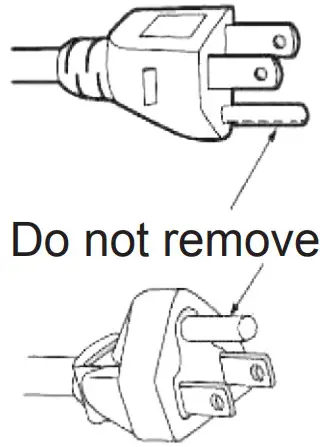 Warning: Do not remove the earthing pin on the mains plugs. This apparatus is equipped with a three prong earthing type mains plug. This plug will only fit an earthing-type mains socket. This is a safety feature. If you are unable to insert the plug into the mains socket, contact an electrician. Do not defeat the purpose of the earthing plug.
INTRODUCTION
Package Overview
Carefully unpack and verify that you have the items listed below under standard accessories. Some of the items under optional accessories may not be available depending on the model, specification and your region of purchase. Please check with your place of purchase. Some accessories may vary from region to region.
The warranty card i s only supplied i n some specific regions. Please consult your dealer for detailed information.
Standard Accessories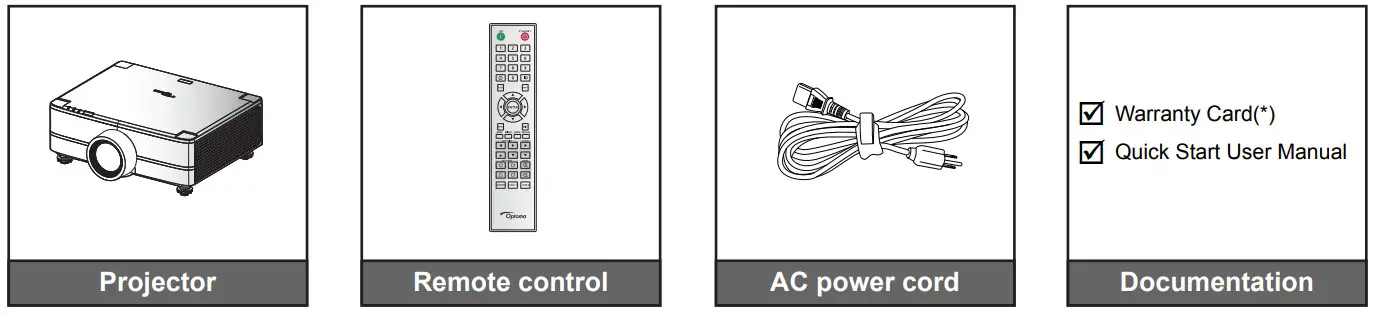 Note:
Note:
- The actual remote control may vary depending on the region.
- (*) For European warranty Information, please visit www.optoma.com.
 Please scan the OPAM warranty QR code or visit the following URL:
https://www.optoma.com/us/support/Wwarranty-and-return-policy/  Please scan the Asia-Pacific QR code or visit the following URL:
https://www.optoma.com/support/download
Product Overview 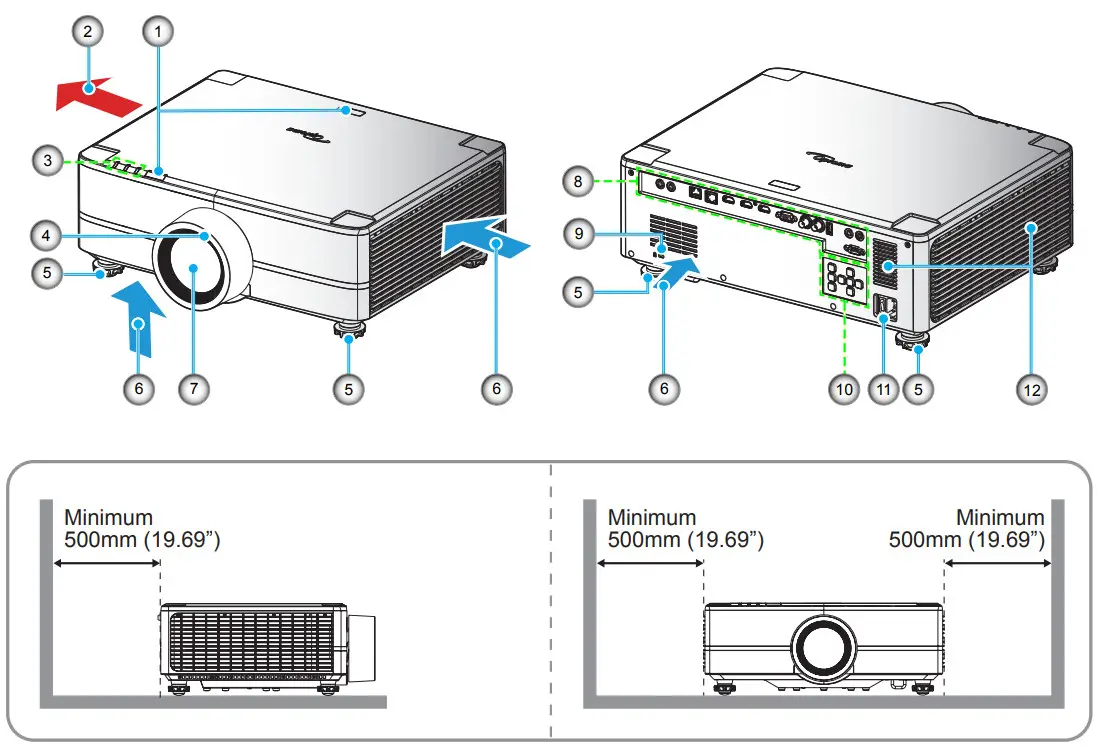 Note:
Note:
- Do not block projector intake and exhaust vents.
- When operating the projector in an enclosed space, allow a t least 500mm (19.69”) clearance around the intake and exhaust vents.
| No. | P Item |
| 1. | IR Receiver |
| 2. | Ventilation (Outlet) |
| 3. | LED Indicators |
| 4. | Deco Ring (1.6x lens / Fixed lens models) |
| 5. | Tilt-Adjustment Foot |
| 6. | Ventilation (Inlet) |
| 7. | Projection Lens |
| 8. | Input / Output |
| 9. | KensingtonTM Lock Port |
| 10. | Control Panel |
| 11. | Power Socket / Power Switch |
| 12. | Speakers |
Connections 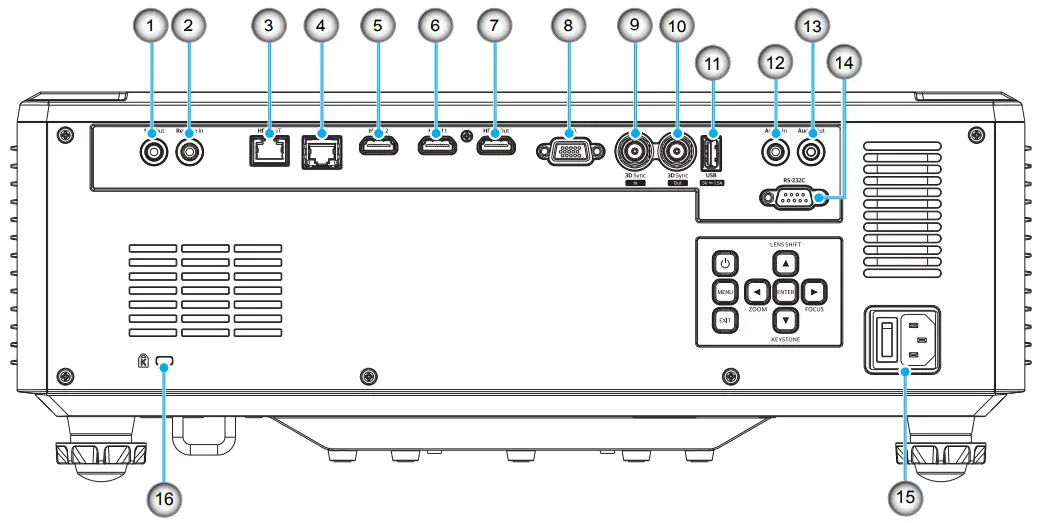
| No. | Item | Cable | Example Connections¹ |
| 1. | 12V Out Connector | 12V Trigger Cable | Motorized screen. Curtain, etc |
| 2. | Remote In Connector | Wired Remote Control Cable or IR Receiver Cable (3.5mm TRS type2) | RCU |
| 3. | HDBaseT Connector | RJ-45 Cable | Media Play |
| 4. | LAN Connector | RJ-45 Cable | Local or Company Network |
| 5. | HDMI 2 Connector | HDMI Cable | Computer, Game, Console, Media Play |
| 6. | HDMI 1 Connector | HDMI Cable | Computer, Game, Console, Media Play |
| 7. | HDMI Out Connector | HDMI Cable | Screen |
| 8. | VGA Connector | VGA Cable | Computer |
| 9. | 3D Sync In Connector | 3D Sync Cable | Computer |
| 10. | 3D Sync Out Connector | 3D Emitter Cable | 3D Emitter |
| 11. | USB Connector (Power 5V-1.5A)4 | USB (A to A) Cable | USB Flash Drive |
| 12. | Audio In Connector | Audio In Cable | Media Play |
| 13. | Audio Out Connector | Audio Out Cable | Speaker, Media Play |
| 14. | RS-232C Connector | RS232 Cable | Computer |
| 15. | Power Socket / Power Switch | Power Cord | Projector |
| 16. | Kensington TM Lock Port | Protection Cable | Projector |
Note:
- These are just a few examples of what you can connect. There may be more options available for each port.
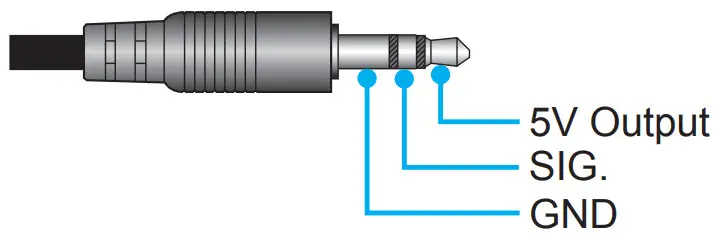
- 3.5mm TRS type.

- Not recommended for charging a cell phone.
Keypad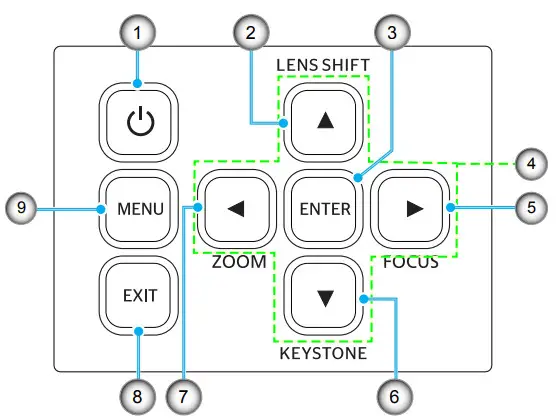
| No. | Button | Function |
| 1. | Power Button | Turns the projector on or off. |
| 2. | Lens Shift | Adjust the lens vertical / horizontal position. |
| 3. | Enter | Confirm the settings. |
| 4. | Four Directional Select Keys | Navigation keys. |
| 5. | Focus | Adjust the image focus. |
| 6. | Keystone Correction | Adjust the keystone correction. |
| 7. | Zoom | Adjust the image size. |
| 8. | Exit | Returns to previous menu or exit menu if at top level. |
| 9. | Menu | Shows the main menu on screen. |
Remote Control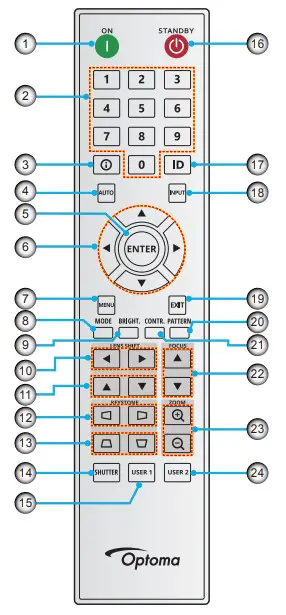
| No. | Button | Function |
| 1 | Power On | Turn the projector on. |
| 2 | Number Keys | Input numbers (0-9). |
| 3 | Info | Display information on the screen image. |
| 4 | Auto | Automatically synchronize the projector to an input source. |
| 5 | Enter | Press to confirm the selection. |
| 6 | Arrow Keys | Use arrow keys to navigate through the menu or select the appropriate settings. |
| 7 | Menu | Show the main menu on the screen. |
| 8 | Mode | Press to select the preset display mode. |
| 9 | Brightness | Set the brightness of the image. |
| 10 | Left Shift (Horizontal) | Adjust the image position horizontally. |
| 11 | Left Shift (Vertical) | Adjust the image position vertically. |
| 12 | Keystone (Horizontal) | Adjust a horizontally keystone image. |
| 13 | Keystone (Vertical) | Adjust a vertically keystone image. |
| 14 | Shutter | Momentarily turn off/on the screen (AV Mute). |
| 15 | User 1 | Press to assign custom functions. See user guide for more info. |
| 16 | Standby | Turn the projector off. |
| 17 | ID | Set the projector address. |
| 18 | Input | Select an input source manually. |
| 19 | Exit | Back to previous menu. |
| 20 | Pattern | Display test pattern. |
| 21 | Contrast | Set the contrast of the image. |
| 22 | Focus | Adjust the image focus. |
| 23 | Zoom | Adjust the image size. |
| 24 | User 2 | Press to assign custom functions. See user guide for more info. |
Note: Some keys may have no function for models that do not support these features.
SETUP AND INSTALLATION
Connecting Sources to the Projector 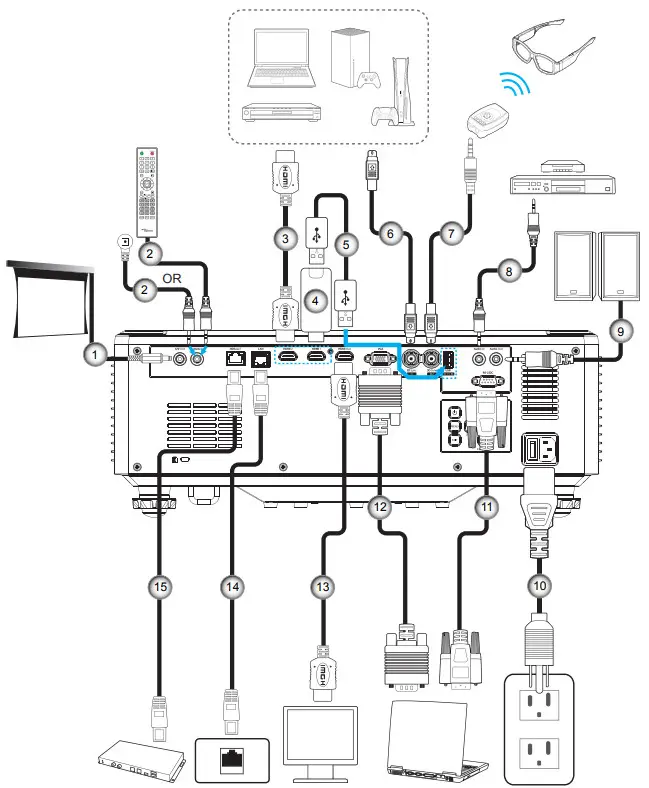
| No. | Item |
| 1 | 12V DC Jack |
| 2 | Wired Remote Control Cable or IR Receiver Cable (3.5mm TRS type) |
| 3 | HDMI Cable |
| 4 | HDMI Dongle |
| 5 | USB (A to A) Cable |
| 6 | 3D Sync Cable |
| 7 | 3D Emitter Cable |
| 8 | Audio In Cable |
| 9 | Audio Out Cable |
| 10 | Power Cord |
| 11 | RS232 Cable |
| 12 | VGA Cable |
| 13 | HDMI Cable |
| 14 | RJ-45 Cable |
| 15 | RJ-45 Cable |
Adjusting the Projector Image
Adjusting the Projector’s Height
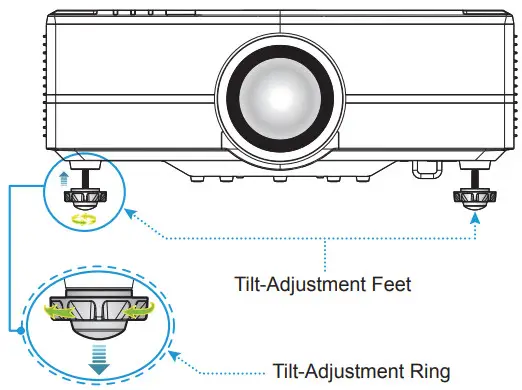
The projector is equipped with elevator feet for adjusting the image height.
- Locate the adjustable foot you wish to adjust on the underside of the projector.
- Rotate the adjustable foot clockwise or counterclockwise to raise or lower the projector.
 Adjusting the Projection Image Shift
The projection lens can be moved up, down, right, and left with the motor-driven lens shift function. This function makes the positioning of images easy on the screen. Lens shift is generally expressed as a percentage of the image height or width, see below illustration.
Vertical / Horizontal Lens Shift 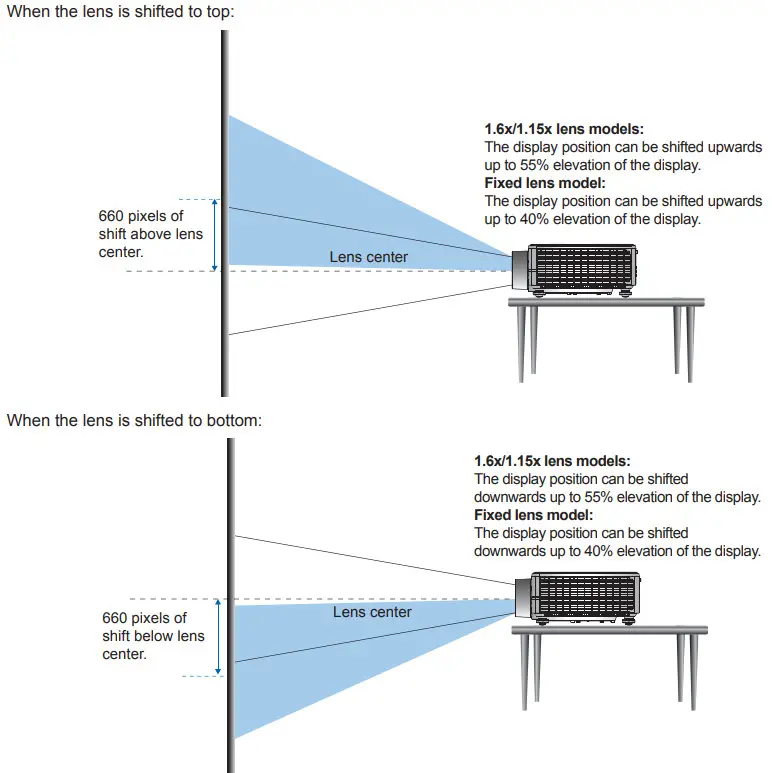
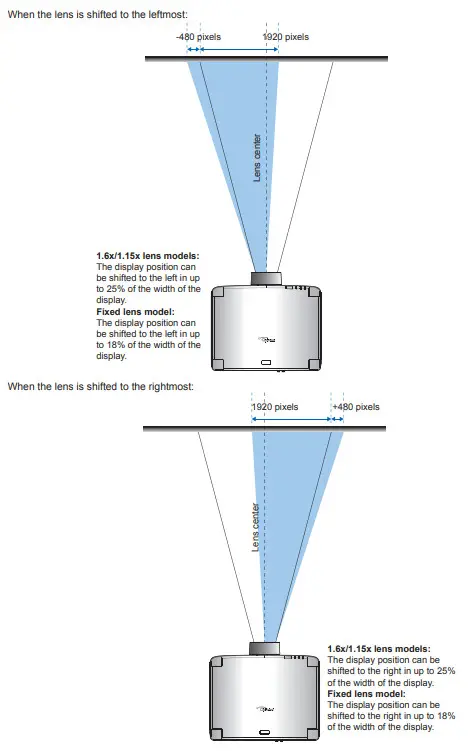 Lens Shift Range
| WUXGA | Lens Shift Range (1/2 image) | |||
| AH | Av | AHo | AVo | |
| 1.6×11.15x lens models | 50% | 110% | 10% | 30% |
| Fixed lens model | 36% | 80% | 0% | 0% |
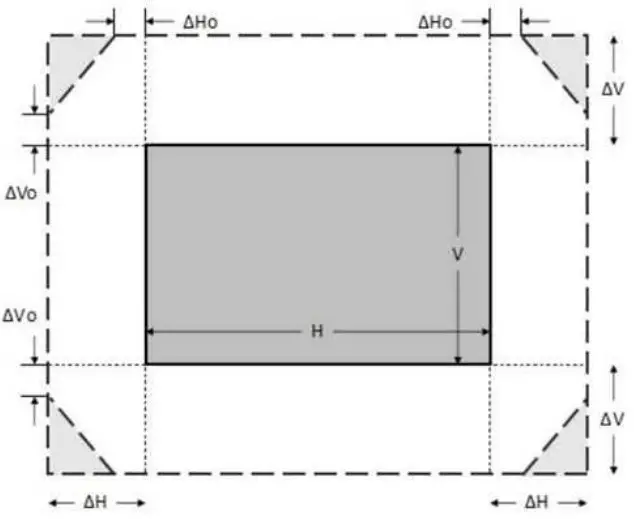 Note:
Note:
a)  H: The lens shift range in horizontal direction when the lens is at the center.
b) V: The lens shift range in vertical direction when the lens is at the center.
c) H0: The lens shift range without vignetting in horizontal direction when the lens is at the top center or the bottom center.
d) V0: The lens shift range without vignetting in vertical direction when the lens is at the middle right or the middle left.
Adjusting the Projector’s Zoom and Focus
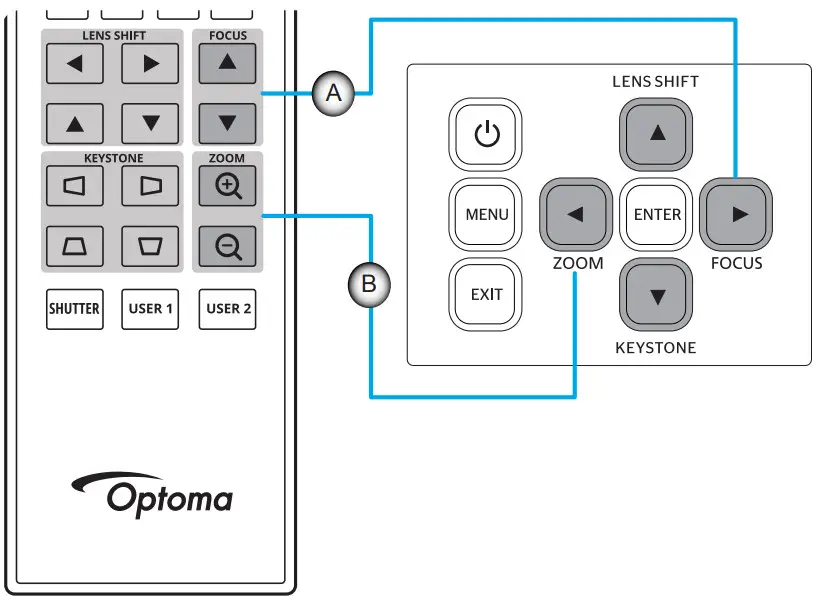
Use the remote control or projector keypad to adjust the zoom and focus of the projected image.
- To adjust the image focus, press Focus and the
 buttons until the image is sharp and legible. A
 - To adjust the image size, press Zoom and the

 buttons on the remote control or
 on the keypad to get the required image size. B
Adjusting the Projector Position
When you select a position for the projector, consider the size and shape of your screen, the location of your power outlets, and the distance between the projector and the rest of your equipment.
Follow these general guidelines:
- Position the projector on a flat surface at a right angle to the screen. The 1.6x/1.15x lens models projector (with the standard lens) must be at least 60 inch (1.52m) from the projection screen. The fixed lens model projector (with the standard lens) must be at least 40 inch (1.02m) from the projection screen.
- Position the projector to the desired distance from the screen. The distance from the lens of the projector to the screen, the zoom setting, and the video format determine the size of the projected image.
- Lens throw ratio:
1.6x lens model:1.25 — 2.0
1.15x lens model: 0.65 — 0.75
Fixed lens model: 0.63
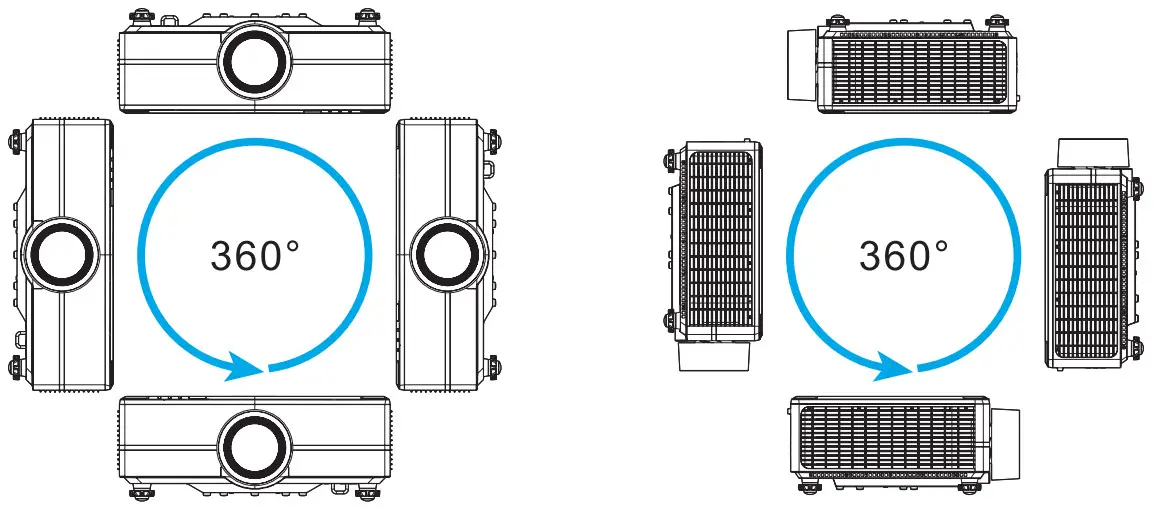
360 degrees free orientation operation.
- When installing multiple projectors, keep at least 1000mm (39.4″) space between the adjacent projectors.
- For ceiling/wall mount installations, make sure to leave 15 mm (0.6″) between the ceiling mount and the bottom intake vents of the projector.
Remote Setup
Install / Replacing Remote Control Batteries
Two AAA size batteries are supplied for the remote control.
- Remove the battery cover on the back of the remote control.
- Insert AAA batteries in the battery compartment as illustrated.
- Replace back cover on remote control.

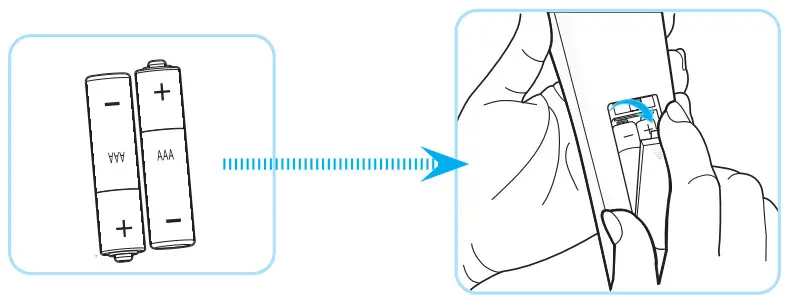
Note: Replace only with the same or equivalent type batteries.
CAUTION
Improper use of batteries can result in chemical leakage or explosion. Be sure to follow the instructions below.
- Do not mix batteries of different types. Different types of batteries have different characteristics.
- Do not mix old and new batteries. Mixing old and new batteries can shorten the life of new batteries or cause chemical leakage in old batteries.
- Remove batteries as soon as the are depleted. Chemicals that leak from batteries that come in contact with skin can cause a rash. If you find any chemical leakage, wipe thoroughly with a cloth.
- The batteries supplied with this product may have a shorter life expectancy due to storage conditions.
- If you will not be using the remote control for an extended period of time, remove the batteries.
- When you dispose of the batteries, you must obey the law in the relative area or country.
Remote Control Effective Range
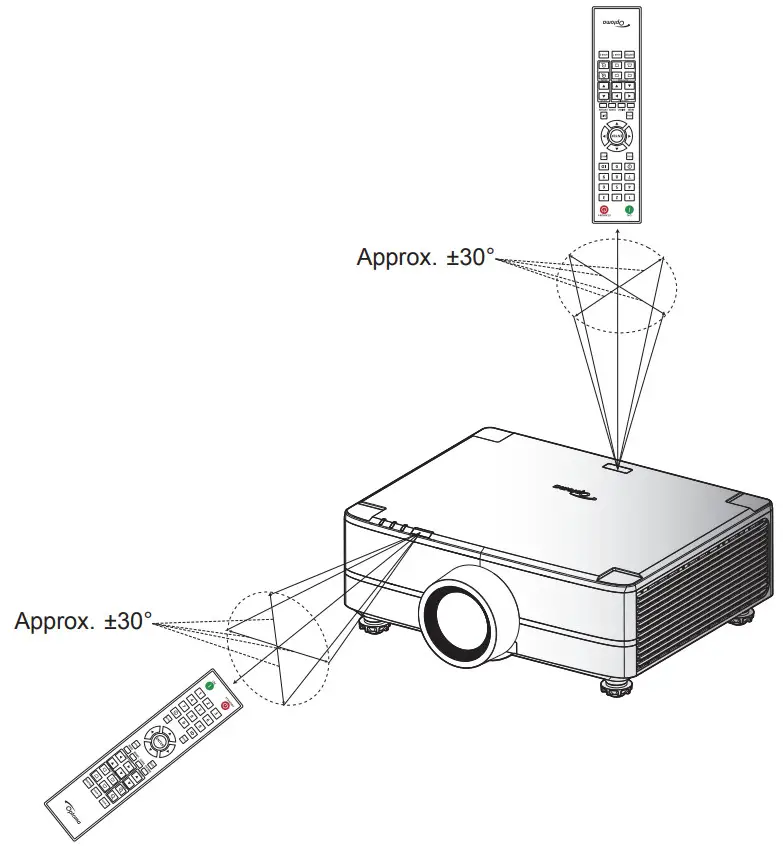
Infra-Red (IR) remote control sensor is located on the top and front sides of the projector. Ensure to hold the remote control at an angle within 30 degrees perpendicular to the projector’s IR remote control sensor to function correctly. The distance between the remote control and the sensor should not be longer than 20 meters (65.6 feet) when holding not longer than 30 meters (98.4 feet) when aiming the sensor at 0°.
- Make sure that there are no obstacles between the remote control and the IR sensor on the projector that might obstruct the infra-red beam.
- Make sure the IR transmitter of the remote control is not being shined by sunlight or fluorescent lamps directly.
- Please keep the remote controller away from fluorescent lamps for over 2 m or the remote controller might become malfunction.
- If the remote control is close to Inverter-Type fluorescent lamps, it might become ineffective from time to time.
- If the remote control and the projector are within a very short distance, the remote control might become ineffective.
- When you aim at the screen, the effective distance is less than 5 m from the remote control to the screen and reflecting the IR beams back to the projector. However, the effective range might change according to screens.

USING THE PROJECTOR
Powering On / Off the Projector
Powering On
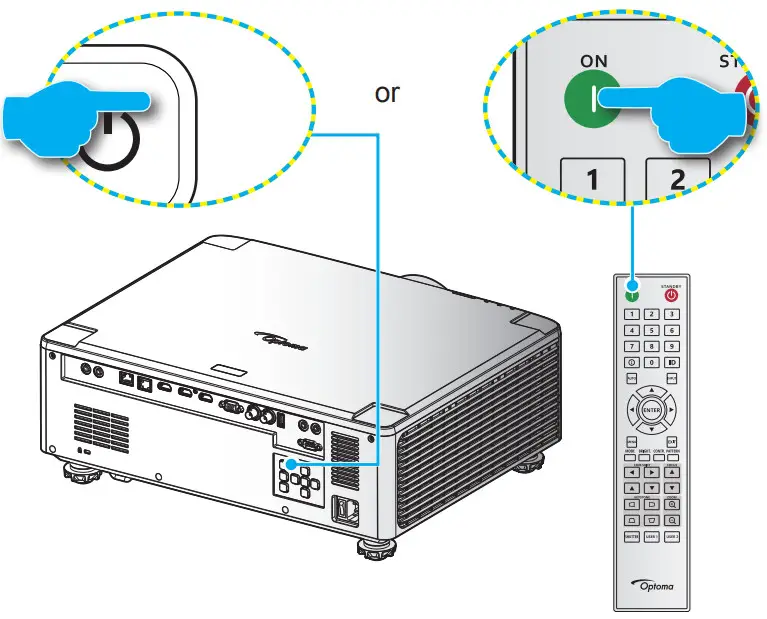
- Securely connect the power lead and signal/source cable. When connected, the power LED will turn red.
- Set the power switch to the “
 ” (On) position and wait until the “
  ” button on the projector keypad is solid red.
- Turn on the projector by pressing the “ ” button on the projector keypad or remote control. During startup the power LED is flashing red and during normal operation, the power LED is solid green.

 ” (On) position and wait until the “
  ” button on the projector keypad is solid red.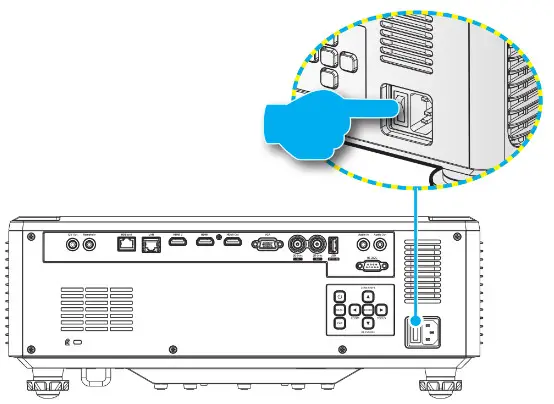
Powering Off
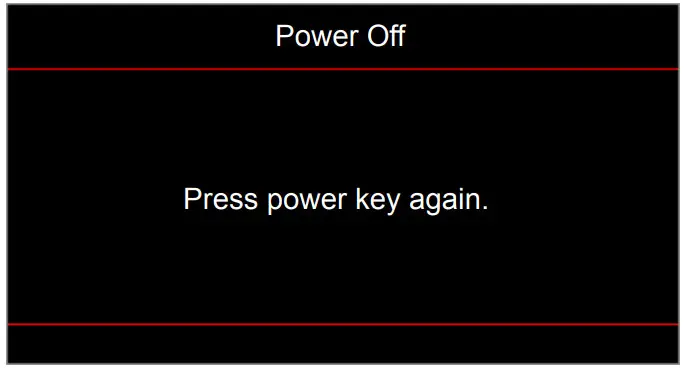
- Turn off the projector by pressing the “ ” button on the projector keypad or the button on the remote control. The following message will be displayed:

- Press the or button again to confirm, otherwise the message will disappear after 15 seconds. When you press the or button for the second time, the projector will shut down.
- During the cooling cycle, the power LED is flashing green. When the power LED turns solid red, this indicates the projector has entered standby mode. If you wish to turn the projector back on, you must wait until the cooling cycle has finished and the projector has entered standby mode. When the projector is in standby mode, simply press the “ ” button on the projector or the remote control again to turn on the projector.
- Disconnect the power cord from the electrical outlet and the projector.
Note:
It is not recommended that the projector is turned on immediately, right after a power off procedure. By default, the projector turns off automatically after 20 minutes of inactivity. You can modify the idle time length in “Auto Power off (min.)” menu in “System Settings → Power”. If you want the projector to enter standby mode instead, disable auto power off and set the sleep time interval in “System Settings → Power →Sleep Timer (min.)”.
Menu navigation and features
The projector has multilingual on-screen display (OSD) menus that allow you to make image adjustments and change a variety of settings.
- To open the OSD menu, press the Menu key on the remote control or projector keypad.
- To select a main menu or sub menu, use the buttons to highlight it. Then, press the Enter button to enter the sub menu.
- Press the Exit button to return to the previous menu or exit the OSD menu if at top level.
Setting methods to adjust the function value or selection an option.
• To adjust the slide bar values, highlight the function, and use the  buttons to change value.
• To check or uncheck a checkbox, highlight the function, and press Enter.
• To input a number or symbol, highlight the number or symbol, and use the  buttons to make a selection. You can also use the number keys on the remote control or keypad.
• To select a function option, use the  buttons to make the selection. If no Enter icon shows at the navigation bar, the highlighted option is automatically applied. If there is an Enter icon at the navigation bar, press Enter to confirm your selection.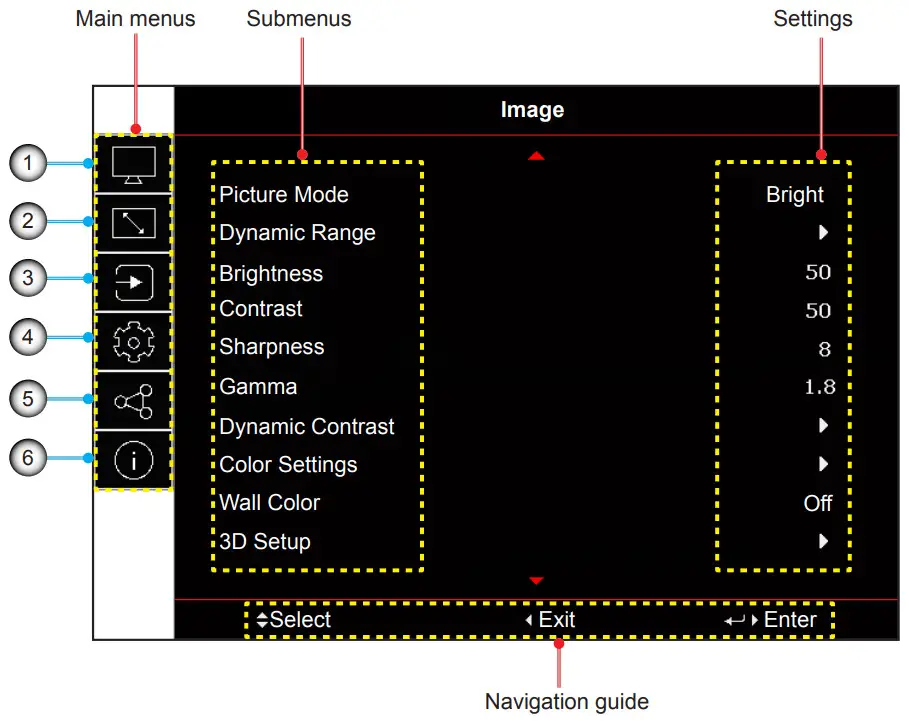
| No | Item |
| 1. | Image menu |
| 2. | Display menu |
| 3. | Input settings menu |
| 4 | Device setup menu |
| 5 | Communication menu |
| 6 | Information menu |
OSD menu tree
| Main Menu | Sub Menu 2 | Sub Menu 3 | Sub Menu 4 | Sub Menu 5 | Sub Menu 6 | Values |
| Image | Picture Mode | Presentation | ||||
| Bright [default] | ||||||
| Cinema | ||||||
| HDR | ||||||
| sRGB | ||||||
| DICOM SIM. | ||||||
| Blending | ||||||
| 3D | ||||||
| 2D High Speed | ||||||
| User | ||||||
| Dynamic Range | HDR | Off | ||||
| Auto [default] | ||||||
| HDR Picture Mode | Bright | |||||
| Standard [default] | ||||||
| Film | ||||||
| Detail | ||||||
| Brightness | 0~100 [default: 50] | |||||
| Contrast | 0~100 [default: 50] | |||||
| Sharpness | 1~15 [default: 10] | |||||
| Gamma | Film | |||||
| Graphics | ||||||
| Standard(2.2) | ||||||
| Vivid | ||||||
| 3D | ||||||
| Blackboard | ||||||
| DICOM SIM. | ||||||
| 1.8 | ||||||
| 2.0 | ||||||
| 2.4 | ||||||
| 2.6 | ||||||
| Dynamic Contrast | Dynamic Black | Off [default] | ||||
| On | ||||||
| Speed | 1~15 [default: 1] | |||||
| Strength | 0~3 [default: 2] | |||||
| Level | 50%~100% [default: 100%] | |||||
| Extreme Black | Off [default] | |||||
| On | ||||||
| AV Mute Timer | 0s~10s [default: 0s] | |||||
| Black Signal Level | 0~5 [default: 0] |
| Main Menu | Sub Menu 2 | Sub Menu 3 | Sub Menu 4 | Sub Menu 5 | Sub Menu 6 | Values |
| Image | Color Settings | Color | 0~100 [default: 60] | |||
| Tint | 0~100 [default: 50] | |||||
| Color Temperature | Warm | |||||
| Standard [default] | ||||||
| Cool | ||||||
| Color Wheel Speed | 2X | |||||
| 3X [default] | ||||||
| White Balance | Red Gain | 0-100 [default: 50] | ||||
| Green Gain | 0-100 [default: 50] | |||||
| Blue Gain | 0-100 [default: 50] | |||||
| Red Offset | 0-100 [default: 50] | |||||
| Green Offset | 0-100 [default: 50] | |||||
| Blue Offset | 0-100 [default: 50] | |||||
| White Enhancement | 0~10 [default: 10] | |||||
| Color Space | Auto [default] | |||||
| RGB (0-255) | ||||||
| RGB (16-235) | ||||||
| REC709 | ||||||
| REC601 | ||||||
| Color Matching | Auto Test Pattern | Off | ||||
| On [default] | ||||||
| Red | Hue | 0~254 [default: 127] | ||||
| Saturation | 0~254 [default: 127] | |||||
| Luminance | 0~254 [default: 127] | |||||
| Green | Hue | 0~254 [default: 127] | ||||
| Saturation | 0~254 [default: 127] | |||||
| Luminance | 0~254 [default: 127] | |||||
| Blue | Hue | 0~254 [default: 127] | ||||
| Saturation | 0~254 [default: 127] | |||||
| Luminance | 0~254 [default: 127] | |||||
| Cyan | Hue | 0~254 [default: 127] | ||||
| Saturation | 0~254 [default: 127] | |||||
| Luminance | 0~254 [default: 127] | |||||
| Magenta | Hue | 0~254 [default: 127] | ||||
| Saturation | 0~254 [default: 127] | |||||
| Luminance | 0~254 [default: 127] | |||||
| Yellow | Hue | 0~254 [default: 127] | ||||
| Saturation | 0~254 [default: 127] | |||||
| Luminance | 0~254 [default: 127] | |||||
| White | Red | 0~254 [default: 127] | ||||
| Green | 0~254 [default: 127] | |||||
| Blue | 0~254 [default: 127] | |||||
| Reset | Yes | |||||
| Cancel [default] |
Main Menu | Sub Menu 2 | Sub Menu 3 | Sub Menu 4 | Sub Menu 5 | Sub Menu 6 | Values |
| Image | Wall Color | Off [default] | ||||
| Blackboard | ||||||
| Light Yellow | ||||||
| Light Green | ||||||
| Light Blue | ||||||
| Pink | ||||||
| Gray | ||||||
| 3D Setup | 3D Mode | Off | ||||
| Active 3D [default] | ||||||
| 3D Format | Auto [default] | |||||
| Frame Packing | ||||||
| Side by Side | ||||||
| Top and Bottom | ||||||
| Frame Sequential | ||||||
| 3D Tech | DLP-link | |||||
| 3D Sync [default] | ||||||
| 3D-2D | 3D [default] | |||||
| L | ||||||
| R | ||||||
| 3D Sync Out | To Emitter [default] | |||||
| To Next Projector | ||||||
| 3D Invert | Off [default] | |||||
| On | ||||||
| Frame Delay | 1~200 [default: 1] | |||||
| Reset | Yes | |||||
| Cancel [default] | ||||||
| Save to User | Yes | |||||
| Cancel [default] | ||||||
| Apply to User | User-Presentation | |||||
| User-Bright [default] | ||||||
| User-Cinema | ||||||
| User-HDR | ||||||
| User-sRGB | ||||||
| User-DICOM SIM. | ||||||
| User-Blending | ||||||
| User-3D | ||||||
| User-2D High Speed | ||||||
| Reset | Yes | |||||
| Cancel [default] |
| Main Menu | Sub Menu 2 | Sub Menu 3 | Sub Menu 4 | Sub Menu 5 | Sub Menu 6 | Values |
| Display | Aspect Ratio | Auto [default] | ||||
| 4:3 | ||||||
| 16:9 | ||||||
| 16:10 | ||||||
| LBX | ||||||
| Native | ||||||
| Digital Zoom | Proportional | Off [default] | ||||
| On | ||||||
| Horizontal | 50%~400% [default: 100] | |||||
| Vertical | 50%~400% [default: 100] | |||||
| Horizontal Shift | 0~100 [default: 50] | |||||
| Vertical Shift | 0~100 [default: 50] | |||||
| Reset | Yes | |||||
| Cancel [default] | ||||||
| Image Shift | H. Position | 0~100 [default: 50] | ||||
| V. Position | 0~100 [default: 50] | |||||
| Reset | Yes | |||||
| Cancel [default] | ||||||
| Geometric Correction | Warp Control | Basic [default] | ||||
| Advanced | ||||||
| AP | ||||||
| Basic Warp | Keystone | Horizontal | 0~40 [default: 20] | |||
| Vertical | 0~40 [default: 20] | |||||
| Pincushion | Horizontal | 0~100 [default: 50] | ||||
| Vertical | 0~100 [default: 50] | |||||
| 4-Corner | Top Left | |||||
| Top Right | ||||||
| Bottom Left | ||||||
| Bottom Right | ||||||
| Advanced Warp | Grid Color | Green [default] | ||||
| Magenta | ||||||
| Red | ||||||
| Cyan | ||||||
| Grid Background | Black [default] | |||||
| Transparent | ||||||
| Warp Setting | Grid Points | 2×2 [default] | ||||
| 3×3 | ||||||
| 5×5 | ||||||
| 9×9 | ||||||
| 17×17 | ||||||
| Warp Inner | Off [default] | |||||
| On | ||||||
| Warp Sharpness | 0~9 [default: 9] | |||||
| Blend Setting | Blend Width | [default: 0] | ||||
| Overlap Grid Number | 4 [default] / 6 / 8 / 10 / 12 | |||||
| Gamma | 1.8 /1.9 /2.0 /2.1 /2.2 [default] /2.3 /2.4 |
| Main Menu | Sub Menu 2 | Sub Menu 3 | Sub Menu 4 | Sub Menu 5 | Sub Menu 6 | Values |
| Display | Geometric Correction | Advanced Warp | Black Level | Area | Bottom [default] | |
| Top | ||||||
| Enable | Off [default] | |||||
| On | ||||||
| Edit Area | ||||||
| Add Point | ||||||
| Remove Point | ||||||
| Brightness | Brightness | |||||
| Red | 0~255 [default: 20] | |||||
| Green | 0~255 [default: 20] | |||||
| Blue | 0~255 [default: 20] | |||||
| Exit | ||||||
| Red | 0~255 [default: 20] | |||||
| Green | 0~255 [default: 20] | |||||
| Blue | 0~255 [default: 20] | |||||
| Reset | Bottom | Yes | ||||
| Cancel [default] | ||||||
| Top | Yes | |||||
| Cancel [default] | ||||||
| All | Yes | |||||
| Cancel [default] | ||||||
| Memory | Save Memory | Memory 1 [default] ~Memory 5 | ||||
| Apply Memory | Memory 1 [default] ~Memory 5 | |||||
| Clear Memory | Yes | |||||
| Cancel [default] | ||||||
| Reset | Yes | |||||
| Cancel [default] | ||||||
| Edge Mask | 0~10 [default: 0] | |||||
| Freeze Screen | Unfreeze [default] | |||||
| Freeze | ||||||
| Test Pattern | Off [default] | |||||
| Green Grid | ||||||
| Magenta Grid | ||||||
| White Grid | ||||||
| White | ||||||
| Black | ||||||
| Red | ||||||
| Green | ||||||
| Blue | ||||||
| Yellow | ||||||
| Magenta | ||||||
| Cyan | ||||||
| ANSI Contrast 4×4 | ||||||
| Color bar | ||||||
| Full screen |
| Main Menu | Sub Menu 2 | Sub Menu 3 | Sub Menu 4 | Sub Menu 5 | Sub Menu 6 | Values |
| Display | PIP/PBP | Screen | Off [default] | |||
| PIP | ||||||
| PBP | ||||||
| Main Source | VGA | |||||
| HDMI1 | ||||||
| HDMI2 | ||||||
| HDBaseT | ||||||
| Sub Source | VGA | |||||
| HDMI1 | ||||||
| HDMI2 | ||||||
| HDBaseT | ||||||
| Swap | Swap | |||||
| Size | Small [default] | |||||
| Medium | ||||||
| Large | ||||||
| Location | PBP, Main Left [default] | |||||
| PBP, Main Top | ||||||
| PBP, Main Right | ||||||
| PBP, Main Bottom | ||||||
| PIP, Bottom Right [default] | ||||||
| PIP, Bottom Left | ||||||
| PIP, Top Left | ||||||
| PIP, Top Right | ||||||
| Reset | Yes | |||||
| Cancel [default] | ||||||
| Input Settings | Auto Source | Off | ||||
| On [default] | ||||||
| Quick Resync | Off | |||||
| On [default] | ||||||
| Active Inputs | VGA [default] | |||||
| HDMI1 | ||||||
| HDMI2 | ||||||
| HDBaseT | ||||||
| Latency | Normal [default] | |||||
| Adjustment | 2D Ultra | |||||
| VGA | Phase | 0 ~ 100 [default: 50] | ||||
| Resolution | [read only] | |||||
| HDMI | Output | HDMI 1 [default] | ||||
| HDMI 2 | ||||||
| HDMI 1 EDID | 1.4 | |||||
| 2.0 [default] | ||||||
| HDMI 2 EDID | 1.4 | |||||
| 2.0 [default] | ||||||
| Reset | Yes | |||||
| Cancel [default] |
Main Menu | Sub Menu 2 | Sub Menu 3 | Sub Menu 4 | Sub Menu 5 | Sub Menu 6 | Values |
| Device Setup | Language | English [default] | ||||
| Deutsch | ||||||
| Français | ||||||
| Italiano | ||||||
| Español | ||||||
| Português | ||||||
| Polski | ||||||
| Nederlands | ||||||
| Norsk | ||||||
| 繁體中文 | ||||||
| 簡体中文 | ||||||
| 日本語 | ||||||
| 한국어 | ||||||
| Русский | ||||||
| Magyar | ||||||
| ไทย | ||||||
| Projection | Ceiling | Auto [default] | ||||
| On | ||||||
| Off | ||||||
| Rear | Off [default] | |||||
| On | ||||||
| Lens Settings | Focus | [Focus for adjust] | ||||
| Zoom | [Zoom for adjust] | |||||
| Lens Shift | [Pattern for adjust] | |||||
| Lens Shift Memory | Save Memory | Memory 1~Memory 5 | ||||
| Apply Memory | Memory 1~Memory 5 | |||||
| Clear Memory | Yes | |||||
| Cancel [default] | ||||||
| Lens Calibration | Yes | |||||
| Cancel [default] | ||||||
| Lens Lock | Lock | |||||
| Unlock [default] | ||||||
| Reset | Yes | |||||
| Cancel [default] | ||||||
| Schedule | Date and Time | Read Only | ||||
| Schedule Mode | Off [default] | |||||
| On | ||||||
| View Today | Monday / Tuesday / Wednesday / Thursday / Friday / Saturday / Sunday [Read only] |
| Main Menu | Sub Menu 2 | Sub Menu 3 | Sub Menu 4 | Sub Menu 5 | Sub Menu 6 | Values |
| Device Setup | Schedule | Monday/Tuesday / Wednesday! Thursday / Friday / Saturday / Sunday | Schedule Enable | Off [default] | ||
| On | ||||||
| Event 01-08 | Time | 00:00 – 23:59 | ||||
| Event 09-16 | Function | Off [default] / Power Settings / Input Source / Light Source Mode / Shutter | ||||
| Event | Off [Function = Off] | |||||
| (Function = Power Settings) | Power On [Function = Power Settings] / Eco /Active / Communication | |||||
| (Function = Input Source) | VGA [Function = Input Source]! HDMI1 / HDMI2 / HDBaseT | |||||
| (Function = Light Source Mode) | Normal Mode [Function = Light Source Mode] / Eco Mode / Custom Brightness | |||||
| (Function = Shutter) | Shutter On [Function = Shutter] / Shutter Off | |||||
| Reset | Yes | |||||
| Cancel [default] | ||||||
| Copy Events To | Monday / Tuesday / Wednesday / Thursday / Friday / Saturday / Sunday | |||||
| Reset the Day | Yes | |||||
| Cancel [default] | ||||||
| Reset Schedule | Yes | |||||
| Cancel [default] | ||||||
| Date and Time | Clock Mode | Use NTP Server [default] | ||||
| Manual | ||||||
| Date | 2000- 2037 (Year) [default 2020] | |||||
| 01 – 12 (Month) [default: 1] | ||||||
| 01 – 31 (Day)[ default 1] | ||||||
| Time | 00 – 23 (Hour) [default: 0] | |||||
| 00 – 59 (Minute) [default: 0] | ||||||
| Daylight Saving Time | Off [default] | |||||
| On | ||||||
| NTP Server | time.google.com [default] | |||||
| asia.pool.ntp.org | ||||||
| europe.pool.ntp.org | ||||||
| north-amedca.pool.ntp.org | ||||||
| Time Zone | [default: UTC+00:00] | |||||
| Update Interval | Hourly [default] | |||||
| Daily | ||||||
| Apply | Yes | |||||
| Cancel [default] |
| Main Menu | Sub Menu 2 | Sub Menu 3 | Sub Menu 4 | Sub Menu 5 | Sub Menu 6 | Values |
| Device Setup | Power Settings | Power Mode | Eco | |||
| (Standby) | Active | |||||
| Communication [default] | ||||||
| Signal Power On | Off [default] | |||||
| On | ||||||
| Auto Power Off | 0 – 180m [default Om] | |||||
| Steep Timer | 0 – 16h [default: Oh] | |||||
| 12V Trigger | Off [default] | |||||
| On | ||||||
| Reset | Yes | |||||
| Cancel [default] | ||||||
| Light Source Settings | Light Source Mode | Normal [default] | ||||
| Eco Mode | ||||||
| Custom Power | ||||||
| Custom Brightness | Brightness Level | 30% – 100% [default 100%) | ||||
| Constant Brightness | Off [default] | |||||
| On | ||||||
| Shutter | Fade-In | 0.5 – 5s [default: 0.5s] | ||||
| Fade-Out | 0.5 – 5s [default: 0.5s] | |||||
| Startup | Shutter Off [default] | |||||
| Shutter On | ||||||
| Audio | Mute | Off [default] | ||||
| On | ||||||
| Volume | 0 – 10 [default: 5] | |||||
| Security | Security | Off [default] | ||||
| On | ||||||
| Security Timer | Month | 0 – 35 [default: 0] | ||||
| Day | 0 – 29 [default: 0] | |||||
| Hour | 0 – 23 [default: 0] | |||||
| Change Password | ||||||
| On Screen Display | Menu Location | Top Left | ||||
| Top Right | ||||||
| Center [default] | ||||||
| Bottom Left | ||||||
| Bottom Right | ||||||
| Menu Transparency | 0 – 9 [default 0] | |||||
| Menu Timer | Off | |||||
| 5s | ||||||
| lOs | ||||||
| 15s [default] | ||||||
| 30s | ||||||
| 60s | ||||||
| Information Hide | Off [default] | |||||
| On | ||||||
| Background | Blue | |||||
| Black | ||||||
| White | ||||||
| Logo [default] |
| Main Menu | Sub Menu 2 | Sub Menu 3 | Sub Menu 4 | Sub Menu 5 | Sub Menu 6 | Values |
| Device Setup | Logo Setup | Change Logo | Default Logo [default] | |||
| Neutral | ||||||
| User Logo | ||||||
| Captured Logo | ||||||
| Logo Capture | Yes | |||||
| Cancel [default] | ||||||
| Delete Logo | Captured Logo | Yes | ||||
| Cancel [default] | ||||||
| User Logo | Yes | |||||
| Cancel [default] | ||||||
| High Altitude | Off [default] | |||||
| On | ||||||
| User Data | Save all settings | Memory 1 [default] – Memory 5 | ||||
| Load all settings | Memory 1 [default] – Memory 5 | |||||
| System Update | Auto | Off [default] | ||||
| On | ||||||
| Auto Download | Off | |||||
| On [default] | ||||||
| Update | Cancel [default] | |||||
| Yes | ||||||
| Reset | Reset OSD | Yes | ||||
| Cancel [default] | ||||||
| Reset to default | Yes | |||||
| Cancel [default] | ||||||
| Reset Selective | Image | Yes | ||||
| Cancel [default] | ||||||
| Display | Yes | |||||
| Cancel [default] | ||||||
| Input | Yes | |||||
| Cancel [default] | ||||||
| Communication | Yes | |||||
| Cancel [default] | ||||||
| Setup | Yes | |||||
| Cancel [default] | ||||||
| Communication | Projector ID | 0 – 99 [default: 0] | ||||
| Remote Setup | Remote Code | 0 – 99 [default: 0] | ||||
| Quick Switch Code | Off [default] | |||||
| 1 – 9 | ||||||
| IR Function | Front | Off | ||||
| On [default] | ||||||
| Top | Off | |||||
| On [default] | ||||||
| HDBaseT | Off [default] | |||||
| On |
| Main Menu | Sub Menu 2 | Sub Menu 3 | Sub Menu 4 | Sub Menu 5 | Sub Menu 6 | Values |
| Communi- cation | Remote Setup | User 1 | Freeze Screen [default] | |||
| Blank Screen | ||||||
| PIP/PBP | ||||||
| Aspect Ratio | ||||||
| Information Hide | ||||||
| Network setup | ||||||
| Projector ID | ||||||
| Color Matching | ||||||
| Reset Selective | ||||||
| Quick Switch Code | ||||||
| Audio Mute | ||||||
| Audio Volume | ||||||
| User 2 | Freeze Screen | |||||
| Blank Screen | ||||||
| PIP/PBP [default] | ||||||
| Aspect Ratio | ||||||
| Information Hide | ||||||
| Network setup | ||||||
| Projector ID | ||||||
| Color Matching | ||||||
| Reset Selective | ||||||
| Quick Switch Code | ||||||
| Audio Mute | ||||||
| Audio Volume | ||||||
| Network Setup | LAN Interface | RJ-45 [default] | ||||
| HDBaseT | ||||||
| MAC Address | [read only) | |||||
| Network Status | [read only] Connected | |||||
| [read only] Disconnected | ||||||
| DHCP | Off [default] | |||||
| On | ||||||
| IP Address | [default: 192.168.0.100) | |||||
| Subnet Mask | [default: 255.255.255.0) | |||||
| Gateway | [default: 192.168.0.51] | |||||
| DNS | [default: 0.0.0.0] | |||||
| Apply | Yes | |||||
| Cancel [default) | ||||||
| Network Reset | Yes | |||||
| Email Notification | ||||||
| Email 1 | [read only] | |||||
| Email 2 | [read only] | |||||
| Event | ||||||
| Fan Error | Off [default) | |||||
| Power On/Off | Off [default] | |||||
| Main Menu | Sub Menu 2 | Sub Menu 3 | Sub Menu 4 | Sub Menu 5 | Sub Menu 6 | Values |
| Communication | Email Notification | Video Loss | Off [default] | |||
| Laser | Off [default] | |||||
| Reset | Yes | |||||
| Cancel [default] | ||||||
| Control | Crestron | Off | ||||
| On [default] | ||||||
| IP Address | [default: 192.168.0.2] | |||||
| IP ID | 2 – 255 [default 5] | |||||
| Port | 0 – 65535 [default: 41794] | |||||
| Crestron Setup Apply | Yes | |||||
| Cancel [default] | ||||||
| PJ Link | Off | |||||
| On [default] | ||||||
| Authentication | Off [default] | |||||
| On | ||||||
| Password | [read only] | |||||
| Service | [default: 192.168.0.3] | |||||
| PJ Link Setup Apply | Yes | |||||
| Cancel [default] | ||||||
| Extron | Off | |||||
| On [default] | ||||||
| AMX | Off | |||||
| On [default] | ||||||
| Telnet | Off | |||||
| On [default] | ||||||
| HTTP | Off | |||||
| On [default] | ||||||
| Reset | Yes | |||||
| Cancel [default] | ||||||
| Baud Rate | Serial Port In | 1200 | ||||
| 2400 | ||||||
| 4800 | ||||||
| 9600 | ||||||
| 19200 | ||||||
| 38400 | ||||||
| 57600 | ||||||
| 115200 [default] | ||||||
| Reset | Yes | |||||
| Cancel [default] |
| Main Menu | Sub Menu 2 | Sub Menu 3 | Sub Menu 4 | Sub Menu 5 | Sub Menu 6 | Values |
| Information | Device | Regulatory | ||||
| Serial Number | ||||||
| Projection Hours | ||||||
| System Status | Standby Mode | |||||
| Light Source Mode | ||||||
| Light Source Hours | ||||||
| Total Hours | ||||||
| Normal | ||||||
| Eco Mode | ||||||
| Custom Power | ||||||
| Ambient Temp | ||||||
| Temperature | ||||||
| Communication | Projector ID | |||||
| Remote Code | ||||||
| Network | ||||||
| LAN Interface | ||||||
| MAC Address | ||||||
| Network Status | ||||||
| DHCP | ||||||
| IP Address | ||||||
| Subnet Mask | ||||||
| Gateway | ||||||
| DNS | ||||||
| Control | ||||||
| Crestron | ||||||
| Extron | ||||||
| PJ Link | ||||||
| AMX | ||||||
| Telnet | ||||||
| HTTP | ||||||
| Signal | Input Signal | |||||
| Resolution | ||||||
| Signal Format | ||||||
| Pixel Clock | ||||||
| Horz Refresh | ||||||
| Vert Refresh | ||||||
| Color Space | ||||||
| Picture Mode | ||||||
| Second Signal | ||||||
| Resolution | ||||||
| Signal Format | ||||||
| Pixel Clock | ||||||
| Horz Refresh | ||||||
| Vert Refresh | ||||||
| Color Space |
| Main Menu | Sub Menu 2 | Sub Menu 3 | Sub Menu 4 | Sub Menu 5 | Sub Menu 6 | Values |
| Information | Firmware Version | Main Version | ||||
| I-SCALER Version | ||||||
| F-MCU Version | ||||||
| M-MCU Version | ||||||
| A-MCU Version | ||||||
| LAN Version | ||||||
| Formatter Version | ||||||
| HDBaseT Version | ||||||
| Camera Version |
Image menu
Learn how to configure image settings.
Submenus
- Picture Mode
- Dynamic Range
- Brightness
- Contrast
- Sharpness
- Gamma
- Dynamic Contrast
- Color Settings
- Wall Color
- 3D Setup
Picture Mode
There are many factory presets optimized for various types of images.
Presentation
This mode is suitable for showing in front of public in connection to the PC.
Bright
Maximum brightness from PC input.
Cinema
Provides the best colors for watching movies.
HDR
Decodes and displays High Dynamic Range (HDR) content for the deepest blacks, brightest whites, and vivid cinematic color using REC.2020 color gamut. This mode will be automatically enabled if HDR is set to Auto (and HDR Content is sent to projector – 4K UHD Blu-ray, 1080p/4K UHD HDR Games, 4K UHD Streaming Video). While HDR mode is active, other display modes (Cinema, Reference, etc.) cannot be selected as HDR delivers color that is highly accurate, exceeding the color performance of the other display modes.
sRGB
Standardized accurate color.
DICOM SIM.
This mode can project a monochrome medical image such as an X ray radiography, MRI, etc.
Blending
When using multiple projectors, this mode can eliminate the visible banding and create a single bright, high resolution image across the screen.
3D
To experience the 3D effect, you need to have 3D glasses, make sure your PC/portable device has a 120 Hz signal output quad buffered graphics card and have a 3D Player installed.
2D High Speed
Displays the status of 2D High Speed mode.
User
Memorize user’s settings.
Note:
- When 3D mode is selected, the Presentation, Bright, Cinema, HDR, sRGB, DICOM SIM., Blending, and 2D High Speed mode will be unavailable.
- When 2D High Speed mode is selected, the Presentation, Bright, Cinema, HDR, sRGB, DICOM SIM., Blending, and 3D mode will be unavailable.
- When Blending mode is selected, the HDR, 3D, and 2D High Speed will be unavailable.
Dynamic Range
Configure the High Dynamic Range (HDR) setting and its effect when displaying video from 4K Blu-ray players and streaming devices.
Note: Only HDMI supports the Dynamic Range function.
HDR (High Dynamic Range)
- Off: Turn off HDR Processing. When set to Off, the projector will NOT decode HDR content.
- Auto: Auto detect HDR signal.
HDR Picture Mode
- Bright: Choose this mode for brighter more saturated colors.
- Standard: Choose this mode for natural looking colors with a balance of warm and cool tones.
- Film: Choose this mode for improved detail and image sharpness.
- Detail: The signal comes from OETF conversion to achieve the best color matchings.
Brightness
Adjust the brightness of the image.
Contrast
The contrast controls the degree of difference between the lightest and darkest parts of the picture.
Sharpness
Adjust the sharpness of the image.
Gamma
Set up gamma curve type. After the initial setup and fine tuning is completed, utilize the Gamma Adjustment steps to optimize your image output.
Film
For home theater.
Graphics
For PC / Photo source.
Standard (2.2)
For standardized setting.
Vivid
Best for playing games. In this mode, color saturation and brightness are well-balanced.
3D
Best for playing 3D videos.
Blackboard
Best for projecting on to a blackboard.
DICOM SIM.
Best for projecting monochrome medical images, such as X-ray diagram.
1.8 / 2.0 / 2.4 / 2.6
For specific PC / Photo source.
Note: When Blending mode is selected, only gamma Standard2.2 is supported.
Dynamic Contrast
Set up the Dynamic Contrast to maximize the contrast for dark content.
- Dynamic Black: Enable this function to automatically adjust the contrast ratio for video sources. It improves the black level in dark scenes by reducing the light output.
- Speed: Adjust the speed of the light source correction. The value ranges from 1 to 15. A lower value makes the correction slower and less aggressive while a higher value results in the faster correction.
- Strength: Set the strength of the dynamic contrast adjustment. The value ranges from 0 to 3, the higher the value the stronger the correction.
- Level: Adjust the light source when the brightness level of the current content gets lower than the set value. The value ranges from 50% to 100%. The higher the value, the larger the range to adjust the light source.
- Extreme Black: Enable this function to automatically increase the contrast ratio by turning off the laser light when black image is detected.
- AV Mute Timer: Set a timer for the laser light to turn off after detecting black content. The set value ranges from 0s to 10s.
- Black Signal Level: Set a black level value as the threshold for the Real Black function. The value can be adjusted from 0% to 5%, with 0 being the darkest black and 5 being the brightest.
Note:
- When Dynamic Black is turned on, the Extreme Black will be unavailable.
- When Dynamic Black is turned off, the Speed, Strength, and Level will be unavailable.
- When Extreme Black is turned on, the Dynamic Black, Speed, Strength, and Level will be unavailable.
Color Settings
Configure the color settings of the projected image to improve the color performance.
Color
Adjust the saturation of the selected color. The value indicates the color shifts from or towards the white in the center of the chromaticity diagram.
Tint
Adjust the color balance of red and green in video images.
Color Temperature
Adjust the color temperature of the projected image. The available options are Warm, Standard, or Cool.
Color Wheel Speed
Set the projector color wheel speed to 2X or 3X.
White Balance
Adjust the white balance of the projected image via gain and offset. Gain and offset are individual controls for each RGB channels used to set greyscale. The Gains calibrate the color of the dark parts and Bias calibrate the white parts.
- Red / Green / Blue Gain: Adjust the color of the image’s bright areas.
- Red / Green / Blue Offset: Adjust the color of the image’s dark areas.
White Enhancement
Adjust the image color brightness while providing more vibrant colors, in increments from 0 to 10.
Color Space
Select a color space that has been specifically tuned for the input signal. The available options are Auto (default), RGB (0~255), RGB (16~235), REC709, and REC601.
Color Matching
Change the color of a projected image by adjusting each color component in the image. The adjustable color includes Red, Green, Blue, Cyan, Yellow, and Magenta (R / G / B / C / Y / M).
- Auto Test Pattern: Enable the function to view a specific color pattern while adjusting.
- R / G / B / C / Y / M: Select a color for further adjustment.
– Hue: Adjust the hue of the selected color. The value reflects the number of degrees of rotation around the chromaticity diagram from the original color. Increasing value indicates counterclockwise rotation, and decreasing value, clockwise rotation.
– Saturation: Adjust the saturation of the selected color. The value indicates the color shifts from or towards the white in the center of the chromaticity diagram.
– Luminance: Adjust the luminance of the selected color. Increase the value to brighten the image (add white to a color) or decrease the value to darken the image (add black to a color). - Reset: Reset the function settings to factory default values.
Note: When 3D, 2D High Speed, or Blending mode is selected, the Color Temperature and White Enhancement will be unavailable.
Wall Color
Set the wall color of the projector to achieve best color performance for a specific wall. The available options are Off, Blackboard, Light Yellow, Light Green, Light Blue, Pink, and Gray.
3D Setup
3D video file combines two slightly different images (frames) of the same scene representing the different views that the left and right eyes see. When these frames are displayed fast enough and viewed with 3D glasses synchronized with the left and right frames, the viewer’s brain then assemble the separate images into a single 3D image. 3D Menu provides options to set up the 3D functions to correctly display 3D videos.
3D Mode
Enable or disable the 3D function.
3D Format
Select a proper 3D format for the 3D input signal. The available options are Auto, Frame Packing, Side by Side, Top and Bottom, and Frame Sequential.
3D Tech
Select a proper 3D technology according to how the 3D sync signal is processed.
- DLP-Link: Select DLP-Link when the 3D sync signal is generated by the DLP Link technology built into the projector. DLP Link works only with the glasses that are compatible with DLP 3D technology and the 3D function is enabled.
- 3D Sync: Select 3D Sync when the 3D sync out signal is sent to an emitter or another projector through the 3D sync out port.
3D-2D
Transform the 3D content to 2D images.
- 3D: Play the 3D content normally.
- L: Play the left images of the 3D content.
- R: Play the right image of the 3D content.
3D Sync Out
Set up the transmission of the 3D sync output signal.
- To Emitter: Send the 3D sync signal to the emitter connected to the 3D sync out port.
- To Next Projector: Send the 3D sync signal to next projector when using multiple projectors.
3D Invert
When the 3D video does not appear correctly, use this function to invert the 3D left and right frames.
Frame Delay
Set a frame delay value for the projector to correct the time difference between the 3D signal being given and the result being executed. This function works only when L/R Reference is set to Field GPIO. When performing 3D blending on multiple projectors, set the frame delay for each projector to correct the non- synchronous images.
Reset
Reset the function settings to factory default values.
Note: When 2D High Speed or Blending mode is selected, the 3D Tech, 3D-2D, 3D Sync Out, 3D Invert, Frame Delay will be unavailable.
Save to User
Save the image settings to the User mode.
Apply to User
Apply the image settings to User-Presentation, User-Bright, User-Cinema, User-HDR, User-sRGB, User-DICOM SIM., User-Blending, User-3D, or User-2D High Speed.
Reset
Reset all the image settings to factory default values.
Display menu
Learn how to configure the settings to properly project images according to your installation circumstances.
- Submenus
- Aspect Ratio
- Digital Zoom
- Image Shift
- Geometric Correction
- Edge Mask
- Freeze Screen
- Test Pattern
- PIP/PBP
Aspect Ratio
Set the aspect ratio of the projected image. The available options are Auto (default), 4:3, 16:9, 16:10, LBX, or Native. Select Auto to display the detected image size.
- Auto: Automatically selects the appropriate display format.
- 4:3: This format is for 4:3 input sources.
- 16:9: This format is for 16:9 input sources, like HDTV and DVD enhanced for Wide screen TV.
- 16:10: This format is for 16:10 input sources, like widescreen laptops.
- LBX: This format is for non-16×9, letterbox source and if you use external 16×9 lens to display 2.35:1 aspect ratio in full resolution.
- Native: This format displays the original image without any scaling.
Note:
- Detailed information about LBX mode
– Some Letter-Box Format DVDs are not enhanced for 16×9 TVs. In this situation, the image will not look right when displaying image in 16:9 mode. In this situation, please try to use the 4:3 mode to view the DVD. If the content is not 4:3, there will be black bars around the image in 16:9 display. For this type of content, you can use LBX mode to fill the image on the 16:9 display.
– If you use an external anamorphic lens, this LBX mode also allows you to watch a 2.35:1 content (include Anamorphic DVD and HDTV film source) that supports anamorphic wide is enhanced for 16×9 Display in a wide 2.35:1 image. In this case, there are no black bars. Light source power and vertical resolution are fully utilized. - When 3D or 2D High Speed mode is selected, the Aspect Ratio will be unavailable.
WUXGA Scaling Table
| 480i/p | 576i/p | 1080i/p | 720p | PC | |
| Auto | – If source is 4:3, auto resize to 1600 x 1200. – If source is 16:9 auto resize to 1920 x 1080. – If source is 16:10 auto resize to 1920 x 1200. | ||||
| 4×3 | Scale to 1600 x 1200. | ||||
| 16×9 | Scale to 1920 x 1080. | ||||
| 16×10 | Scale to 1920 x 1200. | ||||
| LBX | Scale to 1920×1440, then get the central 1920×1200 image to display | ||||
| Native | – 1:1 mapping centered. – No scaling will be made; the image is displayed with the resolution based on input source. | ||||
WUXGA Auto Mapping Rule
| Auto | Input resolution | Auto/Scale | ||
| H-resolution | V-resolution | 1280 | 800 | |
|
4:3 | 640 | 480 | 1600 | 1200 |
| 800 | 600 | 1600 | 1200 | |
| 1024 | 768 | 1600 | 1200 | |
| 1280 | 1024 | 1600 | 1200 | |
| 1400 | 1050 | 1600 | 1200 | |
| 1600 | 1200 | 1600 | 1200 | |
| Wide Laptop | 1280 | 720 | 1920 | 1080 |
| 1280 | 768 | 1920 | 1152 | |
| 1280 | 800 | 1920 | 1200 | |
| SDTV | 720 | 576 | 1350 | 1080 |
| 720 | 480 | 1620 | 1080 | |
| HDTV | 1280 | 720 | 1920 | 1080 |
| 1920 | 1080 | 1920 | 1080 | |
Digital Zoom
Digital adjust the size of the projected image.
Proportional
Enable the function to have the image’s height and width changed at the same ratio.
Horizontal
Use the t and u buttons to change the width of the projected image.
Vertical
Use the p and q buttons to change the height of the projected image.
Horizontal Shift
Use the t and u buttons to adjust the horizontal shift the image.
Vertical Shift
Use the p and q buttons to adjust the vertical shift the image.
Reset
Reset digital zoom settings to factory default values.
Note: When 3D or 2D High Speed mode is selected, the Digital Zoom will be unavailable.
Image Shift
Adjust the projected image position.
H. Position
Use the t and u buttons to adjust the projected image position horizontally.
V. Position
Use the p and q buttons to adjust the projected image position vertically.
Reset
Reset image shift settings to factory default values.
Note: When 3D or 2D High Speed mode is selected, the Image Shift will be unavailable.
Geometric Correction
Configure the geometric settings to reshape the image for different projection surfaces.
Warp Control
Configure the geometric settings to reshape the image for different projection surfaces.
- Basic: Configure keystone, pincushion, 4-corner settings.
- Advanced: Configure grid color, grid background, warp setting, blend setting, and black level.
- AP: Use the warp and blend software tools to control the projector. When the software warp and blend control is enabled, the projector’s built in geometry functions are disabled.
Basic Warp
Configure basic warp settings.
Note: When Advanced or AP of Warp Control is selected, the Keystone, Pincushion, 4-Corner will be unavailable.
- Keystone: Keystone function is used to adjust the images in asymmetric rectangle shape.
– Horizontal: Adjust the left and right side of the projected image to make it an even rectangle. It is used for the images with unequal left and right sides. – Vertical: Adjust the top and bottom side of the projected image to make it an even rectangle. It is used for the images with unequal top and bottom sides.
- Pincushion: Pincushion function is used to adjust the image with barrel or pincushion distortion.
– Horizontal: Correct the projected image with horizontal barrel or pincushion distortion. – Vertical: Correct the projected image with vertical barrel or pincushion distortion.
- 4-Corner: Reshape the image by moving the 4 corners of the image to have it fit a specific projection surface.

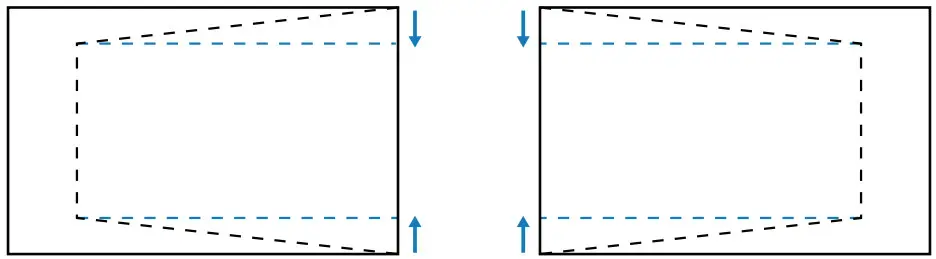 – Vertical: Adjust the top and bottom side of the projected image to make it an even rectangle. It is used for the images with unequal top and bottom sides.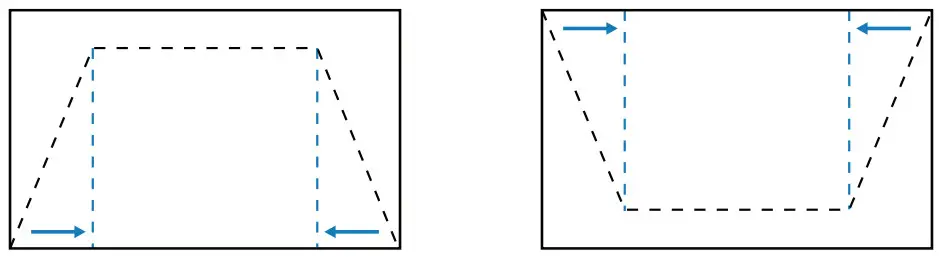
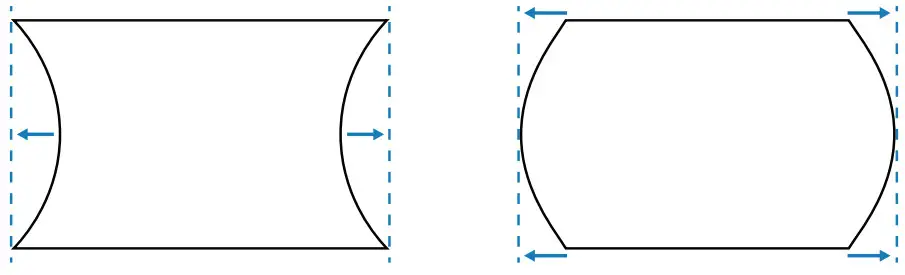 – Vertical: Correct the projected image with vertical barrel or pincushion distortion.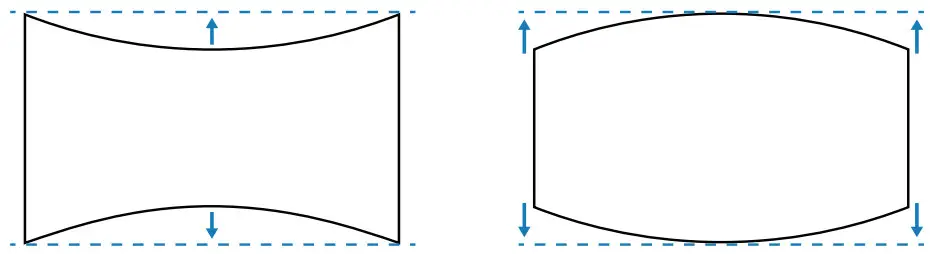
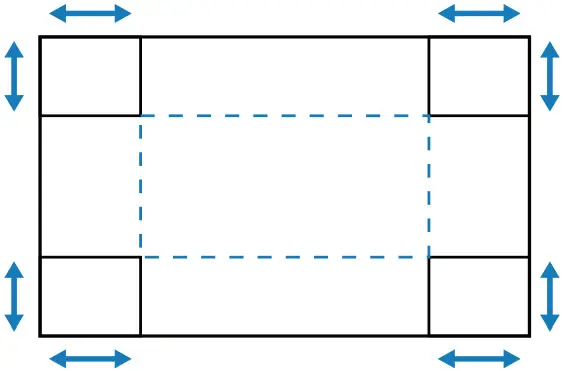
Advanced Warp
Configure advanced warp settings.
Note: When Basic or AP of Warp Control is selected, the Advanced Warp will be unavailable.
- Grid Color: Select a grid color for warp and blend pattern between Green, Magenta, Red, and Cyan.
- Grid Background: Select the grid background between Black and Transparent.
- Warp Setting: Configure warp settings.
– Grid Point: Set the grid points of warp pattern. Options include: 2×2 (default), 3×3, 5×5, 9×9, and 17×17.
– Warp Inner: Turn on to adjust the inner grid.
– Warp Sharpness: When the grid lines are warped from straight into curve, the grid lines will be distorted and become jagged. To avoid the line jagging, adjust the warp sharpness to blur or sharpen the edge of the images. - Blend Setting: Configure the blend settings directly on the projector to merge two or more adjacent images into one larger and seamless image.
– Blend Width: Set the blend pattern width.
– Overlap Grid Number: Set the blend overlap grid number.
– Gamma: Select the gamma value of the blend area to adjust the curvature of the blending effect.
Note: For installation flexibility we have not applied a FW limitation to the blending menu of this device. Distortion may occur if you attempt to warp to an extreme level. For more complex installs, at a cost, please contact your dealer for external devices for warping.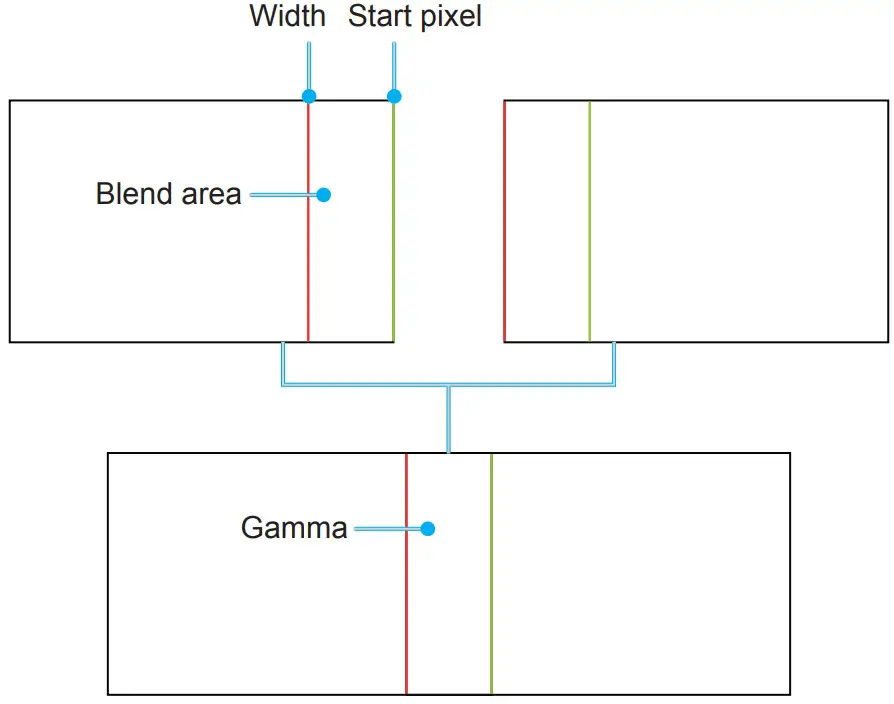
USING THE PROJECTOR
- Black Level: When two images overlap, the overlapping area can appear differently from the areas that do not overlap. You can use the projector’s Black Level setting to make the difference less noticeable.
- Area: Mark the area that needs adjusting.
- Enable: Enable or disable the black level adjustment in the selected area.
- Edit Area: Modify the black level of the selected area.
- Add Point: Add up to 32 area control points for black level adjustment.
- Remove Point: Remove at least 4 control points from the selected area.
Note: After adding or removing a control point, press Enter to move to the next point counterclockwise. - Brightness: Adjust the brightness of the selected area.
- Red/Green/Blue: Adjust each color individually of the selected area.
- Reset: Reset the black level to factory default values either on the Bottom or on the Top area or on both areas.
Memory
The projector allows the user to save up to five geometry memories, including the ones set directly on the projector and the ones configured via external software tools. The available options are Save Memory, Apply Memory, and Clear Memory.
Reset
Reset geometric settings to factory default values.
Edge Mask
The edge blending function allows you to hide one or multiple edges of the projected image. You can use this function to remove the video encoding noise on the edges of the video images.
Note: When 3D, 2D High Speed, or PIP/PBP is turned on, the Edge Mask will be unavailable.
Freeze Screen
Select to pause the display screen despite any change in the source device.
Test Pattern
Select a test pattern. The available options are Off, Green Grid, Magenta Grid, White Grid, White, Black, Red, Green, Blue, Yellow, Magenta, Cyan, ANSI Contrast 4×4, Color bar, and Full screen.
PIP/PBP
PIP/PBP (picture in picture/picture by picture) allows simultaneously displaying two images from two input sources.
Note: The PIP/PBP function does not support 3D, 2D High Speed mode, Aspect Ratio, Digital Zoom, and Image Shift.
Screen
Select the appropriate PIP/PBP mode or disable the function.
- Off: Disable PIP/PBP mode.
- PIP: Display one input source on the main screen and the other input source in an inset window.
- PBP: Display two images of the same size on the screen.
Main Source
Select an input source for the main image. The available input sources are VGA, HDMI1, HDMI2, and HDBaseT.
Sub Source
Select an input source for the main image. The available input sources are VGA, HDMI1, HDMI2, and HDBaseT.
Swap
Swap the main source and sub source.
Size
Change the display size of the sub source in PIP mode. The available options are Large, Medium, and Small.
Location
Adjust the location of the sub image. In the layout chart below, the “P” indicates the main image:
PBP Layout
| PBP Layout | PBP Size | ||
| Small | Medium | Large | |
| PBP, Main Left | 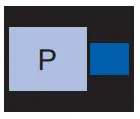 | 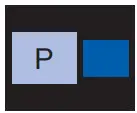 | 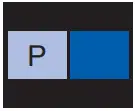 |
| PBP, Main Right | 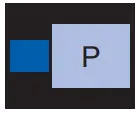 | 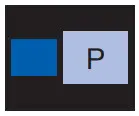 | 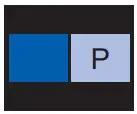 |
| PBP, Main Top | 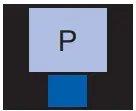 | 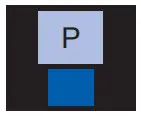 | 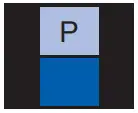 |
| PBP, Main Bottom | 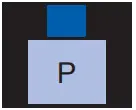 | 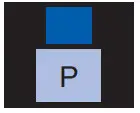 | 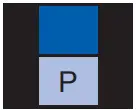 |
PIP Layout
| PIP Layout | PIP Size | ||
| Small | Medium | Large | |
| PIP, Bottom Right | 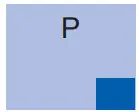 | 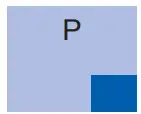 | 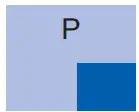 |
| PIP, Bottom Left | 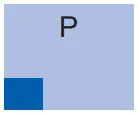 | 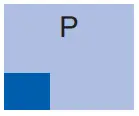 | 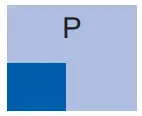 |
| PIP, Top Left | 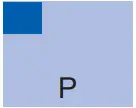 | 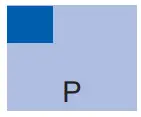 | 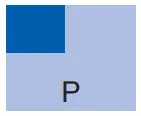 |
| PIP, Top Right | 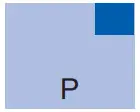 | 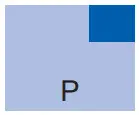 | 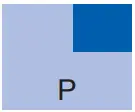 |
Note: PIP/PBP compatibility table as described below.
| PIP/PBP | Main Source | ||||||
| VGA | HDMI 2.0 | HDMI 1.0 | HDBaseT | ||||
| v1.4 | v1.4 | v2.0 | |||||
| Sub Source | VGA | – | V | V | V | V | |
| HDMI 2.0 | v1.4 | V | – | V | V | V | |
| HDMI 1.0 | v1.4 | V | V | – | – | V | |
| v2.0 | V | V | – | – | V | ||
| HDBaseT | V | V | V | V | – | ||
Note:
a) Flashing lines may occur if the bandwidth of both inputs are too high, please try to reduce the resolution.
b) Frame tearing may occur due to a difference in frame rate between the Main and the Sub picture, please try to match the frame rate for each input.
Reset
Reset all the display settings to factory default values.
Input Settings menu
Learn how to configure the projector input settings.
Submenus
- Auto Source
- Quick Resync
- Active Inputs
- Latency Adjustment
- VGA
- HDMI
Auto Source
When Auto Source is enabled, the projector automatically detects and selects the input signal. Once an input source is selected, press the Input button on the remote control or keypad to switch to other available sources.
When the function is disabled, pressing Input will bring up the Active Inputs submenu.
Quick Resync
Set the quick resync feature.
Active Inputs
Select an input signal from the source list. The available input sources are VGA, HDMI1, HDMI2, and HDBaseT.
Latency Adjustment
Enable this feature to reduce response time.
VGA
Setup the VGA source by selecting the proper Phase and Resolution.
HDMI
Set the projector’s HDMI ports.
Output
Set the HDMI 1 or HDMI 2 port to output the signal.
HDMI 1 EDID/HDMI 2 EDID
When receiving a HDMI signal, set the projector’s EDID compatibility to display the signal correctly. Select 1.4 for the input devices with HDMI 1.4, or 2.0 for HDMI 2.0 devices.
Note: For a better 3D experience, it is recommended to choose HDMI 1.4.
Reset
Reset all the input settings to factory default values.
Device Setup menu
Learn how to configure the system settings for the projector.
Submenus
- Language
- Projection
- Lens Settings
- Schedule
- Date and Time
- Power Settings
- Light Source Settings
- Shutter
- Audio
- Security
- On Screen Display
- Logo Setup
- High Altitude
- User Data
- System Update
Language
Select a language for the OSD menu. The available languages are English, German, French, Italian, Spanish, Portuguese, Polish, Dutch, Norwegian, Traditional Chinese, Simplified Chinese, Japanese, Korean, Russian, Hungarian, and Thai.
Projection
Change the image direction by selecting a proper projection mode.
Ceiling
Enable the function for ceiling mount installation.
Rear
Check the function for rear projection.
Lens Settings
Configure the lens settings to adjust the image quality and position.
Focus
Use the ▲ and ▼ buttons to adjust the focus of the projected image.
Zoom
Use the and
and buttons to adjust the size of the projected image.
Lens Shift
Use the ▲▼◀▶ buttons to adjust the lens position to shift the projected area.
Lens Shift Memory
This projector can save up to five lens settings, which records the lens position, zoom and focus.
- Save Memory: Select a record from 1 to 5 to save the current lens settings.
- Apply Memory: Select a record from 1 to 5 to apply the lens settings.
- Clear Memory: Clear the saved lens records.
Note:
- Process the lens calibration before setup lens shift memory.
- Performing a lens calibration will clear the saved lens records.
- When the lens calibration is not competed, the lens shift memory will be unavailable.
Lens Calibration
Calibrate the lens position to return it to the center.
Lens Lock
Lock the lens to prevent the lens motors from moving, which disables all lens functions.
Note: When Lens Lock is turned on, the Focus, Zoom, Lens Shift, Lens Shift Memory, and Lens Calibration will be unavailable.
Reset
Reset the lens settings to factory default values.
Schedule
Schedule the projector functions to operate automatically at the set time.
Date and Time
Display the date and time for the projector.
Schedule Mode
Enable or disable the schedule function. If the projector is controlled via external devices or software, the Schedule Mode displays AP Mode, and the projector’s schedule functions are grayed out.
View Today
View the event list scheduled for today.
Monday to Sunday
Set up the schedule for days of a week. On the Schedule menu page, select a day and configure the schedule settings.
- Schedule Enable: Enable or disable the schedule function for the selected day.
- Event 01-08: Select an event record number, and set up the schedule details.
- Time: Set the time for the event.
- Event: Select a function for the event, which operates automatically at the set time. The available functions are Power Settings, Input Source, Light Source Mode, and Shutter.
- Reset: Reset the event settings.
- More Events / Previous Events (Event 01-16): Display more event records, and select one to set up the schedule details.
- Copy Events To: Copy the events setup for the day to another day.
- Reset the Day: Reset the schedule settings for the day.
Reset Schedule
Reset all of the schedule settings.
Date and Time
Set the date and time of the projector.
Clock Mode
Set the clock mode to NTP Server or Manual.
Note: To use NTP Server, make sure the projector is connected to the Internet.
Date
Set a date for the projector. The date format is in Year/Month/Date.
Time
Set the time for the projector.
Daylight Saving Time
Enable or disable the daylight savings function.
NTP Server
Select a NTP Server for the network clock mode.
Time Zone
Set a time zone for the network clock mode.
Update Interval
Set the date and time update interval.
Apply
Apply date and time modifications.
Note:
- When Use NTP Server of Clock Mode is selected, the Date and Time will be unavailable.
- When Manual of Clock Mode is selected, the Daylight Saving Time, NTP Server, Time Zone, and Update Interval will be unavailable.
Power Settings
Configure the projector’s power settings.
Power Mode (Standby)
Setup the projector’s standby mode.
- Eco: Minimum power consumption (0.5 Watt) which does not allow network control.
- Active: Low power consumption (< 2 Watt) which allows the LAN module to enter sleep mode and supports to be woken by Wake on LAN (WoL). When the LAN module is woken by WoL, the projector is ready to receive commands over the network.
- Communication: More power consumption that allows controlling the projector over the network.
Signal Power On
Turn on this function to have the projector automatically turning on when connected to HDMI input sources. It only applies to the standby projector set to Communication mode.
Auto Power Off
Set an interval timer for the projector to automatically turn off if no signal is detected within the specified time period. Press the t and u buttons to add or reduce time, 1 minutes for each press.
Sleep Timer
Set an interval timer for the projector to automatically turn off after operating for the specified amount of time.
12V Trigger
Use this function to enable or disable the trigger.
Note: 3.5mm TS type mini jack that outputs 12V 200mA (max.) for relay system control.
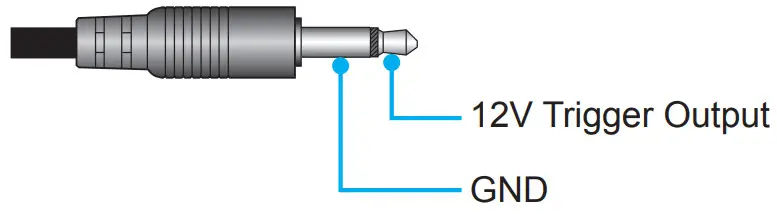
Reset
Reset the power settings to factory default values.
Light Source Settings
Set up the light source to control the projector brightness.
Light Source Mode
Select a light source mode depending on the installation requirements. The available options are Normal, Eco Mode, and Custom Power.
Custom Brightness
When the Light Source Mode is set to Custom Mode, set up the custom brightness level. Set up the Constant Brightness to maintain the image brightness at a specified level. A special algorithm is designed to compensate for the natural decay of brightness so that the image can be maintained at a fixed brightness level.
- Brightness Level: Adjust the brightness level from 30% to 100%.
- Constant Brightness: Enable to maintain the image brightness at the set brightness level. A special algorithm is designed to compensate for the natural decay of brightness so that the image can be maintained at a fixed brightness level.
Note: When Dynamic Black or Extreme Black is turned on, only Normal of Light Source Mode is supported.
Shutter
Set up the shutter behavior.
Fade-In
This function allows the fading-in effect when turning off the shutter. The length of the fading effect can be adjusted from 0.5s to 5s.
Fade-Out
This function allows the fading-out effect when turning on the shutter. The length of the fading effect can be adjusted from 0.5s to 5s.
Startup
Select the shutter behavior when turning on the projector.
- Shutter Off: Projector projects images normally after being powered on.
- Shutter On: Projector automatically turns on shutter after being powered on.
Audio
Set up the projector audio.
Mute
Turn off or turn on the projector sound.
Volume
Adjust the projector audio volume level.
Security
Set up security verification to protect the projector.
Security
Select On to protect the projector with a password. If the user enters incorrect password three times, a message will pop up warning that the projector shuts down in 10 seconds.
Security Timer
Specify the length of time the projector can be used without the password. Once the timer counts to 0, the user must enter a password to use the projector. The timer restarts every time the projector is turned on.
Change Password
Change the projector password.
Note: In the last minute before reaching a specified timer, including Auto Power Off, Sleep Timer, and Security Timer, an on-screen message will pop up warning that the projector shuts down in 60 seconds. Press any button on the remote control or projector keypad to reset the timer and the projector remains on.
On Screen Display
Set up the on screen display menus.
Menu Location
Select the menu location from Top Left, Top Right, Center, Bottom Left, and Bottom Right.
Menu Transparency
Set the menu transparency level.
Menu Timer
Set the length of time the menu displays on the screen.
Information Hide
Enable or disable the corner information messages, such as input source, IP address, and so on.
Background
Set a background color to display when no input signal is detected. The available options are Blue, Black, White, and Logo.
Logo Setup
Set up the logo for the startup screen.
Change Logo
Change the logo for the startup screen. Apart from the Default logo, user can select from Default, Neutral, User Logo, and Captured Logo.
- Default: The projector default logo.
- Neutral: The logo is not displayed on the startup screen.
- User Logo: The user logo uploaded from the web control panel.
- Captured Logo: The logo saved via the Logo Capture function.
Note: The supported logo format is PNG and size is 1920 x 1200 pixels.
Logo Capture
Capture part of the projected image and save it as a customized logo.
Delete Logo
Delete the saved customized logo, including the Captured Logo and Use Logo.
High Altitude
Select On to increase the fan speed. To ensure the image quality and prevent damage to the projector, enable High Altitude mode in high temperature, high humidity, or high altitude environment.
User Data
User can save the projector settings as user data and reload the settings later.
- Save all settings: Save all of the projector settings as user data. User can save up to 5 records.
- Load all settings: Load the previously saved user data.
System Update
Update the system automatically or manually.
- Auto: System checks for new updates automatically every time it is connected to the Internet.
- Manual: Manually update the system firmware.
Reset
Reset the settings to factory default values.
- Reset OSD: Reset OSD settings to default values.
- Reset to Default: Reset all projector settings to default values.
- Reset Selective: Reset the settings of one of the main menus. User can choose from Image, Display, Input, Communication, and Setup.
Communication menu
Communication menu is used to configure the settings that allow the projector to communicate with other projectors or control devices.
Submenus
- Projector ID
- Remote Setup
- Network Setup
- Email Notification
- Control
- Baud Rate
Projector ID
Assign an ID code for the projector from 00 to 99. Use this code as the projector ID when controlling the projector by RS232, Telnet or other control methods.
Remote Setup
Configure the settings of the Infra-Red (IR) remote control.
Remote Code
Set the remote custom code by pressing the remote ID button for 3 seconds and you will notice the remote indicator (above the Off button) starts blinking. Then, input a number between 00-99 using the keyboard numbered keys. After inserting the number, the remote indicator blinks twice quickly indicating that the remote code has changed.
Quick Switch Code
The IR receiving function of the projector can be temporarily deactivated by hot key(0~9) to avoid the IR interference between projectors. The remote ID needs to be set to All.
Note: When hotkey is on, the default function (Direct Source, Zoom/Focus, 3D) are inactive temporarily.
IR Function
Set the remote receiver for the projector to control the communication between the projector and the IR remote.
- Front: Enable or disable the front remote receiver.
- Top: Enable or disable the top remote receiver.
- HDBaseT: Select On to set the HDBaseT terminal as the remote receiver.
User 1 / User 2
Assign a function to the User 1 and User 2 buttons on the remote control. It allows you to use the function easily without going through the OSD menus. The available functions are Freeze Screen [User 1 deafult], Blank Screen, PIP/PBP [User 2 default], Aspect Ratio, Information Hide, Network setup, Projector ID, Color Matching, Reset Selective, Quick Switch Code, Audio Mute, and Audio Volume.
Network Setup
Configure the projector’s network settings.
LAN Interface
To avoid clash, specify the LAN interface to RJ-45 or HDBaseT.
MAC Address
Display the MAC address. (Read only)
Network Status
Display the network connection status. (Read only)
DHCP
Turn on DHCP to automatically acquire IP address, subnet mask, gateway, and DNS.
IP Address
Assign the projector’s IP address.
Subnet Mask
Assign the projector’s subnet mask.
Gateway
Assign the projector’s gateway.
DNS
Assign the projector’s DNS.
Apply
Apply the wired network settings.
Network Reset
Reset the network settings to default factory values.
Note: When DHCP is turned on, the IP Address, Subnet Mask, Gateway, and DNS will be unavailable.
Email Notification
Set up the email notification for the projector.
Fan Error / Power On/Off / Video Loss / Laser
When a Fan Error, Power On/Off, Video Loss, or Laser occurs on the projector, an email notification will be sent to the user
Control
This projector can be controlled remotely by a computer or other external devices through wired network connection. It allows the user to control one or more projectors from a remote control center, such as powering the projector on or off, and adjusting the image brightness or contrast. Use the Control submenu to select a control device for the projector.
Crestron
Control the projector with Crestron controller and related software (Port: 41794).
For more information, please visit http://www.crestron.com.
- Crestron Setup: Setup the Crestron IP Address, IPID, and Port. Then select Crestron Setup Apply to save the modifications.
PJ Link
Control the projector with PJLink v1.0 commands (Port: 4352).
For more information, please visit http://pjlink.jbmia.or.jp/english.
- PJ Link Service: Setup the address for the PJ Link Authentication, Password, Service, and select PJ Link Setup Apply to save the modifications.
Extron
Control the projector with Extron devices (Port: 2023).
For more information, please visit http://www.extron.com.
AMX
Control the projector with AMX devices. (Port: 9131)
For more information, please visit http://www.amx.com.
Telnet
Control the projector using RS232 commands though Telnet connection. (Port: 23)
For more information, refer to “Using RS232 command by Telnet” on page 66.
HTTP
Control the projector with web browser. (Port: 80)
For more information, refer to “Using the web control panel” on page 64.
Reset
Reset the control functions to default factory values.
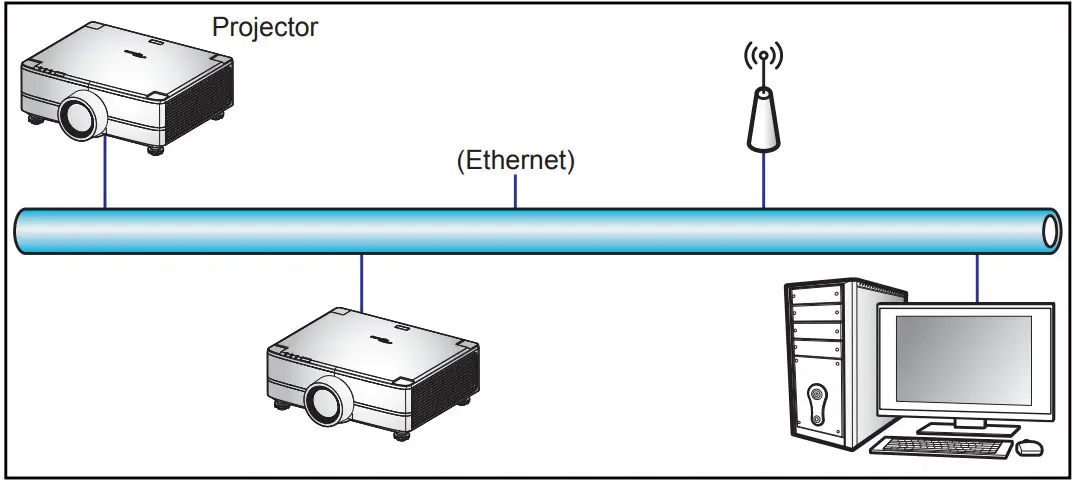
Note:
- Crestron is a registered trademark of Crestron Electronics, Inc. of the United States.
- Extron is a registered trademark of Extron Electronics, Inc. of the United States.
- AMX is a registered trademark of AMX LLC of the United States.
- PJLink applied for trademark and logo registration in Japan, the United States of America, and other countries by JBMIA.
- For more information about the various types of external devices which can be connected to the LAN / RJ45 port and remotely control the projector, as well as the supported commands for these external devices, please contact the Support-Service directly.
- Support OMSC and OMSL. For more information, please contact the Support-Service directly.
Baud Rate
Set the baud rate for Serial Port In and Serial Port Out. The available options are 1200, 2400, 4800, 9600, 19200, 38400, 57600, and 115200 (default).
Reset
Reset all network settings to default factory values.
Using the web control panel
The web control panel allows the user to configure various projector settings using a web browser from any personal computer or mobile devices.
System Requirements
To use the web control panel, make sure your devices and software meet the minimum system requirements.
- RJ45 cable (CAT-5e) or wireless dongle
- PC, laptop, mobile phone, or tablet installed with a web browser
- Compatible web browsers:
- Microsoft Edge 40 or higher version
- Firefox 57 or higher version
- Chrome 63 or higher version
Overview of the web control panel
Configure the projector settings using web browser.
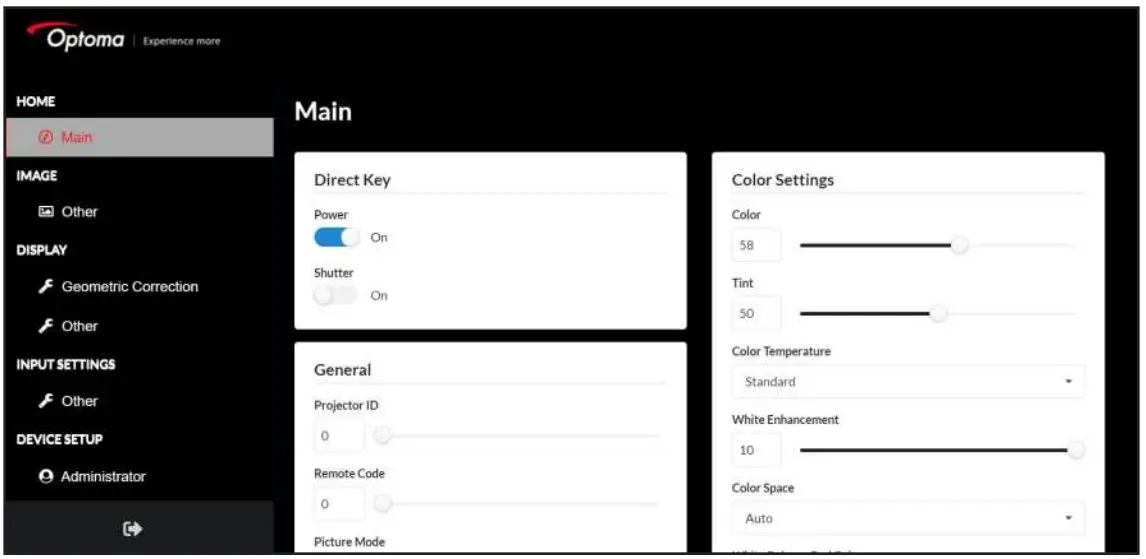
| Menu | Description |
| HOME | View the projector information and firmware version details. |
| IMAGE | To configure image settings. |
| DISPLAY | To configure the settings to properly project images according to your installation circumstances. |
| INPUT SETTINGS | To configure the projector input settings. |
| DEVICE SETUP | To configure the system settings for the projector. |
| COMMUNICATION | Communication menu is used to configure the settings that allow the projector to communicate with other projectors or control devices. |
| INFORMATION | View the projector information about its status and settings. The projector information is read only. |
Accessing the web control panel
When network is available, connect the projector and the computer to the same network. Use the projector address as the web URL to open the web control panel in a browser.
- Check the projector address using the OSD menu.
– On a wired network, select Communication > Network Setup > IP Address.
Note: Make sure DHCP is enabled. - Open a web browser and type the projector address in the address bar.
- The web page redirects to the web control panel.
- In the Username field, type the username: admin (default) In the Password field, type the password.: Device serial number (default). Path: Menu -> Information -> Device -> Serial Number.
Note: It is needed to change the username and password once you have logged in. It is also advised to use a strong password.
When network is not available, refer to “Directly connect the projector to a computer” section.
Directly connect the projector to a computer
When network is not available, connect the projector to the computer directly using a RJ-45 cable, and configure the network settings manually.
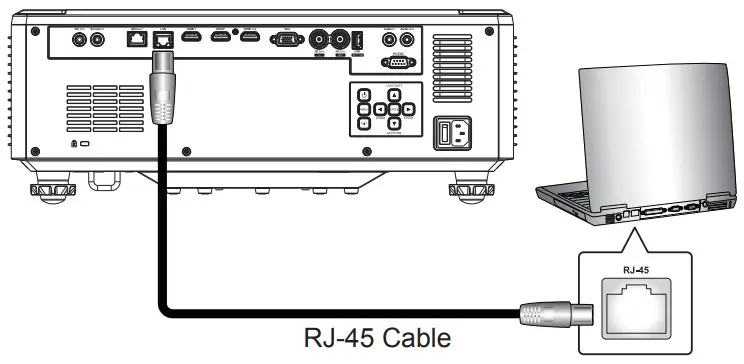
- Assign IP address to the projector
– From the OSD menu, select Network Setup > DHCP.
– Turn off DHCP, and manually set the projector’s IP Address, Subnet Mask, and Gateway.
– Press Enter to confirm the settings. - Assign IP address to the computer
– Set the Default Gateway and Subnet Mask of the computer to match the projector.
– Set the IP address of the computer to match the first three numbers of the projector.
For example, if the projector IP address is 192.168.000.100, set the computer IP address to 192.168.000.xxx, where xxx is not 100. - Open a web browser and type the projector address in the address bar.
- The web page redirects to the web control panel.
Using RS232 command by Telnet
This projector supports using RS232 commands through Telnet connection.
- Set up a direct connection between the projector and computer. Refer to Directly connect the projector to a computer on page 65.
- Disable the firewall on the computer.
- Open the command dialogue on the computer. For Windows 7 operating system, select Start > All Programs > Accessories > Command Prompt.
- Input the command “telnet ttt.xxx.yyy.zzz 23”. Replace “ttt.xxx.yyy zzz” with the projector IP address.
- Press Enter on the computer keyboard.
Specification for RS232 by Telnet
- Telnet: TCP
- Telnet port: 23 (contact service team for more details)
- Telnet utility: Windows “TELNET.exe” (console mode).
- Disconnection for RS232-by-Telnet control normally: Close
- Below are the limitations for using Windows Telnet utility directly after TELNET connection is ready:
– There is less than 50 bytes for successive network payload for Telnet-Control application.
– There is less than 26 bytes for one complete RS232 command for Telnet-Control.
– Minimum delay for next RS232 command must be more than 200 (ms). Information menu.
Info menu
View the projector information about its status and settings. The projector information is read only.
Submenus
- Device
- System Status
- Communication
- Signal
- Firmware Version
ADDITIONAL INFORMATION
Compatible Resolutions
Digital
| HDMI 2.0 | ||
| Established Timing | Standard Timing | Detail Timing |
| 640 x 480 @ 60Hz | 800 x 600 @ 120Hz | 640 x 480 @ 60Hz |
| 640 x 480 @ 67Hz | 1280 x 768 @ 120Hz | 720 x 480 @ 60Hz |
| 640 x 480 @ 72Hz | 1280 x 800 @ 75Hz | 720 x 576 @ 50Hz |
| 640 x 480 @ 75Hz | 1280 x 1024 @ 60Hz | 720 x 4801 @ 60Hz |
| 720 x 400 @ 70Hz | 1360 x 765 @ 60Hz | 720 x 576i @ 50Hz |
| 720 x 400 @ 88Hz | 1400 x 1050 @ 60Hz | 1280 x 720 @ 50Hz |
| 800 x 600 @ 56Hz | 1600 x 1200 @ 60Hz | 1280 x 720 @ 60Hz |
| 800 x 600 @ 60Hz | 1680 x 1050 @ 60Hz | 1280 x 720 @ 120Hz |
| 800 x 600 @ 72Hz | 1440 x 480 @ 60Hz | |
| 800 x 600 @ 75Hz | 1920 x 1080 @ 24Hz | |
| 832 x 624 @ 75Hz | 1920 x 1080 @ 25Hz | |
| 1024 x 768 @ 60Hz | 1920 x 1080 @ 50Hz | |
| 1024 x 768 @ 70Hz | 1920 x 1080 @ 60Hz | |
| 1024 x 768 @ 75Hz | 1920 x 1080 @ 120Hz | |
| 1152 x 870 @ 75Hz | 1920 x 1080i @ 50Hz | |
| 1280 x 1024 @ 75Hz | 1920 x 1080i @ 60Hz | |
| 1920 x 1200 @ 59Hz | ||
| 3840 x 2160 @ 24Hz | ||
| 3840 x 2160 @ 25Hz | ||
| 3840 x 2160 @ 30Hz | ||
| 3840 x 2160 @ 50Hz | ||
| 3840 x 2160 @ 60Hz | ||
| 4096 x 2160 @ 24Hz | ||
| 4096 x 2160 @ 25Hz | ||
| 4096 x 2160 @ 30Hz | ||
| 4096 x 2160 @ 50Hz | ||
| 4096 x 2160 @ 60Hz | ||
| HDMI 1.4 | ||
| Established Timing | Standard Timing | Detail Timing |
| 640 x 480 @ 60Hz | 800 x 600 @ 120Hz | 640 x 480 @ 60Hz |
| 640 x 480 @ 67Hz | 1280 x 768 @ 120Hz | 720 x 480 @ 60Hz |
| 640 x 480 @ 72Hz | 1280 x 800 @ 75Hz | 720 x 576 @ 50Hz |
| 640 x 480 @ 75Hz | 1280 x 1024 @ 60Hz | 720 x 480i @ 60Hz |
| 720 x 400 @ 70Hz | 1360 x 765 @ 60Hz | 720 x 576i @ 50Hz |
| 720 x 400 @ 88Hz | 1400 x 1050 @ 60Hz | 1280 x 720 @ 50Hz |
| 800 x 600 @ 56Hz | 1600 x 1200 @ 60Hz | 1280 x 720 @ 60Hz |
| 800 x 600 @ 60Hz | 1680 x 1050 @ 60Hz | 1440 x 480 @ 60Hz |
| 800 x 600 @ 72Hz | 1920 x 1080 @ 24Hz | |
| 800 x 600 @ 75Hz | 1920 x 1080 @ 25Hz | |
| 832 x 624 @ 75Hz | 1920 x 1080 @ 50Hz | |
| 1024 x 768 @ 60Hz | 1920 x 1080 @ 60Hz | |
| 1024 x 768 @ 70Hz | 1920 x 1080i @ 50Hz | |
| 1024 x 768 @ 75Hz | 1920 x 1080i @ 60Hz | |
| 1152 x 870 @ 75Hz | 1920 x 1200 @ 59Hz | |
| 1280 x 1024 @ 75Hz | ||
Analog
| Analog | ||
| Established Timing | Standard Timing | Detail Timing |
| 640 x 480 @ 60Hz | 1280 x 800 @ 75Hz | 1920 x 1080 @ 60Hz |
| 640 x 480 @ 67Hz | 1280 x 1024 @ 60Hz | 1920 x 1200 @ 59Hz |
| 640 x 480 @ 72Hz | 1360 x 765 @ 60Hz | |
| 640 x 480 @ 75Hz | 1400 x 1050 @ 60Hz | |
| 720 x 400 @ 70Hz | 1440 x 900 @ 60Hz | |
| 720 x 400 @ 88Hz | 1440 x 900 @ 75Hz | |
| 800 x 600 @ 56Hz | 1600 x 1200 @ 60Hz | |
| 800 x 600 @ 60Hz | 1680 x 1050 @ 60Hz | |
| 800 x 600 @ 72Hz | ||
| 800 x 600 @ 75Hz | ||
| 832 x 624 @ 75Hz | ||
| 1024 x 768 @ 60Hz | ||
| 1024 x 768 @ 70Hz | ||
| 1024 x 768 @ 75Hz | ||
| 1152 x 870 @ 75Hz | ||
| 1280 x 1024 @ 75Hz | ||
True 3D video compatibility
| Input timing | |||
| Input Resolutions | HDMI 1.4a 3D Input | 1280 x 720P @ 50Hz | Top and Bottom |
| 1280 x 720P @ 60Hz | Top and Bottom | ||
| 1280 x 720P @ 50Hz | Frame Packing | ||
| 1280 x 720P @ 60Hz | Frame Packing | ||
| 1920 x 1080P @ 24Hz | Top and Bottom | ||
| 1920 x 1080P @ 24Hz | Frame Packing | ||
| 1920 x 1080i @ 50Hz | Side by Side | ||
| 1920 x 1080i @ 60Hz | Side by Side | ||
| 1024 x 768 @ 120Hz | Frame Sequential | ||
| 1280 x 720 @ 120Hz | Frame Sequential | ||
Note: If 3D input is 1080p@24Hz, the DMD should replay with integral multiple with 3D mode.
RS232 Port Setting and Signals Connection
RS232 Port Setting
| Items | Method |
| Communication Method | Asynchronous Communication |
| Baud Rate | 115200 |
| Data Bits | 8 bits |
| Parity | None |
| Stop Bits | 1 |
| Flow Control | None |
RS232 Signals Connection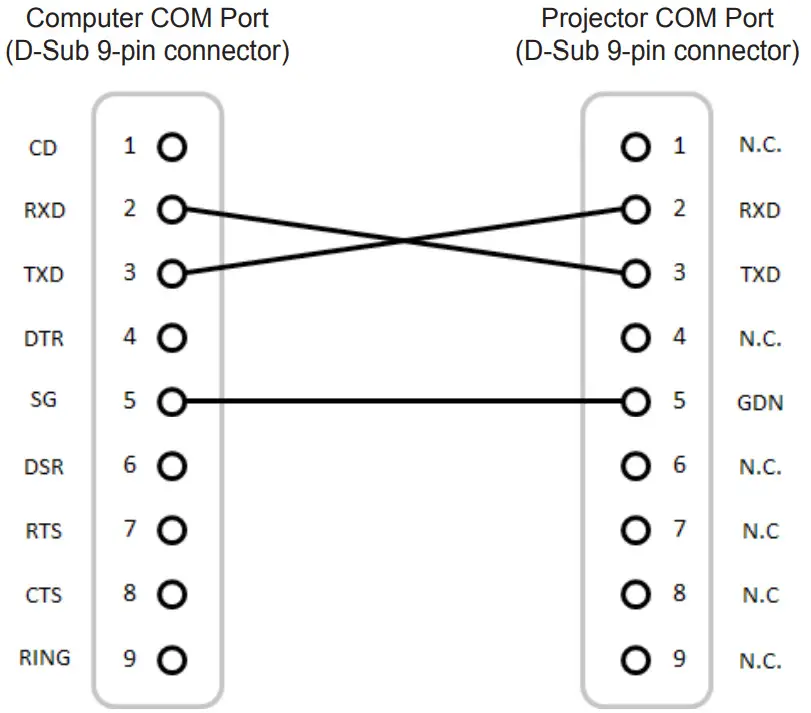 Note: RS232 shell is grounded.
Image Size and Projection Distance
1.6x lens model
The size of projected images is 50 – 300 inches (1.27 – 7.62 m)
| Screen Size 16:10 (Wax H) | Projector Distance | ||||||||
| Diagonal Length of Image | Width | Height | Wide | Tele | |||||
| inch | m | inch | m | inch | m | inch | m | inch | m |
| 50 | 1.27 | 42.4 | 1.08 | 26.5 | 0.67 | 52.3 | 1.33 | 84.0 | 2.13 |
| 60 | 1.52 | 50.9 | 1.29 | 31.8 | 0.81 | 63.1 | 1.60 | 101.2 | 2.57 |
| 70 | 1.78 | 59.4 | 1.51 | 37.1 | 0.94 | 74.0 | 1.88 | 118.4 | 3.01 |
| 80 | 2.03 | 67.8 | 1.72 | 42.4 | 1.08 | 84.8 | 2.15 | 135.6 | 3.44 |
| 90 | 2.29 | 76.3 | 1.94 | 47.7 | 1.21 | 95.7 | 2.43 | 152.8 | 3.88 |
| 100 | 2.54 | 84.8 | 2.15 | 53.0 | 1.35 | 106.5 | 2.71 | 170.0 | 4.32 |
| 120 | 3.05 | 101.8 | 2.58 | 63.6 | 1.62 | 128.3 | 3.26 | 204.4 | 5.19 |
| 150 | 3.81 | 127.2 | 3.23 | 79.5 | 2.02 | 160.8 | 4.09 | 256.0 | 6.50 |
| 180 | 4.57 | 152.6 | 3.88 | 95.4 | 2.42 | 193.4 | 4.91 | 307.6 | 7.81 |
| 200 | 5.08 | 169.6 | 4.31 | 106.0 | 2.69 | 215.1 | 5.46 | 342.0 | 8.69 |
| 250 | 6.35 | 212.0 | 5.38 | 132.5 | 3.37 | 269.4 | 6.84 | 428.0 | 10.87 |
| 300 | 7.62 | 254.4 | 6.46 | 159.0 | 4.04 | 323.7 | 8.22 | 514.0 | 13.06 |
1.15x lens model
The size of projected images is 50 ~ 1000 inches (1.27 ~ 25.4 m)
| Screen Size 16:10 (Wx H) | Projector Distance | ||||||||
| Diagonal Length of Image | Width | Height | Wide | Tele | |||||
| inch | m | inch | m | inch | m | inch | m | inch | m |
| 50 | 1.27 | 42.4 | 1.08 | 26.5 | 0.67 | 27 | 0.69 | 31.3 | 0.79 |
| 60 | 1.52 | 50.9 | 1.29 | 31.8 | 0.81 | 32.7 | 0.83 | 37.8 | 0.96 |
| 70 | 1.78 | 59.4 | 1.51 | 37.1 | 0.94 | 38.4 | 0.98 | 44.4 | 1.13 |
| 80 | 2.03 | 67.8 | 1.72 | 42.4 | 1.08 | 44.1 | 1.12 | 50.9 | 1.29 |
| 90 | 2.29 | 76.3 | 1.94 | 47.7 | 1.21 | 49.8 | 1.27 | 57.5 | 1.46 |
| 100 | 2.54 | 84.8 | 2.15 | 53 | 1.35 | 55.5 | 1.41 | 64.1 | 1.63 |
| 120 | 3.05 | 101.8 | 2.58 | 63.6 | 1.62 | 66.9 | 1.7 | 77.2 | 1.96 |
| 150 | 3.81 | 127.2 | 3.23 | 79.5 | 2.02 | 84 | 2.13 | 96.9 | 2.46 |
| 180 | 4.57 | 152.6 | 3.88 | 95.4 | 2.42 | 101.2 | 2.57 | 116.6 | 2.96 |
| 200 | 5.08 | 169.6 | 4.31 | 106 | 2.69 | 112.6 | 2.86 | 129.7 | 3.29 |
| 250 | 6.35 | 212 | 5.38 | 132.5 | 3.37 | 141.1 | 3.58 | 162.5 | 4.13 |
| 300 | 7.62 | 254.4 | 6.46 | 159 | 4.04 | 169.6 | 4.31 | 195.3 | 4.96 |
| 350 | 8.89 | 296.8 | 7.54 | 185.5 | 4.71 | 198.2 | 5.03 | 228.1 | 5.79 |
| 400 | 10.16 | 339.2 | 8.62 | 212 | 5.38 | 226.7 | 5.76 | 260.9 | 6.63 |
| 500 | 12.7 | 424 | 10.77 | 265 | 6.73 | 283.7 | 7.21 | 326.5 | 8.29 |
| 600 | 15.24 | 508.8 | 12.92 | 318 | 8.08 | 340.8 | 8.66 | 392.1 | 9.96 |
| 700 | 17.78 | 593.6 | 15.08 | 371 | 9.42 | 397.9 | 10.11 | 457.8 | 11.63 |
| Screen Size 16:10 (Wax H) | Projector Distance | ||||||||
| Diagonal Length of Image | Width | Height | Wide | Tele | |||||
| inch | m | inch | m | inch | m | inch | m | inch | m |
| 800 | 20.32 | 678.4 | 17.23 | 424 | 10.77 | 454.9 | 11.55 | 523.4 | 13.3 |
| 900 | 22.86 | 763.2 | 19.39 | 477 | 12.12 | 512 | 13 | 589 | 14.96 |
| 1000 | 25.4 | 848 | 21.54 | 530 | 13.46 | 569 | 14.45 | 654.6 | 16.63 |
| Screen Size 16:10 (Wax H) | Projector Distance | ||||||
| Diagonal Length of Image | Width | Height | Fixed | ||||
| inch | m | inch | m | inch | m | inch | m |
| 40 | 1.02 | 33.9 | 0.86 | 21.2 | 0.54 | 24.4 | 0.54 |
| 50 | 1.27 | 42.4 | 1.08 | 26.5 | 0.67 | 29.8 | 0.68 |
| 60 | 1.52 | 50.9 | 1.29 | 31.8 | 0.81 | 35.1 | 0.82 |
| 70 | 1.78 | 59.4 | 1.51 | 37.1 | 0.94 | 40.5 | 0.95 |
| 80 | 2.03 | 67.8 | 1.72 | 42.4 | 1.08 | 45.8 | 1.09 |
| 90 | 2.29 | 76.3 | 1.94 | 47.7 | 1.21 | 51.2 | 1.22 |
| 100 | 2.54 | 84.8 | 2.15 | 53.0 | 1.35 | 56.5 | 1.36 |
| 120 | 3.05 | 101.8 | 2.58 | 63.6 | 1.62 | 67.3 | 1.71 |
| 150 | 3.81 | 127.2 | 3.23 | 79.5 | 2.02 | 83.2 | 2.04 |
| 180 | 4.57 | 152.6 | 3.88 | 95.4 | 2.42 | 99.4 | 2.53 |
| 200 | 5.08 | 169.6 | 4.31 | 106.0 | 2.69 | 111.0 | 2.74 |
| 250 | 6.35 | 212.0 | 5.38 | 132.5 | 3.37 | 136.9 | 3.48 |
| 300 | 7.62 | 254.4 | 6.46 | 159.0 | 4.04 | 163.3 | 4.07 |
Ceiling Mount Installation
- To prevent damage to your projector, please use the Optoma ceiling mount.
- If you wish to use a third party ceiling mount kit, please ensure the screws used to attach a mount to the projector meet the following specifications:
• Screw type: M4*4
• Minimum screw length: 8 mm
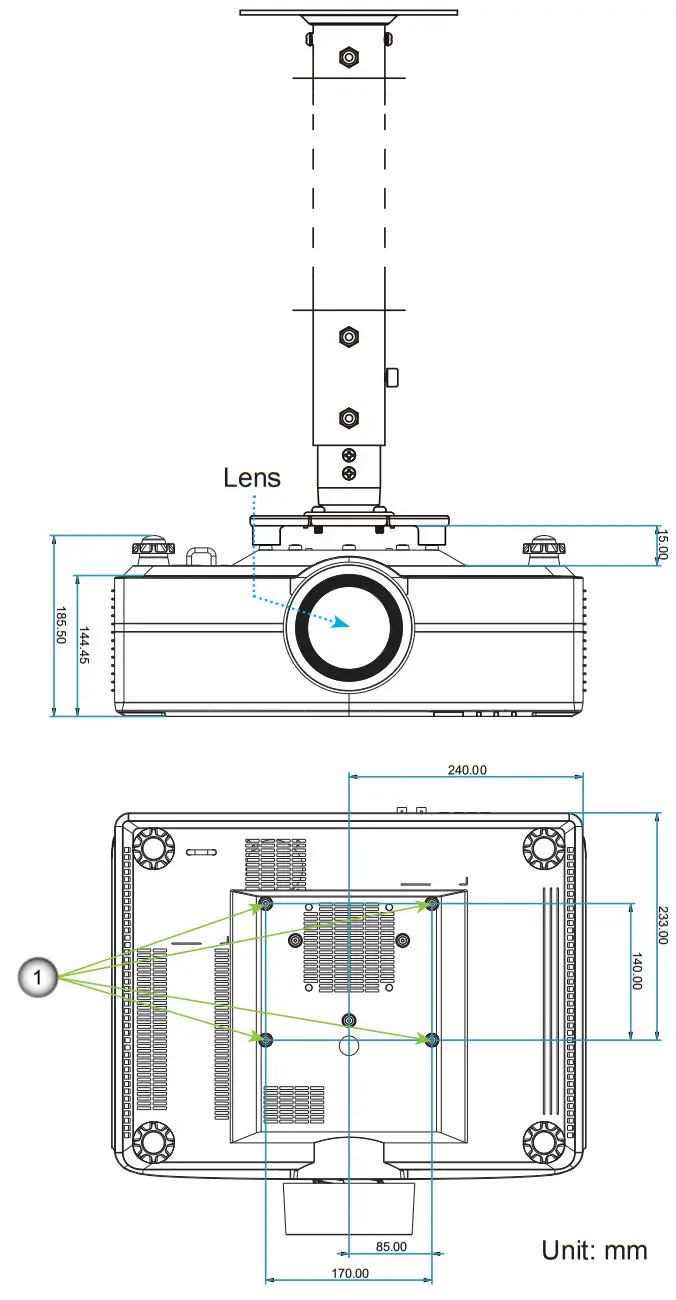
Note:
- Mounting holes for ceiling mount.
- Please note that damage resulting from incorrect installation will void the warranty.
IR remote codes
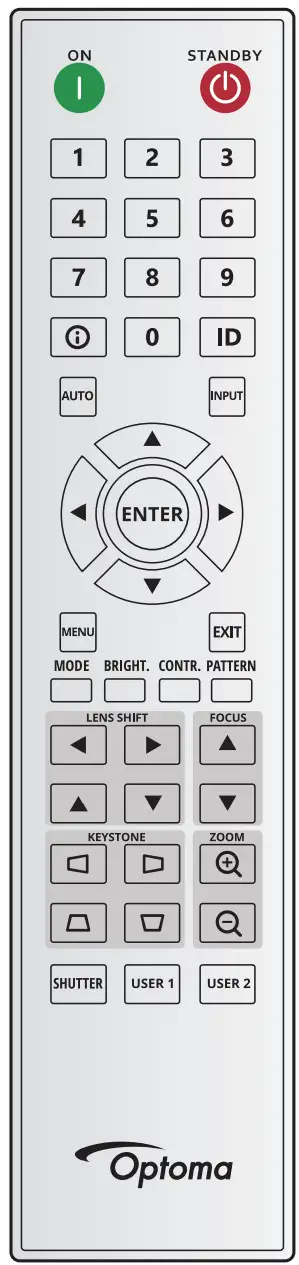
| Key Legend | Key Position | Repeat Format | Address | Data | Description | ||
| Byte 1 | Byte 2 | Byte 3 | Byte 4 | ||||
ON (  ) ) | 1 | F1 | 32 | CD | 2 | FD | Press to turn on the projector. |
OFF ( ) ) | 2 | F1 | 32 | CD | 2E | D1 | Press to turn off the projector. |
| 1 | 3 | F1 | 32 | CD | 72 | 8D | Use as numeric keypad number “1”. |
| 2 | 4 | F1 | 32 | CD | 73 | 8C | Use as numeric keypad number “2”. |
| 3 | 5 | F1 | 32 | CD | 74 | 8B | Use as numeric keypad number “3”. |
| 4 | 6 | F1 | 32 | CD | 75 | 8A | Use as numeric keypad number “4”. |
| 5 | 7 | F1 | 32 | CD | 77 | 88 | Use as numeric keypad number “5”. |
| 6 | 8 | F1 | 32 | CD | 78 | 87 | Use as numeric keypad number “6”. |
| Key Legend | Key Position | Repeat Format | Address | Data | Description | ||
| Byte 1 | Byte 2 | Byte 3 | Byte 4 | ||||
| 7 | 9 | F1 | 32 | CD | 79 | 86 | Use as numeric keypad number “7”. |
| 8 | 10 | F1 | 32 | CD | 80 | 7F | Use as numeric keypad number “8”. |
| 9 | 11 | F1 | 32 | CD | 81 | 7E | Use as numeric keypad number “9”. |
Info ( ) ) | 12 | F1 | 32 | CD | 82 | 7D | Press to display source image information. |
| 0 | 13 | F1 | 32 | CD | 25 | DA | Use as numeric keypad number “0”. |
| ID | 14 | F1 | 32 | CD | A7 | 58 | Press to set remote ID. Please refer to “Remote control ID setup” on page 26. |
| Auto | 15 | F1 | 32 | CD | 4 | FB | Press to automatically synchronize the projector to the input source. |
| Input | 16 | F1 | 32 | CD | 18 | E7 | Press to select an input signal. |
| UP (▲) | 17 | F1 | 32 | CD | 0F | F0 | Press to select items or make adjustments to our selection. |
| LEFT (◄) | 18 | F1 | 32 | CD | 11 | EE | Press to select items or make adjustments to our selection. |
| Enter | 19 | F1 | 32 | CD | 14 | EB | Press to confirm your item selection. |
| RIGHT (►) | 20 | F1 | 32 | CD | 10 | EF | Press to select items or make adjustments to our selection. |
| DOWN (▼) | 21 | F1 | 32 | CD | 12 | ED | Press to select items or make adjustments to our selection. |
| Menu | 22 | F1 | 32 | CD | 0E | F1 | Press to display the on-screen display menus for projector. |
| Exit | 23 | F1 | 32 | CD | 2A | D5 | Press to return to previous level or exit menus if at top level. |
| Mode | 24 | F1 | 32 | CD | 5 | FA | Press to select the preset display mode. |
| Bright. | 25 | F1 | 32 | CD | 28 | D7 | Press to adjust amount of light in the image. |
| Contr. | 26 | F1 | 32 | CD | 29 | D6 | Press to adjust difference between dark and light. |
| Pattern | 27 | F1 | 32 | CD | 58 | A7 | Press to display a test pattern. |
| Lens Shift◄ | 28 | F1 | 32 | CD | 41 | BE | Press to adjust the position of the image horizontally. |
| Lens Shift ► | 29 | F1 | 32 | CD | 42 | BD | |
| Focus ▲ | 30 | F1 | 32 | CD | 86 | 79 | Press to adjust focus to improve image clarity as desired. |
| Lens Shift ▲ | 31 | F1 | 32 | CD | 34 | CB | Press to adjust the position of the image vertically. |
| Lens Shift ▼ | 32 | F1 | 32 | CD | 32 | CD | Press to adjust the position of the image vertically. |
| Focus ▼ | 33 | F1 | 32 | CD | 26 | D9 | Press to adjust focus to improve image clarity as desired. |
Keystone | 34 | F1 | 32 | CD | 87 | 78 | Press to adjust the horizontal keystone. |
Keystone | 35 | F1 | 32 | CD | 51 | AE | Press to adjust the horizontal keystone. |
| Zoom | 36 | F1 | 32 | CD | 52 | AD | Press to adjust zoom to achieve a desired image size. |
Keystone | 37 | F1 | 32 | CD | 53 | AC | Press to adjust the vertical keystone. |
Keystone | 38 | F1 | 32 | CD | 54 | AB | Press to adjust the vertical keystone. |
| Zoom | 39 | F1 | 32 | CD | 55 | AA | Press to adjust zoom to achieve a desired image size. |
| Shutter (AV Mute) | 40 | F1 | 32 | CD | 56 | A9 | Press to hide/unhide the screen picture. |
| User 1 | 41 | F1 | 32 | CD | 57 | A8 | Press to assign user functions. Please refer to “Remote Setup” on page 69. |
| User 2 | 42 | F1 | 32 | CD | 27 | D8 | Press to assign user functions. Please refer to “Remote Setup” on page 69. |
Troubleshooting
If you experience a problem with your projector, please refer to the following information. If a problem persists, please contact your local reseller or service center.
Image problems No image appears on-screen
- Ensure all the cables and power connections are correctly and securely connected as described in the Setup and Installation section.
- Ensure the pins of connectors are not crooked or broken.
- Ensure that the Shutter (AV Mute) feature is not turned on.
Image is out of focus
- Press the Focus ▲ or Focus ▼ button on the remote control or projector keypad to adjust the focus until the image is sharp and legible.
- Make sure the projection screen is between the required distance from the projector. (Please refer to Image size and projection distance page 96).
The image is stretched when displaying 16:10 DVD title
- When you play anamorphic DVD or 16:10 DVD, the projector will show the best image in 16:10 format on projector side.
- If you play 4:3 format DVD title, please change the format as 4:3 in projector OSD.
- Please setup the display format as 16:10 (wide) aspect ratio type on your DVD player.
Image is too small or too large
- Press the Zoom or Zoom button on the remote control or projector keypad to adjust the projected image size.
- Move the projector closer to or further from the screen.
- From the OSD menu, select Display > Aspect Ratio to change the aspect ratio.
Image has slanted sides:
- If possible, reposition the projector so that it is centered on the screen and below the bottom of the screen.
- Press the Keystone
 buttons on the remote control to adjust the screen shape.
 buttons on the remote control to adjust the screen shape.
 Image is reversed
- From the OSD menu, select Device Setup > Projection > Rear to reverse the image so you can project from behind a translucent screen.
Other problems
The projector stops responding to all controls
- If possible, turn off the projector, then unplug the power cord and wait at least 20 seconds before reconnecting power.
Remote control problems If the remote control does not work
- Check that the operating angle of the remote control is pointed within ±30° to the IR receivers on the projector.
- Make sure there are not any obstructions between the remote control and the projector. Move to within 20 meters (65.6 feet) of the projector.
- Make sure batteries are inserted correctly.
- Replace batteries if they are exhausted.
LED Indicators and Lightning Messages
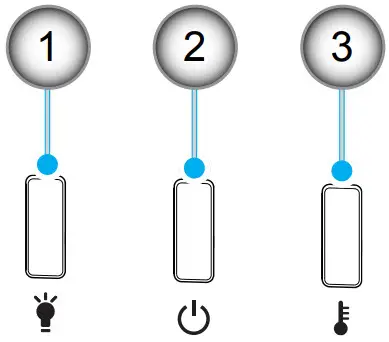
| No. | Item |
| 1 | Temp LED |
| 2 | Power LED |
| 3 | Light LED |
| Status | Light LED | Power LED | Temp LED | |
| Red | Red | Green | Red | |
| Standby | N/A | Steady light | N/A | N/A |
| Power On | N/A | N/A | Steady light | N/A |
| Warning Up Start | N/A | Flashing (1 sec off / 1 sec on) | N/A | N/A |
| Cooling Down Start | N/A | N/A | Flashing (0.5 sec off / 0.5 sec on) | N/A |
| AV Mute | Flashing (1 sec off / 1 sec on) | N/A | Steady light | N/A |
| Error (Power Failure) | Steady light | N/A | N/A | Steady light |
| Error (Fan Failure) | N/A | N/A | N/A | Flashing (3 sec on / 3 sec off) |
| Error (Color Wheel Breakdown) | N/A | N/A | N/A | Flashing (0.5 sec off / 0.5 sec on) |
| Error (Over Temp) | N/A | N/A | N/A | Steady light |
| Error (LD Over Temp) | N/A | N/A | N/A | Steady light |
| Error (LD Voltage Failure) | Steady light | N/A | N/A | N/A |
| Error (Temp Sensor Disconnect) | Flashing (0.5 sec off / 0.5 sec on) | Flashing (0.5 sec off / 0.5 sec on) | N/A | N/A |
| Error (LD Failure) | Steady light | N/A | Steady light | N/A |
| Upgrade Process | Flashing (3 sec off / 3 sec on) | Flashing (3 sec off /3 sec on) | Flashing (3 sec off / 3 sec on) | Flashing (3 sec off / 3 sec on) |
Note: The light off for 10min when projector into upgrade process and All LED Flashing (3 sec off/ 3 sec on)
Specifications
| Optical | Description | ||
| Lens type | 1.6x | 1.15x | Fixed |
| Throw ratio | 1.25~2.0 | 0.65~0.75 | 0.63 |
| Maximum resolution | WUXGA | WUXGA | WUXGA |
| Zoom & focus adjustment | Power | Power | Power |
| Image size (diagonal) | 50”~300” | 50”~1000” | 40”~300” |
| Electrical | Description |
| Inputs | – HDMI 1 v2.0/4K – HDMI 2 v2.0/v1.4a – VGA-IN – 3D SYNC IN – USB Type-A x1 – AUDIO-IN 3.5mm |
| Outputs | – HDMI OUT – 3D SYNC OUT – AUDIO-OUT 3.5mm – 12V OUT Trigger |
| Control | – Wired IR – HDBaseT – RJ-45 (support web control) – RS232 |
| Color reproduction | 1073.4 Million color |
| Scan rate | – Horizontal scan rate: 15.38 ~ 91.15 KHz – Vertical scan rate: 24 ~ 85 Hz (120 Hz for 3D feature) |
| Built-in speaker | 2x 10W speakers |
| Power requirement | 100 – 240V ±10%, AC 50/60Hz |
| Power Consumption | – Normal mode: 520W ± 15% @ 110Vac / 505W ± 15% @ 220Vac – ECO mode: 265W ± 15% @ 110Vac / 260W ± 15% @ 220Vac |
| Input current | 6.5A |
| Installation orientation | Front, Rear, Ceiling-top, and Rear-top |
| Dimensions (W x D x H) | 1.6x lens model: – 486 x 432.5 x 176.0 mm (w/o feet) – 486 x 432.5 x 185.5 mm (with feet) 1.15x lens model: – 486 x 427.5 x 176.0 mm (w/o feet) – 486 x 427.5 x 185.5 mm (with feet) Fixed lens model: – 486 x 417.4 x 176.0 mm (w/o feet) – 486 x 417.4 x 185.5 mm (with feet) |
| Weight | 14 ± 0.5 Kg |
| Environmental conditions | Operating in 5 ~ 40°C , 10% to 85% humidity (non-condensing) |
Note: All specifications are subject to change without notice.
RS232 protocol function list
Baud Rate : 115200
Data Bits: 8
Parity: None
Stop Bits: 1
Flow Control : None
UART16550 FIFO: Disable
Write Command
| ~ | X | X | X | X | X | n | CR | |
| Lead Code | Projector ID | Command | space | variable | carriage return | |||
| Prefix | 00~99 (Default: 00) | 000~999 | 0~9999 | suffix | ||||
Pass:…….P
Fail:……..F
Read Command
| ~ | X | X | X | X | X | n | CR | |
| Lead Code | Projector ID | Command | space | variable | carriage return | |||
| Prefix | 00~99 (Default: 00) | 000~999 | 0~9999 | suffix | ||||
Response Format
Pass:……………
| O | k | n |
| Variable | ||
Fail:…………….F
System Automatically Send
| I | N | F | O | n |
| Variable | ||||
Note: There is a <CR> after all ASCII commands. 0D is the HEX code for <CR> in ASCII code.
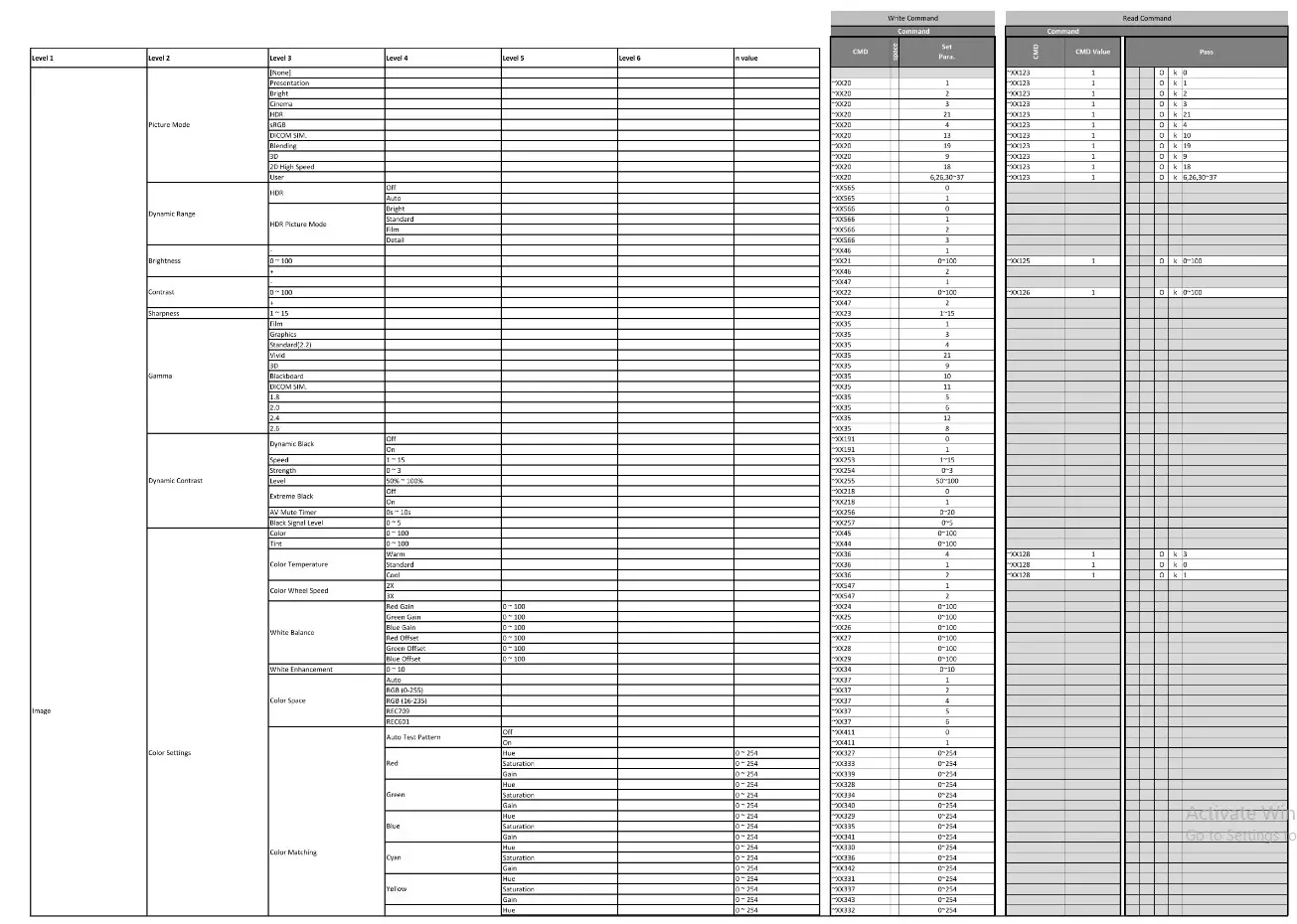 Note: Some commands are not supported, it depends on models.
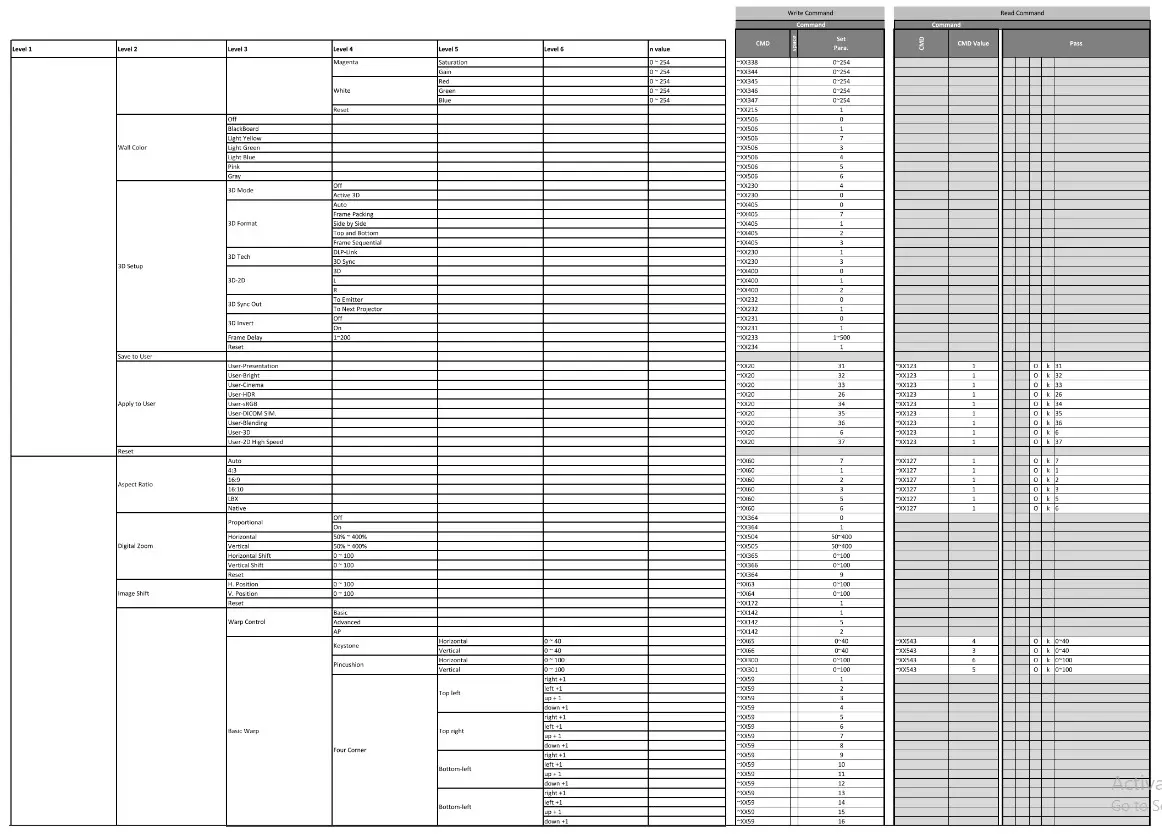
Note: Some commands are not supported, it depends on models.
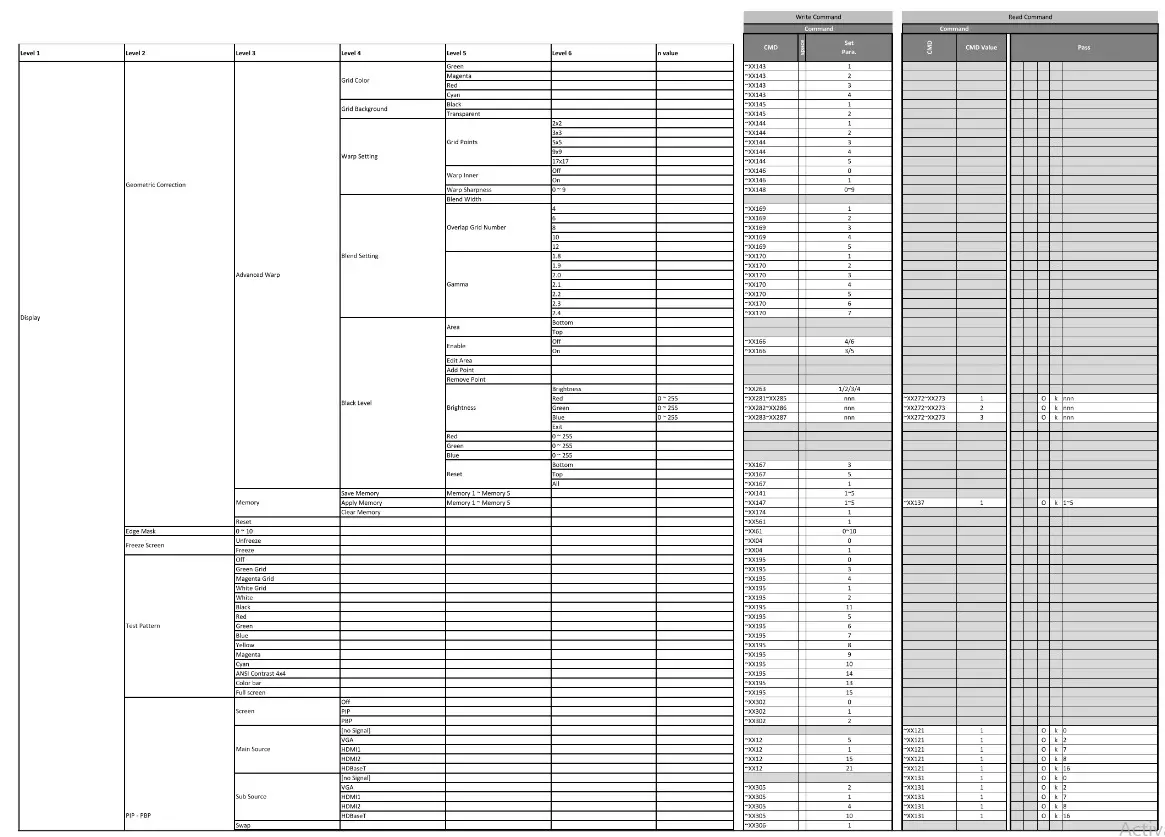
Note: Some commands are not supported, it depends on models.
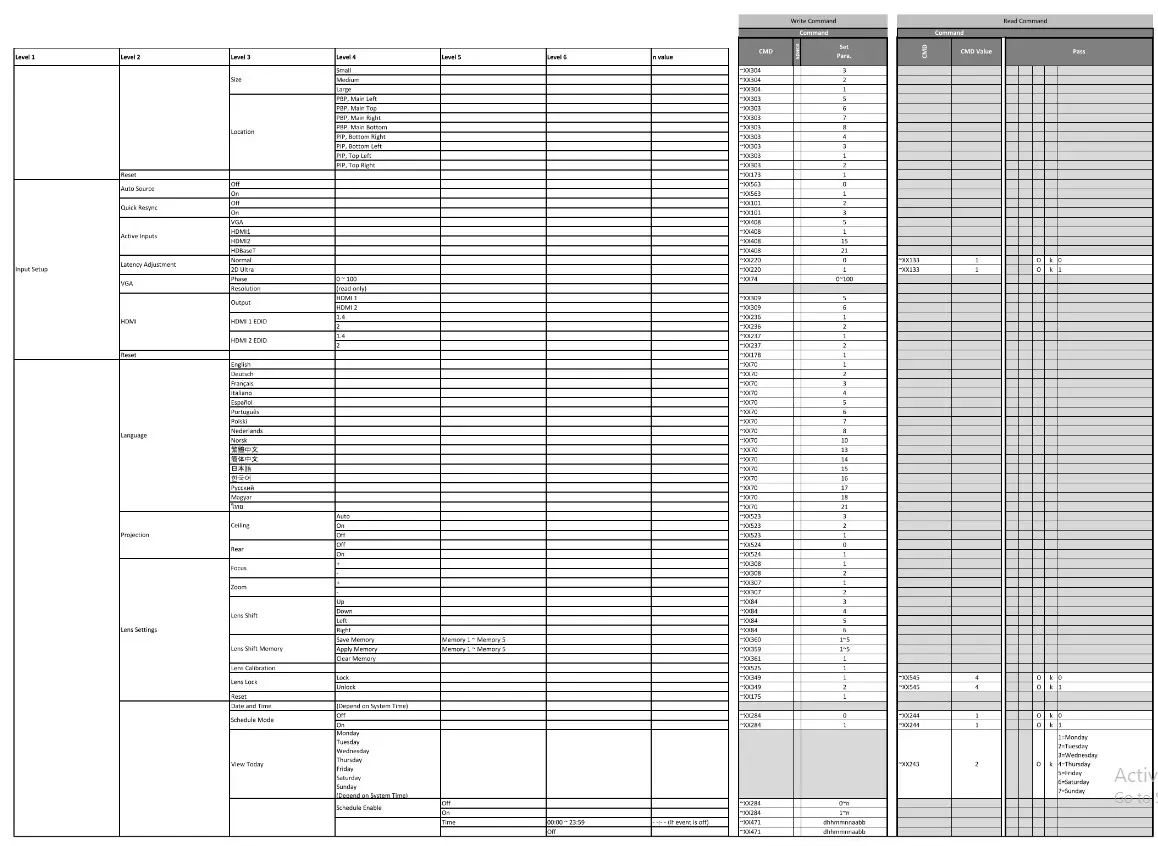
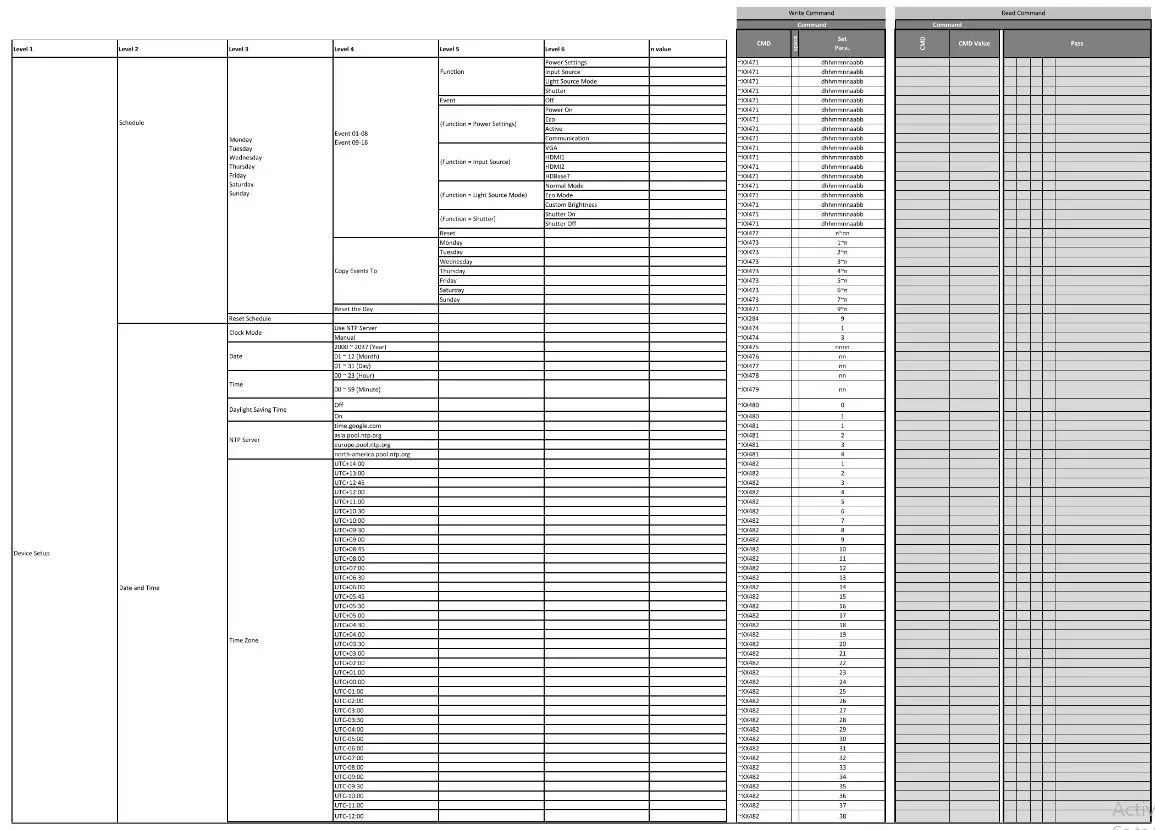
Note: Some commands are not supported, it depends on models.
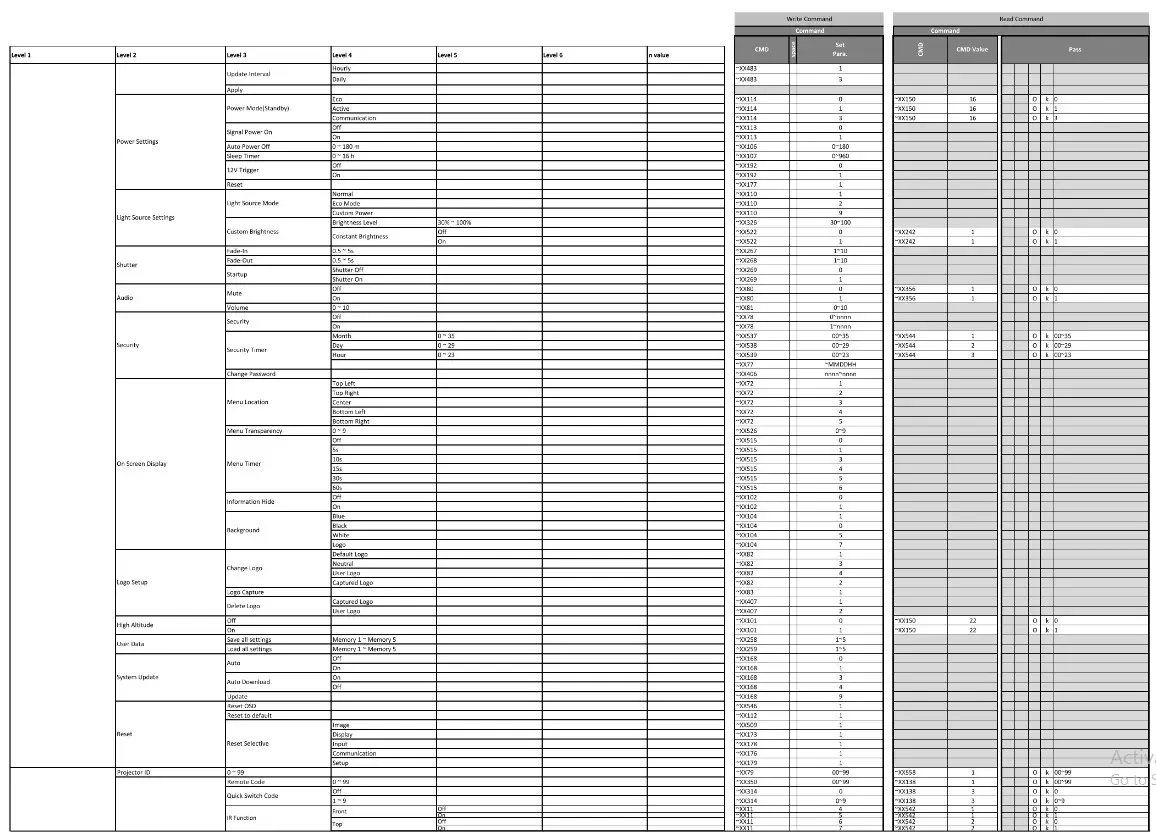
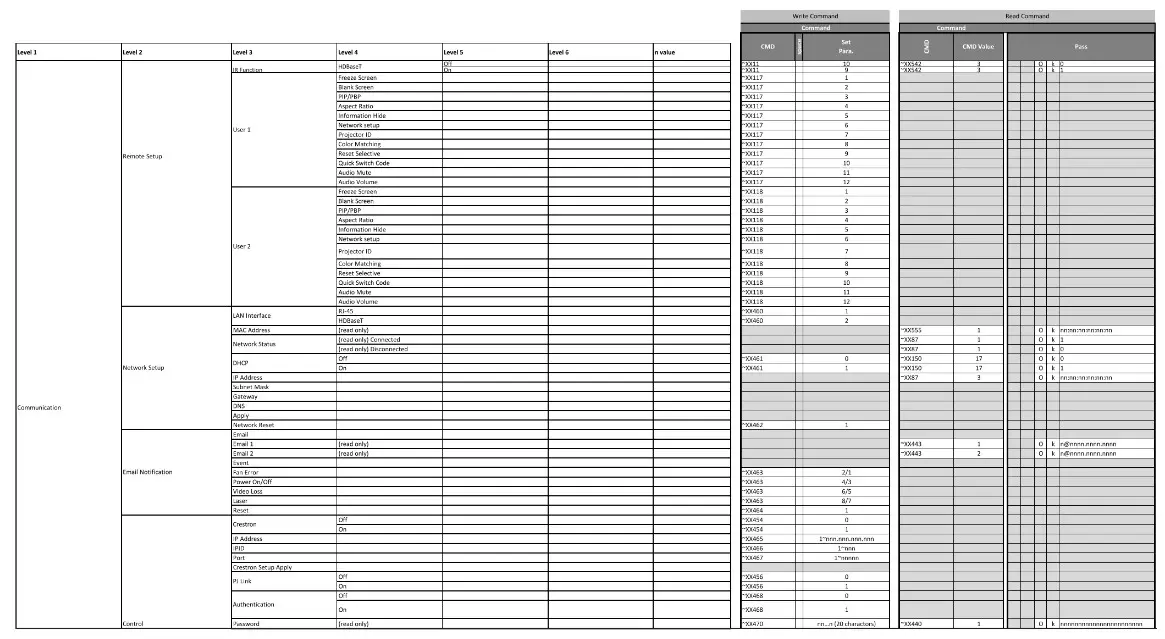
Note: Some commands are not supported, it depends on models.
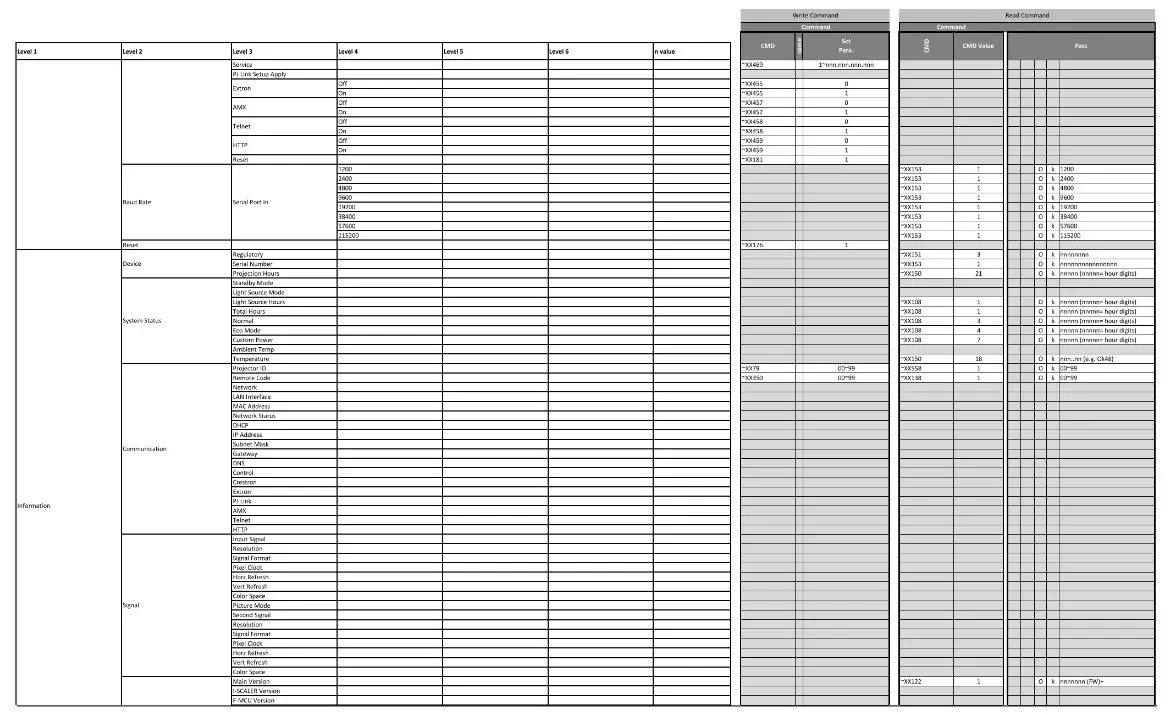
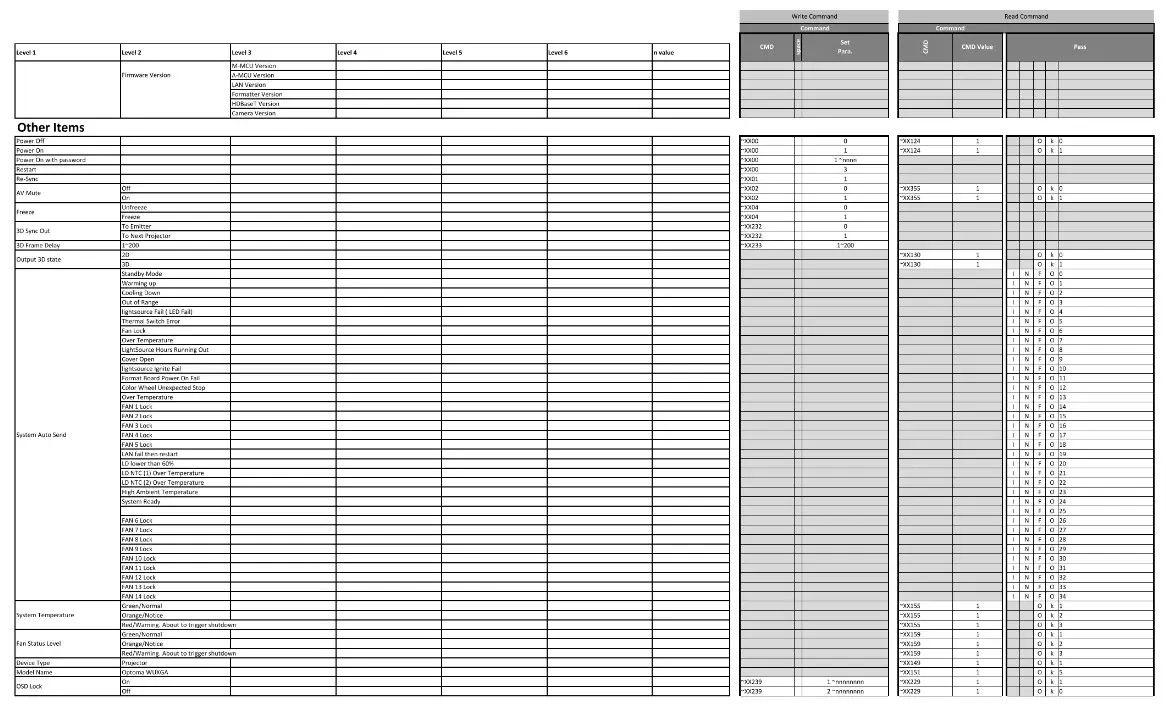
Note: Some commands are not supported, it depends on models.
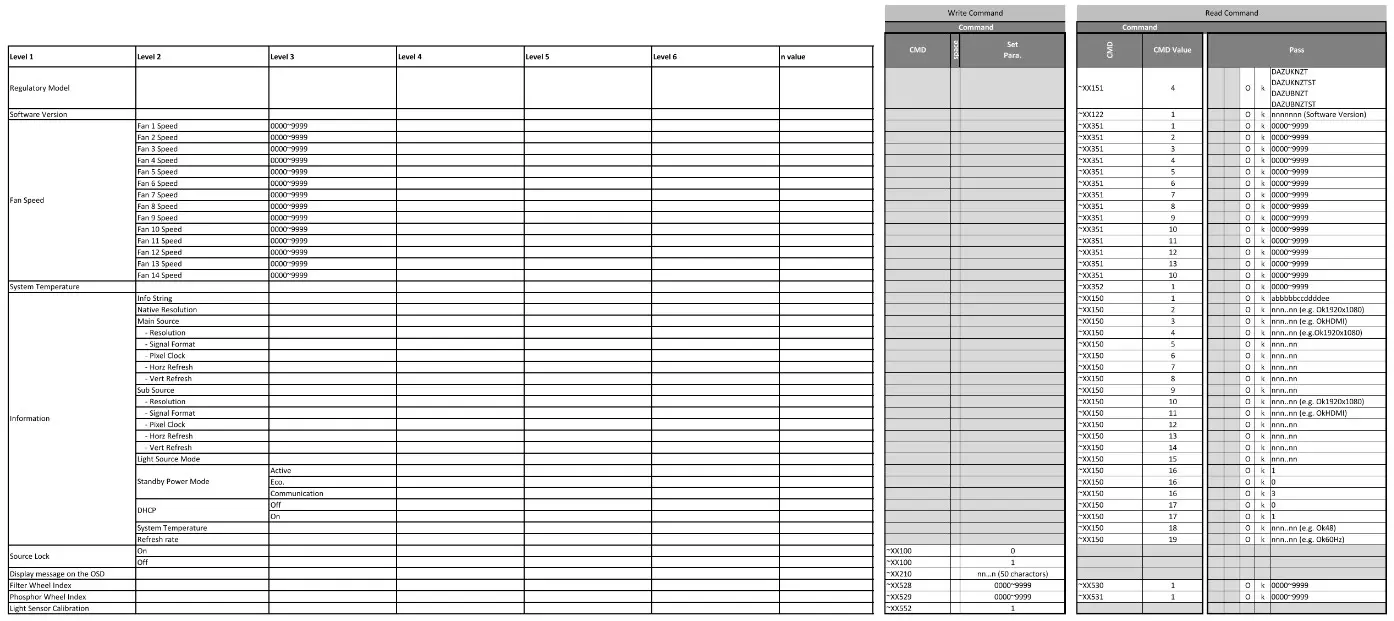
Remote Control Simulation
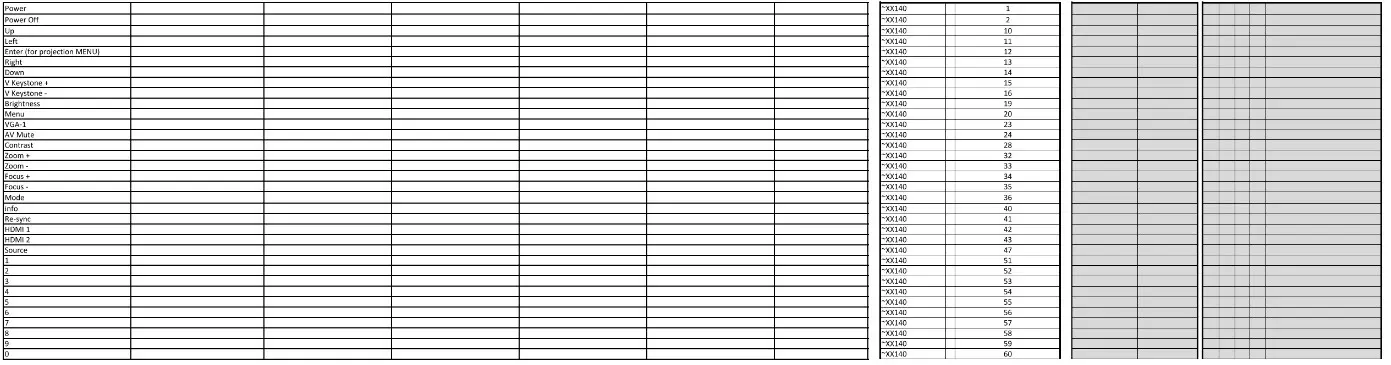

Note: Some commands are not supported, it depends on models.
Note *1 ~xx150
| Power | Light Source Life | Input Source | Firmware Version | Display Mode | |||||||||
| a | b | b | b | b | b | c | c | d | d | d | d | e | e |
| a=0 Power Off | Light Source Life = nn nn | cc=00 None | # | # | # | # | ee=00 None | ||||||
| a=1 Power On | Calculate by each mode formula | cc=01 DVI | ee=01 Presentation (Old: Cinema) | ||||||||||
| cc=02 VGA1 | eel=02 Bright | ||||||||||||
| cc=03 VGA2 | ee=03 Cinema (Old: Movie/Photo) | ||||||||||||
| cc=04 S-Video | ee=04 sRGB\Reference\Standard | ||||||||||||
| cc=05 Video | ee=05 User(1) | ||||||||||||
| cc=06 BNC | ee=06 User2 | ||||||||||||
| cc=07 HDMI1 | ee=07 Blackboard | ||||||||||||
| cc=08 HDMI2 | ee=08 Classroom | ||||||||||||
| cc=09 Wireless | ee=09 3D | ||||||||||||
| cc=10 Compnent | ee=10 DICOM SIM. | ||||||||||||
| cc=11 Flash drive | ee=11 Film | ||||||||||||
| cc=12 Network Display(Presenter) | ee=12 Game | ||||||||||||
| cc=13 USB Display | ee=13 Cinema | ||||||||||||
| cc=14 HDMI3 | ee=14 Vivid | ||||||||||||
| cc=15 DisplayPort | ee=15 ISF Day | ||||||||||||
| cc=16 HDBaseT | ee=16 ISF Night | ||||||||||||
| cc=17 Multimedia | ee=17 ISF 3D | ||||||||||||
| ee=18 2D high speed | |||||||||||||
| ee=19 Blending Mode | |||||||||||||
| ee=20 Sport | |||||||||||||
| ee=21 HDR | |||||||||||||
| ee=22 HDR SIM. | |||||||||||||
| ee=23 Super Bright | |||||||||||||
| ee=24 (Alexa auto check 2D/3D User) | |||||||||||||
Optoma global offices
For service or support, please contact your local office.
| USA 47697 Westinghouse Drive, Fremont, CA 94539, USA www.optomausa.com | 888-289-6786 510-897-8601 [email protected] |
| Canada 47697 Westinghouse Drive, Fremont, CA 94539, USA www.optomausa.com | 888-289-6786 510-897-8601 [email protected] |
| Latin America 47697 Westinghouse Drive, Fremont, CA 94539, USA www.optomausa.com | 888-289-6786 510-897-8601 [email protected] |
| Europe Unit 1, Network 41, Bourne End Mills, Hemel Hempstead, Herts, HP1 2UJ, United Kingdom www.optoma.eu Service Tel : +44 (0)1923 691865 | +44 (0) 1923 691 800 +44 (0) 1923 691 888 [email protected] |
| Benelux BV Randstad 22-123 1316 BW Almere The Netherlands www.optoma.nl | +31 (0) 36 820 0252 +31 (0) 36 548 9052 |