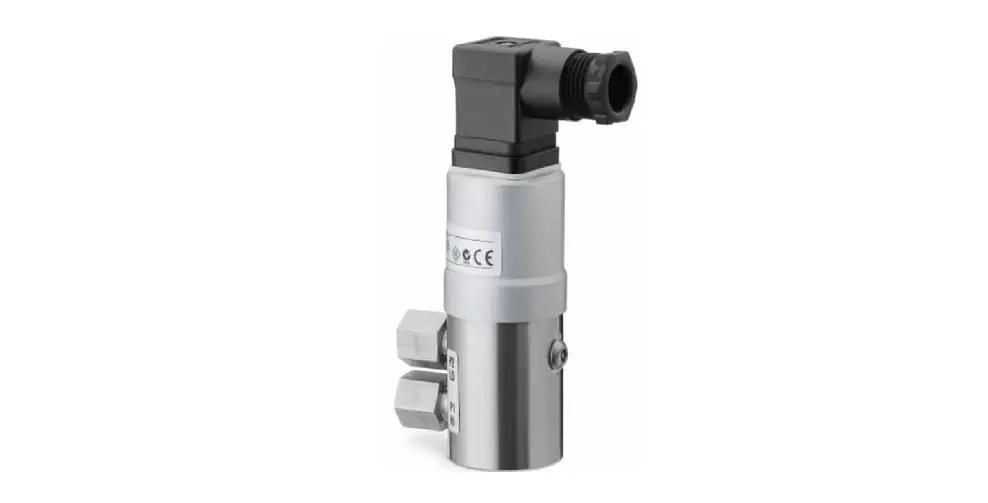
QBE3190UD25 Wet Differential Pressure Sensor
Product Information:
The Siemens Wet Differential Pressure Sensor with Manifold
Assembly is a unidirectional sensor that utilizes a ceramic
technology making it ideal for various industries. It comes with a
three-valve manifold and has three different product numbers:
QBE3190UD25, QBE3190UD50, and QBE3190UD100, with differential
pressure ratings ranging from 0-25 psi to 0-100 psi. The burst
pressure on the high side varies from 543 psi to 72 psi depending
on the product number. The sensor is rated for a pressure rating of
290 psi.
Product Usage Instructions:
Installation:
- Assemble compression fittings to the manifold finger-tight, and
then tighten a minimum of 2 to 3 turns with a 5/8 wrench or to a
maximum of 25 ft-lbs (34 Nm). - Insert the HIGH and LOW pressure lines into the appropriate
pressure port compression fittings at the bottom of the manifold.
Be sure to fully insert the pressure lines against the inside
shoulder and finger-tighten the nut. - While holding the fitting body with the 9/16 wrench, tighten
the nut 1-1/4 turn with the 1/2 wrench.
Pressurizing the System:
- Before pressurizing the system, ensure that valves V1 and V2
are closed and valve V3 is open. - Pressurize the system, and then slowly open valves V1 and V2
while closing valve V3.
Wiring:
- Use a Phillips or flat-blade screwdriver to completely remove
the mounting screw from the conduit cap. - Use a flat-blade screwdriver to pry up the termination board
where indicated (LIFT is embossed on the cover). - Feed wiring through the conduit cap and terminate wires as
shown. - Snap the termination board back into the conduit cap.
- Remove the white protective cap from the sensor.
- Insert the rubber gasket onto the sensor’s metal leads. Ensure
that the lead slots in the conduit cap are oriented to the sensor’s
metal leads. - Snap the conduit cap onto the sensor.
- Replace and secure with the mounting screw.
Mounting:
- Use two screws or required number of nylon tie wraps to mount
the sensor/manifold assembly.
CAUTION:
Personal injury or loss of life may occur if the procedures are
not followed as specified. Equipment damage or loss of data may
occur if the procedures are not followed as specified.
Installation Instructions
Document No. 129-900 June 7, 2012
Wet Differential Pressure Sensor with Manifold Assembly
Product Description
The Siemens Wet Differential Pressure Sensors utilize a unique, well-proven ceramic technology making them ideal for applications across a broad spectrum of industries. These sensors are unidirectional with a three-valve manifold.
Product Numbers
Product Number
Burst Pressure on High Side (psi)
Differential Pressure Rating (psi)
Differential pmax.* (psi)
QBE3190UD25
0 to 25
72
QBE3190UD50
543
0 to 50
116
QBE3190UD100
0 to 100
290
Pressure Rating
CAUTION:
· The maximum manifold pressure rating is 250 psi.
· * Reference the sensors’ pmax. rating. Exceeding the recommended pressure will damage the sensor.
Warning/Caution Notations
WARNING: CAUTION:
Personal injury/loss of life may occur if you do not follow the procedures as specified.
Equipment damage/loss of data may occur if you do not follow the procedures as specified.
Contents
· Sensor/manifold assembly · Rubber gasket · Non-conduit assembly kit · Conduit cap
Required Tools
· Thread sealant (Loctite 565 or equivalent) · (2) crescent wrenches: 1/2″, and 9/16″ · Small, Phillips screwdriver · Small, flat-blade screwdriver · (2) 6-32 sheet metal screws or nylon tie wraps
Installation Time
30 minutes
Prerequisites
· Use two male connector compression fittings with 1/4″-18 NPT threads rated for system pressure for the HIGH and LOW pressure ports of the manifold.
· Prepare the fittings with Loctite 565 Thread Sealant or equivalent anaerobic liquid to prevent leakage. CAUTION: Do not use putty, gasket-type material, or tape.
Installation
Pressurizing the System
1. Before the system is pressurized ensure that: a. Valves V1 and V2 are closed. b. Valve V3 is open.
P1
V3
V1
V2
SEN0635R1
HIGH
LOW
Figure 1. Sensor Flow Loop.
Item Number 129-900, Rev. AA
Page 1 of 3
Document No.129-900 Installation Instructions June 7, 2012
Installing the Sensor/Manifold Assembly
1. Assemble compression fittings to the manifold finger-tight, and then tighten a minimum 2 to 3 turns with 5/8″ wrench or to a maximum 25 ft-lbs (34 Nm). See Figure 2.
2. Insert the HIGH and LOW pressure lines into the appropriate pressure port compression fittings at the bottom of the manifold. Be sure to fully insert the pressure lines against the inside shoulder and finger-tighten the nut.
3. While holding the fitting body with the 9/16″ wrench, tighten the nut 1-1/4 turn with the 1/2″ wrench.
Figure 2. Attaching Compression Lines to the Compression Fittings.
4. Pressurize the system, and then: a. Slowly open valves V1 and V2. b. Close valve V3.
Wiring
1. Use a Phillips or flat-blade screwdriver to completely remove the mounting screw from conduit cap.
2. Use a flat-blade screwdriver to pry up the termination board where indicated. (LIFT is embossed on the cover.) See Figure 3.
3. Feed wiring through the conduit cap and terminate wires as shown.
NOTE: For non-conduit installations, insert the plastic connection with washer from the Non-conduit Assembly Kit before terminating wires.
Terminal 1 (IN) 2 (OUT) 3
Operating voltage 7.5 to 33 Vdc Output signal 4 to 20 mA Not used
Figure 4. Wiring Terminals, Sensor Top View.
4. Snap the termination board back into the conduit cap.
NOTE: The termination board can be oriented in any direction.
5. Remove white, protective cap from sensor.
6. Insert rubber gasket onto sensor’s metal leads. Observe the different slot sizes on the gasket.
CAUTION: Lead slots in the conduit cap must be oriented to the sensor’s metal leads.
NOTE: The ground lead may appear slightly bent, but do not attempt to straighten it. Insert the ground lead into the conduit cap first to correct any alignment issues.
7. Snap conduit cap onto sensor.
8. Replace and secure with the mounting screw.
Mounting the Sensor/Manifold Assembly
1. Use two screws or required number of nylon tie wraps to mount the sensor/manifold assembly.
SEN0631R1
Figure 3. Accessing and Connecting to the Wiring Terminals.
Page 2 of 3
Figure 5. Mounting Options and Approved Position.
Siemens Industry, Inc.
SEN0634R1
Mounting the Sensor/Manifold Assembly (Continued)
2. Ensure that the sensor is mounted vertically. The conduit cap may be positioned to face left, right, front or back.
Figure 6. Unapproved Mounting Positions.
3. If air bleeding is desired: a. Carefully loosen the two nuts of the compression fittings assembled to the sensor. See Figure 7. NOTE: While holding the fitting body with the 9/16″ wrench, loosen the nuts with the 1/2″ wrench.
Compression Fitting Nuts for Bleeding
Document No. 129-900 Installation Instructions
June 7, 2012
SEN0638R1
Figure 7. Compression Fitting Nuts Location.
b. Carefully tighten the nuts after bubble-free media flows out.
The installation is now complete.
Information in this publication is based on current specifications. The company reserves the right to make changes in specifications and models as design improvements are introduced. Product or company names mentioned herein may be the trademarks of their respective owners. © 2012 Siemens Industry, Inc.
Siemens Industry, Inc. Building Technologies Division 1000 Deerfield Parkway Buffalo Grove, IL 60089-4513 USA +1-847-215-1000
Your feedback is important to us. If you have comments about this document, please send them to [email protected]
Document No. 129-900 Printed in the USA
Page 3 of 3