2020 Fineness of Grind Gauges
 User Guide
Elcometer 2020, 2050, 2070
Fineness of Grind Gauges
For the avoidance of doubt, please refer to the original English language version.
Please ensure that all packaging is disposed of in an environmentally sensitive manner. Consult your local Environmental Authority for further guidance. is a registered trademark of Elcometer Limited, Edge Lane, Manchester, M43 6BU. United Kingdom
Elcometer Limited 2008-2020. All rights reserved. No part of this document may be reproduced, transmitted, transcribed, stored (in a retrieval system or otherwise) or translated into any language, in any form or by any means (electronic, mechanical, magnetic, optical, manual, or otherwise) without the prior written permission of Elcometer Limited.
OVERVIEW
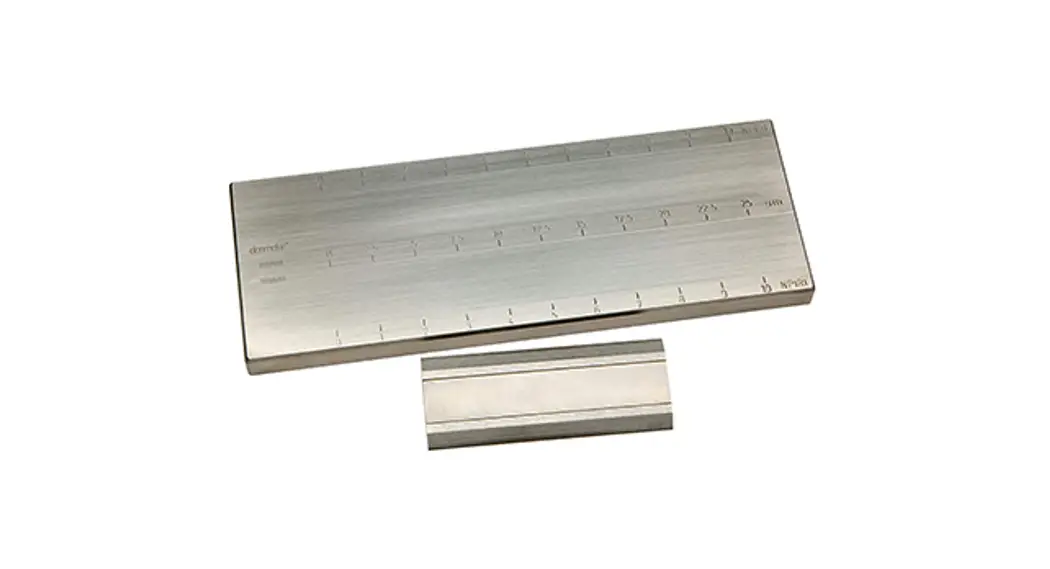
Fineness of Grind Gauges are used to determine particle size and fineness of the grind. They are suitable for the measurement of many materials, including paints, pigments, inks, printing inks, coatings, chocolates and other similar products. They may also be used to indicate the presence of undesirable large particles in these materials.
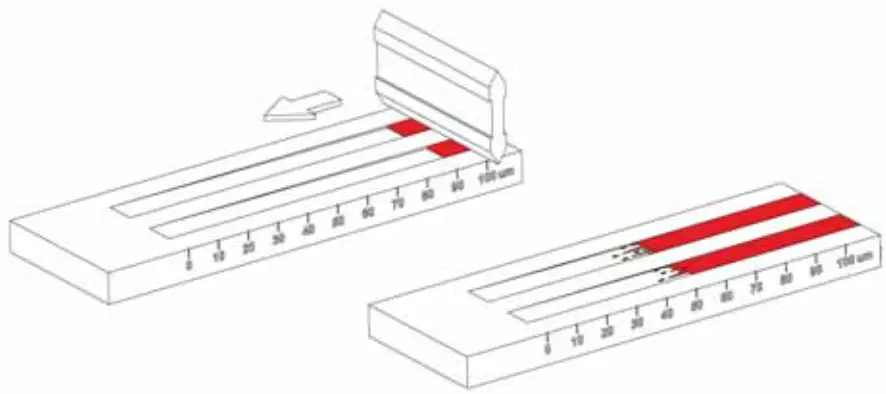
A scraper is used to pull the material along a sloping groove machined into the top surface of the gauge and the fineness of the grind is read directly from a scale engraved into the gauge.
Elcometer 2020: This model has two grooves and graduations marked in microns or mils, NS or H (Hegman) and PCU (Paint Club Units) on the top of the gauge.
Elcometer 2050: This model has a single groove and graduations marked in microns or mils on the top of the gauge.
Elcometer 2070: This model has two grooves and graduations marked in microns or mils and NPIRI (National Printing Ink Research Institute) on the top of the gauge.
BOX CONTENTS
- Elcometer Fineness of Grind Gauge
- Scraper
- Carry Case
- Calibration Certificate (if ordered)
- User Guide
TEST PROCEDURE
Before you start:
- Ensure the gauge and scraper are clean (see Section 3.3 ‘Cleaning After Test’ on page en-4).
- Perform a preliminary test to determine the size of the gauge most suitable for the fineness of grind characteristics of the material being measured.
TEST PROCEDURE (continued)
- Place the gauge on a flat, horizontal, and non-slip surface, with the zero mark on the scale closest to the user.
- Place a suitable amount of the material in the deep end of each groove.
- Place the scraper on the surface of the gauge behind the material. Use both hands to hold the scraper.
- Pull the scraper along the length of the gauge at a constant speed. Stop at a point beyond the zero depth. This operation should take approximately 1 to 2 seconds.
- View the drawn-out material within the next 3 seconds. This avoids inaccurate testing due to the evaporation of the material. The material should be viewed at right angles to the length of the groove and at an angle of 20° to 30° with the surface of the gauge.

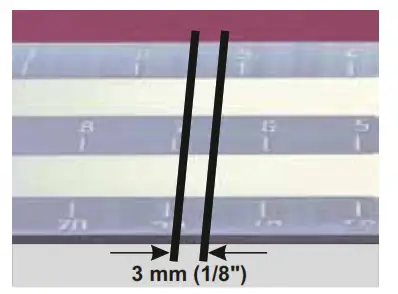
- Elcometer 2020 and 2050: Find a band across the groove(s) 3mm (1/8″) wide which contains 5 to 10 particles of the material. Read the position of the upper limit of this band on the scale and record this value.
Elcometer 2070: Find the first position in the material where a given number° of scratches can be seen. Read the scale and record this value. 3 mm (118″)
- Use a suitable solvent to clean the gauge and scraper. 8 Perform two more tests and calculate the average value of the results. The average value is the fineness of the grind of the material.
a. Apply sufficient downward pressure to clean excess material from the edges of the gauge. Avoid the formation of air bubbles.
b. A recommended method is to record 2 values: Position one – where there are 4 scratches, and Position two – where there are 10 scratches.
3.3 CLEANING AFTER TEST
Always clean the gauge after each test using a suitable solvent. After cleaning and to protect against rust, ensure that all materials are removed and that the gauge is dry. Apply a thin layer of oil to the surface of the gauge and the scraper before storage. DO NOT use very aggressive solvents or wire brushes, metal scrapers, metal files, or other metallic tools for cleaning. Store the gauge and scraper in the case provided when not in use.
CARE & MAINTENANCE
Regularly inspect the gauge and scraper for signs of wear or damage.
To inspect the scraper:
- Place the edge of the scraper on a reference plane (the smooth, level face of the gauge is a good alternative).
- Shine a bright light towards the back of the scraper. Rock the scraper backward and forwards and inspect the contact edge for any light coming through between the scraper and gauge.

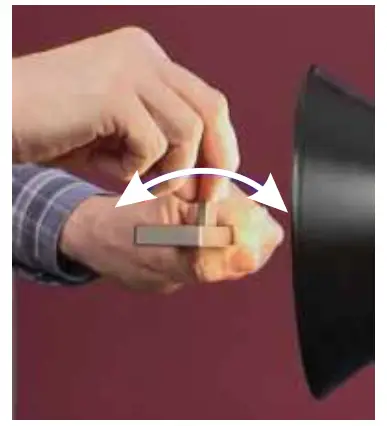
If the light is visible, the scraper is not suitable for use and should be replaced.
Description
| Description Replacement Scraper for Elcometer 2020 Replacement Scraper for Elcometer 2050 Replacement Scraper for Elcometer 2070 | Part Number KT002020N001 KT002030N001 KT002070N001 |
Rust can appear on the gauge when it is only used occasionally and when it has been handled by users with sweaty hands.
TECHNICAL SPECIFICATION
| 5.1 GLUCOMETER 2070 FINENESS OF GRIND GAUGES | |||
| Part Number° | Range | Graduations | |
| pm / mils | SPIRIT | ||
| K0002070M001 | 0 – 25pm | 0 – 10 | 2.5pm |
| K0US2070M001 | 0 – 1 mil | 0 – 10 | 0.1 mil |
| Groove Length | 165mm (6.5″) | ||
| Groove Width | 25mm (0.98″) | ||
| Accuracy | ±3pm (0.12 mil) or 5% whichever is the greater | ||
| Can be used in accordance with ASTM D 1316 | |||
| 5.2 GLUCOMETER 2050 FINENESS OF GRIND GAUGES | ||||
| Part Number° | Range | Graduations | ||
| pm | mils | pm | mils | |
| K0002050M001 | 0 – 25pm | – | 1pm | – |
| K0002050M002 | 0 – 50pm | – | 2pm | – |
| K0002050M005 | 0 – 100pm | – | 5pm | – |
| K0002050M008 | 0 – 250pm | – | 12.5pm | – |
| KOUS2050M001 | – | 0 – 1 mil | – | 0.05 mil |
| KOUS2050M002 | – | 0 – 2 mils | – | 0.1 mil |
| KOUS2050M005 | – | 0 – 4 mils | – | 0.2 mil |
| KOUS2050M008 | – | 0 – 10 mils | – | 0.5 mil |
| Groove Length | 200mm (7.87″) | |||
| Groove Width | 12mm (0.47″) | |||
| Accuracy | ±3pm (0.12 mil) or 5% whichever is the greater | |||
| Can be used in accordance with: ASTM D 1210, AS/NZS 1580204.1, DIN 53203, EN 21524, FTMS 141 4411.1, ISO 1524, JIS K 5600-2-5, NF T30-046 | ||||
d. Optional Calibration Certificates are available to purchase separately. Calibration Certificates must be requested at time of order, they can not be supplied retrospectively.
| 5.3 GLUCOMETER 2020 FINENESS OF GRIND GAUGES | ||||||
| Part Number° | Range | Graduations | ||||
| pm / mils | Hegman (NS) | PCU | ||||
| K0002020M003 | 0 – 15pm | 8 | -7 | 10 | -9 | 1.5pm |
| K0002020M004 | 0 – 25pm | 8 | -6 | 10 | -8 | 2.5pm |
| K0002020M001 | 0 – 50pm | 8 | -4 | 10 | -5 | 5pm |
| K0002020M002 | 0 – 100pm | 8 | 0 | 10 | 0 | 10pm |
| KOUS2020M004 | 0 – 1 mil | 8 | -6 | 10 | -8 | 0.1 mil |
| KOUS2020M001 | 0 – 2 mils | 8 | -4 | 10 | -5 | 0.2 mil |
| KOUS2020M002 | 0 – 4 mils | 8 | 0 | 10 | 0 | 0.5 mil |
| Groove Length | 127mm (5″) | |||||
| Groove Width | 12mm (0.47″) | |||||
| Accuracy | ±3pm (0.12 mil) or 5% whichever is the greater | |||||
| Can be used in accordance with: ASTM D 4414-A, AS/NZS 1580.107.3, BS 3900-05-7B, ISO 2808-1A, ISO 2808-7B, JIS K 5600-1-7, NF T30-125, US NAVY PPI 63101-000, US NAVY NSI 009-32 | ||||||
d. Optional Calibration Certificates are available to purchase separately. Calibration Certificates must be requested at time of order, they can not be supplied retrospectively.
TMA-0311 Issue 08 – Text with cover 19182
www.elcometer.com