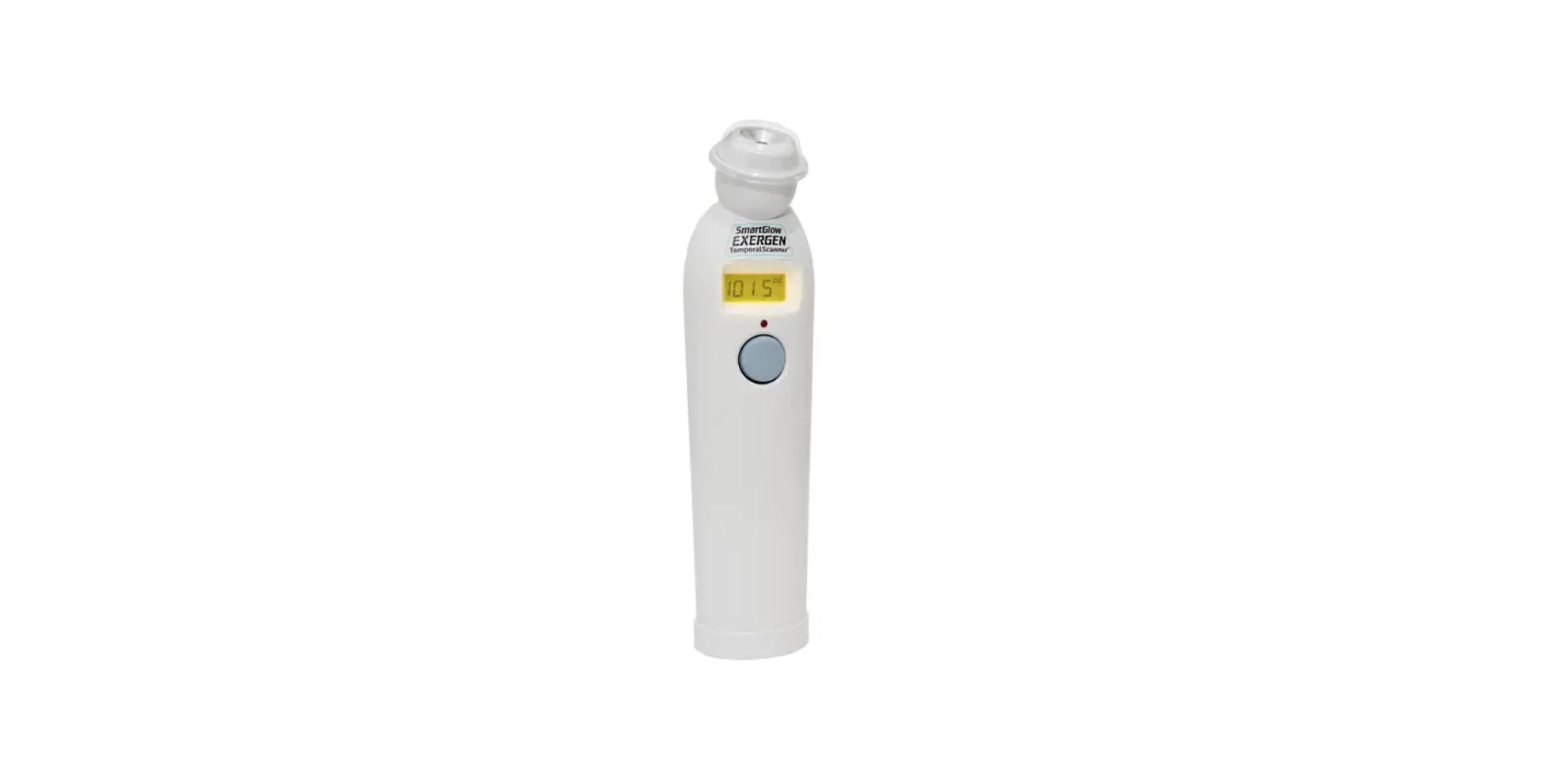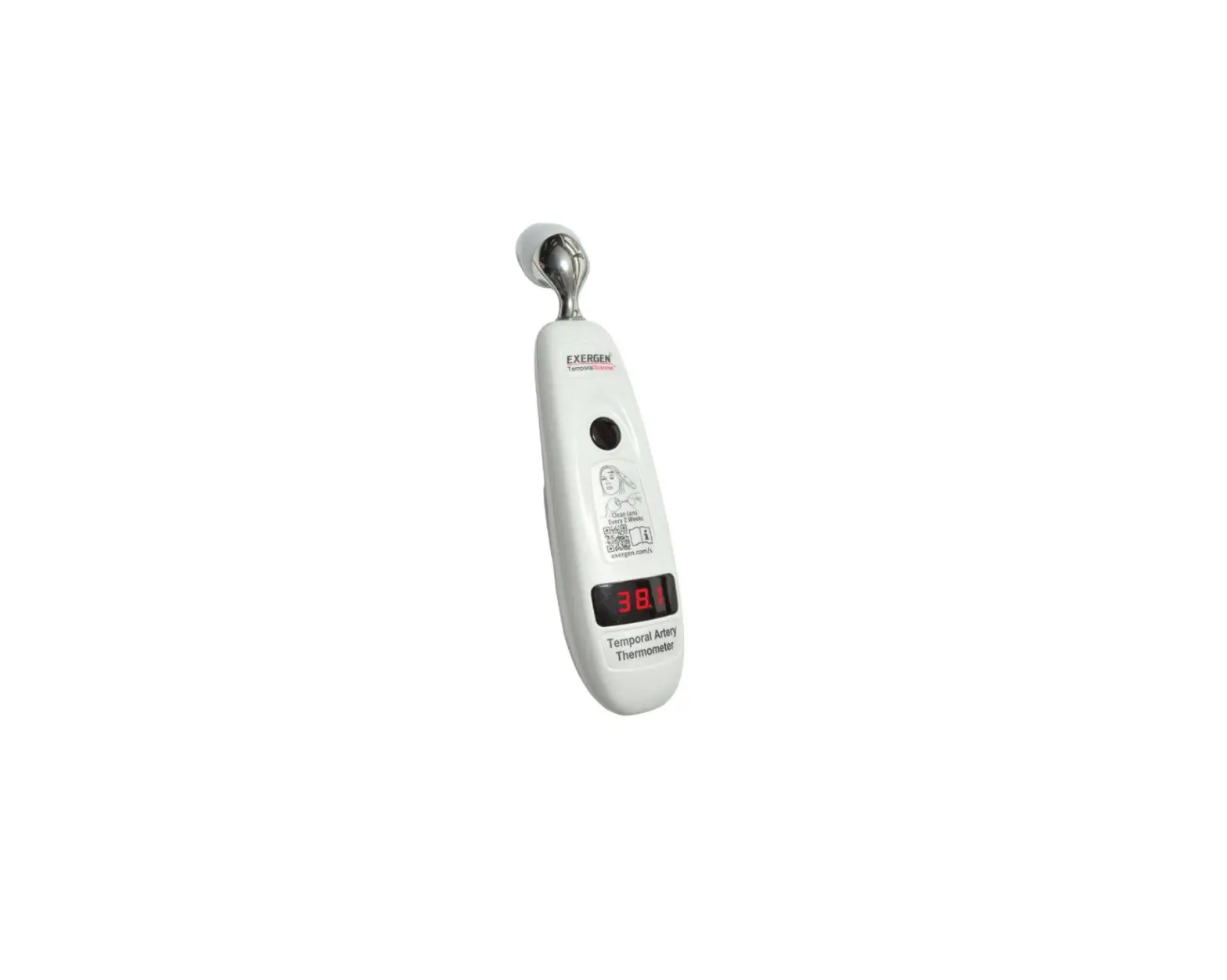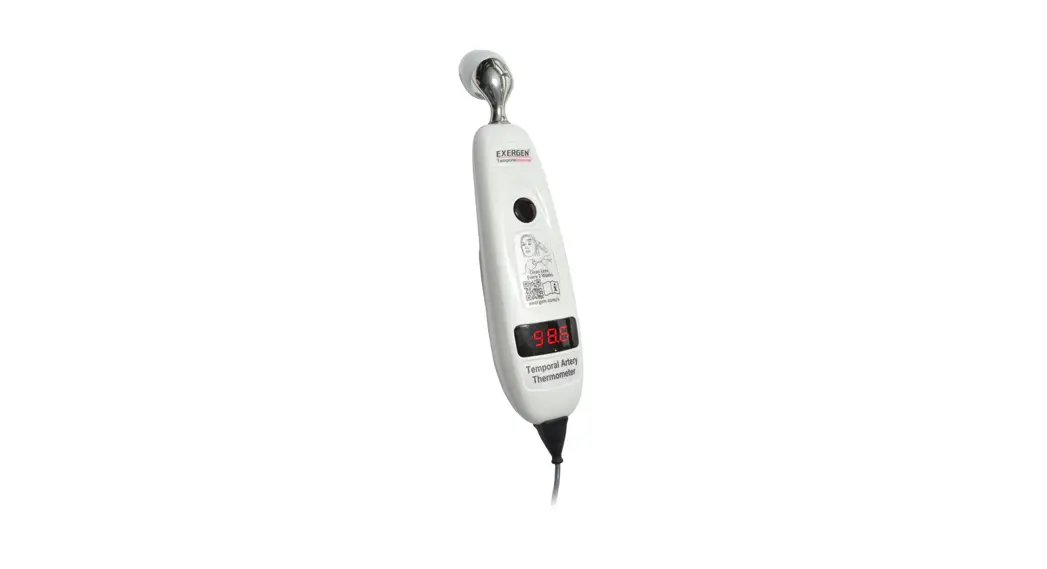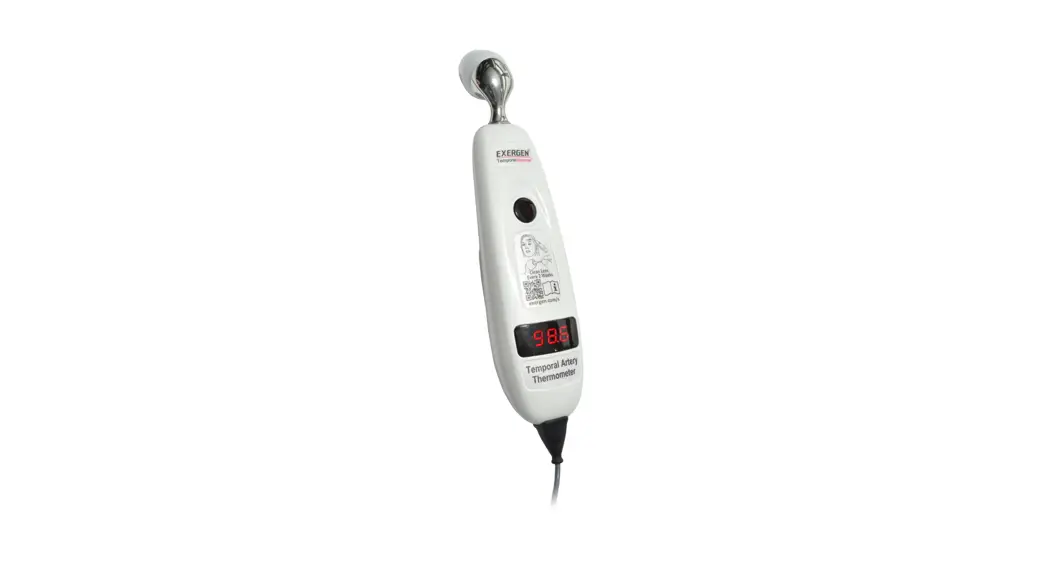


Changing the Way the World Takes Temperature
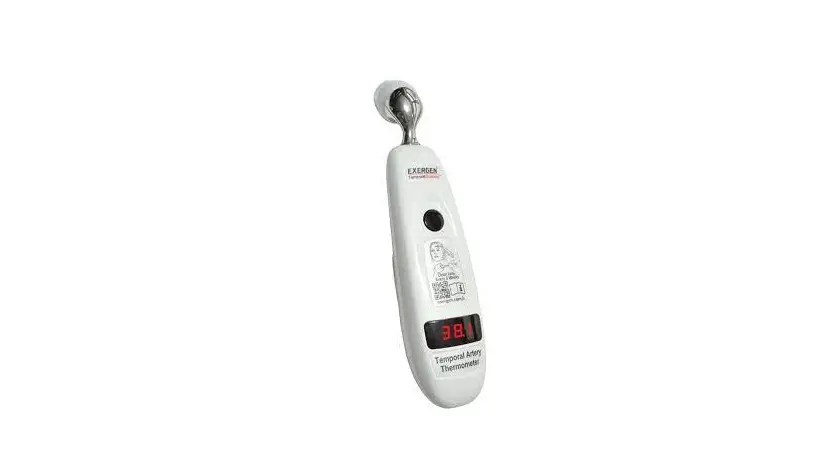
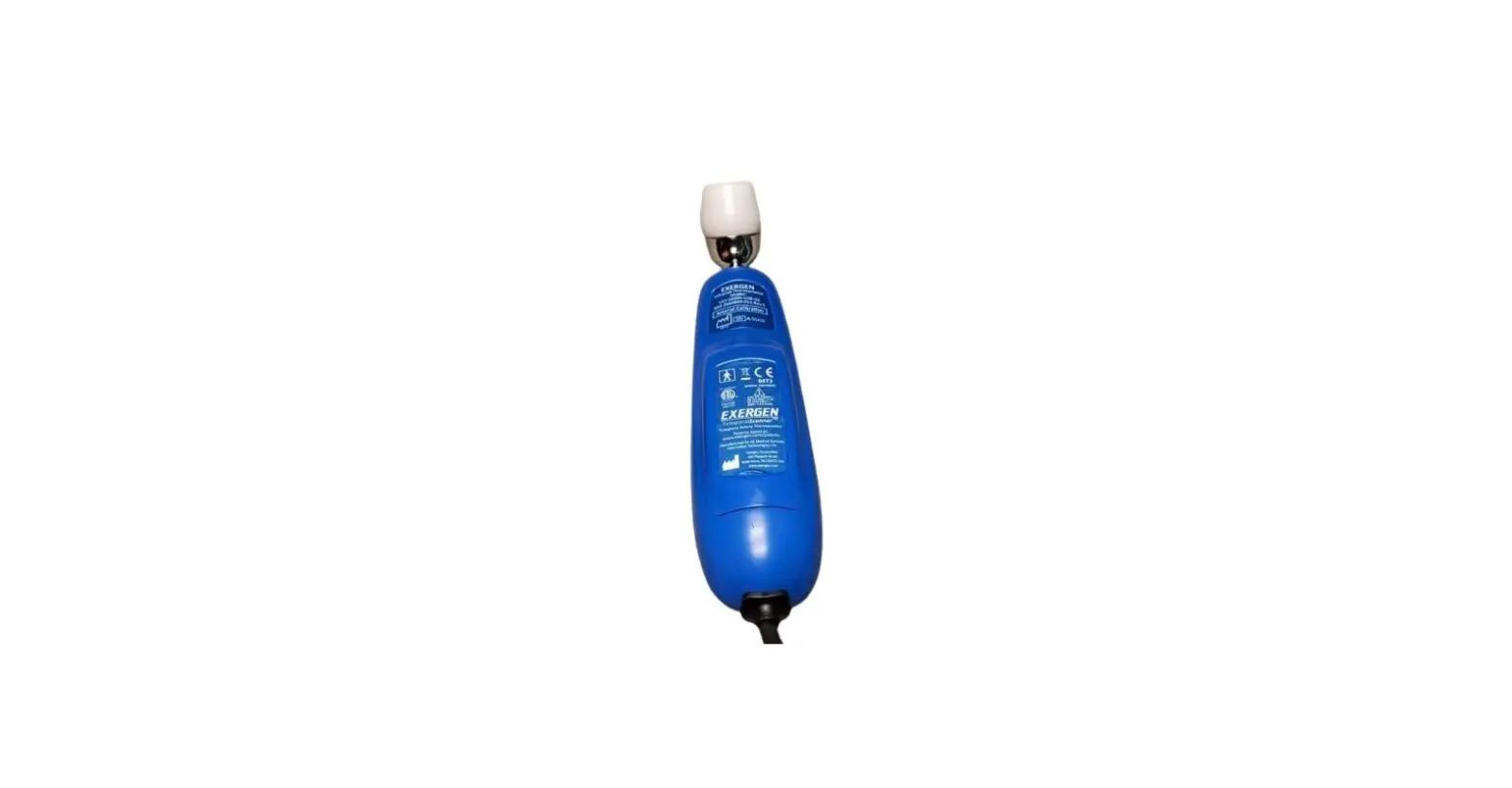
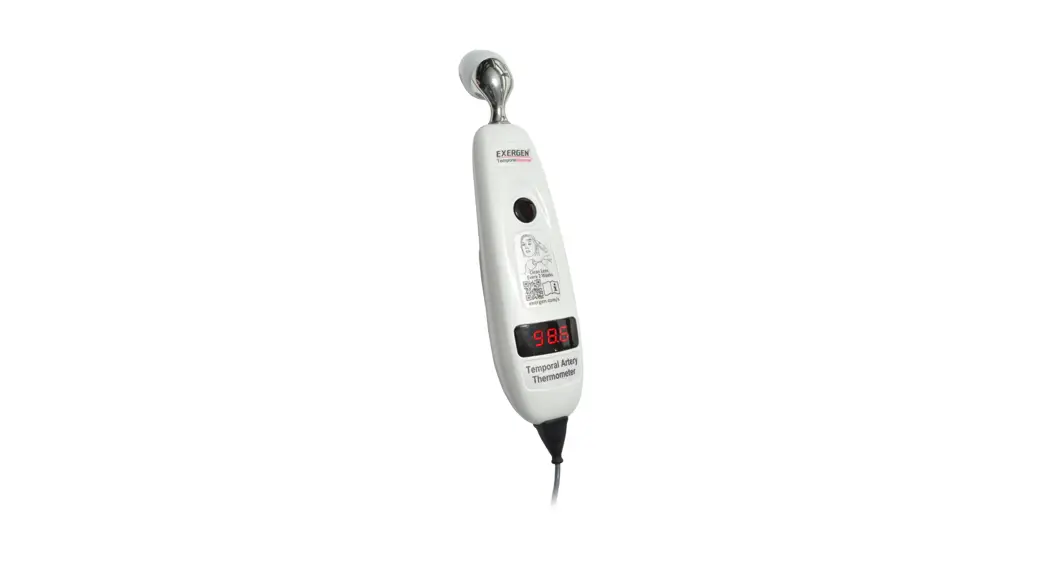
The TemporalScanner is an infrared thermometer designed for accurate, completely non-invasive temperature assessment by scanning the temporal artery (TA).
Temperature is measured by gently stroking the TemporalScanner across the forehead, and includes a momentary touch of the probe to the neck area behind the ear lobe, to account for any cooling of the forehead as a result of diaphoresis. The patented arterial heat balance technology (AHB™) automatically measures the temperature of the skin surface over the artery and the ambient temperature. It samples these readings some 1000 times a second, ultimately recording the highest temperature measured (peak) during the course of the measurement. The TemporalScanner emits nothing – it only senses the natural thermal radiation emitted from the skin.
It has been clinically proven in premier university hospitals to be more accurate than ear thermometry, and better tolerated than rectal thermometry, and is supported by more than 70 peer-reviewed published studies covering all ages from premature infants to geriatrics in all clinical care areas. It is a superior method for patients and clinicians alike.
A 40-page compendium on Temporal Artery Temperature Assessment is available at www.exergen.com/medical/PDFs/tempassess.pdf, and a complete list of peer-reviewed published clinical studies is available at www.exergen.com/c. Complete multilanguage information on clinical use, instruction manuals, and training are available at www.exergen.com/s, which includes links to a specialized clinical site http://www.exergen.com/tathermometry/index.htm.The link to www.exergen.com/s appears on the front label of the instrument as a scannable “QR” symbol for easy linking to the site.

Important Safety Instructions
READ ALL INSTRUCTIONS BEFORE USING
Intended Use: The Exergen TemporalScanner is a handheld infrared thermometer used by medical professionals for the intermittent measurement of human body temperature of people of all ages, by scanning the forehead skin over the temporal artery. Intended users are physicians, nurses, and nursing assistants at all levels who normally provide atient care. The thermometer provides a peak temperature reading from plural readings during the step of scanning. Electronic circuitry processes the measured peak temperature to provide a temperature display based on a model of heat balance relative to a detected arterial temperature, the electronic circuitry computing an internal temperature of the body as a function of ambient temperature and sensed surface temperature. Training materials that are supplementary to this instruction manual are available t www.exergen.com/s and recommended for first-time users.TAT-5000S Series thermometers are used by medical professionals in clinical environments. Such medical professionals include physicians, nurses, nurses’ aides, patient care technicians, and others who are trained to take the temperature of patients. Clinical environments include areas where medical professionals are providing medical services for patients, including hospitals, outpatient clinics, primary care offices, and other settings where the temperature is taken as part of patient care. Additionally, the TAT-5000S series thermometers are not for use aboard aircraft or near High-Frequency Surgical Equipment or Radio Frequency shielded rooms, such as MRI (Magnetic Resonance Imaging) areas.
When using the product basic safety precautions should always be followed, including the following:
- Use this product only for its intended use as described in this manual.
- Do not take temperature over scar tissue, open sores, or abrasions.
- The operating environmental temperature range for this product is 16 to 40°C (61 to 104°F).
- Always store this thermometer in a clean, dry place where it will not become excessively cold (-20°C/-4°F), or hot (50°C/ 122°F) or humid (max RH 93% non-condensing, at 50 to 106 kPa).
- The thermometer is not shockproof. Do not drop it or expose it to electrical shocks.
- Do not Autoclave. Please note cleaning procedures in this manual.
- Do not use this thermometer if it is not working properly if it has been exposed to temperature extremes, damaged, been subject to electrical shocks or immersed in water.
- There are no parts that you can service yourself except for the battery, which you should replace when low by following the instructions in this manual. For service, repair, or adjustments, return your thermometer to Exergen. Warning: no modification of this equipment is allowed.
- Never drop or insert any object into any opening, unless stated in this manual.
- If your thermometer is not used regularly, remove the battery to prevent possible damage due to chemical leakage.
- Follow the battery manufacturer’s recommendations or your hospital policy for the disposal of used batteries.
- Not suitable for use in the presence of flammable anesthetic mixtures.
- Do not use corrosive substances on the thermometer.
- If the device fails to operate as described above, see the FAQ section of this manual. Additionally, ensure that you are not in the presence of electromagnetic disturbances.
- If you have any additional questions regarding the use or care of the thermometer, please see www.exergen.com or call customer service at 617-923-9900.
SAVE THESE INSTRUCTIONS.
WARNING
Use of this equipment adjacent to or stacked with other equipment (other than TAT-5000S compatible patient monitors) should be avoided because it could result in improper operation. If such use is necessary, this equipment and the other equipment should be observed to verify that they are operating normally.
WARNING
Use of accessories, transducers, and cables other than those specified or provided by the manufacturer of this equipment could result in increased electromagnetic emissions or decreased electromagnetic immunity of this equipment and result in improper operation.
WARNING
Portable RF communications equipment (including peripherals such as antenna cables and external antennas) should be used no closer than 30 cm (12 inches) to any part of the AT-5000S thermometer, including cables specified by the manufacturer. Otherwise, degradation of the performance of this equipment could result.
Introduction to Temporal Artery Thermometry
Temporal artery thermometry (TAT) is a completely new method of temperature assessment, using infrared technology to detect the heat naturally emitted from the skin surface. In addition, and of key importance, this method incorporates a patented arterial heat balance system to automatically account for the effects of ambient temperature on the skin.
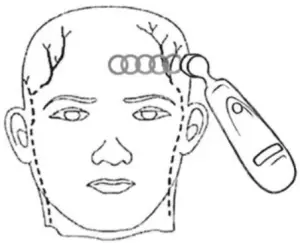
This method of temperature assessment has been shown to improve results and reduce costs by non-invasively measuring body temperature with a degree of clinical accuracy unachievable with any other thermometry method.
Before Using, Familiarize Yourself with the Instrument
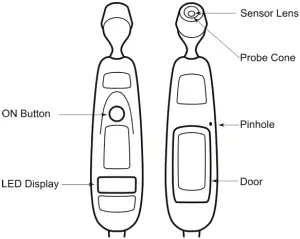
- To Scan: Depress the red button. The instrument will continually scan for the highest temperature (peak) as long as the button is depressed.
- Clicking: Each fast click indicates a rise to a higher temperature, similar to a radar detectorSlow clicking indicates that the instrument is still scanning, but not finding any higher temperature.
- To Retain or Lock Reading: The reading will remain on the display for 30 seconds after the button is released. If measuring room temperature, the temperature will remain on the display for only 5 seconds.
- To Restart: Depress the button to restart. It is not necessary to wait until the display is clear, the thermometer will immediately begin a new scan each time the button is depressed. Alternate sites when a temporal artery or behind the ear are unavailable:
- Femoral artery: slowly slide the probe across the groin.
- Lateral thoracic artery: slowly scan side-to-side in the area ~midway between the axilla and the nipple.
2-Step Infant Temperature Measurement
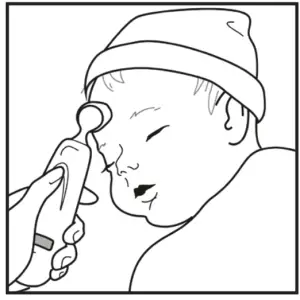 | 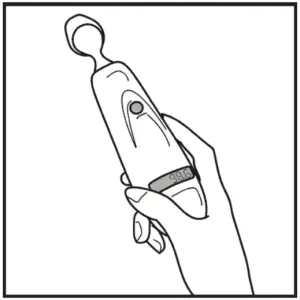 |
| Step 1 Place probe flush on the center of the forehead and depress the button. Keepingbutton expressed, slowly slide probe midline across forehead to the hairline. | Step 2 Release button, remove from head, and read. |
How to improve the accuracy of your measurements on infants.
| 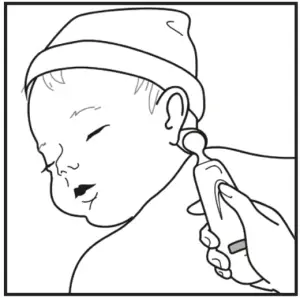 |
| The preferred site is the temporal artery area. Unless visibly diaphoretic, one measurement here is typically all that is required. | If the temporal artery is covered, then the area behind the ear, if exposed, can be an alternate site. |
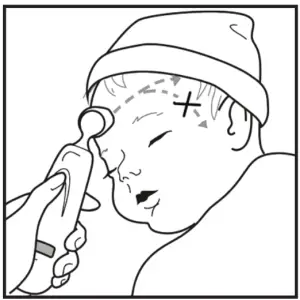 | 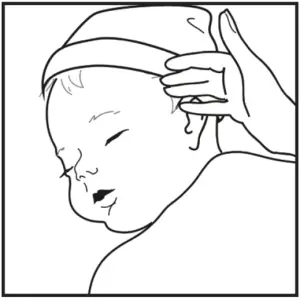 |
| Measure straight across the forehead and not the downside of the face. At mid-line, the temporal artery is about 2 mm below the surface but can go deep below the surface on the side of the face. | Brush the hair aside if covering the area to be measured. Measurement site must be exposed. |
3-Step Adult Temperature Measurement
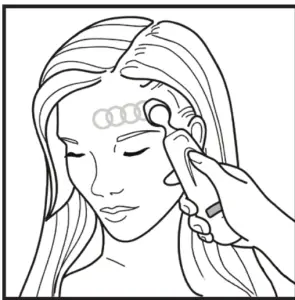 | 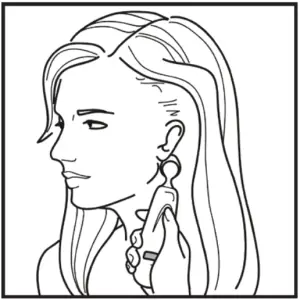 | |
| Step 1 Slide across the forehead. Place probe flush on the center of the forehead and depress the button. eeping button depressed slowly slide probe mid-line across the forehead to the hair line. | Step 2 Slide behind the ear. Keeping button depressed, lift probe from the forehead, touch behind ear halfway down the mastoid process and slide down to the soft depression behind the earlobe. | Step 3 Release button, remove from heat, and read. |
How to improve the accuracy of your measurements on adults.
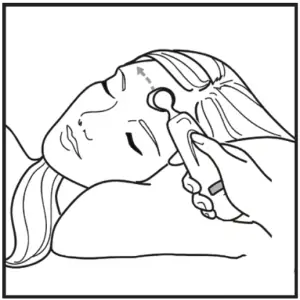 | 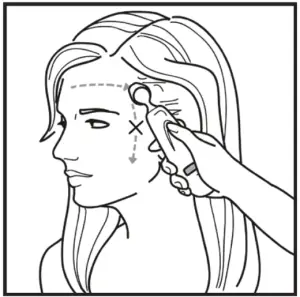 | 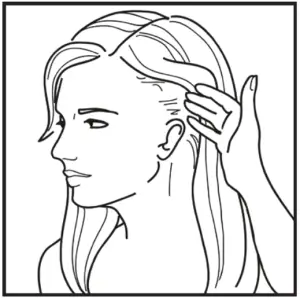 |
| Measure only the upside on a patient in a lateral position. The downside will be insulated preventing the heat from dissipating, resulting in falsely high readings. | Think of a sweatband. Measure straight across the forehead and not down the side of the face. At mid-line, the temporal artery is about 2 mm below the surface but can go deep below the surface on the side of the face. | Measure exposed skin. Brush the hair and bangs aside if covering the area to be measured. |
| Minimum measuring time: 2 seconds. | Minimum time between successive measurements: 30 seconds |
Frequently Asked Questions
Q: How does the temperature from a temporal scanner relate to core temperature?
A: Temporal artery temperature is considered a core temperature because it has been demonstrated as accurate as the temperature measured by a pulmonary artery and esophageal catheter, and as accurate as a rectal temperature on a stable patient. Rule of thumb: Rectal temperature is about 0.5°C (1°F) higher than an oral temperature and 1°C (2°F) higher than an axillary temperature. It will be easy to remember if you think of core temperature as a rectal temperature and apply the same protocol you would use for a rectal temperature.
If your thermometer is marked Oral and has a serial number beginning with “O” (standard model starts with “A”), it is programmed to compute the normal average cooling effect at the mouth, and automatically reduces the higher arterial temperature by that amount. This calibration allows the hospital to maintain existing protocols for fever workups based on oral temperature and results in reading consistent with the 37°C (98.6°F) mean normal oral temperature, in the range of 35.9 – 37.5°C (96.6 – 99.5°F) you now see.
Q: What should I do if I get an abnormally high or low reading, how do I confirm my reading?
- Repeat the reading with the same Temporal Scanner; a correct reading will be reproducible.
- Repeat the reading with another Temporal Scanner. Two Temporal Scanners with the same reading will confirm the reading.
- Sequential readings on the same patient in rapid succession will cool the skin; it is best to wait about 30 seconds for the skin to recover from the cold probe.
| Type of Abnormal Temperature | Possible Cause | Helpful Hint |
| Abnormally Low Temperature | Dirty Lens | The clean lens of the scanner every two weeks. |
| Releasing the button before finished measuring | Release the button after finishing measuring. | |
| Measuring when an ice pack or wet compress is on the forehead | Remove ice pack or wet compress, wait 2 minutes, and re-take temperature. | |
| Measuring a completely diaphoretic patient | Complete diaphoresis includes diaphoresis of the area behind the ear and suggests that the temperature is rapidly dropping. Use an alternative method of temperature measurement in these cases until the patient is dry and the temporal artery measurement can be repeated. | |
| Improperly scanning down the side of the face | Scan straight across the forehead. The temporal artery is closest to the skin in that area. | |
| Abnormally High Temperature | Anything covering the area to be measured would insulate and prevent heat from dissipating, resulting in falsely high readings. | Confirm measurement site has not recently been in contact with heat insulators such as hats, blankets, and hair. Scan the area not covered or wait about 30 seconds for the previously covered area to equilibrate to the environment. |
Care and Maintenance
- Handling: The TemporalScanner is designed and built to industrial durability standards in order to provide long and trouble-free service. However, it is also a high-precision optical instrument and should be accorded the same degree of care in handling as you would provide other precision optical instruments, such as cameras or otoscopes.
- Cleaning the case: The TemporalScanner case can be wiped down using a cloth dampened with 70% isopropyl alcohol. The industrial-grade housing and design of the electronic components allow for completely safe cleaning with 70% isopropyl alcohol but should not be immersed in fluid or autoclaved.
- Cleaning the sensor lens: With normal use, the only maintenance required is to keep the lens on the end of the probe clean. It is made of special mirror-like, silicon infrared transmitting material. However, dirt, greasy films, or moisture on the lens will interfere with the passage of infrared heat and affect the accuracy of the instrument. Regularly clean the lens with a cotton swab dipped in alcohol in accordance with the instruction label on the instrument (see below). Use only light force for cleaning, to avoid damaging the lens. Water can be used to remove any residual film left by the alcohol. Do not use bleach or other cleaning solutions on the sensor lens.

DO NOT SUBMERGE THE THERMOMETER IN ANY CLEANING SOLUTION.
- Calibration: Factory calibration data is installed via a computer that communicates with the TemporalScanner’s microprocessor. The instrument automatically self-calibrates each time it is turned on using this data, and will never require recalibration. If readings are not correct, the instrument should be returned for repair.
- Battery: A standard alkaline 9V battery provides approximately 15,000 readings.* To replace, insert the end of a bent paper clip into the pinhole on the side of the unit to release the battery compartment door. Disconnect the old battery and replace it with a new one in the same location. Replace the cover. Use only high-quality alkaline batteries.* approximate number of readings when scanning for 5 seconds and reading the temperature display for 3seconds before turning the thermometer off.
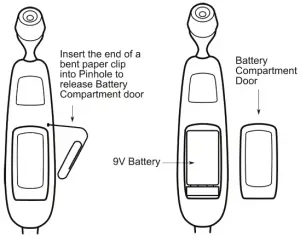
Display Diagnostics Chart
The following chart summarizes the conditions that may occur while the TemporalScanner is in use, and the associated indications:
| Condition | Display | Range |
| High Target | HI | > 43 °C (110° F) |
| Low Target | LO | < 16 °C (61° F) |
| High Ambient | HI A | > 40 °C (104° F) |
| Low Ambient | LO A | < 16 °C (61° F) |
| Low Battery | bAtt | |
| No or Very Low Battery | blank display | |
| Processing Error | Err | Restart. Return to Exergen for repair if error message persists. |
| Scanning (Normal Operation) | – – – – |
Fahrenheit or Celsius Conversion
The TemporalScanner can be used in either °F or °C. To convert from one scale to the other, the only tools necessary are a paper clip and the tip of a small screwdriver.
For °F/°C Conversion:
- Insert the end of a bent paper clip into the pinhole on the side to release and remove the cover. Remove the battery from the compartment.
- Locate the switch, and with the tip of a screwdriver, slide left or right to the opposite position.
- Remove the screwdriver.
- Replace the cover.
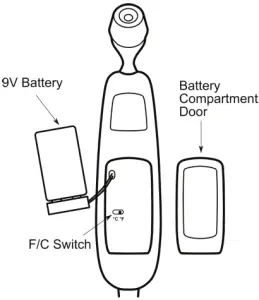
Guidance and Manufacturer’s Declaration – Electromagnetic Emissions
The infrared forehead thermometer model TAT-5000S series is intended for use in the electromagnetic environment specified below. The user of the TAT-5000S series should assure that it is used in such an environment.
| Emissions test | Compliance | Electromagnetic environment-guidance |
| RF emissions CISPR 11 | Group 1 | The TAT-5000S series thermometer uses no RF energy therefore any emissions are unlikely to cause any interference in nearby electronic equipment |
| RF emissions CISPR 11 | Class B | The TAT-5000S series thermometer is suitable for use by a healthcare professional in a typical healthcare environment. |
| Harmonic emissions | Not applicable | |
| Voltage fluctuations | Not applicable |
Guidance and Manufacturer’s Declaration – Electromagnetic Immunity
The TAT-5000S series thermometer is intended for use in the electromagnetic environment specified below. The user of the TAT-5000S series should assure that it is used in such an environment.
| Immunity test | IEC 60601 test level | Compliance level | Electromagnetic environment-guidance |
| Conducted RF IEC 61000-4-6 | 3Vrms 150 kHz to 80 MHz | Not applicable | Portable and mobile RF communications equipment should be used no closer to any part of the TAT-5000S series including cables if applicable, than the recommended separation distance calculated from the equation applicable to the frequency of the transmitter. Recommended separation distance d=1,2*P1/2 d=1,2*P1/2 80 MHz to 800MHz d=1,2*P1/2 800MHz to 2,7 GHz Where P is the maximum output power rating of the transmitter in watts (W) according to the transmitter manufacturer and d is the recommended separation distance in meters(m). Field strength from the fixer RF transmitters, as determined by an electromagnetic site survey, a. should be less than the compliance level in each frequency range, and b. interference may occur in the vicinity of equipment with the following symbol: |
| Radiated RF IEC 610004-3 | 10V/m 80 MHz to 2,7 GHz | 10V/m |
Note 1 At 80MHz and 800MHz, the higher range applies. Note 2 These guidelines may not apply in all situations. Electromagnetic propagation is affected by absorption and reflection from structures, objects, and people.
a. Field strengths from the fixed transmitters, such as base stations for radio (cellular/cordless) telephones and land mobile radios, amateur radio, AM and FM radio broadcast, and TV broadcast cannot be predicted theoretically with accuracy. To assess the electromagnetic environment due to fixed RF transmitters, an electromagnetic site survey should be considered. If the measured field strengths in the location in which the TAT-5000S series thermometer is used exceeds the applicable RF compliance level above, the TAT- 000S series thermometer should be observed to verify normal operation. If abnormal performance is observed, additional measures may be necessary, such as reorienting or relocating the TAT-5000S.
b. Over the frequency range 150 kHz to 80 MHz, field strengths should be less than 3V/m.
c. Portable and mobile RF communications equipment can affect performance.
Guidance and Manufacturer’s Declaration – Electromagnetic Immunity (cont)
The TAT-5000S series thermometer is intended for use in the electromagnetic environment specified below. The user of the TAT-5000S series should assure that it is used in such an environment.
Immunity test | IEC 60601 test level | Compliance level | Electromagnetic environment-guidance |
| Electrostatic discharge (ESD) IEC61000-4-2 | 8kV contact 15kV air | 8kV contact 15kV air | Floors should be wood, concrete or ceramic tile. If floors are covered with synthetic material, the relative humidity should be at least 30%. |
| Electrical fast transient/ burst IEC 61000-4-4 | 2kV for power supply lines t kV for input-output lines | Not applicable | The main power quality should be that of a typical health care environment. |
| Surge IEC 61000-4-5 | t kV line(s) to line(s) 2kVline(s) to earth | Not applicable | Mains power quality should be that of a typical health care environment. |
| Interruptions and voltage variations on power supply Input lines IEC 61000-4-11 | <5% UT (>95% dip in UT) for 0,5 cycle 40% UT (60% dip in UT) for 5 cycles 70% UT (30% dip in UT) for 25 cycles < 5% UT (>95% dip in UT) for5 sec. | Not applicable | Mains power is not applicable. The TAT-5000S series is powered by battery and battery only. |
| Power frequency (50/60 Hz) magnetic field IEC 61000-4-8 | 30A/m | 30A/m | Power frequency magnetic fields should be at the level characteristic of a typical location in a typical health care environment. |
| Note UT is the a.c. mains vol age prior to the application of the test level | |||
| Recommended separation distances between portable and mobile RF communication equipment and the TAT-5000S Series | |||
| The TAT-5000S series forehead thermometer is intended for use in an electromagnetic environment in which radiated RF disturbances are controlled or the user of the TAT-5000S series thermometer can help prevent electromagnetic interference by maintaining a minimum distance between portable and mobile RF communications equipment (transmitters) and the TAT-5000S series thermometer as recommended below, according to the maximum output power of the communications equipment. | |||
Rated maximum output power of the transmitter (W) | Separation distance according to the frequency of transmitter m | ||
| 150 kHz to 80 MHz d=1,2 P1/2 | 80 MHz to 800 MHz d=1,2 P1/2 | 800 MHz to 2,7 GHz d=2,3 P1/2 | |
| 0,01 | 0,12 | 0.12 | 0.23 |
| 0.1 | 0,38 | 0.38 | 0.73 |
| 1 | 1,2 | 1,2 | 2,3 |
| 10 | 3,8 | 3.8 | 7,3 |
| 100 | 12 | 12 | 23 |
| For transmitters rated at a maximum output power not listed above, the recommended separation distance d in meters (m) can be estimated using the equation applicable to the frequency of the transmitter, where P is the maximum output power rating of the transmitter in watts (W) according to the transmitter manufacturer. Note 1At 80 MI–lz and 800 MHz the separation distance for the higher frequency range applies. Note These guidelines may not apply in all situations. Electromagnetic propagation is affected by absorption and reflection from structures, objects, and people. | |||
Repair
If repair is required, please go to our website at www.exergen.com/rma to request a Return Materials Authorization (RMA) number. You will receive an email response with an MA number and instructions on where to return your unit. Alternatively, you may contact Exergen customer service at (617) 923-9900 or [email protected] or contact your local distributor.
Specification t | TAT-5000S |
| Clinical Accuracy “ | ± 0.1°C or 0.2°F Per ASTM E1112 |
| Temperature Range | 16 to 43°C (61 to 110°F) |
| Arterial Heat Balance Range for Body Temperature “‘ | 34.5 to 43°C (94 to 110°F) |
| Operating Environment | 16 to 40°C (61 to 104°F) |
| Resolution | 0.1° C or F |
| Response Time | -0.04 seconds |
| Time Displayed On Screen | 30 seconds |
| Size | Instrument : 7.9″ X 1.8″ X 1.6″ |
| Weight | 0.3 kg (0.6 lb) |
| EMI and RFI Protection | Alloy cast enclosure on the upper part inside of the casing |
| Storage Conditions | -20 to 50°C (-4 to 122°F) |
| Display Type and Size | Large bright LED’s |
| Construction Method | · Industrial duty impact-resistant casing · Chemically resistant casing and lens · Hermetically sealed sensing system · Chrome-plated alloy cast head |
| Warranty | Instrument: Lifetime |
† The values of quantities stated in SI units are to be regarded as the standard. The values of quantities in parentheses are not in SI and are optional.
** Laboratory accuracy outside the physiological range is +/-0.3 °C (0.5 °F).
***Automatically applied when the temperature is within the normal body temperature range, otherwise reads surface temperature.
Responsible Cover Options
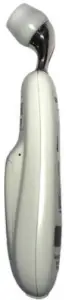 | 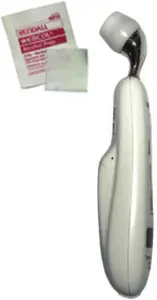 | 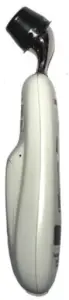 | 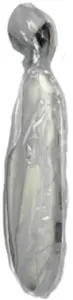 |
| No Cover Terminal Cleaning at Patient | No Cover Alcohol Wipe Between Patients | Probe Cap Covers Entire Probe | Full Sheath Covers Entire Instrument |
Responsible Covers
Responsible covers, meaning they can be used once and discarded, or reused on the same patient, are available for all levels of cross-contamination protection should they be preferred for certain patient populations, and are still very cost-effective. These options include responsible caps and full instrument sheaths, the sheaths being mainly used for isolation patients.
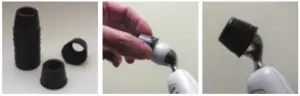
Using the Responsible Probe Caps:
- Apply cap by pushing onto the probe head with fingers.
- Remove cap by pushing edge forward with the thumb.
- Caps may be reused on the same patient.
Using the Responsible Full Instrument Sheaths:
- Insert instrument into sheath bottom end first. If the instrument is on a cable, insert probe end first and twist sheath at the neck with fingers to assure film is smooth over probe lens.
- Wrap additional film around probe neck. The film should be smooth over the probe lens.
- Slide additional film under fingers while using.
Responsible covers can be discarded in normal trash. The operator is responsible for checking the compatibility of the
thermometer, probe cover, and monitoring equipment. Incompatible components can result in degraded performance.
| Exergen p/n | Description |
| 134203 | Responsible Caps, box of 1000 |
| 129462 | Responsible Sheaths, a box of 250 |
Convenience Options
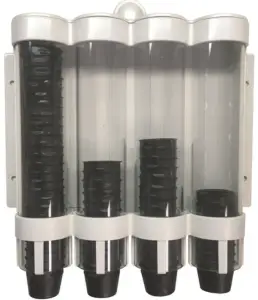
Resposable Cap Dispenser
PN134315
Verification Testing
All Exergen infrared thermometers are designed to permanently maintain their accuracy and normally recalibration is not required unless the thermometer has been physically damaged or experiences component failure. In the unlikely event recalibration might be required, the thermometer must be returned to Exergen for the procedure.
However, calibration can be verified in the lab or clinical units quite easily using Exergen calibration kits.
See: https://www.exergen.com/professional-medical-products/products/calibration-verification-kit
and: https://www.exergen.com/professional-medical-products/products/professional-product-manuals
 | Symbol for Manufacturer |  | Do not throw this device away in the trash, contact Exergen Corp. for disposal and recycling instructions. |
 | Caution | IPXO | Ordinary Equipment -Not protected against ingress by liquids |
 | Consult Instructions for Use |  | “On” (only for part of Equipment) |
 | Degree of Protection Against Electrical Shock Type BF Applied Part, Battery Operated |  | MEDICAL ELECTRICAL EQUIPMENT ANSI/AAMI/ES60601-1: 2005/(R)2012 3rd Edition including Amendment 1; CAN/CSA-C22.2 No. 60601.1: 2014; IEC 60601-1-6; ISO 80601-2-56: Particular Requirements For Basic Safety and Essential Performance of Clinical Thermometers For Body Temperature Measurement |
The CLINICAL THERMOMETER is an ADJUSTED MODE CLINICAL THERMOMETER. The correction method is proprietary. Laboratory testing protocol for laboratory accuracy is available upon request.
EC REP
QHi Europe Ltd.
Unit 1, 97/98 Lagan Rd,
Dublin Industrial Estate, Glasnevin,
Co. Dublin, D11 RX96, Ireland
BERGEN CORPORATION
400 PLEASANT STREET
WATERTOWN, MA 02472
PH (617) 923-9900
www.exergen.com