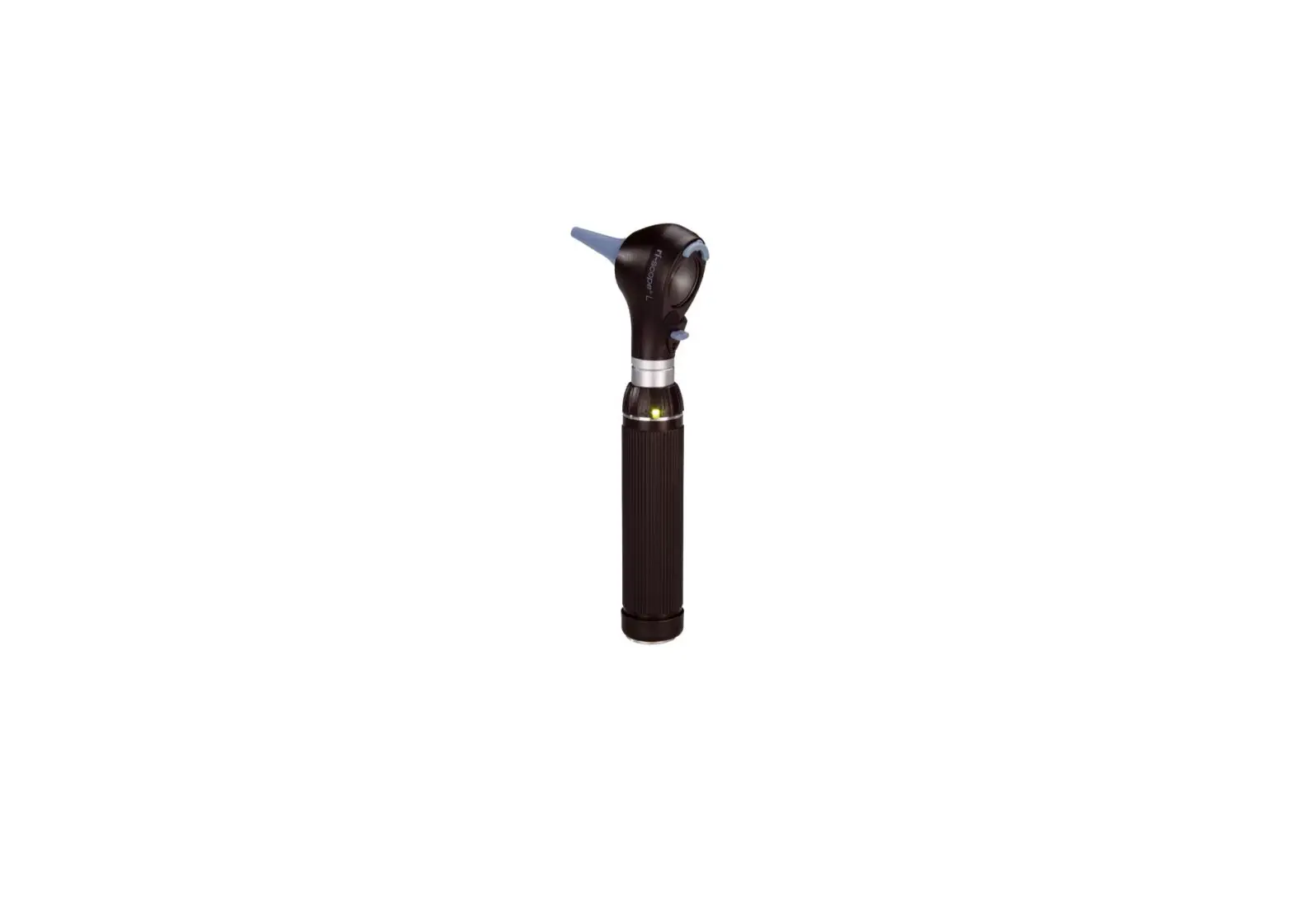
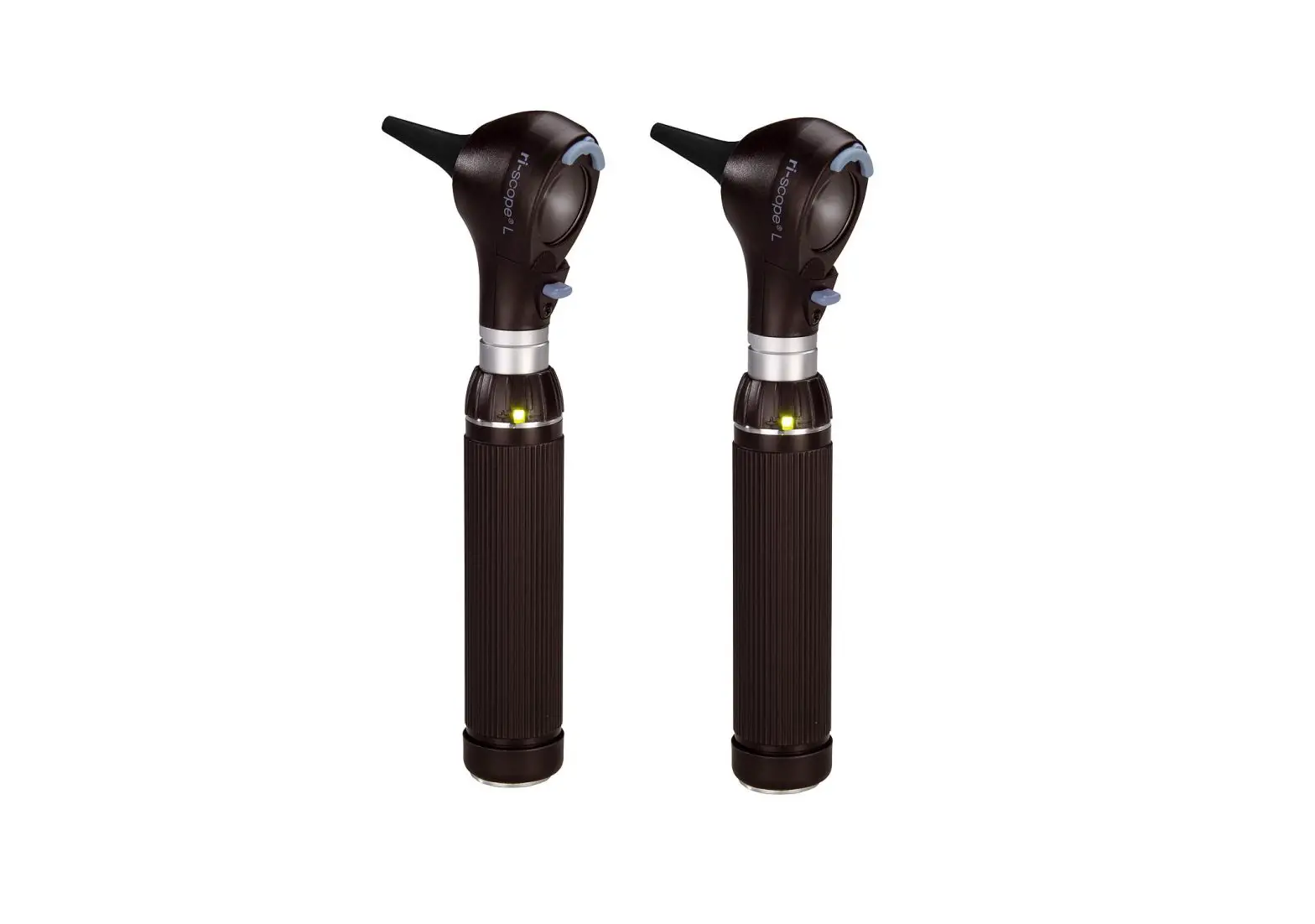
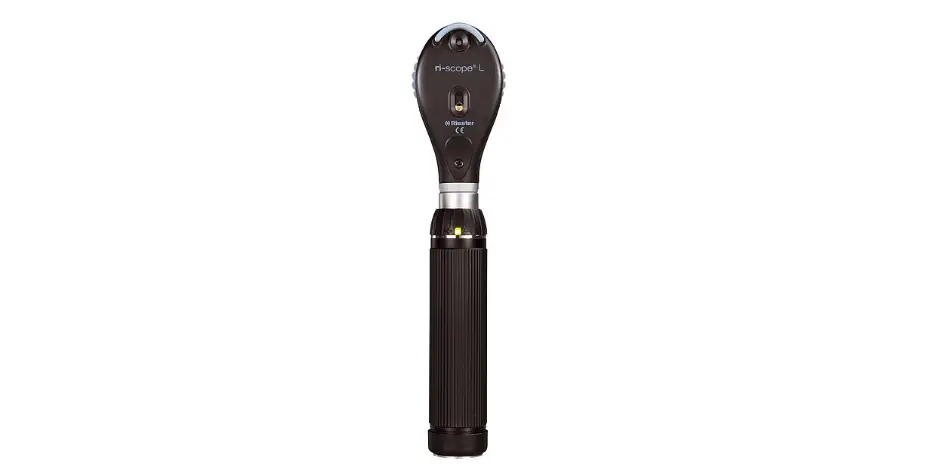
ri-scope L Otoscopes Diagnostic Instruments
Product Information
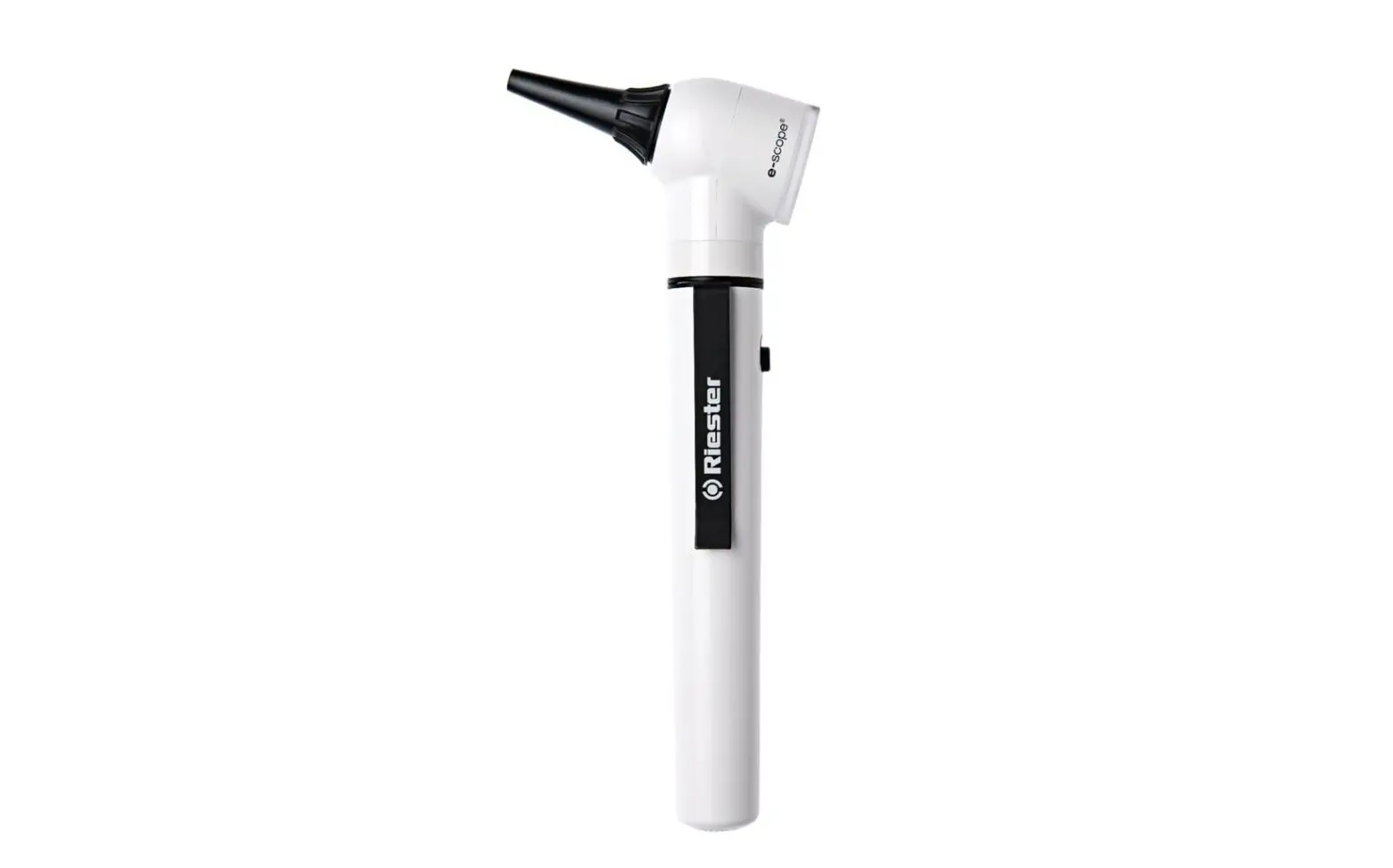
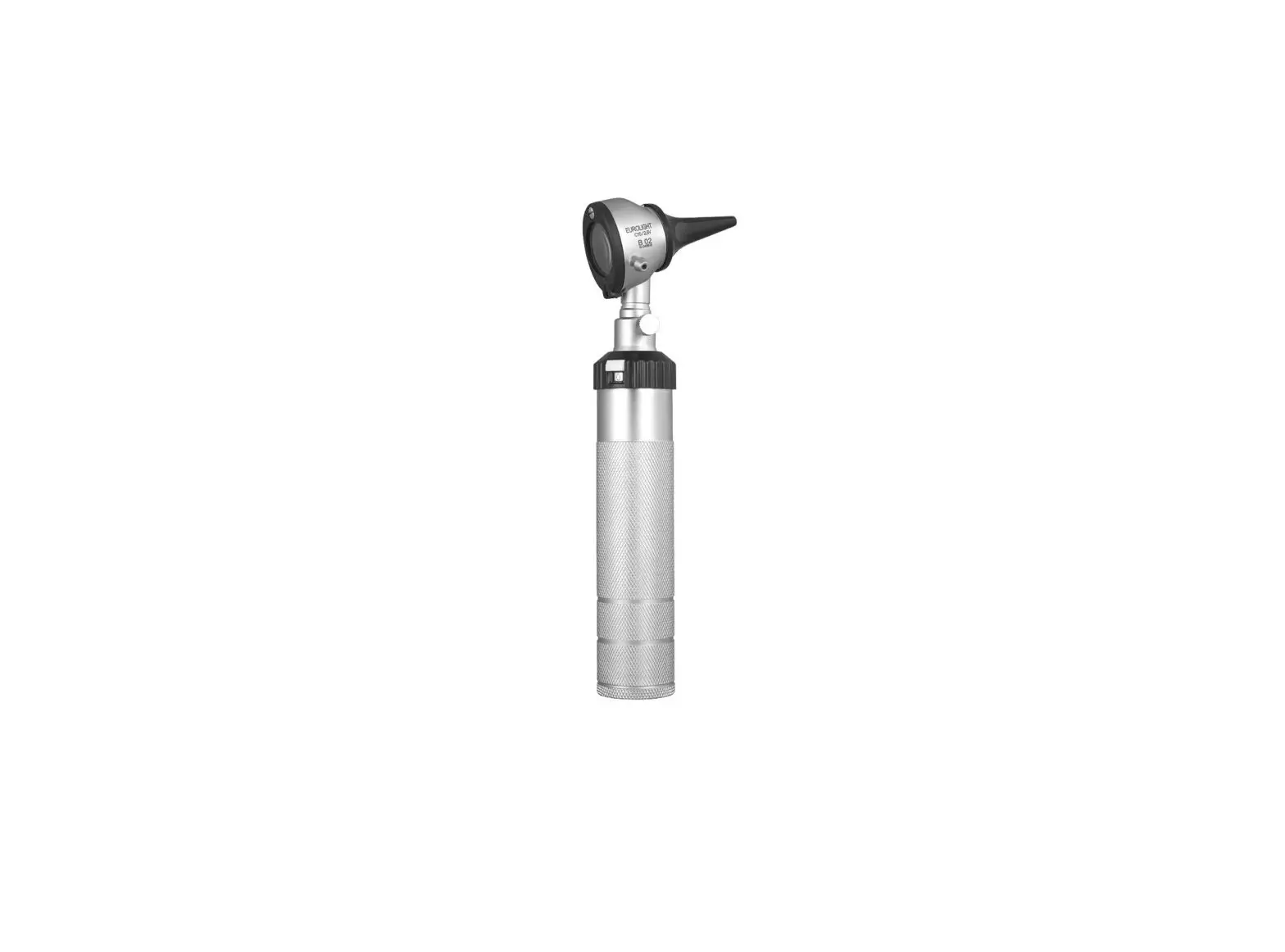
The product is a battery handle used in medical settings, such
as hospitals and doctor’s offices. It is designed to hold batteries
and serve as a handle for medical equipment.
The specifications of the battery handle are as follows:
- Type: Riester Battery Handle
- Battery Type: 18650 Li-ion Battery
- Voltage: 3.6 V
- Capacity: 2600 mAh
- Energy: 9.62 Wh
The operating environment for the battery handle is as
follows:
- Temperature: Between 10°C and 30°C
- Relative Humidity: Between 30% and 70%, non-condensing
- Air Pressure: Between 800 hPa and 1100 hPa
Product Usage Instructions
Caution: Before using the battery handle, please read and
follow the important information below:
- Make sure to use the recommended battery combinations described
in sections 2.3 to 2.8. - For batteries already inserted or provided separately, remove
the red safety film on the positive side before initial use. - To insert or remove batteries, twist the battery handle cover
counterclockwise at the bottom of the handle. - Prior to the first use of the plug-in handle, it should be
charged for up to 24 hours in a socket. - Do not have the handle plugged into a socket while replacing
the battery.
Please refer to the user manual for additional safety
instructions and technical specifications for other components of
the product, such as the otoscope and ophthalmoscope.
ri-scope® ri-scope® L ri-derma
Gebrauchsanweisung Diagnostische Instrumente Instructions Diagnostic Instruments Mode d’ emploi Instruments diagnostiques Instrucciones para el uso Instrumentos diagnósticos Istruzioni per I’ uso Strumenti diagnostici
Inhaltsverzeichnis 1. Wichtige Informationen zur Beachtung vor Inbetriebnahme 2. Batteriegriffe 3. Inbetriebnahme (Einlegen und Entnehmen von Batterien und Akkus) 4. Laden der Batteriegriffe mit Akkus: 5. Aufsetzen von Instrumentenköpfen 6. ri-scope®L Otoskope 7. ri-scope®L Ophthalmoskope 8. Retinoskope Slit und Spot 9. Dermatoskop 10. Lampenträger 11. Nasenspekulum 12. Zungenspatelhalter 13. Kehlkopfspiegel 14. Operationsotoskop für Veterinärmedizin 15. Operationsotoskop für Humanmedizin 16. Auswechseln der Lampe 17. Pflegehinweise 18. Ersatzteile und Zubehör 19. Wartung 20. Hinweise 21. Elektromagnetische Verträglichkeit
Contents 1. Please note the following important information before startup 2. Battery handles 3. Commissioning (inserting and removing batteries and rechargeable bat-
teries) 4. Charging battery handles with rechargeable batteries: 5. Placing instrument heads 6. ri-scope® L otoscope 7. ri-scope® L ophthalmoscope 8. Retinoscope Slit and Spot 9. Dermatoscope 10. Lamp holder 11. Nasal speculum 12. Tongue depressor 13. Laryngeal mirror 14. Operating otoscope for veterinary medicine 15. Operating otoscope for human medicine 16. Replacing the lamp 17. Care instructions 18. Spare parts and accessories 19. Maintenance 20. Instructions 21. Electromagnetic compatibility
Sommaire 1. Veuillez prendre en compte les informations importantes suivantes
avant le démarrage 2. Manches à piles 3. Mise en service (insertion et retrait des piles et des piles rechargeables) 4. Chargement des manches à piles avec des piles rechargeables : 5. Mise en place des têtes d`instruments 6. Otoscope ri-scope® L 7. Ophtalmoscope ri-scope® L 8. Rétinoscope Fente et Spot 9. Dermatoscope 10. Support de lampe 11. Spéculum nasal 12. Abaisse-langue 13. Miroir laryngé 14. Otoscope opératoire pour la médecine vétérinaire 15. Otoscope opératoire pour la médecine humaine 16. Remplacement de la lampe 17. Conseils d`entretien 18. Pièces de rechange et accessoires 19. Entretien 20. Instructions 21. Compatibilité électromagnétique
Índice 1. Información importante a tener en cuenta antes de la puesta en marcha. 2. Mango para pilas 3. Puesta en marcha (inserción y extracción de baterías y pilas) 4. Carga de mangos para pilas con baterías: 5. Configuración de los cabezales de los instrumentos 6. Otoscopio ri-scope® L 7. Oftalmoscopio ri-scope® L 8. Retinoscopio de hendidura y punto 9. Dermatoscopio 10. Portalámparas 11. Espéculo nasal
02
12. Depresor de lengua 13. Laringoscopio 14. Otoscopio quirúrgico para medicina veterinaria 15. Otoscopio quirúrgico para medicina humana 16. Sustitución de la lámpara 17. Instrucciones de mantenimiento 18. Repuestos y accesorios 19. Mantenimiento 20. Notas 21. Compatibilidad electromagnética
Indice 1. Informazioni importanti da leggere attentamente prima della messa in
servizio 2. Manici portabatterie 3. Messa in servizio (introduzione e rimozione di batterie e batterie rica-
ricabili) 4. Carica del manico portabatterie con batterie ricaricabili: 5. Collocazione della testina operativa 6. Otoscopi ri-scope® L 7. Oftalmoscopi ri-scope® L 8. Retinoscopi a fessura e a spot 9. Dermatoscopio 10. Illuminatore 11. Speculum nasale 12. Supporto per abbassalingua 13. Specchietto laringeo 14. Otoscopio chirurgico per uso veterinario 15. Otoscopio chirurgico per uso umano 16. Sostituzione della lampada 17. Istruzioni per la manutenzione 18. Parti di ricambio e accessori 19. Interventi di manutenzione 20. Note 21. Compatibilità elettromagnetica
C 1. ,
2. 3. (
) 4. : 5. 6. ri-scope® L 7. ri-scope® L 8. 9. 10. 11. 12. 13. 14. 15. 16. 17. 18. 19. 20. 21.
03
04
05
1.Wichtige Informationen zur Beachtung vor Inbetriebnahme Sie haben ein hochwertiges Riester DiagnostikBesteck erworben, welches entsprechend der Richtlinie93/42/EWG für Medizinprodukte hergestellt wurde und ständigen strengsten Qualitätskontrollen unterliegt. Die hervorragende Qualität wird Ihnen zuverlässige Diagnosen garantieren. In dieser Gebrauchsanweisung werden der Gebrauch der Riester Batteriegriffe der ri-scope® bzw. ri-derma Instrumentenköpfe und deren Zubehör beschrieben. Bitte lesen Sie die Gebrauchsanweisung vor Inbetriebnahme sorgfältig durch, und bewahren Sie sie gut auf. Sollten Sie Fragen haben, stehen wir, oder der für Sie zuständige Vertreter für Riester Produkte, Ihnen jederzeit gerne zur Verfügung. Unsere Adresse finden Sie auf der letzten Seite dieser Gebrauchsanweisung. Die Adresse unseres Vertreters erhalten Sie gerne auf Anfrage. Bitte beachten Sie, dass alle in dieser Gebrauchsanweisung beschriebenen Instrumente ausschließlich für die Anwendung durch entsprechend ausgebildete Personen geeignet sind. Bei dem Operationsotoskop im Besteck Vet-I handelt es sich um ein Instrument, welches ausschließlich für die Veterinärmedizin produziert wurde und daher keine CE-Kennzeichnung besitzt.
Warnung: Bitte beachten Sie ferner, dass die einwandfreie und sichere Funktion unserer Instrumente nur dann gewährleistet wird, wenn sowohl die Instrumente als auch deren Zubehör ausschließlich aus dem Hause Riester verwendet werden. Die Verwendung von anderem Zubehör kann erhöhte Elektromagnetische Störaussendungen oder eine geminderte elektromagnetische Störfestigkeit des Gerätes zur Folge haben und zu einer fehlerhaften Betriebsweise führen.
Achtung/Kontraindikationen – Es besteht evtl. die Gefahr der Entzündung von Gasen, wenn das Instrument
in Anwesenheit von brennbaren Gemischen oder Gemischen von Pharmazeutika. – Die Instrumentenköpfe und Batteriegriffe dürfen niemals in Flüssigkeiten gelegt werden. – Bei einer längeren Augenuntersuchung mit dem Ophthalmoskop kann durch die intensive Lichteinwirkung die Netzhaut beschädigt werden. – Das Produkt und die Ohrtrichter sind unsteril. Nicht auf verletzten Gewebe verwenden. – Verwenden Sie zur Begrenzung der Gefahr von Kreuzkontaminationen neue oder desinfizierte Ohrtrichter. – Die Entsorgung gebrauchter Ohrtrichter hat in Übereinstimmung mit den aktuellen medizinischen Praktiken bzw. den lokalen Vorschriften bezüglich der Entsorgung von infektiösem, biologischem medizinischem Abfall zu erfolgen. – Verwenden Sie nur Zubehör / Verbrauchsmaterialien aus dem Hause Riester oder von Riester freigegebenes Zubehör / Verbrauchsmaterialien. – Reinigungshäufigkeit und -ablauf müssen den Vorschriften für die Reinigung von unsterilen Produkten in der jeweiligen Einrichtung entsprechen. Reinigungs / Desinfektionshinweise der Gebrauchsanweisung müssen beachtet werden. – Das Produkt darf nur von geschultem Personal verwendet werden.
Sicherheitshinweise:
CE Kennzeichnung
Temperaturgrenzen in °C für Lagerung und Transport
Temperaturgrenzen in °F für Lagerung und Transport
Relative Luftfeuchtigkeit
Zerbrechlich, mit Sorgfalt behandeln
Trocken aufbewahren
,,Grüner Punkt” (Länderspezifisch)
Warnhinweis, dieses Symbol macht auf eine möglicherweise gefährliche Situation aufmerksam.
Gerät der Schutzklasse II
Typ B Anwendungsteil
Achtung: Gebrauchte elektrische und elektronische Geräte sollten nicht in den normalen Hausmüll gelangen sondern gemäß nationaler bzw. EURichtlinien separat entsorgt werden
Chargen-Code
Seriennummer
Achtung Bedienungsanleitung beachten
06
Nur zum Einmalgebrauch
2. Batteriegriffe und Inbetriebnahme
2.1. Zweckbestimmung/Indikation
Die in dieser Gebrauchsanweisung beschriebenen Riester Batteriegriffe dienen
zur Versorgung der Instrumentenköpfe mit Energie (die Lampen sind in den entCshaprrgeenc–Choedenden Instrumentenköpfen enthalten). Sie dienen ferner als Halter.
Batteriegriffe in Verbindung mit Steckerladegerät für ri-accu® L.
Seriennummer
— 4 —
2.2. Batteriegriffe-Sortiment AllAechitnundg iBeesdieenrunGgseabnlreaituuncghbesaachntewneisung beschriebenen Instrumentenköpfe passen 2.
Baattuerfiefgorilfgfeende Batteriegriffe und können somit individuell kombiniert werden. Alle 2.1. ZIwnesctkrbuesmtimemnutnegn/kInödpikfaetiopnassen ferner auf die Griffe des Wandmodells ri-former®.
Die in dieser Gebrauchsanweisung beschriebenen Riester
Batteriegriffe
dienen zur Versorgung
der Instrumentenköpfe
mit Energie (die Lampen
sind
in
den
entsprechenden Instrumentenköpfen
enthaAltCenH).
TSieU
dNienGen
ferner
als
Halter.
LED Instrumentenköpfe sind erst ab einer bestimmten Seriennummer der Di2D.e2r.
i BnaadgttienesroeiersgGreiefsbfert-aa-Suotcrihtosimannewnretii-sufnogrbmescehrrie®bekneoImnstpruamteibnteenl.koApfnpgasastbaeufnfolügebneder die Kompatibilität Ihrer BatteDrieiagrgiffne
o unsdeksatnan tsioomnit iendrihviaduletlel knomSbiieniegrtewrenrdeena.uDifesAernIfnrstarugmee.ntenkopf passt
ferner auf die Griffe des Wandmodells ri–former®.
A2CH.3TU. NBGa! tteriegriff Typ C mit rheotronic® 2,5 V LED IUnstmrumdeinetesneköpBfeastitned reirestgabriefifneerzbuestbimemttreeniSbeerienn,nubmemneör tdiegr eDinagnSoiseest2atihona
rni–fdoermlserü®bliche Alkaline kompBataibtetle.
ArnigeanbeTn
y üpberC
dieB
Kaombpyat(iIbEiliCtätN
Ihorerrm
Diabgenozseeisctahtionnu
enrhgaltLenR
S1ie4
g)eroned
aeurf
Aenfirnaegen. ri-accu® 2,5 V. Für
riD–sceorpeG®LrOiftfosmkopite,drie–scmoper®iL-Oapchtchaulm®osvkoopne,Rpeirefesctt,eHr.Nk.Oa, nprnaktnikuanrt,idme luLxea®d, Veegt,eRreätintorskio-pceharger® Slit,
Svpoont, rRi–viiesiosnt®eurndg
EeliltaeVduee:n werden.
22.
h3a.
nB2da.et4tlesür.ibeBlgicrhaifeft
T AtyelpkarCliinmeegi
t BrrahtietfeofrtirTeonynTipcy®pC
2C,5mB
Vab.iUytm(rIEhdCiNeesoerom
Btabtretzeoeriicnehgnirciuffne®g
zLu3Rb1,e45t)roeVdibe(erfneü,ibnreennrö
riti–i-gaceccnhuS®aierger® L) 2,5
VU.
Dmer
Gdriifef
mseit
n demB
ari-t-atcecur®ievognr
Rifiefszteur
kbanent
nrueri
ibme
Lnadbegeenräöt
rti-i-cghearngeSr®i
veo:n Riester gelad-en1wAerkdeknu. von Riester mit 3,5 V (Art.Nr. 10691 ri-accu® L). 2.4.
B-at1teLrieagdrifef
gTyepr
Cä
mtitr
rih-ecothroanircg®
e 3,5r®
V
L(fü(rA
ri-r-cth.aNrgre.r®1L0) 705, Art.Nr. 10706)
Um
diesen
Batteriegriff
zu
betreiben
benötigen
Sie:
— 1
Ak2k.u5
v.onB
RaIEtStTeERr
imeitg
3r,5i
f Vf(ATryt.pNrC. 10m69i1t
rri–ahcceu®oL)t.ronic® 3,5 V — 1
LaZdeugmerätLria–cdhaerngeri®n
Ld(Aertr.NSr.t1e0c70k5d, Aorst.eNr2. 130070V6) oder 120 V 2.5.
BUatmteridegireifsf
eTynp
CS
mteitc
rhkedootrsoneicn®g
3r,5if
Vf
zzuum
b Laedterne
inib
deernStbecekndoöseti2g3e0nV oSdieer :120 V Um
d-ie1senA
SktekckudovsoenngrRiffi
zeus
bteetreribmeni
bte3nö,5tigVen(
SAier:
t.Nr. 10692 ri-accu® L).
— 1
Akku
von
RIESTER
mit
3,5
V (Art.Nr. 10692
ri–accu® L).
2.6.
B2a.t6te.riBegariftftTeyrpiCemgirt rihfefoTtryopnicC®
3m,5
i Vt(rführ Seteockterrlaodengeicrä®t) 3,5 V (für Steckerladegerät) Um
dUiesmen
dBaitetesreiengrifBf
zaut
bteetrreiiebegnr
bifefnöztuigebn
e Siter:
e iben benötigen Sie: —-11
AStke-kcu1k
e vArolnakd
RkeIgEueSrTävEtoR(
n AmrittR.
N3i,r5e.
1Vs0t(7Ae0r7rt.)N.mr. 1it0639,45
ri-V-ac(cAu®rLt)..Nr. 10694 ri-accu® L).
-1 Steckerladegerät (Art.Nr. 10707).
Neu
ri-accu® USB
Neu2
.
6
.
1
Art.Nr. 10r7i0–a4ccu®USB
Batteriegriff Typ C mit rheotronic® 3,5 V und mit ri-accu® USB Ladetechnik
2.6.1e
Anrtt.Nhrä.
1l0t7: 04
Batte-riegr1iffA
Tykpk
Cu
mvito
rnheoRtrioensict®e
3r,5mV
uintd3
m,5it
rVi–a(cAcur®tU.NSBr.La1d0et6e9ch9nirk
i -accu® USB)
enthä-lt: 1 Griff Typ C rheotronic®
–1
Ak-ku
vo1n
RUIESSTBER
K mait
b 3,e5Vl
(TArytp.NrC.
1,06s9i9eri-h-acacbu®eUnSBd) ie Möglichkeit den Akku an jedem DIN EN –l–a11d
UGerSniBf.f
O
KTpaybt6ezpieou
0 n Cln
g9
T t Raeyl5he
p bne0l
i Coaek,tt/s
r oehotsiDnne
ReritkII
hEnaNSakeTbEtesERnaN
N
e suiiene6f
dMt2zizee3ut
d Me6izlöi8ialng-ildmsi1ccehhiknz
t zeuu.idt(gg
dee2leearnslM
sa A AeksnrOkestuO.se
N
z NP.nBere.)t.
.z an1tneO0iilUhp
7 mrteS0iimto9B
dnHearaNannAlder.tybt.-N-zNierge.tte1ze0tret7äi0lRt9o/diaNeenr.seCttoezmqrpuueteeinlrlzeuM
oehdnizeinPisactih-
Funktion: Instrumentenkopf mit Batteriegriff Typ C und ri-accu® USB ist während des Ladevorgangs Funktionsbereit. Es kann daher während des Ladevorgangs eine Untersuchung am Patienten durchgeführt werden.
ACHTUNG! Findet während dem Ladevorgang (Batteriegriff Typ C mit USB Ladetechnik Art. Nr. 10704) eine Untersuchung am Patienten statt, darf nur das Medizinische Netzteil von Riester Art.Nr. 10709 verwendet werden, da dieses ME System nach Norm IEC 60601-1:2005 (Third Edition) + CORR. 1:2006 + CORR. 2:2007 +A1:2012 geprüft wurde und Medizinisch zugelassen ist.
Dieser ri-accu® USB verfügt über eine Ladezustands-Anzeige. LED leuchtet grün: der Akku ist voll aufgeladen. LED blinkt grün: Akku wird aufgeladen. LED leuchtet orange: Akku zu schwach, muss geladen werden.
– Spezifikationen:
18650 Li-ion Battery, 3,6 V 2600 mAh 9,62 Wh
Umgebungstemperatur:
0° bis +40°
Relative Luftfeuchtigkeit:
30% bis 70% nicht kondensierend
Transport- und Lagertemperatur: -10° bis +55°
Relative Luftfeuchte:
10% bis 95% nicht kondensierend
Luftdruck:
800 hPa – 1100 hPa
Betriebsumgebung:
Der ri-accu®USB wird ausschließlich von professionellen Anwendern in Kliniken
und Arztpraxen benutzt.
2.7. Batteriegriff Typ AA mit rheotronic® 2,5 V Um diese Batteriegriffe zu betreiben, benötigen Sie 2 handelsübliche Alkaline Batterien Typ AA (IECNormbezeichnung LR6)
2.8. Batteriegriff Typ AA mit rheotronic® 3,5 V (für ri-charger® L) Um diesen Batteriegriff zu betreiben benötigen Sie: – 1 Akku von Riester mit 3,5 V (Art.Nr. 10690 ri-accu® L) – 1 Ladegerät ri-charger® L (Art.Nr. 10705, Art.Nr. 10706)
3. Inbetriebnahme (Einlegen und Entnehmen von Batterien und Akkus)
ACHTUNG! Verwenden Sie nur die unter 2.3 bis 2.8 beschriebenen Kombinationen!
07
3.1. Einlegen der Batterien: Batteriegriffe (2.3 und 2.7) Typ C und AA mit rheotronic® 2,5 V: – Drehen Sie den Batteriegriffdeckel am Unterteil des Handgriffes entgegen
dem Uhrzeigersinn ab. – Legen Sie die handelsüblichen Alkaline Batterien, die Sie für diesen Bat-
teriegriff benötigen mit der Plusseite in Richtung Griffoberteil in den Batteriegriff ein. – Drehen Sie den Batteriegriffdeckel wieder fest auf den Batteriegriff auf.
3.2. Entnehmen der Batterien: Batteriegriffe (2.3 und 2.7) Typ C und AA mit rheotronic® 2,5 V: – Drehen Sie den Batteriegriffdeckel am Unterteil des Batteriegriffes entge-
gen dem Uhrzeigersinn ab. – Nehmen Sie die Batterien aus dem Batteriegriff heraus, indem Sie die Öff-
nung des Batteriegriff etwas nach unten halten und gegebenenfalls etwas schütteln. – Drehen Sie den Batteriegriffdeckel wieder fest auf den Batteriegriff auf.
ACHTUNG! Bei allen bereits ab Werk eingesetzen oder separat mitgelieferten Akkus ist vor Erstinbetriebnahme die rote Sicherheitsfolie auf der Plusseite zu entfernen!
ACHTUNG! Betrifft nur Batteriegriff (2.5) Typ C mit rheotronic® 3,5 V zum Laden in der Steckdose 230 V oder 120 V: Bei Verwendung des neuen ri-accu® L Art.Nr. 10692 ist darauf zu achten, dass an der Feder des Batteriegriffdeckels keine Isolation angebracht ist. Bei Verwendung des alten ri-accu® L Art.Nr. 10692 muss eine Isolation an der Feder angebracht sein (Kurzschlussgefahr!).
neuer ri-accu® L
alter ri-accu® L
3.3. Einlegen der Akkus: Batteriegriffe (2.4 und 2.8) Typ C und AA mit rheotronic® 3,5 V (für ri-charger® L). Batteriegriff (2.6) Typ C mit rheotronic® 3,5 V (für Steckerladegerät). Batteriegriff (2.5) Typ C mit rheotronic® 3,5 V zum Laden in der Steckdose 230 V oder 120 V.
ACHTUNG! Bitte Sicherheitshinweis beachten! – Drehen Sie den Batteriegriffdeckel am Unterteil des Handgriffes entgegen
dem Uhrzeigersinn ab. – Entfernen Sie bei Erstinbetriebnahme die rote Sicherheitsfolie auf der
Plusseite des Akkus. – Legen Sie den für Ihren Batteriegriff zulässigen Akku (siehe 2.2), mit der
Plusseite in Richtung Griffoberteil in den Batteriegriff ein. Neben dem Pluszeichen finden Sie zusätzlich einen Pfeil der Ihnen die Richtung zum einlegen in den Batteriegriff weist. – Drehen Sie den Batteriegriffdeckel wieder fest auf den Batteriegriff auf.
3.4. Entnehmen der Akkus: Batteriegriffe (2.4 und 2.8) Typ C und AA mit rheotronic® 3,5 V (für ri-charger® L). Batteriegriff (2.6) Typ C mit rheotronic® 3,5 V (für Steckerladegerät). Batteriegriff (2.5) Typ C mit rheotronic® 3,5 V zum Laden in der Steckdose 230 V oder 120 V.
ACHTUNG! Bitte Sicherheitshinweis beachten! – Drehen Sie den Batteriegriffdeckel am Unterteil des Batteriegriffes entge-
gen dem Uhrzeigersinn ab. – Nehmen Sie den Akku aus dem Batteriegriff heraus, indem Sie die Öffnung
des Batteriegriff etwas nach unten halten und gegebenenfalls etwas schütteln. – Drehen Sie den Batteriegriffdeckel wieder fest auf den Batteriegriff auf.
4. Laden der Batteriegriffe mit Akkus: 4.1. Batteriegriffe (2.4 und 2.8) Typ C und AA mit rheotronic® 3,5 V (für ri-charger® L). – Können nur im Ladegerät ri-charger® L (Art.Nr. 10705, Art.Nr. 10706) von
Riester geladen werden. – Dem Ladegerät ri-charger® L liegt eine extra Gebrauchsanweisung bei, die
beachtet werden muss.
4.2. Batteriegriff (2.6) Typ C mit rheotronic® 3,5 V (für Steckerladegerät). – Er kann nur mit dem Steckerladegerät (Art.Nr. 10707) von Riester geladen
werden.
Dazu wird der kleine runde Stecker am Unterteil des Batteriegriffes durch die Öffnung im Batteriegriffdeckel in den Akku (Art.Nr. 10694 ri-accu® L) eingesteckt. Verbinden Sie den Netzstecker des Steckerladegerät jetzt mit dem
08
Stromnetz. Der Ladezustand des Akku wird Ihnen über die LED am Steckerladegerät mitgeteilt. Rotes Licht bedeutet laden, grünes Licht bedeutet das der Akku voll geladen ist.
4.3. Batteriegriff (2.5) Typ C mit rheotronic® 3,5 V zum Laden in der Steckdose 230 V oder 120 V – Drehen Sie das Griffunterteil des Steckdosenhandgriffes entgegen dem
Uhrzeigersinn ab. Die Steckdosenkontakte werden sichtbar. Runde Kontakte sind für 230 V Netzbetrieb, flache Kontake sind für 120 V Netzbetrieb. Stecken Sie das Griffunterteil nun zum Aufladen in die Steckdose.
ACHTUNG! Vor der ersten Inbetriebnahme des Steckdosenhandgriffes sollte dieser in der Steckdose bis zu max. 24 Stunden lang aufgeladen werden.
ACHTUNG! Der Steckdosengriff darf nicht länger als 24 Stunden aufgeladen werden.
ACHTUNG! Der Griff darf sich beim Auswechseln des Akkus niemals in der Steckdose befinden!
Technische Daten: Wahlweise 230 V oder 120 V Ausführung
ACHTUNG! · Sollten Sie das Gerät längere Zeit nicht benutzen oder auf Reisen mitneh-
men, entfernen Sie bitte die Batterien und Akku´s aus dem Griff. · Neue Batterien sollten dann eingelegt werden, wenn die Lichtintensität des-
Instrumentes schwächer wird. · Um eine optimale Lichtausbeute zu erhalten, empfehlen wir, beim Batterie-
wechsel (wie in 3.1 und 3.2 beschrieben) immer neue hochwertige Batterien einzulegen. · Sollte der Verdacht bestehen, dass Flüssigkeit oder feuchter Beschlag in den Griff eingedrungen sein könnte, darf er auf keinen Fall aufgeladen werden. Insbesondere bei den Steckdosenhandgriffen kann dies zu einem lebensgefährlichen elektrischen Schlag führen. · Um die Haltbarkeit des Akku zu verlängern, sollte der Akku erst dann aufgeladen werden, wenn die Lichtintensität des Instrumentes schwächer wird.
4.4. Entsorgung: Bitte beachten Sie, dass Batterien und Akkus speziell entsorgt werden müssen. Informationen hierzu erhalten Sie bei Ihrer Gemeinde bzw. bei Ihrem zuständigen Umweltberater/ in.
5. Aufsetzen von Instrumentenköpfen Setzen Sie den gewünschten Instrumentenkopf so auf die Aufnahme am Griffoberteil auf, dass die beiden Aussparungen des Unterteils des Instrumentenkopfes auf die beiden hervorstehenden Führungsnocken des Batteriegriffes aufsitzen. Drücken Sie den Instrumentenkopf leicht auf den Batteriegriff und drehen Sie den Griff in Richtung Uhrzeigersinn bis zum Anschlag. Das Abnehmen des Kopfes erfolgt durch Drehung entgegen dem Uhrzeigersinn.
5.1. Ein- und Ausschalten Batteriegriffe Typ C und AA Schalten Sie das Instrument ein, indem Sie den Schaltring am Griffoberteil in Richtung Uhrzeigersinn antippen. Um das Instrument auszuschalten drücken Sie den Ring entgegen dem Uhrzeigersinn bis sich das Gerät ausschaltet.
5.2. rheotronic® zur Regulierung der Lichtintensität Anhand der rheotronic® ist es möglich die Lichtintensität an den Batteriegriffen Typ C und AA einzustellen. Je nach dem, wie oft Sie den Schaltring entgegen oder in Richtung Uhrzeigersinn antippen, ist die Lichintensität schwächer oder stärker.
ACHTUNG! Bei jedem Einschalten des Batteriegriffs ist die Lichtintensität bei 100%. Automatische Sicherheitsabschaltung nach 180 Sekunden.
Erläuterung des Zeichens am Steckdosenhandgriff:
ACHTUNG! Bedienungsanleitung beachten!
6. ri-scope® L Otoskope 6.1. Zweckbestimmung/Indikation Das in dieser Gebrauchsanweisung beschriebene Riester Otoskop wird zur Beleuchtung und Untersuchung des Gehörganges in Kombination mit den Riester Ohrtrichtern produziert.
6.2. Aufsetzen und Abnehmen von Ohrtrichtern Zur Bestückung des Otoskopkopfes können wahlweise Einmal-Ohtrichter von Riester (in schwarzer Farbe) oder wiederverwendbare Ohrtrichter von Riester (in schwarzer Farbe) gewählt werden. Die Größe des Ohrtrichters ist hinten am Trichter gekennzeichnet.
09
Otoskop L1 und L2 Drehen Sie den Trichter in Richtung Uhrzeigersinn bis ein Widerstand spürbar wird. Um den Trichter abnehmen zu können, drehen Sie den Trichter gegen den Uhrzeigersinn ab.
Otoskop L3 Setzen Sie den gewählten Trichter auf die verchromte Metallfassung des Otoskopes bis er spürbar einrastet. Um den Trichter abnehmen zu können, drücken Sie die blaue Auswerfertaste. Der Trichter wird automatisch abgeworfen.
6.3. Schwenklinse zur Vergrößerung Die Schwenklinse ist fest mit dem Gerät verbunden und kann um 360° geschwenkt werden.
6.4. Einführen von externen Instrumenten ins Ohr. Wenn Sie externe Instrumente ins Ohr einführen möchten (z.B. Pinzette), müssen Sie die Schwenklinse (ca. 3-fache Vergrößerung), welche sich am Otoskopkopf befindet, um 180° verdrehen. Sie können jetzt die Operationslinse einsetzen.
6.5. Pneumatischer Test Um den pneumatischen Test (= eine Untersuchung des Trommelfells) durchführen zu können, benötigen Sie einen Ball, der im normalen Lieferumfang nicht enthalten ist, aber zusätzlich bestellt werden kann. Der Schlauch des Balles wird auf den Anschluss gesteckt. Sie können nun die notwendige Luftmenge vorsichtig in den Ohrenkanal eingeben.
6.6. Technische Daten zur Lampe Otoskop XL 2,5 V 2,5 V 750 mA mittl. Lebensdauer 15 h Otoskop XL 3,5 V 3,5 V 720 mA mittl. Lebensdauer 15 h Otoskop LED 2,5 V 2,5 V 280 mA mittl. Lebensdauer 10.000 h Otoskop LED 3,5 V 2,5 V 280 mA mittl. Lebensdauer 10.000 h
7. ri-scope®L Ophthalmoskope 7.1. Zweckbestimmung/Indikation Das in dieser Gebrauchsanweisung beschriebene Riester Ophthalmoskop wird zur Untersuchung des Auges und des Augenhintergrundes hergestellt.
ACHTUNG! Weil längere intensive Lichteinwirkung die Netzhaut beschädigen kann, sollte die Verwendung des Geräts für die Augenuntersuchung nicht unnötig verlängert werden und die Helligkeitseinstellung sollte nicht höher als benötigt für eine klare Darstellung der Zielstrukturen eingestellt sein.
Die Bestrahlungsdosis für die photochemische Gefährdung der Netzhaut ist das Produkt aus Bestrahlungsstärke und Bestrahlungsdauer. Wenn die Bestrahlungsstärke auf die Hälfte reduziert wird, darf die Bestrahlungszeit doppelte so lang sein, um den maximalen Grenzwert zu erreichen.
Obwohl keine akute optische Strahlungsgefahren für direkte oder indirekte Ophthalmoskope identifiziert worden sind, wird empfohlen, dass die Intensität des Lichts das in das Auge des Patienten gerichtet wird, auf das Mindestmass reduziert wird, das zur Untersuchung / Diagnose erforderlich ist. Säugling / Kinder, Aphasiker und Menschen mit Augenerkrankungen haben ein höheres Risiko. Das Risiko kann auch dann erhöht sein, wenn die untersuchte Person während der letzten 24 Stunden bereits schon einmal mit diesem oder einem anderen ophthalmologischen Instrument untersucht wurde. Dies trifft insbesondere dann zu, wenn das Auge einer Netzhautfotografie ausgesetzt war.
Das Licht dieses Instruments ist möglicherweise schädlich. Das Risiko einer Augenschädigung erhöht sich mit der Bestrahlungsdauer. Eine Bestrahlungsdauer mit diesem Instrument bei maximaler Intensität von länger als >5 min. führt zur einer Überschreitung des Richtwertes für Gefährdungen. Von diesem Instrument geht keine photobiologische Gefährdung nach DIN EN 62471 aus, es verfügt trotzdem über eine Sicherheitsabschaltung nach 2 / 3 Minuten.
7.2. Linsenrad mit Korrekturlinsen Die Korrekturlinsen können am Linsenrad eingestellt werden. Es stehen folgende Korrekturlinsen zur Auswahl: Ophthalmoskop L1 und L2 Plus: 1-10, 12, 15, 20, 40. Minus: 1-10, 15, 20, 25, 30, 35. Ophthalmoskop L3 Plus: 1-45 in Einzelschritten Minus: 1-44 in Einzelschritten
Die Werte können im beleuchteten Sichtfeld abgelesen werden. Pluswerte werden durch grün, Minuswerte durch rote Zahlen angezeigt.
7.3. Blenden Über das Blendenstellrad können folgende Blenden gewählt werden: Ophthalmoskop L1 Halbmond, kleine/mittlere/große Kreisblende, Fixierstern, Slit. Ophthalmoskop L2 Halbmond, kleine/mittlere/große Kreisblende, Fixierstern und Slit. Ophthalmoskop L3
10
Halbmond, kleine/mittlere/große Kreisblende, Fixierstern, Slit und Karo.
Blende
Funktion
Halbkreis:
zur Untersuchung bei trüben Linsen
Kleiner Kreis: zur Reflexminderung bei kleinen Pupillen
Mittlerer Kreis: zur Reflexminderung bei kleinen Pupillen
Großer Kreis: für normale Fundusuntersuchungen
Karo:
zur topographischen Feststellung von Netzhautveränderungen
Slit:
zur Bestimmung von Niveauunterschieden
Fixierstern:
zur Feststellung von zentraler oder exzentrischer Fixation
7.4 Filter Über das Filterrad können zu jeder Blende folgende Filter zugeschaltet werden: Ophthalmoskop L1 Rotfreifilter Ophthalmoskop L2 Rotfreifilter, Blaufilter und Polarisationsfilter. Ophthalmoskop L3 Rotfreifilter, Blaufilter und Polarisationsfilter.
Filter Rotfreifilter:
Funktion kontrastverstärkend zur Beurteilung feiner Gefäßveränderungen z.B. Netzhautblutungen
Polarisationsfilter:
zur genauen Beurteilung der Gewebefarben und zur Verminderung von Hornhautreflektionen
Blaufilter:
zur besseren Erkennung von Gefäßanomalien oder Blutungen, zur Fluoreszenz-Ophthalmologie
Bei L2 + L3 kann jeder Filter zu jeder Blende hinzugeschaltet werden.
7.5. Fokussiervorrichtung (nur bei L3) Durch Drehen des Fokussierrades kann eine schnelle Feineinstellung des zu betrachtenden Untersuchungsfeldes auf diverse Enfernungen erreicht werden.
7.6. Vergrößerungslupe Mit dem Ophthalmoskop-Set wird eine Vergrößerungslupe mit 5-facher Vergrößerung mitgeliefert. Diese kann bei Bedarf zwischen den Instrumentenkopf und das Untersuchungsfeld gehalten werden. Das Untersuchungsfeld wird entsprechend vergrößert.
7.7. Technische Daten zur Lampe Ophthalmoskop 2,5 V XL 2,5 V 750 mA Ophthalmoskop 3,5 V XL 3,5 V 690 mA Ophthalmoskop 3,5 V LED 3,5 V 29 mA
mittlere Lebensdauer 15 h mittlere Lebensdauer 15 h mittlere Lebensdauer 10000 h
8. Retinoskope Slit und Spot 8.1 Zweckbestimmung/Indikation Die in dieser Gebrauchsanweisung beschriebenen Retinoskope Slit/Spot (auch Skiaskope genannt) wurden zur Feststellung der Refraktion (Fehlsichtigkeit) des Auges hergestellt.
8.2. Inbetriebnahme und Funktion
Setzen Sie den gewünschten Instrumentenkopf so auf die Aufnahme am Griffoberteil auf, dass die beiden Aussparungen des Unterteils des Instrumentenkopfes auf die beiden hervorstehenden Führungsnocken des Batteriegriffes aufsitzen. Drücken Sie den Instrumentenkopf leicht auf den Batteriegriff und drehen Sie den Griff in Richtung Uhrzeigersinn bis zum Anschlag. Das Abnehmen des Kopfes erfolgt durch Drehung entgegen dem Uhrzeigersinn. Mit der Rändelschraube können Sie nun die Rotation des Strichbildes und Fokussierung des Strich- bzw. Punktbildes vornehmen.
8.3. Rotation Das Strichbild kann mit dem Bedienelement um 360° gedreht werden. Der jeweilige Winkel lässt sich direkt an der Skala am Retinoskop ablesen.
8.4. Fixationskarte Für die dynamische Skiaskopie werden die Fixationskarten auf der Objektseite des Retinoskopes in die Halterung eingehängt und fixiert.
8.5. Technische Daten zur Lampe Strich- (Slit-) Retinoskop HL 2,5 V 2,5 V 440 mA mittl. Lebensdauer 15h Strich- (Slit-) Retinoskop XL 3,5 V 3,5 V 690 mA mittl. Lebensdauer 50h Punkt- (Spot-) Retinoskop HL 2,5 V 2,5 V 450 mA mittl. Lebensdauer 15h Punkt- (Spot-) Retinoskop XL 3,5 V 3,5 V 640 mA mittl. Lebensdauer 40h
9. Dermatoskop 9.1. Zweckbestimmung/Indikation Das in dieser Gebrauchsanweisung beschriebene Dermatoskop ri-derma wird zur Früherkennung von pigmentierten Hautveränderungen (malignen Melano-
11
men) hergestellt.
9.2. Inbetriebnahme und Funktion Setzen Sie den gewünschten Instrumentenkopf so auf die Aufnahme am Griffoberteil auf, dass die beiden Aussparungen des Unterteils des Instrumentenkopfes auf die beiden hervorstehenden Führungsnocken des Batteriegriffes aufsitzen. Drücken Sie den Instrumentenkopf leicht auf den Batteriegriff und drehen Sie den Griff in Richtung Uhrzeigersinn bis zum Anschlag. Das Abnehmen des Kopfes erfolgt durch Drehung entgegen dem Uhrzeigersinn.
9.3. Fokussierung Fokussieren Sie die Lupe durch Drehen des Okularringes.
9.4. Hautaufsätze
Es werden 2 Hautaufsätze mitgeliefert: 1) Mit Skalierung von 0-10 mm zur Messung von pigmentierten Hautveränder-
ungen wie malignen Melanomen. 2) Ohne Skalierung.
Beide Hautaufsätze sind einfach abnehm- und austauschbar.
9.5. Technische Daten zur Lampe ri-derma XL 2,5 V 2,5 V 750 mA mittl. Lebensdauer 15 h ri-derma XL 3,5 V 3,5 V 690 mA mittl. Lebensdauer 15 h ri-derma LED 2,5 V 2,5 V 280 mA mittl.Lebensdauer 10.000 h ri-derma LED 3,5 V 3,5 V 280 mA mittl.Lebensdauer 10.000 h
10. Lampenträger 10.1. Zweckbestimmung/Indikation Der in dieser Gebrauchsanweisung beschriebene Lampenträger wird zur Beleuchtung der Mundhöhle und des Rachenraumes hergestellt.
10.2. Inbetriebnahme und Funktion Setzen Sie den gewünschten Instrumentenkopf so auf die Aufnahme am Griffoberteil auf, dass die beiden Aussparungen des Unterteils des Instrumentenkopfes auf die beiden hervorstehenden Führungsnocken des Batteriegriffes aufsitzen. Drücken Sie den Instrumentenkopf leicht auf den Batteriegriff und drehen Sie den Griff in Richtung Uhrzeigersinn bis zum Anschlag. Das Abnehmen des Kopfes erfolgt durch Drehung entgegen dem Uhrzeigersinn.
10.3. Technische Daten zur Lampe Lampenträger XL 2,5 V 2,5 V 750 mA Lampenträger XL 3,5 V 3,5 V 690 mA Lampenträger LED 2,5 V 2,5 V 280 mA Lampenträger LED 3,5 V 3,5 V 280 mA
mittl. Lebensdauer 15 h mittl. Lebensdauer 15 h mittl.Lebensdauer 10.000 h mittl.Lebensdauer 10.000 h
11. Nasenspekulum 11.1. Zweckbestimmung/Indikation Das in dieser Gebrauchsanweisung beschriebene Nasenspekulum wird zur Beleuchtung und somit zur Untersuchung des Naseninneren hergestellt.
11.2. Inbetriebnahme und Funktion Setzen Sie den gewünschten Instrumentenkopf so auf die Aufnahme am Griffoberteil auf, dass die beiden Aussparungen des Unterteils des Instrumentenkopfes auf die beiden hervorstehenden Führungsnocken des Batteriegriffes aufsitzen. Drücken Sie den Instrumentenkopf leicht auf den Batteriegriff und drehen Sie den Griff in Richtung Uhrzeigersinn bis zum Anschlag. Das Abnehmen des Kopfes erfolgt durch Drehung entgegen dem Uhrzeigersinn. Zwei Bedienungsarten sind möglich: a) Schnellspreizen Drücken Sie die Stellschraube am Instrumentenkopf mit dem Daumen nach unten. Bei dieser Einstellung kann die Position der Schenkels des Spekulums nicht verändert werden. b) Individuelles Spreizen Drehen Sie die Stellschraube in Richtung Uhrzeigersinn bis Sie die gewünschte Spreizöffnung erreichen. Die Schenkel schließen sich wieder wenn Sie die Schraube entgegen dem Uhrzeigersinn drehen.
11.3. Schwenklinse Am Nasenspekulum befindet sich eine Schwenklinse mit einer ca. 2,5-fachen Vergrößerung, die auf Wunsch einfach herausgezogen bzw. wieder in die dafür vorgesehene Öffnung am Nasenspekulum gesteckt werden kann.
11.4. Technische Daten zur Lampe Nasenspekulum XL 2,5 V 2,5 V 750 mA mittl. Lebensdauer 15 h Nasenspekulum XL 3,5 V 3,5 V 720 mA mittl. Lebensdauer 15 h Nasenspekulum LED 2,5 V 2,5 V 280 mA mittl.Lebensdauer 10.000 h Nasenspekulum LED 2,5 V 2,5 V 280 mA mittl.Lebensdauer 10.000 h
12. Zungenspatelhalter 12.1. Zweckbestimmung/Indikation Der in dieser Gebrauchsanweisung beschriebene Spatelhalter wird zur Untersuchung des Mund- und Rachenraumes in Kombination mit handelsüblichen Holz- und Kunststoffspateln hergestellt.
12.2. Inbetriebnahme und Funktion Setzen Sie den gewünschten Instrumentenkopf so auf die Aufnahme am Grif-
12
foberteil auf, dass die beiden Aussparungen des Unterteils des Instrumentenkopfes auf die beiden hervorstehenden Führungsnocken des Batteriegriffes aufsitzen. Drücken Sie den Instrumentenkopf leicht auf den Batteriegriff und drehen Sie den Griff in Richtung Uhrzeigersinn bis zum Anschlag. Das Abnehmen des Kopfes erfolgt durch Drehung entgegen dem Uhrzeigersinn. Führen Sie einen handelsüblichen Holz- oder Kunststoffspatel in die Öffnung unterhalb des Lichtaustrittes bis zum Anschlag ein. Nach der Untersuchung kann der Spatel leicht entfernt werden, indem man den Auswerfer betätigt.
12.3. Technische Daten zur Lampe Spatelhalter XL 2,5 V 2,5 V 750 mA Spatelhalter XL 3,5 V 3,5 V 720 mA Spatelhalter LED 2,5 V 2,5 V 280 mA Spatelhalter LED 3,5 V 3,5 V 280 mA
mittl. Lebensdauer 15 h mittl. Lebensdauer 15 h mittl. Lebensdauer 10.000 h mittl. Lebensdauer 10.000 h
13.Kehlkopfspiegel 13.1. Zweckbestimmung/Indikation Die in dieser Gebrauchsanweisung beschriebenen Kehlkopfspiegel werden zur Spiegelung bzw. Untersuchung des Mund- und Rachenraumes in Kombination mit dem Riester Lampenträger hergestellt.
13.2. Inbetriebnahme Die Kehlkopfspiegel können nur in Kombination mit dem Lampenträger verwendet werden. Eine optimale Beleuchtung ist dadurch gewährleistet. Nehmen Sie einen der 2 Kehlkopfspiegel und stecken Sie ihn in der gewünschten Richtung vorne auf den Lampenträger auf.
14. Operationsotoskop für Veterinärmedizin 14.1. Zweckbestimmung/Indikation Das in dieser Gebrauchsanweisung beschriebene Riester Operationsotoskop wird ausschließlich zur Anwendung an Tieren bzw. für die Veterinärmedizin produziert und besitzt deshalb keine CE-Kennzeichnung. Es kann zur Beleuchtung und Untersuchung des Gehörganges sowie für kleinere Operationen im Gehörgang eingesetzt werden.
14.2. Aufsetzen und Abnehmen von Ohrtrichtern für Veterinärmedizin Setzen Sie den gewünschten Trichter auf die schwarze Halterung am Operationsotoskop so auf, dass die Aussparung am Trichter in die Führung in der Halterung passt. Fixieren Sie den Trichter, indem Sie ihn im Uhrzeigersinn drehen.
14.3. Schwenklinse zur Vergrößerung Am Operationsotoskop befindet sich eine kleine um 360° schwenkbare Vergrößerungslinse mit einer ca. 2,5-fachen Vergrößerung.
14.4. Einführen von externen Instrumenten ins Ohr Das Operationsotoskop ist offen gestaltet, so dass externe Instrumente ins tierische Ohr eingeführt werden können.
14.5. Technische Daten zur Lampe Operationsotoskop HL 2,5 V 2,5 V 680 mA mittl. Lebensdauer 20h Operationsotoskop XL 3,5 V 3,5 V 700 mA mittl. Lebensdauer 20h
15. Operationsotoskop für Humanmedizin 15.1. Zweckbestimmung/Indikation Das in dieser Gebrauchsanweisung beschriebene Riester Operationsotoskop wird zur Beleuchtung und Untersuchung des Gehörganges sowie für das Einführen von externen Instrumenten in den Gehörgang produziert.
15.2 Aufsetzen und Abnehmen von Ohrtrichtern für Humanmedizin Setzen Sie den gewünschten Trichter auf die schwarze Halterung am Operationsotoskop so auf, dass die Aussparung am Trichter in die Führung in der Halterung passt. Fixieren Sie den Trichter, indem Sie ihn im Uhrzeigersinn drehen.
15.3. Schwenklinse zur Vergrößerung Am Operationsotoskop befindet sich eine kleine um 360° schwenkbare Vergrößerungslinse mit einer ca. 2,5-fachen Vergrößerung.
15.4. Einführen von externen Instrumenten ins Ohr Das Operationsotoskop ist so gestaltet, dass externe Instrumente ins Ohr eingeführt werden können.
15.5. Technische Daten zur Lampe Operationsotoskop HL 2,5 V 2,5 V 680 mA Operationsotoskop XL 3,5 V 3,5 V 700 mA
mittl. Lebensdauer 20 h mittl. Lebensdauer 20 h
16. Auswechseln der Lampe Otoskop L1 Nehmen Sie die Trichteraufnahme vom Otoskop ab. Drehen Sie die Lampe entgegen den Uhrzeigersinn heraus. Drehen Sie die neue Lampe in Richtung Uhrzeigersinn fest und setzen Sie die Trichteraufnahme wieder auf.
16.1. Otoskope L2, L3, ri-derma, Lampenträger, Nasenspekulum und Spatelhalter Drehen Sie den Instrumentenkopf vom Batteriegriff ab. Die Lampe befindet sich unten im Instrumentenkopf. Ziehen Sie die Lampe mittels Daumen und Zeigefinger oder eines geeigneten Werkzeuges aus dem Instrumentenkopf. Setzen
13
Sie die neue Lampe fest ein.
16.2. Ophthalmoskope Nehmen Sie den Instrumentenkopf vom Batteriegriff ab. Die Lampe befindet sich unten im Instrumentenkopf. Entnehmen Sie die Lampe mittels Daumen und Zeigefinger oder eines geeigneten Werkzeuges dem Instrumentenkopf. Setzen Sie die neue Lampe fest ein.
ACHTUNG Der Stift der Lampe muss in die Führungsnut am Instrumentenkopf eingeführt werden.
16.3. Operationsotoskope Veterinär/Human Drehen Sie die Lampe aus der Fassung im Operationsotoskop und drehen Sie eine neue Lampe wieder fest ein.
17. Pflegehinweise 17.1. Allgemeiner Hinweis Die Reinigung und Desinfektion der Medizinprodukte dient zum Schutz des Patienten, des Anwenders und Dritter und zum Werterhalt der Medizinprodukte. Aufgrund des Produktdesigns und der verwendeten Materialien, kann kein definiertes Limit von max. durchführbaren Aufbereitungszyklen festgelegt werden. Die Lebensdauer der Medizinprodukte wird durch deren Funktion und den schonenden Umgang bestimmt. Defekte Produkte müssen vor Rücksendung zur Reparatur den beschriebenen Wiederaufbereitungsprozess durchlaufen haben.
17.2. Reinigung und Desinfektion
Die Instrumentenköpfe und Griffe können außen mit einem feuchten Tuch gereinigt werden bis optische Sauberkeit erreicht ist. Wischdesinfektion nach Vorgaben des Herstellers des Desinfektionsmittels. Es sollten nur Mittel mit nachgewiesener Wirksamkeit unter Berücksichtigung der Nationalen Anforderungen zur Anwendung kommen. Nach der Desinfektion Abwischen des Instrumentes mit einem feuchten Tuch um mögliche Desinfektionsmittelreste zu entfernen.
Die Hautaufsätze (ri-derma) können mit Alkohol oder einem geeignetem Desinfektionsmittel abgerieben werden.
Achtung! · Legen Sie die Instrumentenköpfe und Griffe niemals in Flüssigkeiten! Ach-
ten Sie darauf, dass keine Flüssigkeiten ins Gehäuseinnere eindringen! · Der Artikel ist für maschinelle Aufbereitung und Sterilisation nicht freigege-
ben. Es kommt hierbei zu irreparablen Schäden!
17.3. Sterilisation a) Wiederverwendbare Ohrtrichter Die Ohrtrichter können bei 134°C und 10 Minuten Haltezeit im Dampfsterilisator sterilisiert werden. b) Einmal Ohrtrichter
Nur zum Einmalgebrauch Achtung: Bei mehrmaligem Gebrauch kann es zu einer Infektion kommen.
18. Ersatzteile und Zubehör Eine detaillierte Auflistung finden Sie in unseremProspekt Instrumente für H.N.O. Ophthalmologische Instrumente, den Sie sich unter www.Riester.de https://www.Riester.de/en/productdetails/d/ri-scoper-l-premi um-ent-and-ophthalmic-instruments/ri-scoper-l-otoscopes/ herunterladen können.
19. Wartung Die Instrumente und deren Zubehör bedürfen keiner speziellen Wartung. Sollte ein Instrument aus irgendwelchen Gründen überprüft werden müssen, schicken Sie es bitte an uns oder an einen autorisierten Riester Fachhändler in Ihrer Nähe, den wir Ihnen auf Anfrage gerne benennen.
20. Hinweise Umbegungstemperatur: Relative Luftfeuchtigkeit: Transport- und Lagertemperatur: Relative Luftfeuchte: Luftdruck:
0° bis +40° 30% bis 70% nicht kondensierend -10° bis +55° 10% bis 95% nicht kondensierend 800 hPa – 1100 hPa
21. ELEKTROMAGNETISCHE VERTRÄGLICHKEIT BEGLEITDOKUMENTE GEMÄSS IEC 60601-1-2, 2014, Ed. 4.0
ACHTUNG! Medizinische elektrische Geräte unterliegen hinsichtlich der elektromagnetische Verträglichkeit (EMV) besonderen Vorsichtsmaßnahmen. Tragbare und mobile Hochfrequenz-Kommunikations-Einrichtungen können medizinische elektrische Geräte beeinflussen. Das ME-Gerät ist für den Betrieb in einer elektromagnetischen Umgebung der häuslichen Gesundheitsführsorge und für professionellen Einrichtungen wie industrielle Bereiche und Krankenhäuser bestimmt.
14
Der Anwender des Gerätes sollte sicherstellen, dass es in einer derartigen Umgebung betrieben wird.
Warnung: Das ME-Gerät darf nicht unmittelbar neben oder mit anderen Geräten gestapelt angeordnet verwendet werden. Wenn der Betrieb nahe oder mit anderen Geräten gestapelt erforderlich ist, sollte das ME-Gerät und die anderen ME-Geräte beobachtet werden, um seinen bestimmungsgemäßen Betrieb in dieser Anordnung zu überprüfen. Dieses ME-Gerät ist ausschließlich zum Gebrauch durch medizinische Fachkräfte vorgesehen. Dieses Gerät kann Funkstörungen hervorrufen oder kann den Betrieb von Geräten in der näheren Umgebung stören. Es kann notwendig werden, geeignete Abhilfemaßnahmen zu treffen, wie z.B. eine neue Ausrichtung, eine neue Anordnung des ME-Gerätes oder die Abschirmung.
Das bewertete ME- Gerät weist kein wesentliches Leistungsmerkmal im Sinne der EN60601-1 auf, dessen Ausfall bzw. dessen Versagen der Spannungsversorgung zu einem unvertretbarem Risiko für den Patienten, den Bediener oder Dritte führen würde.
Warnung: Tragbare HF-Kommunikationsgeräte (Funkgeräte) einschließlich deren Zubehör wie zB. Antennenkabel und externe Antennen, sollten nicht in einem geringeren Abstand als 30 cm (12 Inch) zu den vom Hersteller bezeichneten Teilen und Leitungen der ri-scope L Instrumenten-Köpfe mit Handgriffen verwendet werden. Eine Nichtbeachtung kann zu einer Minderung der Leistungsmerkmale des Geräts führen.
Leitlinien
und
Herstellererklärung
—
elektromagnetische
Emission
Die
ri–scope
L
Instrumente
sind
für
den
Betrieb
in
einer
wie
unten
angegebenen
elektromagnetischen
Umgebung
bestimmt.
Der
Kunde
oder
der
Anwender
des
ri–scope®
L
sollte
sicherstellen,
dass
es
in
einer
solche
Umgebung
benutzt
wird.
Emissionstest
Konformität
Elektromagnetische
Umgebung
—
Anleitung
RF
emissions
HF–Aussendung
nach
CISPR
11
Gruppe
1
Das
ri–scope®
L
verwendet
HF–Energie
ausschließlich
zu
einer
internen
Funktion.
Daher
ist
seine
HF–Aussendung
sehr
gering
und
es
ist
unwahrscheinlich,
dass
benachbarte
elektronische
Geräte
gestört
werden.
RF
emission
HF–Aussendung
nach
CISPR
11
Aussendungen
von
Oberschwingungen
IEC
61000–3–2
Aussendungen
von
Spannungsschwankungen
Flicker
IEC
61000–3–3
Klasse
B Unzutreffend
Das
ri–scope
L
ist
für
den
Gebrauch
in
allen
Einrichtungen
einschließlich
Wohnbereichen
und
solchen
bestimmt,
die
unmittelbar
an
ein
öffentliches
Versorgungsnetz
angeschlossen
sind,
das
auch
Gebäude
versorgt,
die
für
Wohnzwecke
genutzt
werden.
Unzutreffend
15
Leitlinien
und
Herstellererklärung
—
elektromagnetische
Immunität
Die
ri–scope
L
Instrumente
sind
für
den
Betrieb
in
einer
wie
unten
angegebenen
elektromagnetischen
Umgebung
bestimmt.
Der
Kunde
oder
der
Anwender
des
ri–scope®
L
sollte
sicherstellen,
dass
es
in
einer
solche
Umgebung
benutzt
wird.
Immunitätstest
IEC
60601
Testlevel
Konformität
Elektromagnetische
Umgebung
—
Anleitung
Entladung
statischer
Elektrizität
(ESD)
IEC
61000–4–2
Con:±8
kV
Air:±2,4,8,15
kV
Con:±8
kV
Air:±2,4,8,15
kV
Fußböden
sollten
aus
Holz
oder
Beton
bestehen
oder
mit
Keramikfliesen
versehen
sein.
Wenn
der
Fußboden
mit synthetischem
Material
versehen ist,
muss
die
relative
Luftfeuchte mindestens
30%
betragen.
Schnelle
Transiente
elektrische
Störgrößen/Bursts
IEC
61000–4–4
5/50
ns,
100
kHz
,
±2
kV
Unzutreffend
Stoßspannungen
IEC
61000–4–5
±
0,5
kV
Spannung
Außenleiter–Außenleiter
±
2
kV
Spannung
Außenleiter–Erde
Unzutreffend
Die
Qualität
der Versorgungsspannung
sollte
der einer
typischen
Geschäfts–
oder Krankenhausumgebung entsprechen
Die
Qualität
der Versorgungsspannung
sollte
der einer
typischen
Geschäfts–
oder Krankenhausumgebung entsprechen
IEC
61000–4–11
Spannungseinbrüche,
<0%
UT
0.5
Periode
Unzutreffend
Kurzzeitunterbrechungen
b ei
0,45,90,135,180,225,270
und
Schwankungen
der
und
315
Grad
Versorgungsspannung
nach
0
%
UT
1
Periode
und
70%
UT
25/30
Perioden
IEC61000–4–11
Einphasig:
bei
0
Grad
(50/60
Hz)
Die
Qualität
der Versorgungsspannung
sollte
der einer
typischen
Geschäfts–
oder Krankenhausumgebung entsprechen
Magnetfeld
mit
30A/m
energietechnischen
Bemessungs–Frquenzen
50/60
Hz
IEC
61000–4–8
30A/m
50/60
Hz
Netzfrequenz–Magnetfelder
sollten
auf
einem
Niveau
sein,
das
für
einen
typischen
Ort
in
einer
typischen
kommerziellen
Krankenhausumgebung
charakteristisch
ist.
ANMERKUNG
UT
ist
die
Wechselstromquelle.
Netzspannung
vor
der
Anwendung
des
Testlevels.
16
Leitlinien
und
Herstellererklärung
—
elektromagnetische
Immunität
Die
ri–scope
L
Instrumente
sind
für
den
Betrieb
in
einer
wie
unten
angegebenen
elektromagnetischen
Umgebung
bestimmt.
Der
Kunde
oder
der
Anwender
des
ri–scope®
L
sollte
sicherstellen,
dass
es
in
einer
solche
Umgebung
benutzt
wird.
Immunitätstest
IEC
60601
Testlevel
Konformität
Elektromagnetische
Umgebung
—
Anleitung
3
Vrms
IEC
61000–4–6
0,5
MHz
bis
80MHz
Geleitete
HF
Störgrößen
nach IEC61000–4–6
6
V
in
ISM– Frequenzbändern
zwischen
0,15
MHz
und
80
MHz
80%
AM
bei
1
kHz
Tragbare
und
mobile
HF–Kommunikationsgeräte
sollten
nicht
näher
an
einem
Teil
des
berührungslosen
ri–scope
L
einschließlich
der
Kabel
verwendet
werden,
als
der
empfohlene
Abstand,
der
sich
aus
der
für
die
Frequenz
des
Senders
geltenden
Gleichung
berechnet. Unzutreffend
Empfohlener
Trennungsabstand
d
=
1,2
×
P
80
MHz
bis
800
MHz d
=
2,3
×
P
800
MHz
bis
2,7
GHz
Wo
bei
P
die
maximale
Ausgangsleistung
des
Senders
in
Watt
(W)
gemäß
dem
Senderhersteller
und
der
empfohlene
Abstand
in
Metern
(m)
ist. Feldstärken
von
festen
HF–Sendern,
die
durch
eine
elektromagnetische
Standortuntersuchung
ermittelt
wurden,
sollten
in
jedem
Frequenzbereich
geringer
sein
als
das
Übereinstimmungsniveau. In
der
Nähe
von
Geräten,
die
mit
folgendem
Symbol
gekennzeichnet
sind,
können
Störungen
auftreten:
Radiated
RF IEC
61000–4–3
3
V/m 80
MHz
to
2.7
GHz
10
V/m
Proximity
fields
from
RF
wireless
communications
equipment
380
—
390
MHz
27
V/m
27
V/m;
PM
50%;
18
Hz
28
V/m
430
—
470
MHz
28
V/m;
(FM
±5
kHz,
1
kHz
sine)
PM;
18
Hz11
9
V/m
704
—
787
MHz
9
V/m;
PM
50%;
217
Hz
800
—
960
MHz
28
V/m
28
V/m;
PM
50%;
18
Hz
1700
—
1990
MHz
28
V/m;
PM
50%;
217
Hz
28
V/m
2400
—
2570
MHz
28
V/m;
PM
50%;
217
Hz
5100
—
5800
MHz
9
V/m;
PM
50%;
217
Hz
9
V/m
ANMERKUNG
1
Bei
80
MHz
und
800
MHz
gilt
der
höhere
Frequenzbereich. ANMERKUNG
2
Diese
Richtlinien
gelten
möglicherweise
nicht
in
allen
Situationen.
Die
elektromagnetische
Ausbreitung
wird
durch
Absorption
und
Reflexion
von
Strukturen,
Objekten
und
Menschen
beeinflusst.
Ausbreitung wird
durch
Absorption
und
Reflexion
von
Strukturen, Objekten
und
Menschen
beeinflusst.
a
Feldstärken
von
festen
Sendern,
wie
z.
B.
Basisstationen
für
Funk–
(Mobil–
/
Schnurlos–)
Telefone
und
a
gÜübgsLFÜübggLeaeebeebaeebeinbnmuenlnemnueddearr,rdaerrsptr
mu ee wptmuestereis
ä s rvinoiü
i s lvinoüeeroelsbefkoesbfne
t nr nzieetnrilihenumifl
he nn zmf
ue
.z m Fueu.
Fm urnvWmernW
g e o
k k
g B lkukeldeuöngedeöegnsnsennsnseinafgtasnrgntenärgnsäpägsä
se rgte
e t rigtetktn
e re kiwnereiwnea,ln,ean,,
e
ed
ds AeedasAaroS
a r on amüdnamüedlslbl
b eb ldbtne
a d tNaneenneeetdnetoree
. omr eee.ms
e r suuUruUricmicnm
arn n hOmrhOmfeuf,aeruarrur
e
ws l etedlnetednre,i,ilitikil
i
tke ee acLeeeaL,e,khen
k ten eAzteAt,itt,
i. lsr
dM lesr dMseseoBtoteoneokukum.-m-ml-mt
l- nt
lnoB lurutratgaogd
eao ne dngdg
mse
bmd b dandandiresse
easa
eaFa
F s Vo
o stgrMstgtrMibeii
bani nsr-sr–ar–stica-esice—Rs-iRcch-cch-sotstcouhoiuhciecenhsspnotpnotc
c e iUeUeeedpehdphnttnbnf
efee e L
L u uwwftet
üL LUeUvenvnnii
r erre rrkbkbmm
sds ddrrF
e e uuuuww,,ggeuoo
cncn kkeesneebbhhddööb
b knnraauunn
ui u- FFddcc–nn-nnnns(eehheeggMceeggrrtttt
o nn nneeii
owwaannpsstt
uzuzb
e
e
ei i BBwwuurrffihh
ldd gege sLs-eeüü-rä,rtä,t./rru
rbu
rb tdtdddaazSzneneeeeeclclcrdrdiinnhnhncchtt
r
hr t
,hv t,v nooaa
o ue oue ggubbggnmenme
re MeuMulz
z
n nf onfn
o od eadea
sg
g g gggsßesße-
–
ee t e)ke tnknnneennönnTöa
a
nn nnaneanh
hw wo
n o
nln H nmHmerenreneeFmfFmretrenot-n-de-den-SanSna
etn etenle
el
h e ehnee
nn
n R eRrner.und.fdFfoF
oW
o n W
eoB e-Br–rrd-rreereeednedn
tt ttnenrie
ri
s nisrnirecelclih
bdi c hbdchi
h i
n
z e nze
u i
u
i c
c
h htt
sein, wie zum Beispiel das Neuausrichten
oder Verschieben
des ri–scope L. b
Über
den
Frequenzbereich
von
150
kHz
bis
80
MHz
sollten
die
Feldstärken
weniger
als
3
V
/
m
betragen.
b
Über
den
Frequenzbereich
von
150
kHz
bis
80
MHz
sollten
die
Feldstärken
weniger
als
3
V
/
m
betragen.
Empfohlene
Abstände
zwischen tragbare und mobEilme pHfFo-h-Kloemnem
Aubnsitkäantdioen
zswgeisrcähteenund
des ri–scope L Das
ri–scope Ltirsatgfbüarrdee
unn
Edin
msaotbziline
HeiFn-e-Kroemlemkturnoimkaatgionnestigsecrhäetne
U unmdg
edbeus
n rig–svcoorpgee
s Le
hen, in
der HDFa–sS
t röi-r-ssctoraphel
u Ln
isgte
fnü
r k
odnentr
o Elilniesarttzw
iner
edienne.r
D eelerkKtruonmdeagondeetrisdcheer nB
e Unmugtzeebrudnegs
v
roi-r-sgceospeeheLnk,a
innn
d
er
hHeFlf-e-Sntö, reslterkathrloumngaegnn
e ktoisncthroellSietörtr
u wnegredne
n zu.
D
veerr
m Kueniddeen
o, dinedre
dmere
Binen
Mutinzedre
dsteasb
rsit–ascnodp
zew
Li
s kcahnenn
thraeglfbeanr,e
enle
ukntdro
mmoabginleenti
s HcFhe–
K Sotömrumnugneink
a ztuio
vnesrgmeeräidteenn,
(
iSnednedme
r enin) u
Mndin
ddeesmtarbi-s-stcaonpde
zLwgisecmheänß
dterargmbaaxreimn
a ulnedn
mAuosbgialenng
s HleFi
s–
t Kuonmg mvounn
idkiaetiKoonmsgmeruäntiekna
t (iSoennsdaeursnrü)
sutnudn
gdeemin
g rie–hscaoltpeen
L
w
gierdm.äß
der
maximalen
Ausgangsleistung
von
die
Kommunikationsausrüstung
eingehalten
wird.
Trennungsabstand
entsprechend
der Frequenz des Senders
Bewertete
m
aximale
ABueswgaenrgtestleei
s mtuanxigmdaeles
AusganSegnsldeeisrtsung
des
Se(nWd)ers
Trennungsabstand
entsprech(men) d
der
Frequenz
des
Senders
(m) 150
KHz to
80
MHz
80
MHz to
800
MHz
150
KHz
to
80
MHz
80
MHz
to
800
MHz
Für
(W) 0.01
0.01 0.1
0.1 1
1 10
10 100
Sender1m00it
einer
0.12
0.12
0.38
0.38
1.2
1.2
3.8
3.8
12
12
maximalen
Ausgangsleistung,
die
0.12
0.12
0.38
0.38
1.2
1.2
3.8
3.8
12
12
oben
nicht
aufgeführt
0.23
0.23
0.73
0.73
2.3
2.3
7.3
7.3
23
23
sind, kann
der
eFmürp
fSoehnldeenre
m
Aibts
etiannedr
dmianxiMmeatlernn
A(ums)gaungteslreViseturwnge,n
ddiuen
ogb
deenr
nfiücrhdt
iaeu
Ffgreqfüuherntz
sidneds,
S keandne
dresr
geemltepnfodhelne
n Gele
Aicbhsutanngdg
de
s inch
Mätezttewrne
r(mde)n
u,nwteorb
Veei Prw
deien
d muanxgim
dearle
f
ü Aru
dsigea
Fnrgesqleuiestnuzn
dgedse
SseSnednedrse
rs
inge
Wlteanttd
(eWn
) G
islet.ic
ehnutnsgp
r geecshcehnädtz
dt
e wmer
Sdeennd,
e wrohbeersit
Pe
l dleier.
maximale
Ausgangsleistung
des
Senders
AinN
MWEaRttK
(UWN)G
is1t.
B eenits8p0reMcHheznudn
de
8m00
SMenHdzerghiletrdseterllTerre.n
nungsabstand
für den
höheren
FAreNqMueERnKzbUeNreGi
c 1h
B. ei
80
MHz
und
800
MHz
gilt
der
Trennungsabstand
für
den
höheren
AFNreMqEuReKnUzbNeGre
2ic
Dh.iese
Richtlinien
gelten
möglicherweise
nicht
in
allen
Situationen.
Die
eAleNkMtrEoRmKaUgNneGt
i2s
c Dhies
Aeu
Rsibcrhetiltinuinegn
w
geirldtednu
mrcöhgAlicbhseorwpteioisne
u nnicdhRt
einfl
aelxleionn
SvitounatSitornuekntu.
r Deine,
Oeblejekktrtoemn
augnnde
Mtisecnhsec
hAeunsb
breeitiunnflgu
s wsitr.d
durch
Absorption
und
Reflexion
von
Strukturen,
Objekten
und
Menschen
beeinflusst.
800
MHz to
2.7
GHz
800
MHz
to
2.7
GHz
0,23 0,23
0,73 0,73
2,3 2,3
7,3 7,3
23 23
17
ENGLISH
1. Important information to observe prior to initial use You have purchased a high quality Riester diagnostic instrument set manufactured in compliance with Directive 93/42/EEC for medical devices and subject to stringent quality control procedures at all stages. The excellent quality guarantees you reliable diagnoses. The use of the Riester battery handle for the ri-scope® and ri-derma instrument heads and their accessories is described in our Operating Instructions. Please read the Operating Instructions carefully before initial use and retain them for future reference. Should you have any questions, we or the representative responsible for Riester products are available for you at all times. Please find our address on the last page of these Operating Instructions. We would be pleased to provide you with the address of our representative on request. Please note that at the instruments described in these Operating Instructions are exclusively suitable for use by properly trained persons. The operation otoscope in the Vet-I instrument set is an instrument exclusively produced for veterinary medicine and therefore bears no CE mark. Please also note that the faultless and safe function of our instruments can only be ensured if the instruments as well as their accessories used are exclusively from Riester.
Warning: The use of other accessories may result in increased electromagnetic emissions or reduced electromagnetic immunity of the device and may lead to incorrect operation.
Caution / Contraindications – There may be the danger of ignition of gases when the instrument is in the
presence of combustible mixtures or mixtures of pharmaceuticals. – The instrument heads and battery handles must never be placed in liquids. – In the case of a longer eye examination with the ophthalmoscope, the inten-
sive exposure to light can damage the retina. – The product and the ear specula are non-sterile. Do not use on injured tis-
sue. – Use new or sanitized specula to limit the risk of cross-contamination. – The disposal of used ear specula must occur in accordance with current
medical practices or local regulations regarding the disposal of infectious, biological medical waste. – Only use accessories / consumables from Riester or Riester-approved accessories / consumables. – Cleaning frequency and sequence must comply with regulations on the cleaning of non-sterile products in their respective facility. Cleaning / disinfection instructions in the operating manual must be observed. – The product may only be used by trained personnel.
Safety instructions:
CE marking
Temperature limits in °C for storage and transport
Temperature limits in °F for storage and transport
Relative humidity
Fragile, handle with care
Store in a dry place
,,Green Dot” (country-specific)
Warning, this symbol indicates a potentially dangerous situation.
Device of protection class II
Application part type B
Attention: Used electrical and electronic equipment should not be treated as normal household waste but should be disposed of separately in accordance with national or EU directives
Batch code
Serial number
Please observe the operating instructions
For single use only
2. Battery handles and startup 2.1. Purpose / indication The Riester battery handles described in this manual are used to power the instrument heads (the lamps are incorporated into the corresponding instrument heads). They also serve as a receptacle. Battery handles in conjunction with plug-in charger for ri-accu® L
18
Chargen–Code
Seriennummer
—
4
—
2
. 2A.chBtuantgt
Beerdyienhuangnsadnleeiturnagn
begaechten
22
..1
B.a
ZAatwtnleelrdciekingbcresiafstftneirm
utmhmuenergne
/ft
Ionhdrieekaabtdioesn
cdoemscbrinibeeddininditvhiidsumalalyn. uAalll
fit the following battery handles instrument heads also fit on the
Die
inh
daiensedrl
Geesbroaufcthhsaenwweiasulnlgm
beoscdhreielbreni-efno
Rriemsteerr
B®att.eriegriffe
dienen
zur
Versorgung
der
Instrumentenköpfe
mit
Energie
(die
Lampen
sind
in
den
entsprechenden
Instrumentenköpfen
e
nthaAltTenT).E
SNie
dTieIOneNn
f!erner
als
Halter.
2.2.
BLaEtteDrieignrisffter–Suomrtimeenntt
heads are only compatible with a specific serial number of the fBDeaertrnt
eiernnrri
i
do ae-iugfserfosit
defrifriceem
G
u Gsenerbtdifrarf
a ke®tua
idncohendsns
sa
Wionaimwsagnietdnai
ismnuvodnoasigvditi
e lbdialeculsseb
c rsllihl-
et-kfroaioermotbmiebnoeninrne®ri
e .Ie.n
r tIqs
n t wruufeeomrdsreemntn.t.e
Danikteoisopefrn
p Inaasstbsrtuo
amuueft
n fottelhgnekenodpcefo
pamsspt
atibility of your diag-
A2C.H3TU. NBGa!
t
tery handle type C with rheotronic® 2.5 V LkEoDm
IpTnasottirbuoemlp.
e Aenntrgeaanbtkeeönp
f ütehb
seeirn
s ddi
e eer
Ksbto
amabtp
teaeitnibreiyrli
btähets
a tIhimnremdr
l tDeeinasg
S,neorysieoensuntautmnioemn
e eerrdh
dael2rte
Dnsia
Stgiaen
no gsedersnatear
t adiuofna
A
rlni-k-ffroaargmleien.
r e®
batteries type
C Baby (IEC standard LR14) or a ri-accu® 2.5 V. The handle with the ri-accu®
Für
rfi-r-socompe®RL
Oietosstkeoprec,
rai–nscoopne®lLy
Obpehthcahlmaorsgkoepde,
i pnertfehcet,
HR.Nie.Os,
tperarktrikia-ncth,
daer
lugxeer®,®
Vetc,
hReatirngosekro.pe
Slit,
Spot,
ri–vision®
und
EliteVue:
2.3.
B2a.t4te.rieBgariftft
Teypr
yC
mhita
rnhedolterontiyc®p
2e,5
C V.
Uwmit
dhiesreh
Baettoeritegrroiffen
ziuc
b®etr3e.ib5enV,
b(efnoörtigreni-
Scieh
arger® L)
22ge,
h5laa
VdnT-.ed
Done1e
l wsorür
eGpberrldeciicfefhrhn
mea.a
iAttrel
dkgaeetlmihna
e ribis
-B-alacebtctaueb®rtia
te venottn
r Te
y yRrpiehy
Csat
Bfernarob
kdyaml
n(eInEC
R nyNuoioreu
r ismmwtb
Leeaizrdleleiwgcnheinretäuhetn
rdgi3-
– L:c.Rh5a1r4Vg)e
or(d®ae
vrro
t en.in
Rneienos
r.tie–1arc
0cu6®9
1 ri-accu® L).
– 1 charger ri-charger® L (art. no. 10705, art. no. 10706)
2.4.
Batteriegriff
Typ
C
mit
rheotronic®
3,5
V
(für
ri–charger®
L)
U–
1m
A
dk2ike.us5e
vn.o
n BB
a RatItEteStrTieeEgRrr
y i mffi
h ztu
3a
,b5ne
Vtdr
e(lAiebret.tnNy
brp.e
1ne0ö6tCi9g1ew
n ri
– S-iaitechc:
u
®r
Lh).e
otronic® 3.5 —
1
LaFdoegrercäth
rai–crhgairngegr®i
Ln
(Atrht.eNr.w
10a7l0l5s,
Aorct.Nkre.
t 10273060)
V or 120 V 2U
.m5.
d BT-iaeot1steeonrrpi
e Setegcercrhifkafad
Ttoryesgpe
ne t Chg
a mriibfsiftl
z resuho
e bboectatkrroteetnibeticer®nhy
b a3e,fn5rn
oödVt
m l zigeuemnyR
SLoiaieued:e
s
wnt
e iinlr
l dewnr
e iSttehedck3:d.o5seV
23(0a
Vr
t o.dnero
1.201
V0
692 ri-accu® L)
—
1
Akku
von
RIESTER
mit
3,5
V
(Art.Nr.
10692
ri–accu®
L).
U2
.m6.
d B2Tiaeo.ts6teeon.rpi
BBeaegatrrtifteaftr
Titeeyegrpry
i t Cfhf
m h ziusiat
b
nrbehtdeareoltitetbreeotnnry
i ybcp®ehn
e
3öa,t5Cing
Vedw
n (lf
eSüiitre
hy S:
to
eruchkewerlaioldletgnreeroäetn)d
i:c® 3.5 V (for plug-in charger)
–1
Ak-k1u
vroenc
RhIESaTrEgRe
maitb
3l,5e
Vb
(Aarttt.Nerr.
y10f6r9o4
m ri–acRcuie®
s L)t.e
r with 3.5 V (art. no. 10694 ri-accu® L). –
-1
Ste-c1kePrlalduegge-riänt
(Acrht.aNrr.g
1e07r07(a).
r t. no. 10707)
New
ri-accu®USB
Neu2
.
6
.
1
art. no. 10r7i–0ac4cu®USB
Battery handle type C with rheotronic® 3.5V and with ri-accu®USB chareB2n.a6tt.ht1eäg-
rAltiier:nt
g .rNg1ifrf.rt
T 1eey0ccp7
0h h C4
an m
roitg
l roeheagobytrloiennicbc®la
3ut,5tdVee
r usyn:df
mroitm
ri–aRcciue®sUSteB
r Lawdeittehchn3i.k5
V (art. no. 10699 ri-accu®USB) –1
Ak-ku
vo1n
hRIaESnTEdRl
e mitt
y 3p,5eV
(CArtR.Nhr.
e 10o6t9r9o
rni–aikccu®USB)
–l–a11d
UGerSn-iBf.f
O
K
Tpay61btpieo2
ClnU
3
T Rayl6hS
p be8
B i Coe-,tt
r e1hoctine
aRrcikI
b hEo
SaemTblEeRnpT
e slyiiienap
dMnieCet
d M,iUzöicngShilsiBccahhkr
zesguitogi
ndeuleagrnsc
s Aeieksnkeuwsp
z No.iBets.th
z astonei
ubi ilh
mltreeimtp
dwa
Hetrai
it n Aehdrnty.-N-atNrne.ct
1yzo0te7nDi0lt
9oIaNd
acenrt.
EC (oN2mpMu6t0eOr9
Oz5uP0
)./DRIiNesEteNr
offers an optional medically approved power supply under art. no. 10709.
Function: Instrument head with battery handle type C and ri-accu®USB is ready for use during charging. It can therefore be used during a patient examination while it is charging.
ATTENTION! Takes place during charging (battery handle type C with USB charging technology art. no. 10704), if the medical power supply of Riester art. no. 10709 is used, since this ME system is tested in accordance with standard IEC 60601-1: 2005 (Third Edition) + CORR. 1:2006 + CORR. 2: 2007 + A1: 2012 and is medically approved.
This ri-accu®USB has a charge status indicator. LED is green: – Battery is fully charged. LED flashes green: – Battery is being charged. LED is orange: – Battery is too weak and must be charged.
– Specifications:
18650 Li-ion Battery, 3.6 V 2600 mAh 9.62 Wh
Ambient temperature:
0° to +40°
Relative humidity:
30 % to 70 % non-condensing
Transport and storage temperature: -10 ° to +55 °
Relative humidity:
10 % to 95 % non-condensing
Air pressure:
800 hPa – 1100 hPa
Operating environment: The ri-accu®USB is used exclusively by professional users in clinics and medical practices.
2.7. Battery handle type AA with rheotronic® 2.5 V To operate these battery handles, you need 2 standard alkaline batteries type AA (IEC standard LR6)
2.8. Battery handle type C with rheotronic® 3.5 V (for ri-charger® L) To operate this battery handle you will need: – 1 rechargeable battery from Riester with 3.5 V (art. no. 10694 ri-accu® L). – 1 charger ri-charger® L (art. no. 10705, art. no. 10706)
3. Commissioning (inserting and removing batteries and rechargeable batteries)
ATTENTION! Use only the combinations described under 2.3 to 2.8!
3.1. Inserting the batteries: Battery handles (2.3 and 2.7) type C and AA with rheotronic® 2.5 V:
19
– Unscrew the battery handle cover on the lower part of the handle in a counter clockwise direction.
– Insert the standard alkaline batteries designated for this battery handle with the plus side in the direction of the handle top into the battery handle.
– Screw the battery handle cover firmly back onto the battery handle.
3.2. Removing the batteries: Battery handles (2.3 and 2.7) type C and AA with rheotronic® 2.5 V: – Unscrew the battery handle cover on the lower part of the battery handle in
a counter clockwise direction. – Remove the batteries from the battery handle by holding the opening of the
battery handle slightly downwards and shaking it slightly if necessary. – Screw the battery handle cover firmly back onto the battery handle.
ATTENTION! For all factory-installed or separately supplied batteries, the red safety foil on the plus side must be removed before startup!
ATTENTION! Only applies to battery handle (2.5) type C with rheotronic® 3.5 V for charging in the 230 V or 120 V socket: When using the new ri-accu® L art. no. 10692, make sure that there is no insulation on the spring of the battery grip cover. When using the old ri-accu® L art. no. 10692, insulation must be attached to the spring (danger of short circuit!).
neuer ri-accu® L
alter ri-accu® L
3.3. Inserting the batteries: Battery handles (2.4 and 2.8) type C and AA with rheotronic® 3.5 V (for ri-charger® L). Battery handle type C with rheotronic® 3.5 V (for plug-in charger) Battery handle (2.5) type C with rheotronic® 3.5 V for charging in the socket 230 V or 120 V.
ATTENTION! Please observe safety instructions! – Unscrew the battery handle cover on the lower part of the handle in a coun-
ter clockwise direction. – Remove the red safety foil on the plus side of the battery during initial star-
tup. – Insert the battery approved for your battery handle (see 2.2) into the battery
handle with the plus side in the direction of the handle top. In addition to the plus sign you will also find an arrow that shows you the direction of insertion into the battery handle. – Screw the battery handle cover firmly back onto the battery handle.
3.4. Removing the batteries: Battery handles (2.4 and 2.8) type C and AA with rheotronic® 3.5 V (for ri-charger® L). Battery handle type C with rheotronic® 3.5 V (for plug-in charger) Battery handle (2.5) type C with rheotronic® 3.5 V for charging in the socket 230 V or 120 V.
ATTENTION! Please observe safety instructions! – Unscrew the battery handle cover on the lower part of the battery handle in
a counter clockwise direction. – Remove the batteries from the battery handle by holding the opening of the
battery handle slightly downwards and shaking it slightly if necessary. – Screw the battery handle cover firmly back onto the battery handle.
4. Charging the battery handles with rechargeable batteries: 4.1. Battery handles (2.4 and 2.8) type C and AA with rheotronic® 3.5 V (for ri-charger® L). – Can only be used in the charger ri-charger® L (art. no. 10705, art. no. 10706)
from Riester. – The ri-charger® L charger comes with an additional user manual that must
be observed.
4.2. Battery handle type C with rheotronic® 3.5 V (for plug-in charger) – It can only be used with the plug-in charger (art. no. 10707) from Riester..
For this purpose, the small round plug is inserted into the lower part of the battery handle through the opening in the battery handle cover in the battery (art. no. 10694 ri-accu® L).
Now connect the mains plug of the plug-in charger to the power supply. The charge status of the battery is indicated via the LED on the plug-in charger. Red light means charging, green light means that the battery is fully charged.
20
4.3. Battery handle (2.5) type C with rheotronic® 3.5 V for charging in the 230 V or 120 V socket. – Unscrew the bottom part of the socket handle counter clockwise. The socket
contacts will become visible. Round contacts are for 230 V mains operation, flat contacts are for 120 V mains operation. Now plug the handle base into the socket for charging.
ATTENTION! Before using the socket handle for the first time, it should be plugged into the socket up to a max. of 24 hours.
ATTENTION! The socket handle must not be charged for more than 24 hours.
ATTENTION! The handle must never be in the socket when replacing the battery!
Technical specifications: 230 V or 120 V version options
ATTENTION! · If you do not use the device for a long time or take it with you while traveling,
please remove the batteries and rechargeable batteries from the handle. · New batteries should be inserted when the light intensity of the instrument
becomes weaker. · In order to obtain an optimal light yield, we recommend that you always in-
sert new high-quality batteries when changing the battery (as described in 3.1 and 3.2). · If there is a suspicion that liquid or condensation has penetrated the handle, it must not be charged under any circumstances. · This can lead to a life-threatening electric shock especially with regard to the socket handles. · To extend the battery life, the battery should not be charged until the light intensity of the instrument becomes weaker.
4.4. Waste disposal: Please note that batteries and rechargeable batteries must be disposed of as special waste. You can obtain the relevant information from your local authority or from your local environmental advisor.
5. Fitting instrument heads Fit the required instrument head on the receptacle on the upper part of the handle such that the two recesses of the lower part of the instrument head fit on the two protruding guide studs on the battery handle. Press the instrument head lightly on to the battery handle and screw the handle clockwise as far as it goes. The head is removed by screwing counter clockwise.
5.1. Switching Type C and AA battery handles on and off Activate the instrument by turning the switching ring on the top of the handle clockwise direction. To switch off the instrument turn the ring anti-clockwise direction until the device is swithced-off.
5.2. rheotronic® for adjusting the light intensity With the rheotronic it is possible to modulate the light intensity for the C and AA handles. Depending on how often you turn the switching ring clockwise or anti-clockwise direction, the light intensity is stronger or weaker.
ATTENTION! At every switch-on of the battery handle the light intensity is at 100% Automatic safety switch-off after 180 seconds.
Explanation of the symbol on the plug-in handle:
ATTENTION! Observe the Operating Instructions!
6. ri-scope®L otoscope 6.1. Purpose The Riester otoscope described in these Operating Instructions is produced for illumination and examination of the auditory canal in combination with Riester ear specula.
6.2 Fitting and removing ear specula Either Riester disposable ear specula (blue colour) or reusable Riester ear specula (black colour) can be fitted to the otoscope head. The size of the ear specula is marked at the back of the speculum.
L1 and L2 otoscopes Screw the speculum clockwise until noticeable resistance is felt. To remove the speculum, screw the speculum counter clockwise.
L3 otoscope Fit the chosen speculum on the chrome-plated metal fixture of the otoscope until it locks into place. To remove the speculum, press the blue ejection button. The speculum is automatically ejected.
21
6.3. Swivel lens for magnification The swivel lens is fixed to the device and can be swivelled 360°.
6.4. Insertion of external instruments into the ear If you wish to insert external instruments into the ear (e.g. tweezers), you have to rotate the swivel lens (approx. 3-fold magnification) located on the otoscope head by 180°. Now you can use the operation lens.
6.5. Pneumatic test To perform the pneumatic test (= examination of the eardrum), you require a ball, which is not included in the normal delivery package, but can be ordered separately. The tube for the ball is attached to the connector. Now you can carefully insert the necessary volume of air into the ear canal.
6.6 Technical data of the lamp Otoscope XL 2.5 V 2.5 V 750 mA ave. life 15 h Otoscope XL 3.5 V 3.5 V 720 mA ave. life 15 h Otoscope LED 2.5 V 2.5 V 280 mA ave. life 10.000 h Otoscope LED 3.5 V 3.5 V 280 mA ave. life 10.000 h
7. ri-scope®L ophthalmoscopes 7.1. Purpose / indication The Riester ophthalmoscope described in these Operating Instructions is produced for the examination of the eye and the eyeground.
ATTENTION!
Because prolonged intense exposure to light can damage the retina, the use of the eye exam device should not be unnecessarily prolonged, and the brightness setting should not be set higher than needed for a clear representation of the target structures. The irradiation dose of the photochemical exposure to the retina is the product of irradiance and duration of irradiation. If the irradiance is reduced by half, the irradiation time may be twice as long to reach the maximum limit.
Although no acute optical radiation hazards have been identified for direct or indirect ophthalmoscopes, it is recommended that the intensity of light directed into the patient`s eye be reduced to the minimum required for examination / diagnosis. Infants / children, aphasics and people with eye diseases are at a higher risk. The risk may be increased if the patient has already been examined with this or another ophthalmological instrument during the last 24 hours. This is especially true when the eye has been exposed to retinal photography. The light of this instrument may be harmful. The risk of eye damage increases with the duration of irradiation. An irradiation period with this instrument at maximum intensity of longer than >5 min. exceeds the guideline value for hazards.
This instrument does not pose a photobiological hazard according to DIN EN 62471 but still features a safety shutdown after 2 / 3 minutes.
7.2. Lens wheel with correction lens The correction lens can be adjusted on the lens wheel. The following correction lenses are available: L1 and L2 ophthalmoscopes Plus: 1-10, 12, 15, 20, 40. Minus: 1-10, 15, 20, 25, 30, 35. L3 ophthalmoscope Plus: 1-45 in single steps Minus: 1-44 in single steps
The values can be read off in the illuminated field of view. Plus values are displayed in green numbers, minus values with red numbers.
7.3. Apertures The following apertures can be selected with the aperture hand-wheel: L1 ophthalmoscope Semi-circle, small/medium/large circular aperture, fixation star, slit. L2 ophthalmoscope Semi-circle, small/medium/large circular aperture, fixation star and slit. L3 ophthalmoscope Semi-circle, small/medium/large circular aperture, fixation star, slit and grid.
Aperture
Function
Semicircle: for examinations with turbid lenses
Small circle: to reduce reflections for small pupils
Medium circle: to reduce reflections for small pupils
Large circle: for normal examination results
Grid:
for topographic determination of retina changes
Light slit:
to determine differences in level
Fixation star:
22
to ascertain central of eccentric fixation
7.4 Filters Using the filter wheel, the following filters can be switched for each aperture: L1 ophthalmoscope Red-free filter L2 ophthalmoscope Red-free filter, blue filter and polarisation filter. L3 ophthalmoscope Red-free filter, blue filter and polarisation filter.
Filter
Function
Red-free filter: contrast enhancing to assess fine vascular changes, e.g.
retinal bleeding
Polarisation filter: for precise assessment of tissue colours and to avoid
retinal reflections
Blue filter:
for improved recognition of vascular abnormalities or
bleeding, for fluorescence ophthalmology
For L2 + L3, every filter can be switched to every aperture.
7.5. Focussing device (only with L3) Fast fine adjustment of the examination area to be observed is achieved from various distances by turning the focussing wheel.
7.6. Magnifying glass A magnifying glass with 5-fold magnification is supplied with the ophthalmoscope set. This can be positioned between the instrument head and the area under examination, as required. The area under examination is magnified accordingly.
7.7. Technical data on the lamp XL 2.5 V ophthalmoscope: 750 mA ave. life 15 h XL 3.5 V ophthalmoscope: 690 mA ave. life 15 h LED 3.5 V ophthalmoscope: 280 mA ave. life 10.000 h
8. Slit and spot retinoscopes 8.1 Purpose / indication The slit/spot retinoscopes (also known as skiascopes) described in these Operating Instructions are produced to determine the refraction (ametropias) of the eye.
8.2. Initial use and function Position the required instrument head on point of attachment on top section of handle with both recesses of the instrument head bottom section being congruent with the two projecting guide cams of the battery handle. Press instrument head lightly on battery handle and rotate handle in clockwise direction to the stop. Remove head by rotating in counter-clockwise direction. Rotation and focusing of the slit and/or spot image may now be effected by the knurled screw.
8.3. Rotation The slit or spot image may be rotated by 360° by the control. Each angle may be directly read from the scale on the retinoscope.
8.4. Fixation cards Fixation cards are suspended and fixed on the object side of the retinoscope into the bracket for the dynamic skiascope.
8.5 Technical data of the lamp Slit retinoscope HL 2.5 V 2.5 V 440 mA Slit retinoscope XL 3.5 V 3.5 V 690 mA Spot retinoscope HL 2.5 V 2.5 V 450 mA Spot retinoscope XL 3.5 V 3.5 V 640 mA
mean life span 15h mean life span 50h mean life span 15h mean life span 40h
9. Dermatoscope 9.1. Purpose / indication The ri-derma dermascope described in these Operating Instructions is produced for early identification of changes of skin pigmentation (malignant melanomas).
9.2. Commissioning and function Position the required instrument head on point of attachment on top section of handle with both recesses of the instrument head bottom section being congruent with the two projecting guide cams of the battery handle. Press instrument head lightly on battery handle and rotate handle in clockwise direction to the stop. Remove head by rotating in counter-clockwise direction.
9.3. Focusing Focus the magnifying glass by rotating the eyepiece ring.
9.4. Skin-friendly contact plates
2 skin-friendly contact plates are included: 1) With a scale of 0-10 mm for the measurement of pigmented lesions such as malignant melanoma. 2) 2) Without scaling. Both contact plates are easily removable and replaceable.
9.5 Technical data of the lamp ri-derma XL 2.5 V 2.5 V 750 mA ave. life 15 h ri-derma XL 3.5 V 3.5 V 690 mA ave. life 15 h ri-derma LED 2.5 V 2.5 V 280 mA ave. life 10.000 h ri-derma LED 3.5 V 3.5 V 280 mA ave. life 10.000 h
23
10. Bent-arm illuminator 10.1. Purpose / indication The bent-arm illuminator described in these Operating Instructions is produced for illuminating the oral cavity and the pharynx.
10.2. Initial use and function Position the required instrument head on point of attachment on top section of handle with both recesses of the instrument head bottom section being congruent with the two projecting guide cams of the battery handle. Press instrument head lightly on battery handle and rotate handle in clockwise direction to the stop. Remove head by rotating in counter-clockwise direction.
10.3 Technical data of the lamp bent-arm illuminator XL 2.5 V 2.5 V 750 mA bent-arm illuminator XL 3.5 V 3.5 V 690 mA bent-arm illuminator LED 2.5 V 2.5 V 280 mA bent-arm illuminator LED 3.5 V 3.5 V 280 mA
ave. life 15 h ave. life 15 h ave. life 10.000 h ave. life 10.000 h
11. Nasal speculum 11.1. Purpose / indication The nasal speculum described in these Operating Instructions is produced for illumination and therefore examination of the inside of the nose.
11.2. Initial use and function Position the required instrument head on point of attachment on top section of handle with both recesses of the instrument head bottom section being congruent with the two projecting guide cams of the battery handle. Press instrument head lightly on battery handle and rotate handle in clockwise direction to the stop. Remove head by rotating in counter-clockwise direction. For two modes of operation: a) Fast expansion Push set screw on instrument head down with your thumb. This setting does not allow changes in the position of the speculum legs. b) Individual expansion Rotate set screw in clockwise direction until the required expansion width is obtained. Close legs again by turning screw in clockwise direction.
11.3. Swivel lens The nasal speculum is equipped with a swivel lens of approx. 2.5X enlargement which may be simply pulled out and/or replaced in the opening provided on the nasal speculum.
11.4 Technical data of the lamp Nasal speculum XL 2.5 V 2.5 V 750 mA Nasal speculum XL 3.5 V 3.5 V 720 mA Nasal speculum LED 2.5 V 2.5 V 280 mA Nasal speculum LED 3.5 V 3.5 V 280 mA
ave. life 15 h ave. life 15 h ave. life 10.000 h ave. life 10.000 h
12. Tongue depressor 12.1. Purpose / indication The blade holder described in these Operating Instructions is produced for examination of the oral cavity and pharynx in combination with commercial wooden and plastic blades.
12.2. Initial use and function
Position the required instrument head on point of attachment on top section of handle with both recesses of the instrument head bottom section being congruent with the two projecting guide cams of the battery handle. Press instrument head lightly on battery handle and rotate handle in clockwise direction to the stop. Remove head by rotating in counter-clockwise direction. Insert a commercial wooden or plastic tongue blade into the aperture below the light opening up to the stop. The tongue blade is easy to remove after examination by actuating the ejector.
12.3. Technical data of the lamp Depressor holder XL 2.5 V 2.5 V 750 mA Depressor holder XL 3.5 V 3.5 V 720 mA Depressor holder LED 2.5 V 2.5 V 280 mA Depressor holder LED 3.5 V 3.5 V 280 mA
ave. life 15 h ave. life 15 h ave. life 10.000 h ave. life 10.000 h
13. Laryngeal mirror 13.1. Purpose / indication The laryngeal mirrors described in these Operating Instructions are produced for mirroring or examination of the oral cavity and pharynx in combination with the Riester bent-arm illuminator.
13.2. Initial use Laryngeal mirrors may only be used in combination with the bent arm illuminator, thus ensuring maximum lighting conditions. Take two laryngeal mirrors and fix them in the required direction on the bent-arm illuminator.
14. Operation otoscope for veterinary medicine 14.1. Purpose / indication The Riester operation otoscope described in these Operating Instructions is produced exclusively for use on animals and for veterinary medicine and therefore bears no CE mark. It can be used for illumination and examination of the
24
auditory canal, as well as for minor operations in the auditory canal.
14.2. Attachment and removal of ear specula in veterinary medicine Position the required speculum on the black bracket of the operating otoscope, with the recess of the speculum fitting into the guide of the bracket. Attach speculum by rotating in anti-clockwise direction.
14.3. Swivel lens for enlargement The operating otoscope comprises a small magnifying lens to be swivelled at an angle of 360° for a maximum enlargement of approx. 2.5 x.
14.4. Insertion of external instruments into the ear The operation otoscope is designed to be open so that external instruments can be inserted into the animal ear.
14.5. Technical data of the lamp Operating otoscope HL 2.5 V 2.5 V 680 mA Operating otoscope XL 3.5 V 3.5 V 700 mA
ave. life 20 h ave. life 20 h
15. Operation otoscope for human medicine 15.1. Purpose / indication The Riester operation otoscope described in these Operating Instructions is produced for illumination and examination of the auditory canal and for insertion of external instruments into the auditory canal.
15.2. Placing and removing ear specula for human medicine Place the desired speculum on the black holder on the surgical scope so that the notch on the speculum fits into the guide in the holder. Fasten the speculum by turning it clockwise.
15.3. Swivel magnifying lens for enlarging There is a small 360 ° swivel magnifying lens on the surgical oscilloscope with a magnification power of about 2.5 times.
15.4. Insertion of external instruments into the ear The operating otoscope is designed so that external instruments can be inserted into the ear.
15.5. Technical data of the lamp Operating otoscope HL 2.5 V 2.5 V 680 mA Operating otoscope XL 3.5 V 3.5 V 700 mA
ave. life 40 h ave. life 40 h
16. Replacing the lamp Otoscope L1 Remove the speculum receptacle from the otoscope. Unscrew the lamp counter clockwise. Tighten the new lamp clockwise and reattach the speculum receptacle.
16.1. Otoscopes L2, L3, ri-derma, lamp holder, nasal speculum and depressor holder Remove the instrument head from the battery handle. The lamp is located at the bottom of the instrument head. Pull the lamp out of the instrument head using your thumb and forefinger or a suitable tool. Insert the new lamp firmly.
16.2. Ophthalmoscopes Remove the instrument head from the battery handle. The lamp is located at the bottom of the instrument head. Remove the lamp from the instrument head using your thumb and forefinger or a suitable tool. Insert the new lamp firmly.
CAUTION: The pin of the lamp must be inserted into the guide groove on the ophthalmoscope`s instrument head.
17. Care instructions 17.1. General note The cleaning and disinfecting of the medical devices serve to protect the patient, the user and third parties and to maintain the value of the medical devices. Due to the product design and the materials used, there is no defined upper limit on feasible reprocessing cycles. The service life of medical devices is determined by their function and careful handling. Defective products must have completed the entire reprocessing procedure before being returned for repair.
17.2. Cleaning and disinfecting
The instrument heads and handles can be cleaned externally with a damp cloth until visual cleanliness is achieved. Wipe with disinfectant according to the instructions of the disinfectant manufacturer. Only cleaning agents with proven efficacy should be used under consideration of national requirements. After disinfecting, wipe the instrument with a damp cloth to remove possible disinfectant residue.
The contact plates (ri-derma) can be rubbed off with alcohol or a suitable disinfectant.
25
Attention! · Never place the instrument heads and handles in liquids! Make sure that no
liquids penetrate the housing interior! · The article is not approved for machine reprocessing and sterilisation. This
can lead to irreparable damage!
17.3. Sterilisation a) Reusable ear specula The ear specula can be sterilised at 134° C, with a 10 minute period in the steam steriliser. b) Single use ear specula
For single use only
Attention: Repeated use lead to infection.
18. Spare parts and accessories A detailed list can be found in our brochure, ,,Instruments for H.N.O.,” Ophthalmologic Instruments, which you can find at www.Riester.de https://www.Riester.de/en/productdetails/d/ri-scoper-l-premium-ent-and-ophthalmic-instruments/ri-scoper-l-otoscopes/
19. Maintenance The instruments and their accessories require no special maintenance. If an instrument needs to be inspected for any reason, please send it to us or to an authorised Riester dealer in your area, whom we will gladly name upon request.
20. Instructions
Ambient temperature:
0° to +40°
Relative humidity:
30 % to 70 % non-condensing
Transport and storage temperature: -10 ° to +55 °
Relative humidity:
10 % to 95 % non-condensing
Air pressure:
800 hPa – 1100 hPa
21. ELECTROMAGNETIC COMPATIBILITY ACCOMPANYING DOCUMENTS ACCORDING TO IEC 60601-1-2, 2014, Ed. 4.0
Attention:
Medical electrical equipment is subject to special precautions regarding electromagnetic compatibility (EMC). Portable and mobile radio frequency communication devices can affect medical electrical equipment. The ME device is for operation in an electromagnetic environment or home health care and intended for professional facilities such as industrial areas and hospitals. The user of the device should ensure that it is operated within such an environment.
Warning:
The ME device may not be stacked, arranged or used directly next to or with other devices. When operation is required to be close to or stacked with other devices, the ME device and the other ME devices must be observed in order to ensure proper operation within this arrangement. This ME device is intended for use by medical professionals only. This device may cause radio interference or interfere with the operation of nearby devices. It may become necessary to take appropriate corrective measures, such as redirecting or rearranging the ME device or shield. The rated ME device does not exhibit any basic performance features in the sense of EN60601-1, which would present an unacceptable risk to patients, operators or third parties should the power supply fail or malfunction.
Warning: Portable RF communications equipment (radios) including accessories, such as antenna cables and external antennas, should not be used in closer proximity than 30 cm (12 inches) to parts and cables of the ri-scope L instrument head specified by the manufacturer. Failure to comply may result in a reduction in the device`s performance features.
Directives and manufacturer`s declaration – Electromagnetic emissions The ri-scope L instruments are intended for use in the electromagnetic environment specified below. The customer or user of the ri-scope® L should ensure that it is used in such an environment.
26
Guidance and manufacturer’s declaration – electromagnetic emission
The ri–scope
L
instrument is intended for use in the electromagnetic environment specified below. The customer or the user of the e-scope® should ensure that it is used in such an environment
Emission test
RF emissions HF- emissions pursuant to CISPR 11
Compliance Group 1
Electromagnetic environment guidance
The ri–scope
L
uses RF energy exclusively for an internal function. Therefore his RF transmission is very low and it is unlikely to be adjacent electronic devices are disturbed.
RF emissions HF- emissions pursuant to CISPR 11
Emissions of harmonics IEC 61000-3-2
Emissions of voltage fluctuations, flicker IEC 61000-3-3
Class B Not applicable
The ri–scope
L
is intended for use in all
establishments, including residential areas and those directly connected to a public supply network that also supplies buildings used for residential purposes.
Not applicable
Guidance and manufacture’s declaration electromagnetic immunity
The ri–scope
L
instrument is intended for use in the electromagnetic environment specified below. The customer or the user of the ri–scope
L
should ensure that it is used in such an environment
Immunity testing
IEC 60601 test level
Compliance
Electromagnetic environment – Instructions
Electrostatic discharge (ESD)
IEC 61000-4-2
Con: ±8 kV Air: ±2,4,8,15 kV
Fast transient electrical 5/50 ns, 100 kHz , ±2 kV disturbances / bursts IEC 61000-4-4
Surge voltage IEC 61000-4-5
± 0.5 kV voltage Phase-to-phase conductor ± 2 kV voltage Line-to-earth
Con: ±8 kV Air: ±2,4,8,15 kV
Floors should be wood, concrete or ceramic tile. If floor are covered with synthetic material, the relative humidity should be at least 30%.
Not applicable Not applicable
The quality of the supply voltage should be that of a typical business or hospital environment.
The quality of the supply voltage should be that of a typical business or hospital environment.
Voltage dips, short-term interruptions and fluctuations in the supply voltage acc. to
IEC 61000-4-11
Magnetic field with efficiency-rated frequencies
<0% UT 0.5 period at 0.45, 90, 135, Not applicable 180, 225, 270 and 315 degrees
0% UT 1 period and 70% UT 25/30 periods single-phase: at 0 degrees (50/60 Hz)
30A/m
30A/m
50/60 Hz
50/60 Hz
IEC 61000-4-8 NOTE UT is the AC source. Mains voltage before the application of the test level.
The quality of the supply voltage should be that of a typical business or hospital environment.
Mains frequency magnetic fields should be at a level characteristic of a typical location in a typical commercial hospital environment.
10
11
27
Directives and manufacturer’s declaration – Electromagnetic immunity
The ri–scope
L
instruments are intended for use in the electromagnetic environment specified below. The customer or user of the ri–scope
L
should ensure that it is used in such an environment.
Immunity testing IEC 60601 test level
Guided RF
Diturbances acc. to IEC61000-4-6
3 Vrms 0,5 MHz bis 80MHz 6 V in ISM frequency
bands between 0.15
MHz and 80 MHz
80% AM at 1 kHz
Compliance
Electromagnetic environment – Instructions
Portable and mobile RF communications equipment should not be used closer to any part of the non-contact Not applicable ri–scope
L
including the cables, than the recommended
distance, which is calculated using the equation applicable to the transmitter frequency.
Recommended separation distance
d
=
1,2
×
P
80
MHz
bis
800
MHz d
=
2,3
×
P
800
MHz
bis
2,7
GHz
Where P is the maximum output power rating of the transmitter in watts (W) according to the transmitter manufacturer and d is the recommended separation distance in metres (m).
Field strengths from fixed RF transmitters, as determined by an electromagnetic site survey,a should be less than the compliance level in each frequency range.b
Radiated RF IEC 61000-4-3
3 V/m
10 V/m
80 MHz to 2.7 GHz
Interference may occur in the vicinity of equipment marked with the following symbol:
Proximity fields
380 – 390 MHz 27 V/m
from RF wireless communications
27
V/m; PM 50%; 18 430 – 470 MHz
Hz
28
V/m
equipment 28 V/m; (FM ±5 kHz, 1
kHz sine) PM; 18 Hz11
9 V/m
704 – 787 MHz
9 V/m; PM 50%; 217 Hz 800 – 960 MHz 28 V/m
28 V/m; PM 50%; 18 Hz
1700 – 1990 MHz
28 V/m; PM 50%; 217 28 V/m
Hz
2400 – 2570 MHz
28 V/m; PM 50%; 217 9 V/m Hz
5100 – 5800 MHz
9 V/m; PM 50%; 217 Hz
NOTE 1 At 80 MHz and 800 MHz, the higher frequency range applies.
NOTE 2 These guidelines may not apply in all situations. Electromagnetic propagation is affected by absorption and reflection from structures, objects and people. a field strengths of fixed transmitters, such. B. Base stations for radio (cellular / cordless) telephones and land
mobile radios, amateur radio, AM and FM broadcasting and television broadcasting can not be predicted theoretically accurately. To assess the electromagnetic environment due to fixed RF transmitters, an electromagnetic examination should be considered. If the measured field strength at the location where the ri– scope
L
is used exceeds the above RF compliance level, the ri–scope
L
should be observed to verify normal operation. If abnormal performance is observed, additional measures may be required, such as reorienting or shifting the ri–scope
L
b With a frequency range over 150 kHz to 80 MHz, the field strengths should be less than 3 V/m.
12
Recommended distances between portable and mobile RF communications equipment and the ri–scope
L
The ri-scope L is intended for use in an electromagnetic environment in which RF emissions are controlled. The customer or user of the ri-scope L can help to avoid electromagnetic interference by observing the minimum distance between portable and mobile RF communications equipment (transmitters) and the ri-scope L in accordance with the maximum output power of the communication equipment.
Rated maximum output power of the
transmitter
(W)
Separation distance according to the frequency of the transmitter (m)
150 KHz to 80 MHz
80 MHz to 800 MHz 800 MHz to 2.7 GHz
0.01
0.12
0.12
0.23
0,23
0.1
0.38
0.38
0.73
0,73
1
1.2
1.2
2.3
2,3
10
3.8
3.8
7.3
7,3
100
12
12
23
23
For transmitters with a maximum output power not listed above, the recommended distance d in metres (m) can be estimated using the equation for the transmitter frequency, where P is the maximum output power of the transmitter in watts (W). according to the transmitter manufacturer.
NOTE 1 At 80 MHz and 800 MHz, the separation distance applies to the higher frequency range.
NOTE 2 These guidelines may not apply in all situations. The electromagnetic propagation is affected by absorption and reflection of structures, objects and people.
28
13
FRENCH
1. Informations importantes, à lire attentivement avant la mise en service Vous avez entre les mains un dispositif de diagnostic Riester de grande valeur, qui a été fabriqué conformément à la directive européenne 93/42/CE « Dispositifs médicaux » et fait l’objet de contrôles de qualité permanents des plus rigoureux. La qualité incomparable de ce dispositif est le garant de la fiabilité de vos diagnostics. L’utilisation des manches à piles Riester des têtes d’instrument ri-scope® et ri-derma et de leurs accessoires est décrite dans ce mode d’emploi. Veuillez s’il vous plaît le lire attentivement avant d’utiliser votre dispositif pour la première fois et conservez-le soigneusement. Si vous avez des questions, nous, ou le représentant des produits Riester compétent pour votre secteur, nous tenons à votre entière disposition pour y répondre. Vous trouverez notre adresse à la dernière page de ce mode d’emploi. L’adresse de notre représentant vous sera volontiers communiquée sur demande. Veuillez s’il vous plaît noter que tous les instruments décrits dans ce mode d’emploi ne doivent être utilisés que par des personnes spécialement formées à cet effet. L’otoscope chirurgical du set Vet-I est un instrument produit exclusivement pour la médecine vétérinaire. Il ne porte donc pas le marquage CE. Veuillez également noter que le bon fonctionnement et la sécurité de nos instruments ne sont garantis que si vous utilisez exclusivement les instruments et leurs accessoires de Riester.
Avertissement : L`utilisation d`autres accessoires peut augmenter les émissions électromagnétiques ou réduire l`immunité électromagnétique de l`appareil et peut entraîner un dysfonctionnement.
Précautions / Contre-indications – Il peut exister un risque d`inflammation des gaz lorsque l`instrument – est en présence de mélanges combustibles ou de mélanges de produits
pharmaceutiques. – Les têtes d`instrument et les manches à piles ne doivent jamais être placées
dans des liquides. – Dans le cas d`un examen de la vue plus long avec l`ophtalmoscope, l`exposi-
tion intensive à la lumière peut endommager la rétine. – Le produit et les spéculums auriculaires ne sont pas stériles. Ne pas utiliser
sur des tissus blessés. – Utiliser des spéculums neufs ou désinfectés pour limiter les risques de con-
tamination croisée. – Les spéculums auriculaires usagés doivent être éliminés conformément
aux pratiques médicales actuelles ou à la règlementation locale concernant l`élimination des déchets médicaux infectieux et biologiques. – Utiliser uniquement des accessoires / consommables provenant d`accessoires / de consommables approuvés par Riester. – La fréquence et la séquence de nettoyage doivent être conformes à la règlementation sur le nettoyage des produits non stériles dans leurs établissements respectifs. Les instructions de nettoyage / désinfection du manuel d`utilisation doivent être respectées. – Le produit ne doit être utilisé que par du personnel qualifié.
Consignes de sécurité :
Marquage CE
Limites de température en ° C pour le stockage et le transport
Limites de température en ° F pour le stockage et le transport
Humidité relative
Fragile, manipulez avec soin
Conservez dans un endroit sec
« Point Vert » (spécifique au pays)
Attention, ce symbole indique une situation potentiellement dangereuse.
Dispositif de protection de classe II
Pièce d`application de type B
Attention : Les équipements électriques et électroniques usagés ne doivent pas être traités comme des ordures ménagères ordinaires mais doivent être éliminés séparément conformément aux directives nationales ou de l`UE.
Code de lot
Numéro de série
Veuillez respecter les instructions d`utilisation
29
À usage unique seulement
2. Manches à piles et mise en route 2.1. Usage / Indication Les manches à piles Riester décrits dans ce manuel d`utilisation sont utilisés pour alim
enter les têtes d’instrument (les lampes sont intégrées dans les têtes d’instrument correspondantes). Ils servent également de réceptacle. Manch
eCshaàrgepni-l-Ceosdea
ssociés avec un chargeur enfichable pour ri-accu ® L
2.2. Ga
mSemrienenudmemperr
o
d
u
i
t
s
d
e
m
a
n
c
h
e
s
à
p
i
l
e
s
—
4
—
Toutes les têtes d’instrument décrites dans ce manuel d`utilisation conviennent
aux m
a nAcchhtuensg
Bàedpieinluensgsasnuleiivtuanng
t bseaechttepne
uvent donc être combinés individuellement. Taop22
up..1
Btl.eia
Zqtswtueerlecieekgbsrreiifs-tftfeêimo
trmemusnegd
r /’®
i Innds.iktartuiomn
ent s’adaptent également aux poignées du modèle
Die
in
dieser
Gebrauchsanweisung
beschriebenen
Riester
Batteriegriffe
dienen
zur
AVeVnEetrhsRoaTrltgeIunSn)g.S
S diEeer
M d
IineEsnterNunm
T feern!nteern
aklösp
Hfeal
tmeirt.
Energie
(die
Lampen
sind
in
den
entsprechenden
Instrumentenköpfen
Le
s têtes d’instrument à DEL ne sont compatibles qu’avec un numéro série
sp2é.2c.
Bifaitqteurieegdrifefel–Saorstitmaetniot
n de diagnostic ri-former®. Des informations sur la compaBDtaeitrbt
ienirl
i dietigeérsiefdfre
eG
uenvbdor
a ktuarncehns
sasontmwaietti
iisnoudnnigvi
bddeuesecllhd
kriioeambgebnnineoi
e Insrtst
t wircuemrdseeonntn.e
Dntikedospeisfr
p Ipnaosstsrntu
aimbuefl
n efotselgnesknoudperf
pdasestm
ande.
ferner
auf
die
Griffe
des
Wandmodells
ri–former®.
2.
3 .Manches à piles de type C avec rheotronic® 2,5 V
LdeeLkEotfDmyo
A
IppnnCaesHtctirTbtCuUeimolN.B
e nAGnna!nt
g e
b eanbykmeö(npne
f üeonb
sertirnm
dddi
eeeer
KsCcto
ameEbspI
eaiLtmnibeRirlai
1 btnäe4tsc
) tIhihmoreemurs
tDueinaàng
Sneproriisi-eleenasntscautcmirouemn®
q eerruh
d2aieel.rt5e
r DntiVa
Sg2.ienL
o gpseeeirlsnmeteas
t aaiuosnfn
tA
c rani-h-ffnroeadrgmaaee.vr
r ®de
callecaril-inaecscu
® de Riester ne peut être chargé que dans le chargeur Riester ri-charger®.
Für
ri–scope®L
Otoskope,
ri–scope®L
Ophthalmoskope,
perfect,
H.N.O,
praktikant,
de
luxe®,
Vet,
Retinoskope
2.S
4 li.t,M
Spaotn,
rci-h-viesioàn®p
uinlde
EslitdeVeuet:y
pe C avec rheotronic® 3,5 V (pour ri-charger® L)
Po2.u3.r
Buattteilriiesgerirff
cTyep
Cm
maitn
rhcehoteroànicp®
i 2l,e5s
V,.
Uvmo
u disesea
Buartteezriebgreifsfeo
ziun
bedtreeib:en,
benötigen
Sie
–
2g2e,
h511laa
Vdnpc.ed
Dhniele
l eawsrü
erGbrrgrldeiicfeefchn
u meh.
r iAatl
dkrraeigl-mienc
e rahi
-B-baaacltrcetuge®redi
e vreno®n
TR
yRpiiLe
e Csts
(Beatareb
r kyrat
. n(IdnENC
e nN°uo3r
1 r i,mm50b
L7Vea0zde(e5iagc,hernratäu.rtn
trNgi.-
– Lc°NRha11°r4g0)e1
o6r0d®9e
7 v1ro
0 enri6n
Rie)-ienas
rtcie–acrc
ucu®®
L)
2.U25.m4..
M
d Biaeatstenenrci
Behagtretifefrà
Tieygppr
ii Cflf
e
m zusit
b
rdehteereoittbryeonpn
i bec®en
C
3ö,t5aig
Vve
n (ef
Sücire
r:r
i
– h -chearogetr®r
Lo)
nic® 3,5 V po–
u 1
r Akckuh
vaorng
ReIErSTeERn
mbitr
3a,5n
Vc
(hAartn.Ntr.à
10u69n1e
ri–pacrcius®e
L).m
urale de 230 V ou 120 V.
Po–
u1
Lraduetgielriäste
rir–chcaergemr®a
Ln
(Acrht.Ner.à
10p70r5is,
Aer,t.Nvor.
u 10s70a6u)
rez besoin de : – 2
.51.
Bpaitlteerireegrcifhf
Tayrpg
Ce
maitb
rlheeodtreonRic®ie
3s,5t
e V
r zudme
La3d,e5n
iVn
d(earr
Stt.ecNkd°os1e0
23609
V2
ordie-r
a 12c0c
Vu
® L)
Um
diesen
Steckdosengriff
zu
betreiben
benötigen
Sie:
2.-6-
1.
AMkkua
vnocn
h RIeESTàERp
miilte
3s,5
Vd
(eArtt.yNrp.
e 106C92a
riv–aecccu®r
Lh).
eotronic® 3,5 V (pour chargeur enfic2
h.6a.
Bbalttee)riegriff
Typ
C
mit
rheotronic®
3,5
V
(für
Steckerladegerät)
PoUumr
diuesteinli
sBaettrercieegrimff
zaun
becthreeibeàn
bpeinleötsig,env
o Siue:s
aurez besoin de :
– –1
1 Akpkuil
veonr
ReIcEShTEaRr
mgeit
a 3,b5
l Ve
(Adrte.NRr.
i1e06s9t4e
rri–aaccvue®c
L)3.
,5 V (art. N° 10694 ri-accu® L) – –
-1
1 Stecchkearlragdeeguerräte
(Anrtf.iNcrh.
1a0b70le7).(
art. N°. 10707)
Nouveau
ri-accu®USB
2.N6.e1u.
a
r
t
. N° 10704ri–accu®USB
Ma
nche à piles de type C avec rheotronic® 3,5 V et technologie de charge ri-B2.aa6tc.t1ec
rAuiertg®.rNifrUf.
T 1Sy0pB7
0 C4c
m
o itm
rhpeorteronnidc®:
3,5V
und
mit
ri–accu®USB
Ladetechnik
– en1thäplti:l
e rechargeable de Riester avec 3,5 V (art. N° 10699 ri-accu®USB)
– –1
1 Akmku
a vonnc
RhIEeSTEdRe
mtity
3p,5eV
C (ArRt.Nhre.
1o0t6r9o9
n ri-i-akccu®USB)
– —-11
1 UGrSiBcff
âK
Taybbple
eCl
T RyhUpe
SCo,tB
r hoineritk
yh
apbeen
C sie,
dcieh
Maörgglicehkepito
dsesni
Abklkeu
za.Bv.
aenc
ihrteomu
Htaendsy-o-Nuetrzcteeil
oUdeSr
CBomcpoutnerf
o zur
me à
ladlean.
n Ooptriomnael
biDeteINt
RIEESTNER
6 ei0n
9 M5e0dizi/nDiscIhN
zuEgeNlass6en2e3s
6Ne8t-zt1eil
s maitn
dser
Acrot.nNrt.a
1c07t09a
avne.
c le patient (2
MOOP). Riester propose une alimentation électrique facultative médicale-
ment homologuée, conformément à l`art. N° 10709.
Fonction : Tête d`instrument avec manche à piles de type C et ri-accu®USB prête à être utilisé pendant la charge. L`instrument en cours de chargement peut donc être utilisé lors de l`examen d`un patient.
AVERTISSEMENT ! A lieu pendant la charge (manche à piles de type C avec technologie de chargement USB art. N° 10704), si l’alimentation électrique médicale de Riester, art. N° 10709 est utilisée, car ce système électromédical est testé conformément à la norme CEI 60601-1: 2005 (Troisième révision) + CORR. 1: 2006 + CORR. 2: 2007 + A1: 2012 et médicalement homologuée.
Ce ri-accu®USB a un indicateur d`état de charge.
Le voyant DEL est vert :
La batterie est complètement chargée.
Le voyant DEL clignote en vert : La batterie est en cours de chargement.
Le voyant DEL est orange : La batterie est trop faible et doit être chargée.
Caractéristiques :
18650 batterie Li-ion, 3,6 V 2 600 mAh 9,62 Wh
Température ambiante :
0 °C à + 40 °C
Humidité relative :
30 % à 70 % sans condensation
Transport et température de stockage : – 10 °C à + 55 °C
Humidité relative :
10 % à 95 % (sans condensation)
Pression de l`air :
800 hPa à 1 100 hPa
Environnement d`utilisation : Le ri-accu®USB est utilisé exclusivement par des utilisateurs professionnels dans les cliniques et les cabinets médicaux.
2.7. Manche à piles de type AA avec rheotronic® 2,5 V Pour utiliser ces manches à piles, vous avez besoin de 2 piles alcalines standard de type AA (norme CEI standard LR6)
30
2.8. Manche à piles de type C avec rheotronic® 3,5 V (pour ri-charger® L) Pour utiliser ce manche à piles, vous aurez besoin de : – 1 pile rechargeable de Riester de 3,5 V (art. N° 10694 ri-accu® L) – 1 chargeur ri-charger® L (art. N° 10705, art. N° 10706)
3. Mise en service (insertion et retrait des piles et des piles rechargeables)
AVERTISSEMENT ! Utiliser uniquement les combinaisons indiquées de 2.3 à 2.8 !
3.1. Insertion des piles : Manches à piles (2.3 et 2.7) de type C et AA avec rheotronic® 2,5 V : – Dévissez le cache du manche à piles sur sa partie inférieure dans le sens
inverse des aiguilles d`une montre. – Insérez les piles alcalines standard indiquées pour ce manche à piles avec le
côté positif orienté vers le haut à l’intérieur du manche à piles. – Revissez le cache du manche à piles fermement.
3.2. Retrait des piles : Manches à piles (2.3 et 2.7) de type C et AA avec rheotronic® 2,5 V : – Dévissez le cache du manche à piles sur sa partie inférieure dans le sens
inverse des aiguilles d`une montre. – Retirez les piles situées dans le logement des piles en maintenant l’ouver-
ture légèrement orientée vers le bas et en secouant légèrement le manche si nécessaire. – Revissez le cache du manche à piles fermement.
AVERTISSEMENT ! Pour toutes les piles installées lors de la fabrication ou fournies séparément, le film de sécurité rouge sur le côté positif doit être retiré avant la mise en service !
AVERTISSEMENT ! S`applique uniquement au manche à piles (2.5) de type C avec rheotronic® 3,5 V lors du chargement sur une prise de 230 V ou 120 V : Lors de l`utilisation du nouveau ri-accu® L art. N° 10692, assurez-vous qu`il n`y a pas d`isolation sur le ressort du cache du logement des piles. Lorsque vous utilisez l`ancien ri-accu® L art. N° 10692, une isolation doit être fixée au ressort (risque de court-circuit !).
neuer ri-accu® L
alter ri-accu® L
3.3. Insertion des piles : Manches à piles (2.4 et 2.8) de type C et AA avec rheotronic® 3,5 V (pour le ri-charger® L). Manche à piles de type C avec rheotronic® 3,5 V (pour chargeur enfichable) Manche à piles (2.5) de type C avec rheotronic® 3,5 V pour charger sur une prise de 230 V ou 120 V.
AVERTISSEMENT ! Veuillez respecter les consignes de sécurité ! – Dévissez le cache du manche à piles sur sa partie inférieure dans le sens
inverse des aiguilles d`une montre. – Retirez le film de sécurité rouge sur le côté positif de la pile lors de la pre-
mière utilisation. – Insérez la pile adaptée à votre manche à piles (voir 2.2) dans celui-ci, avec
le côté positif orienté vers le haut. En plus du signe positif, vous trouverez également une flèche qui indique le sens d`insertion dans le manche à piles. – Revissez le cache du manche à piles fermement.
3.4. Retrait des piles : Manches à piles (2.4 et 2.8) de type C et AA avec rheotronic® 3,5 V (pour le ri-charger® L). Manche à piles de type C avec rheotronic® 3,5 V (pour chargeur enfichable) Manche à piles (2.5) de type C avec rheotronic® 3,5 V pour charger sur une prise de 230 V ou 120 V.
AVERTISSEMENT ! Veuillez respecter les consignes de sécurité ! – Dévissez le cache du manche à piles sur sa partie inférieure dans le sens
inverse des aiguilles d`une montre. – Retirez les piles situées dans le logement des piles en maintenant l’ouver-
ture légèrement orientée vers le bas et en secouant légèrement le manche si nécessaire. – Revissez le cache du manche à piles fermement.
4. Chargement des manches à piles avec des piles rechargeables : 4.1. Manches à piles (2.4 et 2.8) de type C et AA avec rheotronic® 3,5 V (pour le ri-charger® L). – Ne peut être utilisé que dans le chargeur ri-charger® L (art. N° 10705, art.
N° 10706) de Riester. – Le chargeur ri-charger® L est livré avec un manuel d`utilisateur supplé-
mentaire contenant des instructions à respecter.
31
4.2. Manche à piles de type C avec rheotronic® 3,5 V (pour chargeur enfichable) – Il ne peut être utilisé qu`avec le chargeur enfichable (art. N° 10707) de Ries-
ter.
Pour ce faire, insérez la petite fiche ronde dans la partie inférieure du manche à piles à travers l’orifice du cache du manche à piles (art. N° 10694 ri-accu® L). Connectez ensuite la fiche de secteur du chargeur enfichable à la source d’alimentation. L`état de charge de la pile est indiqué grâce au voyant DEL du chargeur enfichable. Le voyant rouge signifie que la charge est en cours et la lumière verte signifie que la batterie est complètement chargée.
4.3. Manche à piles (2.5) de type C avec rheotronic® 3,5 V pour charger sur une prise de 230 V ou 120 V. – Dévissez la partie inférieure du manche à prise dans le sens inverse des
aiguilles d’une montre. Les contacts de la prise deviennent visibles. Les contacts ronds sont destinés au secteur 230 V, les contacts plats au 120 V. Maintenant, branchez la base du manche dans la prise pour le chargement.
AVERTISSEMENT ! Avant d’utiliser le manche à prise pour la première fois, vous devez le brancher à la prise pendant une durée maximale de 24 heures.
AVERTISSEMENT ! Le manche à prise ne doit pas être chargé pendant plus de 24 heures.
AVERTISSEMENT ! Le manche ne doit jamais être branché à la prise lors du remplacement de la pile !
Spécifications techniques : Options de version 230 V ou 120 V
AVERTISSEMENT ! · Si vous n`utilisez pas l`instrument pendant une durée prolongée ou ne l’em-
portez pas avec vous en voyage, veuillez retirer les piles et les piles rechargeables du manche. · De nouvelles piles doivent être insérées lorsque l`intensité lumineuse de l`instrument devient plus faible. · Pour obtenir un rendement lumineux optimal, nous vous recommandons de toujours insérer de nouvelles piles de haute qualité lors du remplacement des piles (comme décrit aux points 3.1 et 3.2). · Si vous soupçonnez que du liquide ou de la condensation a pénétré dans le manche, celui-ci ne doit en aucun cas être chargé. · Cela peut entraîner un choc électrique mettant la vie en danger, en particulier en ce qui concerne les manches à prise. · Pour prolonger la durée de vie des piles, ne rechargez pas la pile avant que l`intensité lumineuse de l`instrument ne soit plus faible.
4.4. Élimination : Les piles et les accus doivent être éliminés comme déchets spéciaux. Pour toute information à ce sujet, veuillez s’il vous plaît vous adresser à votre commune ou au délégué à l’environnement compétent.
5. Mise en place des têtes d’instrument Poser la tête d’instrument souhaitée sur le logement dans la partie supérieure du manche de manière que les deux encoches de la partie inférieure de la tête se trouvent sur les deux ergots de guidage du manche. Appuyer légèrement sur la tête et tourner le manche à fond dans le sens horaire. Pour détacher la tête, tourner le manche dans le sens antihoraire.
5.1. Mise en marche et arrêt Manches à piles de type C et AA Allumez l’instrument en touchant sur la bague de réglage en haut du manche en direction sens horaire.Pour arréter l’instrument poussez la bague en sens antihoraire jusqu’à l’instrument est arrété
5.2. rheotronic® pour le réglage de l’intensité de la lumière Grâce à la technique rheotronic il est possible de régler l’intensité de la lumière pour les manches type C et AA. L’intensité de la lumière dépend combien de fois vous tournez la bague de réglage en sens horaire ou antihoraire.
AVERTISSEMENT ! A chaque enclenchement du manche l’intensité de lumière est à 100%. Extinction de sécurité automatique après 180 secondes.
Signification du symbole sur la manche à prise:
AVERTISSEMENT ! Se conformer au mode d’emploi !
6. Otoscopes ri-scope®L 6.1. Destination L’otoscope Riester décrit dans ce mode d’emploi sert à éclairer le conduit auditif et à l’examiner avec les spéculums auriculaires Riester.
32
6.2. Insertion et éjection des spéculums auriculaires On peut adapter sur la tête de l’otoscope, au choix, des spéculums auriculaires jetables de Riester (de couleur bleue) ou des spéculums réutilisables de Riester ! (de couleur noire). La taille du spéculum auriculaire est indiquée à l’arrière du spéculum.
Otoscope L1 et L2 Tourner le spéculum dans le sens horaire jusqu`à ce que vous sentiez une résistance. Pour éjecter le spéculum, le tourner dans le sens antihoraire.
Otoscope L3 Mettre le spéculum sur la monture métallique chromée de l’otoscope et appuyer jusqu’à vous sentiez qu’il s’encliquète. Pour éjecter le spéculum, appuyer sur le bouton bleu. Le spéculum est éjecté automatiquement.
6.3. Lentille grossissante pivotante La lentille pivotante est fixée sur l’instrument et peut être tournée de 360°.
6.4. Introduction d’instruments externes dans l’oreille Si vous voulez introduire dans l’oreille des instruments externes (p. ex. une pincette), vous devez faire pivoter de 180° la lentille grossissante (grossissement env. x 3) qui se trouve sur la tête de l’otoscope. Ensuite, vous pouvez mettre en place la lentille chirurgicale.
6.5. Test pneumatique Pour pouvoir effectuer l’otoscopie pneumatique (= un examen du tympan), vous avez besoin d’une poire, qui n’est pas comprise dans la livraison standard, mais que vous pouvez commander à part. Le tuyau de la poire est enfoncé sur le raccord. Vous pouvez maintenant insuffler doucement la quantité d’air nécessaire dans le canal de l’oreille.
6.6. Données techniques de la lampe Otoscope XL 2,5 V 2,5 V 750 mA durée moyenne : 15 h Otoscope XL 3,5 V 3,5 V 720 mA durée moyenne : 15 h Otoscope à LED 2,5 V 2,5 V 280 mA durée moyenne : 10 000 h Otoscope à LED 3,5 V 3,5 V 280 mA durée moyenne : 10 000 h
7. Ophtalmoscopes ri-scope®L 7.1. Usage / Indication L’ophtalmoscope Riester décrit dans ce mode d’emploi sert pour l’examen de l’oeil et du fond de l’oeil.
AVERTISSEMENT ! Étant donné qu`une exposition prolongée à une lumière intense peut endommager la rétine, l`utilisation de l`appareil pour un examen oculaire ne doit pas être inutilement prolongée, et le réglage de la luminosité ne doit pas être plus élevé que nécessaire pour obtenir une vision claire des structures ciblées.
La dose de rayonnement de l`exposition photochimique de la rétine est le produit de l`irradiance et de la durée du rayonnement. Si l`irradiance est réduite de moitié, le temps de rayonnement peut être deux fois plus long pour atteindre la limite maximale.
Bien qu`aucun risque de rayonnement optique aigu n`ait été identifié pour les ophtalmoscopes directs ou indirects, il est recommandé que l`intensité de la lumière dirigée dans l`oeil du patient soit limitée au niveau minimum nécessaire pour l`examen ou le diagnostic. Les bébés, les enfants, les aphasiques et les personnes souffrant de maladies des yeux présentent un risque plus élevé. Le risque peut être accru si le patient a déjà été examiné avec cet instrument ou un autre instrument ophtalmologique au cours des 24 dernières heures. Cela est particulièrement vrai lorsque l`oeil a été exposé à une photographie rétinienne.
La lumière de cet instrument peut être dangereuse. Le risque de lésions oculaires augmente avec la durée du rayonnement. Une période de rayonnement avec cet instrument à une intensité maximale supérieure à 5 min dépasse la valeur sécuritaire recommandée.
Cet instrument ne présente pas de risque photobiologique selon la norme DIN EN 62471, mais dispose toutefois d`une fonctionnalité d`arrêt par sécurité après 2 à 3 minutes d`utilisation.
7.2. Roue à lentilles avec lentilles de correction Les lentilles de correction peuvent être réglées sur la roue à lentilles. Vous avez le choix entre les lentilles de correction suivantes : Ophtalmoscope L1 et L2 Plus : 1-10, 12, 15, 20, 40. Moins : 1-10, 15, 20, 25, 30, 35. Ophtalmoscope L3 Plus : 1-45 par pas Moins : 1-44 par pas
Lecture des valeurs dans l’afficheur à éclairage. Affichage des valeurs positives en vert et des valeurs négatives en rouge.
7.3. Diaphragmes La roue à diaphragmes permet de sélectionner les diaphragmes suivants:
33
Ophthalmoscope L1: Demi-lune, petit/moyen/grand spot, étoile de fixation, fente. Ophthalmoscope L2: Demi-lune, petit/moyen/grand spot, étoile de fixation, fente. Ophthalmoscope L3: Demi-lune, petit/moyen/grand spot, étoile de fixation, fente et grille.”
Diaphragme
Fonction
Demi-lune :
pour examen avec lentille opaque
Petit spot :
pour la réduction des réflexes des petites pupilles
Sport moyen : pour la réduction des réflexes des petites pupilles
Grand spot :
pour les examens de fond d`oeil
Grille :
pour la constatation topographique des modifications de la rétine
Fente :
pour la détermination des différences de niveau
Étoile de fixation : pour la constatation des fixations centrale et excentrée
7.4. Filtres La roue à filtres permet d’utiliser les filtres suivants avec chaque diaphragme : Ophtalmoscope L1 Filtre absorbant du rouge Ophtalmoscope L2 Filtre absorbant du rouge, filtre bleu et filtre de polarisation. Ophtalmoscope L3 Filtre absorbant du rouge, filtre bleu et filtre de polarisation.
Fonction des filtres Filtre absorbant du rouge : accentue les contrastes pour l’évaluation des petites modifications vasculaires, par exemple, saignements rétiniens
Filtre de polarisation : pour l’évaluation chromatique exacte des tissus et pour une réduction des réflexions de la cornée
Filtre bleu : pour une meilleure reconnaissance des anomalies vasculaires ou des saignements, pour l’ophtalmoscopie par fluorescence
Pour les ophtalmoscopes L2 + L3, chaque filtre peut être utilisé avec chaque diaphragme.
7.5. Dispositif de focalisation (uniquement L3) La roue de focalisation permet de régler rapidement et avec précision le champ à examiner sur différentes distances.
7.6. Loupe Une loupe grossissant au facteur 5 est livrée avec l’ophtalmoscope. Elle peut être intercalée si nécessaire entre la tête de l’instrument et le champ d’examen pour grossir le champ d’examen.
7.7 Caractéristiques techniques de la lampe Ophtalmoscope XL 2,5 V 2,5 V 750 mA durée de vie moy. 15 h Ophtalmoscope XL 3,5 V 3,5 V 690 mA durée de vie moy. 15 h Ophtalmoscope à LED 3,5 V 3,5 V 29 mA durée de vie moy. 10 000 h
8. Rétinoscopes à trait et à spot 8.1 Usage / Indication Les rétinoscopes à trait et à spot (aussi appelés skiascopes) décrits dans ce mode d’emploi servent à mesurer le pouvoir réfringent (anomalies de la vision) de l’oeil.
8.2. Mise en service et fonctionnement
Placez la tête d`instrument choisie sur le logement de la partie supérieure du manche de telle sorte que les deux évidements de la partie inférieure de la tête d`instrument soient placés sur les deux ergots de guidage du manche à piles. Appuyez légèrement la tête d`instrument sur le manche et imprimez une rotation au manche dans le sens des aiguilles d`une montre jusqu`à la butée. Le retrait de la tête se fait par rotation dans le sens inverse. La vis moletée vous permet de procéder à la rotation et à la focalisation de l`image à traits ou à points.
8.3. Rotation L`élément de commande permet de faire tourner de 360° l`image à traits ou à points. La valeur de l`angle peut être lue directement sur la graduation du rétinoscope.
8.4. Carte de Fixation Pour la Rétinoscopie dynamique, les cartes de fixation sont montées et fixées dans le support sur le coté objet de la retinoscope.
8.5. Caractéristiques techniques de la lampe Rétinoscope à fente HL 2,5 V 2,5 V 440 mA Rétinoscope à fente XL 3,5 V 3,5 V 690 mA Rétinoscope à fente HL 2,5 V 2,5 V 450 mA Rétinoscope à fente XL 3,5 V 3,5 V 640 mA
durée moyenne : 15 h durée moyenne : 50 h durée moyenne : 15 h durée moyenne : 40 h
34
9. Dermatoscope 9.1. Usage / Indication Le dermatoscope ri-derma décrit dans ce mode d’emploi sert au dépistage précoce des modifications de la pigmentation cutanée (mélanomes malins).
9.2. Mise en service et fonctionnement
Placez la tête d`instrument choisie sur le logement de la partie supérieure du manche de telle sorte que les deux évidements de la partie inférieure de la tête d`instrument soient placés sur les deux ergots de guidage du manche à piles. Appuyez légèrement la tête d`instrument sur le manche et imprimez une rotation au manche dans le sens des aiguilles d`une montre jusqu`à la butée. Le retrait de la tête se fait par rotation dans le sens inverse.
9.3. Mise au point Ajustez la focale de la loupe en faisant tourner l`anneau de l`oculaire.
9.4. Plaques de contact respectueuses de la peau
2 plaques de contact respectueuses de la peau sont incluses : 1) Avec une échelle de 0 à 10 mm pour la mesure des lésions pigmentées telles que le mélanome malin. 2) Sans échelle. Les deux plaques de contact sont facilement amovibles et remplaçables.
9.5 Données techniques de la lampe
ri-derma XL 2,5 V
2,5 V 750 mA
ri-derma XL 3,5 V
3,5 V 690 mA
ri-derma à LED 2,5 V 2,5 V 280 mA
ri-derma à LED 3,5 V 3,5 V 280 mA
durée moyenne : 15 h durée moyenne : 15 h durée moyenne : 10 000 h durée moyenne : 10 000 h
10. Support de lampe 10.1. Destination Le support de lampe décrit dans ce mode d’emploi sert à éclairer la cavité buccale et la gorge.
10.2. Mise en service et fonctionnement Placez la tête d`instrument choisie sur le logement de la partie supérieure du manche de telle sorte que les deux évidements de la partie inférieure de la tête d`instrument soient placés sur les deux ergots de guidage du manche à piles. Appuyez légèrement la tête d`instrument sur le manche et imprimez une rotation au manche dans le sens des aiguilles d`une montre jusqu`à la butée. Le retrait de la tête se fait par rotation dans le sens inverse.
10.3 Caractéristiques techniques de la lampe support de lampe XL 2,5 V 2,5 V 750 mA durée de vie moy. 15 h support de lampe XL 3,5 V 3,5 V 690 mA durée de vie moy. 15 h support de lampe à LED 3,5 V 3,5 V 28 mA durée de vie moy. 10 000 h
11. Spéculum nasal 11.1. Usage / Indication Le spéculum nasal décrit dans ce mode d’emploi sert à éclairer et examiner l’intérieur du nez.
11.2. Mise en service et fonctionnement
Placez la tête d`instrument choisie sur le logement de la partie supérieure du manche de telle sorte que les deux évidements de la partie inférieure de la tête d`instrument soient placés sur les deux ergots de guidage du manche à piles. Appuyez légèrement la tête d`instrument sur le manche et imprimez une rotation au manche dans le sens des aiguilles d`une montre jusqu`à la butée. Le retrait de la tête se fait par rotation dans le sens inverse. Deux modes de manipulation sont possibles: a) Écartement rapide Enfoncez avec le pouce la vis de réglage de la tête
d`instrument vers le bas. Avec ce réglage, la position des branches du spéculum ne peut plus être modifiée. b) Écartement progressif Faites tourner la vis de réglage dans le sens des aiguilles d`une montre jusqu`à ce que vous ayez atteint l`écartement voulu. Les branches se referment lorsque vous tournez la vis dans l`autre sens.
11.3. Lentille pivotante Le spéculum nasal porte une lentille pivotante avec un grossissement d`env. 2,5 fois, qui peut être tout simplement retirée ou replacée dans l`ouverture du spéculum prévue à cet effet, selon les besoins.
11.4. Données techniques de la lampe Spéculum nasal XL 2,5 V 2,5 V 750 mA durée de vie moy. 15 h Spéculum nasal XL 3,5 V 3,5 V 720 mA durée de vie moy. 15 h Spéculum nasal à LED 2,5 V 2,5 V 280 mA durée de vie moy. 10 000 h Spéculum nasal à LED 3,5 V 3,5 V 280 mA durée de vie moy. 10 000 h
12. Abaisse-langue 12.1. Usage / Indication Le support pour abaisse-langue décrit dans ce mode d’emploi sert pour l’examen de la cavité buccale et de la gorge avec les abaisse-langue en bois et en plastique du commerce.
35
12.2. Mise en service et fonctionnement
Placez la tête d`instrument choisie sur le logement de la partie supérieure du manche de telle sorte que les deux évidements de la partie inférieure de la tête d`instrument soient placés sur les deux ergots de guidage du manche à piles. Appuyez légèrement la tête d`instrument sur le manche et imprimez une rotation au manche dans le sens des aiguilles d`une montre jusqu`à la butée. Le retrait de la tête se fait par rotation dans le sens inverse. Introduisez un abaisse-langue courant du commerce en bois ou en plastique dans l`ouverture située au-dessous de la sortie de lumière jusqu`à la butée. Après l`examen, l’abaisse-langue est facile à retirer par actionnement de l`éjecteur.
12.3. Données techniques de la lampe Support de dépresseur XL 2,5 V 2,5 V 750 mA Support de dépresseur XL 3,5 V 3,5 V 720 mA Support de dépresseur XL 2,5 V 2,5 V 280 mA Support de dépresseur XL 3,5 V 3,5 V 280 mA
durée moyenne : 15 h durée moyenne : 15 h durée moyenne : 10 000 h durée moyenne : 10 000 h
13 Miroir laryngé 13.1. Usage / Indication Les miroirs pour larynx décrits dans ce mode d’emploi servent à visualiser et examiner la cavité buccale et la gorge ; ils s’utilisent avec le support de lampe Riester.
13.2. Mise en service Le miroir de laryngologie peut uniquement être utilisé en association avec le porte-lampe. Un éclairage optimal est ainsi garanti. Prendre l’un des deux miroirs pour larynx et le mettre à l’avant sur le support de lampe dans la direction souhaitée.
14. Otoscope chirurgical pour la médecine vétérinaire 14.1. Destination L’otoscope chirurgical pour la médecine vétérinaire Riester décrit dans ce mode d’emploi est destiné à être utilisé uniquement en médecine vétérinaire, sur les animaux. Il ne porte donc pas le marquage CE. Il peut être utilisé pour éclairer et examiner le conduit auditif ainsi que pour les petites interventions chirurgicales dans le conduit auditif.
14.2. Mise en place et retrait des spéculums auriculaires de médecine vétérinaire Placez le spéculum choisi sur la fixation noire de l`otoscope d`opération de manière à ce que l`évidement du spéculum s`adapte dans le guidage de la fixation. Fixez le spéculum en le faisant tourner dans le sens inverse des aiguilles d`une montre.
14.3. Lentille pivotante de grossissement L`otoscope d`opération possède une petite lentille pivotante à 360° qui assure un grossissement d`env. 2,5 fois.
14.4. Introduction d’instruments externes dans l’oreille L’otoscope chirurgical a une conception ouverte, de manière à permettre d’introduire des instruments externes dans l’oreille de l’animal.
14.5 Caractéristiques techniques de la lampe Otoscope opératoire HL 2,5 V 2,5 V 680 mA durée de vie moy. 20 h Otoscope opératoire XL 3,5 V 3,5 V 700 mA durée de vie moy. 20 h
15. Otoscope chirurgical pour la médecine humaine 15.1. Destination L’otoscope chirurgical Riester décrit dans ce mode d’emploi est destiné à éclairer et examiner le conduit auditif et à introduire des instruments externes dans le conduit auditif.
15.2. Mise en place et retrait de spéculums auriculaires à usage médical Placez le spéculum désiré sur le support noir de l`otoscope chirurgical de manière à ce que l`encoche sur le spéculum rentre dans le guide du support. Fixez le spéculum en le tourna
 Rudolf Riester GmbH – Medical devices of the highest standards.
 ri-scope® F.O. Otoskop L2 von Riester